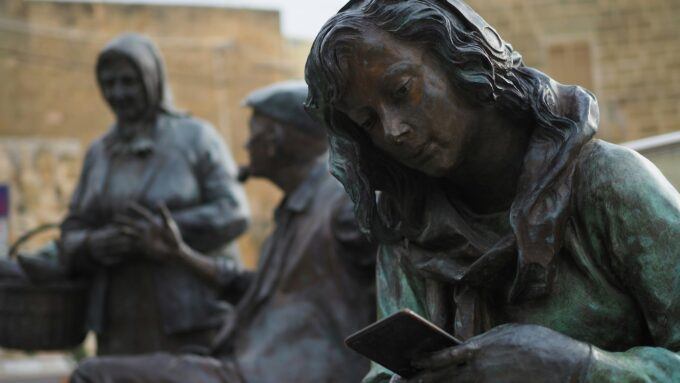
Image by Ian Borg.
It is a stark reflection of our world, its prevailing values and ideals, that leaders of some of the richest nations invest billions in instruments of death and destruction, while ignoring the basic needs of the poorest people on Earth.
At its best, Overseas Development Aid (ODA) is a demonstration of collective compassion — an act of sharing; a manifestation of that simple yet profound Christian injunction: “You shall love your neighbour as yourself” (Mark 12:31). A commandment that challenges the false belief in separation, pointing instead to the deeper reality of oneness.
ODA has never been sufficient to meet the needs of people living in formerly colonised nations — primarily in sub-Saharan Africa, but also in parts of Asia, South America, and elsewhere. And now, the world’s major donors — the United States, by far the largest contributor with roughly 30% of global ODA, followed by Germany (17%) and the United Kingdom (7.5%) — are cutting even that inadequate amount.
Combined, these three nations provide more than half of all global aid (around 54.5%). Other wealthy states, including France, the Netherlands, and Belgium, have followed the U.S. lead and reduced their contributions to overseas development programmes.
Since Trump imposed a 90-day freeze on all U.S. overseas aid in January, the USAID budget has been slashed — with an estimated 83% of recipient programmes cut or suspended. U.S. Secretary of State Marco Rubio announced that “approximately 5,200 of USAID’s 6,200 programmes are being terminated, with only about 18% remaining to be transferred to the State Department.
The consequences of these draconian measures for humanitarian aid operations worldwide are severe.
According to a report published in The Lancet, 14 million people will die by 2030 as a consequence of the unprecedented cuts — 4.5 million of whom are children under the age of five.
Calculated suffering
The impact of these massive cuts has been devastating, both on specific programmes and across the United Nations system. The UN has warned that it is now “facing the most severe funding shortfall in the history of humanitarian aid” — due in large measure to the actions of President Trump — who makes no secret of his contempt for the UN. The consequences have been both immediate and catastrophic.
The World Food Programme (WFP) has been forced to scale back its lifesaving operations across sub-Saharan Africa, leaving an estimated 14 million people at risk of malnutrition and starvation. WFP Executive Director Cindy McCain said, “Every ration cut means a child goes to bed hungry, a mother skips a meal, or a family loses the support they need to survive.”
The UN Children’s Fund (UNICEF) projects a 20% drop in income, threatening education programs, as well as immunisation, child protection and nutrition services.
The UN Office for the Coordination of Humanitarian Affairs (OCHA) — responsible for emergency appeals — faces “a shortfall of $58 million, after its largest donor, the United States, cut funding.
The International Organization for Migration (IOM) expects a 30% fall in donor funding, reducing assistance for displaced people and forcing cuts in camp management and essential services such as water and sanitation.
The World Health Organization (WHO) has lost an estimated $1 billion, severely undermining its ability to manage disease outbreaks, maintain vaccination programmes, and respond to health emergencies.
Thousands of individual programmes supporting the poorest and most vulnerable people on Earth are being reduced or cancelled, affecting initiatives in a number of nations. In Yemen, desperately needed women’s shelters and community clinics funded by the U.S. and UK have closed. In Afghanistan, hundreds of health centres supported by WHO and WFP have stopped operating, leaving millions without access to even the most basic medical care.
An estimated five million people in Sudan are losing access to essential aid provided by OCHA and UNHCR. Nearly four million Ethiopians risk losing food assistance through WFP’s malnutrition programmes. In Uganda, around one million refugees — half the country’s total — have lost all food rations. Across Chad, the Central Sahel, Nigeria, Rwanda, Kenya, Djibouti, and South Sudan, the same pattern of collapse is unfolding, the result of these unprecedented and profoundly inhumane cuts.
As Tom Fletcher, UN Under-Secretary-General for Humanitarian Affairs and Emergency Relief Coordinator, said, “Brutal funding cuts leave us with brutal choices. All we ask is one per cent of what you chose to spend last year on war.”
To put this in perspective, while the US plans to spend $832–850 billion on its military in 2025, funding for life-saving aid programmes that protect millions of children and families is slashed — to less than 5% of this colossal sum; a stark reflection of the moral bankruptcy and perverse values of those in power.
“But this isn’t just an appeal for money,” Fletcher continued — “it’s a call for global responsibility, for human solidarity, for a commitment to end the suffering.”
In this piercing statement, Fletcher identifies the very crux of the matter: the decisions to reduce ODA are political choices, not economic necessities. In fact, they are moral judgments, reflecting what ideologically market-driven governments deem important, and, by contrast, what they consider expendable.
War and militarism are funded without question — and in many cases see their budgets increase — while human welfare is totally neglected, relegated to the margins, and reduced to little more than an afterthought.
Collective abuse
This attitude of neglect has deep historical roots, reflecting a worldview that assigns value to human beings based on wealth, status, and race, while prioritising the demands of capital — for profit — over the most basic needs of people and the health of the planet. It is a legacy of exploitation and violence.
Withholding aid from the most vulnerable people in the world — many of whom are women and children — in nations either rendered poor by direct Western interventions or kept impoverished through measures imposed via structural adjustment programmes (SAPs) is a form of collective abuse.
It is more about justice — or rather, injustice — than about aid. It reflects the cruelty of a socio-economic system that is inherently inhumane, one that has bred extreme inequality.
Inequality, in its myriad forms, is itself an injustice — one now reaching levels that threaten the structural integrity of societies: the extreme concentrations of wealth and, with them, privilege and power. The brutal injustice of grinding poverty, malnutrition, and starvation in a world overflowing with food; the injustice of denied opportunity, of lack of access to good-quality health care and education — or, in some cases, to any access at all.
And on and on it goes: in all areas of contemporary life — from the distribution of natural resources, including water and food, to access to the arts, and all points in between — we find the poison of injustice.
And as long as injustice persists, there will never be social harmony, and there will never be peace.
The choice is clear
Throughout the world, humanity faces a fundamental choice: the path of division and hate — promoted by leaders like Trump and far-right bigots everywhere — or the path of sharing, cooperation, and unity. These two alternatives, evident for generations, are now more sharply defined than ever.
For the vast majority of people, the humane way — the way of kindness, cooperation, and brotherhood — is what they long for. Yet a powerful and persuasive rhetoric of hate, spread by reactionary forces, is actively working to deny that reality. Paradoxically perhaps, this rhetoric finds fertile ground precisely because of decades of social injustice.
The far right prospers in environments of widespread economic hardship, misery, and resentment — blaming foreigners and minority groups, and offering simplistic (often unworkable) solutions to complex problems.
The cuts to ODA flow from this hateful source; they are a cruel example of the kind of world being promoted by the voices of extremism — a divided world devoid of compassion and tolerance.
In order to transition through this time of tension and cast aside the forces of division for once and for all, we must recognise that justice is universal — that, if it is denied to anyone, we all suffer. As a wise man once said, “The suffering of the many is the illness of the whole…justice alone will provide the cure.”
The choice to share the world’s resources and national wealth more equitably reaches far beyond the sordid realm of politics. It is a moral and spiritual question – one that goes to the very heart of who we are as human beings and the kind of world we wish to live in.
Humanity is one; the world is one. The creation of two worlds — one for the rich and powerful, and another for the poor, the exploited, and the marginalised — is an affront to that truth, a betrayal of the principle of our shared existence. If humanity is to survive, and everyone everywhere, be given the opportunity to flourish, this false division must end.
Sharing — of which ODA is a primary expression — is the basic requirement to bring this about; sharing creates justice, cultivates trust, and encourages cooperation. These ideals of living, or Principles of Goodness, are not trite platitudes; they are the essential foundations upon which a peaceful and sustainable world can be built. Without them, further division and conflict are inevitable.

No comments:
Post a Comment