19 Feb 2015

Right-wing nationalists regain Croatian presidency

Paul Mitchell

Kolinda Grabar-Kitarović of the Croatian Democratic Union (HDZ) was inaugurated as president on February 15. Her surprise, wafer-thin victory over Ivo Josipović—who is allied to the ruling Social Democratic Party (SDP)—makes it likely that the HDZ will win the general election later this year.
Just four years ago, in 2011, the SDP won a landslide victory over the HDZ, but since then it has pursued anti-working class policies, imposed austerity measures and cut public spendingdriving the country into a seventh year of recession. (See: EU imposes harsh austerity on Croatia, its newest member)
The employment rate is among the EU’s lowest and unemployment is around 18 percent and among young people (excluding students) is close to 50 percent. A growing number are at risk of poverty and social exclusion, which already affects almost one third of the population. Wages continue to decline, with over half of employees receiving less than 5,000 kunas (€650) a month.
In the first round of the presidential election in December, Grabar-Kitarović received 37.2 percent of the vote, narrowly losing to Josipović’s 38.5 percent. Ivan Vilibor Sinćić from the anti-eviction Human Wall movement polled 16.4 percent and Milan Kujundžić from Alliance for Croatia, a coalition of extreme nationalist and fascistic parties 6.3 percent.
Because none of the candidates won more than 50 percent of the vote, a run-off election was held on January 11, in which Grabar-Kitarović scraped in with 50.7 percent of the vote.
The turnout for the first round was just 47.1 percent, an indication of the disconnect between the working population and the two main political parties that have alternated power over the last two decades. There is little to choose between them, with both espousing Croatian nationalism and an unwavering commitment to austerity.
The main role of the president is in the field of foreign affairs and as head of the armed forces, but Grabar-Kitarović made clear she was going to intervene in domestic matters. “We have come a long way but we have to completely change our current economic paradigm,” she declared. “We must overcome party interests and implement changes that cannot be postponed. We must stop living off the money we’re borrowing from future generations.”
Grabar-Kitarovic promised to continue the legacy of the late President Franjo Tudjman, who founded the HDZ in 1989. The party’s extreme nationalism helped to hasten the fragmentation of Yugoslavia and its collapse into years of bloody civil war. Despite the perilous implications of Tudjman’s demands for secession from the Yugoslav Federation, the US, Germany, Britain and France saw the independence of Croatia as best serving their own interests following the dissolution of the Soviet Union and the Warsaw Pact. There was no further value in upholding the unity of Yugoslavia, which, since the split between Stalin and Tito, had performed a valuable function as a buffer against a Soviet thrust into the Mediterranean. With the demise of the USSR, the Western powers regarded Yugoslavia’s old, centralised state structure as an obstacle to the privatisation of state-owned industry and the penetration of Western capital.
They considered Tudjman an ally in breaking open these structures and limiting Serbian [and hence Russian] influence in the Balkans. Thus Slobodan Milosevic was cast as the sole villain and Serbia was categorised as a “rogue state”, while Tudjman, despite his authoritarianism and racist opinions, was portrayed in the most favourable light.
Since then the West has continued to see Croatia as a bulwark against Russia in the Western Balkans, hastened its integrating into NATO and the EU (it joined in July 2013 as the 28th member state) and cultivated its politicians.
After graduating from Los Alamos High School in New Mexico in 1986 Grabar-Kitarović returned to Yugoslavia to complete a degree at Zagreb University. In 1993, she became an adviser, and then senior adviser, to then Deputy Foreign Minister Ivo Sanader, who assumed leadership of the HDZ following Tudjman’s death in 2000. Grabar-Kitarović became Sanader’s protégé, but has had to distance herself from him more recently. Last year, he was sentenced to a nine-year jail sentence after being convicted for embezzling millions of kunas whilst in office. The charges against Sanader threw the HDZ into crisis and contributed to it losing power to the SDP in 2011. (See: Croatia’s ruling party in crisis).
From 1995 to 1997, Grabar-Kitarović served as head of North American relations in the Croatian Foreign Minister. After a spell at the Croatian embassy in Canada, she attended George Washington University as a Fulbright scholar in 2002–2003, then Harvard University and the School of Advanced International Studies at Johns Hopkins University.
In 2003 she became an HDZ member of the Croatian parliament, Minister of European integration, and then Foreign Minister from 2005 to 2008--overseeing Croatia’s entry into NATO. In 2008 she stood next to US President George W. Bush as he signed the accession documents at the White House.
US cables from that period released by Wikileaks show the very close relationship between Grabar-Kitarović and US officials. One, for example, from 2007 reports a meeting with Undersecretary for Political Affairs Nicholas Burns who “then turned to domestic issues that Croatia should address… FM [Foreign Minister] Grabar-Kitarovic responded that Croatia is aware of these problems and is working to resolve them.”
That Grabar-Kitarović was seen as a valuable asset and conduit for US policy was demonstrated in her appointment as Croatia’s Ambassador to the US from 2008 to 2011 and then as Assistant Secretary General for Public Diplomacy at NATO until 2014.
Her call to change Croatia’s “current economic paradigm” chimes with the demands of the International Monetary Fund (IMF) and European Commission. In November the IMF warned, “Reform fatigue is a risk, especially in view of approaching presidential and parliamentary elections.” It called for “steadfast fiscal consolidation” (i.e., more austerity) and “significant additional reforms.”
The measures demanded included implementing the second phase of the labour law reform, reviewing the wage-setting system and streamlining public wage bonuses, improving the effectiveness and transparency of the social protection system (i.e., cut benefits), reducing access to early retirement, taking forward retirement age reform (i.e., reduce pensions), reforming the health sector, restructuring the local government system and state-owned enterprises and reducing their role in the economy.
Last year, Independent Croatian Unions President Kresimir Sever warned, “What those in power should be afraid of are spontaneous unrest and going out in the streets. While it is organised by the unions, they are under surveillance.”
This was a plea to the ruling elite not to forget the vital role the trade unions were performing in stifling popular opposition. With Grabar-Kitarović’s election, Sever said “he expects even better cooperation” with her than he had with Josipović and that “we will find in her a strong champion for workers’ rights, for decent wages and decent working conditions.”
The election campaign has heated up with both the SDP and HDZ trying to outdo each other in stoking up Croat nationalism, seizing on the provocative statements of Serb nationalist Vojislav Seselj following his release from The Hague on the grounds of terminal ill health.
The SDP government is attempting to reduce support for the Human Wall movement by introducing an “emergency” debt-relief initiative named “Fresh Start” this month. Many Croatians—an estimated 317,000 household and businesses—have had their bank accounts blocked and are unable to get credit. However, the proposals will only apply to around 60,000 people, with an income of less than 1,250 kuna (€160) a month and debt of less than 35,000 kuna (€4,500).

White House outlines policy for deepening intervention in Central America

Mathew Brennan

In the FY 2016 budget proposal presented to Congress earlier this month, the White House included a request for tripling US aid to Central America to $1 billion. The funding would be channeled through the Alliance for Prosperity in the Northern Triangle, which was formed last November in Washington at a conference convened by the Inter-American Development Bank (IDB). It will be directed primarily toward the governments of Honduras, Guatemala, and El Salvador.
The Obama administration’s budget proposal was followed by a campaign on its behalf in the New York Times—by both the newspaper’s editorial board and Vice President Joseph Biden, who is overseeing the initiative. Both made the case that the Central American aid, coupled with an increase in the budget for the Department of Homeland Security, would promote the White House’s purported goals of “comprehensive immigration reform” and “stemming systemic violence” in the region.
The Times’s editorials were quick to point to the approximately 70,000 unaccompanied children who fled to the United States last year, largely from Honduras, Guatemala and El Salvador. These child refugees, and the violence and poverty rampant in the regions they were fleeing, are the supposed impetus to, as Biden cynically put it, Washington’s drive to “stem the dangerous surge in migration.” Or as the Times’s editorial board dishonestly framed the issue, the increase in aid will “meaningfully tackle the root causes of instability that over the decades have led to thousands of people to embark on dangerous journeys to the United States searching for a better life.”
However, as is the case with US foreign policy everywhere else in the world, there is a political chasm between the public statements of the White House and the real aims of US imperialism.
On the one hand, there is a massive social crisis in Central America. Honduras, Guatemala and El Salvador account for the world’s first, fifth, and sixth highest murder rates, respectively.
According to the World Bank, at least 60 percent of Hondurans, 54 percent of Guatemalans, and 35 percent of El Salvadorans live below the official poverty line. Nearly a third of the Honduran population and a quarter of the Guatemalan population live on less than two dollars a day. At least 30 percent of the Honduran population is officially unemployed, the highest rate in all of Latin America.
Gang and state violence are rampant in all three countries. According to a 2013 United Nations report, over 60 percent of the unaccompanied children who were interviewed by their representatives while being held in US immigration detention centers cited violence by gangs, drug cartels and state security forces, and fear of being recruited into gangs, as their reasons for fleeing.
On the other hand, there is the source of this enormous instability, delicately described by the Times as the “root causes,” which are overwhelming bound up with decades of brutal US imperialism-directed “dirty wars” against the populations of all three countries.
A CIA-orchestrated coup in 1954 against the, the democratically elected Guatemalan government of Jacobo Arbenz began more than four decades of carnage in the region. Arbenz’s government was overthrown by CIA-organized military forces in 1954, at the behest of the United Fruit Company, which adamantly opposed a limited land reform. That country’s dirty war continued until 1996. Guatemalan security forces, trained and directed by the Pentagon and US intelligence agencies, systematically suppressed and terrorized the working class and peasantry, killing more than 200,000 Guatemalans during this genocidal period.
In El Salvador, Washington funneled at least $6 billion in aid to support and arm military juntas that terrorized workers and peasants over the last quarter of the twentieth century. These juntas employed “death squads” as a form of counter-insurgency against the FLMN guerrilla group. At least 75,000 people were murdered by the military in the peak years of repression, between 1980 and 1992, when a peace accord was signed and the FMLN transformed itself into a bourgeois party.
More recently in Honduras, the democratically elected government of President Manuel Zelaya was overthrown by US-backed military forces in 2008, after it turned to Venezuela for cheap oil and loans. In her book Hard Choices, then-secretary of state Hillary Clinton admits that she ensured Zelaya would not return to office after he was kidnapped and flown out of the country by the Honduran military. Since 2008, under a government controlled heavily by the coup leaders, the murder rate has increased by over 50 percent, several opposition political leaders have been assassinated, and gang membership has increased to more than 65,000 by some estimates.
There is also the larger historical context of US “aid” to Central America. Historically, this money has been funneled through state agencies such as the National Endowment for Democracy (NED), the Agency for International Development (USAID) and the American Institute for Free Labor Development (AIFLD)—which all provided economic and political support for the repressive military dictatorships. William Blum points out in his bookKilling Hope that “(t)hese organizations with their reassuring names all contributed to a program to greatly expand the size of Guatemala’s national police force and develop it into a professionalized body skilled at counteracting urban disorder…with officers sent for training in Washington…and Los Fresnos, Texas.”
When Joseph Biden speaks of “confronting the interlocking security, governance, and economic challenges” in Central America through the Alliance for Prosperity, this is the sort of “interlocking” partnerships he has in mind.
The White House budget proposal is in line with similar US-led initiatives such as Plan Colombia and the Merida Initiative in Mexico.
Taken together, these aid initiatives, while cloaked in rhetoric about “fostering democracy” and “combating narco-trafficking,” have been overwhelmingly used as a wedge to open up new markets for US investment, exploit cheap labor and crush emerging opposition movements to US-backed right-wing governments.
The new initiative is also driven by challenges confronting US imperialism in the region: the encroachment of economic rivals, on the one hand, and the threat of social upheavals within the working class, on the other. China as well as Russia have made significant trade deals and capital investments across Latin America over the last 15 years. China increased trade in the region by 1,200 percent between 2000 and 2009, and has plans to build a $50 billion canal in Nicaragua in 2019 that will dwarf the Panama Canal.
Internally, the bourgeoisie is overseeing virtually unprecedented levels of social inequality, wage stagnation, and an assault on democratic rights across the board. Social unrest related to these developments is already on display among the working class throughout the region—most recently in the mass protests over the disappeared students in Mexico.
Partnerships such as the proposed Alliance for Prosperity, with its emphasis on the increased militarization of the southern borders of the US and Mexico, are at their heart a preparation by the US ruling class to repress social upheavals and scapegoat immigrants for the inherent crisis of global capitalism.

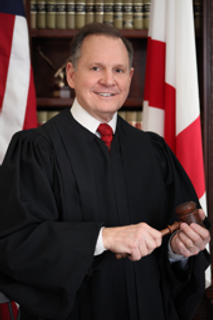
Alabama judge asks courts to defy order granting same-sex marriage licenses

Eric London

Alabama Supreme Court Chief Justice Roy Moore is ordering probate judges in his state to ignore a US federal court order allowing gay and lesbian Alabamians to exercise their right to marry.
Alabama Chief Justice Roy Moore
Judge Moore’s maneuver is in violation of the Fourteenth Amendment to the US Constitution, which states: “No state shall … deprive any person of life, liberty, or property, without due process of law; nor deny to any person within its jurisdiction the equal protection of the laws.” The Fourteenth Amendment gives the federal government power to prohibit states from carrying out actions that violate these basic rights.
Moore’s action flouts a February 12 ruling by US District Court Judge Callie V.S. Granade ordering Mobile County Probate Judge Don Davis to begin allowing same-sex marriages in the state’s largest county. Davis had previously failed to abide by an earlier court order.
Judge Granade’s ruling was the latest in a lawsuit filed by four homosexual couples who were denied marriage licenses under the Alabama state constitution’s ban on same-sex marriage. One of the plaintiffs, whose partner faces serious health issues, is unable to enforce a medical power of attorney document because of the couple’s non-married status.
In late January, Judge Granade granted the plaintiff couples’ motion for a preliminary injunction against the state law. In effect, Judge Granade’s decision prohibited Alabama from enforcing its marriage ban on the grounds that it denied the plaintiffs’ fundamental right to marriage.
Judge Granade ordered a stay on her own decision, which expired on February 9. The Eleventh Circuit Court of Appeals and the Supreme Court of the United States denied the Alabama Attorney General’s request to extend the stay, and probate judges in many Alabama counties began issuing marriage licenses to same-sex couples the same day the stay expired.
Judge Moore, however, sought to block the federal court’s decision and ordered probate judges to continue to refuse marriage licenses. Although most probate judges are issuing marriage licenses, a substantial minority of counties are following Judge Moore’s orders and refusing to abide by the District Court’s decision.
In refusing to abide by the federal district court ruling, Moore invoked the “states’ rights” arguments that were traditionally utilized by southern states in opposing desegregation and other civil rights legislation. “It’s my duty to speak up when I see the jurisdiction of our courts being intruded by unlawful federal authority,” Moore declared.
This argument was supported by US Supreme Court Justice Clarence Thomas, who filed a dissent in the Supreme Court’s decision not to intervene in the case. The decision, Thomas wrote, “represents yet another example of this court’s increasingly cavalier attitude toward the states.”
The basic conclusion that flows from Judge Moore’s pseudo-legal rationale is that the states have the right to ignore the Equal Protection and Due Process Clauses, which were ratified alongside the amendment banning slavery (Thirteenth) and the amendment granting former slaves the right to vote (Fifteenth).
The three amendments are together known as the “Civil War Amendments,” because they codified the egalitarian outcome of the war between the union and the slaveocracy. In this sense, Judge Moore is repudiating a fundamental legal product of the defeat of the confederacy: that the federal government can prevent the states from violating the democratic rights of the people.
The actions of Moore in relation to gay marriage are also a continuation of his efforts to integrate religion and the state, a direct violation of the Establishment Clause of the US Constitution.
“It seems as if the foundations of our nation are becoming rotten, and Christians seem to act as if they think that God does not see what they do in politics,” Judge Moore said in 2012, arguing for what amounts to a theocratic conception of the state. He has often complained of the “moral decay” of American society, noting that gay marriage would lead to the “ultimate destruction” of the country and that homosexuality is an “inherent evil.”
Judge Moore has been on the forefront of religious assaults on the separation of church and state. In 2003, he made a name for himself when he disobeyed a federal court order requiring the removal of a monument to the biblical ten commandments on the steps of the state judicial building. At the time, Moore denounced jurists who believe “obedience of a court order [is] superior to all other concerns, even the suppression of belief in the sovereignty of god.”
Moore is no small-town magistrate—he is the most powerful judge in the state who won election with significant political and financial backing from the state’s political establishment. His efforts to create a controversy over the gay marriage issue serve both to whip-up homophobic sentiment in Alabama and to elevate his own profile to national prominence.
That someone like Judge Moore occupies the highest judicial position in an American state is an indictment of the entire American ruling class. Increasingly detached from its democratic traditions, the political establishment elevates the political progeny of southern segregationists to occupy leading positions in the most impoverished regions of the country.
While President Barack Obama issued mild criticisms of Moore’s actions, they have largely been left to stand. This is in line with the continuous efforts of the White House to accommodate the anti-democratic actions of the religious right, as the administration has carried out a wholesale attack on every other democratic principle.
Most recently, Obama’s pandering to right wing religious elements found expression in his decision to exclude non-profit religious organizations from the requirement that employers provide contraceptives to their workers, following a campaign by religious fundamentalists denouncing the provision as a “war on religion.”
Obama’s climb-down was followed by two reactionary rulings by the US Supreme Court, undermining the Establishment Clause. In particular, the Court ruled last year that in Burwell v. Hobby Lobby that contraceptive provisions of the Affordable Care Act violated the “religious liberty” of “Christian corporations.”
As a concession to those supporting the measure, the Obama administration did not raise the Establishment Clause in the defense of the contraception mandate.

Mounting violence against Muslims in America

Tom Carter

A series of attacks on Muslims in the US have occurred in the wake of theCharlie Hebdo shootings in France and executions carried out by the Islamic State (ISIS) in Syria. These events have been seized on by governments around the world, including the Obama administration, to promote anti-Islamic sentiment so as to justify expanded military interventions in the Middle East and stepped up domestic repression.
On February 10, three Muslim-American students—Deah Shaddy Barakat, 23, his wife Yusor Mohammad Abu-Salha, 21, and her sister Razan Mohammad Abu-Salha, 19—were found shot in the head, execution-style, in Chapel Hill, North Carolina. The two young women were wearing traditional hijabs when they were killed.
The man who turned himself in to authorities in connection with the murders had previously brandished guns at the victims and threatened them. Before the shooting, Yusor Abu-Salha told her father, “Daddy, I think he hates us for who we are and how we look.”
On February 12, an Arab-American man was brutally attacked by two white men at a Kroger supermarket in Dearborn, Michigan. The attackers also taunted his daughter, who wears a hijab, making references to ISIS and Muslims. The attackers called the man and his daughter “r--head” and said, “Go back to your country.”
On February 13, the Quba Islamic Institute in southeast Houston, Texas was the target of an arson attack that destroyed a substantial portion of the building and caused an estimated $100,000 in damage. On February 17, police in Austin, Texas arrested a man for threatening to bomb an Islamic center as well as a Middle Eastern restaurant.
Last month, a “Texas Muslim Capitol Day” event (the declared purpose of which was to “engage American Muslims in the political process”) was attacked and disrupted by anti-Muslim thugs. Another attack was organized on “Muslim Day” in Oklahoma City. The attacking group’s Facebook page screamed, “Get Islam Out of America.”
The rate of hate crimes against Muslims in the United States stands at five times what it was before September 2001. A recent poll found that out of all religions, Americans harbor the most negative feelings towards Muslims.
The American political and media establishment bears a significant portion of the responsibility for these trends.
A recent report by the Center for American Progress entitled “Fear, Inc. 2.0, The Islamophobia Network’s Efforts to Manufacture Hate in America” exposes a veritable “Islamophobia industry” operating on the periphery of the American state. Tens of millions of dollars have been spent over the past decade to promote anti-Muslim bigotry through a shady network of politicians, journalists, foundations, “activists” and “experts.”
This Islamophobia network enjoys close ties with police departments and the intelligence agencies. Anti-Muslim bigotry, the report indicates, can often be found “masquerading as law-enforcement counterterrorism training.” The training materials and “experts,” according to the report, encourage police and intelligence agents to see “a terrorist plot in every mosque.”
The intentional whipping up of anti-Muslim bigotry has intensified internationally in the wake of the Charlie Hebdo attacks last month. As theWorld Socialist Web Site has explained, the campaign to vilify Muslims serves definite political ends.
Anti-Muslim hysteria provides a justification for imperialist mayhem abroad as well as a wedge with which to attack democratic rights at home. Policies can be pursued in the climate of such hysteria that would otherwise be unthinkable. And, as with all such campaigns against racial and religious minorities throughout the twentieth century, murderous and fascistic elements are mobilized that, in a crisis, can be unleashed against the working class as a whole.
In cultivating the conditions for an intensification of anti-Muslim violence within the United States, a particularly reprehensible role has been played by the racist, homicidal film American Sniper. The film features an elite US soldier heroically slaughtering Iraqi “savages” for God and country.
Chris Kyle, the real-life sniper behind Clint Eastwood’s pro-war propaganda film, boasted of killing more than 300 people. (He was apparently also a pathological liar who bragged about having shot and killed dozens of “looters” in the aftermath of Hurricane Katrina and to have participated in other events that are unlikely ever to have happened).
During a military investigation of allegations that Kyle killed an unarmed civilian in Iraq, Kyle said, “I don’t shoot people with Korans. I’d like to, but I don’t.”
In the current toxic social climate, and in the absence of any progressive outlet for social discontent, American Sniper has met with a certain and disturbing response. “American sniper makes me wanna go shoot some f---ing Arabs,” wrote one individual on Twitter. “Nice to see a movie where the Arabs are portrayed for who they really are,” wrote another, “vermin scum intent on destroying us.”
Another individual wrote, “Great f---ing movie and now I really want to kill some f---ing r--heads.” And another: “American sniper made me appreciate soldiers 100x more and hate Muslins (sic) 1000000x more.”
The American-Arab Anti-Discrimination Committee described a “drastic increase” in hate speech on social media following the film’s release. It is not difficult to see how these kinds of responses can translate into real violence.
A revealing episode was provided by the “National Prayer Breakfast” on February 5. Bowing to pressure from the right, Obama utilized the occasion (a reactionary spectacle under any circumstances) to denounce “ISIL, a brutal, vicious death cult that, in the name of religion, carries out unspeakable acts of barbarism, terrorizing religious minorities like the Yezidis, subjecting women to rape as a weapon of war, and claiming the mantle of religious authority for such actions.” Obama also mentioned the Crusades and the Inquisition as examples of “terrible deeds” committed in the name of religion.
Obama’s appearance fueled an ongoing campaign by the Republican right denouncing the White House for not going far enough in vilifying Muslims. Obama was criticized on the grounds that his invocation of the Crusades and the Inquisition “throws Christians under the bus.”
“The words ‘radical Islamic terrorism’ do not come out of the president’s mouth,” declared Republican Senator Ted Cruz. “The word ‘jihad’ does not come out of the president’s mouth. And that is dangerous.”
“The president’s comments… at the prayer breakfast are the most offensive I've ever heard a president make in my lifetime,” former Virginia Governor Jim Gilmore told reporters. “He has offended every believing Christian in the United States. This goes further to the point that Mr. Obama does not believe in America or the values we all share.”
The engines of anti-Muslim agitation in the United States do not include only the usual suspects: the Republican Party, the military, AM talk radio, police, the intelligence agencies, Fox News, the Murdoch Press, religious zealots, billionaire reactionaries, the Tea Party and so forth.
Instead, anti-Muslim prejudice has been lent a certain respectable gloss by so-called “liberal” and “left” sections of the political establishment. These layers either endorse the vilification of Muslims, acquiesce to it, or make hand-wringing scholarly inquiries into whether or not Islam is “inherently violent.”
“The rash of horrific attacks in the name of Islam,” read a front-page article in the New York Times on January 9, “is spurring an anguished debate among Muslims here in the heart of the Islamic world about why their religion appears cited so often as a cause for violence and bloodshed.” The article then weighs arguments—for and against—the proposition that Islam is “inherently more violent than Judaism or Christianity.”
No significant section of the political establishment in any of the imperialist countries has shown itself capable of taking a principled stand in opposition to the promotion of anti-Muslim sentiment. That task falls to the socialist movement, which stands for the international unity of the working class, defends its democratic achievements, and rejects all attempts to whip up national, ethnic or religious bigotry.

German government prepares new military doctrine

Johannes Stern

German Defense Minister Ursula von der Leyen on Tuesday heralded the adoption of a new military and security strategy for Germany. Her speech, on the occasion of the first meeting of those preparing the “White Paper 2016,” underscored the turn by the German ruling elite to an aggressive foreign policy 70 years after the end of the Second World War.
Almost ten years after the publication of the last White Paper in 2006, “a new White Paper is overdue,” von der Leyen said at the beginning of her presentation. She referred to the changed “security environment,” pointing in particular to “the alarming development of transnational terrorism” and “the behavior of Russia in Ukraine,” which, she said, had “wide-ranging consequences.”
Saying she hoped the Minsk ceasefire would be implemented, she warned that one should “have no illusions.” She continued: “The new policy of the Kremlin began before the crisis in Ukraine and will keep us busy for a long time to come.”
Now the task was to find “the appropriate reaction by the West to the attempt to establish geo-strategic power politics as a way of pursuing interests,” and to Russia’s efforts “to replace internationally established rules and regulations with dominance and zones of influence.”
The defense minister ignored the fact that the crisis in Ukraine was the result of the putsch carried out by fascist forces with the support of Berlin one year ago. However, she implicitly acknowledged that the real background to the new White Paper was not “Russian aggression” in Ukraine, but the end of German restraint with regard to foreign policy, announced by President Gauck, Foreign Minister Steinmeier and herself at the Munich Security Conference at the beginning of 2014.
To reduce the need for the new White Paper to the “changed environment” would be “too reactive,” said von der Leyen. Rather, the paper had to “serve the purpose of self analysis and self assurance.” It “should explain our actions and our intentions clearly. It should offer a narrative,” she added.
The contours of this “new narrative” have already become clear over the past year. In numerous speeches, commentaries, interviews and think tank strategy papers, German politicians, journalists and academics have repeatedly demanded that Germany take on “more leadership” and “responsibility” in Europe and the world. To this end, they have argued, Germany requires a foreign policy strategy that clearly formulates German interests, along with the provision of the necessary military means to defend these interests.
Von der Leyen’s speech was a continuation of this basic line. She emphasized that “our intentions with regard to German security policy have changed quite fundamentally.” What was important was “leading from the center” and “readiness to engage.” She allowed no room for doubt that what she meant by this was the development of a globally oriented militaristic foreign policy.
She explicitly excluded any political, geographic or other restriction on military intervention. She declared, in effect, that the German army was free to intervene anywhere around the world, noting that there was no “rigid prescription for action that sets immovable geographic or qualitative boundaries.”
In other words, everything that German imperialism deemed to be necessary was permissible. There was “no checklist for foreign engagements,” “no compulsion to engage,” but also “no taboos.”
“More responsibility” could mean “fighting together to establish or preserve peace,” she declared. It could mean “training together in fragile regions, educating, building.”
Von der Leyen praised the German interventions in northern Iraq, in Afghanistan, in Kosovo, off the coast of Lebanon, in Mali and in Eastern Europe. Germany was “deeply committed” to the buildup of NATO forces in these areas, she said. Together with “partners,” it was “introducing the new rapid spearhead force” and expanding NATO headquarters in Szczecin.
At the end of her speech, the defense minister let the cat out of the bag: Germany had to massively rearm! It was necessary “to maintain the armed forces as long term partners and provide them with the necessary means.” Consequently, the White Paper would discuss “efforts to secure modern weapons,” an “up-to-date personnel policy” and an “appropriate budget.”
Von der Leyen announced her first weapons deal the same day as her speech. The Defense Ministry plans to purchase 138 helicopters for the army, including 80 multi-purpose NH90 helicopters and 40 “Tiger” combat helicopters. The deal will cost 8.7 million euros.
Because of broad opposition to militarism and war within the population, the government had previously raised the question of increased military spending with caution. The aim of the White Paper is to change this.
The president of the Armed Forces Association, André Wüstner, said on the fringes of the meeting in Berlin that “it is high time for new strategic guidelines.” The defense minister had to “break free” to “fully equip the army against the backdrop of current crises and conflicts.” Two weeks ago, at the Munich Security Conference, Wüstner had called for the arming of Germany and preparations for war.
This sentiment was echoed in a guest column in the Süddeutsche Zeitung by Christian Mölling, a staff member of the foundation Stiftung Wissenschaft und Politik (German Institute for International and Security AffairsSWP), which works closely with the government. He wrote that Von der Leyen had to explain in the White Paper “what role German soldiers, helicopters and tanks should play in foreign policy and in crises.” He argued that the “parameters of defense policy” depended “on the actual capabilities of the army and not on external dangers.”
The SWP published a strategy paper under the title “New Power, New Responsibility: Elements of a German Foreign and Security Policy for a Changing World” in the fall of 2013. This paper provided a template for the return of German militarism. While at that time meetings about a new, aggressive German foreign policy were taking place in secret, the current discussion on the White Paper is to take place in full view of the public.
Von der Leyen concluded by saying she looked forward “to cooperation with experts from different government agencies, with parliament, with foundations and with academia.”
To this end, four working groups, under the headings “Security and Defense Policy,” “Partnerships and Alliances,” “Armed Forces” and “National Frameworks of Action” have been established. Among the participants are leading security policy makers, journalists, academics, military personnel and representatives of German and American think tanks.
They include: Sylke Tempel, chief editor of the journal Internationale Politik; Thomas Bagger, head of the planning staff of the Foreign Office; General Major Hans-Werner Wiermann, commander of the Territorial Missions Command of the armed forces in Berlin; Winfried Nachtwei, former security policy spokesperson of the Green Party; Henning Otte, defense policy spokesperson of the Christian Democratic Union/Christian Social Union (CDU/CSU) fraction in parliament; Constanze Stelzenmüller, former security policy editor of Die Zeit and fellow at the US Brookings Institution think tank; Lieutenant General Heinrich Brauß, adjunct general secretary of NATO for defense policy and military forces planning; and Humboldt University Professor Herfried Münkler.

US steps up threats against Russia as Ukrainian troops retreat from Debaltseve

Niles Williamson

The retreat Wednesday of Ukrainian soldiers from the city of Debaltseve was a major defeat for the Kiev regime in its military offensive against pro-Russian separatists in the eastern Donbass. It was also a blow to US policy in Eastern Europe.
The loss of Debaltseve has underscored the bankruptcy of the US puppet regime in Kiev and the lack of popular support for military operations against ethnic Russians in the east.
Ukrainian President Petro Poroshenko announced Wednesday that he had ordered a “planned and ordered” withdrawal of Ukrainian troops from the battered transit hub. The New York Times reported that a column of approximately 100 transport trucks ferried soldiers out of Debaltseve early in the morning. The convoy came under intense fire from separatist tanks and snipers as it made its way toward the government-held city of Artemivsk, approximately 45 kilometers to the northwest.
Ukrainian Defense Ministry spokesman Andriy Lysenko reported that a majority of the estimated 8,000 Ukrainian soldiers who had been trapped in the city had escaped. “At the moment, almost 80 percent of the Ukrainian units have retreated from this sector and this operation is to be completed soon,” he told reporters.
The head of the separatist Donetsk People’s Republic, Aleksandr Zakharchenko, had called on the encircled soldiers to lay down their weapons and surrender ahead of last Sunday’s cease-fire deadline.
In the lead-up to the cease-fire negotiated in Minsk last week, several thousand Ukrainian troops entrenched in the city had been surrounded by separatist militias. Fighting continued in Debaltseve after the cease-fire deadline, as the separatists sought to force a complete surrender by the Ukrainian forces.
German Chancellor Angela Merkel and French President Francois Hollande launched a last-ditch diplomatic effort last week, securing a cease-fire after it was reported that US President Barack Obama was moving toward a decision to arm the Kiev regime with lethal military equipment, including anti-armor missiles, raising the specter of war between NATO and Russia.
Speaking from Hungary on Tuesday, Russian President Vladimir Putin called for the Ukrainian troops in Debaltseve to give up their weapons and for the separatists to allow them to return home. He downplayed the significance of the fighting and called for the cease-fire he negotiated with Germany and France to be “implemented in full.”
American officials have seized on continuing hostilities following Sunday’s cease-fire deadline to press for an escalation of economic and military pressure on Russia. US State Department spokesperson Jen Psaki stressed at a press briefing Tuesday that the delivery of American weaponry to the Kiev regime remained “on the table.”
Ashton Carter, who was sworn in as Obama’s new secretary of defense on Tuesday, openly backed the arming of the Ukrainian regime at his Senate confirmation hearing earlier this month. He told the Senate Armed Services Committee that he was “very much inclined” to support a plan for delivering lethal weapons. Carter insisted that the US needed to “support Ukraine in defending themselves.”
US Senators John McCain and Lindsey Graham released a joint statement on Tuesday in which they pressed for Obama to move forward with such a plan. The Republican senators declared the cease-fire a failure and blamed “Russia and its Ukrainian proxies” for assaulting Debaltseve.
They demanded that in addition to arming the Kiev regime, the Obama administration impose tougher economic sanctions on Russia to “change Putin’s behavior.” McCain and Graham called for the removal of Russia from the SWIFT financial network, a move that would significantly curb the access of Russian banks to the international financial system.
EU Foreign Minister Federica Mogherini declared in a statement Wednesday that the actions of the separatists in Debaltseve constituted a “clear violation of the cease-fire” and called on Russia and the separatists to “immediately and fully implement” the terms of the Minsk agreement. She warned that the EU was prepared to take “appropriate action” in the event of further violations of the agreement.
At a meeting of the UN Security Council on Tuesday, US Ambassador to the UN Samantha Power accused Russia of supporting an “all-out assault” in Ukraine in violation of the cease-fire. She baldly repeated US allegations, unsubstantiated, that Russian troops were involved in the fighting in eastern Ukraine and Russian arms were being funneled to the separatists. She declared that Russia had “manufactured and continues to escalate the violence in Ukraine.”
The crisis in Ukraine began last year after a pro-Western government came to power in a coup backed by the US and EU and spearheaded by fascist forces. The putsch ousted the elected pro-Russian president, Viktor Yanukovych.
After opposition to the regime emerged in the Donbass region, which has a majority Russian-speaking population, Kiev began military operations in an attempt to violently suppress the separatists.
Large urban centers, including Luhansk and Donetsk, have been subjected to months of artillery shelling and mortar attacks by Ukrainian forces. Ukrainian military assaults have been spearheaded by fascist and nationalist “volunteer battalions,” including the notorious Azov Battalion, whose members are known to sport Nazi insignia on their helmets, and the Right Sector militia headed by Dymytro Yarosh, a devotee of Ukrainian nationalist and Nazi collaborator Stepan Bandera.
A cease-fire deal negotiated between Kiev and the pro-Russian rebels in September never took hold, with fighting continuing through the end of last year. Kiev launched a renewed offensive in January to solidify its control over territory in the east, but the action quickly backfired, with the separatists making significant territorial gains in a counter-offensive. The position of the Ukrainian military continued to deteriorate in the face of the separatist offensive in the east and opposition to conscription in the west.
Significant resistance has emerged in western Ukraine to the military draft that came into effect at the end of January, with many reportedly fleeing the country to avoid service. Morale is reportedly extremely low amongst the government’s armed forces, with thousands of reported desertions.
According to estimates by the UN, more than 5,400 soldiers and civilians have been killed in the conflict, while more than a million people have been displaced. A German intelligence estimate cited by the Frankfurter Allgemeine Zeitung places the death toll much higher, at approximately 50,000.

Syriza, requesting six-month loan extension for Greece, accepts continued austerity

Robert Stevens

The Syriza-Independent Greeks government is set to request a six-month loan extension Thursday, reversing its previous pledges and accepting the debt-repayment scheme and austerity program dictated by the European Union.
Greece’s current loan agreement with the so-called “troika” (European Commission, European Central Bank and the International Monetary Fund) expires at the end of this month. Without further loans, it will rapidly default on its foreign debt of €320 billion.
According to press reports, the request was scheduled to be submitted on Wednesday, but was held back by Athens in order to ensure that it was worded in a manner acceptable to the Eurogroup. Led by Germany, the euro zone governments have thus far rejected Syriza’s concessionary offers and insisted on an explicit acceptance of the current debt repayment plan.
The new government will reportedly agree not to roll back the austerity measures already implemented or take any action not approved by the troika, while asking for a loan extension of up to six months that is not formally attached to completion of the austerity programme agreed by the previous Greek government.
On Tuesday, a senior Greek cabinet minister, speaking anonymously, said, “We will ask for an extension of the current bailout agreement within the framework of the Moscovici plan.”
This is a reference to a document authored by Pierre Moscovici, economic chief of the European Commission, which Greek Finance Minister Yanis Varoufakis on Monday said he was prepared to sign. At Monday’s meeting of euro zone finance ministers in Brussels, the Moscovici document was withdrawn and replaced with another from Eurogroup head Jeroen Dijsselbloem demanding that Greece remain within the previous austerity agreement and impose further cuts.
German Finance Minister Wolfgang Schäuble denounced the new Greek proposal, stating, “It’s not about an extension of the loan programme, it’s about whether this program is fulfilled, yes or no.”
A further indication of German opposition came Wednesday evening with the decision of the European Central Bank (ECB) to grant a further extension of just €3.3 billion to Greek banks accessing the ECB’s Emergency Liquidity Assistance fund. At the current rate of deposit outflows from Greek banks, this sum is estimated to cover just one week of funding. The ECB board was split on the issue, with the Bundesbank’s Jens Weidmann opposing even this token increase.
In preparing to submit the new Greek proposal, Varoufakis met with Moscovici on Tuesday. On Wednesday he spoke by telephone with US Treasury Secretary Jack Lew, who called on Greece to "find a constructive path forward in partnership" with its creditors. A US Treasury statement warned that “failure to reach an agreement would lead to immediate hardship in Greece, that the uncertainty is not good for Europe, and that time is of the essence.”
On Wednesday evening, Varoufakis tweeted that a Eurogroup teleconference would be held Friday to discuss Greece’s proposal.
Syriza has been desperately seeking to come to an agreement with the troika and the Eurogroup since its election last month on an anti-austerity platform. But the eurozone governments, led by Germany, have to date rejected the supposedly “left” government’s pleas for some form of verbal camouflage for what amounts to capitulation to the demands of EU and the banks.
German Finance Minister Wolfgang Schäuble, in particular, has gone out of his way to crack the whip and display contempt for Syriza, exhibiting the arrogance and indifference of the bourgeoisie for the suffering of the Greek masses. The evident aim is to make Greece an object lesson on the futility of challenging the power of capital.
Syriza, a party that speaks for sections of the bourgeoisie and privileged upper-middle class layers in Greece, is incapable of mounting any real opposition to the dictates of the EU and the banks. It is part of the bourgeois political order and explicitly defends the capitalist economic system and its organizational and political framework in Europe, the EU.
It is being forced, before the eyes of the world, to systematically discard its “radical” pretences in something akin to a political striptease.
On Wednesday, the Greek government released documents outlining its negotiating positions and citing statements made by Varoufakis at the last two Eurogroup meetings. The documents are an extraordinary testament to the lengths Syriza has gone in repudiating its anti-austerity rhetoric in an effort to satisfy the rapacious demands of the European ruling elite.
In his presentation to the February 11 Eurogroup meeting, Varoufakis started by stressing that Syriza understood the austerity measures already in place in Greece would be permanent. “Greece has made a vast adjustment over the past five years at immense social cost” he said. “The new government takes this adjustment as its point of departure.”
He continued, “Our government will be the most reform-oriented government in Greek modern history, and among the most enthusiastic reformers in Europe.”
Addressing concerns that Syriza might implement a few reforms partially reversing austerity measures in place regarding privatisations, the firing of public sector workers, the slashing of pensions and cuts in the minimum wage, Varoufakis explained that Syriza’s proposals were so watered down as to be inconsequential. It was untrue “that we have rolled back previous reforms and added to our state budget,” he declared.
Regarding privatizations, he said “we are ready and willing to evaluate each and every one project on its merits alone. Media reports that the Piraeus port privatisation was reversed could not be further from the truth.” He went on to insist that “foreign direct investment will be encouraged.”
On the promised reinstatement of laid-off state employees Varoufakis had already said this policy would apply to “just one tiny little miserable percent of those who lost their jobs.” He told the Eurogroup meeting that just 2,013 workers would be rehired, and promised that this “tiny number” would “have no adverse effect on competitiveness and no fiscal bearing as [the reinstatements] will be paid for entirely by other savings in the state budget.”
Syriza’s “reform” of pensions was barely a change in the existing policy and would cost almost nothing, pleaded Varoufakis. He said the “restoration of the pension cuts we announced concern pensioners living at or below the poverty line and comes up to less than 2 euros per day per eligible pensioner—a grand total of around 9.5 million.” [Emphasis added].
On the minimum wage, Syriza is proposing merely a return to the level that prevailed before the austerity measures were launched. On this issue as well, big business had nothing to fear, Varoufakis assured the assembled finance ministers. The “government will phase in its restoration to the 2012 level gradually, from September onward,” he said, and only “after consultation with employers and trades unions.” It would apply, moreover, “only to the private sector.”
Posing the question, “Will it reduce the competitiveness of the private sector?” he answered, “The government commits to reforms, e.g., in social security. Reducing the tax on wages will ensure it does not.”
Varoufakis was addressing finance ministers who in 2010 alone imposed €487 billion in austerity cuts, with hundreds of billions in further cuts since then. Varoufakis concluded, “Some of you... were displeased by the victory of a left-wing, a radical left-wing party. To them I have this to say: It would be a lost opportunity to see us as adversaries. We are dedicated Europeanists. We care about our people deeply but we are not populists promising all things to all people.” [Emphasis added.]
The Eurogroup listened to Varoufakis, but did not even bother to look at his latest paper outlining Syriza’s proposals.
The fact that the Eurogroup has rejected such miserable proposals out of hand shows that the European Union will not allow anything to be legislated in Greece, or anywhere else, that impinges on the ongoing transfer of wealth from the poor to the rich.
The Daily Telegraph summed up the position of the ruling elite when it lauded Lithuania, calling it “the euro zone’s newest member… where the minimum wage is €300 per month and which is now asked to cave so Syriza can increase the Greek minimum wage to €751 per month.”
If any agreement is reached between the Eurogroup and Greece it will be based on a continuation of austerity enforced by Syriza. Even then, the growing scale of Greece’s foreign debt is such that it cannot be paid off. More and more commentators are concluding that Greece is edging toward default and exit from the euro zone.
The Guardian warned in its editorial Wednesday that Greece’s application for an extension “would be only a temporary, if welcome, respite to the underlying problem.” The editorial continued: “It would be foolish to assume that it represents a conclusive step back from the brink.”

Japanese prime minister pushes to end constitutional limits on the military

Peter Symonds

Under conditions where US imperialism is resorting to war as an instrument of foreign policy in Ukraine, the Middle East and the Asia Pacific, other major powers are also seeking to remilitarise and remove any restraints on their use of military force. That is the significance of the call by Japanese Prime Minister Shinzo Abe for a fundamental revision of the country’s post-war constitution.
Last week, in his first keynote policy speech to parliament since the December election, Abe formally put constitutional change on his government’s agenda. He exhorted the “people of Japan” to “be confident,” exclaiming: “Isn’t it time to hold deep debate about revising the constitution? For the future of Japan, shouldn’t we accomplish in this parliament, the biggest reform since the end of the war?”
Constitutional revision has been a longstanding ambition, not only of Abe. Substantial sections of the Japanese political establishment object in particular to Article 9 of the constitution, which renounced war forever and declared that land, air and sea forces would never be maintained. The constitution was drawn up by the post-war American occupation under General Douglas MacArthur, although from the 1950s the US encouraged Japan to establish its own substantial “self-defence forces” as part of their Cold War alliance.
Since the collapse of the Soviet Union in 1991, the Japanese ruling class has increasingly viewed the post-war constitution as an intolerable impediment to pursuing its own imperialist ambitions in Asia and internationally. Amid rising geo-political tensions, the Abe government has already expanded military spending, re-oriented defence strategy to fighting a war with China and is waging a propaganda campaign to whitewash the war crimes of the Japanese military during the 1930s and 1940s.
Last July, Abe took a further major step in undermining Article 9 by announcing a “constitutional reinterpretation” allowing for so-called “collective self-defence”—in other words, for Tokyo to militarily support the US and other potential allies, even if Japan was not directly threatened or under attack. A battery of legislation to give legal force to this “reinterpretation” has already been drawn up and will be pushed through the national parliament after local elections in April.
As part of its “pivot to Asia,” the Obama administration has actively encouraged Japan to take a more aggressive stance toward Beijing and play a greater role in “regional security”—that is, in supporting the US military build-up in the Indo-Pacific region against China. Washington welcomed the Abe government’s statement on “collective self-defence” as it opens the door for the closer integration of US and Japanese forces, including in Japan itself, where nearly 50,000 American military personnel are based.
Abe now plans to press ahead with his far broader objective of sweeping constitutional change, well aware that he faces major obstacles. Any constitutional amendment requires a two-thirds vote in both houses of parliament before being put to a popular referendum for ratification. More fundamentally, the government confronts deep-seated public opposition, especially in the working class, to any attempt to revive Japanese militarism or change the constitution.
In calling for a “deep debate,” Abe is preparing a lengthy ideological offensive. He has already seized on the barbaric execution of two Japanese hostages by the Islamic State of Iraq and Syria (ISIS) militias to argue for the removal of constitutional and legal restraints on the military’s ability to launch rescue operations. Undoubtedly, the government will exploit or manufacture a series of terrorist or war scares to try to stampede public opinion into supporting constitutional change sometime after upper house elections in mid-2016.
The driving force behind the revival of Japanese militarism is the deepening breakdown of global capitalism, which is fuelling geo-political rivalries and tensions around the globe—from the provocative intervention of the US and its allies in Ukraine, to the new US-led war in the Middle East and Washington’s “pivot” against China. Like Germany, Japan continues to pursue its objectives within the framework of the US alliance, but, at the same time, is rearming in order to pursue its own imperialist interests, which may come into conflict with those of the United States.
Having suffered what it regarded as a humiliating defeat in World War II, the Japanese ruling elites only reluctantly accepted the constitution foisted on them by the American occupation. Abe often speaks of “escaping the post-war regime,” by which he means not only removing the constitutional shackles on the Japanese military but ending the country’s post-war subordination to American interests.
In his 2006 book, Towards a Beautif ul Country: My Vision for Japan, Abe declared that Article 9 of the constitution “failed to provide a necessary condition for an independent nation.” That reflected the US stance toward Japan, he wrote. “In order to protect national interests of its own and other Allied powers, the US ... drafted the constitution not to let Japan challenge the Western-centred world order again.”
Abe is determined to remove the restraints on Japanese imperialism’s ability to aggressively prosecute its interests internationally. In just over two years since he came to power in December 2012, Abe has mounted a far-ranging diplomatic offensive to strengthen Tokyo’s ties around the world, visiting more than 50 countries on five continents.
At the same time, the Liberal Democratic Party government is seeking to amend or abolish basic democratic rights contained in the post-war constitution. It is proposing to grant sweeping “emergency powers” to the prime minister, restore the emperor to his pre-war status as head of state and replace the “fundamental rights” of citizens with patriotic “duties,” including to respect the national flag and anthem. Above all, these anti-democratic measures will be used against the working class under conditions of mounting government attacks on living standards.
The re-emergence of Japanese militarism holds great dangers for the working class in Japan and internationally. Amid a mounting economic crisis and growing inter-imperialist rivalry, all the major powers are preparing for war. The US and Japan fought a bloody war between 1941 and 1945 that cost millions of lives in order to determine which power would dominate China and the Asia Pacific. While the US and Japan are currently allies, the unresolved questions of the last war continue to fester, threatening new tensions and conflict.
The sole social force capable of halting the accelerating drive to war in Europe, the Middle East and Asia is the international working class. The International Committee of the Fourth International (ICFI) and its sections are the only organisations fighting to build a global anti-war movement of workers and youth on the basis of a socialist and internationalist perspective to abolish the root cause of war—the bankrupt capitalist system and its outmoded nation-state system.

Resuming the Indo-Pak Dialogue: Evolving a New Focus

PR Chari

Foreign Secretary Jaishankar is scheduled to visit Pakistan for resuming the interrupted Indo-Pak dialogue, which has got the talking heads in New Delhi into a tizzy. Why on earth did the Prime Minister reverse course after taking the firm position that Pakistan could not indulge in unacceptable conduct and hope to continue efforts to normalise relations with India? It would be recollected here that the Pakistani Foreign Secretary had gone ahead last year during his visit to India to meet separatist leaders from Kashmir in New Delhi, despite being specifically urged not to do so. That act of deliberate intransigence had caused Prime Minister Modi's ire, and his announcement that no further dialogue with Islamabad was possible due to its obduracy. 

What has happened then to occasion this policy reversal? It has been alleged that US pressure on New Delhi was responsible. President Obama has made the inclusion of Pakistan within the structure of various dialogue processes into an article of faith, despite Pakistan's many transgressions. This is vividly demonstrated by Obama's Afghanistan policy, which privileges Pakistan above all others for being doled out financial largesse, despite its proven links with al Qaeda, Taliban and militant groups of all descriptions. It is therefore quite possible that President Obama strongly urged Modi to resume the dialogue with Pakistan and not complicate the American plans for withdrawing its forces from Afghanistan. Indeed, there are committed elements in India who also believe that dialogue with Pakistan should be an uninterrupted and uninterruptable process that is not subject to the vagaries of day-to-day occurrences.

Conspiracy theorists have also speculated that the BJP's humiliating defeat in the Delhi state elections, despite Modi's personal canvassing, alongside other stalwarts of the BJP and the RSS, made it imperative to divert public attention away from this electoral disaster. Hence, the dramatic decision to resume the shelved India-Pakistan dialogue although nothing has changed in the bilateral situation. This conclusion has some merit. But subsequent clarifications by the Government have sought to play down the significance of this overture to Pakistan by urging that the Foreign Secretary's visit to Islamabad is part of a larger diplomatic endeavour. Visits are also planned thereafter to the other SAARC capitals to infuse new life into this moribund organisation. The policy implications of this modality are of the essence and need to be emphasised, especially in the light of Prime Minister Modi's radical declarations during the last SAARC Summit meeting  in Kathmandu held in November 2014.

After identifying terrorism as the major security threat confronting the regional grouping, Modi predicted that regional integration could occur “through SAARC or outside it” if the group failed to reach consensus on the many fundamental issues that were bedevilling this regional organisation. Modi also asserted, significantly, that India would work “through SAARC or outside it, among some or all of its members,” which presages a new approach to dealing with India's South Asian neighbours. Plainly, this was Modi's instinctive reaction to Pakistan's obstructive conduct during the Summit meeting, where it did not allow several proposals for achieving regional cooperation to be passed. Under its Charter, unfortunately, the founders of SAARC had opted for all its decisions being taken by consensus, and not on the basis of majority votes, which has enabled intransigent members to halt decision-making for frivolous and implausible reasons.

Modi's message to Islamabad was plain. If the situation so warranted India could work within the SAARC modality or with individual SAARC countries or with smaller groupings of its members. A new relevance was thereby accorded to bilateral relations and sub-regional groupings within the ambit of SAARC. Reportedly, a BJP spokesperson had declared earlier that “South Asia will grow without Pakistan if they don’t want to be on board. They anyway see themselves as a part of the Islamic West Asian world; good luck to them.” The Foreign Secretary could pursue these propositions during his forthcoming visit to Pakistan, in addition to the set-piece agenda for Indo-Pak meetings that must perforce include border incidents, terrorist activities, hostile propaganda, apart from more constructive items like strengthening trade relations and facilitating people-to-people relations. 

In his subsequent visits to the other SAARC countries the Foreign Secretary could also explore the possibility of invigorating the possible sub-regional groupings within SAARC  where some natural affinities are available, and trade, communications and similar cooperative linkages are already existing. A sub-regional grouping that would include Bangladesh, Bhutan, India and Nepal (BBIN), or India, Maldives and Sri Lanka (SIM) is presently conceivable. And, a sub-regional grouping comprising Afghanistan, Pakistan and India (API) can be visualised in the fullness of time if the politics of these countries transcends their present dissensions.  

Viewed in the SAARC perspective the resumption of the Indo-Pak dialogue offers Pakistan both a challenge and an opportunity to redeem its present image of being the global centre for jihad and religious terrorism. It would be in the self-interests of both China and the US to support these initiatives that derive from the SAARC modality.