21 Feb 2015

Greek Finance Minister Yanis Varoufakis’ mission to save capitalism

Chris Marsden

This week, Britain’s Guardian published an essay by Greece’s Finance Minister Yanis Varoufakis, entitled, “How I became an erratic Marxist.”
Varoufakis has been portrayed as leading the fight, along with Prime Minister Alexis Tsipras, against the austerity programme imposed on Greece by the European Union. This, in turn, is said to be proof that Syriza constitutes a model “left” party to be emulated throughout Europe and internationally.
The frank account given by Varoufakis of his political beliefs, motives and history belies such claims.
His is a highly revealing statement, one that is very rare in that he clearly feels the need to explain himself and attempts to do so with a degree of honesty. In doing so, he lays bare not only his own political outlook, but that of an entire social layer.
In his essay, adapted from a lecture delivered in 2013, Varoufakis makes clear that he is neither a Marxist nor a revolutionary, but at best someone whose politics can be described as vaguely reformist. He is not a member of Syriza, but was chosen to represent the government precisely because of these views. He wants nothing more than to convince the ruling elite that they risk plunging the continent into an economic and political catastrophe and to advise them to take an alternative path.
Varoufakis begins by stating that the crisis of 2008 was not merely a “cyclical slump,” but one that “poses a threat to civilisation as we know it.”
“[T]he question that arises for radicals is this: should we welcome this crisis of European capitalism as an opportunity to replace it with a better system? Or should we be so worried about it as to embark upon a campaign for stabilising European capitalism?”
“To me, the answer is clear,” he replies. “Europe’s crisis is far less likely to give birth to a better alternative to capitalism than it is to unleash dangerously regressive forces that have the capacity to cause a humanitarian bloodbath, while extinguishing the hope for any progressive moves for generations to come.”
“For this view,” he adds, “I have been accused, by well-meaning radical voices, of being ‘defeatist’ and of trying to save an indefensible European socioeconomic system. This criticism, I confess, hurts. And it hurts because it contains more than a kernel of truth.”
Varoufakis says that he has “campaigned on an agenda founded on the assumption that the left was, and remains, squarely defeated.” He now wishes to “convince radicals” that they too must work to defend “a repugnant European capitalism whose implosion, despite its many ills, should be avoided at all costs.”

Who is Varoufakis?

Varoufakis explains that he wrote a doctoral thesis in 1982 that was “deliberately focused” so that “Marx’s thought was irrelevant,” after which he became a lecturer based upon “the implicit contract … that I would be teaching the type of economic theory that left no room for Marx.”
In 2000, he took his first step into the political arena in Greece as an adviser to “the future prime minister George Papandreou, hoping to help stem the return to power of a resurgent right wing.”
Instead, he is forced to admit, “As the whole world now knows, Papandreou’s party not only failed to stem xenophobia but, in the end, presided over the most virulent neoliberal macroeconomic policies that spearheaded the eurozone’s so-called bailouts thus, unwittingly, causing the return of Nazis to the streets of Athens.”
It took Varoufakis six years to come to this conclusion. Even then, after finally breaking with Papandreou in 2006, “[M]y public interventions in the debate on Greece and Europe have carried no whiff of Marxism.”
Nevertheless, he asserts, “Karl Marx was responsible for framing my perspective of the world we live in.”
Varoufakis attributes this to the influence of his “metallurgist father,” together with the impact of “the strange times I grew up in, with Greece exiting the nightmare of the neo-fascist dictatorship of 1967-74.”
At no time does Varoufakis display any understanding of the political forces at work during those tragic events, including the role played by the Stalinist Communist Party, even though his father served time in an island prison camp for Greeks who had fought with the partisans in the 1946-49 civil war. His mother too was a feminist active in the Women’s Union of Greece, founded by members of Pasok.
His political outlook was common to that of the “left” milieu around Pasok, having been inspired to study economics after meeting the party’s founder, Andreas Papandreou. Regarding the essential conformism of his views, one can note that among his various criticisms of Marxism, is that it inspired movements which “instead of embracing liberty and rationality as their rallying cries and organising concepts … opted for equality and justice ….” [Emphasis added.]
Varoufakis’ claims to being an “erratic Marxist” will be dealt with at greater length elsewhere. Suffice it to say that his theoretically confused account depicts Marxism in terms that are infused with existentialist idealism, refracted through the prism of post-modernism. He speaks, for example, of “Marx’s mesmerizing gift for writing a dramatic script for human history, indeed for human damnation, that was also laced with the possibility of salvation and authentic spirituality.”
For Varoufakis, Marx did not uncover real laws governing the objective movement of the capitalist mode of production. Rather, “Marx created a narrative populated by workers, capitalists, officials and scientists who were history’s dramatis personnae.”

Thatcherism not only conquers, it convinces

Varoufakis studied at Essex University from 1978, and then began his academic career in the UK. Under the heading, “Thatcher’s lessons,” he describes his experiences in the 1980s as seminal:
The lesson Thatcher taught me about the capacity of a long-lasting recession to undermine progressive politics, is one that I carry with me into today’s European crisis. It is, indeed, the most important determinant of my stance in relation to the crisis. It is the reason I am happy to confess to the sin I am accused of by some of my critics on the left: the sin of choosing not to propose radical political programs that seek to exploit the crisis as an opportunity to overthrow European capitalism, to dismantle the awful eurozone, and to undermine the European Union of the cartels and the bankrupt bankers.
Speaking of his experiences in Britain, Varoufakis describes having initially “thought that Thatcher’s victory could be a good thing, delivering to Britain’s working and middle classes the short, sharp shock necessary to reinvigorate progressive politics; to give the left a chance to create a fresh, radical agenda for a new type of effective, progressive politics.”
Instead, “As life became nastier, more brutish and, for many, shorter, it occurred to me that I was tragically in error: things could get worse in perpetuity, without ever getting better.”
The “left”, he adds, “became more introverted, less capable of producing a convincing progressive agenda and, meanwhile, the working class was being divided between those who dropped out of society and those co-opted into the neoliberal mindset.”
As a result, Thatcherism, he asserts, “permanently destroyed the very possibility of radical, progressive politics”—and not just in Britain.
He asks, “What good did we achieve in Britain in the early 1980s by promoting an agenda of socialist change that British society scorned while falling headlong into Thatcher’s neoliberal trap? Precisely none. What good will it do today to call for a dismantling of the eurozone, of the European Union itself, when European capitalism is doing its utmost to undermine the eurozone, the European Union, indeed itself?”
Varoufakis concludes from these experiences that, given the failure of the “left”, the only possible outcome of the present crisis of European and world capitalism is fascist reaction. If preventing this “means that it is we, the suitably erratic Marxists, who must try to save European capitalism from itself, so be it.”
With Europe’s elites “behaving today as if they understand neither the nature of the crisis that they are presiding over, nor its implications for the future of European civilisation … the left must admit that we are just not ready to plug the chasm that a collapse of European capitalism would open up with a functioning socialist system.”

An ahistorical account

Varoufakis’ extremely demoralised outlook assigns to a grocer’s daughter from Grantham the world-historic role as the gravedigger of the entire socialist project. It is a position that is both ahistorical and which turns political reality on its head.
He leaves out entirely the period of intense and potentially revolutionary struggles that unfolded on a global scale in the period between 1968 and 1975. This began with the May-June 1968 General Strike in France and included the 1973 military coup in Chile, the fall of the fascist dictatorship in Portugal in April 1974, followed in July by the fall of the Greek military junta, the collapse of the Nixon administration and the US defeat in Vietnam. In the UK, a mass strike movement led by the miners brought down the Conservative Government of Edward Heath in February that same year.
Mass movements involving millions of workers were betrayed and prevented from becoming a revolutionary challenge to capitalism by the Stalinist and social democratic parties. Moreover, a significant factor in the inability of the working class to mount a political challenge to these betrayals was the role played by the various Pabloite and state capitalist tendencies in opposing the necessary break from these organisations.
It was only in the aftermath of these defeats that the bourgeoisie was able to begin a counter-offensive against the working class that was politically codified in the beggar’s broth of supply side economics associated with Thatcher and Reagan. Even then, the ruling class continued to rely on the Labour and trade union bureaucracy to impose defeats on the working class, as exemplified by the 1984-85 miners’ strike.
When he asks what good was done by those promoting “an agenda of social change,” Varoufakis refers to a host of petty bourgeois groups that gravitated around the Labour Party and the trade unions that were themselves rapidly careening to the right. This was an era in which his co-thinkers on the euro-communist wing of the Communist Party, from which Syriza later emerged, were proclaiming Thatcherism as an all-conquering radical force and proof that the working class no longer represented an agency of social transformation.
Varoufakis only echoes this political apologia for the betrayal of the labour and trade union bureaucracy when he blames the working class for having either “dropped out” or been “co-opted into the neoliberal mindset.”
When he asserts that a crisis of European capitalism can only benefit “the Golden Dawn Nazis, the assorted neofascists, the xenophobes and the spivs,” he is in fact repudiating any possibility of socialism. If a systemic crisis of global capitalism does not pose the necessity for its revolutionary overthrow, then nothing ever will. His own raison d’être thus becomes making a politically hopeless appeal to the ruling class, seeking to convince the super-rich that they are making a terrible mistake by implementing policies that could lead to a social explosion. It is an appeal that has fallen on deaf ears.
The political logic of his approach is that Syriza must save capitalism at all costs. Therefore how will he approach workers who simply don’t get the message, or those “sectarians” from the left who oppose such an agenda and argue for revolution? They must be opposed and, if necessary, suppressed.

Varoufakis as a social type

Varoufakis closes his lengthy presentation with a “final confession.” It is worth repeating because it exposes the social impulse behind the politics of the entire pseudo-left.
He writes of “indulging a feeling of having become agreeable to the circles of polite society. … The sense of self-satisfaction from being feted by the high and mighty did begin, on occasion, to creep up on me .…
“My personal nadir came at an airport. Some moneyed outfit had invited me to give a keynote speech on the European crisis and had forked out the ludicrous sum necessary to buy me a first-class ticket. On my way back home, tired and with several flights under my belt, I was making my way past the long queue of economy passengers, to get to my gate. Suddenly I noticed, with horror, how easy it was for my mind to be infected with the sense that I was entitled to bypass the hoi polloi.”
Speaking on behalf of a party that is now in coalition with the right-wing nationalist Independent Greeks, and which pitches its appeal to the leaders of the EU and to President Barack Obama, he declares, “Forging alliances with reactionary forces, as I think we should do to stabilise Europe today, brings us up against the risk of becoming co-opted, of shedding our radicalism through the warm glow of having ‘arrived’ in the corridors of power, …” [Emphasis added.]
As a self-exposure, this statement leaves nothing to be desired. But Varoufakis is describing not only his own trajectory, but that of a broader social strata. Syriza has indeed “arrived” in the corridors of power, but similar political formations want nothing more than to emulate their success.
There is nothing particularly remarkable about Varoufakis’ biography. His equivalents can be found in The Left Party in Germany, the New Anticapitalist Party in France, the International Socialist Organization in the US or the Socialist Workers Party in the UK. Such parties constitute a definite social tendency that is rooted in and expresses the interests of the affluent upper-middle class, which desires nothing more than a more favorable distribution of wealth within the top five-to-ten percent in return for their political services on behalf of the bourgeoisie.
It is to them that Varoufakis offers his final piece of advice:
“The trick is to avoid the revolutionary maximalism that, in the end, helps the neoliberals bypass all opposition to their self-defeating policies and to retain in our sights capitalism’s inherent failures while trying to save it, for strategic purposes, from itself.”

Oil refinery workers denounce USW treachery, call for national strike

Gabriel Black

Oil refinery workers in the United States are nearing the end of the third week of their strike over safety conditions, pay and benefits. On Thursday, negotiators for the United Steelworkers (USW) rejected the seventh offer from lead industry bargainer Shell. The content of the offer, the first made by Shell since February 5, was not revealed by the USW. However, it must have been so insulting the USW felt rank-and-file workers would never accept it.
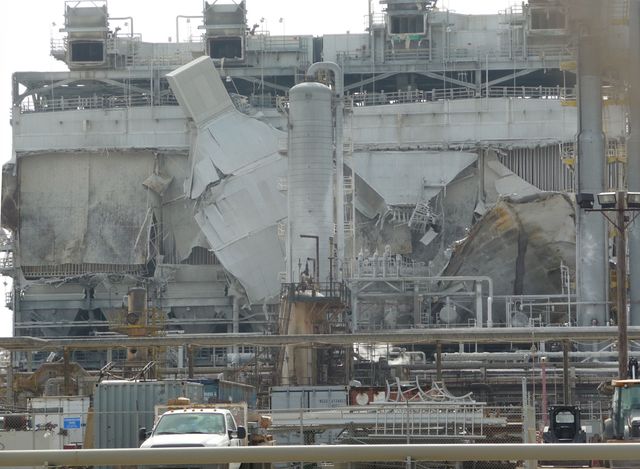
The site of the explosion at the Exxon refinery in Torrance, California
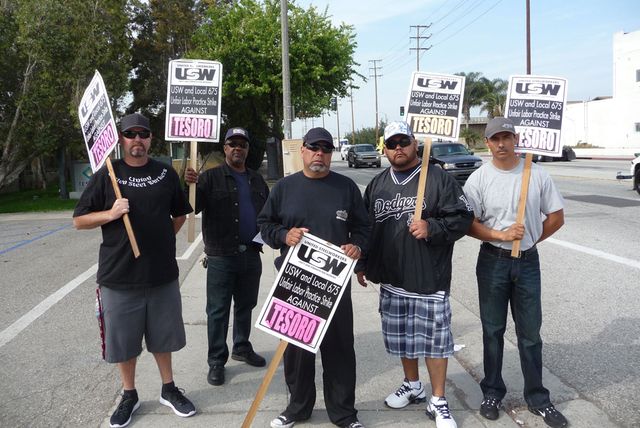
Despite the intransigence and arrogance of the oil giants, the USW refuses to expand the strike, which it has limited to only 5,200 of the 30,000 oil workers it organizes. The mood on the picket lines remains determined. Many workers realize that they are striking not just for themselves but for all workers who have suffered eroding living standards and working conditions even as corporate profits hit record levels. The explosion at ExxonMobil’s Torrance, California refinery Wednesday also bolsters their fight against overwork and understaffing.
Pickets at the Tesoro, Carson California refinery
The Obama administration is closely monitoring the strike and wants the USW to shut it down as soon as possible. The president has intervened against 20,000 West Coast dockworkers, with his labor secretary ordering the International Longshore and Warehouse Union (ILWU) to reach a settlement with the Pacific Maritime Association, which has repeatedly locked out workers.
While the USW has sought to impose a media gag order on striking workers, oil workers and their supporters have increasingly turned to social media. The comments section of the USW Oil Worker Facebook page is overflowing with comments calling for a national strike and denouncing the USW for emasculating the struggle.
Christopher James Jones writes, “Close the other refineries and quit playing games!” to which two workers responded: “I agree! How many middle fingers do we need to take before we take action!??” and “Yep. Its time to strike at ALL sites.”
Another worker, Cedric Graham, posted, “It is time for the union to take the gloves off and pull any plants on rolling 24’s. A week off from negotiations while families are burning through savings and basically begging the local for help while dues are deducted is unacceptable.”
Kyle Olson writes, “It’s pathetic, pull more refineries or get off the pot. Our ‘strike’ isn’t hurting these companies at all, just the union employees that are feeling the hardship from not working. And with the union not willing to pull the trigger on other refineries it leads us that are out to believe that it’s all for nothing. Be big boys and get our voices heard by the oil companies by PULLING MORE REFINERIES!”
Workers in the United States have been battered by years of wage stagnation and decline. Last year the National Employment Law Project released two separate reports that detailed this. One, released in November, showed that manufacturing jobs saw a 21.05 percent wage drop between 2003 and 2013. The other, released earlier in the year, found that a disproportionate number of jobs created during the so-called “recovery” (2009-present) pay less than $13 an hour.
Like the United Auto Workers and other unions, the USW has long collaborated with the corporations to slash labor costs in order to boost “competitiveness” and profitability. Obama appointed USW President Leo Gerard to a joint labor-management committee to accelerate this cost-cutting process in the energy and manufacturing sectors.
The USW’s Facebook page has been flooded with likes and messages of support and solidarity. Many comments denounce the irrationality and greed of the major oil companies, who made more than $90 billion in profits last year. Tammy Letts wrote, “I support you! Oil corps don’t give a damn about workers, environment or humanity.” Another, Matt Smith, writes “The American working class is behind you 100%.”
One commentator, Neal Gomez, apparently a USW member, wrote “Yeah… these companies have made RECORD BILLIONS in the last decade but refuse to share that prosperity with the workers who make it happen, often in hazardous environments!!! Cutting jobs, retirement pkgs, paltry wages, etc; and ever increasing overtime by reduced staffing, hiring, unskilled (often dangerous!) labor to perform maintenance…simple greed!!!.”
Gomez continues, worrying about the heads of the union, “Now if only they [the oil companies] don’t buy our international reps out and sell us down the river again!!!!” Writing in another USW post, Gomez writes “SOLIDARITY!!! Let’s just hope International [the USW’s International Executive Board] doesn’t sell a ‘few’ of us out!!!! IF there’s strength in numbers, then take us ALL OUT!!!! No one wants a strike, but petty cash n t-shirts only go so far when we have some of our Union brothers and sisters walking picket!!! Let’s drop the hammer!!!”
Many workers have also expressed frustration with the lack of help for striking workers from the USW as well as the general secrecy and inaccessibility of the negotiations. Ashley Salinas writes on the USW oil worker page, “Is there not a strike fund pay that kicks in after a month of strike? Bills are piling up and groceries aren’t free. Where do we turn for help?” Another worker replied to her, “There is definitely a fund for help, but the way it is allocated is very interesting...make sure to go to the local to inquire ASAP.”
Cheri Nicole Davidson-Henderson expressed feeling “in the dark” about issues in the contract negotiations. She wrote, “A little more communication would be nice, but in the meantime lets stop playing games with these small threats.”
These comments vindicate the warnings the WSWS gave about the treacherous role of the USW and the need for workers to take control of the conduct of the strike.
As the WSWS has previously noted, “The continued sabotage of the strike by the USW is the greatest danger workers face… New organizations of struggle, including rank-and-file strike committees, must be organized to set up pickets at every refinery, chemical plant and oil terminal to shut the entire industry down. At the same time this fight must be linked up with West Coast dockers, teachers, auto workers, and other sections of the working class in opposition to the corporations and both big business parties.”

Unemployment in Australia at 12-year high

Terry Cook

Australian Bureau of Statistics (ABS) figures released last week show the official unemployment rate in January reached the highest level in more than 12 years, with nearly 800,000 people looking for work. This is a sharp indication of the growing social crisis impacting on the lives of the working class and all young people.
January’s unemployment rate leapt to 6.4 percent in seasonally adjusted terms, up from 6.1 percent the previous month. In all, 12,200 jobs were wiped out, with the loss of 28,000 full-time positions partly offset by a 15,900 increase in part-time employment. This continues a decades-long trend of growing numbers of people being forced into low-paid and precarious casual employment.
Officially, the number of jobless workers now stands at 795,000, due to the job destruction that has occurred under Liberal-National and Labor governments alike at both the federal and state levels. Forecasts produced by successive governments have proven false. Treasury predicted before the 2013 federal election that unemployment would peak at 6.25 percent in mid-2014 then stabilise before dropping to 5 percent in 2015–16.
Young people are bearing the brunt of the worsening situation. Over the past 12 months, while the total unemployment rate has risen 0.5 percentage points from 5.9 to 6.4 percent, the unemployment rate for 15 to 19 year-olds has skyrocketed 3.8 percentage points, from 16.5 to 20.3 percent. Among those aged 15 to 24, joblessness rose from 13.1 to 14.2 percent between December and January—the highest level since April 1998.
Unemployment increased significantly in most states, driven by a deepening economic downturn, collapsing mining export prices and ruthless restructuring by major employers.
In South Australia, where downsizing is continuing throughout the car industry, the unemployment rate leapt from 6.6 to 7.3 percent. In Victoria, where thousands of manufacturing jobs have been eliminated in recent years, the figure jumped from 5.6 to 6.6 percent. In Queensland, where thousands of coal mining jobs have been axed over the past 18 months, the rate rose from 6.2 to 6.5 percent. In New South Wales, Australia’s most populous state, unemployment increased from 6.0 to 6.3 percent
In an effort at damage control, Prime Minister Tony Abbott declared that while the January jobs figures were “disappointing,” his government was “serious about creating jobs.” Ludicrously, he claimed that “the outlook on employment is the most positive it has been for 10 years.”
The latest figures underscore the fraudulent character of Abbott’s 2013 election pledge that his government would create a million new jobs within five years. The data also puts paid to any residual claims that Australia, because of its vast mineral and gas deposits, could avoid the worst effects of the 2008 global economic crisis. In fact, official unemployment in Australia is now higher than in the US (5.6 percent), the UK (5.9 percent) and New Zealand (5.6 percent).
However, as damning as they are, the ABS figures cloak the real depth of the jobs crisis. The ABS data excludes anyone who has worked one hour or more per week, and those who are not actively seeking work on a daily basis.
A more accurate picture can be gleaned from Roy Morgan surveys, which estimate that unemployment stood at 9.8 percent in January. Under-employment—those looking for extra working hours—was estimated at 8.2 percent, giving a total of 18.1 percent unemployed or under-employed.
Economic analysts are now forecasting further sharp increases in joblessness. Deutsche Bank senior economist Phil O’Donaghoe predicted that unemployment would rise to 6.75 percent by mid next year. JP Morgan economist Tom Kennedy said the ABS results were a “shocking report all round,” saying unemployment could shortly reach 6.5 percent.
Such estimates are conservative in the face of the marked economic slowdown in China, and the ongoing slumps in Japan and Europe, which are helping fuel precipitous falls in the prices for Australia’s main export commodities—iron ore, coal and liquefied natural gas (LNG).
The unravelling of the two-decade resources boom has already resulted in massive layoffs, mine closures and the shelving of investment across the country, including in mining-associated industries such as mine services and mining equipment.
Late last month, BHP Billiton revealed plans to slash 300 jobs at its South Australian Olympic Dam operations, adding to 580 job losses announced a week earlier at iron ore miner Arrium’s Peculiar Knob mine near Cooper Pedy, also in South Australia. Iron ore prices have fallen to around $US62 per tonne from more than $US100 per tonne 12 months ago.
In the same week, the South Australian Labor government reached a $10 million incentive agreement with OZ Minerals to move its 45-job head office to Adelaide, despite the gold and copper miner cutting 80 contractor positions last month.
This month, mining giant Rio Tinto outlined plans for another round of cost cutting, including more job losses across its iron ore operations.
In the former mining boom state of Queensland, the prospects of an upturn when LNG exports commence have been dashed. Arrow Energy this month shelved its multibillion-dollar LNG project and QGC’s parent company, BG Group, reduced the value of its LNG operation by $5 billion. Santos will cut $50 million from spending on its coal seam gas to LNG project, and Origin is believed to be shedding hundreds of jobs.
This week rail haulage company Aurizon warned it is likely to suspend investment in the construction of a rail line in Western Australia’s Pilbara mining region, as well as rail and port infrastructure in Queensland’s Galilee Basin, because thermal coal prices are forecast to drop 8.9 percent to $64 a tonne, the lowest level since 2006. Aurizon has cut thousands of jobs over the past few years and now employs 6,977 workers, compared to 9,390 in June 2010 after it was privatised by the previous state Labor government in Queensland.
More job cuts are looming in the auto industry, with the three remaining manufacturers—Ford, GM Holden and Toyota—planning to shut down all production by 2017. Collapsing sales of Ford’s Falcon model have placed intensified pressure on the company to close its plants before next year’s scheduled date.

Germany: Further strike action imminent at Deutsche Bahn

Dietmar Henning

The German train drivers’ union (GDL) announced on Tuesday that talks had failed with Deutsche Bahn (DB) and declared it would call on its members once again to strike. It will be the seventh strike in the ongoing contract dispute. Since July last year, GDL members have been on strike six times for a total of 165 hours.
DB management and the media have sought to cast the conflict as an irrational struggle between the GDL and the railway and transport union (EVG), fought out at the expense of passengers and employees purely over issues of power and prestige. In fact, it concerns the the right to strike, the right of workers to struggle for decent wages and working conditions and against job cuts, as well as the constitutionally protected right of coalition, the right to freely make alliances in defence of one’s interests.
DB has sought repeatedly to provoke the GDL and deliberately delay the union until the so-called collective bargaining law comes into force, which will make their strike virtually illegal.
The German government adopted the collective bargaining law two months ago, which was drafted by the department of labour minister Andrea Nahles (Social Democrats, SPD). It is aimed at undermining the basis for smaller unions like the GDL, Cockpit (pilots), UFO (air traffic controllers) and Marburger Bund (doctors), which have repeatedly sought to break out of the straitjacket of the main unions controlled by the German confederation of trade unions (DGB) to organise strikes.
The law is now being rushed through parliament at high speed. According to the timetable, the Bundesrat (Germany’s upper house of parliament) should take its final vote on the bill on July 10, its last sitting before the summer break. Subsequently, only the largest trade union at each company will be permitted to reach collective bargaining agreements. At DB, this is the EVG trade union.
The GDL documented the delaying tactics by DB in its press releases. Management continues to refuse to discuss the GDL’s demands (a 5 percent wage increase and a cutting of weekly working hours by two hours). The only exception to this has been a one-off payment of €510 for the second half of 2014.
Only on December 17, after six strikes and a ruling by the state labour court in Hesse, did DB concede to the GDL the right to negotiate on behalf of all train employees. Until now, the GDL has only concluded agreements for train drivers, not conductors, catering staff and other train staff members who have joined the GDL due to the close collaboration between management and the EVG.
Then on January 21, DB suddenly insisted, according to the GDL statement, on a “compatible collective agreement without contradictions.” In this case, the GDL would not have been able to negotiate a different agreement to the recognised union EVG and would have had to withdraw most of its demands.
Later, DB presented a comprehensive collective agreement containing different provisions on remuneration, working hours and bonuses for train drivers, conductors, catering staff, signallers and switchyard engineers. But the GDL insisted on equal working conditions for all members of train staff.
Another disputed issue is the scope of the collective agreement. The GDL intends to enforce the same working conditions at smaller rail companies as at DB, so that if drivers and other staff switch to another company, their pay rates will be guaranteed. Since regional transport is generally awarded through public contracts, companies often come forward offering to cut costs with lower wages than DB. Train drivers, who are then compelled to change companies, often suffer a major loss of income.
The GDL finally declared the talks had failed when DB stated in a policy paper February 11 that an agreement with the GDL was dependent upon a deal with the EVG.
The GDL offered to continue with negotiations on February 26 if DB fulfilled nine points. In essence, the GDL was demanding nothing more than what was called for at the beginning of talks last July, according to the trade union’s accompanying letter: “DB must, without preconditions, expand the current collective agreement, which applies to 97 percent of train drivers in Germany, to the conductor, catering, trainer and signaller professional groups. Yard engineers must be integrated into the collective agreement as train drivers.”
DB immediately opposed negotiations with the justification that talks could not be conducted “according to the principle of holding a gun to the head.” In a press release, they claimed that the GDL’s demands had been fulfilled in a number of areas. “The GDL can establish collective agreements for all professional groups, there are no preconditions, and DB has agreed to a solution outline for a comprehensive collective agreement that the GDL itself outlined in negotiations.”
In reality, DB sabotaged the talks to delay the GDL and to mobilise the public against them. For this, it can rely on the support of a broad front.
The media is again agitating against the train drivers and conductors. The majority owner behind the rail company is the state, meaning, thereby, the German government. And the EVG, which is also currently in talks with DB, has slavishly backed the firm in its actions against the competitor trade union.
DB human resources chief Ulrich Weber felt able to comment in a Spiegel Online interview that the EVG wanted “like us, no competing comprehensive agreements for a professional group.” The EVG, which is continuing talks with DB, reported progress on Wednesday. Further rounds of talks are planned for March 5 and 25.
The trade union confederation to which the GDL belongs, the German Professionals Confederation (DBB), is now also criticising the strike threat. DBB deputy chairman Klaus Dauderstädt told Tagespiegel, “Two proposals are currently on the table and must be unified. That’s why now isn’t the time for escalation, but rather for intensive negotiations.” Since the DBB is currently deciding on assistance to the GDL in its strike, such a comment is more than simply a piece of friendly advice.

Refugees deported from the EU, imprisoned in Ukraine

Martin Kreickenbaum

Refugees illegally refused entry by the European Union are detained for months in Ukraine, abused and tortured. According to research by the German television station ARD’s news magazine Report Mainz and the weekly publication Der Spiegel, the prisons are financed with millions of dollars from Brussels.
Hasan Hirsi, who fled Somalia more than three years ago, told reporters he was tortured with electric shocks in Ukraine. “Hirsi’s hands trembled as he spoke of his ordeal in the detention center,” wrote Der Spiegel. For days the refugees were given nothing to eat. They were beaten repeatedly and tortured again and again with electroshocks. “I realized that the situation for me in Ukraine was terrible. I couldn’t stay,” said Hirsi. He was still a minor at the time.
But Hirsi’s escape to the European Union, in order to petition for asylum there, was blocked. Refugees in Ukraine were placed under police surveillance and arrested. If they did manage to cross the border into the EU countries Hungary or Slovakia, they were immediately deported back to Ukraine.
Refugee Ali Jaga, who also comes from Somalia, explained: “They captured me in Slovakia and then in the middle of the night simply took me back to Ukraine. They never once said that they were sending us back to Ukraine, which is the same as saying: We’re bringing you to a refugee camp. But then we saw the Ukrainian flag.”
Such actions, known as “pushbacks,” are serious violations of international law under the Geneva Conventions, which state that asylum applications must be heard and reviewed. The rejection of refugees at the border is a clear break with a central component of international refugee law. The Hungarian and Slovakian border guards, who have deported Hasan Hirsi and other refugees to Ukraine, are thereby carrying out illegal acts.
But the EU Commission pleads ignorance. With respect to the Report Mainzreport, they declare that they are unaware of any “cases of specific or widespread pushbacks.” That is simply not credible.
As early as 2011, the refugee relief organizations Border Monitoring Project Ukraine (BMPU) and Pro Asylum, documented dozens of cases of refugees whose right of access to asylum procedures in Hungary and Slovakia were refused. Even minors were ruthlessly deported to Ukraine in a matter of hours.
The UN Refugee Agency of the United Nations (UNHCR) also acknowledges the illegal Pushbacks. Ilja Todorovic of the UNHCR Bureau in Kiev told Report Mainz: “There are reports available to us about refugees, who for good reason do not want to remain in Ukraine, trying to make it to the EU. But on the EU side of the border they are stopped and sent back. One can say unlawfully sent back, because they are not allowed to submit an application for asylum in the EU.”
The European Union, which is sealing itself off from refugees ever more rigorously, actually finances the inhumane prison system for refugees in Ukraine. As part of the “European Neighborhood Policy,” the EU allocated €30 million to Ukraine between 2007 and 2010 for the establishment of detention centres for refugees. Last year, the EU called for the building of further prisons at the cost of an additional €20 million. From 2000 to 2006, the EU had already transferred €35 million for the building up of border security.
The funds are provided so that Ukraine can take over the dirty work of the EU regarding refugees. The country acts as a frontline deterrent to block the entry of refugees into the European Union. In addition to financial support, Ukraine receives in return visa privileges for its own citizens.
Human rights organizations indicate that severe violations of the rights of refugees have been going on for years in Ukraine. In 2010, Human Rights Watch reported on the abuse and torture of refugees by Ukrainian border guards. “They beat me in the head with a pistol. I lay on the floor, unconscious. They dragged me through the snow. They kicked me in the neck,” reported one refugee from Pakistan.
Other refugees described what it was like to be tortured with electric shocks: “They strapped me to a chair. They placed electrodes on my ears,” said a refugee from Afghanistan. A Somali complained that he was robbed by Ukrainian security forces who threatened to kill him.
Marc Speer, who works for the project “bordermonitoring.eu” in Ukraine, toldReport Mainz: Whoever is caught here, attempting to flee, generally spends a year in a prison built with the help of the EU. That is the kind of punishment received for the irregular crossing of the border or even for an attempt at crossing it.”
In the year 2012, 80 Somali refugees carried out a weeks-long hunger strike due to inhumane conditions in the prisons. After several weeks, the hunger strike was ended by a special armed unit of the Ukrainian police. Refugees were physically abused and a number of them force fed.
Beyond the prisons, the circumstances facing refugees in Ukraine are catastrophic. Their daily food rations are worth less than €1. Medical treatment is unavailable and there is no chance of finding work. Almost all refugees report experiencing violence. The random detention of refugees is a daily occurrence.
In light of the intensification of the political situation and the strengthening of nationalist and openly fascistic forces, the situation facing refugees in Ukraine will only worsen. Along with this comes the social impoverishment of the entire Ukrainian population as a result of massive austerity programs imposed by the European Union.
The EU Commission turns a blind eye to the growing misery and distress of refugees. A request by the reporting team from Report Mainz received the terse reply: “The EU supports Ukraine so that it is able to manage irregular migration and the handling of asylum seekers according to the best European standards.”
It is scandalous that the European Union continues to recognize Ukraine as a stable third status country. In addition to its illegal pushback operation it deports refugees, whose asylum requests are rejected in line with an EU treaty of 2010.
Ilja Todorovic of the UNHCR in Kiev declared: “The EU uses neighbor states in the East, sends money and other things, only then to assert: Refugees in Ukraine have it good. We work here, however, and know: That’s not true. If one uses that as an excuse to slow the flow of refugees then that has nothing to do with human rights. The refugee problem is outsourced.”
The hypocrisy of the European Union is boundless. The last time the EU raised the human rights situation in Ukraine was the occasion of the European Soccer Championships of 2012, when the EU demanded the prompt release of the pro-Western oligarch and politician Yulia Tymoshenko. By contrast, they have nothing to say about the situation of refugees in Ukraine.
The human rights violations against refugees in Ukraine make a mockery of the claims by the EU that the overthrow of President Victor Yanukovych has led to the creation of a democratic state. Günter Burkhardt, the managing director of Pro-Asylum, told the Kölner Stadt-Anzeiger: “It cannot be that the EU supports Ukraine in the current conflict while at the same time accepting human rights violations by Ukraine against defenseless refugees.”
The situation in Ukraine is not an isolated case. The European Union is using force to erect a buffer zone around the EU in order to keep out refugees as much as possible. Serious human rights violations are consciously accepted in an effort to deter refugees.
In an interview with the radio program Deutsche Welle, the director of the German office of Human Rights Watch summed up these cynical politics: “The EU has financed refugee camps for years in different non-member states. Even such undemocratic countries as Libya and Belarus have received funding, so that refugees can be prevented from entering the EU. That testifies to a definite callousness in Brussels.”

Obama budget cuts target high school counselors

Nancy Hanover

A cynical event honoring the School Counselor of the Year was held at the White House at the end of January. The photo-op was purportedly part of “600 new actions to help more students prepare for and graduate from college.”
The “600 actions” are largely pledges by dozens of colleges to increase the number of graduates, with various college-funded programs to utilize analytics, provide “transparency in outcomes” and “encourage accountability.” No suggestion was made of the need to provide funding for school counselors.
Just the opposite. In the 2015 education budget request, the president has again requested the termination of the only real federal support for districts to provide counseling, the Elementary and Secondary Education Counseling (ESEC) grant program. Obama has called for all funding for the program to be folded into a general “wellness” scheme.
Among the largely cosmetic pledges in his public relations package, however, was support for an alternative to school counselors—the College Advisor Corps, a nonprofit that is creating a subclass of untrained college “mentors.” The initiative is lifted from the playbook of an increasingly discredited Teach for America.
When schools are hit with budget crises—as have been unremitting during the entire Obama administration—school counselors and other non-classroom personnel are the first on the chopping block. Spending on K-12 schools has been cut in 44 out of 50 US states between 2007 and 2012. Additionally, Title I—the federal program for the most impoverished schools—declined under the Obama administration by 10 percent last year, and funding for students with disabilities fell another 11 percent.
These cuts have translated into the loss of some 300,000 school district jobs nationally since 2008 and led to a catastrophic shortage of counselors and psychologists.
Presently there is one college counselor for every 471 students in the United States. California has only one counselor for every 1,016 students. In 2008, the ratio nationally was 1-to-457. The American School Counselor Association (ASCA) considers 1-to-250 a desirable ratio. Today students can expect to meet with a school counselor, on average, for 20 minutes in an entire school year. One in five high schools has no counselors on staff at all.
The ASCA says the most devastating impact is among the youngest learners. “At the elementary level, there are lots of classroom lessons and activities that go on to help students develop the academic skills and behaviors that they need in order to be successful throughout their entire academic careers,” said ASCA assistant director Eric Sparks. He added, “With fewer counselors to support them, those kids are not getting the school counseling programming, and they’re not getting the individual services that they need.”
Brian Martin, a former counselor from Hamilton, Ohio, said, “The student-to-counselor ratio is higher than it has ever been ... (as) schools are almost being asked to serve as social service agencies.”
Belle Allen, a guidance counselor since 1996, told the Cincinnati Enquirer that years ago “we did a lot of scheduling, a lot about colleges, but now there are a lot of mental health issues that students are dealing with.” More than 50 percent of US schoolchildren are living in poverty, and rising social tensions are inevitably reflected in the school environment.
At the same time, high school students are left without assistance despite the fact that the college application process (not to mention the struggle for financial aid) becomes more complicated every year. A series of standardized tests, fees and acquiring numerous written recommendations are the baseline demands for even one college application. Some students submit as many as a dozen of these applications, with countless additional forms for winning some type of financial aid or scholarship.
The College Advising Corps (CAC) began in 2004 at the University of Virginia. After being feted by the Obama administration and turned into a nonprofit last year, it is growing rapidly.
Funded by foundations, university partners and the federal government via AmeriCorps, CAC recruits newly-minted college graduates, preferably minorities, and places them in schools where the majority of students are low-income.
At the recent “College Opportunity Day of Action,” Michelle Obama enthused, “School districts are partnering with nonprofits and colleges to provide training for counselors once they’re in our schools [emphasis added].” She continued, “Nonprofits are stepping up to improve student-and-counselor ratios and bringing recent graduates into schools to serve as role models and mentors.”
Similar to Teach For America, the new college graduates receive a paltry six weeks of training and are then placed in the most needy schools. In an article largely favorable to CAC, Education Week describes the functions of these “near-peer” advisers. “At a corps training session last fall, advisers were encouraged to adapt games, such as Monopoly and Who Wants to be a Millionaire? with questions related to the college search.
“‘To give them 40 minutes of fun, it makes them happy and creates a dialogue for them to come to us when the time is right,’ said Molly Thompson, 23, an adviser at two central Pennsylvania high schools.”
A far cry from “improving the student-and-counselor ratio,” this operation will be used to justify the further elimination of counseling services for students in poor school districts.
The CAC has now branched into 14 states with 470 advisers in 483 high schools. CAC aims to be in 1,000 schools by 2020, according to Education Week. Presently, 30 percent of the corps members are funded by AmeriCorps and earn between $24,000 and $30,000 a year. After one year, they are entitled to a $5,600 education credit that can be used to pay down student loans. The median salary of a high school counselor in 2012 was $53,600.
As an indication of the road ahead and the business possibilities inherent in the program, Bloomberg Philanthropies has recently begun financing an e-advising initiative. The e-advising works in conjunction with CAC, but provides even fewer services—merely a remote phone contact—for students seeking help.
Once more, the Obama administration brings together business interests, foundations and nonprofits to undermine essential services, attack the rights associated with public education, eliminate trained professionals and substitute well-meaning but untrained young people who are themselves being denied the right to a secure and decent job.

Record cold weather in the US leads to spate of deadly house fires

Evan Blake

Since December 21, the first day of winter, there have been 576 fatalities attributable to residential fires in the United States, according to the United States Fire Administration’s website, which compiles media reports on US house fires. Of this total, 84 were children age 14 or younger, and 175 were senior citizens age 65 or older.
Texas, with 43 home fire fatalities, Ohio with 42, and Michigan with 35, have seen the highest number of deaths from residential fires.
In recent days, much of the eastern US has experienced records low temperatures in numerous cities, increasing the danger of house fires and other cold-related deaths. For working-class families, traditional home heating costs during this period of extreme cold have soared, forcing many to partially heat their homes with unsafe space heaters, or forgo heating altogether.
Cold weather has extended deep into the southern US. In Orange Park, Florida, a schoolteacher in her 60s was killed on Friday morning, when her house was engulfed in flames that began from a space heater. The house did not have smoke detectors.
A house fire in Knoxville, Tennessee early Thursday morning killed three people. James Overton, 73, Edith Overton, 63, and their disabled son Derek Overton, 47, were all killed by the fire, the cause of which has not been released. The fire has been designated as “weather-related,” which means that the deceased were not the victims of foul play and that the fire was accidental, not intentional.
On February 11, a mother and her three children died in a trailer house fire at the Gary Malone Trailer Park in South Point, Ohio. Ashley Mays, 25, her son, Elijah Parker, 5, and her twin 11-month-old sons Anthony and Preston Walker passed away in the fire. The family lived with Ashley’s girlfriend, Dorothy Walker, 32, and her 9-year-old son Hunter, who were not home when the fire broke out.
Mays’ next-door neighbor, Ryan Luther, told the Ironton Tribune, “When I moved here, I was homeless. Ashley was very helpful. You could ask her for anything and she would do anything for anybody. It’s devastating when something like this happens.”
Investigators have found that the fire began in the center of the trailer, but have yet to determine a cause. According to the State Fire Marshal’s Office in Ohio, there were no smoke alarms found inside the trailer.
Neighbor Rebecca Davis criticized the trailer park landlord’s maintenance practices, telling local news station WOWK-TV, “It is possible that any of [the trailers] could go with the way he has them rigged up.”
Ohio’s Revised Code states that there is no “state-level” code requiring a single family’s home to have detectors, nor are landlords legally obligated to install them. So far this winter, there have been 24 house fire fatalities in Tennessee alone.
On Thursday, February 12, a house fire in Mosinee, Wisconsin, killed siblings Neatha Carwile, 68, and Hershel “Fred” Bauman, 75. Autopsy reports indicate that both died from smoke inhalation. The smoke detectors in their apartment were not working at the time of the fire.
The two victims were found in the upstairs apartment of a duplex. It is unclear why the two were unable to escape, but police investigators have said that Bauman had physical limitations that could have made escaping difficult. His sister was caring for him at the time of their deaths.
The cause of the fire is still under investigation, but foul play is not suspected and authorities believe the fire began in the couple’s kitchen. Two adults and their grandchild, who live in the lower duplex, were able to get out safely.

Japan rewrites foreign aid rules to include military assistance

Ben McGrath

The Japanese government announced last week that it would provide aid for the first time to foreign militaries through its Official Development Assistance (ODA) program. The move is part of Prime Minister Shinzo Abe’s aggressive diplomatic efforts to build Japanese influence and ties, particularly in Asia, on all levels, including military.
To implement such measures, the cabinet re-wrote Japan’s foreign aid policy for the first time in more than a decade. “Based on the new framework, we will promote more strategic development assistance and further contribute to the peace, stability and prosperity of the international community,” said Foreign Minister Fumio Kishida.
Far from contributing to international “peace” and “instability,” the change to foreign aid policy is aimed at forging new military partnerships as part of Abe’s so-called “pro-active pacifism.” The previous foreign aid policy explicitly banned the use of the ODA budget to assist foreign militaries.
Japan has in the past provided aid to foreign militaries but never through its official aid program. The military assistance will be taken out of what is a shrinking foreign aid budget. The total aid budget was set as 542 billion yen ($4.5 billion) for the upcoming fiscal year—the 16th consecutive annual cutback. The figure is less than half of the peak level of 1.2 trillion yen in 1997.
Kishida justified the cabinet’s decision by saying, “Given that militaries now play an important role in non-military activities such as post-conflict rebuilding and reconstruction, as well as disaster relief, we’ve clarified our policy of non-military cooperation.”
The government’s claims that such assistance will only be used for non-military purposes are completely fraudulent. Firstly, the line between military and non-military equipment and aid is an elastic one. Secondly, any assistance to foreign militaries will increase their overall resources.
Commentators have already questioned vague wording of the re-written ODA charter which declares, “Where military forces or personnel are involved in development assistance for civil or nonmilitary purposes such as disaster relief, each case is studied specifically with a focus on practical significance.”
Eiichi Sadamatsu, the director general of Japan’s Center for International Cooperation, remarked, “The sentence is quite vague. What does ‘practical significance’ point to? What are the criteria for studying each case?”
The Abe government is already using Japan’s military, or Self-Defense Forces (SDF), as an instrument of foreign policy, including through interventions in natural disasters. In 2013, it dispatched 1,180 SDF personnel to the Philippines following the devastating typhoon Haiyan—one of the largest military deployments in a relief mission.
Its real purpose was to enhance Japanese standing in the Philippines and to undermine Chinese influence. A government source told the Asahi Shimbunat the time, “That response is aimed at holding China in check as well.”
In announcing the new ODA charter, Abe took a thinly veiled swipe at Chian, declaring that this new “non-combat” aid would also assist in protecting the “rule of law.” The Abe government has repeatedly accused Beijing of failing to abide by international law in its maritime disputes with Japan and other neighboring countries.
In reality, Japan, backed by the United States, has taken an aggressive stance in its dispute with China over the Senkaku/Diaoyu Islands in the East China Sea. Tensions with China sharply escalated in September 2012 after the Japanese government unilaterally changed the status quo by “nationalizing” the rocky outcrops.
Japan recently announced the possibility of Japanese air and naval patrols in the South China Sea where China is engaged in territorial disputes with South East Asian neighbors, particularly the Philippines and Vietnam. Last year, a standoff between China and Vietnam took place after a Chinese state-owned company placed an oilrig in waters claimed by both countries. During the tense month-long standoff, Chinese and Vietnamese vessels rammed each other threatening to trigger a wider conflict.
Japan has already agreed to provide patrol boats to the Philippines, Vietnam and Sri Lanka in a move that will only compound tensions with China. Ten vessels are to be sent to the Philippines later this year and six will be delivered to Vietnam. Tokyo has also raised the possibility of providing patrol boats to Indonesia.
Abe has made Japan’s relations with the Association of Southeast Asian Nations (ASEAN) a key part of his foreign policy. Since coming to office in December 2012, he has visited all ten ASEAN countries, the first Japanese prime minister to do so.
The Japanese government is pursuing this foreign policy agenda as part of the US “pivot to Asia”—a comprehensive diplomatic offensive and military build-up by the US and its allies directed against China. Within this context, Abe is remilitarizing Japan and strengthening its influence in the region in order to further its economic and strategic interests.
Last July, Abe announced a controversial “reinterpretation” of Japan’s constitution that formally bars the country from waging war. The decision to allow so-called “collective self-defense” opens the door for Japan to take part in wars of aggression so long as it is in alliance with the US or other nations.
This month, Abe has placed the revision of the constitution as a whole on the government agenda—most likely in the aftermath of upper house elections in mid-2016. He is exploiting the recent murders of two Japanese citizens by the Islamic State of Iraq and Syria (ISIS) to try to whip up support for deeply unpopular constitutional amendments, including the lifting of all restraints on the use of the military in wars.
The recent decision to allow ODA assistance to be provided to foreign militaries is one aspect of this militarist agenda.

Argentina charges US interference in crisis over prosecutor’s death

Rafael Azul

The political crisis precipitated by the mysterious January 18 death of Alberto Nisman has continued to deepen after a mass march called by fellow prosecutors and backed by the government’s right-wing opponents drew large crowds into the streets of Buenos Aires Wednesday to mark one month since the Argentine federal prosecutor was found with a fatal bullet wound to his head.
Supporters of the government of President Cristina Fernandez de Kirchner denounced the march as a maneuver of the political right and forces within the state apparatus aimed at bringing about a “soft coup,” while charging that foreign governments—particularly Washington—have attempted to manipulate the case to pursue their own geostrategic interests.
A week before his death, Nisman had announced that he would accuse Fernandez de Kirchner, Foreign Minister Hector Timerman and other officials as well as employees of intelligence services of making an illegal and secret agreement with the government of Iran to protect Iranian “spies” who were allegedly involved in the 1994 suicide car bombing at the Argentina Israelite Mutual Association (AMIA) building that killed 85 people. Nisman had produced a 290-page report about the case, and among papers found in his apartment were requests for criminal warrants against both Fernandez de Kirchner and Timerman.
While there is no evidence that Nisman was murdered—forensic reports on the bullet’s path are consistent with an act of suicide—there is widespread skepticism in Argentine society that Nisman took his own life. This is not only a matter of the timing of his death, but also long experience with political and judicial corruption and impunity for state criminals, going back to those who carried out the mass killings, disappearances and torture under the former military dictatorship.
While undoubtedly such sentiments found expression in the February 18 demonstration, dubbed a “march of silence,” those who played the key role in organizing it are themselves fully complicit in this corruption and impunity, including the federal attorneys, veterans themselves of cover-ups and frame-ups of workers and the left.
On the eve of Wednesday’s march, a White House spokesman stated that the Obama administration is “concerned” about the issues arising from Nisman’s death and is continuing to “monitor closely” the events in Argentina.
Florida Senator Marco Rubio and other congressional Republicans have called for an international investigation into Nisman’s death and for sanctions against Argentina unless it severs ties with Iran. Nisman had ties to Rubio, who invited him to testify before a Senate panel, before the visit was barred by the Argentine government.
In a letter to US Secretary of State John Kerry on Tuesday, Foreign Minister Timerman declared that Argentina would not tolerate being turned into a “theater for operations of politics, intelligence or, even worse, more serious actions, because of conflicts that are completely unconnected with its history.”
This rhetoric, however, was belied by Timerman’s proposal in the same letter that the US raise the issue of the 1994 bombing in its talks with Iran on the latter’s nuclear program, effectively subordinating Argentina to US imperialist maneuvers with Iran.
Nisman was appointed in 2004 by President Nestor Kirchner (the current president’s late husband) to head up the investigation of the 1994 bombing and had produced documents that charged the president and other government officials with cover-up and a secret agreement with Iran to impede the investigation and protect the alleged perpetrators.
Nisman collaborated in the investigation with SIDE (now renamed SI), a notorious and powerful intelligence and secret police agency that played a role in the savage repression of the working class and left-wing youth in Argentina, as well as in the infamous “Plan Condor,” collaborating with the CIA in chasing down exiled political opponents of the military fascist dictatorships in Brazil, Chile and Uruguay. Nisman worked with SIDE chief Jaime Antonio Stiuso, who had been with the agency since 1972.
Fernandez de Kirchner has accused Stiuso of directing and manipulating Nisman (and perhaps murdering him) for his own political purposes. Stiuso is now in hiding. According to the Madrid daily El País, Nisman came forward with his indictment—widely described as a political document—right after Stiuso was fired from SIDE last December and amid fears that a prosecutor aligned with the government would replace him.
That SIDE and elements like Stiuso continued to wield power within the state more than three decades after the end of the military dictatorship is a damning indictment of all the civilian governments that followed, including that of Fernandez de Kirchner. All of them bowed to the repressive apparatus, while also relying upon it to defend the state and both foreign and Argentine capital against the working class.
The intimate involvement of foreign intelligence agencies in the case is undeniable. These included the Israeli Mossad, as well as the US CIA and FBI. Nisman and SIDE worked in close contact with these agencies—in SIDE’s case before and after the AMIA bombing.
While the Lebanese Islamic Jihad claimed responsibility for a 1992 bombing of the Israeli embassy in Buenos Aires, the group had largely been dissolved by this point. Both it and the AMIA attack suspiciously coincided with negotiations between Argentina and Iran on a resumption of nuclear cooperation (Argentina had suspended shipments of nuclear material a few months before the embassy bombing). There are suspicions that the bombings were carried out with the aim of disrupting Argentine-Iranian relations.
During the course of the AMIA bombing investigation it came to light that SIDE had received warnings from the Brazilian intelligence service, as well as Argentine consulates in Milan and Beirut, that an attack on AMIA was in the works and allowed it to happen. In the aftermath of these bombings, however, SIDE (discredited by its role under the dictatorship, and having suffered substantial cuts in its personnel and budget) was reconfigured as an “anti-terrorist” agency, assuming greater powers with restored funds.
There exists ample evidence of the continuing presence of anti-Semitic elements in the Argentine armed forces and police, and in SIDE itself. Those elements, which were given free reign under military rule, now sense a change in the political climate. The Nisman crisis has brought out of the woodwork these openly fascistic elements (in recent days, leaflets were brazenly distributed in Jewish neighborhoods in Buenos Aires that read “the only good Jew is a dead Jew; Nisman = good Jew,” while Nazi symbols were painted on the walls of buildings in the area). Argentina has the sixth largest Jewish population in the world.
Right-wing opposition parties, meanwhile, are blocking legislation to abolish SIDE and create a new intelligence agency.
There is a parallel between SIDE and the American CIA. The terrorist attacks on September 11, 2001 in the US were carried out by persons known to US intelligence, just as SIDE had known about the impending AMIA bombing. The political establishment is, in both cases, dominated by the intelligence apparatus and determined to prevent any real accounting for these events.

US and UK intelligence agencies hacked cell phone encryption keys

Nick Barrickman

Beginning in 2010, a previously undisclosed unit of the British GCHQ acting with support from the NSA, the Mobile Handset Exploitation Team (MHET), penetrated the internal networks of cell phone SIM card manufacturing companies in order to steal encryption keys before the phones came to market, according to documents revealed by NSA whistleblower Edward Snowden and published this week on the Intercept .
The latest revelations of hacking to spy on cell phone communications underscore the criminality of the operations undertaken by the NSA and GCHQ and their companion agencies in imperialist countries around the world.
The documents show that MHET agents “cyberstalked” employers at SIM card manufacturers, monitoring their social media accounts, emails and other personal information with technology provided by the NSA in order to gain means to infiltrate their employers’ networks. “These people were specifically hunted and targeted by intelligence agencies, not because they did anything wrong, but because they could be used as a means to an end,” said the ACLU’s Christopher Soghoian to the Intercept .
Subscriber identity modules, or SIM cards, store identification information for cell phone users, including encryption keys that protect vital personal information that is transferred from a phone to a wireless carrier. By obtaining the encryption keys of mobile devices, intelligence agencies are able to bypass a phone’s security to monitor all communication on a given device, including voice communication, text messages and emails.
Over a three month period, “millions of keys were harvested” and shared with the NSA, which has the capability to process millions of keys per second, according to the Intercept. Gemalto, the world’s largest producer of SIM card technology, had hundreds of thousands of encryption keys stolen as part of the GCHQ’s DAPINO GAMMA program in early 2010, while MHET sought to develop similar means to infiltrate other manufacturing firms. The Interceptnotes that the team’s largest “score” of keys was in its hacking of the Chinese technology firm Huawei, a company that the US government has accused of collaborating with Chinese intelligence.
The documents expose as lies claims made by President Obama in early 2014 that “… people around the world, regardless of their nationality, should know that the United States is not spying on ordinary people who don’t threaten our national security and that we take their privacy concerns into account in our policies and procedures.”
“Gaining access to a database of keys is pretty much game over for cellular encryption,” Matthew Green, a cryptology expert at the Johns Hopkins Information Security Institute, told the Intercep t. Green stated that the latest revelations were “bad news for phone security. Really bad news.”
The Intercept notes that, due to the document only revealing the activities of MHET in its incipient period, “It is impossible to know how many keys have been stolen by the NSA and GCHQ to date,” adding that, “even using conservative math, the numbers are likely staggering.” Considering the fact that the NSA/GCHQ obtained each user’s encryption key illegally, allowing them to circumvent requirements to obtain warrants and other formalities, there is no official record of who the government is monitoring.
The documents show that, in addition to operating in collusion with private firms to monitor the population, the intelligence agencies also freely break the law in order to achieve the same ends.
The monitoring of the world’s population illegally by the US and Britain goes far beyond the practices engaged in by those countries, such as China and Russia, that western imperialism seeks to target for military intervention and often accuses of cyber espionage.
The latest documents come as representatives of the US intelligence community have called for the ending of encryption software altogether, claiming that it hampers the job of law enforcement. “Encryption isn’t just a technical feature; it’s a marketing pitch. … And my question is, at what cost,” said FBI director James Comey to an audience late last year at the liberal Brookings Institution.
“Perhaps it’s time to suggest that the post-Snowden pendulum has swung too far in one direction—in a direction of fear and mistrust,” Comey said in reference to the public’s reaction to the whistleblower’s revealing of mass government spying.