21 Feb 2015

Make more than 100% gain from Digital Shares of Internet Websites.


What Is Your Website About?
   
Our website provides synthetic stock exchange market where you can purchase digital shares of Internet web sites. Buying digital shares of a web site you are receiving rights to gain dividends from this web site and at any time you can sell your shares for the best price (you do not have any rights to the web site property). Each digital share brings a dividend on your account on the daily, weekly, or monthly basis. The amount of dividend depends on share.Your income includes dividends and growing price of shares. Some stocks are rising in price by 100% or 200% per month that profit from their sale can be very high.

How Do I Make Money On Your Website?
       

You have money as dividend from your shares. You can purchase shares at the Shares page.Also big part of revenue comes from the purchases made by your referrals.You will get paid 25% commission from every transaction they made. Invite referrals from blogs, forums, and traffic exchange sites. Please see promotion materials at the "Invite Referrals" web page.

The upcoming Academy Awards: Selma, American Sniper and other issues

David Walsh

The 87th Academy Awards ceremony will take place Sunday evening, hosted by actor Neil Patrick Harris, at the Dolby Theatre in Hollywood, California. If recent ceremonies are anything to go by, the event will be thoroughly scripted and lacking in spontaneity. Occurring at a time of unprecedented global tension and volatility, virtually no hint of the external world will be permitted entry into the self-absorbed proceedings.
As much as the Academy Awards broadcast becomes more embalmed with each passing year, it still passes for a major public occasion in the US. In fact, its generally stilted and meticulously stage-managed character places the awards show in the same category as every other event on the official calendar.
For good reason, the audience for the tedious three-hour plus broadcast has generally shrunk in recent years. The 2014 show attracted some 44 million viewers, one of the highest totals of the new century, but was still considerably down from the 57.25 million in 1998.
The awards show remains big business, both in terms of box office revenue eventually generated for the films that win major honors and advertising money for television network ABC, which broadcasts the ceremony. The price of a 30-second commercial this year is $1.95 million, and the network anticipates netting some $100 million.
The American film industry as a whole remains big business ($31 billion in revenue in 2013), despite declining ticket sales. According to the tracking firm Rentrak, North American movie ticket revenue was down more than five percent in 2014, to an estimated $10.35 billion (about 30 percent of the global total), the third such year-over-year decline in the past five years.
The declines in frequent film attendance among 18- to-24-year-olds (17 percent) and 25- to 39-year-olds (also 17 percent) were especially marked. According to one industry analyst, the film industry is “losing that younger audience because they’re agnostic about how they get their content.” The generally poor quality of the films coming out is also no doubt a factor at a time of widespread economic hardship.
The entertainment and media market in the US is estimated to be worth between $550 and $600 billion dollars, the largest in the world and a third of the global total. The export of US entertainment services, including film, television, music, sports, gaming, Internet, etc., is calculated to be worth half a trillion dollars worldwide.
Too much is at stake on Sunday evening, in other words, to let genuine considerations of artistic excellence ultimately hold sway.
As for the nominations themselves, a host of arbitrary, subjective and “political” factors no doubt plays a role. This is Hollywood, after all.
The eight nominees for best picture, for example, vary widely in quality. The crassest elements in the film industry and media are protesting, as they have done in response to the Academy Award nominations a number of times in the past several years, that the highest-costing and largest-grossing films are “underrepresented” in this category. In fact, none of the seven top-grossing films received a best picture nomination. The budgets of the highest-grossing films averaged $151 million, while the budgets of the nominated films averaged $21 million (low by contemporary Hollywood standards).
BoyhoodThe Grand Budapest Hotel and Selma, despite their limitations, are worthwhile nominations. WhiplashBirdmanThe Imitation Game and The Theory of Everything contain intriguing moments and performances. Clint Eastwood’s American Sniper is a terrible film, which mythologizes the Iraq war and one “American hero,” sniper Chris Kyle. Mr. Turner, which did receive three other nominations, and Foxcatcher, with five, certainly deserved to be nominated for best film.
Complaints have been raised about the failure of Ava DuVernay and David Oyelowo to receive nominations for best director and best actor, respectively, for their contributions to Selma, the film about the 1965 voting rights march. Certainly, the inclusion of Bradley Cooper, who does little more than drawl and draw a bead on outgunned Iraqis in Eastwood’s film, at the expense of Oyelowo, is a travesty.
The failure of any black performers or directors to gain nominations this year has stirred the charlatan Al Sharpton and his National Action Network into action. In a statement, the group, which plans a protest outside the award ceremony Sunday, called on the Academy of Motion Picture Arts and Sciences “to accelerate [its] push to be more inclusive. With all of this year’s acting contenders being white and no women in the directing or writing categories. It’s obvious that the Academy has a diversity problem they are going to have to fix.” Sharpton’s outfit exists to pressure large corporate entities to employ a greater share of the African American upper middle class that it speaks for.
The question of American Sniper is a more vexing one. Why has the film found a popular response?
There are no doubt numerous factors. For one thing, Eastwood’s film had the good fortune to appear in movie theaters when there was virtually no competition. A number of the big-budget films that came out simultaneously were ignominious flops. Moreover, in its action sequences, American Snipercontains a certain tension and drama, and the film claims to depict a war the concrete facts and details of which few Americans know much—and are no doubt curious—about.
Eastwood’s own personality and career are somewhat complex issues. The actor-director, deservedly or not, has the reputation of being vaguely “antiestablishment.” His body of work as a director is generally poor, often abysmally poor, but it does contain a few genuine and humane bright spots, including True Crime (1999) and Letters from Iwo Jima (2006). His love of jazz and jazz musicians is also well known, reflected in his directing Bird(1988), a fictional tribute to legendary saxophonist Charlie Parker, and producing the documentary Thelonious Monk: Straight, No Chaser (1989).
As we have noted, American Sniper ’s script downplays the filthy right-wing and anti-Muslim bigotry to be found in Kyle’s autobiography. Unlike the actual sniper, who apparently reveled in the killing of Iraqis, Cooper’s character looks sorrowful after each murderous episode and even tells a fellow soldier on one occasion to shut his mouth when he begins to celebrate.
Nonetheless, the claim that American Sniper is any sense “antiwar” or has merit because, in the words of producer Harvey Weinstein, “it introduces America to PTSD [post-traumatic stress disorder],” is preposterous.
As we noted in a comment January 31 on the WSWS: “The sequences set in Iraq present the American forces as engaged in a righteous campaign against an almost inconceivably savage and evil foe. American Sniper ’s attitude toward Iraqis, and Arabs generally, is hostile and contemptuous. The US forces represent order, modernity, civilization and sanity; the Iraqis—superstition, backwardness, treachery and violence. The American soldiers are obliged, according to the logic of the film, to exterminate great numbers of Iraqis both in self-defense and as some sort of act of public hygiene.”
The success of American Sniper is nonetheless troubling, and indicates some of the cultural and political problems in America, where the population has been bombarded with foul notions on a daily basis for the past several decades. The promotion of militarism has been especially poisonous. The American people are led to believe at every opportunity that the professionalized armed forces, with whom they have little to do on a daily basis, are made up of “heroes” protecting them from unspeakable evil. Skepticism and mistrust no doubt abound, but the relentless propaganda has its impact, including in weakening the instinctive empathy for the suffering of others.
The population is unaware to a large extent, thanks to the campaign of lies of the government and the media, of the atrocities being committed by the American military on a daily basis, and it is largely unprepared for the sinister role this mercenary force is readying to play in every part of the globe and in the US itself.
What’s being celebrated in American Sniper, after all, is especially despicable. Snipers have more often than not been portrayed in American films as cowards or worse. In films like The Manchurian Candidate (1962),The Day of the Jackal (1973), Two-Minute Warning (1976) and numerous others, the killer-sniper is presented as the lowest form of human life. And America has had its experience with real-life snipers, from the assassination of John F. Kennedy in 1963, the University of Texas tower shootings in 1966 and beyond.
Whether American Sniper wins the best picture award or not depends to a large extent on how intimidated and cowed Hollywood liberalism is by the ultra-right and its spurious claim that wide layers of the population are enamored of the American military and the semi-fascist Kyle. By any logical artistic or intellectual standard, Eastwood’s film should not have a chance, but one shouldn’t hold one’s breath.

Marcel Ophüls’ Memory of Justice and other documentaries

Hiram Lee

This is the second of a series of articles on the recent Berlin international film festival, the Berlinale, held February 5-15, 2015. The first part was posted February 19 .
Director Marcel Ophüls (born 1927 in Frankfurt, Germany) has devoted much of his career to an examination of the crimes committed during the Second World War and the fate of those who either collaborated with the Nazis or who opposed them.
The son of filmmaker Max Ophüls, he remains best known for his 1969 filmThe Sorrow and the Pity, which documented life under the collaborationist Vichy regime in France. He won the Academy Award for Best Documentary Feature in 1988 for what is perhaps his best film, Hotel Terminus: The Life and Times of Klaus Barbie about the infamous Nazi torturer’s escape to Bolivia with the help of US intelligence.
This year’s Berlin Film Festival exhibited the world premiere of a newly restored version of Ophüls’ 1976 documentary Memory of Justice. Prior to the screening, Ophüls was also presented with the Berlinale Kamera award, given to artists who “have made a unique contribution to film and to whom the festival feels especially close.”
Like nearly all of Ophüls’ films, Memory of Justice comes with a long running time, approaching five hours in this case. It covers a wide range of subjects including the Nuremberg Trials, the bombing of Dresden by the US military, US war crimes in Vietnam and the brutal methods employed by French colonial rule in Algeria.
There is much in the film that is valuable. Ophüls’ serious approach to historical questions, and in particular his investigations into the foundations on which postwar society was built, have real significance for contemporary audiences. Given the campaign of historical falsification currently underway in Germany aimed at relativizing the crimes of the Nazis, the screening of the film in Berlin was a significant event.
Nazis on trial in Nuremberg
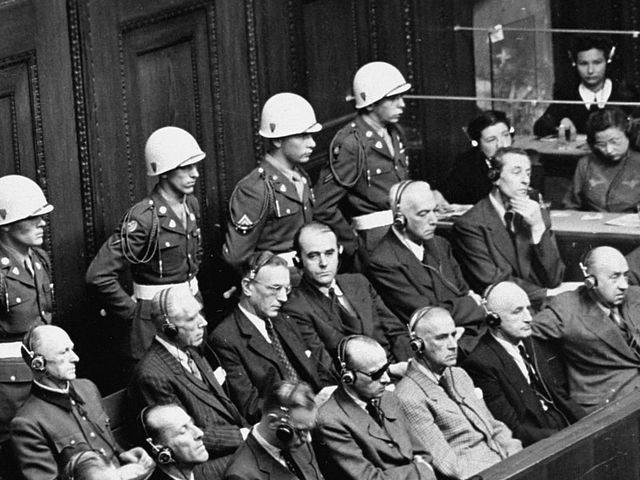
The first part of Memory of Justice centers on the Nuremberg Trials and features footage of the sessions. Retired Brigadier General Telford Taylor, chief counsel for the prosecution during most of the trials, is interviewed extensively, as are defendants Albert Speer and Karl Dönitz, both convicted of war crimes.
Dönitz, the naval commander who briefly succeeded Hitler as head of state following his suicide, remains unrepentant and provides some of the more outrageous commentary in the film. Speer, architect and Minister of Armaments and War Production for the Third Reich, who had already completed a 20-year prison term at the time the film was made, was by this time largely “rehabilitated.” In expressing regrets about his role in the Nazi regime, however, Speer was never as forthcoming as he would have liked viewers to believe.
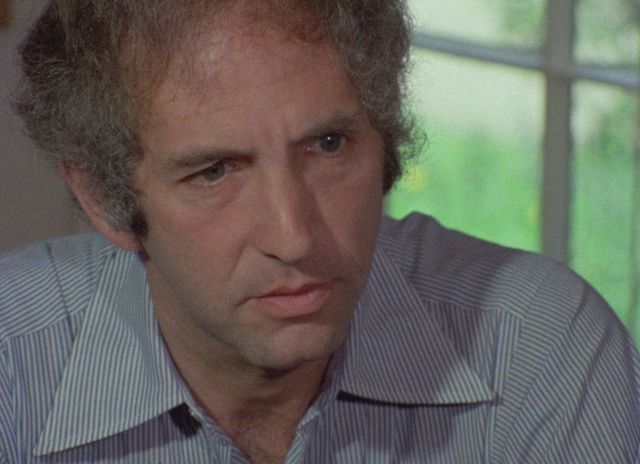
Daniel Ellsberg in Memory of Justice
The second part of the film takes up Vietnam and Algeria, and exposes acts that violate the precedents established in Nuremberg. This section features extended interviews with whistleblower Daniel Ellsberg, whose leaking of the Pentagon Papers exposed the war plans of the US government, and Henri Alleg, whose book La Question described his torture at the hands of the French armed forces in Algeria.
There is a striking moment when Ophüls confronts Edgar Faure of the Radical Party in France, then serving as president of the National Assembly. Faure had earlier functioned as French counsel for the prosecution during the Nuremberg Trials, but dismisses Ophüls’ questions about the methods used by France in Algeria, asserting that it is unfair to compare the actions of France, which had slowly built up colonies over time, to that of an invading war power such as the Nazis.
While he is adept at cross-examining many of his interview subjects, Ophüls is at his strongest as a filmmaker when he allows groups of ordinary people to talk amongst themselves, and argue over differing impressions of historical events and their implications. One is allowed a glimpse into some of the attitudes of the time and the often frustrated search for answers.
In another section of the film, a theater recounts to his fellow performers how a denazification officer once asked him, “Why didn’t you stand on stage and denounce the Nazis?” “They would have hanged us the next day!” he exclaims. Among the more significant sections of the film is the sequence concerning those who made fortunes collaborating with the Nazis and who continued to rake in massive amounts of money after the war.
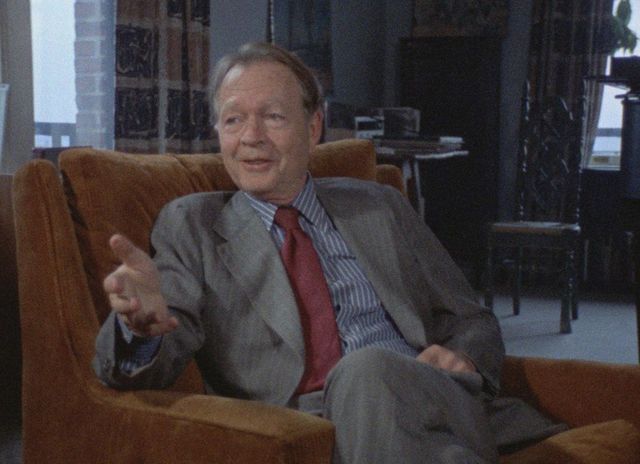
Telford Taylor in Memory of Justice
In particular, Taylor laments that industrialist Friedrich Flick, who profited from slave labor in the concentration camps, was granted an early release from his already minimal seven-year prison sentence.
Another commentator notes that SS Colonel Kurt Becher, who had been appointed commissar of all German concentration camps just prior to the end of the war, was now a big industrialist living in Bremen.
In fact, both convicted war criminals could be counted among the richest men in West Germany by the 1970s. Flick, in fact, was one of the wealthiest individuals in the world at the time of his death in 1972. While Ophüls exposes the hypocrisy of all the post-Nuremberg justifications offered for crimes in Vietnam and Algeria, and provides some sense of the social roots of fascism in Germany, he stops short of the more in-depth analysis required to truly understand the crimes documented in his work.
Ophüls may not agree with musician Yehudi Menuhin who declares in an interview conducted early in the film: “I go on the assumption that everyone is guilty.” But when Ophüls asks the mother of Mike Ransom, an American soldier killed in Vietnam, who wonders aloud what the Second World War really accomplished, “What was the alternative? Allowing hate to take over?” one suspects the director has accepted too many of the official stories about the Second World War.
In the end, one is left with something of an enormous tapestry, in which some of the threads do not hold together as well as they should, but in which others are richly stitched together. Ophüls has not told the whole story, but he has contributed much to our knowledge of some of the most barbarous crimes committed by imperialism in the last century.

Other documentaries

Along with Iraqi Odyssey , which we reviewed in our coverage of last year’s Toronto International Film Festival, one of the more significant films shown at the Berlinale was Tell Spring Not to Come This Year. Directed by Saeed Taji Farouky and Michael McEvoy, it documents a year in the life of soldiers from the Afghan National Army in the Helmand province following the withdrawal of NATO troops.
Most of the soldiers are terribly poor and have joined the army for that reason, though one complains he hasn’t received his salary in nine months. The film is thoughtfully made, with the directors able to capture a number of little moments—perhaps just a look, or a comment made to no one in particular—that often speak volumes.
Sequences in which the soldiers are deployed to confront local villagers are chilling. One soldier with his face covered by a mask tells a group of local police that if they don’t find out who has been shooting at their army base, the soldiers will “come back here and kill all ten of you.” They go on patrols, kicking down the doors to private homes and take their prisoners away in blindfolds. An opium farmer protests against their harassment: “If the government paid a good price for wheat, then everybody would grow wheat!”
Their role is to intimidate and subjugate the population. One is left asking: in what methods were these soldiers trained by NATO?
Getting to the heart of the matter, one soldier explains: “Everybody came to Afghanistan for their own personal gain. I live in a village on a hill. One day two foreigners came and said, ‘That’s our hill.’ They wanted what was under it.”
Kurt Cobain
Kurt Cobain: Montage of Heck and Fassbinder: To Love without Demandsdeal with the lives of Nirvana singer Kurt Cobain and German filmmaker Rainer Werner Fassbinder, respectively, both of whom died at an early age.
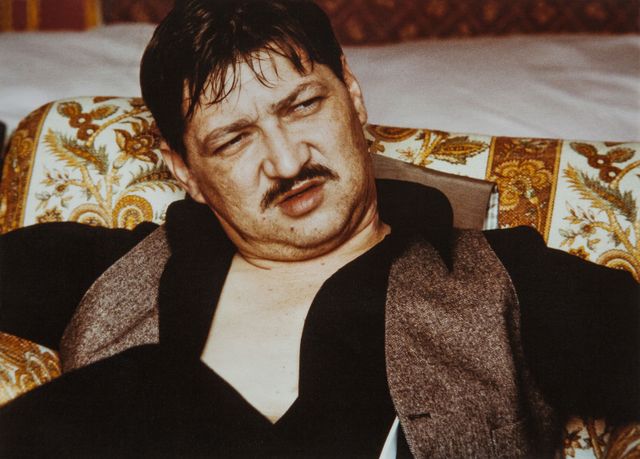
Fassbinder was responsible for some of the better films of the 1970s, including Ali: Fear Eats the Soul (1974), Fox and His Friends (1975) andMother Kuster  s Trip to Heaven (1975). Director Christian Braad Thomsen, who knew Fassbinder personally, has given us a psychological portrait of sorts, demonstrating Fassbinder’s apparent capacity for jealousy and extreme selfishness. There are tell-all interviews with Fassbinder’s frequent collaborators Irm Hermann and Harry Baer. Fassbinder, we are told, came to behave like the child he never had. It is another contribution to the depiction of the iconic filmmaker as a “bad boy” of cinema.
Rainer Werner Fassbinder
As to what conditions in postwar Germany, the period of the “Economic Miracle” and the radical movements of the 1960s and 1970s contributed to Fassbinder’s personality and the direction of his work, including its strengths and weakness, Thomsen never really bothers to ask.
With only the material shown to us in Thomsen’s documentary, it would be difficult to understand why Fassbinder remains a figure worth our attention today.
Kurt Cobain: Montage of Heck also places its subject, the Nirvana front man, on the analyst’s couch. The film focuses on a difficult home life, Cobain’s addiction to heroin and his often rocky relationship with his wife, singer Courtney Love.
Excerpts from Cobain’s journal entries, in which he rails against hypocrisy, the Reagan administration and everything he found phony about official life, provide at least some sense of what was on the troubled artist’s mind much of the time. The anger and disaffection (and much of the pessimism) of the generation that came of age in the 1980s and 1990s found expression in his music.
Early in the film, Cobain’s mother describes the town of Aberdeen, Washington, prior to Cobain’s birth in 1967, as a boomtown in which “even if you didn’t have much, you had enough.” Later, Cobain himself describes Aberdeen as “an isolated wasteland.”
Through what processes did this all-too familiar transformation take place and what was its impact on young people living through it? This is the question the film avoids, and the missing piece in all the biographies about the singer that have appeared over the years.

“Cultural appropriation,” “white privilege” and the attacks on rapper Iggy Azalea

Nick Barrickman & David Walsh

In recent months, the hip hop music industry has witnessed a controversy surrounding the musical success of Australian-born rapper Iggy Azalea (born Amethyst Amelia Kelly in 1990, Sydney, Australia).
Azalea, a white rapper affecting a cadence and drawl similar to artists associated with the southern American hip hop scene, received four Grammy nominations this year (among them, best rap album, record of the year and best new artist), including for her work on 2014’s “The New Classic.” As it turned out, she did not take home any of the awards at the recent Grammy ceremony. Her single “Fancy” has been a huge hit, with seven million copies sold worldwide.
Iggy Azalea
Iggy Azalea’s growing fame in a musical genre largely associated with African Americans has led to verbal assaults on the Australian rapper by a number of well-known figures, including Snoop Dogg, Nicki Minaj and, most notably, the Harlem-born singer-songwriter Azealia Banks.
Banks, who has something of a penchant for conflicts with fellow performers, first took exception to an Azalea lyric on the 2012 song “D.R.U.G.S,” in which the Australian raps: “Tire marks, tire marks, finish line with the fire marks/ When the relay starts I’m a runaway slave-master.” Banks responded on Twitter to the effect that she had issues with anyone “outside of my culture trying to trivialize very serious aspects of it.” Azalea later apologized for the tasteless lyric, admitting that it was “careless.”
Matters escalated after news surfaced late last year that Azalea was nominated for several 2015 Grammy awards. Banks appeared in mid-December on New York City’s Hot 97 radio talk show, accusing the Australian rapper in a lengthy interview of appropriating “black music” for her own ends.
“At the very least y’all owe me the right to my f***ing identity and to not exploit that sh*t,” said Banks in a clearly emotional state, adding, “That’s all we’re holding on to with hip-hop and rap … I feel like it’s being snatched away from me or something … The blackness is gone.” Banks was later more explicit, demanding on social media that “We [African Americans] are the children of the people who perished in the name of modern capitalism and we deserve a piece of that f***ing pie.”
Azealia Banks
On cue, media commentators, fellow performers and other entertainment industry personalities began weighing in on “Azalea-Gate,” chastising Azalea for her perceived lack of humility and contrition. “She [Azalea] seems clueless as to why hip-hop is black dominated, but she’s absolutely sure that she deserves a place in it,” remarked Reni Eddo-Lodge, a commentator on “race and gender issues” for the British Telegraph. “She’s succeeding in a genre with no idea of its social and historical significance,” Eddo-Lodge added.
Sorting through the confusion and social backwardness that the “Azalea-gate” controversy has generated would take more than one comment, but we can offer a few points.
First of all, the effort to examine music and popular culture through the prism of race is a hopeless and reactionary one. There is no such thing as “black music” or “white music.” The musical cross-fertilization between the various national populations in the US goes back to the earliest days of the country. Obviously, that process took place, in the first place, under conditions of the savage oppression of the African population brought to America as slaves. Nonetheless, it took place. In the modern era, one of the glories of American popular music has been the enormous variety of influences and traditions.
Distinct music genres have specific (sometimes specific ethnic) roots, but that has never stopped the mixing and evolution of styles and trends, which is an entirely healthy and often quite spectacular feature of pop music in particular. In fact, that speaks to the essentially democratic character of popular thinking and feeling, when it has a chance to develop organically. To call this virtually unstoppable process “appropriation” is fraudulent and regressive. It should be celebrated rather than denounced.
Rejecting the racialist attacks against Iggy Azalea should not be taken for an instant as a denial of the long history of discrimination against and exclusion of black artists, performers and athletes. The persecutions of boxer Jack Johnson and Chuck Berry are well known. Black jazz and pop musicians were subjected to humiliating conditions for decades, not being allowed to eat or stay in the same restaurants or hotels as their white counterparts. The former were often cheated out of their rightful careers or earnings.
However, the apartheid-like conditions engendered political opposition to the entire existing order among the most perceptive and insightful black artists and musicians. The great singer Paul Robeson, of course, but also blues and folk artists Leadbelly, Brownie McGhee, Sonny Terry, Josh White and others, turned toward the Communist Party (along with many African American writers and poets.). Later, in the 1960s and 1970s, Marvin Gaye, Curtis Mayfield and The Temptations performed openly anti-Vietnam War songs. Stevie Wonder was identified with opposition to Richard Nixon in the early 1970s. (In another field, of course, there was Muhammad Ali, who gained an enormous following because of his opposition to US intervention in Vietnam.)
The American ruling elite was frightened by the inner city rebellions of the 1960s, and the level of black popular disaffection. It set out consciously to cultivate a layer of African American politicians, entertainers and performers who identified with and were committed to capitalism. And this policy has had some success. Hip hop, which emerged in the mid-1970s, was born within that general atmosphere, although there have been and continue to be oppositional voices within it.
However, the general climate of the last several decades has been dominated by individualism, worship of money and status, and political conformism. Much of the noise, posturing and bravado in hip hop, in reality, is an effort to conceal the fact that, on all important matters, the leading artists, often aspiring or successful businessmen and women, align themselves with official public opinion.
So, to suggest that the “radicalism” and “anti-authoritarian sneer” of African American-dominated rap music, which supposedly “valorizes outsiders and underdogs,” is threatened by Iggy Azalea’s “empty white echo,” in the manner of Washington Post pop music critic Chris Richards, is a fantasy. The anti-establishment image of hip hop, in fact, has been largely a marketing and public relations gimmick, which has helped build up careers and bank accounts for a host of performers, producers and record company executives.
Azealia Banks’ comment is revealing. She is not a political figure, and her remarks reflect more widespread attitudes, but they are still a self-indictment. On the one hand, she points out that slavery was bound up with the birth of “modern capitalism,” but then, far from calling for opposition to such a brutal economic system, she pathetically asks for “a piece of the … pie”! This is the outlook of an entire stratum of African American performers, academics, politicians, union officials, “activists” and such—they simply want in, or, in many cases, further in.
Hip hop is a multi-billion dollar industry. Nervousness about the economics of the record industry no doubt lies behind some of the shrill cries about “white privilege” and “cultural appropriation” and the attacks on performers like Iggy Azalea. Total profit from US music sales and licensing was $6.3 billion in 2009, less than half the industry’s $14.6 billion in profits ten years earlier, according to CNN Money. Major label rap music, which makes up a significant portion of the industry’s proceeds, has itself seen a decline in profits as it has been exposed to the proliferation of downloading software and other such technology.
As for the trivializing of “very serious aspects” of history and culture, one doesn’t have to look very far, or search out someone of Azalea’s nationality and skin color. Just one example: Kanye West’s 2013 album Yeezus(nominated for two Grammy awards in 2014), on which the rapper absurdly likened his difficulties with the opposite sex at public venues to South African apartheid and his troubles buying satisfactory luxury goods to chattel slavery in the American South!
If Iggy Azalea’s music is neither challenging nor innovative but immensely popular, that’s part of the general cultural situation under capitalism and the specific impact of the entertainment industry’s immensely powerful marketing apparatus. No serious singer or musician takes to heart such success or lives and dies on sales figures or largely meaningless awards. As the Post’s Richards says himself, speaking of awards ceremonies like the Grammys: “These are private business parties designed to radiate an aura of prestige and pad television ratings.”
Big social and artistic questions face every musician and performer. To do important work in our day means, first of all, rejecting self-absorption and selfishness and struggling with all one’s might to express the broadest social realities and truths. It is absolutely certain that music like that will find a wide and receptive audience.

Pulling down the shutters at the Berlinale

Stefan Steinberg

This is the first of a series of articles on the recent Berlin international film festival, the Berlinale, held February 5-15, 2 015.
Some of the major entries at this year’s 65th Berlin International Film Festival (Berlinale) gave the distinct impression that certain prominent US and European directors had consciously pulled down the shutters to what was going on around them. War raging in the middle of Europe, accelerating inequality, social decline at a level unknown since the 1930s…none of these issues got a look in.
Instead, having hermetically sealed off their work as much as possible from the social and political upheaval currently taking place across the globe, these directors were then free to concentrate on their pet themes—identity politics, sex and death—in an especially self-absorbed manner.

Nobody Wants the Night

Nobody Wants the Night
Two years ago, this reviewer criticised the Spanish director Isabel Croixet (born 1960) at the 2013 Berlinale for offering to share her “perplexity” with her audience. Croixet’s latest film, Nobody Wants the Night, makes clear that behind the director’s “perplexity” is a definite agenda close to the heart of the affluent middle class—gender issues, the elevation of primitivism over civilisation and…building up one’s own bank balance.
In the past, Croixet made a number of election videos for the Spanish Socialist Workers Party (PSOE), one of Spain’s two principal bourgeois parties. Now, possibly in an attempt to distance herself from the thoroughly discredited Spanish social democrats, she has retreated to the North Pole, literally, for her new film.
In Nobody Wants the Night, American Josephine Peary (Juliette Binoche) sets off around the turn of the twentieth century to find her husband, explorer Robert Peary, who has disappeared in the course of an expedition to the North Pole. In the course of her trek across the frozen tundra, Peary is eventually forced to rely on the support of an Inuit girl (Rinko Kikuchi), who it turns out has her own reasons for finding Josephine’s husband. The labourious second half of the movie concentrates on the relationship between the two women and Josephine’s realisation that her civilised upbringing is of little use in the Arctic waste.
In the words of Binoche at a Berlin press conference: “The white, educated person goes into the wilderness and encounters a new way of feeling. I had the image of a peacock becoming a dog.… Nobody wants the night. We don’t want to go into that dark place, but sometimes we need to”.
At the same press conference, following the showing of her film (which occupied the prestigious place of festival opener), Croixet noted that her main motivation for making the movie was to counter male-oriented tales of the Arctic. “Nobody has told the story of the North Pole from the point of view of the woman”, she declared.
When asked about the gender politics at the heart of her film, Croixet made clear that her own conception of feminism was money-based: “I want more money for women”, she told journalists. “That’s what I want! More salary than them [male directors] would be great. But I agree with having the same salary”.
Croixet then when on to applaud the fact that Germany had a female “president” (i.e., Chancellor Angela Merkel) and further revealed her political standpoint with an endorsement of Hillary Clinton for US president: “Maybe if we have more women presidents. You have a president here. Maybe if we had that in Japan or in the States…maybe Hillary!”

Eisenstein in Guanajuato

Eisenstein in Guanajuato
While Croixet identifies the standpoint of women as the missing link in cinematic treatment of the North Pole, the 72-year-old British director Peter Greenaway has decided to examine the work of the outstanding Russian director Sergei Eisenstein by concentrating on his sex life. Eisenstein in Guanajuato is an appalling film that says far more about the demoralised and distorted predilections of Greenaway than it does about the famed Soviet filmmaker.
According to Greenaway, who wrote the screenplay, the loss of his virginity to a Mexican man at the age of 33 is the key to understanding the evolution of Eisenstein’s cinema.
The background to Greenaway’s stupid work was the trip by Eisenstein to Mexico in 1931 to plan a film, Que Viva Mexico!, to be funded by pro-Communist sympathisers in the US. As one critic noted about Greenaway’s film, one does not learn much about the problems Eisenstein encountered in Mexico because he hardly ever leaves the bedroom!
This reviewer fled the cinema after the fifth appearance of Eisenstein’s genitalia in the first hour of the movie.
At the subsequent press conference, Greenaway wallowed in the applause of the assembled journalists, and went on to extol the virtues of Eros and Thanatos in cinema. “Cinema is surely, surely, surely, all about sex and death, isn’t it? Most Western art is all about sex and death from the very, very beginning to the very, very end”.
Greenaway’s films and outlook speak to a very definite social layer who avidly seek to obscure the social realities, including the source of their own wealth and social status—i.e. forms of exploitation determined by concrete social and historical relations—by emphasising “universal” and “timeless” motives such as sex and death.

Knight of Cups

Knight of Cups
In regard to one of American director Terrence Malick’s recent films, this web site concluded, while acknowledging that the work contained a number of striking images, “The Tree of Life is bound up with a certain intellectual quackery, which itself reflects some of the problems of cultural life in the past several decades”.
Malick’s latest film premiered at the Berlinale takes such intellectual quackery to new heights, or depths. Knight of Cups has no discernible plot. Its main character, screenwriter Rick (Christian Bale) wanders listlessly through Los Angeles musing over the worthlessness of his life and life in general—communicated in a voice-over. Rick says very little. Apparently Rick has it all—wealth, Armani suits, career at a peak, a variety of beautiful women (often half-dressed or naked)—but it all seems hollow.
The film is laden with bits of quasi-philosophising balderdash such as “when one gets older, one thinks the confusion would lessen, in fact, it only increases”, and “we are all just fragments with the impossible task of piecing together the fragments”.
Like Greenaway, Malick (born 1943) has his worshippers who are quite prepared to trade in any sort of coherent narrative or delineation of character for a few stunning images. One idolater describes Knights of Cups as a “gorgeous, mesmerising, pensive, exquisite companion piece to The Tree of Life ”. Others maintain that Malick’s new film is a critique of the Hollywood Dream.
In fact, below the surface (and there is not much below the surface) lurks Malick’s apparently growing disenchantment with humanity as a whole. At one point in Knight of Cups, Rick walks past a line of homeless camped under cardboard coverings on LA’s “Skid Row”. The voice-over declares: “Sometimes I wish for a deluge that would wash everything away”.

Queen of the Desert

Queen of the Desert
Veteran German director Werner Herzog (born 1942) avoids the worst excesses of Greenaway and Malick in his new film Queen of the Desert,which has been described as a companion piece to David Lean’s classicLawrence of Arabia (1962). The central character in Queen of the Desert is the historical figure of Gertrude Bell (played by Nicole Kidman), who broke with the traditional role of an upper-class English woman at the start of the twentieth century to take off to the Middle East as explorer and later diplomat.
In her activities as a diplomat, Bell played a key role in establishing borders in the Middle East, most notably those of Iraq and Jordan, which helped British imperialism to maintain its influence over the region. The renewed interventions in recent years by Western imperialist powers have brought chaos and immense suffering to the region. There are certainly sufficient grounds to draw definite historical parallels to and conclusions about the disastrous role of the great powers in the Middle East.
This is not, however, the road that Herzog chooses to take. Bell’s role in drawing up the boundaries of Iraq and Jordan is briefly mentioned at the end of the film, but Herzog prefers to concentrate most of his work on Bell’s frustrated relationships with various male contemporaries, while highlighting what he describes as the “natural beauty” of the region.
In tediously predictable fashion, Herzog told the press that his aim was “to tell a story, not give a history lesson”. When questioned on the politics of the region at the press conference in Berlin, Nicole Kidman passed the buck back to Herzog, saying: “I tried to get Werner to give me a history lesson and he just said: ‘Nicole, this is too extensive’.”
Herzog is on record criticising the demonisation of Muslims by the media, but to the extent that he avoids a genuine historical approach in his new film, he provides a cover for the Western powers that bear responsibility for the complete breakdown of social, political and ethnic relations in the Middle East.
This review has concentrated on a number of the most flawed movies at the Berlinale to draw out some of the ideological and artistic obstacles standing in the way of filmmakers. At the same time, there were films at the festival, new and old, that did adopt a serious approach to history and social life, most notably the documentary The Memory of Justice (1967) by the French director Marcel Ophüls, which deals with the Nuremberg Trials and the aftermath of the Second World War.
Subsequent articles will discuss The Memory of Justice and some of the other more interesting films on view at the festival.

Workers Struggles: Asia, Australia and the Pacific

Asia

South Korean shipbuilding workers accept pay deal

On February 16, more than 60 percent of 15,400 union members at South Korea’s Hyundai Heavy Industries (HHI), the world’s largest shipbuilder, approved a new wage agreement negotiated with the management and ending the 11-month dispute. While the union ended two months of limited strike action on December 31 after reaching a tentative agreement with HHI for a 2 percent pay rise along with other entitlements, the deal was rejected by workers who wanted a 6.5 percent pay increase.
The new agreement, however, is only slightly different from the company’s previous offer. Like the last company offer, it includes a 2 percent basic pay increase, company stock worth 1.5 times the workers’ base salaries, a 200,000-won gift certificate and paid leave on February 23.
Workers will also receive additional increases after a local court last week ruled that the company must treat regularly paid bonuses as regular wages, effectively increasing the baseline in calculating overtime and holiday shift pay as well as retirement pensions.

Nepalese telecom workers protest

Employees of the privately-owned United Telecom Ltd (UTL) in Kathmandu Valley have threatened industrial action if management failed to respond to workers’ 14-point demand by February 18. The All Nepal Organisation of Bank, Finance Workers’ Union—UTL Chapter lodged their claims in July but received no response from management.
The telecom workers want include the company to increase wages, the issuing appointment letters, as per Nepal labour law, to employees who have worked for more than 240 days and the withdrawal of management plans to cut 65 jobs,
The UTL union said action would begin with a four-hour strike next Tuesday, followed by blocking entry to the office of the CEO and the CFO on Wednesday and Thursday for four hours. If management fails to address their demands by Thursday, they have threatened an indefinite strike from Friday.
Their action follows protests last month that affected the company’s telecom service outside Kathmandu Valley, international gateway service and internet service.

Pakistan: Punjab brick-kiln workers protest

Male and female brick-kiln workers on February 16 demonstrated at Gojra in Toba Tek Singh district to demand implementation of the government’s minimum wage ruling. According to the government notification, kiln owners had to pay workers 888 rupees ($US14.3) per 1,000 bricks.
The kiln workers were organised by the Labour Qaumi Movement (LQM), which has also demanded the distribution of social security cards. The LQM has threatened to escalate their protests if the minimum wage payment was not implemented by February 25.

Sri Lankan export processing zone workers strike

Shore to Shore and United Tobacco Processing employees at Sri Lanka’s Katunayake Export Processing Zone (EPZ) struck on February 16 to demand a 2,500-rupees ($US18.8) wage rise, in line with suggestions made by Sri Lanka’s new finance minister in his January interim budget speech. The workers said they would remain on strike until they get the increase.
Fearful that the strike would spread to other EPZ factories, Labour Department intervened and offered workers a 1,500-rupee increase. Workers rejected this offer.
The Shore to Shore company makes and supplies tags, labels and brand packaging to apparel exporters and factories. United Tobacco Processing manufactures and exports cigar tobacco and accessories.

India: Himachal Pradesh hydropower workers protest

Around 1,300 tribal workers at Kinnanur, in Himachal Pradesh state in northern India, have been protesting for over a month at the Jaypee Hydropower to demand higher wages and better shelter and compensation.
The protest initially involved company workers but is now being supported by workers and peasants in the surrounding 18 villages. Despite being exposed to freezing cold conditions, the workers said they would maintain their protest until demands were met.

Tamil Nadu public transport workers to strike again

Following a protest in Chennai on February 14, 20 unions representing 150,000 Metropolitan Transport Corporation (MTC) workers in Chennai have issued a strike notice to take effect on March 3 in support of 45 demands. The workers have not had a wage increase since September 2013.
Their action follows a three-day strike in December which was called off after the Tamil Nadu government agreed to form a tripartite committee to negotiate workers’ demands. The unions said that although the committee was established there have been no meetings.
The major trade unions involved include the Labour Progressive Front and the Centre for Indian Trade Unions. The Anna Thozhir Sangam Peravai trade union, which is supported by the ruling All India Anna Dravidian Progress Federation, is not participating in the strike.

Australia and the Pacific

Coles supermarket workers continue strike action

Meat workers from the Coles supermarket chain in Victoria struck for 24 hours on Wednesday and picketed the Coles store in Richmond, Melbourne over the company’s attacks on wages and conditions in a proposed enterprise bargaining agreement (EBA). Their action follows one-day strikes on February 6 and 11 over the issue.
Australian Meat Industry Employees Union (AMIEU) members are concerned that a workplace agreement between a rival union—the Shop Distribution and Allied Employees Association (SDA) and Coles—could reduce their existing wages and conditions. Under the SDA agreement, all new supermarket meat department workers will be on lower wages and conditions than AMIEU members. Workers are concerned that Coles intends to use the SDA agreement to do away with skilled meat workers.
The SDA agreement, which would cover all Coles’ meat workers and truck drivers, penalty rates would be reduced or eliminated, weekend work made mandatory, sick pay reduced, rostered days off axed and cuts made to adult rates for young meat packers and cabinet attendants. Newly-recruited butchers would receive up to $12,000 less a year, and any new meatpackers up to $8,000 less.

Sydney construction workers strike

Construction workers at the Barangaroo building site in Sydney, New South Wales took protected industrial action on February 16 in a dispute for a new enterprise bargaining agreement. The strike prevented Boral concrete trucks entering the site. The Construction Forestry Mining and Energy Union (CFMEU) has been negotiating with DeMartin and Gasparini, a subsidiary of Boral, for over nine months for a new agreement.
According to the CFMEU, Boral and De Martin and Gasparini are using a draft federal Liberal government Building Code, which is not law, to force workers to give up current conditions. A union spokesman claimed that the company wanted to insert clauses into the agreement that would casualise its workforce. Workers had previously rejected a wage offer that was at least $50–$100 less a week in wages, including less site allowances, than their demands.

Queensland coal and freight train drivers strike

Several hundred coal and freight train drivers in Queensland’s Mackay region, planned to strike for 24-hours yesterday in a 19-month pay dispute with rail operator Aurizon. Rail, Tram and Bus Union (RTBU) members at the company’s Bluff, Stanwell, Callemondah (Gladstone) and Pring (near Bowen) depots planned to walk out. Union members at Jilalan, and Coppabella will stop work on February 23. Their action follows 24-hour stoppages in January over the dispute.
Drivers are concerned that Aurizon is moving to terminate the current enterprise agreement and take away existing conditions and allowances which outweigh a 4 percent pay rise the company is offering. Aurizon says it wants so-called “legacy provisions” scrapped from the current agreement, including no forced redundancies, restrictive rostering practices and various allowances.

Western Australian coal miners threaten to strike over pay cut

Around 220 Griffin Coal mine workers in the south-west town of Collie in Western Australia have threatened to strike over wage-cutting moves by company management. Lanco Infratech, which purchased the mine in 2011, has responded to falling coal prices by demanding pay cuts as high as $50,000 a year.
Lanco Infratech has presented workers with various cost-cutting options, which it claims are necessary to keep the mine “financially viable.” The first option involves a 42-hour week, foregoing a 7.5 percent pay rise due to be paid this year under an existing agreement, and a 17.5 percent pay cut from current wage levels.
The second demand is a 17.5 percent pay cut, but with CPI linked increases, and in increase in working week from 42 to 56 hours.
The third demand involves a 38 percent pay cut and reduction of the working week to 35 hours on a five-day roster. This would mean workers losing weekend and overtime penalty payments, which amount to an average $47,000 annual cut in each worker’s pay.
A CFMEU representative said workers had rejected these “offers” and would strike if Lanco imposed its demands. The CFMEU, however, has already accepted the company’s refusal to pay the outstanding 7.5 percent pay rise due this year.
Griffin Coal is one of the main suppliers for the state’s coal fired power stations and industrial action would impact on the state’s power supplies including in Perth, the Western Australian capital.

New Zealand: Wendy’s fast food chain workers continue protesting

Following protests last week in Auckland, Wendy’s Hamburgers workers in Christchurch, on New Zealand’s South Island, demonstrated outside Wendy’s restaurant at Hornby on February 18 in a dispute over “zero-hours” contracts. Zero-hour contracts do not guarantee any hours of work and employees are always on call. Contract employees do not receive the same entitlements as other workers, such as a day off in lieu for any public holidays worked.
McDonald’s, KFC, Pizza Hut, Starbucks and Burger King also employ staff on these contracts with workers rostered anywhere from 3 to 40 hours a week. According to the Unite union, the only workers with guaranteed hours at Wendy’s are those with two years’ service and “open availability” for six or seven days in a week.

Schäuble’s arrogance towards Greece and the class divide in Germany

Peter Schwarz

German Finance Minister Wolfgang Schäuble’s rejection of a request from Athens for financial aid risks Greek state bankruptcy and the country’s exit from the euro zone.
Although EU finance ministers have reached a provisional agreement with the Greek government, for some time it was unclear whether this would be possible, given Schäuble’s arrogant stance. Nonetheless, a large part of the German media and several European governments supported the aggressive approach of Schäuble, who is demanding nothing less than unconditional surrender from the Greek government.
The Frankfurter Allgemeine Zeitung announced excitedly that “Poker-face Varoufakis [had] found his master” in Schäuble, and that “The EU must insist on compliance with the agreed terms.” Die Welt titled an editorial “Schäuble knows which language Athens understands!” And the headline in the tabloidBild ran, “Germany says: Thank you, Wolfgang Schäuble!” and, “Finally, someone says NO to the bankrupt Greeks”.
Some voices also warned of the risks posed by a line of constant confrontation. For them, it is not about the misery and social devastation that five years of austerity have brought about in Greece; they do not complain about that at all. Rather, they fear disadvantages for Germany and the European Union (EU) if the new Greek government does not receive the necessary room for manoeuvre, so it can at least save face.
The objections to Schäuble’s stance range from the impossibility of escaping the vicious circle of recession and growing national debt, to the billions in losses which would fall on Germany in the event of a Greek sovereign default, to the danger that Greek exit from the euro could trigger a European chain reaction and induce the end of the euro. The geopolitical consequences that a possible Greek exit from NATO and a growing influence of Russia or China on the Mediterranean country are also cited.
Despite these serious objections, why does Schäuble and those standing behind him maintain their uncompromising stance?
It cannot be explained by senile obstinacy or Schäuble’s poor personal relationship with his Greek counterpart Varoufakis. The 74-year-old Christian Democrat is one of the most experienced politicians in Europe. He has been in the Bundestag (parliament) for 42 years and has held numerous ministerial posts since 1984; he negotiated the unification treaty with East Germany in 1990, and was for a long time regarded as Helmut Kohl’s crown prince for the office of chancellor.
To understand Schäuble’s real motives one must look beyond the Greek borders to Europe and Germany. On the same day on which Schäuble pointedly rejected the letter from Athens, the Paritätische Wohlfahrtsverband, an umbrella organisation of welfare organisations, published a new report on poverty in Germany. Its conclusion was that the country is as socially divided as never before.
The poverty rate has risen steadily since 2006, and is now running at 15.5 percent, or 12.5 million people. In the east of the country, it stands consistently above 18 percent, and in the capital Berlin at 21.4 percent. At the other pole of society, wealth is growing enormously. A recent study revealed that one third of German private wealth lies in the hands of the richest one percent of the population.
Germany is one of the richest countries in the EU and is one of the few where the economy has grown slightly in recent years. In other European countries and in the European Union as a whole, social inequality is even more marked.
This is the result of a deliberate policy. Since the 2008 crash, European governments and the European Central Bank have pumped trillions into the banks, making working people throughout Europe pay through falling wages and cuts in social benefits. The results can be seen in the rise of the DAX, Germany’s leading stock index. Since the low point of the finance crisis, it has risen from below 4,000 to 11,000 points.
In this dramatic redistribution of income and wealth, Greece served as a pilot project. From the perspective of the European financial elite, the so-called “rescue” of the country was merely a continuation of the bank bailout programme. The supposed “financial aid” has not benefited the Greek treasury, but has gone to the accounts of the banks who have rid themselves of their risks and pocketed massive profits.
The bill has been paid by the Greek people, through the devastating social cuts dictated by the troika, whose economic policies recall those of bloody dictatorships like the Pinochet regime in Chile.
Schäuble’s reckless arrogance was aimed above all at the working class in Germany and throughout Europe. He is trying to intimidate anyone who dares to oppose the policy of social devastation.
What Schäuble expressed in the arrogant but polished language of the politician was translated by Bild, this inexhaustible source of intellectual pollution from the Springer publishing house, into the inflammatory language of the gutter. Bild articles on Greece are full of racist terms such as “bankrupt Greeks”, “Greek profiteers” and “Extremos of Greece”. The paper developed a veritable Führer cult around Schäuble: “I trust this face. I trust this man ... Something harder does not exist “, wrote columnist Franz Josef Wagner.
The media are well aware of the link between the intransigent attitude of the German government regarding Greece and the growing social tensions in Europe. The financial daily Handelsblatt defended Schäuble’s stance, stating, “How would Mr. Rajoy (otherwise) want to explain that his over-indebted and austerity-plagued Spain must be further reformed?” Die Welt warned that Syriza might obtain “cheerful imitators” if it looked like the Greek government had won a victory.
It is no coincidence that Schäuble is most strongly supported by the governments of some of the poorest countries in Europe, such as Slovakia and Lithuania, who have themselves carried out massive cuts in social spending and fear the reaction of the working class.
Syriza has nothing with which to oppose this policy. As the WSWS wrote earlier this week, it does not represent the “insurgent masses”, but rather comes “as a supplicant speaking on behalf of failing Greek capitalists” to Brussels and Berlin. It directs itself exclusively to the elites in politics and business, and has not appealed to the European working class at any point. It does not question the capitalist system and supports the European Union, the political and organizational framework for the offensive of the banks against the European working class.
The ruling class offensive can only be repulsed by revolutionary means: the independent political mobilization of the working class throughout Europe against capitalism.