9 Apr 2015

The U.S. and Israel: Diverging Interests

Lawrence Davidson

It is often alleged that the basis for U.S.-Israeli relations lies in “shared concerns and interests.” However, what really holds the relationship together is a systemic aspect of American politics – the system of special interest lobbying and the money that underlies it. That practice is just about as old as the country itself, and the Zionist lobby is a past-master at exploiting this system. With the Supreme Court rulings telling us that political spending and donations are forms of free speech, this rather perverse aspect of U.S. politics is not going to change in the foreseeable future.
Therefore, one would assume that the present deterioration in relations between the Obama White House and Israeli Prime Minister Benjamin Netanyahu, as refreshing as it is, only represents a temporary glitch rather than a permanent breach in the alliance between the two countries. Well, perhaps, but getting the relationship back to the status quo ante may be harder than many expect.
For example, on 29 March 2015 the New York Times reported that Hillary Clinton met with Malcolm Hoenlein, executive vice chairman of the Conference of Presidents of Major American Jewish Organizations to let him know that she wants to “improve relations with Israel.” That sort of statement is a standard prerequisite for anyone planning to run for the presidency in 2016. While there was no elaboration on the meeting coming from Clinton’s office, Mr. Hoenlein was quite forthcoming. According to him, “Secretary Clinton thinks we need to all work together to return the special U.S.-Israeli relationship to a constructive footing, to get back to basic shared concerns and interests.”
Wishful thinking aside, is that really possible? While Clinton is attuned to her political interest in keeping the Zionist lobby bipartisan in 2016, Mr. Hoenlein seems blind to the fact that the U.S. and Israel no longer have any “shared concerns and interests” in the Middle East. In fact, looked at it objectively, their “concerns and interests” are now in opposition.
A Major Foreign Policy Goal Since 2001
Since the terrorist attacks of 2001, a major foreign policy goal of the U.S. government has been the pursuit and destruction of the Sunni extremist organization al-Qaeda and its offshoots. To that end the Americans invaded Afghanistan in 2001 and, more problematically, Iraq in 2003. The popular frustrations that resulted from those wars brought Barack Obama to the presidency in 2008 in order change tactics, but not the goal. In other words, the American public still approved going after al-Qaeda, but were tired of the costly war-making approach characteristic of the Bush Republicans and their neoconservative advisers. In truth the Bush approach of invasion and “regime change” proved disastrously counter-productive. It caused the collapse of political stability in both Afghanistan and Iraq thus creating power vacuums that became breeding grounds for al-Qaeda.
Obama rationalized the anti-al-Qaeda campaign. He ended the unpopular American occupation of Iraq and wound down the Afghan war. In their places he substituted drone warfare. Drones kill jihadists (and a lot more folks as well) with no great risk to American lives (though harm to the psychological health of the computer jockeys guiding these weaponized model airplanes is certainly a cost). You just remotely steer the drones to the place where your informants say your target happens to be (dinner party, family visit, wedding, etc.) and launch the drone’s missiles into that spot. Straightforward, except for the fact that, on average, drones kill 28 civilians for every enemy individual they target. In fact, that is what the U.S. was doing in Yemen before the Saudis started their present, much more indiscriminate, bombing campaign (using real airplanes) throughout that country.
U.S. allies in the region, specifically Israel and Saudi Arabia, had no problem with the drone attacks against al-Qaeda until 2011. That was when civil war broke out in Syria and when al-Qaeda and its offshoots showed up to fight against the embattled Assad regime in Damascus. Keep in mind that Assad was seen as an enemy of Israel. Syria called for help from Shiite Iran and Hezbollah (also enemies of Israel). Soon the fighting spread across the border into northern Iraq, and the Iraqi government also called for help from Iran.
From an American, anti-al-Qaeda perspective, things began to look really bad. ISIS (aka the Islamic State of Iraq and the Levant), an al-Qaeda inspired movement operating in both Syria and Iraq, declared itself the “new caliphate” and started to take and hold territory while cutting off the heads of anyone who got in the way. The Obama administration did not want to go back into another Middle East war (they still had residual troops on the ground in Afghanistan) but fortunately “boots on the ground” proved unnecessary. Why? Because there was another power right in the region willing to pick up the slack – a power which was just as much an enemy of al-Qaeda as the U.S. was. That power was Iran.
That meant that certainly by 2014 the United States and Iran understood that they were on the same side of a struggle that, in the U.S., represented a primary concern of the American people for the past 15 years. On the Iranian side the concern was even more immediate, because the aggressive behavior of ISIS threatened Iran’s western border as well as its Lebanese ally, Hezbollah. Given this situation, the last thing both countries wanted was open hostilities with each other. That encouraged both parties to work hard to settle the dispute over Iranian nuclear power.
Divergence
Unfortunately, Israel, and by extension the American Zionist lobby, had lost interest in U.S. concerns about al-Qaeda. Indeed, Tel Aviv had come to take the opposite point of view, seeing some merit in Islamic terrorists as long as they were Sunnis. One has to keep in mind that the Israelis are obsessed with Shiite Iran and its nuclear energy program, which Prime Minister Netanyahu has hysterically proclaimed a danger to the survival of Israel. From that point of view any enemy of Iran is a friend of Israel – even if it is al-Qaeda.
Indeed, in 2013 Michael Oren, then Israeli ambassador to the United States (actually he grew up in West Orange, New Jersey), told the Jerusalem Post, “We always wanted Bashar Assad to go, we always preferred the bad guys who weren’t backed by Iran to the bad guys who were backed by Iran.” A year later he was at an Aspen Institute Conference and declared that Israel would prefer the victory of ISIS to the continuation of an Iranian-backed Assad. Nor have the Israelis been shy about acting on this preference. They have established a non-aggression pact with an al-Qaeda Syrian affiliate called the al-Nusra Front, cared for al-Nusra wounded in Israeli hospitals, and mounted attacks on the Lebanese and Iranian forces opposing al-Nusra.
So, at least in Syria, Israel is actively supporting a group that had, in an early incarnation, attacked the U.S. – one that represents forces that still pose a major worldwide risk to U.S. security. Perhaps someone ought to update Congress on this point.
This rearrangement of allies has made for strange bedfellows – not only the U.S. and Iran, but also Israel and Saudi Arabia. And that brings us to the present situation in Yemen. Until the recent Saudi air strikes in Yemen, that country was the most active site of U.S. drone attacks against al-Qaeda operatives. But the Saudis don’t see the war on al-Qaeda as any more important than the Israelis. Their main concern is, once more, Shiite Iran whom they see as much more an enemy than either jihadists or Zionists. So the Saudis have thrown a temper tantrum over the recent deal over Iran’s nuclear program. Part of their acting out was to tell Washington to pull its drone operators out of Yemen because the Saudis were going to bomb that country and particularly its Shiite Houthi population to ruination. Ruination of course, means the creation of a power vacuum in Yemen, and just as in Syria and Iraq, power vacuums create the ideal breeding ground  for extremist groups like al-Qaeda. Finally, there are unconfirmed reports that at least some of the munitions the Saudis are dropping on Yemen are made in Israel.
Conclusion
Obviously the real “concerns and interests” of the United States in the Middle East have noticeably diverged from those of Israel. As a consequence Israel is now loudly complaining that Washington has abandoned it. Well, Washington might do well to play the same game – to loudly complain about Israel’s traitorous behavior. After all, the U.S. gives that country a lot of money and weaponry and now the Israelis chose to support their benefactor’s enemy.
We can count on the Zionist lobby to try to obfuscate this fact. And, given that their financial and ideological power helps shape self-serving political interests in Congress, they may be able to pull it off, at least in that venue. They are also financially backing the Republicans when it comes to the 2016 presidential race. Can those politicians who support the Israeli perspective win that election?
Hopefully, the Israeli point of view will now prove to be a hard sell when it comes to the American voter. The recent agreement with Iran has created a new reality for the country’s foreign policy – one that is consistent with the popular desire for no further U.S. military involvement in the Middle East. It is going to be difficult for bought-off politicians, even those allied with Fox TV, to throw everything into reverse and declare al-Qaeda an ally and Iran still the mortal enemy. Hopefully, that will translate into political failure in 2016 for anyone who wants to undo the new accord with Iran.

Autocrats United Against Yemen

Adil E. Shamoo

The latest war in the Middle East is now well underway in Yemen, where airstrikes by a Saudi-led coalition have killed hundreds and plunged the Arab world’s poorest country into a deepening humanitarian crisis.
The target of the strikes are Yemen’s Houthi rebels, Zaydi Shiite resistance fighters that seized the capital Sanaa last January and have made inroads in southern Yemen since. Other members of the 10-country coalition include Egypt, Sudan, Pakistan, and most of the Gulf Cooperation Council of Sunni monarchies.
Washington has confirmed that it’s providing logistical support on the ground.
It’s a variation on an old theme, where autocratic and despotic regimes in the Middle East call on the United States to do their dirty work. The result for the United States helping these regimes to stay in power has been the prevalence of anti-Americanism among Arabs and Muslims.
Nonetheless, in addition to providing intelligence to the Saudis for their bombings in Yemen, the U.S. also just removed its partial weapons freeze on Egypt’s military regime — a signal of approval of Cairo’s leadership in the anti-Houthi fight.
A Proxy War?
The members of the coalition allege that the Houthis are proxies for Tehran. By roping in Washington, the Saudis (like the Israelis) may be trying to forestall the U.S. rapprochement with Iran after the recent breakthrough in nuclear talks and tacit cooperation between the two countries against the Islamic State in Iraq.
Media reports have largely echoed the charge that the Houthis are Iranian proxies. Yet this misleading cliché serves no other interest than to demonize Iran.
Though it’s likely that Tehran is helping the Houthis in some capacity, scholars on Yemen have been unable to gather much credible evidence of Iran’s military involvement. Even Katherine Zimmerman, a policy wonk at the right-wing American Enterprise Institute, told Foreign Policy there was “nothing that’s seen as hard evidence” to indicate Iranian involvement.
More likely, the driving forces of the rebellion are local, as a Chatham House report by Peter Salisbury recently indicated, concluding that the influence of external forces is exaggerated. “The Houthi are not Iranian proxies in the sense that Hezbollah is an Iranian proxy,” adds British foreign secretary Philip Hammond. Even if Iran is supplying help, Tehran “can’t actually control what the Houthis do.”
Of course, the U.S. is over 7,000 miles away, yet it flies drones, runs special ops, and facilitates Saudi bombing raids in Yemen. Can it really treat alleged Iranian involvement from next door with much disdain?
A Local Conflict
Despite some of their more strident rhetoric, the Houthis appear much more moderate in their aims — namely, representation and resources for their Zaydi Shiite constituency — than they’re credited with by the West. They’re also staunch opponents of al-Qaeda in the Arabian Peninsula (AQAP), the al-Qaeda franchise most feared by Western intelligence agencies, and of the Islamic State, which has allegedly established a foothold in Yemen.
But outside these Sunni extremist forces, the conflict in Yemen isn’t so much about sectarian affiliation as it is access to resources.equalworthHome to 25 million people, Yemen is one of the poorest countries in the world despite the recent discovery of oil there. Resources have historically been scarce and wealth is concentrated among the few in power.
In the late 1960s, Yemen went through two simultaneous revolutions — one in the north and one in the south. A new Yemen Arab Republic was declared in the north along the Saudi border and enjoyed good relations with the Saudis. In the south, a new Peoples Democratic Republic of Yemen was declared. A socialist country, it enjoyed the patronage of the Soviet Union and favorable relations with Tehran.
In 1990, the two countries merged into a unified country under the leadership of Ali Abdullah Saleh as a president. Yes, that’s the same Saleh who became a cooperative client of the United States.
Saleh became increasingly corrupt and autocratic, concentrating power in the hands of his family before he was finally deposed in 2012. In the meantime, AQAP thrived in Yemen, opening the door to later inroads by ISIS. Both AQAP and ISIS are sworn enemies of the Shiite Houthis. Recently, suicide bombers allegedly linked to ISIS killed and wounded hundreds of Shiite worshipers.
The Houthis backed the uprising that overthrew Saleh from the presidency in 2012. But in the current Houthi revolt, Saleh — a secular Zaydi Shiite who retains some supporters in the Yemeni army — has supported them in the hope of re-installing himself or his son to power. He’s calling for new elections, since the pact that ousted him and installed his
vice president, Abdu Rabbu Mansour Hadi, as the country’s leader was only intended to be transitional.
Playing with Fire
With the Houthis continuing to make gains around the southern port city of Aden despite the airstrikes, the Saudis’ bombing alone will not likely not be enough to tip the battle. More ominous is the prospect of a ground intervention, particularly as Sunni Arab countries contemplate forming an “Arab NATO” alliance to enforce the region’s status quo.
However, the Houthis and their allies are battle-hardened and know the terrain — this is their mountainous country, after all. The war could then degrade into guerilla warfare with no end in sight. With their chief rival for power tied up, al-Qaeda and ISIS will thrive further. Even now, AQAP is exploiting the chaos.
The Egyptian-Saudi armada to topple the Houthis and their allies could result in Iran deepening its own suspected involvement in the war. The involvement of so many countries in the region in the war in Yemen could result in a wider war with completely unpredictable outcomes, even outside the country’s borders.
The Saudis and the Egyptians are particularly vulnerable to internal and external serious rebellions. The Saudis military may not stay loyal to the regime if the war with Yemen drags on. The restive Shia population in eastern Saudi Arabia may rebel. The majority Shia in Bahrain could rise up again against the Bahraini government, as well as against the Saudi military forces stationed there. The Egyptians are at war from within already and the new war will just inflame it further.
The silver lining is the emerging U.S. rapprochement with Iran, which could tilt control of the narrative away from Israel and the Sunni countries and form the basis for a mediated settlement — but only if the recent nuclear agreement survives an assault from Netanyahu and congressional hardliners.

Refugees in Indefinite Detention

Binoy Kampmark


“Australia is holding more than 30 people in indefinite detention for undisclosed reasons. These people are recognised refugees who cannot return home due to the dangers they face there.”
Remedy Australia, Petition
Melbourne, Australia.
Daniel Flitton, senior correspondent for The Age, sees the lack of interest in Australia’s novel approach to indefinite detention for refugees as unfathomable. Concerns about metadata retention, and the elasticity of surveillance powers, may have been REGISTERED on the Australian pulse, but “People don’t much care that in Australia a confidential judgment by ASIO has condemned more than 30 people to endless incarceration.”
Earlier this year, the same paper reported that, “without fanfare or public notice, 10 men slipped recently into the Australian community. They are now tasting a freedom denied to some of them for up to five years” (The Age, Jan 10). According to sources, “ASIO had assessed the men, most of whom were Tamil, to be a threat to national security, but in the past few weeks this decision has been reversed.” Such is the arbitrariness of bureaucratic judgment.
More importantly, this is Australia’s contribution to legal purgatory, its healthy bite size offer in the revisions of refugee rights. It is a view that finds non-citizens as subjects of indefinite detention not by any genuine legal standard, but in accordance with the shoddy, often ill-informed speculations of the domestic intelligence service, ASIO.
ASIO, in other words, maintains a judicial foothold it should scant have. International conventions do not factor in such assessments – the primacy of sovereignty, the hoarse, over-stated voice of national security, counts above all else. By the same token, the agency does not have the powers of detention the Minister for Immigration has.
A security assessment, for its presence or lack of quality, is to be fed into what should amount to a range of factors. Immigration ministers are, however, notoriously fickle on the subject, deferring to the espionage service as a reflex. ASIO’s position is always that such individuals are assessed on “knowledge and information available at the time and in the context of the security environment.”
The result of such determinations is a twilight zone of control and monitoring. As a refugee assessment to the Commonwealth Ombudsman went, the detainees in question  with an adverse security assessment are being accommodated in a low security facility and are able to participate in excursions to the movies, the temple, the market and other public places; but are told that they cannot live in the community because they are a threat to Australia” (The Age, Mar 28).
Australia has, like its bosom ally of note, the United States, been attempting to come up with a range of legal exotica in this regard. The rather crabbed view of the Abbott government to the institutional disease we call indefinite detention was to simply justify it on other grounds. The UN Human Rights Committee in 2013 took the government to task in the indefinite detention cases of FKAG et al andMMM et al. The response from Canberra in both cases has been crass and predictable.
In FKAG et al v Australia (HRC, 2013), the Committee found violations in articles 7 (inhuman and degrading treatment, and 9(1) (arbitrary detention) and 9(4) (habeas corpus) of the International Covenant on Civil and Political Rights for the 37 authors of the complaint, 36 of whom were Sri Lankan Tamils including THREE children, and one a Burmese man of Rohingya ethnic minority. The Committee recommended that the applicants be released “under individually appropriate conditions” and provided full “rehabilitation and appropriate compensation.” Finally, Australia was encouraged to comply with the prohibitions on inhuman and degrading treatment and arbitrary treatment outlined in the Covenant.
The response to the Committee recommendations was cool. A mild admission that the Covenant had some relevance to Australia’s legal obligations was noted, along with the injunction against arbitration and indefinite detention. But ASIO’s “assessment on whether it would be consistent with the requirements of security” to take certain “administrative action” was admitted as gospel. “It is Australia’s policy that unlawful non-citizens who are the subject of adverse security assessments from ASIO will remain in held immigration detention, pending the resolution of their cases.”
Then came the ticking off. The Committee had not “given adequate weight to various processes and policy developments outlined in Australia’s submissions.” The Australian government submission reads like an apologetic justification for abuse. Besides, Australian officials were being generous. There were regular reviews of an “independent” sort. And it wasn’t all that bad. “As at 27 November 2014, a total of 12 adult authors have been released from immigration detention following new security assessments by ASIO.”
The recent interest in this self-contrived legal vacuum was only sparked by such organizations as Remedy Australia, a body that has persistently argued that detention of such a nature is unwarranted and patently unjust. On top of that, they have argued that any such individuals should be compensated on release. They have as their allies in such figures as Harvard law professor Gerald Neuman, who served on the HRC when it decided the relevant cases. The jurist found the response from Canberra striking. “You have to give people notice of the reasons why they are being held.”
The point to be made is that the main parties, those clumsy political players who simply swap government positions like picnic chairs, agree with such extra-judicial treatment. “Neither Labor or the Coalition,” explained The Age (Jan 10) editorial, “can take credit for anything but callous subservience to political expediency.”
The altar of national security requires its perverse sacrifices, none of which actually hold any content of truth or value. The state is mere hologram and fiction, a nonsensical compact held together by assumption and fantasy about its security. That such fantasy should wander into the world where desk bound agents, rather than the judges, don the wig of authority and the gown of wisdom, is something that Australia, and other countries, have BECOME complicit in.

April: Promising and Annoying April

Barbara Nimri Aziz

April is a difficult month in northeastern US. By difficult, I mean it’s annoying and at the same time promising. Promising because it marks the end of winter’s discomforts. Yet real comfort and signs of new growth remain elusive.
The landscape into which we dreamily gaze in anticipation of that relief is not only colorless. It’s drab and hazy and lifeless. At least winter gave us crisp, clear air, and the radiant contrast of sparkling, white snow and naked, black trees that frame a magnificent eagle gliding through the river valley. Our shy red cardinals are easy to spot in winter too. And the ice! Sheets of ice cling in giant curtains over rock hillsides and rows of glass icicles hang from roofs outside our windows.
Now, with ice and snow melting away, fields are littered with broken branches and other winter detritus. New York City streets not yet rain-washed, stink terribly from the droppings of hundreds of thousands of New Yorkers’ pet dogs. Pieces of discarded city life, hidden under snow for months now lie exposed, soggy, and undecipherable.
But warmer days assure us winter is ending (if not ended). Taking the air temperature as our cue, we have our cars washed of months of accumulated mud and salt; we enthusiastically pack away woolens and boots and optimistically pull off plastic insulation from windows. We let our shoulders relax and open our necks to the wind and lift our faces to speak real words to our neighbors who during winter only got a nod from behind our knit-wrapped heads.
Then the thaw ends. Temperatures plummet and we awaken to four inches of spring snow. Puddles of water and mud in driveways and streets freeze, so that stepping on this tender snow-cover becomes particularly hazardous.
We search the landscape for color. That corner patch of earth catching some midday sun? Alas, a budding crocus. (Perhaps an early daffodil.) I recognize emerging green leaves that might release a blossom tomorrow.
Newly arrived birds bring color too:–blue of blue jays, red of robin, and rust of merganser ducks. With these flecks of color we become more assured that spring’s really here. Our confidence grows when we detect new smells:– the unmistakable aroma of healthy, rotting earth, tree bark falling away to release the odors of new growth. I inhale deeply.

8 Apr 2015

Detroit arts projects highlight brutal US prison system

Seraphine Collins

Natural Life, on view February 6-March 28 at the Museum of Contemporary Art Detroit (MOCAD), calls the attention of museum-goers to the savage practice of Juvenile Life Without Parole (JLWOP) imprisonment. The three-piece installation project is comprised of a designed space, a 77-minute documentary film featuring interviews with several JLWOP inmates and an interactive web site.
The MOCAD exhibition culminated in a panel discussion following a final screening, and featured guests Donald Logan, a formerly incarcerated juvenile lifer, Deborah LaBelle, an attorney representing juvenile lifers in Michigan, and Michael Brown, an instructor with Writer’s Block.
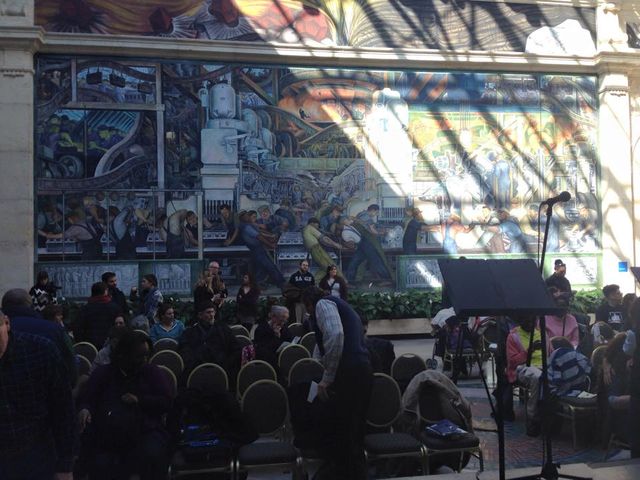
Writer's Block event in the Rivera Court, DIA
On February 28, Writer’s Block, a non-profit literary arts workshop for prisoners, facilitated by members of the Hamtramck Free School, in Hamtramck, Michigan, presented poetry and visual work from 12 inmates. The presentation took place in the Rivera Court at the Detroit Institute of Arts (DIA), where poems were read by family members and friends of the imprisoned, to an audience of 250.
WSWS reporters attended the Writer’s Block event and MOCAD screening, and recently spoke to Natural Life creator Tirtza Even to learn more about the projects’ goals.
The United States is the only country in the world that allows JLWOP sentencing. JLWOP was ruled unconstitutional by the US Supreme Court in June 2012, as a violation of the Eighth Amendment to the Constitution’s prohibition of “cruel and unusual punishments.” However, the decision to apply the ruling retroactively is still determined at the state level, leaving the lives of 2,500 individuals in the balance, hundreds of whom are still imprisoned in 2015, including 365 in Michigan—the second-highest number in the nation. As of 2011-2012, there were 12 13-year-olds and 77 14-year-olds serving life sentences in the US.
The press kit for Natural Life points to the increasing barbarity of Michigan’s laws. Prior to 1988 charges against children under 17 had to be filed in juvenile court. Prosecutors could ask judges to waive 15- and 16-year-olds to adult court. The law was then changed in favor of automatic waivers, which allowed prosecutors to charge 15- and 16-year-olds directly as adults. In 1996, “The automatic waivers from the 1988 change in the law were expanded to include 14-year-olds for homicide offenses. Once convicted in adult court of first-degree murder, the judge has no discretion but to sentence the youth to Life Without Parole.”
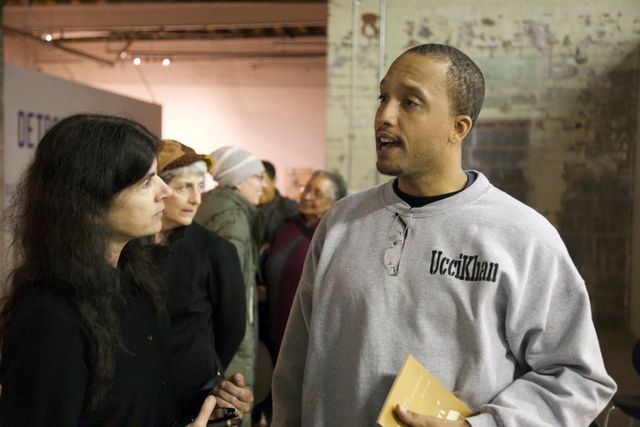
Tirtza Even with assistant director Phillip Sample
Filmmaker Tirtza Even, the creator of Natural Life, holds masters degrees in telecommunications and cinema from New York University’s Tisch School of the Arts; she currently teaches at the School of the Art Institute of Chicago. Her prior work includes pieces on Palestine as an occupied territory and an exploration of the experience of hearing impairment. Her interest in JLWOP arose when, while employed as a University of Michigan assistant professor in 2007, she took her students into a Michigan correctional facility where they produced collaborative film projects with inmates, as participants in the Prison Creative Arts Project (PCAP). It was there that she encountered the evocative poetry of inmate Justin Gibson, 24 years old at the time and serving a life sentence. This encounter has informed her work focus ever since.
After collaborating with Gibson for nearly three years, she realized the project’s completion would signal a change in her life, while Gibson, now a dear friend, would remain imprisoned for the entirety of his. This realization led to Even’s determination to expose the inhumane practice of JLWOP, resulting in Natural Life, which Even describes as her first project to concern itself more with content than with craft.
The stories presented in the Natural Life film, culled from some 50 hours of phone interviews with five current Michigan JLWOP inmates, alongside interviews with family members and experts on JLWOP, are innately compelling for audiences. Moreover, the aesthetic choices made by Even and her team in the film production and environment design are clearly discernable and allow for those stories to be told with grace and clarity.
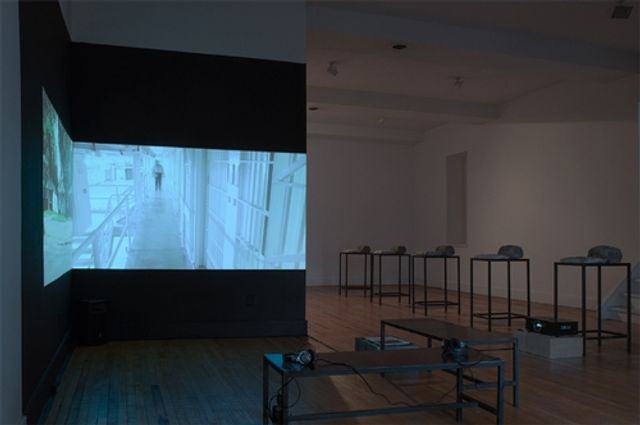
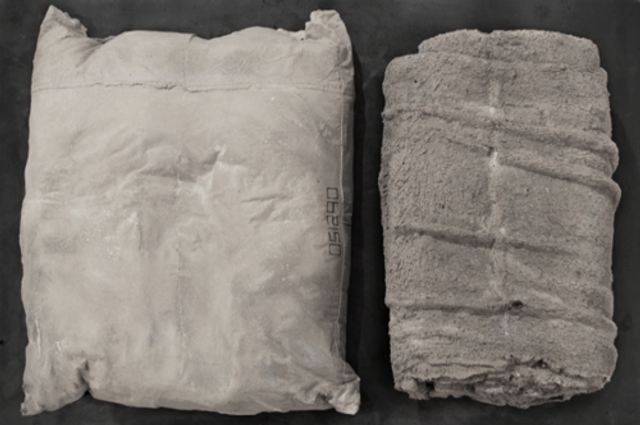
The installation space, conceived of by artist Ivan Martinez, includes five cast concrete and steel sculptures, one for each juvenile represented in the film, each comprised of a set of standard-issue prison bedding. The cast pillow and blanket are scaled down to child-size and each set is inscribed with the birth and arrest dates of the featured individual, directing the viewer’s attention to the small span of time each prisoner lived in the outside world, free. The film itself is constructed as a diptych, with two separate images always playing side-by-side, and is projected into a corner. The audience is meant to feel boxed in by this and the two steel benches provided for viewers to watch from, purposefully placed to create the opposite boundary of the box, emulating the floor plan of a cell.
Natural Life Installation
The film consists of phone interviews with the inmates, who, in accordance with state law, aren’t allowed to be filmed, juxtaposed against images of the neighborhoods they came from and reenactments of prison life filmed in an inoperative jail. There are also interviews with JLWOP experts and family members; the audience becomes familiar with the attorney representing all five, Deborah Labelle, who also directs the American Civil Liberties Union’s Juvenile Life Without Parole Initiative, and Donald Logan, a former lifer who was released via a rare sentence commutation from Michigan Governor Jennifer Granholm, after spending nearly four decades behind bars.
Family members recount the circumstances surrounding their child’s or sibling’s sentencing; filmed sitting on their living room couches or at back-yard picnic tables, many break down in tears. These moments help audience members from diverse backgrounds connect with the humanity that exists in neighborhoods they may have only experienced prior through mass media representations.
JLWOP sentences are overwhelmingly handed out to the economically disadvantaged. The film begins with Tammi Smith, a woman whose brother was murdered by two juveniles in the 1980s. Tammi recounts how she and her two brothers were kicked out of their abusive home when she was only 15. Coming from a background similar to that of the boys who took her brother’s life eventually allowed Tammi to gain perspective. She tells interviewers, “I wonder how many dysfunctional kids are out there who have no clue how to switch [the lifestyle they’ve inherited] around.”
Another individual discussed in the film, Barbara Hernandez, was sentenced to life at age 16 because she was present when her boyfriend murdered a man she thought they would only be robbing. She describes growing up in a trailer without electricity, using a bucket for a toilet and sleeping with shoes on at night in an attempt to get away from her father when he would come to her room to molest her. Through this emphasis on background circumstances, the film hints at the broader social issues at play, though they are not directly spoken to.
When the WSWS asked director Tirtza Even about her presentation ofNatural Life, she referred to Miller v. Alabama, the 2012 case in which the Supreme Court ruled JLWOP sentencing to be cruel and unusual punishment. The court has agreed to hear a new case, Montgomery v. Louisiana, to determine whether a juvenile sentenced prior to June 2012 may take advantage of the Miller v. Alabama ruling. It is Even’s goal to help secure mandatory resentencing of juveniles as she believes that the US prison system is “less about rehabilitation than it is about containment,” and so the film portion of the project will continue to be shown throughout Michigan in the coming weeks.
Beyond the exhibition space of Natural Life is the ongoing work of arts programs that operate within the walls of the prisons themselves, providing a means for inmates to process their experiences and share their stories via creative writing and visual arts projects. These programs illustrate the capability of an incarcerated person to contribute their knowledge to the world around them.
Natural Life sculpture
Writer’s Block is one such program. Founded in Hamtramck, Michigan, in 2013 by members of the Hamtramck Free School, an educational project consisting of curriculum generated by the community members who participate, and wherein “free” means both that the school is free of charge and that it is directed toward the goal of social emancipation. Writer’s Block visits the Macomb Correctional Facility on a weekly basis.
An exhibition of work generated in a Writer’s Block classroom was recently held in the Rivera Court of the Detroit Institute of Arts, which provided the space free of charge. The exhibition featured the work of 12 current prisoners, most of whom had been sentenced as minors to life without parole.
Audience members described the event as moving and therapeutic. All the poetry was recited by friends and family of the prisoners, who expressed thanks to Writer’s Block for “giving a voice to the unheard and hidden.” Fathers, daughters, cousins, brothers, sisters and friends read their loved ones’ words.
The poetry revealed great depths of self-reflection, with a common theme, not surprisingly, being childhood. One poet wrote about his drug-addicted mother who could not provide a stable home for his siblings and himself—even so, the tone used was not one of anger, but instead, of loss and hurt. Another poet commented on the tears that came from having no money. The Detroit water shut-offs and guns were also recurring subject matter in the works. Many of the writers regretted the life that families were forced to live and spoke about the crisis of the system that created poverty, including “The Pressures of being,” by Raymond “Umar” Hall. This is an excerpt:
Pangs
Pangs
Heart beats behind my cornea
Standing on the northernest peak of Michigan
Deep breaths at high altitudes feels like no breath at all
No space in a highly combustible canister
Set over a flame
Never mind the highly flammable sign
Til it explodes
Then everybody try to rationalize
Never mind the obvious signs 
The stench of week old trash
Mildewed clothes
Broken glass
McDonald’s napkins roll like tumble weeds in the street
There’s no pressure if you oblivious to this scene
For me the pressures of being remind me of things
Prison yards remind me of empty fields divided by streets 
The breaks between generations are just yield signs and wrong turns
Blood spills
Minor profits turned in the foyer
Adds to the pressure s of being
In prison
Art work by Writer's Block participant
It was through a program like Writer’s Block that Even first encountered the practice of JLWOP. She continues to make this work a priority, facilitating filmmaking collaborations between her students at the School of the Art Institute and inmates. Each semester Even observes the empowering nature of the collaborations for inmates who find themselves not being taught but rather being treated as equals, a scenario almost unheard of for those behind bars.
Equally, she says, “My students engaging with inmates are changed to the core. A deep undoing of stigma takes place. Students overcome bias and condescension. It’s the first time they’ve come into contact with someone labeled ‘criminal,’ a label which tells you very little about the actual human being.”
The treatment of children examined by Natural Life in particular is a searing indictment of American capitalism. What can be said about a political and judicial system that operates with such cruelty to still developing and defenseless members of society? In that regard, one has to take note of the discrepancy between the sincere motivations and moving execution ofNatural Life, and the brutal conditions it exposes, on the one hand, and its extremely timid political perspective, on the other. The work’s call to action is limited to a petition to Michigan Governor Rick Snyder, which is an entirely futile endeavor.
Natural Life will be screened in New York City at the School of Visual Arts on April 8 and at UnionDocs Center for Documentary Art in Williamsburg, Brooklyn on April 10.

Australian central bank warns of worsening economic outlook

Mike Head

At its monthly board meeting yesterday, the Reserve Bank of Australia (RBA) left interest rates unchanged at a record low 2.25 percent, but foreshadowed further rate cuts because of deteriorating economic conditions.
Since a 25-basis-point rate cut in February, the RBA has now left rates on hold for two months in a row, after a series of reductions from 4.75 percent in late 2011 in an unsuccessful bid to reverse the deepening economic slump.
In his statement, RBA governor Glenn Stevens said more cuts “may be appropriate over the period ahead” to foster “sustainable growth” in demand. Despite its extremely cautious language, the bank admitted that conditions looked bleak.
“[T]he available information suggests that growth is continuing at a below-trend pace, with overall domestic demand growth quite weak as business capital expenditure falls,” the RBA said. “As a result, the unemployment rate has gradually moved higher over the past year.”
Despite the lowest interest rates in Australia’s post-World War II history, business investment has dried up, on top of a collapse in mining investment. On the official understated figures, unemployment has risen to a 12-year high, with nearly 800,000 people out of work.
Sky-rocketing housing prices, however, fuelled in part by low mortgage interest rates, forced the bank to hold off reducing rates again. The RBA fears exacerbating a huge property bubble, especially in Sydney, the country’s main financial centre. “The bank is working with other regulators to assess and contain risks that may arise from the property market,” the bank said.
According to RP Data, capital city home prices have soared by 22 percent since January 2013. This has priced an entire generation out of home ownership and sent rents soaring, while also creating the conditions for a housing-driven financial crash.
Mortgage debts have reached previously unheard-of levels in working class areas, so job losses and pay cuts can quickly throw families into severe difficulties. The household debt-to-disposable income ratio hit a new unsustainable peak of 153.8 percent in March, above the pre-2008 crash high of 152.7 percent.
In yesterday’s statement, the RBA pointed to a key driver of its lowering of rates. Amid an escalating international currency war, the central bank is trying to push down the value of the Australian dollar to make Australian exports more competitive on global markets. It noted that the Australia dollar had “declined noticeably” against a rising US dollar over the past year, but less so against a basket of currencies.
Hours before the RBA announcement, the shock waves running through the economy as a result of collapsing iron ore prices intensified when Western Australian miner Atlas Iron suspended trading in its shares. Atlas, which employs about 1,000 people, said it would review the company’s operations, an indication of mine closures that will eliminate hundreds more jobs.
Atlas is a relatively small iron ore producer but at its peak, in 2011, enjoyed a market capitalisation of almost $4 billion. Its share price has plunged from $4.26 to just 12c, leaving it with a market valuation of just $110 million.
Since late February alone, the global iron ore price has dropped 24 percent to around $US47 a tonne—a quarter of its 2011 peak of nearly $US200 a tonne. Atlas is now losing $11–$14 on each tonne it produces.
Atlas’s announcement turned the spotlight back on other prominent miners, including BC Iron, Arrium, Grange Resources and Fortescue Metals Group, Australia’s third-largest producer, which is carrying $US9 billion in debt.
The ore price implosion is being driven by two factors—falling Chinese steel production and a ruthless operation by the world’s two biggest and lowest-cost producers, BHP Billiton and Rio Tinto, to eliminate their competitors by nearly doubling their output.
Fortescue is among the big two’s targets, as is Brazil’s giant, Vale. Significantly, so are high-cost Chinese producers. According to estimates by GaveKal Research, Chinese mine output fell 12–16 percent in 2014, but most Chinese firms are hanging on by slashing costs, so the price war will continue.
More fundamentally, Chinese steel production is predicted to decline by 25 percent over the next 15 years. China’s economic growth has slowed sharply from around 10 percent to 7 percent, its steel-intensive housing construction is declining and its exports are falling because of ongoing stagnation in its main markets, Europe and America.
Via its two biggest exports—iron ore and coal—Australian capitalism is acutely exposed to the end of China’s largely debt- and property-driven boom. Between 2007 and 2014, Chinese annual steel production rose from 489 million tonnes to 823 million, while the rest of the world’s output fell from 855 million to 839 million.
Likewise in coal, from 2007 to 2012, Chinese consumption increased from 2.9 billion tonnes to 3.9 billion, whereas the rest of the world’s dropped from 4.3 billion to 4.2 billion.
Hopes of corporate Australia’s two-decade resources bonanza continuing with the commencement of large-scale liquefied natural gas (LNG) exports have been dashed by the precipitous fall in global oil prices, to which LNG prices are linked.
This has dire implications for the Australian government’s developing budget crisis. According to Deloitte Access Economics, every $1 drop in the iron ore price cuts annual tax revenues by $300 million. The price plunge has already added an estimated $4 billion to last December’s government forecast of a $40 billion deficit for 2015–16.
Business groups are ramping up their demands for deep cuts to social spending, as well as wage rates and workers’ basic conditions, particularly weekend, evening and holiday penalty rates.
The Australian Financial Reviews editorial yesterday again lashed Prime Minister Tony Abbott’s government for abandoning its promises to the financial markets. “Even though the country remains vulnerable to any hiccup in the Chinese economy, the projected return to budget deficit [sic] has been allowed to slip into the never-never,” it objected.

Third witness dies in German trial against far-right NSU

Dietmar Henning

On March 28, 20-year-old Melissa M. died in a Heidelberg clinic of a pulmonary embolism, according to official reports. Three weeks earlier, she had testified as a witness before the NSU investigative committee of the Baden-Württemberg state assembly in Stuttgart. Her testimony was given behind closed doors because the witness felt threatened.
Melissa M. is the third witness to die under mysterious circumstances in the investigation into the terrorist murders of the “National Socialist Underground” (NSU).
On September 16, 2013 her boyfriend at the time, the 21-year-old Florian Heilig, burned to death in his car. Eight hours later, he was to be questioned about the NSU by the state criminal police.
On April 3, 2014, 39-year-old Thomas Richter, aka “Corelli”, was found dead in his apartment. The official cause of death was given as a severe sugar imbalance resulting from undiscovered diabetes.
Both Heilig and “Corelli” possessed background information about the death of Michèle Kiesewetter, the last of the 10 murder victims ascribed to the NSU. While the first nine were immigrants who died between 2000 and 2006 in apparently racist killings, there appeared to be no obvious motive for the 2007 murder of the police officer Kiesewetter, who came from Thüringia.
Even before the NSU flew apart, the Nazi dropout Heilig had already claimed he knew who had shot Kiesewetter in Heilbronn. He had been interrogated by the state criminal police once and was to testify a second time on the day of his death.
Up to 2012, “Corelli” had been an undercover informant of the Federal Office for the Protection of the Constitution (as the Secret Service is called), and at the time of his death was in a witness protection programme. Among other things, he had also been a founding member of the Ku Klux Klan in Baden-Württemberg. Two police officers who were part of Kiesewetter’s 10-strong squad at the time of her murder also belonged to this racist group.
In an earlier article, we asked, “Did Kiesewetter have to die because she had information about the far-right scene or about the relationship between far-right extremists and the security agencies?”
As for Melissa M., apart from her brief connection with Heilig, she had no known close relations with the right-wing scene. She had been summoned by the Stuttgart committee of inquiry to shed light on the death of her previous boyfriend.
Despite the horrific circumstances of the death of Florian Heilig, within a few hours of his death the authorities were claiming it was suicide; any third party negligence was to be excluded. At first, frustration at bad grades was cited as a motive, and then a broken heart.
However, neither Melissa M. was questioned (the cause of the alleged broken heart), nor were the objections of his family taken into account, who have always vehemently rejected the suicide theory. The parents say their son had never shown suicidal tendencies and was, moreover, “terrified of fire.”
A forensic study of evidence at the crime scene was practically non-existent. The burned-out vehicle was not thoroughly examined and was then released for scrapping after just one day. The police did not even secure the mobile phone and laptop of the deceased, which were in the car. This was only done by the family, who then handed them over to the parliamentary committee of inquiry. The keyring of the deceased, including his car key, has remained missing.
The investigation into the cause of death of Florian Heilig was given to a Stuttgart police officer who was also the “contact person between the police and the Ku Klux Klan”. This was reported by the Südwest Presse in a barely noticed article of 7 March (in German).
From 2001, Detective Superintendent Jörg B. acted as the contact between one of Kiesewetter’s later colleagues and the Ku Klux Klan in Schwäbisch-Hall. At that time, his brother held a high-ranking position in the racist group. He claims he himself was never a member of the Ku Klux Klan––at least this has never been proved.
It was Jörg B. who told the family about the death of their son Florian. He testified as a witness before the Stuttgart committee of inquiry on March 9.
It would appear that in her unpublished testimony to the inquiry, Melissa M. contributed little to clarifying the background, either because she did not know anything or was afraid.
The committee chairman Wolfgang Drexler reported that Melissa M. was only together with Florian Heilig for three months. According to the father, Florian Heilig ended the relationship with her the day before his death by sending a message on WhatsApp. Both spoke against it being suicide as a result of a broken heart.
Drexler also stated that the young woman did not know anything about the right-wing scene; in their short relationship, Heilig had not said anything about his right-wing past. “She could make practically no contribution to our inquiry”, Drexler said. She had not been able to concretise why she felt threatened.
Nevertheless, the circumstances of Melissa M’s death are highly circumspect. As the police and prosecutors in Karlsruhe stated, on the evening of 28 March her boyfriend found her suffering a sudden seizure at her home in Kraichtal near Karlsruhe. The doctors summoned could not save the life of the young woman. Melissa M. died in a hospital in Heidelberg.
The police immediately claimed there was no sign of any third party negligence. The subsequent autopsy also did not reveal any clues. According to the official version, four days earlier, after a minor motorcycle accident, she suffered a bruised knee and sought outpatient hospital care on the evening of the accident. Two days later, she went to the doctor.
Both the hospital and the doctor should have undertaken treatment to prevent a thrombosis, the formation of a blood clot. “Nevertheless, it is likely a thrombosis developed from the accidental haematoma in the knee and ultimately caused the embolism,” the press release issued by the police and prosecutor’s office in Karlsruhe stated on 30 March.
The daily taz interviewed a professional in dermatology and phlebotomy from the Freiburg Vein Center about the death. He explained that the risk of thrombosis in a healthy individual was low. Pulmonary emboli were rarer still. Theoretically, it was possible to cause a pulmonary embolism artificially, he said. “To do this, a foreign substance must be injected into a deep vein, which has direct access to the lungs.” However, he had never seen a case where a pulmonary embolism was the result of criminal intent.
Melissa M’s death is above all suspicious because of her relationship with Florian Heilig. After the circumstances of his death had been covered up for 1-1/2 years, more details came to light as a result of the Stuttgart committee of inquiry, indicating that he did indeed know something about the murder of Kiesewetter.
Heilig had told his family that the trial of NSU member Beate Zschäpe was a “pure farce” as long as no other people sat in the dock. He mentioned a man named “Matze”, whom he knew in the right-wing scene.
When questioned by the state criminal police, he had also mentioned “Matze”, who had been his “mentor” in the neo-Nazi scene. “Matze” had introduced him to the scene, and brought him to meetings with the NSU and another right-wing underground organization called “Neoschutzstaffel” (NSS) in east Öhringe near Heilbronn. The meeting took place in the local “House of Youth”.
This statement was explosive. If it proves to be true, then the NSU did not act alone, but in conjunction with at least one other right-wing terrorist group whose members have still not been unmasked. The murder of Kiesewetter, whose service weapon was found in the burned-out NSU apartment in Zwickau, might have been carried out by another group, or in conjunction with another group.
The police officials classified Heilig’s statements as not credible. They claimed not to know any “Matze”. They said a meeting of neo-Nazis in the “House of Youth” in Öhringe had not taken place on the day in question, as if terrorists would officially book rooms in a council-owned building.
One police official from the earlier investigation told the Stuttgart inquiry that this man was known. His name was Matthias K. and he comes from Neuenstein in Hohenlohekreis. He had the conspicuous tattoos that Florian Heilig described: a swastika on his arm and an NSS logo on his hip. His father was a social worker and had his office in the basement of the “House of Youth” in Öhringe. According to information from the Stuttgarter Nachrichten, Matthias K. is currently a soldier in the German army.
The committee of inquiry would invite Matthias K. as a witness, its chairman Drexler said. Should it come to that, it is to be hoped that Matthias K. stays alive, after the experiences with Heilig, Corelli and Melissa M.
Since the spectacular exposure of the NSU in November 2011, evidence has mounted that numerous threads lead from Uwe Böhnhardt and Uwe Mundlos, who were found dead in a motor home, and Beate Zschäpe, on trial in Munich and adamantly remaining silent, throughout the right-wing extremist scene and deep into the state apparatus.
The neo-Nazi scene, from which the NSU emerged, had been built up and financed by the state secret service in Thuringia. The 10 murders for which the NSU is blamed, took place under the eyes of the secret services. According to the most recent information, at least 24 undercover operatives of the various secret services were active in the environs of the NSU. The Hesse secret service agent Andreas Temme had even been present at the scene of the murder of Halit Yozgat in Kassel.
After the NSU breakup, masses of documents were destroyed by the authorities. There are doubts whether Mundlos and Böhnhardt actually killed themselves, as the official version runs. And the murder of police officer Kiesewetter raises many more questions.

Behind the airline workers strike at Alitalia

Mariane Arens

More than 2,000 pilots and cabin crew went on strike at Italian airline Alitalia for eight hours on 20 March. This coincided with a work stoppage by all employees at the Meridiana Airline on the island of Sardinia and an eight-hour strike by air traffic controllers at the airline safety agency ENAV in opposition to privatisation. Around 300 flights were cancelled at Italian airports and all airline travel was subject to major delays. A further 24-hour strike has been announced for 7 May.
The immediate reason for the strike was the failure of contract talks between management and several unions (Uitrasporti, Anpav, Anpac). However, this takes place in the context of a bitter global cost-cutting drive at the expense of airline workers.
While the airlines fight out this conflict globally, with the world’s largest firms assuming control of smaller competitors, the unions pursue a purely national strategy, generally ending up supporting the cost-cutting programmes against their own members in the interest of competitiveness. Alitalia exemplifies this process.
Although representatives of the European Cockpit Association (ECA), which represents pilots from 36 countries, travelled to Rome to give their support to the Italian pilots’ union Anpac, this was merely to convince Alitalia “that a productive, positive relationship with a professional pilots union is the most effective way to succeed in today’s marketplace.”
On the same day, 20 March, pilots at German airline Lufthansa were also on strike, with no co-operation with the strike at Alitalia. Yet in both cases very similar issues are involved: the defence of working conditions and wages against the direct attacks of management and its strategy of outsourcing to budget airlines.
While Lufthansa justifies its cost-cutting measures citing competition from cheap airlines like Ryanair and Easyjet, and well-financed Arabian carriers like Emirates and Etihad, Alitalia has already been taken over by Etihad. The Arabian airline based in Abu Dhabi has controlled 49 percent of the company’s stock since last summer, rebranding the firm as Alitalia SAI Societa Aerea Italiana.
Management of the newly-founded firm is dominated by old industry captains of Italian big business and a representative of Etihad. The president is Luca Cordero de Montezemolo, a long-time head of Fiat, Ferrari and Maserati. The chairman of the board is Silvano Cassano, former chief executive at Benneton, and the vice president is James Hogan, the representative of Etihad.
Since Etihad’s involvement began on 1 January 2015, there has been no contract agreement for the workers. The striking workers are demanding that the wages at regional airline CityLiner be aligned with those at the main concern, and that the payment of an additional month’s wages be reintroduced, which was eliminated to unburden the financially troubled company.
However, the primary source of the conflict with workers is the refusal of the airline to abandon so-called “wet leasing”. Under this practice, not only aircraft from other companies, but also their crew are leased and paid according to the cheaper wage agreements of the external firm.
Although Cassano explained that management did not intend to outsource parts of Alitalia to external providers, this practice has been apparently taking place at Alitalia for years. Two years ago, the unemployed Ivan Mosenghini, who had previously worked as a pilot with Alitalia for 26 years, wrote in a letter to the newspaper Corriere della sera that several aircraft flew “under a false flag.” While bearing the Alitalia logo, in reality they belonged to a budget airline fleet.
Mosenghini made reference to a series of contracts reached by Alitalia with sub-contractors like the Romanian airline Carpatair. These companies paid workers as much as 40 percent less than the main company. In so doing, Alitalia was abandoning “the professionalism of hundreds of pilots.” By using the Alitalia logo, Carpatair deceived passengers “who are being led to believe that nothing has changed.”
One cost-cutting drive has followed another at Alitalia over recent years. After the Second World War, the airline was state-owned and administered by ERI, the Institute for Industrial Reconstruction until it was gradually privatised in 1990. But until the financial crisis of 2008, the Italian economy and finance ministry still owned half of the company’s stock.
Then, in the autumn of 2008, a consortium of companies and banks took over the airline, which was practically bankrupt. This was arranged by Silvio Berlusconi, who was Prime Minister for the third time at the time and had made the election promise to save the national airline. He blocked a planned takeover by AirFrance by permitting the takeover of the most profitable parts of the company by the banks IntesaSanpaolo and UniCredit and firms Fiat, Benneton, Piaggio and steel firm Riva, while the debts remained with the state. Berlusconi re-wrote Italian bankruptcy law to achieve this goal.
This resulted in the emergence of Alitalia CAI (Compagnia Area Italiana), which controls the remaining 51 percent of Alitalia today. At the beginning of 2009, 5,000 jobs were cut, from a total of 20,000. But even after this, the airline did not emerge from debt and continued its search for a global partnership with Air France, KLM, Lufthansa, Delta Airlines, and ultimately Etihad.
The takeover of 49 percent by Etihad resulted in a further restructuring and the destruction of jobs. This has been the outcome at every airline that Etihad has invested in. Since Etihad invested in Air Berlin in 2011, over 1,000 jobs have been cut. Air Serbia has lost 333 and Air Seychelles 250 jobs.
Etihad’s investment in Alitalia brought about the laying-off of 240 pilots and 750 cabin crew. The subsidiary AirOne airline was shut down in autumn 2014. Alitalia and AirOne employed 2,500 pilots ten years ago. Alitalia today employs just 1,300—barely half.
Wages have been reduced sharply since the 2008 privatisation. According to estimates by the newspaper La Stampa, the gross wage of an Italian pilot at that time could reach €240,000. With the founding of Alitalia CAI, these wages were cut sharply and tied to actual hours flown. Since then, Alitalia pilots are paid directly just 30 percent of their wages, while the remaining 70 percent is made up by performance bonuses dependent on the number of hours flown.
This development is part of “a global tendency,” as Gregory Alegi, a teacher of airline management at Rome University wrote in the same La Stampaarticle. The wage structure guarantees a maximum of cost flexibility to the airlines, but compelled pilots to accept huge wage cuts if routes were cut or flights cancelled.
The trade unions supported this development in all essentials. In 2009, they agreed to the elimination of 5,000 jobs at Alitalia, and when Etihad came on board, they ensured that a planned strike was sold out.
The United Arab Emirates-based newspaper the National cited the head of the pilots’ union, Giovanni Galiotti, “We feel redundancies are really necessary. Our opinion is that it is wrong to blame Etihad for redundancies, because these redundancies are the fruit of the privatisation. Under the principle of saving people, you need to accept some loss.”
The recent crash of a GermanWings plane in the French Alps has given new urgency to the discussion of the working conditions faced by pilots. The catastrophe, which was likely caused by a co-pilot suffering severe mental health problems, demonstrates how important it is that there are sufficient numbers of well-rested, motivated and healthy pilots in the cockpit.
In light of this event, the struggle of pilots at Alitalia, Lufthansa and other airlines takes on a new dimension. They are defending their working conditions, wages, jobs and pensions not just in their own interest, but also for the benefit of airline passengers and society as a whole.