21 Apr 2015

In defense of Diego Rivera’s Detroit Industry frescoes

Tim Rivers & David Walsh

“Diego Rivera and Frida Kahlo in Detroit,” at the Detroit Institute of Arts, March 15-July 12, 2015 The current exhibition at the Detroit Institute of Arts (DIA), “Diego Rivera and Frida Kahlo in Detroit,” treats the 11 months the famed Mexican artists spent in the city, between April 1932 and March 1933.
The exhibition contains much that is fascinating and even sublime. However, the overall approach taken by the curators, which exalts art concentrated on the “self,” is troubling and, in some places, wrongheaded and even reactionary.

Diego and Frida Rivera, Frida Kahlo, 1931
Rivera (1886-1957) and Kahlo (1907-1954) were married in August 1929, and spent much of the years 1930 to 1933 in the US, in response, in part, to an anti-communist witch-hunt in Mexico. A socialist and supporter of the October Revolution, Rivera had been expelled from the Communist Party of Mexico in 1929 for speaking out in opposition to Stalin.
While in Detroit, Rivera painted his magnificent Detroit Industry frescoes, which remain the centerpiece of the DIA. The murals depict industrial production in all its facets, with workers at the center of the imagery, as well as the natural and social processes that culminate in modern human life. This complex work directs the viewer to many of the great dramas and dilemmas of the 20th century.
The DIA show contains full-sized cartoons, the preparatory drawings for the murals, as well as documentary videos, paintings and drawings by both Rivera and Kahlo from before, during and after the time the artists spent in Detroit. The cartoons, in particular, are spectacular, but fragile. They have not been seen for thirty years.
A brief video of Rivera at work is riveting. The great care, precision and enthusiasm with which he and his collaborators carried out the mural work are evident. Often working eighteen hours at a time, the Mexican artist lost a great deal of weight in the course of the Herculean physical and mental effort.
Another video clip shows workers in soup lines, and then, on March 7, 1932, Dearborn police and Ford company thugs attacking the Hunger March of 3,000 unarmed, unemployed people as they approached the Ford Rouge Plant. Four workers were shot to death in the infamous incident, a fifth died of his injuries three months later and 60 more were wounded in the bloody attack.
The funeral procession five days later, estimated at 60,000 people, shook the city’s foundations as chorus after chorus of “The Internationale” echoed for miles. That took place only weeks before Rivera and Kahlo arrived.
Emiliano Zapata, revolutionary peasant leader, Diego Rivera, 1932
A series of works illustrates Rivera’s art prior to his stay in Detroit. There is the iconic portrait of Emiliano Zapata, the revolutionary peasant leader, and a lithograph of a peasant, “Boy with Dog,” from 1932. The unforgettable paintings “Flower Day” from 1925 and “Flowered Barge” (1931) in his mature, glowing, monumental style, appear as well. “Sawing Rails,” done in Moscow in 1927, and “Soviet Harvest Scene” are also on display.
Frida Kahlo’s “Portrait of Eva Frederick” from 1931 is appealing and shows the influence of Rivera. Her painting “Frieda and Diego Rivera, 1931” uses a flattened, primitive approach. Kahlo’s “Window Display on a Street in Detroit” (1932), the first painting she completed in Detroit, is quite touching.

Flower Day, Diego Rivera, 1925
Rivera’s pieces, “Juanita Rosas,” “Self-Portrait” and “Nude with Beads,” all from 1930, and “Friend of Frida,” from 1931, along with Portraits of Edsel Ford and DIA director William Valentiner, responsible for Rivera’s coming to Detroit, are included as well.
On May 24, 1932, Valentiner wrote in his diary with deep respect and admiration: “Today Rivera made a sketch of me in profile, with finest red and black chalk. While other artists usually waste a lot of paper, he used only one sheet. With the greatest assurance he drew the outlines with fine and even lines. It was at its best after half an hour, when the sketch was finished… Contrary to other great artists, he immediately brings out the likeness between the portrait and the model. With his mathematically inclined mind he immediately hits upon the right proportions.” (Margaret Sterne, The Passionate Eye, The Life of William R. Valentiner)

Diego Rivera and Frida Kahlo in Detroit, 1933, DIA archives
Unfortunately, as noted above, the remarkable character of many of the works in “Diego Rivera and Frida Kahlo in Detroit” does not compensate for the exhibition’s real and significant weaknesses, which tend to compromise and undermine its important material.
At the center of the difficulties lies the organizers’ unjustifiable attempt to elevate Kahlo’s artistic stature and, more generally, to make the case for art that primarily explores the individual artist’s “anguish and sense of suffering,” in the words of a DIA press release. This effort is in line with contemporary identity politics and upper-middle class self-absorption. This inevitably involves, implicitly or explicitly, diminishing or dismissing the significance of the Detroit Industry frescoes and its subject matter.
To understand why the frescoes are so offensive to contemporary art museum officials and critics alike, one has to grasp the driving forces in Rivera’s artistic life in the early 1930s, which animated the painting of the murals. The Mexican painter was inspired by great events, especially the Russian Revolution of 1917 and the Mexican Revolution of 1910-1920, in the production of his most important works.
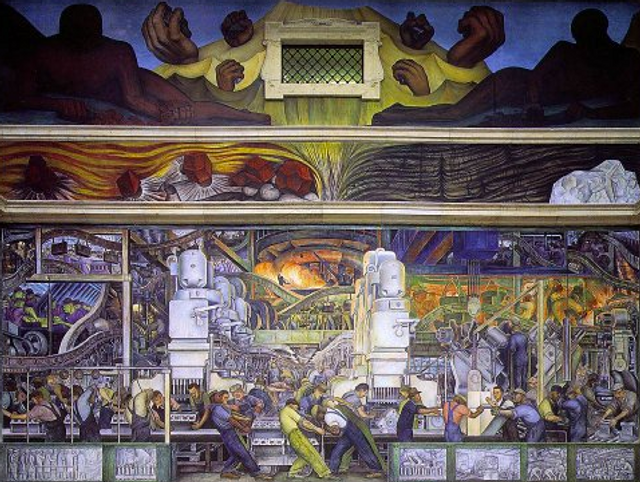
North Wall, Detroit Industry Murals by Diego Rivera, 1932-33
It will come as a revelation, and one hopes an inspiration, to many who attend the exhibition that there is a history and tradition of revolutionary art. It has proved possible in the past to develop the highest forms of creative expression wedded to the aspirations, struggles, sufferings and trials of the masses. Rivera and his work were perhaps the greatest demonstration of this possibility in the field of fine art in the 20th century.
Leon Trotsky, whose supporter Rivera became for a number of years, wrote in 1938: “In the field of painting, the October revolution has found her greatest interpreter not in the USSR but in faraway Mexico… Nurtured in the artistic cultures of all peoples, all epochs, Diego Rivera has remained Mexican in the most profound fibres of his genius. But that which inspired him in these magnificent frescoes, which lifted him up above the artistic tradition, above contemporary art, in a certain sense, above himself, is the mighty blast of the proletarian revolution. Without October, his power of creative penetration into the epic of work, oppression and insurrection, would never have attained such breadth and profundity.” (“Art and Politics in Our Epoch”)
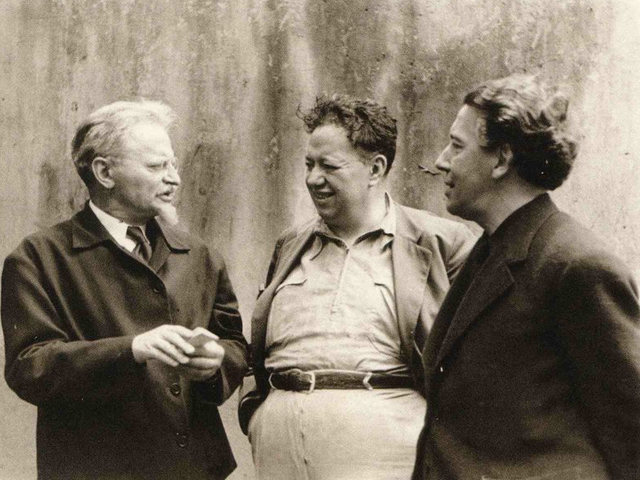
Leon Trotsky, Rivera and Andre Breton in Mexico
Rivera defended Trotsky against the vicious attacks of Stalinism and was instrumental in the Russian revolutionary’s obtaining asylum in Mexico in 1937. They collaborated, together with André Breton, on an important “Manifesto for an Independent Revolutionary Art.” The omission of Trotsky’s name from the exhibition can hardly be an accident.
One of the extraordinary videos on display at the DIA shows a mass of workers battling police, as well as Rivera and Kahlo in front of a banner advertising works by Lenin and Marx in English. “There remained one thing left for me to prove,” said Rivera, speaking of his trip to the US. “My theory of revolutionary art would be accepted in an industrial nation where capitalists rule.” An overhead view of the DIA courtyard when the murals were opened to the public in March 1933 shows the space packed wall to wall.
Both in the mural work and in the video footage, a powerful sense of the industrial working class in Detroit emerges. Museum-goers perhaps used to the often demoralized and irrationalist outpourings of postmodernism, racial politics, feminism and other trends in recent decades will be struck by the massive and creative force of the working class.
The viewer must also be struck by the striking parallel, despite the changes over many decades, between present-day Detroit and the situation described in one of the videos of growing popular anger over the mass poverty at one pole of society and the immense wealth at the other, in the midst of the Depression. Many must see this and think, “So it remains today!”
The Industry frescoes are the greatest draw at the DIA and have always held a special place with the most conscious elements of the population in Detroit and beyond. The threat to the DIA two years ago, in connection with city’s filing for bankruptcy protection, aroused popular outrage. On the one hand, DIA officials are obliged to pay nominal tribute to the frescoes, describing the work as a “masterpiece” in their promotional material. On the other hand, the current show contains a sustained and consistent attack on Rivera and his work.
Before the Detroit Industry murals were made public in 1933, right-wing forces and religious bigots were howling for their destruction. Rivera’s artistic response was powerful and enduring. The frescoes depict the emergence of the working class, drawn like minerals from all regions and races and formed in the cauldron of industrial production into the central creative force of a bright future.
Now, however, a new kind of attack is under way, proceeding from within, as it were, from the DIA hierarchy and the art world.
Along these lines, certain aspects of the current exhibition’s organization are significant. The room containing Rivera’s breathtaking cartoons, for example, is followed by one almost entirely devoted to Kahlo’s miscarriage, or abortion, that occurred while she was in Detroit.
Three weeks before Rivera began to paint his murals, his wife entered Henry Ford Hospital. Evidence suggests, according to the exhibition catalogue, that Kahlo induced the loss of her pregnancy on July 4, 1932 by ingesting quinine. A few weeks later, with Rivera’s encouragement, she made the lithograph “Frida and the Abortion, 1932” to memorialize the event.
The end of her pregnancy figures prominently in Kahlo’s work and may have influenced Rivera’s decision to replace an agricultural scene, which appears in the exhibition as a full-sized cartoon, with a healthy infant curled in a plant bulb. This remarkable series of cartoons of the images that surround the infant is at the center of the current show. Root systems extend into rich soils and subterranean aquifers. Plowshares cultivate the surrounding terrain.
The artist said the image represented the museum “as the central organism for the development of the aesthetic culture of the community.” (“Dynamic Detroit--An Introduction,” Creative Art, April 1933). Giant, exquisite female nudes cradle fruits and grain on either side and lovingly watch over the child--the picture of a rich and satisfying future for all.
In any event, the loss of the unborn baby was traumatic for Kahlo and Rivera, but the curators’ decision to raise this personal tragedy to the level of a world-historical event strikes a false, tasteless and disoriented note.
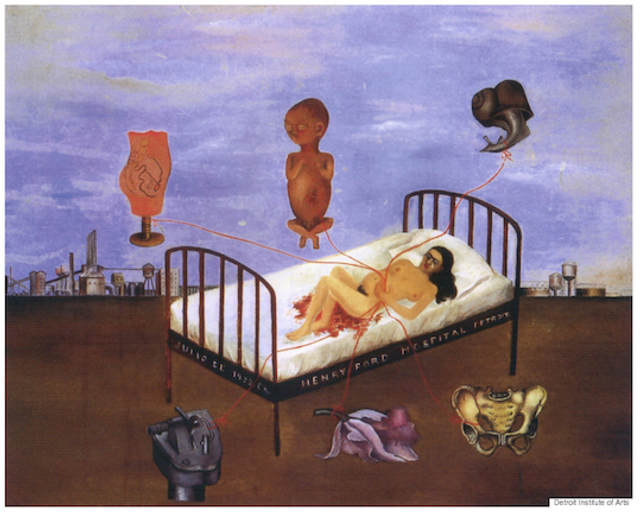
Henry Ford Hospital, 1932, Frida Kahlo
In Kahlo’s “Henry Ford Hospital, 1932” we are confronted with a stricken woman, in a pool of blood, connected by multiple umbilical cords to a fetus, a snail, a pelvis and several other objects. The curator’s argument that somehow this agonizing, intimate experience must supplant the grand conception of a harmonious future for all mankind is deeply disturbing.
This sort of imagery becomes the basis for the claim, for example by the New York Times’ Roberta Smith, that “Kahlo emerges in the final galleries as the stronger, more personal and more original artist.” Kate Abbey-Lambertz headlines her piece at the Huffington Post, “How Frida Kahlo’s Miscarriage Put Her On The Path To Becoming An Iconic Artist.”
One of the foulest efforts to denigrate Rivera, Michael H. Hodges’ “Kahlo trumps Rivera in popular fame,” recently appeared in the Detroit News, a chief organ of Detroit business circles. There is a certain appropriateness here. The new, slightly more sophisticated, assault on the murals is taken up by the newspaper that was at the center of the original attacks.
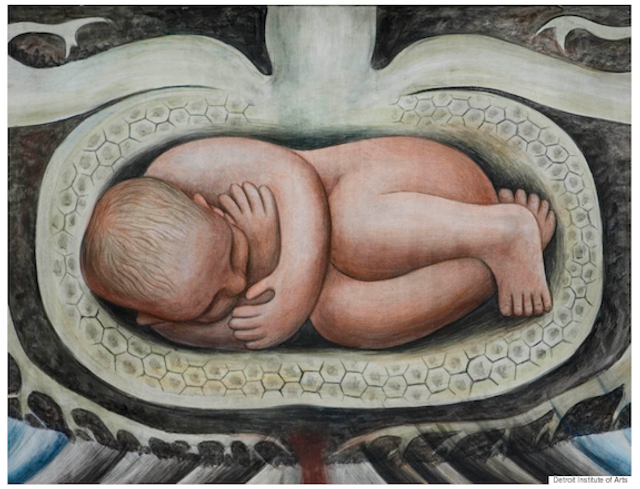
Baby in a plant bulb from the east wall of the Detroit Industry Murals, Diego Rivera
On March 19, 1933, a News editorial argued that the Rivera murals were “psychologically erroneous, coarse in conception and, to many women observers, foolishly vulgar.” The News further asserted that the work was “un-American, incongruous and unsympathetic,” recommended that DIA director Valentiner be fired and concluded that “perhaps the best thing to do would be to whitewash the entire work and return the Court to its original beauty.”
Hodges’ piece in March 2015 takes a different tack, assembling fashionable and snobbish contemporary attacks on Rivera. The News journalist first notes that in 1932 Rivera was one of the most famous artists in the world. “How times have changed,” he observes, and then carries on: “Kahlo, the subject of the hit 2002 movie ‘Frida,’ has morphed into a pop-culture superstar and feminist icon, her fame today easily swamping Rivera’s. To explain this, curators and art historians point to changing fashions and the compelling nature of Kahlo’s personal narrative, which resonates with our self-obsessed age.
“For Rivera, one-half of the current Detroit Institute of Arts blockbuster… it’s been quite a fall from grace,” he writes.
Hodges calls on none other than the current, soon-to-retire, DIA director Graham Beal to help make his case. Beal terms Kahlo “an international superstar,” adding, “you often have to explain to people--particularly anyone under 40--just who Rivera was and why we should care.” (Who talks like this, using terms like “international superstar?”)
The News article continues: “‘When I first visited here in the early 1970s,’ he [Beal] adds, ‘Rivera looked hopelessly old-fashioned and wrong-headed--realistic, political, and in a way, propagandistic. Her art is much more in keeping with today--highly personal and intimate, full of pain and uncertainty.’”
These comments speak to decades-old processes that are now coming to a head. Wide layers of the so-called intelligentsia, who have become affluent and moved far to the right, no longer feel the need to conceal their social indifference and outright hostility to the working population… and their utter obsession with themselves. It’s repugnant.
They latch onto Kahlo because what they read in her art corresponds to their own unease, interpreted in purely existential and individual terms. Rivera’s challenging and carefully conceived imagery of people at work or engaged in epic struggles against war and disease, ignorance and prejudice is compared unfavorably to a series of pictures focusing on one individual’s physical and psychic injuries.
The attack on art that addresses great social questions is relentless. On the audio guide, for example, guest curator Maria Cotera, a Women’s Studies professor at the University of Michigan, asserts that we now know that “the minor is where we find the big ideas” and that “big ideas became deeply personal.” Wall texts celebrate Kahlo’s subjectivism and criticize Rivera for advocating and explaining political principles and big historical and intellectual conceptions.
The curators write, for example, “Her [Kahlo’s] intellectual and artistic interests hinged on defining and representing herself,” while “Diego Rivera wanted his murals to become part of a dialogue about society that supported his intellectual and artistic agendas.”
The line of the exhibition, never stated in an honest manner, is that Rivera may have had some justification for his social art given the conditions of the 1930s, but we have long since transcended the period when art and politics concentrated on the working class. Kahlo’s critique of life is far more profound, “more thorough” than the class struggle conception promoted by Rivera because it is not fixated on changing the external world. Instead, it focuses on the inner being and “deeper” questions such as gender, sexuality, etc.
These views inevitably raise more directly the question of Kahlo’s art and career, a subject far too large for extended treatment here. It is evident that the discovery of Kahlo coincides with the emergence of gender politics and postmodern ideology in the 1970s and 1980s.
As “Made in Her Image: Frida Kahlo as Material Culture,” by Lis Pankl and Kevin Blake, points out: “It is certainly no accident that Kahlo’s popularity rose with the linguistic and cultural turn in the humanities and social sciences. With a greater emphasis on representation and identity politics, the academy found in Kahlo a perfect subject for analysis. Kahlo’s complex ethnicity… artistic autoeroticism, and evident links to gender construction are of much appeal to poststructuralists.”
One cannot place all the blame for the uses to which she and her work are put on Kahlo, but there is certainly some basis in the art itself for the current infatuation. It does violence to the history of art and helps no one to reduce Rivera, a colossal figure who drew upon a profound study of art and conveyed powerfully the impact of the Russian and Mexican Revolutions, to the benefit of Kahlo, a figure identified with extreme subjectivity. Such a readjustment in the artistic-intellectual world’s opinion must give one pause.
The victim of a serious accident at the age of 18 that required her to undergo dozens of surgeries over the course of her lifetime, Kahlo was no doubt a gifted artist, but her work is strikingly dominated by considerations of herself and her difficulties. She produced 143 paintings, 55 of which were self-portraits. Why so many? “Because I am so often alone,” she explained, “because I am the subject I know best.” Yes, but did she truly understand herself? An immense focus is hardly a guarantee that one understands a subject all that well.
There is something static, unchanging, in Kahlo’s self-portraiture, even immature. Of course, she died quite young and she came under various influences, not all of them happy or helpful ones. But in the self-portraits of Rembrandt and van Gogh, for example, one feels an unending intellectual and aesthetic development, the result of a bottomless curiosity about the world, history, society, resulting in an intense and compassionate realism.
A self-portrait is more than a picture of an individual. In its psychological depth and rigorous objectivity, a great self-portrait points beyond itself to something about the human situation in general, and perhaps the artistic personality in particular. Kahlo’s self-portraits are unusual and distinctive, but they tend to refer the viewer always back to Kahlo and her immediate situation. They seem often to be a reminder of her anguished presence more than a window onto something broader. One cannot help but have the feeling these paintings are intended in part to impress and even to shock.
The subject cannot be removed from art, not should it be, but there is a distinction between dealing honestly and vividly with oneself and one’s circumstances and self-obsession. If a work becomes excessively personal, the universal may be lost in the process.
At a certain point, if the representation becomes too particular, why should anyone else care a great deal? Kahlo was neither the first nor the last person to suffer physical ailments and complications. Pankl and Blake write, “Kahlo’s depictions of bodily pain are the most widely explored elements within her work.”
Art also requires a certain detachment, and the most compelling artistic figures have treated suffering, including their own, with restraint and dignity, not self-pity.
Uncritical admirers of Kahlo are miseducating the public and aspiring artists as well when they suggest, by implication, that wholeheartedly embracing one’s afflictions or perhaps one’s biology by itself is a possible route to artistic greatness. If such were the case, there would be no need for a serious study of art or society, or a concern with the fate of anyone other than oneself. And, indeed, such an outlook helps account for the largely desiccated, angst-ridden and self-centered art that predominates today.
All in all, the DIA’s “Diego Rivera and Frida Kahlo in Detroit,” a peculiar and contradictory event, raises a host of pressing issues.
Much of the imagery, including video imagery assembled by the curators themselves, tends to direct the museum-goer toward the big events of the 20th century, to the revolutionary role of the working class and, by implication, to a consideration of what point society and the human condition have now reached. After all, the exhibition is being held in an economically devastated city, where tens of thousands of people face the possibility of having their water shut off in the near future!
Yet the show’s organizers and museum officials, along with their media apologists, are waging a ferocious ideological campaign in opposition to such concerns—even at the expense of the DIA’s own centerpiece—in favor of art, in the words of the New York Times ’ Smith, suffused with “existential torment.”
The defense of the Detroit Industry frescoes falls once again, as it did in the 1930s, to the only social force with an interest in the cultural development of the population as a whole and in art that looks at life and reality critically, the working class.


Caterpillar moves to close its plant in Tasmania, Australia

Terry Cook

Amid a rising wave of downsizing and closures throughout the Australian mining sector, Caterpillar, the US mining equipment giant, has announced it will eliminate another 280 jobs at its factory in Burnie, on Tasmania’s northwest coast, and relocate the bulk of work to a plant in Rayong Province, Thailand.
The Caterpillar workers, who make bucket loaders and bumper trucks for the mining industry, were informed 10 days ago that manufacturing would cease over the next 12 months. Only about 100 jobs in research, development and distribution would remain, for now, at Burnie. Six years ago, the plant employed more than 600 people.
The closure will also hit suppliers and contractors, adding to the jobs crisis gripping the island state, where more than 1,600 mining jobs have been scrapped in the past 12 months alone, driven by falling commodity prices and stalling demand.
Even on the vastly understated official figures, Tasmania’s unemployment rate already stands at 6.6 percent, well above the national level of 6.1 percent. In the state’s northwest, the rate is 7.8 percent. Among 15- to 24-year-olds, Tasmania’s official jobless rate is 16.1 percent, and 17.4 percent in the state’s northwest.
Caterpillar workers had been assured by the management, in partnership with the trade unions, that they could protect their jobs by accepting cuts to conditions to make the company “internationally competitive.”
Australian Manufacturing Workers Union (AMWU) state secretary John Short told the media that workers had “bent over backwards, especially over the last three to four years” to reduce labour costs from more than $120 an hour to below $80 an hour. He declared: “They’ve made massive efforts, been on a four-day week at one stage, to secure their jobs and this is the thanks they get.”
Short accused people of now “running up the white flag” about the job losses, but it is the union that is doing everything it can to suppress workers’ opposition to the closure. He said the union would meet with management to ask if there would be “any assistance with retraining if they (workers) were to seek jobs elsewhere.”
The trade unions have not conducted a single campaign in defence of jobs in Tasmania or anywhere else for decades. Instead, they joined hands with employers to ensure “their” global “competiveness,” which has served to pit workers against their overseas counterparts and help drive an endless destruction of jobs and working conditions.
Caterpillar’s director of public affairs, William Oei, claimed that the “downturn in the mining industry contributed to the decision” to axe the jobs at Burnie. The Fortune 100 company, like other transnational corporations, is ruthlessly restructuring its operations internationally.
Caterpillar launched two large plants in Rayong during 2012 to take advantage of Thailand’s low wages—the country’s basic monthly wage currently stands at 1,3581.9 baht (around $A539).
Last month, the company announced it would eliminate 230 jobs in Joliet, Illinois and move the production of oil pumps and valves to a factory in Monterrey, Mexico, where the average daily minimum wage is about 70 pesos (less than $US5). The company said the decision was necessary “to remain cost competitive.”
In 2012, Joliet workers went on strike for more than three months to oppose Caterpillar’s plan to slash healthcare and pension benefits, and freeze wages. At that time, pay for most workers at the plant ranged from just $13 to $28 an hour.
These developments are part of a wide offensive by Caterpillar. Between June 2012 and June 2013 alone, it cut its global workforce by more than 20,000, including 4,392 in the US. The sale of company assets, including Bucyrus’ global distribution network, resulted in the loss of 6,572 jobs.
The company laid off 760 production workers at its Decatur, Illinois facility, 1,400 workers at its facility in Gossellies, Belgium, and 200 workers in France. The mass layoffs, plant closures and slashing of wages and benefits enabled the company to clear $US45,000 in profits per Caterpillar employee by 2012.
Nowhere have the unions done anything to defend their members’ wages, conditions or jobs. In the United States, the United Auto Workers (UAW), the International Association of Machinists (IAM) and the United Steelworkers (USW) have long records of working hand in glove with Caterpillar and other corporations to enforce one concession after another on workers. In 2013, Caterpillar worked with the USW to enforce a six-year concessions contract on approximately 800 workers at its Global Mining facility in South Milwaukee, Wisconsin.
Caterpillar, which had sales of more than $55 billion worldwide in 2014, also manufactures trucks and motor graders at Tullamarine in Melbourne, and retails its products in Australia through Hastings Deering and WesTrac franchises.
Like the AMWU, the Tasmanian Liberal government and the state Labor opposition have begun an operation to demoralise the Caterpillar workers and head off any action by them to defend their jobs. All these forces fear that a struggle by workers at Caterpillar could trigger a broader movement in the working class, with tens of thousands of workers facing a similar assault.
State Labor leader Bryan Green declared that he wanted to work with Caterpillar to try to “reverse the decision,” without specifying what that would entail. He appealed to the federal Liberal-National government for a bipartisan effort to encourage the company to stay in the state. Federal Employment Minister Eric Abetz promptly dismissed that prospect, likening the closure to the shutting down of the car industry in Australia.
The state government which, like its Labor predecessors, is overseeing the destruction of thousands of public sector jobs, said it would establish a “Tasmanian Taskforce” charged with “supporting workers through the redundancy process”—that is ensuring they make an orderly exit.
The taskforce, comprised of “senior business representatives, including from Caterpillar, local, state and federal government representatives”—that is, all those responsible for the assault on jobs and working conditions—would also work “to support local jobs and retain advanced manufacturing capacity on the coast”.
The developments at Caterpillar demonstrate once again that in order to defend past gains workers must break decisively with Labor and the trade unions, which act at all times to defend the interests of big business and seek to divide the working class along national lines.

Unifor Canada preparing to collaborate in slashing auto workers’ pensions

Carl Bronski

Unifor officials have signaled to General Motors’ (GM) management that the union is open to surrendering the last remnants of a defined-benefit pension plan for newly hired workers at the Canadian plants of the Detroit Three car makers.
The union, which represents auto workers at GM, Ford, and Fiat-Chrysler, will begin its next round of collective bargaining with the auto companies in July 2016.
In a bid to prepare the ground for further concessions to the auto bosses, several Unifor officials, speaking on condition of anonymity, told the Globe and Mail that ending a “hybrid” pension program for all hourly paid new hires would be the best way to convince GM to invest in its facilities in Oshawa and St. Catharines, Ontario. Should such a concession be granted to GM, it is all but certain Unifor would accept that a similar provision be included in the upcoming contracts with Ford and Fiat-Chrysler.
Already in 2012, Unifor’s predecessor, the Canadian Auto Workers union (CAW), agreed to create a two-tier pension system at the Detroit Three’s Canada-based plants by placing new hires into a hybrid-pension scheme that was part defined benefit (i.e., a guaranteed monthly amount upon retirement) and partly “defined contribution.” Under a defined contribution-plan, workers’ pensions are entirely dependent on the returns of money invested on their behalf in stock and other financial markets.
Then, in September 2013, Unifor set the stage for the final destruction of any guaranteed pension benefits for new-hires when it negotiated an agreement with GM at the Ingersoll, Ontario CAMI assembly plant that pushes all new employees into a wholly defined-contribution pension scheme.
The CAMI plant was once a joint venture between GM and the Japanese carmaker Suzuki and consequently has bargained separately from the Detroit Three pattern contracts since its opening in 1989. In 2009, GM bought out Suzuki to become sole proprietor. The 2013 deal Unifor signed with GM at CAMI has now predictably become the stalking horse for concession demands in the upcoming 2016 negotiations with the Detroit Three.
One union official told the Globe and Mail that GM is exerting “huge” pressure on the union to accept its pension demands. “When I say huge, I would say they (GM) have no interest in doing anything … If we don’t follow suit with what CAMI did.” But lest any worker believe GM’s demands are antithetical to the union’s position, another anonymous official stated, “It’s pretty hard for us not to do what CAMI did. In my opinion, it’s a good thing to do.”
Another union official who agreed to go on the record with the Windsor Starwas of the same opinion. Local 222 Oshawa President Ron Svajlenko thought the concession would be quietly accepted by his membership. “They have done this at CAMI. At the same time, it’s not new across the board,” he said. Revealing perhaps more than he intended about the union’s own perception of themselves as junior partners of GM management, Svajlenko opined, “We’re interested in hearing [GM’s] feedback on what their expectations are of us and what help we will need from governments and municipalities.”
Despite appeals from both the Ontario government and union officials for clarity, GM continues to remain silent on its plans for auto production in Canada beyond 2017.
The company has already announced plans to move production of its Camaro model from Oshawa, Ontario to Lansing, Michigan later this spring. The move threatens over 1,000 unionized jobs in Oshawa. To no avail, provincial government and Unifor officials have implored GM for a model to replace the lost production. Terms of the 2009 $10.8 billion federal and Ontario government bailout of GM and Chrysler stipulated that the companies meet loose domestic production quotas until 2017. With the imminent expiration of that agreement (although the auto companies have yet to repay in full the monies that they received), it is expected that at least some production previously located in Canada will move to Mexico and the United States.
Since the 2009 bailout, the Detroit Three companies have raked in $76 billion in profits.
A recent report by the Centre for Spatial Economics warned that should both auto plants in Oshawa close, 4,100 jobs would be immediately eliminated with a further 30,000 jobs endangered due to spin-off effects. The report went on to state that the plant closures and resulting unemployment would cut over $5 billion from Ontario’s gross domestic product and would cost the Ontario and federal governments $1 billion in lost revenues annually.
Unifor officials are bending over backwards to convince the auto executives that the union will do whatever it takes to reduce autoworkers’ wages and benefits to a level below those of workers south of the border. Union President Jerry Dias has bragged that “about two-thirds of unionized workers at the Oshawa plants are eligible to retire under the provisions of the (current) Unifor contract with GM. This will save General Motors billions.” Of course, the “billions” saved would be on the backs of the thousands of new hires who would enter the plants with not only massively compromised pension benefits, but significantly lower two-tier wage and benefit packages.
As Dias went on to excitedly explain, “If those workers retire, they can be replaced by newly hired employees who start at $20.50 per hour and whose wages won’t rise to the full seniority level of $34 an hour until they have been there for 10 years.”
For the union officialdom what is paramount in their calculations is not the well-being of the members they purport to represent, but the maintenance of a lucrative dues base that funds their six figure salaries, perks and expense accounts.
Dias and the union’s chief economist, Jim Stanford, have also recently pitched the lower Canadian dollar, which is fueling higher inflation and thereby eroding workers’ real wages, as further cause for celebration. They claim “all-in” labour costs for second-tier workers at Detroit Three factories in the United States now stand at $42 (US) whilst new hires in Canada reportedly account for $30 (CDN) in total labour costs (about half of the cost of veteran Canadian autoworkers).
Dias may well revel in the comparison of rates of exploitation between American and Canadian autoworkers. But just as Unifor, following on from its hidebound nationalist and pro-capitalist perspective, works to lower labour costs north of the border, so the United Auto Workers (UAW) does the same in the US. Already a third tier of American auto workers is in place at several General Motors factories in the Detroit area for a small number of workers who build battery packs and place parts in the right sequence to be assembled on cars. Without this new lower-tier, the union expected the work to go to Mexico or another country with even lower labor costs.
At the recently concluded UAW Bargaining Convention (in the run-up to the September 2015 expiration of auto contracts in the US), UAW President Dennis Williams told reporters he was willing “to talk” with the auto bosses about expanding the third tier for component work. In the scurrilous union tradition of “whip-sawing” contracts back and forth across borders, Unifor alongside the UAW continues to aid and abet the race to the bottom for North American autoworkers.

Child poverty at devastating levels in US cities and states

Patrick Martin

Reports issued over the past week suggest that child poverty in America is more widespread than at any time in the last 50 years. For all the claims of economic “recovery” in the United States, the reality for the new generation of the working class is one of ever-deeper social deprivation.
The Annie E. Casey Foundation publishes the annual Kids Count report on child poverty, which was the source of state-by-state reports issued last week. These reports use the new Supplemental Poverty Measure, developed by the Census Bureau, which includes the impact of government benefit programs like food stamps and unemployment compensation, as well as state social programs, and accounts for variations in the cost of living as well.
The result is a picture of the United States with a markedly different regional distribution of child poverty than usually presented. The state with the highest child poverty rate is California, the most populous, at a staggering 27 percent, followed by neighboring Arizona and Nevada, each at 22 percent.
The child poverty rate of California is much higher than figures previously reported, because the cost of living in the state is higher. Moreover, many of the poorest immigrant families are not enrolled in federal social programs because they are undocumented or face language barriers. The same conditions apply in Arizona and Nevada.
The other major centers of child poverty in the United States are the long-impoverished states of the rural Deep South, and the more recently devastated states of the industrial Midwest, where conditions of life for the working class have deteriorated the most rapidly over the past ten years.
It is a remarkable fact, documented in a separate report issued February 23 by the Catholic charity Bread for the World, that African-American child poverty rates are actually worse in the Midwest states of Iowa, Ohio, Michigan, Wisconsin and Indiana than in the traditionally poorest parts of the Deep South, including Mississippi, Louisiana and Alabama.
Several of the Midwest states have replaced Mississippi at the bottom of one or another social index. Iowa has the worst poverty rate for African-American children. Indiana has the highest rate of teens attempting or seriously considering suicide.
The most remarkable transformation is in Michigan, once the center of American industry with the highest working-class standard of living of any state. Michigan is the only major US state whose overall poverty rate is actually worse now than in 1960.
This half-century of decline is a devastating indictment of the failure of the American trade unions, which have collaborated in the systematic impoverishment of the working class in what was once their undisputed stronghold.
The United Auto Workers, in particular, did nothing as dozens of plants were shut down and cities like Detroit, Pontiac, Flint and Saginaw were laid waste by the auto bosses. Meanwhile, the UAW became a billion-dollar business, its executives controlling tens of billions in pension and benefit funds, while the rank-and-file workers lost their jobs, their homes and their livelihoods.
In Detroit, once the industrial capital of the world’s richest country, the child poverty rate was 59 percent in 2012, up from 44.3 percent in 2006.
The social catastrophe facing the population in Detroit also exposes the role of the Democratic Party and the organizations around it that have for decades promoted identity politics—according to which race, and not class, is the fundamental social category in America. The city, like many throughout the region, has been run by a layer of black politicians who have overseen the shocking decay in the social position of African-American workers and youth.
Cleveland, also devastated by steel and auto plant closings, was the only other major US city with a child poverty rate of over 50 percent.
The Detroit figure undoubtedly understates the social catastrophe in the Motor City, since it comes from a study concluded before the state-imposed emergency manager put the city into bankruptcy in the summer of 2013, leading to drastic cuts in wages, benefits and pensions for city workers and retirees.
Wayne County, which includes Detroit, had the highest child poverty rate of any of Michigan’s 82 counties. Southeast Michigan, which includes the entire Detroit metropolitan area, endured an overall rise in child poverty rates from 18.9 percent in 2006 to 27 percent in 2012.
The state-by-state reports issued by Kids Count were accompanied by a press release by the Casey Foundation noting that the child poverty rate in the United States would nearly double, from 18 percent to 33 percent, without social programs like food stamps, school meals, Medicaid and the Earned Income Tax Credit.
This was issued as a warning of the effect of widely expected budget cuts in these critical programs. It coincided with the first hearing before the House Agriculture Committee on plans to attack the federal food stamp program by imposing work requirements and other restrictions to limit eligibility.
The food stamp program has already suffered through two rounds of budget cuts agreed on in bipartisan deals between the Obama White House and congressional Republicans, which cut $1 billion and $5 billion respectively from the program. Now that Republicans control both houses of Congress, they will press for even more sweeping cuts in a program that helps feed 47 million low-income people, many of them children.

Two dead children found inside Detroit freezer: A symptom of deep social decay

Lawrence Porter

Last month, court bailiffs, evicting a family in a low-income housing development on Detroit’s east side for failure to pay rent, discovered two dead children, ages 9 and 13, wrapped in plastic bags inside a large freezer.
The horrific tragedy captured national headlines, used by the political establishment and mass media as an opportunity to demonize the poor and give political credence to the ongoing reorganization of the former industrial center following the largest municipal bankruptcy in US history.
Makeshift memorial for two children found in freezer
The single mother of the children, 35-year-old Mitchelle Blair, who has two other surviving children, has been charged with murder and child abuse. She reportedly confessed to the police that she killed her children after she says she found out they were sexually abusing another child.
The Detroit press has described the events as the “heinous” action of a wayward mother. Right-wing Detroit News columnist Nolan Finley—infamous for his shameless class arrogance in the service of the financial elite—charged that the deaths, and the increase in impoverished children in Detroit, were the product of bad choices and negligence. Rather than point to “outside causes,” declared Finley, residents should look in the “mirror” at the “self-inflicted wounds.”
Not far from this empty moralizing was the preacher’s eulogy at the children’s funeral. “The village failed those children, starting with me, and extending to you,” said Greater Grace Senior Pastor Charles Ellis III. “You are to blame. I’m to blame. We’re all to blame. Somebody should’ve heard something. Somebody should’ve seen something. Somebody should’ve said something.”
Such statements, however, explain nothing. Presuming that the account provided by prosecutors of the mother’s actions is true, it is clear that a terrible act has been committed. Yet how is one to explain such actions? They cannot be understood outside of their social context—the deep poverty, alienation, and social dislocation and breakdown in Detroit.
According to accounts of acquaintances, Blair suffers from severe mental health problems. She lived with her children under conditions of destitution, in the hollowed out shell of one of the ruined neighborhoods that exist in the city.
Detroit, with 59 percent of its children now living in poverty, is entering its second decade as the largest poor city in the US. Vast tracts of the city have been all but abandoned. Schools are shuttered, neighborhood stores are empty and buildings decaying, streets are left without lighting or maintenance, and thousands of people are unemployed or underemployed, without utilities or even water service.
Under the leadership of the Democratic Party, and with the assistance and collaboration of the United Auto Workers union, Detroit, the “Motor City,” has been transformed from a town of auto workers with so-called “middle class” living standards into a center of low-wage and highly exploited labor. Mass layoffs and service cuts have laid waste to working class neighborhoods formerly filled with well-kept homes.
These conditions could not but have had a profound impact on Blair’s state of mind. The abuse of children, in particular, has drastically increased in tandem with the deindustrialization of American cities and the epidemic of extreme poverty.
Damon Campbell
The comments of Damon Campbell, a neighbor and friend of the family, are revealing. Campbell painted a very different picture of Blair than the one portrayed by the media. He spoke with compassion and anger to the World Socialist Web Site about her conditions of life.
“She was only getting food stamps and the utility check. She had no cash income coming in,” said Campbell. Tens of thousands of families have been cut off from all cash income by budget cuts imposed by Michigan’s Republican Governor Rick Snyder, a millionaire former hedge-fund manager.
Campbell continued, “Three years ago, they told everyone they had 48 months, but they cut her off [all cash assistance] because she had already been on it past the time period they were looking for.”
Blair reportedly received only a $150 check monthly for utilities through the Martin Luther King Housing development, a public-private partnership administered by the federal government.
“Personally, I don’t know how she did it,” added Campbell. “It was impossible conditions. Often she didn’t have food. She would come to our house, and if we had 4-5 packs of meat we would give her one or two packs.”
Campbell said she was dealing with four children without the ability to buy even personal items. “She had to buy soap. And with the two girls and one over puberty, she had to take care of her personal needs. There were a lot of little things she had to get” but didn’t have the money for, stated Campbell.
“It’s really hard out here for a lot of people,” he continued. “The poverty is real bad. It is at the bottom. In this area, King homes, maybe 100 to 150 people have a steady income. And we are talking about over 1,000 people.
“Just to give an example. If a person gets their food stamps on the 13th, by the 25th of that month they are basically almost out of food. And we are talking about an individual that spends all of their money on food.”
The US Census puts 41 percent of Detroit residents at or below the federal poverty level. Detroit’s east side, where Blair lived, has tracts of staggering poverty. In the census tract just south of the affluent city of Grosse Pointe Park, 72 percent of families live in poverty. North of the MLK apartments, near Chrysler’s Jefferson North Assembly plant, the poverty rate is even worse, at 83 percent.
Campbell said Blair’s aunt helped her with some of her bills and had taken the children and supported them for a year. But the aunt had been unable to continue. At that point her family lost contact with Blair.
“Anyone who knew her would tell you that her character was like an over-protective mother,” Campbell said.
Campbell said she was the same way about the child she was taking care of when she was arrested. The child’s mother would call Blair up to babysit. When the child had whooping cough, Campbell said it was Blair, with the help of the doctor, who brought the child back to health.
“To this day if anyone said they thought she would do this, they are not being honest. You never would have thought that,” he concluded.
Campbell told the WSWS Mitchelle suffered sexual abuse during her childhood and that likely caused her problems. He emphasized Blair needs psychiatric treatment. “There is no way she shouldn’t have had a psychiatric evaluation. But they are shutting clinics down even though things could be going on in people’s minds like her situation. If they had talked to her beforehand they would have known she said she was seeing things and that she hears voices.
“Over a period of years she was sexually abused by several men,” he stated. Campbell thought her actions were connected to this history, compounded by mental illness. He said Blair believed her own children had sexually abused another child. “That is the story she has had from day one,” said Campbell. “Even if she lost her mind or whatever, this is her story.”
“The whole thing makes me sick,” said Campbell. “Something has to be done. I hope she gets the help she needs.”
The tragic deaths of these children are a testament to the depraved state of contemporary capitalism. Only a thoroughly rotten society can allow the systematic impoverishment of millions of people at the hands of a criminal class of scoundrels and profiteers, aided and abetted at every turn by endless numbers of well-to-do politicians, court officials and media know-nothings.

UK Labour competes with Conservatives over most business-friendly pro-austerity manifesto

Robert Stevens

The Labour Party’s general election manifesto proves only that virtually nothing of substance separates it from the other main party of the British ruling elite, the Conservatives.
Eschewing the glossy colour cover of its 2010 document of a family looking out towards a radiant sunrise, Labour declared its austerity agenda by opening its manifesto with a pledge to introduce a “Budget Responsibility Lock.”
Labour is already committed to an initial £30 billion in cuts. In January it worked with the governing Conservative/Liberal Democrat coalition to push through the Budgetary Responsibility Bill, committing all future governments to permanent austerity—with only a handful of Labour MPs voting against.
Labour now pledges, “Our manifesto begins with the Budget Responsibility Lock”, which is “the basis for all our plans in this manifesto” and is aimed at “securing our national finances.”
The “Budget Responsibility Lock guarantees that: Every policy in this manifesto is paid for. Not one commitment requires additional borrowing”, the manifesto states, boasting, “We are the first party to make that pledge and with this manifesto it is delivered. We will legislate to require all major parties to have their manifesto commitments independently audited by the Office for Budget Responsibility [OBR].”
It promises, “The first line of Labour’s first Budget will be: ‘This Budget cuts the deficit every year’.” Labour will “only lay a Budget before the House of Commons that cuts the deficit every year, which the OBR will independently verify. We will get national debt falling and a surplus on the current budget as soon as possible in the next parliament.”
With this Labour vows to continue the mass austerity it introduced following the collapse of Britain’s banks during the 2008 global financial crash. The savage austerity programme of the 2010 Conservative/Liberal Democrats continued the cuts initially carried by Labour, in order to pay for the £1 trillion bailout of the banks.
Launching the manifesto in Manchester, Labour leader Ed Miliband said the Conservatives were a “party of sums that do not add up and commitments that will not be kept.”
So right-wing is Labour’s programme that the Economist commented that “the Labour leader, sounded like a fiscally hawkish Conservative.”
As is now the norm, Labour’s “plan to balance the books” is said to mean “making tough, but fairer choices.”
There is nothing remotely “fair” about it. The manifesto declares, “We will live within our means. We have no proposals for any new spending paid for by additional borrowing.”
Under Labour the richest in society will face an increase in income tax of just 5 pence to 50p in order that they “contribute a little more to help get the deficit down.”
Meanwhile companies will still be able to exploit “the most competitive rate of Corporation Tax in the G7.”
In a declaration of their intent to complete the bailout of the bankers, the manifesto states, “All proceeds from the sale of our stakes in Lloyds and RBS [banks that had to be partly nationalised after they collapsed in the crash] will be used to repay the national debt.”
Everyone else will face savage attacks. Massive welfare cuts will continue, with Labour committing to capping “structural social security expenditure in each spending review so that it is properly controlled.”
Among the cuts outlined is a cap on child benefit payment rises for two years.
The manifesto commits a Labour government to supporting the US-led NATO threats against Russia, which poses the danger of an armed conflict between nuclear powers. Labour “will continue to uphold our key alliances” and these “include the United States”, it declares. “The crisis in Ukraine over the past year has demonstrated the importance of NATO and the EU standing up to external threats in Europe’s eastern, and southern neighbourhoods.”
Labour warns ominously that it must “maintain the best Armed Forces in the world, capable of responding to changing threats in an unpredictable security landscape.”
The manifesto maintains that “The rise of ISIL [Islamic State], an aggressive Russia threatening its neighbours in eastern Europe, and continuing economic uncertainty in the Eurozone, are each a challenge to our national security.”
Launching the Conservative Party manifesto, party leader David Cameron also assured the capitalist class that austerity will continue and his party would “finish the job.”
So intertwined are Britain’s political elite with big business that the Tories’ manifesto was assembled by Jo Johnson, a Conservative minister and former journalist for the newspaper which articulates policy on behalf of finance capital, the Financial Times. The manifesto calls for “the most competitive taxes of any major economy” and the cutting of £10 billion of “red tape” over the next parliament.
The Tories plan a further £12 billion in welfare cuts, with a freeze on working age benefits for two years from April 2016 and a lowering of the benefit payments cap from £26,000 to £23,000 listed in the document.
Jobseeker's Allowance for 18-21 year-olds is to be replaced with a Youth Allowance time limited to six months. Young people will then be forced onto slave-labour apprenticeship paying less than £3 an hour, traineeship or do community work to claim benefits.
In a further attack on workers’ rights, the manifesto proposes legislation requiring 40 percent of those entitled to take part in strike ballots to vote for a strike before industrial action can proceed.
Labour has done everything to convince big business that it can be trusted to continue the transfer of wealth from the poorest to the richest. As he launched the manifesto, Miliband criticised a last-minute policy announcement by the Tories to give an additional further £8 billion to the National Health Service—a desperate attempt to draw on popular support for public health provision—as a “panic” pledge. He said, “You can’t fund the NHS with an IOU. Every promise we make is paid for, that is the difference between the Conservative party and the Labour party.”
Since then Labour has continually shifted the pro-business agenda its manifesto outlines further rightwards.
On Saturday, in a move seen as soliciting support from the right-wing layers orbiting around the Tories and the United Kingdom Independence Party (UKIP), Miliband said all new immigrants to Britain should be able to speak English. He told the Guardian, “I want to reach out to Tory voters, to Liberal Democrat voters, to Ukip voters, to non-voters.”
Addressing Labour’s policy of a 5 pence tax increase to 50p for the wealthiest, Chuka Umunna, the shadow business secretary, said, “I wouldn’t want to do it permanently because … I would like to see the tax burden as low as possible. I don’t believe that you tax for the sake of taxing: you tax to fund public services and, currently, to reduce our deficit and our debt.” He continued, “Ed Balls [the shadow chancellor] and I say it all the time to business audiences because we believe it.”
Big business was generally approving towards the policies of both parties, cautioning that any retreat from austerity was not an option. Simon Walker, director-general of the Institute of Directors, said Labour was “to be commended for recognising that deficit reduction is now a centre-ground issue, and an issue of paramount importance for our economic security.”
Adam Marshall, executive director of the British Chambers of Commerce, said, “It’s always good to see any political party talk about fiscal responsibility because that is of huge importance to business.”
He warned, “The litmus test is whether the next government actually delivers on those promises of responsibility, and I think it’s fair to say for all of the parties the jury’s still out on that.”

US economic decline overshadows IMF-World Bank meeting

Nick Beams

The annual spring meetings of the International Monetary Fund and World Bank held in Washington over the weekend comprised the treasurers and central bankers, together with financial experts and analysts, from all the major capitalist economies. However not a single proposal was advanced from this high-level meeting to alleviate, let alone resolve, the mounting problems besetting global capitalism.
The reason is not hard to find. The meetings were dominated by the ongoing disintegration of the very structures of the post-war economic order of which the IMF and the World Bank have constituted two major pillars.
While it was not officially on the agenda, the announcement by China that it had secured the agreement of 57 countries to become founding members of its proposed Asia Infrastructure Investment Bank (AIIB) was a hot topic of discussion in the backrooms and corridors, especially at the World Bank.
The IMF and World Bank have been the two most prominent institutions reflecting the economic primacy of the US in the post-war world. But the establishment of the AIIB, and the decision of major economic powers, including Britain, France and Germany, to sign up is an expression of major shifts in the world economy and the position of the US within it.
New York Times article headlined “At Global Economic Gathering, US Primacy is Seen as Ebbing,” published on the eve of the meetings, captured some of the mood. In an interview with the NYT, Arvind Subramanian, the chief economic advisor to the Indian government, said the US was almost handing over legitimacy to the rising powers. “People can’t be too public about these things, but I would argue this is the single most important issue of these spring meetings.”
The article went on to cite comments made by former treasury secretary and a top adviser in both the Clinton and Obama administrations, Lawrence Summers, that the inability of Washington to prevent key allies from joining the AIIB signalled “the moment the United States lost its role as the underwriter of the global economic system.”
US treasury secretary Jack Lew disputed the notion that there was any decline in the American position, saying there was a lot of “noise in Washington” and this occasion was no exception “but the United States’ voice is heard quite clearly in gatherings like this.”
It may well be, but talk is cheap. The fact remains that the US is unable to offer any economic measures to boost the global economy in the way that it once could. This is under conditions where, as the main document prepared for the meeting, the IMF’s World Economic Outlook (WEO) drew out, lower growth, and even stagnation, is becoming the “new normal.” The WEO was accompanied by the IMF’s Global Financial Stability report, which showed that far from lessening, financial risks are on the increase.
Those risks are certain to be increased by another major issue that dominated unofficial discussion—the looming prospect that Greece may default on its loans, possibly as early as the middle of next month.
The official mantra within the euro zone is that the financial risks posed by a Greek exit are not as severe as they were in 2012. This is largely because the outcome of the austerity measures imposed under the so-called troika has been to take Greek debt off the hands of the private banks and transfer it to the European Central Bank and the IMF.
In the lead up to the meeting and during its sessions, the IMF and European financial authorities made clear there would be no accession to calls by the Greek government for some relief. In fact, the Financial Times has reported that in private and off-the-record discussions some European government representatives were in favour of pushing Greece out of the euro zone.
The hard line against Greece was laid down by IMF managing director Christine Lagarde. Adopting the tone of a school ma’am lecturing an errant student, she said: “We have been able to express and explain the policy of the IMF in terms of payments delays and give the precedents and history of that to Mr Vourafakis [the Greek finance minister].”
Speaking at a press conference during the Washington talks, ECB president Marion Draghi said the euro zone was much better equipped than it had been in the past to deal with a Greek crisis and sought to downplay the risks of financial contagion.
However, he added: “We are certainly entering into uncharted waters if the crisis were to precipitate, and it is very premature to make any speculation about it.”
Summing up the American position, Lew warned that a crisis in Greece would place a cloud of uncertainty over the European and global economies. “I do not think anyone can predict how markets will respond to dramatic changes in circumstances,” he said. “We have been clear in our conversation with all parties there is an urgent need to come together around a comprehensive approach.”
While the US views the prospect of a European crisis with alarm because of its impact on the American economy it is not able to significantly intervene. That is a measure of its economic decline. Gone are the days when a crisis would see the US convening an international economic summit to hammer out measures to overcome it.
In fact there was considerable discussion over whether US financial policy may contribute to financial instability, when the Federal Reserve begins to increase official interest rates. In 2013, indications that the Fed was moving to wind back its program of asset purchases—quantitative easing—brought a sharp movement of funds out of emerging markets in what was dubbed a “taper tantrum.”
In the lead up to last weekend’s meeting, the director of the IMF’s monetary and capital markets department, José Viñals, warned that there could be a “super taper tantrum” as the Fed moved closer to lifting official rates from their present near-zero level.
“This is going to take place in uncharted territory,” he said. “Markets could be increasingly susceptible to episodes in which liquidity suddenly vanishes and volatility spikes.”
However, despite the warnings of these dangers, nothing emerged from the IMF-World Bank meeting to suggest that financial authorities have any measures to meet them.

The pseudo-left and the Libyan catastrophe

Bill Van Auken

In addition to Barack Obama and Hillary Clinton, France’s Nicolas Sarkozy and the UK’s David Cameron, there are others who bare political and moral responsibility for the human tragedy in the Mediterranean: an international fraternity of pseudo-left intellectuals and groups that served as cheerleaders for imperialist intervention, supporting the US-NATO war on Libya as a “humanitarian” rescue mission, and even proclaiming the events in Libya a “revolution.”
Representative of this sociopolitical layer is University of Michigan Professor Juan Cole, who turned his widely read web site “Informed Comment” into an open propaganda vehicle for imperialist war.
“I am unabashedly cheering the liberation movement on and glad that the UNSC [United Nations Security Council]-authorized intervention has saved them from being crushed,” Professor Cole wrote in March 2011 in an “An Open Letter to the Left.”
He sarcastically wrote that he wanted to “urge the Left to learn to chew gum and walk at the same time,” by which he meant learning to make pragmatic accommodations to imperialism, deciding which US wars for regime change it would support on what he termed a “case by case basis.”
He dismissed any suggestion that his “liberation movement” was led by elements connected to Al Qaeda, despite ample evidence at the time, not to mention the bloody confirmation since. He likewise attacked any suggestion that the Obama administration had been moved by anything but the purest “humanitarian concerns.” Charges that the US and its imperialist allies aimed at dominance over Libya and its oil reserves and the denial of these resources to their rivals, principally China, were described by Cole as “bizarre.”
Leaving no doubt as to his loyalties, Cole proudly proclaimed, “If NATO needs me, I’m there.”
Cole’s last major article on Libya was written in June 2012. After spending a few days in the country, he wrote a glowing account, deriding “a kind of black legend about Libya, that it has become a failed state and is a mess, that there are armed militiamen everywhere, that everybody is a secessionist, that the transitional government is not doing anything, that people of sub-Saharan African heritage are bothered in the streets, etc., etc.”
Now that every element of this “black legend” is manifest and incontrovertible, what is Cole’s assessment?
Last February, in a cursory piece about the Egyptian bombing of Libya in response to the mass beheadings of the Coptic Christians, Cole wrote that ISIS had gained “small toeholds in Libya because of a power vacuum,” adding reassuringly that “Revolutionary states often fall into political violence, as with France’s Vendee after 1789, as part of the process of establishing new forms of legitimacy.”
As a historian, Cole is shameless in prostituting his academic credentials to serve the propaganda needs of the US State Department. If there is a “power vacuum” in Libya, it is precisely because there is no “revolutionary state” that commands the allegiance of the Libyan people. And to compare the present multisided clash of Islamists and warlords for control of oil wells and territory in Libya with the Jacobins’ suppression of the Catholic- and royalist-led peasant uprising against the French Revolution is an act of intellectual cretinism.
Cole was by no means alone in jumping on the US-NATO “humanitarian” war wagon. France’s New Anti-Capitalist Party (NPA) was an enthusiastic supporter of the war on Libya. As the war ground toward its bloody conclusion, the NPA declared that as a result of this “revolutionary process,” it was “a new life that is opening up for the Libyan people.” It gushed, “Liberty, democratic rights, and the use of wealth produced by natural resources to satisfy the fundamental needs of the people are now on the agenda.”
What does the NPA say now about its glowing predictions? The “new life” it promised for Libyans is a reality of unceasing violence, economic collapse and social devastation.
“Liberty and democratic rights”? Torture, summary executions and arbitrary imprisonment are rampant. As for “wealth produced by natural resources,” the economy is in free fall, having contracted 30 percent last year. Oil production, which accounts for some 80 percent of the country’s gross domestic product, has fallen to less than a fifth of what it was before the US-NATO war. Schools and hospitals, once the most advanced in the region, have been shut down by the fighting. Power outages are common, as are shortages of food, fuel and medical supplies.
The Left Party in Germany, the International Socialist Organization in the US, the Socialist Workers Party in Britain and a number of other similar pseudo-left groups all provided service to imperialism, supporting the pro-imperialist “rebels” and helping to dress up a naked intervention for oil and geostrategic interests as a crusade to protect civilians and promote democracy and human rights.
This gravitation to “humanitarian” imperialism neither began nor ended with the criminal war in Libya. This new pseudo-left constituency for imperialism made its debut with these organizations’ support for the “humanitarian” US-NATO bombardment of the former Yugoslavia in 1999. Much as in the Libyan case, the intervention was staged on the pretext of saving Kosovar Albanians from a supposed massacre at the hands of the Serbs, and then resulted in a skyrocketing of the death toll.
What has been the result of this “humanitarian” war for “liberation” concluded 15 years ago? Kosovo, a territory of 1.8 million people, remains economically, politically and socially unviable, dominated by poverty, organized crime and corruption. The unemployment rate is 45 percent—60 percent for younger workers—and tens of thousands are streaming out of the country.
And, of course, in Syria, all of these political organizations lined up to support a proxy war for regime change backed by the US and its European allies along with the most reactionary monarchical regimes in the Middle East. Once again, they called an imperialist dirty war a “revolution” and dismissed the overwhelming evidence that the principal armed forces mobilized against the Assad regime consisted of Al Qaeda-linked Islamist militias. As in Libya, the result has been the devastation of an entire society.
The attempt by the pseudo-lefts to cast imperialist intervention as “revolution” reached its apogee—or, more precisely, its nadir—with the US-orchestrated coup in Kiev, which was backed by these groups as a “mass revolt for democracy,” in the words of the NPA. The leader of a Russian Pabloite organization went so far as to praise the neo-fascist thugs who spearheaded the coup as “the most combative and militant section of the movement.”
All of these organizations bear moral and political responsibility for the catastrophes these imperialist interventions have wrought in country after country. Their lining up behind the bloodthirsty “human rights” wars of aggression is no accident and cannot be ascribed to mere political stupidity. It reflects the alignment with imperialism of a privileged upper-middle class layer, including elements within academia and the media, whose social interests are expressed in the politics of these groups.