23 Apr 2015

Warnings of an economic downturn in New Zealand

Tom Peters

Reserve Bank deputy governor Grant Spencer issued a blunt warning to the government last week that the housing bubble in Auckland, the country’s largest city, could suddenly burst, endangering the wider economy.
While the National Party government and some media commentators continue to describe New Zealand as a “rock star economy,” there are growing fears of a crisis triggered by a collapse in the property market combined with the global slump in prices for dairy products, the country’s main export.
Growth was 3.5 percent last year, the highest in the OECD. This was based on a temporary increase in construction activity following the 2010–2011 Christchurch earthquakes and agricultural exports to Asia. The economy is highly exposed to the gathering global economic downturn, particularly the slowdown in China, which is New Zealand’s biggest trading partner.
House prices in Auckland increased by nearly 17 percent in the year to March alone. According to the Real Estate Institute, the median house price in the city is an extraordinary $NZ720,000—more than double the national median.
Rents are increasingly unaffordable, rising by between 5 and 10 percent per year. Homelessness and overcrowding has soared in Auckland, Christchurch and other centres. The home ownership rate reached a record low of 61.5 percent in 2013.
Speaking to the Rotorua Chamber of Commerce, Spencer made clear that this is the result of rampant speculation, coupled with a housing shortage and a growing population. “Indicators point to an increasing presence of investors in the Auckland market and this trend is no doubt being reinforced by the expectation of high rates of return based on untaxed capital gains,” he said. The proportion of houses bought by investors has risen to 37.4 percent in February from 33.8 percent in September 2013.
The out-of-control housing market is one example of how New Zealand capitalists, like their counterparts internationally, continue to engage in the same parasitic activity that led to the 2008 financial crash. Rather than producing anything in the real economy, the super-rich are increasing their fortunes through the stock market and various investment bubbles, while driving up living costs for ordinary people.
Spencer warned that “a correction” in house prices “could be prompted by a range of potential shocks to the economy or financial system,” such as a rise in global interest rates or increased unemployment. “With 60 percent of its lending in residential mortgages, the New Zealand banking system could be put under severe pressure in such scenarios,” he said, adding that the “resulting contraction in credit would amplify the impact of an adverse external shock to the domestic economy and financial system, making it more difficult to avoid a severe downturn.”
There are numerous sources of economic instability. The country’s exports are being hit hard by the decline in China’s economic growth, which fell to just 7 percent in the first quarter of 2015—the lowest rate since the immediate aftermath of the economic crisis in 2008–2009.
While China remains New Zealand’s largest export market, figures released last month showed that the value of exports to China has fallen 45 percent since late 2013. The drop was driven by a 51 percent fall in prices for dairy exports since their peak in February 2014.
Craig Ferguson, an analyst from Antipodean Capital Management, told Fairfax Media on April 16 that dairy prices could fall by another 60 percent due to supply outstripping demand globally. DairyNZ chief executive Tim Mackle said the forecast was “not looking pretty” and “many farmers won’t be in credit for the entire 12 months of next season” unless they cut costs. Total farm debt stood at $52 billion last year, about two thirds of which is held by dairy farmers.
New Zealand is also affected by the slowdown in Australia, where minerals exports have collapsed, business investment has dried up and unemployment is at a 12-year high. Migration figures indicate that many New Zealanders who moved to Australia and other countries in recent years are returning, compounding to NZ’s housing shortage.
The government has trumpeted the soaring value of the New Zealand dollar, which has almost reached parity with the Australian currency for the first time since 1973, as a sign of economic strength.
In reality, the relative value of the currency reflects instability in Australia, New Zealand’s second largest trading partner. Almost 20 percent of New Zealand exports and 50 percent of the country’s foreign direct investment go to Australia. New Zealand’s Timber Industry Federation president John McVicar told TVNZ that parity between the two currencies was “not sustainable and will be devastating for many mills.” The industry has already experienced several mill closures and thousands of redundancies since the 2008 financial crisis.
The government is responding to the sharp decline in tax revenue and increasing economic volatility by deepening its austerity measures. Finance Minister Bill English told a business meeting in Christchurch on April 21 that next month’s budget will be the “toughest” since the government came to power in 2008.
Previous budgets have slashed spending on basic services, including health care and education, while tens of thousands of people—including single parents and disabled children—have been pushed off welfare benefits. National has partly privatised the country’s power companies and plans to sell tens of thousands of public housing units.
The opposition Labour Party agrees that the working class must be made to bear the burden of the crisis. Labour has mainly attacked the National government for failing to return a budget surplus, which would be achieved by cutting spending even more drastically.
In response to the housing crisis, Labour and its allies, the Greens and the anti-Asian xenophobic NZ First Party, have sought to divert the growing hostility towards the government in a reactionary nationalist direction. Joined by several media commentators, the opposition is demanding restrictions on foreigners buying houses.
Labour and NZ First have also called for cuts to immigration, with NZ First scapegoating Chinese and Indian immigrants for unemployment. Labour, the Greens and the Maori nationalist Mana Party all supported NZ First in last month’s by-election in Northland.

Workers at Germany’s Postbank begin indefinite strike

Gustav Kemper

Several thousand Postbank employees went on strike in Germany on Monday. The previous week, 94.8 percent of union members voted for an indefinite strike.
The high percentage of workers who voted to strike makes clear the anger of Postbank employees. Along with the gradual takeover of Postbank by Deutsche Bank between 2008 and 2010, there has been a systematic worsening of working conditions. The number of employees, which at the time of the takeover totaled 20,000, has been reduced sharply since then.
While vacation time has been shortened, working hours have also been cut, pay has been decreased and pressure on the job has continually increased. Deutsche Bank has carried out a radical cost-cutting program. Many tasks have been outsourced, and employees have not infrequently been forced to accept wage cuts of 30 percent or more.
In addition to this constant worsening of conditions, the Deutsche Bank management has now announced that Postbank will face additional cutbacks. The details have not yet been made public, but a number of different proposals are up for debate and will be presented by Jürgen Fitschen and Anshu Jain from the DB executive to the supervisory board for a decision on April 24. All the proposals have one thing in common, however: cost cuts and so-called “efficiency increases” through additional reductions in jobs and benefits.
There have been some reports about plans to sell off not only Postbank, but also the private customer branch of Deutsche Bank, enabling the bank to concentrate on investment and speculation. But even if Deutsche Bank maintains its private customer branch, approximately a third of the 700 branches would reportedly be closed and the rest would be restructured.
The head of the executive board of Commerzbank, Martin Blessing, spoke enthusiastically to Manager Magazine about the “35 percent equity return” that one could achieve in this section of the market. There was speculation that Commerzbank—with its 15 million private customers—could buy Postbank, which has 14 million private customers. The consequence of the merger would be a massive reduction in personnel. The Spanish bank Santander is also interested in Postbank.
Meanwhile, the German services union Verdi has no answer to the planned job cuts. It has only called the present strike because it is aware of how alarmed Postbank employees are over their future prospects. It is trying to allow the workers to let off steam in a controlled manner by means of selective strikes.
Verdi functionaries, together with the works councils, have been informed about this development for a long time. Verdi head Frank Bsirske sits with nine other representatives of the union and the works councils in the supervisory board of Deutsche Bank AG and works there as co-manager. Each of them receives yearly compensation of approximately 200,000euros.
Alfred Herlin, president of the joint works council Wuppertal/Sauerland, who is also president of the company works council and a member of the European works council, is deputy president of the supervisory council and received 273,000 euros last year.
The news channel n-tv reported at the beginning of the week that Verdi has agreed to the sale of Postbank. According to statements made on the station, workers representatives had supported splitting off the entire private customer business because, according to the union, the creation of a separate private customer bank would result in the least number of job losses.
“On the contrary, the most likely scenario is a sell-off of Postbank alone, for example through a public offering,” n-tv wrote. “The executive board could, according to insiders, win Verdi over to this variant in the end—providing that the losses be suffered by the Deutsche Bank branches, while the Postbank branches would remain largely protected.
In answer to an inquiry at the Verdi press office in Berlin, a Verdi spokesperson said that this account was false and did not correspond to the facts. He said that no decision has been made yet and that Verdi will not give preference to the Postbank solely because its degree of organization is higher.
In answer to the question of whether Verdi and the works councils in the supervisory board would vote against selling Postbank and the threat of job cuts bound up with that, he said that according to his information, the representatives of the employees in the supervisory board are interested in reaching a consensual decision with the entire supervisory board.
Such a “consensual decision” in the supervisory board means nothing else but imposing the interests of capital at the expense of the employees.
In spite of the radical talk currently used by Verdi functionaries, the union accepts the capitalist profit system and dominance of the market, which is why it has agreed to the gradual implementation of cuts in the past.

Families of accident victims denounce ruling upholding GM bankruptcy shield

Shannon Jones

In the wake of a court decision last week upholding General Motors’ (GM’s) protection against lawsuits stemming from accidents before its 2009 bankruptcy, families of victims and their attorneys have denounced the ruling.
Meanwhile, it is reported that the number of approved death claims against the company stemming from an ignition defect has risen to 87.
GM had asked US bankruptcy judge Robert Gerber to uphold the shield contained in the US government-sponsored forced bankruptcy and restructuring of GM. Plaintiffs had argued that the company should be held liable for accidents prior to its July 2009 bankruptcy exit, since it knew of a deadly ignition defect tied to numerous fatal accidents but remained silent about it.
This means that accident victims and their families cannot sue for death or injuries sustained while driving defective GM vehicles prior to July 2009. The deadline for submissions for death and injury claims from a victim compensation fund established by GM in relation to the ignition defect was January 31. The ruling also blocks suits claiming economic damages for the loss of value of defective vehicles.
The qualifications for the victim compensation settlement were restrictive, only covering accidents involving front-end collisions where airbags failed to deploy in models subsequently subject to recall. The fund is expected to pay out a maximum of $600 million, a tiny fraction of GM’s annual revenues.
In the wake of the ruling, a GM spokesman remarked, “As a result of the ruling we expect there will be fewer plaintiffs with eligible claims.”
In fact, Bob Hilliard, an attorney for accident victims, told the press that the ruling could save GM as much as $10 billion in claims. “Hundreds of victims and their families will go to bed tonight forever deprived of justice. GM, bathing in billions, may now turn its back on the dead and injured, worry free.”
The ignitions on the 2.6 million vehicles, mostly Chevrolet Cobalts and Saturn Ions built between 2003 and 2007, that were ultimately recalled by GM can be easily jarred out of the “run” position, cutting power to the engine and disabling power steering, power brakes and airbags. Sudden engine cutoff can lead to loss of control under conditions where occupants are unprotected by airbags in the event of a crash.
An independent review of National Highway Traffic Safety Administration (NHTSA) statistics counted 303 deaths between 2002 and 2012 involving now-recalled GM vehicles in which airbags failed to deploy. For its part, GM stonewalled accident victims, often resorting to threats and intimidation.
The WSWS spoke to Ken Rimer, stepfather of Natasha Weigel, who died in the 2006 crash of a Chevrolet Cobalt equipped with a faulty ignition switch. The family recently received a settlement through the victim compensation fund. The culpability of GM in Weigel’s death was well documented. A Wisconsin state trooper made a report following the accident in which he tied airbag non-deployment to a defective ignition switch. Both GM and the NHTSA were aware of the report, but chose to ignore it.
Rimer denounced the decision by Judge Gerber to uphold the bankruptcy shield. “Our hearts go out to everyone impacted by the judge’s ruling. Now these families are out in the cold. They lost their loved ones and have no legal standing.
“All the judge is looking at in this is information on pieces of paper. He is not looking into the broken hearts of those who lost loved ones.”
He remarked, about the victim compensation fund, “In my heart I would like to believe that someone in GM thought, ‘let’s make things right.’ But part of me believes it was the bottom line. Between the legal people and the bean counters they got together and said ‘let’s go with this, it will save money.’ ”
According to its web site, the victim compensation fund has received 4,343 claims to date relating to the ignition defect, including 475 death claims. However, only 244 have been deemed eligible, including 87 death claims and 11 claims for “category 1” injuries involving severe disabilities, among them multiple amputations or brain injuries. GM initially acknowledged only 13 deaths relating to the defect.
Kathryn Harvey, an attorney with MLG Automotive Law, a firm representing some GM accident victims, told the WSWS, “It is egregious. You have a company admitting to responsibility for the deaths of 87 people, and families of people who were killed are not going to have a redress.
“They hid it from the bankruptcy court, and now the judge says that’s OK. If it doesn’t fit the criteria for the victim compensation fund and it happened pre-bankruptcy, you are out of luck. The case that started all of this, the death of Brooke Melton, would not have qualified. They did not even count it in their official death toll.”
In a letter to GM, Laura Christian, mother of Amber Marie Rose, who died in a 2005 crash involving a car with a defective ignition, chastised the automaker for taking a tax credit on its victim compensation payouts. “If GM is taking a deduction for these ignition switch settlements, then taxpayers, including GM victims, are literally paying General Motors for the deaths it caused.”
The court ruling upholding the bankruptcy shield comes despite the fact that internal company documents demonstrate that GM knew of problems with defective ignition switches as early as 2001.
Both GM and the NHTSA were aware of fatal crashes involving the now-recalled vehicles where airbags failed to deploy well before the 2009 bankruptcy filing. In fact, GM admits it knew of problems with the ignition switch on the Saturn Ion in 2001 but approved production anyway, despite the part not meeting its own specifications.
After receiving numerous customer complaints, including unfavorable press reviews, engineers in 2006 proposed a fix, but GM rejected it because of cost considerations. Finally, in 2007, GM quietly ordered a new switch installed, but did not assign a new part number, a violation of engineering principles, which strongly suggested a deliberate cover-up.
As deaths and injuries mounted, GM steadfastly rejected a recall. It ignored clear evidence that the non-deployment of airbags was related to the defective ignition switch. According to an internal investigation ordered by GM, in 2009 then-CEO Rick Wagoner “may have viewed” a PowerPoint slide documenting the Cobalt’s past problems with accidental engine shutoffs. Wagoner later claimed he had no memory of the slide.
So far, no one has been held criminally liable at GM, and the company has faced merely a token fine of $35 million, less then one day’s revenue. As in other cases involving flagrant corporate malfeasance, from the BP oil spill to the 2008 financial meltdown, the perpetrators have faced only the mildest consequences.

Six Minneapolis Somali-Americans arrested in FBI terror “sting”

Bill Van Auken

The Minnesota US Attorney’s Office Monday announced the arrest of three young Somali-Americans in connection with an alleged plan to travel to Syria and join the Islamic State of Iraq and Syria (ISIS).
The announcement came with the usual assurance that the alleged terrorists had posed “no threat to the public,” and the outline of the case that was presented made it clear that once again the FBI had used a confidential informant to organize a “sting” operation.
The defendants, three of them age 19 and the other three between 20 and 21, were all charged with conspiracy and attempt to “provide material support to a designated foreign terrorist organization.”
Federal authorities acknowledged that there is no evidence whatsoever that the young men who are charged had any plans to carry out terrorist acts within the United States.
The criminal complaint against them specifies their crime as “attempting to travel to Syria in order to involve themselves in the fighting that has consumed Syria for more than three years.” It further explains: “A variety of armed groups are operating in Syria. Those armed groups include many terrorist organizations, among which is [ISIS].”
This argument reads like an indictment not merely of the six Somali-American youth, but of the US government itself. After all, “the fighting that has consumed Syria” has been supported directly by the US and its regional allies, which have funneled money and weapons to the so-called rebels, who, as the federal prosecutor acknowledges, “include many terrorist organizations.”
On this basis, it would be far more fitting to indict President Barack Obama along with leading figures in the CIA and Pentagon for providing “material support” to these elements, than the six hapless youth who were ensnared by the FBI.
The six were arrested Sunday. Two of them—Mohamed Abdihamid Farah and Abdirahman Yasin Daud—were picked up in San Diego, where they had been lured by the FBI and their “confidential human source”—aka informant—with a phony scheme to supply them with fake passports and get them across the border to Mexico and from there to the Middle East.
The other four—Adnan Abihamid Farah, Hanad Mustafe Musse, Guled Ali Omar and Zacharia Yusuf Abdurahman—were seized at their homes in Minneapolis. While the informant had recorded them in his discussions about the fabricated travel plan, they had backed out either for lack of money or because of qualms about making the trip.
The criminal complaint, while claiming that they had been in touch with one Minneapolis man who managed to leave the US and reach Syria last year, acknowledges that earlier attempts by the youth to travel to Syria—made when at least some of them were in high school—had been thwarted, either by the authorities, who refused to allow them to board planes, or, in one case, by one of the youth’s parents, who confiscated his passport.
It was the role of the FBI’s informant to overcome all such problems, making himself the ringleader in a plan to get out of the US.
As the complaint explains, the informant told the six that he had secured a “contact in California for the production of forged passports.” He asked them to give him passport photos and $100 down payments for the fake documents.
One of the youth asked for his picture back, and, in the end, only two agreed to make the trip to California. Even they moved to pull out of the scheme, just two days before their arrests, when one of them was unable to sell his vehicle, which he was counting on to pay for the trip.
At that point, the informant arranged a call to an FBI undercover agent posing as the passport forger in San Diego, who said he would buy the car and throw in the passports for free, convincing them to make the trip with the informant to San Diego, where they were promptly arrested
Minneapolis US Attorney Andrew Luger told a press conference Monday: “What this case shows is the person radicalizing your son, your brother, your friend may not be a stranger. It may be their best friend, right here in town.” He could have added that this “friend” might also be an informant working under the direction of the FBI.
Minnesota Public Radio (MPR) described the atmosphere as “tense” at the St. Paul, Minnesota, courthouse where four of the defendants were arraigned on Monday. Some 70 Somali-Americans, including relatives of the accused, packed the courtroom.
MPR quoted Abdihamid Yusuf, the father of Adnan and Mohamed Farah, as saying that his US-born sons had been “brainwashed” by the FBI’s undercover informant.
The Minneapolis case comes on the heels of the arrest earlier this month of a 20-year-old Kansas man who was charged with plotting a suicide bomb attack on the Fort Riley military base. The defendant, John T. Booker, was brought into a Kansas City court Tuesday in an orange jumpsuit and shackles, where he was charged with federal crimes, including attempting to use a weapon of mass destruction and attempting to provide material support to a terrorist group.
Booker, who reportedly suffers from mental illness, was entrapped by the FBI after he came to the government’s attention for postings on his Facebook page. These led to his being barred from the US Army after initially being recruited.
An FBI informant was used to pump Booker about his sympathy for ISIS. This informant then put him in touch with an individual he described as his “cousin,” supposedly a “high-ranking sheikh planning terrorist attacks in the United States.”
The two undercover FBI men than convinced Booker he should carry out a bombing, provided him with a list of explosive materials and subsequently assembled the dummy “bomb” themselves, showing the 20-year-old how he could supposedly detonate it.
Imam Omar Hazim of the Islamic Center of Topeka told the media that Booker suffered from bipolar disorder and had stopped taking his medication because “he didn’t like the way it made him feel and it was expensive.”
“I think the two FBI agents set him up,” he said.
These cases are part of a long pattern of the FBI manufacturing terrorist plots and entrapping individuals who on their own would have never carried out criminal actions.
These activities have become so ubiquitous and so blatant that even the Wall Street Journal reported Wednesday that “The wide use of informants or undercover agents in the arrests of suspected Islamic State supporters in the US is sparking criticism that authorities are luring people into crimes.”
The Journal cited a report by the Center for National Security at Fordham University’s School of Law that found that 60 percent of the cases against Americans charged with ISIS-related offenses involved undercover FBI informants.
“They’re playing on people’s frailties, especially the younger types with mental and emotional problems,” Wadie Said, a professor at the University of South Carolina School of Law, told the Journal. “Is the government trying to remove a danger or working to create the crime, break it up and then claim a victory against ISIS?”
The political interests underlying these FBI sting operations are clear. By fabricating terror cases, the US government seeks to provide a pretext for both endless war abroad and the steady buildup of a police state apparatus at home.

Call for new international economic order at Asia-Africa summit

Nick Beams

Further evidence of the declining economic influence of the United States was on display at the Asia-Africa Conference (ACC) in the Indonesian capital, Jakarta, yesterday.
Addressing the opening session of the ACC, which is commemorating the 60th anniversary of the establishment of the non-aligned group of nations in Bandung, Indonesian president Joko Widodo issued a call for a new global economic order which is not reliant on the three main international lending institutions.
“The idea that the world’s economic problems can be solved through the World Bank, IMF (International Monetary Fund) and the ADB (Asia Development Bank) is obsolete and must be abandoned,” he told the representatives of 92 nations attending the gathering.
While he did not mention it by name, Widodo’s remarks were a reference to the establishment of the Chinese-backed Asia Infrastructure Investment Bank (AIIB). This institution has been opposed by the US because it is seen as undermining the key institutions it established in the aftermath of World War II and the ADB which is under the control of Japan. Indonesia is among 57 countries which have signed up as founding members of the AIIB.
“I am of the opinion that the fate of the global economy should not only be left to those three financial institutions. It is imperative that we build a new economic order that is open to new emerging economic powers,” he continued.
There had to be reform of the global economic architecture “to avoid the domination of certain groups of countries” clearly referencing the United States, Japan and their western allies.
Widodo also took aim at the United Nations saying Asian and African nations should push for its reform as it was powerless to deal with global imbalances and injustices, referring in particular to the question of Palestine and calling for the establishment of an independent Palestinian state.
While the conference itself is regarded as something of an irrelevancy, a hangover from the geo-politics of the Cold War, the economic shifts reflected in it are not. In 1955, the 29 nations which gathered at Bandung in Indonesia under the banner of non-alignment, represented about one quarter of the world’s economic output. Today they comprise around half of the world economy. China is now the world’s second largest economy and India is increasingly becoming an economic force.
The other major event on the opening day was the address by Japanese Prime Minister Shinzo Abe, whose statement on Japan’s role in World War II received close attention, especially from China and South Korea.
Abe is due to address the US Congress next week, where his remarks on World War II will also be carefully studied in the lead up to a speech marking the 70th anniversary of the end of the war in August.
In his address to the summit, Abe expressed “deep remorse” for Japan’s actions in World War II but significantly did not repeat phrases used on previous occasions.
The meaning of apologies in Japanese politics in diplomacy is gauged not so much by the formal acknowledgement of wrong-doing but in the detail of such statements.
It was significant, therefore, that Abe studiously avoided the phrase introduced by Prime Minister Murayama in 1995 and repeated verbatim by Prime Minister Koizumi a decade later, that offered Japan’s “heartfelt apology to the people of the Asian nations affected by Japan’s colonial rule and aggression.”
Within Japan, right-wing nationalist political forces, which have considerable influence in the Abe government, have sought to expunge from the historical record the use of “comfort women” by the Japanese army in Korea and even to deny that the Nanjing massacre of 1937 in China took place.
Abe’s remarks were noted in a report published by the official Chinese news agency, Xinhua, which described him as a “staunch nationalist and active revisionist” who, together with “the majority of his cabinet and a horde of lawmakers,” had no intention of following the path charted by his predecessors. Abe has said that because he has upheld the Murayama statement as a whole he does not need to repeat its key phrases.
These assertions are not cutting any ice in Beijing where Abe is regarded as the most nationalist prime minister in the post-war period. That assessment will have been further buttressed by his summit remarks, which, while not specifically targeting China, were clearly aimed in its direction.
“We should never allow to go unchecked the use of force by the mightier to twist the weaker around,” Abe said. “The wisdom of our forefathers in Bandung was that the rule of law should protect the dignity of sovereign nations, be they large or small.”
These comments were in line with the US-Japan campaign against so-called Chinese assertiveness and aggression in the South and East China Seas. In the case of the long-running dispute over the rocky outcrops, known as the Senkaku in Japan and the Diaoyu in China, tensions were escalated by Japan in 2012 when it formally took over ownership of the islets from their previous private owners. Conflicts between China, Vietnam and the Philippines over territorial claims have been inflamed by increased US intervention under Obama’s “pivot to Asia.”
In what amounted to at least tacit recognition of the blows to US and Japanese economic influence struck by the wide support for the AIIB, Abe pledged Japanese assistance in the training of some 350,000 people in Asia and Africa over the next five years in an effort to ensure “quality growth” and eradicate poverty.
“Japan’s resolve is to turn growth in Asia and Africa into an enduring, not ephemeral, event,” he said, pledging to work with the “young and ambitious” in Africa and Asia and foster a generation which will “shoulder their countries’ economic development.”
However, at the heart of this initiative is not economics and development as such, but rather a striving by Japan to counter what it sees as growing Chinese economic and political power in both Asia and Africa.

Obama, Republicans push anti-China trade pact

Patrick Martin

Both the US Senate and House of Representatives have begun action on legislation to grant President Obama Trade Promotion Authority, also known as “fast-track” authority, which would enable the US government to finalize the Trans-Pacific Partnership, a trade agreement with 11 other countries in Asia and the Americas.
The Senate Finance Committee on Wednesday, in a 20-6 vote, approved the measure and sent it to the Senate floor, where it will likely face stronger opposition in advance of a vote in the coming weeks. Five Democrats and one Republican on the committee voted “no.”
The Finance Committee vote followed an agreement last week between Republicans and a section of committee Democrats on the terms of the TPA legislation after protracted talks between the committee chairman, Orrin Hatch of Utah, and the ranking Democrat, Ron Wyden of Oregon.
The House Ways and Means Committee was to begin work on the legislation Thursday, its chairman, Paul Ryan of Wisconsin, announced. Ryan participated in the talks with Hatch and Wyden and signed off on the deal.
The bill would give the president authority to negotiate trade agreements under provisions for fast-track congressional approval--the House and Senate would each have up-or-down votes without amendments or procedural delays--for the next three years.
As a practical matter, congressional approval of Trade Promotion Authority is both necessary to reach a trade deal and tantamount to approval of it. No country will sign a trade agreement with the United States if Congress can amend it at will or filibuster it. Congress has never rejected such an agreement in a straight up-or-down vote.
The Trans-Pacific Partnership is an economic and trade component of the Obama administration’s pivot to Asia, which involves the mobilization of US military, political and economic assets against the rising power of China. The 11 other nations now engaged in the TPP talks include Japan, Australia, New Zealand, Brunei, Malaysia, Singapore, Vietnam, Chile, Peru, Mexico and Canada.
If the 12-nation trading area is established, it will be the world’s largest; comprising 40 percent of the world’s economy- a bigger proportion than is covered by the European Union. Other Asian countries are expected to sign on if the TPP materializes. South Korea has indicated interest and the Philippines, Thailand and Indonesia are also potential candidates.
Discussion of TPP in official Washington has proceeded on two separate tracks, one for the corporate elite and its military-intelligence apparatus, and one for those posturing demagogically--and entirely falsely--as defenders of American workers.
Within decisive circles of the ruling elite, the main discussions have revolved around the strategic value of TPP as a means of putting pressure on China and forestalling its rise to a preeminent economic position in the Asia-Pacific region. The central question is the incorporation of Japan, the world’s third-largest economy, into the future bloc, since without Japan the TPP would be little more than an expanded NAFTA: the US, Canada and Mexico, plus a handful of second-tier Asian economies.
Japanese Prime Minister Shinzo Abe is due in Washington April 28 for talks at the White House. He will also address a joint session of Congress. The Obama-Abe talks are expected to deal with the main roadblocks to completion of the TPP, particularly US-Japanese conflicts over agricultural and automobile trade.
The Washington Post, in an editorial that left no doubt about the real purpose of the TPP talks, called on the Obama administration to make sure the deal is finalized with Japan and Congress. The newspaper declared that “the TPP is about geopolitics as well as economics.” It added, “The key here is Japan. Aging and economically troubled, the Asian giant is looking to forge a deeper political and security commitment with the United States to offset a rising China.”
The editorial concluded with this warning: “If the TPP fails, there won’t be much left of the Obama administration’s pivot to Asia.”
Vice President Joseph Biden made a similar argument April 17, addressing a group of 29 right-wing congressional Democrats, most of whom are expected to back Trade Promotion Authority. “China is a gigantic force sitting on top of all nations smaller, except India, in the region and is able to do what Russia is able to do in Europe with regard to oil,” he said. “They have significant economic power to deny access to their markets or open access to their markets for all of those regional powers.”
Promotion of the TPP is thus tied to the increasingly frenzied efforts of American imperialism to provoke regional conflicts with China and North Korea, effectively a client state of Beijing: with Japan over the Senkaku/Diaoyou islets; with the Philippines and Vietnam, among others, in the South China Sea; on the Burmese border with China; and between India and China.
In the media coverage of TPP, however, such considerations have been overshadowed by the fake-populist posturing of a large section of the congressional Democratic Party, along with Democratic Party-aligned groups, including the AFL-CIO, environmental groups, the Nation magazine and the pseudo-left International Socialist Organization.
These forces are opposing the trade pact on the basis of anti-Chinese chauvinism and American nationalism, seeking once again to promote the lie that US workers’ jobs and wages can be defended at the expense of the jobs and conditions of workers of other countries. Their attempt to divert working class anger over unemployment and wage cuts along reactionary nationalist channels is linked to the promotion of militarism.
On April 15, four congressional Democrats addressed a rally of more than 1,000 union officials and their supporters, chaired by United Steelworkers President Leo Gerard, fresh from his betrayal of the strike by oil refinery workers.
Senator Elizabeth Warren of Massachusetts performed her fist-pumping ritual, shouting into the microphone, “No more secret trade deals! Are you ready to fight? No more special deals for multinational corporations! Are you ready to fight?”
Senator Bernie Sanders of Vermont, who may carry out a token challenge to Hillary Clinton for the Democratic presidential nomination, declared that Congress was “totally owned by billionaires and their lobbyists.”
AFL-CIO President Richard Trumka, another veteran of countless betrayals of struggles of the working class, both as president of the nearly defunct United Mineworkers of America and now as head of the labor federation, testified against the trade agreement at a hearing Tuesday before the Senate Finance Committee.
Trumka had previously announced a “massive” six-figure ad campaign to lobby Congress against fast-track authority. “We can’t afford to pass fast-track, which would lead to more lost jobs and lower wages,” he declared. “We want Congress to keep its leverage over trade negotiations- not rubber-stamp a deal that delivers profits for global corporations, but not good jobs for working people.”
This demagogic rhetoric covers up the AFL-CIO’s long record of helping corporate America impose “lost jobs and lower wages” on millions of workers. The unions are not defending the interests of the working class, but rather the profits of less competitive sections of the American capitalist class, particularly in manufacturing, which fear they will lose out to foreign rivals in Japan, Mexico and other countries in the TPP talks.
As for the opposition by congressional Democrats, it is largely for show, to keep the campaign dollars flowing from the unions. When push comes to shove, a sufficient number of Democratic votes will likely be found in both the Senate and the House to offset any potential Republican defections.
Obama is playing his part in the charade, highlighting opposition among congressional Democrats while declaring them wrong on the issue. Like Warren and Sanders, Obama claims to be defending the interests of working people. “I would not be doing this trade deal if I did not think it was good for the middle class,” he said in an interview Tuesday with MSNBC.
He went so far as to claim that his six-year record in office was proof that any trade deal would be good for working people--as though the slashing of wages in the auto industry, the destruction of millions of decent-paying jobs, and an economic “recovery” based on low-wage, part-time labor, enforced by drastic cuts in social benefits, had never happened.
Both factions in the ruling class “debate,” the advocates of “free trade” and the advocates of protectionism, represent sections of the capitalist class. Both are implacably hostile to the interests of working people.

The refugee crisis and the new “scramble for Africa”

Johannes Stern

At their summit in Brussels today, the European Union heads of state and government will adopt a ten-point plan negotiated at a special meeting of EU foreign and interior ministers held in Luxembourg on Monday.
The plan calls for an extension of police/military operations to keep refugees fleeing poverty and violence in North Africa and the Middle East from reaching “Fortress Europe.” That, however, is only its immediate aim. Under discussion are much broader plans for the former colonial powers to reassert control in a new “scramble for Africa.”
The EU’s response to the refugee crisis is as cynical as it is criminal. The European powers, having collaborated with Washington in devastating Libya and much of the Middle East in a series of “humanitarian” wars and regime-change operations, turning millions into refugees, now use the chaos they created to further subordinate and plunder their former colonies under the guise of “solving the refugee problem” and fighting human trafficking.
Politicians and media commentators in Brussels, Berlin, Paris, London and Rome are with increasing openness discussing military action. They are seeking a UN mandate for operations to destroy refugee boats off the Libyan coast and deploy Special Forces to hunt down traffickers within the country.
Other, more extensive operations are envisaged, including the seizure of oil refineries in Libya, the installation of a pro-imperialist “unity government” in Tripoli, the “stabilization of Tunisia and Morocco,” and the creation of refugee camps in sub-Saharan Africa.
Germany, which abstained from the NATO air war against Libya four years ago, is now at the forefront of discussions of a coordinated military intervention in Africa. Following the call by President Gauck at the beginning of 2014 for Germany to rearm and more aggressively assert German imperialist interests, the ruling class is eager to demonstrate the return of German militarism on the world arena and secure a share of the spoils from the subjugation of Africa.
We need to “bring more stability to Libya” and “put a stop to trafficking organizations” on the ground, German Foreign Minister Frank-Walter Steinmeier told the ARD program “Report from Berlin.”
Roderich Kiesewetter, the Christian Democratic representative on the parliamentary Foreign Affairs Committee, said in an interview with broadcaster Deutschlandfunk that while a UN mandate was needed for a “police action in North Africa,” such an operation would be “easier to achieve than in Iraq or Syria.”
In an interview with the Frankfurter Allgemeine Zeitung, Interior Minister Thomas de Maizière called for “a robust mandate to take action against traffickers,” including intervening “in ports and their infrastructure.”
“Robust mandate” is code language for a United Nations Security Council resolution under Chapter 7, Article 42, which sanctions “such action by air, sea, or land forces as may be necessary to maintain or restore international peace and security,” i.e., an open-ended mandate for war. The NATO war that overthrew the government of Muammar Gaddafi and left the country at the mercy of warring militias was similarly sanctioned under Chapter 7, Article 42 of the UN Charter.
According to Spiegel Online, preparations are under way in the German Defence Ministry “for possible German participation in both an EU rapid rescue mission and a long-term…military operation against the trafficking gangs in the Mediterranean.”
The web site reports that German Chancellor Angela Merkel has asked her defense minister, Ursula von der Leyen, to prepare “a list of possible German contributions to both operations” for today’s EU summit. Spiegel Onlinecontinues: “The military has already presented the minister with lists of German ships that are available for the two options.”
Under the headline, “What our Navy can achieve in the Mediterranean,” theFrankfurter Allgemeine Zeitung calls for Germany to play a leading role in any military operation. The newspaper writes that Atalanta [the EU’s antipiracy operation in the Horn of Africa] shows “what role German forces could play in such a multinational formation in the long run.” It continues, “German frigates would be able to lead such a flotilla of warships or patrol boats.”
That what is being proposed is not humanitarian assistance, but a new war, is so obvious that the Süddeutsche Zeitung has felt obliged to admit, “This is not a humanitarian initiative.”
The “Africa Policy Guidelines” adopted by the German government in the spring of 2014 provide insight into the real aims behind the plans being discussed by the European powers. The document speaks of the “growing relevance of Africa for Germany and Europe,” stemming, in part, from the growing economy and “rich natural resources” of the continent. The statement calls on the German government to act “early, quickly, decisively and substantially,” and to “use the full range of its available resources.”
Germany’s ruling elite, 70 years after the end of the Second World War and the horrific crimes of the Nazis, views the deaths of more than a thousand refugees over the past week as an opportunity. It and its counterparts in France, Britain and Italy are exploiting the human disaster in the Mediterranean—for which they are responsible—to advance their competing geostrategic and commercial interests.
The return of German militarism and the new “scramble for Africa” raise critical historical questions. At the beginning of the 20th century, the struggle of the imperialist powers for control of the continent not only led to crimes against the indigenous population, it also exacerbated the inter-imperialist tensions that exploded in the First World War. Today, the global capitalist crisis is once again fueling a frenzied drive for imperialist conquest and plunder and creating the conditions for a new world war, this time carrying the risk of nuclear incineration.
Renewed military aggression in Africa and the danger of a Third World War can be averted only by the mobilization of the international working class on the basis of a socialist and revolutionary program. Hence the crucial importance of the International Committee of the Fourth International’s  International May Day Online Rally to be held Sunday, May 3.

Attacks On Christians And Indian Government

Abdur Rab Khan


Instead of stopping, the cycle of attacks on and vandalism against churches is only spreading. Recently, subversive elements carried out a despicable act at a church in a historical city Agra as well. Incidents of attacks on Christian places of worship and targeting them have occurred one after the other in the past few months. The Agra incident is the new link in this chain. A 71-year-old nun was raped in West Bengal's Nadia District in March. The cycle of protests against that incident had not even stopped when the incident of demolishing an under-construction church came to light in Haryana's Hisar. After that, reports of stone-pelting on a church in Navi Mumbai were received. Members of Hindu Dharma Sena and Bajrang Dal reportedly desecrated a church in Madhya Pradesh's Jabalpur. Those praying in the church were even mistreated. Before leaving, they even issued a threat that if religious prayers are conducted in the church in future, they will have to face terrible consequences. Earlier, churches were attacked in Delhi one after the other. These incidents, which have been continuing for the past few months, cannot be just called a coincidence. It appears that such conspiracies are being hatched in an organized manner to terrorize minorities.
Despite all this, the government is not ready to take any action on its part. The impression that the BJP government at center is busy backing all these organizations directly or indirectly is becoming common. Although the prime minister and the home minister are busy reiterating the slogan of together with all, development for all and are also expressing the commitment of strictly following the Indian Constitution, they are refraining from taking any action against those tearing the Indian Constitution to shreds. The designs of such people are getting bolstered because of the government's silence. The government has limited itself to merely paying lip service when it comes to assuring the minorities. It is certainly being claimed that the followers of all the religions will be treated equally in this country, but the actual situation is exactly the opposite of this.
If the prime minister is serious with regard to his message, why is he not able to stop his people from giving hateful statements and inciting attacks on the minorities? Is he afraid that if he is strict, he will lose the support of these people? These elements might have worked for him in the elections, but the people in the country have given the mandate against corruption and for development. IPS (Indian Police Service) officer Julio Ribeiro, who is known for his efforts to curb terrorist activities, says that the public has given so much power to Narendra Modi that he can rein in such incidents within a day if he wishes to. However, either lack of willpower comes in the way or the fear of upsetting other leaders of the party hampers the path.
India is a country having a unique example of unity in diversity. People following different religions, speaking different languages, and observing different traditions live here. Together, all these make India a bouquet whose example no other country of the world can present. It is the central government's responsibility to maintain this unique example of India. No organization or circle or people with specific outlook should be allowed to affect this bouquet. The government needs to act with determination and courage to stop the incidents of attacks on Christians that are coming to light. Nothing can be achieved by mere lip service and the government's silence will further bolster the designs of these communal forces. The fears that this would affect the country's secular framework cannot be denied.

End Our Misery - For God's Sake

Abdul Majid Zargar

Kashmir’s tryst with peace has proved short lived yet again , thanks to the savage & barbaric killing of two young boys Khalid Muzaffar Wani Of Tral & Suhail Ahmad Sofi of Narbal. The two killings in quick succession is a befitting answer to newly elected Chief Minster Mufti Mohammad Syed’s assertion that being head of unified command in State, the security forces will have to listen and act according to his instructions. Though a Judicial probe has been ordered into the latter killing and two policemen reportedly arrested for violating the standard operating procedure but the fate of such inquiries is a foregone conclusion for every native of the State. The political con artists of National conference have also visited the grieving family at Narbal. The killers of yesterday have suddenly turned into mourners of today. We have been left with the only option of wailing over the dead bodies of our children and mourn our own helplessness to save the precious lives.
Kashmiri Muslims have been mauled , cleaved and dehumanised by a system in which only the writ of security forces work. They have the unfailing habit of creating reasons for mass disruption at regular intervals just to remind the natives that they are here and you cannot live in peace unless & until you are fully & truly subjugated. A bereft political leadership at the centre and a state leadership playing a mercenary role for them has neither the desire nor the will to investigate at the macro level the reasons behind the recurring episodes of needless killings by the various wings of the police and the military, which by their regularity and timing must certainly be significantly more than the aberrations they are made out to be. The resultant massive disaffection and alienation of the people against praetorian India is being further managed by creating a police state and buying the loyalties of a miniscule section of the populace. The net achievement - even as Kashmir is becoming more dependent socially & economically on New-Delhi, the two are getting more divided politically.
Great nations never try to correct the history, but only learn from it. India is doing exactly the opposite in Kashmir. Without learning anything from what Kalhana has said that Kashmiris may be conquered by love but cannot be suppressed by force, it is trying to re-write and change the course of history through military pen & ink. It has stepped into an unending arms race, more than half of which is attributable to Kashmir problem directly or indirectly. Since 2002, it has procured approximately thirteen billion US dollars in weaponry(mainly Kashmir specific) from the Israeli state alone. This is a colossal sum for India, where 40 percent of the world’s poor reside. Eight of the poorest states in India are more impoverished than the 26 poorest countries of the African continent. Thirteen billion dollars, in addition to the other monies and resources invested in the militarization of Kashmir, do not evidence an intent to attempt a political solution but manage the territory through barrel of the Gun. Compare this with the era when India’s first Prime Minster Nehru, with his characteristic pride, famously told the U.S. President, Eisenhower that Indians were no international mendicants for weapons.
Human rights violations in Kashmir will not stop without seriously thinking over demilitarization of the State. Let it start by relocating the army strictly on borders & auxillary forces confined to barracks. Let India’s political class not think that by committing these doables, its power over Kashmir will be ruptured. Let required political steps be taken in right earnest to attempt a just solution. Demonizing pro-freedom leadership is no option. It has to accept the hard realities and take the proverbial bull by horn. Remember if Kashmir issue remain unresolved, it will soon become the focus of a new grand game as America and ISAF forces completely withdraw from Afghanistan. With an assertive China, India is likely to become the new Pakistan for America to act as a proxy for the new cold war with China. With all the three neighbors possessing nuclear weapons, the region is sitting on a powder keg with annihilation of the whole region waiting in wings. Unfortunately UN has also miserably failed to address the problem. It has recently listed world’s ten political hotspots ( Syria, Iraq, Libya, Yemen, South Sudan, Somalia, Afghanistan, Ukraine, the Democratic Republic of Congo and the Central African Republic) where Kashmir does not find a mention. It is a grave error on the part of UN with an unintended message for Kashmiris to pick up arms once again, if they want to be heard.

After The Bardo Terrorist Attack

Serge Jordan


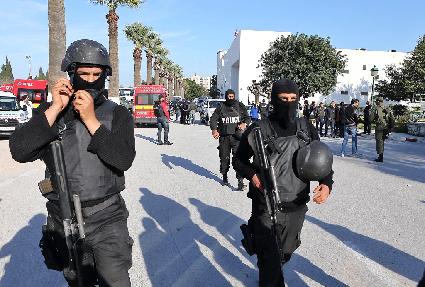
The barbarous terrorist attack on the 18 March at the Bardo Museum in Tunis, that claimed 22 lives, represents a watershed in the political situation of post-revolution Tunisia. This appalling event, the first terrorist act of this scale to take place in the heart of the capital, came as a reminder of the stark reality hidden behind the laudatory propaganda of the mainstream media and politicians about the successful “democratic transition.”
But the Bardo attack has also given a convenient excuse for the ruling class to try and speed up its counter-revolutionary offensive on the Tunisian masses, in both the economic and political fields. It appears that the newly-elected President Beji Caid Essebsi’s obsession of “restoring the prestige and authority of the State” has been given a boost. The US government has already announced a tripling of its military aid to the country.
The Tunisian government -whose leading political force, Nidaa Tounes, is partly a recycling machine for old regime supporters and corrupt businessmen linked to the former Ben Ali dictatorship- has seized the recent terrorist strike as a golden opportunity to reassert a heavier State machinery, and to target the social movements and strikes which have been increasing since the beginning of this year.
The official position focuses on the fact that the Bardo attackers were targeting the new “symbol of democracy” that Tunisian institutions arguably represent. This ironically coincides with the new government exploiting this very event to impose a clampdown on democratic rights. A recent report from Human Rights Watch detailed how the government’s new anti-terrorism draft bill, if passed in parliament, would allow extended detention without charge, would see the disruption of public services prosecuted as a “terrorist act”, and justify the use of the death penalty.
Under the guise of the “protection of the armed forces”, another draft law adopted by the council of ministers on 8 April would, de facto, give a status of impunity to the security forces at the expense of people’s freedoms. Among other things, it says that “no criminal liability shall be attached to an agent who would cause the death of an individual in the context of the mission he pursues”.
The shift in language used in the Tunisian press since 18 March also highlights an acceleration of the ideological offensive to shame all the workers and poor people who fight for their rights:
“The gratuitous and manipulated protest movements are threatening the fragile economic balance of the country. Why do we see them everywhere and without any valid reasons? Should Tunisia decree that those who attack the country’s economic fabric must be considered as economic terrorists? And why not after all? Should we tolerate that a handful of badly intentioned people, conducted by saboteurs, manipulators and destroyers, make of our country a new Somalia?” (Directinfo, 14/04)
This comes also with a new spike in vilifications of the revolution itself, and in some cases, the spreading of a perfume of nostalgia for the days of overt dictatorial rule:
“Human rights lose all their meaning in the face of these terrorists” (Touhami Abdouli, Le Temps, 21/03)
“Obviously, we will never ask ourselves the question of why Tunisia had peace during 23 years of dictatorial regime” (Le Temps, 22/03)
This attempt to bury the legacy of the revolution marks a certain re-assertion of the “old guard” within the State and its appendages, that the electoral victory of Nidaa Tounes has unleashed. The composition of the government is no exception. The Prime Minister Habib Essid himself occupied several posts as secretary of state under the Ben Ali regime, and others in his cabinet have similar pedigrees. After the Bardo attacks, some high security officials who had been sacked in 2011 during a mild cleansing reform within the Interior Ministry have been re-incorporated in their jobs. This move is justified by their supposed experience in the struggle against terrorism – a “struggle against terrorism” which, under Ben Ali, was a cover for the harassment, imprisonment and torture of thousands of political and trade union activists. Similarly, two days after the attack, Essebsi argued in a TV speech for the country to accept “painful reforms”, and defended the lifting of all the restrictions on businessmen who are within the scope of lawsuits and travel bans for their connections with the Ben Ali regime.
National unity?
The Tunisian ruling class and its imperialist backers such as the IMF, the World Bank and the Western governments behind them, plans more deregulation of business requirements, privatisations of state-owned banks and other companies, liquidation of the state subsidy system and other neo-liberal measures. All of which have one essential aim -squeezing the revenues of working class families further, while maximising the profit-making avenues for the bosses, the shareholders and the international creditors.
They all hope to exploit the shock following the Bardo bloodshed to push through their anti-working class agenda.
Part of this involves the hammering down of the need for “national unity”. How convenient! A few months ago, the leading parties in the present government, Nidaa Tounes and the right-wing Islamists of Ennahda, were still both trying to convince us that there was an irreconcilable fracture in Tunisian society, between the “modernists” in favour of a “civilian State” on the one hand, and the Islamists in favour of a “religious State” on the other hand. Now that this masquerade has been exposed for what it is, because the enemies of yesterday have now joined hands in the same coalition to the exclusive benefit of their big business friends, we are supposed to be convinced that their “sacred union” should be ours as well.
National unity is a suitable weapon of the ruling class to try and neutralise opposition to its rule, even as its mouthpieces engage in throwing mud at striking workers and communities in struggle. This new mantra for national reconciliation is aimed at deflecting the mounting class anger by rallying the whole country behind a common enemy, and at trying to bind the workers’ hands and feet with their capitalist masters.
But the growing number of disputes taking place in the workplaces, in both public and private sectors, illustrates that a serious gulf is building up between the capitalist class’s wishful thinking and the reality on the ground. Government officials are well aware that beyond the political use of the present state of affairs, they will not prevent serious backlashes from the working class. The repeated militant national strike actions by the teachers’ union since the beginning of the year have given a flavour of what people in power might have to expect for the year to come. The teachers’ strike, last Wednesday, recorded an average participation rate of 95.3 % across the country according to union figures (the highest being in the central region of Gafsa with 99.6%, and the lowest in the northern region of Bizerte with 91%).
In the phosphate mines, in the textile industry, in the postal services, among the pilots, in public transport -numerous sectors have been involved in industrial action in the recent weeks. The UGTT also announced a two-day national strike in the health sector on the 28 and 29 April. A report published on the day of the Bardo tragedy noted that 94 strikes had taken place since the beginning of 2015, including 74 in the private sector. It is becoming clear that the government’s hope of using the terrorism scarecrow to reduce this nascent wave of working class resistance has been extremely short-lived.
The burning question is: when is the leadership of the workers’ movement eventually going to decide to waken up to the burgeoning reality and lead the millions who are striving for action and real change?
Leadership missing in action
While the government pretends to be engaged in a resolute fight against terrorism, its policies of social devastation only increase the sense of hopelessness and despair among the poorest in society, leading to the growth of religious extremism in the country. Poor neighbourhoods that have become a fertile ground for the recruitment of jihadists are, before anything else, areas where state policy has failed in every respect.
This is why the struggle against terror is intimately linked with the struggle to achieve a decisive break from the economic policies pursued by successive governments since the fall of Ben Ali who have all fundamentally applied the disastrous recipes of the old regime.
The Tunisian General labour Union UGTT has called for a “national congress against terrorism”. But its appeal is directed towards the existing capitalist establishment. It even aims at bringing on board the UTICA (Tunisian Union of Industry and Commerce), the national bosses’ organisation, rather than serving as a lever to organise the fight-back against the government and to engage in a serious discussion on building a working class alternative to the continuing austerity and state repression, which is all that this right-wing government has on offer for the Tunisian people.
Since the Bardo museum attack, the UGTT central executive has essentially echoed the government’s rhetoric about the need for “national unity” rather than providing its affiliates with a plan of action worthy of its name, independently from all the manoeuvres of the capitalists and their parties, and challenging the state’s pretensions to set the tone on anti-terrorism.
The lack of lead from the trade union leadership, and from the left-leaning Popular Front coalition for that matter, has allowed a vacuum that has been occupied by pro-capitalist establishment figures. This has meant that the voice of working people, of trade unionists and left activists, of the revolutionary youth, of the unemployed, has hardly been heard in this debate.
The workers’ movement needs its own political voice
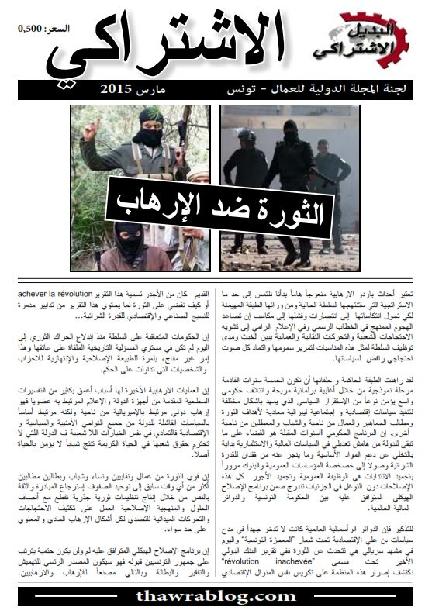
In its last paper, the CWI in Tunisia, Al-Badil al-Ishtiraki (Socialist Alternative), draws parallels between the terror of the jihadists and the State-sponsored terror, and pushes forward proposals for actions based on rejecting both, and campaigning for the transformation of all the local and sectorial social battles into a mass political struggle to eventually topple Essid’s government.
First page of "al-Ishtiraki", the paper of the CWI group in Tunisia. Title reads: "Revolution against terror"
At the present time, this might sound like a herculean task. But the present government is much weaker than it seems. More than four million Tunisians (out of a population of eleven million), including about 80% of the youth between 19 and 25 years old, abstained in the last legislative elections. An internal crisis is already affecting the main governing parties. The existence of such an improbable coalition is in itself a sign of the difficulties for the ruling class to assemble in the first place a tool capable of implementing their desired policies.
The apparent “strength” of the present government only betrays the extremely timorous character of the workers’ leaders and their lack of confidence in the class whose interests they are supposed to defend.   The acquaintances between parts of the UGTT bureaucracy and the Nidaa Tounes party have notably acted as a brake on the response, or rather the lack of it, from the UGTT headquarters in the recent events.
A united front of all workers and social organisations, around the militant bases of the UGTT and the left, of unemployed organisations like the UDC (Union of Unemployed Graduates) and of the social movements, is urgently needed to push back the counter-revolutionary offensive. The starting point of such a movement could be the campaign for organising a mass 24-hour general strike in order to bring all the layers in struggle together, on the basis of the total refusal of any economic “sacrifices” or any erosion of democratic rights.
Such a general strike would have to be seen as a springboard towards escalating actions and demands, until the government is given a decisive blow. Local general assemblies and democratic committees of action in the communities and workplaces would help widen the active support base of the movement, by providing a space to discuss and democratically decide the next steps in the struggle. In the long run, the local, regional and national coordination of such bodies could constitute the backbone for a government genuinely fulfilling the revolution’s demands.
All the governments since the overthrow of Ben Ali have failed the revolution entirely, and the present one is no exception. If anything, this cabinet is composed of all the fundamental components of the reaction put together. The struggle for a progressive government of the poor, the youth and the working masses, based on a socialist program of nationalisation of all major industries, banks, and big land properties under the democratic control of the Tunisian people, is what the left and the trade union movement should strategically prepare the people for.
An independent working class political alternative decisively turned towards grassroots struggles, equipped with a militant programme of action, as well as with democratic and inclusive structures, is what is crucially missing at this point. The rise of reactionary religious forces, the electoral victory of a party based on old-regime cronies, the lack of a proper response from the left after the Bardo attack -all recent developments in Tunisia underline the need to urgently rebuild an authentic independent political voice for the working class, the youth and all the people who have carried out the revolution with genuine hopes for a better future.