29 Apr 2015

OPEC Vs. Fracking

Karl Grossman

Manipulation of the petroleum market is not new. John D. Rockefeller with his Standard Oil Trust mastered it between the end of the 19th and start of the 20th Century. Rockefeller and his trust succeeded in controlling virtually all the oil industry in the United States and also dominating the international market. The Standard Oil Trust fixed prices, set production quotas and ruthlessly forced out competitors.
The U.S. Supreme Court in 1911, in the wake of muckraker Ida Tarbell’s investigative articles and book on the Standard Oil Trust, utilized the Sherman Antitrust Act to break the trust up into 34 pieces. ”For the safety of the Republic,” the court declared, “we now decree that this dangerous conspiracy must be ended.”
The most prominent corporate offshoots of Standard Oil today are ExxonMobil, Chevron and ConocoPhillips. The 34 were supposed to operate independently but, critics have long held, there’s been continued collusion: that the U.S.-dominated oil industry went from being a monopoly to a cartel.
With discoveries of oil in the Middle East in the 1930s and with Standard Oil offshoots deeply involved, the Arabian American Oil Company—Aramco—was created in Saudi Arabia in 1944. In the 1970s, the Saudi government began acquiring more and more of a stake in Aramco, taking over full control in 1980 of what is now called Saudi Aramco.
The Organization of the Petroleum Exporting Countries—OPEC—was formed in 1960 to “coordinate and unify the petroleum policies of its Member Countries and ensure the stabilization of oil markets in order to secure an efficient, economic and regular supply of petroleum to consumers, a steady income to producers and a fair return on capital for those investing in the petroleum industry.”
The senior partner in OPEC, now a 12-nation organization, is Saudi Arabia. This figures considering it has the world’s largest proven crude oil reserves at more than 260 billion barrels.
OPEC sets production targets for its member countries. An early and major flexing of OPEC petroleum power, its system of control, came in 1973 with the “oil embargo” or “oil shock” of that year. It was an OPEC effort to punish the U.S. for its support of Israel in the 1973 Yom Kippur War. Other OPEC-induced “oil shocks” have followed.
This historical background brings us to why the price of a barrel of oil has plummeted in half, from a high of $115 a barrel last June—and why you, as a result, are paying less for a gallon of gasoline at the pump.
The key reason is hydraulic fracturing—or fracking—and OPEC’s move to discourage competition to it from fracking.
In recent years there’s been a revolution in petroleum extraction made possible by a new technique of splitting underground shale formations through hydraulic fracking. This has vastly expanded the gas and oil output of the fracking process.
Fracking is a messy and polluting process. Massive amounts of water and 600 chemicals are shot into the ground under high pressure to release the gas and oil. Especially problematic is the leakage of gas from fracking wells into underground water causing not only serious contamination but the phenomenon of what comes out of a water faucet bursting into flames when touched with a match. The 2010 film Gasland, nominated for an Academy Award, and the subsequent Gasland Part II, both written and directed by Josh Fox, documented this fiery aspect of fracking along with the many instances of water pollution and impact on people’s health caused by the contamination of water. There is also a major problem of fracking causing earthquakes.
Horizontal fracking in shale formations was first developed with federal government support in the United States starting in the 1980s It has enabled the U.S. to again become a global giant in petroleum production.
The International Energy Agency last year projected that in 2015, because of fracking, the U.S. would displace Saudi Arabia as the world’s largest oil producer.
Fracking, however, is a relatively expensive process—about ten times more costly than the $5 to $6 per barrel cost of drilling oil from conventional wells in Saudi Arabia.
By letting the price of oil drop the Saudi-led move has applied substantial financial pressure—so far—on the fracking industry. With the current price per barrel cost at less than $60 a barrel, fracking has become a problematic undertaking economically. And consequently there have been reductions in and cancellations of numerous fracking operations.
As Alan Greenspan, chairman of the Federal Reserve between 1987 and 2006, put it recently: “At the root of the price collapse was the development in the U.S. of technologies for extracting tight oil, mostly from shale deposits, by horizontal drilling and hydraulic fracturing. This reversed the decline in U.S. oil production.”
“After the oil embargo of the 1970s,” he said, ”OPEC wrested oil pricing power from the U.S.” But now, there’s been a “shale technology breakthrough.”
“As a result, the gap between global production and consumption has widened, precipitating a rise in U.S. and world inventories, and a fall in prices. Saudi Arabia, confronted with an oil supply glut but not wishing to lose market share, abandoned its leadership role as global swing producer and refused to cut production to support prices.”
Explains Jamie Webster, an oil market analyst at HIS Energy in Washington, D.C.: “The faster you bring the price down, the quicker you will have a response from U.S. [fracking] production—that is the expectation and the hope. I cannot recall a time when several [OPEC] members were actively pushing the price down in both word and deed.”
There are other factors, too.
The plunging price of oil has impacted severely on Russia causing some analysts to see collusion between the U.S. and Saudi Arabia to hurt the Putin regime in Russia—and some have extended this to seeing such a conspiracy as also being aimed at major oil producers Iran and Venezuela, too.
Russian President Vladimir Putin himself has raised this prospect declaring in December: “We all see the lowering of the oil price. There’s lots of talk about what’s causing it. Could it be the agreement between the U.S. and Saudi Arabia to punish Iran and affect the economies of Russia and Venezuela? It could.”
A few days later, Venezuela’s President Nicholas Maduro charged: “Did you know there’s an oil war. And the war has an objective: to destroy Russia. It’s a strategically planned war…also aimed at Venezuela, to try and destroy our revolution and cause an economic collapse.”
In the U.S., Martin Katusa, chief energy investment strategist at Casey Research in Vermont, believes, “It’s a three-way oil war between OPEC, Russia and North American shale.”
Is a Saudi Arabian assault on the clean-energy movement a factor, too?
“Now energy experts are seeing evidence that the oil bust is helping Saudi Arabia achieve another long-term goal: undermining global efforts to reduce dependence on fossil fuels,” wrote Joby Warrick, environmental reporter for The Washington Post recently. Among those seeing this is Durwood Zaelke, president of the Institute for Governance & Sustainable Development (IGSD) in Washington. “If a period of low prices gets consumers hooked on cheap gas and inefficient cars, that sustains their market,” he said.
In fact, with the sharp decrease in the price of gasoline, sales of SUVs and other low-efficiency vehicles has been rising. This past November was the best month for SUV sales since 2001, according to Autodata.
Still, Ken Johnson, vice president of communications for the Solar Energy Industries Association in Washington told me: “We have not seen any direct link between the price of oil and the development of solar projects nationwide, which remains quite strong.”
Meanwhile, there’s the question of how low the price of a barrel of oil can get and frackers still making it economically with the price a barrel below what’s been their “break-even” price of $70.
Dan K. Eberhart, CEO of Canary, a Colorado-based drilling services company, says “U.S. producers are getting better and more economical” and the price to frack is falling, and this is “going to help U.S. producers stay competitive in the worldwide oil market.”
Katusa of Casey Research says “the versatility and survivability of a lot of these shale producers will surprise people. I don’t see that the shale sector is going to collapse overnight.”
The fracking industry nevertheless is being hurt badly. “The shale oil revolution is in danger,” was the headline in Fortune.  “The recent drop in oil prices poses a major challenge to the frackers. But oil producers, Wall Street analysts, and most industry experts claim the setback will be brief and minor. Don’t believe them,” the article continued. “The basic economies of fracking—what it costs to drill versus what oil now sells for—spells big trouble for the shale boom.” As the Daily Koss headlined its piece on the matter: “97% of fracking now operating at loss at current oil prices.”
Then there’s the issue of how long the U.S. shale boom can last. Fracked wells don’t last long. The International Energy Agency in its 2014 World Energy Outlook projects that as a result, fracking-dominated petroleum production in the U.S. “levels off in the early 2020s and its total production eventually starts to fall back.”
Further, “proved reserves” for petroleum from shale is about 10 billion barrels, according to the U.S. Department Energy, a small fraction of the reserves in the Middle East.
Then there’s the big question of whether oil—from fracking or conventional drilling in the Middle East—can compete with the windfall in renewable energy technologies.
A report recently done for the National Bank of Abu Dhabi by the University of Cambridge and Price Waterhouse Coopers, titled “Financing the Future of Energy,” declares: “The energy system of the past will not be the same as the energy system of the future. It is clear that renewables will be an established and significant part of the future energy mix, in the region and globally.”
“The sharp fall in the oil price in 2014 has raised the question of whether the trend towards a more integrated energy mix and the growth of renewables will continue, or be stalled by more affordable oil and gas,” says the report. “There are strong reasons to believe it will continue.”
Solar photovoltaic power and wind energy have “already a track record of successful deployment. Prices have fallen dramatically in the past few years: solar PV falling by 80 per cent in six years, and on-shore wind by 40 per cent. The speed of this shift towards grid parity with fossil fuels means that, in many instances, perceptions of the role of renewables in the energy mix have not caught up with reality.”
The report notes the bid of the Dubai Electricity and Water Authority in December 2014 to build a 200 megawatt solar photovoltaic facility in Dubai “set a new world benchmark for utility scale solar PV costs, showing that photovoltaic technologies are competitive today with oil at US$10/barrel.”
The report goes on that “solar is on track to achieve grid parity in 80 percent of countries within the next two years, so cost is no longer a reason not to proceed with renewables.”
There have been numerous reports in recent years mirroring this analysis.
How will the oil industry respond? As it has through its history—with market manipulation. Indeed, as the secretary-general of OPEC, Abdulla al-Badri said recently: “Now that prices are around $45-$55 [a barrel], I think maybe they [have] reached the bottom and we [will] see some rebound very soon.” Badri went on that oil prices might get to “more than $200” a barrel, although he wouldn’t give a time frame.

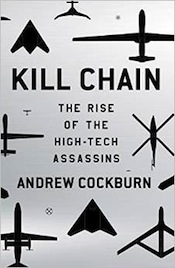
Assassination as Policy in Washington and How It Failed: 1990-2015

Andrew Cockburn

As the war on terror nears its 14th anniversary — a war we seem to be losing, given jihadist advances in Iraq, Syria, and Yemen — the U.S. sticks stolidly to its strategy of “high-value targeting,” our preferred euphemism for assassination.  Secretary of State John Kerry has proudly cited the elimination of “fifty percent” of the Islamic State’s “top commanders” as a recent indication of progress. Abu Bakr al-Baghdadi himself, “Caliph” of the Islamic State, was reportedly seriously wounded in a March airstrike and thereby removed from day-to-day control of the organization. In January, as the White House belatedly admitted, a strike targeting al-Qaeda leadership in Pakistan also managed to kill an American, Warren Weinstein, and his fellow hostage, Giovanni Lo Porto.
More recently in Yemen, even as al-Qaeda in the Arabian Peninsula took control of a key airport, an American drone strike killed Ibrahim Suleiman al-Rubaish, allegedly an important figure in the group’s hierarchy.  Meanwhile, the Saudi news channel al-Arabiya has featured a deck of cards bearing pictures of that country’s principal enemies in Yemen in emulation of the infamous cards issued by the U.S. military prior to the 2003 invasion of Iraq as an aid to targeting its leaders.  (Saddam Hussein was the ace of spades.)
Whatever the euphemism — the Israelis prefer to call it “focused prevention” — assassination has clearly been Washington’s favored strategy in the twenty-first century.   Methods of implementation, including drones, cruise missiles, and Special Operations forces hunter-killer teams, may vary, but the core notion that the path to success lies in directly attacking and taking out your enemy’s leadership has become deeply embedded.  As then-Secretary of State Hillary Clinton put it in 2010, “We believe that the use of intelligence-driven, precision-targeted operations against high-value insurgents and their networks is a key component” of U.S. strategy.
Analyses of this policy often refer, correctly, to the blood-drenched precedent of the CIA’s Vietnam-era Phoenix Program — at least 20,000 “neutralized.” But there was a more recent and far more direct, if less noted, source of inspiration for the contemporary American program of murder in the Greater Middle East and Africa, the “kingpin strategy” of Washington’s drug wars of the 1990s. As a former senior White House counterterrorism official confirmed to me in a 2013 interview, “The idea had its origins in the drug war.  So that precedent was already in the system as a shaper of our thinking.  We had a high degree of confidence in the utility of targeted killing. There was a strong sense that this was a tool to be used.”
Had that official known a little more about just how this feature of the drug wars actually played out, he might have had less confidence in the utility of his chosen instrument.  In fact, the strangest part of the story is that a strategy that failed utterly back then, achieving the very opposite of its intended goal, would later be applied full scale to the war on terror — with exactly the same results.
The Kingpin Strategy Arrives
At the beginning of the 1990s, the Drug Enforcement Administration (DEA) was the poor stepsister of federal law enforcement agencies.  Called into being by President Richard Nixon two decades earlier, it had languished in the shadow of more powerful siblings, notably the FBI.  But the future offered hope.  President George H.W. Bush had only recently re-launched the war on drugs first proclaimed by Nixon, and there were rich budgetary pickings in prospect.  Furthermore, in contrast to the shadowy drug trafficking groups of Nixon’s day, it was now possible to put a face, or faces, on the enemy.  The Colombian cocaine cartels were already infamous, their power and ruthless efficiency well covered in the media.
For Robert Bonner, a former prosecutor and federal judge appointed to head the DEA in 1990, the opportunity couldn’t have been clearer.  Although Nixon had nurtured fantasies of deploying his fledgling anti-drug force to assassinate traffickers, even soliciting anti-Castro Cuban leaders to provide the necessary killers, Bonner had something more systematic in mind.  He called it a “kingpin strategy,” whose aim would be the elimination either by death or capture of the “kingpins” dominating those cartels.
Implicit in the concept was the assumption that the United States faced a hierarchically structured threat that could be defeated by removing key leadership components.  In this, Bonner echoed a traditional U.S. Air Force doctrine: that any enemy system must contain “critical nodes,” the destruction of which would lead to the enemy’s collapse.
In a revealing address to a 2012 meeting of DEA veterans held to commemorate the 20th anniversary of the kingpin strategy’s inauguration, Bonner spoke of the corporate enemy they had confronted.  Major drug trafficking outfits, he said, “by any measure are large organizations. They operate by definition transnationally. They are vertically integrated in terms of production and distribution. They usually have, by the way, fairly smart albeit quite ruthless people at the top and they have a command and control structure. And they also have people with killchain2expertise that run certain essential functions of the organization such as logistics, sales and distribution, finances, and enforcement.”  It followed therefore that the removal of those smart people at the top, not to mention the experts in logistics, would render the cartel ineffective and so cut off the flow of narcotics to the United States.
Pursuit of the kingpins promised rich institutional rewards.  Aside from the overbearing presence of the FBI, Bonner had to contend with another carnivore in the Washington bureaucratic jungle eager to encroach on his agency’s territory. “DEA and CIA were butting heads,” recalled the former DEA chief in a 2013 interview. “There was real tension.” Artfully, he managed to negotiate peace with the powerful intelligence agency, “so now we had a very important ally. CIA could use DEA and vice versa.”
By this he meant that the senior agency could use the DEA’s legal powers for domestic operations to good advantage.  This burgeoning relationship brought additional potent allies. Not only was his agency now closer to the CIA, Bonner told me, but “through them, the NSA.” A new Special Operations Division created to work with these senior agencies was to oversee the assault on the kingpins, relying heavily on electronic intelligence.
This new direction would swiftly gain credibility after the successful elimination of the most famous cartel leader of all.  Pablo Escobar, the dominant figure of the Medellín cartel, was an object of obsessive interest to American law enforcement.  He had long evaded U.S.-assisted manhunts before negotiating an agreement with the Colombian government in 1991 under which he took up residence in a “prison” he himself had built in the hills above his home city. A year later, fearing that the government was going to welsh on its deal and turn him over to the Americans, Escobar walked out of that prison and went into hiding.
The subsequent search for the fugitive drug lord marked a turning point. The Cold War was over; Saddam Hussein was defeated in the first Gulf War in 1991; credible threats to the U.S. were scarce; and the danger of budget cuts was in the air. Now, however, the U.S. deployed the full panoply of surveillance technology originally developed to confront the Soviet foe against a single human target. The Air Force sent in an assortment of reconnaissance planes, including SR-71s, which were capable of flying at three times the speed of sound. The Navy sent its own spy planes; the CIA dispatched a helicopter drone.
At one point there were 17 of these surveillance aircraft simultaneously in the air over Medellín although, as it turned out, none of them were any help in tracking down Escobar.  Nor did the DEA make any crucial contribution. Instead, his deadly rivals from Cali, Colombia’s other major trafficking group, played the decisive role in the destruction of that drug lord’s power and support systems, combining well-funded intelligence with bloodthirsty ruthlessness.
His once all-powerful network of informers and bodyguards destroyed, Escobar was eventually located by homing in on his radio and gunned down as he fled across a rooftop on December 2, 1993.  Though the matter is open to debate, a former senior U.S. drug enforcement official assured me unequivocally that a sniper from the U.S. Army’s Special Operations Delta Force had fired the killing shot.
Following this triumph, the DEA turned its attention to the Cali cartel, pursuing it with every resource available: “We really developed the use of wiretaps,” Bonner told me.  Patience and the provision of enormous resources eventually yielded results. In June and July 1995, six of the seven heads of the Cali cartel were arrested, including the brothers Gilberto and Miguel Rodríguez-Orijuela, and the cartel’s cofounder, José “Chepe” Santacruz Londoño.  Although Londoño subsequently escaped from jail, he would in the end be hunted down and killed.  Continued U.S. pressure for the rest of the decade and beyond resulted in a steady flow of cartel bosses into prisons with life sentences or into coffins.
Cartel Heads Go Down and Drugs Go Up
The strategy, it appeared, had been an unqualified success.  “When Pablo Escobar was on the run, for all practical purposes, his organization started going down… ultimately it was destroyed.  And that’s the strategy we have called the kingpin strategy,” crowed Lee Brown, Bill Clinton’s “drug czar,” in 1994.
In public at least, no officials bothered to point out that if that strategy’s aim was to counter drug use among Americans, it had achieved precisely the opposite of its intended goal.  The giveaway to this failure lay in the on-the-street cost of cocaine in this country.  In those years, the DEA put enormous effort into monitoring its price, using undercover agents to make buys and then laboriously compiling and cross-referencing the amounts paid.
The drugs obtained by these surreptitious means, however, were of wildly varying purity, the cocaine itself often having been adulterated with some worthless substitute. That meant that the price of a gram of pure cocaine varied enormously, since a few bad deals of very low purity could cause wide swings in the average. Dealers tended to compensate for higher prices by reducing the purity of their product rather than charging more per gram. As a result, the agency’s price charts showed little movement and so gave no indication of what events were affecting the price and therefore the supply.
In 1994, however, a numbers-cruncher with the Institute for Defense Analysis, the Pentagon’s in-house think tank, began subjecting the data to more searching scrutiny. The analyst, a former Air Force fighter pilot named Rex Rivolo, had been tasked to take an independent look at the drug war at the request of Brian Sheridan, the hardheaded director of the Defense Department’s Office of Drug Control Policy who had developed a healthy disrespect for the DEA and its operations.
Having tartly informed DEA officials that their statistics were worthless, mere “random noise,” Rivolo set to work developing a statistical tool that would eliminate the effect of the swings in purity of the samples collected by the undercover agents. Once he had succeeded, some interesting conclusions began to emerge: the pursuit of the kingpins was most certainly having an effect on prices, and by extension supply, but not in the way advertised by the DEA. Far from impeding the flow of cocaine onto the street and up the nostrils of America, it was accelerating it. Eliminating kingpins actually increased supply.
It was a momentous revelation, running entirely counter to law enforcement cultural attitudes that reached back to the days of Eliot Ness’s war against bootleggers in the 1920s and that would become the basis for Washington’s twenty-first-century counterinsurgency wars. Such a verdict might have been reached intuitively, especially once the kingpin strategy in its most lethal form came to be applied to terrorists and insurgents, but on this rare occasion the conclusion was based on hard, undeniable data.
In the last month of 1993, for example, Pablo Escobar’s once massive cocaine smuggling organization was already in tatters and he was being hunted through the streets of Medellín. If the premise of the DEA strategy — that eliminating kingpins would cut drug supplies — had been correct, supply to the U.S. should by then have been disrupted.
In fact, the opposite occurred: in that period, the U.S. street price dropped from roughly $80 to $60 a gram because of a flood of new supplies coming into the U.S. market, and it would continue to drop after his death.  Similarly, when the top tier of the Cali cartel was swept up in mid-1995, cocaine prices, which had been rising sharply earlier that year, went into a precipitous decline that continued into 1996.
Confident that the price drop and the kingpin eliminations were linked, Rivolo went looking for an explanation and found it in an arcane economic theory he called monopolistic competition. “It hadn’t been heard of for years,” he explained. “It essentially says if you have two producers of something, there’s a certain price. If you double the number of producers, the price gets cut in half, because they share the market.
“So the question was,” he continued, “how many monopolies are there? We had three or four major monopolies, but if you split them into twenty and you believe in this monopolistic competition, you know the price is going to drop. And sure enough, through the nineties the price of cocaine was plummeting because competition was coming in and we were driving the competition. The best thing would have been to keep one cartel over which we had some control. If your goal is to lower consumption on the street, then that’s the mechanism. But if you’re a cop, then that’s not your goal. So we were constantly fighting the cop mentality in these provincial organizations like DEA.”
The Kingpin Strategy Joins the War on Terror
Deep in the jungles of southern Colombia, coca farmers didn’t need obscure economic theories to understand the consequences of the kingpin strategy. When the news arrived that Gilberto Rodríguez-Orijuela had been arrested, small traders in the remote settlement of Calamar erupted in cheers. “Thank the blessed virgin!” exclaimed one grandmother to a visiting American reporter.
“Wait till the United States figures out what it really means,” added another local resident. “Hell, maybe they’ll approve, since it’s really a victory for free enterprise. No more monopoly controlling the market and dictating what growers get paid. It’s just like when they shot Pablo Escobar: now money will flow to everybody.”
This assessment proved entirely correct. As the big cartels disappeared, the business reverted to smaller and even more ruthless groups that managed to maintain production and distribution quite satisfactorily, especially as they were closely linked either to Colombia’s Marxist FARC guerrillas or to the fascist anti-guerrilla paramilitary groups allied with the government and tacitly supported by the United States.
Much of Rivolo’s work on the subject remains classified. This is hardly surprising, given that it not only undercuts the official rationale for the kingpin strategy in the drug wars of the 1990s, but strikes a body blow at the doctrine of high-value targeting that so obsesses the Obama administration in its drone assassination campaigns across the Greater Middle East and parts of Africa today.
Rivolo was, in fact, able to monitor the application of the kingpin strategy in the following decade.  In 2007, he was assigned to a small but high-powered intelligence cell attached to the Baghdad headquarters of General Ray Odierno, who was, at the time, the operational U.S. commander in Iraq.  While there he made it his business to inquire into the ongoing targeting of “high-value individuals,” or HVIs.  Accordingly, he put together a list of 200 HVIs — local insurgent leaders — killed or captured between June and October 2007.  Then he looked to see what happened in their localities following their elimination.
The results, he discovered when he graphed them out, offered a simple, unequivocal message: the strategy was indeed making a difference, just not the one intended. It was, however, the very same message that the kingpin strategy had offered in the drug wars of the 1990s.  Hitting HVIs did not reduce attacks and save American lives; it increased them. Each killing quickly prompted mayhem. Within three kilometers of the target’s base of operation, attacks over the following 30 days shot up by 40%. Within a radius of five kilometers, a typical area of operations for an insurgent cell, they were still up 20%. Summarizing his findings for Odierno, Rivolo added an emphatic punch line: “Conclusion: HVI Strategy, our principal strategy in Iraq, is counter-productive and needs to be re-evaluated.”
As with the kingpin strategy, the causes of this apparently counter-intuitive result became obvious upon reflection.  Dead commanders were immediately replaced, and the newcomers were almost always younger and more aggressive than their predecessors, eager to “make their bones” and prove their worth.
Rivolo’s research and conclusions, though briefed at the highest levels, made no difference.  The kingpin strategy might have failed on the streets of American cities, but it had been a roaring success when it came to the prosperity of the DEA.  The agency budget, always the surest sign of an institution’s standing, soared by 240% during the 1990s, rising from $654 million in 1990 to over $1.5 billion a decade later.  In the same way, albeit on a vaster scale, high-value targeting failed in its stated goals in the Greater Middle East, where terror recruits grew and terror groups only multiplied under the shadow of the drone.  (The removal of al-Baghdadi from day-to-day control of the Islamic State, for instance, has apparently done nothing to retard its operations.)  The strategy has, however, been of inestimable benefit to a host of interested parties, ranging from drone manufacturers to the CIA counterterrorism officials who so signally failed to ward off 9/11 only to adopt assassination as their raison d’être.
No wonder the Saudis want to follow in our footsteps in Yemen. It’s a big world. Who’s next?

Darkness in the Morning

Joseph Grosso

In one way, since the end of the Second World War, when the U.S. assumed its role as the leading global hegemon, American policy towards the Middle East has resembled a damaged pinball machine gone tilt. There was the CIA led 1953 coup against Iran’s democratically elected Prime Minister Mohammad Mosaddeq, whose sin was nationalizing the British Anglo-Iranian Oil Company, that resulted in the reinstallation of Shah Mohammad Reza Pahlavi. When the ghastly Shah regime finally fell decades later and Iran was soon after at war and Washington’s tilt away from Iran was towards Iraq, of course ruled by none other than Saddam Hussein (his Baath Party’s coup in 1963 also was helped along by the CIA), this tilt coinciding with the worst of Hussein’s atrocities, including the use of chemical weapons against Iranian soldiers (U.S. intelligence provided imagery and maps about Iranian troop movements) and the Kurds. A few years later Hussein overstepped his bounds by seizing Kuwait, perhaps due to misreading shady diplomatic signals -then American ambassador to Iraq April Glaspie was quoted as telling Hussein ‘We understand that and our opinion is that you should have the opportunity to rebuild your country. But we have no opinion on the Arab-Arab conflicts, like your border disagreement with Kuwait’, thus ending Hussein’s days as an American client. Even the ‘Special Relationship’ with Israel wasn’t without such mechanics. Though the United States was the first state to formally recognize Israel in 1948, President Eisenhower didn’t tolerate the Israeli-British-French seizure of the Suez Canal in 1956. The tilt towards Israel didn’t truly occur until after the 1967 war – probably when Washington awoke to Israel’s usefulness as a bulwark against Pan-Arabism.
Still in perhaps a greater way, American policy, in the midst of all that, has displayed a certain consistency: an inherently reactionary arraignment built off the promises of stability and the free flow of oil to the global economy, the main pillars of which for decades, and most especially after the loss of the Shah in Iran, have been the Israeli government, the Egyptian military, and the House of Saud. The practical result was not only the flow of oil but also the enabling of a divided region full of dictatorships and economic stagnation. It all made Wahhabism, often funded by the House of Saud, and other strains of radical Islam, in the case of Hamas and Hezbollah, covertly funded early on by Israel, an appealing ideology to the masses trapped under the system.
This cynical epoch was supposed to have ended with the blowback of September 11th, 2001. It was no less than George W. Bush who proclaimed at a speech at the American Chamber of Commerce in November 2003 ‘Sixty years of Western nations excusing and accommodating the lack of freedom in the Middle East did nothing to make us safe.’ Of course Bush’s murderous invasion of Iraq, by then a nation decimated under a lethal combination of Western sanctions and entrenched dictatorship, only served, among other things, to destabilize the country, the culmination of which has been the rise and expansion of ISIS.
A few years later it was Barack Obama in the White House as the Arab Spring got going in December 2010. In May 2011 Obama declared ‘Yet we must acknowledge that a strategy based solely upon the narrow pursuit of these interests will not fill an empty stomach or allow someone to speak their mind. Moreover, failure to speak to broader aspirations of ordinary people will only feed the suspicion that has festered for years that the United States pursues our interests at their expense.’ He then spoke out for a ‘set of core principles’ including economic reform, human rights, opposition to violence and repression but not before helpfully leaving himself an out with ‘Not every country will follow our particular form of representative democracy, and there will be times when our short-term interests don’t align perfectly with our long-term vision for the region.’
It’s only in the subservient mind of American punditry where such a banal sentiment can be declared ‘historic’. Still Obama can be credited with casting aside Hosni Mubarak a couple of months before he made that speech despite the loud objections of the House of Saud and Benjamin Netanyahu (with the usual Great Power hypocrisy: Bahrain, home country of the United States Fifth Fleet, saw its uprising brutally crushed by its government with Saudi support. There was only token opposition from Washington). Even the subsequent coup against Mohamed Morsi in 2013 initially had enough respectable support (such as by Nobel Peace winner Mohamed ElBaradei), before its repression became too apparent, to be defendable. Still, in the aftermath of that repression and the fact that Egyptians overall are back to square one, did Obama have to approve a full restoration of military aid to Egypt’s government?
One of the charming side effects whispered about the Iraq War was that with a new democratic ally installed in Bagdad, and one with ample oil reserves, would enable the United States to step down as patron to the House of Saud. The same sort of idea floats around the ‘energy independence’ notion the fracking boom is supposed to be bringing. Yet the present day finds the United States supporting the House of Saud’s intervention in Yemen in favor of deposed autocrat Abd-Rabbu MansourHadi. The official justification is that the Houthi uprising that forced Hadi out is Iranian controlled- a largely dubious charge though no doubt such ties will increase as the Houthis are under the Saudi coalition’s assault; this despite the fact that the Houthis are sworn enemies of Al Qaeda in Yemen, the main calling card of Hadi.
Meanwhile the same dynamic is at play in Iraq where the U.S. seems to be trying to square the circle by fighting ISIS without the most effective fighters. Shite reprisals against Sunnis who have already suffered enough under ISIS rule is a serious concern but with the Iraqi army in disarray a policy of completely marginalizing Shite fighters (in an effort to limit Iranian influence, no doubt also conforming to Saudi wishes despite that at the same time the United States is negotiating with Iran over its nuclear program) risks prolonging ISIS rule. A view through this dizzying looking glass of events seems to show the American alliance with the House of Saud is still cemented, even as Saudi ties to 9/11 are still being investigated.
As for the Israeli government is concerned it would seem fair to at least suspect Obama of a cowardice that goes beyond the political and into the personal; back in his first term the announcement of settlement expansion, just as the Obama administration was attempting to restart the tedious ‘peace process’ , greeted Joe Biden’s arrival in Israel. That set the tone for the rest of Obama’s tenure as Netanyahu piled on the insults: lecturing Obama on national TV about ‘reality’ after Obama told AIPAC that negotiations should be based on the pre-1967 borders, all but campaigning for Mitt Romney in 2012, and most recently doing an end-round past the White House to address Congress about the destructiveness of the administration’s nuclear deal with Iran. For all that Netanyahu got support for his war in Gaza and endless reassurances that the partnership with Israel is bigger than any personal differences. So American aid keeps flowing and the Palestinians remain stateless and subject to the never-ending process.
To say that after years of war and upheaval the United States came full circle in the Middle East is to miss the essential point: it never relinquished its role as slumlord. The pillars of stability are still in place and have never been seriously threatened. An unjust status quo has gotten much worse, the region now bitterly divided even further (the original vision of European imperialism still vibrates) and therefore a market for patronage and arms dealers. Besides ensuring Israel’s military advantage, it is notable that Saudi Arabia is now the fourth highest spender on weaponry in the world. Last year Qatar got a deal an $11 billion deal with The Pentagon to purchase Apache attack helicopters and Patriot and Javelin air-defense systems. UAE last year spent three times what they spent a decade ago. Drones will soon be hovering more than ever. The amount of bloodshed will undoubtedly continue to be great. Such is Western policy in the region most constant result.

Is Thailand Slipping Out of Its American Shackles?

Afshin Rattansi

Things are changing at ASEAN. It doesn’t matter how much the Philippines bleats on from U.S. State Department crib sheets about the threat of Communist China at this week’s ASEAN meeting in Kuala Lumpur.
I got a hint of the change when I visited Thailand recently.
Anyone with half a brain knows that going on holiday to Thailand has, for decades, been like showering dollars on a country prostituted to Washington. Since the Second World War, Thailand has been a bulwark of U.S. military might that may have cost the lives of six million in Indo-China (adding up Korea, Vietnam, Laos, Cambodia, Indonesia to name a few).  So even thinking of holidaying in Thailand – for all its natural beauty – always seemed to me like contemplating a visit to Sun City.
But things are changing. This month, when I visited Thailand, Bangkok witnessed its first visit by a Russian premier in a quarter of a century. And that’s Bangkok under a military government – not the fake democracy promoted by Washington Consensus countries for all too long.
The latest coup government, run by a military commanded by General Prayut Chan-o-cha doesn’t seem to take John Kerry’s calls so easily. And that’s despite the fact he knows very well how the US government deposed his predecessor in a U.S.-backed 2006 coup against a leader who only slightly deviated from IMF/World Bank neo-genocide. The poor have been dying in Thailand for a long time. And General Prayut is not following the U.S. script.
Thaksin Shinawatra’s democratically elected government was overthrown by the US government not because of corruption. Thaksin’s problem was he actually responded to some of the pain of his electors by mitigating some IMF structural adjustment programmes. He slowed down Washington’s desire for privatisation of healthcare, housing and education.
De Toqueville famously gave some credit for the Jacobite Revolution to Louis XVI’s tiny moves towards mitigating feudal inequality. It’s when autocracy gives a little that you know it’s the end. And Thaksin, the neoliberal telecoms billionaire, gave a few crumbs away.
Before democratically-elected Thaksin fled to Dubai after the U.S.-backed coup, he had given the poor of Thailand a taste of subsidised healthcare – something the neoliberals at IMF HQ must have recoiled at with horror.
Thaksin’s protégé-sister, Yingluck who was overthrown by General Prayut even allowed a bronze statue of the great poet, journalist and guerrilla Jit Phumisak to go up in Bangkok. Jit who favoured non-aligned revolution was gunned down at 36, a year before Che Guevara. He wrote Chom Na Sakdina Thai; “The Real Face of Thai Feudalism” and the Johnson administration has long been rumoured to have had a hand in his assassination. Perhaps, the Thai people got a glimpse of the future denied them for so long by U.S.-policy.
Did the U.S. see the threat of another Mahathir Mohamad of Malaysia who ignored Western economic “advice” during the 1990s collapse of South-East Asia? Back then, U.S. proxy media like the BBC and CNN got very worked up about Mahathir even though Malaysia wasn’t even particularly important for U.S. military operations in the region. Malaysia doesn’t even have a formal military treaty with the U.S. about joint operations.
But Thailand is different. Back when three million Vietnamese were being slaughtered by the U.S., 80% of all American airstrikes originated in Thailand. What could the White House do with a country so militarily important defying neoliberal law? What would happen if it forged military alliances with BRICS countries?
Obama’s plan was to install just another line of leaders in Thailand from the oligarchic elites that have ruled the country under U.S.-watch for as long as anyone can remember. The plan worked out about as well as longstanding IMF economic dictatorship. Thanks to Structural Adjustment Programmes, Thailand is not only a nation of stunning natural splendour being annihilated by uncontrolled tourism. It has a devastating statistical record of injustice.
Thailand has a World Bank GINI coefficient of inequality worse than Burkina Faso’s – nearly as bad that of the United States. Its infant mortality rates at 11 per 1,000 births are approaching those of Ohio’s or DC’s African-American community (14.5 and 14). To put that in perspective infant mortality in countries that don’t support the IMF like Cuba is 4.7. In Malaysia which defied Washington, the figure is 7 per 1,000.
Amidst the infamous Go-Go bars of Bangla Street, staff tell me that the new military government is cracking down on corruption. The Tourist Police are no longer demanding money and free services from sex-workers. Healthcare is getting marginally better in the rural provinces to which money is repatriated by all the Thai workers here. But if General Prayut has a hard time battling the corruption of oligarchic elites whose largesse he, himself, has long benefited from, it is his foreign policy that may ultimately stick in the craw of the White House.
It’s bad enough for Washington to see Bangkok and Moscow get closer after the visit of Russian Prime Minister Medvedev. NATO invokes Ukraine to forge media frenzy against Russia. But NATO invokes the South China Sea to get at Beijing. Just on the Saturday before this week’s 26th ASEAN Foreign Ministers’ Meeting in Malaysia, Xu Qiliang from the Central Military Commission of the Chinese Communist Party was in Bangkok to hold talks with Thai Defence Minister Prawit Wongsuwan. Elevating military cooperation was top of the agenda. It seems the military government really is recalibrating relations with the U.S.
The Thai Ministry of Transport even appears to want to convert U-Tapao military base 90 miles from Bangkok into a commercial airport that could terminate U.S. military access to runways. There will be a sigh of relief in Laos, Cambodia and Vietnam.
This month, Russian Trade Minister Denis Manturov said “Our friends from the Western part of the world are ignoring Thailand.” Many of the people of Thailand may hope this continues. Expect lots of anti-Thai propaganda in the Western media for the foreseeable future.

Baltimore, the Fire This Time

Belén Fernández

The National Guard was unleashed on Baltimore yesterday to quell unrest following the funeral of 25-year-old Freddie Gray, who died of injuries sustained in police custody. On 12 April, Gray was pinned to the pavement by officers before being loaded into a police van. When he was taken out of it his spine was ‘80 per cent severed’, according to the family’s lawyer. He spent a week in a coma and died on 19 April.
On Saturday I went to join a protest due to start at the corner of Presbury and North Mount streets. On my way there from the subway station I passed an alleyway with four police cars in it, their lights flashing. The cops appeared to be questioning people. A group of residents, all black, stood at the entrance to the alley, their phone cameras trained on the police.
I asked what was going on. ‘This shit happens every day around here.’ When a fifth police car arrived, a few members of the group put their hands sarcastically in the air. One man told the officer at the wheel that the alleyway couldn’t accommodate any more police vehicles.
Phone footage can occasionally force the police to be accountable, as in the case of Walter Scott, an unarmed black man shot several times in the back by an officer in South Carolina.
Gray’s arrest was captured on film too, but only up until the moment he was shoved into the van. His crime had been to flee the police unprovoked in a ‘high-crime area’ – a.k.a. ‘running while black’.
Given the cops’ track record, it’s hardly surprising people run from them. Technically it doesn’t count as probable cause for arrest, but the Supreme Court has determined that the fourth amendment protecting against arbitrary detention doesn’t necessarily apply in ‘high-crime areas’.
The court hasn’t defined, however, what these areas are. According to a 2008 article in the American University Law Review,
There is no agreement on what a ‘high-crime area’ is, whether it has geographic boundaries, whether it changes over time, whether it is different in different parts of the country, whether there are different types of ‘high-crime areas,’ or who determines that an area is, in fact, a higher crime area.
Meanwhile, the ability to designate high-crime areas encourages the police to commit crimes in them. Last September, the Baltimore Sun reported that the city had paid out $5.7 million since 2011 in police abuse lawsuits. There was a state of emergency in Baltimore long before it was declared yesterday.

The Young Terrorists are Here!

Binoy Kampmark

If they are not coming to a military parade near you, vomiting ideological pile at a police station, or some such edifice of authority, they are certainly planning to, endorsing some idea of it, or demonstrating a keenness on sneaking a head off here and there. Welcome to the world of terrorist toddlers, pubescent teens, and youngsters.
Australia’s foreign minister, Julie Bishop, certainly thinks so. In a session chairing the UN Security Council last year, she told members how, “Terrorists are younger, more violent, more innovative and highly interconnected.” Instead of numbing themselves with the dreary effects of social media, they have used it enterprisingly “to terrorise, and to recruit, and are very tech-savvy.”
And there is no better time to be a terrorist in whatever shape and form than now. Dr. Clarke Jones from the Australian National University is convinced, gazing into some rather cloudy crystal ball, that 2015 “is going to be a year of terrorism in the sense that I think we are going to see more small scale attacks.” Apparently, terrorism, in its “nature,” is changing.
Obviously Jones is unburdened by the weight of violent nationalist movements that littered Europe in the nineteenth century, and the post-colonial world in the twentieth, with its various victims of terrorism. We are so modern, and so different.
These young demons, for Bishop, seemingly shelter behind the veil of prosaic behaviour – such as then 17-year-old Adam Dahman, “who grew up in a typical Australian household and played sport for his local high school.” Or the three Succarieh brothers from Brisbane.
In Britain, excitement abounds over the issue of a 14-year-old, said to be the remarkable mastermind of incitement of Australian teenagers arrested in connection with a supposed terrorist plot against recent Anzac commemorations. The teenager in question has been charged with two offences of inciting terrorism overseas in communicating with the young Melbourne-based Sevdet Besim “namely to carry out an attack at an Anzac parade in Australia with the aim of killing and/or causing serious injury to people.” Presumption, it would seem, is sufficient to constitute a credible threat.
The prosecutors have certainly been doing the rounds nabbing the garrulous young, taking note of language that sounds like the puerile antics of shopping mall video gaming. (The words uttered via the encrypted message on Telegram were an encouragement that Besim “sharpen his knife as hard as he could.”) The teenager was initially arrested with a 16-year-old girl from Manchester on April 2. They subsequently received bail after being questioned on suspicions of preparing a terrorist act. Evidently not satisfied, the authorities re-arrested the 14-year-old on April 18.
According to Deborah Walsh, the deputy head of counter terrorism at the UK Crown Prosecution Service, the incitement took the form of encouraging a beheading in Australia during the course of Anzac Day celebrations involving a knife, then a gun or a “car-up” on police. The beheading of a “loner” was to be the appetiser, allowing the audience to “get a taste for it”.
In Walsh’s words, “The decision to prosecute has been taken in accordance with the Code for Crown Prosecutors. We have determined that there is sufficient evidence or a realistic prospect for conviction and that a prosecution was in the public interest.” Realism, evidently, is in the eye of the prosecutorial beholder.
Why the fuss? The enthusiastic authorities cite converts to the ISIS cause, noting, for instance, groups of young women as young as 15 who have travelled to join the group in Syria last year. (The mistake here is to draw the next conclusion: that these girls are the next bomb throwers and conscientious executioners.) The number, noted in The Independent(May 1) totals about 22. Prominent has been the case of London trio Shamima Begum (15), Kadiza Sultana (16) and Amira Abase (15). Everywhere, there are fears of a fifth column of radicalised returnees and blood-savage recruits.
This orgiastic fearfulness has made those in power worried. They are starting to see terrorists everywhere, from pram to pulpit, from diaper to primary school. To date, the French authorities have come closest in astonishing law watchers with their interest in the phenomenon of terrorist children. On January 8, a day after two gunmen attacked the offices of the satirical magazine Charlie Hebdo, an eight-year old boy reported as Ahmed was asked in his primary school class in Nice whether he was “Charlie”. Taking issue with the question, he suggested that, “I am on the side of the terrorists, because I am against the caricatures of the prophet”.
The stunned teacher conveyed the youngster to the principal, who then reiterated the question three more times in front of the class in collective chiding. “Are you Charlie?” The incident was subsequently reported by the administrators to the police, who went about their diligent task protecting the French Republic against the purported silliness of a child of eight who had not provided suitable homage for the moment by interrogating him.
According to Fabienne Lewandowski of the Alpes-Maritimes regional police, the school principal insisted that the child had suggested “French people should be killed,” “I am on the side of the terrorists” and “the journalists deserved to die.” Sefen Guez Guez, the lawyer representing Ahmed, could only conclude that the police, in questioning his client, showed how France had succumbed to a “collective hysteria”.
What has changed in this latest round of authoritarian lunacy is not the type of terrorism, but the response of authorities to perceptions of what form it might take. The weight attributed to such terms as incitement has diminished to that of a feather. The delusionary ranting of a child is taken as the ideological promise of a fully-fledged fanatic able to massacre and maim. Those defending the law should be far more questioning of such premises.

Buhari:Nigeria's Realities, Hopes and Impediments

Steve Orji

Cascading this model, to the cradle of other social institutions like schools, offices and colleges, can improve the quality of Nigeria's public and human assets, deepen the culture of excellence, and serve as strong framework for improved social trust and surely will impact on the reputational asset of the country.The Public information bill (PIB), will underpin the Buhari's administration's intent at providing institutional and fiscal expenditure transparency within the tiers of government, in the hope the legislative arm will make a speedy accent to the bill. The passage of the bill will also provide moral impetus for all arms of government, including the judiciary to deal circumspectly, and to be fair and ethically honest, especially in the dispensation of justice to the common, helpless people of Nigeria, long denied justice.
Offshore investments and business partnership in Nigeria slowed in time past, for the fact that Nigerian businessmen, are deemed untrustworthy. Even agents of government. The Halliburton bribery scandal, involving some top government officials has since remained an official secret.  The inability of government to make public the outcome of the Oputa panel, remains a model case of lack of institutional transparency.
What happened to the pious Okigbo probe-panel and the oil revenue windfall? The nation fell silent for so long on some high-profile murders, involving well-placed Nigerians.  Could one say justice has been done when the judiciary is under the thumb of the ruling party?
No nation thrives well when it sweeps under the carpet, acts of injustices, undermine the spiritual and moral capacities of it's people. Loads of Nigerians have gone to their graves, whose cringing voices were suppressed and their legitimate social and personal requirements forcefully denied.
Can Buhari alter the indices, to make the institutions sturdy and steady with an independent, professional and ethical backbone as is required, to support the social aspirations of Nigerians? The spin-off of this kind of social and ethical transparency will ultimately alter the Nation’s social class structure. Would super-rich Nigerians provide plausible explanations of the source of their wealth? The millennium gap between the very wealthy and the very poor accounts in part to prominent social vices like stealing, prostitution, militancy, kidnapping etc.
Many Nigerians may find it difficult to sustain the culture of honesty, when they know that known thieves around them were never brought to book and multi-millionaires emerge every second just by patronising  "well connected" politicians.
There has to be systematic restoration of the middle-class, by incentivizing the struggling mass of Nigerians, into active economic participation. The activities of the Microfinance Banks, need to be sustained and given wider economic latitude. The Small Medium Enterprise (SME) scheme needs to be refloated and sustained for deeper economic impact amongst the have-nots of the society.
Growing the middle-class will absorb the negative social energy of competitive materialism, gracefully allowing citizens, youths, mature into sustainable moral values of contentment and self-dignity. Politicians and the syndrome of free money, did some harm to the social structure and values of Nigeria-must everyone own exotic assets?  "The quest to belong" as defined by politicians and their acolytes, resulted in the bandwagon strive to "achieve"-the result was citizen's discontentment, inordinate ambitions, and the twisted social structure that Nigeria is unfortunately steeped in. By Buhari, accepting to declare his assets, prior and after, provides a moral compass for Nigeria's social readjustments.
Heavy expenditures made in the power and industrial sectors-like the Ajaokuta steel complex, and the Aba geometric power project, and even the TINAPA, business resort need to be revisited and economically exploited. Such gigantic domestic assets should be divorced of politicking and ethnic myopic views.
To sustain the gains of the internal fiscal mop-ups, Nigeria needs to roll the engine of its industrial outputs, as a way to halt excessive importation and to develop its strategic, domestic manpower potentials.  What have the Technology institutions (FUTO for instance) been able to produce?  Technology institutions should lead the charge to haul Nigeria into its Millennium Technology dreams.
Buhari's moral credentials and that of his side-kick, Osibajo, seem formidable to lead the charge against corruption. Beyond this, they need strong and actionable policy thrust that will enforce the bit and pieces of their leadership goals. Nigerians are not "difficult" to manage. What has eluded the nation is lack of leadership. The followership is ever ready. Nigeria is in dire need of leaders with a roadmap, and the character attributes to walk the talk. A clear sense of order and unwavering vision.
May God grant Buhari and his team divine wisdom as they take the seat of government on the 29th of May 2015. Our sincere, hearty prayers for this great and historic moment for Nigeria, will go a long way in helping Nigeria achieve its prophetic mandate as a torch-bearer in the comity of Nations.

Corruption in Uganda: Weighing the Options

Carla Benin


Corruption is a problem that affects every facet of daily life, but given how pervasive it is, it's sometimes hard to begin chipping away at it. I know that as Uganda gears up for national elections in 2016, politicians may be looking for weaknesses in their policies or policy outcomes that can be amended ahead of the elections so that candidates can promote a better track record. Perhaps the timing is just coincidental, but based on what you've been discussing this week; it appears that you are trying to do a better job on corruption. Maybe some will view this cynically -- as just a ploy to get votes -- but I would argue that Corruption should absolutely be a campaign priority.
Voters should be concerned about graft. Politicians should either be touting their contributions to the fight against corruption or shaming their opponents about how they're contributing to the problem.  In the U.S. this is political campaigning 101. After all, the electorate should be voting for an MP, or LC5 or a President, based on the amount of progress that's been made in their home region. A very common campaign catch phrase in the U.S. is "Are you better off than you were four years ago?"
Corruption plays a role in how the voting public in Uganda will answer that question.  Was my primary school built with such shoddy materials and is now falling apart because someone skimmed money off the construction budget? Are my local clinics continually out of stock of medicine because lifesaving drugs are getting stolen along the supply route? Do I have to pay a policeman to investigate a robbery at my home?  Are people in your constituency better off than they were five years ago?  As representatives of the Ugandan government and the ruling party, you are the people on the ground who play a pivotal role in how your constituents answer this question. 
How do you contribute to a more transparent and prosperous Uganda? What can you do every day to improve the performance of your government? Fortunately, there are volumes of research, a plethora of international agreements, protocols and conventions.  In other words, there's no shortage of guidance on how to fix corruption.
Let me take a few minutes to talk about some of the approaches my government has used to curb corruption internationally.  First, we have increased our own capacity -- through our Department of Justice and Securities and Exchange Commission -- to pursue cases of bribery of officials overseas.  Since 2009, the U.S. has filed more than 100 enforcement actions and recovered more than two billion dollars in assets.  We also use our authorities to deny visas to foreign corrupt officials to deny them safe haven in the U.S. The use of this authority in Uganda was announced last year and we will continue to use it as a tool in our efforts to make corruption less attractive.
We have provided billions of dollars in assistance to support anti-corruption and good governance internationally, as well as posted expert prosecutors and law enforcement officers to help countries build sound and fair justice systems. And we use economic assistance programs like the Millennium Challenge Corporation as an incentive to countries that have demonstrated political will in fighting corruption. Here in Uganda, USAID funds a really innovative project whereby civil society groups are training citizens to do audits of schools, health centers, and other services, and then recommending cases to the rewards and sanctions boards to ensure there are consequences for offenders.
I don't want to give the impression that the United States has a perfect scorecard on corruption. We've have our fair share of scandals that have caused a lot of pain and loss for those responsible as well as outraged millions of law-abiding Americans who are angered by their deceit.  But our rather stubborn, enduring commitment to rule of law means that the guilty are eventually brought to justice. Corrupt politicians go to jail and their careers are ruined. Businessmen bribe government officials, we catch them, and they too have their careers and lives ruined by a prison sentence. While there are those today that still try to get away with it, I think for the most part we've made the risks of corruption outweigh the benefits. The RISKS OF CORRUPTION OUTWEIGH THE BENEFITS.
I'll come back to that thought shortly, but I'd like to pan out to the big picture for a minute -- and talk about how corruption impacts the U.S.-Uganda relationship.  I mentioned earlier some of the actions we are taking to curb corruption internationally. One of the most powerful tools we have is the Foreign Corrupt Practices Act, which makes it illegal for companies and their employees to influence anyone -- anywhere in the world -- with any personal payments or rewards. Those found guilty may go to prison and companies are forced to pay exorbitant fines. U.S. law makes it highly unattractive to pay off foreign officials.
Now some of you may have heard of the African Leadership Summit that took place in Washington last August and which President Museveni attended.  While lots of topics were covered, U.S. investment in Africa was an important theme running throughout the event. President Museveni returned to Uganda from that trip invigorated about the possibilities of increasing U.S. investment and trade in Uganda, eager about working with U.S. companies to create new industries in Uganda, and even more importantly -- new jobs.
Unfortunately, corruption is one of the biggest impediments to attracting more U.S. investment in Uganda.  It is a cancer eating away at Uganda's investment climate. Corruption is routinely leading serious investors, who have their choice of investment destinations, to turn away from Uganda.  And why wouldn't they?  Corruption distorts economic activity, reduces competition, eats up profits, erodes trust, and sullies corporate images.  Potential investors need only to look at the press to see daily reports of corruption in government ministries and throughout the society at every level.  For instance, the Auditor General identified 1.7 trillion Ugandan shillings in unaccounted funds in fiscal year 2012-2013. That’s around 565 million U.S. dollars.  Just as sadly, Uganda has slipped even further in Transparency International’s index on corruption -- the nation now ranks 140th out of 177 countries worldwide. 
You might think that as district representatives none of this applies to you. However, I'm sure you would agree that an agro processing plant in your district -- for example -- could go a long way in curbing unemployment, taking vulnerable youth off the streets, and adding to the overall wealth of the community.  Everyone benefits.
Too often, though, people see corruption as pervasive, endemic -- an impossible nut to crack. Many Ugandans feel helpless to change a society that has more or less condoned the "eating" that takes place every day.  In the absence of vigilance on the issue, people have suggested that the U.S. and other donors should fix corruption here -- as if it could be part of one of our assistance programs. While we do have some programs aimed at improving transparency and governance, we can't do much without your leadership.
So where do you begin? I know Honorable Tumwebaze offered some specific guidance on how to curb corruption in your districts. I'd like to applaud him for highlighting that absenteeism is a form of corruption.  We need people in the districts to be actively contributing to a better Uganda every day. Your government leaders have and will continue to help you learn your role in fighting corruption. Each of you has a different set of challenges. I am not here to be prescriptive on how you deal with this issue.
I promised I would come back to this idea of risks versus benefits. For me, this is a way of describing political will. As I said before, there is no shortage of guidance on how to fix corruption, but is there a shortage of the political will to actually do it?  Lots of people talk about political will but it's not always clear what that really means or how it gets translated into our everyday work. In this case, political will is about deciding that the risks -- or downsides -- to corruption -- outweigh the benefits, and then enacting and applying laws equally to all Ugandans that bring corrupt people to justice. If corruption is going to be tackled, Uganda must realize that the consequences of a country and society permissive of corruption are too many -- and that the benefits of anti-corruption efforts, supported by strict adherence to rule of law, are far greater than the risks. 
I will leave you with one last thought -- a real-world version of a centuries old philosophical idea.  Perhaps it will help guide you as you return to your districts and contemplate your contribution to this effort. I would like you to consider asking yourself, "Is what I do today -- in my work, with my family, in my church -- is it helping Uganda? Does it move the country toward a brighter future? Or, it is disregarding my country and my fellow citizens in favor of a handful of individuals? Do my actions help my entire district or do they favor a handful of elites?" Collectively, you can decide that corruption is no longer acceptable. That it hurts your friends and neighbors. And it hurts Uganda. This kind of awareness will contribute to a healthier, secure, democratic, and prosperous Uganda. America is ready, willing, and able to partner with you to attain this shared vision. Thank you.

The African Context: How Much State in the Economy?


African nation-state economies have traditionally been connected to the global market system through exports of raw materials and less on value added products. The economic activities on the continent, especially in Sub Saharan Africa, are characterized largely by uncoordinated informality and short-term spasms of vibrant formal sectors in urban areas. For  African countries to be effective players both in the region and globally a mixed role of state stewardship and private sector drive is required.

Diaspora Voting Mechanisms Should Be Inclusive

Joseph Lister Nyaringo & Elijah Kombo Ogaro


Kenya’s Diaspora is huge. From those living in Uganda to those in Sydney, Monaco China, Qatar, Russia, South Sudan and Brazil. The fixation by media and the Kenyan government to Kenyans living only in the USA is not only wrong but also one-sided. The more than 3 million Kenyans living abroad do not only come from the USA but from other parts of the world where they have spread their businesses wings, investments and expertise, which is an advantage to the country.
That is why recent announcement by the government to zone 6 voting centres in the USA where majority of Kenyans live does not make sense. Any democratic government worth its weight in salt should focus to ensure that the highest percentage of Kenyans living abroad is given a chance to exercise their universal suffrage.
Exercising one’s democratic right in an election means that every vote must count. The government should not focus on big numbers a lot but ensure that even in countries where you will only find less than 20 Kenyans, they must be given a chance to vote. After all, how will a Kenyan living in Alaska travel to Washington DC to vote? How about those living in Asia, Europe and South America; leave alone those living in Uganda and may not have a chance to travel to Kenya during voting day?  Remember, not all Kenyans will have the privilege to travel home during the electioneering period to cast their votes but all this can be made possible by the IEBC because the body has the capacity to do so. 
If millions of Kenyans shillings were lost on fake BVR kits for the 2013 polls, why not start early since elections are 3 years away? First of all, the best mode to accommodate voters living abroad is through e-voting since we live in the information age. To make this happen, the government through Dr Fred Matiangi, who is the Cabinet Secretary for ICT together with IEBC’s Issack Hassan, need to work mechanisms to ensure that Diaspora can vote electronically in 2017.
Focusing on 6 voting zones in the US; will only attract a poor voter turnout but it will also not cater for the democratic interests of other Kenyans scattered all over the globe. We wonder how the government came up with the establishment of the 6 voting zones in the USA. We hope it’s not the work of the some dubious registered Diaspora organization purporting to speak on behalf of Kenyans living abroad!
Since the supreme law of the land allows Diaspora voting, the same should be applied to all citizens across the board irrespective of where they live. This is the surest way to avoid disenfranchising them on an important matter like the right to vote. By the way, when did Ambassador Robinson Githae quit his diplomatic duties to join the IEBC? Note that it’s his office in Washington DC which announced the formation of 6 voting zones in the US. If the IEBC wasn’t involved in these latest arrangements since it’s the only body mandated by the constitution to coordinate all matters related to elections in the country, then Githae’s announcement is totally unconstitutional.
On voting rights for Kenyans living abroad, many developing democracies like Angola, Dominican Republic, Philippines, Ecuador and Iran have made it possible for their nationals residing abroad to vote. Why not Kenya when we are actually ahead in many fronts compared to the said countries?
It must be remembered that a well-managed external voting despite accounting for a relatively low percentage of overall turnouts can have a considerable impact on election results. This is the true essence of democracy where every vote and every voice must count to define the leadership destiny of a country. 
IEBC should start an early head count of Kenyans living abroad and then map out proper online voting systems. Kenyans living abroad are tired of being sanitized about the huge remittances they make to boost the exchequer. They need tangible mechanisms put in place to address their social and political interests in the land of their heritage.
Statistically, in the year 2014, diaspora remittance was Kshs. 122 billion. It’s projected that this will increase to Kshs. 245 billion in the year 2015. This isn’t mean business to the national economy from the Diaspora. And indeed, it should stir the current government to enact laws which caters for the interests of Kenyans living abroad.
Why not even the creation of a 48th County in the Country, a senatorial seat or even a constituency? Kenyans abroad need a say; a big say in the management of Kenya’s affairs. Currently, the Diaspora affairs are managed under a mere Directorate under Dr. Amina Mohamed’s Ministry of Foreign Affairs. This directorate has been accused of mismanagement of diaspora affairs. A full-fledged Ministry will be a step in the right direction to address Diaspora challenges in a more coordinated manner.
Finally, entrenching mechanisms for external voting will increase political participation and thereby contribute to political accountability for democratic development in Kenya. It’s also part of citizens’ rights in the quest for best leadership practices in a country where they derive their identity and national origin.