1 May 2015

The Pentagon’s ‘Long War’

Pepe Escobar

Whatever happens with the nuclear negotiations this summer, and as much as Tehran wants cooperation and not confrontation, Iran is bound to remain — alongside Russia — a key US geostrategic target.
As much as US President Barack Obama tried to dismiss it, the Russian sale of the S-300 missile system to Iran is a monumental game-changer. Even with the added gambit of the Iranian military assuring the made in Iran Bavar 373 may be even more efficient than the S-300.
This explains why Jane’s Defense Weekly was already saying years ago that Israel could not penetrate Iranian airspace even if it managed to get there. And after the S-300s Iran inevitably will be offered the even more sophisticated S-400s, which are to be delivered to China as well.
The unspoken secret behind these game-changing proceedings actually terrifies Washington warmongers; it spells out a further frontline of Eurasian integration, in the form of an evolving Eurasian missile shield deployed against Pentagon/NATO ballistic plans.
A precious glimpse of what’s ahead was offered at the Moscow Conference on International Security (MICS) in mid-April.
Here we had the Iranian Defense Minister, Brigadier-General Hussein Dehghan, openly stating that Iran wanted BRICS members China, India, and Russia to jointly oppose NATO’s uncontrolled eastward expansion, and characterizing NATO’s for all practical purposes offensive missile shield as a threat to their collective security.
We also had Russian Defense Minister Sergey Shoigu and Chinese Defense Minister Chang Wanquan emphasizing their military ties are an “overriding priority”; plus Tehran and Moscow stressing they’re strategically in synch in their push towards a new multipolar order.
Tearing up the New Iron Curtain
Washington’s Maidan adventure has yielded not only a crystallization of a new Iron Curtain deployed from the Baltics to the Black Sea. This is NATO’s visible game. What’s not so visible is that the target is not only Russia, but also Iran and China.
The battlefield is now clearly drawn between NATO and Russia/China/Iran. So no wonder they are getting closer. Iran is an observer at the CSTO (Collective Security Treaty Organization) and is bound to become a member of the SCO (Shanghai Cooperation Organization) by 2016.
Russia providing S-300 systems to Iran; S-400 systems to China (with new, longer-range guided missiles); and developing the S-500 systems, which are capable of intercepting supersonic targets, for itself, all point to an ultra high-tech counterpunch. And NATO knows it.
This budding military Eurasia integration is a key subplot of the New Great Game that runs parallel to the Chinese-led New Silk Road(s) project.
As a counterpunch to encroachment, it was bound to happen; after all Beijing is confronted by US encroachment via the Asia-Pacific; Russia by encroachment via Eastern Europe; and Iran by encroachment via Southwest Asia.
Washington would also go for encroachment via Central Asia if it had the means (it doesn’t, and especially now with the New Silk Roads bound to crisscross Central Asia).
Eurasian geopolitics hinges on what happens next with Iran. Some selected Washington factions entertain the myth that Tehran may “sell out” to the US — thus ditching its complex Russia/China strategic relationships to the benefit of an expanded US reach in the Caucasus and Central Asia.
The Supreme Leader as well as President Rouhani have already made it clear that won’t happen. They know Washington trying to seduce Iran away from Russia and turn it into a client state does not mean Washington ever accepting Iran’s expanded sphere of influence in Southwest Asia and beyond.
So the multi-vector Russia-China-Iran strategic alliance is a go. Because whatever happens with the nuclear negotiations this summer, and as much as Tehran wants cooperation and not confrontation, Iran is bound to remain — alongside Russia — a key US geostrategic target.
That Long and Winding Road
And that brings us — inevitably — to GWOT (Global War on Terror).
The Pentagon and assorted US neo-cons remain deeply embedded in their strategy of actively promoting Sunni-Shi’ite Divide and Rule with the key objective of demonizing Iran. Yemen is just yet another graphic example.
Only fools would believe that the Houthis in Yemen could get away with mounting a power play right in front of a CIA drone-infested US military base in Djibouti.
Once again, this is all proceeding according to the Divide and Rule playbook. Washington did absolutely nothing to “protect” its Yemeni puppet regime from a Houthi offensive, while immediately afterwards providing all the necessary “leading from behind” for the House of Saud to go bonkers, killing loads of civilians — all in the name of fighting “Iranian expansion”. US corporate media, predictably, has gone completely nuts about it.
Nothing new under the sun. This was already foreseen way back in 2008 by the RAND Corporation report Unfolding the Future of the Long War.
Yes, this is the good ol’ Pentagon Long War as prosecuted against enemies, fabricated or otherwise, all across the “Muslim world”.
What RAND prescribed has become the new normal. Washington supports the petrodollar GCC racket whatever happens, always in the interest of containing “Iranian power and influence”; diverts Salafi-jihadi resources toward “targeting Iranian interests throughout the Middle East,” especially in Iraq and Lebanon, hence “cutting back… anti-Western operations”; props up al-Qaeda — and ISIS/ISIL/Daesh — GCC sponsors and “empowers” viciously anti-Shi’ite Islamists everywhere to maintain “Western dominance”.
The Long War was first formulated in the “axis of evil” era by the Highlands Forum, a relatively obscure, neo-con infested Pentagon think tank. Not accidentally the RAND Corporation is a major “partner”.
It gets even juicier when we know that notorious Long War practitioners such as current Pentagon supremo “Ash” Carter, his deputy Robert Work, and Pentagon intelligence chief Mike Vickers are now in charge of the self-described “Don’t Do Stupid Stuff” Obama administration’s military strategy.
What the Pentagon — with customary hubris — does not see is Moscow and Tehran easily identifying the power play; the US government’s hidden agenda of manipulating a “rehabilitated” Iran to sell plenty of oil and gas to the EU, thus undermining Gazprom.
Technically, this would take years to happen — if ever. Geopolitically, it’s nothing but a pipe dream. Call it, in fact, a double pipe dream.
As much as Washington will never “secure” the Middle East with Iran as a vassal state, thus enabling it to transfer key US military assets to NATO with the purpose of facing the Russian “threat”, forget about going back to 1990s Russia under disaster capitalism, when the military industrial complex had collapsed and the West was looting Russia’s natural resources at will.
The bottom line: the Pentagon barks, and the Russia/China/Iran strategic caravan goes on.

The Myth of the Irish Recovery

Cillian Doyle

Dublin, Ireland.
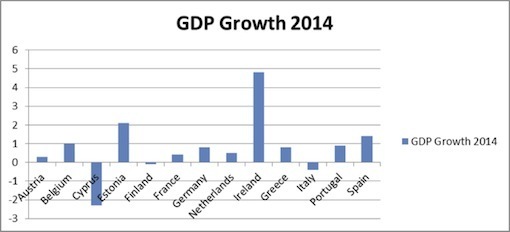
Have you heard the news? Dear old Ireland is in the midst of a great economic recovery. Well, that’s according to the government, the mainstream media, the multinational sector and even Angela Merkel. Yes, one by one they have been lining up to cheer on the poster boy of European austerity. Their hearty tale goes something like this; after experiencing one of the greatest economic shocks in history, Ireland having swallowed the austere medicine mandated by the Troika became – in defiance of all economic logic – the fastest growing economy in Europe (see graph 1 of Eurostat data).
doyle2
Our Prime Minister Enda Kenny talks of a ‘Celtic Phoenix’ rising from the ashes. The domestic and international media have been crowing ‘Ireland is on the way back’‘Economic recovery keeps on motoring and ‘Ireland shows struggling Europe the way ahead’. The multinationals (MNCs) think things are going so well we should be giving the rich tax cuts again – something the government is all for. Whilst Angela Merkel has credited us as a ‘tremendous success story’ – one the austerity averse Greeks should be emulating.
But alas, this is just one version of events, and there is certainly another, albeit a less publicised and more depressing account. This is what could be described as the everyday experience of ordinary Irish people. It’s by no means the tale of triumph over adversity that the government are trumpeting. On the contrary, it is one of ongoing economic hardship, tragedy and farce.
The supposed ‘recovery’ that our leaders are harping on about is completely alien to the hundreds of thousands of ordinary people who have been consistently taking to the streets to protest against their policies. It’s alien to the ever growing number of people who are in long term mortgage arrears and face losing their homes, or to the people who have already lost theirs. And it’s alien to 10,000 people who just this month snapped up the entire allocation of work visas for Canada in less than 12 minutes, therein joining the 170,000 of our young people who have left since 2010.
So how do we reconcile these two contrasting/conflicting accounts? Could it be the case that a recovery is indeed underway but has yet to ‘trickle’ down to all sectors of the economy? Or is deprivation and stagnation a harsh reality which is merely being hidden by headline growth figures which just don’t add up?
Pliable Stats vs Stubborn Facts
The government are quick to point to our growth figures of 4.8% GDP and 4% GNP, but what does this really tell us? In short, not much. Ireland’s unique position in the global tax avoidance operation has rendered the standard economic indicator of GDP (gross domestic product) useless as measures of the health of the economy. It’s been well documented that the profit shifting activities of the multinational sector (MNCs) based here leads to massive distortions in this statistical indicator. So our politicians, analysts and commentators turned to GNP (gross national product) for a more accurate picture of the economy’s health.
But GNP is just GDP after we control for all the money that is flowing in and out of the country in a given period – and it too suffers from the same kind of distortions from MNCs profit shifting. Take for example the case of management consultancy firm Accenture who, along with several other big international groups, chose to relocate their headquarters to Ireland.
Now such ‘headquarters’ might consist of a small office with a single phone in it (see: Brassplate Company), which might lead you to believe makes it of zero consequence to domestic economy – but you’d be wrong. Even if such firms engage in no economic activity beyond their one roomed office, their massive profits are still recorded in the national accounts (GDP and GNP).
Then there’s issue of the major financial institutions located in the Irish Financial Services Centre (IFSC) which are currently managing some of the world’s largest investment funds. The Irish Funds Industry Association (IFA) recently announced that ‘Assets domiciled in Ireland in 2014 have reached a new high of €1.6 trillion‘. This is worth more than the entire value of all final goods and services produced in Australia last year.
And whilst you might be thinking that sounds great, the effect on the real economy has been negligible – aside from the distortions to our GNP. But don’t take my word for it, it was the Central Bank that stated Financial Sector developments, which are for the most part unrelated to the domestic economy, account for a significant portion of the rise in GNP’.
So right about now you might be feeling like GDP and GNP offer us no great insight into the health of the real Irish economy, but let me tell, it gets worse. The methodology by which the national accounts (GDP and GNP) are compiled was recently changed to inflate the figures. How did they do this? Well, now goods that are not even being made here are being counted as if they were.
Once again it’s the Irish Central Bank we can thank for drawing our attention to this little peculiarity as they point out that ‘goods owned by an Irish entity that are manufactured in and shipped from a foreign country are now recorded as Irish exports’. In other words, goods that never saw Irish soil or touched the hands of Irish workers are being recorded as if they were one of our exports. The only criteria being that they are owned by an ‘Irish entity’. A term so elastic it can be stretched to fit just about any purpose. I’d say you couldn’t make this stuff up, but it appears somebody already has.
The Slow Death of Domestic Demand
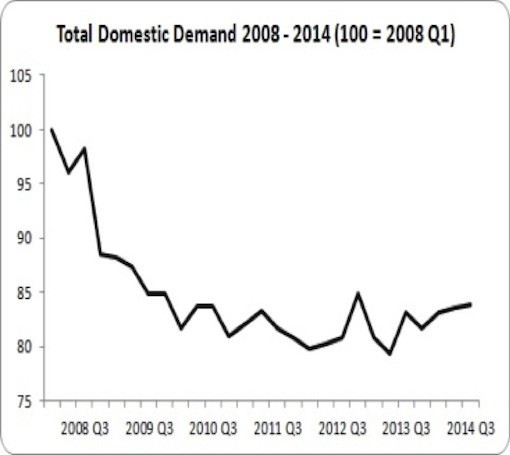
The only means of comprehending the true health of the economy is to look at domestic demand – or what’s left of it. Domestic demand, which makes up about three quarters of the economy, is comprised of government investment and expenditure on public services and consumer spending. Thus it doesn’t suffer from the kind of distortions attributable to the MNCs that the likes of GDP or GNP does.
The two graphs below illustrate perfectly the superficial nature of this ‘recovery’. As we can see domestic demand fell off a cliff in 2008 and has pretty much remained there. Consumer spending – which is the largest component of domestic demand – is actually below 2009 levels. Given that disposable income has fallen by 20% since 2008, largely as a result of falling wages, rising taxes and cuts to welfare spending (in other words austerity), is it any wonder that the Irish Small and Medium Size Enterprise Association (ISME) just this month described the government’s recovery as ‘glacially slow and patchy’. But surely this was to be expected? If you depress people’s incomes to breaking point where’s your demand going to come from? And if you’ve got no demand, then you’ve got recovery.
The fact of the matter is you can’t tax and cut your way out of a recession in the same way that you can’t diet and starve your way out of a famine. But with over half a million Irish people now experiencing food poverty – try telling the government that.
doyle3
doyle4

A very ‘Irish’ Recovery
Have you ever heard the expression ‘that’s a bit Irish’? Collins English dictionary defines ‘Irish’ – in its adjective form – as something ‘ludicrous or illogical’. Well, judging by that standard, this is a very ‘Irish’ recovery.
Oh sure, there’s been a recovery for some. Ireland’s richest 250 individuals saw their combined wealth increase by 16% to a whopping 75 billion in the last year alone, so it’s fair to say they’re doing ok. Then there’s the multinationals, whose massive profits continue to enjoy de facto tax immunity. And things are even looking up for the politicians, who are planning to give themselves a pay increase as recognition for masterminding this great ‘recovery’.
Call me old fashioned if you will, but to me a recovery isn’t a recovery until the lives of the people who make up the bulk of that economy start to improve. We still seem a long way away from that point. And for that reason most Irish people don’t believe in this recovery; because they don’t see it and they certainly don’t feel it.

War Crimes and Forgetting

Pete Dolack

Forty years after the long Vietnamese struggle for independence concluded with the capture of Saigon, the mythologies surrounding the war on the other side of the Pacific Ocean have not loosened their grip. The “debate” surrounding the war is a textbook example of corporate media obfuscation.
A strong debate played out in the corporate media outlets of the United States concerning the Vietnam War at the end of the 1990s, and that same debate, with the same parameters, continues today. This debate, however, is only between two “acceptable” viewpoints — an honorable effort that tragically failed or a well-intentioned but flawed effort that should not have been undertaken if the U.S. was not going to be “serious” about fighting.
Left out are the widely held views that the war should never have been fought because it was a war to extend U.S. hegemony or that the U.S. simply had no business fighting in another country’s civil war. Further, the first “acceptable” viewpoint implies, and the second explicitly states, that the U.S. didn’t really fight hard to win the war, ignoring the actual intensive level of the U.S. war effort in which most of North Vietnam’s larger cities were reduced to rubble, much of the farming lands were destroyed and three million Vietnamese were killed.
Thus there was all the appearance of a free and open media at the same time that the media obscured.
Elections only when you do as we say
What were some of the messy things going on in Southeast Asia at the time? (Most of the following is taken from Manufacturing Consent by Noam Chomsky and Edward S. Herman, Pantheon Books, 1988.) The U.S. sabotaged the scheduled 1956 all-Vietnam election that was a cornerstone of the 1954 agreement that ended the French intervention; an election that was not allowed to occur precisely because Ho Chi Minh would have won. The U.S. set up South Vietnam as an artificial puppet state, overthrew and killed South Vietnam’s “leaders” and installed new “leaders,” who were invariably military thugs.
The U.S. invented the Gulf of Tonkin attack, a deliberate lie to create a cover for increasing the U.S. military role. By the time of the U.S. land intervention in 1965, American aerial bombing, napalming and gassing had already killed 15,000 Vietnamese. The U.S. carried out a policy of rural and urban terror. The military forced peasants in wide parts of the country off their land and into “strategic hamlets” — in reality, rural concentration camps — and killed peasants who refused to leave their homes. Tens of thousands were swept from their homes and sent to camps in single ground operations.
A writer in Foreign Affairs wrote that destroying the countryside and forcing rural residents into cities was necessary because the Viet Cong were “a powerful force which cannot be dislodged from its constituency so long as the constituency continues to exist.” The U.S. systematically destroyed by force any South Vietnamese grouping opposed to the installed military dictators, even non-Communist groups such as organized Buddhists.
The U.S. leveled major cities — 77% of the buildings in Hue, one of Vietnam’s biggest cities, were completely destroyed. Dams were blasted away, allowing salt water from the South China Sea to flood farmland, making the growing of food impossible. When North Vietnam agreed to the Paris Peace Agreements in 1972, Henry Kissinger decided not to accept the pact, began demanding major changes to an agreed-upon document, then launched the Christmas bombings of Hanoi and Haiphong when the North Vietnamese government insisted the agreement be signed.
In South Vietnam, 9,000 of 15,000 hamlets were damaged or destroyed, as were 25 million acres (100,000 square kilometers) of farmland and 12 million acres of forest. Killed were 1.5 million cattle. One million widows and 800,000 orphans were left behind.
In North Vietnam, 34 of the largest 36 cities suffered significant damage, with 15 completely razed, while 4,000 of about 5,800 communes were damaged. More than one million acres of farmland and 400,000 cattle were destroyed in the North. The Central Intelligence Agency admitted that at least 30,000 North Vietnamese were killed per year by 1967 by U.S. bombing, with these deaths primarily civilian. The total tonnage of bombs dropped by the U.S. in Vietnam exceeded that of all bombing by all countries during World War II. Reports of the countryside at the end of the war spoke of entire regions as “bare, gray and lifeless.”
No mercy in neighboring countries
Next door, in Laos, following a 1958 election in which a two-party Left coalition won 13 of 21 legislative seats, the U.S. swiftly overthrew the government, with the new government seated by the U.S. vowing to disband the Pathet Lao, which had won the most seats. Two years later, that new government was overthrown by the U.S., which installed a CIA-backed extreme Right-wing general.
In rural Laos, entire districts were wiped out by bombing. A series of articles in Le Monde reported on a district capital that had been deserted for three years because of repeated bombings. This capital was a portion of a 20-mile area stretching into the countryside in which not a single building was left standing and in which were found the remnants of American fragmentation bombs, which are dropped to maximize civilian casualties.
There were areas of Laos where villagers hid in nearby mountains, in caves or in ditches during daytime because of the ceaseless bombardment and who could conduct life only at night. Craters so saturated some areas that it was impossible to distinguish them, and all vegetation was destroyed. More than 350,000 Laotians — more than 10% of the country’s population — were killed and a similar number left homeless.
In Cambodia, bombing by the U.S. during the period 1969 to April 1975 resulted in 600,000 deaths and two million refugees, according to the same Finnish Inquiry Commission that concluded one million people died during the subsequent Khmer Rouge régime. As the bombing was ending in 1975, the U.S. government estimated that deaths from starvation in the Cambodian capital, Phnom Penh, were near 100,000 per year.
This horrific bombing is believed to have played a role in the rise of the Khmer Rouge, which the U.S. covertly sided with during its murderous four-year reign. A U.S. government report in 1975 said 75 percent of Cambodia’s draft animals had died and that it would likely be three years before the country could regain rice self-sufficiency.
The carnage inflicted on Vietnam reverberates still. An estimated 19 million tons of toxic herbicides were applied that has resulted in more than half a century of damage to health and birth defects.
Such is the price of empire, paid by those on the receiving end. If these are not war crimes, then what would be?

Greece: the Confrontation

Bertrand Renouvin

Between Athens and Berlin, supported by Frankfurt [the European Central Bank], the confrontation is political. But it is not a matter of a conflict between two legitimate entities as numerous Eurocrats want us to believe. It is not some democratic European institutions, rooted in representativeness across half a continent, which attempt to assert their legitimate rights in opposition to the democratic institutions of a small country.
Greece is not a great power but we are presently discovering that it has more force than one would expect from the size of its economy and the extent of its territory.
Recall that, in the European Union, Greece can block any decision that requires unanimity as in the case of new sanctions that could be imposed on the Russian Federation.
Above all, Greece has a legitimate government which rests on a parliamentary majority arising from the free decision of a sovereign people. Opposed to Greece are powers and forces which cannot invoke democratic legitimacy, for reasons that have already been laid out on multiple occasions but which the European institutions and the European Central Bank do not want to acknowledge.
The European Parliament resembles a democratic assembly, the Commission resembles a government, the European Council, which brings together the heads of state and of governments, resembles bodies with executive powers – but they are nothing of the sort.
The European Parliament is not a legislative power given that it cannot initiate laws. It does not represent the European people as the European people do not exist. The [2007] Treaty of Lisbon evokes the ‘citizens of the European Union’ but this citizenship is acquired only within the framework of national states which issue European passports to French citizens, German citizens, Greek citizens, etc.
It is the European Commission that exercises legislative power by drawing up European directives whereas it comprises officials vested with executive power: they are given responsibility to enforce such texts which are not laws, for those officials are not representatives of a sovereign people.
The European Council [previously Council of Ministers] (configured according to appropriate domains of competence) is not a government as it co-produces texts with the Parliament and the Commission and approves the annual budget, while the Parliament is restricted to the right to disapprove of details of the Commission’s decisions.
The European Court of Justice decides arbitrarily on the matters that come before it: it creates European law while bypassing the legislative prerogatives of democratic national representative assemblies. The Court has actually established the principle of the absolute primacy of Community law over national law, national Parliaments having the obligation to integrate the former into the latter. This is worse than a government of judges, given that this Court of Justice does not operate within an institutional framework set by a Constitution. We are confronted by an autocratic body that constitutionalizes its laws and interprets them according to its own pleasure.
In the strict sense, the European Union has no institutions – that would presuppose a Constitutional order – but only instruments which do not respect the principle of the separation of powers, however essential in countries which respect the rule of law.
In any case, this Union cannot be considered a state. It is only a “juridical union founded on international law”, according to the unimpeachable definition given by the German federal Constitutional Court at Karlsruhe. This [fiction] doesn’t prevent the creation of a kind of ‘economic constitution’ – by establishing, for example, budgetary equilibrium as a principle – according to the ideological norms, whereas the so-called ‘European Constitution’ has in fact been rejected by France and the Netherlands.
In short, these are non-democratic bodies – the European Central Bank, the Eurogroup [Commission, Parliament, European Council, Court of Justice] – which attempt to subjugate a democratic government. These bodies can invoke the legality of the treaties but nothing that they impose can be legitimate for they are not the expression of a sovereign power.
Greece is, on the contrary, a sovereign state in which the government must satisfy the legitimizing criteria of popular sovereignty and of national sovereignty. It is this strength that the German government, the European Central Bank and the president of the Eurogroup are attempting to crush by technocratic mechanisms involving financial blackmail pure and simple.
We hope on behalf of the whole of Europe for a victorious resistance of the Greek government and of its people.

The Great Falshak

John Helmer

Moscow.
Works of art are only reliable investment assets if the trade in them is tested and transparent enough to prove they aren’t stolen goods, forgeries, or what is known in Russian as falshak (фальшак), a term originally applied to counterfeit coins.
Naturally, as the art trade generates higher and higher prices for individual works, the lure of expensive objects becomes irresistible for those with cash on the run. That is, if it can be laundered, er exchanged, through international auction houses like Christie’s, Sotheby’s, and Bonhams – institutions less regulated, and apparently more reputable than banks. Just as these house names claim to be setting records for auction prices for their goods, the margin of profit to be gained from fraud and forgery attracts almost as many well-heeled crooks for sellers as for buyers.
The relatively short time in which Russian art has been traded in international markets has meant that the swiftly earned riches of the Russian oligarchs have been bidding up auction house prices for objects with dim histories, uneducated demand, and short or non-existent records of ownership. For a London auction house like Bonhams, the record-setting value of Russian art it has been able to find for sale has turned into an opportunity for exchanging the auction house itself for cash. If the privately-owned Bonhams, whose turnover is a tenth of the two bigger houses, were to trade at the price to earnings ratio (P/E) of Sotheby’s, it might fetch over £530 million. But prices like that don’t fetch if there is slightest suspicion of falshak.
Bonhams has been selling itself, according to the Financial Times, for its success at taking a corner on two markets – vintage cars and Russian paintings. It has set the market record for “the most expensive Russian painting sold at auction: the ‘Madonna Laboris’, by Nikolai Konstantinovich Roerich, fetched £7.9m.” At the time – June 2013 – Bonhams claimed [1] the Roerich work was “the most valuable Russian picture ever to be sold in a Russian art auction.” Last November, Christie’s beat the Bonhams record with the sale of Valentin Serov’s Portrait of Maria Zetlin for £9.2 million; for that story, and the Russian record table, click here [2].
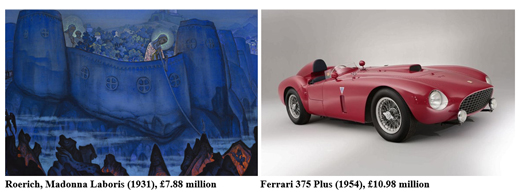
art1
Bonhams’ cars have turned out to be pricier than its Russian paintings, and there’s the rub. One of the priciest, a Ferrari 375 Plus, turns out to be stolen goods. That’s according to at least five, maybe six claimants now in court in the US and in London. As for Russian painting, Bonhams [1] was lucky to “rediscover” the Roerich Madonna; since then it has been unable to sell Russian paintings for anything like a record, either for lot or for batch.
Worse, there is still controversy among Russian experts over an attempt Bonhams made in 2008 to sell a work by Alexandra Exter [3], an artist of the Russian Avant-Garde of the 1920s. That painting (lead image), ‘Study for Venice’ of 1924, was withdrawn from sale in circumstances the experts and auctioneers aren’t willing to discuss on the record.
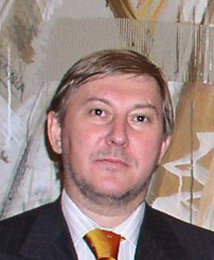
Yevgeny ZyablovA Russian art expert, Yevgeny Zyablov (right), chairman of the board of Art Consulting [4], concludes that “the reliability of Christie’s
and Sotheby’s is higher. More controversial things, or things without attribution or elaboration, you can meet at Bonhams.”
So what has become of the Financial Times [5] attempt to promote the sale of Bonhams itself? According to the newspaper’s report of July 2014, “people close to the group said they were hoping to complete a sale by the autumn.” The newspaper claimed Poly Culture of China was one of four bidders – the others were Bain Capital, CVC Capital and Bridgepoint. CVC is a shareholder in Formula 1; neither it, nor Bain and Bridgepoint had taken an equity stake in a business like Bonhams; their names may have been planted. A few weeks after the Financial Times reported, Bain, CVC and Bridgepoint were reported [6] to have dropped out, leaving Poly Culture, the only one of the four to operate within the fine arts, with a price offer for Bonhams reported to be “several hundred million pounds”.
Poly Culture [7] was listed on the Hong Kong Stock Exchange in March 2013, initially valued at HK$33 per share [8]. It then jumped to $45, but steadily slipped over the past two years. Its current share price of HK$24 gives Poly Culture a market capitalization equivalent to £512 million. It is trading on a price-earnings ratio of 11.5. So based on Bonhams’ reported financials for 2013, the Chinese ratio should give Bonhams a valuation of about £300 million. If Bonhams were valued on Sotheby’s P/E of 20.5, it might be worth £533 million [9].
The Poly group says it originated as a joint venture in the 1980s between the People’s Liberation Army and CITIC, a giant state-owned conglomerate, best known in China for its CITIC Bank. Poly Group’s current lines of business include military technology, real estate, and popular entertainment, as well as art auctions [10]. The company hasn’t said a word about its reported interest in Bonhams; it refused this week to answer questions about its reported bid.
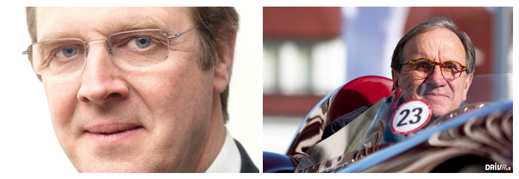
Bonhams [11] is jointly owned by two businessmen: Robert Brooks (below, left) and Evert Louwman (right), a Dutchman. Both were racing car drivers; both traders of new and used cars. Brooks was also an auctioneer [12] for Christie’s, and the owner of the London premiseswhich Bonhams rents out.
art2
By mid-September Poly Culture was reported [13] in London to have dropped out of the Bonhams bidding – and there was noone left. A source claims Bonhams was asking for £350 million, whilst the source claims the Chinese were only willing to offer between £250 million and £275 million. Independently, Reuters reported bank sources as claiming they had put together a loan of about £200 million to back the bidding. By then, Bonhams had acknowledged an outright sale to a single investor was the only chance it had to generate an equity profit, all earlier attempts to find underwriters for a stock exchange listing having failed [12].
Financial reports filed by Bonhams reveal that in 2013 it valued its assets at £112.9 million. Revenue was £127.1 million; earnings (Ebitda) £26 million; profit £15.7 million. These numbers were all up healthily over 2012.

Leslie WexnerBetween the start of the bidding for Bonhams and the drop-outs, a group of claimants to a Ferrari Bonhams had sold went to the High Court. The lead claimant, Leslie Wexner (right), an American underwear merchant, demanded that Bonhams return of more than £12 million – that covered the purchase price of the car which Bonhams had auctioned on June 27, 2014, plus legal costs. This story hit the newspapers in November of 2014.
The disclosure of Bonhams’ financials for 2014 is running late compared to last year. Because of the litigation over the Ferrari, the provision for liability of just over £1 million in the 2013 financial report is likely to rise to the court claim figure, plus legal costs. At about £12 million that may be enough to push Bonhams into loss.
This isn’t the first legal fracas Bonhams has faced for mis-selling Ferraris. In May of 2013, Bonhams had auctioned a 1959 Ferrari, subtitled Ferrari 410 SuperAmerica Series III Coupe, for which a London antiques dealer Thierry Morin paid Bonhams £480,000, following a fiercely contested auction. Bonhams had claimed in sale advertising the car had done “a mere 16,626 km”. Court action followed when Morin discovered the car had almost certainly done more than 200,000 kms.
Had Bonhams been tampering with the odometer — was it lying to defraud? Morin went to the High Court in London for the contract to be cancelled[14], and his payment, plus costs, returned. The High Court ruled against him, on the jurisdictional ground that it was a Bonhams subsidiary in Monaco which had done the deal, not the London parent. “M. Morin does not have a reasonably arguable case against B&B London that they owed him a duty of care, ” wrote the judge, Jonathan Hirst. but he rule that if Morin sued in Monaco against the Bonhams compay there, “[he] certainly has an arguable cause of action against B&B Monaco in Monesgaque law if he can establish a misrepresentation as I am satisfied he can.”
“If it is right,” Hirst decided against Bonhams, “that the Ferrari had actually done over 200,000 kms, it is a matter of real concern how an international auction house could have stated that it had done “a mere 16,626 kms” when (if Mr Grist’s evidence is accepted) a short road test would have revealed the true position….For this latter reason, I would also conclude that M Morin had a reasonable prospect of showing that B&B Monaco was in breach of any duty of care.”
This year’s Ferrari problem for Bonhams is the evidence that the car had been stolen in 1989 and that Bonhams knew there was an ongoing dispute among several claimants when it told Wexner otherwise. According to court papers available last week, Wexner’s lawyers argue, “Bonhams knew that if it honestly revealed the true position regarding the challenges to title to the car, no-one would even consider buying it. This is apparent on the face of Bonhams’ own evidence… Bonhams knew that to auction the car successfully it had to present it on the basis that the long-running dispute around it had been resolved and that there was no challenge to the sellers/consignors’ title. When it realised that that would not be possible, it could have done the honest thing and pulled the car. But it knew that the financial consequences of doing so would be disastrous. So, instead, Bonhams pushed ahead with the auction and told the world and the Buyers what it knew was not true: that, in short, a purchaser would take the car free of any known risk of challenge to title.”
At this point there are six claimants to the car, including Wexner. No trial is likely before April of 2016. For the time being, according to the court documents, Bonhams is refusing to put in writing what it intended to mean by the pre-auction representations it issued on the Ferrari. One of the claimant buyers has asked the court to order a forensic inspection of the chassis, brake drums, and take metal shavings to determine whether the metal is as old as Bonhams claims the car to be.
In court last week Justice Julian Flaux said: “This case requires momentum and robust case management. The idea that it should maunder on does not seem appropriate.” Evidently frustrated by the competing claims, he demanded that by the date of the next hearing, May 5, Wexner and the others, including Bonhams, should agree on a list of issues to be decided. The judge also suggested that mediation might be a better option, because the longer the litigation goes on, the faster the asset will depreciate. The reputational and financial risks to Bonhams also grow as the case drags on.
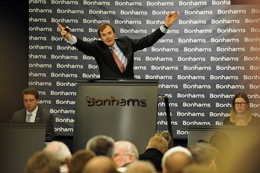
BonhamsBonhams has issued a press statement: “we are satisfied that any claim is wholly without merit and will be strongly contested.” In court papers Bonhams claims that before the sale to Wexner it had brought the parties together; that the ownership dispute had been resolved; that “all relevant litigation had been settled”; and that Bonhams knew of “no reason why . . . the buyer should not be able to register title in . . . the USA.” Wexner and the other claimants are saying Bonhams is lying. According to its defence, “the idea that Bonhams would have participated in the fraudulent activity alleged against it is absurd”.
The impeachment of Bonhams’ credibility and the failure of its sale to investors cast a shadow over the Russian art market, not only because the mystery discovery of Roerich’s Madonna and the record price it fetched aren’t likely to be repeated. Misrepresentation, fraud and forgery aren’t unique to Russian art, according to Simon Hewitt, international editor of Russian Art + Culture [15]. “Russian Art has attracted forgers in specific, lucrative areas, particularly the late 19th century (Shishkin, Aivazovsky) and the early 20th century Avant-Garde. In my opinion, there is as much forgery of Flemish old masters as there is of late 19th century Russian paintings.”
“The Avant-Garde is a case apart,” Hewitt adds, “because the KGB set up something of a forging industry in the field as a way of accessing gullible foreign cash. They had access to materials dating from the 1920s which enabled many of their fakes to pass chemical testing with flying colours. When researching a piece for ART + AUCTION a few years ago I was informed by one high-profile source that the post-KGB forging industry continues, with practitioners based in ships off the Israeli coast (as well as Germany).”
It has been much easier also to get away with forgery in Russian art, at least in the 1990s. “Spurious authenticity certificates could be had from chronically underpaid and easily corruptible Russian museum officials for a pittance until quite recently, but this is less and less the case.”
Pyot Aven (below, right) of the Alfa Bank group, and one of the largest collectors of Russian art, has called in experts to authenticate the paintings in his own collection. In 2011, he called a press conference to report that a criminal gang based in France and Switzerland was flooding the market with fake watercolours by Natalia Gonacharova (left). “[She] never did watercolour versions of her oil paintings”, Aven said [16].
art3
Aven’s collection is reported to hold 400 paintings, with a value estimated last November [17] by Forbes at $500 million. They are works of the late 19th century and early 20th century. Vyacheslav Kantor [18], owner of the Acron fertiliser group, has an equal sized collection; he specializes in Russian Jewish artists of the early 20th century, whose collection value is also estimated by Forbes at $500 million.
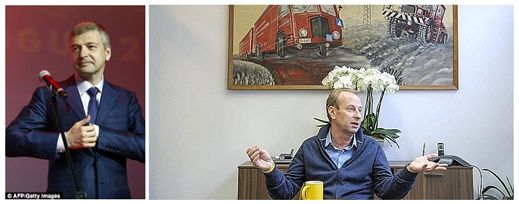
In Forbes these are advertisements for asset value, resale profit, collateral credit. The loopholes in the Forbes calculation are authenticity and dealer fraud. In November the publication claimed Dmitry Rybolovlev’s (below, left) collection was worth $700 million. This month fraud indictments in Monaco, France and Switzerland, initiated by Rybolovlev against his art dealer Yves Bouvier (right), reveal that the paintings were over-valued and Rybolovlev over-charged.
art4
Just how little an oligarch’s collection may turn out to be was revealed when liquidators of Boris Berezovsky’s [19]estate discovered he had laundered his money too quickly, and carelessly, into works that turn out, on examination now, to be forgeries. Works that Forbes would put up to £50 million turn out to be a fraction.
For litigation by another fertilizer specialist, Andrei Melnichenko of Eurochem, to prove he had been defrauded by a New York art dealer, click here [20]; Melnichenko didn’t win. For Victor Vekselberg, who did win in a London court over Christie’s in the case of a fake Kustodiev painting, read this [21].
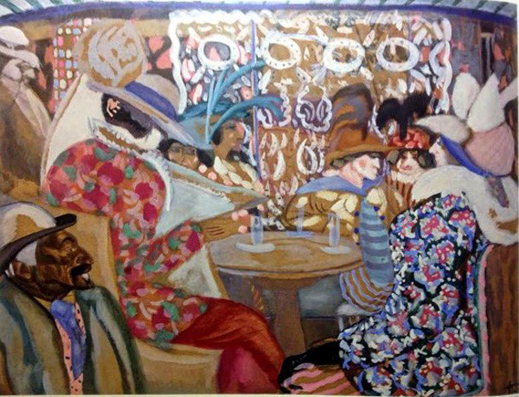
Right now, a St. Petersburg court is hearing criminal charges of conspiracy to commit fraud by Elena Basner in the certification, then sale, of the 1913 painting, “In the Restaurant” attributed to Boris Grigoriev (below). Bringing the charges is the collector, Andrei Vasiliev [22]. The Russian press coverage of all sides in the affair, which Basner [23] has called a frame-up, is voluminous.
art5
The Russian expertise on which museums rely are the Art Research and Restoration Centre named after Academician Igor Grabar (GRC) and the State Tretyakov Gallery. They say they do not make public comments.
Yekaterina Kartseva, co-owner and founder of  Privatecollections.ru [24], says that Russian art forgery is exposed regularly, particularly of 20th century and contemporary works. “Less high-profile cases occur quite regularly; many of my friends who bought a painting at auction cannot obtain confirmation of authenticity at the Tretyakov Gallery. Major Russian auction houses are trying to keep track of their reputation, but many are bombarded with lawsuits. Most problems arise with online auctions, since there it is more difficult to keep track. Major Western auctions rarely bring cases to court. At Sotheby’s, as far as I remember, the buyer has three months in which to return the work. If the work is brought to us, we will examine it, make contact with the experts at Sotheby’s, and if the experts do not agree, there is three months for the buyer to make a decision.”

UsmanovKartseva suspects there may be forgeries in well-known collections, such as the collection of cellist Mstislav Rostropovich, which was bought by Alisher Usmanov at Sotheby’s in 2007. Usmanov (right) paid £25 million ahead of the auction, and then presented the works to the state. Paintings by Grigoriev and Roerich led the Sotheby’s estimates, which were roughly five times the prices Rostropovich had paid [25].
Suspicion doesn’t always result in an unambiguous certificate, Karsteva concedes. “Authentication may end up with a statement like, ‘the work does not conflict with the brush of a certain author’…the opinion of some experts do not necessarily reflect the opinion of others. The art market is certainly more prone to fraud, which is stimulated by the very high price of some of the works, when it isn’t clear whether the collector’s motive is to buy the painting itself or to demonstrate for all to see the cash equivalent. If you bought an image, is it important for you for the object to be the original or a copy?”
Zyablov of Art Consulting explains that as the economic stringencies being felt by buyers get worse, demand is restricting price, and the circulation of forgery is contracting. “Our company was created in order to protect investors — we have a very tough procedure. For this reason the British market takes our expertise for insurance of private collections. During the growth of the market, investors (buyers) had high hopes for this market. They bought a lot of things that were attributed by some experts without evidence, and sometimes without provenance. Now all these things are out of the market. You can appreciate too that when the market itself has fallen in volume, the number who want to make fakes and sell them is greatly reduced. Market expertise in Russia has also developed strongly to stop counterfeiting.”
A Moscow art market source explains that just as the incentive to forge is bound to grow as art prices grow, so does the expertise to detect it. When prices were in the low thousands of pounds, he said, the gallery or auction house commission would be roughly equal to the cost of high-quality chemical and other testing to authenticate a work. Russian buyers started out naïve, and if prices were low, they didn’t need to be careful. Once prices reached the millions of pounds,though, the demand for expertise intensified, and the cost was affordable for the auction houses.
About the Rostropovich collection, Zyablov says: “of course, things can turn out to be fake, and this might be found in many different collections. For example, Pyotr Aven commissioned us to examine and evaluate his collection for insurance purposes. From a few hundred things we found two things which were wrongly attributed. Pyotr Olegovich was grateful to us, and talked about it at a press conference. So, such cases happen.”
Auction houses like Christie’s, Sotheby’s, and Bonhams maintain their own experts, Zyablov adds. “Experts with the same specialization compete for credibility. Those who stand on the side of the market, and are more lenient in their assessments, get promoted by the market. In this way, there’s better business for experts who are less tough. This is a paradox. The trend of expertise to protect the buyer goes against the trend of the market, which favours higher priced sales.”

Remembering the Fall of Saigon

Binoy Kampmark

Despite sharing the same diplomatic table as the United States, and forging ahead with trade agreements, Vietnam still remembers. Remembers, that is, those “countless barbarous crimes,” as the country’s prime minister calls them, committed by the United States during the long wars of the 1960s and 1970s. On April 30, 1975, Saigon was stricken by scenes of evacuation and panic. “Our homeland,” explained Nguyen Tan Dung, “had to undergo extremely serious challenges.”
Both countries provided mirrors of violent change, a form of toxic exchange that seemed share more with disease than nutrition. A distant country that was supposedly off the radar of American homes became a round-the-clock transmission feast of gore and depravity. Then came the battlefield traumas and the counter-cultural response.
The words from President Gerald R. Ford a week before the fall of Saigon before an audience at Tulane University spoke of America regaining “the sense of pride that existed before Vietnam, but it cannot be achieved by refighting a war that is finished as far as America is concerned.” The crowds began gathering for the evacuation – 130,000 Vietnamese leaving the South that April, a projection that made State Department predictions woefully inadequate. Bing Crosby’s White Christmas did the rounds on radio on April 29, triggering the airlift evacuation “Operation Frequent Wind”.
An all to quiet theme behind the commemorations has been one of waste. Waste of life, of resources. In Tim O’Brien’s words on the fall of Saigon and a slew of images, it was “the waste of it all. The dead, the wounded, the money, the psychic energy and the moral energy […] just everything.” Poor planning for the evacuation also saw a prolonging of suffering – the separation of families, the special, God-like power of who would join in the evacuation and who could not. “We separated families in a wink,” remembers Frank Snepp, one of the CIA’s top strategists working in Vietnam, “because we hadn’t planned adequately.”
But a response to defeat and trauma tends to be that of the reassuring fairy tale, the inventive scribe who finds better ways of reimagining horror. “Think of them,” suggests Bill Moyers, “as silver-lining tributes to good intentions and last-ditch heroism that may come in handy in the years ahead.” Hence the fall of Saigon being deemed humanitarian and worthy of remembrance in its tragic meter. American aggression, noted Christian Appy, was given a different pigmentation: that of “a tragic humanitarian rescue mission.”
The very idea of defeat that somehow masquerades as honourable exit started the show. The peace accords of 1973 served as a masking agent. The brutality began to disappear from the screens beaming into the homes. But scores were going to be settled, and vacillation before the advancing North Vietnamese forces would see compromising records fall into the hands of the victors. The CIA, as tends to be the usual pattern, could not be trusted to be reliable on this one – those on their payroll were found in undestroyed records, captured, sent for re-education, be it through ideological patching up or traditional execution.
As Moyers notes, a response of selective remembrance reverberates in the halls of quaint, if somewhat dangerous delusion. Spin doctors with dusters and gloves have gone back into the archives, reshaping defeats as strategic wind downs and “exists”. America, after all, cannot lose, and certainly can’t be seen to sport a broken nose. Corrupt regimes installed by the grace of superpowers become mechanisms of stability. Gambles pay off even when they are ignominious failures. That is the modern legacy of Vietnam, visible in Iraq, Afghanistan and Libya.
Euphemistic bureaucracy thrived in South Vietnam, and has given birth to some terrifying monsters. The language of “body counts” and “free fire zones” entailing practical desserts have not lost their appeal in any shape or form. They have found shape in the broader objectives of the modern American Republic.
Vietnam also provided another pertinent reminder in the context of refugees. The first makeover of anniversary thought was to neglect the enormous internal displacement created by US operations – those arising from the “strategic hamlet program” designed to “pacify” local populations. In a technique all too reminiscent of British strategy towards the Boers in South Africa, millions were forced off their land, herded, encamped. “I never flew refugees back in,” remembers flight chief Jim Soular. “I always flew them out.”
Refugees arising from the conflict chose the sea as a means of passage. They were the “boat people” snaking their way in danger via the Mekong and the South China Sea to make it to countries like Australia. Many were ethnic Chinese that formed the bulk of those expelled by the Vietnamese government in 1979. Government policy to them from Australia, an ally of the southern government, resisted cultural and racial angst. There was no Pacific or extra-territorial repulsion, despite the fear in some circles that white purity was being muddied. But tens of thousands would languish for years in refugee camps in Southeast Asia.
Even now, as the fall of South Vietnam is being remembered, it is providing moments of selective reflection. Whatever happens at these points, the strategists and the dream factory merchants should be kept away from the planning rooms about military interventions. Any reference to Vietnam as precedent is bound to be foolish and misguided, because the wrong questions are bound to be asked.

Glimmers of Hope for the Constitution

Rebecca K. Smith

Last week, the U.S. Supreme Court issued a rare glimmer of hope in a case called Rodriguez v. United States. In the case, the court held that police cannot extend a routine traffic stop to use a drug dog to sniff a stopped vehicle for drugs. The court stated: “We hold that a police stop exceeding the time needed to handle the matter for which the stop was made violates the Constitution’s shield against unreasonable seizures.” In other words, police cannot pull you over for a burned out tail light, give you a ticket, and then detain you for another 10 minutes while they use a drug dog to sniff the outside of your car for drugs. However, the dog can sniff the outside of your car for drugs while you are getting the ticket. But after the ticket is issued, police have to let you leave. Basically, the issue is that police cannot detain you any longer than necessary to issue the ticket for the reason that you were pulled over.
This holding is based on the Fourth Amendment, which prohibits unreasonable searches and seizures. Previously, the court held that it was not an unreasonable search to allow a drug dog to sniff the outside of a car for drugs during a traffic stop, even if the owner would not consent to a search and the police did not have a search warrant. That ruling, Illinois v Caballes, was a major strike against the Fourth Amendment’s protection of individual privacy. Last week’s ruling inRodriguez lessens the blow of that case a little bit.
So why did the Supreme Court unexpectedly issue a decision that will limit police power rather than expand it? Perhaps the recent flood of videos of unarmed black men killed by police during traffic stops is having an effect. Indeed, some commenters are referring to this type of impact as “the Ferguson Effect.” Perhaps all of these recent objective video recordings have caused some people to question their own assumptions and biases about what really goes on during police encounters with people of color in this country.
This brings up another recent glimmer of hope related to the struggle against racial profiling. Last week, a federal court in Arizona held a contempt hearing to address whether Sheriff Joe Arpaio should be held in contempt of court for continuing to encourage racial profiling of Latinos after a federal court held that his practices were illegal and unconstitutional. In 2013, in a class action lawsuit, a federal judge in Arizona ruled that the Maricopa County Sheriff’s Department, led by Sheriff Joe Arpaio, had racially profiled Latino drivers, and unreasonably detained them after traffic stops as part of aggressive and illegal anti-immigration patrols. The judge held that it was unconstitutional to consider race as a factor in determining where to conduct patrol operations, in deciding whom to stop and investigate for civil immigration violations, and in prolonging the detentions of Latinos while their immigration status was confirmed. The judge entered a permanent injunction against the racial profiling practices of the Sheriff’s Department. Two weeks ago, the federal Ninth Circuit Court of Appeals affirmed the district court’s permanent injunction against the racial profiling in Melendres v Arpaio.
However, since the original 2013 permanent injunction was issued, Arpaio has continued to instruct his deputies to break the law and engage in racial profiling to implement an aggressive and illegal anti-immigration policy. So last week, the federal district court judge held a contempt hearing to determine if Arpaio should be held in contempt of court for violating the federal court’s injunction against racial profiling. If the federal judge ultimately finds Arpaio in contempt of court, Arpaio could face jail time, which would be an ironic and fitting end to his tenure as Sheriff.

The Rebel, Oronto Douglas

Daphne Wysham

If they knew him at all, the world knew Nigerian Oronto Douglas as the former attorney for the writer, playwright and Ogoni human rights activist Ken Saro Wiwa. Despite Oronto’s and even President Bill Clinton’s best effort, Ken was framed and hanged in 1995 together with 8 other Ogoni men who dared resist Shell Oil’s drilling in their homeland under former dictator Sani Abacha. Or perhaps the world knew Oronto as a top advisor to the former president of Nigeria, Goodluck Jonathan.
To his friends, Oronto was so much more. He was a man of profound sacrifice, service, love, integrity, and faith. He was a true Christian, taking to heart the message of the rebel Jesus. Like Jesus, he was at his most fierce in taking on the money-lenders in the temple. Oronto’s “temple” was the natural world, and in particular, the lush and verdant landscape of the Niger Delta. In speeches and interviews, he took on the oil companies and their backers, repeatedly proclaiming, “They drill and they kill!” He urged people of conscience to divest from fossil fuel companies.
His fearlessness in the face of violence, torture and even threats of death meant that he carried the message against the planet-plundering oil companies around the world, speaking truth to power, no matter the price.
I first met Oronto Douglas at the Kyoto international climate negotiations in 1997. We were on the same panel which Friends of the Earth had pulled together. As soon as he started to speak, the journalists – all of whom had been sleepily typing away at their computers – rushed to our corner of the hall, riveted by his powerful, personal story.
When I learned this brilliant orator had never been to America, I helped arrange for Oronto to come to the US. I knew Americans needed to hear his message. We traveled together to Seattle, Portland, San Francisco, New York and Washington, DC. Again and again, tirelessly, passionately, he told of the occupation of the Niger Delta by oil companies, the colonialism that predated them, and his love of the NigerwherevultresDelta and its peoples. At every location, when Oronto ended his speech with a call for divestment from oil and gas companies, I could predict just how many seconds would pass – three, exactly – before the audience would rise to its feet in a standing ovation.
Oronto came from a village in Bayelsa State where human rights were routinely violated, the earth was scorched in decades-old caked oil spills, the water was polluted, the air rained toxins from endless gas flares, and troops routinely gunned down or tortured those who protested. Nevertheless, he quickly came to recognize that climate change and the oil companies operating in Nigeria were an even greater threat than the government itself – and not just to Nigeria, but to the entire planet. And so he and his fellow Ijaws, the largest ethnic nationality in the Niger Delta, determined in 1998 to usher in the New Year with “Operation Climate Change,” a maneuver which required the cooperation of all of the oil workers of the Niger Delta and thousands of protestors, to draw attention to the rights of the Ijaw to self-determination on their territory. Their declaration of independence was released in the now For a few days, he and his fellow activists and the oil workers managed to shut down all of the oil flow stations, shutting in over half of all of Nigeria’s oil production. As troops fired on demonstrators, his friends knew Oronto was a hunted man.
Try as we might to generate news coverage of the political motivations behind “Operation Climate Change” in the U.S. and the cause of the Ijaws, we failed. It was over the holidays between Christmas and New Year’s, and every journalist seemed to be on vacation or unwilling to cover such an obscure topic. Our fear was that Oronto and his comrades would be hunted down in the creeks where they were hiding and killed without any international press attention. So a group of us decided we would raise the funds to take out a full page ad in one of Nigeria’s largest news dailies, with signatures from activists and world leaders, and the statement: “The World is Watching: Peace in the Niger Delta.”
It was on another of his trips to Washington, D.C., when we decided we needed to do more to elevate Oronto’s status in the international press, so we arranged for him to meet President Bill Clinton. Oronto was able to have a photograph of him shaking hands with Bill Clinton, which we immediately ensured was sent to the press in Nigeria, with the caption, “Oronto Douglas meets President Clinton.” We had determined the higher Oronto’s profile, the safer he would remain. Little did we know that, try as we might to protect him from an assassin’s bullet, it was the pollution–the drillers’ and spillers’ carcinogenic fossil fuels–that would end up killing him.
Oronto was compassionate, joyful, hard-working, tireless, determined to work for justice, environmental protection and peace. His spirit and example inspired me to take more risks, to be more fearless, to do more than I was doing to be of service. He made a point of always lifting up those around him, no matter how heavy his sorrows and important his work. He may be taking a call from the president of Nigeria, he still had the scars of torture on his back, but he made time for the smallest of concerns in his friend’s lives. This was particularly the case if children were involved–he loved children and they loved him.
Oronto had a grand vision of a united Nigeria, one held together not by the outdated boundaries of colonialism nor torn apart by the dangerous animosities of tribal identities but by the agreement of a sovereign national conference. I hope one day that dream of his becomes a reality. It is sorely needed, particularly as oil prices have fallen and the budget for Nigeria’s government, 80 percent of which comes from oil revenues, has dropped with it. In the interim, Oronto played a pivotal role in helping Nigerian elections become more free, transparent and fair, which became evident when President Goodluck Jonathan quickly ceded power to Muhammadu Buhari despite a close election.
I saw him on numerous visits to the US, always finding out about them at the last minute, days or maybe even hours before his arrival. Sometimes he was in the US meeting with the State Department. Other times he was getting treated for cancer. Had I known that the last time I saw Oronto would be my last visit, I would have done more than just accompany him to see his doctor. If he had had the time or energy, I would have held a press conference and shouted to the rooftops: Here walks a modern day hero, a man who can show us the way back to the temple, a man who is far more powerful than the money lenders, the oil companies and the politicians, a man unafraid of the killers and the drillers. Here walks the one and only Oronto Natei Douglas! But, of course, he would have none of such fanfare.
To all of you who loved Oronto, and I know there are many, he was indeed our beloved Oronto, but he was also God’s beloved Oronto. And he is now most certainly in God’s embrace. May God bless his widow and his sons and lift them up at this most painful time, as Oronto did for all of us, and may his spirit and the supreme example of a life of service and love that he led live on in all of us. In Jesus’ name. Amen.