2 May 2015

Sentencing phase of Boston Marathon bombing trial underway

Tom Hall

The sentencing phase of Dzhokhar Tsarnaev’s trial over his role in the 2013 Boston Marathon bombing is currently underway, with the defense calling witnesses beginning this past Monday. The chief issue in dispute is whether or not Tsarnaev will be spared the death penalty after he was found guilty in April of 30 counts related to the attack, 17 of which carry potential death sentences.
Prosecutors spent only three days out of more than three weeks of testimony making their case for the death penalty, which mainly consisted of testimony from victims and their family members.
During their opening remarks, lead prosecutor Nadine Pellegrini displayed a provocative, hitherto unreleased photograph of Tsarnaev thrusting his middle finger at a surveillance camera in his jail cell the day of his arraignment, three months after the bombing, in an attempt to paint Tsarnaev as “unconcerned, unrepentant and unchanged.”
This was revealed as a simple scare tactic on cross-examination, however, when the defense team showed the full video recording of the incident, indicating that it was fairly typical spontaneous juvenile behavior.
Tsarnaev’s defense attorneys are mainly presenting a potted family drama at the center of their defense, attempting to portray him as an innocent, otherwise normal teenager caught up in a toxic family environment stoked with psychological trauma and religious fanaticism. They are arguing that the young Tsarnaev brother under the spell of his older, more aggressive brother Tamerlan.
For example, in their opening arguments delivered on Monday, they accused Tsarnaev’s mother of being a “destructive force in the lives of everyone around her” who was “desperate for praise and validation,” while arguing that she was the ultimate source of his brother Tamerlan’s turn towards Islamic fundamentalism.
The defense’s witnesses are thus far comprised primarily of Dzhokhar’s childhood friends, classmates and teachers, all of whom have testified to his character as “quiet,” “loyal,” and a good friend and student. Witnesses have also attested to Tamerlan’s “aggressiveness” and domineering relationship with his younger brother.
At no point thus far in the proceedings has the defense raised the really substantive issues of the case, namely, the implicit or explicit implication of the federal government in the Boston bombing. As revealed last year by court filings by Dzhokhar’s defense attorneys, the FBI had attempted to recruit Tamerlan Tsarnaev as an informant.
There are strong indications that US intelligence was attempting to use Tamerlan to further its anti-Russian operations among Chechnyan insurgents. Tamerlan was also separately investigated by the FBI in 2011 for his Islamist fundamentalist sympathies and placed on at least two separate terrorist watch lists.
Nevertheless, Tamerlan was allowed to travel to Dagestan for six months in 2012 in an attempt to link up with Chechnyan rebels, and to return to the United States unmolested, even though the US government had been warned in a detailed letter by Russian intelligence of his Islamic fundamentalist views. While there, Tamerlan repeatedly expressed interest to a cousin in joining Islamic fundamentalist fighters in Syria, where they are acting as US proxy forces in a war to topple president Bashar Al-Assad. The militias in Syria include many veteran Chechen fighters.
There are also connections between the American intelligence community and the brothers’ uncle, Ruslan Tsarni. In the 1990s, Tsarni headed the Congress of Chechen International Organizations, which was registered at the home of Graham Fuller, the former vice chairman of the National Intelligence Council at the CIA under President Reagan, and who was forced to resign because of his involvement in the Iran-Contra scandal. Tsarni was also once married to Fuller’s daughter.
Then there is the murder of Ibragim Todashev, a key witness and friend of Tamerlan, by the FBI after being detained for four hours in his Florida apartment. Several different, mutually contradictory media reports to the effect that Todashev was killed after he suddenly attacked the officers were exploded when it was revealed that Todashev was unarmed and had been shot three times in the back and once in the head. Even though the official autopsy completely contradicted the officer’s story, and despite the fact that the FBI agent in charge had a history of violence during his brief stint as an Oakland cop, no charges were ever filed.
Finally, there is the lockdown of the city of Boston carried out after the bombing. As the World Socialist Web Site explained at the time, the police-military occupation of a major metropolitan area, in the course of which military vehicles and helicopters patrolled the city while SWAT teams conducted warrantless house-to-house searches, was a “dress rehearsal for mass repression and the imposition of military rule.” This analysis has been completely confirmed in the past nine months alone, which have seen the deployment of paramilitary forces against protesters on two separate occasions, in Ferguson, Missouri last fall and in Baltimore, Maryland this past week.
If these burning questions are not raised in the course of the sentencing phase, the only really substantial portion of the trial given the defense’s admission of Dzhokhar’s involvement, it is precisely because of their politically explosive character. This is in spite of the fact that limits imposed by the judge on the defense’s ability to probe Tamerlan’s planning and execution of the attack, which would obviously raise serious questions about government complicity, no longer apply during the sentencing phase.
There is broad opposition to executing Tsarnaev in Massachusetts. According to a poll commissioned by the Boston Globe, only 19 percent of the state’s population favors the death penalty in Tsarnaev’s case, with 63 percent favoring life in prison. Even shortly after the bombing itself, a similarGlobe poll only found 33 percent of those who responded favoring the death penalty.

Russia, China announce joint naval exercises in the Mediterranean

Alex Lantier

Russian and Chinese warships will hold joint naval exercises in the Mediterranean Sea later this month, according to Chinese military sources. This unprecedented decision reveals the sharp tensions between the major world powers arising from the US-led “pivot to Asia” against China and the NATO war drive against Russia over the Ukraine crisis.
The exercises will mark the first time that Chinese warships carry out military operations in the Mediterranean. Chinese Defense Ministry spokesman Geng Yansheng said the Chinese navy would contribute warships currently on anti-piracy patrols off the coast of Somalia, in the Indian Ocean. The nine-ship Russo-Chinese fleet in the Mediterranean will practice refueling, escort and live-fire missions.
“The aim is to deepen both countries’ friendly and practical cooperation, and increase our navies’ ability to jointly deal with maritime security threats,” Geng said at a monthly briefing on Thursday.
Chinese officials implausibly downplayed any suggestion that the exercises were aimed at the United States and its European allies. “What needs saying is that these exercises are not aimed at any third party and have nothing to do with the regional situation,” Geng declared.
A glance at the “regional situation” shows, in fact, that military tensions are escalating between the NATO imperialist powers, Russia, and China—a situation for which NATO’s aggressive policies are mainly responsible. While NATO stages military drills aimed at Russia across Eastern Europe and the Black Sea, war is spreading in the Mediterranean. A US-led proxy war is burning in Syria, as is the civil war that erupted in Libya after the 2011 NATO war destroyed Colonel Muammar Gaddafi’s regime.
Russian and Chinese warships already had appeared in the Mediterranean during the Libyan and Syrian wars. Chinese vessels evacuated 30,000 Chinese workers from Libya during the 2011 war, while Russian warships patrolled the Syrian coast in 2013 to dissuade NATO from launching missile strikes on Syria, a Russian ally.
If Moscow and Beijing have taken the extraordinary step of organizing live-fire exercises off the coast of Europe, however, this is to send Washington and its European allies a political signal. US-led policies of strangling Russia’s economy with financial sanctions and seeking to topple Russian President Vladimir Putin, or isolating China through the US “pivot to Asia,” pose the threat of all-out war.
Chinese commentators indicated the Mediterranean exercises were also Chinese President Xi Jinping’s response to US-Japanese military deals in the Asia-Pacific, agreed between Obama and Japanese Prime Minister Shinzo Abe during Abe’s visit to Washington this week.
“Russia wants to show the United States it is not isolated and can launch exercises near Eastern Europe. And as a result of Abe’s visit to the United States and the upgraded Japan-American military relationship, Xi wants to show the United States he has good relations with Russia,” said Shi Yinhong, a professor of international relations at Renmin University in Beijing.
James Hardy, Asia-Pacific editor of IHS Jane’s Defense Weekly, said the exercises marked a new stage in the development of the Chinese navy’s fighting capabilities and would be seen as a challenge by ruling elites in the NATO countries.
“The geopolitical significance of its exercising along Russia will not be lost on the US and NATO, although it would be churlish of anyone in the West to complain about it, given the number of joint drills the US and its allies conduct in China’s near seas,” he told the New York Times .
The greatest danger facing the world’s population is that the risk of world war is largely hidden from the working class internationally. However, military standoffs such as the US threat to arm the far-right regime in Kiev against pro-Russian forces in east Ukraine, or the Japanese standoff with China over the Senkaku/Diaoyu islets, could erupt into all-out wars threatening the very survival of humanity.
In an interview in March, Putin confirmed that the Russian military prepared for possible nuclear war with NATO in the initial weeks of the conflict in Ukraine triggered by a NATO-backed, coup in Kiev last year.
The only progressive basis for struggle against the danger of world war is the political mobilization of the working class internationally against war. This struggle cannot be left to an alliance between the reactionary regimes in Moscow and Beijing.
Oscillating between maneuvers designed to warn off NATO policymakers and attempts to work out deals with them, the policies of the capitalist oligarchies that emerged from the restoration of capitalism in China and the USSR only deepen the danger of war. It is safe to predict that the imperialist powers will respond to this exercise by stepping up military pressure on Moscow and Beijing, and any other regime that they see as a potential obstacle to their interests.
Reckless imperialist policies are clearly pushing the Russian and Chinese towards a strategic alliance. Last year, Russia and China signed a $400 billion pipeline deal allowing Russia to export its oil and gas towards China, bypassing a cut-off of Russian energy exports to Europe, should this arise. At the same time, Moscow and Beijing held joint naval exercises off China’s Pacific coast. As US and European sanctions hit Russia and the Russian ruble plunged on the currency markets last December, top Chinese officials said Beijing would offer Russia financial backing.
Beijing is now offering symbolic support to Moscow in the Ukraine crisis, by preparing to send an official delegation to May 9 celebrations in Moscow of the Soviet victory over Nazi Germany in World War II. Officials from US, the leading European powers, and the NATO-backed Ukrainian regime have announced that they will boycott the ceremony.
A defensive Russo-Chinese alliance aimed at the US, Europe and Japan all too obviously draws potential battle lines of a Third World War. However, it is hardly clear that such a war could only emerge in the form of a conflict between unstable alliances of the imperialist powers, on the one hand, and Russia and China on the other.
Divergences are rapidly emerging between the major imperialist powers themselves over what policy to pursue towards Russia and China. In March, in a stunning rebuke to Washington, the European powers bucked US appeals not to join the Chinese-led Asian Infrastructure Investment Bank (AIIB). Several European governments are openly opposed to financial sanctions against Russia.
Moreover, the Sino-Russian relationship is itself deeply fraught. Powerful tensions exist between Beijing, flush with export revenues from cheap-labor Chinese export industries, and Moscow, which has never recovered from the industrial collapse that followed the restoration of capitalism in the USSR.
China’s Global Times newspaper pointed to the distrust between the rival capitalist cliques in Russia and China in an article discussing why Chinese financial aid would not suffice to overcome US-European economic sanctions.
It wrote, “Due to Russia’s large population of 140 million people, its modernity and strong currency cannot be solely supported by oil, gas and timber … China is capable of offering sufficient capital, technologies and markets to Russia, but these efforts can only take limited effect if Russia’s economy still relies heavily on oil exports and lacks structural diversity. If Chinese investment in Russia shoots up under these circumstances, Moscow might suspect China has ulterior motives. Russia does not want to be a vassal of the Chinese economy.”

US “Grand Strategy” for war against China laid out

Nick Beams

The advanced stage of discussions in US foreign policy circles over the pursuit of an ever-more aggressive policy toward China has been revealed by the recent release of a chilling report under the auspices of the influential Council on Foreign Relations.
Entitled “Revising US Grand Strategy Toward China,” the report is nothing less than an agenda for war. It is authored by Robert D. Blackwill and Ashley J. Tellis, both of whom have close connections to the US State Department and various American foreign policy think tanks.
The report cites a publication produced during World War II defining “grand strategy” as one that “so integrates the policies and armaments of a nation that the resort to war is either rendered unnecessary or is undertaken with the maximum chance of victory.” This is not merely a concept of war but “an inherent element of statecraft at all times.”
The report’s central theme is that US global dominance is threatened by the rise of China and this process must be reversed by economic, diplomatic and military means.
Significantly, at the beginning of the report, its authors cite the Pentagon’s Defence Planning Guidance document of 1992, produced in the wake of the collapse of the Soviet Union, which insisted that US strategy had to “refocus on precluding the emergence of any potential future global competitor.”
While asserting that China has a “grand strategy” for regional and ultimately global domination, the authors make clear they regard the threat to the US position as arising from China’s economic growth within the present international order.
This analysis recalls that advanced at the beginning of 1907 by the senior British Foreign Office official Eyre Crowe about the impact on Britain of the rise of Germany. Crowe concluded that, whatever the intentions of its leaders, Germany’s economic expansion, in and of itself, constituted a threat to the British Empire. Seven years later, the two major powers were at war.
China is not an imperialist power as Germany was, but its very economic rise is undermining the US position.
According to the report: “Because the American effort to ‘integrate’ China into the liberal international order has now generated new threats to US primacy in Asia—and could eventually result in a consequential challenge to American power globally—Washington needs a grand strategy toward China that centres on balancing the rise of Chinese power rather than continuing to assist its ascendancy.”
A repeat of the Cold War policy based on “containment” is not possible because that was grounded on the autarkic policies of the Soviet Union, whereas China’s economic growth is bound up with economic globalisation and China’s integration into world markets.
In its own way, this assertion is a direct confirmation of the Marxist analysis that the origins of war lie in the very modus operandi of the capitalist system itself. China has operated within the framework of the global market, established not least by the United States, but this integration has itself undermined US primacy.
In the report’s words: “US support for China’s entry into the global trading system has thus created the awkward situation in which Washington has contributed towards hastening Beijing’s economic growth and, by extension, accelerated its rise as a geopolitical rival.”
Accordingly, in advancing the core elements of an American “grand strategy,” the authors place considerable importance on economic issues. As part of a plan to “vitalize” the economy, the US should “construct a new set of trading relationships in Asia that exclude China, fashion effective tools to deal with China’s pervasive use of geo-economic tools in Asia and beyond, and, in partnership with US allies and like-minded partners, create a new technology-control mechanism vis-a-vis China.”
The Trans Pacific Partnership (TPP), which currently excludes China and for which Obama is now seeking fast-track authority from the US Congress to negotiate, is regarded as essential. Failure to deliver it would “seriously weaken” the US grand strategy.
The report’s focus on the underlying economic issues by no means implies any downgrading of military means. On the contrary, the authors spell out detailed measures, both in terms of US policy and those it must secure from its allies in the region.
The relationship with Japan is regarded as occupying first place. The report’s proposals include an expansion of the US-Japan security relationship to encompass all of Asia, the upgrading of the Japanese military, aligning Japan with concepts such as Air-Sea battle—a massive attack on military facilities in mainland China—and intensifying Japanese cooperation with ballistic missile defence (BMD). Anti-missile systems are seen as vital for a first-strike strategy, which aims to render inoperable any retaliation.
With regard to South Korea, the report calls for increased BMD capacity, as well as a comprehensive strategy, developed with Japan, to bring about “regime change” in North Korea.
Australia is described as the “southern anchor” of US relationships in the Pacific. The report calls for the use of the Stirling naval base in Western Australia to support “US naval force structure in the region.” The US and Australia should deploy surveillance and unmanned aerial vehicles on Australia’s Cocos Islands in the Indian Ocean and “the two countries should work together to more rapidly identify potential Australian contributions to ballistic missile defence.”
And the list goes on. Indian nuclear weapons must be seen as an “asset” in the current balance of power, and US-India military co-operation should increase. Indonesia’s role in joint military exercises must be expanded, naval exercises with Vietnam stepped up and the Philippines must develop a full range of defence capabilities.
On the political front, the report calls for the reinforcement of trusted strategic relationships and partnerships throughout the Indo-Pacific region that include traditional US alliances but go beyond them. It advocates strengthening Asian states’ “ability to cope with China independently” and building new forms of intra-Asian co-operation—clearly directed to counter China—that do not always involve the US but are systematically supported by it.
After detailing these anti-China measures on the economic, military and political fronts, the report states that the US must energise “high-level diplomacy” with China to “mitigate the inherently profound tensions” and to “reassure US allies and friends in Asia and beyond that its objective is to avoid a confrontation with China.”
The source of this blatant contradiction lies in a no less significant component of the US war drive—the offensive on the ideological front. The purpose of the “high-level diplomacy” and even possible joint ventures with China on some issues, is to manufacture the propaganda lie that the cause of war is the fault of America’s enemy—in this case Chinese assertiveness and aggression. That lie has been central to the launching of US military activity ever since it became an imperialist power at the end of the 19th century.
In reality, the report itself specifically rules out any accommodation with China. In their conclusion, the authors state: “[T]here is no real prospect of building fundamental trust, ‘peaceful coexistence,’ ‘mutual understanding,’ a strategic partnership, or a ‘new type of major country relations’ between the United States and China.”
The release of this report and its clear elaboration of the US war drive underscore the necessity for the development of a socialist strategy against war by the international working class. This will be at the centre of tomorrow’s May Day Online International Rally called by the International Committee of the Fourth International.

US sends warships to Strait of Hormuz, claiming Iran threat

Thomas Gaist

The US Navy will deploy new forces to “accompany” US cargo ships passing through the Strait of Hormuz, Pentagon officials announced Thursday. The strait is one of the most important commercial waterways in the world, controlling the entrance to the Persian Gulf and handling massive flows of seaborne commercial traffic, including one third of seaborne oil.
The US Navy “accompaniments” will proceed on a near daily basis, affecting at least 25 passages by US ships per month, a spokesperson for the 5th Fleet told Fox News. Elements of the US Air Force, including reconnaissance and other types of war planes, will assist the mission.
The Navy began the new buildup in response to orders from US Central Command (CENTCOM). The new deployments are being made for an indefinite length of time, a US Navy spokesman implied Friday, saying that the Pentagon “does not have an end date” for the patrols.
The further escalation of US deployments to the strait is being justified by the US government as a response to the seizure of the cargo ship Maersk Tigris last week by Iranian naval forces. In official statements this week, the Pentagon described the seizure of the Maersk and alleged harassment of another cargo ship on April 25 by Iranian forces in the language of war, denouncing the moves as “provocations.” US military officials described the Iranian move as “a provocative show of force by Tehran,” in comments to theWall Street Journal.
“The unpredictability of our Iranian friends,” has made it necessary to pre-position the additional naval forces at the mouth of the Persian Gulf, and American naval units are being placed on high alert in case Tehran decides to “do something stupid,” US military sources told the Journal .
The US is also concerned to protect the large quantities of “munitions, equipment, hardware and food for the US military” that move through the strait, officials said.
The US naval escalation underscores the marked growth of tensions around the Arabian Peninsula and Persian Gulf, and the further intensification of conditions for a region-wide war drawing in the US, Saudi Arabia, Iran and a handful of other states and non-state groups.
The naval deployments come in the context of significantly intensified tensions in the region and globally. The US military is conducting ever-growing military exercises on the doorsteps of both Russia and China, directly arming and training neo-fascist militants in Ukraine, inciting the Philippine and Vietnamese militaries against China, and backing the Saudi-led regional war coalition currently laying waste to Yemen.
Whatever the immediate impetus for the recent escalations around the Strait of Hormuz, there is no doubt that US forces deployed to the area will be utilized to ratchet up pressure against Tehran and prepare new US military interventions throughout the region.
Thus far, Iran’s leadership has denied any political motives behind the seizure of the Maersk cargo ship, presenting the incident as a strictly legal issue. Iranian officials claim the seizure was necessary to enforce a ruling by an Iranian court against the shipping line, stemming from the loss of some 10 containers of cargo in 2005.
The Maersk’s owners received notice Thursday that after an extended appeals process, an Iranian court had fined it $3.6 million in connection with the 2005 law suit. The company claims that it still has not received a full explanation for the sudden imposition of the large fine and takeover of its ship.
The takeover may have been initiated by elements within the Iranian military seeking to burnish Tehran’s anti-imperialist facade, even as direct negotiations between the representatives of the Iranian government and the US and European powers are thoroughly discrediting the radical pretensions of Iran’s clerical elite.
This line of reasoning gains credibility from the fact that the seizure of the Maersk was carried out in the immediate wake of the renewed Saudi bombardment of Yemen and fresh deployments of US aircraft carriers and other war ships to the region. Iranian officials may have green-lighted the sudden move, a somewhat reckless action which included the firing of live ammunition across the bow of the commercial vessel as it was sailing peacefully in international waters, as a political maneuver aimed to enhance Iran’s position in the ongoing P5+1 negotiations.
Should this prove true, it only demonstrates that powerful objective forces are pushing the region towards larger and larger wars, the wishes of the leaders for a political settlement and a return to “stability” notwithstanding. While Iran’s bourgeoisie is scrambling to secure a deal with US imperialism that could satisfy the Saudis and contain the growing chaos, a drumbeat of militarist conspiracies and provocations, arising out of the dynamics of imperialism and the nation state system, continuously reasserts the danger of a region-wide conflagration.
The seizure of the Maersk Tigris came just days after the US deployed the aircraft carrier USS Theodore Roosevelt to the same area, supposedly on a mission to intercept a convoy of Iranian vessels sailing to Yemen. The Houthi rebels, which have received political support from Iran, and Yemen’s civilian population are currently facing a sustained and punishing air assault by a coalition of Arab states led by Saudi Arabia and backed by the US government.

Parasitism, plutocracy and economic depression

Andre Damon

Seven years since the 2008 financial crash, the US economy remains mired in slump, stagnation and financial parasitism. This reality was underscored Wednesday with the release of figures showing that the economy all but ground to a halt in the first quarter of this year, refuting the endless claims by the Obama administration that the US is in the midst of an economic “recovery.”
The US Commerce Department reported that gross domestic product grew at a rate of just 0.2 percent between January and March, down from a rate of 2.2 percent in the previous quarter. Since the official end of the recession in 2009, the US economy has grown at an average annual rate of only 2.2 percent, compared to an average growth rate of 3.2 percent during the 1990s and 4.2 percent in the 1950s.
The ongoing economic stagnation in the United States is one element of a global crisis that continues to grip the world economy. Last month, the International Monetary Fund warned in its World Economic Outlook that global growth is unlikely to return to rates that existed before the 2008 financial meltdown.
It warned, “Potential growth in advanced economies is likely to remain below pre-crisis rates, while it is expected to decrease further in emerging market economies in the medium term.” The report added, “Shortly after the crisis hit in September 2008, economic activity collapsed, and more than six years after the crisis, growth is still weaker than was expected before the crisis.”
The IMF noted that business investment is at historic lows, significantly below the level experienced in the aftermath of any recovery since World War II. This assessment was borne out in the Commerce Department’s report on US economic growth, which showed that business fixed investment plunged by 3.4 percent over the previous quarter.
The slump in productive investment takes place even as corporations are sitting atop the largest cash hoard in history: US corporations alone have $1.4 trillion on their balance sheets.
Instead of using this money to invest, hire workers or raise wages, major US corporations are using it to buy back shares, increase dividends and engage in an orgy of mergers and acquisitions.
General Motors, which slashed pay of new-hires by fifty percent during the 2009 auto restructuring and is looking to cut labor costs even further in the upcoming contract, has announced a $5 billion share buy-back scheme, using its massive cash hoard to further enrich its wealthy shareholders.
Meanwhile energy giant Shell, which early this year waged a bitter struggle against oil refinery workers striking to demand higher pay and safety improvements, announced that it would make $70 billion available to buy up British oil producer BG group.
This year is shaping up to be one of the biggest for mergers and acquisitions in history, with a record $4.3 trillion available for merger activity, according to Credit Suisse.
Notable mergers have included the food producers Kraft and Heinz (likely to result in 5,000 job losses), and Staples and Office Depot (closing up to 1,000 stores and eliminating thousands of workers). RadioShack, meanwhile, has worked out a deal with Standard General that would close more than 2,000 stores and eliminate 20,000 positions.
Stock markets have celebrated each of these successive corporate bloodbaths. Last month, the technology-heavy NASDAQ exchange eclipsed its peak in early 2000 at the height of the dot-com bubble. The NASDAQ has nearly quadrupled since 2009, while the Dow Jones Industrial Average has increased threefold.
As a result of the soaring stock market, the 400 richest individuals in the United States, whose wealth has doubled since 2009—the era of Obama. They now have a combined net worth of $2.29 trillion, larger than the annual output of the 130 poorest countries in the world.
The soaring wealth of the financial oligarchy is another side of the continual impoverishment and immiseration of working people. One in four American children are officially in poverty, one in five do not get enough to eat, and half of public school students qualify for free or reduced price lunches.
The American state functions not to ameliorate this soaring inequality, but rather to facilitate the continuous enrichment of the corporate and financial aristocrats.
The institutions supposedly responsible for “regulating” the financial system do little more than cover up for and facilitate its crimes. This basic reality was expressed in the latest settlement between the United States and Deutsche Bank, in which the German bank last month received a wrist-slap fine for flagrantly helping to rig LIBOR, the key global interest rate, for its own enrichment.
Wall Street pays handsomely for the support and protection it receives from so-called financial regulators. A case in point is Ben Bernanke, the man who, as chairman of the Federal Reserve, oversaw the bank bailout and “quantitative easing” measures that transferred trillions of dollars onto the balance sheets of Wall Street.
Now, Bernanke is getting his payday: he has been hired by not one, but two leading financial institutions: the hedge fund Citadel and Pimco, one of the largest bond traders in the world, each of whom will pay him handsomely in exchange for services rendered.
These dominant features of economic life in the present period are not incidental aberrations, but rather express the essential character of the capitalist system first identified by Karl Marx and Friedrich Engels nearly 170 years ago: crisis, economic stagnation and ever-growing inequality.
The only way to end this cycle of parasitism and economic slump, and ensure a decent standard of living for all people, is to break the political stranglehold of the financial oligarchy. This is inseparable from the struggle to do away with the parasitic and outmoded capitalist system, and replace it with socialism, the rational reorganization of society in the interest of the great majority of the population.

1 May 2015

Sri Lankan parliament passes amendment to restrict presidential powers

Wasantha Rupasinghe

After weeks of haggling between the minority government led by the United National Party (UNP) and the opposition coalition, the Sri Lankan parliament passed amendment (19A) to the country’s constitution on April 28 to restrict certain powers of the executive presidency.
The government and President Maithripala Sirisena declared that the amendment was a “historic achievement” to “free the country from the dictatorial constitution.” The opposition coalition headed by Sri Lanka Freedom Party (SLFP) boasted that the constitutional change could not have passed without its support. The media joined the chorus to praise for the so-called victory of democracy.
These claims are a fraud. The 19th amendment is designed to refashion the constitution to hoodwink the working class and poor by providing a democratic façade for repressive measures being prepared to ram through the austerity demands of the International Monetary Fund (IMF).
It was the UNP government of President J. R. Jayawardene that enacted the 1978 constitution that established the executive presidency and reduced parliament to a rubber stamp. Jayawardene calculated that stronger presidential powers were needed as his government sought to impose its “open economic policy” to transform the island into a cheap labour platform.
In the past three decades, more than a dozen amendments have been passed strengthening presidential powers. The 18th amendment enacted in 2010 under former president Mahinda Rajapakse enabled the ability to appoint top judges and civil servants and removed the two-term limit on the presidency.
The latest amendment reinstated the two-term limit; restricted presidential immunity by allowing fundamental right petitions against his actions; and changed the president’s power to dissolve the parliament after one year to four and a half years. The appointment of top officials including to the election commission and the judiciary will now be assigned to “independent commissions.”
The president still has considerable powers as head of government and the state including to appoint the prime minister and cabinet. He is also the commander in chief of the armed forces.
Sirisena had been part of the Rajapakse government before he abruptly resigned to contest the January 8 presidential election with the UNP’s backing. Their campaign focussed on denouncing Rajapakse’s dictatorial rule, nepotism and corruption and calling for the restoration of parliamentary rule in an effort to exploit widespread anger over the government’s attacks on living standards and democratic rights.
Sirisena’s defection had been engineered behind the scenes by former president Chandrika Kumaratunga and UNP leader Ranil Wickremesinghe, both of whom have close connections in Washington. The US hostility towards Rajapakse was not over his autocratic rule but his government’s close relations with China, which is the target of the Obama administration “pivot to Asia.”
The 19th amendment was not about defending the democratic rights of working people. Rather the UNP wanted to put on a show of “democracy” in the lead-up to parliamentary elections while consolidating their own position and the state apparatus by concentrating power in the hands of parliament and the prime minister. It was forced to back off at the insistence of coalition partner Jathika Hela Urumaya (JHU) and the opposition Sri Lanka Freedom Party (SLFP). The Supreme Court in determining the constitutionality of the bill expressed reservations about restricting all presidential powers through a parliamentary bill.
The government showed its own anti-democratic character by including a clause to penalize private media bodies if they failed to adhere to the election commission’s regulations during an election. It withdrew the clause after widespread criticism.
The bill was passed after two days of parliamentary debate with 214 votes out of the 225-member parliament. One SLFP parliamentarian Sarath Weerasekara, a former top navy officer, voted against the bill, saying it posed a threat to “national security.”
Frontline Socialist Party (FSP) parliamentarian Ajith Kumara shelved the party’s demand for the abolition of the executive presidency tacitly supported the bill by abstaining. The FSP, a breakaway faction of the communal Janatha Vimukthi Peramuna (JVP), explained its abstention by saying that it did not want to be identified with Sinhala extremists such as Weerasekara.
The JVP was instrumental in bringing about the amendment by working closely with the UNP and president in the National Executive Council, a top advisory body. While declaring that the party wanted to remove all the powers of the executive president, JVP leader Anura Kumara Dissanayake declared in parliament that “we support the bill because something is better than nothing.”
All of this posturing is a sham. There is no constituency for democratic rights in the Sri Lankan bourgeoisie. Ever since formal independence in 1948, successive Sri Lankan governments have ridden roughshod over the democratic rights of the working class and rural poor through the extensive use of emergency powers to crack down on resistance by workers and the poor.
The ruling elite has repeatedly whipped up anti-Tamil chauvinism to divide the working class and entrenched police state methods of rule during the protracted communal war against the separatist Liberation Tigers of Tamil Eelam (LTTE). So-called parliamentary rule up to 1978 did not stop government attacks on democratic rights and living conditions.
The government claims the parliament will be dissolved in a few weeks after passing another amendment on electoral reforms. Whichever party comes to power will deepen the assault on democratic rights and living conditions. The government is under IMF orders to reduce its budget deficit to 4.4 percent of the GDP this year from 6 percent last year. Democracy is not compatible with the deepening gulf between rich and poor.
The country is also caught up in the international geo-political tensions provoked by the US “pivot to Asia.” Washington and other imperialist powers are monitoring the political development in Sri Lanka. On April 23, just before Sirisena’s speech on his “one hundred day achievements,” the envoys of the US, Britain and Germany all extended their “fullest support” to his policies.
Deputy US Ambassador Andrew Mann declared that there was an “immense potential for the expansion of bilateral cooperation” and pointed to the upcoming visit of Secretary of State John Kerry who is scheduled to arrive in Colombo tomorrow. Washington is keen to establish Sri Lanka as an important strategic asset in its preparations for war against China.
The working class and poor can only defend their democratic rights on the basis of an intransigent political struggle against all factions of the bourgeoisie on the basis of international socialism. The Socialist Equality Party fights for a workers’ and peasants’ government in the form of a Socialist Republic of Sri Lanka and Eelam as part of a Union of Socialist Republics of South Asia.

Military police attack Brazilian teachers, leaving over 200 injured

Bill Van Auken

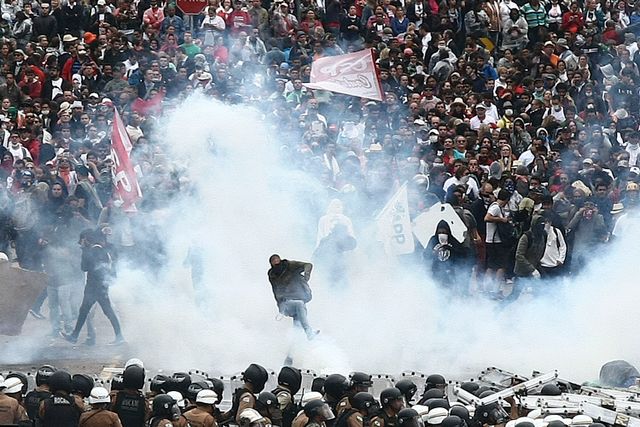
Over 200 striking teachers were injured in Brazil’s southern city of Curitiba Wednesday after militarized police used rubber bullets, tear gas, stun grenades, pepper spray and batons to prevent them from entering the Paraná state house to protest against a proposed attack on their pension rights.
Police tear gas protesting teachers [Foto: Agência Paraná]
The teachers, who launched an indefinite strike last Saturday, had faced continuous police attacks since setting up a tent camp outside the state legislative building on Monday. The repression escalated sharply on Wednesday, however, as the legislature prepared to vote on a bill backed by Governor Beto Richa that would radically alter the pension system for public employees.
The pension change is part of a series of austerity measures and tax cuts that are being implemented across Brazil at both the national level by Workers Party (Partido dos Trabalhadores-PT) President Dilma Rousseff and at the state level by governors like Richa of the right-wing PSDB.
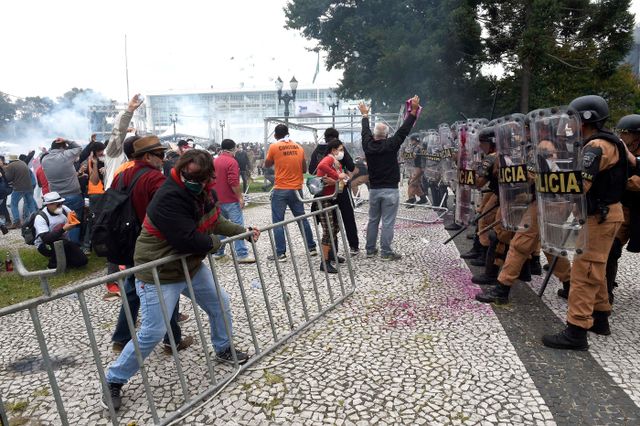
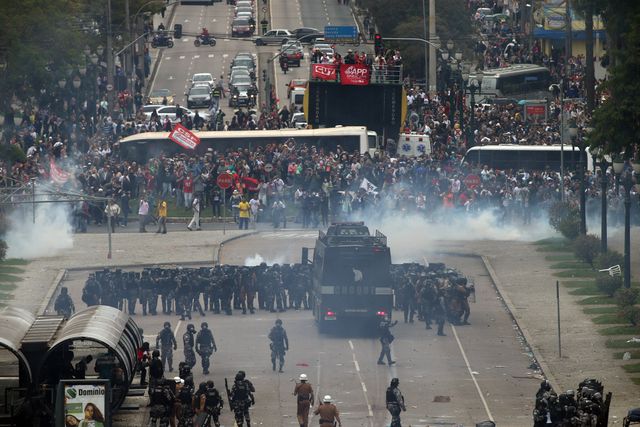
The government center of Curitiba was described by many Wednesday as a war zone, with helmeted members of the Military Police and its BOPE special police operations battalion firing guns and helicopters overhead, dropping gas on the teachers and their supporters, who were said to number between 15,000 and 20,000. Armored cars were also deployed and a water cannon, originally procured for suppressing last year’s demonstrations against the World Cup, was turned against the teachers.
Police confront protesters [Foto: Agência Paraná]
The striking teachers were met with overwhelming force when they attempted to push past police barricades and into the state legislature. Under Richa’s orders, some 2,000 Military Police had been deployed at the building to violently quell any such attempt.
Last February, a similar demonstration had succeeded in occupying the legislative chamber and halting a vote on an austerity package, which included the pension counter-reform. The authorities were determined to prevent any repeat of this action.
In the end the Legislative Assembly approved the amendments to the pension legislation by a vote of 31 to 20. The Richa administration has claimed that by forcing workers to contribute to their pensions and slashing state contributions, the legislation will reduce the state budget by more than US$41 million a month. The vote first had to be postponed because of tear gas in the hall. It was subsequently taken amid the sounds of gunfire and screams of the wounded from outside.
According to official figures released by the municipality of Curitiba, 213 people were injured in the police violence. Of these, at least 42 were taken to the hospital and eight were reported in serious condition.
Curitiba’s city hall was turned into a makeshift first aid center with teachers streaming in covered with blood from head wounds and suffering from other injuries, including dog bites.
The Order of Brazilian Lawyers, which sent observers to the demonstration, issued a statement denouncing the police violence. “The Military Police should act to guarantee the safety of the population, not to carry out the massacre” witnessed in Curitiba, it said.
The teachers’ struggle in Paraná is only one of many that have unfolded across Brazil in recent months, including in neighboring São Paulo, where a state teachers’ strike is already in its second month.
Police tear gas protesting teachers [Foto: Agência Paraná]
The war on teachers, which took on its most direct form in the streets of Curitiba, will only intensify as the PT national government of President Rousseff pushes through what she has described as “huge cuts” to the budget, including funding for education.
The strike in Paraná was forced upon the teachers union, the APP (Associação dos Professores do Paraná) over the opposition of the leadership, which tried to limit it to a one-day protest and to confine demands solely to the pension issue.
The teachers unions nationally, most of them affiliated to the CUT labor federation, have sought to limit the strikes and have kept them isolated one from the other.
The CUT is closely tied to the ruling PT and therefore works to subordinate the workers’ struggles to the Rousseff government. This government is implementing austerity measures and pushing through a new law on outsourcing which threatens to decimate the wages and social rights of wide layers of the Brazilian working class, even as it is engulfed in a massive corruption scandal surrounding the state-owned energy conglomerate Petrobras.
The deliberate suppression of workers’ struggles by the PT, the CUT and various pseudo-left groups which gravitate around them has allowed the Brazilian right to capitalize on the crisis of the Rousseff government, organizing mass demonstrations for impeachment and, in the case of some elements, a return to military dictatorship.
The violent confrontation in Curitiba, however, is indicative of the heating up of the class struggle in Brazil and the vast anger and opposition that exists within the working class toward the entire bourgeois political setup, from the PT to the extreme right.

Capitalism, the working class and the fight against police violence

Joseph Kishore

The events in Baltimore, Maryland following the police killing of 25-year-old Freddie Gray mark a political turning point in the United States. The enormous class divide in America, the bankruptcy of the entire political system and the collapse of democratic forms of rule—all have been laid bare by this latest act of state brutality and the military-police mobilization against the eruption of social anger.
In recent days, thousands of people have participated in demonstrations in Baltimore, New York, Philadelphia and other cities throughout the country. Further protests will take place today and over the weekend. While the police violence is the immediate spark, far deeper issues are involved: mass unemployment, poverty, the decay of cities and social infrastructure, and unprecedented levels of social inequality.
The entire political superstructure has responded to the unrest in Baltimore by backing the deployment of thousands of troops from the National Guard, a branch of the armed forces. Baltimore, only 40 miles from the nation’s capital, has effectively been occupied, with heavily armed units placed in key public locations throughout the city, accompanied by armored vehicles and military helicopters. A state of emergency has been declared, and a curfew imposed on all residents.
The actions in Baltimore come half a year after the crackdown in Ferguson, Missouri last August, when the city was turned into a war zone in response to demonstrations over the police killing of Michael Brown. The state violence was repeated later in the year, following a rigged grand jury proceeding that exonerated Brown’s killer.
The irony is hard to miss. The United States government, which wages war all over the world on the phony pretext of defending “democracy” and “human rights,” increasingly relies on the methods of martial law in response to any indication of social unrest within its borders.
Conditions in Baltimore exemplify the immense social inequality that is the defining feature of American society. As a whole, it is ranked the sixth poorest city in the country. In the Sandtown-Winchester area where Gray was arrested, more than half of the working-age population is unemployed, and a third of all residential properties are vacant or abandoned. A report put out by the city in 2011 found that nearly a third of all families in the neighborhood live in poverty.
To regulate this social catastrophe, the police have been armed to the teeth and given free rein to terrorize the population. Arrests, beatings and harassment are a daily reality. A report by the Baltimore Sun last year found that the city paid out $5.7 million since 2011 over lawsuits related to police violence. “Officers have battered dozens of residents who suffered broken bones—jaws, noses, arms, legs, ankles—head trauma, organ failure, and even death, coming during questionable arrests,” the newspaper reported.
While the vast majority of the population in Sandtown-Winchester is African-American, the fundamental division in Baltimore—as in American society as a whole—is class, not race. Like many urban centers, Baltimore is run by a predominantly black political elite, including the mayor, the city council president, the police chief, the top prosecutor and many others. Half of the police force is black as well.
Baltimore Mayor Stephanie Rawlings-Blake—who led the charge in denouncing Baltimore youth as “thugs” earlier this week—personifies a layer of the African-American upper middle class that has become part the Democratic Party political establishment and attained positions of power and privilege. The daughter of a longtime Maryland politician, Rawlings-Blake has worked closely with the city’s business elite to develop and gentrify sections of downtown, while areas like West Baltimore have been laid to waste.
It is now a half century since the wave of urban uprisings that swept the United States in the late 1960s—including in Baltimore and countless other cities following the assassination of Martin Luther King, Jr. in April 1968.
The rebellions in the 1960s came during the last gasp of liberal reformism in the United States. Over the past 50 years, the ruling class has gone on the offensive, carrying out a relentless assault on jobs, wages and living standards. Social inequality has soared to levels not seen since before the Great Depression of the 1930s. Cities like Baltimore have been deindustrialized, with entire sectors of the economy wiped out.
To facilitate the war on the working class, the ruling class worked deliberately to integrate a small minority of the African-American middle class into the mechanisms of state power, including through policies such as affirmative action. Meanwhile, conditions for the vast majority of African-American workers and youth are worse today than they were in the 1960s.
Obama himself represents the culmination of this process. The first African-American president has presided over an unprecedented transfer of wealth to the top one percent, unending war abroad and an assault on the most basic democratic rights. Since the economic crisis of 2008, unlimited resources have been funneled to the banks and Wall Street. The stock market and corporate profits are at record highs, while the administration has spearheaded the assault on wages, public education, health care and the conditions of life of the working class as a whole.
Since 2009, nearly all income gains in the United States have been captured by the top one percent of the population, with the 400 wealthiest individuals in the country now controlling a staggering $2.29 trillion. More than $600 billion a year is devoted to financing the US military juggernaut, yet in cities like Baltimore and Detroit thousands of households are being shut off from running water, the most basic necessity of modern life.
There are no political mechanisms within the political system through which any of the grievances of the vast majority of the population can find expression. Everything that has passed for “progressive” or “left” politics—including the politics of race—has been exposed by events. It is precisely this that terrifies the ruling class, and explains its ever more direct resort to force and violence.
The rights of the working class can be achieved only through revolutionary struggle, uniting workers of all races in an independent political movement in opposition to the Democratic and Republican Parties and the capitalist profit system they defend.
The Socialist Equality Party calls for the mobilization of the entire working class in defense of the workers and youth of Baltimore. The same police-state apparatus, trained in Iraq and Afghanistan, that terrorizes the population of Baltimore and has been called out to suppress popular protests is and will be deployed against all opposition to the policies of the corporate and financial aristocracy.
Mass meetings and demonstrations should be organized throughout the country to demand the immediate arrest of Gray’s killers, the lifting of the state of emergency in Baltimore and the withdrawal of the National Guard and the demobilization of the police. These democratic demands should be linked to a program that advances the social rights of the entire working class—including a massive redistribution of wealth to provide decent-paying jobs, education and health care for all.
Nothing can be achieved without a frontal assault on the domination of society by a financial aristocracy that is determined to maintain its stranglehold through violence and terror. Their grip over economic and political life must be broken through the establishment of a society based on public ownership and democratic control of the forces of production. To implement this program, the working class must take political power—in the United States and internationally.

Has Peshawar Changed Pakistan’s Approach to Tackle Terrorism?

Rana Banerji


The Tehrik-e-Taliban Pakistan’s (TTP)  terrorist attack on the Army Public School, Peshawar, on December 16, 2014, killing 132 children and several teachers, many from Army background, was traumatic; its intensity and cruelty shocking civil society in Pakistan, much in the same way as the public flogging of a woman by the Taliban in Swat did in April 2009, though with far more tragic consequences this time.
 
The Operation Zarb-e-Azb in North Waziristan was undertaken from June 2014 after a lot of dilly-dallying by politicians and abortive peace talks with the TTP. `Zarb-e-Azb’ was the Pakistan Army’s unilateral decision. The civilian government was left with no choice but to fall in line. After Peshawar, politicians found it easier to support the crackdown.
A 20 point National Action Plan (NAP) to tackle terror was announced. This too was Army-driven. It included a declaration of intent to execute convicted terrorists under a fast track process, lifting the moratorium on death sentences. It was decided to strengthen and activate the National Counter-Terrorism Authority (NACTA). Units of a Federal Counter Terrorism force were to start functioning in all four provinces. Revamping and reforming the criminal justice system is also envisaged, to strengthen counter-terrorism measures, including granting powers to provincial Criminal Investigation Departments (CIDs) to intercept terrorist communications.

Countering propagation of hate speeches and extremist publications, choking finances for terrorists and terrorist organisations, ensuring that proscribed terrorist organisations do not re-emerge under different names, taking effective steps against religious persecution, registration and regulation of madrassas, monitoring their sources of finance, banning any glorification of terrorism and terrorist organisations through print and electronic media were other facets of this `noble intent’.

However, the fragile consensus to deal with this difficult problem has dissipated from the very outset. Though nine Military Courts have been set up to function for two years by passing the 21st Amendment to the 1973 Constitution and amending the 1952 Army Act, questions about their constitutional veracity were raised. They were seen as ` a very dangerous option’ entailing risks of irreversible miscarriage of justice, wherein` a category of Pakistanis will not deserve the same rights and safeguards as normal citizens’ and `there will be no presumption of innocence’ nor` appeals to appellate courts’. `The presiding military officer will be judge and juror’. A public interest litigation challenging its validity is pending before their Supreme Court. A stay order on executions has been passed. It has even been suggested that `a fifth military coup’ may have silently taken place with the unanimous consent of the National Assembly. 

Religious parties like the Jamaat-e-Islami (JeI) and Jamiat Ulema-e-Islam (JuI) joined this bandwagon of protest. Maulana Fazlur Rehman denigrated the government’s `non-serious attempt to convert an Islamic state into a secular one’.
A crackdown against criminals and terrorists in Karachi has been made part of the NAP. Apex Committee meetings were held in Karachi, associating Pakistani Prime Minister Nawaz Sharif,  Sindh Chief Minister Qaim Ali Shah, former Pakistani President Asif Ali Zardari, as well as other politicians and senior army commanders. The Pakistan army chief decried the continuing political interference in the functioning of the police in Karachi. He emphasised the need to allow impartial, merit based functioning of the law and order machinery in the city. On March 11, the Muttahida Qaumi Movement (MQM) headquarters at 90, Azizabad, Karachi, was raided by Pakistan Rangers. Several MQM (A) party workers were arrested. 

This did symbolise a change in political realities in Pakistan. Having been unable to effectively cope with internal security issues, especially religious extremism and terrorism, the civilian federal and provincial governments have begun leaning heavily on the Army to pick their chestnuts from the fire. This has been described by political analysts in Pakistan as an `evolution of a new Civil-Military hybrid’.

Will this be temporary or permanent? 

The Nawaz Sharif government faces a peculiar dilemma. It can neither afford to alienate the Army top brass nor completely delink itself from right-wing sympathisers of militancy and the madrassa establishment. Therefore, it appears to have adopted a midway approach, conceding space to the Army for now, on counter-terrorism and other related matters, in return for letting the current civilian arrangement drift on till 2018. 

Religious hardliners and sectarians groups, especially those entrenched in Punjab do not accept these developments and may try to scuttle implementation of the counter-terrorism agenda in future.

Three imambargahs packed with worshippers were attacked in Peshawar and Rawalpindi in early 2015. Shias in Pakistan continue to be targeted single-mindedly and with a vengeance by outfits like the Lashkar-e-Jhangvi (LeJ). 

Hazaras are fleeing Balochistan, and barricades surround segregated Shia urban neighborhoods in Quetta. Christian congregations have also been targeted in Peshawar and Lahore.

A plethora of militant organisations continue to flourish across Pakistan. A cleric-criminal alliance emerged as a product of deep-rooted social imbalances and state patronised jihad in the 1980s. Religion-based militant groups gained strength from this attitude. Over the passage of time, these militant groups got stronger and gradually became independent. Many have turned against the State and others (even Lashkar-e-Taiba?) may do so in the future.

Tribal areas in the Federally Administered Tribal Areas (FATA) became important for militants to keep their networks intact and expand their infrastructure. Afghan refugee settlements in Peshawar and Quetta provided space to criminals involved in smuggling arms, explosives and communication tools, besides serving as recruitment centers for potential terrorists. Also, in many cases, militants used these settlements as hideouts. Prisons in Pakistan hold thousands of militant detainees, many of whom have not been tried in court yet. These serve as safe havens, enabling networking, recruitment and running of cells to radicalise fellow inmates. While the military aspects of `Zarb-e-Azb’, clearing and holding militancy infested areas have progressed considerably, civilian efforts to re-settle internally displaced civilians (IDPs) are wanting.

Though the need for regulating the curriculum and financing of madrassas has been recognised in the NAP as vital to control or reverse the tide of Islamic radicalisation, the policy of `enlightened moderation’ has remained on paper. Reform efforts were quietly stymied for lack of adequate political will in the face of orchestrated opposition from the ulema. 

In terror-related cases, the lower and higher judiciary has failed to dispense justice in an expeditious manner. Protection of prosecution attorneys or witnesses has been lacking. Conviction rates in charge-sheeted cases have been abysmally low. Important criminal cases involving known terrorists/terror groups were frequently adjourned on flimsy pretexts. 

In comparison to the power of the religious right, the fecklessness and lack of spirit of the liberal left stands out. Whereas half-tutored and half-lettered battalions of the religious right are ready to take to the streets at a moment’s notice, liberal activists like the recently assassinated Sabeen Mahmud wage their battles in isolation and in dwindling numbers. 

In this backdrop, it would be naïve to expect the Army to make a clean break from spawned terrorists of different hue or take the lead in reversing the religious narrative. Nevertheless, for the time being, the new politico-Army arrangement seems to have engendered hope that religious extremism, sectarianism and terrorism will somehow be brought under control. However, this may prove to be a double-edged sword if civilian institutions and processes for countering terrorism fail to emerge stronger. This will need civilian political will, which is lacking. Would the continuity of this “diffident political-will” lead again to a collapse of democracy in Pakistan? Only time will tell.

United States Commission On International Religious Freedom Places India on Tier 2 List Of Countries

Shehzad Poonawalla

Reference to National Commission for Minorities about the Key Highlights of the 2015 Report of the United States Commission on International Religious Freedom (USCIRF)- an independent, bipartisan US federal government commission, that makes a strong indictment of the Narendra Modi government on Minority issues.
Key Highlights of the 2015 Report of the United States Commission on International Religious Freedom (USCIRF)- an independent, bipartisan US federal government commission, that makes a strong indictment of the Narendra Modi government on Minority issues.
1) India has been placed on its Tier 2 list of countries
2) "Since the election, religious minority communities have been subject to derogatory comments by politicians linked to the ruling BJP and numerous violent attacks and forced conversions by groups such as RSS and VHP"
3) "Christian communities, across many denominations, report an increase of harrasment and violence in the last year, including physical violence, arson, desecration of churches and Bibles, and disruption of religious services.Perpetrators are often individuals and groups associated with RSS and VHP and operate with near impunity"
4) Mentions about 6 instances of Church attacks between December 2014 and February 2015.
5) Slams "Ghar wapsi" program carried out by groups in an attempt to convert 4000 Christian and 1000 Muslim families and attempt to raise funds by saying that it costs nearly Rs 2 lakhs per Christian and Rs 5 lakhs per Muslim!
6) "Members of RSS allegedly tricked dozens of Muslim families into attending a meeting by telling them they would be provided financial help, but instead performed a conversion ceremony; an investigation is underway"- Agra incident
7) Highlights President Obama's remarks on religious freedom issues during his visit in India and at the US National Prayer Breakfast urging India to not be 'splintered along the lines of religious faith.'
8) States that Modi's public statement for the first time that his government will ensure there is complete freedom of faith is notable given the longstanding allegation that as CM of Gujarat in 2002 , Mr Modi was 'complicit in anti-Muslim riots in the state.' Mentions about the revoking of his tourist visa by the State Department.
9) In its 2015 annual report, the US Commission on International Religious Freedom asked US President Barack Obama Administration to press the Indian government to publicly rebuke officials and religious leaders who make derogatory remarks about communities and to boost religious freedom standards in India.
10) The panel said that despite the country's status as a pluralistic, secular democracy, India has long struggled to protect minority religious communities or provide justice when crimes occur, which perpetuates a climate of impunity.
Prayer:
Although the Modi government has responded by stating that it "does not take cognisance of such reports", it is a fact that world over, the stifling of religious freedoms in India is becoming a debate and is reflecting badly upon us as a plural, liberal democracy. Hence, authorities including the courts, investigative agencies, statutory bodies like National Commission for Minorities and National Human Rights Commission and the Ministry of Home Affairs must treat every case of religious atrocity and discrimination with seriousness so that no country or international agency can point fingers upon a vibrant democracy like ours. Mr.Modi's government must walk the talk on 'Sabka Sath, Sabka Vikas'.
The NCM must discuss the said report and its contents and should insist that the Government of India take corrective steps