6 May 2015

Russia, Ukraine And The West: In Defence Of History Against Falsification

Mike Faulkner

According to one dictionary definition the term “propaganda” should be understood as “information, ideas, opinions etc. propagated as a means of winning support for, or fomenting opposition to, a government, institution etc.” There is nothing here to indicate whether the information, ideas and opinions propagated need be true or false.
Thus, to take a simple example, the US occupation for more than a century of Cuban territory at Guantanamo Bay for use as a naval base, is a fact. To state that fact is to speak the truth. It is also a fact that the treaty by which the US came into possession of Guantanamo was imposed upon Cuba against the will of its people, with the threat that failure to accept it would result in the US occupation of the island. It is also a fact that since 1959 the Cuban government has refused to accept the rent from the US for Guantanamo, claiming, truthfully, that the territory housing the base belongs to Cuba and that the US has no legitimate right to be there. All of this factual information and the truthful expression of opinion by the Cuban government, most recently by President Raul Castro, demanding its return to Cuba, has been reiterated consistently for the past 56 years. The demand for the return of Guantanamo may be regarded as “winning support for” the Cuban government, or “fomenting opposition to” the US government. In that case such a demand could, according to the definition, be regarded as propaganda. It would, nevertheless be a just demand on the basis of a truthful presentation of the facts.
“Propaganda” has a derogatory ring to it. It is usually taken for granted that all propaganda must be mendacious, involving deliberate falsification intended to deceive its recipients and persuade them to accept what the propagandists know to be untrue. It may be readily accepted that in many cases this is indeed what propaganda is about. But not necessarily in all cases. During the Second World War following the Battle of Stalingrad, the National Committee for a Free Germany, composed largely of captured German officers who had turned against Hitler, broadcast messages to the Wehrmacht calling on them to surrender. One of these took the form of a clock ticking off the seconds with a voice-over in German informing the demoralized German soldiers that one of their number was dying every second on the Eastern Front, and leaving the sound of the clock ticking away. It was frighteningly effective propaganda. At that time, it was also true. Even propaganda involving deliberate falsehoods may be justified at times.
The radical journalist Claude Cockburn recounts (Cockburn Sums Up. 1981) how in 1936, during the Spanish Civil War, he filed a news report, purportedly from Tetouan in Spanish Morocco, in which he claimed to witness a full-scale revolt by Moorish soldiers against the Spanish army. It was intended to persuade the government of Leon Blum in France that Franco might lose the war and thus persuade him (Blum) to lift his arms embargo on the Spanish Republicans. No such revolt had happened. Cockburn made it up. After the Second World War he was roundly condemned for having engaged in “Black” propaganda, by Labour MP Richard Crossman. When Cockburn reminded Crossman that he himself had engaged in exactly such propaganda exercises to deceive the Nazis during the war, Crossman’s response was that “Black” propaganda “may be necessary to war, but most of us who practiced it detested what we were doing.” “Was it then possible” Cockburn retorted, “ that throughout the life and death struggle our propagandists had all along taken the view that their paramount duty was to be gentlemen, and not to tell lies, however damagingly misleading these might be to the enemy?” With his unfailing wit he characterized Crossman’s stance as “a comfortable ethical position, if you can stop laughing.”
It is difficult to argue convincingly that all propaganda is bad and morally indefensible. Most people would agree that during the Second World War what Crossman referred to as “black” propaganda was necessary and morally defensible when employed by the anti-fascist forces fighting the Nazis. But all propaganda employed by the Nazis and fascists was indefensible and morally deplorable. It depends entirely on the cause in which it was employed: propaganda in support of barbarism and genocide, or propaganda for humanity and liberation.
Josef Goebbels, Propaganda Minister of the Third Reich, (in today’s parlance Hitler’s Director of Communications), bequeathed to the post-war world one salient lesson which he drew from the development of radio and the cinema in the 1930s. He knew that the most effective propaganda method for shaping public opinion in an advanced, literate capitalist society was one which persuaded people that they were not being subjected to propaganda at all. Most of the films they watched had no overt political content, but crucially, some did; the various news media persuaded most Germans that the racism, ethnic nationalism and anti-semitism they peddled simply echoed their own sentiments of patriotism and natural deference to leaders who deserved their trust and loyalty. German life, despite its evident militarisation, was thoroughly petit-bourgeois. The minority who were not taken in, learned, for the most part, to keep their heads down. Everyone was well aware that there were concentration camps for those who stuck their necks out. Most tried not to think about such things.
Today it is becoming more obvious than ever that we are subjected to a form of propaganda that owes a great deal to the pioneering work of Dr. Goebbels. There is no need for the threat of incarceration for those who refuse to consent to the dominant political narratives of the day. In Britain, despite the likelihood that the forthcoming general election will produce a hung parliament and that there could be something of an electoral earthquake in Scotland, there appears to be little awareness about the increasing gravity of the international situation. Wherever one looks – the Middle East, the exodus from Libya with hundreds drowning daily in the Mediterranean, Greece, Ukraine – there is evidence of deepening and unmanageable crises. But potentially the most dangerous of all is the growing Western rhetoric of revived cold war hostility towards Russia. It is impossible to understand this without looking at the part that the Soviet Union played in the Second World War.
Russia and the Falsification of History
One does not need to be an admirer of Vladimir Putin to recognize that his stand in confronting the Western powers and NATO over Crimea and Ukraine is justified. A few relevant facts, readily available but seldom mentioned in the mainstream media, are worth recording:
There are more than one thousand US and NATO military bases around the world. 737 of them are outside the USA. Since its establishment in 1949 with 12 founding members, NATO has steadily expanded to a present membership of 28 states. 12 of these are former members of the Warsaw Pact in Eastern Europe including Poland and the Baltic states of Estonia, Latvia and Lithuania. The US has increased its military forces in Poland and NATO’s control over Baltic airspace on Russia’s borders. There are 116,000 US military personnel in Europe.
Outposts defending US corporate power and not national safety, American military bases represent a constant threat to peace in every region they are deployed. Few things illustrate the meaning of American exceptionalism better than this sprawling network of offensive installations. Be sure to click TWICE on this graph for accurate resolution.
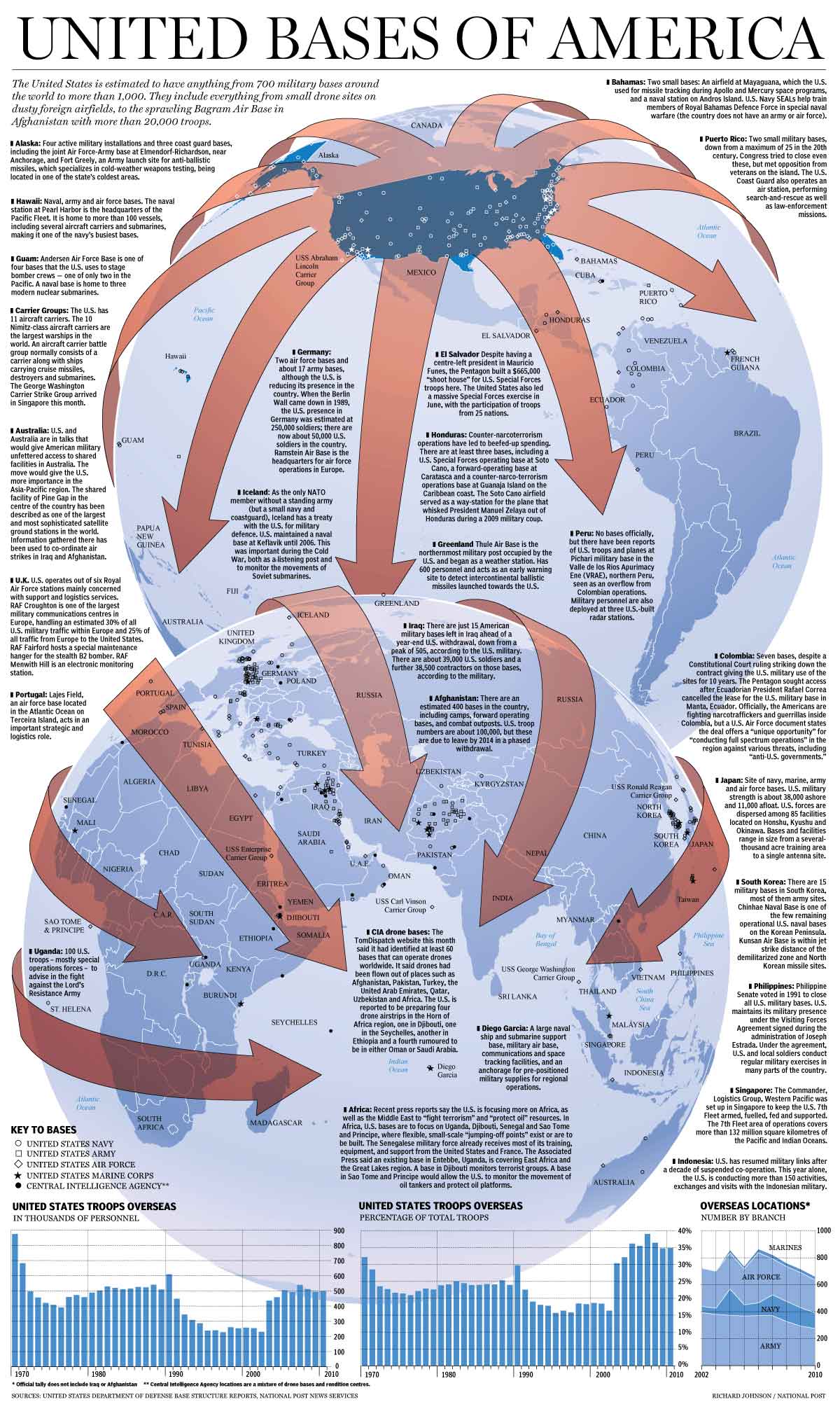
Russia has a military presence in nine countries. All but two of them (Vietnam and Syria) were formally part of the Soviet Union. The Russian naval base at Sevastopol on the Black Sea in Crimea was retained after the collapse of the Soviet Union on lease from the Ukrainian government. The significance of Sevastopol for Russia is not simply due to its strategic geopolitical importance on the Black Sea. It is also because of its history, and in particular its determined resistance to the Nazi invaders during the 9 month siege of 1941/2 and the heroism of its defenders and citizens in the terrible final assault that overwhelmed them.
Anyone who genuinely wants to understand Russian concerns about the steady military expansion of the US and the NATO states on its western borders cannot afford to ignore the titanic part played by the Soviet Union in the defeat of Nazi Germany and its allied fascist satraps in the Second World War. But the mainstream western media and the political elites whose politics they endorse, have no interest in dealing truthfully with this. In fact, for 70 years they have propagated a mendacious, deliberately falsified, revisionist account of this history. Throughout the decades of the cold war the major part played by the Soviet Union in the wartime alliance against Hitler was ignored or downplayed. After 1945 the myth, concocted by ideologues in the United States and supinely accepted by their foreign acolytes, was propagated that Moscow was at the centre of a world-wide communist conspiracy aimed at world domination, and that the Soviet Union was the totalitarian successor to Nazi Germany, bent on military aggression against countries of the “Free World” in Europe and Asia. Only the United States it was claimed, as the beneficent protector of the “Free World” through its formidable nuclear arsenal and its global network of military bases, together with its subordinate allies in NATO, SEATO, and CENTO, could stop the communists from dominating the world. The Soviet Union and the communist-ruled states in Europe associated with it, no longer exist. But US and NATO military power has gone from strength to strength since then. The permanent arms economy that was the main expression of US and NATO power can only justify its continued existence and relentless growth by inventing new enemies against whom it has to defend “freedom-loving peoples.”
BELOW: “The Gustav”, a giant railway gun used by the Nazis in their assault on Sevastopol.

The Second World War was the most colossal armed struggle in history. It is no exaggeration to say that had German imperialism in the form of the Nazi Third Reich triumphed in that war, the genocidal barbarism that it brought wherever its rule extended would may well have spelled the end of human civilization. It is estimated that 60 million people lost their lives between 1939 and 1945 in the war. This is about 3% of the world’s population in 1939. If we compare fatalities for four member states of the wartime alliance against the Axis (which excludes of course many other participant nations), the discrepancies are striking. The figures in brackets are the percentages of the country’s total population:
United States....... 420.000 (0.32%)
United Kingdom ..450.000 (0.90%)
France.................. 550.000 (1.36%)
Soviet Union......... 26.6 million (14.2%)
The Soviet fatalities in World War Two amounted to more than 1% of the world’s 1939 population. There is no parallel to the heroism and scale of the sacrifice of the Soviet people in that war. Americans, in particular, cannot begin to understand the dimensions of this catastrophe, for it is simply mind-boggling. It is as if the United States had emerged from a war with every single man, woman and child killed in the states of California, Texas, and New York, combined. (1)
Turning to the US and EU response to last year’s referendum in Crimea and the conflict in eastern Ukraine, it is worth repeating here a passage from an article that appeared in this column at the time of the referendum in March last year, including the extract from The Road to Stalingrad, John Erickson’s magisterial study of the Soviet Union at war.
“In that book he recounts in great detail the Soviets’ last ditch defence of Sevastopol in June 1942. General Manstein’s 11th Army subjected the fortifications to ‘27 days of relentless bombardment and savage attacks which raged on by the hour as each Soviet position had to be smothered in men and fire before opposition was literally blotted out…Each fort had to be blown out of the ground in which they were anchored with all their concrete and steel. Even when cracked open the forts fought on. Riflemen fought in gas masks and smoking stench…A sea of fire rolled relentlessly on Sevastopol.’ Erickson describes how Soviet soldiers, having fired their last rounds blew themselves up with their guns as German infantrymen closed in for the kill. The siege lasted 250 days, from 30.October 1941 to 4. July 1942. At least 18,000 Russians were killed and 95,000 were captured. After the fall of the city the Nazi Einsatzgruppen moved in and began the systematic genocide of the Jews. Ukrainian nationalist collaborators in the Crimea asked the Nazi authorities to be allowed to liquidate the Jews themselves. Manstein was promoted by Hitler to the rank of Field Marshal. Sevastopol, after its final liberation from German occupation in 1944 received the title “Hero City”. These events, like the 1941 defence of Moscow, the three- year-long siege of Leningrad, the unparalleled resistance and final victory at Stalingrad have been engraved on the memory and consciousness of generations of Russians.”
It is perhaps unnecessary to add anything to this in order to convey a sense of what the Crimea and Sevastopol mean to the Russian people and why it is that the millions who died in defending their homeland in “The Great patriotic War” are remembered and honoured with such reverence.
There are No Fascists in Kiev!
So outrageous has been the western media distortion of the situation in Ukraine, presenting the Maidan coup as a democratic revolution or peaceful transition to democracy, that the pro-Washington FP Group had to admit in March 2014 that yes, “There are Bad Guys in the Kiev government.“ Rabid fascists and antisemites such as Right Sector, the Azov Battalion and Svoboda have either been ignored or described euphemistically as “nationalists”. At any rate, it has been claimed that such groups are insignificant and that they play no role in the Kiev government or in the activities of the Ukrainian army in the East. FP Group has had to come clean, reporting that when the State Department ridiculed Putin’s “false claims” and assured Americans that the “far right” were not represented in parliament, they were wrong. Putin’s claims were not false. They were true. Likewise, the former RT presenter Liz Wahl, who was feted in the west when she quit the station, falsely claimed that Ukraine had no neo-Nazis. Prior to the March 2014 referendum the fascist group, Svoboda, demanded that, despite the fact that 60% of Crimean people speak Russian as a first language, all government business be conducted in Ukrainian. They also pushed for the repeal of a law against “excusing the crimes of fascism.” The FP Group reporter admitted that “more than a few of the protesters who toppled Yanukovych , and of the new leaders in Kiev, are fascists.” After March 2014 Svoboda held 25% of Ukrainian ministries, including defence. Members of Right Sector held the posts of prosecutor general and Deputy Chair of Parliament. Another Right Sector MP founded the “Joseph Goebbels Political Research Centre” and described the Holocaust as “a bright period in human history.” US Senator John McCain shared a platform with Svoboda chief Tyahnbok, embracing him with the message “The Free World is with you; America is with you.”
Most Western commentary on Russia and the Ukraine seems either duplicitous or ignorant, sometimes both. Few and far between are those who have serious knowledge and experience of Russia. Few care a jot that both the Ukraine and Georgia were for hundreds of years part of the historic Russian state. Seldom mentioned is the fact that the solemn promise made to Gorbachev at the time of Germany’s reunification in 1990 that NATO would “not expand one inch to the East” was casually cast aside by Clinton. Ignored is the warning by 92-year-old George F. Kennan (who did understand Russia) in 1996 that “Expanding NATO would be the most fateful error of American policy in the entire post-cold war era.” Ignored are the views of Steven F. Cohen, one of the few US Russian scholars to place the blame for the present crisis where it belongs.
The cohort of new cold war ideologues and mediocrities that passes for the leadership of the Western world moves on from the chaos and carnage they have caused in Iraq, Afghanistan, Libya and elsewhere to commemorate the 70th anniversary of VE Day on May 8th. In so doing they will, with straight faces, issue grave warnings about the threat we all face from Russia. They will absent themselves from the celebrations in Moscow on May 9th and pretend that Victory in Europe in 1945 was won entirely by the armed forces of Britain and the United States. 

European Biofuel Bubble Bursts

Sean Buchanan

Ten years of debate in the European Union over the detrimental effects of the demand for biofuels for transport on food prices, hunger, forest destruction, land consumption and climate change have come to an end.
The European Parliament finally agreed new E.U. laws on Apr. 28 to limit the use of crop-based biofuels, setting a limit on the quantity of biofuels that can be used to meet E.U. energy targets.
With Europe the world’s biggest user and importer of biodiesel – from crops such as palm oil, soy and rapeseed – the vote is expected to have a major impact around the world, notably in the European Union’s main international supplier countries Indonesia, Malaysia and Argentina. It is likely to signal the end to the expanding use of food crops for transport fuel.
“Let no-one be in doubt,” said Robbie Blake, Friends of the Earth Europe’s biofuels campaigner, “the biofuels bubble has burst. These fuels do more harm than good for people, the environment and the climate. The EU’s long-awaited move to put the brakes on biofuels is a clear signal to the rest of the world that this is a false solution to the climate crisis. This must spark the end of burning food for fuel.”
With the vote, the European Union has agreed to put a limit on biofuels from agricultural crops at seven percent of E.U. transport energy – with an option for member states to go lower. Before the vote, the expected ‘business as usual’ scenario was for biofuels to account for 8.6 percent of E.U. transport energy by 2020. Current usage stands at 4.7 percent, having declined in 2013.
Indirect greenhouse emissions released by expanding biofuels production will be reported every year by the European Commission and by fuel suppliers in an attempt to increase the transparency of the impacts of the policy.
Commenting on the vote, Kirtana Chandrasekaran, Friends of the Earth International’s food sovereignty coordinator, said: “While the EU has not gone far enough to stop the irresponsible use of food crops for car fuel, this new law acknowledges a reality that small-scale food producers worldwide know – that biofuel crops cripple their ability to feed the world, compete for the land that provides their livelihood, and for the water that sustains us.”
Around the world, 64 countries have policies to increase or maintain the amount of biofuels used in transport fuel, including most recently Indonesia, which has been criticized by environmentalists as promoting a policy that will accelerate deforestation in the country.
Kurniawan Sabar, campaign manager for WALHI/Friends of the Earth Indonesia, said: “The people of Indonesia will be relieved to hear that the EU has taken some action to limit Europe’s demand for palm oil for biofuels, which has escalated deforestation, land grabbing, and conflicts in Indonesia. The Indonesian government should take note and abandon its own plans for new subsidies to expand biofuels plantations in Indonesian forests.”

Greenpeace India Faces Imminent Shutdown

Colin Todhunter


The Executive Director of Greenpeace India, Samit Aich, today addressed his staff to prepare them for the imminent shutdown of the organization after 14 years in the country.
He said:
“I just made one of the hardest speeches of my life, but my staff deserve to know the truth. We have one month left to save Greenpeace India from complete shutdown, and to fight MHA’s [Ministry of Home Affairs] indefensible decision to block our domestic accounts.”
Greenpeace India has one month left to fight for its survival with the threat of an imminent shutdown looming large. The NGO has been left with funds for staff salaries and office costs that will last for just about a month. Calling it "strangulation by stealth," Greenpeace India challenged the Home Minister to stop using arbitrary penalties and confirm that he is trying to shut Greenpeace India down because of its successful campaigns.
The Home Ministry’s decision to block Greenpeace India’s domestic bank accounts could lead to not only the loss of 340 employees of the organization but a sudden death for its campaigns which strived to represent the voice of the poor on issues of sustainable development, environmental justice and clean, affordable energy.
Following allegations over foreign funding, Greenpeace India has been the subject of a string of penalties imposed by the MHA, all of which have been overturned by the Delhi High Court. The latest is blocking access to domestic bank accounts funded by donations from over 77,000 Indian citizens.
While, Greenpeace India is currently preparing its formal response to this decision as well as a fresh legal challenge, Aich is concerned that the legal process could extend well beyond 1st June when cash reserves for salaries and office costs will run dry.
Aich continued:
“The question here is why are 340 people facing the loss of their jobs? Is it because we talked about pesticide-free tea, air pollution, and a cleaner, fairer future for all Indians?”
Priya Pillai is a senior campaigner with Greenpeace India. Her overseas travel ban was overturned by the Delhi High Court in March. She said:
“I fear for my own future, but what worries me much more is the chilling message that will go out to the rest of Indian civil society and the voiceless people they represent. The MHA has gone too far by blocking our domestic bank accounts, which are funded by individual Indian citizens. If Greenpeace India is first, who is next?”
Greenpeace India has asked the MHA to recognize the impact of its decision.
Aich says:
“The Home Minister is trying to strangle us by stealth, because he knows an outright ban is unconstitutional. We ask him to confirm that he is trying to close Greenpeace India and suppress our voice. His arbitrary attack could set a very dangerous precedent: every Indian civil society group is now on the chopping block.”
Since coming to power in 2014, the new Modi-led administration has promised to remove ‘blockages’ to ‘development’. In pushing through a strident neoliberal agenda, this was originally taken to mean regulatory obstacles. But it is increasingly clear that protest and dissent are to be regarded in a similar light.
A 2014 leaked Intelligence Bureau report stated that foreign NGOs and their Indian arms were serving as tools to advance Western foreign policy interests in various areas. Greenpeace was singled out for particular attention and was deemed to be working against the ‘national interest’.
Greenpeace responded at the time by saying:
"We believe that this report is designed to muzzle and silence civil society who raise their voices against injustices to people and the environment by asking uncomfortable questions about the current model of growth."
At a time when the administration is opening up the economy to Western interests, which could impact the livelihoods of hundreds of millions, the hypocrisy of blaming certain individuals and NGOs for working to further Western foreign policy objectives has not been lost on observers and campaigners alike.

Taking Aim at Popular Sovereignty

Jason Hirthler

Shortly after the Cold War ended, the Pentagon advanced a strategic paradigm that judged American military might by its capacity to conduct two “major theater” wars simultaneously. Though later modified by the Bush and Obama administrations, the concept illustrated the scope of American ambitions in the unipolar world it perceived behind the collapsing scenery of the Soviet Union. Today the forces of neoliberal capital, represented variously by the Bilderberg Group, the Group of Thirty, the G7, and which are the motive force of U.S. imperial strategy, are prosecuting two simultaneous wars against the withering forces of popular rule—but by other means than military.
Enervated by forty years of persistent assault by neoliberal ideologues and their political flacks, the Western world’s progressive community and its legacy of embedded rights seems at times a spent force, unable to galvanize a soporific community of first-world consumers enthralled by the promise of creature comforts but little else. Even as its mostly deeply held beliefs in populism are emptied of their power. Western populace is largely unmoved as the twin forces of finance and trade perform a blitzkrieg on democratic sovereignty. Through a fog of legal casuistry and token reform, it is those that suffer racism and real economic exclusion that raise their voices, and their fists, in reply. But will their lone ire be enough? In more comfortable liberal circles, only the faintest signs of protest flicker absently across the expanse of exurban cul-de-sacs. These communities are happy to be co-opted by a compromised democratic left, content to hide behind the rhetoric of reform and the dispiriting “realities” of modern politics.
The first frontal assault on popular rule is in banking and finance, the second along the hazy frontier of free trade. On both fronts the advance guard of capital—represented by corporate trade negotiators and European Union executives—is rolling virtually unopposed through the economic and legal landscape of democratic governance, erecting new models designed to undermine national sovereignties at every turn, and finally shackle nation-states within a prison of corporate fascism. Two instances below nicely illustrate the stakes being contested and the methods involved. Though the venues are underwhelming—bureaucratic Brussels, sleepy Frankfurt, dull conference centers in New Zealand and Canada—the outcomes will be real and lasting.
The Finance Sector
The European Central Bank is not what one would describe as an ethically sound organization. As financial crises rolled through Europe, the ECB took one pitiless stance after another regarding economies of its members. Its destruction of Ireland is a case study in cruelty. Then, when more recently faced with a teetering Greek republic and a freshly elected anti-austerity government, the ECB barely hesitated. It reduced liquidity and then reduced the cap on Greece’s ability to issue, sell, and buy its treasury bonds, reducing the Greeks ability to finance their government. In so doing, ECB President Mario Draghi was essentially suffocating the Greek economy in order to force it to accept its detested neoliberal prescriptions. And you know what these prescriptions are: cutting state spending by slashing social welfare and constricting budgets in a straightjacket of inflexible deficit caps; liberalization of the labor market—that clever euphemism used to disguise the deregulation of labor for the benefit of capital; the privatization of state assets, ostensibly to generate cash to fund the budget, but in reality designed to both ensure regular interest payments to the ECB and to slowly cripple the state itself, removing its power to resist the decrees of a federalized Europe, run top-down by unelected bank commissions. This latter kind of privatization is effectively a form of “accumulation by dispossession,” as social geographer David Harvey puts it. And this is why earlier this year Greek Prime Minister Alex Tsipras and Finance Minister Yanis Varoufakis were bullied into agreeing to continue, almost without revision, the neoliberal framework accepted by previous governments, despite their Syriza party’s initial promise to reject austerity. That agreement was interim, and the troika and the Greeks are working on new lending regime due to be concluded this summer.
Even such a minor concession as slowing the implementation of austerity—which Varoufakis had hoped to achieve—was too much for the ECB to stomach. The troika, or “institutions” that include the ECB, the International Monetary Fund (IMF) and the European Commission, is unflinching in its ideological commitment to neoliberalism. Everyone must toe the line. Everybody has to march in step. No concessions will be made in the inexorable advance of capital toward the complete control of the EU. Mario Draghi, of course, answers to the major banking concerns of the world, his fellow members of the Group of Thirty, a private cabal of central bankers.
The ECB is now the Single Supervisory Mechanism (SSM) of the European Union, an idea ratified in 2013. This makes it the final supervisory authority of major member banks in the Eurozone, evidently a significant step toward “banking union,” which would further remove member states’ sovereign control of their economy—ever the covert dream of EU visionaries. In order to receive the ECB’s sanction to print euros, Greece must swallow the poison pill of austerity. This power makes it the de facto policy maker of Europe. Once the hope of Greek’s desultory youth and bitter public workers, Syriza has proven itself to be a false radical, having surrendered to ECB pressure. The radical elements in Syriza may mutiny, but the party’s capitulation isn’t much of a surprise. As the Oceania Saker wrote, “Empires do not surrender their colonies through reasonable arguments or by the bankruptcy of their regressive ‘reforms.’”
The Trade Sector
Add this loss of domestic power the evolving apparatus of global trade being implemented through the Trans-Pacific Partnership (TPP) and the Trans-Atlantic Trade and Investment Partnership (TTIP), and previously the WTO and NAFTA, among other treaties. This free trade superstructure is establishing a supranational legal framework designed to privilege corporate profiteering over domestic legislation in the public interest. Recent leaked elements of both treaties shed light on the anti-democratic nature of each. A proposal from the TTIP negotiations recommends that all draft domestic legislation be subjected to a vast, byzantine screening process conducted by a ‘regulatory cooperation body’ evidently staffed by TTIP insiders. The power of the body to reject legislation isn’t clear, but certainly it would wield tremendous influence on proposed law, as it would represent the consolidated interests of multinational beneficiaries of the TTIP. Perhaps the more immediate goal of the screening apparatus would be to simply deter and delay the implementation of any legislation deemed harmful to corporate interests—regardless of whether that legislation is in the public or planetary interest. As if the independence of legislators across the developed world isn’t already vitiated by corporate patronage, the TTIP would expand the fetters that would prevent an independent-minded member of parliament from acting on the citizen’s behalf, making it ever easier to rationalize selling his constituents down the river, in the great tradition of Barack Obama.
Recent WikiLeaks revelations from the TPP negotiation are even more daunting in the shameless manner by which they flout democratic institutions. The TPP has already built in extensive powers for the Investor State Dispute Settlement (ISDS) model. The increasingly infamous ISDS allows corporations to sue governments if a company decides that domestic legislation is an unreasonable fetter on its profit forecasts. Suits are resolved in unelected private tribunals staffed by both parties to the suit and by another, supposedly neutral arbiter.
The ISDS model has already borne fruit for corporate power. Public Citizen conducted a thorough analysis of the leaked investment chapter and had this to say about ISDS:
Under U.S. “free trade” agreements (FTAs) alone, foreign firms have already pocketed more than $440 million in taxpayer money via investor-state cases. This includes cases against natural resource policies, environmental protections, health and safety measures and more. ISDS tribunals have ordered more than $3.6 billion in compensation to investors under all U.S. FTAs and Bilateral Investment Treaties (BITs). More than $38 billion remains in pending ISDS claims under these pacts, nearly all of which relate to environmental, energy, financial regulation, public health, land use and transportation policies.
Like the TTIP, the TPP model elevates corporate interests above public interests. And like these trade partnerships, the federal model of the EU uses monetary policy to restrict the democratic impulses of its member populations. Together, the architecture of these commercial and financial formations promise to pinion global populations within a nominally representative but wholly unaccountable regime of multinational corporate cartels. Though Mussolini said corporatism was the merger of the state with corporate power, the coming reality represents the definitive triumph of the corporation over the state. It absorbs the state whole. Decisively beaten on two fronts, the state will likely continue to exist, but not as a democratic institution. In the new dystopia, its role would be to serve as an instrument of repression. An instrument through which corporate power can beat back negative popular reactions to its strip-mining of nation-states, their resources, and the remaining assets of an angry and alienated populace. The only question that remains is how long the majority will tolerate the intolerable.
A Coda on Change
Despite the air of inevitability around the trade and finance initiatives, there are flashes of resistance. In the past week, the Greek Supreme Court has declared pension cuts unconstitutional, a remarkable step that directly defies the prescriptions of the ECB, setting up a showdown between federal and provincial Europe. Syriza also relaunched the state television station shut down thanks to austerity. Spain’s anti-austerity Podemos continues to threaten establishment parties in advance of December elections. Across the Atlantic, in a seemingly unrelated scenario, a popular uprising has grown around the killing of a black Baltimore resident in police custody. Coming after much-publicized deaths at the hands of police in Ferguson and New York, a consistent pattern of unrest is surfacing across American society. The sour public mood is also evident in repeated nationwide strikes by service workers for higher wages, and numerous urban movements insisting that local municipalities pay $15 an hour. And not least in the rising resistance to the diktats of the unelected and self-appointed arbiters of world trade. On the face of it, these protests seem to address separate issues. But they don’t. The EU protests in Greece and Spain in particular, and the U.S. protests in Baltimore, Seattle, Chicago, and elsewhere, have a common cause: the unrelenting assault of neoliberalism—on wages, on democracy, on labor, on social welfare, on minorities, and on federal government itself. Whether a reaction to intolerable economic policies, transparent efforts to remove economic decision-making from the public realm, or cries of rage against the repressive arm of the state, a single animus sparks each flare of discontent. Whether they will coalesce into a bonfire of neoliberal vanities remains to be seen.

In Praise of the Four “R”s

J.A. Masko

There are at least three potential audiences for this piece: those that are saying, “What the hell is this guy saying? Violence is good? Criminal thuggery revolutionary?” And then there are those who are wondering, what does he mean exactly? Is he just being sensationalists or radical chic? And then there are those who get it. Most of them haven’t been to university, but most have either been in a riot or have at least felt the undeniable surge that comes from desperation and rage that leads to disrupting business as usual.
Yes, rage. Riots come from rage and most commentators don’t have any rage or any experience in riots, except as creepy voyeurs, endlessly repeating the TV cycle narrative. This is why I rarely watch or read mainstream media in these events: I’ve seen and heard them time and time again, and to listen to the tired, worn out “analysis” offends my sensibility and experience. That’s the other reason I don’t listen to them because I’ve been in riots. Or should I say rebellions? I know the types and the thrills, the victories and the defeats. And because I study media and how they frame stories and because I study how we go from riots to rebellions to resistance and then to Revolution, I understand it is critical to talk about what is really going on in showing us the news. What is actually happening behind the television and print pundits’ opinions of “riots”? What function do they serve? So that we know how to interpret civil disturbances and react accordingly, as spectators of our own lives.
First of all, the specifics of the current number of riots are not important to this conversation, as they are simply replays of replays. Not until we discuss the function of different public disturbances, will we be able to understand how we get from desperation of the riot that challenges the slavery of everyday life to rebellion, resistance and Revolution. Instead we must talk about how riots are dismissed as the slavish desire of a consumer’s dream of the “good life,” instead of being recognized as a call for justice. So needless to say, I don’t believe non-violence is our only option, a reform that will only put off the inevitable. I believe riots have many causes, but I’m here concerned about taking the incidental riot and turning it into a historical riot, one that allows us to dream of a better world.
Black Lives Matter, but racial violence is class violence. Face it, everyday, people of every color get abused and murdered by the security forces that themselves are every shade of the rainbow, yet are blue and blue throughout. Of course there is a color component, how could it be otherwise when black people are a great part of the American underclass? But if you’re Henry Louis Gates and you get arrested for “breaking” into your own house, you get a beer with Obama and the racist cop who arrested you. Poor people don’t get that break. They get broken. And forget about white privilege, poor people of color aren’t denied privilege, they are denied the human rights that we all should and can enjoy. Black privilege accords with White privilege quite nicely (oh you know this if you’re 3rd generation Spelman or Howard); it’s called class privilege. But what about those vicious crackers and peckerwoods? The KKK and the Aryan Brotherhood? The sad privilege they call their own is pathetic outdated colonialism, used by the elite to divide and conquer. The vanquished would rather argue, yes, I am not being oppressed or exploited. This is exactly what they want; it is easier to say you want to be brutalized, and to say you deserve it, than to admit you are being fucked. And of course, the working class is white in popular culture and pretty happy on the sitcoms and reality Television shows so those out there fighting for a better life are criminals, rioters, and bums. All the usual suspects that take, take, and take as they rely on the Welfare State instead of hard work.
Should we fight incessantly for equality in race, gender, sexual orientation, disability, and all other political identities? YES, without fail! But we can’t fail to connect it to a larger structural system that reroutes natural allies into neoliberal narratives struggling for their own piece of the pie. And those in the academy and industry usually get the spoils before us proles. To deny the very existence of a working class and a working class life betrays the poverty of your theory and the inability to relinquish your “privilege,” but allows the petit bourgeois its illusions of helping the needy from the greedy. To frame riots, rebellion, and resistance, as a class thing, or a gender thing, or a sexual orientation thing, is to ignore the structure that in fact create the “rioting and looting” in the first place. Without the ability to help not just workers, but to help workers realize themselves as a class of workers for themselves, or in other words creating a political party that representing workers and not the business sector. This is the main fear of the elite, that the people, the demos, will move from simply rioting to envisioning a better world and ways to achieve it.
But on to the fun stuff, rioting. First of all, we’ll hear about how we only talk about riots when they’re “urban,” and not the fun loving rioting of Superbowl victories or Spring break rape revelry type. That’s because these are fundamentally different. White college kids rioting are doing it for fun, because they are bored and they can like when Kentucky lost in the Final Four recently. The authorities don’t mind (as long as too many shots aren’t fired), but letting off steam is great in their minds. When riots happen in “urban” areas it is usually because the security forces killed someone or there is at least the rumor of such an event. This is serious stuff; not kids letting off steam, but people who are pissed and not afraid to show it. Oh yes, it’s fun, but because you are finding your might and the comrades next to you as a class, not some kids breaking shit for the hell of it. And we do not find some puppyshit college kids at historical riots, you get “blue collar” workers (yeah, they still exist), you get ex-military, you get gang-members, you get mothers, and fast-food workers and housewives; you get all kinds of men and women in a like-minded state and it’s not about having fun. These are the underclass, the lumpen proletariat that can’t take it anymore and are ready to do something about it.
Why do the police have military grade equipment? Because they are going to need it when they finally understand that force and coercion won’t work. Many military and ex-military are embarrassed and angry and no longer are supportive of the security forces and more and more on duty refuse to attack their fellow citizens. Nothing will stop the desire of people to be free. Nothing. Historical Riots reestablish the existence of history itself. They re-open history as our own making and only we can make history, as people creating a better world. And who says that we cannot imagine a better world? Only the mental cripples on Wall Street.
A man far smarter than me spoke of riots, and how they came about, and he had a word for it: stikhiinost. It means something like the elemental force that erupts when that feeling of injustice can no longer be tolerated. It also has many more inflections than I can add, but it has been translated into spontaneous. That ponderous word that explains all the differences, the nuances, the causes with the simplistic, “The riot was spontaneous, It started out of nowhere” This is a way of masking that, yes, actions, disruptions occur most often in unpredictable manners, but they are not spontaneous in the sense that we cannot understand where they came from and yet the conditions that created and fostered them are present nonetheless. In fact, the point is to understand those conditions so that the stikhinnyi nature of our outrage, or our desire to change the injustices around us, is directed and not only an outpouring of anger. That it becomes politicized, not labeled criminal.
So riots do not come out of the “blue,” or even from the killing of a citizen or a thousand other injustices; they come out of the injustice of the capitalist system. Riots are the first form that says to the security forces and the elite that we will not take it. Riots are rebellions. Rebellions use riots or physical disruptions to announce that the way our lives are ordered must be changed and that a new world can and must be envisioned. So when you see the terms, “rioters,” “criminals,” “thugs,” ask what function that serves? To demonize those who simply cannot take it anymore or to hide the fact that they’ve been driven to such desperate measures? It is to depoliticize the people trying to create history.
Oh, you say, but what about those looters? Yes, there are looters and I support them in historical riots. You have been told in every facet of your life to try to get as much as you can, however possible, so if you can grab five big screen televisions and sell them, do so. This is the American Dream of the Corporate United States, so get yours! Is looting a political act? It can be when you are looting for your survival or it can be as capitalist as any Forture 500 company. Are all riots political? As I’ve mentioned already, rioting is only rebelling and rebellion can have any political nature. Can a historical riot be depoliticized? This is the function of mainstream media, to create the narrative of criminality and to “blame” the problem on the “wrong” way to protest. How sad and hopeless that our poor have to steal from themselves and be blamed for their own poverty when the titans of industry relentlessly plunder the world’s wealth in an unending class war? How many criminals on Wall Street and in the financial sector have served time for the biggest crime in history, but you are going to give jail time to someone who threw a bottle? “Just how blind America? Ain’t no tellin’.”
Remember we can talk about revolutions, but only when it is safely at a distance, in far off countries where the “rioters” skin is not white. Revolutions in the U.S. are about the new iPhone and the new app perfectly designed for white 20 something’s with just enough money to keep them distracted. This is why the revolution will not be televised, because what you see as televised is not the revolution.
Only though bringing to the table the spectator of a new day, a new horizon created by riots that we can turn to rebellion, to then Revolution. By understanding that a new Idea can be made visible and discussed instead of dismissed, we acknowledge riots as resistance. I mean the idea that a collective social arrangement, superior to the one we have at present, is something we can realize in our lifetimes. History is not dead. By creating a rebellion, a refusal to accept the conditions as they are, we move into resistance. The ability to recognize ourselves as a class, and to understand our oppressions aren’t a contest to see who has it the worst; we are not separate demographics and we all experience the alienation of work and feel hunger when our bellies are empty. Understanding how our resistance is connected and united, the process of revolution begins. Born not in blood, but through ideas, yet the erotic violence of conception cannot and should not be denied. There is love in fighting for the dignity of all humans.
This resistance is an action, a praxis that allows us to see its directions, because history does not contain the seeds of its solution. It cannot be prefigured with the loans of Caesars gold. Using the Master’s tools means tearing down his house, but only after burning it down. The elite have never committed class suicide so whatever means are necessary should be considered. Wars of position, wars of movement, wars on campuses, wars in workplaces; I’m not talking about the future. I’m talking about the wars that are going on right now everywhere. But we should remember; all war is politics so the outcome is most often decided before a blow is even landed or a gun loaded.
Our Revolution will never arrive. It will always be in the state of becoming. Our Revolution will be that state of becoming. It is within our grasp and yet we teeter on the edge of killing the planet. “Socialism and Barbarism” has never have been more evident. The choice is ours.

Pope Francis in Washington DC

Robert Hunziker

On the heels of his Papal Encyclical about sustainability, due in June ‘15, Pope Francis is scheduled to address Congress this coming September.
Meanwhile, and only four months before the Pope’s scheduled address: “The House Committee on Science, Space and Technology voted Thursday to cut deeply into NASA’s budget for Earth science, in a clear swipe at the study of climate change,” Michael Hiltzik (The Economy Hub), The GOP Attack on Climate Change Science Takes a Big Step Forward, Los Angeles Times, May 1, 2015.
The Holy See does not hand out Papal Encyclicals every day. Rather, an encyclical, which may address bishops, as well as all Christendom, is a sacred papal letter that addresses the pressing issues of the times.
The upcoming June ’15 Papal Encyclical will address ecological sustainability. Environmentalists have their fingers crossed, hoping the Pope hits the ball out of the park. Climate change deniers, to a great extent, hope he strikes out at the plate.
In preparation, the Pontifical Academy of Sciences, the Vatican’s research unit, recently hosted a one-day conference, bringing together scientists and spiritual leaders from around the world.
Only the highest-ranking Vatican officials know the contents of the upcoming encyclical. Nevertheless, according to Bloomberg news reporter Eric Roston, The Pope Is About to Release His Secret Climate Change Plan, Bloomberg Business, May 1, 2015.
According to Bloomberg’s report, “the letter itself is finished.” Inside the Vatican, theologians and translators are putting together the greatly anticipated letter in the languages of the world. After all, the Pope is the leader of 1.2 billion Catholics, and certainly one of the most influential people on the planet. It makes perfect sense he address worldly issues.
Clues about contents of the preeminent encyclical may be discerned by reading-between-the-lines the origin behind the recent meeting at the Pontifical Academy of Sciences. Jeffrey Sachs, director of Columbia University’s Earth Institute is one of the key organizers. According to Mr. Sachs, “We’re here today because sustainable development is far off course.”
“Sustainable development is far off course” is a polite way of saying “degradation of the planet sucks.”
Further clues as to the Pope’s position are found on the Pontifical Academy of Sciences web site under the heading: “Statement of the Joint PAS/PASS Workshop on Sustainable Humanity, Sustainable Nature: Our Responsibility,” wherein it states:
“The massive fossil fuel use at the heart of the global energy system deeply disrupts the Earth’s climate and acidifies the world’s oceans.”
Well, well now, it is very doubtful much changed with ocean acidification or fossil fuel use since the Joint PAS/PASS affaire in 2014. Those conspicuous clues are likely as valid as a handprint in dried concrete Therefore, we know where the Pope is coming from and likely what he’ll say. Namely, fossil fuels have got to go, the sooner the better. How else interpret the statement that fossil fuel “deeply disrupts” the Earth’s climate?
Not only that, but the biggest clue to the contents of the encyclical is this: Why, in the first instance, conduct a meeting about “sustainability” if the planet is already sustainable? End of story.
But, the story continues as Pope Francis is, after all, scheduled to address Congress this September. Talk about a clash of interests. “Republicans don’t like the idea of addressing climate change head-on,” Ibid.
It doesn’t get much more “head-on” than an address by the Pope, who commands attention whenever and wherever he speaks, especially on the heels of a Papal Encyclical.
How will America’s climate change pooh-pooh entourage in Congress handle such an affaire?

Keeping Time for the Grateful Dead

Ron Jacobs

In a decade that was replete with important years, 1965 was one of the most important in terms of politics, civil rights, rock and roll and the counterculture. If one was a teenager with any awareness about the world outside their everyday life, it would have been hard to stay put and pretend that life was like it appeared on television’s Leave it to Beaver or even My Three Sons. Protesters against US apartheid were getting beaten and hosed in the American South while others protesting their racist conditions enforced by racist police burnt up parts of Watts in Los Angeles. The US war on the Vietnamese was ramping up, with bombers attacking Vietnamese villages daily while at home the military draft stepped up its game. There had been a huge antiwar protest in Washington, DC in the spring organized by a New Leftist student group called Students for a Democratic Society and their message had reached millions of young men around the nation who were considering their options when the letter from the draft board came. The Beatles “invaded” the United States the year before. Bob Dylan released (or was in the process of releasing) two albums that changed the world of rock music forever. The Rolling Stones were kicking it up with their own versions of American blues numbers and the radio played their hit tune “(I Can’t Get No) Satisfaction” repeatedly. Then, there was this stuff called LSD.
Bill Kreutzmann was one of those teenagers. His family life had created a situation where he was living on his own at age sixteen. He was learning drums and he had met this older cat named Jerry Garcia. They knew this other guy named Bob Weir and this rugged fellow named Ron McKernan. They all liked music and a couple of them could even play (or sing.) So, that’s what they did. Their first bass plyer didn’t pan out and Garcia found a guy named Phil Lesh, who was studying music composition across the Bay from San Francisco. From these beginnings, a band was formed. Add a connection to the scene (nominally “lead” by writer Ken Kesey) existing outside of Stanford University in a Palo Alto district called Perry Lane and one arrives at the band called the Grateful Dead.Deal-My-Three-Decades-of-Drumming-Dreams-and-Drugs-with-the-Grateful-Dead-353x
This band was more than the jingle to everyone else’s jangle in the heyday of the counterculture. It was also more than a flashback to those times after they had passed. A quote from the Egyptian Book of the Dead that they placed on their second album hints at their role: “In the land of the night/the ship of the sun is drawn by the grateful dead.” This type of understanding, however grandiose it may seem to those not attracted to the phenomenon of the counterculture or the Grateful Dead, is emblematic of how they were (and maybe still are) perceived by millions.
Like any cultural phenomenon with its heft, the Grateful Dead has had a few books written about them. From the original band biography written by hippie hustler Hank Harrison titled The Dead to Candace Brightman’s (who was also a light technician with the Dead) cultural history Sweet Chaos: The Cultural History of the Grateful Dead; from band biographer Dennis McNally’s comprehensive history titled A Long Strange Trip to Perspectives on the Grateful Dead: Critical Writings—just to name a few—the Grateful Dead and their storied history is well documented. In addition to the histories and cultural analyses, there are the memoirs by band members and members of the broader Grateful Dead family. The most recent of the latter is drummer Bill Kreutzmann’s Deal: My Thirty Years of Drumming, Drugs and Dreaming with the Grateful Dead.
Kreutzmann, who was a founding member of the band, tells a story of the Grateful Dead from its beginnings in the 1965 San Francisco Bay Area to its last show in Chicago in 1995. In telling his tale, he also chronicles the freewheeling anarchy of the counterculture and its demise. Likewise, he reflects on the institutionalization of rock and the commodification of the scene. Like other rock biographies, there are tales of hijinks on the road, women, and drugs. There is also a lot of discussion about drumming; time signatures and tricks with the sticks. What is different from other rock biographies, though, is Kreutzmann’s everyman observation. According to Kreutzmann, he was always a fan of Jerry Garcia, even thirty years after he started playing drums behind him. Although he ultimately became a rock star like his bandmates, the story he relates in these pages indicate an ability to ignore much of the ego stroking that comes along with that stardom. In part, this is due to the nature of the Grateful Dead and its existence for much of its life as something like a house band for hippies and their hangers on. The pedestal of stardom where performers like Mick Jagger and so many of today’s superstars seem to thrive was not where the Dead preferred to be. Much of this can be attributed to their beginnings as participants in the Acid Tests organized (if that’s the word) by Ken Kesey and his Merry Pranksters. If it does anything to most people, LSD makes one realize they are not any better than anyone else. Of course, there are some exceptions to this truth; one thinks of manipulators in the counterculture scene who took advantage of people on psychedelic drugs. The worst example of the phenomena would be Charles Manson, although there were others (Tim Leary, Mel Lyman) whose head trips pissed plenty of people off.
After reading this book and enjoying the stories and anecdotes therein, whether the story was about Bob Dylan showing up at the Dead’s San Rafael studio and playing the Beatles song “Nowhere Man,” or a tale about a pot bust in New Orleans, I realized the underlying context of this book is the transition of the Grateful Dead from a bunch of hippies to a corporation. Implicit in this tale is the similar trajectory of the counterculture the Grateful Dead sang to and for. It is a story with as many different reasons and interpretations as there are tellers. Bill Kreutzmann’s is one more. It is a personal tale of universal intention told with humor and the sense of fun that was crucial to the experience of a Grateful Dead concert and the counterculture itself. Like the daily lives of every hippie freak (or an acid trip), it wasn’t always easy street, but it was always an adventure.

Selling the Olympics

Binoy Kampmark

The merchants of the Olympic brand are running out of ideas. For decades, the deception of common humanity and the broader interests of building peace before the terror of war supposedly immunised the Olympics from slander and critique. Olympism was a high-ended spectrum of nobility, though it reeked of the body beautiful and a state sponsored cult of blood.
It also meant that countries, and more to the point cities, were encouraged to host the large scale event before a rather inflated name. Megalomaniacs, dictators, and gullible democracies joined in the profligate fun. Even mayor Jean Drapeau of Montreal, host city of the 1976 Summer Games, could claim in a moment of suspended sanity that “the Olympics can no more lose money than a man can have a baby.” It took till 2006 for the accrued $1.5 billion debt to be paid off.
The bidding process, positively smacking with corrupt wheeling and unscrupulous dealing, would throw up a doomed unfortunate who would, after the hangover from the celebrations, sober up to the prospect of excessive cost over poor returns and revenue.
As economist Victor Matheson has pointed out in rather damning fashion, “Public expenditures on sports infrastructure entail reductions in other government services, an expansion of government borrowing, or an increase in taxation, all of which produce a drag on the local economy.” (Importantly, such infrastructure tends to be deemed equivalent to general public infrastructure, a sophistic nonsense.)
Matheson throws cold water on any such notions that these events actually bring in the attractions of the purse, or the prospect for greater employment to the local economy. “At best public expenditures on sports-related construction or operation have zero net impact on the economy as the employment benefits of the project are matched by employment losses associated with higher taxes or spending cuts elsewhere in the system.”
More states are realising that the Olympics is a factor for the production of white elephants, mouldering and festering structures that have seen more weeds than spectators over their lifetime.
The 2022 Winter Olympics saw numerous withdrawals last year. Cities such as Krakow, Munich, and Davos-St. Moritz scrapped their bids in the face of public rejection. Lviv’s withdrawal was a disaster of history – revolution and war put pay to any idea that hosting an Olympics might actually be wise, while sane heads in Stockholm did the sums and decided that earnings would, in fact, be poorer than expenditure.
The results for countries showing greater reluctance for hosting the Olympics is that its organisers are returning back to police state and authoritarian sponsors. But the IOC is also trying to hunt for fresh pastures, approaches and, to be frank, the plain gullible. One has been a recent suggestion for encouraging multicity-bids in an effort to distribute the financial folly. Even a few countries – take Malaysia and Thailand – are rumoured to be putting in joint bids for the 2024 games.
Some have fallen for the trick. The bun fights are already starting in Australia about such a move regarding the 2028 games, which various cities vying off for the richest events. Brisbane’s Lord Mayor thinks his city is in with a jolly chance, showing that even a prospective Olympic bid can distract from the impact of environmental disasters in the state.
The Herald Sun was keen to parade Melbourne’s gold-studded sporting attributes in a manner to outshine other cities who might partake in the co-hosting. The brunt of the boast was, invariably, Sydney. The Melbourne Cricket Ground’s capacity of 100,000 was superior to other stadia in the country. The city’s Hisense Arena for cycling is close to the central station, while Sydney’s Dunc Gray Velodrome is 24km west of the city. As for sailing: “We’ve got water, and it’s windy all the bloody time.”
In what is absurd Olympic speak, commentary abounds that the $50 million or more necessary to mount such a bid would actually be “a worthy investment” (Sydney Morning Herald, Apr 29). They point to the Melbourne games of 1956, the same city’s hosting of the Commonwealth Games in 2006 and Sydney’s 2000 effort as “positive” achievements.
Again, stubborn mendacity prevails, with the view that winning an Olympic bid somehow enriches the local environment in terms of development and modernisation. Justin Madden, a senior infrastructure consultant working at Arup, falls for the IOC propaganda with striking ease. A bid by Brisbane, Sydney and Melbourne might spur on a “city-to-city ultra-fast rail” that would invigorate the eastern seaboard. With “critical time lines” pressing down on construction efforts, this might make such a project “possible”.
Anyone with any sense of Australia’s record on trains and modernisation will understand that obstacles tend to prevail over achievement and speed. Inter-state obstinacy, to take one stellar example, made sure that each state, even at federation, retained its own rail gauge system.
In such an environment, the public will generally matters less than buffoonish government self-promotion. Sporting events of such scale have always been about spectators and image, even if that image proves far from convincing on the ledger.

America’s God Complex

William E. Alberts

American presidents reverently end their speeches with the audience-approving Benediction, “God bless America.” What they are really communicating is that God favors America. That, today, America is God’s chosen people. Even more! They are equating America with God. Which— in the magical twinkle of a rationalizing mind’s eye—means that America is God—white America, that is. As political leaders like to assert: America is today’s embodiment of Jesus’ teaching that “a city set on a hill cannot be hidden,” and by inference, his followers, “are the light of the world.” (Matthew 5: 14-16) With a “manifest destiny” that swept our white forefathers across the American continent, over the bones of indigenous people and on the backs of black persons forced into slavery—today’s continuation of which includes a trail of bodies, citizens killed by police “while being black.”
America also sees itself as “the leader of the free world,” possessing the gold standard of morality, and thus determining which countries need to be liberated and which are state sponsors of terrorism.  America’s unmatched military force allows it to live in a parallel universe, and assume the role of judge, jury and executioner over much of the world with its economic power, sanctions and “kill lists.” A dominant majority of its citizens are conditioned to believe that they are the “good guys” and those who resist America’s policies “the bad guys.” All of which means that other people worship lesser gods, and therefore don’t count, and are disposable.
A classic example of America’s God complex is the Bush administration’s invasion and occupation of Iraq. An unnecessary, horribly destructive pre-emptive war against the Iraqi people, which author, political commentator and social justice activist Noam Chomsky calls, “The major crime of this millennium.” (“’Any reader of Orwell would be perfectly familiar’ with US maneuvers—Chomsky to RT,” rt.com/usa,April 17, 2015)
A “Christ changed my heart”-President George W. Bush said, at a March 2003 news conference on Iraq, “I pray daily . . . for peace.” Two weeks later, America was hell-bent for war against Iraq. A war based on trumped-up lies accusing President Saddam Hussein of possessing mushroom-cloud”-threatening weapons of mass destruction and ties to the 9/11 attacks against America. And “God” was reverently woven into these manipulating falsehoods.
In his 2003 State of the Union address, a preying President Bush declared, “We seek peace. . . . And sometimes peace must be defended. . . . If war is forced upon us (italics added), we will fight in a just cause and by just means.” The “just cause?” “If Saddam does not fully disarm, for
the safety of our people and for the peace of the world, we will lead a coalition to disarm him,” Bush declared to applause. And that “coalition” included a divine Partner. “We do not claim to know all the ways of Providence,” Bush asserted, “yet we can trust them, placing our confidence in the loving God behind all of life, and all of history.” (“State of the Union-President George W. Bush,” The White House, Jan. 28, 2003)
The “ways of Providence” led to the horrible war crime against Iraq, which was marketed for American consumption as “Project Iraqi Freedom.” And a devout President Bush continued to remind red-blooded, white evangelical Christians especially and other believers that, “Freedom is not America’s gift to the world; freedom is almighty God’s gift to every man and woman in the world.” (“Text: President Bush’s Acceptance speech to the Republican National Convention,” FDCH E-Media, Inc., The Washington Post, Sept. 2, 2004)
Many God complex-motivated white evangelical Christians got the message. Their faith leaders were reported to have preached “war sermons” with a “common theme,” which was, “Our president is a real brother in Christ, and because he has discerned (italics added) that God’s will is for our nation to be at war against Iraq, we shall gloriously comply.” (“Wayward Christian Soldiers,” By Charles Marsh, The NewYork Times, Jan. 20, 2006)
Besides, supporting the pre-emptive war against Iraq had other faith-based benefits. While American-led multinational corporations were coveting the enormous reservoir of oil under Iraq’s ground, evangelical Christians, with their God complex, saw the invasion as a “unique opportunity” to convert Muslims fortunate enough to survive above ground.
Not that all faiths accommodated President Bush’s criminal war against Iraq. Numerous faith groups and their leaders protested early on. Some strongly. But, in time, with American boots on Iraqi ground, and most of mainstream media cheer-leading the war, the prophetic voices of faith lessened in intensity, and then became silent. The United Methodist Church, the country’s second largest Protestant denomination) is a classic case in point—especially with President Bush and his vice president, Dick Cheney, being United Methodists.
On November 8, 2005, over two-and-a-half years after the invasion of Iraq, the United Methodist Church’s Council of Bishops released a “Statement of Conscience” against the Iraq war. The 94 Bishops began by “repent[ing] of our complicity in what we believe to be the unjust and immoral invasion and occupation of Iraq.” Then vagueness took over. “In the face of the United States Administration’s (italics added) rush toward military action based on misleading information, too many of us were silent.” The Bishops committed themselves “to albertspeacemaking . . . without being so cautious in confronting evil(italics added) that we lose our moral authority.” They issued a call to “all United Methodists to “object with boldness when governing powers (italics added) offer solutions of war that conflict with the gospel message of self-emptying love.” (“94 Methodist Bishops Sign Statement of Conscience Repenting Complicity with the Iraq War,”www.worldcan’twait.net, Nov. 8, 2005) (For a fuller discussion of the Bishops’ “Statement of Conscience , see Alberts, “Jesus, the Theological Prisoner of Christianity: Time to Stop Evangelizing and Start Liberating,Counterpunch, Aug. 25/26, 2007)
“The United States administration?” “Without being so cautious in confronting evil?” “Governing powers?” The 94 United Methodist Bishops could not even bring themselves to name the two “governing powers” most responsible for the horribly “evil” deaths and destruction unleashed upon the people of Iraq—and America—their own church members: President George W. Bush and Vice President Dick Cheney.
No problem. Today, The United Methodist Church has created the George W. Bush Presidential Library and Museum at Southern Methodist University. Here is seen the rationalizing power of the God complex: a Christian denomination creating a noble monument to the war criminal most responsible for “the major crime of this millennium.”
Here is also seen the moral bar for the selection of United Methodist Bishops: most clergy-candidates for bishop have demonstrated their creativity serving as chaplains of the status quo, rather than confronting political and corporate power with reality and moral truth. Which means that more prophetic United Methodist ministers are often passed over for bishop, or their candidacy undermined.
The George W. Bush Presidential Library and Museum needs to be viewed in the light of Massachusetts Institute of Technology’s Center for International Studies’ “gruesome” findings on Iraq. In “looking back on ten years of war, trauma, death and displacement,” the Center qualified its findings with, “These are the results of the war that we know. And the overall figures are stunning. The findings: “4.5 million displaced, 1-2 million widows, 5 million orphans, about one million dead—in one way or another, affecting nearly one in every two people in Iraq with tragic life-altering (or ending) impacts.” (‘IN THE BUSH PRESIDENCY; HOW MANY DIED,’ Iraq: the Human Cost, web.mit.edu) And the Bush administration’s “major crime of this millennium,” with its horrible brutality, has fathered the birth of the brutally vengeful Islamic State, or ISIS.
Those possessed with the God complex, or the related ethnocentric disease of American exceptionalism, need to hear the message of MIT’s study: “The American public still for the most part has no idea what the United States did to that country, and until we Americans take responsibility for the harm we do to others with our perpetual wars, we can never recover from our war sickness, which drives us to resort to violence in international affairs in a way no other democracy routinely does.”   MIT’s message continues: “The news media rarely describes the ruinous consequences of U.S. policy and war-making for Afghanis and Iraqis. Few, if any, novels, films or other cultural expressions attempt to capture the suffering either.” (Ibid)
But the suffering of American victims of our government’s “perpetual wars” is greatly lauded and publicized as a noble sacrifice in defense of our country’s freedom. An American soldier is killed in Iraq, or Afghanistan, and the media carry stories of people lining the streets as the hearse passes slowly by, carrying his or her body to the house of worship, where he or she is lovingly eulogized. A tragic ritual repeated countless times in cities, towns and villages across the country—of precious American lives needlessly sacrificed in our government’s immoral “perpetual wars.” Immoral wars masked by political leaders, and accompanying mainstream media, as defensive, to protect Americans, but, in reality, are launched to control other countries and their energy resources—for the benefit of America’s military, industrial, energy, intelligence complex.
In a like manner, blow back violence against Americans is reinterpreted to accommodate our country’s God complex. The massive publicity surrounding the victims of the tragic 2013 Boston Marathon bombings illustrates just how sacred America lives are portrayed in relation to the unknown, nameless millions killed and maimed and widowed and orphaned by their government– in their name.
The heart-wrenching stories of Boston Marathon victims, presented at the recent penalty phase of the trial of accused bomber Dzhokhar Tsarnaev, made headlines. Like, “Jurors hear of lives torn apart by bombings.” (By Milton J. Valencia and Patricia Wen, The Boston Globe, April 21, 2015). And, “In Boston courtroom, a procession of heartbreaking loss in Tsarnaev sentencing,” (By CNN Wire Service,Fox6now.com, April 22, 2015) Heart-wrenching testimony of victims’ families that led several jurors to “wipe away tears.” “She was the light of my life,” said the father of Krystle Marie Campbell, one of three victims who died in the bombings. (By Milton J. Valencia and Patricia Wren,Ibid) The courtroom testimonies greatly humanized all of the victims, portraying their loss and injury and aspirations—and “the light” they provided for their loved ones lives. As prosecuting attorney Nadine Pellegrini “told jurors in her opening statement . . . ‘you know how Krystle, Lingzi, Martin and Sean died. . . . Now you need t know how they lived. You need to know and understand why their lives mattered.’” (Ibid)
Along with deeply moving stories of loss and injury, there are much publicized stories of courage and perseverance. Like ballroom dancer Adrianne Haslet-Davis, who lost part of one leg in the bombings. At Dshokhar Tsarnaev’s trial, “she testified that she thought she was dead when the second bomb exploded because she couldn’t hear herself scream.” Last year, she told the Huffington Post, “I absolutely want to dance again and I also want to run the marathon next year.” She did both this year, telling “the news outlet that it was an ‘incredible cathartic’ experience.” (Boston Marathon Survivor with Prosthetic Leg Dances the Foxtrot at the Finish Line,” By Caitlin Keating,www.people.com, 4/29/2015)
And, now, Hollywood actor Mark Wahlberg, originally from Dorchester, Massachusetts, is planning to produce a movie on the Boston Marathon bombings, called “Patriots’ Day.” Our bipartisan political leaders could not ask for a more favorable script for its “perpetual wars.” Tony Press,CBS Film President, put the movie this way: “There is nothing more compelling than a real story populated by real heroes . . . . The team that we have assembled for this project is determined to give audiences a very personal look at what occurred during the days when the eyes of the world were on the city of Boston and how a group of contemporary patriots faced this crisis.” (“Mark Wahlberg to produce Boston Marathon bombing movie,“ By Jessica Derschowitz, CBS News, April 1, 2015)
Those “patriots” include Boston area faith leaders, whose voices and visibility were sought after the Marathon bombings and given much coverage by the dominant press. The same voices that are rarely heard confronting bipartisan political leaders with reality and moral truth for needlessly creating enemies and causing such blowback violence with their “perpetual wars.”
The references to Boston Marathon bombing victims is not intended, in any way, to minimize their suffering and courage and perseverance. The intent is to focus on the immorality of bipartisan political leaders’ “perpetual wars,” which are a primary cause of the blow back violence against the Marathon bombing victims and other Americans. Blowback violence that will continue with more victims, if we allow our bipartisan leaders and dominant media to continue justifying their “perpetual wars” by glorifying American lives and negating the humanity and existence of the wars’ countless victims.
Journalist Glenn Greenwald goes to the heart of America’s God and exceptionalism complexes, writing, “American and Western victims of violence by Muslims are endlessly mourned, while Muslim victims of American and Western violence are completely disappeared.” He continues, “When there is an attack by a Muslim on Westerners in Paris, Sydney, Ottawa, Fort Hood or Boston, we are deluged with grief-inducing accounts of the victims. We learn their names,” he goes on, “and their extinguished life aspirations, see their pictures, hear from their grieving relatives, watch ceremonies honoring their lives and mourning their deaths, launch campaigns to memorialize them.”   Greenwald has a name for it: “the ugliest propaganda tactic on which the War on Terror centrally depends . . . toxic tribalism that repeats itself over and over throughout the West. Western victims are mourned and humanized, while victims of Western violence are invisible and thus dehumanized.” (‘THE KEY WAR ON TERROR PROPAGANDA TOOL: ONLY WESTERN VICTIMS ARE ACKNOWLEDGED,’firstlook.org/theintercept, 4/24/2015)
Glenn Greenwald applies the God complex mentality to President Obama, who recently said that he “profoundly regretted” and “took full responsibility” for the drone strike deaths of two Al Qaeda hostages: American veteran aid worker Warren Weinstein and Italian aid worker Giovanni Lo Porto. “We all bleed when we lose an American life, Obama stated. “We all grieve when any innocent life is taken.” (“Hostage Deaths Show Risk of Drone Strikes,” By Peter Baker and Julie Hirschfeld Davis,The New York Times, April 25, 2015)
In response to President Bush’s apology, Glen Greenwald quotes “Pakistani lawyer Shahzad Akbar, who represents 150 victims of American drones and was twice denied entry to the U.S. to speak about them.” Akbar told Greenwald’s ”Intercept colleague Ryan Devereaux how two of his child clients would likely react to Obama’s ‘apology’ yesterday:
Today, if Nabila or Zubair or many of the civilian victims, if they are watching on TV the president being so remorseful over the killing of a Westerner, what message is that taking? The answer, he argued is “that you do not matter, you are children of a  lesser God, and I’m only going to mourn if a Westerner is killed.” (‘THE KEY WAR ON TERROR PROPAGANDA TOOL: ONLY WESTERN VICTIMS ARE ACKNOWLEDGED,’ Ibid)
Prosecutors and mainstream media made much of the “incendiary photo” of Boston Marathon bomber Dzhokhar Tsarnaev giving the finger to a security camera in his cell “three months after the bombing.” (“After Jury Sees Gesture by Marathon Bomber, Defense Tries to Blunt Its Meaning, By Katharine Q. Seelye, The New York Times, April 23, 20015) With their “perpetual wars” creating endless enemies and blowback violence. Their investment of America’s resources in destroying countless lives for the profit of those making money and maintaining political power off the wars. At the expense of countless citizens of color in Baltimore, Ferguson, Cleveland, New York, North Charleston and elsewhere in America. Citizens whose own neighborhoods are occupied, rather than protected, by the police. It is far past time for far more Americans to see that, while Dzhokhar Tsarnaev may appear to be giving America the finger, our bipartisan political leaders are giving Americathe shaft with their “perpetual wars.”
I was privileged to work as a hospital chaplain at Boston Medical Center for 22 years, over 18 full-time. With its diversity of patients, BMC is like a global neighborhood. And the sacred worth of every patient is seen with the sounding of Code Blue, signaling that one is in distress. When that alarm sounds, doctors and nurses and supporting staff rush to the bedside of the patient in crisis. Whatever the patient’s religion, race, nationality, economic status, or sexual orientation , his or her life matters. All deserve “exceptional care, without exception,” which is Boston Medical Center’s mission statement, and the commitment of other hospitals as well. America desperately needs revelations from the faith community of a global neighborhood god who cares for everyone—without exception.