7 May 2015

Three more Republican candidates join US presidential race

Patrick Martin

Three more multi-millionaires announced their candidacy for the Republican presidential nomination Monday and Tuesday, bringing the total number of declared candidates to six. As many as a dozen others are openly campaigning, raising money, or participating in forums, without yet formally declaring.
Two weeks ago a forum in New Hampshire, the first primary state, drew a staggering 19 active or potential candidates, who addressed hundreds of Republican Party activists in the course of two days. These included four US senators, four governors, six former governors, one former senator, and a US congressman, as well as three who had never held political office.
The multiplication of Republican candidates is the byproduct of several factors, including the lack of any credible frontrunner—which reflects the general unpopularity of the party’s ultra-right policies—and the factional divisions among ultra-right Tea Party elements, Christian fundamentalists, corporate executives, and the direct representatives of the military-intelligence apparatus.
But one factor is of overriding importance: the flood of money into the two big business parties, particularly in the wake of the 2010 Supreme Court decision in the Citizens United case, which effectively scrapped all limitations on campaign contributions.
As a result, virtually any candidate, no matter how obscure or erratic, can sustain a presidential bid—at least during the year before actual voting begins—providing he or she can find a billionaire backer willing to put up the money. Many of the Republican presidential hopefuls are participating in the hope that a well-received speech or television appearance will allow them to hit that jackpot.
On the Democratic side, the influx of big money seems to have produced the opposite result. The presumptive nominee, former secretary of state Hillary Clinton, has the active or passive support of all the available politically active billionaires, who are less numerous on the Democratic side than on the Republican. As a result, she faces only one declared opponent, Vermont Senator Bernie Sanders, with few significant challengers waiting in the wings.
On the Republican side, it requires a $50 million campaign war chest for 2015 alone—the year before the election—to be taken seriously as a candidate. The influence of big money accounts directly for the early announcements by three US senators, Ted Cruz, Rand Paul and Marco Rubio, because as federal elected officials they can only raise money directly as declared candidates for the presidency. Governors like Scott Walker of Wisconsin and Chris Christie of New Jersey, as well as ex-governors like Jeb Bush of Florida, have no such restrictions, and can raise vast sums of money even before the formal declaration.
None of the three candidates who joined the Republican presidential race this week is likely to win the nomination, but the combined effect of their entry is to push the campaign even further to the right. Each of the three candidates demonstrates, in different ways, that holding false, retrograde, and virtually demented views is no barrier to being treated as a serious presidential candidate—provided you declare your unflagging loyalty to capitalism, religion and the US military.
Retired neurosurgeon Ben Carson declared his candidacy Monday morning at a rally at the Music Hall in downtown Detroit, his birthplace. Carson, who is African-American, had a fabled medical career at Johns Hopkins in Baltimore, during which he never openly engaged in politics. Even now, as a declared presidential candidate, he boasts of never using notes or a prepared text, simply speaking off the cuff.
Carson was promoted among Tea Party Republicans after a televised confrontation with President Obama in 2013 during the National Prayer Breakfast in Washington, in which he denounced the Affordable Care Act and advocated a “flat tax” that would substantially cut taxes for the wealthy and corporations. The Wall Street Journal immediately published an editorial headlined “Ben Carson for President,” and a National Draft Ben Carson for President Committee raised $16 million.
In subsequent months Carson went on to claim that Obamacare was the “worst thing to have happened in this nation since slavery” and to suggest that Obama was a “psychopath” and that Christians faced repression in the United States “very much like Nazi Germany.” He published a 2014 book,One Nation, denouncing the decline of moral values in America and appealing to Christian fundamentalists and anti-gay bigots.
Carson’s opposition to welfare programs and his law-and-order demagogy took a blow from the recent events in Baltimore, the city where he made his name as a surgeon and medical administrator. He has been silent on the police violence that triggered days of unrest, while claiming that rioters saw looting as an economic opportunity.
Multi-millionaire former CEO Carly Fiorina announced her candidacy Monday as well, using video posted on the Internet as well as media interviews. Like Carson, she has never held political office, but she has been active in Republican Party politics since being fired by Hewlett-Packard in 2005. She was the Republican candidate for US Senate in California in 2010, losing to incumbent Democrat Barbara Boxer, and served as an adviser and campaign surrogate for Republican presidential nominee Mitt Romney in 2012.
Fiorina claims that her top qualification is knowing “how the economy actually works” and that her role as a CEO showed she could make “a tough call in a tough time with high stakes.” Her corporate experience does indeed personify the state of the American economy, as she oversaw the cutting of 36,000 jobs at H-P and then received a $21 million golden parachute from the company when she eventually lost the confidence of the board of directors and was ousted, after a merger with rival Compaq failed to boost profits sufficiently.
Fiorina’s campaign appears to be an audition for running mate rather than for the top spot on the Republican ticket, as she has focused largely on strident public attacks on the likely Democratic nominee, Hillary Clinton, the role traditionally played by a vice-presidential nominee. She is acceptable to the military-intelligence apparatus, having served two years as chair of the CIA’s External Advisory Board, from 2007 to 2009.
Like Carson and many of the other Republican hopefuls, Fiorina is prone to bizarre utterances, as when she told Time magazine that liberal environmentalists were responsible for the massive drought now afflicting California.
The third Republican to declare his candidacy this week, former Arkansas Governor Mike Huckabee, ran for president previously in 2008, winning the Iowa caucus thanks to support from Christian fundamentalists and home-schoolers, and also winning seven primaries in the South. He had to halt his campaign after financial support dried up, but was the last rival to concede to the eventual Republican nominee, John McCain.
Since then, Huckabee has become a multimillionaire talk-show host on Fox News, raking in additional income with a radio program and books marketed to the ultra-right audience, and by serving as a pitchman for a dubious series of commercial products, including a quack remedies for diabetes. Like Bill Clinton, he has risen from poor beginnings in Hope, Arkansas—they were both born in the same small town—to living in a mansion, although in Huckabee’s case it is on the Florida Gulf coast rather than in the New York City suburbs.
As a largely flattering profile on Politico.com described him, Huckabee is now “a part of the one percent. There’s the 10,900-square-foot beachfront mansion he built on Florida’s Panhandle, worth more than $3 million. There are regular trips on private jets, often to elite events at which he has given countless paid speeches.”
While likely to have an impact again in the Iowa caucus and Southern primaries, Huckabee faces more competition for the Christian fundamentalist vote than in 2008. He has accordingly sought to outbid rivals like Cruz, former senator Rick Santorum and Louisiana Governor Bobby Jindal, suggesting that Obama was against Christians and Jews but gave his “undying, unfailing support” to the Muslim community. He has also been the most strident Republican opponent of gay marriage and abortion.
This is combined with a right-wing populist attack on New York-based financial interests, denouncing “the real axis of evil in this country—the axis of power that exists between Washington and Wall Street.” He has come close to the language of the AFL-CIO in opposing the Trans-Pacific Partnership trade deal, where he declared that among American CEOs, “We have a lot of globalists and, frankly, corporatists instead of having nationalists.”
This type of right-wing populist demagogy is a political show aimed at confusing workers and lining them up behind the interests of their “own” capitalists on the basis of economic nationalism. It serves the interests of the financial aristocracy and the military-intelligence apparatus, which is preparing for stepped-up military adventures overseas.

Record number of internally displaced people globally in 2014

Niles Williamson

According to a report issued by the Internal Displacement Monitoring Centre (IDMC) on Wednesday, a record 38 million people in 60 countries were displaced by ongoing conflicts from their homes within the borders of their own country through the end of 2014. They comprise the vast majority of the more than 50 million classified as refugees.
The report, “Global Overview 2015,” notes that the number of people internally displaced is equivalent to the combined populations of New York City, London and Beijing. The report marks the third straight year in which the IDMC has tallied a record number of internally displaced people.
The report blames rising wealth inequality for increasing conflict around the globe as marginalized religious, ethnic and tribal minorities seek independence and control over territory. They single out Islamic jihadist groups such as the Islamic State in Iraq and Syria (ISIS), Boko Haram and Al Shabaab whose actions and the response by Western imperialism have caused millions to flee their homes.
11 million people were newly displaced as the result of violent conflict in the course of 2014, with an average of 30,000 people fleeing their homes every day. Iraq, South Sudan, Syria, Democratic Republic of Congo (DRC) and Nigeria account for 60 percent of new displacements.
Iraq showed the greatest new dislocation with 2.2 million people escaping from areas seized by ISIS. The Islamic fundamentalist organization launched an offensive in June last year in which it seized control of large swathes of northwestern Iraq including the major cities of Mosul and Tikrit. The United States responded by launching a new air campaign in Iraq and dispatching thousands of special forces which are assisting the Iraqi military in a counterassault.
A total of at least 3.2 million people are currently internally displaced in Iraq, a legacy of the American invasion and occupation of the country between 2003 and 2011.
In neighboring Syria, where the US and its allies have stoked a civil war against President Bashar al-Assad, at least 1.1 million people were forced out of their homes last year. In total, 35 percent of Syria’s population, approximately 7.6 million people, have been displaced by ongoing fighting in the country’s four-year-old civil war. It is estimated that at least 30 percent of the housing stock registered in the 2014 census has been damaged or destroyed, making return for many impossible.
US imperialism and its allies bear the responsibility for the unprecedented humanitarian catastrophe in Syria as they have flooded the country with weaponry and provided military training to so-called moderate rebel forces, which include Islamist fighters now aligned with ISIS and the Al-Qaeda affiliated Al-Nusra Front.
Meanwhile, fighting in South Sudan’s ongoing civil war displaced at least 1.3 million people last year, 11 percent of the country’s total population. Competing factions of the Sudanese People’s Liberation Army have been fighting for control over the northeastern provinces which contain key oil fields since the end of 2013.
In the DRC at least a million people were displaced by fighting in the country’s eastern provinces. People fled in the aftermath of a series of massacres carried out by the rebel Allied Democratic Forces in the city of Beni that killed several hundred.
Nearly one million people were displaced in Nigeria last year where the Islamic fundamentalist organization Boko Haram has been involved in an insurgency since 2009. Suicide attacks and other assaults by Boko Haram killed more than 10,000 people throughout northern Nigeria in 2014.
Ukraine was the only European country in which a significant number of people were newly displaced by fighting last year. More than 646,000 people were forced from their homes as a result of fighting in eastern Ukraine between government forces backed by the United States and Germany and pro-Russia separatists.
The conflict began after the US and Germany backed a fascist-led coup which ousted pro-Russian President Victor Yanukovych. The new pro-Western regime launched a bloody offensive which sought to suppress pro-Russian separatists in the eastern Donbas region opposed to the new government.
What the report makes clear is that every continent is affected by the growing numbers of people displaced due to ongoing armed conflicts.
There were at least 436,500 newly displaced people in North and South America in 2014, making a cumulative total of 7 million people. In Mexico more than 281,000 people have been displaced by fighting between the drug cartels and gang violence. More than 500,000 people in El Salvador, Guatemala and Honduras are currently displaced as the result of organized crime and gang violence.
Colombia accounted for 90 percent of the Americas’ total displaced population. The 6,044,200 people counted as displaced in Colombia account for 12 percent of the country’s total population. In addition to gang violence, many in Mexico, Colombia and Guatemala have been displaced by illegal and legal logging operations and cultivation of crops such as cocoa, poppies for opium, marijuana and palm oil.
Sub-Saharan Africa accounts for more than 10 million of the world’s internally displaced peoples, and at least 4.5 million people newly displaced in 2014. The insurgency in Somalia headed by the Islamic jihadist group Al Shabaab has contributed to the more than 1 million displaced people in that country. Displaced people in Somalia suffer from the highest rate of severe malnutrition in the impoverished country.
At least 3.8 million people were newly displaced in the Middle East and North Africa in 2014, bringing the total to 11.9 million. In just the last four years alone, 7.8 million people have been forced out of their homes. The number of people forced to flee their homes in Libya, destabilized by a US-NATO air assault in 2011, increased more than six-fold from 2013 to 400,000. The Middle East and North Africa now account for 31 percent of the world’s internally displaced people, up from just 14 percent in 2011.
South Asia accounted for 1.4 million new displacements with a total of 4.1 million displaced by violence. In Pakistan the number of displaced people grew from 746,700 to 1.9 million. The US has carried out years of drone attacks and backs military operations against an Islamic insurgency in the country’s northwestern FATA region. In neighboring Afghanistan, which has been subjected to continuous US military operations since 2001, the number of displaced people grew by more than 170,000 to 805,400.
In Southeast Asia, 95 percent of the 855,000 displaced people are in Burma, Indonesia and the Philippines. While the region saw 134,086 new displacements in 2014, it was the only region that experienced a decline in the overall total, mainly in Burma and the Philippines.

French National Assembly passes draconian electronic surveillance law

Anthony Torres

The French National Assembly overwhelmingly passed the Intelligence Law on Tuesday, retroactively sanctioning mass spying carried out by the intelligence services. The reactionary and antidemocratic law formally sets up the surveillance infrastructure for a police state in France, allowing the government to collect data on the entire population.
All the parties of the political establishment supported the law, which was approved 438-86, with 42 abstentions. It was overwhelmingly backed by both the ruling Socialist Party (PS) and the conservative Union for a Popular Majority (UMP). Some Green and Left Party delegates voted against, secure in the knowledge that the law would pass overwhelmingly.
The Senate is due to begin examining the law on May 20 and is expected to approve it before the Constitutional Council examines it.
Prime Minister Manuel Valls (PS) personally appeared at the National Assembly to defend the bill. Admitting that “it is exceptionally rare for a prime minister to present a bill to the representatives of the nation,” he said that he was doing so “to insist on the law’s importance.”
During parliamentary debate last week, Valls sought to intimidate deputies critical of the bill by saying that they were refusing to “defend the Republic.” All but accusing opponents of the bill of treason, Valls declared that the decision to vote for or against the law would separate “those who have a sense for the state from those who sometimes do not.”
The French ruling class is seizing on the attacks on the anti-Islam Charlie Hebdo magazine in January to rapidly push through far-reaching measures. By voting for the law, the state is sanctioning powers that even supporters of the law admit were illegal, though broadly used. Last month, Le Monde wrote that “this text, which legalizes forty years of illegal practices by the secret services and tries to somewhat control them, was in the works for years.”
Thus, for years, the intelligence services have employed criminal practices to spy on everyone, without criticism from the parliament, which obeys the orders of the police and intelligence services. The law will now function to protect and offer legal cover to these same intelligence officials.
The law obliges Internet Service Providers to provide their clients’ data in real time. Electronic surveillance will be stepped up, with the mass collection of metadata. Cameras and microphones can also be exploited for spying purposes. Communications between two people in France, as well as communications between people in France and abroad, can be recorded.
An automated national judicial file for perpetrators of terrorist violations will conserve these data for 20 years, and 10 years for minors. Prison officials will also have the right to use these techniques legalized by the bill, turning them into an extension of the intelligence services.
The law also legalizes the use of IMSI-Catchers—false cell phone towers that allow authorities to identify and track physical movements of any cell phone user near the device. Previously, the use of such devices was illegal under French law.
The current law breaks with legality by hiding and justifying illegal conduct taking place without the knowledge of the population. This will only encourage the intelligence services, which know that they are protected by the state, to break through the weak limits that the law unconvincingly claims to impose upon them.
In fact, the law gives the secret services virtually unlimited powers. The National Commission of Control for Intelligence Techniques (CNCTR) will be composed of six magistrates of the Council of State and of the Court of Cassation, of three deputies and three senators from the government and the opposition, and one “technical expert.” This body replaces the current National Commission for Control of Security Intercepts (CNCIS).
The CNCTR can give advisory opinions to approve more intrusive spying, but in urgent cases operational chiefs or even agents of the intelligence services can skip the formality of obtaining the CNCTR’s advice, with the authorization of the prime minister.
The CNCTR thus serves as a pseudo-democratic cover for mass surveillance by the secret services.
The vote for the intelligence law took place behind the back of the French people. Besides a few criticisms that substantial powers were being granted to the intelligence services, the vast political implications of the law were neither mentioned nor debated.
One of the few more substantial statements on the law came from UMP deputy Alain Marsaud who, though he supported it, admitted: “This law does not have enough built-in controls. The capacity for intrusion it grants is enormous. Our life will not be the same before and after it passes, because everything we say will be monitored. This law can allow the creation of a political police, the likes of which we have never seen.”
The passage of the intelligence law, which has been openly compared in the press to the USA Patriot Act, is a warning to the working class. The ruling class is breaking with democratic forms of rule. Following the model employed in all the major capitalist countries, France is responding to the growth of social antagonisms through mass spying and a wholesale assault on democratic rights.
The French ruling class is seeking to implement the illegal and unconstitutional methods perfected by the US National Security Agency, as exposed by Edward Snowden. The NSA collects and monitors the communications data of the American people and of billions of other people around the planet, outside of any democratic control.
The immense expansion of the powers of the spying apparatus is part of a general militarization of French society. After the January terrorist attacks on Charlie Hebdo, the state has deployed 10,000 troops inside France itself.
The “war on terror” proclaimed by the Bush administration nearly 15 years ago was used by the American ruling class as the ideological framework for never ending war abroad and the destruction of democratic rights at home. It is now the modus operandi for country after country.
On Wednesday, a day after the vote in France, the Canadian House of Commons voted to approve the Anti-Terror Act, which gives the Canadian Security Intelligence Service and police vast new powers, including the ability to disrupt activity declared to endanger “national security” and engage in preventive arrests and detention without charges.

Naga Peace Process: Gone Off Track

Wasbir Hussain


That New Delhi’s Naga peace policy has flopped has become evident with the Khaplang faction of the National Socialist Council of Nagaland (NSCN-K) calling off the 14-year ceasefire on 27 March and immediately targeting security forces, killing eight soldiers of the Assam Rifles on 3 May. There have been two other recent attacks on the Assam Rifles in Nagaland, with one in the heart of capital Kohima, where an on-duty soldier was shot dead. Earlier, on March 26, four Assam Rifles troopers were injured as armed gunmen attacked the Company Operating Base and outpost in the outskirts of Kohima. The NSCN-K is suspected to have carried out these attacks.

These incidents have broken the rather long lull in Nagaland, Northeast India’s hottest insurgency theatre until the Government of India managed to strike a ceasefire deal with the Isak-Muivah faction of the NSCN (NSCN-IM) in 1997 and began peace talks. Within four years of the truce with the NSCN-IM, New Delhi succeeded in having a similar ceasefire agreement with the rival NSCN-K. But unlike the movement on the peace efforts with the NSCN-IM, the NSCN-K was not invited for formal negotiations, making the Myanmar-headquartered outfit led by SS Khaplang restive.

In fact, New Delhi began watching the NSCN-K rather closely after it signed a ceasefire deal with Naypyidaw in April 2012. Apart from India, which was uneasy with this move, both the NSCN-IM and the NSCN (Khole-Kitovi) opposed this truce with Myanmar. They felt the NSCN-K cannot behave or consider itself as a group that has relevance in both India and Myanmar.

What eventually might have firmed Khaplang’s resolve to call off the truce with New Delhi could be the actions of two of its senior leaders who have been accused of compromising the NSCN-K’s and the Naga cause’s stand. While Khaplang wanted to abrogate the truce, the two leaders, Wangtin Konyak and T Tithak, wanted the ceasefire to be extended beyond 28 April – the day the term was to end. The picture is still hazy, but the haste with which Wangtin Konyak and T Tithak, were expelled from the NSCN-K, and the duo formed a new rebel group, the NSCN-R (Reformation), indicates that they had already arrived at some sort of an understanding with the Government of India.

New Delhi appeared working to a plan because it did nothing to either save the truce or prevent a split in the NSCN-K. Take a look at the swift turn of events: on 17 April, the new-born NSCN-R signed an initial one year ceasefire agreement with New Delhi. The latter followed this up by cancelling the ceasefire agreement that it had with the NSCN-K, making the ground clear for a direct confrontation with the now belligerent insurgent faction. The whole thing looked like part of a plan to sideline the NSCN-K and paint it as an outfit with no relevance to Nagas in India.

Recently, there are have been several other significant developments that indicate that New Delhi is treading a slippery path. First, although the truce with the NSCN-R, like that with the NSCN-IM, is confined to the state of Nagaland, leaders of the new faction claimed that the government ‘verbally assured’ them that the ceasefire is being extended up to Arunachal Pradesh. These leaders have also claimed that New Delhi has agreed to let the NSCN-R set up a camp in Arunachal Pradesh.

If true, this will have serious ramifications because the NSCN factions are having a free run in several parts of Arunachal Pradesh. Besides, the route the rebels take to Myanmar is via Arunachal Pradesh and any extension of the truce to Arunachal Pradesh will prevent the army and other security forces to engage with these rebels. Moreover, in a jungle warfare scenario, it is next to impossible to ascertain which group or faction a rebel contingent might belong to unless there is a liaison with the security forces.

In the wake of the NSCN-R leaders’ claims, the Centre must clarify the exact facts. If the ceasefire with the NSCN-R is extended beyond Nagaland, the same must apply to the NSCN-IM as well, with whom New Delhi is engaged in peace talks without a breakthrough for the past 18 years. There cannot be different yardsticks for different factions of a same militant group, but unfortunately that is happening and derailing peace processes.

Despite eighteen years of dialogue with the NSCN-IM, desired results have not been achieved. Both New Delhi and the NSCN-IM leadership are either ambiguous or have kept the people in the dark about the progress or otherwise of these deliberations. Additionally, while grappling with the NSCN-IM, New Delhi has not bothered to engage with other Naga rebel groups and factions, particularly the NSCN-K. This gave an impression that New Delhi regarded the NSCN-IM as the sole or principal rebel group representing the Nagas. However, the NSCN-K too has considerable influence in several Naga areas, particularly those bordering Myanmar. If New Delhi has decided to ignore the NSCN-K because it had entered into a ceasefire agreement with the Naypyidaw, then it would only expose the Government’s lack of foresight.

These are certainly not welcome developments insofar as the Naga insurgent politics is concerned as it will make things more difficult for New Delhi in its bid to resolve the Naga issue. 

The questions for New Delhi are: after not formally speaking with the NSCN-K all these years, would you start formal talks with the brand new NSCN-R now? If not, is this the Centre’s old and unproductive strategy of postponing peace yet again? Is the NSCN-R, unlike the NSCN-K, willing to accept the NSCN-IM as the big brother and accept a possible agreement with them? Have you encouraged the formation of the NSCN-R to side-line the NSCN-K? 

If the recent attacks are any indication, the NSCN-K will try to keep demonstrating its strike potential in the coming days with security forces being the main target. The group wants to include parts of Myanmar’s Sagaing Division, where it is based, in its scheme of a united. With an estimated at 1500 fighters, its cadres are mostly based in Sagaing’s northern Lahe and Nanyun townships and thrive on funds collected via kidnapping, extortion and other anti-social activities. 

At the end of the day, the Naga peace process shows clear signs of having gone off track.

The Rich Get Richer

MIKE WHITNEY

Why are stocks still flying-high when the smart money has fled overseas and the US economy has ground to a halt?
According to Marketwatch:
“For the eighth week in a row, long-term mutual funds saw more money flowing out of U.S. stocks and into international stocks, according to the Investment Company Institute……For the week ended April 22, U.S. stocks saw $3.4 billion in net outflows from long-term mutual funds…For the year to date, net outflows for U.S. stocks are $13.79 billion, while inflows for international stocks are $41.12 billion.
Those figures, however, don’t count exchange-traded funds. In April alone, mutual funds and ETFs that focus on international stocks saw $31.8 billion in net inflows, while U.S.-focused funds and ETFs shed $15.4 billion, according to TrimTabs Investment Research.” (“Why U.S. stocks are near highs even as fund investors flee“, Marketwatch)
So if retail investors are moving their cash to Europe and Japan (to take advantage of QE), and the US economy is dead-in-the-water, (First Quarter GDP checked in at an abysmal 0.1 percent) then why are stocks still just two percent off their peak?
Answer: Stock buybacks.
The Fed’s uber-accommodative monetary policy has created an environment in which corporate bosses can borrow boatloads of money at historic low rates in the bond market which they then use to purchase their own company’s shares.  When a company reduces the number of outstanding shares on the market, stock prices move higher which provides lavish rewards for both management and shareholders.  Of course, goosing prices adds nothing to the company’s overall productivity or growth prospects, in fact, it undermines future earnings by adding more red ink to the balance sheet. But these “negatives” are never factored into the decision-making which focuses exclusively on short-term profits. Now get a load of this from Morgan Stanley via Zero Hedge:
 “In 2014, the constituents of the S&P 500 on a net basis bought back ~$430Bn worth of common stock and spent a further ~$375Bn on dividend payouts. The total capital returned to shareholders was only slightly less than the annual earnings reported. On the fixed income front, the investment grade corporate bond market saw a record $577Bn of net issuance in 2014. While the equity and bond universes don’t overlap 100%, we think these numbers convey a simple yet important story. US corporations have essentially been issuing record levels of debt and using a significant chunk of their earnings and cash reserves to buy back record levels of common stock.”  (“Buyback Bonanza, Margin Madness Behind US Equity Rally”, Zero Hedge)
So corporations are borrowing hundreds of billions of dollars from investors through the bond market. They’re using this cheap capital to repurchase shares in order to boost skyrocketing executive compensation and to line the pockets of their shareholders. At the same time, they are weakening the capital structure of the company by loading on more debt.  (It’s worth noting that “highly rated U.S. nonfinancial companies” are now more leveraged than they were in 2007 just before the crash.)
This madcap buyback binge has gotten so crazy, that buybacks actually exceeded profits in two quarters in 2014. Here’s the story from Bloomberg:
“Companies in the Standard & Poor’s 500 Index really love their shareholders….Money returned to stock owners exceeded profits in the first quarter and may again in the third. The proportion of cash flow used for repurchases has almost doubled over the last decade while it’s slipped for capital investments, according to Jonathan Glionna, head of U.S. equity strategy research at Barclays Plc.
Buybacks have helped fuel one of the strongest rallies of the past 50 years as stocks with the most repurchases gained more than 300 percent since March 2009.” (Bloomberg)
But maybe we’re being too pessimistic here. Maybe stocks would have risen anyway due to record high earnings and improvements in the economy. That’s possible, isn’t it?
Nope. Not according to Morgan Stanley at least. Check it out:
“Since 2012, more than 50% of EPS growth in the S&P 500 has been driven by buybacks and growth ex-buybacks has been a mere 3.3% annualized. (EPS: Earnings Per Share)
“More than 50% “!  There’s your market summary in one damning sentence. No buybacks means no 5-year stock market rally. Period.  If it wasn’t for financial engineering and the Fed’s easy money, stocks would be in the same general location as the real economy, circling the plughole, that is.
What’s so frustrating about the present phenom is that the Fed knows exactly what’s going on, but just looks the other way.  So while the stock bubble gets bigger and bigger,  CAPEX –which is investment in future productivity and growth– continues to deteriorate, GDP drops to zero, and demand gets progressively weaker. Shouldn’t that warrant a rethinking of the policy?
Heck, no. The Fed is determined to stick with the same lame policy until hell freezes over. Whether it works or not is entirely irrelevant.
Now take a look at this eye-popper from Wolf Street:  “GE, in order to paper over a net loss of $13.6 billion and declining revenues in the first quarter, said on April 10 that it would buy back $50 billion of its own shares.” (Wolf Street)
I can’t tell you how many times I’ve read similar stories in the last couple years.  The company’s revenues are shrinking, they’re losing money hand over fist, and what do they do?
They announce they’re going to buy back $50 billion of their own shares.
What a joke. And it doesn’t stop there. The Fed’s policies have also ignited a flurry of activity in margin borrowing. This is from CNBC:
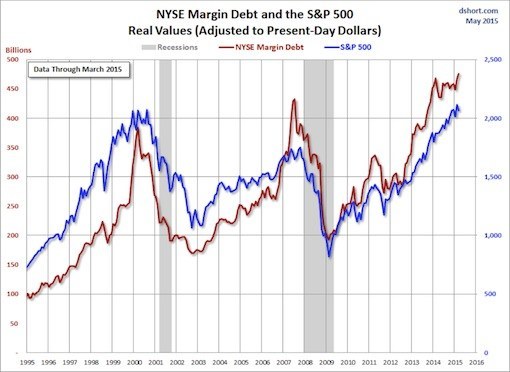
“NYSE margin debt rose to an all-time high in March, according to recently released data from the stock exchange….NYSE margin debt sat at $476.4 billion, up from $464.9 billion at the end of February..(Note: That’s $95 billion more than 2007 at the peak of the bubble.)
Margin debt is created when investors borrow money in order to buy stocks. If an investor buys $100 worth of stocks with $50 in capital, that individual has $50 of margin debt outstanding. Since margin debt provides leverage, it amplifies gains, but also increases the risk to an investor.” (“What record-high margin debt means for stocks”, CNBC)
whitgraf1
More borrowing, more risk taking, more financial instability. And it’s all the Fed’s doing. If rates were neutral, then prices would normalize and CEOs would not be engaged in this reckless game of Russian roulette. Instead, it’s caution to the wind; just keep piling on the debt until the whole market comes crashing down in a heap like it did six years ago. And that’s the trajectory we’re on today, in fact,  according to TrimTabs Investment Research, February saw buybacks in the amount of $104 billion, ” the largest monthly figure since these flows were first tracked 20 years ago. ”
So things are getting worse not better. Bottom line: The Fed has led the country to the cliff-edge once again where the slightest uptick in interest rates is going to send the economy into freefall.
But why? Why does the Fed keep steering the country from one financial catastrophe to the next?
That’s a question that economists Atif Mian and Amir Sufi answer persuasively with one small chart. Check it out:
“Here is the distribution of financial asset holdings across the wealth distribution. This is from the 2010 Survey of Consumer Finances:
whitgraf2
The top 20% of the wealth distribution holds over 85% of the financial assets in the economy. So it is clear that the direct income from capital goes to the wealthiest American households.” (Capital Ownership and Inequality, House of Debt)
Why does the Fed create one bubble after the other?
Now you know.

Universities, Inc.

Ben Agger

We use shorthand for evaluating faculty: “She is productive.” We don’t necessarily have in mind a steel worker toiling in Andrew Carnegie’s factories but, given one’s orientation, perhaps a Hero of Socialist Labor. Factory work may be too grubby a metaphor for genteel academics. The antonym is worse: Loser, slacker, non-publisher. Generational politics are in play as young faculty who publish have seized power from an older generation born before the baby boom. We boomers decamped the New Left after the sixties, entering academic life in order to make a difference, which we did in part by publishing.
Russell Jacoby’s lament for the demise of independent intellectuals such as Susan Sontag and Lewis Mumford always resonated. We ex-New Leftists imagine ourselves to be public intellectuals who also held down university jobs, defying his observation that academia amounts to vita padding. C. Wright Mills, Todd Gitlin, Howard Zinn and Hannah Arendt are among those who pay the bills via tenure but write large books that treat of important societal issues. It took time to become untangled from the obscurantist examples of Frankfurt School role models in order to find a pitch at which we could be heard by undergraduate students and even by Barnes & Noble trade readers. Although borrowing from Habermas the ideal of the public sphere as a talkative democracy, I worry that a digital public sphere blurs the boundary between public and private. Self-revelation goes public via social media as people overshare.
Since the sixties and Sputnik, the public research university has been profoundly transformed as states have massively disinvested in public higher education. Universities are barely state assisted and not state supported, transforming the job of college president into fund raiser. Simply making the academic payroll preoccupies senior academic administrators who patch together paltry state budgets with grant dollars and gifts from football-loving donors. Universities must hire rain makers, especially in STEM disciplines, in order to keep the lights on in the offices of faculty like me who purvey critical theory and cultural studies. Without “productive” electrical engineers and biologists, with large start-up packages used to leverage funded research, the 21st public research university couldn’t stay open. Paul Campos, in a controversial April 4, 2015 New York Times essay, contests the notion that universities receive less funding from the state, arguing that higher tuition can be blamed on the hiring and handsome compensation of additional administrators.
During this disinvestment, academic administrators morphed into CEOs responsible for budget. Their notion of “productivity” is different than ours. They seek faculty who could augment the university budget, through grants, and who conduct “applied” research that fit the agenda of Eisenhower’s military-industrial complex, which becomes the military-industrial-educational complex. Two consequences of the emergence of an administrative professional-managerial class are the decline of faculty governance and the establishment of command-and-control measures designed to keep faculty working hard. “Workload,” and its measurement, is suddenly in the air as neoconservative politicians and CEO-like academic administrators redouble their commitments to get a day’s work for a day’s pay from otherwise
aggeroverunaccountable tenured faculty. Predictably, in this environment, tenure itself has come under attack, and many universities now subject tenured faculty to post-tenure review. No matter that tenure protects academic freedom, as it has since McCarthyism.
And so we who use shorthand, such as the term productivity, need to rethink the implications of our discourse. Productive used to mean she-who-publishes. Now, it means she-who-gets-grants and does applied work. We have leapt from the need to make a payroll during an era of diminished state support of higher education to a general utilitarianism and vocationalism that threaten to change academic life irrevocably.
For their part, junior faculty are encouraged to view themselves as civil servants with a well-defined career ladder. Understandably, they obsess over how “much” it takes to get tenure. These are post-boomers who didn’t cut their teeth on the civil-rights movement or anti-war protest and who don’t necessarily share our conception of the university as a site of social justice and an opening to a public sphere in which intellectual debate matters. They accept new norms of productivity, and they negotiate for handsome “start-up” funds with which to jump start their own careers. Start up, in my prehistoric era, was a used IBM typewriter. One has the sense that many post-boomer faculty could as well be running restaurants, flipping houses, or occupying a corporate cubicle. The politically engaged public intellectual of the sixties has given way to the academic who tweets.
Eventually, young faculty age, as we have. Academic careers have seasons, and rates of productivity vary. It is tempting to view people over 50 or 55 who publish heavily as compulsive. But faculty-accountability measures, which were borne of Frederick Taylor’s time-and-motion studies in early-20th century capitalism, standardize “output,” whereas the life of the mind cannot be reduced to a business or tracked on a production schedule. People may have gaps in their vita as they explore new fields and read more deeply into their current fields. The point of tenure is to give people time to think and re-think as well as to avoid political censorship.
College presidents, who must beg and borrow at every turn, need to pose the argument, to legislators, tax payers and tuition payers, that human capital produces capital, that academic credentialing adds value, albeit often hidden value. This is rhetorical and political work. People of my style call this “valorization,” tracing value creation to its often-hidden roots in domestic labor, children’s labor and—here—college teaching. In plain language, 21st century laptop capitalism requires universities to teach skills and values. Whether all this can be outsourced to online credit-hour providers is debatable. Many contingent college professors merely read the textbook faster than students, but don’t contribute their own research to the literatures they expound. Adjuncts form an industrial reserve army at a time when tenure-track employment is disappearing, especially in non-grantable fields. Post-tenure review is matched by the disappearance of tenure-track employment. Clearly, tenure thwarts administrative flexibility.
This is not to deny that some tenured and tenure-track faculty, given the overwhelming emphasis on research output, don’t care enough about students, nor are rewarded for caring. My premise is that students are best taught by caring faculty who are intellectual leaders in their fields. My wife and I have college-age children.
We must be careful not to get swallowed whole by our own discourse as we convince capital that universities produce human capital. As universities are forced to become business-like, we should be wary about adopting a business model of all things. We need gadflies, poets, and activists, too. We want a university—and society– in which people question the meaning of “productivity.” For academic life to become a career ladder adds momentum to the tsunami of anti-intellectualism so abundant in our media culture and political discourse.

Dispatch From Kathmandu

Barbara Nimri Aziz

Revisiting a school I know well in Kathmandu city, I meet Tilok just as he and his wife, a school teacher, and their baby are about to depart for Darjeeling, Northeast India where her parents live. This young family is among hundreds of thousands of mainly Kathmandu Valley residents leaving the city to be near loved ones, to be assured that their home villages and uncultivated lands are intact and perhaps to recognize that those fields they abandoned for salaried work in the city and beyond now offer a newly discovered security. As a part-time journalist Pilok has been working overtime filing stories about the quake. But it’s not the quake he’s so eager to speak about. It’s his new magazine “Siti Miti; he proudly gives me a signed copy of the very first issue. It will be monthly, he explains, the first of its kind for the Chamling Rai language, one of Nepal’s 124 recognized languages. Only 10,200 Nepalis speak Chamling Rai and it’s never had a script. Tilok and his group consider this project essential to their ethnic survival and identity; they’ve been hard at work for years to develop the written form and prepare materials for their children’s education. A magazine like this pamphlet in my hand is a political symbol for the Rai people and will, they believe, secure a political place for them in the new democratic mix here. Tilok is thinking well beyond the quake, you see.
We went to visit linguistics professor Subadra. At 80 she prefers to live alone in her longtime residence near Kirtipur Campus. On Saturday at 11:50 am, when the quake struck she rushed out of her bungalow seeking safety. She tripped and now lies in a cot with a broken pelvic bone. Friends gather around her bed today sharing anecdotes from each of their neighborhoods—not only cracked walls and impassable lanes but the absence of any government visitors seeing to their needs. They report conditions of villages whose names I once knew well.
The assembly courtyard and playgrounds of Sukanya’s school, Amrit, have become a tent city for the entire MehPin neighborhood sleeping under tarpaulins, cooking communal meals. The school luckily had a diesel generator and retrieved it from in storage to furnish light for the area, so essential during those first two scary nights. Like elsewhere across the country, schools will remain closed for some weeks. Amrit’s teachers and students have joined the exodus to natal villages. But Mokta, Sukanya’s granddaughter of 18 months is ill with an unknown ailment and that’s taking her attention away from the quake. She’s been rocking her all though our visit; it’s her first grandchild.
By night four, here and elsewhere, even families who continue to sleep in a garden spend a final hour inside their parlors to watch the latest episode of “Udaan” (flight), the Indian serial drama they have been following for six months. It’s the story of a young girl, 7, Chakour, whose story as a bonded laborer has gripped the entire subcontinent. I wonder if this too is proving a sense of security for families– some continuity (or escape) at a time they so desperately need a sense of connection and routine.
I’m not very good as a deadline journalist reporting from the field; I found out that in Iraq in the 1990s. While dozens of international journalists were busily typing away at the Baghdad Press Center—(pre-cell phone) where we had to go to get satellite access– I took days to mull over what I’d seen, cross check facts, and absorb the personal testimonials I’d gathered before I could write. It’s the same here in Kathmandu where a week ago, the 7.8 scale earthquake struck as I was packing to leave home for Newark International airport.
I gave no thought at all about cancelling, even though my visit was not urgent; I had neither a news assignment nor a humanitarian mission. I thought, “I’ll go as far as the plane will get me”. To be sure, there were inconveniences and delays, but any facing me were eclipsed by those of the Nepalese. Suffice to say the second attempt from Abu Dhabi was successful. My fellow passengers were about 20 journalists and another 20 or so humanitarian aid reps, from Christian evangelicals to Medicine Sans Frontiers. The remaining 200 or so passengers were young Nepalese men (20-30 in age, from among 3 million migrant laborers outside) who’ve taken leave from their unhappy jobs in Qatar, UAE, Saudi Arabia to get home and offer succor to their families.
A larger aircraft had been assigned to carry those of us from yesterday’s two flights unable to land at Tribhuvan Airport in Kathmandu (turned back to UAE), plus a new load of passengers. Somehow the mood seemed more upbeat than yesterday’s; passengers were loquacious, gaily taking photos of themselves in this more upscale aircraft. Tonight after crossing the Indian Ocean and India we’d again join a fleet of planes circling over Kathmandu Valley. But this time our pilot shared some wonderful optimism, announcing at least 3 times, that he expected to get into Nepal: “We have dropped from 28,000 to 24,000 feet;” then later to 18,000 feet, repeating “I expect we will land. I know how to manage”. Many of us in the cabin erupted in laughter and peered through windows looking for the lights of the Nepalese capital.
Within an hour of getting into the terminal I was pleasantly surprised to locate the suitcase I’d surrendered in New Jersey 58 hours earlier, found the sole taxi sitting outside Arrivals and directed its driver –the cost was irrelevant- to Tamel quarter where I was confident I’d find a room. At 10:30pm it was too late to contact Padma and Nirmal with whom I’d planned to stay, or even Dawa Sherpa who I knew would respond to my call at anytime, anywhere. Anyway, I thought, if their houses are intact, they would surely be occupied by crowds of people from their large families. Indeed, as I’d learn in 2 days, Padma and Nirmal were among the hundreds of thousands sleeping outdoors sharing blankets heaped under tarpaulins, in this case in their own garden. Nirmal was also among perhaps millions who by day 2, had lost all the charge from his phone.
My taxi sped through dark, empty streets; we encountered no roadblocks, not even police checkpoints –perhaps all security personnel were seconded to damaged high value areas. The only traffic I saw was a convoy of 4 small trucks loaded with what was probably humanitarian relief. I frankly expected to encounter chasms and fissures in the road, but the driver zipped along as if he knew where was safe and passable. Two hotels –Northfield and Mandep– were in darkness but I knocked anyway; at both places sleepy security guards shooed me away unsympathetically saying: “no beds, no water”. Finally I persuaded the watchman at nearby Dalai Hotel to take me in—he originally apologized that the rooms were dirty and without sheets; I didn’t care (in fact, it was very clean and in the morning, when I awoke at 1 pm, I even found hot water flowing in the shower pipe.)
I emerged into the street at 2, warned by the hotel receptionist to watch for bricks falling! I was only concerned by a sudden feeling of unsteadiness on my feet, a little woozy, like vertigo. It didn’t last long but would recur at odd times for the next several days. I recall Dr. Ammash, a cellular microbiologist in Baghdad in 1995 explaining how the depleted uranium from US munitions and all the dust of war and refuse, alters the molecules in the air—something to do with ions. It would have deep affects on health, she explained. So I wonder if an earthquake too can cause this air molecule destabilization.
I was also reminded of Iraq where, unable to make phone contact in April 1991, after the massive US bombing there, I determinedly directed my taxi to the homes and businesses of Iraqis who I needed news of; now, I find myself walking the familiar streets Kathmandu to confront the calamity engulfing this nation but also to locate the shops of friends. Jamling and Lhakpa’s trekking outfitters shop was shuttered, but I did find the bookseller Bidur behind his counter. Normally I can depend on Bidur to advise me what anthropologists are in town or what new book on Tibet has appeared. This time the mission would be different.

Curbing the New Corporate Power

Dean Baker

Sabeel Rahman raises many important issues in his discussion of Internet-based companies such as Amazon, Uber, and Airbnb. Unfortunately, he looks in the wrong direction for answers.
His basic point is that these companies are developing substantial market power and using it to put downward pressure on the incomes of producers in the relevant sectors. Rahman’s proposed solution is to apply utility-type regulation to these companies, which would presumably mean government regulatory boards setting prices and standards.
While these companies provide considerable grounds for complaint, as I have frequently written, declaring them monopolies in need of government regulation is misguided on both economic and political grounds.
First, it should be recognized that these companies do not necessarily belong in the same basket. Uber and Airbnb both appear to be highly profitable upstarts that have made a great deal of money in their very short lifetimes. By contrast, Amazon is a marginally profitable company that has made more from avoiding state sales taxes than from the services it provides to consumers.
This point is central to any claim about Amazon’s market power. A company that doesn’t cover the sales tax that its mom-and-pop competitors must pay hardly sounds like a market behemoth. It is true that the company has a huge market capitalization, but so did AOL. Amazon is far from an overwhelming presence in most of the retail markets in which it competes. Arguably it is dominant in the book market, but is Rahman confident that it would retain this dominance if it raised its prices by 10 to 15 percent to make a normal profit? Is it that hard for book buyers to go to a different Website?
I also don’t have much sympathy for the publishers and authors who fear declining incomes due to Amazon’s pressure. They have been more or less idle while millions of small businesses went under in the last three decades because they couldn’t compete with bigger, more efficient companies. Tens of millions of factory workers lost their jobs or saw big pay cuts because the government deliberately placed them in direct competition with low-paid workers in the developing world. Now it is a profound crisis that a tiny group of intellectuals feels similar market pressure? Sorry, I have more sympathy for the family farmers and textile workers.
Playing hardball with publishers does not get Amazon on my shit list. Avoiding sales tax and engaging in illegal labor practices does. To my mind, the best place to start with Amazon is to apply the existing laws. Level the playing field. There is no economic argument for Amazon’s preferential treatment, so make the company responsible for collecting the same sales tax its smaller competitors everywhere it operates.
This same logic should apply to other companies Rahman cites. Uber drivers should be protected by the same minimum wage and hour regulations as other workers. They should also be covered by workers’ compensation. And the company should be required to provide insurance for its drivers and ensure passengers’ safety in the same way as incumbent taxi companies. They should bear the same responsibility for serving the handicapped and elderly that existing cab companies do.
Ditto for Airbnb. Ordering over the Internet should not be a basis for evading fire safety laws, apartment or condo building rules, nondiscrimination statutes, and rent-control ordinances, where they exist.
I also hesitate to embrace Rahman’s solution because the history of utility regulation has hardly been exemplary. The problem of industry capture is real. Comcast is interested in what the Federal Communications Commission does, the general public much less so. We can’t just wish this problem away.
Pressing for utility regulation also makes little sense in the current political climate. If progressives lack the political influence to make Amazon liable for the same sales tax as a mom-and-pop grocery store, how can they induce the government to set Amazon’s prices?
Leveling the playing field seems the best first approach, coupled with some innovation. Is there any reason city governments can’t cut out the middleman by establishing their own taxi fleets or setting up their own bed and breakfast services, which could be linked nationally?
The reforms of the Progressive Era led to many beneficial changes, but we might try thinking forward for once instead of looking back a hundred years.

6 May 2015

Co-director Wim Wenders’ The Salt of the Earth: The photographs of Sebastião Salgado

David Walsh

Directed by Wim Wenders and Juliano Ribeiro Salgado; written by Wenders, Salgado and David Rosier
Veteran German director Wim Wenders (The American Friend, Paris, Texas, Wings of Desire, Buena Vista Social Club, Land of Plenty, Pina and many others) and Juliano Ribeiro Salgado have teamed up to make a film about the 40-year career of the latter’s father, the well-known Brazilian-born photographer Sebastião Salgado.
The Salt of the Earth
Salgado (born 1944) is perhaps most renowned for his photographs of workers and the poor, sometimes the starving and dying, in impoverished regions, along with his pictures taken amid various terrible social disasters, especially those in Ethiopia, Rwanda and the Congo in the 1980s and 1990s.
His work has been published in various collections, including Other Americas, 1986; An Uncertain Grace, 1990; Workers: Archaeology of the Industrial Age, 1993; Migrations, 2000; Sahel: The End of the Road, 2004; Africa, 2007; andGenesis, 2013. Each of these volumes represented years of photo-taking and often involved travel to far-flung parts of the earth.
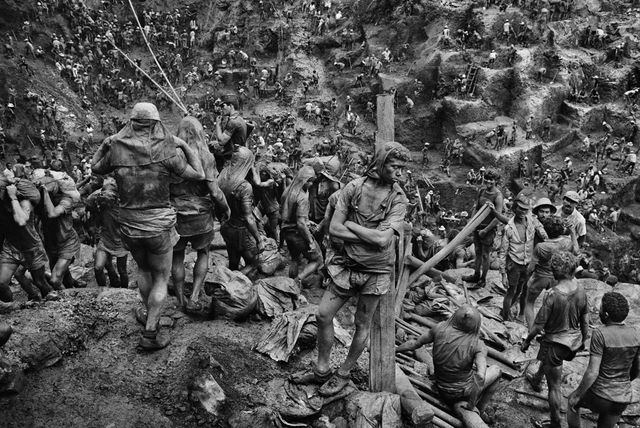
Wenders, in a voiceover, introduces The Salt of the Earth. The first of Salgado’s images the filmmakers present is of the Serra Pelada open-cast gold mine in Brazil (now closed), and it is an astonishing one. From one side of a giant crater we see the opposite wall of this vast hole in the earth, filled from its bottom to its top with a mass of mud-caked humanity, some 50,000 workers, according to the commentary. Each worker, carrying a sack of ore weighing between 60 and one 100 pounds, climbs up a series of ladders 50 or 60 times a day.
The Salt of the Earth
The film then discusses Salgado’s early life. Having grown up on a cattle ranch, Salgado attended the University of São Paulo and studied economics during the period of the Brazilian military dictatorship (which lasted from 1964 to 1985). He participated in the opposition to the dictatorship and eventually moved to Europe, first London, and worked for the International Coffee Organization, often traveling to Africa for the World Bank.
In 1973, now living in Paris, Salgado forsook economics for photography. Among his first photos was a series done in Niger in 1973 during a severe drought. He traveled throughout Latin America during the years 1977-84, visiting, as was his wont, the most remote regions.
During the 1980s, he spent several years in the Sahel, the region across Africa between the Sahara Desert to the north and the Sudanian Savanna to the south. He saw immense suffering here too. He covered the famine in Ethiopia in 1984, which caused more than 400,000 deaths in the northern part of the country. Some of his dying subjects look like concentration camp victims, little more than skin and bones.
From 1986-91, he took photos all over the world for Workers, paying homage to those who labor. The voiceover comments that he was “driven by the same empathy for the human condition.” No doubt Salgado took the assignment and the subject matter seriously.
The famine in Ethiopia, which was worsened by political considerations, and his coverage of the massacres in Rwanda and the Congo in the mid-1990s “changed” Salgado, we are told. Certainly, the images are horrific, both of roads lined with corpses and of innocent civilians driven into the jungle and then massacred or left to die. On top of that, he traveled to the former Yugoslavia and photographed atrocities committed by both Croat and Serb forces.
The Salt of the Earth
What conclusions did Salgado draw from this? In any case, they didn’t come out of the blue. His conclusions were prepared by his social background, his conditions of life and his world outlook. He determined, he tells us, that the fault lay with humanity itself. “We are a ferocious animal,” he tells the camera. “We are violent … our history is a history of wars. It’s an endless story.” Everybody should see the images from the Congo, he says, “to see how terrible our species is.”
This is to draw very false and superficial lessons from the events. Many others did too, of course, with varying degrees of self-interest. The horrors in Ethiopia, Rwanda and the former Yugoslavia did not flow from any innate characteristic in humanity, its supposed propensity for savagery, but, above all, from the specific policies pursued by the Great Powers (plus the history of brutal imperialist rule in the case of Africa) and the rottenness of the national ruling elites. Global capitalism created the conditions for the disasters and consciously instigated ethnic and communal conflicts for its own selfish, geopolitical purposes. Then, it made use of the horrors it had created to justify the attempt to recolonize large portions of the globe.
In any case, Salgado returned to Brazil after deciding that there was “no salvation for the human race.” Along with his wife, he found “healing” in the replanting of the subtropical rainforest in and around his family’s land in Aimorés, Brazil and the establishment in 1998 of the Instituto Terra, dedicated to sustainable development. After treating a couple of expeditions that Salgado made for his newest work, Genesis, about relatively untouched areas of the planet, the film ends on that note—that “the destruction of nature can be reversed.”
The political views articulated here, seconded by Wenders, are very weak. Salgado began as a representative of the International Coffee Organization and the World Bank, presumably working on economic development, and never broke fundamentally from this standpoint, the effort to create a more workable, humane global capitalism. Ideologically, he inhabited for decades the world of NGOs, United Nations organizations, Doctors Without Borders, etc. The notion that by reclaiming 17,000 acres of land in a remote part of Brazil the Salgados are pointing the way forward for humanity to save itself is indicative of a very narrow outlook and very swelled heads.
The Salt of the Earth
Salgado no doubt sincerely sympathized with the suffering people he photographed, but the possibility that these people needed to organize themselves and overthrow their conditions of life, and that they were capable of it, clearly never entered his head. The period in which he worked certainly played a role in this.
The Brazilian photographer has been sharply criticized from a number of quarters for “aestheticizing” the wretched of the earth. One widely circulated critique, by Ingrid Sischy, “Good Intentions,” published in the New Yorkermagazine in 1991, took Salgado to task for his “beautification of tragedy.” His pictures, Sischy argued, comparing the Brazilian unfavorably to such figures as Lewis Hine and Walker Evans, merely “reinforce our passivity.”
She complained, moreover, about the religious strand in Salgado’s photos, for his “coupling human suffering and God’s will.” About one well-known picture of a sightless woman, Sischy asserted that Salgado makes the blindness “holy—in other words, that it needn’t be seen as something to cure.” She claimed, moreover, that “the people in his pictures remain strangers.” His “sentimentalism … isn’t any kind of breakthrough.”
Some of the points are legitimate, but others seem unfair. Many of Salgado’s photos are deeply moving and effective. His sincerity and his intrepid efforts to record the human situation cannot be called into question. At any rate, the criticisms are not really criticisms of Salgado as an individual, but of a social outlook and atmosphere born of a definite historical moment.
The defeats of the working class in Latin America in the 1970s, the collapse of the Eastern European Stalinist regimes and ultimately the Soviet Union, the protracted decline of every labor organization, the apparent triumph of the “market” and “free enterprise,” all had an impact. Various artists and filmmakers, losing confidence—or never having had much confidence—in the ability of the mass of the population to mobilize itself and create a better world, began to discover means by which “beauty” and “joy,” or even “holiness,” could and should be found within existing conditions.
The Salt of the Earth
Abbas Kiarostami’s 2001 documentary ABC Africa, about Uganda’s AIDS orphans, was one prominent example of this trend. As the WSWS commented at the time, “Moreover, by avoiding a larger framework and excluding the possibility of radical change, the film veers dangerously close to making a virtue out of necessity, suggesting at times, ‘Well, life is beautiful and people are happy, even under these conditions!’ Left for all intents and purposes out of the picture is any systematic questioning of a social order that produces such a human catastrophe.”
Salgado has zigzagged from placing a curse on the world’s populace to acting as though, with a little help, the planet will heal itself, without ever seriously considering the root cause of humanity’s problems, its social and economic organization and the dominance of a tiny handful that control vast wealth and power.
The artist’s responsibility is neither to ignore the way things are nor to become overwhelmed by it. “When I say that we must be satisfied with the reality of what exists,” wrote Trotsky in 1908, “you, of course, will not think that I mean that we must be satisfied with what exists. Just the absolute opposite: a great and persistent protest against what exists only becomes possible when we accept the world unconditionally, in its incontrovertible reality.” (“On Death and Eros”)
Unhappily, The Salt of the Earth contains neither a genuine coming to terms with the world’s incontrovertible reality nor a great and persistent protest against its conditions.