8 May 2015

Survival Of The Weakest

Sukumaran C. V.


Violence against women and violence against the Earth, legitimated and promoted by both patriarchal religion and science, are interconnected assaults rooted in the eroticization of domination. The gynocidal culture’s image of woman as object and victim is paralleled by contemporary representations that continually show the Earth as a toy, machine, or violated object, as well as by the religious and scientific ideology that legitimates the possession, contamination, and destruction of Mother Earth.—Jane Caputi.
CIVILIZED MAN SAYS: I am Self, I am Master, all the rest is Other—outside, below, underneath, subservient. I own, I use, I explore, I exploit, I control. What I do is what matters. “What I want” is what matter is for. I am that I am, and the rest is women and the wilderness, to be used as I see fit.—Christina M. Kennedy.
When in 2012 December, Nirbhaya was gang raped inside a running bus and thrown out and killed, the collective patriarchal and misogynistic psyche of the nation believed that it happened because the girl went out at night (that is a crime as far as girls are concerned), it happened because the girl was loitering around with her boyfriend (that also is a crime), it happened because the girl was asking for it by being outside at night!
At Moga in Panjab, the 14 year old girl was not going out at night. And she was not with her boyfriend. She was with her mother and she was travelling in broad daylight and yet she met with (more or less) the same fate of Nirbhaya! Now what will be the excuses of those men (and women) who share the patriarchal bias against the female? What stupid reasons can the male chauvinist culture of the nation put forward to blame the innocent girl?
When I see girls travelling by buses, Nirbhaya and the Moga girl come into my mind. When I see girls travelling by trains, the image of the hapless girl Soumya, who has been pushed out of the running train and raped while being unconscious (and killed), comes into my mind. When I see brave female journalists, the Shakti Mill gang rape incident comes into my mind. When I see girls outside their homes in the remote villages, the Badaun incident comes into my mind.
A democratic society should be one in which the weaker and weakest sections of the people are equally safe and secure as the strongest sections are. But in our country, the weaker sections, the Adivasis and the Dalits, always find themselves in the receiving end. If the nation wants to ‘develop’ and ‘progress’ their land is always snatched and they are always dispossessed and displaced. “Tribals make up just 8 percent of our population. Yet, they account for more than 40 percent of the displaced persons of all projects. And there would be an equally big number of dalits among the displaced.” (P. Sainath, Everybody loves a good drought)
Sainath continues: “Imagine the entire population of the continent of Australia turned out of their homes—eighteen million people losing their lands, evicted from their houses. Deprived of livelihood and income, they face penury. As their families split up and spread out, their community bonds crumble. Cut off from their most vital resources, those uprooted are then robbed of their history, traditions and culture. May be even forced to adopt an alien diet. Higher rates of disease and mortality pursue the dispossessed. So do lower rates of earnings and education. Also, growing joblessness, discrimination and inferior social status. Oddly it all happens in the name of development. And the victims are described as beneficiaries. Sounds too far-fetched even as fiction? It’s happened in India, where in the period 1951-90, over 21.6 million people suffered precisely that fate—displaced by just dams and canals alone. Add mining that has dispossessed 2.1 million people and you have the population of Canada. Further, industries, thermal plants and defence installations have thrown at least 2.4 million other human beings out of their homes. That’s around 26 million Indians.”
And when it comes to the weakest section—the females—the picture is so bleak that it frightens us. It is said that in every 20 minute a woman is raped in India! Nearly 20 years ago a feminist writer wrote that ‘it almost seems as if rape is the favourite pastime of the males of this country.’ (Saraswati Haider,
‘Bandit Queen and Woman Question’, Mainstream, March 23, 1996). It seems that even then the picture is not as bad as now.
The female can’t walk through our streets without being subjected to obscene comments and gestures. The female can’t travel by buses and trains without being groped and fumbled. The female can’t use the public space freely as almost all public space in this nation exclusively belongs to the males. The problem is, as the French feminist Simon de Beauvoir wrote in The Second Sex (first published in 1949), that ‘humanity is male and man defines woman not in herself but as relative to him; she is not regarded as an autonomous being. Man can think of himself without woman. She can't think of herself without man. And she is simply what man decrees; thus she is called ‘the sex' by which is meant that she appears essentially to the male as a sexual being. For him she is sex—absolute sex, no less. She is defined and differentiated with reference to man and not he with reference to her; she is the incidental, the inessential as opposed to the essential…. Legislators, priests, philosophers, writers and scientists have striven to show that the subordinate position of woman is willed in heaven and advantageous on earth. The religions invented by men reflect this wish for domination.’
In our country, the moment the female steps out of her home she is in an insecure and hostile sphere where anything unpleasant can happen to her. It seems that no girl in our country is able to walk through the streets without being heard the obscene comments of the males on her body parts.
While the sexual crimes against women are increasing day by day, the conviction rate is declining alarmingly and the culprits enjoy virtual impunity. This growing culture of impunity makes women helpless victims of sexual harassment. Our law enforcement agencies lack professionalism, and when it comes to the issue of lewd comments and harassment even the police take them for granted. Therefore society can't provide women absolute safety in public places by only addressing the issue as a law and order problem.
The attitude of perceiving woman as a sexual object is to be shattered. Our family set-up, our curricula, our visual media and our cinemas project woman not as an individual and a human being just as man is, but as an object created for man and inferior to man. Lewd comments and sexual harassment start from our schools in the form of eve-teasing, and when the eve- teasers grow up, it becomes sexual harassment. In our society the girls are trained to be submissive and to “suffer silently” the dirty behaviour of the other sex, while the boys are trained to be aggressive and their aggressiveness is praised even when it violates the freedom of a girl to walk freely through the street.
The only crime in which the victim is accused of the responsibility of the crime is sexual harassment or rape. The victim is told that it happened because she wore tight jeans and top or revealing clothes or she was tempting others to be sexually assaulted or raped!! If all the women start wearing burkha, Patriarchy will still continue its practice of raping women and then the excuse suggested may be that it happens because of the anatomy of women.
The basic problem is, as the Norwegian playwright Henrik Ibsen, who wrote the epoch-making play A Doll's House, which came as a thunderbolt to the male-centric social and moral ethos of Europe, says: “A woman cannot be herself in the society of present day, which is an exclusively masculine society, with laws framed by men and with a judicial system that judges feminine conduct from a masculine point of view.” It should be remembered that Ibsen wrote the above quoted sentence in the notes he made for the play in 1878. How contemporaneous the sentence seems in the present day Indian socio-cultural background!
In our country, girls and women fear to travel by bus or by train, they are afraid to be in public places. The prejudice (and attack) against women starts from the womb itself. The foetus is killed, if it is female. Without shattering the typical patriarchal mindset of perceiving woman as a sexual object created for man, we can't create a social milieu which is completely free of sexual violence. Woman should be projected as an individual just like man is. Or else the survival of the female in this country is in grave danger.
P.S.: The ultimate solution to end rape is to make the society a gender egalitarian one. Meanwhile, it doesn't mean that the molesters and the rapists can go scot-free. While the crime rate against woman is increasing so fast, the conviction rate goes at a snail's space. It certainly encourages the males to indulge in violence against girls and woman. And even if convicted; within years, the convicts come out and harass the victims as it happened in Delhi. (In 2007, a young man raped and killed a 6 year old girl, cut her body into pieces and threw them into the public toilets in Delhi. In 2013, the court found out that the culprit was a ‘juvenile' at the time of committing the crime and let him free as he has already been in prison for more than five years. Immediately after coming out of the prison, the ‘juvenile' went to the home of his victim and threatened her parents that he would do the same thing to their younger daughter too!)
I really don’t understand the logic behind considering the rapist as juvenile. Stringent punishment should be meted out to the rapists, whether they are ‘juveniles’ or not, because rape is a kind of murder, more heinous than murder itself. As a group of French feminists in their statement against rape declared:
“Rape is legally recognized as a crime with physical aspects only, namely, the penetration of the vagina by the penis against the will of the victim. In effect, however, the real crime is the annihilation by the man of the woman as a human being.” (Quoted by Saraswati Haider in her article ‘Bandit Queen and Woman Question’, Mainstream, March 23, 1996).

Shinzo Abe: Changing his Stance?

Sandip Kumar Mishra


In the latter half of April 2015, Japanese Prime Minister Shinzo Abe met with both Chinese President Xi Jinping and US President Barak Obama. There were some speculations that he may change his course of being unapologetic on the Japanese colonial past but nothing of that sort happened. On 22 April 2015, Abe met the Chinese President Xi Jinping on the sidelines of the Asia African Summit in Jakarta, Indonesia. It was expected that it would be a better exchange between the two leaders than November 2014 when they encountered in Beijing in a very awkward way.

Optimists believed that in the wake of the 70th anniversary of the end of WW2, Abe might make a statement in August 2015 in which he would change his course of being unapologetic on history issues and his address in Jakarta would be a precursor to that. However, optimists should not have neglected the fact that just a week before his Jakarta visit, Abe sent an offering to the Yasukuni shrine, knowing quite well how it would be received in neighbouring countries. In Jakarta too, Abe stopped by just expressing ‘deep remorse’ for Japan’s role in WW2 and did not make a formal apology – that was made during the same meeting in 2005 by the then Japanese Prime Minister Junichiro Koizumi.
 
During his week-long visit to the US from 26 April, Abe addressed the Joint Session of the US Congress – the first by any Japanese prime minister. It was again expected that he might say something that would be soothing to the countries that have gone through Japanese colonial exploitations and humiliation. But Abe emphasised the supreme importance of the Japanese alliance with the US and also underlined the strategic significance of the Trans-Pacific Partnership (TPP). In his speech in the US, he again assiduously avoided language related to Japan’s colonial past – which has been convention.

Abe probably feels that his consistent ‘aggressive’ approach and unapologetic behaviour would gradually become more acceptable in regional politics and even if it does happen, his stance is very successful for the Japanese domestic politics. He is quite convinced that a declining US would like to have a partner in Asia Pacific, one that fully supports their policy of Asian ‘re-balancing’ or ‘pivot to Asia’ and takes a lead in regional politics. In the process, if Tokyo takes lead and becomes ‘assertive’ vis-à-vis Beijing, it would reduce Washington’s burden and provide them with negotiating space in dealing with China. In the process, Abe feels that an apologetic stance does not go well with an ‘assertive’ Japan.
 
Abe is also quite consistent in being unapologetic on history issues, uncompromising on territorial issues, and aggressive in dealing with neighbouring countries. Abe feels that if the US support continues, he could carry forward his approach without much problems. From his speech at the US Congress, it also appears that he is interested in invoking democracy as common meeting point to connect Japan with India and Australia. Abe also assumes that even though it is dangerous to have a military confrontation in the region, it is useful to keep the situation ‘warm’ and utilise it for his political purposes.

However, he is mistaken and even if his policies may buy him popularity in Japan’s domestic politics, they would not succeed in producing desired results in its external relations. First, his approach may strengthen the US-Japan bilateral but it has led to the emergence of serious mistrust in the US-South Korea-Japan trilateral. It is not surprising that South Korean President Park Geun-hye is ready to meet North Korean leader Kim Jong-un unconditionally, but prefers to get Abe’s apology on the ‘comfort women’ issue before any bilateral talks with him. Second, Shinzo Abe’s policies have been pushing South Korea closre to China over the past few years. Incidentally, a conservative party government is in power in South Korea, one that has strong bonds with the old and reliable ally – the US; but if there would have been a progressive government in South Korea, the entire equation would have been markedly different.

Third, the Japanese behaviour provides breathing space to North Korea, which was feeling pinch of economic sanctions, especially after its third nuclear test in February 2013. Any problem in the Japan-US-South Korea trilateral gives North Korea manoeuvring chance. Fourth, Japan’s expectations that India and Australia as democratic countries would necessarily go along with Japan may not be correct. Democratic values include tolerance, peace, stability and common prosperity. If Tokyo’s unapologetic behaviour does not appear to move in this direction, New Delhi’s and Canberra’s supports cannot be unconditional and as a given.

Lastly, there is no fool proof mechanism to keep political and strategic relations in the regional politics ‘warm’. There is always a serious chance of miscalculation and such strategies must be avoided.

Thus, it would be right to disagree with optimists who keep imagining a changed Shinzo Abe in near future, especially if the US does not change its foreign policy course or regains its huge relative prominence. Since both the options appear either remote or impossible, with all the changes, Abe’s approach will remain the same.

7 May 2015

Students of the West Bank Unite

Ramzy Baroud

In November 1993, I was on a mission. At the age of 21, I wanted to change the world, starting with Birzeit University, the second largest Palestinian university in the West Bank, situated near Ramallah, in the heart of the occupied territories.
Back then I had made a name for myself with my nationalist poetry and my first poetry collection was published a year earlier in Gaza. It was called The Alphabets of Decision. Each assortment of verses started with a letter in the Arabic alphabet, going in order. “It was time for the poor and peasants of Palestine to articulate their political agenda, rejecting the entire culture of political defeat,” I wrote something to that effect in the introduction.
Birzeit was my platform and my audience quickly multiplied. My last performance was in front of a crowd of thousands, who cheered, chanted and, once I concluded my call for rebellion against Oslo’s “Gaza-Jericho First” agreement, and the assured defeat it heralded, we marched outside the campus, only to be greeted with Israeli army bullets and tear gas.
That was anything but a fatalistic act compelled by the fervor of youth. At the time, local, Israeli and international media were eagerly awaiting the student council election results in Birzeit. A leading hub for Palestinian nationalism – to be compared to Najah University of Nablus – Birzeit was the first litmus test for late PLO leader Yasser Arafat’s Oslo “peace process”. The idea was this: if the Fatah (al-Shabiba) supporters won the elections, it would be understood as a symbolic popular mandate that the Palestinian people were in favor of what it turned out to be political folly and a strategic calamity that has since then institutionalized the Israeli occupation and Palestinian division.
Palestinians are highly politicized people, and utterly sensitive to any attempt at squandering or bargaining their rights. Oslo was but the last of such attempts that span the last seventy years of history – from the Rogers Plan, to the Village Leagues, and more.
The Birzeit student elections were our opportunity to send an early message that Oslo was born dead and that any “process” that negotiates the most basic human rights of Palestinians is fully rejected.
As Palestine’s rich were vying for the economic dividends of peace, and diaspora elites that were affiliated with Arafat and his Fatah party were ready to “return” and claim position and prestige, the daughters and sons of refugees, peasants and laborers of Palestine stood firm in Birzeit. Sure, the language here is loaded with socialist class references, but truthfully that was what it was. We were the “masses” as we gathered in Birzeit from every corner of the occupied territories, unified by an eagerness to learn, but also compelled by nationalistic priorities.
A coalition was quickly formed between Islamic student groups and the socialists. It was also a formidable alliance that brought Muslims and Christians together, where a Palestinian identity took center stage, sidelining Islamic and socialist references and ideologies. We were afraid for our country and our people. To think that at that age we possessed the foresight and political consciousness to predict the disaster of Oslo, while many intelligent and experienced men and women genuinely celebrated and anticipated “peace” should tell you much about the intellectual prowess of Palestine’s youth.
In November 1993, the Israeli army was on a mission too. Nightly raids in the towns of Birzeit, Abu Qash, and other villages where many students resided, targeted leaders of the anti-Oslo movement. Some of us fled to the mountains to escape the army’s wrath. We plotted ways to reach the university on Election Day via nearby hills. Others stayed at the university for days. Others were not so lucky, as they were arrested and jailed, while some were tortured. Many Gaza students were deported back to the strip.
Fatah supporters, although they didn’t endorse the Israeli action, benefited from it. A favorable Birzeit vote was the needed impetus to sell Oslo as a popular demand, to hail its architects as national heroes, and to shut out the opposition – the debate altogether – as irrelevant.
Independent vote monitors finally emerged from what I believe was the Engineering school, joined by representatives of the factions that contested the elections. The leader of the group took the stage and declared the results: al-Quds Awalan bloc (Jerusalem First) won.
That was us. And Jerusalem First was our answer to Arafat’s men’s deferral of discussing the status of Jerusalem – along with other fundamental issues, such as the rights of refugees, borders, etc – until the “final status negotiations,” which were never actualized.
There was a pause of a single second that felt much longer, as if thousands of us, who camped at the campus until late at night, wanted to eternalize and attempt to fathom the meaning of that victory. A single second that was loaded with meanings, with oppressive memories of those who died, of those in jail, of those persisting in squalid refugee camps fashioning hope from desperation and standing strong. A single second followed by an uproar, an incredible euphoria which I am yet to witness ever since.
‘With our bloods .. with our souls .. we will sacrifice for you Palestine,’ we chanted in tandem, the echoes of our chats penetrating the darkness, reaching the ears of Israeli soldiers who prepared for action. We roamed the university in a rare moment of victory, and hope, feeling that the bond that ultimately unified us was much stronger than all of the obstacles that stood between us.
It was Oslo’s first crisis. The victory was followed by a massive crackdown, arrests, imprisonments and deportation. Like many others, I was sent back to Gaza. It was the end of my academic career at Birzeit, never to see the campus again, or to have coffee with my peers at the main cafeteria ever again. Ameed, Ahmed, Abdulhadi, and all the rebels of the past, remained in the past.
Since then, the Israeli crackdowns on Birzeit students became the joint responsibility of Palestinian Authority (PA) goons as well. When the PA was established in 1994, terror in Palestinian campuses became the norm. Joint Security Coordination between the PA and the Israeli army made sure that rebellious Palestinians were punished severely, and when necessary, eliminated altogether.
After the 2007 Hamas-Fatah split in Gaza, the crackdowns on Fatah’s enemies in campuses became harsher than ever before and the margin for free expression was limited to the point of suffocation. The PA became the new occupier, and Israeli soldiers watched from a distance, only getting involved when PA security required a helping hand.
Yet when submissiveness was assured, Birzeit rose once more in a display of people’s power similar to that of November 1993. On 22 April, Fatah was once more defeated as Hamas-affiliated supporters won a convincing majority by winning 22 seats. The socialist group, the Popular Front for the Liberation of Palestine, harvested five more, leaving Fatah supporters with only 19 seats. The students were speaking of a coalition, another symbolic gesture that the one party role is not a Palestinian quality.
While top Fatah leaders are promising to study and investigate, examine the evidence and reform their political agenda that led to the defeat, some are suggesting that these will be the last student elections in the West Bank for a while. It is understood that Fatah defeat is a reflection of a larger phenomenon that speaks of the dissatisfaction with that Oslo culture that my generation fought against, and ferociously so, some 22-years ago.
The pessimists are not wrong. Abbas remains in “power” since his election as the head of the PA in 2005, with no further elections required. No legislative elections have been held since Hamas won the majority of the vote in 2006 either, for similar outcomes are to be expected.
Yet despite the limited margins of freedom in Palestine – due to the Israeli occupation and its PA contractors – Birzeit roared once more, reflecting a larger trend of courage and fearlessness that began in Gaza, but is echoing in every corner of the West Bank.
And as a member of a past generation at Birzeit, I would like to take my hat, or red kuffiyeh off, and tell the students of Birzeit, Najah, al-Quds, Bethlehem and elsewhere: Please finish the job we started. Democracy is your vehicle and the freedom of your people should always be your ultimate goal.

The Iran Framework

Mel Gurtov

We have every reason to celebrate the so-called framework agreement with Iran. It exemplifies the best of President Obama’s foreign policy, namely, engaging adversaries. Remember when candidate Obama’s argument for engagement during campaign 2008 was ridiculed by Hillary Clinton, among many others? Now Obama has two major engagement successes to crow about, leaving behind those who are quick to criticize the deals with Cuba and Iran as anything from foolish to treasonous. Needless to say, neither of those understandings is complete; the devil is always in the details, and there are plenty of them. But to reach this point after more than 35 years when other administrations have either failed to cut a deal or refused to try is nothing short of extraordinary. And in the case of Iran, the nuclear agreement comes at a crucial moment, not merely in terms of Iran’s nuclear-weapon potential but more broadly with respect to the chaotic shape of Middle East politics.
John Limbert was a political officer in the US embassy in Tehran when the nightmare hostage crisis unfolded in 1979. Out of his captivity has come a seminal guide, Negotiating with Iran: Wrestling the Ghosts of History (2009), which reflects his deep background in Persian studies and his commitment to dialogue and mutual understanding. His book examines several cases of crisis in Iran and then offers a number of guidelines to successfully negotiating with the Iranians. At a time when we are hearing loud criticisms of the nuclear deal and efforts by Congress members, and Israel, to undermine it, we should pay attention to what experts like Limbert have to say.
Limbert proposes fourteen negotiating lessons. I have selected seven of them, and added one of my own. Comparing the lessons with the framework just concluded allows us to see how effectively the two countries’ diplomats worked together.
Avoid legalisms; seek solutions based on “mutually agreeable standards” that Iran can claim as a victory. Having two MIT scientists who knew of one another discuss technicalities was a key to successful talks. That allowed many details of an accord to focus on science, not politics. As for claiming victory, while Secretary of State John Kerry and other US officials could cite major concessions by Iran, Foreign Minister Mohammad Javad Zarif could boast that Iran will keep its centrifuges and nuclear enrichment program, its major nuclear research site at Fordo, and some of its uranium stockpile.
“Be aware of Iran’s historical greatness” and past grievances based on humiliations by foreign powers. President Obama, in an interview with Thomas Friedman of the New York Times and elsewhere, has shown his attentiveness to Iran’s history and culture. He has pointed to the Ayatollah Ali Khamenei’s mention of Iran’s unhappy history with the US, and has made respectful comments about Iran’s greatness and right to acknowledgment as a major regional power. Throughout the years of talks with Iran, its leaders have above all else demanded “respect,” i.e., justice and recognition of Iran’s legitimacy. The nuclear negotiations have provided that.
Clarify lines of authority: be sure to talk with the right people, but also present a common US position. This was a challenging lesson to follow inasmuch as the ayatollah deliberately kept in the background, letting his negotiators do their thing but without committing himself to the outcome. On the US side, Republican and others’ sniping presented obstacles for negotiators, in particular when 47 US senators signed a letter to the ayatollah warning that any agreement was subject to Congressional review. Nevertheless, the “right people” were evidently at the table and were able to craft an agreement that, on Iran’s side, the ayatollah did not negate and, on the US side, amazed even some conservative critics.
Understand Iranian interests. Obviously, removing the sanctions was essential to a deal, but not at any price. Iran’s insistence on keeping fuel rods at home and not shipped to Russia was essential face-saving, and US negotiators did not allow that position to halt the talks. Likewise on the centrifuges issue: The US negotiated down their number (from about 19,000 to 6,000), but Iran still has some 5,000 allowed to operate according to CIA director John O. Brennan.
Do not assume the Iranians are illogical, uncompromising, untrustworthy, duplicitous. US negotiators clearly did not. Hopefully, they kept in mind that many Iranians view Americans the same way.
Ignore hostile rhetoric and grandstanding; be businesslike and professional—and be willing to stay the course.
Remember that there were successful US-Iran talks in the past, for example in 2001-2002 over Afghanistan following the fall of the Taliban.
Be ever-conscious of the politics of a deal—the fact that on each side, it must be sold to wary buyers and outright opponents who want to see it fail. This is why the “optics” of the deal are so important, with each side having a different narrative of the deal’s strengths so as to make it more attractive domestically. The message here: Don’t interpret public statements about the deal by the other side as backsliding with the intention to subvert it.
The nuclear deal with Iran, if it holds, could potentially open a new era in US relations with the Middle East. Though the Saudis, the Israelis, and some other supposed friends of the US will object, a cooperative US-Iran relationship is a critical piece in the overall puzzle to find a path to something resembling stability. We can see the outlines of cooperation with Iran in Iraq and Afghanistan, where Washington and Tehran have common interests. Simply put, Iran’s leaders feel threatened by ISIS, al-Qaeda, and the Taliban. To be sure, there are also places—Yemen, Israel/Palestine, Libya, and Syria—where the US and Iran are at odds. But if the nuclear deal can move forward, and termination of sanctions can lead to a fruitful economic relationship, the agenda of cooperation may expand and violence-by-proxy may greatly reduce. For the US, an end to one-sided relationships in the Middle East would be a blessing, with positive ramifications for Israel and others.

Statues of Edward Snowden, Julian Assange and Bradley Manning unveiled in Berlin

Stefan Steinberg

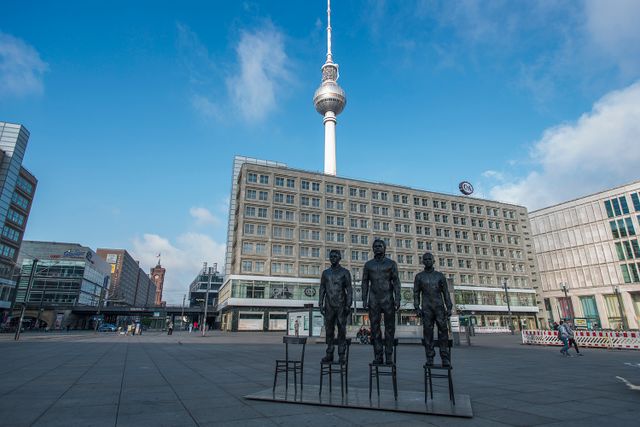
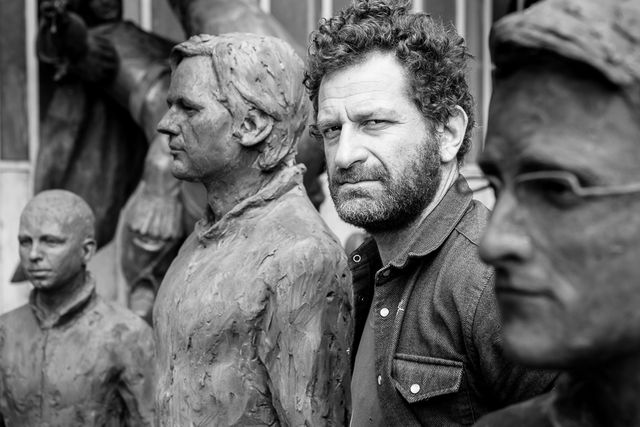
Bronze statues of persecuted whistleblowers Edward Snowden, Julian Assange and Bradley Manning were unveiled in Berlin on May Day. The statues are part of an art project entitled “Anything to Say?”, the work of Italian artist Davide Dormino, which pays tribute to the courage of the three.
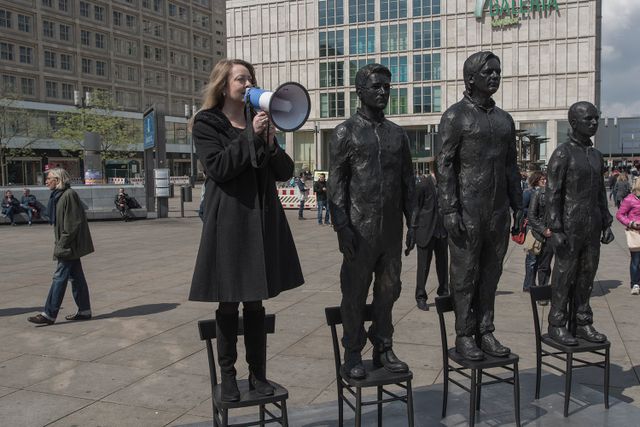
The life-size effigies of the trio stand in a row on chairs beside one extra empty chair. The extra chair invites passersby to express their solidarity with the three whistleblowers and share their own views publicly.
Davide Dormino and his sculptures
In an online statement, Dormino says: “History never had a positive opinion of contemporary revolutionaries. You need courage to act, to stand up on that empty chair even if it hurts.”
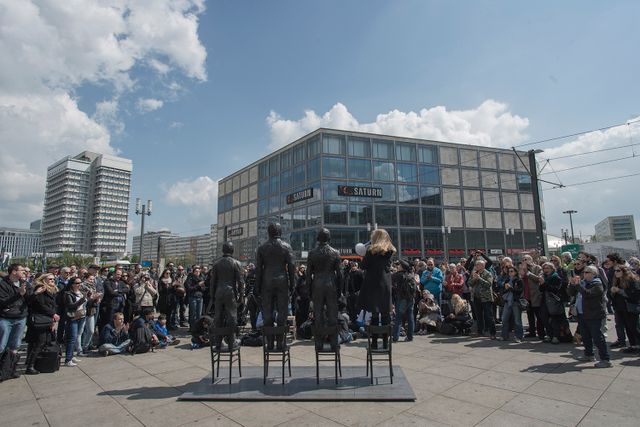
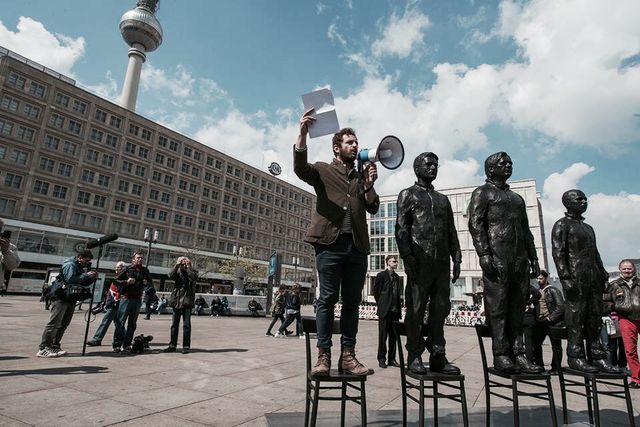
Hundreds of people gathered in Berlin’s Alexanderplatz on Friday, with many adults and also children mounting the chair to air their views to the assembled crowd.
The WSWS spoke with Dormino, an artist who also teaches sculpture and drawing at the Rome University of Fine Arts (Libera Accademia di Belle Arti di Roma).
Stefan Steinberg: What was your motivation for this project?
"Anything to Say?" Sculptures of Edward Snowden, Julian Assange and Bradley Manning in Berlin's Alexanderplatz
Davide Dormino: I was speaking to my friend, the American author and journalist, Charles Glass, about courage and the importance of adopting a critical attitude toward authority, and gradually the concept for the project emerged.
This has been an element in my art work for many years, in fact, from the very beginning. I am a firm advocate of public art. I believe that such art is a great chance to speak to a broad audience, and I believe art is a great opportunity to help people to mature and develop their ideas.
I came up with the idea of three figures standing on chairs. Why the chairs? The chair has a double meaning. It can be something comfortable, but we can also use it to elevate ourselves and gain a new perspective. The idea was to represent three icons of our contemporary world, three men who defied the system. They chose the chair of courage … but the empty chair is the most important part of the sculpture. It is an opportunity for us to stand up, to get a better view and share their courageous stance.
The crowd in Alexanderplatz
Perhaps you may remember the scene in the film, Dead Poets Society[1989], where the pupils stand on the tables as an example of courage and the rejection of blind authority—I think we need such courage today.
There was an amazing reaction in Berlin at Alexanderplatz. Everybody felt that it was an all-inclusive moment. Some people stood on chairs and expressed their support for the whistleblowers, some said nothing. It was very important.
SS: Could you say some more about your conception of public art?
DD: I am an independent artist. I work with galleries, but an integral part of my work is public art. In 2011 I did a work to commemorate the victims of the 2010 earthquake in Haiti, “Breath”. It was also a public art work, a monument to the many victims of the earthquake. Art is great when it gives people an opportunity to ask some questions about their lives and society.
SS: There are many artists today who deny or play down art’s social role and are content to reduce art to mere decoration.
DD: Art can do much more. The role of the artist is to help people to ask questions, encourage discussion and assist in developing new perspectives.
SS: Which in turn requires a critical view of society …
DD: This has been the case since the beginning of the world. Important artists have always been the first to recognize and point to a new direction. I did a teaser for the project that you can see on YouTube. In the video, I say there is no time for compromise. Art is called upon to make a choice, to show a new direction. I call upon people to take a stand because their liberty is at stake. I conclude: “Be courageous because courage is contagious.” 
"Anything to Say?"
SS: The individuals you’ve sculpted are vilified by political establishments all over the world. In various ways Edward Snowden, Julian Assange, and Bradley [Chelsea] Manning are all prisoners and have had to accept huge restrictions on their freedom. Why are they heroes for you?
DD: They are heroes because they show us how much control governments have over us. We have to understand the difference between control and privacy. Privacy is sacrosanct. It is a basic human right. With the new technology it is easier for the government to control us. That is not democracy, in my opinion, but it is also important to know why and how they control us.
We need to have the courage to know the truth. Sometimes people don’t understand and they say, “It doesn’t matter if they know everything about me.” This is very wrong.
SS: In the past your work has taken a more abstract form, this time you have chosen a very direct, realistic form.

DD: I deliberately chose to model them in a realistic fashion—an ancient form of representation. The message has to be clear. People have to be able to immediately recognize them.
SS: What is the plan for the sculptures after Berlin?
DD: The idea is to make a viral sculpture, a living sculpture that can be featured in the main squares of the most important cities of the world. To leave a sign, a flag, to create a meeting point to encourage dialogue and permit people to adopt a different point of view. To start discussions.
After a month in Berlin, we will move the sculptures to the Ostrale art centre in Dresden. They have supported us. We are also working to organize exhibitions in America, Moscow, Switzerland, Portugal and other countries.

Leading Australian journalist advocates confrontation with China

James Cogan

Peter Hartcher, the international editor of the Sydney Morning Herald and a frequent guest on television current affairs programs, wrote a column on May 5 that called for the US and its allies, including Australia, to confront China over Beijing’s construction of alleged military infrastructure on disputed territories in the South China Sea.
Hartcher’s piece was headlined: “World reluctant to point finger at China’s encroachment on strategic islands.” Standing reality on its head, he depicted the Asia-Pacific as a region where an aggressive China has brushed aside the concerns and protests of neighbouring states and the United States. Beijing, he declared, is pursuing an agenda of “relentless expansionism, yet no one is prepared to stand in its way.”
Hartcher condemned regional governments, and the Obama administration, for supposedly refusing to oppose China. The Association of South East Asian Nations (ASEAN) had “showed it was weak, divided and unwilling to confront China” and “won’t even talk about the problem openly, much less act.” Australia, he asserted, “has dealt with it the same way almost all countries have—by pretending that it’s not really happening… Governments do not want to put trade relations at risk by confronting Beijing over its bad behaviour in taking territory from weaker states.”
Hartcher echoed the stance outlined in a major report published last month by the US Council for Foreign Relations (CFR). The report advocated a “new grand strategy,” consisting of an intensified economic, diplomatic and military drive to undermine and weaken China. It asserted that China is the “most significant competitor” of the US and called for “less emphasis on support and cooperation and more on pressure and competition”.
After citing Bob Blackwill, one of the authors of the CFR document, Hartcher concluded his column as follows: “The question is no longer whether China will forcibly take territory claimed by other nations. The question is what the rest of the world is going to do about it.”
Both the CFR report and Hartcher’s comment, in denouncing Chinese aggression, excluded any reference to the context in which the Chinese regime has ordered the construction of airfields and other infrastructure on tiny reefs and islands in the South China Sea. Neither mentioned the US “pivot” to Asia, which has involved continuous diplomatic and military provocations directed against China since Obama formally announced the policy on the floor of the Australian parliament in November 2011.
With the openly stated aim of concentrating 60 percent of American air and naval power in the Indo-Pacific by 2020, Washington is expanding its military deployments across the region. New basing arrangements have gone into effect in Australia, Singapore and the Philippines, including at sites directly adjacent to the disputed territories. The US has expanded its military ties and exchanges with India and Vietnam, and most provocatively, with Japan. The Obama administration has provided a blank cheque to the right-wing nationalist Japanese government of Shinzo Abe, pledging full US military support to maintain Japan’s hold over the East China Sea’s Senkaku/Diaoyu islands, which are claimed by China.
The US, Australian and Japanese armed forces are being systematically integrated and trained, through regular military exercises, to implement the Pentagon’s AirSea Battle concept, which envisages devastating attacks on targets in mainland China, cyber and outer-space attacks on satellites and communications systems, and a naval economic blockade.
In July, as many as 30,000 American and Australian personnel, deployed with dozens of warships and hundreds of aircraft in the Pacific Ocean and across northern Australia, will conduct Exercise Talisman Sabre. The training is literally a dress rehearsal for blockading the Straits of Malacca and Indonesia’s Sunda and Lombok Straits, and shutting down the maritime trade routes through which China receives energy supplies and raw materials.
It is in this climate of growing threat that the Chinese regime is seeking to establish facilities in the South China Sea. Its military would seek to utilise the tiny outposts to protect the approaches to the sea lanes, and negate the overwhelming superiority of the US and its allies.
The CFR report and Hartcher’s comment reflect the manner in which Beijing’s attempts to match imperialist militarism with militarism of its own are being seized upon in the US and Australia to demand even greater aggression.
Hartcher has a carefully cultivated persona within the Australian media establishment, as the detached and passionless commentator, someone who stands apart from the rhetoric of the “left’ and the “right.” His commentary on China, however, has marked him out as one of the most bellicose advocates of military confrontation.
On March 4, Hartcher authored a column for the Sydney Morning Heraldbluntly headlined: “IS [Islamic State], Russia, China: all fascist states.” He justified this amalgam by reducing the historical phenomenon of fascism to an authoritarian, centralised, nationalistic state, powered by a “sense of historical grievance or victimhood.” China, he opined, “is overcoming its ‘century of humiliation’ at the hands of Western imperialism.”
“In short,” Hartcher declared, “there is no need for Western leaders to play word games… All three of these rising threats are enemies of freedom. They deny freedom to their own people and they ride roughshod over the rights of other peoples.”
He concluded: “The world confronts a resurgent fascism. It doesn’t seem that the West, absorbed with economic crisis in Europe and political dysfunction in the US, comprehends fully the force and the fury rising against it.”
In the period ahead, Hartcher’s assertion that China is an expansionist fascist power, seeking to destroy the “West,” may well emerge as the political pretext for the steadily growing preparations for war by the US and its allies.

The British election as seen from Europe

Peter Schwarz

Today’s general election in the UK has sparked disquiet and concern in Europe’s ruling circles, particularly in Germany. It is regarded as a source of economic instability and a step towards the fracturing of the European Union into its national and regional components.
While leading politicians—not least for fear outside interference could boost anti-EU sentiments—are holding back on their comments, the leading media have published analysis and editorials which also include the views of big business representatives.
Financial Times columnist Wolfgang Münchau, who is well connected in Germany, commented, “The aftermath of the British elections is one of the most pressing issues on the minds of EU policymakers. It ranks some distance behind a breakdown of the Minsk II ceasefire agreement in Ukraine, but some way ahead of a sudden Greek exit from the euro zone.”
Many editorials accuse both the Conservative Prime Minister David Cameron and his Labour challenger Ed Miliband of opportunist adaptation and a lack of leadership.
Münchau finds it astonishing that “given the importance of this Thursday’s elections for Britain’s future in the EU, Europe has played hardly any role in the debate.”
Die Zeit refers to the election campaign as “intra British navel-gazing”. Britain has become “provincial” and “self-absorbed”. Cameron, “in the eyes of the other European countries”, is letting himself “be driven by the Eurosceptics in his own party and the anti-EU UKIP”.
The right-wing Die Welt accuses the prime minister of wanting to “win over nationalist and Euro-critical voters” and that he has become “the prisoner of his own rhetoric.”
Several editorials express concern that the outcome of the election could result in a long period of political and economic instability, which could then spread to the whole of Europe. Since all available forecasts show neither the Tories nor Labour winning a majority, they expect protracted coalition talks, with the end result being a chronically unstable government.
“In this complex situation, a stable new coalition emerging is rather unlikely,” says Spiegel Online, “and that in a country whose economy is still on rather shaky legs. ... Economic and political shock waves could spread from London that will also be felt far beyond the British Isles.”
The news magazine expects that the stock markets will record declines and the value of the pound will fall “if the impression of political instability solidifies on Friday. ... For a country whose business model is based on the constant influx of foreign capital, that would be a very unpleasant situation.”
In addition, the Frankfurter Allgemeine warns that the country’s dependence on capital inflows would have dire consequences in the event of political instability. The current UK account deficit of “around 140 billion euros a year” corresponds to “5.5 percent of economic output—a lonely record among major industrialized countries”, the paper writes.
However, the fears of the effects of a Brexit, a possible withdrawal of Britain from the European Union, run far deeper than concerns over the conjunctural impact of the election. Cameron had already announced two years ago that he would let the people vote on this question in 2017 if he were elected for a second term.
So far, he has spoken in favour of Britain remaining in the EU, but only if it grants significant concessions—which, given the complex relations between the 28 member states, is virtually impossible. Public opinion in Britain appears currently to lean in favour of remaining in the EU, but given the uncertain international situation, it is impossible to predict the result of a referendum in two years.
The Frankfurter Allgemeine believes that the uncertainty of the outcome of a referendum alone would have serious consequences. “Domestic or foreign companies could shelve investment plans or even leave the country faced with the years of stalemate expected.”
A victory for Ed Miliband, who represents a more EU-friendly view, would not in the long run solve the problem in the view of the newspaper. It is to be expected that the Tories in opposition “will be dominated by Eurosceptics” and could win the next elections “with an anti-EU campaign”, it states.
In the Financial Times, Wolfgang Münchau points out that even Labour holds an increasingly Eurosceptic view. In the party’s 83-page election manifesto, the topic of the EU takes up little more than a page, where it claims it will “change the EU in the best interests of Britain” and “protect our national interest”. The EU’s interests are not mentioned at all.
In addition to economic questions, several editorials deal with the political and strategic consequences of a Brexit. They see this as the beginning of the end of the European Union.
According to Spiegel Online, a British decision against the EU would be “a shrill signal”. It states: “For the first time, a country—and especially such a large, important and central one—would voluntarily withdraw from the EU. Other Eurosceptic countries could follow. European integration as a whole would be in question.”
The Frankfurter Allgemeine also warns of the “signal effect” of such a move: “A ‘Brexit’ provides an example that European integration—and thus also the internal market—are not irreversible.”
The newspaper cites financial and policy experts, according to whom a Brexit would be “likely to lead to the dismantling of the United Kingdom”. It warns of a “momentous chain reaction of ‘Brexit’ and ‘Sexit’ [the secession of Scotland].” What is “all the more astonishing,” is that “the important topic of Europe has so far played only a minor role in the British election campaign itself”, the paper concludes.
Die Welt compares the potential consequences of a Brexit with the “financial crisis of 2008-2009.” The “risks for the rest of Europe are enormous, not least for Germany”, which would “lose an important ally”. London had, “just like Chancellor Angela Merkel, always insisted that the EU needs to be competitive as a whole. Without England, the preponderance of the southern states, including France, would be almost overwhelming.”
The French newspaper Le Figaro also wants to prevent a Brexit. It accuses Cameron of “pursuing a chaotic European policy, of taking a failed gamble and of posing hazardous ultimatums”, and of accepting “the risk of a ‘Brexit’ in face of a sceptical electorate”. If he was re-elected, Europeans would have to help him out of this trap, “Since the EU needs British dynamism and its model of success.”
The Irish Times warns of the “enormously damaging” consequences for Ireland: “British withdrawal from the EU would be a huge shock to the whole European project and to its global influence and reputation”. It “would have deep implications for Irish business, agriculture, social policy, financial services, trade and energy.” It would be extremely damaging “to the close relationship built up between Dublin and London. Irish-British relations would revert to a damaging bilateralism based more on power relations than interdependence.” And it would profoundly unsettle Northern Ireland, politically and economically.
Journalist Christoph von Marschall, of public radio broadcaster Deutschlandfunk, paints a picture of an “existential crisis” of the EU. One should no longer treat the European trouble spots separately, he warns. If one takes together the risks of a Greek bankruptcy, a fracture of the sanctions front against Putin, a withdrawal of Britain from the European Union and an election victory of Marine Le Pen in the French presidential election in 2017, it will “suddenly be clear that the EU Europe as we know it will probably soon cease to exist.”
Reading these warnings coming mainly from the conservative, business-oriented media, one would assume that the ruling elites would do everything possible to stop an impending economic disaster and the disintegration of the continent into conflicting parts. One could add surveys of British, European and American business leaders who warn overwhelmingly of the devastating consequences of a Brexit.
Nevertheless, the centrifugal forces and contradictions in Europe are growing. This cannot be explained by the personal failings of politicians like Cameron and Miliband, nor with the growing pressure of right-wing populists like Nigel Farage and Marine Le Pen. More fundamental objective forces are at work.
The global crisis of capitalism, which has deepened since the 2008 financial crisis, is exacerbating national and social tensions everywhere. Europe is no exception. In the short term, an EU breakup might have devastating economic consequences, but in the long term this is outweighed by strategic considerations.
Is the British ruling class really served by remaining in a European Union in which Germany rises seemingly unstoppably to become the dominant economic and political power? Should Paris play second fiddle to Berlin, or orient more closely to Moscow or Washington, with which Germany could come into conflict? Is it really in the interests of Germany to hold together an EU of 28 states, or is it better to retreat to a core Europe and use the freed-up funds to build up the military?
These and similar considerations play a role in the background.
Christopher Clark called his bestseller about the First World War, “The Sleepwalkers”. The title tends to understate the criminal determination with which the protagonists pushed towards war. But it is true in so far as they—like sleepwalkers—were no longer accessible to “rational” arguments. Driven by imperialist and class interests, they marched with open eyes into the catastrophe.
The situation is similar in Europe today. The warnings that the continent is heading for a disaster must be taken seriously. The answer, however, does not lie in defending the European Union. This tool of the most powerful business and financial interests is the driving force behind the social division of the continent and the emergence of national antagonisms. The EU is organizing the attacks on the working class, it is driving forward rearmament at home and abroad, and it serves as a battleground upon which the European powers are struggling for supremacy.
The only way to unite Europe on a progressive basis is through the establishment of the United Socialist States of Europe. The defence of social and democratic rights, the opposition to war and militarism, the fight against the European Union and the unification of the European working class on the basis of an anti-capitalist, socialist programme are inseparable components of this struggle.

Kerry visits Colombo to deepen US ties with Sri Lanka

K. Ratnayake

US Secretary of State John Kerry’s two-day visit to Sri Lanka last weekend was a further step to reset US ties with Colombo as part of military preparations against China.
Relations between the US and Sri Lanka were strained under former President Mahinda Rajapakse, who tilted toward China and tried to balance between Washington and Beijing. A regime-change operation backed by the US resulted in Maithripala Sirisena winning a presidential election in January.
Kerry met with President Sirisena, Prime Minister Ranil Wickremesinghe, Foreign Minister Mangala Samaraweera and Tamil National Alliance (TNA) leaders. He praised Sirisena, Wickremesinghe and Samaraweera for taking “difficult decisions” and announced “an annual partnership dialogue between our two governments” to “deepen our partnership with you.”
Significantly, this was the first visit by one of the highest-ranking US officials to Sri Lanka since 2005, when Secretary of State Colin Powell travelled to the island after the devastating December 2004 Asian tsunami. Powell visited a number of affected countries, using the catastrophe to advance US strategic interests.
Kerry made hypocritical lectures during his visit about human rights, democracy and reconciliation. None of these was his real agenda. His trip was aimed at placing Sri Lanka firmly in line with the Obama administration’s “pivot” to Asia, which is directed at encircling China and subordinating it to US hegemony. Kerry’s visit also sent a wider message that US imperialism is aggressively pursuing its drive against China.
For almost half a decade, Washington backed the Rajapakse government’s war against the separatist Liberation Tigers of Tamil Eelam (LTTE) to the hilt. But it was concerned when China emerged as the principal supplier of military hardware and funds to the cash-strapped government. The Obama administration then cynically raised human rights violations committed during the final months of the war, when tens of thousands of civilians were killed, to press Colombo to distance itself from Beijing. Last year, Washington backed a UN Human Rights Council (UNHRC) resolution, threatening an international war crimes probe.
When Rajapakse called an early presidential election for January 8, State Department officials utilised long-established connections with pro-US United National Party (UNP) leader Wickremesinghe and former President Chandrika Kumaratunga to bring forward Sirisena, one of Rajapakse’s senior ministers, as a candidate to oust Rajapakse. Kerry personally telephoned Rajapakse on election day, advising him to “respect the election outcome.”
Sirisena and his minority government, led by Wickremesinghe, swiftly shifted in favour of the Western powers, particularly Washington and its regional ally, India. It also declared a review of Chinese-funded projects, with the $US1.4 billion Colombo City Port City project still to be approved. The message to China is that relations will continue, but not at the same level as before.
Kerry spelled out Washington’s strategic interests in a lecture at the Kadirgamar Centre in Colombo. He explained that the US had no problem with Rajapakse’s war to crush the LTTE. Speaking in terms that also sought to justify Washington’s ruthless wars around the globe, Kerry said: “It is sometimes necessary to go to war, despite the pain it brings. For all of my country’s disagreements with the previous government in Sri Lanka over how it fought the LTTE, we clearly understood the necessity of ridding this country of a murderous terrorist group.”
Without mentioning Rajapakse’s relations with China, Kerry pointed to Sri Lanka as a geo-strategic asset located near vital trade routes, on which China depends heavily. He declared: “Your country sits at the crossroads of Africa, South Asia and East Asia... The Indian Ocean is the world’s most important commercial highway.”
Kerry noted that 40 percent of all seaborne oil passes through the Strait of Hormuz and half the world’s merchant fleet capacity sails through the Straits of Malacca. He stated: [W]ith its strategic location near deep-water ports in India and Myanmar, Sri Lanka could serve as the fulcrum of a modern and dynamic Indo-Pacific region.”
Kerry asserted that the US was already providing leadership on maritime security in the Indian Ocean in association with “close friends and allies across the region, including India, Australia, Indonesia and Japan.”
The secretary of state said the US and Sri Lanka “are also working together to oppose the use of intimidation or force to assert a territorial or maritime claim by anyone.” He asserted the need to defend “freedom of navigation and over-flight and other lawful uses of the sea and airspace.” Freedom of navigation is a slogan with which the US is fomenting provocations against China, while encouraging Japanese imperialism’s claims in the East China Sea and claims by the Philippines and Vietnam in the South China Sea.
The Pentagon is already boosting relations with the Sri Lankan military. On April 19, US Seventh Fleet commanders invited Samaraweera, State Minister of Defence Ruwan Wijewardena and a delegation to the USS Carl Vinson Carrier Strike Group, where they had discussions and viewed its military might.
Kerry was keen to ensure that the TNA, the main Tamil bourgeois alliance, backed the government. Washington wants to stop any agitation over the repression of the island’s Tamil minority that could deepen the political instability in Sri Lanka, as well as southern India, affecting Washington’s strategic interests.
In his meeting with TNA delegates, Kerry supported “devolving powers”—a formula for power-sharing between the Colombo and the Tamil elites in the island’s north and east. However, he urged the TNA to cooperate with “the new government’s initiative towards an amicable solution,” TNA spokesman Suresh Premachandran said.
A considerable section of the Sri Lankan elite is enthusiastic about the new relations with the US. The Colombo media featured articles on the importance of Kerry’s visit. A Sunday Times editorial stated: “The dialogue [between the US and Sri Lanka] completely broke down. It had to take an election in Sri Lanka to turn the tide—and Secretary Kerry’s visit is, largely, to pay tribute to the voters of Sri Lanka who helped oust the Rajapakse regime, and put back on track US-SL relations.”
Sri Lankan capitalists were dismayed about losing business with the US, the country’s largest single destination of exports, worth about $2.5 billion in 2013. Sirisena’s government hopes to attract more investment, using its close relations with the US, the international finance capital. Speaking alongside Kerry, Foreign Minister Samaraweera declared: “Sri Lanka has been considered a paradise for tourists for many years but our government is now also keen to make Sri Lanka an investor’s paradise.”
Kerry said a US Treasury and Commerce department team would work with the government on economic measures to achieve “greater investment and greater growth.” That means deeper attacks on working-class conditions in the name of economic reform, as well as exposing workers across the region to the danger of war against China.

Alberta: NDP election sweep ends 44 years of Tory rule

Keith Jones

The trade union-backed, ostensibly left-wing New Democratic Party (NDP) was unexpectedly swept to power in Tuesday’s Alberta election, bringing an abrupt end to 44 years of Progressive Conservative rule over Canada’s main oil-producing province.
In the six preceding Alberta elections stretching back to 1993, the NDP had never won more than 4 seats. On Tuesday it won 53, as its share of the popular vote increased more than fourfold from the 2012 election to 40.5 percent.
The NDP swept urban Alberta, including the smaller cities of Red Deer, Lethbridge, and Medicine Hat. It won all 19 seats in the provincial capital, Edmonton, and 14 of Calgary’s 25 seats.
Headquarters to Canada’s major oil companies, Calgary has long been considered the political-ideological center of Canada’s “new right,” which first emerged as the Reform Party in the late 1980s and ultimately became the dominant force in Stephen Harper’s “new” Conservative Party. Harper, who has headed Canada’s national government since 2006, is himself a Calgary MP.
The Progressive Conservatives (PC), led by former Harper cabinet minister and Canadian Imperial Bank of Commerce vice-chairman Jim Prentice, lost 60 seats and have been reduced to the third party in the 87-seat provincial legislature, behind the right-wing populist Wildrose Party—a party that only a few weeks ago appeared to be on its deathbed.
Prentice, in his election night concession speech, announced that he is not only resigning as PC leader. He is renouncing the Calgary seat to which he was just reelected and quitting politics.
Within weeks of Prentice becoming Conservative leader and Alberta Premier last September, the province’s economy was roiled by the plunge in world oil prices.
The government’s response was to introduce a raft of austerity measures aimed at placing the burden of the economic slump on the working class in what is already far and away Canada’s most socially unequal province.
The budget introduced by the government just prior to the election detailed plans to slash public spending by close to 10 percent in real terms over the next three years, eliminated the equivalent of 1,700 full-time health care jobs, introduced a new health care premium, and imposed numerous other hikes in taxes and government fees.
Speaking with the CBC while on the campaign trail last month, Prentice touted his imposition of unpopular policies designed for and by big business as proof of his capacity for leadership. “No one,” said Prentice, “expected that we would lose close to 50,000 permanent jobs in this province in the last three months. Nobody expected we’d see a $7 billion crater open up in our public finances because of the collapse in oil prices.”
Although the New Democrats will on occasion employ vague anti-big business rhetoric, they are no less beholden to big business and staunch defenders of the capitalist profit system than their Tory rivals.
Within hours of the NDP sweeping the polls, Premier-elect Rachel Notley was pledging to work with Prime Minister Harper and offering obsequious reassurances to big business.
Any policy changes, Notley told a Wednesday morning press conference at the Alberta legislature, “will be done collaboratively and in partnership with our key job creators in this province.” The premier-elect said she will be “reaching out” to industry in coming days. “I’m hopeful that over the course of the next two weeks they will come to realize that things are going to be just A-OK over here in Alberta.”
The daughter of a former Alberta NDP leader, Notley has lifelong ties to Canada’s social democrats and the trade union bureaucracy. As she insisted, and all but the most rabid right-wing sections of the corporate media conceded, the NDP is proposing modest changes—the scrapping of the Conservative cuts to health care and education and the new health care premium; a staggered raising of the minimum wage to $15 per hour over the next three years; a 2 percent increase in the provincial corporate tax rate; and higher tax rates for the upper middle class and rich (the top 10 percent).
If implemented, the corporate tax increase will roll the taxation rate back to what it was in 2004; the income tax increase would still leave high-income Albertans paying less than in any province but New Brunswick.
The NDP is committed to reviewing the royalties paid by the province’s oil and natural gas producers. But Notley has pledged that there will be no increases during a period of depressed world energy prices, adding that the review could well leave the royalties unchanged. In a further measure of her readiness to work hand-in-glove with Big Oil, the premier-elect has repeatedly said that the she is modeling her energy policy and relationships with the province’s energy producers after that of longtime Progressive Conservative Premier Peter Lougheed.
Invariably the new government, as have previous NDP regimes in Ontario, BC, and wherever else Canada’s social democrats have gained office, will come into headlong conflict with the working class.
That said, the Alberta elections point to growing political volatility and popular disaffection with the traditional political and economic establishment. This is the product of the recent economic tailspin, but also of years of government austerity, social reaction and ever-widening social inequality.
Buoyed by the development of the tar sands and high oil prices, Alberta’s economy has grown far more rapidly than the rest of Canada’s over the past two decades. The “boom years,” however, were marked by intensifying hardship for wide swathes of the population due to housing shortages, inadequate public infrastructure, and the country’s lowest minimum wage outside the impoverished Atlantic Provinces.
Prentice will now be forever identified with the collapse of the Tories’ Alberta political dynasty. Yet only a few weeks ago he was being touted by the corporate media as a political titan who would in all likelihood lead Alberta’s government for years to come.
Arguably the second or third most powerful minister in Harper’s government till he choose in 2012 to cash in and make millions as a top bank executive, Prentice was coaxed back to Alberta by Calgary’s oil barons last summer to take charge of a PC government that had been tarnished by scandal and to steer it further right.
Topping business’s agenda for Prentice was a renewed push for health care privatization, slashing social spending, and overcoming the political logjam in the building of new pipelines for Alberta oil-sands bitumen.
Recognizing that the political ground was shifting under their feet, the majority of the Wildrose MLAs (Members of the Legislative Assembly), including the party’s leader, Ayn Rand devotee Danielle Smith, crossed the floor in December to join the government and “reunite” the right.
The unions, for their part, were eager to work with Prentice. As the government was sent reeling by the drop in oil prices, the Alberta Federation of Labour and heads of the various public sector unions entered into talks with Prentice. In 2012 the unions had rallied round Prentice’s predecessor, Alison Redford, claiming that she was a “progressive” Tory and that the reelection of her Conservative government was the only way to prevent the Wildrose from coming to office.
Three years on, the unions cited Prentice’s promise to repeal a vicious anti-worker law that Redford had enacted in 2014 that threatens union officials and workers who even speak about the possibility of a walkout in defiance of the province’s draconian antistrike laws with criminal prosecution, as evidence that they could work with the new premier to deal with the budget crisis caused by the oil price drop.
But in the aftermath of the Conservatives’ March 26 budget, the corporate media-created bubble around Prentice and his government burst. Workers were outraged that Prentice, while slashing public services and hiking user fees and regressive taxes for Albertans across the board, insisted that corporate tax rates were untouchable. At the same time, the budget angered small business owners, professionals, and other petty-bourgeois layers by abandoning the 10 percent “flat” income tax that PCs had introduced in the later 1990s and otherwise relying on “revenue-raising” measures, not just social spending cuts, to balance the budget three years hence.