16 May 2015

Accepting the Narrative of Power

Jason Hirthler

One of the cardinal sins of political critique is accepting without challenge the presumptive narrative of state power. Last week The Nation did just that. Michael T. Klare’s article, “Why the Deal With Iran Is Worth Fighting For,” swallows whole the poison storyline of the Obama administration regarding the Iran negotiations.
The official storyline goes something like this: Since the Islamic Revolution in 1979, Iran has been a festering swamp of fundamentalism, and a happy supplier of ready-made takfiri who proceed to wreak havoc on the Middle East. Even the one positive to do with Iran is a negative: it hasn’t got a bomb yet. But it feverishly wants one. Only heavy, economy crippling sanctions imposed by more civilized and peaceable Western nations have prevented the mad clerics in the Marble Palace from acquiring a nuclear weapons capacity, which in the hands of a trigger-happy Shia theocracy is the knee-trembler of all terrorist threats. Sanctions have brought them to the negotiating table. John Kerry’s lantern-jawed resolve (which has no equal in the Orient) has brought them to their knees. Iran has agreed to surrender the majority of their centrifuges, most of its enriched uranium, and their (potentially) plutonium producing Arak reactor. Plus Tehran has submitted, at the West’s behest, to ceaseless inspections by IAEA technical minions who may or may not be Western spies. As Barack Obama regularly touts (impotently to the warmongering Republican right, which cannot hear Obama’s importunate cries above the din of their threat alerts) that Iran is the most inspected country in the world.
The last bit of this storyline, about what Iran surrendered in negotiations, is true. The rest, to put it mildly, is bullshit. There are sheaves of documented proofs that this entire tinsel-town plotline is a fabrication, an elaborate falsification designed to make witless American consumers pull the ballot levers for whichever neoconservative party tells the most frightening version of the story. According to what we know, Iran is not looking to build a nuclear weapon; is tired of the sanctions ruining its economy; is sickened by the West’s cynical manipulation of oil prices to much the same effect; assumes and has always assumed a defensive military posture; is worried principally about Western aggression, which it understands would be triggered should it be found to be pursuing a WMD. In fact, Iran has joined with the rest of the region in supporting for a Nuclear Free Middle East.
Sorry to say, none of the above facts fit the administration’s farcical tale. Thus are they elided from view. Nor are corollary conclusions admitted. For instance, that Israel is the largest obstacle to a peace and a nuclear weapons free ME, as a non-signatory of the Nuclear Non-Proliferation Treaty (NPT), the only ME country with a large inventory of nuclear weapons, and an unwillingness to even document its stockpile. By extension America is also at fault. As Israel’s patron—to the tune of $3 billion a year in military assistance—the United States allows Tel Aviv to continue its asinine policy of “deliberate ambiguity” regarding its nuclear stockpile. It is said to have hundreds of weapons, but this has never been confirmed. The U.S. has also allowed the rabid bellicosity of Israeli Prime Minister Benjamin Netanyahu to flourish. The pugnacious Zionist radical has kept up a steady drumbeat of demonization the entire length of this century, convincing Israelis, Europeans, and Americans that a bomb-bearing Iran would spell apocalypse.
None of this is helpful for those interested in putting out the numerous sectarian bushfires that now scorch the entire region. Neither is it helpful for supposedly progressive magazines like The Nation to lazily endorse the Democratic line.
Klare opens his piece by citing the opinions of Barack Obama, the conservative right, APAC and its clients, and phantom leftists who evidently fear a deal with Iran will inflate military aid to Egypt and Israel. Of course, we know this last will not occur unless those nations demonstrate newfound methods of trampling human rights—always the signal precursor to generous American aid packages.
But note what Klare has done here. He’s done what all well-taught propagandists do—limit the spectrum of debate. He cites only those opinions that fit the state narrative. Some think the deal will duly constrict Iranian nuclear ambitions. Some think the shifty mullahs will circumvent it. Nowhere is it mentioned that there is no reason to fear Iran. That there is no bomb. That there is no bomb on the way. That there is no reason to believe—that even if it had one—Iran would use it. Sixteen national intelligences agencies in the United States have repeatedly affirmed this view. Iran quit its research into weaponization technology more than a decade ago. And it has repeatedly made peaceful overtures to the United States during that time, hoping to move itself out of the bull’s eye of Western contempt. But this view cannot be entertained lest it be endorsed.
The article then argues for the negotiations because their failure “will almost certainly result in heightened tensions and a very real risk of war.” Tensions would only rise if the U.S. wanted them to, which it presently would. That lays the onus on Washington, not Iran. Yet Klare is here arguing by extension that Iran should forego its energy rights in order to prevent the American empire and its Israeli proxy from committing acts of aggression against it. Reasonable enough, in a pacifist sense, but without the context of the negotiations–launched on a campaign of false pretext, shoddy evidence, and steady vilification–it is impossible to understand how Iran is making an enormous concession to a fatuity. After all, the treaty is not based an authentic threat, but on a concerted and relentless desire by the U.S. to disarm all of the West’s perceived enemies, enemies being defined as those that reject U.S. hegemony.
Once disarmed, there will be little deterrent for the West to indulge its pillaging instincts wherever it sees fit. This eventuality is never discussed. It is also interesting to hear Western pundits on the left argue that Iran surrender a degree of its sovereignty to avoid the whiplash of imperial warfare, while trumpeting the Palestinian right to resist. This is not to say an agreement may not delay a conflict. It will. But treaties built on false foundations soon expose their flaws. The piece then notes the process of removing the sanctions, but never so much as hints that they are thoroughly baseless and based on conjecture provided principally by Israel and the U.S. to create a basis for illegal actions that have none.
Then, because he feels obliged, as all Western authors do, Klare adds the possibility that “Iran will cheat.” James Clapper, the head of the 16 National Intelligence Agencies (all insufficiently warlike according to beltway neocons), rather wearily pointed out before Congress the fact that undermines this oft-repeated fear. Namely, that if Iran somehow eluded the anthills of inspectors crawling the country’s nuclear facilities, and began madly enriching uranium toward 90 percent purity, and flicked on a hidden reactor and began furiously working to make plutonium, the United States would see it happening. Satellite detection. How swiftly would our missile-wielding drones get airborne? Nor has anyone bothered to explain why the Islamic Republic would have a death wish in the first place.
Klare then pauses to note that, in dealing with ally requests for more guns to fend off phantom Persian bomb squads, Obama “should be cautioned against taking any steps whose net effect would be to exacerbate regional tensions.” This is a nice milquetoast aside, tossed off to softly admonish a President who has done little but exacerbate regional tensions since arriving in the Oval Office. Droning Yemen. Destroying Libya. Destabilizing Syria. Reentering Iraq. Plunging more aid than to any other nation ($89B in fiscal 2014) into the aid sinkhole of Kabul.
The article again warns of the “likelihood of crisis and war” if the provisional agreement falters. One wants to ask the author why, if he is so worried of provoking regional conflict in a region already brimming with it, why not propose the one step that could reign in the most belligerent country in the Middle East? Namely, threating to cut off foreign aid to Israel until it quits occupying and settling Palestinian land, discloses its nuclear arsenal, signs the NPT and opens a path to reduction. The answer would undoubtedly be that such a demand is untenable in today’s “political climate.” But why? Because there is no public uproar demanding it. This is not unlike voters who continue to vote the lesser evil while arguing that no third-party candidate can win. But that is only so because lesser evil voters refuse to begin building a third party by voting for one.
The article wraps up by reminding us that negotiations produced “concessions on all sides.” It doesn’t bother to name the Western concessions. It may mean to say the lifting of the sanctions, but what precisely are we losing by ending them? Nothing. In fact, we’re opening up new revenue streams for Western multinationals, including a new energy source for Europe that doesn’t include Russian energy—long a goal of the administration, which has hoped to split Russia from the EU. Not to mention, once more, that the sanctions are groundless, gratuitous, and hurtful to Iranians.
In sum, what the article has left out are facts that would damn the Obama administration’s entire narrative about Iran, undermine the wholly illegal sanctions regime it has established, and expose the entirely unjust and cretinous nature of the negotiations themselves. That Iran has come to the table, obliquely validating the Western fairy tale, is little more than an exhibition of American power. As Iran acutely understands from watching the bonfire of its neighbors at Western hands, the U.S. can wreck your economy, assassinate your scientists, divide your allies, obliterate your cultural patrimony, topple your government, steal your most cherished resources, and leave you for dead. One can understand taking steps to avoid this fate, if they leave one’s sovereignty partially in tact and one’s borders untrammeled. What is harder to comprehend is the insatiable desire to visit these terrors on others. But that is the enigma of power, and why it turns narratives of peace into the sanguinary nightmares we so often see.

Dueling Fundamentalisms: Christian and Islamic

Robert Fantina

We hear a lot today about ‘fundamentalist Islam’, and the dire threats to civilized life that it threatens. This is mainly, today, focused on ISIL (Islamic State of Iraq and the Levant), with television viewers watching, horror-stricken, news reports of ISIL soldiers indulging in the barbaric practice of beheading their prisoners.
The government of Saudi Arabia, a ‘civilized’, wealthy country with which the United States has full diplomatic relations, has publically beheaded at least eighty people this year, but there isn’t much outcry, or even reporting, about that on the evening news. If ISIL should establish itself as a country on oil-rich lands, and establishes relations with the U.S., one can expect to stop hearing any news about beheadings.
So out of nearly 2 billion Muslims in the world, a few in France, Canada and the U.S. have committed serious highly-publicized crimes, in the name of some twisted version of Islam. ISIL is doing the same in the Middle East. Yet the U.S. and Canadian governments, at least, and the U.S., corporate-owned media, would have the world believe that those criminals represent Islam, and that it is a religion of violence, whose members are determined to take over the world.
In the U.S., for some inexplicable reason, fundamentalist Christianity has been established and enshrined as something respectable, yet for millions of Christians in the U.S., this peculiar brand of Christianity in no way represents them or their beliefs. Let’s look at a few statementsfantinamade by fundamentalist Christian leaders, and compare them to Christianity.
End Times broadcaster Rick Wiles made this prediction, should marriage equality become the law of the land: “I believe I am speaking under the unction of the Holy Spirit. I’m telling you there will be swift, sudden and devastating consequences for the United States of America.”
Mr. Wiles’ arrogance, to purport to be speaking ‘under the unction of the Holy Spirit’, is of itself offensive to people who truly seek to follow Jesus Christ. Where in scripture it talks about ‘swift, sudden and devastating consequences for the United States of America’ should the Supreme Court legalize marriage equality, he does not bother to state.
Franklin Graham, son and heir to right-wing nut job Billy Graham, has called for prayer rallies in all fifty states in 2016, hoping to get more conservatives to run for office. Said he: “LGBT (Lesbian, Gay, Bisexual, Transgender) activists, abortion rights advocates, aggressive atheist groups, and others who ignore God’s Word are trying to shove their agenda down our throats.” Does it not appear, rather, that Mr. Graham and his followers, are, indeed, forcing “their agenda down our throats”? There are no laws proposed that require people to marry a member of the same sex; no legislation mandates abortion; churches are still open to anyone who wishes to worship, and there do not appear to be any proposals to close them.
Indeed, LGBT activists, rather than ‘forcing their agenda down our throats’, wish only to be allowed to marry the person of their choice, something legal in only 37 states today. If Mr. Graham were really concerned about preventing abortion, he might be on the forefront of efforts to bring sex education courses into all public schools, and to assist in making birth control available to anyone who wants it. Puzzlingly, he does not appear to be there. Atheist groups may object to taxpayer funding of religious displays on public buildings, but have never, to this writer’s knowledge, attempted to prevent them from being displayed on church property, or at private homes. The concept of the separation of church and state, often dismissed by the religious right, is, in fact, a constitutional protection.
Mr. Graham accuses these people of ignoring ‘God’s Word’. Yet he does not show where in scripture God condemns the activities that he, Mr. Graham, is condemning.
Former Arkansas governor and current GOP (Generally Opposed to Progress) presidential wannabe Mike Huckabee has said that LGBT equality “is not a political issue … It is a biblical issue.” He further said that he will hold to that position “unless I get a new version of the Scriptures.”
This writer is a Christian, actively involved in the religion he embraced in his twenties. He has, in Sunday School classes over the past couple of decades, and in individual reading, studied the Bible, both the Old and New Testament, in detail. He suggests that either Mr. Huckabee obtain that new version of the scriptures, or read the one he has more carefully. This writer has found nothing in the New Testament that can be construed as criticism of LGBT equality, and the few, limited passages in the Old Testament that might somehow be twisted to do so would take a far more liberal and open interpretation than this writer is willing to make. And, lest Mr. Huckabee has forgotten, Jesus Christ tells us that, with his birth, death and resurrection, old things are done away, and all things are made new. This means, at the very least, the Law of Moses, wherein those isolated passages reside.
One might argue that this writer has attempted to compare brutal murder with verbal offenses. This brings up two additional points:
1) Christian fundamentalists encourage war, and vote for government officials who will perpetuate it. The number of people killed in their name and by their actions far exceeds anything ISIL has done or could do if it operated for a century.
2) Even domestically, the risk for greater violence exists, thanks to the Christian right. For example, in 2011, the Michigan state legislature attempted to pass an anti-bullying law, since it was one of the last states in the union that didn’t have one. All the Democrats in the state legislature, who had worked for years to pass such a law, voted against it. The reason: it included a provision to exempt from penalty, ‘religiously-motivated bullying’.
It is not this writer’s intent to discuss this most peculiar oxymoron. Rather, he will simply point out that it generally is not a far stretch to move from bullying to physical violence.
It would be preferable, it seems to him, to work to prevent that violence, rather than attempting to stop it once blood has been shed.
The U.S. has not learned this important lesson. Rather than granting Palestinians, for example, the basic human rights and dignity that Jesus Christ certainly accorded to every human being, the U.S. would rather provide Israel with the means of killing them, thus increasing anger towards, and violence against, the U.S. Rather than seeking peaceful, diplomatic means to bring Russia’s war with Afghanistan to an end in the 1980s, the U.S. preferred to finance the ‘rebels’ opposing Russia, and thereby armed the Taliban. Many ISIL weapons captured by the U.S. and its allies have been U.S.-made.
So it seems that both Christian fundamentalists and fundamentalist Muslims all operate on fear, encouraging their followers to flout law in the name of a god of their own creation. Both cause death and suffering, fundamentalist Muslims on a small scale, with Christian fundamentalists drowning in the blood of their millions of victims.
The cycle perpetuates itself; the U.S. and its allies bomb countries with large Muslim populations, creating more hostility and hatred towards the U.S., and causing the numbers of recruits of ISIL to swell. The Christian right sees this growth, and clamors for more bombs against Muslim countries. More deaths of Muslims causes more hatred and acts of violence, to which more U.S. bombs are the answer.
How will it stop? Only when people of all religions and no religion are able to accept that not everyone believes as they do, and that differing beliefs must be respected, will there be any change. And that will only be the start; corporate-owned media must be seen for what it is: an advertising tool for the government. And the corrupt U.S. regime, which values profits over people and political expediency over human rights, will continue to be a major impediment to peace. Regime change there is vital.

Looming Battle of the Churches Over the Environment

Joyce Nelson

Any day now Pope Francis, leader of the world’s 1.2 billion Roman Catholics, will be issuing a rare papal Encyclical on climate change and the environment. The Encyclical will apparently be urging all Catholics to take action against climate change. It will be sent to 5,000 Catholic bishops and 400,000 priests around the world, who will be asked to distribute it to their parishioners. The expected 60-page Encyclical comes months in advance of the next UN climate meeting set for December in Paris.
In November 2014, Pope Francis sent a letter to the UN Climate Change Conference in Lima, Peru, stating that “the time to find global solutions is running out” and that “an effective fight against global warming will only be possible through a collective response.” Ultimately, the delegates at the Lima conference agreed to only voluntary pledges to reduce carbon emissions.
During his Asian trip (Jan. 12 – 19) to Sri Lanka and the Philippines, Pope Francis told reporters aboard the papal plane that the Lima conference “was nothing much, it disappointed me. I think there was a lack of courage. They stopped at a certain point. Let’s hope the delegates in Paris will be more courageous and move forward with this.”
While in Asia, the pope focused his remarks on issues of poverty, but the climate change issue was a powerful subtext. Sri Lanka faces catastrophic sea level rises, while the Philippines was hit in November 2013 by a devastating super-typhoon that left 7,350 people dead or missing. Typhoon Haiyan, the most powerful storm ever recorded on land, had winds of 196 miles an hour and is considered to have been an extreme weather event consistent with man-made climate change. On January 17, Pope Francis visited Tacloban, one the cities devastated by the super-typhon.vol-22-no-3-cover-350x450
Resistance to Pope Francis’ environmentalism is already mounting, especially in the U.S. where some powerful right-wing evangelical Christian churches consider science and environmentalism as hostile to the Bible. E. Calvin Beisner, spokesman and founder of an evangelical lobby group called Cornwall Alliance for the Stewardship of Creation, told the UK’s The Guardian in December that “the pope should back off” regarding climate change, adding that the “Catholic church is correct on the ethical principles but has been misled on the science. It follows that the politics the Vatican is promoting are incorrect. Our position reflects the views of millions of evangelical Christians in the U.S.”
The “Dominion Mandate”
Beisner has been described by religiondispatches.org (Aug. 15, 2014) as “the most influential evangelical anti-environmentalist in the United States.” He is vehemently against any government regulation of the environment as an impediment to the will of God. That’s because Beisner and the Cornwall Alliance are squarely in the evangelical tradition called “dominionism” based on the so-called “dominion mandate” proclaimed in Genesis 1:28: “And God blessed them [Adam and Eve], and God said unto them, be fruitful, and multiply, and replenish the Earth, and subdue it; and have dominion over the fish of the sea, and over the fowl of the air, and over every living thing that moveth upon the Earth.”
Many (although not all) dominionists take that passage as a divine trump-card against those who call for environmental protection or regulation. The Cornwall Alliance Declaration of Environmental Stewardship states: “We aspire to a world in which liberty as a condition of moral action is preferred over government-initiated management of the environment as a means to common goals.”
Most dominionists also believe that the Bible is “inerrant” and the Second Coming is “imminent.” In taking the Bible literally and as incapable of being wrong (rather than as metaphorical or symbolic truth), most dominionists believe that Earth is a mere 6,000 to 10,000 years old, and that the “end times” are not only “imminent,” but to be welcomed, because the Faithful will be “Raptured” to Heaven before the Battle of Armageddon erupts in the Middle East.
Of course, if you believe that the “end times” are imminent, then long-term planning for the health of the environment is as futile as it is unnecessary.
In dismissing climate-change science, Beisner and the Cornwall Alliance believe that “Earth and its ecosystems – created by God’s intelligent design and infinite power and sustained by His faithful providence – are robust, resilient, self-regulating, admirably suited for human flourishing, and displaying His glory. Earth’s climate system is no exception.”
More recently, Beisner has stated that climate change may be happening and may be caused by human activity, but any attempts to mitigate it by transitioning away from fossil fuels would “hurt the poor.” According to Bloomberg News (Dec. 12, 2014), this is the same stance now being taken by Peabody Energy Corp., ExxonMobil and Chevron Corporation – the latter two known to be funders of right-wing evangelical groups.
The website thinkprogress.org investigated the Cornwall Alliance in 2010 and found “deep ties to the oil industry,” especially ExxonMobil and Chevron, as well as direct connections to “longtime right-wing operatives orchestrating the climate science denial machine.” When asked about such ties by the UK’s The Guardian (May 5, 2011), Beisner said, “There have been no corporate donations and certainly no oil money,” although he did not deny connections to the “climate science denial machine” long funded by fossil fuel interests.
The “Green Dragon”
In 2010, at a special function hosted by the (oil industry-backed) Heritage Foundation, the Cornwall Alliance launched a book and accompanying video called Resisting the Green Dragon, which labelled the environmental movement as “one of the greatest threats to society and the church today.”
Reportedly, the book states that “This slimy jade road…is paved with all kinds of perverted and destructive behaviours, leads to death itself, and finally to the pains of hell forever.” It also claims, “So-called ‘natural’ or wilderness areas are not hospitable to man and God does not consider this a good or natural state…”
In its list of aspirations, the Cornwall Alliance hopes for “a world in which the relationships between stewardship and private property are fully appreciated, allowing people’s natural incentive to care for their own property to reduce the need for collective ownership and control of resources and enterprises…”
Fully in the free-market, neoliberal economic camp, the Cornwall Alliance is apparently opposed to collective (i.e., public) ownership of parks and wilderness areas, collective ownership of natural resources and utilities, and of collectively owned Aboriginal lands.
Beisner’s rhetoric has been heating up lately. In 2013, he called the environmental movement “the greatest threat to Western civilization” because it combines “the utopian vision of Marxism, the scientific facade of secular humanism, and the religious fanaticism of jihad.” He has also angrily denounced the very concept of “social justice,” and has strongly criticized other evangelical Christian churches which don’t take the same hard-line stance against environmentalism that he does.
A Well-oiled Machine
The Cornwall Alliance is a key member of the Council for National Policy (CNP) – a secretive organization that is considered one of the pillars of the New Right in the U.S., which gained control of Congress in the 2014 mid-term elections through Tea Party/Republican victories. Many of the winning politicians (including state governors) are climate skeptics whose campaigns were heavily funded by fossil fuel interests.
These newly elected politicians (and their Big Oil backers) are looking to prevent climate-change regulations that would threaten industry profits. They are also looking to stop the creation of new wilderness areas, roll back environmental regulation, force through the Keystone XL pipeline, and open the Pacific Coast to energy exploration.
Environmental writer Peter Dykstra has said of the midterm election victories, “The last time a Congressional anti-science caucus was this strong may have been during the Scopes Monkey Trial ninety years ago.” Climate change deniers such as Sen. Ted Cruz (R–Texas), Sen. James Inhofe (R–Oklahoma), and Sen. Marco Rubio (R–Florida) are each chairing major Senate committees that will determine environmental and climate change policy. Behind the anti-science caucus is the Council for National Policy.
The CNP was founded in 1981 by several right-wing conservatives, including Tim LaHaye, a former Republican strategist and head of the Moral Majority who wrote the popular ”Left Behind” fiction series, in which the Anti-Christ returns as the Secretary-General of the United Nations (in league with Russia). According to author/activist Chris Hedges, the CNP brought together dominionist evangelicals and “the right-wing industrialists willing to fund them.”
The membership of the CNP has been described as “essentially a secret society of wealthy, hard-right Republicans” with an agenda of “cleaving to Christian heritage, unqualified support of Israel, a strong military, gun rights, traditional values, and small government.” Over the years, a variety of right-wing speakers have addressed the CNP, including Ronald Reagan, free market economist Milton Friedman, Dick Cheney, Mitt Romney, George W. Bush, and, in June 1997, Stephen Harper, now Prime Minister of Canada.
The CNP meets in utmost secrecy three times a year and gives billions of dollars to right-wing evangelical organizations. The CNP membership and donor lists are kept secret, and its events are closed to the public and the press. The CNP is known, however, to have given an award to the billionaire Koch brothers, who are heavily involved in Canadian tar sands development and other fossil fuel interests, and who have long been funding a large roster of U.S. and Canadian right-wing think tanks, lobby groups and evangelical organizations collectively known as “the Kochtopus.”
That funding to the CNP and evangelical groups has paid off for the climate denial machine. Many American voters prefer to think of extreme weather events in Biblical rather than scientific terms. The Atlantic (November 2014) recently reported: “As of 2014, it’s estimated that nearly half of Americans – 49% – say natural disasters are a sign of ‘the end times,’ as described in the Bible. That’s up from an estimated 44% in 2011.”
Genetically Modified Crops
The Cornwall Alliance’s website has recently endorsed genetically-modified (GM) seeds and crops as in keeping with the Gospel message because they help “feed the poor.” Reportedly, the U.S. government and Monsanto have long been seeking papal support for GM seeds, crops and foods, but the Vatican has been silent on the issue. That may be about to change.
In 2013, Pope Francis met with representatives from the Landless Rural Workers Movement in Brazil (MST). MST is a founding member of Via Campesina – the world organization that represents 200 million peasant farmers. In the discussion, the threat of GM seeds and crops was raised, as peasant leaders from Brazil described the high costs, food insecurity, and land threats created by the imposition of GM crops. Subsequently, the Vatican asked the peasant movement for a short list of scientists knowledgeable about the negative impacts of GM crops.
On April 30, 2014, a letter signed by eight experts from Argentina, Brazil, Mexico, India and Canada was sent to Pope Francis, along with an accompanying document calling for the Pope to speak out against the negative impacts of GM seeds on the world’s peasants and on global food security. With the permission of Pope Francis and the peasant organizations, the letter and document were made public on August 14.
The letter states in part: “…GM-free forms of agriculture based on peasants and small-scale farmers, diversity, and socially and environmentally responsible science are essential to address hunger and climate change, but they are at risk due to GM contamination and the advancement of corporate monopolies. Because of this, and with the greatest respect, we believe that it would be of momentous importance and great value to all if Your Holiness were to express yourself critically on GM crops and in support of peasant farming. This support would go a long way toward saving peoples and the planet from the threat posed by the control of life wielded by companies that monopolize seeds, which are the key to the entire food web…”
One of the letter’s signatories, Prof. Andres Carrasco of Argentina, developed a sudden illness and died during the preparation of the documents. The other seven signatories are Ana Maria Primavesi (Austria/Brazil), Elena Alvarez-Buylia (Mexico), Pat Mooney (Canada), Paulo Kageyama (Brazil), Rubens Nodari (Brazil), Vandana Shiva (India), and Wanderley Pignati (Brazil).
Signatory Pat Mooney, who is with the Ottawa-based ETC. Group, told me that Pope Francis’ forthcoming Encyclical will probably focus “more on climate change than anything else,” but there might be a reference to GMOs in it. “There is a hope for it” being included, he said. Mooney confirmed that there is “a history of conversations” and “close links” between biotech giant Syngenta and members of the Vatican. The biotech industry claims that GMO crops will help feed the world during climate change – a claim debunked by many independent scientists worldwide, as documented in materials sent to Pope Francis.
Church Groups Mobilize
On January 14, a new international coalition called the Global Catholic Climate Movement was launched, bring together primarily Catholic lay organizations around the world to take action on climate change in tandem with Pope Francis’s Encyclical. Other large religious coalitions, including the Interfaith Moral Action on Climate and the Evangelical Environmental Network, are also organizing to address the issue in advance of the Paris 2015 conference.
The Cornwall Alliance’s E. Calvin Beisner continues to insist that Pope Francis is “badly misinformed” on climate science. On January 20, Beisner told The Heartlander (a publication from the climate-denying Heartland Institute) that Pope Francis and his advisors “need to learn the empirical evidence.” The author of the article, H. Sterling Burnett, is an advisor for the Energy, Natural Resources and Agricultural Task Force at the American Legislative Exchange Council (ALEC) – brainchild of the Koch Brothers.
Pope Francis’ forthcoming Encyclical and his September visit to the U.S. both promise to be major events in the lead-up to the Paris climate talks in December. The elaborate Kochtopus spin machine, including its evangelical arms, will be working overtime in 2015.

How Speculation for Its Own Sake Pays Billions

Pete Dolack

The absurdity of the tsunami of money crammed into speculators’ bank accounts is illustrated in the fact that the 25 highest-paid hedge-fund managers vacuumed up a collective $11.6 billion in 2014 — and that was considered to be a bad year for them by the business press. Stratospheric though that total is, it is barely more than half of what the top 25 took in a year earlier.
All together now: Awwww. Yes, somehow these speculators will have to get by on a paltry average of $467 million.
Institutional Investor’s Alpha magazine — one can hear their editors’ teeth gnashing at their heroes’ bitter fate — lamented that 2014 was the worst year since the 2008 stock meltdown for hedge-fund managers in announcing its “Rich List.”
Nonetheless, some observers might believe that these moguls earned somebody serious money to collect such enormous paychecks. But that wasn’t necessarily the case. For the sixth consecutive year, hedge funds fell short of the average stock-market performance, returning a composite average of three percent. Perhaps the 25 hedge-fund managers who hauled in the most money for themselves were better? Not really. Alpha reports that the hedge funds of at least 12 of the individuals on its top 25 list posted gains below the 2014 average.
The S&P 500 Index, the broadest measure of U.S. stock markets, gained 11.4 percent in 2014 and the benchmark Dow Jones Industrial Average gained 7.5 percent. So somebody throwing darts, or parking their money in a passive fund that tracks a major index, would have done as well or better in many cases. Despite their subpar performances, hedge-fund managers continue to receive an annual fee of two percent of the value of the total assets under management and 20 percent of any profits. The fee gets paid even when the fund loses money.
So it’s heads, Wall Street wins and tails, Wall Street wins. And hedge funders pay less in taxes. Much of their income is classified as capital gains under U.S. tax law, and the tax rate on capital gains are much less than on regular income.
Imposing austerity on others is a job never finished
What is that hedge-fund managers do to “earn” such enormous sums of money? Let us take a look. The top person on the 2014 list is Kenneth Griffin of Citadel Capital, who hauled in $1.3 billion for the year. Citadel makes lots of money through computerized high-speed trading — buying and selling securities in microseconds to take advantage of momentary price changes. Apparently allowing computers to do the work leaves Mr. Griffin with time to pursue his hobby of widening inequality still more.
Not content with the fact that his 2014 earnings are equal to the combined median wage of 26,000 U.S. workers, he contributed $10 million to an Illinois campaign that seeks to cut workers’-compensation benefits, make it illegal for employees to contribute to political campaigns through their union, abolish prevailing-wage laws and render union dues collections much more difficult. He’s also contributed millions to the Koch brothers’ war chest. Mr. Griffin’s firm also owns a stake in ServiceMaster, a company that profits from the privatization of public services by firing employees and rehiring them at lower wages.
Huffington Post article, noting that Mr. Griffin is also a major donor to Chicago Mayor Rahm Emanuel, nonetheless reports that he believes Mayor 1% is too soft on public employees despite the mayor’s attacks on pensions and teachers. The article said:
“Griffin, alone, could fund all of Chicago’s pension liabilities for [2014] (estimated at $692 million) and still have $208 million [from his 2013 income] left to scrap by on. Yet Griffin is terribly worried that the mayor is being too soft on retirees. He castigated Chicago and Illinois politicians for not making ‘tough choices,’ blaming Democrats who control city, county and state government for not fixing pension, education and crime problems.”
Second on the hedge-fund list is James Simons of Renaissance Technologies. Although Alpha reported that he no longer runs his firm on a day-to-day basis and “spends a good chunk of the year on his 226-foot yacht,” Mr. Simons hauled in $1.2 billion in 2014. His firm employs physicists, others scientists and mathematicians to develop models for its computerized trading. Alas, speculation pays much more than scientific research that might benefit humanity.
Buy, strip, profit, repeat
Third on the list is Raymond Dalio of Bridgewater Associates, who took in $1.1 billion in 2014. He specializes in bond and currency speculation. Fourth on the list is William Ackman of Pershing Square Capital Management, who is what the corporate media likes to call an “activist investor.” In other words, someone who buys stock in a company and immediately demands massive cuts so he can make a large short-term profit is an “activist investor” because he does this more loudly than others.
Mr. Ackman hauled in $950 million in 2014. Forbes magazine, as consistent a cheerleader for the corporate overclass as any institution,summed him up this way last year:
“[H]edge fund billionaire William Ackman has tried to destroy a company that sells diet shakes, played a prominent role in nearly driving a 112-year-old retailer into the ground [and] helped launch a hostile takeover of a pharmaceutical company in a way that the Securities & Exchange Commission is reportedly examining for potential violations of insider trading law. Now, Ackman is suing the U.S. government.”
He is suing the U.S. government because it is taking the profits from federal housing-loan programs Fannie Mae and Freddie Mac to recoup money used to bail them out rather than handing the profits over to speculators such as himself. Never mind that the government spent hundreds of billions of dollars bailing out speculators. Among his most recent exploits, he was involved in two separate deals that would have moved a U.S. corporation’s headquarters to Canada so that it could avoid paying taxes, savings that would be earmarked for speculators’ wallets.
No summation of hedge-fund greed would be complete without a mention of Paul Singer, another entrant on the Alpha list. The vulture capitalist specializes in buying debt at pennies on the dollar and then demands to be paid the full face value, regardless of human cost. Among other exploits, he has seized an Argentine naval ship, demanded $400 million from the Republic of the Congo for bonds he bought for less than $10 million and compelled the government of Peru to pay him a 400 percent profit on the debt of two banks he bought four years earlier.
The outsized renumeration of financiers is due to the disproportionate size of the financial industry. A rough calculation estimates that in 11 business days speculators trade instruments and contracts with a value greater than all the products and services produced by the entire world in one year. In other words, a year’s worth of gross world product is traded in about two weeks on the world’s stock, bond, derivative, futures and foreign-exchange markets.
Such frenzied trading, often involving high-speed computers and ever more exotic betting, has little to do with actual economic needs and much to do with extracting money by ever more imaginative needs. Such is a system that values financial engineering more than human life.

The War of Fools

URI AVNERY

A few days ago, Israeli TV Channel 10 broadcast an investigative story about the 2006 Israeli attack on Lebanon, known as “Lebanon War II”.
Though not very profound, it provided a good picture of what actually happened. The three main Israeli protagonists talked freely.
The picture was very disturbing, to say the least. One could say that it was alarming.
The main conclusion is that all our leaders at the time behaved with blatant irresponsibility, combined with stupidity.
To recapitulate: Lebanon II lasted 34 days, from July 7 to August 14, 2006.
It was provoked by a border incident: Hezbollah forces in South Lebanon crossed the border and attacked a routine Israel patrol. The aim was to capture Israeli soldiers in order to effect a prisoner exchange – the only way to get the Israeli government to release Arab prisoners.
In the attack, two Israeli soldiers were dragged to Lebanese territory. All the others were killed. We were told that the captives were assumed to be alive. The film shows that the army command knew immediately that at least one of the captives was dead, and the second was assumed to have died, too. In fact, both were killed in the action.
The usual reaction to such an incident is a retaliatory strike “to restore deterrence”, such as the bombing or shelling of a Hezbollah base or a Lebanese village. Not this time. The Israeli cabinet started a war.
Why?
The TV story does not provide a convincing answer. The decision was taken at once, after a minimum of deliberations. One gets the feeling that emotions and personal ambitions played a major role.
The TV investigation consists almost exclusively of the testimonies of the three persons who actually took the decision and conducted the war.
The first was the Prime Minister. Ehud Olmert had arrived at his office only a few month earlier, almost by accident. He had been the Deputy Prime Minister under Ariel Sharon, who had given him this empty title as compensation for not giving him a serious ministry. When Sharon suddenly fell into a permanent coma, Olmert adroitly managed to succeed him.
Throughout his adult life, Olmert had been a political functionary, being loyal to nobody, jumping from party to party and from patron to patron, from the Knesset to the Jerusalem municipality and back, until he achieved his lifetime’s ambition: the Prime Minister’s office.
Throughout, he had not gathered any military experience at all. He had shirked real army service, and in the end he did some shortened service in the army’s judicial department.
The Defense Minister, Amir Peretz, had even less military experience. A labor activist by profession, the former Secretary General of the giant Histadrut trade union, he became the leader of the Labor Party. When his party joined Olmert’s new government, Peretz could chose a ministry and took the most prestigious one: Defense.
This combination of two government leaders without any military qualifications is unusual in Israel, a country perpetually at war. The entire country laughed when Peretz was caught by a photographer at an army exercise following the action through binoculars with the lens caps still on.
The third person in the fateful trio, the Chief of Staff Dan Halutz, was supposed to make up for the military deficiencies of his two civilian superiors. He was a professional soldier, an officer in good standing. But, alas, he was an Air force general, a former combat pilot, who had never handled ground troops.
In Israel, all previous Chiefs of Staff had come from the land forces, had been experienced infantry or tank commanders. The appointment of Halutz to this post was highly unusual. Bad tongues insinuated that the former Defense Minister, a person of Jewish-Iranian origin, had preferred Halutz because his father was also an immigrant from Iran.
Be that as it may, the Chief of Staff, less than a year in office, had no qualifications for leading a force on the ground.
It thus happened that the three leaders of Lebanon War II were new in office, quite inexperienced in directing a ground war. Two of the three had no experience whatsoever in military matters.
The Chief of Staff had another misfortune. It appeared later that a few hours after the decision to go to war, and before the first shot was fired, he had instructed his broker to sell his shares. In the TV story he argued that he had meant to give the instruction some days earlier, when no one dreamed of a war, and that for some technical reason there had been a delay. But like Peretz’ photo with the capped binoculars, Halutz’ affair with the shares cast a shadow over both.
Olmert, of course, has in the meantime been convicted of taking bribes and divers other crimes and sentenced to prison, pending appeal.
Lebanon War II was preceded 24 years earlier by Lebanon War I, which was led by Defense Minister Ariel Sharon under the auspices of Menachem Begin.
At the time, the purpose was to destroy the Palestinian bases in South Lebanon. There was a definite war aim, a clear operational plan and efficient, military and political leadership. It ended, of course, in disaster, when the Sabra-Shatila massacre shocked the world.
In the wake of the atrocity, a Commission of Inquiry was set up and Sharon was dismissed from the Ministry of Defense (but not from the government). Military commanders were punished.
In spite of this, in Israel the campaign was considered a brilliant military achievement. Only a few realized that it was a military shambles: on the eastern front, opposite Syria, no Israeli unit reached its prescribed objective, while on the western front the Israeli troops reached Beirut only after the prescribed time, and only by breaking the UN-imposed cease-fire. (It was then that I met Yasser Arafat in the besieged western part of the city.)
Lebanon I had one unforeseen and, lasting effect. The Palestinian troops were indeed removed for the country and relocated in Tunis (where Arafat continued to conduct the fight until the Oslo agreement), but instead of the Palestinian threat another, much worse threat grew in Lebanon. The Shiite population, until then an ally of Israel, became a deadly and very efficient enemy. Hezbollah (“Party of Allah”) grew into a potent political and military force, which eventually led to Lebanon War II.
Yet Lebanon War I was a strategic masterpiece compared to Lebanon War II.
In Lebanon II there was no operational plan at all. Nor was there a clear war aim – a requisite for any successful military operation.
The war started with a massive bombardment of civilian as well as military targets, power stations, roads and villages, the fulfillment of an Air Force general’s dream. Decision were taken and revoked, operations started and cancelled. Targets were bombed and destroyed without any purpose, except to terrorize the civilian population and “burn into their consciousness” the lesson that it was not worthwhile to provoke Israel.
Hezbollah reacted by terrorizing Israeli towns and villages with missiles. On both sides, casualties and destruction mounted. South and Central Lebanon suffered, of course, the most.
When Hezbollah did not capitulate, pressure in Israel mounted for a ground attack. It led next to nowhere. After the UN decreed a cease-fire, the Israeli leadership decided to make a last effort and launched a ground attack after the deadline. 34 Israeli soldiers were killed for nothing.
A large part of the operation was carried out by reserve soldiers, who were hastily called up. When the reservists arrived at their bases, they found the permanent emergency stores empty of many essential war materials. Being uniformed civilians, they complained loudly. Clearly, the army command had neglected the stores for years. The same with training – many reserve troops had not been through their annual training exercises for years.
When the fire eventually stopped, the achievements of the Israeli army amounted to nothing. A few Lebanese villages right next to the border were conquered, and had to be left again.
This time, the failures could not be covered up. A civilian Commission of Inquiry was set up. It condemned the leadership. Peretz and Halutz had to resign, Olmert was indicted for corruption soon after and had to resign, too.
From the Israeli government’s point of view, Lebanon II did yield some achievements.
Since then until now the Lebanon-Israel border has been comparatively quiet. If there had been any discernible war aim at all, it was to terrorize the Lebanese civilian population by widespread destruction and killing. This was indeed achieved. Hassan Nasrallah, the outstanding Hezbollah leader (who was appointed after his much less able predecessor was “eliminated” by the Israeli army in a “targeted killing”) publicly admitted with unusual candor that he would not have ordered the prisoner-taking action if he had foreseen that it would result in a war.
However, listening to the three Israeli leaders in the TV stories, one is struck by the glaring incompetence of all three. They started a war in which hundreds of Israelis and Lebanese were killed and houses destroyed without a valid reason, conducted a war without a clear plan, took decisions without the necessary knowledge. Speaking on TV, they showed very little respect for each other.
An Israeli, listening to these testimonies, is compelled to ask himself or herself: is this true for all our wars, past and future? Has this only been covered up until now by censorship and silent agreement?
And the much larger question: has this not been true for most wars in history, from ancient Egypt and Greece until now? We know already that World War I, with its millions of victims, was ignited by political idiots and conducted by military incompetents.
Is humanity condemned to suffer this forever? Is this all that we Israelis can look forward to, another few wars conducted by the same kind of politicians and generals?

Inside The Drug Wars

Ron Jacobs

The drug war is out of control. It is responsible, both directly and indirectly, for the massive rate of incarceration in the United States. It is also a direct cause of the increase in police harassment faced daily by tens of thousands of US residents, especially those of color. It is in large part responsible for the constant surveillance we live under and, even worse in some ways, for our casual acceptance of this surveillance and the abuses that come with it. Among these abuses one can include home invasions by overly-armed police, arrests via entrapment, drug sniffing dogs in schools, airports, and even at music festivals. Even this is not enough for some law enforcement officials. Newt Gingrich and New Jersey’s Governor Christie are but two of the more prominent politicians who consider the recent legalization of marijuana in Washington and Colorado (among others) to be criminal and wrong. Their statements remind one of former LAPD Chief Daryl Gates’ wish that all drug users should be shot.
Yet, the United States of America is home to the world’s most medicated population in history. The use of legal prescribed pharmaceutical drugs—many of them considerably more harmful than their illegal cousins—is at an all-time high. One can turn on the television at any time of the day or night and witness at least two or three glossy advertisements for some kind of pharmaceutical compound within the first twenty minutes of viewing. These advertisements include a laundry list of the potential dangers each one poses. Yet, law enforcement agencies like the Drug Enforcement Agencies (DEA) focus on the pursuit and arrest of marijuana growers, dispensaries, and sellers for reasons seemingly known only to them.519E3kcsrWL._SY344_BO1,204,203,200_
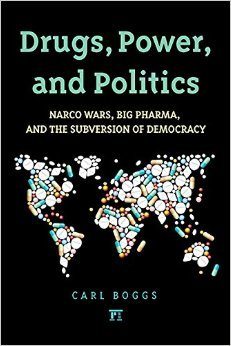
Author Carl Boggs takes this situation on in his most recent book, Drugs, Power, and Politics: Narco Wars, Big Pharma, and the Subversion of Democracy. One of the few such texts discussing the obvious hypocrisy of illegal drugs and the corporate pharmaceutical business, Drugs, Power, and Politics dissects the economics and politics of both sides of the drug business in twenty-first century United States. In doing so, the book also reveals the structural design that business serves as both metaphor and integral part of. The numbers he cites are representative of the role the current effort to control who takes drugs, what kind of drugs they take and who profits from them are staggering in themselves: 900,000 marijuana arrests in the United States from2002 to 2012, eighty percent of painkillers consumed are consumed by US residents, global sales of pharmaceutical drugs approximately $840 billion, DEA budget $3 billion. These are but the tip of the iceberg, but prove Boggs’ point that money is a primary factor in the seemingly endless narco wars.
Once one moves beyond the dollar signs and the arrest figures, other even more ominous phenomena appear. Perhaps foremost among them is the statistically obvious racism of the law enforcement aspect of the US war on drugs. Black and Latino residents (mostly young men) in the US are stopped, frisked, arrested and imprisoned at rates far beyond their relative percentage of the population in the country. Furthermore, the extremely long leash given to police officers and agents involved in illegal drug enforcement when added to the panopticon of surveillance that has been constructed to fight this trade makes the DEA a greater threat to civil and human rights than any other government agency in North America. When combined with the growing militarization of local police forces and an increasing use of drones, the level of surveillance becomes almost incomprehensible.
The symptoms of the desire to control drugs, who uses them, and which ones are to be legal are somewhat common knowledge. They are also disheartening and almost too numerous to list much less comprehend. Boggs utilizes these to discover and discuss the disease these symptoms represent. In his competent hand, that disease is easily recognized: neoliberal global capitalism. Both major political parties are part and parcel of this system, so there is no easy or obvious political way out of the hold Big Pharma and law enforcement have over our lives and well-being. The former uses its enormous wealth to write legislation in its favor while opposing other laws that might impinge on its profits; at the same time, it seduces the public with unfettered access to the airwaves and our wallets. Meanwhile, the regiments aligned against the illegal drug trade are now the most undemocratic realm of American public life.
Carl Boggs has written a comprehensive history useful to the drug war opponent and the civil libertarian. It is equally useable to the social scientist, the pot grower, the student looking for valid and well-researched information, and the interested citizen wondering what the hell is happening to their country. By placing the prevalent US drug control mechanisms into the capitalist economic model he provides an analysis that makes clear the role profits play in each and every facet of the drug economy, from pharmaceutical sales to the often brutal policing of illegal drug users in America’s streets.

Methane’s Accelerating Danger

Robert Hunziker

Methane (CH4) is 25 times more efficient at entrapping solar radiation and effectuating global warming than is carbon dioxide (CO2).
As the Arctic becomes more and more ice-free, the release of methane entrapped for millennia in Arctic ice accelerates. This, in turn, increases the risks of a planetary catastrophe. Yet, the scientific community does not like using words like “catastrophe,” which is considered alarmist. So, forewarned, this is an alarmist article.
Not only is this article alarmist, it is an indictment of views about climate change held by most, if not all, of the Republican candidates for presidency. Regardless of their individual personal beliefs about climate change, they are beholden to fossil fuel interests and extremely rich right-wing whackos that clandestinely pour money into phony orgs and payoffs for weak-kneed, cowering scientists to disseminate “confusing information to the public about global warming/climate change.” Without a doubt, these are the nation’s top gun eco terrorists. Similar to Al Qaeda, they work in the shadows.
Over the past couple of centuries, the rate of increase of CO2 versus CH4 in the atmosphere is running askew as carbon dioxide’s increase of 40% is a far distant second place to methane’s 250% increase. There’s nothing confusing about those numbers.
As it happens, by all accounts, climate scientists are wringing their hands over the 40% increase in carbon dioxide. That’s understandable as CO2 remains in the atmosphere for up to hundreds of years, blocking solar radiation from bouncing back into outer space. Ergo, over time global warming consumes the planet in a dreadful event that is currently tracking headlong towards bright red flashing lights at the end of the tunnel of doom.
Thereby, CO2 blanketing the earth is similar to turning on an oven, the more CO2 is emitted, similar to turning up the oven, the more heat builds, as it gets hotter and hotter and hotter over time whilst the “CO2 blanket” traps solar radiation. In time, humanity is toast.
Considering the fact that scientists worry about CO2 in the atmosphere, they must be experiencing migraines, sleeplessness and outright gloominess about CH4 because, with gigatons of methane trapped under Arctic ice, only a fraction of that CH4 could turn the planet into something akin to an oven, assuming too much Arctic ice melts. And, that is precisely the point as Arctic melt is already occurring at an alarming rate!
It’s all about runaway global warming as the Arctic threatens to turn ice-free in September, during its minimal cycle, in an upcoming year. Some Arctic experts believe it could happen within a few years, some several years, some in decades or longer.
There is a lot of mystery behind the likely impact of an ice-free Arctic because it has never happened before in human history. Questions arise: How much methane is trapped under the ice and how quickly does it release into the atmosphere and how soon does agricultural land turn bad?
Of course, the process takes considerable time to play out because nature still follows a geological time clock, which is very slow. Nevertheless, human-induced climate change has already proven to speed up nature’s course, increasing the risks of a runaway global warming nightmare, maybe within current lifetimes, who knows?
After all, the proof is found in facts. As a result of excessive levels of greenhouse gases like CO2 in the atmosphere, the Arctic is warming up 2-3 times faster than lower latitudes, which fact shall be discussed further on.
Still, nobody knows how this will play out. After all, how many scrapes with extinction has humanity experienced? The answer is: None, this will be the first go-around.
Along those same lines, scientists have calculated approximately how much methane is buried under and within the ice, but in the interest of maintaining some decorum of sanity and in the spirit of forestalling outright public panic, that information will not be divulged.
Arctic Update- Things Getting Worse, Not Better
“It appears that the rise of methane in the atmosphere is accelerating… Things look set to get worse… global methane levels have risen from a low of 723 ppb a couple of centuries ago to mean methane levels as high as 1,839 ppb in 2014. That’s a rise of more than 254%. The situation is dire….” (Source: Methane Levels As High As 2,845 ppb, Arctic News.org, April 26, 2015).
Not only that, unruly spikes of methane up to 2,845 ppb are becoming more commonplace in the Arctic.
Meanwhile, the Arctic’s big spring melt down is now in full swing, according to the National Snow & Ice Data Center (NSIDC), University of Colorado, Boulder, as of May 6th, 2015: “During April, the decline in ice extent starts to accelerate… April 2015 was marked by a fairly rapid decline during the first week of the month, little change during the middle of the month, and then a steep decline over the final week.” Uh-huh.
Additionally, and of crucial interest: “April was marked by higher than average air temperatures (1 to 3 degrees Celsius or 2 to 5 degrees Fahrenheit) throughout the Arctic,” which is the evidence of Arctic temperature increasing 2-3 times faster than elsewhere on the planet, Ibid.
Multi-Year Ice Dissipating Fast, Increasing Risks of Ice-Free Arctic
Arctic ice experts are quick to point to the risks associated with loss of multi-year ice because multi-year ice maintains the integrity of the Arctic. Loss of multi-year ice is precedent to an ice-free Arctic, which is precedent to runaway global warming.
Ice thickness over the central Arctic Ocean has declined from an average of 3.59 meters (11.78 feet) to only 1.25 meters (4.10 feet), a reduction of 65% over the period 1975 to 2012, according to R. Lindsay and A. Schweiger, Arctic Sea Ice Thickness Loss Determined Using Subsurface, Aircraft, and Satellite Observations, Polar Science Center, Applied Physics Laboratory, University of Washington, Aug. 2014.
The Lindsay results carry the distinctive footprint of global warming, nothing confusing about that. Significantly, the Lindsay study includes over 3,000 thickness measurements by sonar from submarines and from air by satellites as well as aircraft.
The significance of multi-year ice is that it constitutes what is popularly known as the North Pole and its ice environs or the Arctic. Multi-year ice constitutes thicker, more solid, longer-lasting ice, or structure, same as the Arctic has existed for thousands upon thousands of years.
However, nowadays, with human-caused global warming as a result of fossil fuel CO2 emissions coincident with extreme warming of the northern latitudes, multi-year ice is dissipating fairly quickly. This, therefore, opens up the Arctic to increase potential of methane release as solar radiation is absorbed into the dark background of water rather than reflected back out into outer space by the white background of ice and snow, scientifically known as the “albedo effect.”
Therein lies the focal point of risks of runaway global warming, turning the planet into a hotbed of human warfare squabbling over tillable land. Over time, these battles for survival will likely take the human socialization process back in time to something akin to the Neanderthal Age, with cell phones!
Leading Siberian Scientist Delivers Stark Warning- Frozen Bogs Becoming New Methane Threat
Inauspiciously, a newly recognized methane threat has been discovered in the Russian hinterlands, which is one more horrendous example of disastrous blowback from use of fossil fuels. Assuredly, the billionaire eco terrorists will now have to sic their spin-doctors on this one, maybe they could say Russians cannot be trusted, something like that might work.
Russian Professor Sergey Kirpotin, director of the BioClimLand Centre of Excellence for Climate Change Research discovered thawing frozen bogs in western Siberia, which will release billions of tonnes of methane, greatly speeding up effects of global warming.
Just like that, a new force of methane appears to be kicking into gear in the bogs with uncanny timing, as Arctic ice-melt is opening up clear water passageways for oil and gas exploration. Talk about a Catch-22, this is it in spades!
“Prof Kirpotin, 51, first made the discovery about the threat 10 years ago when it was found the permafrost melting for the first time since being formed at the end of the Ice Age,” Vera Sainitskaya, New Warning About Climate Change Linked to Peat Bogs, The Siberian Times, May 13, 2015.
“He warned at the time that it could be ‘an ecological landslide that is probably irreversible.’ Now it seems the situation is more advanced than first thought,” Ibid.
Remarkably, Prof Kirpotin’s discovery is essentially a trip back in geologic time to the last Ice Age, 100,000-to-20, 000 years ago, which is amazing and also filled with scary after-effects. Just to think: The permafrost Dr. Kirpotin investigated has not melted since the last Ice Age, until now! This is yet another distinctive footprint of global warming.
According to Prof Kirpotin, “There is a so-called methane threat in the north of the bog. On top of that, the ice shelf is also thawing, releasing methane hydrates and something really awful is happening.”
“Something really awful happening” is not exactly a nerve-soothing statement by a leading expert on Siberian bogs.
Science is Radically Divided on the Timing Issue of Climate Change
Without question, scientists are radically divided on the issue of climate change and few predict an upsurge any time soon. Nevertheless, it’s the scientists who base opinions on first hand knowledge “boots on the ground” who are screaming the loudest. They do not let “ computer models” override what they personally experience. In contrast, they see and feel the “reality in the field.” They are like scientific pioneers in the field, in the marsh, below and above the ice, on expeditions into the wilderness where nobody cares to tread. It’s hard work.
And, they happen to be the scientists who do not like what they see, for example, Dr. Natalia Shakhova, one of the world’s leading authorities on methane. She heads the Russia-U.S. Methane Study at the International Arctic Research Center, at the University Alaska Fairbanks and the Pacific Oceanological Institute, Far Eastern Branch of Russian Academy of Sciences.
Dr. Shakhova’s expeditions “boots on the ground” to the Arctic convince her that only a tiny percentage of the vast amounts of methane buried in Arctic ice is necessary to double current atmospheric methane. Worse yet, she suspects an outburst of 50 gigatons could happen at any time, which would likely cripple civilization. Decidedly, it would be a disaster beyond repair, further burdening an increasingly fracturable ecosystem, which may one day burst wide open, catching all humanity flatfooted!
By all appearances, the ecosystem has increasingly become more fragile within the context of a very resilient planet that has already withstood five extinction events, but it is still standing.
Thankfully, pioneering scientists like Dr. Kirpotin and Dr. Shakova travel to the field and report their findings. Otherwise, nobody would ever truly know how dangerously civilization is on edge and at risk. Meanwhile, fossil fuels burn away ever-faster, facilitating capitalism’s neoliberal experiment, truly a life or death enterprise.
Every hour the sun beams onto Earth more than enough energy to satisfy global energy needs for an entire year. Capture it!

Greece’s Fractured Political Culture

Andrew Raposa

Originally, Syriza was a coalition of left-wing factions in Greece with quite a diverse membership consisting of atheists, Catholics, Marxist, Maoists, and Greens. The European Union considered such a diffused constellation a “prominent evil,” but doubted that such incompatible ideological groups would ever overcome such disparate measurable differences.
In 2009,Greece faced its first tough austerity regime, when Prime Minister George Papandreou implemented a program of public spending cuts as a reaction to reductions imposed by the European Union resulting in a 300 billion Euro debt. In 2010, even tougher austerity measures were introduced and were immediately met with public outrage. The Greek people just could not stand such an assault on their living standards and public services.
In 2010, Papandreou responded with a proposed “referendum” that would institute a moratorium on Greece’s sovereign credit and debt obligations. For one shining moment, the referendum was received favorably by most parties. The referendum, however, produced a barrage of attacks from the EU and other creditors. Papandreou backed off from implementing the proposal and then promptly resigned as Prime Minister. Papandreou’s party PASOK, like previous governments in Greece, failed because of their ineptitude in handling money and credit, causing large fiscal deficits and simply governing.
The Papandreou regime began with the ideological objective of instituting democratic socialism: a radical ideological model predicated on a host of Marxist constructs. However, fervid right-wing attacks and European opposition forced an ideological change to a social democratic model of governing. So, Greek parties tended to converge around the center of the political spectrum. As the Greek economy worsened, with prolonged depressions lasting several years or more, workers and employees suffered enormous (40%) losses in income, and sharp declines in medical benefits, education and welfare payments.
The first sign of a turning tide was the triumph of the anti-austerity coalition Syriza. In 2014 , a coalition of left-wing components and its charismatic leader Alexis Tsipras, claimed a healthy 36% of the vote in the Greek general election. As an anti-austerity government, the party was to stand as an ideological bulwark against capitalist debt and bailouts. Syriza’s ascension went hand-in-hand with the descent of the previously dominant left party, PASOK, which once represented the bulk of the left in Greece in opposing the hated Troika (The European Union commission, the European Central Banks and IMF) which was held responsible for Greece’s harsh austerity conditions.
Syriza with its highly diverse ideological left-culture has its roots in the popular struggles for Greek independence and political stability. The party is especially strong in its opposition to the neo-fascist movement, Golden Dawn, whose essential features, as an extreme right-wing ideology, is evident in its openly avowed support for National Socialism in all its symbolic meaning. Established in the early 80s,  the Golden Dawn Party‘s ideological objective is to defend (like other right-wing parties ) against its supposed enemies: Marxism, liberalism, and egalitarianism. Its support derives primarily from citizens who previously had backed the New Democracy, a party whose ideology ranged from the center-right to nationalistic anti-Communism.
Syriza’s victory represents the Greek people’s rejection of the devastating austerity programs imposed on Greece and Europe by the major capitalist parties and institutions. This was no ideological, European Social democracy. Its agenda was to break with neo-liberalism and austerity. It appeared to bring a type of political culture that is linked to a social, political and ideological radicalism
Syriza’s projected program for Greece in 2012, reflected a high degree of radicalism. Its demands included : nationalization of banks, audits of the public debt, renegotiating debt payments and restoration of the minimum wage, taxes on all financial transactions, mortgage relief for poor families, demilitarization, ending Greece’s military cooperation with Israel, closing of all foreign bases in Greece, and withdrawal from NATO.
So why did Syriza choose to align with a right-wing nationalist party the New Democracy (ANEL), rather than with a party with closer to its social and economic programs? Why choose ANEL, when an alliance with Greece’s communist party (KKE) would seem a more fitting ideological coalition. Or, as some of Syriza’s detractors claim, is Syriza simply a bourgeois party, based on privileged layers of the petty bourgeoisie in bed with the interest of Greece’s capitalist class and international capital? After all, Syriza needed only two seats for a winning coalition. Did the KKE simply reject Syriza?
Syriza’s capitulation to neoliberal forces will create a mood of defeatism among progressive forces across Europe. Indeed, in retrospect PASOK’s sociopolitical and economic agenda and foreign policy now appears to have been far more radical than any set of policies in the present coalition of the Radical Left. It took PASOK’s leadership about two years to capitulate to western capitalist hegemony before it converted from hard core democratic socialism to a weakened social democracy. It has taken the Syriza less than a month to surrender to neoliberal Europe and international capital. Syriza accepted an extension of the bailout agenda and capitulated to Germany’s demands for austerity and neoliberal reforms. Syriza’s capitulation will only end up strengthening the forces of the extreme ideological right.
What is to be done? Many unanswered questions remain.
It is more and more evident that historical conditions for a radical democratic socialism are lacking in Greece. As of now, attempts to follow this moribund ideological path is fruitless. Whether they are called social democracies or democratic socialist parties, the result is that these ideological formulations have mutated into Democratic Liberalism. Ownership and social control has broken down because real power has shifted from labor to owners of capital. Syriza’s divorce between theory (ideology) and practice (praxis) continues to this day, Perhaps what is needed is the establishment of a new social contract that will mediate left-wing and right-wing ideological practices, in the interest of providing relief for the Greek people.