16 May 2015

‘Tis Pity She’s a Whore: Playwright John Ford’s lurid classic receives Off-Broadway revival

Robert Fowler

At the Duke Theater, New York City, April 14-May 16.
New York City’s Red Bull Theater Company is the only troupe in the US currently dedicated to the exploration of the Jacobean plays of William Shakespeare and his contemporaries, to what the company describes as “heightened language plays.” The troupe has pursued this artistic mission since its founding in 2003 with productions of Shakespeare’s Pericles,Volpone by Ben Johnson and The Revenger’s Tragedy by Thomas Middleton, to name but a few.
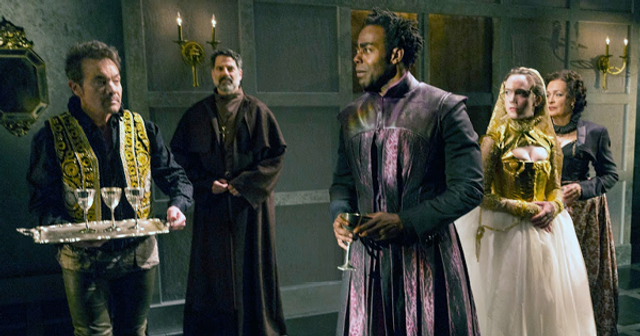
'Tis Pity She's a Whore at the Red Bull Theater
This spring the New York company’s attention has turned to the provocative and lurid ‘Tis Pity She’s a Whore by John Ford (1586-c. 1639), which has an incestuous relationship at its center. It is believed that the work was first performed some time between 1630 and 1633 (thus actually in the reign of Charles I). The play’s title alone was so controversial over the years that it was often abbreviated to ‘Tis Pity, or changed to Giovanni and Annabella or simply The Brother and Sister. The piece was omitted from an 1831 collected edition of Ford’s work.
Ford’s life spanned a number of significant social and cultural events, including the execution in 1587, one year after his birth, of Mary Queen of Scots; the Anglo-Spanish War (1585-1604); the death of Elizabeth I and the end of the Tudor dynasty; and the unification in 1603 of the British and Scottish crowns under James I of England (James VI of Scotland), of the House of Stuart. The efforts of Shakespeare and the other major Elizabethan-Jacobean playwrights were obviously important for Ford, who trained as a lawyer, as was the translation of the Bible into the English language in 1611. Although the precise date of his death is not known, it is believed that Ford died on the eve of the English Revolution of 1640.
Intriguingly, the playwright dedicated ‘Tis Pity to John Morduant, 1st Earl of Peterborough, who had been held for a year in the Tower of London on suspicion of being complicit in the Gunpowder Plot of 1605, the failed attempted assassination of James I by a group of English Catholics.
And indeed a sense of injustice and “out of jointness,” which takes an explosive emotional form, permeates the work. Ford was heavily criticized for the play and its refusal to condemn his transgressive protagonist, Giovanni. In this reviewer’s opinion, therein lies the actual strength of the piece. The lead character that Ford created is a complex, dynamic and deeply flawed individual. Simply to revile him would be a conservative choice and would seriously limit the play’s dramatic impact. Ford was obviously well aware of this.
The play is set in Parma, Italy. Giovanni (Matthew Amendt) has just returned from his studies in Bologna. We quickly discover he has developed an inflamed incestuous passion for his sister, Annabella (Amelia Pedlow). In the opening scene, he engages in a combative discourse on the ethical implications of the situation with Friar Bonaventura (Christopher Innvar). Giovanni suggests that a mere “customary form,” the taboo against incest, stands between him and “perpetual happiness.” Predictably, Bonaventura is appalled (“Have done, unhappy youth! for thou art lost”) and refuses to give his consent, and tries desperately to convince Giovanni that his desires are evil.
Giovanni defends his feelings in a deeply romantic fashion with a speech that includes the following lines: “Say that we had one father, say one womb / (Curse to my joys!) gave both us life and birth; / Are we not, therefore, each to other bound / So much the more by nature? by the links / Of blood, of reason? nay, if you will have it, / Even of religion, to be ever one, / One soul, one flesh, one love, one heart, one all?”
This opening scene and indeed the entire play have a distinctly anti-authoritarian feel to them. Two opposed moral codes are at work, the official one and Giovanni’s, which is essentially anarchistic, atheistic, individualistic. Ford’s is a materialistic world, where no supernatural intervention takes place. People make their own history, for better or worse. Giovanni and to a lesser extent Annabella choose to live by their own laws, and pay the ultimate price.
The “us against the world” sentiments are strong felt, as is the Romeo and Juliet -like predicament. Although Ford greatly admired and was undoubtedly influenced by Shakespeare, one gets the impression at times that ‘Tis Pity is in fact parodying the bard’s classic love story.

'Tis Pity She's a Whore
This impression is fortified when we are introduced to Giovanni’s “Juliet,” Annabella, who is being hounded by a number of prospective suitors, including the mean-spirited Grimaldi (Tramell Tillman), the poetic Soranzo (Clifton Duncan) and the clownishly camp Bergetto (Ryan Garbayo).
Necessarily for the unfolding of the tragic narrative, Annabella has no romantic feelings whatsoever toward any of these men. Despite the somewhat formulaic nature of the rejection scene, to Ford’s credit his fluid writing allows Annabella to spurn all their advances with compassion and humor rather than outright contempt.
Annabella then confides in her tutoress Putana (Franchelle Stewart Dorn) that she reciprocates Giovanni’s affections. Putana (clearly an homage to the Nurse in Romeo and Juliet ), in contrast to the Friar, gives her full blessing.
At this point, an intriguing subplot emerges through the presence of Hippolita (Kelly Curran), a former lover of Soranzo. Upon seeing the latter, she verbally assaults him for having let her send her husband Richardetto on a dangerous journey she believed would lead to Richardetto’s death, simply so Soranzo and she could pursue their affair. At the conclusion of this rant, Soranzo exits, seemingly nonplussed. His servant Vasques (Derek Smith) stays behind, allowing himself to be seduced by Hippolita. Vasques assures her he will carry out revenge on his master. This scene was executed with a great rhythm and considerable panache by the three performers.
Ford’s ability to tell a complex story now comes to the fore. Richardetto (Marc Vietor) is not dead, but has in fact arrived in Parma disguised as a doctor, along with his niece Philotis (Auden Thornton). Richardetto, for his part, is also seeking revenge on Soranzo and convinces Grimaldi that by stabbing Soranzo he will eradicate his principal competition for Annabella’s affections.
Alas, this clever plan goes dreadfully awry as Philotis, Richardetto’s naive niece, and Bergetto have fallen madly in love and are planning to consummate their desires in the location where Grimaldi intends to kill Soranzo. Inevitably, Bergetto is murdered by mistake, leaving Philotis, Bergetto’s servant Poggio (Ryan Farley) and Signor Donado (Everett Quinton), Bergetto’s uncle, in despair.
Meanwhile, Signor Florio (Philip Goodwin), Annabella’s father, insists his daughter choose a suitable mate. Having no choice, she succumbs to Soranzo’s advances and the wedding date is set.
But more melodrama ensues as Annabella’s secret dalliances with her brother have resulted in her pregnancy. After admonishing her in suitably pious fashion, the Friar convinces Annabella to marry Soranzo before the pregnancy becomes too obvious.
In the subsequent lavish wedding scene, Hippolita disguised as a masque dancer reveals herself to Soranzo and sarcastically raises a toast to his marriage. The tension is palpable. She confesses her intention was to poison his wine. Vasques, Soranzo’s servant, however, steps forward retracting his betrayal of his master and announces that he has in fact poisoned Hippolita’s beverage.
She falls to the floor dying melodramatically, enraged at Vasques, unleashing insults at everyone present at the wedding and offering vengeful prophecies. (“Take here my curse amongst you; may thy bed / Of marriage be a rack unto thy heart.”)
In a moment of genuine humanity, deeply affected by Hippolita’s horrible death and revolted by the impact that the desire for vengeance has on the human spirit, Richardetto abandons his plans to murder Soranzo and sends his niece Philotis off to a convent to save her soul. (“All human worldly courses are uneven, / No life is blessed but the way to heaven.”)
The relationship between Giovanni and Annabella has a predictably tragic outcome. Giovanni, despite being called upon to “to cry to Heaven” for forgiveness, dies unrepentant, hoping only that wherever he is going, heaven or hell, he may see “my Annabella's face.”
In the final scene, Ford once again takes aim at Church authority figures in the form of the Cardinal (Rocco Sisto), who was introduced midway through the play. Observing the carnage before him, the Cardinal callously declares that “all the gold and jewels” of the dead are to be confiscated by the Church and put “to the Pope's proper use”!
Ford’s play is turbulent, bloody and disturbing. A sense of doom pervades it. ‘Tis Pity She’s a Whore is a rationalistic, but pessimistic account of human beings and their actions. In the struggle between the instinctive desires of individuals and the crushing weight of institutions and traditions, the outcome is never in doubt. The Red Bull Theater deserves credit for attempting the work.
One of the weak points of the production is a relatively bland and generic scenic design by David M. Barber, along with distractingly contemporary costumes designed by Sara Jean Tosetti, which did little to aid the actors.
Some of the performances are stilted, particularly from the more veteran actors in the company. Director Jesse Berger needs to shoulder some of the responsibility for this, however, as much of the direction is too self-conscious. Certain scenes were laboriously presented and seemed overly naturalistic for such an epic piece of theater. One felt the actors were rejecting impulses to “go bigger” in fear they might appear to be “over-acting.” On the contrary, this is what the production was largely lacking.
That being said, Matthew Amendt as Giovanni—playing a character younger than he obviously is—copes ably in an emotionally demanding role, as does Amelia Pedlow as his tragic partner. They convey the grandiosity of the macabre text successfully, particularly in their intimate scenes together.


Alberta’s NDP pledges to “partner” with big business

Keith Jones

Alberta’s incoming New Democratic Party (NDP) government has been anxiously seeking to reassure big business that it will loyally serve their interests.
Party leader and Premier-designate Rachel Notley has been “reaching out,” to use her words, to the province’s oil barons, proclaiming in both public and private that she views them as “partners.” Any changes, she insists, will be made in consultation and cooperation with them and will be predicated on the continued health—i.e. profitability—of Alberta’s most important industry.
The NDP, Notley declared in an interview on Global Television’s “West Block,” wants Alberta to be “a healthy place for investment.”
Speaking last Tuesday, one week to the day the NDP swept to power ending 44 years of Progressive Conservative rule over Canada’s principal oil-producing province, Notley said she had had “some really good discussions” with the heads of the major oil and gas companies. She was confident, she said, “we’ll be able to continue what started through those conversations. … My guiding principle is the economic health of Alberta, job creation and maintenance, and as a result of that, the sustainability of the industry.”
Explaining Notley’s actions, a leader of her transition team told the Globe and Mail, “We’re not going to be able to impose change on the industry. We’re going to have to find a meeting of minds. That is what she is saying in her phone calls to industry leaders.”
Notley has also sought to signal her rightwing intentions by boasting that she is taking counsel from former Saskatchewan NDP Premier Roy Romanow and surrounding herself with other NDP veterans. A stalwart of the most rightwing section of the NDP establishment for decades, Romanow was long courted by Liberal Prime Minister Jean Chretien to join his cabinet.
Notley has named Brian Topp, a Romanow protégé, to be her chief of staff. Topp served as Romanow’s deputy chief of staff from 1993-2000, as the Saskatchewan NDP government imposed sweeping social spending cuts, including closing scores of local hospitals and clinics, to balance the provincial budget
In November-December 2008, Topp played a pivotal role in the federal NDP’s attempt to form a coalition government with the Liberals. As Topp detailed in his 2010 book, How We Almost Gave the Tories the Boot (the Inside Story Behind the Coalition), he helped negotiate an agreement under which the NDP was to serve as the junior partner in a Liberal-led coalition government pledged to “fiscal responsibility,” implementing the Liberal-Conservative plan to slash corporate taxes by $50 billion and waging war in Afghanistan through 2011.
Notley has also convinced Richard Dicerni to remain as the secretary to the cabinet, the top bureaucrat in Alberta’s government. A senior mandarin in federal and provincial governments for decades, Dicerni was brought in by outgoing Premier Jim Prentice after he assumed the leadership of the Progressive Conservatives last September with the strong backing of Big Oil and the aim of steering Alberta’s government sharply right.
Dicerni was quick to praise Notley: “She is walking the talk in regards to stability and continuity,” he declared.
The NDP was catapulted into office in the May 5 provincial election, quadrupling its share of the popular vote and raising its delegation in the 87-member Alberta legislature from 4 to 54.
It benefited from a groundswell of opposition to the Progressive Conservatives, who had responded to the collapse in oil prices by lashing out against working people. Their March budget announced a nine percent real cut in government spending over the next three years, slashed 1,700 health care jobs, imposed premiums for public health care and raised numerous other fees and taxes—while insisting that corporate tax rates were inviolable.
Saying her party needs time to prepare its unexpected entry into government, Notley has yet to set a date for the official transfer of power.
The Premier-elect has also been loath to make any policy pronouncements. She has said that before the end of the NDP’s four-year mandate, it will establish a “Resource Owners Rights Commission” to examine the royalties paid by oil and gas producers. But Notley has also pledged that there will be no royalty increases while energy prices are depressed and that it is possible the review will leave the royalties unchanged.
In 2007, the Progressive Conservative government of Ed Stelmach increased royalties, but subsequently backed off the in the face of bitter opposition from energy producers The royalty increase was an important factor in the rallying of sections of the oil industry behind the upstart Wildrose party in the 2008 and 2012 elections. Wildrose is now the Official opposition, while the Tories, with 10 seats, have been relegated to third place.
The Alberta oil barons are notorious for their ultra-rightwing views and have been a pillar of support for Stephen Harper’s Conservative government. Predictably, some oil executives have responded to the prospect of an NDP government modestly raising royalties and increasing the corporate tax rate two percentage points to 12 percent (the rate in neighbouring Saskatchewan, another major oil-producing province) with reactionary rants and threats of an investment strike.
However, many others have taken the measure of the new government and announced, as Notley boasted, their readiness to work with it. Encana CEO Doug Suttles said he was confident Notley understands the importance of the energy sector and will not make precipitous changes. On Thursday, the Canadian Association of Petroleum Producers (CAPP), the main industry lobby group, announced it was starting a committee to consult with the incoming government “on priorities to make the industry stronger.”
CAPP head Tim MacMillan stressed that there were many avenues for collaboration between the government and the industry and that CAPP wants to be “a positive force” in helping “change” happen in Alberta.
Since its founding in 1961, the trade union-based NDP has been an integral part of the bourgeois political establishment, a mechanism for defusing and suppressing working class opposition. Like social democratic parties the world over, the NDP has lurched to the right over the past three decades. It has repudiated even its traditional milquetoast reform program, imposing capitalist austerity whenever it has held office and playing a major role in dismantling the social-welfare programs it once held up as proof capitalism could be humanized.
The NDP has emerged as a staunch supporter of an aggressive foreign policy, supporting Canada’s participation in one imperialist war or intervention after another, including the 1999 NATO war on Yugoslavia, the Afghan war, the ouster of Haiti’s elected president Jean-Bertrand Aristide in 2004, and the 2011 NATO “regime change” war in Libya.
The NDP’s implacable opposition to any serious mass challenge to austerity was highlighted by its attitude toward the 2012 Quebec student protests. It refused to even nominally oppose the Quebec government’s Bill 78—legislation which effectively outlawed the strike and placed draconian restrictions on the right to demonstrate over any issue in Quebec.
Buoyed by this month’s victory in Alberta, the NDP and their trade union backers will step up their campaign to bring to power an alternate government of austerity and war in this October’s federal election. This is exemplified by their repeated calls for a coalition with the Liberals, the Canadian ruling elite’s traditional alternate part of government.

Two killed during mass protest by Chilean students

Bill Van Auken

Two young protesters were gunned down in the Chilean port city of Valparaiso Thursday during mass nationwide demonstrations against the failure of President Michelle Bachelet to implement educational reforms promised during her 2013 election campaign.
Killed were two students from Universidad Santo Tomas in Viña del Mar, Exequiel Borvarán, 18, and Diego Guzmán, 24. Guzmán was a member of the Juventudes Comunistas, the youth movement of the Chilean Communist Party.
According to witnesses, the two were among demonstrators who were either putting a poster on the wall of a residential building or spray-painting a slogan. The owner of the house challenged them, and a group of demonstrators gathered to defend the action. After first joining his father in confronting the demonstrators and threatening them with a revolver, the son of the building’s owner fired on the crowd from the second floor of the house, mortally wounding the two students. They were taken to a nearby hospital but died from their wounds.
Police who arrested the accused gunman, Giuseppe Briganti, said that they had recovered the pistol used in the killings along with a quantity of money and drugs during their search of his family’s house. The government quickly issued a statement affirming that Briganti “has no link to the police forces who were at the march.”
President Bachelet offered condolences to the families of the two slain students and described their murder as “an act of total irrationality, absolutely unjustified.”
While the double murder is a horrible crime, it is not merely an inexplicable act of irrationality. The bloody violence in Valparaiso reflects growing social tensions within a country that still lives with the legacy of the brutal mass killing, torture and imprisonment of workers, students and leftists under the US-backed dictatorship of General Augusto Pinochet, who ruled Chile for over a decade and a half. Part of that legacy was the criminalization of protest and the branding of all those opposed to the policies of the capitalist state as “terrorists.”
The students had taken to the streets precisely because of Bachelet’s failure to deliver on her promise to finally carry out a major reform of the education system imposed under Pinochet’s military junta. The dictatorship abolished the right to free higher education, imposing tuitions that now amount to thousands of dollars in a country where half the population earns less than $450 a month. It also encouraged the development of private universities to exploit education as a source of profit.
The same system has remained in place since the end of the dictatorship, despite the previous two decades of rule by the so-called Concertacion, a coalition that includes Bachelet’s Socialist Party, the Christian Democrats and other smaller political groupings.
In the aftermath of the killings, students and their supporters held candlelight vigils in the capital of Santiago, Valparaiso and cities across Chile.
Valentina Saavedra, the president of the Federation of Students of the University of Chile (Fech), spoke at the Santiago demonstration, saying that “the same thing could have happened to any of us and none of us are criminals.”
Ricardo Paredes, of the National Coordinator of Secondary Students (Cones), said that “we are not even talking about state repression, we are talking about civil violence; this is the legacy left by the dictatorship, the hatred of some against others.”
The mass student protests, which saw more than 100,000 march in Santiago (which had the largest of the demonstrations), represent the first major challenge in the streets to Bachelet, who took office at the beginning of last year.
They took place as her government, mired in corruption scandals, including a suspect land deal involving her son, has plumbed new depths of unpopularity. A poll released last week found that her approval rating had fallen to 29 percent.
For masses of Chileans, the government has failed to deliver on Bachelet’s promises to fight social inequality, which remains the highest for any of the 34 countries that make up the Organization for Economic Co-operation and Development. Wages remain stagnant for the vast majority, and economic growth has come to a near standstill amid falling prices for copper, Chile’s main export.
The influence-peddling scandals have only exposed the government and all of the major parties as instruments of Chile’s capitalist ruling class.
Hostility toward the Bachelet administration has been expressed most sharply by Chile’s students. Ennio Vivaldi, the rector of the University of Chile, warned Thursday of an “atmosphere of radical distrust on the part of the students toward the system, the parliament, in the authorities in general.” He called for the government to take even “minimal actions” to defuse the growing anger in the country’s universities.
Bachelet’s response has been to turn even further to the right. In a major shakeup last week, she fired her finance minister and other cabinet members, shifting control more firmly into the hands of Christian Democrats and other figures close to big business interests.
The sacking of the finance minister marked the first time that someone has been fired from this post since the end of the dictatorship. Picked to fill the position was Rodrigo Valdes, a Massachusetts Institute of Technology-trained economist who worked previously for the International Monetary Fund.
Santiago’s Chamber of Commerce hailed the appointment, declaring Valdes a “great professional” and predicting that “this new cabinet will help improve the investment climate if there is greater openness to the private sector’s proposals.”
Even as the rightward shakeup of the government signaled a turn from even the minimal reforms Bachelet had previously advocated, Bachelet brought a second member of the Chilean Communist Party into her cabinet, naming Marcos Barraza as minister of social development. He joins Claudia Pascual, who kept her post as minister for women amid the general reshuffling.
The Chilean CP, which was brought into the government in the attempt to provide it with somewhat more of a “left” face in order to contain and divert the struggles of the workers and students, was rewarded for its wholly uncritical attitude toward the corrupt capitalist administration headed by Bachelet.

Crisis envelops UK Labour leadership contest

Paul Mitchell

Labour Party leader Ed Miliband resigned last week following the party’s rout in the May 7 general election, but a crisis is already enveloping the contest to find his replacement.
Front-runner Shadow Business Secretary Chuka Umunna announced his withdrawal on Friday, just days after declaring his leadership bid. Umunna told reporters that the pressure and scrutiny he had undergone in the last few days was not “a comfortable experience” for him or his family. He insisted that there was no scandal behind his decision to withdraw.
Earlier this week, former army officer Dan Jarvis, MP for Barnsley Central since 2011 and currently shadow minister for justice, announced that he would not be putting his name forward in the contest after all. Jarvis declared, “It’s not the right time for my family. My eldest kids had a very tough time when they lost their mum [in 2011] and I don’t want them to lose their dad.”
The Labour leadership contest is a poisoned chalice. Despite years of austerity and attacks on social conditions, the Conservatives still managed to win 331 parliamentary seats and 36.9 percent of the vote, giving them an unexpected 15-seat parliamentary majority. Labour ended up with 30.4 percent of the vote and 232 seats—the party’s worst defeat since 1987.
In Scotland, once a heartland for Labour, the party lost all but one of its seats. Many of its leading lights were kicked out. The Scottish National Party, campaigning on a supposed anti-austerity ticket, swept the board. Labour fared no better in England, seeing a significant part of the anti-Tory vote going to the United Kingdom Independence Party and the Greens.
Labour’s response is to lurch even further to the right. Immediately after the election, Miliband was roundly condemned as being too left-wing, focusing on the party’s “core” working class vote and failing to appeal to “aspirational” Conservative voters. A chorus of demands erupted for a return to “New Labour” and the legacy of Blair.
Both Blair and his chief strategist Peter Mandelson threw their weight behind Umunna, a suitably shallow and opportunist vessel. After becoming an MP in 2010, the former solicitor served as Miliband’s parliamentary private secretary before being rewarded with the post of shadow business secretary less than 18 months after entering Parliament.
His politics find suitable expression in a posting on the ASmallWorld website, known as “Myspace for Millionaires”, requesting the name of nightclubs in London where he didn’t have to mix with the “trash” and “C-list wannabes”.
Umunna’s ability to “not come across as political” won the praise of the head of the Confederation of British Industry’s employers’ group, John Cridland, who assured reporters that he was “a guy with whom we can do business”.
During the election campaign, Umunna insisted that Labour would be a “resolutely pro-business government”. Afterwards, he insisted that Labour had to say it was not “afraid to say we want to help people make their first million”. He declared, “We need a different, big-tent approach—one in which no one is too rich or poor to be part of our party,” along with “drastic” political reform including a “massive” devolution of power to our cities, regions and towns.
Umunna has penned articles promoting “Blue Labour”, the “Flag, faith and family” project pioneered by the academic Maurice Glasman, which stands for the dismantling of social provision utilising nationalism, anti-immigrant measures and a more corporatist relationship with the trade unions.
Trade union leaders had said they would block Umunna’s leadership bid. Len McCluskey, general secretary of the Unite union, criticised those who claimed that Labour lost the general election because it was too left-wing. He declared, “Labour didn’t lose votes by proposing to tax the wealthiest a bit more, or intervene in the housing and energy markets. It did lose support because of its muddled message on austerity.”
This is just hot air. In 2013, he enthused over Miliband’s adoption of Conservative “One Nation” rhetoric and that Labour was “the natural, historic, vehicle” for the working class. Shortly before the election, he repeated that the Labour Party “is our party. We built it, to serve us, the people” and that Miliband’s flagship pledges are “our policies.”
Miliband’s flagship pledges included the assertion that his party would be a more “sensible” advocate of austerity, and would implement a “budget responsibility lock”, clamp down on immigration, defend the European Union and maintain Britain’s role as a leading military power.
Reports suggest that McCluskey and other trade union leaders are contemplating backing the right-winger Andy Burnham, the shadow health secretary. Elected an MP in 2001, he was regarded as a Blairite technocrat, dedicated to the New Labour project as culture secretary, chief secretary to the Treasury and health secretary. In that role, he laid the groundwork for the privatisation of the UK’s first NHS hospital at Hinchingbrooke.
In the leadership contest following Gordon Brown’s resignation, Burnham came in a miserable fourth place after campaigning on the mantra of “aspirational socialism”. Today he says, “Our challenge is not to go left or right, to focus on one part of the country above another, but to rediscover the beating heart of Labour,” adding, “That is about the aspirations of everyone, speaking to them like we did in 1997.”
Yvette Cooper, who became an MP in 1997 and is forever tainted with the Blair-Brown years, wants Labour to “move beyond the old labels of left and right” and states, “Labour lost because we didn’t convince enough people in all parts of the country that we had the answers to match up with their ambitions.”
Cooper has been shadow home secretary for the past four years, during which time she attacked Conservative Home Secretary Theresa May from the right on border controls, immigration and extremism. In March 2013, she delivered a major speech, apologising that Labour had let in too many Eastern European workers and calling for immigration to be “properly controlled.” She criticised the Tories for failing to reduce “net migration” and presiding over a system that “isn’t working at the moment and [it] has got significantly worse since the election.”
Liz Kendall, elected MP for Leicester West in 2010 and currently the shadow minister for care and older people, called for “a New New Labour.” She has said that in the NHS, “What matters is what works”, whether it be public or private.
Historian Tristram Hunt, MP and shadow education secretary, declared the party should take its time to carry out a “brutal post-mortem” about its “underlying philosophy and thinking”. Labour would only win if the party championed “aspirational” voters, he said.
According to the New Statesman, “the left of the party is also hoping to get a candidate on the ballot paper” in the form of Labour Party deputy chair Jon Trickett or former National Union of Mineworkers president and parliamentary Trade Union Group chair Ian Lavery. But that they will get nowhere is borne out by the decision of Socialist Campaign Group chair John McDonnell not to stand. He told the magazine, “I’ve done it enough times and been blocked from getting on the paper. How many times can I be hit by that?”
In 2010, when he stood as the candidate of the party’s putative left wing, McDonnell withdrew when only 16 out of a total of 258 Labour MPs were prepared to support him. The WSWS wrote then, “The simple reason for McDonnell’s defeat is that the left wing in the Labour Party is an insignificant and impotent rump” and that his “alternative programme” setting out “a radical new course to challenge the consensus” within the Labour Party were “anathema to the party for which he functions as a loyal political apologist”.

Japanese cabinet approves new military legislation

Ben McGrath

The Japanese cabinet signed off on two new bills on Thursday that will accelerate Japan’s remilitarization. The legislation corresponds to joint-military guidelines agreed to by Prime Minister Shinzo Abe during his recent trip to the United States. The bills will be presented to the Japanese parliament, or Diet, shortly and a vote is expected by July.
The legislation consists of one new bill and a second that contains 10 revisions to existing laws. The ruling Liberal Democratic Party (LDP) and its junior coalition partner Komeito formally agreed to the bills on Monday, setting up their submission to the Cabinet. The LDP-Komeito coalition has a firm parliamentary majority, virtually guaranteeing the bills will pass.
Abe claimed that the laws would “ensure peace for Japan and the world.” Likewise, Chief Cabinet Secretary Yoshihide Suga couched the bills in defensive terms, saying they would allow the government “to protect the peaceful lives of the public.” He continued, “We need legislation that would enable (the country) to address every situation in a seamless manner.”
The bills have nothing to do with ensuring peace or protecting the public. The Abe government, encouraged by the US, is seeking to remove all restrictions on the operations of the Japanese military, in particular its ability to participate in Washington’s wars under the guise of “collective self-defense.”
The new law has been dubbed the “international peace support law.” It will allow the government to dispatch the Self-Defense Forces (SDF)—the formal name of Japan’s military—abroad without the enactment of a special law or regular extensions from the Diet. While the LDP sought to do away with all restrictions, Komeito insisted that parliamentary approval still be required initially for each new military mission.
The ten revisions to existing legislation include allowing the SDF to be deployed anywhere in the world to provide logistical support to an ally, namely the United States. Washington has pressed for such a law in order to allow Japan to support the US wars in the Middle East.
Another revision would allow Japan to use military force for actions such as minesweeping even if Japan were not under attack. As the bills were being prepared, Abe regularly cited the Strait of Hormuz to justify such a deployment.
However, central to so-called “collective self-defense” is Japan’s integration into the US military build-up throughout Asia against China as part of its “pivot to Asia.” Speaking last month, Abe explained why, from Washington’s standpoint, the present situation was untenable.
“If there were an attack against the US [Aegis] destroyer [near Japan], Japan would not be able to prevent that from happening under the current law,” he said. “In the future, the Japanese Aegis destroyer will be able to protect the US Aegis destroyer.”
There is nothing “defensive” about Japan’s remilitarization. Under both the LDP and previous Democratic Party of Japan (DPJ) government, Tokyo deliberately inflamed tensions with Beijing. In 2012, the DPJ government of Prime Minister Yoshihiko Noda sparked the current tense standoff over the disputed Senkaku/Diaoyu Islands in the East China Sea by “nationalizing” the rocky outcrops.
Since coming to office, the Abe government has boosted military spending, redrawn military guidelines to focus on China, established a US-style National Security Council and enacted anti-democratic secrecy law. At the same time, Abe has been waging an ideological campaign to whitewash the crimes of Japanese militarism in the 1930s and 1940s to condition public opinion, particularly young people for new wars.
Last summer, the government “reinterpreted” the country’s post-war constitution to allow for “collective self-defense”—negating Article 9 which formally renounces war and the maintenance of armed forces. The latest legislation is the means by which this “reinterpretation” is to be put into effect.
Article 9 has been flouted for decades to permit Japan to maintain “self-defence” forces. However, the Japanese ruling class no longer wants any, even nominal, restrictions on its use of the military to pursue its economic and strategic interests.
Hajime Funada, the head of the LDP’s panel on constitutional revision, told Reuters last month, “The Cabinet resolution and legislation being crafted now have gone right up to the limits of what is possible under the constitution as it is now. If we want to have more flexibility, it is necessary to revise Article 9.”
The LDP has stated it is seeking to revise the constitution by 2018 when the next lower house elections are scheduled. However, any constitutional change requires a two-thirds majority in both the upper and lower house in the Diet as well as the approval of a majority of Japanese voters via a referendum.
The US has fully backed the new laws and Japan’s broader remilitarization. In his recent meeting with Abe in Washington, Obama reaffirmed the US commitment to its military alliance with Japan, again stating the US would back Japan in any war with China over the disputed islands in the East China Sea.
China is understandably concerned about the Japanese government’s new legislation and its close involvement in the US war preparations in Asia. Foreign ministry spokeswoman Hua Chunying stated, “We hope that Japan can earnestly learn the lessons of history, uphold the path of peaceful development… and play a constructive role in the region.”
There is widespread public opposition to the new legislation in Japan, reflecting deep-seated hostility in the working class and among young people to militarism and war. A poll by Japan’s public broadcaster NHK this week found that 50 percent of the public is opposed to Japan’s expanded role under the new joint military guidelines with the US.
On Tuesday, 2,800 people gathered in Tokyo’s Hibiya Park to protest against the legislation. Another demonstration involving 500 people was held on Thursday morning in front of Abe’s office. A 23-year-old graduate student told the media, “If a war starts, it will be our generation that will be dispatched. I cannot tolerate this.”
Members of the opposition DJP took part in Hibiya Park protest. The DPJ, however, has no fundamental opposition to the LDP government’s remilitarization of Japan. Its “nationalization” of the Senkaku/Diaoyu Islands in 2012, which sparked sharp tensions with Beijing, opened the door for the Abe government to pursue even more aggressive policies.

Controversy erupts over American B1 bomber deployments to Australia

James Cogan

A political controversy unfolded in Australia yesterday over whether the United States plans to base long-range B1 bombers in the country as part of the US “pivot” and military build-up in Asia against China.
The episode highlights two facts. Firstly, the preparations for war by the US and its allies are far more advanced than is known by masses of people. Secondly, governments, the military and the establishment media will shamelessly lie in order to keep the working class in the dark about the immense dangers that it confronts.
The controversy began with testimony by senior Obama administration officials on Wednesday to a US Senate Foreign Relations Committee hearing, entitled “Safeguarding American Interests in the East and South China Seas.” The hearing convened a day after a Wall Street Journal report revealed that Defense Secretary Ashton Carter requested plans be drawn up for a provocative deployment of US naval and/or air assets to challenge Chinese territorial claims over islands and reefs in the South China Sea.
US Secretary of State John Kerry will be in China this weekend, demanding that Beijing end the construction of alleged military infrastructure on disputed territories and asserting the “freedom of navigation” rights of the US to send warships into Chinese-claimed waters. Such a reckless course of action by Washington could trigger war.
At the Senate hearing, David Shear, the US Assistant Secretary of Defense for Asian and Pacific Security Affairs, was asked by Democrat Senator Ben Cardin whether the deployment of US forces across Asia was a “direct response to additional challenges because of maritime security concerns” and if the US “had the assets in place to deal with these potential problems”—that is, a military confrontation with China.
Shear answered comprehensively and confidently, without referring to notes or consulting staff. He detailed aircraft and naval deployments to Japan, Singapore and Guam. He then stated: “We are undergoing an important shift in the way we posture our forces… we will be moving significant numbers of Marines to Hawaii, Guam and Australia. We will be placing additional air force assets in Australia as well, including B1 bombers and surveillance aircraft. We are looking at further deployments in the Philippines on a rotational basis once we have implemented the enhanced cooperation agreement… We will have a very strong presence...”
In Australia, the revelation that B1 bombers were to be based in the country, as part of US deployments against China, was reported on the Thursday evening news and in the newspapers on Friday morning. Australian Defence Department officials initially did not dispute Shear’s statements, telling Fairfax Media journalists only that the “specifics of future force posture cooperation are yet to be finalised.”
As public discussion swirled around the implications of a B1 bomber deployment, however, Prime Minister Tony Abbott’s government went into damage-control.
A B1 Lancer’s deadly arsenal
Defence Minister Kevin Andrews issued a statement asserting that Shear had “mis-spoke.”
Abbott then told a hastily convened media conference: “I understand that the official [Shear] mis-spoke and that the US does not have any plans to base those aircraft in Australia.” After reaffirming the US alliance, he claimed that it was “not aimed at anyone” but was for peace and stability in the region.
An unnamed Australian official blamed Shear’s supposed “gaffe” on “a badly-prepared Pentagon brief.” Another official asserted that “there has simply been no discussion with the Americans formally or informally about bloody B1s… basing is out of the question.”
Within hours, the US embassy in Canberra issued its own statement via Twitter: “Contrary to reports, and to correct the record, the US has NO plans to rotate B1 bombers or surveillance aircraft in Australia.”
These official denials are simply not credible. The Joint Posture Initiative agreed between the former Labor government of Prime Minister Julia Gillard and the Obama administration, when the “pivot” was announced in November 2011, included agreements on the rotational deployment of aircraft. B-52 bombers have made periodic visits to northern Australian air bases ever since, on the understanding that they “neither confirm nor deny” whether they are armed with nuclear or conventional payloads.
These undertakings have been further enhanced at annual Australia-US ministerial (AUSMIN) talks. The November 2013 meetings, for example, agreed to “increased rotations of US Air Force aircraft in northern Australia.”
Even if the Pentagon had not yet informed the Australian government, it was hardly a secret in the US military that such “rotations” would eventually include B1 bombers. The aircraft has been specifically assigned to long-range anti-ship missions as part of the military component of the “pivot.”
In August 2012, Major General Michael Holmes, assistant deputy chief of staff for Air Force Operations, Plans and Requirements, told USA Today: “The B1’s capabilities are particularly well-suited to the vast distances and unique challenges of the Pacific region.” Citing an air force official, the article noted that B1s were being outfitted with “anti-ship missiles” and could “track ships at sea and launch the missiles from ‘hundreds of miles’ away.”
Northern Australia is the ideal location to base B1s for a key aspect of the Pentagon’s “AirSea Battle” strategic plan: a blockade of the key sea lanes between the Indian and Pacific Oceans to cripple the Chinese economy, and the destruction of Chinese naval or commercial ships attempting to break the blockade.
Shear’s “mistake” was to publicly state the truth: the use of bases, airfields and ports in Australia by the US military and intelligence apparatus is explicitly bound up with preparations for war against China. Since the “pivot” was announced, the Australian political and media establishment has sought to maintain a conspiracy of silence and censorship about this fact. There has been almost no public discussion, let alone debate, except in rarified strategic and foreign policy circles, and every effort has been made to prevent opposition voices from being heard.
The attempts by Abbott and others to deny that the US-Australia alliance is directed against China are partly motivated by their desire to prevent, for as long as possible, a rupture in relations with China—Australia’s largest export market and overall trading partner.
More fundamentally, however, the instinctive resort to lies reflects the immense nervousness in both Australian and American ruling circles over how masses of workers and young people will respond as they become conscious of the war danger.
With the Obama administration actively plotting a provocation in the South China Sea in the coming months or even weeks, it is becoming increasingly difficult for the establishment to prevent public discussion on the potentially catastrophic consequences of this reckless imperialist policy.

The Amtrak disaster and America's crumbling infrastructure

Andre Damon

Tuesday’s derailment of an Amtrak train on America’s busiest rail route has exposed before the whole world the crumbling state of infrastructure in the United States.
Eight people were killed, over two hundred injured and rail traffic snarled for a week for the simple reason that the publicly funded Amtrak commuter railway had not implemented a basic automated train control system.
While the precise circumstances that led up to the catastrophe are still being investigated, it is clear that the train accelerated to twice the speed limit around a sharp and dangerous and antiquated portion of the track. Officials from the National Transportation Safety Board are considering the possibility that before this happened, the cabin may have been struck by a rock or a bullet, based on a radio discussion overheard by the assistant conductor. The windshield of a nearby regional train had also been hit by a projectile shortly before the Amtrak train derailed.
Whatever caused the train to speed up sharply before it derailed, it could have been easily prevented by a safety system known as “positive train control.” As a result of chronic under-funding, the system had not been installed on that section of the rail line, leaving no backup in the event of human or mechanical error.
Engineer Brandon Bostian, who was driving the train at the time that of the accident, had previously been a vocal critic of the woefully inadequate safety systems on US rail lines, declaring on an online forum that “they have had nearly a hundred years of opportunity to implement SOME sort of system to mitigate human error.”
The media and political establishment have been quick to point the finger at Bostian, with Philadelphia Mayor Michael Nutter, a Democrat, declaring that his conduct was “clearly…reckless.” These efforts to blame the engineer are a transparent attempt to divert attention from those who are actually responsible for the tragedy.
America, a country with more billionaires than all of Europe combined, has a public rail system that is dilapidated and obsolete. The US rail system could be called “third world,” but in fact many developing countries have significantly more advanced infrastructure.
Turkey, a country with one-twelfth the area of the United States, has more miles of high-speed rail. China has nearly eight times more high-speed rail track, and in much better condition, with some trains traveling nearly 100 miles per hour faster than those operating on America’s only high-speed rail line.
The chronic under-funding is not for lack of demand for rail transit. Amtrak’s ridership has increased every year for over a decade and is up by more than 50 percent since 2000.
But funding for the system has dwindled year after year. According to Amtrak, by 2019 funding for the Northeast Corridor, where the crash took place, is slated to cover only one fourth of what is needed to keep the system in good repair.
Rail is only one component of America’s glaring infrastructure crisis. In New York City, only 20 percent of roads are in good condition, while 27 percent of bridges are “functionally obsolete,” according to one survey.
The American Society of Civil Engineers has given infrastructure in the United States a D (poor) rating, with no element of infrastructure receiving more than a B- rating. The country’s levees, such as the ones that failed during Hurricane Katrina in 2005, received a D-, while roads received a D, as did schools, transit, aviation and dams. The country needs to invest an additional $3.6 trillion to raise its infrastructure to the level of a “B” rating by 2020, according to the group.
The media and political establishment defends the systematic defunding of infrastructure on the grounds that there is no money for levees, bridges and modern rail lines. This claim is made, with a straight face, in a country that spends more money on the military than the next ten nations combined, and that has three times more billionaires than any other.
The funding priorities of the United States government recall the maxim of Nazi propagandist Joseph Goebbels, who infamously declared, “we can do without butter, but…not without arms.”
The wars in Afghanistan and Iraq are expected to have a total cost of up to $6 trillion, according to a 2013 Harvard study, or nearly twice the cost of repairing America’s infrastructure. The lifetime cost of just one US weapons system, the F-35 joint strike fighter, is slated to cost $1.5 trillion.
In addition to the vast resources lavished on the military, countless billions of social wealth are diverted every year into the pockets of the financial oligarchy. The Federal Reserve’s “quantitative easing” program, which has created over three trillion dollars in paper wealth for the financial elite, could well have covered the entire infrastructure shortfall documented by the American Society of Civil Engineers.
Just two days after the Amtrak crash, a spike in Facebook stock made billionaire CEO Mark Zuckerberg $1.2 billion wealthier in a single day. This is nearly equivalent to the annual federal funding for Amtrak.
The combined wealth of the 400 richest people in the United States comes out to $2.29 trillion, or a staggering 1,635,714 times the annual federal funding for Amtrak.
The entire annual transportation budget of the federal government, some $27.4 billion, is roughly the equivalent to the increase in the wealth of Bill Gates over the past three years alone.
The primary concern of the American state is neither the satisfaction of social needs, nor the basic upkeep of the infrastructure needed for economic production itself. Rather, the state concerns itself with the promotion of endless wars abroad, the funneling of trillions of dollars into the police/intelligence apparatus and, at the core of it all, the enrichment of a parasitic and criminal oligarchy that has ruined American society to quench its obscene lust for personal wealth.
The United States, the center of imperialism and the global financial system, expresses in the highest form the rot, decay and historically bankrupt nature of the capitalist system. This obsolete and irrational system must be done away with and replaced by socialism. The expropriation of the wealth of the financial aristocracy and the rational reorganization of society to meet the social needs of the population is a matter of the greatest urgency.

Trade Deals and the Logic of the Middle Finger

Rob Urie

Optimism Finds a Cure
After news broke that Senate Democrats had voted against giving President Obama fast-track authority for his TPP (Trans-Pacific Partnership) ‘trade’ agreement there was a moment when true knowledge of the world was held ever-so-briefly in suspension. Eternal optimists of the liberal and progressive persuasions instantly declared that Democrats had acted on, if not quite their moral compasses, at least credible threats from the electorate that their futures as professional collectors of campaign contributions might be at risk. However, upon reading the ‘reasons’ for the vote it became clear that said Democrats were only moving slowly to assure they would be paid their proper tribute for endorsing the deal.
While optimism is certainly within the range of normal human emotions, those expressing it in socially beneficial forms can be found facing down militarized cops in Ferguson, Missouri, fighting mountaintop removal in West Virginia and occasionally burning cop cars in Baltimore. As Senate Democrats were quick to demonstrate, where optimism is never rewarded is in expectations that they will act in the public interest. It took only twenty-four short hours for the graftariat to ready itself to once again conduct the (rich) people’s business. If the fact of the reversal fails to impress, the speed with which it took place certainly should. With the capitalist coup (TPP, TTIP) now so near completion, the call of opposition has been rephrased as it always should have been, to ‘take the politics out of money.’
uriefinger1
Above, Barack Obama explains the origin of campaign contributions to slow-learners in the Senate. Earlier trade deals provided incentives to relocate manufacturing jobs to low-wage countries. NAFTA (North American Free-Trade Agreement) contained a version of the ISDS (Investor-State Dispute Settlement) mechanism currently being used by corporations to extort money from sovereign governments for acting in the public interest. From there bank bailouts and ongoing subsidies and guarantees and Federal Reserve policies to boost the value of financial assets held by the very rich have added to plutocratic wealth. Government now works on a commission basis, taking back in campaign contributions a tiny percentage of the public resources transferred to ‘private’ pockets. Original image source: politico.com.
The Power of Positive Larceny
In contrast to the ‘American vision’ of politicians and ordinary citizens alike, if such a thing can be momentarily granted, the world created by writer Gabriel Garcia Marquez is ‘softly’ fluid— poetic rather than deliberately larcenous. While, for instance, an overwhelming preponderance of Americans, including nominally elected representatives, believe in God, from that ‘place’ outward hope finds itself attached to implausibility, to a pre-conscious knowledge that assessed likelihood has little bearing on expected outcomes. In Marquez’s vision outcomes, no matter from whence they emerge, are their own facts. Americans accede to no such logic— belief is the outcome against which ‘the facts’ must be rectified. These facts of studied neglect include the wall, the empty bowl, the police taser, the first kiss and the revolutionary moment.
uriefinger2
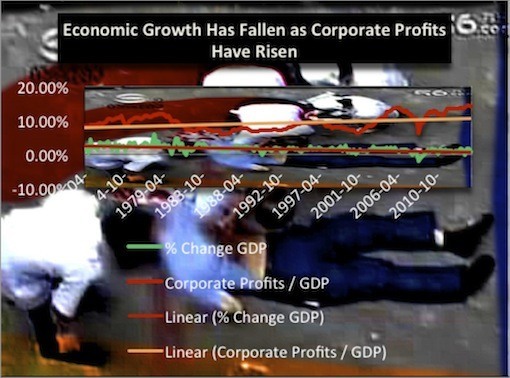
Graph (1) above: beginning in the 1970s antique capitalist ideology was used to reorganize of the economies of the West. Theory had it that economic growth would rise if economists were given free reign. Left unspecified was precisely where it would rise, and for whom. In the U.S. the rate of economic growth has fallen as corporate profits have taken an increasing share of that which remains. Given the concentrated ownership of corporations, these trends have overwhelmingly benefitted the already wealthy. With the TPP (Trans-Pacific Partnership) and TTIP (Trans-Atlantic Trade and Investment Partnership) being moved forward, claims of past economic success require magical interpretation of actual outcomes. This failure to relate facts to theory suggests that neoliberalism won’t end until it is ended. Data source: St. Louis Fed.
This tendency toward magical interpretation finds itself most firmly attached to modes of analytical reasoning, in particular to economics. If individuals are the fundamental ‘unit’ of society (how else could it be?) and we are rational in a specific mathematical sense (how else could it be?) and we have perfect knowledge in the sense of knowing what we don’t know (how else could it be?), then economists have a theory of how to organize the world for us. This is what our neoliberal minders and ‘their’ elected representatives have put before us with the TPP— a plan of economic reorganization created just for us.* *(The term ‘us’ here is not intended to refer to any actual person or persons either real or imagined. It is a generic term for any grouping of like objects from the perspective of one or more of the constituent objects).
Abstract optimism, like faith, exists in the space between supine fumbling and active engagement. Einstein’s now cliché: “insanity is doing the same thing over and over again and expecting different results” face the limits of real world ‘experiments’ like ‘free-trade.’ Leftish economists have repeatedly made the point that the TPP and TTIP aren’t really trade agreements, but are the formalization of corporate power through supranational tribunals and patent protections. Inferred is that prior trade agreements were something different. Lowering trade barriers and tariffs, part of the alleged purview of earlier trade deals, was never about making labor mobile to match the mobility of capital. And the nation-states that are the signatories (or not) of trade agreements are no more persons, as in ‘partners’ of these so-called partnerships, than are corporations— they represent specific, not ‘national,’ economic interests.
uriefinger3
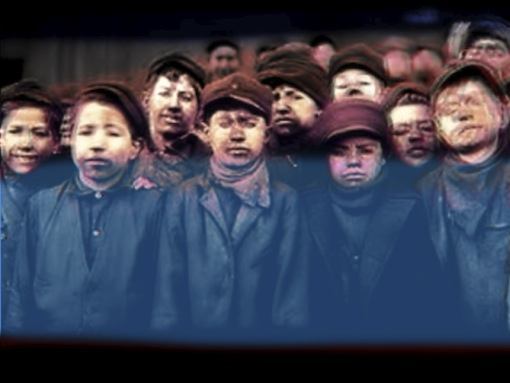
Prohibitions against child labor are premised in part on the idea that children are too young to choose ‘their’ work and therefore too young to ‘benefit’ from it. This idea of free choice is fundamental to the theorized relationship of political to economic freedom. Corporate profits are premised on economic efficiency— the argument that capitalism makes ‘us all’ better off in some cosmic aggregation. If true, why would child labor that produces profits not be beneficial to ‘us all?’ If this isn’t true (writer’s prerogative: it isn’t), why isn’t codifying the terms of exception— basic human rights that take precedence over economistic considerations, the first step of trade agreements? Original image source: thinkprogress.com.
The Logic of the Middle Finger
There exists a logical tension between measured and reasoned language— the form and content of political and economic discourse, and its ‘objects.’ The implied, and occasionally stated, goals of measure and reason are to be ‘effective,’ to persuade those who hold sway over institutional facts that one course or policy is better than another. Left apparently unconsidered is the nature of these institutions, what it is that motivates them? Within the Western liberal frame these are generic questions— what motivates government, business, or the electorate? When considerations move to the particular, to the TPP, racist cops and policing, Wall Street as bailout-dependent economic overlord and global environmental crisis generic questions, and with them generic motivations, lose bearing because they presuppose what they are claimed to describe.
uriefinger4
The late Abbie Hoffman makes a measured and reasoned political statement. He wasn’t known for being punctual. Original image source: openingceremony.us.
The optimistic case is that America is in a revolutionary moment. Simple description finds embedded plutocracy intent on widespread immiseration and the wholesale takeover of civil governance to promote its own interests, a military dedicated to creating moral and human catastrophe around the globe, domestic surveillance and policing that are at war with citizens by the degree of their vulnerability, environmental crisis that is becoming increasingly intrusive and potentially catastrophic and a ruling class that believes it has no use for the rest of us. Warriors, politicians, financiers and the police each have their own institutional logics. Reason and measure— statistics, flow-charts, budgets and action plans, are their form. Engagement through the terms given grants base ‘neutrality’ that institutional outcomes render implausible.
uriefinger5
Man being tortured at Abu Ghraib. The George W. Bush administration had economistic goals for its torture programs— the stated intentions were to elicit false confessions to support the invasion of Iraq, to gain information with ‘operational’ value in the conduct of the war and / or to convey American indifference to life and human dignity to dissuade resistance to ‘American interests’ through terror. The Obama administration has been just as casual with terroristic murder as the (George W.) Bush administration, if less ambitious in the breadth of its terror campaigns. Original image source: aegisacademy.com.
This isn’t a call for irrationality. It is to ask where the meta-logic, the logic that joins the interests of Afghan villagers about to be bombed with those of the drone pilot about to bomb them, resides? When Barack Obama or George W. Bush have spoken of ‘American interests’ the implied logic is local— it is one group interest against another, not deference to some universal interest. And few but the preoccupied, otherwise engaged and / or intellectually lazy believe that the ‘international community’s’ interest is universal, despite the strategy of posing it as such. The logic of the middle finger then is the refusal of the about to be bombed, the about to be trade-dealed and the about to be beaten and / or murdered by the police to accede to the logic of the bomber, the trade-dealer and the police. And for all of the chatter about embedded plutocracy, the dividing line between ‘inside’ and ‘outside’ remains at institutional behest, as potentially temporary as the accoutrement that serves as social delineation.
Fortune Shits the Bed
Conspicuously missing from the current ‘moment’ is the soundtrack, the anti-commodity of social expression that makes official absurdity visible by offering contrast to it. The institutional panic that hit Senate Democrats when they realized they had momentarily slowed the trajectory of total capitulation to capitalist interests was met by equally panicked interpretation from the cooperative opposition that a crack had appeared that had not been made to appear. House Democrats may or may not pass ‘fast track’ and the TPP but jobs will nevertheless be outsourced, pensions looted, wedding parties in the Middle East bombed and Democrats (and Republicans) will remain craven and self-serving until a different order is established.
uriefinger6
Hillary Clinton contemplates existence with fear, loathing and somewhere deep inside, buried interest. Original image source: Mike Coppola / Getty Images.
Most likely assumed, but certainly not on good evidence, is that officialdom is aware of the choices available to it. Once a step is taken outside of the inherited-from-history and the handed-to-us-by paid-apologists, official choices seem less brilliant conspiracy and more dim muddle. The rich may very well get richer, but what a tired farce that is for both the takers and the taken from. A starting retort is the logic of the middle finger— assertion that the given logic won’t be internalized. Another is the bringing forth of the anti-commodity, a cultural revolution to give scope, credence and heart to revolution in the streets. John Coltrane, Ornette Coleman, Jimi Hendrix and the Sex Pistols gave context to official logic by delimiting it, by providing contrast to the dim tedium that is repressive logic.
One other way to put this is that refusal of rebellion is both abrogation and abdication, not because I say so, but because the powers that be make it so. The last half-century has been of singular trajectory, a capitalist coup that cannot escape its internal logic no matter the consequences. Negotiation, always the preferred tactic, can only take place outside of this logic because otherwise the terms are set and negotiation is capitulation. By analogy, the logic of ‘fast-track’ authority is to control the terms so that outcomes are assured. What is negotiation in ‘internal’ terms can only be accepted or rejected in ‘external’ terms— there is no negotiation to it. These are, in fact, the terms that have been ‘offered.’ My counter begins with a raised middle finger— not very sophisticated, but from the heart and to the point. The next move belongs to you.

Selfie Economics

JOHN K. WHITE

Dublin, Ireland.
Archimedes famously noted, “Give me a lever long enough and a place to stand and I will move the world.” If Archimedes were alive today, he might use his savvy to leverage the smallest of margins and make trillions as a fund manager. Or fashion another Eureka moment when he figured out that now is a good time to short-sell the long bull market and make a few trillion more. So what if more people live in poverty than at any time in history, while more than 40% of all corporate profits go to the financial industry? What’s another trillion to a smart guy?
Smart guys have been making money ever since they learned how to tweak information to their advantage. In the early 1800s, the Rothschild family used their fraternal network to accumulate the largest fortune ever. Niall Ferguson noted in The Ascent of Money that the Rothschilds knew the outcome of the Battle of Waterloo two days before the British cabinet did and, more importantly, before the bond-buying public. Strategically placed around Europe, four brothers took advantage of slow news trickling through inefficient channels to make a killing. Remember The Sting, when Paul Newman and Robert Redford played Robert Shaw for a chump by setting up a delayed wire fraud? To the insiders go the spoils.
To be sure, who you know trumps what you know, but old-fashioned ingenuity is required for most regular Joes. In 1873, Joseph Jagger bested Monte Carlo after he figured out that one of their roulette tables was improperly balanced. He racked up a sizeable wad ($6 million in today’s money), before the casino bosses cottoned on and changed the location of the wobbly wheel; Jagger soon started losing as per the standard 7.7% house rate. In 1892, Karl Pearson advanced the mathematics of bias using repeated roulette data, the chi-squared test for randomness and a correlation coefficient named after him. At least, some greater good came of wanting to divine the mathematical odds of where a spinning ball might land on average.
In the early 1960s, making the serious money required a computer, that is, for the smarty pants in university mathematics departments with preferred access, such as Edward Thorp, who first applied his number-crunching acumen to the Blackjack table. Using computers at UCLA and MIT, Thorp ran his mammoth iterations to work out the odds of every possible dealer-player configuration, for example, calculating that it is better to stick with a 12 against a dealer’s 6. It’s called a Monte Carlo simulation, sheer brute numerical force, used today to predict weather patterns, calculate the motion of a nucleus in a DNA sequence, even to improve car and airplane safety.
Thorp’s book Beat the Dealer changed the casino for the informed player, and he soon applied his advanced smarts to the market. In The Quants, Scott Patterson’s book about how quantitative analysts almost destroyed Wall Street, he noted that in the shadowy world of warrants, Thorp “stumbled upon a gold mine full of arbitrage opportunities,” devising a formula to bet on both sides of what would become known as convertible bond arbitrage, “one of the most successful and lucrative trading strategies ever devised.”
The really smart guys who knew the mathematics flocked to the financial world, amassing unheard of amounts of wealth and carting their winnings to the banks in U-hauls. Money was all that mattered, more than product or people, the market now an alchemist’s dream to wring every last penny out of another’s less efficient investment strategy.
Others have applied their formulas and educated guesses to make their killings. In 1992, George Soros made almost $2 billion in a single currency speculation when he bet against the British pound. In the midst of the 2009 American mortgage market meltdown, John Paulsen bet against the bloated American real estate market and made $1.25 billion in a single day and ultimately $4 billion over the course of the crisis. Soon after, home foreclosures hit all-time highs.
It’s not all glory though, perhaps why we still think of the market as a game. As part of the Long Term Capital Management hedge fund, Robert Merton and Myron Scholes used their academics smarts to make more than a trillion in credit default swap derivatives, that is, until Russia defaulted on its bonds and brought LCTM down with it. They did however get an Economics Nobel for their troubles.
Not all divinations are legal, though one wonders how some of the more obvious schemers can get away with their scams. Former NASDAQ stock exchange chairman Bernie Madoff ran a $50-billion Ponzi scheme for decades without one losing quarter. In No One Would Listen, Harry Markopolos noted that enormous gains kept coming in but no one wanted to ask questions: “They never bothered to look a little deeper to see if he was cheating other clients—like them for example. What they didn’t understand was that a great crook cheats everybody.”
In Empire, Ferguson noted about another Rothschild family shell game, where they lent funds to the British prime minister of the day to purchase stock in the Suez Canal, from which a capital gain of more than 130 per cent accrued. It little mattered the conflict of interest or that the public was in the dark. The mix of politics and insider trading continues to this day, including in the U.S. Senate where as Ann Woolner reported, “72 congressional aides from both parties made trades in companies that their bosses’ help oversee.” (The Wall Street Journal, October 14, 2010). The regular citizen seems always to be on the outside.
The smart guys at Goldman Sachs helped Greece massage its wobbly finances, thus aiding in its calamitous course. They also had enough friends in high places to receive a $6-billion government bailout during the global credit meltdown yet still managed to pay almost $3 billion in bonuses. Who you know, what you know, and how you can make more money than dreamed of, no matter the consequences.
The favourite parlour game today is the foreign exchange market, once a simple mechanism to protect a company’s international exposure against unforeseen events. Now, it’s a five-trillion-dollar-a-day crap shoot, using the latest fancy algorithms, aided and abetted by the Fed and ECB if you’re smart enough.
What’s more, speed is everything, transactions made in seconds using the latest computers. Day or high-frequency trading is the buying and selling of a stock, not for investment purposes, but to bet on the short-term rise and fall of stocks. In How The West Was Lost, Dambisa Moyo noted that “high-frequency trading accounts for as much as 73 per cent of US daily equity volume, this figure being up from 30 per cent in 2005.” The so-called 2010 “flash crash” that saw the largest 1-day Dow Jones loss (9%) was also been blamed on high-frequency trading.
Adam Smith knew that people mattered in his calculations, despite the impersonality of assembly-line efficiency, but his sentiments have been ignored in favour of cut-throat competition and supposed innovation. His invisible hand was meant to guide all wills, but has become a strapped-on prosthetic used to explain capitalism as an effortless rule of nature, as though preordained, where talent and determination win out.
In fact, there is a basic lack of empathy, as if playing a children’s board game where winning is all that matters. Weren’t we supposed to put way childish things as we became adults and think about our relationship with others? Is being number one on the Forbes List a success or, indeed, a failure of our times? Imagine having $56 billion (the average of the current top 10) when more than one billion people live in abject poverty, when thousands die daily from malnutrition, neglect, or unfortunate disaster. New Jersey Senator Loretta Weinberg went so far as to refer to Madoff as a “sociopath with no sense of values.” You can’t take it with you, though cryonics hopeful Edwin Thorp hopes he can at least come back some day to spend it.
Thankfully, the math men aren’t all so selfish. Some have applied their trade to the rip-off world around them, such as Henri Poincaré who realized he was getting 950 grams in his daily bread loaf instead of the advertised 1 kg, which helped to advance probability theory. Adolphe Quételet saw that there were 2,200 more short men than expected, all hoping to dodge enlistment into Napoleon’s army. As Leonard Mlodinow noted in The Drunkard’s Walk, there was an absence of randomness, which has been used today to reveal bias in backdated stock options and a point-shaving scam in almost 70,000 college basketball games.
As we face extraordinary challenges of inequality, global indebtedness, and staggering world poverty amidst obscene wealth, we must decide if we want to maximize financial gains for the already wealthy or improve the life of those with none. Is selfishness to be rewarded? Do GDP and bond yields mark the health of a person, a nation, a world?
Greed is not good. It is not evolutionary, efficient, or right. Greed is bad, and it’s destroying our world. If only I had a lever long enough.