20 May 2015

U.S. Wakes Up to New (Silk) World Order

Pepe Escobar

The real Masters of the Universe in the U.S. are no weathermen, but arguably they’re starting to feel which way the wind is blowing.
History may signal it all started with this week’s trip to Sochi, led by their paperboy, Secretary of State John Kerry, who met with Foreign Minister Lavrov and then with President Putin.
Arguably, a visual reminder clicked the bells for the real Masters of the Universe; the PLA marching in Red Square on Victory Day side by side with the Russian military. Even under the Stalin-Mao alliance Chinese troops did not march in Red Square.
As a screamer, that rivals the Russian S-500 missile systems. Adults in the Beltway may have done the math and concluded Moscow and Beijing may be on the verge of signing secret military protocols as in the Molotov-Ribbentrop pact. The new game of musical chairs is surely bound to leave Eurasian-obsessed Dr. Zbig “Grand Chessboard” Brzezinski apoplectic.
And suddenly, instead of relentless demonization and NATO spewing out “Russian aggression!” every ten seconds, we have Kerry saying that respecting Minsk-2 is the only way out in Ukraine, and that he would strongly caution vassal Poroshenko against his bragging on bombing Donetsk airport and environs back into Ukrainian “democracy”.
The ever level-headed Lavrov, for his part, described the meeting with Kerry as “wonderful,” and Kremlin spokesman Dmitry Peskov described the new U.S.-Russia entente as “extremely positive”.
So now the self-described “Don’t Do Stupid Stuff” Obama administration, at least apparently, seems to finally understand that this “isolating Russia” business is over – and that Moscow simply won’t back down from two red lines; no Ukraine in NATO, and no chance of popular republics of Donetsk and Lugansk being smashed, by Kiev, NATO or anybody else.
Thus what was really discussed – but not leaked – out of Sochi is how the Obama administration can get some sort of face-saving exit out of the Russian western borderland geopolitical mess it invited on itself in the first place.
About Those Missiles…
Ukraine is a failed state now fully converted into an IMF colony. The EU will never accept it as a member, or pay its astronomic bills. The real action, for both Washington and Moscow, is Iran. Not accidentally, the extremely dodgy Wendy Sherman — who has been the chief U.S. negotiator in the P5+1 nuclear talks — was part of Kerry’s entourage. A comprehensive deal with Iran cannot be clinched without Moscow’s essential collaboration on everything from the disposal of spent nuclear fuel to the swift end of UN sanctions.
Iran is a key node in the Chinese-led New Silk Road(s) project. So the real Masters of the Universe must have also — finally — seen this is all about Eurasia, which, inevitably, was the real star in the May 9 Victory Day parade. After his pregnant with meaning Moscow stop — where he signed 32 separate deals — Chinese President Xi Jinping went to do deals in Kazakhstan and Belarus.
So welcome to the New (Silk) World Order; from Beijing to Moscow on high-speed rail; from Shanghai to Almaty, Minsk and beyond; from Central Asia to Western Europe.
By now we all know how this high-speed trade/geopolitical journey is unstoppable — spanning the Beijing-led, Moscow-supported Asian Infrastructure Investment Bank (AIIB) and the BRICs Development Bank. Central Asia, Mongolia and Afghanistan — where NATO has just lost a war — are being inexorably pulled into this trade/geopolitical orbit covering all of central, northern, and eastern Eurasia.
What could be called Greater Asia is already shaping up — not only from Beijing to Moscow but also from business center Shanghai to gateway-to-Europe St. Petersburg. It’s the natural consequence of a complex process I have been examining for a while now — the marriage of the massive Beijing-led Silk Road Economic Belt with the Moscow-led Eurasia Economic Union (EEU). Putin described it as “a new level of partnership.”
The real Masters of the Universe may have also noted the very close discussions between Russian Defense Minister Sergei Shoigu and the deputy chairman of the Central Military Council of China, Gen. Fan Changlong. Russia and China will conduct naval exercises in the Mediterranean Sea and the Sea of Japan and will give top priority to their common position regarding U.S. global missile defense.
There’s the not-so-negligible matter of the Pentagon “discovering” China has up to 60 silo-based ICBMs – the CSS-4 – capable of targeting almost the whole U.S., except Florida.
And last but not least, there’s the Russian rollout of the ultra-sophisticated S-500 defensive missile system — which will conclusively protect Russia from a U.S. Prompt Global Strike (PGS). Each S-500 missile can intercept ten ICBMs at speeds up to 15,480 miles an hour, altitudes of 115 miles and horizontal range of 2,174 miles. Moscow insists the system will only be operational in 2017. If Russia is able to rollout 10,000 S-500 missiles, they can intercept 100,000 American ICBMs by the time the U.S. has a new White House tenant.
Once again, the real Masters of the Universe seem to have done the math. Can’t reduce Russia to ashes. Can’t win in the New (Silk) World Order. Might as well sit down and talk. But hold your (geopolitical) horses; they might still change their mind.

From Indigenous Struggle to Ecosocialism

Quincy Saul & Hugo Blanco

The epic life of Hugo Blanco requires an epic introduction. None could do better than Eduardo Galeano:
“Hugo Blanco was born for the first time in Cuzco, 1934. He arrived in Peru, a country divided in two. He was born in the middle. He was white, but he was raised in Huanoquite, a town where his friends in games and adventures all spoke Quechua. He went to school in Cuzco, where the Indios couldn’t walk on the sidewalks, which were reserved for decent people. Hugo was born for the second time when he was ten years old. He received news from his town, and learned that Bartolome Paz had branded an indigenous peasant with a hot iron. This owner of land and people had branded his initials with fire on the buttocks of a peasant, named Francisco Zamata, because he hadn’t tended well to the cows on his property. This wasn’t so unusual in fact, but that brand marked Hugo forever. And as the years passed, this man who wasn’t Indio started becoming one; he organized campesino unions and paid with beatings, tortures, prisons, harassment and exile his chosen disgrace. . . Hugo Blanco has walked his country backwards and forwards, from the snowy mountains to the dry coasts, passing through the humid jungles where the natives are hunted like beasts. And wherever he has gone, has has helped the fallen to get up, the silenced to speak. The authorities accused him of being a terrorist. They were right. He sowed terror among the owners of lands and peoples. He slept under the stars and in cells occupied by rats. He went on fourteen hunger strikes. . . More than once, the prosecutors demanded the death penalty, and more than once the news was published that Hugo had died. And when a drill opened up his skull, because a vein had burst, Hugo awoke in panic that the surgeons may have changed his ideas. But no. He continued to be, with his skull sewed up, the same Hugo as always. His friends are sure that no transplant of ideas would work. But we did fear that that Hugo would wake up sane. But here he is – he continues to be that beautiful madman who decided to be Indio, even though he wasn’t, and wound up being more Indio than anyone.”
— Eduardo Galeano, excerpts from passages quoted in Lucha Indiegna #105, May 2015
Quincy Saul:  We read in Lucha Indigena and other publications that in Peru today roughly 20% of the national territory has been ceded to foreign mining interests. We read also about the Guardians of Lakes, and the people resisting mining in Cajamarca. What are the lessons for the world that are emerging from these struggles?
Hugo Blanco: We all learn from the struggles in Peru and in the rest of the world. From the 4th to the 8th of August of 2014, we were gathered in Cajamarca weaving international alliances. The dominant system’s means of communication hide our struggles or lie about them. They are spokespeople for the enemies of humanity and nature. So one of our great tasks is to broadcast what is really happening.
The diffusion of our news awakens national and international solidarity. This international solidarity is manifested in actions of all kinds: Declarations, conferences, publications, public gatherings, and marches, all of which seek to stop the attack on the defenders of Water and Life.
“Lucha Indigena” has economic limitations – we could do much more if we had more resources, if we had a local in the capital of the country, where in addition to selling the periodical we could sell pamphlets, shirts, stickers, as we have done at times when we have received some money. We would screen some of the many movies about the struggle, host conferences, and organize debates. We would have more possibilities of weaving networks.
We would show reality, the truth of the facts: That so-called “progress” and “development” are predatory to nature; they use up all the water necessary for small-scale agriculture, (which feeds people good food) and they are leading us towards the extinction of the species. Now, there is a small network of comrades at an international level which has understood this and is beginning a collaboration with “Lucha Indigena.” To communicate with them, write to the Colombian comrade Manuel Rozental, or to the Uruguayan comrade Raul Zibechi.
QS: You have said that you used to think the revolution would come in the distant future, but when you learned about climate change you realized that revolution will have to come within your lifetime. The climate scientists agree, and give us a short timeline (a 2015 carbon emissions peak). Is this a pipe dream? You have said that this revolution is possible, but not certain. How can we save the world in so short a time? How can we do it while also staying true to what the Zapatistas call “the speed of democracy”?
HB: Before I thought that if my generation didn’t make the revolution, then future generations would make it. What I now see is that there will not be future landordeathgenerations, if transnational corporations continue to govern the world. The only thing that interests them is profit, and it is with this single objective that they direct all technical and scientific advances, attacking nature more and more. If this continues, the human species may not last another 100 years.
I believe that the capitalist system today, in its neoliberal stage, has entered into its final crisis, an economic, ethical and political crisis. Some call it a “crisis of civilization.” This crisis can conclude in two ways: One in which a unified humanity kicks the transnational corporations out of the governments of the world, and directs its own destiny. The other way is if humanity cannot do this, and the government of transnationals exterminates humanity, including of course all the components of the governing transnationals. This is why I said that before I fought for social equality, and now I fight for something more and more important – the survival of my species.
QS: How can the revolutionary ideologies of the industrial working class (Marxist-Leninism, etc) work together with the revolutionary cosmovisions of indigenous peoples? One sees revolution as progress, the other as return. (Not return to the past, which as you have said is impossible, but “a return to the principles of communal society on the continent before the invasion.”) One seeks mastery over nature, the other seeks harmony within it. In your life you have embodied and encompassed both, so you are in a rare and unique position to answer this question. It is an ideological-spiritual question, but also a practical-strategic one — must indigenous peoples join the industrial working class in a factory system? Or must factory workers join indigenous nations in subsistence living?
HB:  Now that we have begun to talk of Marxism, let’s talk about him. I respect Marx a great deal, he has been one of my fundamental teachers. It is he who best analyzed capital, and has taught us the method of dialectical materialism. When they asked him if he was a Marxist, he said that Marxism didn’t exist. What happened is that since we came from Christianity, we were left without a Bible, and there are those who are looking for a substitute. I admire and respect Marx and his teachings, but I don’t take his writings as a Bible.
Marx was a human being, capable of being wrong, such as when he thought that since socialism would come after the development of capitalism, the revolution would be made in England or in another developed country. Fortunately Lenin was not dogmatic, and he understood that the chain could be broken in its weakest link, and was one of the drivers of the Russian revolution. Departing from this same premise, Marx said that he thought that the conquest of India by the English was positive – I am not in agreement with this.
But we don’t forget that Marx talked about “primitive communism.” We also don’t forget the admiration and respect that Engels had for the primitive “gens.”
José Carlos Mariategui got to know the indigenous community, but this didn’t fit the Stalinist “official line” of the “revolution in stages:” “First the democratic-bourgeois revolution against feudalism supporting the ‘progressive bourgeoisie’, and later the socialist revolution.” To this he said “the revolution in Peru will be socialist or it will not be.” We don’t forget that in his most famous work “Seven Essays,” two of them are dedicated to the indigenous, “El Problema del indio,” and “El problema de la tierra.”
In terms of Lenin, he is another of my great teachers. However, I believe the necessity of a party is relative. On the point of “the dictatorship of the proletariat”, I am not for any dictatorship. We have seen in Russia how it turned into the dictatorship of a bloody bureaucracy that massacred the proletariat and buried the revolution.
Marx said that it is better to see reality than to read 100 books. As I respect him, I follow his advice – and what do I see? That because of the treason of Social Democracy and Stalinism, vigorous workers’ revolutions were destroyed, as in Austria and Spain. The bourgeoisie read Marx too, and it knew that the proletariat would be its gravedigger. So it fought back with outsourcing, (so that the worker wouldn’t be able to claim an increase in wages from the factory owner, because the owner didn’t contract the worker) with the hierarchal organization that divides workers, and with automation, etc. Meanwhile, capital is ferociously attacking nature, and those who are most connected to nature are the indigenous peoples, who use their collective organization to struggle in its defense.
Trotskysm? Trotsky said that Trotskyism doesn’t exist. The organization of the Fourth International sought to revindicate the revolutionary tradition against the distortions of Marxism, which the bureaucracy made for its own interests. They predicted that if the workers in the cities and the country didn’t recover power in the Soviet Union, it would fall into the hands of capitalism. Unfortunately, this happened – the principal leaders of the Communist Party of the Soviet Union became the most important neoliberal capitalists. The objective of “Trotskyism” was to combat the soviet bureaucracy which governed the communist parties of the world. As those bureaucracies have disappeared, why be a Trotskist? I have to join with those who are fighting against the neoliberal system, fundamentally in defense of nature. Naturally everything I have learned from what is called “Trotskyism” I continue to use, such as confrontations against bureaucracies. But it would be stupid to tell the youth: “In the last century there as a debate in the Left.” I have to tell them about the attack on the environment and how to struggle in its defense. Trotskyist comrades in France and Spain have joined with non-Trotskyist revolutionaries in the same organization, which seems correct to me.
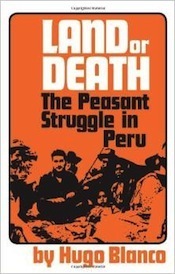
QS: In “Land or Death: The Peasant Struggle in Peru” you talk about your “syndicalist deviation” and failure to build the Party. In more recent writings you express opposition to all forms of vanguardism. This is a two part question: Tell us about how your ideas about organization have changed. And what is the most appropriate form for revolutionary organization in the 21st century? You have said that “we must braid together internationally the defense of Mother Earth.”How?
HB:  The indigenous campesino struggle in the valleys of La Convencion and Lares was successful. Our slogan was “Land or Death!” We got the land. It was the first land reform in Peru, from 1961-1963 (the Velasco land reform was in 1971). It was the most complete. We didn’t leave a single handful of earth to the latifundistas, and didn’t pay them a cent. We struggled against the latifundistas, against the government, against the police and against the courts. It cost us lives and jail, but we were victorious.
At that time I thought it was a deficiency to not have built the party. But I don’t think so anymore. As the Zapatistas say, everyone will see in their time and place how to do things. If we believe we should build a party, we should do it, and if we don’t think it’s convenient, we shouldn’t. But if we construct a party, it must be the base of the party which commands, not the leaders. I repeat another Zapatista concept: Command by obeying (Mandar obedeciendo). I believe that in Peru today a party is not necessary. In other places it could be necessary.
How can we weave the defense of Mother Earth together internationally? From August 4-8th, we were occupied with this question in Cajamarca. There was an international gathering in defense of water. There were people form Colombia, Argentina, Chile, Mexico, France, Basque Country, Cataluna, and Holland. After the debates we constituted an international network, and thousands of us walked to visit the lakes (at an altitude of 4000 meters) which the Conga mining project (that has the government, parliament, courts, police and the big media as its servants) is trying to destroy. There is also another smaller and more condensed international network, with many points of view in common, which I am part of.
QS: You have written extensively about the Zapatistas. Other former guerrilas like Raquel Guitérrez Aguilar have written about how the Zapatista uprising in 1994 was a personal and political turning point for them. Was it the same for you? What’s the relationship between Zapatismo and ecosocialism? Can we say that Zapatistas are ecosocialists, even if not all ecosocialists are Zapatistas?
HB:  The Zapatistas are the best socialists I have met, with their seven principles of commanding by obeying. In the Zapatista territories, they elect not individual authorities, but groups, who are replaced after a short time. No authority at any level ever gains a cent. They are ecologists; they eat the food they grow themselves, and they don’t use agrochemicals or GMOs. They are ecosocialists even though they don’t use the term.
QS: People all over the world see South America has a region of hope for revolutionary change. Is there promise in Venezuela’s adoption of ecosocialism as official government policy? You have written about how the indigenous peoples of South America are often fighting against ‘Socialism of the 21st century’. But we also can’t deny that indigenous peoples have more rights and recognition under these current regimes than ever before.
HB: We give energetic support to the “progressive” governments of South America in their rising up against North American imperialism and against internal reaction. But we fight them when they attack indigenous peoples, when they capitulate to the transnationals, or when they attack democracy. I cite some examples of “Socialism of the 21st Century”:
VENEZUELA: The indigenous Yukpa people have been trampled with the invasion of their lands by capitalist cattle ranchers. They have complained repeatedly throughout the era of Chavez, and were never given attention. An assassin hired by the ranchers killed their implacable leader Sabino Romero three days before the death of Chavez. The Bolivarian army protected the assassin’s flight. The indigenous Wayu people near the border with Colombia are also treated as hostile by the army. On paper it may call itself ecosocialist. I pay attention to what they do, not what they say.
BOLIVIA: The indigenous peoples have had a long struggle against Morales, who tried to open a highway through Tipnis, trampling indigenous populations and natural reserves. The government used police aggression in repressing the protests. Other popular sectors supported their struggle, until the government had to retreat. They have put forward a mining law which favors corporations without consulting the mostly indigenous farmers.
ECUADOR: . In the Ecuadorian constitution the rights of Mother Earth are considered, but in practice they promote their depredation. Correa is trying to impose mining in Cabecera de Cuenca, like the Conga project in Quimsacocha (Tres Lagunas). The indigenous people took me to the lakes, where we made offerings. Ecuador is also trying to exploit the oil in the natural reserve and indigenous territory of Yasuni, against the will of the majority of the country.
Of the other countries we’ll mention only few things:
BRAZIL: Even though it has a constitutional mandate, the government refuses to give titles of land possession to indigenous peoples, favoring the usurpation of their territories by agribusiness, as it destroys the Amazon rainforest.
URUGUAY: Has approved a predatory mining law.
ARGENTINA: Is promoting Yankee fracking against the persistent resistance of the Mapuche people.
In this revolutionary intransigence of not reconciling with capitulation, and being against opportunism, one could say that I continue to be a “Marxist-Leninist-Trotskist,” even though I don’t identify myself that way anymore.
QS: You seem to be ambivalent about the term “ecosocialism”. You have written that “in South America we cannot use the term ‘eco-socialist’,” but also you have written many things in favor of ecosocialism. In 2009 in Belem, you began to call yourself an ecosocialist. Tell us how you came to this, how it emerged from your earlier experience and political philosophies, and how do you see it developing locally and internationally in the century to come?
HB: Of course I am an ecosocialist, as are the indigenous peoples, even though they don’t use the term. I believe along with indigenous peoples that it is the collective which rules, not the individual. The indigenous peoples and I defend Mother Nature, water, and forests, so we are ecologists.
What I have said is that the word “socialist” has been prostituted. By Michelle Bachelet, who used in her first government a Pinochet “anti-terrorist” law against the Mapuche people, and by the governments of so-called “21st Century Socialism” in the anti-indigenous cases mentioned above. And in the so-called “First World” the term “socialist” has been used by Tony Blair, invader of Iraq, by José Zapatero in Spain, to implant neoliberalism, and now the neoliberal government of France as well calls itself “socialist.”
I don’t have any ambivalence: I consider myself an ecosocialist, and I repeat, I believe that the indigenous peoples of the world are struggling and dying for their ecosocialist conviction, even though they don’t use the term. 
QS: Ecosocialism is a relatively new revolutionary ideology and worldview, even as it draws on ancient roots. Having participated in and witnessed almost a century of the development of other revolutionary ideologies, how would you advise ecosocialists to think, work and organize themselves? What are some pitfalls to avoid, obstacles to overcome, horizons to aim for, visions to dream of?
HB: Earlier I indicated that I don’t believe in “the correct line.” I don’t consider myself “the vanguard”, and I don’t even believe in it. I am about 80 years old, and when I was young I enjoyed learning from the elders. Now that I am an elder I enjoy learning from the young and from children. This is not an ingenuous turn of phrase, it is the truth. We elders have a lot in our memory, and we consciously or unconsciously return to it to find solutions to current problems. The young person confronts the problems of their times spontaneously. It’s very possible that they’ll be right and I’ll be wrong.
With that said, I’ll give my opinions: We are struggling against the large transnational corporations that govern the world. We know that their sacred principle, which they will sacrifice any other consideration in order to fulfill, is “to gain more money in as little time as possible.”They know very well that the attack against nature to gain more money will carry us to extinction, but this is much less important than the fulfillment of their sacred principle.
This is the true morality of the system. Derived from this is the ultra individualism which the system teaches us, even though it doesn’t say so clearly: If you can take your brother’s inheritance, do it. The sooner your parents die, the better; you’ll get the inheritance. You should the best,the victor; in order to ascend you have to crush the heads of others. Bullying is the beginning of the moral apprenticeship of this system; it does not exist among indigenous peoples (and for those who are interested, look up “Ubuntu” on the internet.)
We know that these transnational corporations have at their service the governments of the world, the parliamentary majorities, the armies, the police, the judicial powers, the supreme courts, and the means of communication. There are governments who resist a little because of pressure from below; they make a fuss, but in the end they capitulate.
It is against this that we must struggle, in defense of nature, of humanity and its survival. Our strength is that there are more of us below – if we awake and unite, the triumph will be ours. Let us join hands with those at the bottom of the whole world. We must be consistent in unmasking all the governments.
Our goal is that humanity governs itself, without bosses, without leaders. Loving, respecting, and caring for our Mother Nature. Everyone loving and respecting each other. You are my other I. Everyone in their time and place will see how to struggle. There can be organizations of local resistance, parties; provincial, national and international networks. “Wanderer, there is no path – the path is made by walking.”

The Battle of Palmyra

Franklin Lamb

Office of the Director-General of Antiquities and Museums (DGAM), Damascus.
This observer has met dozens of Syrian patriots these past few years while traveling across this ancient crucible of civilization to chronicle Syria’s Endangered Heritage. Among them, two Syrians particularly stand out. They are Syria’s indefatigable Minister of Tourism Becher Riad Yazji and Dr. Maamoun Abdel-Karim, the General Director of Syria’s Directorate General of Antiquities and Museums (DGAM). I met with each of them again this past week, just as the Palmyra crisis was unfolding and both are indeed not only Syrian, but also international patriots, given their work–day and night– to preserve and protect the global heritage of all of us.
With respect to Dr. Abdel-Karim, who even knows when the gentleman last got some sleep, as he has become the international go-to source on the current fast moving and potentially catastrophic developments at Palmyra (Tadmor).  It is here, just 200 miles northeast of Damascus, and fewer than 20 miles from raging Da’ish (ISIS) fighters who have stunned the world and terrified the more than 70,000 citizens by invading eastern Homs.The jihadists are currently closing in on the UNESCO World Heritage site of Palmyra.
Islamic State members reportedly were driven out by Syrian forces on 5/16/2015. Soon after, five civilians were reportedly killed by an ISIS mortar strike near the National Museum of Palmyra and more than 350 fighters, from both sides of the continuing assault have been killed this past week.  On 5/18/2015 Brigadier General Haidar Ali Asaad, the head of the Syrian Palmyra military operations was reportedly killed, while defending Palmyra, once more raising fears about the fate of the ancient city’s archeological treasures.
Every 30 minutes Dr.Abdel-Karim seems to takean assessment call from staff at the Palmyra Museum, where this observer has spent time and was given tours last year of its breathtaking collection of antiquities, some having been recovered from looters, with the help of INTERPOL along with modest, but not enough, help from the neighboring governments of Lebanon, Turkey, Iraq and Jordon.
Just posted videos on the Protect Syrian Archeology website show the fighting on 5/15/2015 between the Da’ish and the Syrian army near the Citadel.  The day before, 5/14/2015, the UK Guardian presented a report showing ISIS jihadists at the gates of Palmyra, while the UKTelegraph published a series of high-resolution photos two days ago. According to the provincial governor, Talal Barazi, Da’ish has now brought up reinforcements from the Euphrates Valley to the east.
Da’ish has also carried out successive attacks on the outskirts of Palmyra, seizing full control of the town of Al-Sukhna that lies on the Palmyra-Deir Ezzor Highway 65 kilometers northeast of Palmyra and subsequently attacking Al-Sukhna, Al-Amiriyah, the Al-Amiriyah storehouses and dozens of checkpoints around Al-Sukhna, managing to take complete control of the towns within 10 hours, according to sources at the scene. In nearby Amriya, Da’ish is reported to have executed 23 family members of Syrian government workers on 5/16/2015 and the same source reports Da’ish executed 26 people in al Amriya and nearby al Sukhna on 5/14/2015. Both villages are about 45 miles (70 kilometers) northeast of Palmyra.
As of mid-afternoon 5/18/2015, the threatening situation at the archaeological site is eerily calm. For the moment.  A source at the scene reports that the Syrian military has forced ISIS militants to withdraw to the borders of the archaeological site and fighting is raging outside Palmyra with heavy artillery exchanges in the west of the town. Dr. Maamoun has just reported to us that ISIS has not entered the city yet, and added that “we hope these barbarians will never enter…if the militants make it to Palmyra, it will be a repetition of the barbarism and savagery which we saw in Nimrud, Hatra, and Mosul.  If that happens, a major chapter in Middle Eastern history and culture will be yet another casualty of this tragic conflict.
British historian Tom Holland describes the Palmyra site as “an extraordinary fusion of classical and Iranian influences intermixed with various Arab influences as well and the destruction of Palmyra wouldn’t just be a tragedy for Syria, it would be a loss for the entire world.” This is because Syria’s cultural heritage isn’t just about Middle Eastern history. Syria is a wellspring of the global culture of all of us. The consequences of its destruction could not be more ominous in terms of conservation and the identity of our specie.
syria-palmyra-ancient-afp
The ruins of Palmyra, the “Venice of the Sands”. Photo: AFP.
Palmyra, is known here as the ‘Venice of the Sands”, an appellation applied by Thomas Edward Lawrence and others because like Venice, this magnificent city formed the hub of a vast trade network, only with the desert being its sea and camels its ships.   Among the massive ruins at Palmyra this observer was shown a plaque taken from T.E. Lawrence’s autobiography, The Seven Pillars of Wisdom where the archeologist-soldier wrote:  “Nothing in this scorching, desolate land could look so refreshing.”
Crime novelist Agatha Christie, who accompanied her archaeologist husband, Max Mallowan to the site, called Palmyra “lovely and fantastic and unbelievable.” And so it is–as of this afternoon (5/18/2015). But another world wonder may well be on the brink of destruction. Palmyra is in the crosshairs of militants fighting with the self-proclaimed Islamic State who three months ago severely damaged archeological sites at Nimrud and Hatra across the border in Iraq.
Da’ish and like-minded jihadists deny that their destruction of archeological sites in this region are acts of vandalism or terrorism.  Rather, they argue that what they are doing is honorable religiously. It is obligatory “idol destruction.” In a recent article in its online magazineDabiq, it is claimed that archeological sites like Palmyra must not be excavated and restored, but rather viewed with “disgust and hatred” and destroyed because they are pre-Islamic. ISIS propaganda claims the Islamist militants should be supported, even praised, for destroying idols or false gods and that their ‘work’ with bulldozers and jackhammers are following in the footsteps of the Prophet Mohammed, who smashed pagan statues in Mecca.
Among the greatest architectural monuments at the Palmyra site endangered at this hour is a wide, colonnaded street over half a mile long and the Temple of Baal, as well as a theater and the Agora. In addition, a Roman aqueduct and huge necropolises are on the outskirts.
According to UNESCO, “From the first to the second century, the art and architecture of Palmyra, standing at the crossroads of several civilizations, married Greco-Roman techniques with local traditions and Persian influences.” The site “represents an irreplaceable treasure for the Syrian people and for the world,” UNESCO Director-General Irina Bokova said on 5/15/2015. “I appeal to all parties to protect Palmyra and make every effort to prevent its destruction.” The site has already suffered four years of conflict; it suffered from looting and represents an irreplaceable treasure for the Syrian people and for the world.”
A major watering hole and the resting place for merchants’ caravans on the old Silk Road, the trade route linked China and the Mediterranean. Palmyra grew rich levying tolls on traders passing through with spices and silks and slaves that it became known as the Bride of the Desert. But right now, today, yet another world wonder in Syria is on the brink of destruction.
Why Palmyra, matters
Palmyra is perhaps the last place anyone would expect to find a forest of stone columns and arches, according to Kevin Butcher, Professor in the Department of Classics and Ancient History at the University of Warwick and a specialist in the Roman Near East, “Travelers in the 17th and 18th centuries were repeatedly astonished by what they saw: a vast field of ruins in the middle of the Syrian desert, roughly half-way between the Mediterranean coast and the valley of the River Euphrates.”
As noted above, the main reason for the site’s prosperity is that ancient Palmyra sits at the edge of an oasis of date palms and gardens.  It was a vital watering place on a trade route from the east and its very name “Palmyra” refers to the date palms that still cover much of the area. Its Semitic name, Tadmor, is a derivation from tamar, meaning “date palm.”
According to Professor Butcher, from modest beginnings in the 1st Century BC, Palmyra gradually rose to prominence under the aegis of Rome until, during the 3rd Century AD, the city’s rulers challenged Roman power and created an empire of their own that stretched from Turkey to Egypt. Palmyra was a thriving trade hub to rival any city in the Roman Empire its remains, including the ancient theater, drew thousands of tourists annually before March 2011.
Locals speak proudly about Palmyra’s Queen Zenobia, and this observer has met more than one young lady whose parents gave them her name. Zenobia fought against the Roman Emperor and also defeated the invading Persians. In the middle of the third century, when the Sasanians invaded the Roman Empire and captured the Emperor Valerian, it was the Palmyrenes who defeated them and drove them back across the Euphrates. In the context of today’s regional Geo-politics Zenobia takes on added symbolism.
Palmyra was a great Middle Eastern achievement, and was unlike any other city of the Roman Empire. It was simply unique, culturally and artistically. In other cities the landed elites normally controlled affairs, whereas in Palmyra a merchant class dominated the political life, and the Palmyrenes specialized in protecting merchant caravans crossing the desert. This observer has been honored to examine the well-preserved remains of edifices, such as the great sanctuary of the Palmyrene Gods, the Temple of Bael), a grand colonnaded street and a theater which as of today, still stands.
Palmyra has its own unique identity. The Palmyrenes were proud to adorn their buildings with monumental writing in their own Semitic script and language rather than relying exclusively on Greek or Latin that was used elsewhere in the empire. As Professor Butcher instructs us, Palmyra developed its own artistic style, and its own take on Classical architecture. Decorative patterns on its buildings and its inhabitants’ styles of dress speak of widespread connections with east and west. Chinese silks have been found adorning mummies in Palmyrene tombs. Theirs was a cosmopolitan culture with an international outlook. Only small parts of the site have so far been excavated. Most of the archaeology lies just beneath the surface rather than deeply buried, and it is particularly vulnerable to looting. While gazing at the Temple of Bael some while back, this observer’s military escort pointed to a shovel and told me if I were to dig “anywhere around here” as he swept the horizon with his outstretched arm, I would find priceless treasures.  Archeologists have only scratched the surface of the great expanse of Palmyra.
The next few days will be a test for world powers, a chance to take action before the crime against humanity is allowed to happen. The global community must take the decision without further delay to protect and preserve Syria’s and all of ours shared global heritage.
Some of what can and must be done immediately:
All political and religious leaders in the region must stand up and remind the world that there is absolutely no political or religious justification for the destruction of humanity’s cultural heritage at Palmyra or anywhere else.
A late report from Washington has it that U.S. President Barack Obama is considering an NSA recommendation that Special Forces “boots on the ground” at least be discussed and that the US may direct its war against Da’ish to save Palmyra. Some argue that what US forces did in Baghdad, standing idle and watching as the National Museum was looted must not be allowed again in Syria.  While US forces on the ground would likely be widely opposed and is in fact unnecessary,  to date the government of Syria and its regional allies have not challenged the US led air strikes against Da’ish, neither in both Syria nor in Iraq. These strikes should for a limited period of one week and under UN control and used on a limited basis solely to stop the Jihadists from destroying this irreplaceable cultural heritage site.
There exists ample international customary law and international conventions in force, including Chapter 7 of the UN Charter that allows and even calls for action on the facts of the Palmyra emergency. The UN Security Council has the resources and the responsibility to act and its 15 member states must not veto a resolution that is expected to be submitted this coming week to save Palmyra.
The people and officials of Syria are doing their part.  It remains for the rest of us to join with them and do ours.

Men Gone Mad

David Macaray

It has long been said (maybe the renowned sociologist Vance Packard said it first) that Madison Avenue’s advertising campaigns pivot around man’s conscious or subconscious fears. Fear is the catalyst. Indeed, man’s fears, insecurities and regrets are what make possible the Art of the Sale.
Examples of fertile ground: The fear of not fitting in, the fear of missing out, the fear of driving an unworthy car, the fear of drinking an uncool beer, the fear of municipal drinking water, the fear of emitting “morning breath,” the fear of vaginas smelling like, well, vaginas. You name it, and a sharp-eyed marketer will find a way of making it scary.
Marketers, advertisers, and elected officials (arguably, themselves a species of “marketer”) not only exploit a human being’s core fears, they are devoted to inventing new fears—lurid fears, subversive fears, abstract fears—in order to manipulate us. After all, nothing motivates people more than fear, and voters need to be manipulated every bit as much as consumers do.
Not to put too fine a point on it, but politicians and the media have basically conditioned us to be afraid of everything: Young black men, skinheads, hippies, China, immigrants, socialists, Halloween candy, trans fats, transsexuals, melting glaciers, inflation, unemployment, labor unions, taxes, nudists, Moslems, having our identity stolen, and the prospect of living an “unfulfilled” life.
Indeed, compared to all the insidious and potentially fearful mind-fucks out there, a person with a morbid fear of spiders seems almost refreshing.
I took a philosophy class once where we discussed the concept of fear. We examined it from an epistemological, psychological and physiological point of view. We also sought to compare and contrast modern man’s fears with those of the “cavemen,” asking ourselves, among other things, who had the most fears—those primitive archetypes or us.
Needless to say, it was no contest. Our prehistoric ancestors were afraid of very little, maybe five or six things, tops. Cavemen feared being attacked by wild animals, starving to death, freezing to death, being beaten to death by a stronger caveman, and falling into a river and drowning. That was pretty much it. The fear of being ridiculed behind their back for wearing an unattractive animal pelt didn’t even move the needle.
So what does this comparison tell us about human progress? Yes, modern man invented Science, Technology, Aesthetics, Philosophy and Mathematics, and yes, we put a man on the moon, and yes, we cured small pox, and yes, people now live more than twice as long as the cavemen did.
But despite those achievements, modern man has to acknowledge that at any given point in time there are about 300 things out there that frighten us. It’s true. When we contemplate it, we realize that most of the time we’re walking around scared shitless. And how does that revealing bit of self-knowledge make us feel? Naturally, it scares us.

Africa Embraces Green Economy

Achim Steiner


This is a clear signal of continent-wide political will to accelerate the transition to a green economy. At a country level - from Rwanda to Ghana, from Morocco to South Africa, from Senegal to Kenya - the level of innovation and commitment to sustainable economic growth is remarkable.Africa is poised to become the frontline of a global transition to more-inclusive green economies. African Ministers of Environment endorsed the green economy at the recent African Ministerial Conference on the Environment in Cairo, acknowledging that the "green economy can be a vehicle to achieve all 17 draft sustainable development goals."
In Kenya, for example, the government will soon launch its Green Economy Strategy and Implementation Plan (GESIP), which lays out how Kenya can increase investment in the green economy. This is simple economic sense. Investing in the green economy provides opportunities to boost growth, address poverty, create employment and improve the overall well-being of the population.
In Kenya alone, a shift in investment to green sectors would lead to an additional 3.1 million people being lifted out of poverty by 2030, and gross domestic product (GDP) 12 per cent higher than under a business-as-usual scenario.
Green investments also improve agricultural yields, on which the majority of African citizens still depend. Agriculture remains the dominant sector of the African economy - accounting for 32 per cent of GDP and supporting the livelihoods of 80 per cent of Africa's population. In Senegal, for example, the amount of arable land available will increase by 5 per cent if investments in sustainable agriculture are made.
Wealth Accounting
Africa's economy is growing fast. The World Bank estimates that growth in sub-Saharan Africa will hit 5.1 per cent by 2017. But the challenge before today's leaders is to ensure that this expansion does not come at the expense of the natural resources upon which the continent so heavily depends.
Natural capital is a critical asset, but such resources are often left out of balance sheets, meaning they are not accounted for in development processes - despite the economic value they bring and the many livelihoods and businesses they support.
For example, a recent UNEP study found that Zambia's forest ecosystems contribute $1.3 billion, roughly 6.3 per cent of GDP, to the national economy - almost double previous estimates thanks to the inclusion of value-adds such as water regulation, carbon storage and pollination. Evidence elsewhere shows that conserving natural capital creates jobs - crucial in Africa where an estimated 11 million youth are expected to join the labour market every year. Since 1995, an estimated 486,000 work opportunities were created in South Africa in environmental rehabilitation programs, including sustainable forest management and reducing invasive species.
Renewable Energy
Part of Africa's growth strategy must also involve bringing energy to all of its citizens. Over 1.2 billion people don't have access to electricity, almost half of them in Africa. As a result, many rely on wood or other biomass to cook and heat their homes, causing millions of deaths each year from indoor air pollution.
To ensure people are not left behind, we need to provide them with access to clean, reliable and efficient energy - which of course brings the co-benefit of reduced carbon emissions and pollution. In that regard, it is encouraging to note that investment in a low-carbon future is on the rise.
In 2014, we saw a US$270 billion surge in investment, up 17 per cent on the previous year, according to the most recent Global Trends in Renewable Energy Investment report from the Frankfurt School UNEP Centre and Bloomberg New Energy Finance. In developing countries, clean energy investment rose 36 per cent to US$131 billion, on track to surpass investment in developed countries.
I am delighted to note that Kenya is a major player in this shift to sustainable energy sources, with the government and private sector pursuing opportunities in geothermal, solar and wind. Another example can be found in Ghana, where the Renewable Energy Fund is a successful illustration of resource mobilization for the promotion of renewable energy sources. Ghana is now building Africa's largest solar PV plant.
Renewable energy also creates employment, as can be seen in Senegal - where investments in expanding solar and wind capacity are projected to create up to 30,000 additional jobs by 2035. This trend in growth of renewable energy is one we at UNEP support through initiatives such as the Seed Capital Assistance Facility, and I look forward to seeing further investment around the continent.
Cities
Another vital element of the green economy transition lies within cities. Africa's urban population was 41 per cent in 2012. But by 2035, around half of all its citizens will live in cities as the population approaches the two-billion mark.This is, of course, a challenge. But it is also a major opportunity. Cities have agglomeration benefits that drive innovation, business development and job creation. What matters are innovative and integrated approaches, and the way cities are designed and managed.
For example, huge opportunities exist in energy-efficient buildings and lighting. According to a 2014 study by UNEP's Finance Initiative (UNEP FI), energy-efficient buildings can deliver up to 20 per cent reductions in energy consumption and provide overall better market value for investors. Equally, a global switch to efficient on-grid and off-grid lighting would save more than US$140 billion and reduce CO2 emissions by 580 million tonnes every year.
Possibilities also exist in transport. With spending on transport infrastructure growing at an unprecedented rate across Africa, policymakers have a window of opportunity to mitigate climate change threats and ensure the health and well-being of millions of Africans by introducing clean and efficient transportation. In this regard, the Africa Sustainable Transport Forum, held in Nairobi last October, was an important step in the right direction.
The Adaptation Challenge
It is also important to focus our minds on the challenges the continent faces - chief among them climate change. Regardless of what the international community does this year in Paris, some impacts of climate change have already become unavoidable. Africa is, unfortunately, set to bear the brunt of such impacts.
By 2050, Africa's adaptation costs could rise to US$50 billion per year if global warming were to remain below 2°C, and up to US$100 billion per year if the global temperature rise were more than 4°C by 2100. This would have a severe impact on agricultural production, food security, human health and water availability - and undermine the sustainable development agenda. In Burkina Faso, for example, changes in rainfall patterns and temperatures could affect up to 30 per cent of agricultural production.
The evidence suggests that African countries - such as Ghana, Ethiopia and South Africa - are already committing resources of their own to adaptation efforts. However, international funding will be required to bridge the growing gap.
Financing
The need for financing is not limited to the climate, however. Enormous public and private investment is required for the transition to a low-carbon economy, to win the global fight against poverty and disease, and to provide high-quality education and physical infrastructure worldwide.
Indicative figures show the required additional investment flows into sustainable development will be in the range of 1 to 2.5 per cent of GDP per year from 2010 to 2050. Currently, investments in sustainable development are well below 1 per cent of global GDP.
A significant change across the world's financial system in strategy, culture and approach will be required if capital and finance are to be reallocated to accelerate the emergence of a green economy - which is why UNEP launched the Inquiry into the Design of a Sustainable Financial System.
The Inquiry, due to present its findings in October of this year, aims to engage, inform and guide policy makers, financial market actors and other stakeholders concerned with the health of the financial system and its potential for shaping the future economy.
Achieving a financial system that finances a green economy is dependent on working with all segments of the finance industry, and on bridging the dialogue gap between private finance and public stakeholders. UNEP FI is a good example of such effective partnerships. UNEP FI has 20 financial members in seven African countries, including South Africa, Kenya, Nigeria and Morocco.
Independently, several countries, such as Ethiopia, Rwanda and Mozambique, have established, or are looking to establish, special national funds to finance the implementation of their respective Green Economy Strategies. The Government of South Africa has set up a Green Fund to provide catalytic finance to facilitate investment in green initiatives - this includes funding green economy project initiation and development, research and development, and capacity-building initiatives.
This is just the beginning of what I hope will be a global move to the catalyzing the finance we need, but money doesn't solve everything. Only when coupled with sound regulatory frameworks and appropriate pricing and incentives, and only when sustainability is mainstreamed in national development planning processes, will green economy investments achieve their full potential.
In conclusion, governments across Africa are formulating green economy strategies. These strategies are already driving growth, employment and trade opportunities, as well as reducing natural risks. UNEP will be working with a wider range of stakeholders, most notably under the Partnership for Action on Green Economy (PAGE), to assist governments in developing and boosting these strategies. Four African countries are already working with PAGE - Ghana, Senegal, Mauritius and Burkina Faso - and we look forward to more. In addition, UNEP is working with the African Development Bank (AfDB) in countries such as Kenya and Mozambique. The AfDB has anchored green growth in its 10-Year Strategic plan, and established a cross-departmental Green Growth team.
With initiatives such as the above and the 3GF in place, political will to act growing ever stronger, a wealth of opportunities to draw upon, and more and more partners coming on board, Africa's growth trajectory is undoubtedly set to go green.

Political Trajectory: Which Way for Burundi?

David-Ngendo Tshimba


A coup d’état attempt was launched in Burundi’s capital city Bujumbura in a bid to overthrow President Pierre Nkurunziza—who was attending an urgently scheduled East African Summit in Dar es Salaam, Tanzania—amid unrest over his bid to be re-elected to a third term. Thousands of people in Bujumbura, it is reported, poured into the streets of Bujumbura by the afternoon of Wednesday 13 May 2015 following the announcement by Major General Godefroid Niyombare. At any rate and if unfolding media reports are anything to go by, the coup outcome is far from clear. Whether foiled or not, it is certain that huge uncertainties loom ahead of Burundi’s political future.
Recapitulation of last year’s events
In the aftermath of the decade-long bloody civil war and following prolonged political negotiations from Kigobe and Kajaga (Burundi) through San Egidio (Italy) and Sun City (South Africa) to Mwanza and Arusha (Tanzania), Burundians adopted a Constitution which requires a two thirds majority for the passing of any bill tabled in the Parliament. This was ingeniously adopted to avoid the excess of power by simple majority rule and to bring the ruling party to exercise its power in concert with the Opposition.
By end of year 2014, contrary to what members from the ruling party CNDD-FDD considered with regard to the amendment of some provisions in the current Constitution to allow for the candidature the incumbent President in the forthcoming general elections, members of the political opposition as well as civil society underscored that if anything in the Constitution were to change, this should be done by not simply relegating  the matter to the National Assembly (where the ruling party holds majority of seats) but rather by  engaging with all stakeholders in the public life, including members of the political opposition and civil society.
Then, Burundi’s former President, Senator Domitien Ndayizeye, murmured that any proposal of amendment of Article 299 of the present-day Burundian Constitution—in a bid to secure a third presidential term for incumbent President Pierre Nkurunziza—would have far-reaching repercussions on efforts for the rebuilding of the political as well as socio-economic tissues of a society recovering from a gloomy past. This, Senator Ndayizeye further stated, could negatively affect the yet fragile social cohesion and so negatively impact on national security, to the extent of spilling over neighbouring countries.
As the year 2014 drew to its close, Burundian political party leaders, under the auspices of the First Vice President of the Republic, Bernard Busokoza, gathered at the Royal Palace hotel to proceed with a first evaluation of the implementation of the roadmap for the 2015 elections as well as iron out challenges to its full realization. This roadmap was adopted by consensus at a workshop on the electoral process in Burundi, organised by the Government of Burundi in concert with the Burundi United Nations Bureau (BNUB) from the 11th to the 13th day of March 2013 in Bujumbura. It was hoped that this gathering would allow Burundi’s key political actors to take stock of the implementation of the roadmap thus far as well as identify challenges and opportunities to strengthen the dialogue and democratic culture in Burundi, and so contribute to the creation of a conducive environment for free, fair, inclusive and peaceful elections in 2015. The said roadmap contained general principles and recommendations around four theme, namely; the legal framework for the elections; an enabling environment; electoral management and conduct; and the monitoring mechanism.
History seems to be repeating itself in Burundi after a decade of fragile, hard-won social peace following the signing of the 2000 Arusha Accord. Is the Burundian political elite designing a scenario akin to that of 1993 through such (in)famous roadmap to the 2015 general elections? The unfolding political bickering in the country seems to work against the avoidance of violence in the upcoming 2015 elections, if at all the latter would ever take place. For now, things remain convoluted.
Beyond the incumbency of President Nkurunziza
For a country previously devastated by political violence at a large scale, reducing all political stakes to electioneering by arguing for the right of the candidature of the incumbent president may simply be akin to granting a pain-killer to a patient in urgent need of surgery just as arguing for the utter exclusion of the candidature of the incumbent president at the expense of ‘new comers’ in the search for presidency may be synonymous with placing temporary bandages to a fractured limb. Systemic reforms of the state previously embroiled by political violence seems to be the commensurate dose in curing Burundi’s political ills in a much more rewarding manner.
In the context of post-transition Burundi, the questions of redistribution of land and that of full reintegration of previously exiled populations—whether civilian or armed—have come to the fore of the post-violence debate in the country. More vital, land is access to livelihoods; it allows for the bringing together of family structures that represents a vital coping mechanism in a context of extreme poverty; it symbolises connection with the past, with history, a reaffirmation of identity; and its equitable distribution represents hope for sustainable peace. What is even more critically important to reckon with is the fact that in such a small country with a big population whose livelihoods emanate from farming and livestock, land is in chronically short supply. Therefore, daunting as it may be, addressing current demands on land with the return of approximately half a million people in a way that is simultaneously equitable and feasible is critical to the long-term stability of Burundi.
In the final analysis, whereas the signing of the Arusha Accords as a pact for political justice does still represent a necessary and respectable step in Burundi’s nation-building process, the aspirations found in these Accords would never yield any positive results in the Burundian society unless they faithfully resonate with the deep-seated wishes for capabilities and functionings of local populations, most notably those from the new younger generation. On the one hand, a long events-filled history of conflict, ethnic politicisation and polarisation, authoritarian rule, a decade of civil war, and growing impoverishment will continue to be appended to the reflection of the Burundian reality.
On the other hand, power-sharing arrangements, democratic elections, peace agreements, demobilisation, and an infusion of development aid constitute another reflection of the Burundian reality. What lies in between, Peter Uvin in his latest book on Burundi’s contemporary political history (2009) rightly argues, is a generation of young people raised during times of mass violence (massacres, forced displacements or a brutal civil war) with years of education lost, hearts traumatized, and possessions lost. Some have fought, some have fled, some have stayed, but all have faced dramatically limited opportunities. Yet, these young adults who came of age during the war now represent the future of Burundi. The availability of jobs in a context of severe economic scarcity remains a crucial challenge that any ruling government will have to face—now and the coming future.
Allegorically, to conclude, if some people suffer from inherited diseases, Burundi too suffers from its inherited history. But if molecular biology has come to provide some sparks of hopes for the cure of inherited diseases, only social and economic justice may be the most promising cure for past political violence. 

US Dollar Hammers Uganda Shilling

 Enock Nyorekwa Twinoburyo


On the 13 may 2015, I attended an IMF presentation on the Regional economic outlook for the Sub Saharan Africa, including Uganda. The presentation indicated a very sound economic environment for Uganda with growth poised to increase to 5.4% in 2015 from the 4.9% in 2014. This compares favourably to the Sub Saharan Africa average of 4.5% and world average of 3.5% in 2015. Inflation remains below the medium term target of 5%, with annual core inflation for the year ending April 2015 at 4.6%, compared to 3.7% that was recorded in March 2015. Inflation is expected to increase in the coming months largely on account of the exchange rate depreciation, which is estimated to have a 40% pass through into inflation. The medium term inflation risks are in part demonstrated by the increase of the Central Bank Rate (CBR) to 12% in April monetary statement from 11%, the latter having remained unchanged since June 2014.

The Uganda exchange rate to the dollar has depreciated by 20% between June 2014 and March 2015, compared to Rwanda (6%), Kenya (10%), Ghana (30%), Angola (12%), Mauritius (18%),Cote de Ivoire (23%), Nigeria (24%),South Africa (16%),Senegal (23%) and Zambia (13%).  As of end march, 2015, the US dollar had strengthened by 28% against the the Euro, 18% against the Japanese yen, 12% against the South African Rand, and 11% against the British pound on year on year basis. Bank of Uganda recent intervention to smoothen the exchange rate volatility has come at the cost of the dwindling foreign exchange reserves estimated at USD 2.7 Billion as of end march 2015 (or 3.5 months of next year's import), the lowest in the last 3 years.
The strength of the dollar withstanding, there are a number of the factors that indicate the Uganda shilling may depreciate further. The guest speaker at the very conference Prof Balunywa (also a former Bank of Uganda board member)  intimated the depreciation may reach UGX 3500 to the dollar by June next year.  First the exchange rate has been on a downward spiral over the last decade, in particular depreciating from UGX/USD 1750 in January 2007 to a record low of UGX 3000 in March 2015, and has since oscillated around that bound even with the Central bank intervention. 
In 2011, there was a heightened depreciation of the shilling, in part on account of the election related fiscal slippages and increased money supply. It is projected that money supply will grow at higher rate of 17.5% in both FY 2014/15 and 2015/16 compared to 6.7% in FY 2012/13.  On account that the recent supplementary budget was largely recurrent, and funded in part by re allocations, it is arguable that the recurrent budget will account for more than 50% of the budget and a similar trend could be exhibited with the expansionary 2015/16 budget, as was in previous election years.
There is bi causality between the exchange rate and the current account (difference largely between exports and imports) - implying the shilling depreciation would spur more exports and reduce imports on account of relative respective prices. On the other hand, the widening current account deficit would have a weakening effect on the shilling. While the statistics show that Ugandan current account deficit has eased, it remains a sizeable share of GDP and susceptible to worsen, which leaves exchange rate vulnerable. The export basket remains narrow and is dominated by primary products, including coffee, fish, tobacco, gold, and flowers. The dismal growth in the Eurozone, suspension of vegetables to the Europe, conflict in South Sudan and Burundi should have a fair share impact on foreign exchange earnings through exports and remittances as well as aid transfers. The import bill will likely increase on account of the large import bill associated with large infrastructure projects.
There are a number of other factors inter alia, the increased visa fees impact on tourism, the envisaged slowdown in foreign direct investments due to the dwindling oil prices; election downward risks, and the US recovery. The periphery bound foreign exchange reserves will arguably compromise the credibility of central bank to stabilise the rate against volatility.
By and large, the increased dollarization of economy, with foreign deposits at UGX 4.578 trillion in March 2015 accounting for 36% of the total deposits from 33% in June 2014, is indicative of the increased preference of the dollar by key economic players. Against the backdrop of factors highlighted, taking a short position in dollar may be potentially lucrative. Given the exchange rate follows a random (volatile) walk; take my conclusion with a pinch of salt.

Africans Celebrate Efforts-- Not Outcomes

 Ejike E. Okpa


The Global Green Development Group is happy to announce the opening registration for the 3rd Annual African Global Economic & Development Summit 2015, also known as the AGED Summit to be held in Los Angeles at the University of Southern California (USC) this August. This event is expected to connect the entrepreneur and business communities to the opportunities and growth potential of the African Continent as well as  bring countries from all over Africa to California to showcase their trade ready projects that are in need of technical and investment partners.
I like to know what has come of the Africa’s Pupils, Prime Ministers and Presidents who came to Washington DC in August 2014, to meet President Obama. As the largest gathering of such odd fellows in DC history, who came for jamboree and opportunity to shake hands with Obama, and the loose initiative surrounding Power Africa Initiative, yet to be funded, what will this ‘2-by-4’ gathering do differently?

Africans celebrate Efforts not OUTCOMES.

To appease the unsuspecting onlookers, one is bombarded with rates of growth in most African countries – impressive all things considered. To that I say, thank God for statistics for what they show. But my God! What about what they do not reveal? A visit to these countries with glowing growth rates reveals conditions unfit for the 21st century; no water supply, no power and of course, the sewer system is something hardly seen as necessary. The absence of sewer and reliable water supply systems is why mosquitoes in Africa have a field day. The environment is breeding ground for malaria carrying mosquitoes.
Were efficient and dependable water supply systems to be the order, about 70% of the public health challenges in Africa would be made manageable. But no, they rather jump at the solutions that Bill Gates with his feel-good givers delivers: Mosquito Nets for Africa. It is like trying to contain a lion already out of the cage and ready to bite. Good luck with that! Advertorials keep coming to impress and attract vulture and money laundering investors out to make quick bucks and leave the locals more damaged.

Since the songs and dances about helping Africa, the continent is largely behind the A-ball, dangling and swinging from one continent to the other and accepting whatever anyone gives them or promises to give them. Africa will rather copy from ‘C’ countries – India, China, Israel, Russia, Pakistan, and so forth than devote energy and copy from ‘A’ countries. When one copies from a ‘C’ student’ will they end up ‘C’?, Heck no. They end up with ‘C-‘ or ‘H’ – Horrible. That is my prediction, and its unassailable.

In July, President Obama will make a trip to Kenya, in part to fulfill a desire so it is on record that he visited the land of his father while president -- but note, it is NOT a state visit. He will attend as a participant in a Summit. The Kenyans are ready to troop to the streets to welcome their Son as if the Messiah is coming with a mentality of Daniel Come to Justice. It makes one wonder if Africans are that excited because of another human being, whose presence hardly addresses their despondent situation and condition except for the ‘feel good.’
Investing in Africa is still a challenging proposition because some of the required fundamentals are not in place. Not minding that Africa has the highest numbers of Prime Ministers and Presidents than any other continents, these odd fellows are yet to understand how to leverage their number to make things happen for their dark continent. If number is a crucial factor in the game of politics, how come Africa is not leveraging that?

The quantity is definitely not QUALITY because when they come to the table, they are largely ignored or told: "Wait, we get to you when we have decided how to share the resources of your continent."  Given that the native Africans who migrated to all parts of the world are yet to emerge with any significant economic and political clout, they are not able to enable or orchestrate any policy and investment resources to reach the continent. Native Africans may have physically migrated but not mentally as their conduct and outlook is still like living in their various countries but enjoying just being present in their new land.

Hearing about all the remittances, in billions, making their way to Africa is more like water under a bridge – it flows in and out. Remittances are not resources the investment world tracks for development. They are consumer resources that find their way back to the countries of origin – to appease and please the recipients in the relative countries.They do nothing to trigger quantifiable economic development momentum.

I wish the organizers of the USC conference best of luck. But since they have no money of their own to invest in Africa, one thing absent is that in Economics: Money Attracts Itself while in Science, the opposite attracts. With that in mind, I resort to the old American saying using Missouri mantra – Show Me The Money. Equity attracts Debt, so that they tango and tangle to create resources to go after a deal.

Sub-Saharan Africans have no clue what Equity is and how to cultivate that. They rather have their hands out in a HELP and GIVE stance instead of INVEST and PARTNER with us stand.

I like to hear a counter.