23 May 2015

European Union’s “migrant mission”: War plans in a humanitarian cloak

Robert Stevens

The flood of desperate refugees seeking to escape carnage and war in North Africa and the Middle East continues to swell. On Wednesday alone, more than 900 migrants were rescued from three overcrowded boats en route from North Africa to Europe.
Nearly all survived, but just this year 2,000 refugees have died gruesome deaths trying to make the Mediterranean crossing and an estimated 5,000 have perished in the last 18 months. The highest death toll was the drowning of nearly 900 men, women and children off the coast of the Italian island of Lampedusa on April 19.
In response, the representatives of the imperialist powers shed crocodile tears. But this was only a cynical cover for the overarching militarist and colonialist strategy now being enacted.
The European Union (EU) is rapidly moving to further subordinate and plunder their former colonies, under the guise of “solving the refugee problem” and fighting human trafficking.
On May 18 the EU approved Operation EUNAVFOR Med. It will establish a naval force in the Mediterranean and in Libyan territorial waters backed up with fighter jet support, under the excuse of clamping down on people smugglers. The plan should properly be understood as a launching pad for a renewed military intervention in Libya and the rest of North Africa—and as an extension of ongoing operations in Iraq and Syria.
The mission statement allows for the destruction of boats operated by “smugglers.” Ships can be intercepted, seized or destroyed even when they are in Libyan coastal or international waters. Such military action would require the agreement of the United Nations Security Council.
The remit of EUNAVFOR goes far beyond its stated aim of finding and stopping boats used by people traffickers. A Guardian report of a 19-page strategy paper for the mission notes that ground operations may also be needed.
The document states, “A presence ashore might be envisaged if agreement was reached with relevant authorities.” It continues: “The operation would require a broad range of air, maritime and land capabilities. These could include: intelligence, surveillance and reconnaissance; boarding teams; patrol units (air and maritime); amphibious assets; destruction air, land and sea (sic), including special forces units.”
The paper refers to a possible “presence or tasks in the Libyan territory.” Land operations could include “action along the coast, in harbour or at anchor [against] smugglers’ assets and vessels before their use.”
This could result in significant casualties, with the planning document admitting: “Boarding operations against smugglers in the presence of migrants has a high risk of collateral damage including the loss of life.”
The Guardian leak gives the lie to Federica Mogherini, the EU’s chief foreign and security policy coordinator, who claimed, “We are not planning in any possible way a military intervention in Libya.”
Up to 10 EU countries have volunteered to take part in the campaign, including Italy, Britain, France and Spain. These countries are all opposed to taking in even a few thousand refugees. But they are united in staking out a place in what is in fact a war plan.
Any such operation would be sanctioned under Chapter VII of the United Nations Charter. In recent years Chapter VII has been used to sanction military interventions in Afghanistan, the Democratic Republic of Congo, Sierra Leone, Rwanda, Somalia, Haiti, Iraq and Libya itself.
In addition the EU is also prepared to invoke Article Five of the NATO Charter, mandating action by the entire alliance when any individual member or its armed forces come under attack. Such an attack is highly likely and could provide the imperialist powers with a suitable casus belli .
The document even warns of “militia and terrorist’ threats to the EU forces. It states, “The existence of heavy military armaments (including coastal artillery batteries) and military-capable militias present a robust threat to EU ships and aircraft operating in the vicinity.”
Under conditions of raging civil war in Libya, the EU powers are preparing to use this tragedy, one entirely of their own making, to justify a military invasion.
According to reports, the operation will be launched from the June 25 EU summit in Rome. In preparation, Mogherini has lobbied the UN Security Council for support. NATO has also offered its help if requested.
The filthy imperialist operation being planned is as cynical as it criminal. The fact that millions of refugees in North Africa and the Middle East have been uprooted from their homes, and are desperately fleeing the carnage they face is due to decades of imperialist wars and intrigues in the region.
The imperialist powers have entirely absolved themselves of any responsibility. Indeed it was only due to massive public outrage against what is essentially a policy of mass murder of thousands of refugees that the EU countries even put into place the token rescue plan now in operation.
On Thursday Reuters reported on a proposed new European Commission draft plan to relocate across the continent just 40,000 asylum seekers who have arrived by boat in Italy and Greece. Reuters noted that the tiny figure had been likely “set to guarantee acceptance after some EU states, notably France, had initially baulked at the idea of opening their doors to migrants.”
This follows last week’s announcement by the EU that it would take in just 20,000 asylum-seekers currently living outside the bloc. In Libya alone nearly two million refugees—more than a quarter of the population—have been forced to flee to Tunisia.
The drive to war and attacks on democratic rights, including the freedom of immigration, is being driven by the global crisis of capitalism. The struggle against war and its attendant evils must be led by the working class, the only class that has no interest in the maintenance of militarized borders, prison camps for desperate refugees, and the entire apparatus of repression that constitutes the nation-state.
The only way to prevent this drive to war is through the overthrow of the capitalist system, based on the perspective of uniting the working class internationally in the struggle for socialism. Central to this is the struggle for the United Socialist States of Europe, as part of a world socialist federation. This is the perspective advanced by the International Committee of the Fourth International.

Growing danger of landslides in Sri Lanka

Vijith Samarasinghe

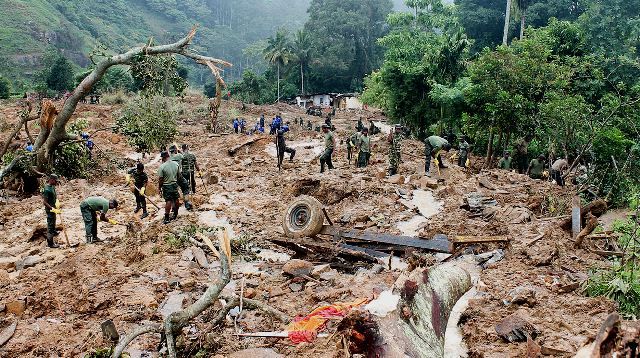
Government authorities are once again issuing landslide warnings as Sri Lanka’s central hills are being hit by heavy monsoon rains. On April 20, a massive landslide hit the Haldummulla area in the Badulla district, not far from last October’s Meeriyabedda disaster, one of the worst in Sri Lanka’s history.
The Meeriyabedda landslide claimed 37 lives, all of whom were tea plantation workers living in miserable line-room accommodation. Fortunately no one was killed at Haldummulla.
Aftermath of the Meeriyabedda landslide
Geoscientists have identified these areas as “high risk” for nearly 50 years, with the dangers facing these communities increasing each year. In fact, the number of deaths and property damaged caused by landslides is not confined to Sri Lanka’s mountainous central region but extends to the lower hills in the county’s south-western districts. According to the National Building Research Organisation (NBRO), about 500 deaths directly related to landslides have been recorded in the past 50 years.
In the immediate aftermath of last year’s Meeriyabedda disaster, the Rajapakse government attempted to blame the victims, claiming that the estate workers had been “given alternative land to build houses.”
The claim is false. The estate workers had not been properly warned and the Maskeliya Plantations Company, which manages the Meeriyabedda Estate, failed to take any precautionary measures.
Landslides, earthquakes, tsunami and storms are, of course, natural disasters but their impact can be minimised by scientific planning and preventative measures which have not been implemented by the plantation companies and successive Sri Lankan governments.
While Sri Lanka’s central mountains and south-western hilly regions are naturally landslide prone because of their geological characteristics and high monsoonal and inter-monsoonal rainfall, the growing incidence of landslides is bound up with the emergence of the plantation economy.
Reckless, unplanned land clearing for tea and other plantations by the British colonial administration permanently changed the drainage patterns and dramatically reduced vegetation cover, making far larger areas more vulnerable.
Total forest cover in Sri Lanka was slashed by 40 percent during the period of plantation expansion, from 1880 to 1950, with the largest impact on montane and sub-montane forests. By 1930, some 55 percent of the country’s mountainous watershed areas were cleared for tea plantations, causing an annual erosion rate of 100,000 to 800,000 tonnes of soil and heightening the danger of landslides.
Parallel to this land-degradation, the British plantation companies brought hundreds of thousands of workers from India as indentured labour accommodating them in landslide risk areas. At the same time, thousands of local people were displaced from their traditional land and forced to live high-risk areas.
The political disenfranchisement of estate workers of Indian origin under the Sri Lanka’s 1949 citizenship act ensured that the safety and conditions of estate workers and their families were ignored.
Thousands of plantation workers throughout Sri Lanka still live in unsafe, dilapidated line-rooms owned by major plantation companies. The estate homes destroyed in last year’s Meeriyabedda landslide were the property of the plantation giant Richard Peiris and Company (PLC), which recorded 35 billion rupees revenue in 2013 alone.
According to investigations by the Ministry of Environment and regulatory bodies such as the Geological Survey and Mines Bureau, unplanned gem mining, urbanisation and intense small holder agriculture in the upper-watersheds have increased risks in the past three decades.
Global climate change is also exacerbating the situation. A report by the Sri Lanka Climate Change Secretariat’s 2nd National Communication notes that overall dry periods are now longer, while rainfall intensity during wet season has increased. These changes weaken hill slopes. The report partly attributes the increase of landslides in Sri Lanka—600 landslides were recorded between 2000 and 2010—to climate change.
A 2008 report by the NBRO senior scientist Sunil Jayaweera explains that the scientific planning of settlements and proper regulation of plantations, urbanisation, agriculture and mining in upper watersheds areas could dramatically reduce the landslide disasters and deaths in Sri Lanka.
Basic engineering can strengthen unstable slopes. Landslides are caused mainly by deeper geological factors that can be detected well in advance and necessary measures can be taken to relocate people to safer areas. Recent advances in satellite imagery and computer-based risk analysis have enabled more precise identification of high risk areas.
Despite the availability of these scientific methods, no serious attempt has been made by the Sri Lankan state to lessen the social impact of the landslides. The NBRO has identified 3,760 high landslide risk areas were relocation is recommended. However, apart from a handful of responses, following major tragedies, there is no concerted relocation program.
Sri Lanka capitalism remains heavily dependent on the plantation economy, currently 15 percent of the country’s exports earnings. As a result, no serious attempts have been made to restore vegetation-cover in the mountains, take action against plantation companies or institute rudimentary landslide safety programs.
The refusal of successive Sri Lankan governments to take these minimal measures is in line with their defence of the capitalist profit system. Colombo, moreover, has exacerbated the risks, providing tax cuts and other financial incentives for reckless unplanned profit-making ventures.

Police crackdown on protest in western China

Ben McGrath

A large scale demonstration last weekend in China ended in violence after it was broken up by police. The protest in the county of Linshui was in opposition to a decision by the provincial government that appeared to re-route a planned high speed railway away from Linshui and towards a neighboring city.
The demonstration began on Saturday, and continued into Sunday and was, according to eyewitnesses, initially peaceful. An estimated 20,000 to 30,000 people participated in the protest, demanding that Linshui County be included on the high speed train route as initially planned.
Linshui is located in the eastern part of Sichuan Province in southwestern China where poverty is widespread. The county is home to approximately one million people but lacks a train station or airport and is connected to the rest of China with only an expressway. Locals hope that the proposed railway would bring jobs and improved economic conditions.
The protest began when news circulated that the railway would be diverted to nearby Guang’an, the birthplace of former top Chinese leader Deng Xiaoping. Many demonstrators believed that political favoritism was involved in the decision.
Protesters chanted slogans such as, “Bring back our railway,” and “We want the railway to achieve development and prosperity.” One protestor identified as Ms. Gan, told the UK-based Telegraph newspaper: “No-one organized this protest—people just came out onto the streets spontaneously.”
Riot police and heavily-armed paramilitary police were dispatched to suppress the protest. A witness told the Wall Street Journal that violence erupted “when police began roughly handling people.” Images of police wielding batons and striking people in the head were posted online along with pictures of protesters bleeding from large wounds. Photos also showed tear gas been used to disperse the crowd.
Protesters defended themselves by throwing rocks and in some cases smashed the windshields of police cars. Some reports indicated that four people had been killed. However, a local government statement posted online stated that the protest “had caused some police and ordinary people to be injured but nobody died.” Officials said that 30 police officers and 38 protesters were injured.
Chinese authorities attempted to suppress news of what occurred in Linshui. Journalists were targeted for arrest. A reporting team for Al Jazeera was detained at gunpoint for several hours before being released. Their video equipment was also seized and later returned but with all memory cards erased. The Internet was taken down across the region, searches related to “Linshui” were blocked and articles and photos already posted on news sites and social media were deleted.
As of Monday, the local government reported that the “riot” was over, with 40 people arrested on Saturday and an additional 20 people on Sunday. The central government has downplayed or simply refused to comment on the protest. Following the demonstration, however, Chinese authorities have stated that no final decision has been made on the proposed railway route.
Local authorities and businesses, which will be hard hit by the routing decision, were sympathetic to the protest. However, the broad involvement of working people was driven by widespread poverty and unemployment. Many workers have been forced to migrate to larger cities, leaving behind their families, in search of employment.
Cheng Dequan, a retired teacher who lives in a village near the Linshui town center, told the Financial Times in early May, “The village school is still there, but there are only two grades and maybe ten students. They can’t keep it going. The parents have all gone to work in cities.”
An article in the Financial Times this week highlighted the economic divide within China between the fastest growing and more backward provinces such as Sichuan that has been accentuated by the current slowdown in China.
Wigram Capital founder Rodney Jones told the newspaper: “The downturn is being felt hardest in the poorer provinces—which have the biggest deficits and have relied the most on investment for growth.” While the national growth figure was 5.8 percent for the first question, Jones estimated that the economy actually shrank in 11 of the country’s 31 provinces.
The article focussed on China’s northeast, once an industrial center, but now one of the country’s most economically devastated regions. Over the past few years, its economy was reliant on property investment, but housing prices and construction are now declining.
Chen Liyong, now a taxi driver after losing his job at a cement company last year, said of life in the city of Harbin, the capital of Heilongjiang Province, “Our economy here has relied almost entirely on building housing but everyone who can afford an apartment already has one and we don’t have anyone moving here from other places.”
Last month more than 30 taxi drivers drank poison in a busy shopping area in Beijing in a protest against the desperate conditions they face. According to police, the drivers all survived and were from the city of Suifenhe in Heilongjiang Province.
In the first quarter, 20 of China’s 31 provinces experienced growth of less than 8 percent—the level long regarded in Beijing as necessary to prevent rising unemployment and social unrest. The social crisis is likely to worsen as China faces its worst economic slowdown in 25 years and may not even reach the projected 7 percent growth rate. Longer term, growth is expected to decrease to 6.1 percent between 2016 and 2020.
Provincial authorities in Sichuan, where people have long suffered from poverty, are touting recent memoranda of understanding on investment with South Korea and Singapore, as having the potential to bring economic development. However, as last weekend’s protest in Linshui county underscores, there are also vast disparities even within provinces.
The Linshui protest is also a sharp indication of the explosive social tensions conditions that are being generated by declining growth rates.

UK Conservatives plan to scrap Human Rights Act

Jean Shaoul

The incoming Conservative government is to replace the 1998 Human Rights Act with a British “Bill of Rights and Responsibilities.” It will curtail the power of the European Court of Human Rights (ECHR) in Britain, which has overturned a number of decisions in the British courts, including deportation orders and the refusal to grant some prisoners the right to vote in elections.
In effect, the Conservatives will reduce the ECHR to no more than an advisory body. Should the ECHR not accept Parliament’s veto of its rulings, the government would withdraw from the Council of Europe, the human rights watchdog that is not related to any European Union (EU) institution. All Europe’s 48 countries, except Belarus—a military dictatorship—have signed up to the Council of Europe and made the Human Rights Convention part of their constitutional and domestic laws.
The new measures will erode the right to life, to privacy, to a fair trial, to protest and to freedom from torture and discrimination. It will enable the government to deport more people and defy ECHR’s requirements. In relation to foreign policy, the repeal of the act means that UK armed forces could act with impunity, as they would no longer be subject to human rights legislation. Even the right-wing Economist magazine, which speaks for British finance capital and demands a more assertive British foreign policy, lamented the “poor signal” it will send “about Britain’s commitment to international law.”
The new legislation, expected to be included in the Queen’s Speech next week, will be introduced by Justice Minister Michael Gove, who supports the reintroduction of the death penalty, under the guise of “restoring national sovereignty,” and “bringing decision making back to Britain.” In so doing, the government, by falsely implying that the ECHR is part of the EU, is also using it to whip up a nationalist and xenophobic campaign.
The act incorporates the rights enshrined in the European Convention on Human Rights into domestic British law, thereby enabling someone with a complaint under human rights law to get justice from British courts without having to go to the European Court. It requires all public bodies, including central and local government, the police, the National Health Service, prisons and other services to abide by these human rights, and extends to outsourced public services such as care homes.
The Convention includes the right to life, not to be tortured or subjected to inhumane treatment, not to be held as a slave, to liberty and security of the person, to a fair trial, not to be retrospectively convicted for a crime, to a private and family life, to freedom of thought, conscience and religion, to freedom of expression, to freedom of assembly and association, to marriage, to an effective remedy, not to be discriminated against, to the peaceful enjoyment of one’s property and the right to an education.
Breaking the link between British law and the ECHR threatens a constitutional crisis in relation to the devolved regions in Northern Ireland, Scotland and Wales. The Good Friday Agreement that brought to an end the conflict in Northern Ireland specifically requires the incorporation of the European Convention into the laws governing the region.
In addition, the Scottish National Party government in Edinburgh says that the repeal of the act requires its permission, which it would refuse, since Parliament in London cannot legislate on issues relating to the devolved regions without their consent.
Britain’s Human Rights Act was introduced by the Blair Labour government in 1998 and came into force in 2000. Its antecedents are in the 1950 European Convention on Human Rights, drawn up after World War II in response to the horrendous crimes carried out by the Nazis. The Convention, based in part at least on the principles enshrined in the Magna Carta, drew upon the 1948 Universal Declaration of Human Rights.
It was one of a number of mechanisms, along with the Marshall Plan, during the Cold War against the Stalinist Soviet Union that served to rehabilitate capitalist rule—under conditions where it had been widely discredited—and show it was compatible with democracy and civil liberties, particularly those of Europe’s millions of displaced peoples and refugees.
However, while British lawyers played a major role in drawing up the Convention, and the UK was one of the first states to ratify it in 1953, it only signed up to the court’s jurisdiction in 1966, some seven years after its establishment. It took more than four decades for the British government to incorporate the Convention into British law.
This was forced upon the Labour Party, after numerous defendants during the Thatcher years won high-profile legal actions in the European Court of Human Rights in Strasbourg. These cases highlighted their failure to receive any justice in British courts.
The incoming 1997 Labour government introduced the Human Rights Act, incorporating the European Convention into British domestic law, along with the Freedom of Information Act. This was in order to present itself as a progressive force that would overturn 18 years of reactionary policies carried out by successive Conservative governments and pursue an “ethical foreign policy,” while continuing with the same economic policies.
A major consideration in adopting the act was it would enable defendants to seek redress in British courts without going to Strasbourg. From this perspective, the act was largely successful. There have been approximately 10 critical judgments against the UK a year, compared to hundreds by local judges.
Furthermore, Section 2 of the act only requires UK judges to “take into account”, not follow Strasbourg’s rulings. In other words, the Human Rights Act did not change the right of the British courts to interpret rulings by the ECHR.
Even this was too much for the Blair government. Within a few years, it pledged a “radical overhaul of Britain’s controversial human rights legislation,” following a High Court ruling in 2006 that the government was guilty of an “abuse of power” in its efforts to deport nine Afghans. In a desperate attempt to flee the Taliban regime in Afghanistan, they had hijacked a Boeing 727 in 2000 and forced it to fly to Britain in order to seek asylum.
The Conservative government is proposing to get rid of the Human Rights Act on the basis of an amalgam of lies, falsifications and non-sequiturs about its operations, pointing to the key reason for its abolition. It aims to dispense with all the democratic norms that restrict the ability of the ruling class to wage war on the working class at home and abroad in pursuit of its financial and geostrategic interests.
The act is to go the same way as other key elements of international law over which successive governments in the last 15 years have ridden roughshod.
In addition to waging an illegal war alongside the US against Iraq, governments, both Labour and Conservative-Liberal Democrat, have introduced a raft of anti-democratic legislation that contravene human rights legislation—including attacks on the right to silence, to trial by jury and the right of assembly. In the name of combating terror, the Labour government passed the Prevention of Terrorism Act abrogating the right to free speech, habeas corpus—protection from unlawful detention—and the presumption of innocence upon which all legal and democratic principles have hitherto rested.
The government’s intention to repeal the Human Rights Act is a warning to the working class. The ruling class is breaking with democratic forms of rule. Like its counterparts elsewhere, Britain’s ruling elite is responding to the growth of social antagonisms with a militarist foreign policy, for which it has no popular mandate, and a wholesale assault on democratic rights.

Massive military escalation looms as ISIS advances in Iraq

Niles Williamson

The Pentagon announced Thursday that it will rush 2,000 AT-4 anti-tank rockets to the Iraqi military following the capture of Ramadi, capital of Iraq’s western Anbar province, by the Islamic State in Iraq and Syria (ISIS). ISIS fighters have seized control of tanks, artillery and large caches ammunition abandoned by the Iraqi military as they fled. More than 40,000 civilians have been forced from their homes by the ISIS advance.
US president Barack Obama, in an interview with the Atlantic published Thursday, described the loss of Ramadi as a “tactical setback,” but said that he did not think that the US was losing the fight against ISIS. “There’s no doubt that in the Sunni areas, we’re going to have to ramp up not just training, but also commitment, and we better get Sunni tribes more activated than they currently have been,” Obama stated.
The fall of Ramadi last weekend, just 70 miles west of Baghdad, is a major defeat in the campaign against ISIS, with approximately 7,000 Iraqi soldiers completely routed. ISIS deployed at least 30 car bombs in the successful offensive, 10 of which were reportedly equivalent in size to the truck bomb used in the 1995 Oklahoma City bombing, annihilating whole city blocks.
Military spokesman Colonel Steve Warren told reporters that the rockets were to be used by the Iraqi military to destroy possible car bombs from a much further distance than was possible with automatic weapons. “This is a good counter to that [type of bombing],” Warren stated.
Warren denied reports that the United States was considering training Iraqi soldiers to call in American airstrikes against ISIS targets. “If the JTAC [Joint Terminal Attack Controller] says, ‘Put a bomb there,’ no questions are asked,” he stated. “That is not something we are going to delegate to anyone other than Americans. Period.” Instead, Warren said, the US will train the Iraqi forces in better ways to call in air support by formatting their radio calls and identifying their positions to avoid being hit by American bombs.
The announcement of the expedited rocket deliveries came as ISIS continued to make advances towards Habbaniyah, 24 miles east of Ramadi. Iraqi Police major Khalid al-Fahdawi told Reuters on Thursday that ISIS forces had breached defensive positions in the city of Husaibah, six miles outside of Ramadi.
Far from activating the Sunni tribes, as suggested by Obama, the Iraqi government with US support is deploying approximately 4,000 Shiite militiamen to a military base outside Habbaniyah in preparation for an eventual counterattack against ISIS.
In the aftermath of the collapse of the Iraqi military in Anbar, Iraqi prime minister Haidar Al-Abadi has dispatched the Iranian-backed Shiite militias to spearhead the effort to retake the Sunni-dominated province. The militias have been ordered to coordinate with whatever remains of the Iraq military units that were routed and at least 2,000 police officers.
The deployment of the Shiite militias to retake Ramadi, a largely Sunni-populated city, will only serve to stoke sectarian tensions. American-supported Shiite militias and Iraqi Special Forces deployed in previous offensives against ISIS in Sunni areas have operated as death squads torturing and executing Sunni prisoners.
According to Human Rights Watch, the Shiite militias went on a rampage of retribution, looting and burning at least 3,200 buildings, including civilian homes, after pushing ISIS out of the city of Amerli in September 2014. Photos and videos have emerged showing men in the uniforms of Iraqi Special Forces posing with severed heads and dragging corpses behind their Humvees.
The logical outcome of the developments on the ground in Iraq is the reintroduction of thousands of American combat troops and an escalation of the air campaign. President Obama has already deployed approximately 3,000 troops to Iraq to serve as trainers and advisers for the Iraqi military.
Republican senator John McCain, chairman of the Senate Armed Senate Committee, criticized the White House on Monday and said that more US troops would be necessary as a result of the latest debacle in Iraq. “We will have to have more people on the ground and this is really serious, the fall of Ramadi,” McCain stated in an interview on MSNBC.
Testifying before the Senate Armed Forces Committee on Thursday, Frederick Kagan, one of the architects of the 2007 “surge” in Iraq, called for the deployment of as many as 20,000 American troops to assist the Iraqi military in any eventual effort to retake Ramadi.
Kagan reported that the fall of Ramadi had “completely derailed” plans announced at the beginning of the year to retake from ISIS the northern city of Mosul. “I think the fight for Ramadi will be hard enough,” Kagan said. “I think that these operations in and around Ramadi demonstrate that the Iraqi security forces are current levels of U.S. support are not capable of defending even their territory against determined ISIS attack, let alone clearing a major ISIS safe haven.”
Marine general Gregory Newbold, who retired in 2002 in opposition to plans for war with Iraq and advised Obama’s campaign for president in 2008, told NPR on Thursday that he disapproved of the White House’s strategy against ISIS in Iraq.
He called for an escalation of the air campaign and an overwhelming use of force by US ground troops. “What we need to do is become the single most effective and welcome option for those local governments,” Newbold said. “And when we do that, our engagement can’t be timid. It has to be so decisive in employment and so overwhelming an effect that ISIS as an idea, as well as a force, is humiliated.”
As the United States and the Iraqi government prepared a counterattack, ISIS made a second strategic advance on Thursday, seizing control of the Syrian city of Palmyra, some 400 miles northwest of Ramadi. ISIS has made significant advances in Syria at the same time that the United States has initiated a new program to train and equip so-called moderate rebels.
While framed in the context of fighting against ISIS, which developed as an outcome of the US policy of fomenting civil war in Syria, the operations undertaken by the CIA and US client states like Saudi Arabia and Qatar are aimed ultimately at the overthrow of President Bashar al Assad, a key ally of both Iran and Russia. Despite continuous airstrikes by the US and allied forces since June of last year, ISIS now controls at least 50 percent of the territory in Syria and a third of the territory in Iraq.
Even as it drops bombs on Islamic State targets and launches Special Forces raids against ISIS members in Syria, the United States is in a de facto alliance with Al Nusra, the Al Qaeda affiliate against Assad. The Islamist fighters have proven to be much more effective in advancing America’s goal of ousting Assad than the so-called moderates. Weapons funneled into Syria by the United States, including anti-tank missiles, have often ended up in the hands of Al Nusra and ISIS fighters.

Why aren’t the banksters in prison?

Andre Damon

On Wednesday, five major international banks, including JPMorgan Chase and Citigroup, America’s largest and third-largest financial institutions, pleaded guilty to felony charges for helping to manipulate global foreign exchange markets, paying a wrist-slap fine of about $1 billion apiece.
The financial impact on JPMorgan and the other banks for pleading guilty to a felony will be effectively zero. As part of the deal, the Securities and Exchange Commission issued waivers exempting the banks from the legal repercussions arising from their status as criminal organizations, giving them continued preferential treatment in issuing debt, as well as the continued right to operate mutual funds.
Despite the claims by Justice Department officials of a criminal conspiracy "on a massive scale," carried out with "breathtaking flagrancy," there was no talk of breaking up JPMorgan or any other bank, let alone bringing criminal charges against any of their executives.
The rigging of global foreign exchange rates is only the latest in the string of crimes, frauds and criminal conspiracies for which JPMorgan has been fined by US and international regulators.
* In January 2013, JPMorgan, together with 10 other banks, agreed to pay a combined $8.5 billion to settle charges that they forged documents to foreclose homes more quickly.
* In November 2013, the bank agreed to pay $13 billion to settle charges that it defrauded investors by selling fraudulent mortgage-backed securities in the run-up to the housing bubble collapse in 2007 and 2008.
* That same month, JPMorgan paid $4.5 billion to settle charges that it defrauded pension funds and other institutional investors to whom it sold mortgage bonds.
* In December 2013, JPMorgan and eight other banks were fined $2.3 billion for manipulating the London Interbank Offered Rate (Libor), the global benchmark interest rate on which the values of trillions of dollars in securities are based.
* In January 2014, JPMorgan paid $2 billion in fines and penalties to settle charges that it profited from and helped operate Bernard L. Madoff’s Ponzi scheme.
As a result of the crimes perpetrated by JPMorgan and other banks over the past decade, millions of people have had their homes foreclosed, and millions more have lost their jobs, while countless university endowments, pension plans, and municipalities have been swindled out of billions of dollars.
Based on this partial list of only the latest and largest crimes carried out by JPMorgan, it is no exaggeration to conclude that America's largest bank is a criminal organization. Why then is it impossible to prosecute, much less jail, JPMorgan CEO Jamie Dimon, the mastermind of all of these crimes and conspiracies?
The answer to this question lies in the vast retrogression in social relations that has taken place in America amid the enormous growth of social inequality. Behind the increasingly threadbare outwards trappings of democracy, America has become an aristocratic society, with entrenched legal and social privileges for the ruling elite.
Before the French Revolution of 1789, European society was divided into feudal estates, such as the nobility, the church prelates, and the commoners. The estate into which someone was born was not only an economic category, but affected all aspects of life, from the laws that applied to him, to the types of taxes he paid, even to the kind of clothes he was legally allowed to wear.
The foundations of American democracy, laid in the aftermath of the American Revolution, were set up in opposition to the rigid social hierarchy that dominated contemporary Europe. The American Constitution prohibits the granting and holding of titles of nobility, while the 14th Amendment explicitly guarantees "the equal protection of the laws" to all people.
But could anyone argue that this is the case now? According to the American Bar Association, there are more than three hundred people serving sentences of life without parole for shoplifting in the state of California alone, while countless thousands of men throughout the United States are imprisoned for being too poor to pay child support.
Meanwhile the financial oligarchy and the state officials who defend their interests are effectively immune from prosecution. This tiny elite constitutes not merely a separate economic class, but effectively a separate estate, judged under what are, in effect, a different set of laws. A worker can be thrown in jail for failing to show up for a court date, while bankers who steal billions of dollars get off scot-free.
The American financial aristocracy is an inherently criminal class. Its wealth is based not on production, but on plunder, speculation and the upward redistribution of wealth through the impoverishment of the great majority of the population.
This financial oligarchy controls all the levers of power in contemporary society. The media, courts, politicians and so-called financial regulators are all under the thumb of the Wall Street mafiosos. Far from seeking to restrain Wall Street’s criminality, the government functions to facilitate and cover up for its crimes.
In exchange, politicians are provided with millions of dollars in campaign contributions and "speaking fees," while top financial regulators are invariably assured high-paying positions on Wall Street after their stints with the government.
Ben Bernanke, the former Federal Reserve chairman who funneled trillions of dollars to Wall Street during the 2008 bank bailout, announced this year that he has been hired by two major Wall Street firms, the hedge fund Citadel and the bond trading firm Pimco, each of whom will presumably pay him a seven-figure salary. Bernanke followed in the footsteps of his colleague Timothy Geithner, who became the head of hedge fund Warburg Pincus in November 2013, following his stint as Treasury Secretary.
There is no way to break the power of the criminal cabal that dominates political life in the United States within the framework of the present social order. Holding the Wall Street criminals to account requires a radical reorganization of society. Only then can the criminals who head the major US financial institutions be arrested, tried and convicted of the crimes that they have orchestrated against the populations of the United States and the whole world. Their ill-gotten gains must be seized, and the major Wall Street banks must be put under democratic control by the international working class.
This requires the building of a mass movement of the working class, whose aim must be the overthrow of the capitalist system and the socialist reorganization of economic life in the interest of the great majority of the world's population.

21 May 2015

India’s Modi woos and warns China

Deepal Jayasekera & Keith Jones

Indian Prime Minister Narendra Modi used his three-day visit to China last week to both woo and warn China.
While promoting India as a go-to destination for Chinese big business, Modi said that Beijing needs to change its behavior if Sino-Indian relations are to progress to a new level. Following talks with Chinese Premier Li Keqiang in Beijing on May 15, Modi said that he had “stressed the need for China to reconsider its approach on some issues that hold us back from realizing the full potential of our partnership.”
“I suggested,” continued the Indian Prime Minister, “that China should take a strategic and long-term view of our relations.”
Both Modi and his Chinese interlocutors reaffirmed that no power can block the rise of China and India and their belief that the progress of each of their respective countries reinforces the other.
“If the last century was the age of alliances,” Modi told an audience at Beijing’s Tsinghua University, “this is an era of interdependence. So, talks of alliances against one another have no foundation. Neither of us can be contained or become part of anyone’s plans.”
In reality, overshadowing Modi’s entire visit was the dramatic heightening of tensions across the Indo-Pacific region as the result of the US’s “Pivot to Asia”—that is, Washington’s drive to strategically isolate, encircle, and prepare for war against China
Under George W. Bush and now Barack Obama, Washington has made no secret of its aim to use India as a counterweight to China and integrate it into its predatory global strategic agenda.
Modi and his year-old Bharatiya Janata Party (BJP) government have tilted Indian’s foreign policy even closer to the US and its principal regional allies, Japan and Australia. This has included making Obama the first-ever US president to be the principal guest at India’s Republic Day celebrations; echoing much of Washington’s rhetoric regarding the territorial conflicts between China and its South China Sea neighbors; and suggesting that New Delhi may be willing to participate in quadrilateral joint military exercises with the US, Japan, and Australia.
At the same time, Modi has signaled that his government will be much more welcoming to Chinese investment than its predecessor, which blocked Chinese investment in telecommunications and other areas deemed security sensitive. India is partnering with China in a number of important international initiatives, including the BRICS Development Bank and the Chinese-led Asian Development Bank. The Modi government has also indicated that it is anxious to move forward with negotiations to resolve the Indo-Chinese border dispute, which in 1962 erupted in war.
Modi is thus simultaneously developing closer military-strategic ties with the US and seeking to greatly enhance Sino-Indian economic ties.
New Delhi calculates that, up to a point, closer strategic ties with Washington can help it extract favors and concessions from Beijing. This is a high-stakes gamble, which is becoming ever more precarious amidst the sharpening of global geopolitical tensions. Moreover, it is exacerbating these tensions by providing encouragement to US imperialism in its aggressive moves against China.
China, for its part, is anxious to prevent India, a nuclear-weapons state and Asia’s third largest economic power, from becoming harnessed to Washington. Beijing has repeatedly stressed its eagerness to partner with New Delhi and indicated that it would welcome India’s participation in the Maritime Silk Road and its land equivalent, the Silk Road Economic Belt.
However, Beijing is not going to allow itself to be strategically played or shortchanged by New Delhi, especially under conditions where the economic and military strategic gap between India and China has increased exponentially over the past quarter century.
Last month Chinese President Xi Jinping travelled to Islamabad to announce a massive $46 billion investment in an economic corridor linking western China to the Pakistani Arabian Sea port of Gwadar.
This massive project, which ultimately is to involve road, rail and pipeline links, has alarmed and rankled the Indian elite. Just before Modi’s departure for China, the Indian government summoned the Chinese ambassador and launched a formal protest against the corridor. Modi also raised the issue in his discussions with the Chinese leadership.
Publicly, India’s objections to the corridor revolve around its route, which would pass through Pakistan-occupied Kashmir, territory that India claims is rightfully its own. The real issue is that the corridor scheme represents a huge boost for Pakistan, India’s archrival since the two states were created through the 1947 communal partition of the subcontinent.
However, from Beijing’s standpoint the corridor is a defensive thrust and not primarily because Beijing cannot be certain of New Delhi’s long-term strategic intentions—although that no doubt is a factor.
Were the corridor project realized it would enable China to largely sidestep the US-dominated Indian Ocean, allowing Beijing to counter Washington’s plans to cut off China’s access to the oil of the Middle East and much of the markets for its goods by blockading maritime “choke points” like the Straits of Malacca.
In his talks with President Xi, Premier Li, and other senior Chinese leaders, Modi raised standard Indian complaints about Chinese state television using maps of India that reflect China’s and Pakistan’s traditional territorial claims. The Indian Prime Minister also pushed for clarifying the Line of Actual Control between India and China pending, and “without prejudice” to, final resolution of their competing border claims.
However, both sides were anxious to focus the talks on expanding economic ties, albeit for different reasons. While Modi boasts incessantly about India’s growth rate now exceeding that of China, the stark reality is that India’s GDP is just one-fifth that of China’s and the Indian elite desperately needs investment to fuel capitalist growth. The Chinese regime, meanwhile, hopes that expanded economic ties will help it counteract Washington’s growing influence in New Delhi.
After Modi’s meeting with Li in Beijing, the two countries signed 24 agreements for cooperation in education, science, and economic development, including railways, aerospace, mining and tourism, said to be worth over $10 billion.
On the final day of his visit, Modi traveled to Shanghai to meet with top Chinese CEOs and address a meeting of Chinese and Indian business leaders. During his trip to Shanghai, 21 business-to-business deals worth more than $22 billion were struck between Chinese and Indian firms. Many of them involved Chinese financing for Indian infrastructure projects.
In his address to the Business Forum, Modi touted his “Make in India” campaign, which stresses India’s low labour costs (i.e. its vast pool of cheap labour). However, the title of his address, “Working towards a Sustainable Economic Partnership,” highlighted, as did Modi in his talks with Chinese government leaders, New Delhi’s dissatisfaction with the current bilateral trading relationship.
Currently, the balance of trade is overwhelmingly in China’s favor. India’s trade deficit increased in 2014 by some 34 percent to $38 billion on total bilateral trade of just $71 billion.
In his Tsinghua University speech, Modi said that the future of the Indo-Chinese economic partnership depended on improving “the access of Indian industry to the Chinese market. I am encouraged by President Xi’s and Premier Li’s commitment to resolve this problem.
There are growing divisions within India’s business, political and military strategic elite over the country’s relationship with China. A significant faction wants India to align even more fully with US imperialism and is critical of Modi’s attempt to balance increased strategic ties with Washington with growing economic ties to China.
The opposition Congress Party has attacked Modi from the right, pointing to the discrepancy between several anti-China bombasts he made prior to his election as Prime Minister and the posture he adopted last week in Beijing. Congress spokesman Randeep Surjewala called Modi’s visit “a complete and utter failure” on most “issues of national interest,” citing China’s commitment to massively invest in the Pakistan economic corridor and India’s huge trade imbalance with China.
Former National Security Adviser M. K. Narayanan, in a comment written forThe Hindu titled “To China with a clear strategy,” accused Beijing of seeking to impose a “Sino-centric world” and urged Modi to “focus clearly on the strategic aspects of the relationship, and less on trade and economic ties.”
Strategic analyst Brahma Chellaney outright opposed Modi’s China visit. In a Hindustan Times column he claimed that Beijing is pursuing an aggressive anti-India policy on all fronts, while “New Delhi remains hobbled by low self-esteem and a subaltern mindset.” He advocated that “a resurgent India” instead start challenging China over Tibet and aggressively pursue its territorial claims against China and Pakistan over Kashmir.

Australian budget boosts spending on war and surveillance

Mike Head

One of the most revealing, and least reported, features of last week’s Australian federal budget was increased funding for the military and intelligence agencies, not just for this year but for every following year.
While continuing to cut funding for health, education and welfare, the 2015 budget outlined significant rises in spending for overseas military operations, weaponry and war-related surveillance activities. Preparations are being made for a new period of war, in close alliance with the US, and for stepped-up repression to deal with the rising opposition to austerity and militarism.
Already, Australia is directly involved in the Obama administration’s intensifying confrontation with China, and is on the frontline of the latest neo-colonial US-led war in the Middle East.
The annual defence budget jumped by more than $2.5 billion to $31.8 billion—a 7 percent rise on top of an 8 percent increase last year. Much of the extra cash will pay for Australia’s participation in Washington’s war in Iraq and Syria.
The intelligence apparatus received another $1.2 billion boost over the next three years, in addition to the $1 billion rise in the 2014 budget. The lion’s share is going to the overseas spy agency, the Australian Secret Intelligence Service (ASIS), including to fund its activities in the Middle East.
Overall, the budget for overseas military operations tops nearly $2 billion over the next three years, taking the total spent on foreign wars to more than $16.6 billion since the 1999 intervention in East Timor.
The bulk of the additional money will be for Operation Okra in Iraq ($360 million this year alone) and Operation Accordion in the Middle East ($189 million this year), with another $100 million to be spent on the fortified Australian embassy in Baghdad.
Operation Okra currently consists of 400 personnel assigned to the air force bombing operation in Iraq and 200 commandos in the Special Operations force that is working on the ground with the Iraqi army and Shiite militias to fight the Islamic State of Iraq and Syria (ISIS).
When Prime Minister Tony Abbott, backed by the Labor opposition, announced the deployment last September, he claimed that it would cost about $500 million a year. That estimate has already been exceeded. And this year’s decision to deploy an extra 300 soldiers to an Australian-New Zealand “training” mission to try to bolster the Iraqi armed forces, could add up to $200 million more to the annual bill.
A big part of the current allocation is just to operate the war planes. Not counting the cost of the bombs and munitions, a FA/18 Super Hornet strike aircraft costs $25,625 an hour to fly. The Airbus KC30A refueller consumes $16,000 an hour, the C-17 Globemaster transport plane $24,000 a flying hour, the C-130 Hercules transport aircraft $15,000 a flying hour, and the E7 Wedgetail Airborne Early Warning and Control Aircraft $45,277 an hour.
During 2015-16, the military will get about $7 billion for new hardware focused on fighting on distant battlefields. This includes C-17 strategic heavy lift aircraft ($261 million), E-A/18 Growler Super Hornet electronic warfare fighters ($890 million), Air Warfare Destroyers ($746 million) and vehicles ($205 million).
This capital expenditure will grow rapidly to $11 billion in 2018–19. Among the acquisitions will be “advanced fifth-generation Joint Strike Fighters; new patrol, surveillance and transport aircraft; new body armour and advanced technology to counter improvised explosive devices; and replacements for the ANZAC Class frigates and the Collins Class submarines.”
Defence Minister Kevin Andrews also referred to “state-of-the-art Special Forces vehicles being assembled in Australia.” These purchases add to decisions announced last year to buy P-8A Poseidon maritime surveillance aircraft and MQ-4C Triton unmanned aircraft.
Far bigger spending will be unveiled in the government’s Defence White Paper, due to be released in August. Among the purchases will be submarines, estimated to cost $20 billion to $50 billion, and a fleet of surface warships, costing billions more, to replace the navy’s frigates.
There is bipartisan unity on the military build-up, which is an essential component of the unequivocal commitment given by the previous Labor government to the Obama administration’s “pivot” to Asia to prepare for war against China.
Both Abbott’s Liberal-National government and the Labor opposition have pledged to boost military spending to 2 percent of gross domestic product, in line with Washington’s calls for a greater contribution. By 2023, this will amount to more than $50 billion a year—enough to build about 25 major hospitals or 4,000 primary schools.
Grouped together, the allocations for defence, “national security” and law enforcement are the third largest item in the budget—$35 billion a year. This is more than total federal education spending. Health and welfare remain the biggest outlays, but they are increasingly being wound back.
ASIS will receive a massive funding boost of nearly $300 million over the next six years—an average of about 14 percent a year. It is actively engaged in Iraq and Syria, following the passage of legislation authorising it to hand targeting intelligence direct to the military. As a first instalment, the agency’s 2015–16 budget will increase by $30 million to $405 million.
The internal spy force, the Australian Security Intelligence Organisation (ASIO), will receive an additional $12 million after a large injection last year. Its personnel will rise by another 75 to 1,768. This is more than treble the number before 2001, when the fraudulent “war on terrorism” was launched, providing the pretext for a deepening assault on basic legal and democratic rights.
As part of this process, the budget allocated $131 million for telecommunications and Internet companies to help them store the metadata of their customers for two years. This will give the intelligence services the capacity to assemble detailed profiles of the day-to-day activities, personal contacts and political views of the entire population.
Since September, when Abbott announced the Middle East operation, the government, the police and the security agencies—also with Labor’s total support—have mounted one terrorism scare campaign after another, accompanied by 23 arrests in eight sets of raids on homes.
At the same time, more money is also being provided for the “celebration” of the centenary of World War I—an ideological campaign designed to condition public opinion, especially young people, for new wars.
In the budget, an additional $107 million was set aside for a new “interpretive” Australian war museum at Villers-Bretonneux in northern France, $36 million for extra commemorations of World War I and later conflicts, such as the disastrous Vietnam War, and $13 million for “official histories” of the East Timor, Afghanistan and Iraq wars.
The Honest History web site estimates that total spending on World War I celebrations now amounts to $551.8 million—$331 million in federal funding, $140 million in state and territory outlays and $80 million in corporate sponsorship. If the $250 million target for corporate funding is achieved, the total will reach $700 million, about 3.5 times the amount to be spent on the war centenary by every other country in the world combined.

Macedonia conflict threatens to destabilise whole of Balkans

Paul Mitchell

Speaking during a visit to Serbia last Friday, Russia’s Foreign Minister Sergei Lavrov accused Western powers of encouraging regime change in the Former Yugoslav Republic of Macedonia.
“We are greatly concerned with the latest events in Macedonia, and the situation in Kosovo does not give us any ground for optimism,” Lavrov said. “We are seriously concerned that those were the result of a well-planned terrorist act,” he added, referring to the deaths of 14 ethnic Albanian gunmen from the National Liberation Army and eight anti-terrorist policemen in the course of a 16-hour gun battle on May 9 in Kumanovo.
Lavrov warned the European Union (EU) not to “play ostrich and try to present the case as if there were no organizational force behind it”. He said “the events in Macedonia are unfolding against the background of the government’s refusal to join the policy of sanctions against Russia and the vigorous support Skopje gave to the Turkish Stream gas pipeline project, which many people oppose, both in Brussels and across the ocean.”
Macedonian President Gjorge Ivanov was one of the few European heads of state at the World War II Victory Day celebrations in Moscow on May 8.
Turkish Stream is a project to bring Russian gas into southeastern Europe to replace the abandoned South Stream project. For years, the EU and the United States tried to stop South Stream, viewing it as an attempt to increase Europe’s dependence on Russian energy supplies. These moves were accelerated after the US and German-orchestrated coup that toppled the government of Ukraine last year. Bulgaria, a key transit country, was pressured to halt work on the project.
South Stream was a major element in Russia’s attempt to reduce its reliance on Ukraine as a transit territory for its gas supplies to Europe. It also served to retain Russia’s influence in the Balkans, as states in the region joined the EU and NATO following the break-up of the former Yugoslavia.
On Saturday, Russia’s Foreign Ministry issued a statement claiming the arrest of a Montenegrin citizen in Serbia alleged to have “assisted Kosovo-Albanian extremists” in Macedonia was “convincing proof of plans launched from outside to destabilise the internal political situation in this country, an attempt to push it into the abyss of a coloured revolution.”
On Sunday, tens of thousands took part in a demonstration demanding the resignation of Prime Minister Nikola Gruevski and his VMRO-DPMNE (Internal Macedonian Revolutionary Organization—Democratic Party for Macedonian National Unity) government. Social Democratic Union of Macedonia (SDSM) leader Zoran Zaev declared, “This will not be a protest where we gather, express discontent and go home. We will stay until Gruevski quits.”
Protestors set up a protest camp in front of Gruevski’s office.
The SDSM has stepped up its “street” activity and pressure for external intervention since beginning a boycott of parliament in April 2014. It continues to state that elections that month, which the VMRO-DPMNE won for a fourth time with a comfortable majority, were fraudulent, despite the Organisation for Security and Cooperation in Europe concluding they were for the most part “orderly and peaceful” and “the citizens were offered a free choice.”
On Monday, an equally large number of demonstrators took part in a pro-government demonstration. Gruevski told the crowd that demands for his resignation amounted to “a dictatorship of a political minority.”
“For the last three-and-a-half months, Macedonia has been under serious attack,” said Gruevski. “All this time we were atypically silent and waiting for these attacks to end…We were silent but it was enough. It is time for Macedonia to respond... Macedonia does not give up. Macedonia is strong!”
Gruevski was referring to the SDSM releasing tapes of wire-tapped conversations between himself and senior government officials, which implicate them in serious abuses of power. Zaev says the tapes were leaked by disaffected Macedonian intelligence officials, but the government insists a foreign service was involved. Zaev had his passport confiscated earlier this year after prosecutors accused him of attempting to overthrow the government by violence.
Following the release of the tapes, the US, French, British, German and EU ambassadors insisted that Gruevski investigate the accusations. US ambassador Jess Baily declared, “Continued failure to demonstrate this commitment with concrete action will undermine Macedonia’s progress towards EU and NATO membership,” demanding “appropriate political and legal measures to be taken against those responsible.”
Within two days, on May 12, Interior Minister Gordana Jankuloska, Intelligence chief Saso Mijalkov and Transportation Minister Mile Janakieski resigned.
On May 18, Baily and EU Ambassador Aivo Orav organised talks with Gruevski, Zaev, Ali Ahmeti (Gruevski’s coalition partner from the Democratic Union for Integration), and Menduh Ahmeti, leader of the opposition Democratic Party of Albanians. Zaev continued to insist that Gruevski resign and hand over power to a transitional technocratic government that would impose reforms. Further negotiations are planned for May 26.
The VMRO-DPMNE is a right-wing nationalist party, which is presiding over a country with one-third of the population out of work (including half of the country's young people) and social and economic inequalities that have grown much faster than in other countries in the region. Corruption is rampant, patronage endemic and repression increasing.
However, the SDSM offers no progressive alternative for workers and youth looking for an answer to the social crisis. Emerging from the Stalinist League of Communists of Macedonia, which ruled the region from 1945 until the break-up of Yugoslavia in 1990, the SDSM was in government until 1998 and again from 2002 until 2006. During that time it was instrumental in the wholesale privatisation of the economy through the 1993 Macedonian Law on Transformation of Enterprises with Social Capital. Today the SDSM functions as the mouthpiece of one of the factions of the super-rich created by that process.

Greek health workers, journalists, pensioners strike against austerity

Robert Stevens

Thousands of doctors, nurses and ambulance staff from Greece’s state-run hospitals and health centres began a 24-hour strike Wednesday.
The Federation of Public Hospital Employees (POEDIN) called the strike to protest the gutting of health care since the onset of mass austerity in 2010. Among the demands of the workers are the employment of more staff and the payment of unpaid wages. POEDIN said Greece’s national health service was “out of control due to underfunding and understaffing.”
According to POEDIN, the Syriza-led government’s ongoing negotiations with its creditors were not creating “the requirements to solve accumulated problems, and the situation is heading to a non-manageable level.”
During the stoppage hospitals were only kept open with the assistance of emergency staff. The strike was supported by members of the Greek Union of Hospital Doctors (EINAP). The Federation of Greek Hospital Doctors (OENGE) also supported the strike, releasing a statement which stated that public hospitals are in a state of “economic asphyxiation”. The doctors are requesting an increase in hospital funding to €2 billion a year from the current level of €1.4 billion “to solve the problem of lack of materials and medicine.”
The Civil Servant’s Confederation (ADEDY), Greece’s main public sector trade union federation, issued a statement supporting the strike and said its members would be striking nationwide Wednesday. It organised a protest outside the Ministry of Health in Athens for 12:30pm. Some 500 striking medical workers, supported by pensioners protesting cuts to social security and health care, took part.
An ADEDY statement called for “free public health services for everyone, adequate staffing and funding of the national health system (ESY), abolition of the memorandum policies that led to the shrinkage and privatisation of the system, the payment of arrears, and the recovery of wage losses.”
Journalists belonging to the Athens association ESIEA called a six-hour strike from 11:00am to allow them to take part in a general assembly being held by the union. Among the newspapers hit was the daily Proto Thema, which provided no services in Greek or English during the period.
Public health care provision has been slashed to the bone, with the result that three million Greeks, around a quarter of the population, have no health insurance and no right to receive state-funded health care. According to the Organisation for Economic Cooperation and Development (OECD), health spending per head in Greece dropped by 25 percent between 2009 and 2012, and has not improved since. Just €11 billion a year (5 percent of GDP) goes to health care.
The human cost has been staggering. Unprecedented cuts have destroyed an advanced public health care system built up over decades. Two health care trade unions issued figures in September 2014 which show that 850 medical clinics have been closed, 10,000 beds eliminated and 30,000 front-line positions removed. Eleven hospitals have closed since the beginning of the crisis. Wednesday’s strike was not the first called since the pseudo-left Syriza came to office, with port workers taking action on May 6 to oppose privatisation. Employees at the now privately-owned Hellenic Petroleum refinery struck on May 9, following an explosion that injured six workers the previous day.
However, it was the first national stoppage called by either of the two federations. This development is evidence that the trade union bureaucracy are well aware of the mass anger that is brewing against their partners in the Syriza government.
Syriza was elected on a mandate to oppose austerity, but has instead pledged to impose further attacks on the working class. The role of the unions, who fear that opposition will spiral out of control and threaten Syriza’s rule, is to do everything to deaden such a movement.
Syriza is seeking to finalise, in the face of growing anger at systemic and worsening mass poverty, an agreement for a continuation of austerity with the troika of the European Union, European Central Bank and International Monetary Fund.
The government is committed to paying back every cent of the more than €300 billion in debt owed by the Greek state. In the last four months alone has paid back more than €13 billion—several billion euros more than Greece’s entire annual public health service budget! It is estimated that the country’s public hospitals require an immediate injection of €600 million to keep them functioning. Syriza handed over more than this amount (€750 million) in a single payment to the IMF on May 12.
In order to demonstrate to the troika it could run a budget surplus, Syriza has slashed public spending in the first three months of the year. The Financial Times noted that as a result, “Healthcare spending in particular has taken a hit. A line item for ‘cover of hospital deficit’, for example, has seen only €43m in spending thus far…”
ADEDY, its affiliated unions and the GSEE private sector union federation played a critical role over the last five years, working with successive governments as one savage austerity programme after another was imposed. More than 30 general strikes were called, with the specific purpose of using them to allow the anger of workers to be dissipated by ineffective protests lasting mostly for just 24 hours. Both ADEDY and the GSEE were previously dominated by representatives of the social democratic PASOK movement. PASOK is now widely reviled due to its role in imposing austerity with the government of George Papandreou in 2009 and its participation in successive governments that deepened attacks on the living standards of millions. In January’s election it was virtually wiped out, winning just 4.6 percent of the vote.
As a result, many of those in the trade union federations previously loyal to PASOK have decamped to Syriza.
Syriza will utilise the unions to play the same role as the policemen of the working class that they did for the PASOK/New Democracy governments. In February Alternate Minister for Administrative Reform George Katrougalos said of the government’s plans to “restructure,” i.e. cut, the civil service, that “their union (ADEDY) has a different opinion and I invited them to tell them that for me they are my natural partners and that I will not administrate without their cooperation, but at the end I will be the one that will legislate.”
Spyros Papaspyros, a leading figure within ADEDY and formerly a PASOK supporter, said prior to Syriza’s election, “We will be in the next government with alliances and ambitions.”
Bitter experience, in Greece and internationally, proves that the trade unions only exist to facilitate, with government of all political colourations, and big business, the imposition of brutal cuts. The re-emergence of workers struggles in Greece, within months of Syriza’s election, sharply raises the necessity for the adoption of a socialist perspective and a movement of the working class independent of the trade unions and the political establishment.