23 May 2015

Anarchy as Alternative

Edward Martin & Mateo Pimentel

In parts one and two of this series, we argued that to prevent oligarchic rule, democratic and economic institutions need to be salvaged, ironically, through anarchist political activism and Marxist capital analysis, specifically Marx’s labor theory of value, which identifies the systemic and structural nature of exploitation. The point is that workers are “entitled” to the surplus value they create. We also argued that globalization as manifested in the Trans-Pacific Partnership (TPP), amounts to imperialism. In this particular case, we utilize the economic analysis provided by British economist John Hobson. In his great work Imperialism, Hobson, an anti-imperialist capitalist, argues something far more insightful than Marx ever did. The worst that Marx had ever claimed about capitalism was that the system would literally destroy itself. What Hobson argues is that, not only will the system destroy itself, but that taken to a global level the capitalist system will destroy the world. Imagine that, coming from a capitalist. Contrary to popular scholarship, many Marxists claim this same conclusion, such as Lenin, Magdoff, and Sweezy. But it was Hobson who originally argued that capitalism would have to extend beyond its own borders to maintain its competitive edge and control markets outside of its own country. This is compounded by the fact that other countries are forced to do the same, and in so doing, set the stage for a form of economic competition known as “trade wars.” Consequently unbridled, international, globalized capitalism will undermine the dynamic nature of markets, which on the other hand, given rational boundaries, can be an effective and efficient mechanism for allocating scarce economic goods, services, and resources. Take a look at any of the works by World Systems Theorists such as Immanuel Wallerstein and Andre Gunder Frank.
Now to the point: The Trans-Pacific Partnership follows along these same lines. Though our information is based on a leak, from WikiLeaks, we have no reason to doubt the veracity of this leak since to-date, WikiLeaks has never been wrong. So we proceed.
The Trans-Pacific Partnership can be broken down accordingly.savagestate
(1) The Partnership basically is a secret plan for international elites to capture and exploit underdeveloped markets. This means that underdeveloped markets, in least-developed countries can be exploited, meaning their labor force extorted and environmental restrictions obliterated. This extends to Australia and New Zealand as well, though they are not “developing” countries. Nevertheless, the point of “fast-track” legislation is to conceal this economic and environmental disaster arrangement.
(2) TPP will harm the global environment. In this arrangement, the environment will no longer be protected, and already weakened domestic and international environmental regulations will further harm the environment, which has a direct effect on the health of the populations of these countries, including the people of the United States. In fact, the fracking industry will have no regulations placed on it at all. There will be no limit on increased carbon emissions, which invariably contaminates the earth, water, air, and ozone. Liquid natural gas exports to TPP countries will have no environmental regulations either, and in the United States, no environmental clearance at all from the Department of Energy.
(3) Labor in TPP countries will be subject to increased pressure to provide concessions, along with health benefits, job security, etc. This includes the United States. And with the export of capital, jobs in the United States become at-risk, if not, lost completely. The potential for leveraging international labor for increased profits and productivity becomes paramount in their business plan. In other words, pay labor a subsistence wage and maximize profits and productivity at all costs for the shareholders. Can you imagine trying to unionize? Under this agreement, it is unknown what rights organized labor has in TPP countries, specifically Australia, New Zealand, and the United States. We know what the situation is for labor in non-democratic countries such as Vietnam and Brunai. Zip!
(4) As in authoritarian and totalitarian countries, the TPP intends to criminalize Internet access and expression. Criticizing and protesting this trade agreement will be met with legal action based on TPP surveillance. The policing and surveillance will take place within TPP countries, making dissent on the economic and environmental impacts due to the TPP, punishable by law. Sovereignty and due process are absent. Thus the goal of intimidation of dissident groups is effectively quelled from the outset. Moreover, the rights of corporations involved in the TPP give them the ability to sue those groups or individuals who seek economic or environmental damages from those countries participating in the TPP. In other words, foreign and international firms are elevated to the level of sovereign status within the United States and can then sue for damages.
(5) Democratic governance under TPP has been has been subordinated to market rationale. This is not the way that democratic societies and international institutions should be run. Nor is the TPP something that a democratic government should espouse, even though Barak Obama, Chris Matthews, Lawrence O’Donnell, Chris Hayes, Jonathan Altar, Charles Krauthammer, Fox News, et al, argue has always been the way trade agreements have been carried out. We say fuck no! Occupy said bull shit to this. And if it weren’t for the labor unions, Elizabeth Warren, Bernie Sanders, Rachel Maddow, and Ed Shultz speaking out against this, TPP would be a done deal right now. And the pro TPP people keep saying the anti TPP are just wrong. Well there is one way to resolve this pissing match … open up the deal to the light of day and let’s have at it. But you know they won’t because this deal is meant to bone American and TPP participant countries’ labor and environment. Of course they will use the same line going back to the Reagan era where if the elites get rich then it will trickle down to everyone.
(6) All of this is possible because the corporate and power elite in this country, and outside of this country, for all intents and purposes, control our government. The following is our continued analysis of why oligarchic arrangements in the United States have led to the Occupy movement of Wall Street. This also pertains to the clandestine TPP operation and its economic quest for domination. And this same oligarchic dimension also applies to the Department of Justice and the recent exoneration by the new Attorney General, Loretta Lynch, of the corporate chiefs found guilty of fraud re: Citicorp (C), JPMorgan Chase (JPM), London-based Barclays (BCS) and Royal Bank of Scotland (RBS). They get fined 2 billion dollars but they get to keep the 62 billion remaining. This shit is getting outrageous!
Next week we will conclude with our fourth and final entry. We will elaborate on an explanation of how we can break this newest sinister arm of the oligarchic arrangement. It will go beyond political anarchy, Marx’s labor theory of value, and anti-imperialist capitalism. We want markets to work and so we are going to argue that markets optimize when they are responsive to the general will of the people and thus promote the common good. Here’s a clue: liberal notions of labor entitlements from capitalist gurus and a free market freak, fair enterprise Nobel economist, influenced by the Austrian school of economics. What the hell! We’re using a former socialist gone fascist to explain the phenomena of oligarchies in democratic political and economic institutions. Why not use liberal thought? Maybe the answer was there all along…
Anarchism and Oligarchic State
The tendency of organizations (democratic governments, political parties, unions, etc.) is to become oligarchic and therefore obfuscate and undermine democratic rule. Thus it is plausible that the very legitimacy of “democratic” government is in question, especially because oligarchic rule does not serve the general will of the people and the purposes of self-governance. Rather, it serves an elite cadre within organizations in which individuals position themselves for control of the organizations. Liberal democratic self-governance is in question, specifically as it relates to contemporary liberal theorists such as John Rawls in A Theory of Justice, and Robert Nozick in Anarchy, State and Utopia. Both liberal theories – Rawls’ in prioritizing legal rights for those least advantaged in society (welfare rights), and Nozick’s in prioritizing maximum individual liberty (libertarianism) – are challenged by oligarchic tendencies, that is, if Michels’ position is correct. This oligarchic tendency is also present in radical and Marxist democratic organizations that argue for democratic rights as the foundation of economic social justice in a democratic society. Reinhold Niebuhr, Edward Banfield, Amartya Sen, and Rodney Peffer all espouse this tradition.
The problem associated with the inherent nature of democratic organizations to emerge as non-democratic oligarchies is exactly what anarchism seeks to confront. Anarchist critiques of the oligarchic and authoritarian tendencies of Enlightenment liberalism and capitalist development according to its chief spokespersons, such as, Gerrard Winstanley, William Godwin, Pierre-Joseph Proudhon, Henry David Thoreau, Benjamin Tucker, and Emma Goldman and contemporary critiques of modern liberalism, liberal democracies and neoliberal capitalism by philosophical anarchists such as Charles Frankel, Noam Chomsky, Michael Albert, Murray Bookchin, Robert Paul Wolff and A. John Simmons, demand serious attention. Here the understanding is that government, law, and public policy, is hardly justification for moral guidance in the lives of people. In fact, government coercion for anarchists is the very basis of tyranny because it violates the very nature of autonomous and free individuals and communities. Nonviolent civil disobedience, therefore, becomes the modus operandi of anarchists and government dissenters in this tradition.
Early seventeenth century British anarchist, Gerrard Winstanley, argued that the capitalist accumulation of wealth and property resulted in greater social inequality and that land should be understood as a “common treasury,” and that the promotion of federalism within nations and internationalism promoted throughout the world represented the earliest developments in anarchist theory. Winstanley argued that peasants possessed the fundamental human right to the wealth they create and to the land that they worked. Known as the “Diggers,” Winstanley urged peasants to “squat” on stretches of unused common land in Southern England in order to provide themselves with both a domicile a living. Moreover, for Winstanley, the individual person is marginalized by both monarchical and parliamentary (democratic) rule. For anarchists, both authoritarian and democratic rule resulted in plutocratic elite domination. Much like today’s libertarian movement, anarchists believed that the individual person should be given the utmost possible freedom and that voluntary institutions best represent the human person’s natural social tendencies. Yet, the voluntary association of unionized workers, pitted against the elite control and possession of capital, clearly differentiates anarchists from libertarians. Marxists, on the other hand, differ from anarchists for the most part precisely over the role of the state, since the state has a role to play in the revolutionary class struggle. Anarchists would not deny that class warfare results from capitalist exploitation, however they tend to view any role of the state in resolving this conflict as lacking any political legitimacy.
Later eighteenth century British anarchists, such as William Godwin, argued that violent revolutionary action was a legitimate course of action in the event that the new “capitalist state” became increasingly tyrannical, especially in light of the gross inequities of the burgeoning industrial revolution. Godwin argued for a “fixed and immutable” universal natural law as fundamental to justice. Here, Godwin argued that justice itself was based on fundamental human rights, but that human laws could potentially be fallible and that reason and conscience dictates obedience or disobedience to human law. Godwin, furthermore, rejected all established institutions and all social relations that suggested inequality or the power of one person over another, including marriage. Influenced by the anarchist tendencies in the social and political philosophy of Jean-Jacques Rousseau, William Godwin argued that while government might be considered necessary for the short term, in the long run it would eventually become obsolete when others their very freedom and autonomy would be secured through the non-interference in others’ lives. Godwin further argued that individuals should act in accordance with their own judgments and that in return others should be allowed the same liberty.
Nineteenth-century European anarchism developed independently from the earlier British version. It grew out of French socialist thought and German Neo-Hegelianism, as fused by Pierre Proudhon who in turn profoundly influenced Marx and his development of anarchist thought, and later theorists such as Michael Bakunin, Peter Kropotkin, and Georges Sorel. This form of anarchism sought to eliminate the role of the state and simultaneously uphold the greatest amount of freedom based on three main areas: (1) the use of violence as a means to overthrow authoritarian rule; (2) the establishment and respect for individual liberty and human rights; and (3) the promotion of economic and social institutions that foster individual freedom and the common good. With the exception of anarchists such as Pierre Proudhon, Henry David Thureau, Leo Tolstoy, Robert Tucker, and Mohandas Ghandi, who rejected violence as a form of revolutionary action, most anarchists in the nineteenth century have sought to abolish injustice and establish a socially just society based on the above three categories. Thoreau, Tolstoy, Tucker, and Ghandi urged peaceful nonviolent civil disobedience as an alternative to violent revolutionary action.
Philosophical anarchists argue, within the same basic anarchist tradition (e.g., mutualism, anarcho-syndicalism, collectivism, individualism, pacifism, Wobblies, trade unionism, Marxist Anarchism, left libertarianism) that authoritarian systems are not the only form of state oppression but that the modern democratic state itself has become, fundamentally, an instrument by which elites and special interests in a liberal democracy coerce and even use their power to oppress others. Therefore the state, by virtue of its liberal nature: (1) lacks legitimacy because the state serves elite interests at the expense of individual and collective self-governance; and (2) impedes individual autonomy and self-determination by compelling individuals to obey the state through coercion (rules, regulations, and laws), and even force (police and military action). Philosophical anarchists thus argue that individuals, according to their conscience, have the moral right not to comply with the state and even the moral obligation to disobey the state in the event that the policies and laws of a particular government violate the conscience of individual citizens. Godwin argued for a radical egalitarian society where each person should take part in the production of necessities and should share their part in the production of necessities with all in need. Here conceived, a society of free land workers and artisans was the first outline of an anarchist society. This is the “socialist” roots of anarchism trump those of any libertarian element.
In the past other more militant schools of anarchist thought, including those of nineteenth century figures such as Bakunin, Kropotkin, and Marx, argued that it was necessary for the exploited working class to overthrow the state and its controlling capitalist class, violently if necessary. Philosophical anarchists argue that, rather than taking up arms to bring down the state, the optimal situation is to work for gradual change to free individuals from what they perceive to be oppressive laws and social constraints of the modern state and allow all individuals to become self-determining autonomous actors in the world. While philosophical anarchists oppose the immediate elimination of the state by violent means, they adhere to this primarily out of concern that what might remain in place after a given revolution could very well become the establishment of a more harmful and oppressive state. This is especially true among those anarchists who consider violence and the state as synonymous, or who consider it counterproductive, and where public reaction to violence could result in increased “law enforcement” or the reinforcement of the “police state.” Subsequently, philosophical anarchists reject, for the most part, the urge to violence as a means for eliminating the “illegitimate” state, while at the same time they accept the existence of a minimal state as an unfortunate, but “necessary evil.” A. John Simmons claims that “philosophical anarchists hold that there are good reasons not to oppose or disrupt at least some kinds of illegitimate states, reasons that outweigh any right or obligation of opposition. The practical stance with respect to the state, the philosophical anarchist maintains, should be one of careful consideration and thoughtful weighing of all the reasons that bear on action in a particular set of circumstances.” And Robert Paul Wolff further states that while philosophical anarchists may not wish to disrupt a particular state, they do not necessarily think anyone has an obligation to obey the state. There can be no such thing as a government that “has a right to command and whose subjects have a binding obligation to obey.”
Postmodern Anarchism
Other forms of anarchism, such as postmodern anarchism, have been developed by theorists such as May, Newman, and Call, who assert that the anarchist writings of Nietzsche, Bakunin, Kropotkin, Freud, Durkheim, Levi-Strauss, Foucault, Baudrillard, and Chomsky, intersect with postmodern critiques of modernism, rationalism, and scientism. Specifically, this theoretical construct, where anarchism and postmodernism meet, moves beyond anarchism’s conventional attacks on capital and the state to criticize those forms of rationality, consciousness, and language that implicitly condition all economic and political power. May, Newman, and Call, argue that postmodernism contemporizes anarchism, making it relevant to the current political culture of the twenty-first century.
The postmodern anarchists draw on the works of several theorists in an attempt to connect anarchism with postmodernism. May, Newman, and Call, use anarchism to critique liberal notions of language, consciousness, and rationality, which are inherent within capitalist state organizations, and use postmodern methods to deconstruct hegemonies of all sorts, predominantly those dominant ideas and beliefs at the heart of capitalist and Marxist ideology. Yet, their sharpest postmodern attack is leveled against bourgeois liberalism and its manifestation in “late capitalism,” or as Veblen describes it, “conspicuous consumption.” Here the postmodern anarchists nevertheless, identify classical anarchism as being fundamentally opposed to hierarchical (paternalistic) social relations inherent in capitalist modes of production and state socialist regimes. It therefore rejects state capitalist of state socialist uses of force and the “coercive politics implicit in all state systems. Such anarchism envisions strictly voluntary (and typically small-scale) forms of organization,” devoid of any reliance on modernism’s devotion to rationality as an organizing principle typified by Western culture. In this sense, postmodern anarchists argue that liberal democracies can become, and often do become, oppressive hegemonies controlled by a power-elite precisely “to prevent radical change.” Postmodern anarchists such as Call, argue that although “liberalism represents an impressive and historically important body of work … [it] imposes a disturbing silence upon radical thinking.” In rejecting Rorty’s liberal principles (and those of other great liberals such as Holms, Rawls, Nozick, Dworkin, etc.), of avoiding harm and cruelty to others, liberalism as applied to a democratic society “functions to defend existing institutions and to prevent radical change.”

Wine Empire Replaces Redwood Empire

Shepherd Bliss

Northern California’s Sonoma County has been known historically as part of the natural Redwood Empire. Wine industry lobbyists re-branded it as the commercial “Wine Country.” Its economy has been so colonized by outside investors, who extract water and resources from the environment and export them, that re-branding would be appropriate. A more accurate description would be that Sonoma County is now part of the multi-national Wine Empire.
Locals and nature have been dominated by these outside investors; they reap the benefits, while the environment and the residents pay the costs. They have de-localized, industrialized, commercialized, urbanized and commodified a once diverse agrarian place and culture with their excessive wine production and tourism.
I am one of many military veterans who fled cities for the woods to recover within nature. I moved to the countryside of small town Sebastopol and worked that land into a productive food farm. For nearly two-dozen years, I have lived amidst an abundance of redwoods, oaks, wildflowers, other vegetation, much wildlife, apple trees, and delicious boysenberries. We must work to preserve those natural resources and our agrarian culture.
Many rural locals are alarmed by the transformation of our county into a globalized Wine Empire and have been expressing that in various ways in recent years. The world’s largest Big Wine corporations– such as Constellation, Gallo, and Altria Group (formerly Philip Morris)–have colonized Sonoma County. Investors from far away, many of whom have never even visited our lovely county, are the main owners. Locals and this land have become their cash cow, which they bleed and de-water.
Even investors from China have bought part of our county. Last year a subsidiary of the Chinese developer Oceanside Holdings paid $41 million for a permitted resort and winery in the iconic Valley of the Moon. Another large Chinese developer, Zhu Wenchen, then bought Tolay Springs. China’s middle class is growing, and they like California wine. Wine barons from here go to China to recruit investors and promote their brands.
In describing the excessive powers and undemocratic ways of the Wine Empire, also active in other nearby California North Coast counties, one activist from the threatened Lake County used terms such as “Wine Dictatorship” and “Wine Oligarchy.”
GoLocal is a productive group that works to reverse this trend by supporting local businesses, including family vineyards and wineries. Though they have hundreds of members, theirs is a classic David vs. Goliath story.
Chainsaws Butcher Redwoods 
The Wine Empire’s chainsaws butcher redwoods, oaks, and other native trees, even without the required permits. This has been described as the “Whoops” strategy by long-term environmentalist Helen Shane.
Without permits, trees are toppled to make way for long, straight, rigid, regimented rows of stakes into the Earth’s heart. Big fences are constructed to keep everything except this mono-crop out. The wildlife that survived in that habitat for centuries either finds homes elsewhere or perishes.
“When found out,” Shane added, “the developers pay a penalty and go on their ways. It’s more lucrative and efficient for them not to undergo the permitting process. They just blast away and pay a penalty after the fact. They’ve found it less cumbersome and iffy than following laws and ordinances.”
The tightly-pruned world of grapes on stakes lacks wildness, demonstrates fear of nature, and an extractive sense of reducing bio-diversity to a mere commodity to be bought and sold. Some of Big Wine’s vineyards display carefully-managed flowers, but seldom the wildflowers that bloom widely at this time of year.
Wine grapes are a notorious boom and bust crop and will surely bust. Over 60,000 acres in Sonoma County are planted to wine grapes and only about 12,000 to food crops; this is a dangerous imbalance.
The new, large vineyards tend to be conventional, rather than organic. They spray herbicides and other pesticides. Those poisons drift a long way and land on people and other unintended life forms.
For example, Paul Hobbs’ recent 47-acre vineyard converted from an apple orchard exemplifies this industrializing trend. He located it next to the rural Apple Blossom School, Orchard View School, and Tree House Hollow pre-school, with children as young as two and three years old. Parents and neighbors objected, but unfortunately the Wine Empire rules.
The Watertrough Childrens Alliance (WCA) challenged “bad apple” Hobbs. They dogged him and observed him breaking rules. They turned him in and he was charged by the County with violations such as clear-cutting redwood forests without permits and soil erosion. The County issued a “stop work” order, which slowed Hobbs down. He was liable for millions of dollars in fines. The County settled for a mere $100,000. Its regulations are not enforced equally. The Wine Empire rules.
Hobbs was back spraying this February, though he signed a Memorandum of Understanding that he would not do so without informing the schools. A repeat offender, he did not inform them.
In the bio-diverse Redwood Empire, tall trees rule. In the mono-crop Wine Empire, two-footed wine barons rule.
All Empires Rise and Fall
All empires rise and fall, including the powerful Ottoman, British, and Soviet empires. Some fall with more grace than others. Many Wine Empire residents may be fed-up enough with its rulers to at least seek to down-size Big Wine, leaving the local grape growers and wine makers. Many work hard, make good wine, and deserve support for being organic, bio-dynamic, bio-diverse and employing sustainable farming practices, such as dry farming.
Nature could stop the Wine Empire, perhaps in the form of its punishing drought. After four relentless drought years and more expected, there are still 62 current applications for new or expanded vineyards and wineries in Sonoma County to add to the hundreds already here.
It takes around 30 gallons of water to make one glass of wine. That water will come from our common, limited water supply. Thirsty mammals and other animals suffer when a small elite of mainly outsiders benefit from what should belong equally to all of us.
The Wine Empire extracts our water, processes it in factories, and imports it as wine. Along the way, they damage oxygen-providing, life-giving trees that pull moisture out of the air to the ground, and reduce diverse scenic views. They pollute the air with their truck in/truck out operations. Huge tanker trucks bring in grapes from out of the county and sell it at premium prices as “bottled in Sonoma County.”
The Wine Empire is on a collision course with nature and Sonoma County’s rural residents. Even the pro-wine industry daily Press Democrat (PD) adds references to “an increasingly contentious battle over winery development in Sonoma County,” as a PD writer did in the first sentence of an April 28 article on “controversial winery applications.” That article later refers to a “pronounced backlash from rural residents.”
The writing is on the wall. For example, Napa County’s Wagner wine family applied to build the Dairyman Winery and Distillery on the fast-moving two-lane Highway 12 between small town Sebastopol and the county’s largest city, Santa Rosa. It came to the attention of the public on Feb. 3 at a Sebastopol City Council meeting. After 18 citizens spoke against it, with only the applicant favoring it, the Council voted 5-0 to recommend rejection to the County, in whose jurisdiction it is.
“Civil Disobedience”
“Civil disobedience” is what Councilmember John Eder suggested could eventually stop this winery as an event center. Dairyman wants a huge facility that would host over one event a week with up to 600 guests and as late as 10 p.m. This would be in the Laguna de Santa Rosa wetlands, habitat for endangered species.
A group of citizens, Preserve Rural Sonoma County, promptly set up a Facebook page and website. In a few weeks that page had nearly 1000 “likes.” (https://www.facebook.com/preserveruralsonomacounty)
Though the Wagners wanted to avoid an expensive Environmental Impact Report (EIR) to see if the project conforms to the California Environmental Quality Act (CEQA), after citizens’ pressure, they were required to do so. That would cost around $500,000 and take around a year. This apparently would raise their current expenses to over $5 million.
The Wine Empire is in damage control, though it still has much power. Like other wounded beasts, it can still do significant damage.
Meanwhile, we locals live here. We love what remains of our semi-rural Sonoma County. Many of us have dug in. We know our neighbors. We do not plan to leave. We support local grape growers and wine makers who locate themselves in appropriate places where their tasting rooms are not on narrow, rural roads, thus endangering the rest of us.
Wineries belong in urban areas and along the Highway 101 corridor, which are zoned for industry. They do not belong in areas zoned for natural resources, agriculture and rural residence, since they have become mainly event centers for weddings and entertainment, which are not ag. Grape growing is only a small part of what Big Wine does, most of which is not truly agriculture.
A new group with the tentative name Four County Network (4CN) has already had three regional meetings involving residents from the nearby North Coast counties of Napa, Lake, and Mendocino. It has another meeting scheduled for June.
“The loss of farm land and dairy land to vineyards, as well as the struggle to keep small, organic farms going is serious,” said a member of the new 4CN, which focuses on winery over-development. “The impacts of event centers in wineries would be staggering, especially to water and traffic on narrow, rural roads,” he added.
Regionally, Napa County seems the most advanced in reining in its large wine industry. The Wagner family that wants to locate the Dairyman Winery and Event Center near Sebastopol settled for $1 million with Napa County for bottling 20 times more bottles than it was permitted to do.
The president of the Napa Farm Bureau—a fourth generation farmer and grape grower—spoke out against the excesses of the wine industry, as have other former wine executives, at FCN’s May meeting.
As the smaller Napa Valley runs out of water and land, its wine barons want to move to the much larger Sonoma County and to nearby Lake and Mendocino County. They can grow their grapes there and bottle the wine in Napa or Sonoma, which increases their worth.
Long Live the Redwoods!

Murder of Tamil student sparks protests in northern Sri Lanka

Subash Somachandran

Protests have erupted across Sri Lanka’s war-ravaged north and east over the rape and murder of an 18-year-old Tamil student in Punguduthivu, a small island west of the Jaffna Peninsula.
Vithya Sivalohanathan, an advanced-level student from Punguduthivu College disappeared on May 13 after leaving for school. Her body was later found in an abandoned house. She had been raped. Police have so far arrested four people suspected of committing the gruesome crime.
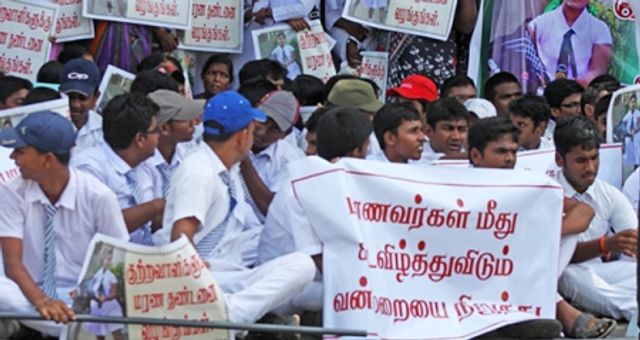
On May 15, students and teachers in Punguduthivu protested over the murder while demanding protection for all students. Campaigns have also been held at several other places throughout Jaffna.
Protest at a Jaffna junction
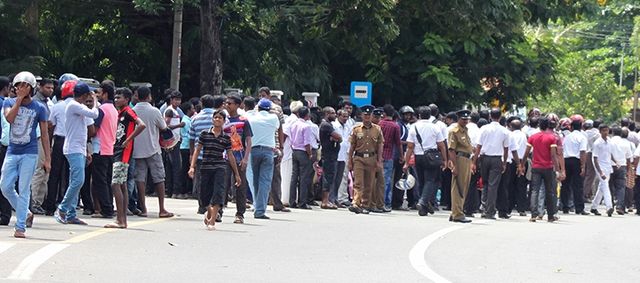
On Wednesday, the day the murder suspects were scheduled to appear in court, residents held a “hartal”—a strike and business shutdown—in the Jaffna district, closing schools, businesses and stopping all transport. Sympathetic workers struck for several hours. Thousands of people gathered at various places in Jaffna to express their anger, including near the court premises. Many residents suspect that criminal gangs are operating throughout the region with the backing of the security forces.
The government of President Maithripala Sirisena responded by mobilising hundreds of armed police, including police commandos, along with the military throughout Jaffna. Police used tear gas to disperse demonstrators as the suspects were brought to the court.
About 130 people were arrested during the protests, accused of throwing stones and damaging public property. On Thursday, a Jaffna magistrate remanded the arrested protestors until June 2.
Demonstrations were also held on May 21 in Jaffna, Kilinochchi, Vavuniya, Mullaithivu and Mannar districts in the North Province, and Batticaloa and Trincomalee towns in the Eastern Province.
Sri Lankan Inspector General of Police N. K. Ilangakoon has been sent to Jaffna to “assess” the situation and “instruct for further actions,” which only means beefing up police measures against local residents.
Students demonstrating in Jaffna
The demonstrations are the largest in Sri Lanka’s north for several years. While residents voiced their anger and concern over the shocking crime, the protests reflect deep-seated opposition to the situation facing Tamils after nearly three decades of repression and a civil war that claimed about 200,000 deaths.
May 19 marked the sixth anniversary of the military defeat of the separatist Liberation Tigers of Tamil Eelam (LTTE). During the final months of the war, tens of thousands of Tamil civilians were killed in murderous attacks by the Sri Lankan military. Sri Lankan President Sirisena and his United National Party (UNP)-led government celebrated the victory on Tuesday and Wednesday.
Sri Lanka’s northern and eastern provinces remain occupied by the military and the scars of the war remain. Tens of thousands of residents have no proper income and most of the land seized by the military during the war has not been returned to their owners.
Many Tamils are homeless and still living in makeshift camps without basic facilities. Youth unemployment is endemic. Young people released from military detention camps, after years of incarceration, are still considered LTTE suspects.
Various Tamil bourgeois politicians, including those from the Tamil National Alliance (TNA), have demanded the death penalty for those found guilty of last week’s murder. Ruling UNP parliamentarian Vijayakala Maheswaran has also called for “public execution of the killers.”
Such reactionary populist demands only strengthen the capitalist state and are aimed at politically diverting attention from the worsening social conditions facing the Sri Lankan masses, Tamil and Sinhalese alike.
TNA leader and Northern Provincial Council Chief Minister C. V. Wigneswaran issued a statement on Wednesday condemning those accused of damaging property during the protests. The Tamil elite fear that any social unrest over the horrendous social conditions in the North and East could jeopardise a future power-sharing arrangement with the Colombo government.
“In this situation,” Wigneswaran said, “we must cooperate with the police [and] not see them as an enemy. It is very clear that there are some malicious people looking for a fight by creating disagreements between us and the police, and trying to sabotage the situation.”
At the same time, Sinhala extremists, such as the Jathika Hela Urumaya (JHU), have seized on the protests to whip up anti-Tamil chauvinism, claiming that the defeated LTTE is behind the demonstrations.
The JHU, which is a supporter of President Sirisena and part of the UNP-led government, has called on the police and the military to impose “law and order” in the North. JHU media secretary Nishantha Sri Warnasinghe falsely claimed that Sinhalese residents were being threatened in Jaffna and told to leave the region. He also declared that “racist, separatist and terrorist groups are trying to raise their heads again by hiding behind this incident.”
Referring to the protests in Jaffna, former President Mahinda Rajapakse told a public meeting in the rural town of Mahiyangana: “The LTTE too began in a similar fashion. This is a dangerous situation. Therefore the police should act immediately. The law should take its course, whether it is the North or the South of the country.” Hinting at LTTE involvement, Rajapakse declared the demonstrations were “well organised.”
Rajapakse is attempting to make a political come-back by whipping up anti-Tamil chauvinism. Likewise, the Sirisena government faces a deepening economic and political crisis and is exploiting communal tensions to divide the working masses and defend capitalist rule.

Hundreds of unemployed workers apply for jobs in Pittsburgh

Evan Winters & Samuel Davidson

Several hundred people attended a job fair Wednesday in Pittsburgh in the hopes of landing one of the few job openings for part-time seasonal work at Amazon’s newly opened distribution warehouse. The jobs will pay just $10.75 an hour.
Held in the Garfield neighborhood—which has a poverty rate of nearly 45 percent, compared to 22 percent for the city as a whole—the fair attracted people from throughout Pittsburgh and even some surrounding areas. The event was advertised with a flyer placed in area residents’ doors and then spread by word of mouth.
People filling out the online application for part-time jobs with Amazon
Camille Grady explained why she came. “I work at Taco Bell. I make $7.50 an hour and even working 40-45 hours a week I get a check for $300-$350 before taxes. That is not enough. My rent is $595 a month, plus gas and electric. I share that with a roommate. A bus pass costs $37.50 a week and my phone bill is $51 per month. When that is all paid I have nothing left.
“I work out in West Mifflin and live in Mount Oliver. I take two buses and it takes me nearly two hours to get to and home from work. I was making $11.75 working at Target overnight, so I thought I was qualified for this job. I have experience with rating systems and stock.
“I wasted my time coming over here. They asked me to fill out a form and then I sat for 20 or 30 minutes. They said someone would get me but no one ever did. All they are doing is handing out an application you can access online, so I am going home and doing it from there.”
Amazon has gained the reputation of operating modern day sweatshops. Workers are expected to work 10-12 hour shifts, constantly moving through the warehouse, climbing steps, and lifting heavy packages. Technology is used to monitor each employee’s productivity and those that fall behind are fired.
The web site that describes the jobs offered tells applicants to “prepare for warp speed!” and that “Temperature in the fulfillment center may vary between 60 and 90 degrees, and will occasionally exceed 90 degrees.”
Workers collapsing from the heat became so common at Amazon’s warehouse in Allentown, Pennsylvania that management parked ambulances outside the center rather than take measures to keep the building cool. At other locations, management wears backpacks filled with Gatorade to revive exhausted workers.
Caleb Barnes, 21, is hoping to sell life insurance in the future but needs part-time work now. “I just got my license to sell insurance and now I need a car so I can start selling policies. I am hoping to work at Amazon long enough to afford a car.
Caleb Barnes
“The job situation is kind of tough. Most people I know are having a hard time finding work. My mom is working part-time and last year our water got shut off. We were both working. Rents are going up, but wages aren’t.”
Pittsburgh is often presented as a model rustbelt city that has “remade itself” with high tech firms and a booming health care and higher education sector. Official unemployment is lower in Pittsburgh than many other rustbelt cities of the same size and there has been a building boom in downtown and some of the neighborhoods. However a closer look reveals that extreme poverty still exists in many neighborhoods of the city and especially in the surrounding small towns that made up the former steel mill and coal mining belt. Within Pittsburgh the new jobs have mainly been low wage, part-time and temporary and whole areas have simply been left out of the economic “development.”
Official unemployment in Pittsburgh is 5.4 percent but unofficially it is much higher. The median household income is below $40,000 a year, over 20 percent below the state average. Nearly one in five live below the poverty level. The situation for minority workers is even worse. The Pittsburgh Regional Quality of Life Survey found that 36 percent of African Americans who were working earned less than $25,000 a year.
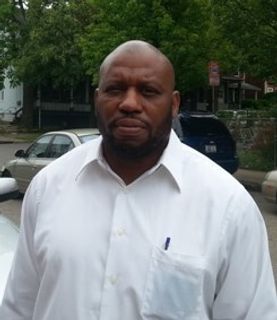
Henry James Holmes
Henry James Holmes, 55, worked for 15 years as a mechanic in California. “I’m a certified diesel mechanic. The company I work for is moving to Mexico and we are all losing our jobs. They gave all of us time off to look for work, so I decided to come back home to see what I can find.
“I left Pittsburgh in 1978. I came out of high school and worked with my dad at the Homestead steel mill for five years before they shut all the mills down. Then I said ‘to hell with it’ and moved out to California. I lived with my brother who was in the Marines until I got on my feet.”
Allen Hunt
Allen Hurt, 52, spoke about the challenges of finding work for people who have criminal records. “I’m having a hard time getting employment. When they ask if you had a criminal record I always say ‘yes’ because I don’t want to lie, but they never contact me for the job.
“I have been out of jail for six years but once they hear you have been in prison they just don’t want to hire you. They don’t ask me about it, they never let me explain what happened. You want to explain that this is past history, that it is part of my past, to prove that I am a better person.
“I am working part-time right now. It is just one week a month. It is not enough. I am seeking more and better employment. Working one week a month doesn’t meet your needs, you can’t pay your bills.”

France boosts military spending, recruits more youth into the army

Kumaran Ira

On Wednesday, the French cabinet adopted a 109-page review of the 2014-2019 Military Program Law adopting after the Socialist Party (PS) government released the Military strategy White paper in 2013. The law is to be debated and voted on in the parliament in June.
The review includes an extra €3.8 billion spending on the military between 2015 and 2019, bringing France’s total defense budget for that period to €162.4 billion. This is the first major rise in French defense spending in a quarter century. In addition to the extra spending, other measures include permanent deployment of from 7,000 to as many as 10,000 troops inside France, as well as boosting naval and air forces and the number of troops available for overseas military operations. The army will go to 77,000 from 66,000 men next year.
Most of these new troops will be fighting in foreign wars. According to Le Monde, “we must provide sufficient, well-trained forces for external military operations at an elevated pace from the Sahel to Iraq.”
Extra spending will also go to cyber warfare, aeronautics and intelligence. Around one billion euros will be spent on the purchase of new equipment including seven attack helicopters, six troop-transport helicopters, and two navy patrol vessels.
Above all, however, France is boosting the size of its army, as masses of youth face unemployment due to the deep economic crisis of European capitalism. Around 13,000 youth will be recruited this year, after the army recruited 10,000 youth in 2014. During a May 19 press conference, the chief of the army general staff, General Jean-Pierre Bosser announced, “the army will become France’s biggest recruiter.” He called this “an unprecedented objective, an extremely important effort.”
France’s rearmament program is accompanied by massive cuts in social spending and draconian police state measures to deal with rising social anger in the working class against austerity and war. The increase in military spending is to be counterbalanced by €3 billion cuts in health care, housing and education.
France’s reactionary rearmament drive is part of a broad military escalation across Europe. Noting that eleven European countries increased defense spending between 2013 and 2014, including Poland (14.33 percent), Holland (2.6 percent) and Sweden (7.18 percent), the military review paper claimed that France was simply moving to keep pace with broader European trends.
The review paper pointed in particular to German rearmament plans. It wrote, “Germany, which until recently was indicating plans to cut spending, announced last March a substantial increase in its defense spending efforts in the short to medium term. Starting in 2016, Germany will spend an extra 1.2 billion euros (including pensions). This will go to sustain the objective of increasing the defense budget by 6.2 percent in five years.”
The rearmament of the major imperialist powers inside Europe is a warning to the working class internationally of the bankruptcy of the social order. Driven by a social and economic crisis for which they have no solution, and by the escalating disasters produced by their wars in the Middle East, Africa, and Eastern Europe, the European capitalist classes are furiously rearming, as they did before the two world wars of the 20th century.
As the wars and extra spending on military are deeply unpopular with broad masses of people facing unemployment and austerity, the French government is advancing false and hypocritical arguments that its rearmament drive is designed to protect the French people against terrorism.
The review paper explained, “Terrorist attacks of January 2015 in Paris showed that France, like other European states, is directly exposed to terrorist threats of unprecedented scope, above all in Africa and the Middle East. Since this threat does not stop at France’s borders, these attacks illustrate the growing integration between the security of the population on the national territory and France’s military action outside its borders.”
This entails not only a massive escalation of military and police-state measures at home, but a broad commitment by the French military to re-occupy large sections of France’s former colonial empire in Africa and Syria. The paper wrote, “This militarized terrorist menace constitutes a major challenge, to be fought in the Sahel-Sahara desert region, a zone as vast as the European continent, or in Iraq against the Islamic State. It requires in particular a serious effort in the areas of intelligence, and the mobility and speed of reaction of our forces.”
In fact, the rise of Islamist forces in the Sahel and in Iraq are largely the product of NATO proxy wars in Libya and Syria, enthusiastically supported by French imperialism, in which NATO relied on Al Qaeda-linked forces to topple regimes targeted by the Western powers for regime change. The NATO powers have not abandoned their reliance on Islamist forces in Libya and Syria, and the claim that they are fighting a “war on terror” is a reactionary lie.
Above all, however, rearmament in France and across Europe is directed not primarily against poorly armed terrorist and guerrilla groups, but at the risk of military conflict between states.
Defense Minister Jean-Yves Le Drian justified the strategic review and the decision to boost military spending by pointing to the rising tide of wars surrounding Europe. He wrote, “Faced with the evolution of the strategic context, France has made the decision to increase its defense budget in the coming years.”
The spending review strategy paper pointed to “a definite degradation of the international situation and the lasting increase of identified risks and dangers. These require the consolidation of our military efforts.”
A major point in the document is the NATO powers’ campaign to threaten war with Russia, after a NATO-backed, fascist-led coup in Ukraine to oust pro-Russian President Viktor Yanukovych last February led to civil war in Ukraine. The conflict with Russia, as French President François Hollande remarked earlier this year, could lead to “total war”.
According to the paper, “the Ukrainian crises raises again, in a way that is unprecedented in many years the question of international security and the stability of borders on the European continent itself.”
This statement, coming amid the simultaneous rearmament of the major European imperialist powers, underscores that far more is at stake than simply Al Qaeda-linked forces, of even the danger of war with Russia. Conflicts with deep historical roots, above all between German and French imperialism, are rapidly emerging.
The French media’s criticisms of the promotion in Germany of Bismarck, who led the German defeat of France in the Franco-Prussian war of 1870, like the recent publication of a book by Jean-Luc Mélenchon denouncing Germany as a “poison” in Europe, testify to these rising tensions.

Ten years after riots, French police cleared in deaths of Clichy-sous-Bois youths

Anthony Torres

Ten years after the electrocution of two suburban youths, Zyed Benna and Bouna Traoré, during a police chase provoked mass rioting across France, the courts have acquitted the two police officers involved. The ruling highlights the impunity enjoyed by police, on which the Socialist Party (PS) government and the entire ruling class rely ever more, as they seek to rule France through the promotion of law-and-order hysteria.
The court’s arguments whitewashing the responsibility of the police are absurd. It ruled that neither Stéphanie Klein, the trainee policewoman manning the phone lines that night, nor Sébastien Gaillemin, who carried out the chase, were “clearly aware of a grave and imminent peril” facing the two youths.
Evidence presented to the tribunal directly contradicts this assertion. When Gaillemin saw that the youth were fleeing into an electric power plant, he said: “If they go in there, their skins will be worthless.” Nevertheless, the court ruled that this comment did not show that police knew the teenagers were in mortal danger.
The court even ventured to predict that “if Sébastien Gaillemin had known there was a serious and imminent danger, he would not have failed to react.”
As the trial began, the presiding judge Nicolas Léger issued what was effectively a warning, that the proceedings would not be “the trial of the police as a whole, of the 2005 mass riots, nor of political comments of various individuals on these events.”
In fact, the justice system did everything it could to prevent the trial of the two policemen from becoming a trial of the police and of the law-and-order policies pursued by both PS and right-wing governments. These policies created the atmosphere of permanent, increasingly militarized confrontation between suburban youth and police in which the two youth were killed as they fled the police.
The police officer who was in pursuit was clearly conscious of the risk of electrocution facing the two youth but did not try to seek assistance. However, the courts cleared the two police officers, in part, to block discussion of police violence and the growth of widespread opposition to the violence, insults and arbitrary arrests carried out by police in poor and immigrant neighborhoods.
The harassment of youth by the police has become a key element of the law-and-order policy of the PS government of President François Hollande, including appeals to the far right, as it seeks to set up the infrastructure of a police state in France.
The families of the victims vigorously protested the court’s ruling. Their lawyer, Jean-Pierre Mignard told the press: “There were signs everywhere saying ‘Risk of death,’ ‘Risk of death’ … .They were school kids. In the radio traffic, the policemen even called them ‘the kids.’ A policeman whose mission is to protect did not have the idea of calling anyone? It is scandalous.”
He added, “It is a shocking decision. After 10 years … there is nothing in the ruling that reflects the work carried out by the plaintiffs. We will not accept such a cavalier disregard for our arguments.”
The PS, by its silence, joined in the whitewashing of the police officer’s role in the two young men’s deaths. Neither Prime Minister Manuel Valls nor Interior Minister Bernard Cazeneuve saw fit to comment on the ruling.
Neo-fascist circles noisily applauded the verdict. National Front (FN) legislator Marion Maréchal Le Pen declared: “This verdict proves that the scum indeed burned and trashed the suburbs just for the fun of it, and not because of any police brutality.”
Christian Estrosi, the conservative mayor of Nice, declared that after the national marches held in January in response to the terrorist attacks on Charlie Hebdo, all criticism of the police was illegitimate. He said, “This case has been hanging over the policemen for 10 years. They have been acquitted today. It is impossible to march on January 11 to applaud the police, the security forces, and the interior security forces, and at the same time to drag them through the mud as they try to reconquer the lost territory of the Republic.”
This remark reflects the perspective of the ruling elite. They look with fear at working class and immigrant districts as “lost territory,” which police must forcibly reconquer by imposing a regime of terror in order to strengthen the authority of the state. In this explosive political context, marked by sharp social tensions across Europe and the deep degeneration of French democracy, the ruling class cannot tolerate any criticism of the police.
The tragic death of Benna and Traoré was a fundamental political experience in France. In response to protests and rioting that spread to suburbs across France—the widest disturbances in France since the 1968 general strike—conservative President Jacques Chirac decreed a state of siege for three months, legally suspending basic democratic rights.
During the 2005 riots, the interior minister and future president, Nicolas Sarkozy, built his reputation on an aggressive promotion of police and law-and-order policies. He promised to clean out “the scum” and “the gangrene” of the projects with a Kärcher high-pressure hose, to deploy permanently 17 squads of CRS riot police and seven mobile brigades in “difficult” areas, and to send plainclothes policemen to identify “leaders, traffickers, and Islamists.”
Mass protests also erupted in 2007 and 2012 after police brutality cases, which were again repressed as in 2005. These events accelerated the state’s preparations to undermine fundamental democratic rights in France and impose a police state.
Throughout the world, since the eruption of the 2008 economic crisis, the police have been increasingly militarized and the mass electronic spying on the population is proceeding apace. Enormous social discontent with the policies of austerity and war have, in France, provoked the political collapse of the ruling PS. Its main remaining social base, beyond the banks, is the police, the army, and the intelligence services—a state of affairs which has emerged ever more openly since the Charlie Hebdo attacks.
Under these conditions, where the ruling class feels itself protected primarily through police violence, the capitalist state takes on features of a police state that consciously views the working masses as enemies.
Hollande has deployed 10,000 soldiers on French soil and pushed through a draconian surveillance law that legalizes mass spying by the intelligence agencies. He also promoted the FN, which has support among significant sections of the army and police, by formally inviting their leader, Marine Le Pen to the Elysée presidential palace.
The bourgeoisie is preparing for a confrontation with the working class, in particular with immigrant youth. The acquittal of the two policemen is a warning: the courts are giving police a blank check to physically repress workers, including with fatal methods, as was seen by the whitewashing of the deaths of Benna and Traoré.

Agreement signed on China-backed investment bank

Nick Beams

The China-backed $100 billion Asia Infrastructure Investment Bank (AIIB) has moved a step closer to commencing operations following a three-day meeting by the 57 founding members in Singapore this week that set up the bank’s articles of agreement.
The official statement from the meeting provided few details apart from saying that the articles of agreement should be ready for an official signing ceremony at the end of June and indicating the AIIB should be operational by the end of the year. Negotiators also discussed a draft policy on the environmental and social framework of the bank’s lending policies, a reference to US criticism that it will not meet international standards.
The US bitterly opposed the AIIB’s establishment, urging its allies not to become founding members, because it threatens to cut across the operations of the IMF and World Bank, which Washington dominates, and the Asia Development Bank, controlled by its chief regional ally, Japan.
Those tensions again came to the surface during the course of the AIIB meeting with the announcement by Japan on Thursday that it would provide $110 billion for Asian infrastructure projects.
The plan, announced by Prime Minister Shinzo Abe at a symposium of Asian officials and experts in Tokyo, represents a 30 percent increase in Japanese funding.
“We intend to actively make use of such funds in order to spread high-quality and innovative infrastructure throughout Asia, taking a long-term view,” Abe said. The funds will be very much under Tokyo’s control. About half will be made available through state-affiliated agencies in charge of aid and loans with the rest distributed in collaboration with the Asia Development Bank.
The aims of the Japanese initiative and its attempts to cut across the AIIB were clearly outlined in comments by Naoto Saito, an economist at Daiwa Institute of Research.
“Japan must have been provoked by the establishment of the Asia Infrastructure Investment Bank by China,” he told Bloomberg. “Japan’s investment will help promote infrastructure projects in Asia, expanding business opportunities for Japanese companies.”
Significantly, in line with US criticism of the AIIB, Japan has pledged to provide “high quality” aid by assisting recipients with expertise in reducing pollution while building roads and railways.
In the same way that “humanitarian concerns” are used to justify imperialist military interventions, the US objections to the China-backed bank are being wrapped up in expressions of “concern” over whether it will meet environmental and labour standards.
The real reason is that the new institution weakens US economic domination. As president Obama recently told the Wall Street Journal, while touting support for the key US Asian economic initiative—the Trans Pacific Partnership—the deal is necessary so that America, rather than China, “writes the rules” for trade. The same issue is at stake with regard to the AIIB.
While the official statement provided no details about the financial structure of the bank, some information was provided by delegates in anonymous comments to journalists on the sidelines of the meeting.
Sources told Reuters that China would like to take a 25–30 percent share, the largest stake in the bank, with India the second largest shareholder at between 10–15 percent. It is expected that Indonesia, Germany and South Korea will be the next largest shareholders, all with just below 4 percent. Overall, Asian countries will own between 72 and 75 percent with the rest held by European participants.
The delegates of the founding-member countries will take the proposals back to their respective legislatures for approval. Some expressed scepticism that the bank would be able to be up and running by the start of next year.
“It is uncertain if we can start from early next year,” one delegate commented on condition of anonymity. “China hopes that members will get such approvals by year-end and the operations start from next year. But I wonder if it is possible, given domestic political conditions in each country.”
While there may be some twists and turns in securing final agreement, the bank’s establishment represents a significant blow to the US which has used the IMF and World Bank to exercise economic hegemony. How closely the US has guarded its position was revealed in the immediate aftermath of the 1997–98 Asian financial crisis when Washington vetoed a proposal by Japan to set up a $100 billion fund to assist financially-stricken countries, insisting that the US-dominated IMF had to play the lead role.
But the US attempts to thwart the AIIB and prevent European powers and its Asian allies from joining failed when Britain announced in March that it was signing on to become a founding member, prompting a rush to join by other European countries.
Some of the underlying motivations for the British decision were revealed in a speech by Barbara Woodward, the British ambassador to China, earlier this month. She said Britain wanted to be part of the AIIB and “become a strong force of positive growth in Asia and the world” and that it “will be good if we can share our experience with AIIB by participating in it early.”
The economic calculations underlying these sentiments, especially so far as the financial interests of the City of London are concerned, were also partially revealed. Woodward said that the UK had always paid great attention to building a strong relationship with China, noting that in the past five years, under the Cameron government, Chinese investment in Britain had grown by 85 percent annually.
This rapid increase points to the reasons why British chancellor George Osborne, as the direct representative of those interests in the Cameron cabinet, was so insistent that British participation in the AIIB go ahead, notwithstanding objections from sections of the UK foreign policy establishment that it could disrupt the strategic relationship with the US.
In her speech, Woodward noted China was now Britain’s six largest trading partner, with bilateral trade rising to more than $80 billion last year and the incoming Conservative government would make a “strong commitment to enhance the trade and investment with China.” Such a commitment, however, will see a rise in tensions with the US.

OECD report: Global social inequality hits new record

Gabriel Black

Income inequality in many developed countries has reached an all-time high, according to a report released Thursday by the Organization for Economic Co-operation and Development (OECD). The report also notes that growth of social inequality has been accompanied by the growth of part-time and contingent labor, particularly for younger workers.
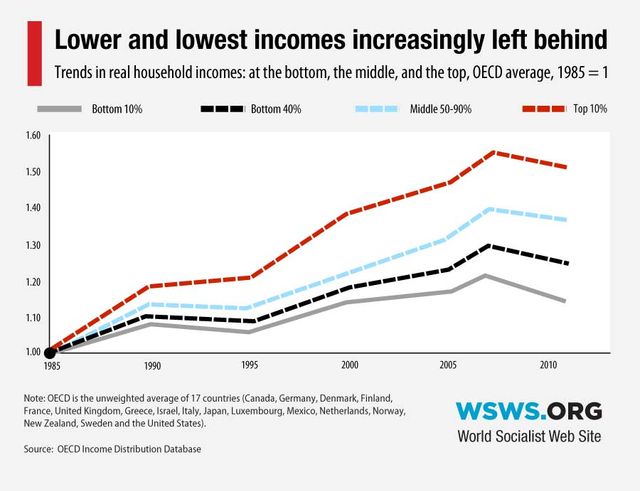
The wealthiest tenth of the population in OECD member countries now earn 9.6 times the income of the poorest 10 percent, up from nine times in the 2000s, and seven times in the 1980s.
“Inequality in OECD countries is at its highest since records began,” said OECD Secretary-General Angela Gurria. The OECD is composed of 34 advanced economies, including the United States, members of the European Union, Japan, Korea, Mexico and several others.
The report notes that in 2012, “the bottom 40% owned only 3% of total household wealth in the 18 OECD countries with comparable data. By contrast, the top 10% controlled half of all total household wealth and the wealthiest 1% owned 18%.”
The United States is the fourth most unequal country in the OECD, after Chile, Mexico and Turkey.
In the mid-1980s, the top 10 percent of US income earners took in 11 times more than the bottom 20 percent. This figure rose to 12.5 times in the mid-1990s, but in 2013, the US’s top 10 percent made 19 times more than the bottom 10 percent.
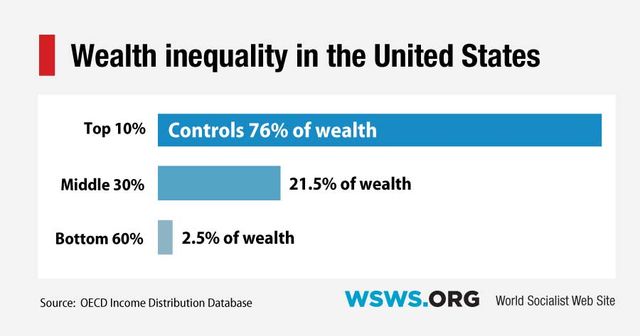
Wealth inequality in the United States is even greater than income inequality. In the US, the top 10 percent controls 76 percent of all the wealth, while the bottom 60 percent owns just 2.5 percent. The top five percent of households in the US have about 91 times more wealth than the average household.
For the OECD countries as a whole, the top 10 percent of the population owns 50 percent of the wealth. The middle 50 percent owns about 47 percent of the wealth, and the bottom 40 percent owns just three percent.
A large portion of this increase in income inequality has occurred in the aftermath of the 2008 financial crisis. According to the report, in the United States, “between 2007 and 2013, net wealth fell on average 2.3 percent, but it fell ten-times more (26 percent) for those at the bottom 20 percent of the distribution.”
Income inequality in the United States is substantially worse than in any other developed country. For instance, while overall household income is 14 percent higher in the US compared to Canada and 25 percent higher compared to Germany and France, the report notes that “the average income of the bottom 10% in the US is 42% lower than in Canada and about 50% lower than in France and Germany.”
The OECD claims that one reason for this difference is that “redistribution through income taxes and cash transfers is considerably lower in the United States than in most other OECD countries.”
The report notes the particular hardship that the lowest-earning sections of the international working class have faced in the past 30 years. In the past three decades “low-income households have not benefited at all from income growth.” For instance, the bottom 10 percent of income earners in the United States lost 3.3 percent of their income since 1985, adjusted for inflation, while the average household income increased by 24 percent.
In Spain and several other countries most severely impacted by the financial crisis, this trend was even sharper. Spain saw the incomes of the poorest 10 percent of the population drop by roughly 13 percent every year between 2007 and 2011.
In addition to a massive growth in income and wealth inequality, the report shows that part-time work, self-employment and temporary contracts have become increasingly prevalent over the past two decades. The OECD notes that “Between 1995 and 2013, more than 50 per cent of all jobs created in OECD countries fell into these categories,” adding, “Low-skilled temporary workers, in particular, have much lower and unstable earnings than permanent workers.”
The OECD notes that young people are the most affected by this turn towards temporary, low-paying work. Forty percent of employed young people in the OECD countries, defined as those aged 18 to 34, do not have full-time regular work.
The OECD report calls on governments to take steps to reduce inequality, declaring that, “In recent decades, the effectiveness of redistribution mechanisms has been weakened in many countries.” It warns that “By not addressing inequality, governments are cutting into the social fabric of their countries and hurting their long-term economic growth.”
The reality, however, is that the growth of social inequality is the deliberate outcome of government policies, whose aim has been the enrichment of the financial oligarchy at the direct expense of the working population. No change in this state of affairs is possible within the framework of the capitalist system, whose essential characteristic is the incessant concentration of wealth at the top of society. 

US prepares new military provocations in South China Sea

Peter Symonds

Just days after a CNN news crew joined a P8-A Poseidon surveillance aircraft over a Chinese-administered islet in the South China Sea, it is clear the flight was a calculated provocation aimed at ramping up pressure on China. American officials immediately exploited the reportage to underline Washington’s determination to challenge Chinese territorial claims in these key strategic waters, regardless of the consequences.
A Navy P-8 Poseidon aircraft
US surveillance flights, along with naval patrols, have become routine since January when Washington initiated its scare campaign over Chinese reclamation activities in the South China Sea. But the presence of a news team for the first time on Wednesday, providing breathless coverage of the flight, along with the unprecedented release of video footage, focussed public attention in the US and internationally on the issue.
Just like the 2003 invasion of Iraq, the media is once again being “embedded” as the propaganda arm of the military as the US prepares for war with China. CNN made no pretence of independent reporting, painting China as the villain engaged in “a massive military build-up” on the islets—an early warning radar station on Fiery Cross Reef—and dramatically highlighting warnings from a Chinese radio operator appealing for the aircraft to “please go away… to avoid misunderstanding.”
Responding to the CNN report, Pentagon spokesman Colonel Steve Warren not only declared that the present “routine flights” would continue, but could in the future breach the 12-mile territorial limit around Chinese islets and reefs. While the Poseidon aircraft had not done so on Wednesday, he said, “that would be the next step.”
“We don’t recognise those islands as anything other than international space,” Warren remarked. “For us to fly through that, we wouldn’t see that as a change in the way we do business.” He acknowledged, however, that the US had not flown over Chinese claimed territory in the South China Sea in the past 20 years.
Warren’s comments confirm media reports over the past fortnight that US Defence Secretary Ashton Carter has instructed the Pentagon to draw up options to fly American aircraft or send warships within the 12-mile limit. As Washington is well aware, such reckless actions have the potential to provoke conflict.
The CNN report featured the comments of former CIA Deputy Director Michael Morell who warned “there’s a real risk, when you have this kind of confrontation, for something bad happening.” Asked about the danger of war between the US and China, he declared that while it was “not in their interests, [and] not in our interests,” nevertheless “absolutely, it’s a risk.”
In what can only be interpreted as a military threat to Beijing, Assistant Secretary of State for East Asia Daniel Russel told a press briefing on Thursday that the reconnaissance flight was “entirely appropriate” and the US would “continue to fully exercise” its right to operate in international waters and airspace. “Nobody in their right mind is going to try to stop the US navy from operating—that would not be a good bet,” he said.
The hypocrisy and cynicism involved is staggering. The US only began to assert its “right” to “freedom of navigation” in the South China Sea in 2010, as the Obama administration prepared to unveil its “pivot to Asia” aimed at undermining China and encircling it militarily. Washington’s intervention into long-running and complex territorial disputes has transformed the region into a dangerous flashpoint.
While berating China for its land reclamation, the US remains silent about similar activities by South East Asian countries such as Vietnam and the Philippines on islets and reefs under their administration. No one in Washington is suggesting that the Pentagon is about to challenge the 12-mile limit around disputed territory controlled by Manila and Hanoi.
Indeed, one of the main US aims has been to drive a wedge between China and its neighbours and to establish closer military ties throughout South East Asia. Washington has encouraged both the Philippines and Vietnam to more aggressively assert their territorial claims in the South China Sea against China.
Last year the US and the Philippines signed an Enhanced Defence Cooperation Agreement that will provide American forces with virtually unlimited access to military bases in its former colony. Indeed, relations are already close, demonstrated by the fact that on Wednesday the Poseidon aircraft flew out from Clark Air Base in the Philippines.
The decision to ask the CNN news team to accompany the flight is part of carefully choreographed preparations for war with China. It came days after US Secretary of State John Kerry visited Beijing to insist China back off its land reclamation, and just prior to the appearance of Defence Secretary Ashton Carter at the Shangri-La Dialogue in Singapore next weekend where he is likely to confront Chinese military officials.
Centre for Strategic and International Studies (CSIS) analyst Mira Rapp Hooper explained this week: “What you’re seeing by the US is a calculated, transparent effort to reveal the situation in all its details and potential dangers.”
The CSIS is heavily involved with the US military in implementing the “pivot to Asia.” Not accidently, as the Obama administration escalated tensions with China this year over the South China Sea, the think tank established the Asia Maritime Transparency Initiative (AMTI) headed by Hooper. Following the CNN report, using its own close Pentagon ties, the AMTI website released its own exclusive video of US surveillance flights.
There is no doubt Washington intends to continue its provocative actions. When China announced an Air Defence Identification Zone (ADIZ) in the East China Sea in November 2013, the US immediately challenged the zone by flying nuclear-capable B-52 bombers into the area unannounced. US plans to fly military aircraft within the 12-mile limit around the Chinese islets are far more reckless. Beijing regards the South China Sea, which is adjacent to major Chinese mainland naval bases, as critical to its strategic interests.
Reacting to the CNN flight, Chinese foreign ministry spokesman Hong Lei declared: “Such action is likely to cause an accident, it is very irresponsible and dangerous and detrimental to regional peace and stability. We express our strong dissatisfaction, we urge the US to strictly abide by international law and international rules and refrain from taking any risky and provocative actions.” He warned that China would closely monitor the situation and “take the necessary and appropriate measures” to secure its islands and reefs in the South China Sea.
US imperialism’s overriding aim is not to secure “freedom of navigation” in the South China Sea. Rather the South China Sea has become the pretext for a show of force intended to bully Beijing into accepting US hegemony in Asia. For this, Washington is preparing for, and willing to risk, war.