23 May 2015

The Problem With the TPP is Capitalism

Rob Urie

Two decades or so ago Scottish philosopher Alisdair MacIntyre made the point that had so much effort not gone into proving the existence of God few people would ever have doubted it. As is currently the case in economics, had ‘free-trade’ not been so wildly oversold much of the economic malpractice attributable to it might not be so easily targetable. As it is, ‘free-trade’ is a slogan, a ‘brand,’ for an opportunistically defined set of social practices and relations. Even with reduced or nonexistent tariffs and trade barriers ‘the economy’ carries with it the residual of historical social relations, standing armies, governments that are political and economic actors on multiple levels and the preponderance of economic acts that never find their way into the economist’s purview.
While the pending TPP (Trans-Pacific Partnership) and TTIP (Trans-Atlantic Trade and Investment Partnership) trade deals have been correctly reported to strengthen intellectual property protections, patents and corporate say over civil governance, (1) a large contingent of mainstream economists and politicians is still invoking free-trade theory to sell the deals and (2) even leftish economists are careful to challenge only these specific aspects of the trade agreements, and not the base premises. Career risk is one reason for not stepping outside of free-trade dogma— economics is amongst the most intellectually constrained of ‘professions.’ And as history has it, the academic mainstream exists to explain the fundamental correctness of existing social relations, not to pose challenges to it.
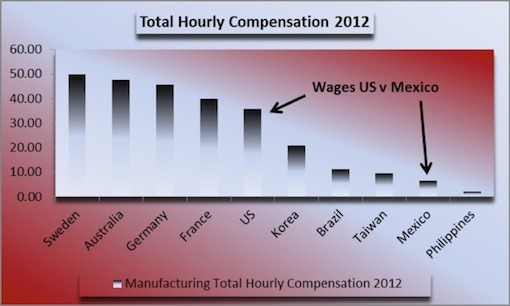
uriettp1
Graph (1) above: manufacturing wage differences between countries, here including the costs of social insurance, are very large. U.S. wages are lower than those of Scandinavian and major European countries due both to lower direct wages and to lower social insurance benefits. Free-trade theory would have these countries at a major economic disadvantage to the U.S. When adjusted for hours worked, U.S. manufacturing workers are relatively poorly paid. And considering that the value of social insurance is a function of its price, high health care costs and poor outcomes place U.S. wages significantly lower when adjusted for the benefits that are actually delivered. While ‘developed’ Europe is rapidly moving toward ‘liberalization,’ toward the systematic immiseration of its manufacturing workers, residual labor power has slowed the pace relative to that of the U.S. Source: BLS.
A typical rhetorical strategy amongst economists is to isolate the effects of wage differentials on jobs gained or lost despite the fact that few of the corporations likely to outsource look at the world this way. Wages, including the costs of social insurance, are but one factor in the consideration of where to locate manufacturing. The ability to pollute with fewer restrictions (costs) is actually part of the mainstream calculus of the advantages of free-trade— ‘the environment’ is considered a natural ‘endowment’ and the ‘correct’ level of pollution a function of cost-benefit analysis, the trade-off between economic production and environmental destruction. Astute readers will see the formula for collective suicide here: the cost-benefit analysis is done at the national level while the toxic effects of industrial pollution adhere to no such boundaries— no global limit is part of the national calculation.

uriettp2
Picture (1) above: much has been made of the extreme levels of pollution in China while little effort has been made to relate the pollution back to Western consumption of goods manufactured there. Within free-trade theory the question of which country’s cost-benefit analysis Chinese pollution should be charged to comes to bear when U.S. based multinational corporations locate manufacturing in China. With China now the largest emitter of greenhouse gases in the world, the question is: how much less would the West consume if the true costs of Chinese production were forced onto products made there? This cost-benefit shell-game is used to justify free-trade when the facts of pollution are concrete and borne by real human beings. Original image source: latimes.com.
A consideration related to ‘optimal’ polluting is transportation costs. With manufacturing wages of $3.00 per hour in China and few environmental restrictions the costs of transporting goods long distances to market are a consideration for Western corporations, but not the greenhouse gas emissions that are an uncounted cost of doing so. This ‘transportation’ effect crosses multiple national borders. The costs of polluting fuels can be allocated, but whose ‘costs’ do greenhouse gas emissions fall within in a national cost-benefit analysis? Low wages and toxic pollution are the result of ‘free-trade’ that working class Chinese are seeing from the growth of ‘state’ capitalism.
The ‘free-trade’ view toward labor is similar to that of pollution— there is an ‘optimal’ level of labor power that facilitates capital formation. Independent labor unions don’t exist in China and labor negotiations there tend to be ad hoc, addressing local grievances in place of making institutional changes. Western ‘free-trade’ agreements have made capital mobile while there have been very few efforts to make labor mobile— jobs are mobile, but workers aren’t. This difference illustrates a limitation of capitalist theory. Capital and capitalist products are mobile because they are created to be mobile. Human beings are situated by history, family, community and different languages and customs. To make labor mobile is to take away everything that makes us human.
uriettp3
Graph (2) above: following passage of NAFTA by Democrat Bill Clinton in 1993 the U.S. trade deficit grew and manufacturing employment plummeted. Economist Dean Baker scales manufacturing to broader employment to come to a similar conclusion here. Proponents of current trade deals argue that manufacturing employment was unaffected by NAFTA when a 10-second search for evidence points in the opposite direction. The claim that productivity gains are behind the fall in manufacturing employment requires a method for separating declining manufacturing wages from the calculation of labor output, with additional reference to the Cambridge Capital Controversy. Productivity calculations are capitalist metaphysics of the first order. Source: St. Louis Fed.
With materially lower manufacturing wages in other parts of the world coincident with few restrictions on industrial pollution, a question that must be asked is: why would trade agreements like TPP and TTIP be needed? The ability of corporations to use the ISDS (Investor-State Dispute Settlement) mechanism to challenge environmental and labor restrictions in developed countries suggests that the ultimate goal is to turn the ‘developed’ West into China. And in fact, the business press and elite politicians have spent to last two decades holding China up as a model for Western economic ‘growth.’ That China is “China” because the West is the West seems not to have occurred to these theoreticians of global domination. And in fact, China’s economic model is ‘managed’ capitalism, within the terms given, the polar opposite of ‘free-market’ economics.
Can Western elites really be so dim as to confuse free-market dogma with actual policies? The focus on intellectual property and patent protections in current trade agreements is the antithesis of free-market theories— they are monopoly rights conferred on private corporations. Support for monopoly rights is the basis of the better informed mainstream critiques of current trade deals. This is to argue that even in mainstream terms these aren’t free-trade deals, so the elites pushing them as such are either fools or liars. However, as the last half-century of economic outcomes suggests, the ‘real’ free-trade posed as the alternative requires similar terms for public accedence— catastrophic global warming, dead and dying oceans, Western cities turned into neo-colonial wastelands, global wars for economic resources and remote, self-serving elites whose singular goal is total control.
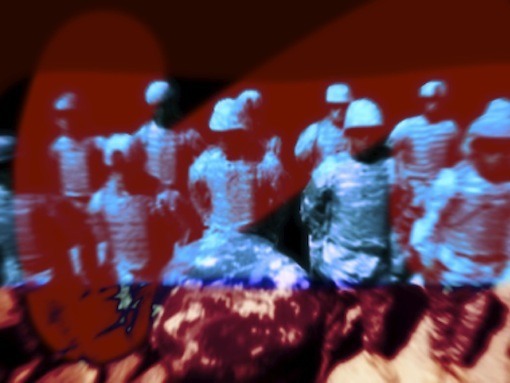
uriettp4
Picture (2) above: financial capital can be moved around the globe at the push of a button and at the speed of sound but human beings, a/k/a ‘labor,’ have embedded relations, we can’t move freely across national boundaries and face language and cultural barriers to ‘free’ mobility. Here the Texas National Guard is being trained to ‘protect’ the U.S. border with Mexico— in the language of economics, to assure labor immobility. Jobs can be moved around the globe, but jobs aren’t labor, they are the capacity of mobile capital to hire labor. The lot of this embedded labor points to the opportunistic nature of free-trade theories; the premises determine the relevant constituents. Free-trade theory accounts for capital and capitalist ‘goods’ but comes up empty when it comes to actual human beings. The only way that we can be ‘accommodated’ is to become capital. Original image source: blog.chron.com.
The Chinese leadership has been relatively open and straightforward about its currency peg to the USD (U.S. dollar). The contrived brouhaha over currency manipulation— the peg that has kept the Chinese currency ‘undervalued’ relative to the USD, is twenty years late. What is likely attractive to U.S. elites is that the Chinese actually have a plan, a mercantilist export strategy that required an undervalued currency to support Chinese exports. The mainstream economists supporting current trade deals do so by spouting antique dogma about ‘comparative advantage’ which is fine with the Chinese— life is easier when your intellectual opponents are willfully blind ideologues. Lest this seem unduly dismissive, the ISDS mechanism, which has nothing to do with comparative advantage, could be removed and mainstream opposition to these trade deals would evaporate.
urie5
Picture (3) above: David Ricardo is the de facto senior advisor to the U.S. trade delegation on modern trade theory. Comparative advantage is the argument that if nations do what they do best ‘the economy’ will benefit. That nation-states are historically locatable modes of social organization and that capitalist production ‘works’ by only accounting for its intended products draws a circle around Ricardo’s vision. Put differently, it is hardly incidental that current trade deals seek total control over civil governance to make the economics ‘work.’ Theories developed in ‘independent’ realms require factual independence that the complex interaction of ‘the world’ renders improbable. See Ian Fletcher’s well considered take down of comparative advantage here. Original image source: biography13.com.
Understanding what Western elites really want from the TPP and TTIP is crucial. President Obama argues that either ‘we’ write the global trade rules going forward or the Chinese will. Point one is that trade rules are not ‘free-trade’ in the sense of an absence of rules— what is being negotiated is ‘managed’ trade. Point two is that the ‘we’ writing the rules are corporate representatives— Bank of America and Monsanto do not represent the public interest and the assertion that they do is profoundly anti-democratic. And despite lip service to the contrary, the ISDS mechanism of these (and past) trade agreements is designed to preclude effective environmental and labor regulations by allowing corporations to sue for wholly imagined ‘lost profits’ that might result from them. In other words, and with apologies to George Orwell, (economic) freedom is slavery.
Implied in Mr. Obama’s view is a unipolar world run by multi-national corporations for their own benefit. Wall Street would be near the top of this food chain— the same Wall Street that got everything it asked for in terms of ‘freedom’ from oversight and regulation and nevertheless killed the global economy in 2008 and exists today on public guarantees, transfers and implied future too-big-to-fail bailouts. U.S. automakers were only able to stay in business through the 1970s and 1980s through massive state intervention— ‘free-marketeer’ Ronald Reagan imposed tariffs and import restrictions that allowed bloated U.S. executives to sell poor quality cars while labor unions were crushed under the interest-rate austerity imposed by Federal Reserve Chairman Paul Volcker. And how profitable would Chevron and Exxon-Mobil be without the murderous, extractive U.S. military to ‘liberate’ oil and gas for them? This is who Mr. Obama today claims should be ‘making the rules’ for the world.
For those who haven’t heard this directly from the mouths of the business theoreticians who birthed it, around two decades ago a group of American business folk, middle aged White guys in suits mostly, developed the theory that America’s ‘comparative advantage,’ what we do best, is ‘management.’ With echoes of the ‘White man’s burden’ American managers, goes the theory, will create a modular economy where ‘we’ tell people, working class Indians, Chinese and Mexicans, what to do and how to do it. Adding clarity of vision, ‘we’ would hire local managers to manage the local workers, local engineers to engineer the production processes, local product designers to design the products and ‘we’ would either hire or locate manufacturing facilities locally. With ‘others’ designing and making products and local managers managing the process, all that was left for ‘us’ to do is to check ‘our’ bank balances to watch the profits accrue.
Yves Smith of nakedcapitalism.com does a slightly more respectful take down of the clever-lite nature of outsourcing ‘theory,’ but the point of current relevance is that Citigroup, General Motors and Monsanto, et al are the chosen players and the antique theoretical anachronism of comparative advantage, with American business ‘leaders’ deciding the terms, is the game that the TPP and TTIP are intended to promote. The ‘intent’ of the ISDS mechanism of superseding civil governance is a function of fitting poorly considered economic theories over the ‘political’ frame of nation-state— Mr. Obama and trade negotiators don’t see it as a capitalist coup because the actual intent is several degrees less sophisticated than the junior high school political theory required to see just how insidious it really is. This isn’t to deny mal-intent. But to the extent it informs these trade agreements, there is more dim tedium than brilliant conspiracy.
Those of us hoping to stick around for a few more decades really might want to change the social trajectory away from this suicidal antique idiocy. What the current arrangement of social circumstance can do— all that it can do, is drop bombs, exacerbate environmental catastrophe and be really mean to poor people. For those of us stuck on the choice between Hillary or Jeb, Democrats or Republicans, what they can do— all that they can do, is drop bombs, exacerbate environmental catastrophe and be really mean to poor people. There is truth in the idea that societies are judged by how we treat the ‘least’ among us, not in some cosmic accounting, but by how we live our lives in the present. From one side the question is: how much crap do ‘we’ really need and from the other, what is the true cost of it and who pays this cost? Vote if you care to, call ‘your’ representatives to vote down trade agreements if you think doing so is useful, but revolution is the solution.

Israel on the Run

Robert Fantina

These are desperate times for Israel. While Prime Murder Benjamin Netanyahu forms a new government with people who have said that Palestinians are not human, and who have openly called for genocide against them, he and they continue to talk about their security concerns, how the Israeli army is the most moral in the world, etc., etc. Yet beyond the ivory towers in which they have ensconced themselves, few people are buying the tattered goods they are selling.
Let’s look at a few examples.
The International Criminal Court (ICC). When Palestine officially signed the Rome statute and joined the ICC, Israel withheld millions of dollars paid by Palestinians in taxes, which Israel collects. This money is needed to pay salaries in Palestine. But even more telling than this illegal act of collective punishment is the fact that Israel contacted several member countries of the ICC, imploring them to reduce the amount of money they pay to that organization in order to keep it going. They were rebuffed on every side. The one country they might have counted on to reduce donations was the United States; however, like Israel, the U.S. has never condescended to join the ICC, believing, like its protégé Israel, that it is above the law.
FIFA (Fédération Internationale de Football Association; English: International Federation of Association Football). Palestine has petitioned FIFA to expel Israel from this organization, the largest and most prestigious soccer organization in the world, saying that Israel prevents Palestinian players from traveling to events, from purchasing necessary equipment, and in other ways preventing full Palestinian participation. In order to prevent any official action against it, Israel is frantically contacting the heads of soccer associations in other nations, desperate to gain support for its (indefensible) position. Rumors are that Israel is even making concessions to the Palestinians, to thwart what would be another slap in the face of the beleaguered Israeli international reputation.
The United Nations and Children’s Rights. In March, The Guardian reported this: “Senior U.N. officials in Jerusalem have been accused of caving in to Israeli pressure to abandon moves to include the state’s armed forces on a U.N. list of serious violators of fantinachildren’s rights.” That Israel kidnaps, arrests without charge, holds for months at a time and tortures children is all well-documented. But the U.N. has yet to officially condemn Israel, despite reports from U.N. agencies clearly stating the obvious. But Israel has worked hard, not to rectify the unspeakable abuses with which IDF (Israeli Defense Forces) terrorists treat Palestinian children, since that is apparently government policy, but to prevent the United Nations from taking action.
In the past, Israel did not bother with such trivialities; it had the U.S. do its dirty work for it. As recently as December, 2014, U.S. Secretary of State John Kerry called at least fifty heads of state to defeat a proposal in the United Nations that would have called for an end to the occupation by 2017.The thanks he received for his efforts was the controversial speech by Mr. Netanyahu to Congress, increased settlement building, and the statement that an independent Palestine would never exist while he is Prime Murderer. Apparently, even the hapless Mr. Kerry and his incompetent boss have been insulted beyond their breaking point, and are not running around the globe, demanding deference to Israel, at least in these matters.
What a difference a few years, social media, and well-publicized genocide make! Another stark difference can be seen in two examples on U.S. university campuses. In 2007, Professor Norman Finkelstein, a noted scholar, son of Holocaust survivors and an outspoken critic of Israel, was denied tenure at DePaul University in Chicago, based on his written, carefully-researched criticisms of that apartheid nation. Although this generated some minor controversy at the time, it wasn’t well-publicized.
In early August of 2014, a job offer tendered to Professor Steven Salaita by the University of Illinois, Urbana-Champaign was withdrawn shortly before the start of classes, due to some ‘tweets’ he sent, critical of Israel. By August 18, over 1,200 academics around the world had vowed to boycott the university, and that number has increased dramatically since then; countless events scheduled to take place there have been cancelled, and the American Association of University Professors is expected to formally censor the school this summer.
It does appear that Israel is on the run. Mr. Netanyahu has formed the most racist, apartheid government the world has known for generations, one that makes the apartheid regime that ruled South Africa for so long seem almost benign. Sweden became the 135th country to recognize Palestine in October of 2014, and just in the last several days the Vatican has done so. While that is certainly a tiny country, its leader is also the leader of billions of Catholics around the world, so the importance of this recognition can’t be overstated. Film and music festivals in Israel reduce their durations, because international participation is down; more and more entertainers are taking a stand against apartheid. Joint academic ventures between Israel and other nations are also on the decline, not to mention the many companies that will no longer do business with firms operating in the occupied territories.
The last major stronghold of support for Israel is the United States, and although President Barack Obama has talked about a ‘readjustment’ of relations with Israel, not much is expected to happen, as long as AIPAC (American Israel Political Affairs Committee) continues to pull the Congressional strings. And lobbying is the name of the game in the U.S. In the just-beginning race for the Republican presidential nomination, Florida Senator Marco Rubio is condemning any light criticism any candidate, announced or potential, ever made about Israel. This isn’t surprising, considering that one of his major donors is Norman Braman, a Florida businessman and a strong supporter of the illegal settlements, who is expected to spend between $10 and $25 million to help Mr. Rubio purchase a four-year lease on the White House. There is no room for principle, and certainly not for human rights, when such sums are to be had by violating them.
The U.S. is currently attempting to pass legislation neutralizing the BDS (Boycott, Divest and Sanction,) movement, and while it is likely to pass, it is unlikely to be upheld when the inevitable court challenge to it occurs. Canadian Prime Minister Stephen Harper, hoping to cement the Jewish vote in his upcoming reelection campaign, is suggesting charging those who criticize Israel under hate-crimes laws. This is not being well-received north of the border, where human rights and civil rights seem to have more importance than they do in the U.S. And any thought that Jewish voters give complete support to Israeli crimes is belied by the number of Jewish organizations established to combat those crimes.
So it does seem as if time is running out. Israel may be able to avoid sanctions from FIFA, the ICC and the U.N. this year, but that nation is becoming the global pariah, shunned for its atrocious human rights violations in Palestine and within Israel itself, where there are separate laws for Israelis, different than those for Africans or Arabs. With U.S. backing, Israel became a world power, and it is now in decline, and so very dangerous. Palestinian suffering will increase in the short-term, but inevitably, Palestine will be free. And once again, the U.S. will be among the last at the party, preferring to remain outside with the international bully, while the other guests toast freedom.

Theology Under the Gallows

Michael Welton

Dietrich Bonhoeffer is a very famous Christian. Most Christians know of him, and books continue to pour off the presses. In serious theological circles, he is taken seriously. My wife even found a book of his poems written in prison (they’re not particularly good). But it is Letters and Papers From Prison, first translated into English in 1953, that has captured a wide audience. In 1997 Touchstone Press brought out a new greatly enlarged edition. I remember carrying around the earlier, thinner version while a student at the University of BC. It was rather cool to be reading him in the 1960s (even better if you had Kierkegaard’s Either/Or in your other hand), and I recall being shaken by some of his more audacious thoughts. Since re-reading him two years ago, I realize that he was pretty prudish and old-fashioned around relations with women, marriage and sexuality. Poor Maria! She was only in her late teens when Dietrich proposed to her, and she had to de-code those very shy and reserved poems to her. Probably the nasty censors wouldn’t have permitted too much eros!
Yet Bonhoeffer is gutsy and courageous in life (after all, he opted to participate in a plot to assassinate Hitler and was a member of the Confessing Church that resisted Hitler). One might expect that his theologizing under the gallows would shake us up. There he is in a prison looking outward at his Church that didn’t exactly take a radical ethical stand at the most opportune of moments. When I had another look at what I had underlined in Letters, I realized that I had been struck once again with the now famous letter written to his good buddy Ebehard Bethge on 30 April, 1944. In this letter he begins with the yearning for the ordinary of the imprisoned. Ah, to stroll arm and arm with Maria, with you and Renate (Eberhard’s wife). He urges Eberhard to keep a “stout heart” and “his wits about him” so that “nothing will scare us.” He tells him that “God is about to accomplish something that, even if we take part in it either outwardly or inwardly, we can only receive with the greatest wonder.” Dietrich is sad that he can’t be with Eberhard (he seems more intimate with him than Maria); he also consoles his friend that he is doing “uncomingly well”, even radiating peace outwardly.
Then he drops a bombshell. He warns Eberhard that he might not like the direction of his theological thought. What is eating his heart out and tormenting his spirit? This question: “what Christianity really is, or indeed who Christ really is, for us today. The time when people could be told everything by means of words, whether theological or pious, is over, and so is the time of inwardness and conscience—and that means the time of religion in general. We are moving towards a completely religionless time; people as they are now simply cannot be religious any more. Even those who honestly describe themselves as ‘religious’ do not in the least act up to it, and so they presumably mean something quite different by ‘religion’.” One might think that Bonhoeffer is merely suggesting that belief in the supernatural will decline until it is barely visible. But something much more profound is at stake: French philosopher Marcel Gauchet (The Disenchantment of the World: a political history of religion [1997; originally published in French in 1985]) states that: “Religion’s demise is not be ascertained by declining belief, but by the extent of the human-social restructuring. Though this restructuring originated within religion, it escaped from and reversed its original religious orientation.”
These are tormenting questions for faith-communities. Bonhoeffer thinks the pietistic orientation of most German Christians had prepared the spiritual soil for the Church’s accommodation to Hitler. Lutheran pietism worked with a dualistic world-view that designated the inner life of the person as Christ’s abode and urged believers to accept the existing political order as appointed by God. Bonhoeffer’s pronouncement of the end of inwardness is a mighty blow to the last resting place of religion in a secular age. He also thinks that the claim for the superiority of the “Christian conscience” disintegrated before the raging golden calf of National Socialism. The failure of “Christian ethics” to awaken the majority of German Christians into action against Hitler’s fascist regime was the nail in the coffin of a Christianity now depleted of moral energy and resolve.
What could Bonhoeffer mean by a “completely religionless time”? Today as we scan the geo-political landscape we might say, “Well, Dietrich, you certainly got that wrong!” Look at all those people in the churches! Look at what some people claiming to serve Allah are doing to their enemies! Look at all those Pentecostals with their arms raised to the heavens crying out for help! But considering more deeply, and reading further in this infamous letter, we learn that Bonhoeffer is challenging the deep-rooted western idea (articulated profoundly by Schleiemacher in the late 18th century) that human beings are innately religious—that is, we have an essential, primal component that senses its dependence on god. As Bishop John Robinson put it his naughty little book, Honest to God(1963), “(T)he Church has based its preaching of the gospel on the appeal to religious experience, to the fact that deep down every man feels the need for religion in some form.” This need, then, could be understood as the desire to stand on metaphysically-rooted solid ground.
Bonhoeffer then asks what if this need for God is “a historically conditioned and transient form of human self-expression, and if therefore man becomes radically religionless—and I think that that is already more or less the case (else how is it, for example, that this war, in contrast to the previous ones, is not calling forth any ‘religious’ reaction)—what does that mean for Christianity?” Answering his own question, Bonhoeffer states: “It means that the foundation is taken away from the whole of what has been up to now been our ‘Christianity”, and that there remains only a ‘last few survivors of the age of chivalry’, or a few intellectually dishonest people, on whom we can descend as ‘religious.’” One is reminded of Kierkegaard’s “knight of faith” who looks like a tax collector.
This is under-the-gallows theology. Bonhoeffer has had the foundation of his daily life kicked out from under him. Detached from the comforts of everyday life, this theologian, now age 38, is able to discern a culturally foundation-less Christianity. The “conditions of belief” that enabled the upward gaze have been battered and eroded over the last five centuries—Bonhoeffer’s “God of the gaps” receded from having anything much to explain or do with the way the world is ordered leaving us poor mortals here below to figure out how to live without smashing each other up too much. The “religious socialists” in Europe and “social gospellers” in the US and Canada in the late 19th and early 20th centuries could still offer humanity the view that God was at work in social change (even using the German Social Democratic Party as his instrument) and transformation, creating moral order and social justice.
But the muddy, bloody and gas-filled trenches of WW I and burning fires of Auschwitz in WW II shattered any optimistic hope. Many wondered if God had vanished into a dark hole–not giving a damn about who dies, suffers or lives. The pugnacious Swiss-German theologian, Karl Barth, abandoned his pre-WW II utopian socialist vision of a Jesus present in the great social movements of the time for the mighty cathedrals of dogmatic theology. There he wrote millions of words to convince his jaded generation that they had to believe really hard that only God could speak his Word to us across the mighty ditch separating the divine and the earthly. Barth warned us not to identify the transcendent One with any of our earthly actions. He urged us not to try to find traces of divine light in nature. And we had better not listen to critical historical scholars too intensely, either. The other mighty German theologian, Rudolf Bultmann, retreated into the idea of an existential, mystical encounter with Jesus as the only way Christianity could stay alive in the secular, demythologized, scientific world. Bultmann at least took the world before him seriously. So did young Dietrich.
The secularization of western society over the past four hundred years has disenchanted the world of people and nature. This is Weber’s great theme; it has been assimilated into our language. Any notion of an animating spirit residing in natural objects dissipated in the icy winds of sceptical reason. The transcendental dimension of life had been lowered into the world, where if Habermas is right, modern consciousness translated metaphysical truths into earthly language that is publicly accessible (such as the notion of the universality of scientific and moral truth claims). The best of Judeo-Christian dogmas had incarnated itself in modern forms of human rights, defence of the dignity of the person and communicative action. That’s the gist of Habermas’s controversial notion of “translation.” Marcel Gauchet’s brilliant idea that the “Western world’s radical originality lies wholly in its reincorporation, into the very heart of human relationships and activities, of the sacred element, which previously shaped this world from the outside” develops Bonhoeffer’s grand intuition of the “end of religion” in a compelling manner.
Bonhoeffer’s questions anticipate the intense contemporary debate around the meanings of secularization, secularism and the secular. To live in a secular age is to live without the presupposition that the world we inhabit in the present has a primal, divine origin. That is, the worldly order has been commanded from Above and demands complete obedience. What Bonhoeffer senses in his prison cell is that, in Gauchet’s words, “We were no longer within the framework of an order handed down unchanged in its original entirety.” In pre-State societies, the world had an invisible foundation, and nobody could imagine challenging the primal order. But with the appearance of the state in human history, the Divine is lowered to the earth and embodied in an earthly representative. Here’s the rub: now the representative is in league with the invisible commander and the subjugated ones can start questioning whether the representative is really doing what the “invisible legislator” (Gauchet’s phrase) desires. The sacred is no longer invisible.
In Living Without God (2008), Ronald Aronson argues that despite opinion polls that indicate that lots of Americans say they believe in some sort of God out there, “The polls also hide the fact that almost all modern lives have become overwhelmingly secular, meaning that, in both industrial and postindustrial societies, government, the media, corporations, shopping, entertainment, sports and leisure, the health-care industry, a vast array of counselors, experts and teachers, and endless personal rational calculations have occupied most of the ground that religion and religion-suffused activity used to occupy. Modern life itself has consigned religion to a non-rational inner space, except when shared with one’s co-religionists. Today, even intensely religious lives are mostly secular most of the time.”
Bonhoeffer thinks that Barth’s movement inside the circle of revelation (simply believe without question) pushes his burning questions to the side. That is, for the imagined “religionless working man (or any other person) nothing decisive is gained here.” Bonhoeffer wonders how Barth can actually speak of God, if we have up to now, been speaking of him with metaphysical presuppositions, inwardness and so on, when these supports have either eroded or vanished. These concerns have to do not with the fact that so and so doesn’t believe in a realm beyond the material. Rather, the question of such a realm’s existence does not enter the mind or the mentality of human beings inhabiting the secular age. One cannot think these things—given the conceptual apparatus available in Western culture in its evolved post-Enlightenment form—that has gradually stripped all transcendental reference points from science, culture, the arts, and religion itself. For Gauchet, the irony is that, “thanks to religion, a society with no further need for religion arises.” Still, one must read Gauchet, slippery French intellectual he is, carefully, for he thinks that while the age of religion may be over, “we should not doubt that, between private religious practices and substitutes for religious experience, we will probably never completely finish with the religious.”
Given this situation, Bonhoeffer wonders “what kind of situation emerges for us, the church? How can Christ become the Lord of the religionless as well? Are there religionless Christians? If religion is only a garment of Christianity—and even the garment has looked very different times—then what is a religionless Christianity?” Bonhoeffer believes that Christians may be called to belong wholly to the world—a kind of incarnational presence that must speak for itself. In this situation—it seems that the Christus Victor of the medieval church would become the face of the vulnerable.
Dietrich signed off on his famous letter, and then found that he needed to add a bit more. He worries very much that Christians speak of God too easily, too facilely. They seem too chatty and cheery and know too much. Bonhoeffer would counsel more silence before the ineffable. He is—famously—profoundly bothered that “God” has been used by us in our weakness. He states: “I should like to speak of God not on the boundaries but at the centre, not in weakness but in strength, and therefore not in death but in man’s life and goodness…. God is the beyond in our midst.”

The Debacle That Bites Back

JOHN GRANT

Jeb Bush had a tough time when a female college student told him earlier this month that his brother, George, and his shock-and-awe debacle in Iraq had created ISIS. Jeb winced and did some ducking and covering. He’d already fumbled a question from Megyn Kelly of Fox News that, if he knew what we know now, would he have done what his brother did. He said he would have also invaded Iraq and that his older brother was one of his campaign’s foreign policy advisers.
Once Jeb realized he’d stumbled into a hornet’s nest, he quickly back-peddled and said he had not understood Kelly’s question. He said he thought he was being asked if he didn’t know now what his brother didn’t know then, would he invade Iraq? In other words, are you, Jeb, as cavalier and oblivious to reality as your brother was? Suddenly realizing how much bad freight his brother’s war carried, he revised his answer: Of course he would not have invaded Iraq.
There was a rare element of accountability, here, something rarely seen vis-à-vis the Iraq War — or wars like Vietnam, for that matter. The question would not have plagued another candidate quite as much. Beyond voting for the war, which Hillary Clinton did and now calls a “mistake,” even before 9/11 Jeb Bush was part of the Project For A New American Century, which functioned as a blueprint for the invasion of Iraq. The PNAC fellows were about sustaining America as ruler of the world; there is little indication they were very much concerned about the truth.
Last week, thanks to a sand storm that grounded US planes, ISIS (or the Islamic State) was able to take Ramadi, the capital of Anbar Province. Since then, they’ve taken the ancient Syrian city of Palmyra. ISIS already controlled Falluja, a small city between Ramadi and Baghdad, and Mosul to the north — plus a lot of sand in between. As is its inclination, the ISIS forces reportedly executed a lot of people in Ramadi. No doubt they did the same in Palmyra.
The Islamic State is largely synonymous with the Sunni-dominated Anbar Province in western Iraq; its control extends into Syria. Much of the top leadership of the Islamic State is made up of former Saddam generals angry about US Proconsul Paul Bremmer’s cavalier decision to completely eliminate the Iraqi army. In the same misguided spirit, Bremmer also disbanded the Bath Party. These decisions, taken in concert, amounted to one of the stupidest foreign policy decisions of modern times, according to the national security consultant Richard Clarke.
So who should be held accountable? Or better yet, who’s gonna ever get it right?
George W. Bush’s post-9/11 decision to militarily wreck Iraq over non-existent nuclear weapons, who will control Iraqi oil and the delusional idea of introducing Jeffersonian democracy into Iraq has now shape-shifted into a truly horrendous monster. Shock-and-awe has gone through the meat-grinder and come out the other end as well-organized psychopathic reaction. What goes around, comes around. The plot gets really absurd when you consider that while the United States government is frantic to counter ISIS it feels obliged to check ISIS’s natural enemy, Iraqi Shiites and Iran, who want nothing more than to crush ISIS. Anbar Province Sunnis aligned with the United States are too weak and insignificant to counter ISIS. Shiite militias controlled by the Baghdad government (militias that fought US troops during the war) have been employed in Anbar in a limited fashion. The US demands these Shiite militias be controlled by the Baghdad government (which is allied with Iran) and not directly by Iranians. To completely unleash the Shiite militias in Anbar would likely lead to a terrible sectarian bloodbath and all sorts of unforeseen consequences and greater war in the region.
It’s hard to imagine the growing perception of the Iraq War as debacle being altered when it hits the history books. True, it ended the Saddam regime, but at the cost of empowering our worst enemy and creating a worse nightmare than Saddam. The US is now performing pretzel-like contortions in Anbar, doing the best it can to PR spin a debacle into a success.
Meanwhile, US right-wing militarists insist on seeing the problem as caused by President Obama. He originally opposed the war and, as promised, eventually withdrew US troops from Iraq. Now, over ISIS, the whole drumbeat to war seems to be happening again. We’re told in anxious, angry tones that if you thought Afghanistan was a haven for terrorists in 2001, the Islamic State in 2015 is much worse and on steroids. With so much military secrecy at play and so much political dishonesty so potentially and intimately connected to the fear-oriented, war-mongering impulse, it’s deja-vu all over again. Fear is rising again, and when Fear takes over it’s only a matter of time before the delusions come out and calls for reason and proportionate reaction are trumped by calls for preemptive attack.
It’s good to periodically remind ourselves of Susan Sontag’s plea after 9/11: “By all means let’s mourn together; but let’s not be stupid together.” Sontag’s plea might translate today as this: By all means, let’s recognize that whether the United States spawned it or not the Islamic State is indeed a monster regime whose absence from the world would be a great improvement. OK. But following up on a military debacle with more of the same is to fully assume the status of “stupid” in Sontag’s equation. If US arrogance and blundering was the fertile ground that nurtured the Islamic State, another round of US arrogance and blundering can only make things even worse.
With the election “silly season” coming into full swing, ISIS is going to be a big topic. Who exactly caused the US to lose the high ground in Iraq? Was it the guy who set it all in movement — or the guy who said from the beginning he was against the war and then wanted to end it? Do we blame those who opened the Pandora’s Box in Iraq or do we blame those who fought from the beginning that the box not be opened? It’s one of many variants of the stabbed-in-the-back myth: Blame those who opposed the war for the sins of those who set the whole runaway war train in motion. The point is, there’s a profound argument at play, here, between an imperial militarist class that never errs and those who would choose a different path to peace and prosperity that includes shifting military funds to domestic problems.
The antiwar movement tried to make this case after 9/11 and in the run-up to the Iraq War. Violence against other people has consequences, many of them unforeseen thanks to the effects of self-delusion. This is certainly why the Vietnam War went off the rails: Decisions were made not on sober intelligence but upon wish-fulfillment. The United States always gets what it wants, and our leaders don’t want to hear that the on-the-ground reality won’t allow what they want. As for 9/11, the anti-war movement tried to make cause and effect linkages between US military foreign policy and the 9/11 attacks, but those linkages remain censored thinking in mainstream America.
Mike Caddell of Radio-Free Kansas reports that voices on the militarist right in his conservative state can’t fathom how ISIS could take Ramadi in the face of US aerial bombing. It must be because Obama is a Kenyan socialist and gave it away. These Kansas conservatives apparently did not understand that Iraqis might be smart enough to attack during a sandstorm that would ground US planes. Such a mundane game-changer raises the horror that looms underneath all this: the specter of the US as an impotent giant.
Many Americans have come to see aerial bombing as magical. If an international problem arises and the culprit can’t be reasoned with or bought off, many accept it as a natural response to send in bomb-laden F16s to fix the problem. This assumption is so deep-seated in the American psyche these days that not sending in bombers is automatically seen by some as bad leadership. Obama went against that with Syria, in what was arguably a profile in courage. Not bombing our way back into Ramadi, thus killing lots of innocent civilians, would be another example of smart leadership. Accept that this is a regional problem we cannot solve, that we can only work to avoid a greater war.
Aerial bombing, of course, was first developed by the British in Iraq circa 1920. Winston Churchill even advocated gassing Iraqi villages from the air to control them. From Nicholson Baker’s Human Smoke, here’s Royal Wing Commander J. A. Chamier on dealing with Iraqi rebellions:
“The attack with bombs and machine guns must be relentless and unremitting and carried on continuously by day and night, on houses, inhabitants, crops and cattle. This sounds brutal, I know, but it must be made brutal to start with. The threat alone in the future will prove efficacious if the lesson is once properly learnt.” Think shock-and-awe 2003. The same brutal logic was at work: wogs only understand violence, so make your first impression especially memorable. Back in 1920, the British were still working in the realm of what William Polk in Violent Politics says is the only tried-and-true counter-insurgency tactic: Scorched earth.
It all comes down to exactly what it is our military/police/surveillance state is defending. It doesn’t seem to be the bottom-up America of Woody Guthrie. That America is awash in troubles — from the effects of neglected and decaying infrastructure; the growing challenges from man-made climate change; a worsening, unfair plutocratic economy; the mass incarceration of poor African American citizens; the dehumanizing effects of technology; a Rube Goldberg health care system in which corporate profits trump citizen needs; and, finally, an education system put to shame by other developed nations. And that’s only the beginning.
Instead, what our military is sustaining is an ever-more-vulnerable empire set loose by Teddy Roosevelt at the turn of the 20th century and given a grand boost mid-century at the end of World War Two. At what point does such an empire begin to destroy the society and culture at its core?
The truth is, the only reason ISIS wants to attack us is because we attacked them first and wrecked their homeland. The same was true for al Qaeda, which rose out of US military alignment with Saudi Arabia and its oil. No one is suggesting the United States give up its power, become a hermit nation and no longer protect itself. Power isn’t a bad thing; neither is sophisticated intelligence or a responsible military. The point is to stop giving so many people in the world reasons to hate us.
Republicans and many Democrats like to preach that renewing America’s slipping greatness is a matter of re-energizing a militaristic capacity that strikes fear in the people of the world. The realities of the coming competitive world would seem to dictate another response, one that doesn’t ignore violent threats, but one that ratchets down the imperial militarism and one that belatedly addresses the nation’s many domestic shortcomings — to make the US a better world citizen and, also, to be more competitive in the world.
This is not a new argument. The problem is just becoming more acute.

The War Commemoration Racket

Paul Craig Roberts

Memorial Day commemorates soldiers killed in war.  We are told that the war dead died for us and our freedom. US Marine General Smedley Butler challenged this view.  He said that our soldiers died for the profits of the bankers, Wall Street, Standard Oil, and the United Fruit Company.  Here is an excerpt from a speech that he gave in 1933:
War is just a racket. A racket is best described, I believe, as something that is not what it seems to the majority of people. Only a small inside group knows what it is about. It is conducted for the benefit of the very few at the expense of the masses.
I believe in adequate defense at the coastline and nothing else. If a nation comes over here to fight, then we’ll fight. The trouble with America is that when the dollar only earns 6 percent over here, then it gets restless and goes overseas to get 100 percent. Then the flag follows the dollar and the soldiers follow the flag.
I wouldn’t go to war again as I have done to protect some lousy investment of the bankers. There are only two things we should fight for. One is the defense of our homes and the other is the Bill of Rights. War for any other reason is simply a racket.
There isn’t a trick in the racketeering bag that the military gang is blind to. It has its “finger men” to point out enemies, its “muscle men” to destroy enemies, its “brain men” to plan war preparations, and a “Big Boss” Super-Nationalistic-Capitalism.
It may seem odd for me, a military man to adopt such a comparison. Truthfulness compels me to. I spent thirty-three years and four months in active military service as a member of this country’s most agile military force, the Marine Corps. I served in all commissioned ranks from Second Lieutenant to Major-General. And during that period, I spent most of my time being a high class muscle- man for Big Business, for Wall Street and for the Bankers. In short, I was a racketeer, a gangster for capitalism.
I suspected I was just part of a racket at the time. Now I am sure of it. Like all the members of the military profession, I never had a thought of my own until I left the service. My mental faculties remained in suspended animation while I obeyed the orders of higher-ups. This is typical with everyone in the military service.
I helped make Mexico, especially Tampico, safe for American oil interests in 1914. I helped make Haiti and Cuba a decent place for the National City Bank boys to collect revenues in. I helped in the raping of half a dozen Central American republics for the benefits of Wall Street. The record of racketeering is long. I helped purify Nicaragua for the international banking house of Brown Brothers in 1909-1912 (where have I heard that name before?). I brought light to the Dominican Republic for American sugar interests in 1916. In China I helped to see to it that Standard Oil went its way unmolested.
During those years, I had, as the boys in the back room would say, a swell racket. Looking back on it, I feel that I could have given Al Capone a few hints. The best he could do was to operate his racket in three districts. I operated on three continents.
Most American soldiers died fighting foes who posed no threat to the United States. Our soldiers died for secret agendas of which they knew nothing. Capitalists hid their self-interests behind the flag, and our boys died for the One Percent’s bottom line.
Jade Helm, an exercise that pits the US military against the US public, is scheduled to run July 15 through September 15.  What is the secret agenda behind Jade Helm?
The Soviet Union was a partial check on capitalist looting in the 1950s, 1960s, 1970s, and 1980s.  However, with the Soviet collapse capitalist looting intensified during the Clinton, Bush, and Obama regimes.
Neoliberal Globalization is now looting its own constituent parts and the planet itself. Americans, Greeks, Irish, British, Italians, Ukrainians, Iraqis, Libyans, Argentinians, the Spanish and Portuguese are being looted of their savings, pensions, social services, and job opportunities, and the planet is being turned into a wasteland by capitalists sucking the last penny out of the environment.  As Claudia von Werlhof writes, predatory capitalism is consuming the globe. http://www.globalresearch.ca/neoliberal-globalization-is-there-an-alternative-to-plundering-the-earth/24403
We need a memorial day to commemorate the victims of neoliberal globalization.  All of us are its victims, and in the end the capitalists also.

Secret Intel Reports on Syria & Iraq Revealed

Rick Sterling

Almost three years ago the Defense Intelligence Agency (DIA) of the U.S. Dept of Defense accurately characterized the conflict in Syria and predicted the emergence of the Islamic State. This stunning revelation has emerged as a result of a Freedom of Information Act law suit filed by Judicial Watch in connection with the House Select Committee on Benghazi.
The heavily redacted August 2012 seven page intelligence report reveals the following:
1. Defense Intelligence Agency (DIA) confirmed the sectarian core of the Syrian insurgency. It says
“EVENTS ARE TAKING A CLEAR SECTARIAN DIRECTION. THE SALAFIST, THE MUSLIM BROTHERHOOD, AND AQI ARE THE MAJOR FORCES DRIVING THE INSURGENCY IN SYRIA.” (capitalization in the report; AQI = Al Queda in Iraq)
This analysis is in sharp contrast with western media and political elite which has characterized the “Syrian revolution” as being driven by protestors in a quest for “democracy and freedom”.
2. DIA confirmed the close connection between Syrian opposition and Al Queda. The report says
“AQI SUPPORTED THE SYRIAN OPPOSITION FROM THE BEGINNING, BOTH IDEOLOGICALLY AND THROUGH THE MEDIA….. AQI CONDUCTED A NUMBER OF OPERATIONS IN SEVERAL SYRIAN CITIES UNDER THE NAME JAISH AL NUSRAH (VICTORIOUS ARMY)”
3. DIA confirmed that the Syrian insurgency was enabling the renewal of Al Queda in Iraq and Syria.   The report says,
“THERE WAS A REGRESSION OF AQI IN THE WESTERN PROVINCES OF IRAQ DURING THE YEARS OF 2009 AND 2010; HOWEVER, AFTER THE RISE OF THE INSURGENCY IN SYRIA, THE RELIGIOUS AND TRIBAL POWERS IN THE REGIONS BEGAN TO SYMPATHIZE WITH THE SECTARIAN UPRISING. THIS SYMPATHY APPEARED IN FRIDAY PRAYER SERMONS, WHICH CALLED FOR VOLUNTEERS TO SUPPORT THE SUNNIS IN SYRIA.”
4. DIA predicted the Syria government will survive but foreign powers and the opposition will try to break off territory to establish an opposition ‘capital’ as was done in Libya. The report says,
“THE REGIME WILL SURVIVE AND HAVE CONTROL OVER SYRIAN TERRITORY…… OPPOSITION FORCES ARE TRYING TO CONTROL THE EASTERN AREAS ADJACENT TO THE WESTERN IRAQI PROVINCES (MOSUL AND ANBAR), IN ADDITION TO NEIGHBORING TURKISH BORDERS. WESTERN COUNTRIES, THE GULF STATES AND TURKEY ARE SUPPORTING THESE EFFORTS. THIS HYPOTHESIS IS MOST LIKELY IN ACCORDANCE WITH THE DATA FROM RECENT EVENTS, WHICH WILL HELP PREPARE SAFE HAVENS UNDER INTERNATIONAL SHELTERING, SIMILAR TO WHAT TRANSPIRED IN LIBYA WHEN BENGHAZI WAS CHOSEN AS THE COMMAND CENTER OF THE TEMPORARY GOVERNMENT.”
5. DIA predicted the expansion of Al Queda and declaration of “Islamic State” (two years before it happened). The report says
“IF THE SITUATION UNRAVELS THERE IS THE POSSIBILITY OF ESTABLISHING A DECLARED OR UNDECLARED SALAFIST PRINCIPALITY IN EASTERN SYRIA AND THIS IS EXACTLY WHAT THE SUPPORTING POWERS TO THE OPPOSITION WANT, IN ORDER TO ISOLATE THE SYRIAN REGIME WHICH IS CONSIDERED THE STRATEGIC DEPTH OF THE SHIA EXPANSION (IRAQ AND IRAN). THE DETERIORATION OF THE SITUATION HAS DIRE CONSEQUENCES ON THE IRAQI SITUATION…… THIS CREATES THE IDEAL ATMOSPHERE FOR AQI TO RETURN TO ITS OLD POCKETS IN MOSUL AND RAMADI, AND WILL PROVIDE A RENEWED MOMENTUM UNDER THE PRESUMPTION OF UNIFYING THE JIHAD AMONG SUNNI IRAQ AND SYRIA AND THE REST OF THE SUNNIS IN THE ARAB WORLD AGAINST WHAT IT CONSIDERS ONE ENEMY, THE DISSENTERS. ISI COULD ALSO DECLARE AN ISLAMIC STATE THROUGH ITS UNION WITH OTHER TERRORIST ORGANIZATIONS IN IRAQ AND SYRIA, WHICH WILL CREATE GRAVE DANGER IN REGARDS TO UNIFYING IRAQ AND THE PROTECTION OF ITS TERRITORY.”
The last prediction (in summer 2012) is especially remarkable since it predates the actual declaration of the “Islamic State” by two years.
The August and September 2012 secret reports were sent to the Secretary of State, Secretary of Defense, State Department, Department of Defense and U.S. Central Command.
Conclusions and Questions
The Defense intelligence report accurately characterized the sectarian core of the Syrian opposition and predicted the renewal and growth of ISIS leading to the declaration of an “Islamic State”.
The consequence has been widespread death and destruction. Today much of the world looks on in horror as ISIS military forces murder and behead Palmyra soldiers and government supporters and threaten the destruction of one of humanity’s greatest archaeological treasures.
Knowing what was in this report raises the following questions:
* Why did the U.S. Government not change their policy?
* Why did the U.S. Government continue to demonize the secular Assad government and actively support a Syrian insurgency where “THE SALAFIST, MUSLIM BROTHERHOOD, AND AQI ARE THE MAJOR FORCE”?
* Why did the U.S. Government prevent mainstream media from seeing and reporting on this intelligence in 2012? (It might have quieted the barking hounds of war.)
* Why did the U.S. Government continue to allow the shipping of weapons to the Syrian opposition, as documented in another secret report from September 2012?
* Is the destruction and mayhem the result of a mistake or is it intentional?
Intentional or not, aren’t the U.S. government and Gulf/NATO/Turkey allies significantly responsible for the mayhem, death and destruction we are seeing in Iraq and Syria today?

The West and ISIS

John Wight

Far from the boasts made by the US, British, and French governments that IS would be destroyed, they have been unable to even contain the extremist jihadi group as it marches from city to city and town to town in Syria and Iraq, seemingly without constraint, sowing chaos and carnage in the process.
There are a number of reasons why the West has made a virtue of failure and disaster in the region. The first, of course, is the determination to prosecute a hegemonic strategy regardless of the consequences. We can trace the modern incarnation of this strategy to the 2003 war in Iraq, which only succeeded in destabilizing the country preparatory to it descending into the abyss of sectarian violence and schism, where it exists today, 12 years later.
The short-lived Arab Spring of 2011/12, which after decades spent living under corrupt dictatorships gave millions of people across the region reason to hope for a better future, gave way to an Arab Winter in the form of a counter-revolutionary process driven by Western intervention – first in Libya with the air war unleashed against the Gaddafi regime, and then in Syria with its support for the opposition against Assad. The resulting chaos laid the ground for the emergence of various al-Qaeda affiliated groups, followed by ISIL/ISIS, later morphing into IS (orDaesh in Arabic).
Despite carrying out airstrikes against the organization both in Syria and Iraq, it has taken Ramadi in western Iraq and the ancient city of Palmyra in the district of Homs in central Syria with alarming ease. After failing to take the Kurdish town of Kobane in northern Syria, next to the Turkish border, and losing Tikrit to Iraq government forces earlier this year, its butchery and barbarism is once again resurgent.
The loss of Ramadi in particular, a mere 80 miles from Baghdad, is a major embarrassment for Washington, despite Obama’s incredulous statement that it merely constitutes a “setback.” The billions of dollars funnelled into Iraq by the US to finance the reconstitution of the Iraqi Army has proved akin to pouring money down a drain. The elite Golden Division, for example, stationed in Ramadi, tucked tail and fled almost on first contact with IS forces, leaving in its wake a significant amount of US-supplied hardware and equipment.
What’s clear by now is that a full-blown Sunni-Shia conflict is underway across the region, pitting Sunni-supported IS against an Iranian-supported Shia militia that has already proved its mettle with the taking back of Tikrit. The context of this struggle is the deep enmity between Iran and Saudi Arabia, informing a series of proxy local conflicts in Yemen and most prominently in Iraq and Syria.
Further, when it comes to this conflict, the West is on the wrong side – friendly with those it has no business being friends with, and enemies of those it has no business being enemies with. The Saudis, Qataris, and Turkey have been guilty of fomenting the chaos and carnage with both the active or passive support for IS, without which it could not sustain its existence and enjoyed the success it has.
In particular the Saudi gang of corrupt potentates, sitting in gilded palaces in Riyadh, have long been dredging a deep well of hypocrisy as part of the US-led grand coalition against IS and its medieval barbarism. A state that beheads almost as many people in public as IS, the oil-rich kingdom’s status as a close Western ally is beyond reprehensible. Money talks, but in Riyadh it flows alongside a river of blood spilled in the name of Wahhabism, the perverse and extreme Sunni ideology that underpins the obscene luxury and ostentation of the nation’s ruling clan.
Iran, Syria, and Hezbollah, supported by Russia, are currently leading the ‘real’ struggle against the savagery of IS. Yet each of them is regarded as a threat to regional stability and Western interests, and scorned as such.
The need for a major reorientation of the West’s entire Middle East policy is glaringly obvious. Instead of lurching from one disaster to another – all in the name of ‘democratism’, which is not to be confused with democracy – a coherent strategy to defeat IS and its butchery rather than make it stronger would entail the formation of a coalition of the willing, comprising Iran and the Syrian government of Bashar al-Assad.
Syria’s survival as a secular state, in which the rights of minorities are upheld, is from guaranteed as the conflict that has ripped the country apart enters its fourth year. Its people have suffered immeasurable harm over the course of this brutal conflict, suffering that evinces no sign of letting up soon.
The Assad government and the Syrian army, which has bled like no other army has in recent times, have proved unbelievably resolute in resisting both Syria’s invasion by thousands of foreign jihadis, and the enormous pressure levelled against the regime by US and its allies, both within and without the region.
As for Iraq, the damage wrought by the sectarianism of the Maliki government, prior to it being ousted in August 2014, is even worse than most thought. The Iraqi Army is unfit for purpose, riven with corruption and a lack of morale. The fact that 200 IS militants were able to rout the 2000 Iraqi troops defending Ramadi tells its own story. It is also evident that IS has been able to exploit the disaffection of the Sunni population throughout Anbar Province – otherwise known as the Sunni Triangle – without whose either active or passive support they would not have been able to take first Fallujah and now Ramadi.
Iraq’s permanent schism along sectarian lines is closer now than it has ever been. This rather than a Western-style democracy is the end result of Bush and Blair’s war of 2003.
The spreading destabilization of the Middle East is a threat to stability and security everywhere. With every gain made by IS more disaffected young Muslims throughout the West are attracted to its ideology. As Malcolm X said, “You can’t understand what’s going on in Mississippi if you don’t understand what’s going on in the Congo.”

Fossil Fuel Subsidies Total Trillions of Dollars Per Year

Pete Dolack

Most of the cost of fossil fuels is hidden because environmental harms such as pollution and global warming are kept outside ordinary economic calculation. Energy companies externalize these costs (among others) — that is, they don’t pay them. The public does.
And we do, to a remarkable extent. When we think of corporate subsidies, we naturally think of taxes not paid, real estate giveaways and other ways of taking money from the public and shoveling it into corporate coffers. Then there are the environmental costs, something prominent if we are talking about fossil fuels. These, too, should be thought of as subsidies since these constitute costs paid by the public. A first attempt at seriously quantifying the magnitude of the totality of subsidies given to fossil fuels leads to a conclusion that the total for 2014 was US$5.6 trillion, a total expected to be matched in 2015.
Yes, you read that correctly: 5.6 trillion dollars. As in 5.6 million million. Or, to put it another way, more than seven percent of gross world product.
A lot of money.
These calculations are, interestingly, the product of an International Monetary Fund working paper, “How Large Are Global Energy Subsidies?” The paper, prepared by economists David Coady, Ian Parry, Louis Sears and Baoping Shang, sought to provide a fuller accounting of the costs of the environmental damages caused by fossil fuels, and found that those costs greatly exceed direct corporate subsidies and below-cost consumer pricing. The authors foresee huge benefits should all fossil-fuel subsidies be eliminated. They write:
“Eliminating post-tax subsidies in 2015 could raise government revenue by $2.9 trillion (3.6 percent of global GDP), cut global CO₂ emissions by more than 20 percent, and cut pre-mature air pollution deaths by more than half. After allowing for the higher energy costs faced by consumers, this action would raise global economic welfare by $1.8 trillion (2.2 percent of global GDP).” [page 7]
As dramatic as the preceding paragraph is, the International Monetary Fund is not suddenly questioning capitalism. The paper carries the caveat that it is “research in progress” and does not represent the views of the IMF. Nor does the paper devote so much as a single word questioning the economic system that has produced such astounding distortions, not to mention the hideous social effects of massive inequality and power imbalances. Nonetheless, it does present an implicit challenge to business as usual and helps conceptualize the massive costs of profligate energy usage. The paper lays out in plain language the environmental, fiscal, economic and social consequences of energy subsidies, stating that energy subsidies [page 5]:
  • Damage the environment, causing more premature deaths through local air pollution, exacerbating congestion and other adverse side effects of vehicle use, and increasing atmospheric greenhouse-gas concentrations.
  • Impose large fiscal costs, which need to be financed by some combination of higher public debt, higher tax burdens and crowding out potentially productive public spending (for example, on health, education and infrastructure).
  • Discourage needed investments in energy efficiency, renewables and energy infrastructure, and increase the vulnerability of countries to volatile international energy prices.
  • Are a highly inefficient way to provide support to low-income households since most of the benefits from energy subsidies are typically captured by rich households.
Paying for Air Pollution and Global Warming
The biggest subsidized cost is air pollution, which the paper’s authors estimate accounts for 46 percent of fossil fuel subsidies. Global warming is the next biggest subsidy, at 22 percent, with corporate and consumer subsidies, foregone taxes and other items accounting for smaller amounts. From this calculation, the authors argue that local benefits from ending subsidies are high enough that doing so should be done in the absence of action in other countries. They write:
“An important point, therefore, is that most (over three-fourths) of the underpricing of energy is due to domestic distortions — pre-tax subsidies and domestic externalities — rather than to global distortions (climate change). The crucial implication of this is that energy pricing reform is largely in countries’ own domestic interest and therefore is beneficial even in the absence of globally coordinated action.” [page 21]
When the costs are broken down by forms of energy, it is no surprise that coal is the most subsidized form. Coal subsidies alone account total four percent of global GDP, according to the paper, with “no country … impos[ing] meaningful taxes on coal use from an environmental perspective.” Petroleum is also heavily subsidized.
If we could at a stroke eliminate all forms of fossil fuel subsidies, the gains would be significant. The authors believe that global revenue gains would be $2.9 trillion for 2015, a total less than the current cost of subsidies because it accounts for a reduction in energy usage from higher prices and an assumption that some tax money would be used for emission-control technologies. The authors also calculate a $1.8 trillion net gain in social welfare, a gain that could be increased were this gain used to invest in education, health and other public benefits.
So if so much good can come from rationalizing the fossil fuel industry, why does this sound like an impossible dream? Unfortunately, in real world of capitalism, there is very little to prevent corporations from externalizing their costs.
With increased corporate globalization, capital can pick up and move at will, inducing political office holders to hand out subsidies, waive taxes and refuse to enforce safety and environmental laws. They do this because the alternative is for corporations to move elsewhere in a never-ending search for the lowest wages and weakest regulations with an accompanying disappearance of jobs. And this globalization, fueled by “free trade” agreements that arise from relentless competition, aggravates global warming as components are shipped around the world for assembly into finished products that are shipped back, greatly adding to the environmental damage imposed by transportation.
Environment Doesn’t Count in Orthodox Economics
Not only is the environment an externality that corporations do not have to account for, thereby dumping the costs on to the public, but orthodox economics doesn’t account for the environment, other than as a source of resources to exploit. The same capitalist market that is nothing more than the aggregate interests of the largest and most powerful industrialists and financiers is supposed to “solve” environmental problems. A Monthly Review article by sociologists Richard York, Brett Clark and John Bellamy Foster, “Capitalism in Wonderland,” puts this contradiction in stark perspective:
“Mainstream economists are trained in the promotion of private profits as the singular ‘bottom line’ of society, even at the expense of larger issues of human welfare and the environment. The market rules over all, even nature. For Milton Friedman the environment was not a problem since the answer was simple and straightforward. As he put it: ‘ecological values can find their natural space in the market, like any other consumer demand.’ ” [May 2009, page 4]
From that perspective, it follows that present-day environmental damage is of minimal concern to capital and future damage of no concern. The industrialists and financiers who reap billions today won’t necessarily be around when the environmental price becomes too high to avoid. The “Capitalism in Wonderland” authors write:
“[T]he ideology embedded in orthodox neoclassical economics [is] a field which regularly presents itself as using objective, even naturalistic, methods for modeling the economy. However, past all of the equations and technical jargon, the dominant economic paradigm is built on a value system that prizes capital accumulation in the short-term, while de-valuing everything else in the present and everything altogether in the future. …
[H]uman life in effect is worth only what each person contributes to the economy as measured in monetary terms. So, if global warming increases mortality in Bangladesh, which it appears likely that it will, this is only reflected in economic models to the extent that the deaths of Bengalis hurt the economy. Since Bangladesh is very poor, [orthodox] economic models … would not estimate it to be worthwhile to prevent deaths there since these losses would show up as minuscule in the measurements. … [E]thical concerns about the intrinsic value of human life and of the lives of other creatures are completely invisible in standard economic models. Increasing human mortality and accelerating the rate of extinctions are to most economists only problems if they undermine the ‘bottom line.’ In other respects they are invisible: as is the natural world as a whole.” [pages 9-10]
Tinkering Versus Analyzing the Structure
The International Monetary Fund paper does offer a brief discussion of social disruptions should fossil-fuel subsidies be removed, suggesting a need for “transitory” programs such as worker retraining and protection of vulnerable groups. [page 31] But their proposed program centers on environmental taxes as a way to align fossil fuels with their costs to make energy prices “efficient.” Certainly, polluters and causers of global warming should be required to absorb those costs. But given that market forces tilt overwhelmingly in favor of large polluters, the fact of massive imbalances in power, and that governments have handcuffed themselves in terms of confronting capital (a trend itself a product of market forces), it is unrealistic to believe such a program is currently politically feasible.
The disruptions to a capitalist economy with a forced large reduction in energy usage are also significant. It is not only that a capitalist economy can’t function without growing (and a growing economy uses more, not less, energy, especially because of ever more complex machinery and lengthening supply chains), but that a capitalist economy doesn’t offer millions of workers who lose their jobs new work in new industries. Every incentive under capitalism is for more energy usage; thus “the market” will object to dramatically higher energy prices, no matter how rational those higher prices.
Ultimately, the authors of the IMF paper are trapped in the same inability to imagine anything outside the present capitalist system, similar to those who claim that stopping global warming will be virtually cost-free. Their paper has done a necessary service by providing the first real quantification of the gigantic costs of fossil fuels and the massive subsidies they receive. Subsidies for renewable energy, in comparison, are minuscule. The massive subsidies for nuclear energy, which is a complete failure on any rational economic basis before we even get to the physical dangers, demonstrate that nuclear is no solution, either. These should also be eliminated.
The size of the social movement that would be necessary to eliminate all these subsidies would be enormous. Why should such a movement ask for mere reforms that fall well short of what is necessary, worthy as they would be. Energy is too important not to be put in public hands. The trillions of dollars of fossil fuel subsidies are the logical product of allowing private interests to control critical resources for private profit and leaving “the market” to dictate outcomes.
We can’t make what is unsustainable sustainable through a better tax policy. That the enormous scale of reform proposed by the IMF paper still falls far short of what is actually necessary to create a sustainable economy demonstrates the severity of the crises we are only beginning to face.