25 May 2015

Riga talks fail to produce Greek loan deal

Robert Stevens

Talks between German Chancellor Angela Merkel, French President François Hollande and Greek Prime Minister Alexis Tsipras failed to produce a breakthrough regarding further loans in exchange for Athens agreeing to deeper austerity cuts.
The leaders met Thursday evening on the side-lines of the European leaders’ summit in the Latvian capital, Riga.
Merkel ruled out any immediate agreement, saying one was only achievable as a result of a joint deal between the European Union, European Central Bank and International Monetary Fund (IMF) “troika.” “The deal must be concluded with the three institutions,” she said. “There is very, very intensive work to be done.”
There had been speculation prior to the summit that a deal was in the offing, possibly by the end of May. Greece must repay a number of IMF loans from that date, with a first instalment of €1.5 billion due on June 5. A final €7.2 billion instalment, as a result of the austerity deal reached by the previous New Democracy government which Syriza voted to continue in February, has still not been disbursed.
The government, now led by the pseudo-left Syriza, will go bankrupt without further loans being made available. The Greek state owes well over €300 billion.
In the last week several Syriza ministers have warned that Greece will not be able to make the June payments without external funding. On Sunday Interior Minister Nikos Voutsis said, “The four instalments for the IMF in June are €1.6 billion, this money will not be given and is not there to be given.”
There are tactical differences between the EU, ECB and IMF over the details of any deal with Greece, but all three institutions are agreed that Athens must deepen austerity and reduce even further the living standards of the working class.
The troika is insistent that Syriza reverse the anti-austerity rhetoric that it was elected on in January, and is demanding further cuts in pensions, increases in sales taxes and attacks on employment rights, with the drafting of new legislation making it easier to fire employees.
On Friday, IMF managing director Christine Lagarde said, “It has to be a comprehensive approach, not a quick and dirty job.”
The Financial Times reported Friday that the IMF, which holds €3.6 billion of the outstanding €7.2 billion tranche, “also want EU assurances that Greece will be able to pay its bills for the next 12 months, a demand that could require Eurozone governments to commit to another bailout programme.”
The FT cited an official involved in the negotiations with Greece, who said, “They [Greece] have been listening to too many people who think that there may be some partial agreement. There will be no such thing. And there will be no agreement without the IMF. And the IMF is super tough.”
The strategy of Merkel and Hollande is to keep Greece within the Eurozone and the European Union, while enforcing further brutal attacks on the working class. The troika’s existing agreement with Greece expires on June 30, with the ruling elite calculating that the longer Athens is prevented from accessing any funding the more cuts it will have to sign up to.
Merkel is under pressure from sections of her own Christian Democratic bloc, with an estimated one third of MPs from her party group opposed to granting Athens any more funding.
Recently Finance Minister Wolfgang Schäuble reportedly said at a private gathering with other EU finance ministers that Greece could use “parallel currency” and not be part of the currency union. The Finance Ministry responded to the report stating that such a scenario “is not up for debate.”
Commenting on the situation Jacob Funk Kirkegaard, a senior fellow at the Peterson Institute for International Economics in Washington, said, “Germany is “ready to take this brinkmanship very far,” with Schaeuble in the role of “attack dog.” He added, “We’re in this game of chicken. The problem is that Alexis Tsipras is riding a scooter and Wolfgang Schäuble is driving an armoured BMW.”
Following his talks with Merkel and Hollande, Tsipras spoke at a meeting of the Syriza central committee over the weekend. He stated, “Rest assured that in this negotiation we will not accept humiliating terms,” adding, “We will not yield to irrational demands on VAT, pension and labour market issues… We made steps to find common ground but we also have red lines.”
The ones who have the red lines in reality are the troika, who are refusing to allow Syriza even the slightest concessions. An indication of some of the prescriptions the IMF is demanding was revealed by the FT who noted, “The IMF estimates show spending on Greek pensions has risen since Syriza took power in January and now accounts for 10 percent of gross domestic product, which IMF staff believe is unsustainable.”
Since it came to office Syriza, which represents sections of the Greek ruling elite and the more affluent sections of the middle class, has done everything possible to satisfy the demands of the troika. Under conditions in which public services and basic infrastructure have collapsed, Syriza has handed over more than €13 billion in loan repayments in just four months.
On Sunday, Finance Minister Yanis Varoufakis told the BBC’s Andrew Marr, “Greece has made enormous strides at reaching a deal. It is now up to the institutions to do their bit. We have met them three-quarters of the way, they need to meet us one-quarter of the way.”
Varoufakis said it had been able to “extract from the fabric of the public sector up to 14 percent of GDP in order to meet repayments to the IMF and other creditors. So we have done remarkably well for an economy that doesn’t have access to the money markets to meet our obligations.”
Varoufakis brags as the social catastrophe in Greece envelopes ever-growing numbers, with poverty at records levels. The latest Organization for Economic Cooperation and Development (OECD) figures reveal that Greece has the highest levels of inequality among its 34 member-states. Poverty almost tripled, from 11 percent in 2007 to 32 percent in 2013. By that date 20 percent of children and young people lived below the poverty line. The richest 10 percent control 25 percent of disposable income against the 2 percent that is controlled by the poorest 10 percent.
These figures only cover the period to 2013. Since then things have substantially worsened in Greece, with around 25 percent of the population still unemployed and jobs being lost at a rate of more than 600 a day.
People in their hundreds of thousands rely on food banks and soup kitchens. Hospitals are running out of money to pay nurses, while necessities they need such as sheets and painkillers are increasingly unavailable. The Timesof London reported Friday on the state of the state-run KAT hospital in Athens, which has no painkillers left in its stocks and has even run out of scissors. A trainee surgeon at KAT commented, “We are at a breaking point. There is no money to repair medical equipment, no money for ambulances to use for petrol, no money to hire nurses and no money to buy modern surgical supplies.”
Last Wednesday thousands of doctors, nurses and ambulance staff from Greece’s state-run hospitals and health centres began a 24-hour strike to protest years of budget cuts. Many of those demonstrating had not been paid for overtime for six months.

The escalation of global financial parasitism

Nick Beams

The announcement last week by the European Central Bank (ECB) that it was going to front-load asset purchases under its quantitative easing program was another revealing insight into the state of global financial markets. It underscored their volatility and the lack of any overall plan by the financial authorities, supposedly in charge, who rush from one trouble spot to another as they seek to prevent the eruption of another crisis.
The decision to step up purchases in May and June came in response to a major fall-off in German 10-year bonds, Bunds. Their yield, which moves in an inverse relationship to the price, jumped from near zero to above 0.55 percent in a matter of a few days.
Announcing the decision last Monday, ECB executive board member Benoit Coeuré said it was not the reversal in the price of Bunds and other sovereign bonds that was of concern but the speed with which it took place as it was another sign of “extreme volatility” and “reduced liquidity.” In other words, the ECB feared that if the sell-off gathered momentum it could be the start of a major crisis and hence it was necessary to step in.
The reaction in financial markets to the promise of enhanced funding from the ECB pointed to the escalation of parasitism which has become the central feature of financial markets and indeed the global economy more broadly.
Notwithstanding concerns that the US economy is not going to rebound in the second quarter—after a growth rate of only 0.2 percent in the first quarter, a figure that may even be revised down—continuing stagnation in Europe and the ever-increasing signs of a significant downturn in China, financial markets celebrated. The key Wall Street index, the S&P 500, experienced two record highs last week, with the Dow industrials index also touching a record on one day.
The rise in stock markets expresses not the health, but rather the deepening sickness, of the global economic order. This was made clear on Friday when markets fell on the indications by US Federal Reserve Bank’s Janet Yellen that the central bank may be considering a slight turn towards a more normal interest rate regime later in the year. They will almost certainly respond positively to any bad economic data on the basis that such news will ensure that the free-money spigot will not be tightened.
The global character of rampant parasitism was revealed in data published this week on the state of financial markets in China. Chinese brokers have raised $14 billion in capital this year—more than the past three years combined—and put half of this into the stock market.
The money is being used for margin lending where loans are secured against the stocks that have been purchased. Despite further evidence of slowing Chinese growth—factory activity, according to the latest purchasing manager’s index, has contracted for the third month in a row and is at its lowest level in a year—the Shanghai composite index is up 44 percent so far this year. It is being fuelled by the belief that as the economy worsens Chinese financial authorities will lower interest rates and take other measures to increase the supply of credit.
The disease, however, is concentrated at the very heart of the global economy and financial system. According to an article published in the New York Times last week, the financial sector is reporting profits that, as a proportion of the economy, are as high as they were in the early 2000s, while merger and acquisition deals, organised through Wall Street finance houses are above levels reached before the global financial crisis of 2008.
With increased financial activity comes increased criminality. Another New York Times article published earlier this month noted that in a recent study one third of people who made more than $500,000 per year said they had either witnessed or had first-hand knowledge of wrong doing. Nearly one in five felt that “financial service professionals must sometimes engage in unethical or illegal activity to be successful in the current environment.” Given the tendency not to admit to criminal activity, even in a survey, both figures are likely to be higher.
The escalation of financial parasitism points to the eruption of another global financial crisis. However, as last week’s intervention by the ECB makes clear, the situation is significantly different from seven years ago.
Prior to 2008, the central banks were not directly involved in the daily operations of financial markets. They stood aside, acting as guardians of the stability of the financial system, establishing the framework for its operations. Today, they are active participants in the market and their activities become a new source of instability as the case of the ECB demonstrates.
Following the ECB’s decision to begin purchases of sovereign debt in March at the rate of €60 billion a month until at least September 2016, the yield on sovereign bonds plunged to zero and below on the basis that their price would continue to rise because of central bank purchases. But when bonds prices fell, the ECB had to suddenly intervene lest the house of cards it had created collapsed.
It is impossible to predict what might prove to be the immediate source of a new crisis. Most likely it will be something not predicted by financial authorities. In the period leading up to September 15, 2008 there were warnings of growing dangers contained in the growth of the American sub-prime mortgage market. However Fed chairman Ben Bernanke claimed it would have no wider effect because of the smallness of this market in relation to the financial system as a whole.
Whatever might provide the initial spark, the objective conditions for a new crisis are lodged within the very operations of the financial system. Financial profits cannot continue to rise indefinitely under conditions of stagnation and outright recession in the real economy because, in the final analysis, financial assets represent a claim upon real wealth. The price of assets can continue to rise—even for a considerable period—so long as money keeps pouring into markets, but when the bubble bursts they turn out to be “toxic.”
While the course of financial events cannot be exactly predicted, the response of the ruling elites has already been established. For the past seven years, their policies have seen the accumulation of vast fortunes for the speculators and outright criminals who occupy the heights of society, while the conditions for the mass of working people have worsened.
Now they intend to deepen this onslaught. This determination was on display during the ECB’s annual conference held in Sintra, Portugal over the weekend. ECB president Mario Draghi called for “structural reforms” to realise “untapped potential” for higher output.
The claims of higher growth are so much window dressing as was made clear in comments by London-based economist Paul De Grauwe. He said when the central bank called for “structural reforms” it really meant the system of government protections should be removed. The bank, he said, was “setting itself outside the democratic process.”
The imposition of financial dictatorship is not a hypothetical issue—it has already been implemented in Greece, impoverishing millions of people. In conditions where they have no solution to the deepening crisis, the financial elites and their representatives are demanding it be extended.

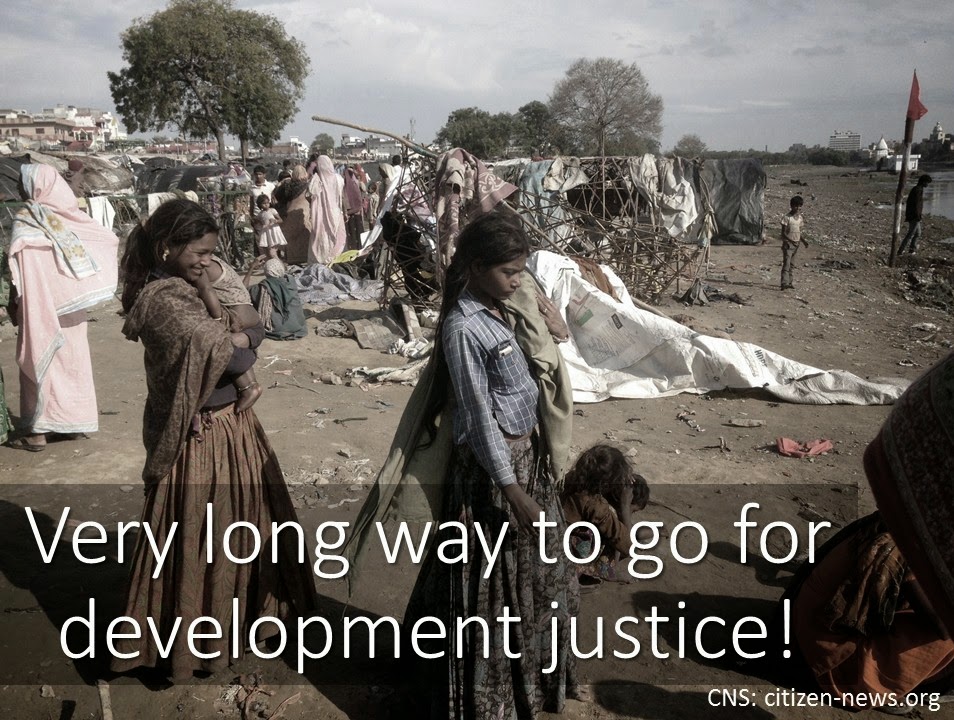
Through The People's Lens: Modi's Development Model So Far

Rahul Pandey, Bobby Ramakant & Sandeep Pandey


Story of Modi’s development model so far: Cutting health and education expenditure, forcing land acquisition, buying expensive jets and unsafe nuclear power, benefitting Big Business, diluting employment guarantee, fanning communal fires, exploiting Ganga, curbing dissent and shielding governance from public scrutiny.
If we separate Modi government’s actions from mere words and assess its priorities from the former, there is now enough evidence to form a clear picture. The picture that emerges is one of grossly skewed priorities.
Whatever Prime Minister Modi might say about working in the interest of farmers, transparency, cleanliness, environment and make-in-India, the concrete actions show otherwise. Let us look at some of the major policy actions initiated in the past one year that are signatures of this government. They indicate a disregard for people’s needs of livelihood, education, health and sanitation, a legitimisation of usurp of India’s natural resources and environment by big commercial interests, and a reinforcement of this exploitative process by curbing dissent and diluting mechanisms of transparency and accountability in governance.
Fund cuts in health, education, drinking water and sanitation, and women and child development
Four important Ministries and sectors that constitute bulk of the social infrastructure – Health and Family Welfare, Women and Child Development, Drinking Water and Sanitation, and Human Resource Development (including education) – face a total cut in funds of INR 40,205 crore in 2015-16 as compared to 2014-15 budget. This includes both Central Plan fund and Centre’s assistance to State and UT Plan fund.
We compare this year’s budget with previous year’s budget estimate rather than actual expenditure as the budget estimate indicates government’s intent. The government first reduced the 2014-15 budget allocation for Ministry of Health and Family Welfare by 20% (i.e. by about INR 6,500 crore) in a revision in December 2014, and later maintained that reduced allocation in the 2015-16 budget. The budget for Ministry of Women and Child Development has been reduced by 52% or INR 10,818 crore, and that for Ministry of Drinking Water and Sanitation by 59% or INR 9,026 crore. It must be noted that the entire Swaccha Bharat Abhiyaan is included in Drinking Water and Sanitation sector. In other words, in spite of Modi’s rhetoric of Swaccha Bharat the total fund allocation in 2015-16 for all governmental programmes of cleanliness, drinking water and sanitation improvement has actually gone down by 59% from budgeted allocation of 2014-15. Finally, the budget for Ministry of Human Resource Development, that includes school education, literacy and higher education, has been cut by 20% or INR 13,853 crore. Majority of this cut is in programmes of school education including setting up model schools at Block level. There is no cut in higher education fund.
While on the one hand the government has reduced these four social infrastructure sectors’ budget by INR 40,205 crore, on the other hand in FY 2014-15 it willingly lost INR 75,592 crore of revenue due to incentives and waivers on customs duty for gold, diamond and jewellery, and another INR 62,399 crore of revenue on account of exemptions on corporate income tax. The Statement of Revenue Impact of Tax Incentives describes these incentives and exemptions as indirect ‘subsidy’ to preferred tax payers. There are several other categories of exemptions as well, but here we mention only these two as they go mainly to the cash-rich companies and wealthy individuals.
Buying expensive Rafale fighter jets and unsafe nuclear power: will they provide security?
Narendra Modi has signed two controversial deals during his visit to France - related to Jaitapur Nuclear Power Plant and the Rafale aircraft. It appears that both these deals will benefit the French companies, Areva and Dassault, respectively, which will provide the products, more than India. Dassault, specially, would have closed down if this deal was not signed. On the other hand the deal will have adverse impact on the public sector unit Hindustan Aeronautics Limited as the contract for domestic production of these aircrafts, after 36 of them arrive in ‘ready to fly’ condition from France, will probably go to some private company. The story of crippling a public sector unit by promoting the private players will be repeated once again in the country. Narendra Modi has already prepared the ground for this by opening up the defence sector to FDI upto 49% of investment, which the previous government was not willing to accede to. The Russian aircraft Su-30 would have cost about half of Rafale. Rafale has been rejected by a number of countries. It is not clear why Narendra Modi wants to buy three dozen of these when the country possesses the capacity to produce its own Tejas Mk2, an aircraft of same category.
The Jaitapur Nuclear Power Project, located in Maharashtra's Ratnagiri district, has been stalled for the last five years as there is stiff opposition on ground. The farmers who will lose land or whose farming will be affected in this very fertile region are opposing the projects on grounds of displacement, damage to environment and safety issues. After the Fukushima accident now people know how dangerous it is to have a nuclear power plant in your vicinity. Two Evolutional Pressurized Reactors, each of 1650 MWe, are proposed here initially, with the final target of achieving 9900 MWe capacity from six reactors.
About 1000 hectares will be lost to the plant and a bigger area affected due to radiation.
Pushing undemocratic changes to 2013 Land Acquisition Act
The Ordinance for amending the 2013 Land Acquisition Act was introduced by Modi government in December 2014, and presented as a Bill in February 2015 with some further modification made in March 2015. The amendments have undone almost all positive achievements of the 2013 Act for the sake of easing up procedures for private industry and facilitating ‘Make in India’ campaign.
The conditions of 70% (or 80%) consent and Social Impact Assessment have been exempted for five areas – industrial corridors, PPP projects (excluding private hospitals and colleges), rural infrastructure, defence and defence production, and affordable housing. It must be noted that practically any major project of private sector can be included in one of these areas. In addition, the prescription to limit use of agricultural land and to avoid multi-crop land has been removed. This is bound to compromise India’s food security. Furthermore, if an offence is committed by a government official or the head of a department, no citizen can file FIR or go to court for the official’s prosecution without prior sanction of the government.
By depriving farmers from having any say in the process of land acquisition, the core principles of latest Bill have become similar to the colonial Act of 1894. It is strange that amendments to the 2013 Act are being proposed citing shortage of land for industry, whereas lakhs of acres of unutilized lands are already lying with the Central and State governments. For instance, over 35% of land earmarked for SEZs lies unutilized and lakhs of acres is locked with sick industry.
Shallowness of ‘Make in India’
It is ironical that the government is doing all this damage while simultaneously claiming to promote ‘Make in India’ policy. How will depriving the majority of our population from basic healthcare and education facilities prepare the workforce required for skilled and productive economic activities? How will snatching agricultural lands from farmers and giving to factories help in a sustainable strategy for ‘Make in India’? How will the procurement of “ready to fly” Rafale jets, thereby diverting a large chunk of defence budget away from potential domestic manufacturing, contribute to ‘Make in India’?
Unfortunately the ‘Make in India’ strategy so far seems to rely too much on inviting foreign investment and favouring selected business houses and too little on involving India’s mass of small manufacturers, entrepreneurs, and farmers. Heads of some of India’s largest business groups have accompanied the PM in most of his high profile foreign visits. Those visits have been largely about inviting investment from foreign MNCs and signing business deals between foreign and Indian MNCs. For instance, bulk of the benefits of USD 22 billion deals signed during PM’s recent visit to China has gone to two particular business houses of India. Most of the deals made in PM’s foreign visits are either about directly procuring ‘readymade’ foreign technology that India does not have or about inviting MNCs to open mass production facilities in sectors in which Indian industry already has competence. 2015 Land Bill offers to ease up forcible acquisition of farmers’ lands for these factories.
All such mega investments will no doubt add to India’s GDP growth but the real questions we need to ask are, “Will they build widespread competence amongst the bulk of India’s manufacturers and farmers and generate enough employment for India’s population?”, and “Will they build domestic competence in development and manufacture of advanced technology?” ‘Not likely’ seems to be the answer to both questions as of now.
For a ‘Make in India’ process to succeed in true sense, it must include agriculture, forestry and related economic activities, and involve farmers and forest dwelling people as stakeholders in form of owners and participants in those activities. Almost all industrial supply chains begin from farmland, forests or mines. Unless the communities who have been living in harmony with these natural resources for ages and who possess valuable traditional knowledge are engaged as equal partners and ‘value adding producers and suppliers’ to successive links in the chain, the entire ‘Make in India’ strategy will fall flat. Such a strategy that undermines the role of indigenous farming and tribal communities will most likely result in massive displacement and distress migration of the people and commercial exploitation of the environment. On the contrary, a strategy that views small farmer and tribal communities as trustees of natural resources, grants them negotiating right and connects them with local clusters of small manufacturers, designers and markets can meet multiple goals of employment, economy, equitable wealth distribution and sustainable development.
In addition, the policy of low priority accorded to health and education needs to be reversed as universal health care and universal education are preconditions to developing productive workforce and enabling people to access better opportunities for employment and entrepreneurship. Without a strategy that involves small manufacturers, entrepreneurs and farmers as equal value adding partners in a collaborative system and provides good health care and education to all, we cannot conceive of building a robust domestic industrial competency.
Contradiction of starting Jan Dhan Yojana and undercutting employment guarantee scheme
Jan Dhan Yojana is a much touted social security program of Modi that aims to open saving bank accounts for the poor and thereby provide them access to banking services and directly transfer benefits to them under various welfare and job schemes. The intention may be good and it is hoped that this will cut leakages and make benefits transfer process efficient. The ground reality, however, reveals that there has been little follow up after the first round of outburst of opening a record 11.5 crore bank accounts in five-six months. Majority of the accounts have zero balance. Moreover, total MGNREGS disbursal has dropped sharply. Instead of re-assessing and course-correcting the Jan Dhan scheme, Modi has gone ahead and announced a pension and two insurance schemes for the poor on a similar scale.
Banking, insurance and pension schemes will be futile without enabling the poor to get employment and regular earning. MGNREGS was a positive initiative undertaken by the UPA government in the direction of creating employment by engaging the poor in productive work such as building local infrastructures. It did create lots of rural employment, slowed down distress migration, and acted as a security valve in times of calamities such as crop failure. However UPA could not build on the initial momentum, the work options under MGNREGS did not expand, and the total number of jobs offered showed a decline since 2011. Instead, the government could have offered the rural poor a steadily expanding set of options of creating infrastructures such as schools, hospitals, pucca roads, drainage, water supply, etc.
Modi government has accelerated the decline. The first quarter of 2015 saw the steepest drop in person-days of employment in the history of MGNREGS – more than half from the first quarter of 2014. That too in the period when a lot of farmers suffered from crop damage due to heavy rains and hailstorms.
Thus the small and medium farmers of India, after being hit in the immediate term by inclement weather, are now facing doom in the short-medium term by shrinking security net of MGNREGS and in the longer term by government’s enthusiasm to legalise forcible grabbing of their farmlands for private industry.
Exploitation of Ganga
Clean Ganga mission has been initiated with the participation of five ministries – Water Resources, now going to be called Water Resources, River Development and Ganga Rejuvenation; Environment and Forests; Power; Tourism; and Surface Transport and Shipping. The Tourism ministry is going to look into how to promote tourism all along Ganga, the Power ministry is going to explore new opportunities of generating hydro-electricity and the Surface Transport and Shipping ministry will see how to use the waterways for facilitating trade.
Hence the mission clean Ganga is not just about cleaning Ganga. In that only the water resources and environment ministries would have been sufficient to undertake the task. The other three ministries are being involved with the objective of commercial exploitation of Ganga.
There have been protests earlier against dams on river Ganga. Persistent efforts of individuals such as Sunderlal Bahuguna and former professor of IIT Kanpur G D Agarwal against big dams on the Ganga have generated awareness about the dangers of such projects in the ecologically fragile region. Lakhs of families who have been displaced by big dams on the Narmada river, and who face submergence because of government’s decision to raise dam height in violation of Narmada Water Dispute Tribunal Award, still await rehabilitation. All this demonstrates government’s enthusiasm to push large projects without caring for or preparing to compensate the destruction caused to the environment and the lives of displaced communities.
One can find out the impact of big tourism activity on any of cities along Ganga and determine its contribution to making it dirty. Spitting, throwing waste, polythene in Ganga is being thought of as a punishable offence. What is Narendra Modi going to do about the untreated sewage which is allowed to meet not just Ganga but virtually every river in the country including Sabarmati? When will that become a crime?
Modi’s plan to clean Ganga with the involvement of agencies which might be looking to make money from their projects could spell a disaster for the holy river and the environment even if we choose not to talk about the lakhs whose lives and livelihood will be affected when these ambitious projects are undertaken. For example, the traditional boatmen and fisherfolk communities are already wary of Modi’s plans.
Increasing communalisation
With the capturing of power at the centre, the people associated with Sangh Parivar have been emboldened to say things in public which they hitherto mostly kept to themselves. Love Jihad, Ghar Wapsi, building a temple for Nathuram Godse, talking of taking away the voting rights of Muslims, asking Hindus to produce more children, demanding right to start performing puja in Taj Mahal, are some examples. Attacks on religious institutions belonging to minorities, especially Churches, including placing a Hindu deity idol in one of them, are vitiating the communal harmony atmosphere of the country. While such communalisation may help BJP to polarise votes in its favour it will have long term effects in terms of distorting the relationship among different communities. For example, in Gujarat, which had been described by VHP President Ashok Singhal as a laboratory for communal experiments after the 2002 massacre there, today the Hindu and Muslim populations are totally segregated, both mentally as well as physically. The VHP President had also claimed then that they will convert the whole country into Gujarat. For now, they seem to be succeeding in their design. By the time they leave the seat of power they would have caused irreparable damage.
Shrinking space for dissent and increasing absence of governance accountability
Another worrying sign is the increasing tendency of the state to label those who disagree and oppose its model of development as acting against national interest. As if the government’s idea of development is sacrosanct and it alone can claim to act in national interest! This brazenly self-centered and dictatorial attitude of the government has resulted in harassment of civil society organizations (CSOs). Bank accounts of a number of organisations which question government's policies, especially those receiving foreign funds, are being seized. But the Sangh Parivar has received large funds in the past for its Ram temple movement from Hindus settled abroad to disturb the communal amity atmosphere of the country and still continues to receive funds for its communal education projects.
While on the one hand the government seems determined to curb democratic right of citizens and CSOs to critique its actions, on the other hand it is trying to make itself less transparent and accountable. It has not appointed Chief Information Commissioner for the past eight months and Information Commissioners for the past one year, thereby rendering the Right to Information (RTI) processes inefficient and slow. Consequently the backlog of appeals and complaints pending in the Commission has swelled to about 40,000. Likewise, the posts of Chief Vigilance Commissioner and Lok Pal have been lying vacant for a long time. Therefore it appears that by procrastination in these crucial appointments the government is weakening the processes that hold its own governance systems accountable to the public. It is indeed surprising that the PM claims to be working for transparency in governance.
In conclusion
In other words, by its concrete actions the government is giving a clear message to its citizens, “Do not believe when we speak for health, education, cleanliness, farmers, transparency, and ‘Make in India’. Judge us by our actions, where we put taxpayers’ money, and what the PM spends his time lobbying for. We are intent on undermining public health care, school education, farmers’ livelihood, food security, sanitation and cleanliness. At the same time we hope to convince some multinational companies to open factories in India where a fraction of the people displaced from farmland will find work, that too provided they skill themselves up for the new jobs. Otherwise some of the educated youngsters from cities will operate machines in those factories. How will majority of the population that remains poorly educated and under-nourished find any productive and dignified employment? – so far we do not have a clue to that question. By legalising land grab by private industries and bypassing farmers’ consent and impact assessment, we’ll let private industries open facilities wherever they wish, be it the most fertile multi-crop land. We will tackle the civil society activists who persistently oppose our plan by painting them anti-national, blocking their funds, and diluting RTI to make it difficult for them to access information.”

The Religious Domination Of World Affairs

Sazzad Hussain

The domination of the religious authorities in the matters of the states is nothing new in contemporary history. Since long, the pedestals of religion—mostly that of Christianity and Islam have been at the helm of the affairs of many powerful empires and political territories. It was the Vatican which had ruled Europe with an ever pervading power and influence for a long period of time in the past and Islam too had the same since the establishment of the Caliphate after the demise of the Prophet. However there realm of influence was not that amount of clout to effect the affairs of the entire world of the modern times.
The Vatican or Christianity paved the way for modern secular nation states after the treaty of Westphalia and it concentrated more on charity works than any other expansionist agendas as seen in the glorious services by humanists like …Hanschel in Africa. But as the western world moved away from the influences of the religious establishments on the matter of state and governance, newly formed states in Asia, after decolonization, began to follow religion in their matters. Later, the western military powers strengthened them as a handy tool to fight Soviet communism. Now, much after the end of the cold war, religion has emerged and also promoted to serve the expansionist designs of various agendas—military, territory, cultural and economic dominations. And these are also echoed in India.
Though the Christianity, mostly the Catholic Church has often been accused of promoting extremism and armed separatism in may parts of the world—like in East Timor and among some ethnic communities of Northeastern India, it has been largely apolitical and non-military on its approaches so far. There were many instances in which Catholic priests led mass movements against corrupt and dictatorial regimes in Latin America, against MNCs destroying the Amazonian rain forests etc. In recent times the Vatican has been very vocal against the occupation and daily atrocities by Israel in Palestine. The Papal authorities have also been opposing the Iraq war and violence in Middle-East, mostly ignited by the west. On the contrary, many ultra-orthodox Jewish forces in Israel and in US have been pushing for more bleeding of Palestine and Hindu fundamentalist groups are gaining momentum India to disturb its secular and pluralistic credentials. Above all, it is the Islamists (say Sunnis) that has been destroying peace and harmony, economy and development, culture and politics of a vast region of the world with tacit approval of western military powers.
The Islamism as a global force was recognized by the west during the Saudi-led oil embargo of 1974 which prompted the oil-boom. It was applied first the thwart the Nasserite-Baathist Arab secular nationalism across the Middle-East and the Maghreb. The fall of pro-western Shah of Iran in 1979 and installation of Shiite Islamic Republic there made global Islamism to take a narrow sectarian perspective supporting Saddam Hussain for its long war with Iran (1980-88). The entry of Soviet troops in late 1979 to Afghanistan made the western powers to engage the Saudi founded Islamist force to Jihad. The Afghan Mujahedeen (1980-88) war the first globalized Islamist military campaign orchestrated by US and its allies. At the same time it was tested and forcefully applied in Muslim majority yet diversely populated democracies like Pakistan where Gen. Zia introduced Islamization with active Saudi involvement. Its effects were also felt in neighbouring India among some Muslims in a politically volatile atmosphere of the 1980s which saw communal programs in Meerut, Bhagalpur and the commencement of the Ayodhya movement. Bangladesh too experienced the same under the regime of Gen. Ershad. The end of Afghan Mujahedeen brought the Jihad to Kashmir, the Caucasus, the Balkans, the Horn of Africa etc and the fall of the Arab nationalism and its clubbing with US following Iraq’s invasion of Kuwait in 1990 brought back the Jihadi expatriates back to Saudi Arabia with the arrival and stationing of US forces on this region for the Gulf War of 1991. The fall of the Soviet Union and the end of the Cold War hostilities led to the emergence of this Saudi led Islamism to a force to reckon with—to thwart and fight any efforts by any states or allies opposed to the western hegemony.
Empowered by huge oil revenues and protected by US military might, this Saudi led Islamist force, with a sectarian ideology called Wahhabism is now transforming the great Babylonian valley (Syria and Iraq) into inferno. They are not only killing and destroying but annihilating other communities—Yazidis, Christians, Armenians, Kurds and Shiites, the people who co-existed peacefully under the Baathist system. While these Islamist forces were unleashed to topple the regime of Gaddafi in Libya and Assad in Syria during the pro-democracy Arab Spring, Saudi Arab, Bharain and other Gulf allies crushed the popular demonstrations in their countries. The rich Gulf monarchies, all US allies, are not using their military power against the menacing IS nor they are pushing Israel to stop its atrocities, segregation on Palestinians—but pounding Yemen for its Shiite Haouthi militants and trying to derail the Iran nuclear deal. The Vatican is often accused of being influential on various MNCs and large corporations affecting the economies and lives of billions across the globe. But now it seems that the Islamist forces, led by Saudi Arabia, Qatar etc are in perfect sync with the global powers and business houses to run their functions unaffected. Likewise Turkey’s ruling party is also leaning towards Islmaism, transforming the Kemalite secularism to Sunni identity and supporting the Islamist forces fighting the Assad regime in Syria. Turkey’s present government is also very business and industry friendly allowing all types of capital to operate in their country.
In India too, a trend has been set to create a free world for big business houses while following a soft Hindutva policy of majoritianism. This internal hegemony within a larger external hegemony is what being characterized by in the contemporary world in the second decade of the twenty first century. The perfect rhyme of religion and business is what now is shaping the world affairs—a system which is definitely going to change our lives and society in the coming days.

South Sudan: Escalation Of Violence Points To Failed Regional And International Action

Amnesty International

New research conducted by Amnesty International on the surge in military activity in South Sudan over the past weeks clearly shows that regional and international efforts to end the human suffering caused by armed conflict in South Sudan have failed.
Amnesty International researchers have just returned from Bentiu in Unity state where they documented violations including civilian killings, abduction and sexual violence.
“The spike in fighting between the parties to the conflict is a clear indication that South Sudan’s leaders have little interest in a cessation of hostilities, while the region and the rest of the international community are reluctant to take bold steps towards addressing repeated atrocities,” said Michelle Kagari, deputy director with Amnesty International.
Thousands of people have fled to the United Nations base in Bentiu to escape intensified fighting in Unity state between the Sudan Peoples’ Liberation Movement/Army-In Opposition and government forces and allied youth and militia groups.
Individuals who fled violence in Rubkona, Guit, Koch and Leer counties consistently described government forces, some in SPLA uniform and others in civilian clothing, mostly from the Bul section of the Nuer ethnic group, attacking their villages armed with axes, machetes and guns.
The interviewees gave chilling accounts of the government forces setting entire villages on fire, killing and beating residents, looting livestock and other property, committing acts of sexual violence and abducting women and children.
A 45-year-old woman told Amnesty International that government forces reached Panthap, in Rubkona county, early on the morning of 8 May. They instructed villagers to bring out all their property and took away anything of value. She said they beat her with a stick, but no one was killed. She fled with approximately 200 other villagers, arriving at the UN camp for displaced persons in Bentiu on 12 May.
A woman from Chatchara, in Rubkona county, described an attack on her village by groups of young men she believed were allied with the government on the morning of 7 May.
“They came and said, ‘bring your property out,’ and then they burnt our tukul [thatch-roofed mud structure]. They beat us with sticks and metal rods, saying ‘where are the boys and young men?’ They took our property, our maize and clothes, and forced us to carry them towards Mayom. We were many women from the village. One woman got tired and was killed. They also shot her two-year old daughter.”
The woman was eventually freed. She too made her way to the UN camp in Bentiu.
A 70 year-old man, also from Chatchara, similarly described beating, burning and looting by the government forces:
“When the SPLA arrived, they beat me and set fire to my three tukuls, and all the tukuls in the village. They took the cows and goats. Some children were shot in the crossfire. Many women and children were killed. I saw young children and women taken and forced to drive the cows and goats. They took my granddaughter, a girl of 13 or 14 years.”
A 20 year-old woman from Guit county recounted how a group of armed SPLA soldiers and youth attacked her village on the night of 7 May:
“They even killed young children and old men. They set the granaries, where we keep maize, on fire. They came to my house and shot my nephew who was about 20 years-old. They beat my mother with a rope used for tying the cows. They were asking her, ‘Where are the young men, we want to kill them, they have joined the opposition.’ I took off running with my three children and two siblings. We ran to the river while they were shooting at us. From the river, I saw them burn the house. They also took our cows and goats—we had 15 cows and 30 goats.”
The woman said four men raped her 23-year-old cousin, a mother of two. “I saw her when I was running. She was screaming,” she said. She also said that the attackers abducted her 13-year-old sister and her 15 year-old brother. She does not know the fate of her husband, mother or disabled uncle, whom she left behind in their home. “My whole family is lost,” she told Amnesty International researchers.
Nyanaath, a mother of three, said that government forces attacked her village in Guit county at midday on 10 May. She said the attackers, some of whom were in uniform, stole cows, looted property and set all the tukuls on fire.
Nyanaath said the attackers then raped women, she included. She told Amnesty International that soldiers took her, pushed her on her back and pulled down her underwear. One started raping her while another pointed his gun at her. She also said she saw 10 boys and girls, aged between 10 and 13, being abducted by soldiers.
The UN Office for the Coordination of Humanitarian Affairs (OCHA) says some 100,000 people have been displaced by the recent fighting in Unity state. About 2,300 civilians, mostly women and young children, have sought refuge at the UN base in Bentiu since 20 April, joining over 50,000 others who have fled there since the start of the conflict in December 2013. More are on their way.
Government forces have blocked others at checkpoints, preventing them from reaching the safety of the base. Thousands have fled into the bush or swamp areas.
The UN Office of the High Commissioner on Human Rights (OHCHR) reported that at least 28 towns and villages in Unity state were attacked in the space of two weeks, between 29 April and 12 May. Civilians were targeted and their property was looted.
“These attacks on civilians in Unity state, and the ensuing displacement, mirror events documented by Amnesty International in early 2014. The fact that some of the same villages and towns are being subjected to a repeat round of atrocities underlines the need for the African Union, the UN and other international bodies to match their tough rhetoric with concrete action to reduce the human costs of the conflict,” said Michelle Kagari.
“There must be a credible threat of accountability to deter those who carry on committing atrocities with total impunity, a comprehensive arms embargo to halt the flow of weapons that further fuel the conflict and targeted sanctions to provide a deterrent to those who continue violating international law,” said Michelle Kagari.
Amnesty International is calling for:
The UN Security Council to impose a comprehensive arms embargo against all parties to the conflict in South Sudan.
The UN Security Council to move quickly to impose asset freezes and travel bans against individuals and entities who have engaged in violations of international humanitarian law and violations and abuses of international human rights law.
The UN Security Council to make public and act upon a paper outlining options for accountability that Security Council members reportedly discussed on 12 May.
The AU Peace and Security Council to reverse its decision to shelve the report of the Commission of Inquiry on South Sudan pending the finalization of a peace agreement, to consider the report during the AU Summit in June and to make it public.
The Intergovernmental Authority on Development (IGAD), to quickly reconvene parties to the conflict and impress upon them that they are bound by commitments to abide by international humanitarian law incorporated within the 23 January cessation of hostilities agreement and recommitted to on numerous occasions over the past year, and to act on its repeated threats to impose targeted sanctions and an arms embargo.

A Color Revolution For Macedonia

Paul Craig Roberts

During the Cold War Washington was concerned about communists fomenting street protests that they could turn into revolutions, with groomed politicians waiting in the wings to take over the new government, thus expanding the Soviet empire. Today this is precisely what Washington does.
We recently witnessed this operation in Ukraine and now it seems to be underway in Macedonia.
The National Endowment for Democracy was established in 1983. The official purpose is to promote democracy abroad. The real purpose was to create dissension in Soviet Eastern Europe. Today the NED uses our tax money to overthrow governments not aligned with Washington.
The NED funds non-governmental organizations (NGOs) in countries targeted by Washington for political destabilization. These NGOs operate under such rubrics as “teaching democracy” and “human rights.” The NGOs develop cadres consisting of idealistic students and disgruntled politicians and set them against the existing government whose independence Washington wishes to curtail.
The idealistic students are simply dupes, and the disgruntled politicians simply desire power in office and will serve Washington in order to get it.
According to Assistant Secretary of State Victoria Nuland, Washington spent $5 billion in Ukraine grooming politicians and creating NGOs as Washington’s Fifth Columns. When Ukraine’s president Viktor Yanukovich refused to align Ukraine with Washington’s interests, Washington unleashed its Fifth Columns, and Yanukovich’s government was overthrown with violence. Despite Washington’s talk about democracy, the fact that Yanukovich’s government was democratically elected and a new election was only a few months away did not stop Washington from overthrowing Yanukovich.
Now the same fate seems in store for Armenia, Azerbaijan, Kyrgystan, and Macedonia. Most Americans don’t know where these places are. Armenia and Azerbaijan are east of the Caspian Sea and are former provinces of the Soviet Union. Kyrgystan is a former Soviet province that borders China. Macedonia, birthplace of Alexander the Great, is a part of northern Greece, but in the 20th century portions of Macedonia became parts of Bulgaria, Serbia, and Albania before becoming a province in Yugoslavia. When Washington destroyed Yugoslavia, Macedonia became an independent republic of two million people. Macedonia is landlocked and surrounded by Greece on the south, Bulgaria on the east, Albania on the west, and by Serbia and Washington-created Kosovo on the north.
Why is Washington interested in controlling Macedonia?
The Macedonian government refused to participate in Washington’s sanctions against Russia and supports the Russian Turkish Stream natural gas pipeline that will deliver Russian natural gas to Europe via Turkey to the Greek border.
Greece is being looted by the European Union, the IMF, and the German and Dutch banks. Consequently, Greece is being pushed into Russia’s arms as Russian support is Greece’s only alternative to the crippling austerity that the EU is forcing upon the Greek people. Macedonia sits between Greece and Serbia, a country with no love lost for Washington and the EU as a result of Serbia’s dismemberment by Washington and NATO aggression. Washington fears the flow of Russian energy, over which Washington would have no control, into its European vassal states via Russian allies in Europe.
If Washington can grab Macedonia, Washington can stand between Greece and Serbia and perhaps persuade Greece to align with a Washington-supported natural gas pipeline that would supply Europe from Azerbaijan, thus reducing Russia’s influence in Europe.
Macedonia has an Albanian minority population. Albania is a Washington vassal and NATO member. Washington has aligned with the dissident Albanians, demonstrators are in the streets, the Macedonian government is accused of corruption as was the Ukrainian government, and the US State Department is expressing its concerns about the Macedonian political crisis that Washington has orchestrated.
Washington is forever talking about democracy and human rights but has no respect for either. Washington uses these words as assertions of their absence in governments Washington intends to overthrow.
The Russian government understands the unfolding events. Whether the Russian government has learned its lesson from standing aside while the Ukrainian government was overthrown remains to be seen.
From an American perspective, as contrasted with Washington’s perspective, the question is whether the reckless pursuit of US hegemony is worth the risk of war with Russia and China. The neoconservatives, who have an iron grip on US foreign policy, believe that hegemony is worth any risk. But do Americans derive sufficient vicarious pleasure from a handful of neocons lording it over the world to accept the risk of nuclear war?
The naked aggression that Washington is displaying toward Russia should alarm not only the American people but also the entire world. War is in the making. War with Russia means war also with China. This is not a war that Washington and its vassals or human life can win.

100% Clean Energy By 2050: Decarbonization As Denial

Bill Henderson

We are refusing to take climate change seriously.
We're trying to get to a deal in Paris to reduce emissions to stay under 2C. 2C is an almost universally agreed guardrail against dangerous climate change, but if it was 1950 and we had today's climate science we'd do everything to stay below a 1C rise in temperature.
But, practically, 2C is now a mirage, a lie we tell ouselves. David Spratt and Oliver Geden make strong arguments that without emergency action it is too late to stay under 2C and Lord Stern and co, adding up present Paris emission reduction pledges, admit that promised emission reduction does not get us under 2C - more like over 3C.

Instead of action and policies of a scale necessary to stay under 2C (after decades of obfuscation and inaction), we conceptualize climate change in a way that climate mitigation seems to remain possible within our particular, wonderful business as usual (BAU).
Putting a price on carbon - whether a version of a tax or cap and trade - and replacing fossil fuels with renewables are the two prime examples. I have tried to show how ineffectual carbon pricing just wastes precious time when deep emission reduction is needed over the next couple of decades. Pricing carbon is a fundamentally wrong shaped policy hyped by economists, bankers and oil companies, a distraction that keeps us from even considering truly effective action.
Just like carbon pricing I want to try and show you how our framing of decarbonization, of getting to a low carbon economy, wrongfoots. It's not that switching from fossil fuels to renewables isn't a good initiative, it's not that transitioning to a low carbon economy or carbon pricing are bad ideas - of course, they aren't, it's just that they are not the emission reduction mechanisms needed now to protect against dangerous climate change. I hope it gives you a deeper look into our conceptualization of climate danger and possible mitigation
Decarbonization is normally pictured as switching from fossil fuels to 100% renewable energy (solar, wind, nuclear, geothermal, tidal, etc.) by a certain date, usually 2050 because this is an enormous transition and such energy transitions historically have taken many decades. Energy planners model different scenarios for making this transition using integrated assessment models (IAMs) to extrapolate energy demand into the future.
You can find a table of such 'Global Decarbonization Studies' (with links) in the excellent “A critical review of global decarbonization scenarios: what do they tell us about feasibility?”
But switching from fossil fuels to 100% renewables by 2050 is not even close to the same thing as reducing emissions enough to stay under 2C (which is already deep into dangerous climate change territory).
As Guy Dauncey explained in his The 2040 Climate Imperative, the carbon budget science bottom line is that if we don't reduce emissions significantly during the next two decades we will release enough greenhouse gases (GHGs) to exceed 2C, so the real question is 'Can renewables replace fossil fuels fast enough to reduce emissions of a scale needed in the next two decades?'
Look at the decarbonization studies: emission reduction of a scale required with renewables replacing fossil fuels is clearly not possible within the appropriate time frame. It may be possible to go 100% renewable, zero carbon by 2050 (and maybe not) but that is not the real climate mitigation question.
What the present modeling of energy transition is all about is continuing BAU into the far future, not about addressing climate change urgently. The IAMs project our present economy and it's trajectory into the future and planners try and find a transition path within that intended future. Fair enough as economic planning, but profoundly unethical wrong footing if you take climate change and our kids future seriously.
The hidden curriculum is that energy growth must happen and that we can only transition as fast as we can build new renewable capacity to replace fossil fuels. But obviously, if we take climate change seriously and such a renewables transition cannot reduce emissions of a scale needed in the crucial next two decades, then we must consider ways of reducing fossil energy production without renewable replacement - we must consider ways to power down that reduce fossil fuel use significantly. But this is heretical, not possible within our present socio-economy as it has developed.
For an example, we have enough clothing and housing for everybody in North America to last at least a decade; we could freeze expenditure on these survival basics and realize significant energy reduction but of course even considering such climate action threatens the whole economy, our whole socio-economy, so no one is even looking at such planning.
But North American's (and the rest of the 750 million global middle class) fossil fuel use is what must be reduced if we are to have any chance of staying under 2C. Emissions must be reduced from over 20 tonnes of GHGs per capita per year to around 2 tonnes.
100% renewables by 2050 is a red herring. If we are serious about climate change, we could reconfigure our socio-economy to power down, eliminating vast areas of inefficient energy consumption that aren't really necessary.
We could do it quickly and with nobody left behind and it doesn't have to be eco-fascist or Big Gov't. And it wouldn't be the end of the world or even the end of fun or the end of business. The market economy would just evolve differently.
We could envision a wartime-style effort of a limited duration requiring reconfiguration required by the climate emergency. Not Change Everything; not anti-capitalism, but a realistic and necessary change of direction faced with an accidental byproduct of large scale fossil fuel use that has been allowed to become civilization if not humanity threatening. Effective action would begin with an urgent schedule for winding down all fossil fuel production, dirtiest first.
This rational-comprehensive framework for staying under 2C could also greatly speed up the transition to renewables: when there is a schedule for keeping fossil fuels in the ground the present severe path dependence benefiting fossil fuels begins to evaporate. Thinking ahead, consideration must be given to allocating some portion of the remaining fossil fuel energy to build renewable capacity for the future.
We need to greatly speed up the transition to renewables but urgent emission reduction must be the priority. Here's David Roberts:
First, as evidenced by the fact that I’ve said it a jillion times, I think that the net benefits of transitioning to low-carbon, low-waste, highly networked systems of transportation and power would vastly exceed the net costs, considered at almost any scale and time frame (except perhaps very short time frames). That’s because climate change of 4 degrees C or greater, which is entirely possible on our current trajectory, carries with it a high probability of runaway feedbacks that could render the Earth all but uninhabitable for hundreds, even thousands, of years. Most of our economic models effectively discount to zero the value of the lives of people living far in the future. I think that’s immoral, that screwing up the Earth for all future generations would be a monstrous crime. ...
(C)ommonly used IAMs also underestimate decarbonization costs in key ways, by underestimating the size and speed of carbon reductions necessary. In his talks, scientist Kevin Anderson offers a whole list of these model shenanigans ­ from unrealistically low CO2 emission growth rates to unrealistically early peaks in emissions to unrealistically large availability of negative-carbon options toward the end of the century. In Anderson’s telling, modelers massage these assumptions to produce results that won’t intimidate and overwhelm policymakers."
I hope you take climate change seriously. We need open debate about our real predicament. We need to escape denial and consider real, effective mitigation strategies. Ask yourself: what will our kids look back and think of our present conceptualization of climate danger and our hands tied behind our back ineffectual mitigation?

23 May 2015

IWC Masters Scholarships for International Students

Brief Description:
The IWC Masters Scholarships are prestigious scholarships awarded annually to high calibre candidates who clearly demonstrate potential to become future water leaders. Scholarships are available to study the IWC Master of Integrated Water Management (MIWM).
Host Institution(s):
The University of Queensland in Brisbane, Australia
Field of study:
No. of  Scholarships:
Up to 3
Target group:
B –  Future water leader from selected countries in North America, Europe, the Middle East or Asia (see details in table below).
Scholarship coverage/inclusion:
A – Each scholarship is valued at approximately AU$ 89,811 and will cover full tuition fees, living costs, return air travel to Australia, student visa and overseas health cover.
B – The scholarship is valued at approximately AU$ 50,776 and will cover full tuition fees and overseas health cover.
Eligibility:
To apply for a scholarship, you must have all of the following:
• A completed undergraduate degree in a related field of study from an internationally-recognised institution;
• At least two years of professional experience (paid work or volunteering experience) relevant to the program.
•  International candidates must also demonstrate English Language Proficiency (see UQ’s Policy including minimum scores for IELTS, TOEFL or PTE). A proof of English language proficiency needs to be uploaded with the online application form.
Application instructions:
International scholarship candidates are no longer required to apply for the MIWM program admission at The University of Queensland (UQ) alongside their scholarship application. To apply, complete an online application form by 1 August 2015.  Shortlisted applicants will be contacted (via email) on 18 August 2015 and will then be invited to submit an application for admission into the MIWM program at The University of Queensland (UQ).
It is important to read the IWC Scholarships Terms & Conditions and visit the official website to access the application form and for detailed information on how to apply for this scholarship.
Website: