24 Feb 2016

Germany’s Deutsche Bank in crisis

Gustav Kemper

After a record loss of €6.8 billion in the 2015 business year, Deutsche Bank’s shares have plunged in value by 35 percent in the first weeks of 2016, reaching their lowest level since 2008. By comparison, even in the year of the 2008 financial crisis, the bank’s losses amounted to only €3.9 billion. The bank’s share price, which at one time was above €100, is currently moving between €13 and €16.
Amid sharp drops in the stock prices of other European banks, leading financial newspapers are reporting “panic on the markets” and “the return of fear,” and asking if the world economy stands on the brink of “the next crash.”
In a bid to settle the unease, John Cryan, chairman of board of Deutsche Bank, claimed in a public letter to bank employees that “Deutsche Bank, given its capital strength and its risk position, [is] absolutely rock solid.” Finance Minister Wolfgang Schäuble reassured US financial outlet Bloomberg TV that Deutsche Bank was giving him “no concerns.”
These assertions had the opposite effect. The very fact that Cryan felt the need to make such a statement was seen as a sign of weakness. Comparisons with the US financial crisis in March of 2008 were made, when investment bank Bear Stearns insisted that rumours about liquidity problems were “absolutely untrue,” before being taken over four days later by JPMorgan Chase in order to prevent a total collapse.

Deutsche Bank and the German state

Notwithstanding its name, Deutsche Bank was always purely a private bank. However, its history is closely bound up with the emergence of Germany as an economic and political great power, and all of the problems, crises and crimes connected to this. Since the bank’s founding in March 1870, its interests and those of the German state have overlapped. In its founding statement, the bank set itself the goal of “finally conquering a position for Germany in the field of financial transactions…” The cornerstone was thus laid for the financing of imperialist expansion in Asia, Africa and South America.
Along with international expansion, Deutsche Bank financed leading industrial concerns such as Krupp, Siemens, Mannesmann, Bayer, BASF, AEG, Thyssen and several mining concerns. Under its guidance, the merger of Daimler and Benz was carried out in the 1920s, as well as the merger of Aero Lloyd and Junkers to form Lufthansa. Its directors and board members were represented on the supervisory boards of many companies.
Hermann Josef Abs, whose career at Deutsche Bank began under the Nazis with the “Aryanisation” of hundreds of Jewish firms as well as the financing of the arms industry, pursued the goal of recentralising the bank after it had been broken up into 10 regional institutions at the end of the Second World War. The growth of the export economy increased the need for a strong bank, which was realised with the founding in 1957 of Deutsche Bank AG, with headquarters in Frankfurt.
Deutsche Bank sought to obtain a stake of at least 25 percent in all important firms, since the earnings from dividend payments were then tax free. Like other board members at Deutsche Bank, Abs was represented on the supervisory boards of dozens of industrial firms.
The close connections between bank and company boards, which controlled and protected each other, became the hallmark of “Rhein capitalism,” or the “social market” economy. It was characterised by the fact that the banks, rather than the stock market, determined financial affairs, and a balance existed between shareholders and boards. The trade unions were integrated into this network via industrial co-determination.

From a business bank to speculation

The globalisation and financialisation of the world economy since the 1970s undermined this business model. To maintain its position in the vastly expanding financial markets, where the big profits were made, Deutsche Bank had to loosen its ties with industry and intervene in the business of global speculation. In this, Deutsche Bank led the way.
With the takeover of London-based investment bank Morgan Grenfell in 1992, as well as the New York wealth management service Bankers Trust in 1999, Deutsche Bank sought to close the gap with the much stronger investment banks on Wall Street and in London. However, the attempt to take over Dresdner Bank and its investment subsidiary Dresdner Kleinwort Benson (DKB) in April 2000 failed due to opposition from Deutsche Bank’s investment subsidiary in London, Deutsche Asset Management.
The expansion of Deutsche Bank was closely associated with Swiss banker Josef Ackermann, who led the bank from 2002 to 2012 and for the first time replaced the collective leadership model with the single chairman of the board. Under his leadership, the bank’s hubris knew no bounds. He announced in 2005 the goal of increasing capital investment returns to 25 percent.
Despite the relocation of the bank’s activities to the global speculation market, close relations remained with the German chancellor’s office and industrial concerns. During the 2008 banking crisis, as the German government made hundreds of billions available to secure the banks, Ackermann was among Merkel’s closest advisers. In April 2008, she even invited him to celebrate his 60th birthday with a banquet in the chancellor’s office.
Like German industry, the German government requires an internationally active bank to pursue its imperialist interests. As Deutsche Bank’s share price fell ever further, the predominant concern in the financial press was the international consequences rather than the immediate financial losses.
As the Frankfurter Allgemeine Zeitung wrote in early February, “German companies do not want to have to rely only on American investment banks. During takeovers abroad, they want to know that they have a dependable partner from their home market on their side. This role cannot be assumed by other German banks like Kommerzbank. The German economy desires a healthy Deutsche Bank.”
In industrial circles, there is great concern that their activities abroad could suffer as a result of Deutsche Bank’s crisis. “German companies heavily engaged abroad require a large German bank to open access for them to markets in Asia and America,” warned the Frankfurter Allgemeine Zeitung. The newspaper cited the business director of the German Chamber of Trade and Industry (DIHK), Martin Wansleben, as saying, “We are of course worried about what is happening there.”
These concerns are increasing with the threat of a breakup of the European Union. “In the most extreme case, Europe will be torn apart between the global players of the United States, China and Russia like a piece of Parmesan in the cheese grater,” capital markets expert Robert Halver from Baader Bank told Handelsblatt.
Deutsche Bank is not an isolated case. “It is an illusion to believe that the banks coped with the 2008 crisis,” Der Spiegel wrote in a recent article on the banking crisis entitled, “A spark is enough”.
The gigantic sums that central banks pumped into the financial system with their low interest policies temporarily prevented a complete collapse and pushed stock prices significantly higher. However, the imbalances in the world economy, the huge financial bubbles and the shifting of business activity to purely financial and speculative operations, which triggered the 2008 crisis, have intensified.
In the context of a sharp economic downturn in China and other emerging economies, falling prices for raw materials, the political consequences of the wars in the Middle East, the intensifying conflict between the United States and China as well as the crisis of the European Union, the entire financial system is once again at risk of collapsing like a house of cards.
The European banking system in particular is mired in deep crisis. Several Italian banks confront the threat of bankruptcy. The financial crisis in Greece could break out again at any moment. In the euro zone, according to Der Spiegel, toxic assets have doubled since 2008 to a value of €1 trillion.
The concentration and interdependence of the banking business have also intensified, increasing the fragility of the entire financial system. A study by ETH Zürich on the influence of tens of thousands of transnational corporations came to the conclusion in 2011 that 147 companies controlled 40 percent of the total monetary value of transnational corporations (TNCs).
The most powerful of these companies include the Wall Street and London banks, as well as a handful of European financial institutions, among them Deutsche Bank. Connections within the banking system are so intertwined that the bankruptcy of one could be enough to bring down the whole system.

Criminal methods

Another reason for the crisis at Deutsche Bank is the criminal methods with which it and many other banks have amassed wealth—methods that helped trigger the 2008 financial crisis. Since 2012 alone, Deutsche Bank has been compelled to pay some €12 billion in fines.
An additional €4.8 billion has been set aside for further legal proceedings. These include accusations of money laundering in its dealings in Russia as well as breaches of political sanctions in Iran. Investigations continue in the United States into its mortgage business prior to the financial crisis and the manipulation of the Libor and Euribor interest rates. Compensation payments related to the bankruptcy of the Kirch media concern will cost the bank approximately €1 billion.
In addition, a trial of bank employees over “serious bank-related tax evasion” in the trading of CO2 emissions certificates is currently ongoing.
Deutsche Bank is also heavily involved in the risky financing of energy companies that are facing difficulties in making interest payments and loan repayments as a result of declining energy prices. Since the volume of “troubled loans” is concealed in the companies’ balance sheets, nobody can estimate the extent of the risk to which the bank is exposed. This is not only the case with Deutsche Bank, but also many other European financial institutions.
Another indication of the scale of the risks is the increased price of credit default swaps (CDS), derivative investments that serve as insurance against defaults. Since January 2016, CDS premiums for Deutsche Bank have more than doubled.
These are, in summary, the main reasons for the fears of collapses and sudden sell-offs gripping the financial markets, which, in the space of a year, have led to a halving of Deutsche Bank’s market value to €20 billion.
“Investors have lost all trust not just in Deutsche Bank, but in all European banks and perhaps even the entire financial and economic system,” was Der Spiegel’s main message.

India: Mounting death toll as army deployed to end caste-based job agitation

Sarath Kumara & Keith Jones

At least 19 people have been killed as Indian police and security forces, including 10,000 Indian army troops and para-militaries, seek to force an end to an agitation aimed at securing caste-based “reservations” (affirmative action) for the Jat sub-caste in the northwestern state of Haryana.
The Rashtriya Jat Mahasabha (National Jat Assembly) announced that it was calling off the agitation Monday after India’s central and Haryana governments—both of them led by the Hindu supremacist Bharatiya Janata Party (BJP)—reaffirmed a pledge to give Haryana’s Jats preferential treatment in obtaining government jobs and university and college places.
However, the agitation continued into the evening in parts of Haryana and security forces killed three more people when protesters tried to prevent them from removing a road blockade.
India’s BJP government first deployed Indian troops against the agitation last Friday. It massively expanded the military intervention over the weekend, after the protests escalated in response to the initial security crackdown.
On Saturday, Jat protesters seized the Munak canal, which supplies nearby Delhi with 60 percent of its water, and diverted the water flow. Within hours, India’s capital and largest urban area was facing an imminent water shortage, forcing the Delhi Union Territory government to announce water rationing and the closure of the city’s schools on Monday.
The agitation has also badly disrupted socio-economic life across Haryana, with train lines and highways blockaded and some businesses attacked. Due to parts shortages, major factories in Haryana’s Gurgaon-Manesar industrial belt have been forced to slash or halt production.
The Indian government and ruling class have responded, as they typically do to any sign of social opposition, with repression, violence and brutality. Over the past four days, military units have been deployed across the state, with curfews and shoot-on-sight orders imposed on major population centers, including Rohtak, Bhiwani, Sonipat, Panipat, Jhajjar and Hisar.
The Haryana agitation speaks to an acute social crisis. Indian Prime Minster Narendra Modi, who won election 21 months ago promising to bring jobs and development to India, claims to have returned India to “high growth.” The reality is India’s exports have fallen for 14 consecutive months, industrial production is stagnant and tens of millions are unemployed or underemployed. And this is true not just for unskilled laborers, but also for ever-growing numbers of university graduates.
That said, the Jat reservation agitation is both politically bankrupt and reactionary.
It is predicated on acceptance of the capitalist profit system. It seeks nothing more than a more “equitable” division of the misery produced by Indian capitalism, through the parceling out of the paucity of government jobs and post-secondary education places on the basis of caste identities.
Such caste-based agitations strengthen the Indian bourgeoisie, the tiny elite whose wealth and incomes have soared as a result of the past quarter-century of neoliberal reforms, by diverting social anger away from a challenge to capitalism, enflaming reactionary caste divisions and splitting the working class.
For decades the Indian bourgeoisie and its political hirelings have manipulated and incited caste and communal divisions, the better to divide the working class.
A major element in this has been the expansion of the “reservation” system, which was pioneered by India’s British colonial overlords then incorporated by the national bourgeoisie, under the leadership of the Congress Party, into India’s post-independence constitution.
Presented as a means of promoting social equality and eradicating caste oppression, “reservations” have in fact only benefited a tiny layer of Dalits (former Untouchables) and other lower castes. This privileged layer, which has been deliberately nurtured as a social prop of bourgeois rule, zealously promotes caste identities, using them to lay claim to privileges and a share of political power.
Meanwhile, 69 years after Indian independence, the Dalits continue to be grossly overrepresented among the poor, the landless and the illiterate.
Initially restricted to Dalits and India’s tribal peoples, reservation was extended to other traditionally lower caste groups, the so-called Other Backward Classes (OBCs), in 1989, when the V.P. Singh government set aside 27 percent of government jobs and higher education places for OBCs.
Such is the perverse logic of reservation that numerous sub-caste groups, or rather their self-proclaimed caste associations and leaderships, have demanded OBC status. This included some that have traditionally eschewed identification with the lower castes. Last year, Modi’s home state Gujarat was shaken by an agitation in the name of one such group the Patidars, or Patels.
The Jats, a traditional Hindu-Sikh subcaste of small farmers that today comprises 29 percent of Haryana’s population, are another such group.
The place that caste has come to play in Indian political life and the ability of the bourgeoisie to channel social anger along caste and communal lies is bound up with the criminal role of the India Stalinists parties, the Communist Party of India (CPI) and the Communist Party of India (Marxist), or CPM.
For decades, they have systematically suppressed the class struggle and subordinated the working class to the Congress and various regional and caste-based parties, while portraying reservations as “progressive” and supporting their extension, including to the private sector.
Over the past quarter-century the Stalinists have propped up a succession of governments at the center that have pursued pro-market reforms, while in the states where they have formed the government they have implemented what they themselves term “pro-investor” policies.
In recent years Haryana has been the site of explosive labor struggles, including at Maruti Suzuki and Honda Motorcycles, against the use of poorly-paid temporary and contract workers. But the Stalinists and their affiliated unions invariably isolated and betrayed these struggles.
A section of the Jat elite has long been agitating for their caste group to gain a share of the 27 percent OBC quota. Their campaign was given new impetus when the then Congress-led central government, in a crass attempt to stump for votes, gave the Jats in Haryana and across north India OBC status just before India’s 2014 general election.
Subsequently, the Supreme Court struck this order down, reaffirming a previous ruling that said the Jats did not meet the caste and socio-economic criteria to be designated “backward.”
It appears that the current agitation was instigated with the backing of the Congress Party in Haryana and a regional party, the Indian National Lok Dal, so as to make political hay at the BJP’s expense.
Under the agreement reached yesterday between leaders of the Jat agitation and the BJP central and Haryana governments, the central government will form a committee under Urban Development Minster Vankaiah Naidu to prepare a “comprehensive report” on the Jat reservation issue and the BJP state government will introduce a bill in the state assembly to “provide for reservation for Jats in the state.”
This, however, will likely lead to a new crisis. First, neither of the BJP governments have explained how they will get around the Supreme Court ruling against Jat reservation. No less significantly, other caste groups will likely forcefully oppose the 27 percent OBC share being “diluted” by its extension to the Jats. Already during the current agitation, a Haryana BJP MP, Rajkumar Saini, announced the formation of a 100,000 strong “OBC brigade” for “direct action” to counter the Jats.
Expressing the views of a section of the ruling elite, the Hindu published an editorial Monday that defended the caste-based reservation system, while opposing the demand for its extension to “relatively well-off communities ...be it Patidars in Gujarat last year or Jats in Haryana this year.
“The Jats,” it continued, “are a relatively prosperous land-owning community in Haryana ...high on the social ladder.”
Such statements are aimed at promoting reactionary caste politics, by insinuating that caste in contemporary India is a socio-economic category. In truth Jats, like all other caste groups, are made up of people from different classes and with divergent and opposed class interests. While there is a Jat elite that is rich and politically influential and leads organizations such as the Jat Mahasbaha, the majority are small farmers who are being squeezed by rising prices, subsidy cuts and the parcellation of the land. According to press reports, 10 percent of Jat peasants in Haryana are landless. Others are workers employed in the globally-connected auto sector that has sprung up over the past two decades in the Gurgaon-Manesar industrial belt.
Irrespective of their caste background, for the vast majority of Indians, including the three-quarters of the population who are forced to eke out an existence on the less than US $2 per day, reservation has done nothing. But for the bourgeoisie it has proven a vital instrument, a means of entrenching caste divisions, so as to use them to divert social opposition and perpetuate capitalist exploitation.
The eradication of caste oppression like the resolution of all the other uncompleted tasks of the democratic revolution in India will only be possible through the revolutionary mobilization of the working class, leading behind it the oppressed toilers, against the Indian bourgeoisie and for the reorganization of society along socialist lines, so as to provide jobs, education and quality public services for all.

UK schools privatisation programme continues despite failures

Tom Pearce

As the Academy programme—the flagship education policy of the previous Labour government—enters its 14th year, all Westminster parties have embraced it.
Under the Conservative government, there has been an exponential increase in academies, allowing all schools to convert or to be forcibly converted by the Department of Education.
There were 4,676 Academies created in June 2015 and hundreds more are planned. The Academy programme has created a fragmented system of education and has forced through the privatisation of state education behind a smokescreen of a professed aim “to improve pupil performance and break the cycle of low expectations.” In August 2015, Prime Minister David Cameron announced that he wanted to make all schools academies. “I want the power to be in the hands of the head teacher and teachers rather than the bureaucrats”, he asserted.
In reality, as 2016 begins, the biggest academy chain in England, the Academies Enterprise Trust (AET), has been accused by the Office for Standards in Education, Children’s Services and Skills (Ofsted) of “failing too many pupils”. Inspectors say that 40 percent of pupils in primary schools run by the AET are in “academies that do not provide a good standard of education”. “It is even worse in secondary, where 47 percent of pupils attend academies that are less than good”, says Ofsted.
Across the AET’s 67 academies, there is a particular weakness in the progress of disadvantaged pupils, with poorer pupils performing “particularly badly”. Inspectors also warned about “unacceptably low” attendance levels. There was also criticism of “insufficient detail” about how the trust is governed.
Ofsted cannot give a judgement on an academy chain. They can only carry out multiple inspections of individual schools under its control. The Academy programme has left parents with an unregulated education system that is going unchecked.
Similar problems have been found at other large academy chains. E-Act—which in the past had been heavily criticised by inspectors, leading to it losing control of 10 schools two years ago—has been judged by Ofsted as having low standards. Attempts to improve “have not had enough impact”, Ofsted said.
There is no substantial evidence that the Academy programme has improved education. In fact, the privatisation of schools has led to a substandard level of education for swathes of children and large academy chains controlling schools across wide geographical areas. The AET has education establishments in the Isle of Wight, Hull, Birmingham, Essex, Leicestershire and Gloucestershire. E-Act’s 23 schools are spread across England, with a number in places including the West Midlands, Buckinghamshire, Bristol, Yorkshire and the North West.
The aggressive privatisation agenda is continuing. The Conservatives intend to completely break the link between local authorities and schools by forcing every school into becoming an academy. The conversion from local authority-controlled to academy status is also being offered to further education centres like sixth-form colleges, with the option to convert as in the primary and secondary sectors.
The financial gain promised to state-run schools (controlled by the local authorities) when converting to academies is instead leaving head teachers in a desperate funding situation. Some schools need to find savings as budgets are squeezed to pay for further academy conversions. This has led to staffing cuts and the setting of unrealistic targets for performance pay. The Newark Academy moved to new £20 million buildings in January, and it has made staffing cuts, which the trust said was due to reduced income and a short-term staff surplus.
It has also led to schools and academy trusts scrambling to raise funding from elsewhere. The Inspiration Trust headed by Jesuit Rachel de Souza, which runs 14 schools in the East of England, took over the Hewett School in Norwich.
School land is to be sold off to the private sector to generate funds. It is owned by the Central Norwich Trust, which in itself has a variety of members including the business Aviva.
The selling off of land by an academy (and its sponsor) can be forced through by the government’s education secretary if no deal can be brokered satisfactorily. This demonstrates the dictatorial state of play where the government can ignore democratic process and enforce its rule across the country.
There has been widespread opposition to conversion of schools into academies over the last decade from communities across the UK, with protests including people chaining themselves to railings to protest forced conversions. But this opposition has been isolated and localised by the teaching unions.
The National Association of Schoolmasters Union of Women Teachers (NASUWT) led strike action in response to academy conversion and redundancies in Newark, but is now in further talks with the trust.
The leader of the National Union of Teachers (NUT), Christine Blower, has recently spoken about the academy chain AEG. She said the chain had been allowed to expand too quickly, and “this speaks to a wider problem with the chaotic system of academies and academy chains. The government continues to promote the expansion of academies and the growth of chains against all the evidence.”
The same arguments are repeated again and again by the unions, but there has been no mobilisation of their membership nationally to challenge the government. Instead, the strategy of the NUT and NASUWT is to carry out local and regional token strikes—the most recent being a nine-day strike at Small Heath School in Birmingham, where the NUT rep has been suspended.
The pseudo-left Socialist Workers Party (SWP) declared, “There is overwhelming support. … Workers can win—but the national union needs to ramp up the pressure on school bosses.”
There is no chance of this happening, as has been proved again and again.
The SWP plays a central role in insisting that the trade unions and Labour Party can be pushed to fight in the interests of teachers and in opposition to the destruction of state education by the Tories. Alasdair Smith, a member of the SWP and a leading figure in the NUT in London, is the national secretary of the Anti-Academies Alliance (AAA). In December, Smith stated, “Lucy Powell and the Labour Party need to clearly state that they will reverse this harmful academies programme.”
He chooses to forget that the Labour Party began the academies programme and has no intention of reversing this policy as it serves the interests of big business. The AAA is affiliated by the Trades Union Congress and a majority of teachers’ unions.

Inaccurate metadata analysis used to kill thousands in US drone strikes

David Brown

According to leaked documents, the Obama administration's use of metadata to identify and target terrorists in Pakistan would misidentify over 99,000 innocent people.
The SKYNET program, named after the antagonist in the Terminator movie series, is used to examine the cellular network metadata of over 55 million people in Pakistan and flag suspicious patterns to target for “counter-terrorism” operations like kidnapping, interrogation or drone assassination.
The drone assassination program, begun in 2002 under Republican president George W. Bush, has been greatly expanded under Democratic president Barack Obama. The Bureau of Investigative Journalism conservatively estimates the death toll from these targeted killings at over 3,200.
An unknown portion of these strikes were based on automated programs like SKYNET. According to the former director of the National Security Administration (NSA) as well as the CIA, retired General Michael Hayden, “We kill people based on metadata.”
Documents reviewing the metadata targeting program were leaked by NSA whistleblower Edward Snowden and then published by The Intercept last year. Patrick Ball, a director of the Human Rights Data Analysis Group, told Ars Technica in an interview that the methods used by the NSA in SKYNET are “ridiculously optimistic” and “completely bullshit.”
In order to process the records for millions of cell phone users the NSA uses a process called “machine learning,” where the computer is fed a set of “known terrorists” and then looks for new targets by how closely an individual's behavior matches the known set. It is essentially the same method used by corporations to target Internet advertising.
Overall the NSA examines 80 different variables such as travel patterns, co-travelers, SIM card swapping, phone contacts and turning off a phone which the NSA sees as an attempt to evade surveillance. The assumption of the NSA is that the behavior of “terrorists” significantly differs from innocent people in consistent ways.
The method the NSA uses to measure success however is fundamentally unsound. To test the program, the NSA began by taking a random sample of 100,000 people and adding seven “known terrorists.” The NSA then gave the program six of the individuals marked as terrorists to analyze and tasked it with finding the seventh. The exceedingly small seed of “known terrorists,” makes the results of the test unreliable.
This is combined with the fact that the “terrorists” tested were handpicked as belonging to the same network, while the ordinary people were randomly selected, removing a significant portion of their social network from the test. Applying the same program to the full database would result in a significant increase in false positives.
In the leaked documents, when the NSA applied their method to the full data set of 55 million, only one of the “known terrorists” was in the top 100 suspects, and only five of them were in the top 500.
According to the NSA slides, they expect to falsely categorize 0.18 percent of the sample as terrorists. This may sound like an exceedingly small number, but when applied to the data of 55 million people, it comes out to 99,000 innocent people wrongly accused. This is much larger than the Haqqani Network, one of the largest groups targeted by the US which is estimated to have anywhere from a 4,000 to 12,000 members, significantly smaller than the number of expected false positives.
The absurdity of the NSA's method is exposed in a slide that presents Al-Jazeera 's longstanding Islamabad bureau chief, Ahmed Zaidan, as the highest rated target. The top secret slide lists him, in sharp contradiction, as a member of both al-Qaeda and the Muslim Brotherhood, two opposed organizations. As a journalist, Zaidan has traveled extensively through Pakistan speaking to all sides of various conflicts.
Disturbingly, Zaidan appears to have already been assigned a watch list number as an al-Qaeda member before being flagged by SKYNET, demonstrating significant inaccuracies in the NSA's set of “known terrorists.”
It is unclear what steps, if any, exist between SKYNET flagging someone as a terrorist and someone being targeted for drone assassination. What is clear from Hayden's statement is that some people are killed based on metadata and the use of programs like SKYNET.
Within Pakistan where SKYNET operates, the drone assassination program is run with fewer restrictions than in other countries. In 2013, Obama ostensibly tightened the guidelines for targeted killings requiring the CIA to have evidence that the target was an “imminent threat” and that they have “near-certainty” that no civilians would be hit. The drone program in Pakistan has been operating under a waiver that explicitly removes those guidelines.
Overall the drone assassination program is thoroughly brutal and inaccurate. Other leaked documents showed that out of 235 people killed by Operation Haymaker in Afghanistan between 2012 and 2013, only 35 were targets; the rest were bystanders.
Obama has relied heavily on assassination during his presidency in order to avoid the political difficulties of actually trying people accused of terrorism. Many of those detained for terrorism at Guantanamo are being held on circumstantial or inadmissible evidence gathered from CIA torture or illegal NSA spying.
According to the former head of the Defense Intelligence Agency, Lt. Gen. Michael Flynn: “The drone campaign right now is really only about killing. When you hear the phrase 'capture/kill' capture is actually a misnomer.”
Increasingly, the Obama administration is relying on metadata and signals intelligence for identifying “terrorists” and selecting drone targets. In Somalia and Yemen, over half of the intelligence used to select targets is based on electronic signals like phone calls that do not directly identify the target.
The Department of Defense announced last August that it was going to expand its drone program by 50 percent over the next four years and Italy has recently agreed to allow US drones to operate out of a base in Sicily to target Libya. Enormous civilian casualties can be expected from the growth of these mechanized killing operations.

Hillary Clinton Is Backed By Major Republican Donors

Eric Zuesse

Aanalysis of Federal Election Commission records, by TIME, which was published on 23 October 2015, showed that the 2012 donors to Romney's campaign were already donating more to Hillary Clinton's 2016 campaign than they had been donating to any one of the 2016 campaigns of — listed here in declining order below  Clinton — Lindsey Graham, Rand Paul, Carly Fiorina, Chris Christie, Rick Perry, Mike Huckabee, Donald Trump, Bobby Jindal, Rick Santorum, George Pataki, or Jim Gilmore. Those major Romney donors also gave a little to two Democrats (other than to Hillary — who, as mentioned, received a lot of donationsfrom these Republican donors): Martin O'Malley, Jim Web, and Lawrence Lessig. (Romney's donors gave nothing to Bernie Sanders, and nothing to Elizabeth Warren. They don't want either of those people to become President.)


In ascending order above  Clinton, Romney's donors were donating to: John Kasich, Scott Walker, Ben Carson, Marco Rubio, Ted Cruz, and Jeb Bush. The top trio — of Bush, Cruz, and Rubio — together, received around 60% of all the money donated for the 2016 race by the people who had funded Mitt Romney's 2012 drive for the White House.  

So: the Democrat Hillary Clinton scored above 14 candidates, and below 6 candidates. She was below 6 Republican candidates, andshe was above 11 Republican candidates (Lindsey Graham, Rand Paul, Carly Fiorina, Chris Christie, Rick Perry, Mike Huckabee, Donald Trump, Bobby Jindal, Rick Santorum, George Pataki, and Jim Gilmore). The 6 candidates she scored below were: Jeb Bush, Ted Cruz, Marco Rubio, Ben Carson, Scott Walker, and John Kasich.

This means that, in the entire 17-candidate Republican  field, she drew more Republican money than did any one of 11 of the Republican candidates, but less Republican money than did any one of 6 of them. So, if she were a Republican (in what would then have been an 18-candidate Republican field for 2016), she would have been the 7th-from-the-top recipient of Romney-donor money.

Therefore, to Republican donors, Hillary Clinton is a more attractive prospect for the U.S. Presidency than was 64% of the then-current  17-member Republican field of candidates.

Another way to view this is that, to Republican donors, a President Hillary Clinton was approximately as attractive a Presidential prospect to lead the nation as was a President Graham, or a President Kasich — and was a more attractive prospective President than a President Lindsey Graham, a President Rand Paul, a President Carly Fiorina, a President Chris Christie, a President Rick Perry, a President Mike Huckabee, a President Donald Trump, a President Bobby Jindal, a President Rick Santorum, or a President George Pataki.

To judge from Clinton's actual record of policy-decisions, and excluding any consideration of her current campaign-rhetoric (which is directed only at Democratic voters), all three of those candidates who were in Clinton's Republican-donor league — Graham, Clinton, and Kasich — would, indeed, be quite similar, from the perceived self-interest standpoint of the major Republican donors.

As to whether any one of those three candidates as President would be substantially worse for Republican donors than would any one of the Republican big-three — Bush, Cruz, and Rubio — a person can only speculate.

However, the main difference between Clinton and the Republican candidates is certainly the rhetoric, not  the reality. The reason for that Democratic rhetoric is that Ms. Clinton is competing right now only  for Democratic votes, while each one of the Republican candidates is competing right now only  for Republican votes.

Hillary Clinton's rhetoric is liberal, but her actual actions in politics have been conservative, except for her nominal support for liberal initiatives that attracted even some Republican support, or else that the Senate vote-counts (at the time when she was in the Senate) indicated in-advance had no real chance of becoming passed into law. In other words: her record was one of rhetoric and pretense on a great many issues, and of meaningful action on only issues that wouldn't embarrass her in a Democratic primary campaign, to attract Democratic voters.

In terms of her actual record in U.S. public office, it's indistinguishable from that of Republican politicians in terms of corruption, and it's indistinguishable from Republican politicians in terms of the policies that she carried out as the U.S. Secretary of State for four years. Her record shows her to be clearly a Republican on both matters (notwithstanding that her rhetoric has been to the exact contrary on both matters).

In a general-election contest against the Republican nominee, Clinton would move more toward the ideological center, and so also would any one of the Republican candidates, who would be nominated by Republican primaries and so running against her in the general election, to draw votes from the center as well as from the right. The rhetorical contest would be between a center-right Clinton and a slightly farther-right Republican; but, at present, the rhetorical contest is starkly  different on the Democratic side than it is on the Republican side, simply because the candidates are trying right now to appeal to their own Party's electorate (Democrats=left; Republicans=right) during the primary phase of the campaign, not addressing themselves now to the entire electorate (as during the general-election campaign).

Only in the general-election contest do all of the major candidates' rhetoric tend more toward the center. The strategic challenge in the general election is to retain enough appeal to the given nominee's Party-base so as to draw them to the polls on Election Day, while, at the same time, being close enough to the political center so as to attract independent voters and crossover voters from the other side.

A good example of the fudging that typically occurs during the general-election phase would be the 2012 contest itself. Both Barack Obama and Mitt Romney drew closer to the rhetorical center during the general-election matchup; but they were actually much more similar to each other than their rhetoric ever  was. (After all, Obamacare is patterned upon Romneycare.) During the general-election Romney-Obama contest, Romney famously said that Russia "is without question our number one geopolitical foe, they fight for every cause for the world's worst actors.” Then, Obama criticized that statement, by saying, "you don't call Russia our No. 1 enemy -- not Al-Qaida, Russia -- unless you're still stuck in a Cold War mind warp.” But, now, as President, Obama's own National Security Strategy 2015  refers to Russia on 17 of the 18 occasions where it employs the term “aggression," and he doesn't refer even once to Saudi Arabia that way, even though the Saudi royal family (who control that country) have been the major funders of Al Qaeda, and though 15 of the 19 perpetrators on 9/11 were Saudis — none of them was Russian — and though 92% of the citizenry in the nation that the Saud family owns and whose ‘news' media and clerics drum into those people's heads the holiness of jihad, approve of ISIS (which the Saud family prohibit inside Saudi Arabiua even while supporting and funding the jihadists in Syria and elsewhere), and though the Sauds as the country's leaders are using American weapons and training to bomb and starve-to-death Yemenis. Instead of calling the Saudi regime “aggressors,” we supply arms to them, and cooperate with them against their major oil-competitor, Russia. (For example, we arm the Saudi-funded jihadists that Russia is bombing in Syria, because Syria is a key potential pipeline route into Europe for Saudi oil and Qatari gas, to replace Russian oil and gas in Europe. So, we support the jihadists, even though Obama's rhetoric opposes them — and even though Obama killed Osama bin Laden, whose Al Qaeda was funded mainly by the Saud family and their friends. Hillary Clinton is even more hawkish against Russia than is Obama. She would be even better for Republican donors than Obama has been.) 

Also regarding such fudging: on 27 March 2009, President Obama in secret told the assembled chieftains of Wall Street, “My administration is the only thing between you and the pitchforks. … I'm protecting you.” Romney could have said the same, if he had been elected. And President Obama's record has now made clear that he indeed has fulfilled on that promise he made secretly to them. The reality turned out to be far more like Romney, than like Obama's campaign rhetoric had ever been. Similarly, on Obama's trade-deals (TPP, TTIP, and TISA), he has been very much what would have been expected from Romney, though Obama in the 2008 Democratic Presidential primaries had campaigned against Hillary Clinton for her having supported and helped to pass NAFTA. Obama's trade-deals go even beyond NAFTA, to benefit international mega-corporations, at the general public's expense.

What Hillary's fairly strong appeal to Romney's financial backers shows is that the wealthy, because of their access to leaders in government, know and recognize the difference between what a candidate says in public, versus what the winning public official has said to them (in private) and actually does  while serving in office. They know that she keeps her promises to them, not  her promises to the electorate.

Hillary Clinton is a good investment for a billionaire — even  for the 70% of them who are Republicans. And, based on those 2015 donation-figures, it seems that they would prefer a President Hillary Clinton, over a President Donald Trump. However, their three favorite candidates, in order, were: Jeb Bush, Ted Cruz, and Marco Rubio. But, in a Clinton-versus-Trump contest, Hillary Clinton would likely draw more money from Republican mega-donors than Trump would, and, of course, she would draw virtually all of the money from Democratic mega-donors. In such an instance, Hillary Clinton would probably draw a larger campaign-chest (especially considering super-pacs) than any candidate for any political office in U.S. (or global) history. Hillary Clinton would almost certainly be the most-heavily-marketed political product in history, if she becomes nominated and ends up running against Trump.

Apple, Surveillance Technology And The Police State

Jon Kofas

In the battle between a giant multinational corporation known for its record of tax evasion around the world as well as its hypocrisy of manufacturing in Asia not because of low wages but “talent availability”, APPLE is not yielding to the FBI/Justice Department request for hacking into the cell phones because the big winner will be SAMSUNG and the other ten largest cell phone companies in the world. APPLE has argued that the US government wants to unlock the cell phone that the shooters in the San Bernardino killings used. However, the goal of the US government under Obama claiming to be the protector of civil liberties is to gain access to all cell phones and carry out surveillance for all users at will. This is not only a constitutional issue that essentially touches on the Fourth Amendment – right to privacy – but it also opens a Pandora’s box because other governments would demand same access as the US has. When it became known that the NSA was spying at home and abroad using the giant tech companies of Silicon Valley, the position of Obama administration officials was that foreigners were not protected under the Fourth Amendment, while US citizens needed to understand that national security is above their Constitutional rights.
On 16 February 2016, the US government convinced a California federal judge to have Apple reveal encryption security features in its cell phones. APPLE has been fighting back both with public opinion campaigns as well as using its lobbying efforts in Congress as a counterweight to the Justice Department. Because it is well known that APPLE along with GOOGLE and all major tech companies had secret agreements with the US government to conduct illegal surveillance at home and globally, it seems somewhat puzzling at this juncture why APPLE is fighting the Justice Department. Is APPLE so interested in protecting citizens for idealistic reasons, for the sake of furthering democracy, or is it simply a case of protecting its global market-share?
Thus far, no government in the world has made the kind of demands of APPLE that the US has made. However, the US of course invokes American Exceptionalism against the background of the “war on terror”, just as it invoked anti-Communism during the Cold War when civil liberties were readily trampled. However, that they are asking APPLE to provide code access to cell phones clearly indicates that the Department of Homeland Security, Justice Department and the FBI have not been doing their jobs as effectively as they claim. Moreover, the question is where does surveillance stop? If there is no privacy of any kind, as we have discovered after the Edward Snowden revelations regarding National Security Agency violations of the Fourth Amendment, then why not suspend the Constitution altogether and declare a State of Emergency? Why go through the motions and the thin faced of a democratic society at all?
For APPLE the argument is hardly the constitutional rights of citizens but global market share. I repeat that if APPLE yields on this issue, the other twelve major cell phone makers in the world will prevail in the global market, most notably SAMSUNG. It is a myth that APPLE or any cell phone maker is concerned about privacy when these dozen large phone companies around the world have been violating the privacy of consumers for many years by illegally collecting and commercializing information of their users without their knowledge. APPLE along with SAMSUNG is among the biggest violators when it comes to privacy, so it stretches one’s imagination to come up with reasons why it is fighting the FBI/Justice Department now. If there was a financial incentive for APPLE to give the FBI what it wanted, it would have done as secretly as it collects information and never discloses it to its users. However, there is no incentive, but there is massive potential harm from the competition.
The America people know very well that their government violates the constitution in the name of national security and it does so randomly and not just in extreme cases such as that involving the unique incident of the San Bernardino case. The surveillance state would not have been possible in the absence of the tech companies cooperating with government. This is not an issue of whether is the US is moving closer to a police state. By its own criteria as defined in the Constitution the US has been practicing police state methods that go back to the early Cold War when Communism was used as the justification. Today, it is terrorism, which ironically the US helps to strengthen by its own policies in Islamic countries, including Syria where ISIL has been operating with the considerable support of US allies in the last five years. After all, there was no ISIS before the US and its EU and regional Middle East allies decided to overthrow Assad in Syria. Even when the Russians were bombing ISIS targets, the US and its allies were critical, giving the impression to ISIS that the priority was removing Assad not ISIS.
The APPLE issue reveals very clearly that the more technology dependent a society becomes, the more it slips down the road of a police state at home because it is pursuing militarism abroad. This does not mean that technology in and of itself is a bad thing – no Luddite thesis here – but that the use of technology by corporations and the state makes it easier to have a police state. Civil liberties are eroding very rapidly in the US and one reason the country ranks at about the same level as Turkey when it comes to social justice is because its practices are about as democratic. The “security hoax” which the government has been pursuing at home and abroad has actually helped to strengthen not just the military industrial complex but tech companies that receive multi-billion contracts from government agencies. The state-corporate nexus has been responsible for the evolution toward a police state that has become more necessary than ever as society is becoming increasingly polarized socioeconomically. Security is the last resort of the state to defend welfare capitalism that accounts for the downward social mobility in America and the increasing alienation of citizens who believe their government serves the top ten percent of the wealthiest people –
63% of Americans say money and wealth distribution is unfair
These attitudes are substantially unchanged over past 30 years
Slight majority of 52% favor heavy taxes on rich as fix

100% Renewable Energy: What We Can Do In 10 Years

Richard Heinberg

If our transition to renewable energy is successful, we will achieve savings in the ongoing energy expenditures needed for economic production. We will be rewarded with a quality of life that is acceptable—and, perhaps, preferable to our current one (even though, for most Americans, material consumption will be scaled back from its current unsustainable level). We will have a much more stable climate than would otherwise be the case. And we will see greatly reduced health and environmental impacts from energy production activities.
But the transition will entail costs—not just money and regulation, but also changes in our behavior and expectations. It will probably take at least three or four decades, and will fundamentally change the way we live.
Nobody knows how to accomplish the transition in detail, because this has never been done before. Most previous energy transitions were driven by opportunity, not policy. And they were usually additive, with new energy resources piling onto old ones (we still use firewood, even though we’ve added coal, hydro, oil, natural gas, and nuclear to the mix).
Since the renewable energy revolution will require trading our currently dominant energy sources (fossil fuels) for alternative ones (mostly wind, solar, hydro, geothermal, and biomass) that have different characteristics, there are likely to be some hefty challenges along the way.

Therefore, it makes sense to start with the low-hanging fruit and with a plan in place, then revise our plan frequently as we gain practical experience. Several organizations have already formulated plans for transitioning to 100 percent renewable energy. David Fridley, staff scientist of the energy analysis program at the Lawrence Berkeley National Laboratory, and I have been working for the past few months to analyze and assess those plans and have a book in the works titled Our Renewable Future. Here’s a very short summary, tailored mostly to the United States, of what we’ve found.
Level One: The Easy Stuff
Nearly everyone agrees that the easiest way to kick-start the transition would be to replace coal with solar and wind power for electricity generation. That would require building lots of panels and turbines while regulating coal out of existence. Distributed generation and storage (rooftop solar panels with home- or business-scale battery packs) will help. Replacing natural gas will be harder, because gas-fired “peaking” plants are often used to buffer the intermittency of industrial-scale wind and solar inputs to the grid (see Level Two).
Electricity accounts for less than a quarter of all final energy used in the United States. What about the rest of the energy we depend on? Since solar and wind produce electricity, it makes sense to electrify as much of our energy usage as we can. For example, we could heat and cool most buildings with electric air-source heat pumps, replacing natural gas- or oil-fueled furnaces. We could also begin switching out all our gas cooking stoves for electric stoves.
Transportation represents a large swath of energy consumption, and personal automobiles account for most of that. We could reduce oil consumption substantially if we all drove electric cars (replacing 250 million gasoline-fueled automobiles will take time and money, but will eventually result in energy and financial savings). Promoting walking, bicycling, and public transit will take much less time and investment.
Buildings will require substantial retrofitting for energy efficiency (this will again take time and investment, but will offer still more opportunities for savings). Building codes should be strengthened to require net-zero-energy or near-net-zero-energy performance for new construction. More energy-efficient appliances will also help.
The food system is a big energy consumer, with fossil fuels used in the manufacture of fertilizers, food processing, and transportation. We could reduce a lot of that fuel consumption by increasing the market share of organic local foods. While we’re at it, we could begin sequestering enormous amounts of atmospheric carbon in topsoil by promoting farming practices that build soil rather than deplete it—as is being done, for example, in the Marin Carbon Project.
If we got a good start in all these areas, we could achieve at least a 40 percent reduction in carbon emissions in 10 to 20 years.
Level Two: The Harder Stuff
Solar and wind technologies have a drawback: They provide energy intermittently. When they become dominant in our overall energy mix, we will have to accommodate that intermittency in various ways. We’ll need substantial amounts of grid-level energy storage as well as a major grid overhaul to get the electricity sector close to 100 percent renewables (replacing natural gas in electricity generation). We’ll also need to start timing our energy usage to coincide with the availability of sunlight and wind energy. That in itself will present both technological and behavioral hurdles.
After we switch to electric cars, the rest of the transport sector will require longer-term and sometimes more expensive substitutions. We could reduce our need for cars (which require a lot of energy for their manufacture and decommissioning) by increasing the density of our cities and suburbs and reorienting them to public transit, bicycling, and walking. We could electrify all motorized human transport by building more electrified public transit and intercity passenger rail lines. Heavy trucks could run on fuel cells, but it would be better to minimize trucking by expanding freight rail. Transport by ship could employ sails to increase fuel efficiency (this is already being done on a tiny scale by the MS Beluga Skysails, a commercial container cargo ship partially powered by a 1,700-square-foot, computer-controlled kite), but relocalization or deglobalization of manufacturing would be a necessary co-strategy to reduce the need for shipping.
Much of the manufacturing sector already runs on electricity, but there are exceptions—and some of these will offer significant challenges. Many raw materials for manufacturing processes either are fossil fuels (feedstocks for plastics and other petrochemical-based materials) or require fossil fuels for mining or transformation (e.g., most metals). Considerable effort will be needed to replace fossil-fuel-based industrial materials and to recycle non-renewable materials more completely, significantly reducing the need for mining.
If we did all these things, while also building far, far more solar panels and wind turbines, we could achieve roughly an 80 percent reduction in emissions compared to our current level.
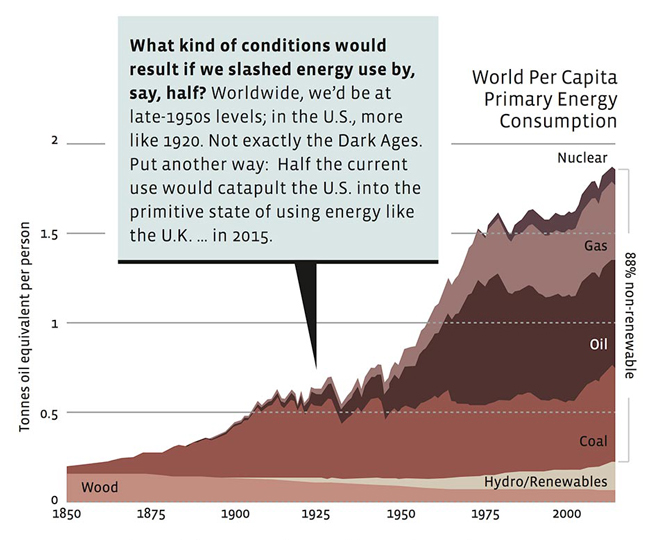
Energy infographic, YES illustration
World per capita primary energy consumption
Sources: Research from Peter Kalmus and Post Carbon Institute
YES! Magazine infographic, 2016
Level Three: The Really Hard Stuff
Doing away with the last 20 percent of our current fossil-fuel consumption is going to take still more time, research, and investment—as well as much more behavioral adaptation.
Just one example: We currently use enormous amounts of concrete for all kinds of construction. The crucial ingredient in concrete is cement. Cement-making requires high heat, which could theoretically be supplied by sunlight, electricity, or hydrogen—but that will entail a nearly complete redesign of the process.
While with Level One we began a shift in food systems by promoting local organic food, driving carbon emissions down further will require finishing that job by making all food production organic, and requiring all agriculture to build topsoil rather than deplete it. Eliminating all fossil fuels in food systems will also entail a substantial redesign of those systems to minimize processing, packaging, and transport.

The communications sector—which uses mining and high-heat processes for the production of phones, computers, servers, wires, photo-optic cables, cell towers, and more—presents some really knotty problems. The only good long-term solution in this sector is to make devices that are built to last a very long time and then to repair them and fully recycle and remanufacture them when absolutely needed. The Internet could be maintained via the kinds of low-tech, asynchronous networks now being pioneered in poor nations, using relatively little power. An example might be the AirJaldi networks in India, which provide Internet access to about 20,000 remote users in six states, using mostly solar power.
Back in the transport sector: We’ve already made shipping more efficient with sails, but doing away with petroleum altogether will require costly substitutes (fuel cells or biofuels). One way or another, global trade will have to shrink.
There is no good drop-in substitute for aviation fuels; we may have to write off aviation as anything but a specialty transport mode. Planes running on hydrogen or biofuels are an expensive possibility, as are dirigibles filled with (non-renewable) helium, any of which could help us maintain vestiges of air travel. Paving and repairing roads without oil-based asphalt is possible, but will require an almost complete redesign of processes and equipment.
Great attention will have to be given to the interdependent linkages and supply chains connecting various sectors (communications, mining, and transport knit together most of what we do in industrial societies). Some links in supply chains will be hard to substitute, and chains can be brittle: A problem with even one link can imperil the entire chain.
The good news is that if we do all these things, we can get beyond zero carbon emissions; that is, with sequestration of carbon in soils and forests, we could actually reduce atmospheric carbon with each passing year.
Doing Our Level Best
This plan features “levels”; the more obvious word choice would have been “stages.” The latter implies a sequence—starting with Stage One, ending with Stage Three—yet accomplishing the energy transition quickly will require accelerating research and development to address many Level Two and Three issues at the same time we’re moving rapidly forward on Level One tasks. For planning purposes, it’s useful to know what can be done relatively quickly and cheaply, and what will take long, expensive, sustained effort.
How much energy will be available to us at the end of the transition? It’s hard to say, as there are many variables, including rates of investment and the capabilities of renewable energy technology without fossil fuels to back them up and to power their manufacture, at least in the early stages. This “how much” question reflects the understandable concern to maintain current levels of comfort and convenience as we switch energy sources. But in this regard, it is good to keep ecological footprint analysis in mind.
According to the Global Footprint Network’s Living Planet Report 2014, the amount of productive land and sea available to each person on Earth in order to live in a way that’s ecologically sustainable is 1.7 global hectares. The current per capita ecological footprint in the United States is 6.8 global hectares. Asking whether renewable energy could enable Americans to maintain their current lifestyle is therefore equivalent to asking whether renewable energy can keep us living unsustainably. The clear answer is: only temporarily, if at all. So why bother trying? We should aim for a sustainable level of energy and material consumption, which on average is significantly lower than at present.
One way or another, the energy transition will represent an enormous societal shift. During past shifts, there were winners and losers. In the current instance, if we don’t pay great attention to equity issues, it is entirely possible that only the rich will have access to renewable energy, and therefore, ultimately, to any substantial amounts of energy at all.
The collective weight of these challenges and opportunities suggests that a truly all-renewable economy may be very different from the American economy we know today. The renewable economy will likely be slower and more local; it will probably be a conserver economy rather than a consumer economy. It will also likely feature far less economic inequality. Economic growth may reverse itself as per capita consumption shrinks; if we are to avert a financial crash and perhaps a revolution as well, we may need a different economic organizing principle. In her recent book on climate change, This Changes Everything, Naomi Klein asks whether capitalism can be preserved in the era of climate change. While it probably can (capitalism needs profit more than growth), that may not be a good idea because, in the absence of overall growth, profits for some will have to come at a cost to everyone else.
This short article only addresses the energy transition in the United States; other nations will face different challenges and opportunities. Poor nations will have to find ways to provide all their energy from renewable sources while advancing in terms of the U.N. Human Development Index. Nations especially vulnerable to sea level rise may have other immediate priorities to deal with. And nations with low populations but very large solar or wind resources may find themselves in an advantageous position if they are able to obtain foreign investment capital without too many strings attached.
The most important thing to understand about the energy transition is that it’s not optional. Delay would be fatal. It’s time to make a plan—however sketchy, however challenging—and run with it, revising it as we go.