29 Mar 2016

The Climate Wars: Trench Warfare or Blitzkrieg?

Ugo Bardi

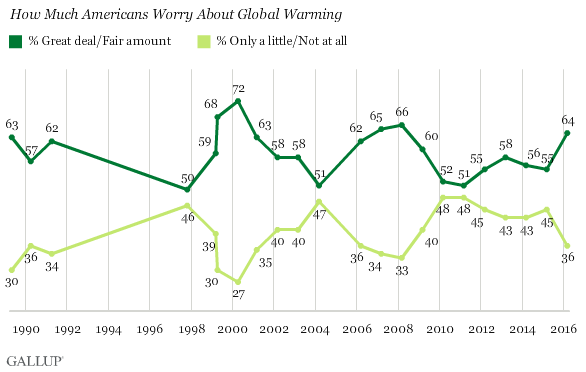
In a previous post, I examined more than 25 years of Gallup polls in the US and I came to the conclusion the climate debate is stuck in a trench warfare condition. Apparently, the percentage of Americans who say they are "worried" about climate change is today nearly the same as it was in 1989.
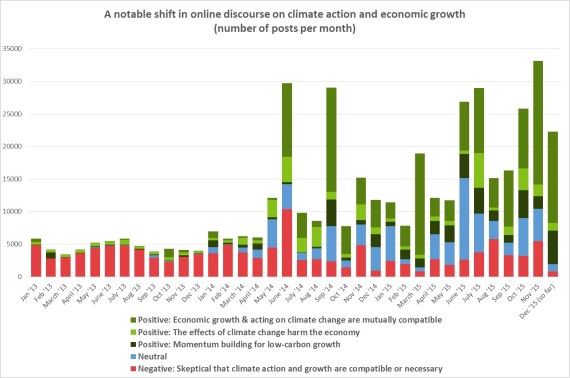
After the publication of that post, I received a comment that cited the results of a recent study of the social media sponsored by "The Global Commission on the Economy and Climate" that seem to be indicating a different trend. Here is the main result of that study;
Clearly, something has changed in 2014 that has led to a remarkable change in the discourse on the relation of climate and economic growth, with a very large growth (around 700%) of people having an attitude defined as "positive" toward climate change. At first sight, it looks good: this is not trench warfare, it is a true blitzkrieg.
However, it is also something that has to be taken with great caution. Note that the question that was examined in the analysis was very narrow; strictly limited to whether one believes that climate change and economic growth are compatible. The analysis didn't examine whether the messages indicated that people were worried or not about climate change, or even whether they believed it existed and was caused by human actions. And the "negative" opinion expressed in a fraction of the messages might well have been expressed by people who were very worried about climate change; so much that they thought (reasonably, in my opinion) that economic growth can only worsen things.
Indeed, the goals and the approach of the group of people who call themselves "The New Climate Economy Commission"seems to be very limited. In one of their reports, they state.
The Global Commission on the Economy and Climate is a major international initiative to analyze and communicate the economic benefits and costs of acting on climate change. Chaired by former President of Mexico Felipe Calderón, the Commission comprises 28 former heads of government and finance ministers and leaders in the fields of economics and business. The goal of the New Climate Economy is to shift public discourse away from the costs of climate action to one focused on how economic growth and climate action can be achieved together
This group is said to be "commissioned by seven countries – Colombia, Ethiopia, Indonesia, Norway, South Korea, Sweden and the United Kingdom," but there are few details on what were the terms of the financing were and which agencies provided it. The page where they could provide more details on these questions is not accessible to the public. Apparently, anyway, the idea is that, since economic growth is good by definition, then it will also solve the climate change problem. Which is debatable, to say the least.
Nevertheless, we have here an interesting result that indicates that the debate on climate is not necessarily stuck forever and that, at least, there is a growing interest in the issue. It also shows that we have remarkable capabilities of studying trends in the debate not just on the basis of the old style opinion polls, but by analyzing complex trend on a vast network of social media. So far, I haven't been able to find an equivalent study that would ask questions such as, for instance, what is the percentage of people believing that it is urgent to act against global warming. That may come in the near future and then we'll be able to see if trench warfare in the climate wars is really transforming itself into a blitzkrieg.

Cuba’s Sustainable Agriculture At Risk In U.S. Thaw

Miguel Altieri

President Obama’s trip to Cuba this week accelerated the warming of U.S.-Cuban relations. Many people in both countries believe that normalizing relations will spur investment that can help Cuba develop its economy and improve life for its citizens.But in agriculture, U.S. investment could cause harm instead.
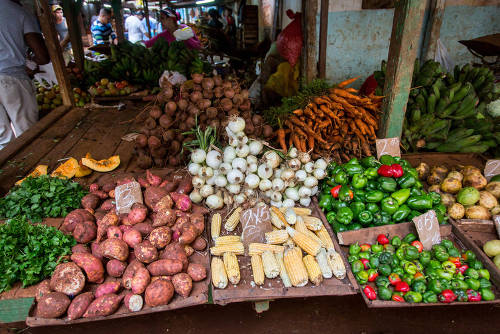
For the past 35 years I have studied agroecology in most countries in Central and South America. Agroecology is an approach to farming that developed in the late 1970s in Latin America as a reaction against the top-down, technology-intensive and environmentally destructive strategy that characterizes modern industrial agriculture. It encourages local production by small-scale farmers, using sustainable strategies and combining Western knowledge with traditional expertise.
Cuba took this approach out of necessity when its economic partner, the Soviet bloc, dissolved in the early 1990s. As a result, Cuban farming has become a leading example of ecological agriculture.
But if relations with U.S. agribusiness companies are not managed carefully, Cuba could revert to an industrial approach that relies on mechanization, transgenic crops and agrochemicals, rolling back the revolutionary gains that its campesinos have achieved.
The shift to peasant agroecology
For several decades after Cuba’s 1959 revolution, socialist bloc countries accounted for nearly all of its foreign trade.
When Cuban trade with the Soviet bloc ended in the early 1990s, food production collapsed due to the loss of imported fertilizers, pesticides, tractors and petroleum. The situation was so bad that Cuba posted the worst growth in per capita food production in all of Latin America and the Caribbean.
But then farmers started adopting agroecological techniques, with support from Cuban scientists.
Thousands of oxen replaced tractors that could not function due to lack of petroleum and spare parts. Farmers substituted green manures for chemical fertilizers and artisanally produced biopesticides for insecticides. At the same time, Cuban policymakers adopted a range of agrarian reform and decentralization policies that encouraged forms of production where groups of farmers grow and market their produce collectively.
As Cuba reoriented its agriculture to depend less on imported chemical inputs and imported equipment, food production rebounded. From 1996 though 2005, per capita food production in Cuba increased by 4.2 percent yearly during a period when production was stagnant across Latin America and the Caribbean.
In the mid-2000s, the Ministry of Agriculture dismantled all “inefficient state companies” and government-owned farms, endorsed the creation of 2,600 new small urban and suburban farms, and allowed farming on some three million hectares of unused state lands.
Urban gardens, which first sprang up during the economic crisis of the early 1990s, have developed into an important food source.
Today Cuba has 383,000 urban farms, covering 50,000 hectares of otherwise unused land and producing more than 1.5 million tons of vegetables. The most productive urban farms yield up to 20 kg of food per square meter, the highest rate in the world, using no synthetic chemicals. Urban farms supply 50 to 70 percent or more of all the fresh vegetables consumed in cities such as Havana and Villa Clara.
The risks of opening up
Now Cuba’s agriculture system is under increasing pressure to deliver harvests for export and for Cuba’s burgeoning tourist markets. Part of the production is shifting away from feeding local and regional markets, and increasingly focusing on feeding tourists and producing organic tropical products for export.
President Obama hopes to open the door for U.S. businesses to sell goods to Cuba. In Havana last Monday during Obama’s visit, U.S. Agriculture Secretary Tom Vilsack signed an agreement with his Cuban counterpart, Agriculture Minister Gustavo Rodriguez Rollero, to promote sharing of ideas and research.
“U.S. producers are eager to help meet Cuba’s need for healthy, safe, nutritious food,” Vilsack said. The U.S. Agriculture Coalition for Cuba, which was launched in 2014 to lobby for an end to the U.S.-Cuba trade embargo, includes more than 100 agricultural companies and trade groups. Analysts estimate that U.S. agricultural exports to Cuba could reach US$1.2 billion if remaining regulations are relaxed and trade barriers are lifted, a market that U.S. agribusiness wants to capture.
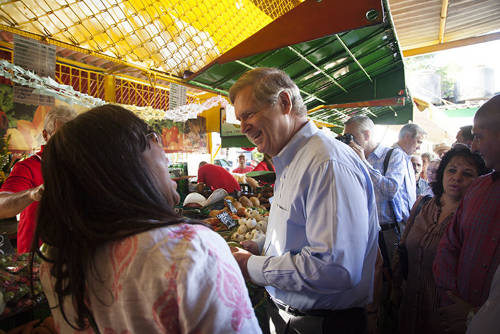
Agriculture Secretary Tom Vilsack and Alabama Congresswoman Terri Sewell tour a Havana farmers' market, November 2015.US Department of Agriculture/Flickr, CC
When agribusinesses invest in developing countries, they seek economies of scale. This encourages concentration of land in the hands of a few corporations and standardization of small-scale production systems. In turn, these changes force small farmers off of their lands and lead to the abandonment of local crops and traditional farming ways. The expansion of transgenic crops and agrofuels in BrazilParaguay and Bolivia since the 1990s are examples of this process.
If U.S. industrial agriculture expands into Cuba, there is a risk that it could destroy the complex social network of agroecological small farms that more than 300,000 campesinos have built up over the past several decades through farmer-to-farmer horizontal exchanges of knowledge.
This would reduce the diversity of crops that Cuba produces and harm local economies and food security. If large businesses displace small-scale farmers, agriculture will move toward export crops, increasing the ranks of unemployed. There is nothing wrong with small farmers capturing a share of export markets, as long as it does not mean neglecting their roles as local food producers. The Cuban government thus will have to protect campesinos by not importing food products that peasants produce.
Cuba still imports some of its food, including U.S. products such as poultry and soybean meal. Since agricultural sales to Cuba were legalized in 2000, U.S. agricultural exports have totaled about $5 billion. However, yearly sales have fallen from a high of $658 million in 2008 to $300 million in 2014.
U.S. companies would like to regain some of the market share that they have lost to the European Union and Brazil.
There is broad debate over how heavily Cuba relies on imports to feed its population: the U.S. Department of Agriculture estimates that imports make up 60 to 80 percent of Cubans' caloric intake, but other assessments are much lower.
In fact, Cuba has the potential to produce enough food with agroecological methods to feed its 11 million inhabitants. Cuba has about six million hectares of fairly level land and another million gently sloping hectares that can be used for cropping. More than half of this land remains uncultivated, and the productivity of both land and labor, as well as the efficiency of resource use, in the rest of this farm area are still low.
We have calculated that if all peasant farms and cooperatives adopted diversified agroecological designs, Cuba would be able to produce enough to feed its population, supply food to the tourist industry and even export some food to help generate foreign currency.
President Raul Castro has stated that while opening relations with the U.S. has some benefits,
We will not renounce our ideals of independence and social justice, or surrender even a single one of our principles, or concede a millimeter in the defense of our national sovereignty. We have won this sovereign right with great sacrifices and at the cost of great risks.
Cuba’s small farmers control only 25 percent of the nation’s agricultural land but produce over 65 percent of the country’s food, contributing significantly to the island’s sovereignity. Their agroecological achievements represent a true legacy of Cuba’s revolution.

Terrorism: Then & Now

Conn Hallinan

The year 2016 is the 100th anniversary of the Irish Easter Rebellion. Throughout the year I will try to revisit some of the lessons of Ireland’s struggle for freedom.
Bombs explode in a subway. The victims are everyday people who happen to be in the wrong place at the wrong time. What follows is outrage: track down the perpetrators. The people who set off the bombs are monsters and inhuman fanatics, thunder the authorities.
But the year is not 2016, it is 1883 during the “Dynamite War” waged by mainly Irish-American members of the Fenians against the English occupation of Ireland. The Fenian Brotherhood was founded in 1848. The “War” targeted the underground, train stations, city halls, public plazas, and factories in London, Manchester, and Liverpool. The war spanned four years, and in the light of the current terrorist attacks in the Middle East and Europe, it is an instructive comparison.
On one level there is no similarity. The “Dynamite War” killed and injured very few people, while terrorist attacks and bombs in Turkey, Iraq, Syria, Egypt, France and Belgium have murdered hundreds and wounded thousands. It is also hard to compare John Devoy and Patrick Tynan of the Fenians to the likes of the Islamic State’s Abu-Bakr al-Baghdadi and Abu Muslim al-Turkmani.
Yet there is an historical lesson here, and we ignore it at our peril. Terrorism is a difficult subject to talk about because anything other than outrage seems like one is making an excuse for unspeakably heinous acts. And yet if we are to seriously look for solutions, that requires asking “why,” even if the answers are uncomfortable.
There are certainly easy “solutions” out there: occupy Muslim communities and torture suspects we arrest. Unleash yet more drones, carpet bomb the bastards, and, if necessary, send in the Marines. But that is exactly what we have doing for the past three decades, and is there anyone who would seriously argue that things are better now than they were in 1981?
Did the invasion of Afghanistan muzzle terrorism? A decade and a half later, we are still at war in that poor benighted country, and the terrorism that we experienced on 9/11 has spread to Madrid, Paris, Beirut, Ankara, Cairo, Brussels, Damascus, Baghdad, and other cities. We sowed the wind in Somalia, Iraq, Libya, Yemen and Syria. Did we expect to reap less than a whirlwind?
In his book “Blowback,” the late Chalmers Johnson chronicled the ricochets from American foreign policy. We raised up the Mujahedeen in Afghanistan to defeat the Russians and helped create Osama bin Laden. We ally ourselves with Saudi Arabia, the country that supplied most of the people who flew those airplanes into the Twin Towers and the Pentagon, whose reactionary brand of Islam has helped create an army of jihadists worldwide.
The flood of refugees headed toward Europe is a roadmap of U.S. interventions in Somalia, Yemen, Iraq, Syria, Afghanistan and Libya. In the case of the latter, we created a failed state, whose massive arms caches has succeeded in destabilizing significant parts of Central Africa.
The nature of American foreign policy—as well as those of some of its allies—is where the conversation of what to do about terrorism has to begin. This is not to excuse terrorism, but to try to understand what it emerges from, instead of playing an endless—and eventually futile—game of whack-a-mole.
For people like Donald Trump and Ted Cruz the answer is simple: terrorists are evil Muslims (although sometimes just being a Muslim is enough). But how many of our leaders ask, “Why are they doing this” and are really interested in an answer? Hillary Clinton says she doesn’t think we should torture people, but she is all for bombing the bejesus out of them and overthrowing their governments. Bernie Sanders is much more sensible, but even he voted for the Yugoslav War, which set off NATO’s eastward march and led to the current crisis over the Ukraine.
Terrorism is not a thing you can wage war against, it is a tactic employed by the less powerful against the more powerful. If you can’t defeat someone’s armies you can always blow up their citizens. Simply using military power in response to terrorism is the most efficient way to recruit new terrorists. Drone strikes are supposed to be “surgical” weapons that only kill bad guys. But as the Bureau of Investigative Journalism has found, drones have killed thousands of civilians. Each of those civilians has a family, and each of those family (clan, tribe, etc.) members is now a potential recruit. The drone war is a perfect example of Johnson’s “blowback.”
Of course, terrorism generates its own “blowbacks.” The “Dynamite War” didn’t do much damage to the British, but it was a political catastrophe for the Irish. The English used it—along with the infamous 1882 Phoenix Park murders of the colonial authority’s chief secretaries—to pass the “Perpetual Coercion Act” and imprison hundreds of Irish activists. The loss of those leaders seriously damaged efforts by the Land League to stop a wave of tenant farmer evictions that followed in the wake of the 1878-79 crop failures.
Those evictions produced a “blowback” of their own. Tens of thousands of Irish were forced to emigrate to America, bringing with them a deep rage at English landlords and the colonial authorities. That fury fed the anger that many Irish-Americans still held against the British, and that led to a revival of the Fenians and the launching of the “Dynamite War.” It was good old American know how that built the bombs that blew up targets in England.
The “War” was actually similar to the current wave of terrorism, at least in conception. Rather than going after the English armed forces and police, most the bombs were set in public places with the explicit idea of terrorizing everyday life. The plan was to transplant the violence of the colonial occupation to the home country. It did, indeed, scare people, including many English who formerly favored the Irish cause, and turned those who were indifferent anti-Irish. It derailed the Home Rule movement for several decades.
The Colonial authorities responded with yet greater repression, much as many of the current candidates for the White House would if given a chance. But while the “Dynamite War” was ill conceived and counter productive, it was a reflection of the basic injustice of colonialism. The Islamic State is a genuine monstrosity, but it reflects a hundred years of European and American manipulation of the Middle East’s resources and politics. When Britain and France divided up the Middle East to their liking in 1916—deliberately building in ethnic, tribal and religious instability—did they really think there would never be a day of reckoning?
There are monsters in the Middle East, but we have helped create them. The question is, can we stop them?
We should know by now that more bombs and troops do exactly the opposite. To seriously tackle terrorism will take a fundamental re-examination of U.S. foreign policy. It must start with challenging the idea that everything about this country is the “best,” the ideology of “American exceptionalism” that underlies so much of our strategic policies. That idea of “exceptionalism” gives us the right to intervene in other countries’ internal affairs, to subvert their political structures, and, if necessary, seek regime change.
We preach “democracy” to Cuba, China and Russia, while being perfectly comfortable with Saudi Arabia and the other autocratic monarchies that make up the Gulf Cooperation Council. People take note of that contradiction and quite logically assume that it is hypocrisy and has more to do with our “interests” than any commitment to the right of people to choose how to run their own lives.
In any case our own political system increasingly looks like some grotesque caricature of democracy, where presidential candidates blithely propose ignoring the Constitution and violating international law, and where a handful of billionaires can dominate the public space.
We are the most powerful economic and military force on the planet, so overthrowing a government or strangling its economy is not all that hard to do. At least in the short run. But the world is simply far too complex to fit into one model of government or worldview and, sooner or later, people will dig in their heels.
How we respond to that resistance is what we need to examine. If the response is force, we can hardly complain when we find ourselves the target of “asymmetrical violence”—terrorism.
The people who set the bombs have to be caught and punished, but that will not end the problem. The Irish who murdered the colonial secretaries in Phoenix Park were caught and punished, but it did not make Ireland a calm place or end Irish resistance to the English occupation. That was resolved when the British finally realized that they could no longer determine the history of another country. We must do the same. And that will take a conversation that we have not yet had. It’s time to start.

Germany’s Deutsche Bahn to slash 2,100 rail freight transport jobs

Dietmar Henning

Germany’s railway operator Deutsche Bahn (DB) plans to slash 2,100 jobs from its freight transportation subsidiary DB Cargo. Nationwide, 215 freight transport points will be closed. This is the first step to a further wave of job cuts.
DB Cargo employs 17,000 people in Germany and, despite of a loss of market share over recent years, from 72 percent five years ago to 62 percent in Germany last year, it is still Europe’s largest rail freight company. Last year, DB Cargo reported losses of €184 million.
The entire DB concern recorded losses of €1.3 billion for 2015, its first loss in more than 10 years. This included one-off costs for DB Cargo related to purchases by the company, which has become a globally functioning logistics concern.
DB board Chairman Rüdiger Grube first announced last October that jobs would be eliminated. In an interview with Welt am Sonntag, he justified this by saying that “20 percent of handling facilities [amounted to] 1 percent of turnover.” Customers in northern and eastern Germany, where the focus of the cuts will be, will be practically cut off from rail freight transport.
DB had already planned last year in cooperation with consultancy firm McKinsey to eliminate one in three jobs at DB Cargo, amounting to the loss of 5,000 jobs. Workers were thus being made to pay with their jobs for the international expansion of DB.
Earlier this month, Reuters reported that 498 out of 1,500 loading centres would no longer be required, affecting up to 3,500 jobs. Among the loading centres to be closed were larger ones such as Bamberg-Hafen, which handles almost 200,000 tonnes of freight per year, and the Rangierbahnhof in Saarbrücken, which handles more than 400,000 tonnes per year. Most however are smaller stations in northern and eastern Germany.
A spokesman confirmed that the business position of the company would impact on the workforce. She refused to provide further information since all measures would first be discussed with representatives of the trade unions and works council.
The latest restructuring plan, codenamed “Bahn Future,” was presented to the trade unions and works council last Tuesday. It is the first step in a larger job-cutting programme, previous cost-cutting plans were unaffected by the current savings programme, trade union representatives said.
The savings are aimed at achieving profitability in rail freight transport by the end of 2018. By 2020, turnover is to increase by €700 million to €5.5 billion. Profits will then be €200 million.
Where precisely the job cuts will take place has yet to be disclosed. On the broadcaster Southwest Radio (SWR), the works council chairman reported that, on the basis of a letter from management, half of the 1,000 jobs in Mainz would be eliminated. On top of the 420 jobs to be cut, there were additional workers who would be changing location. “In the end, up to 600 jobs could therefore be lost in Mainz,” SWR wrote. DB spokespeople denied these figures.
Works councillors and union functionaries have already indicated they are prepared to cooperate in the working out and implementation of the cuts against the workforce. Although they expressed criticism of specific measures to head off the anger of the workers, they by no means ruled out job cuts.
The Mainz works councillor stated that he intended to present new proposals to DB on how as many jobs as possible could be retained. The largest two trade unions, the railway and transport union (EVG) and the train drivers’ union (GDL) linked their warning against pursuing a “course of reduction” with their own plans on how DB Cargo could return to profitability.
In a press release last October, the GDL responded to Grube’s announcement by proposing how “the quality of DB Cargo” could be improved. “Is the closure of freight centres really the best way?” they asked. In any case, the GDL was enthused by the “Bahn Future” plan, since DB had to “finally do its homework.”
EVG Chairman Alexander Kirchner said in a press release last week, “Currently all we hear from management is: save, cut, reduce. A plan for the future does not look like that.”
Kirchner demanded an extraordinary supervisory board meeting at DB Cargo and a “company strategy based on growth and more employment.” The date for this extraordinary meeting has since been made known. DB’s supervisory board, composed of representatives of the trade unions, works council, company and shareholders—the privatised DB is fully owned by the federal state—will meet on Wednesday.
Kirchner, who is also deputy chairman on the supervisory board, declared: “Cargo management must finally lay their cards on the table and say where they are taking us.”
However, his colleague from the EVG executive and deputy chairman of the DB Cargo supervisory board, Martin Burkhard, immediately insisted, “What will happen long-term with DB’s freight transport subsidiary, as well as the divisions ‘regio,’ ‘services’ and ‘maintenance and facilities,’ will be decided at the DB supervisory board meeting on June 8 and not before in the media.” As long as EVG “did not recognise any strategy,” it would not agree to the current plans.
This is the usual cover for cost-cutting policies. The unions have been doing this at DB for years to divert the workers’ attention from the fact that they had long prepared plans to impose new cuts.
The EVG has functioned for decades as a “company union” at DB, and is hardly distinguishable from company management. Since 2002, it has jointly organised the reduction of the DB workforce in Germany from 350,000 to approximately 195,000. This has led to increased amounts of overtime, the elimination of rest time, speedup, days of separation from families and other precarious working conditions. It is the trade union that has imposed the company’s plans against the opposition from workers.
Union officials have been rewarded handsomely in return. The role of Norbert Hansen is still well remembered. Hansen moved from chairman of the Transnet union, the predecessor of EVG, directly into the post of DB human resources director and earned millions in the process.
The next round of rationalisations and cuts is now to be introduced. Last year, Grube presented the supervisory board with a plan for the radical reorganisation of company structures to bring in €610 million in savings by 2020. The detailed plans were, as now, kept secret by the appointed managers, trade union functionaries and works councillors so that they could be carried out unhindered behind the backs of the workers.

Japanese economy continues to show signs of faltering

Ben McGrath

The Japanese government downgraded its assessment of the economy last Wednesday following a similar move by its central bank the previous week. Notwithstanding the initial hype which surrounded it, Prime Minister Abe’s economic agenda—so-called Abenomics—is now a dead letter so far as any economic revival is concerned. Growth has continued to contract while wages remain stagnant.
In a sign of investors’ lack of confidence in the government’s economic measures, the yield on 10-year Japanese Government Bonds has dropped to a record low. This follows the decision by the Bank of Japan at the end of January to charge banks at a rate of 0.1 percent for any new deposits they placed with it.
The aim was to try to force the banks to lend to the real economy but all that has happened is that they have put their money in government bonds, forcing up the price and lowering the yield, which move in an inverse relation to each other.
The yield on the 10-year Japanese Government Bond (JGB) fell to minus 0.135. This means that if a purchaser held the bond to maturity they would make a negative real return on their investment. The aim of the bond purchaser, however, is to find someone who will pay an even higher price for the financial asset—the “bigger fool” theory—and thereby enable them to make a gain on its sale.
Twenty-year bonds also fell by 0.1 percentage points [10 basis points] but remain in positive territory with a yield of just 0.29 percent.
The movements in financial markets are a reflection of the confusion over the direction of the economy and the growing sentiment that the government has no viable program. Consumer spending reflects the same trend as households cut expenditure, fearing the introduction of negative interest rates means the economic outlook must be worse than they had thought.
“The principal driver of negative JGB yields was the Bank of Japan’s deposit rate cut to -10bp, and the market now expects additional cuts during this year starting from as soon as the next Bank of Japan meeting,” said David Tan, of global JPMorgan Asset Management. “This has contributed to a sell-off in banking stocks and a renewed flight to safety into government bonds.”
Global economic conditions are also having a negative impact on the Japanese economy. While the hope is that lower oil costs will improve economic conditions for Japan, there is also fear things could go in the other direction. Hisashi Yamada, chief economist at the Japan Research Institute, said in January, “Oil revenues move around the world in various ways. If they shrink, it could deal a blow especially to emerging countries. This might eventually trigger a sell-off on global stock markets and have a negative impact for Japan.”
Despite the contraction of the Japanese economy at an annual rate of 1.1 percent in the fourth quarter of 2015, BoJ Governor Haruhiko Kuroda argued on March 15 that his agenda was working.
“Since we brought in minus rates, short and long-term bond yields have fallen and that has clearly fed through to falls in mortgage and lending rates—so on the interest rate side the effects are already clear,” he said.
Others are not so sure. Economy Minister Nobuteru Ishihara said the effects of the interest rate cut were still not clear and it would take another three months to gauge the result.
The BoJ is also considering other measures, including expanding its quantitative easing program by increasing its purchases of financial assets from their present level of 80 trillion yen annually. But the 5–4 vote on the governing council to bring in negative rates show there are significant divisions and uncertainty.
Abe came to office in December 2012 promising to revive Japan’s long stagnant economy. His proposed “Abenomics” would introduce three “arrows.” The first was a limited package of stimulus measures while the second arrow was the quantitative easing program.
Ultimately though, the Japanese bourgeoisie is demanding austerity measures. The “third arrow” of Abenomics was unveiled in the summer of 2014. It contains more than 200 pro-market restructuring measures, attacking the social position of Japanese workers, lowering the corporate tax rate into the 20 percent range and moving to eliminate lifetime employment. Abe is also planning to further increase the consumption tax.
However, big business is highly dissatisfied with the pace at which these measures have been implemented. BoJ Deputy Governor Hiroshi Nakaso stated at the beginning of March that he hoped Abe’s “third arrow” would “fly higher and faster.”
“Monetary policy to overcome deflation and the structural reform [the third arrow] to raise the potential growth rate must be pursued in tandem to bring Japan's economy back on track toward sustained growth,” he said.
The highly unpopular increase in the consumption tax is another attack on workers. In 2014, it rose from 5 percent to 8 percent, sending the economy into recession. A planned increase to 10 percent is scheduled for April 2017. However, calls for Abe to delay the increase have become louder recently. While the prime minister currently states the government plans to go ahead with the scheduled tax rise, it is widely speculated that he will announce a postponement at or following the G7 summit, scheduled for May 26–27 in Japan.
For workers, wages have remained stagnant with the median wage level remaining almost entirely unchanged in the past 20 years. Toyota this year has agreed to a paltry basic wage increase of 1,500 yen ($13) a month compared to 4,000 yen last year. This has led to calls from the International Monetary Fund (IMF) for a “fourth arrow;” measures to increase wages in order to achieve the desired 2 percent inflation rate. However, to offset the company’s lost profits, the IMF also suggested tax incentives for companies that raise wages.
There is also talk that Abe may dissolve the lower house of parliament to hold a double election along with that scheduled for the upper house in July. Abe similarly called a snap election in November 2014 after delaying the tax increase scheduled for October 2015. With the opposition in Japan largely in disarray, the ruling Liberal Democratic Party (LDP) would likely take both houses, allowing Abe to use the election as a referendum and justification for his agenda.

As Brazil’s impeachment crisis deepens, economists advocate “Asian model”

Souza Gonzaga

As the political crisis surrounding the drive to impeach Workers Party (Partido dos Trabalhadores—PT) President Dilma Rousseff comes to a head, leading Brazilian economists aligned with the government have taken part in a media blitz in defense of PT’s capacity to manage the current economic depression, the worst since the 1930s.
The current political crisis began two years ago and has been continuously fueled by new revelations in the Operation Carwash (Lava Jato) investigation, which uncovered a bribes-for-contracts scheme that funneled some $800 million out of Brazil’s former economic crown jewel, the state-run energy conglomerate Petrobras.
Rousseff, who formerly chaired the company, managed to win reelection in 2014, but has faced staunch right-wing opposition ever since, with attempts to stop her taking office, vote-rigging accusations, massive street demonstrations and finally the opening of an impeachment procedure, still underway, based on alleged budget manipulation designed to mask the government’s fiscal crisis in the run-up to the election.
While predominant layers within the Brazilian ruling class have lined up behind the drive to oust Rousseff and the PT, a group of pro-PT economists has responded to the government’s crisis by calling for a “deepening” of the policies pursued by former president and PT founder Luiz Inacio Lula da Silva in times of crisis. They roughly equate these polices with adopting an “Asian” model that combines capital controls, currency devaluation and a lowering of wages “in the national interest,” that is, to make industry more competitive and profitable.
Brazilian politics is no stranger to extreme-right nationalism and autarkic political tendencies, and in their effort to defend the PT’s managerial record, ostensibly “left” economists like Luiz Belluzzo and Amir Khair have joined outright right-wing nationalists such as Delfim Netto and Luiz Carlos Bresser-Pereira.
The lineup was underscored by a reported meeting between Lula and both Netto and Belluzzo on January 19 to discuss an “urgent” economic plan for the government. Both economists have extolled Lula’s economic policies in their columns and in widely reproduced interviews during the most acute moment of the crisis over the last month.
Significantly, all these figures have had wide government experience. Netto was the finance minister and best-known civilian official under the US-backed military dictatorship that took power in 1964. His name is associated with the so-called “Brazilian miracle,” a period of economic growth founded on the drastic reduction of workers’ wages and an unprecedented concentration of wealth carried out under military rule. For his part, Bresser-Pereira served the ultra-reactionary oligarch President Jose Sarney, who took office after the end of military rule.
These figures are welcomed also in pseudo-left and Stalinist circles for using Marxist and anti-imperialist phraseology.
Netto has on occasion used his op-eds to say that “Marx was a genius” and that his work is “incorporated in universal thought.” For his part, Bresser-Pereira in February defended Lula on his Facebook page saying that the Lava Jato investigations “targeted Brazil’s greatest popular leader since Getúlio Vargas,” Brazil’s dictator who flirted with the Nazis in the 1930s.
Presenting PT as the “standard-bearer” of Brazilian nationalism and a victim of a reactionary Congress, Bresser-Pereira explained in February on the widely watched “Roda Viva” show on the São Paulo state public television network that “corrections” in economic policy must include wage cutting, as salaries are too high and profits too low in some sectors to make investment attractive.
In an op-ed in the influential business daily Valor Econômico of March 3, he further explained that Brazil must also keep its currency, the real, devaluated to protect itself from the “Dutch disease” (in which an influx of revenue from natural resources exports raises the value of the country’s currency, adversely affecting the manufacturing sector) and deindustrializing further during the crisis.
But most telling of all is his explanation in a March 1, 2015 interview with the daily Folha de S. Paulo, that workers’ opposition to such nationalist plans is a product of “losing the national ideal during the military dictatorship [of 1964-85] … because the military identified with nationalism and ‘developmentalism.’”
Netto’s Folha de S. Paulo column of March 16, for its part, advocated necessary “structural changes” that would drive down the living standards of the Brazilian working class. Criticizing the PT’s reluctance in supporting current Finance Minister Nelson Barbosa, he says that one of his proposals with which the party must comply is “structural fiscal measures which demand constitutional changes that will be felt in the long term (a solution to the Retirement Funds problem and ending obligatory investments [that guarantee minimal health and education funding]).”
Belluzzo, the supposed “left,” has written several op-eds since January on interest rates, counterposing the interests of the industrial sector to that of the banking sector and siding with the exporting and industrial bosses, while advocating that the state under the PT do so as well.
His motivations are clear. For more than two years he has waged a high-profile debate with other economists, arguing that Asian history proves the capacity of the state to promote growth. He explained in Valor Econômico last August that it was fundamental for Asia (the so-called Tigers) to “subordinate macroeconomic development to an authoritarian-bureaucratic arrangement dedicated to the integration of ‘competitive’ new sectors into the productive structure.” He went on to remark that the U.S., at the time, “accepted the authoritarian regime of Park Chung Hee in Korea.”
Recent efforts by these economists, including the meeting with Lula, were designed to counter the industrial bosses’ likely siding with the PT’s right-wing opposition, which was given a definitive impulse by the announcement in early March that the São Paulo Industries Federation (FIESP), the most powerful big business lobby in the country, would support the mass demonstrations of March 13 which ended up mobilizing millions of middle class and upper-middle class protesters in favor of impeachment.
But recent weeks have shown not only the way the PT will behave in government should it survive the looming impeachment crisis, but also how it will behave in opposition should Brazil be the latest Latin American country to see a right-wing political takeover.
These economists’ “left” rhetoric on the power of reactionary nationalist policies are certainly suited to rally the pseudo-left, which have long abandoned any historical perspective on the capitalist crisis and its consequences. These currents, organized today within the framework of PSOL, PSTU and new parties such as Raiz Cidadanista and Rede Sustentabilidade, inside or outside the PT, have been key participants in the party’s decades-long shift to the right.
As neoliberal reforms began hitting Brazilian industry in the 1990s, and massive unemployment affected the PT’s former strongholds in major manufacturing cities, the party moved more and more toward nationalist opposition to neoliberalism, siding with the industrial bosses ostensibly against the “greedy” financial sector. PT-oriented economic think tanks began more and more to accept right-wing economists and circulate their ideas, presenting them as anti-imperialists and “developmentalists,” opposed to liberal orthodoxy.
After a long period of denying the impact of the international financial crisis on the country, the open debate within ruling circles shows that the Brazilian ruling class is growing increasingly fearful that the political crisis may get out of hand, cutting across its aims to exploit the crisis to radically shift class relations in Brazil in its favor.
Behind the more or less dishonest talk of economic cycles and “keeping up” with economic trends is the knowledge that the tectonics of the world economy are in motion and long-term realignments in world relations are taking place, which demand the fiercest class war internationally. Comparisons with the 1970s in Latin America or with authoritarian regimes in the Far East couldn’t be blunter: it is clear that an “Asian” model, designed to create a “Latin American tiger” or emulate China, is a formula for the decimation of working class living standards, extreme labor exploitation and police state measures.
Whether it is the PT or its right-wing opposition that implements these policies remains to be determined. Either way, the working class of Brazil will be thrown into explosive struggles.

Japan’s security laws: Another milestone in the drive to world war

Peter Symonds

Japan’s new military legislation comes into force today, allowing the country’s armed forces, under the guise of “collective self-defence,” to fully participate in wars abroad for the first time since the end of World War II. The implementation of the laws is a major step in the revival of Japanese militarism, which has been encouraged by Washington as part of its “pivot to Asia” and preparations for war with China.
The legislation is in flagrant breach of the Japanese Constitution, which, under Article 7, renounces war forever and affirms that land, sea and air forces will never be maintained.
Prime Minister Shinzo Abe last month dismissed the advice of legal experts that the legislation was unconstitutional, declaring that the constitution, not the new laws, had to be changed. Abe is pressing for an end to all restraints on the military and the transformation of Japan into a “normal nation”—that is, one that can aggressively pursue its economic and strategic interests by armed force.
Since coming to power in 2012, the right-wing Liberal Democratic Party (LDP) government has boosted military spending, concentrated war powers in a US-style National Security Council and refashioned military planning to focus on conflict with China. As part of its “island defence” strategy, Japan is building up military forces on its southern island chain adjacent to the Chinese mainland. On Monday, a new radar station became operational on the island of Yoniguna, just 150 kilometres from disputed islets in the East China Sea known as Senkaku in Japan and Diaoyu in China.
The entire Japanese political establishment, not just the LDP, is responsible for the extreme tensions over the Senkakus. The previous government, headed by the Democratic Party of Japan (DPJ), provoked widespread Chinese protests in September 2012 by “nationalising” or buying the uninhabited rocky outcrops from their private owner. Abe has refused to countenance any negotiations with China over the future of the islands.
In 2014, US President Barack Obama upped the ante by declaring that the US-Japan Security Treaty covered the Senkakus. This was tantamount to committing the US to intervene militarily in support of Japan should war break out between it and China over the islets. Hundreds of dangerous encounters took place last year, as Japan mobilised fighter jets and coast guard vessels to challenge Chinese “intrusions,” heightening the risk that a mistake or miscalculation could lead to conflict.
The implementation of Japan’s “collective self-defence” laws is another milestone in the drive to war being fuelled by the global breakdown of capitalism. Japanese imperialism is presently operating under the patronage of the United States, but it is an alliance of convenience. Japan and the US have already fought one war in the Pacific that cost the lives of millions to determine which power would dominate Asia, and the two could come to blows again.
The remilitarisation of Japan underscores the warnings made by the International Committee of the Fourth International (ICFI) in its February 18 statement Socialism and the Fight against War” that the world is being drawn once again into a catastrophic global conflict. Behind the backs of their populations, capitalist governments are gearing up for war and becoming increasingly bellicose.
“As in the years that preceded the outbreak of World War I in 1914 and World War II in 1939,” the statement declares, “political leaders and military planners are approaching the conclusion that a war between major powers is not a remote possibility, but, rather, highly probable and, perhaps, even inevitable. At a certain point, such military fatalism becomes a significant contributing factor to the outbreak of war.”
As is today the case in Germany, the road to war is being prepared in Japan with a reactionary campaign to revise history and whitewash the monstrous crimes of Japanese imperialism in the 1930s and 1940s. Abe, whose maternal grandfather Nobusuke Kishi was part of the wartime Japanese cabinet, speaks for broad sections of the ruling elite who justify Japan’s role in World War II as a struggle to free Asia from Western colonialism. Abe appointees have dismissed the wartime sexual slavery of hundreds of thousands of “comfort women” by the Japanese military and downplayed or denied such atrocities as the Rape of Nanjing, in which up to 300,000 Chinese civilians and prisoners were slaughtered.
The government is whipping up Japanese patriotism and a climate of fear over the Chinese “threat” so as to justify rearmament. At the same time, it is seeking to project mounting social tensions outward against a foreign enemy. A quarter century of slump has been compounded by the failure of so-called Abenomics to revive the Japanese economy. Wages remain at the level they were two decades ago, and many young people are condemned to a future of unemployment or low-paid casual work. This week, the Financial Times reported that large numbers of elderly people are committing petty crimes in order to get themselves jailed because they cannot survive on their meagre pensions.
The same crisis of global capitalism that is fuelling the drive to war is giving fresh impetus to socialist revolution. Opposition to war and militarism is deeply embedded in the Japanese working class, which suffered not only the police-state rule of the wartime militarist regime in Tokyo, but also the murderous US bombing raids. The Japanese people remain the only population to have experienced the horrors of nuclear incineration in the atomic bombing of Hiroshima and Nagasaki.
Some of the largest anti-war protests in Japanese history took place last year as the Abe government rammed its military laws through the parliament. At their height, the demonstrations swelled to 120,000 in Tokyo, with smaller protests in hundreds of other cities and towns. That anti-war sentiment, however, remained trapped within the parliamentary framework, as the Japanese Communist Party and various pseudo-left organisations have subordinated the protests to the capitalist Democratic Party of Japan, which has no fundamental disagreement with the military legislation.
Workers and youth in Japan, like their counterparts around the world, can halt the slide towards world war only through the construction of an international anti-war movement of the working class based on the program of socialist internationalism. The spread of war can be ended only by abolishing the social order that is its root cause—capitalism, with its archaic nation-state system. The ICFI is the only political organisation on the face of the planet fighting for this perspective. We urge our readers in Japan and throughout Asia to take up the struggle to build this anti-war movement.

28 Mar 2016

The Devil Made Me Do It

Clancy Sigal

In homicide trials I’ve always been slightly suspicious of the “I was abused as a child so I had to murder my girlfriend” courtroom defense.  Or “I was high on meth at the time and…”  Or, “I couldn’t find a job and shot the cop…”  Or, “I have too low an IQ to understand the consequences when the AK47 in my hand got a life of its own …”
The latest version of “Yes I killed my parents so please don’t punish me because I’m an orphan” is the current excuse for young Sunni Muslims on jihadi rampage in Brussels, Ankara and Istanbul (where most victims are Muslims), London  and San Bernardino.  The key words are “disaffected”,  “alienated”, “excluded” or “embittered European youth”.
You live in a slum suburb like Molenbeek or an inhumanly colossal concrete Corbusier-designed Paris banlieue  where exclusion, discrimination and poverty drive you to petty crime and prison where you convert to mass murder  of innocent Muslims and us.
Please.  Most of the 9/11 hijackers were Saudi Arabian middle class.  A college graduate, “quiet, polite” Chicago-born Syed Farook who masterminded the San Bernardino massacre, was religiously devout and had a good job  as an “environmental health specialist”.  Many killer jihadists are college educated especially in technical fields like engineering.
A few days ago, back in my old West London neighborhood, around Notting Hill, two middle class guys in their early 20s, Tarik Hassane and Suhaib Majeed, faced lengthy jail terms for plotting to gun down soldiers and police officers in an ISIS-inspired attack.  They used my jogging space, Regents Park, to send encrypted messages to their handler;  reconnoitered army barracks and police stations; got hold of weapons; and carefully planned a drive-by bloodbath before London counter-intel squads raided their homes.
Soccer-playing Arsenal-fan medical student Hassan, a maths geek and prize winning poet, is the son of a Saudi diplomat and used to tool around Ladbroke Grove in a multi-thousand dollar Range Rover.  Suhaib Majeed was a physics  student at prestigious Kings College and chairman of the Islamic Society.
As the Duke of Wellington is supposed to have said after the battle of Waterloo, “It was a damn close run thing.”
OK, some European jihadists are poor kids trapped in a downward spiral.  But some are like Hassan, Majeed and Syed Farook, economically comfortable but bent on revenge for western sins that range from drone-imperialism to bad sex habits contrary to sharia.
Obama like George W. Bush avoided a term like “radical Islamic terrorism”.  Good for them for not over-reacting. What other words can we use to satisfy our liberalism that also describes what’s happening?

Russia And America, One Hundred Years Face To Face

Gaither Stewart

As Stephen Lendman recently wrote, Sergey Lavrov, Russia’s Foreign Minister and a unique political figure of today’s world, wrote in a March 3 essay in Global Affairs magazine that his country stands “at the crossroads of key trends” in the field of international relations and underlined that Russia, has “a special role in European and global history.”
Unfortunately, average citizens of the West, especially of the USA, know little and understand less of Russia’s history. To the great majority of Westerners, Russia is a mysterious and forbidding land somewhere in the East which poses a threat to the world which it aims at dominating. Therefore, I have summarized here some aspects of that long history in order to amplify and elucidate Russia’s possible role in the “difficult period of international relations”, of which Lavrov speaks so clearly and rationally.
The history of Russia has been marked, on the one hand, by constantly recurring patterns of fascination for and attraction to the West, and on the other hand abhorrence of and isolation from the same West to which Russia throughout its long history has often wanted to belong. To a certain degree Russia is different. Most Russians themselves are convinced of certain “particular Russian qualities” differentiating them from Western man—qualities not understood, and on the contrary, oftentimes misunderstood by the West. These characteristics can be described as components of a great messianic spirit: the Russian people have often believed themselves destined to be the salvation of the world.
While the few periods of wide contacts with the West have renewed the country, given it new vigor and skills and broken a chain of reaction tyranny, those purely Russian characteristics—tenacity, endurance, spiritualism, ethnic unity, love for mankind and popular traditions have given the country superhuman strength in periods of crisis. Russians never give up. Resistance is in the national DNA. Russians consider themselves invincible as a nation of which there are many examples: the battles of Moscow, Leningrad, Stalingrad.
Since early Muscovy, even after Ivan the Great in the 15th century who had defeated the Mongol occupiers of Russia, tripled Russia’s territory and making it a major European nation, and exchanged ambassadors and traders with the outside world, contact between Russians and foreigners was discouraged if not forbidden because they were considered contaminating even for the Tsar himself. And consequently secluded in special residential areas of Moscow.
While this great nation was being born, persecuted Europeans, adventurers and criminals were making their way to today’s USA, where they built log cabins and began the exterminations of the native peoples they encountered.
In comparison, sixteenth century Russia under Tsar Ivan the Terrible had become a formidable European power. It expanded its borders to the South but was defeated in its effort to conquer the Baltic States to the West. Those defeats in the West served to emphasize the necessity to modernize the Russian state. Ivan’s severe reforms and the methods employed to achieve them divided the country and sent many Russians in flight to the borderlands and beyond, joining the free-living Cossacks in the steppes.
Keep in mind that centuries were passing. And Russia was advancing, having liberated itself from the yoke of Tartar occupiers. Europeans and more and more Russians themselves understood that they were a great power to be reckoned with. The expanses, the realization of the great wealth their lands contain, the nation’s potential power, and importantly a unifying worldview (mirovozreniye) began welding the Russians together as a nation state.
It fell to Peter the Great (17th and early 18th centuries) to effect a “window on Europe”. Numerous Russians of all classes were sent abroad to learn necessary skills for Russia’s affirmation as a modern European nation, permitting Peter to build his new capital of Saint Petersburg on the Baltic Sea facing the West. Russians became cognizant of a new way of life and perceived new approaches to social living, shaking Russia out of its self-imposed isolation while the huge country also shook off any remaining inferiority complex vis-à-vis the West. By the end of Peter’s reign in 1725, the upper classes had indeed moved toward Europe, adopting European manners and dress and snobbishly preferring to speak French in the salons and the Court. The masses, the Russian people, a spiritual people, however, remained fixed and committed to old Russian traditions and the Orthodox religion.
As the 18th century progressed and while what became the USA was still a British colony, Catherine the Great imported ideas of French enlightenment—ideas however not yet compatible with traditional Russian views. She came to realize that the thinking of Voltaire and Rousseau were dangerous, a danger to herself … and a threat to Tsardom as well. This was long the great historical dilemma for the rulers of Russia: the nation’s need of Western knowhow in order to maintain its position as a world power and the concomitant threats these new influences posed to the system. In any case, by the end of the century the upper classes had learned a new way of life while they also came to recognize their own backwardness.
But the masses continued to toil and repeat generation after generation the old way of life. Such was the setting for the blossoming of Russian intellectual and social thought in the 19th century.
The French invasion of 1812 and Russia’s subsequent victory over Napoleon’s armies and the occupation of Paris changed Russian life.
For the first time in its history great numbers of ordinary Russians—as opposed to the privileged classes of the previous century—had close contact with one of the major centers of Western civilization. Young, educated military officers brought back from France new customs; but more important were the new ideas which fascinated and enraptured Russian intellectuals. In the face of the veritable explosion of these Western ideas, Alexander I was forced to renege on the promises of the liberalism of his youth. A new period of repression began. Nevertheless, the mild movement for a Constitution by some of the guards officers, the so-called, “Decembrists” of 1825, were crushed by the Tsar. Yet it was too late. Things had changed in Russia. The gentry and other educated classes were infected and began to resist the closed society.
The clash between autocracy in need of modernization but aware that those same ideas endangered its existence and the more enlightened educated classes no longer capable of living in darkness gave birth to the first Russian political emigration: intellectuals who left their homeland to fight for their ideals. The conservatives at home, horrified at how far they had moved away from old Russian traditions by becoming nearly Europeans began resisting European influences, thus articulating a struggle between themselves—the so-called Slavophiles—and the Westernizers. All the while the masses were silent.
In the 1830s and 40s, many liberal-minded men in Russia, suffocated by oppression because of their new ideas, by censorship and political backwardness, emigrated to Europe to study and struggle for fundamental freedoms for their people. The earliest émigrés went to France, England and Switzerland where they supported a program for a Constitution and reforms.
With the birth of Socialism in Europe, Russian socialists were soon born among these intellectuals. The departure of Alexander Herzen from Moscow to Europe in 1847 marked the beginning of a new era of Russian social-political thought which was to result in the overthrow of Tsardom and the Bolshevik victory over its more moderate opponents contesting for power in Russia.
The crushing of the Decembrists of 1825, the execution and exile of their leaders, and simultaneously the new ideas advanced by young liberals had made a great impression on Herzen who dedicated his life work to the cause of Russia democracy. Herzen symbolized the move of Russian émigrés from thought to action. Herzen and friends and later the anarchist, Mikhail Bakunin, initiated a movement centered around their political journal, The Bell, a movement democratic in nature, promoting a union between the governed and the governing in Russia and encouraging Russians in the homeland to overthrow autocracy. The Bell, published in London, circulated among intellectuals in the homeland, and allegedly read by the Tsar himself, was born on the wave of revolution raging across Europe and survived to introduce the revolutionary current of Lenin, Russian socialists and the later Bolsheviks.
During this period occurred the Mexican-American War (1846-47), in which Mexico lost half of its national territory to the Yankees, a war which became the model of American imperialistic wars, ultimately becoming world-wide, in Latin American, Asia, Europe and Africa. The war against Mexico was soon followed by the American Civil War, 1861-65, at the price of 600,000 dead in the name of US capitalism. Two new world powers, Russia in the East and the Unites States in the West were emerging, powers which that within a century would submerge the old European nation states.
Herzen, however, did not have the stuff that revolutionaries are made of. He had attacked Tsardom with the written word while in that period of crisis only extremes counted. Thus, Herzen inevitably fell from favor among younger, revolutionary émigrés. The struggles between the right and the left among Russian intellectuals left Herzen behind as an anachronism. Intellectuals meanwhile split over the concept of revolution—the moderates for whom some form of constitutional democracy was the goal moved toward the conservatives while the more liberal passed to the side of the revolutionaries. The next wave of Russian émigrés was to be dominated by the revolutionaries headed by Lenin.
Russia’s revolutionaries were a fiery bunch, as divided and factious as the Western left today. Russian revolutionaries disagreed, fought and split, and regrouped. But the movement was carried implacably forward by the organized hard core of the movement led by Vladimir Lenin. In essence, the various currents among Russian revolutionaries continued to reflect the old dispute between Westernizers and more traditional Slavophiles, a modern Western socio-political philosophy or the old Russian traditions, which are still the two deep souls of Russia. In this case, Russian Marxists, European in outlook, looked toward the new proletariat as their base. The Socialist Revolutionary wing counted instead on the peasants and, in a broad sense, the Russian people. The necessary support of both these currents was harnessed by Lenin and his successors after they won the revolution and the Civil War.
The Russian Civil War which erupted after the Bolsheviks took power in 1917 was marked by Western intervention (British, American, French and Japanese) on the side of the anti-revolutionary “Whites”. Since then Russian-American relations, despite alliances during European wars and various commercial agreements, have been based on American Capitalism’s unrelenting opposition to Socialism/Communism. Moreover, I believe there is also an underlying anti-Russian spirit present, perhaps because of American jealousy of Russia’s expanses and wealth, or ,even something more spiritual. The Cold War is most exemplary of America’s fundamental attitude, not only toward Russian Communism but also toward Russia itself.
It is paradoxical that the eyes of the two new nations among world powers, Russia and the USA, still antagonistic toward each other after a century of seeing each other’s reflection in Europe, today are both looking eastwards. Despite the US encirclement of Russia and its goal of regime change and dismemberment of its old enemy, despite the proxy wars in Syria, despite America’s return to Latin America and the expansion of its presence in Africa, nothing can be more threatening to the USA than the terrifying image of the Russian-Chinese alliance. Lavrov’s words of Russia and a crossroads should scare the Jesus out of Washington.