20 May 2016

Colombia: the Displaced & Invisible Nation

Daniel Kovalik

The latest thematic report by the Inter-American Commission on Human Rights (IACHR) concerning Colombia makes for shocking though quite important reading.   [1] In short, it details human rights abuses on a massive scale, and lays the blame for these abuses chiefly upon the right-wing paramilitaries aligned with the Colombian State.   Citing Colombia’s Center for Historical Memory, the IACHR concludes that Colombia, with its over 6 million internally displaced persons, is indeed “a displaced nation.”
effectskovalik
Exhibit at Center for Historical Memory, Showing Personal Effects of “False Positive” Victim
As the IACHR explains, the paramilitaries were responsible for 72% of the attacks recorded in the first half of 2015.   Incredibly, the Colombian State, along with its U.S. sponsor, insist that the paramilitaries (also known as Autodefensas) no longer exist as a result of a demobilization (largely faked) back in 2003-2006.   And, it is this very denial, the IACHR points out, which allows the paramilitaries to carry out their reign of terror with near complete impunity.   After all, the State will not dismantle or prosecute what it claims does not even exist.
As explained in the report, “during 2015 the IACHR has continued receiving information about actions of the illegal armed groups that emerged after the demobilization and which are identified as being related or having among their members, persons that belonged to paramilitary groups who, in many cases allegedly continue acting under the protection of State agents.”
The misdeeds the paramilitaries are carrying out under State protection include disappearances, of which there were an incredible 3,400 during the first 7 months of 2015 alone.   In all, the IACHR reports that there have been a total of between 45,000 and 61,918 forced disappearances in Colombia in the past 30 years.   Thus, there have potentially been more than three times the disappearances in Colombia than in Argentina during all of the Dirty War years.   And, of course, with such disappearances come mass graves, of which Colombia has many – 4,519 of them to be exact, with 5,817 bodies exhumed from them so far.
Meanwhile, the IACHR reported on the fact that at least 5,736 individuals were the victims of extrajudicial executions by the Colombian State forces between 2000 and 2010 – that, is during the period of the U.S.’s major military support for Colombia known as Plan Colombia.   Nearly all of these executions were “false positive” killings in which the Colombian military murdered innocent civilians – many of them young, unemployed men – and then dressed them up as guerillas to justify to the U.S. the military assistance the Colombian military was receiving for counter-insurgency purposes.   And, while the rate of such killings has decreased since 2010, they nonetheless continue, with 230 reported cases since then.
To the extent Colombia is covered at all in the mainstream press these days, one rarely gets a glimpse into the horror show which is taking place in that country.   And, casual visitors to places such as Bogota or Medellin would rarely get a glimpse of this either.   This is so because the lion’s share of the violence described above is taking place in the more remote areas where Colombia’s Afro-Colombian and indigenous communities live, and it is these communities which are suffering the brunt of this violence.
As the IACHR explains, these communities are largely “invisible” in Colombian society, “are victims of racial discrimination and disproportionately affected by violence, forced displacement, poverty and social exclusion.” In addition, “the majority of victims of sexual violence in armed conflict are Afro-descendant and indigenous women.” And, impunity for sexual violence in Colombia is near total “given that sexual violence against women would be perpetrated mainly by paramilitary, but also by agents of the government . . . .”
As for the issue of poverty, these communities are suffering from some of the most extreme versions of it, and live in conditions of misery which residents in the major cities are often shielded from.   For example, in Choco – a town nestled in between the Pacific and Caribbean coasts and populated by mostly Afro-Colombian and indigenous – the infant mortality rate is 42.69 per 1000. This figure is higher than that of post-invasion Iraq, and nearly as high as that in such countries as Burma, Bangladesh, Namibia and Haiti.   Meanwhile, in Bogota, the figure is 12.88 per 1000. These figures underscore the incredible inequities and disparity in wealth which make Colombia one of the most unequal societies on earth, with a very stark divide along racial and ethnic lines.
However, the violence against Afro-Colombians and indigenous is not just the product of racism, but is also the product of the unfettered capital penetration of their rich, ancestral land.   As the IACHR points out, large scale megaprojects – many of them mining projects – “have led to the appropriation of Afro-Colombian’s collective territories, and have resulted in “brutal forced displacements, massive violence and selective assassinations.”
And, of course, many of these megaprojects are owned, in whole or in part, by North American companies to which the U.S.-Colombia Free Trade Agreement (FTA) has opened Colombia wide open.
An example of such a deadly megaproject detailed in the IACHR report is the port expansion of Buenaventura, a town which is 90% Afro-Colombian. This port expansion was carried out to facilitate the trade and tourism created by the FTA. And, the struggle of the paramilitaries to control the wealth generated by the port expansion has led to the forced disappearances of hundreds of Buenaventura residents “and the operation of ‘chop houses’ (casa de pique)” where people are chopped up alive.
Like the Colombian and U.S. governments denials of the existence of the paramilitary death squads, the very failure of our mainstream media to acknowledge or discuss the existence of the above-described crimes allows them to continue.   Thus, the U.S. government is able to continue supporting the Colombian military, and by extension its paramilitary allies, and North American multi-nationals are able to keep violently exploiting the Colombian people and their land by virtue of the fact that we are kept in the dark about this reality by a press corps which is failing in its duty to report on such matters of public concern. It is only by breaking this silence around these crimes that we have any chance of stopping them.
Notes.

Obama’s Civil Rights Hypocrisy

Margaret Kimberley

George Zimmerman tried to sell the gun he used to murder Trayvon Martin. The fear of bad publicity prevented him from successfully auctioning the weapon because outrage was loud and swift. But the bigger outrage was ignored. Zimmerman would be in jail if Barack Obama wanted him to be.
Black people, so easily hoodwinked if they fear any risk to Obama’s political fortunes, demanded nothing when Zimmerman was acquitted of killing Martin. It was enough for the gullible to hear Obama say that if he had a son he would look like Trayvon. Neither Zimmerman nor the murderers of Michael Brown, or Eric Garner or Tamir Rice had anything to fear from federal prosecution. The excuse that the bar for prosecution must be high is just that, an excuse.
This same president claimed a right to assassinate Americans without any legislation or case law to back up the assertion. If Obama wanted to prosecute the 21st century lynch mob he could do that too. While black people watched a killer of one of their own brag about and attempt to profit from his deed, the president chose to defend a different group of people altogether.
There is debate and controversy about the use of public restrooms by transgendered people, those who identify with a gender other than the one they manifest physically at birth. The prominence given the issue is out of proportion to the degree of public need. Yet in true American fashion ginned up outrage is reported endlessly over what ought to remain a non-issue. The fire storm is all very foolish but that is why the Department of Justice acted in this case. President Obama loves to wade in on the side of a small segment of white liberal concern instead of helping the people who love them the most.
The federal agency which is so useless in getting justice for black people directed public schools to allow use of restrooms which match students’ gender identity. Meanwhile black people are still killed with impunity if vigilantes like Zimmerman want them dead. There is no attempt to break new ground or even to use precedent in prosecuting killers of black people while other issues are pushed to the forefront of presidential action and media attention.
Screen Shot 2016-05-09 at 9.15.13 AM
There is nothing new about people being transgender or using the restrooms they choose. They have been doing so for years. In contrast, black people risk death constantly just because they exist in this society. Driving, walking, riding a bicycle, being in a public space at the wrong moment, or even calling the police for assistance can get them killed. Yet Obama’s FBI doesn’t even maintain a record of killings committed by the police.
Black people unilaterally surrendered their history of fighting for justice ever since Barack Obama won the Iowa caucuses in 2008. From the moment it became clear that he could become president there was no amount of contempt or indifference from him that would dissuade millions of people from giving him unquestioned support.
While other groups can count on media attention and public policy to address their needs and rights, black people languish at the bottom of American society, victimized physically, politically and economically and without any redress. White supremacy is the constant in the United States. Groups ranging from the LGBT community to the obese to the disabled can count on sympathy and official action to address their needs. Black people find themselves in the opposite position. There is no amount of injustice which triggers official action on their behalf.
Americans allow themselves to be whipped into a frenzy over any issue, the more trivial the more likely they are to panic. Doing so provides distraction from racism or climate change or war or any issue they either don’t care about or feel they have no agency to impact.
Anyone who has ever used a public bathroom has done so with transgendered people. Let others fight over foolishness. The demand for justice and the battle for self-determination must continue. No one else will do so on our behalf.

A 100% Renewable World Is Possible? A Poll Among Experts

Ugo Bardi

I am reporting here the results of a small survey that I carried out last week among the members of a discussion forum; mainly experts in renewable energy (*). It was a very informal poll; not meant to have statistical value. But some 70 people responded out of a total of 167 members; so I think these results have a certain value in telling us how the experts feel in this field. And I was surprised by the remarkable optimism that resulted from the poll.
This is what I asked the members of the list
The question is about the possibility of a society not too different from ours (**) but 100% based on renewable energy sources, and on the possibility of obtaining it before it is too late to avoid the climate disaster. This said, what statement best describes your position?
1. It is impossible for technical reasons. (Renewables have too low EROEIs, need too large amounts of natural resources, we'll run out of fossil fuels first, climate change will destroy us first, etc.)
2. It is technically possible but so expensive to be unthinkable.
3. It is technically possible and not so expensive to be beyond our means. However, it is still expensive enough that most likely people will not want to pay the costs of the transition before it will be too late to achieve it, unless we move to a global emergency status.
4. It is technically possible and inexpensive enough that it can be done smoothly, by means of targeted government intervention, such as a carbon tax.
5. It is technically possible and technological progress will soon make it so inexpensive that normal market mechanisms will bring us there nearly effortlessly.
As I said, it was a very informal poll and these questions could have been phrased differently, and probably in a better way. And, indeed, many people thought that their position was best described by something intermediate, some saying, for instance, "I am between 4 and 5". Because of this, it was rather difficult to make a precise counting of the results. But the trend was clear anyway.
Out of some 70 answers, the overwhelming majority was for option 4, that is, the transition is not only technologically possible, but within reach at a reasonable cost and fast enough to avoid major damage from climate change. The second best choice was option 3 (the transition is possible but very expensive). Only a few respondents say that the transition is technologically impossible without truly radical changes of society. Some opted for option 5, even suggesting an "option 6", something like "it will be faster than anyone expects".
I must confess that I was a little surprised by this diffuse optimism, being myself set on option 3. In part, it is because I tend to frequent "doomer" groups, but also on the basis of the quantitative calculations that I performed with some colleagues. But I think that these results are indicative of a trend that's developing among energy experts. It is an attitude that would have been unthinkable just a few years ago, but the experts are clearly perceiving the rapid strides forward of renewable technologies and reacting accordingly. They feel that there is a concrete chance to be able to create a cleaner world fast enough to avoid the worst.
I understand that this is the opinion of just a tiny group of experts, I understand that experts may well be wrong, I understand that there exist such things as the "bandwagon effect" and the "confirmation bias." I know all this. Yet, I believe that, in the difficult situation in which we find ourselves, we can't go anywhere if we keep telling people that we are doomed, no matter what we do. What we need in order to keep going and fight the climate crisis is a healthy dose of hope and of optimism. And these results show that there is hope, that there is reason for optimism. Whether the transition will turn out to be very difficult, or not so difficult, it seems to be within reach if we really want it.
(*) Note: the forum mentioned in this post is a private discussion group meant to be a tool for professionals in renewable energy. It is not a place to discuss whether renewable energy is a good thing or not, nor to discuss such thing as the incoming near term extinction of humankind and the like. Rather, the idea of the forum is to discuss how to make the renewable energy transition happen as fast as possible; hopefully fast enough to avoid a climate disaster. If you are interested in joining this forum, please write me privately at ugo.bardi(zingything)unifi.it telling me in a few lines who you are and why you would like to join. It is not necessary that you are a researcher or a professional. People of good will who think they have something to contribute to the discussion are welcome.
(**) The concept of a society "not too different from ours" is left purposefully vague, because it is, obviously subjected to many different interpretations.Personally, I would tend to define it in terms of what such a society would NOT be. A non-exhaustive list could be, in no particular order,
•Not a Mayan style theocracy, complete with human sacrifices
•Not a military dictatorship, Roman style, complete with a semi-divine imperial ruler
•Not a proletarian paradise, complete with a secret police sending dissenters to very cold places
•Not a hunting and gathering society, complete with hunting rituals and initiation rites
•Not a society where you are hanged upside down if you tell a joke about the dear leader
•Not a society where, if you can't afford health care, you are left to die in the street
•Not a society where you are worried every day about whether you and your children will have something to eat
•Not a society where slavery is legal and the obvious way things ought to be
•Not a society where women are supposed to be the property of men
•Not a society where most people spend most of their life tilling the fields
•Not a society where you are burned at the stake if you belong to a different sect than the dominant one
Many other things are, I think, negotiable, such as having vacations in Hawaii, owning an SUV, watering the lawn in summer, and more.

AFL-CIO report points to continued social polarization

Shannon Jones

According to a report released Tuesday by the AFL-CIO union federation, American CEOs in 2015 earned 335 times the pay of a typical hourly, nonsupervisory worker. The figures reflect both the lack of any effective limits on executive compensation and the unrelenting war against the jobs and living standards of the working class.
The report noted that CEO pay averaged 800 times the annual compensation of a worker employed full time at the minimum wage. In 2015 the typical CEO of a Fortune 500 index company raked in $12.4 million while a nonsupervisory worker earned on average a paltry $36,900.
The rise in CEO pay has been a familiar feature of American life since the early 1980s when a typical CEO made only 42 times an average employee. By 1990 the typical CEO took in 107 times the compensation of an average worker.
The $12.4 million figure in 2015 was actually a decline from the average of $13.5 million in 2014 and was largely due to an accounting adjustment reflecting how companies value the present value of future pension benefits.
The list compiled by the AFL-CIO does not include other highly paid executives, such as hedge fund managers, whose compensation can reach the billions. For example, Ken Griffin, who runs Chicago-based Citadel, took in $1.7 billion in 2015, edging out James Simons of Renaissance Technologies who pocketed $1.65 billion.
Bloomberg reported in April that Patrick Soon-Shiong of Nantkwest, a cancer treatment firm, topped its list of highest paid executives in 2015, taking in $329.7 million in total compensation, mostly in the form of stock options.
Topping the list of highest paid Fortune 500 CEOs was Joe Kiani of Masimo Corporation, a manufacturer of patient monitoring technologies, with a compensation of $119 million. His income included $115 million in stock and $1.9 million in cash. In 2012 Masimo faced federal charges resulting from the actions of whistleblowers who alleged that it fraudulently billed Medicare and other government programs for its defective hemoglobin monitoring devices.
Among those pocketing hefty pay packages were CEOs at corporations that carried out mass layoffs. For example, Hewlett Packard CEO Meg Whitman took in $17.1 million in 2015. The same year HP axed some 30,000 jobs. Meanwhile, Halliburton CEO David Lesar grabbed $15.9 million in compensation in 2015. That year the oilfield services company cut 6,400 jobs. Caterpillar’s Doug Oberhelman pocketed $17.9 million in 2015, the same year the heavy equipment maker laid off some 5,000 workers.
Lowell McAdams, CEO of strikebound telecom Verizon, took in $18.3 million in 2014. Management is demanding enormous concessions including cuts in health care and pensions for active and retired employees, the right to lay off thousands of call center workers and turning much of the workforce into roaming work crews that could be forced to travel long distances from home.
The rise in CEO pay parallels a corresponding fall in wages, with the real income of workers in a decades-long retreat. The administration of President Barack Obama, elected with the full support of the AFL-CIO, has only accelerated this process.
Overall, workers’ wages fell by 4 percent between 2009 and 2014, with the largest fall among the most poorly paid sections. Food preparation workers and cooks saw real wages decline 7.7 percent and 8.9 percent respectively. Retail workers saw their wages fall by 5 percent and personal care aides by 6.6 percent.
At the same time, most of the current job growth has been in low wage sectors. Six of the 10 highest growth occupations saw a real wage decline between 2009 and 2014.
However, the decline in incomes has not been limited to the poorest paid sectors.
Manufacturing wages, once one of the better-paid sectors, are falling. In 2013 the typical manufacturing production worker made 7 percent less than the median wage for all occupations.
According to a recent Pew report, the number of people living in middle-income households from 2000 to 2014 fell 4 percent nationally. Among adults overall, the share living in middle-income households fell from 55 percent to 51 percent in the time period covered by the study. At the same time, the median income of US households in 2014 stood at 8 percent less than in 1999.
The publication by the AFL-CIO of its report on CEO pay should not divert attention from the fact that the unions have played a crucial role in the growth of social inequality by suppressing the class struggle and sabotaging any movement by the working class against the assault on its living standards. From the 1970s onward the unions have intervened to block strikes and smother any collective resistance by the working class to wage cuts and mass layoffs.
Under the two terms of the Obama administration strike levels continue at their lowest levels since before the formation of the mass industrial unions. There were only 12 work stoppages involving 1,000 or more workers in 2015, and just 11 in 2014. The largest strike in 2015 involved oil refinery workers across the country who were isolated and betrayed by the United Steelworkers (USW).
The USW only called out a small fraction of its membership, eventually saddling workers with contracts containing inadequate pay increases that also imposed unsafe levels of overtime and large co-pays for health care costs.
As a result of the strangling of the class struggle, the share of the national income going to wages is at its lowest level since World War II. At the same time, the top .1 percent of US families now own nearly a quarter of US wealth.
The AFL-CIO itself is the vehicle for a corrupt upper-middle class layer of highly paid union officials who profit from their collaboration with management. While they don’t earn in the tens of millions, they pocket salaries sometimes 10 to 20 times that of ordinary workers.
For example, according to the latest US Labor Department filing, American Federation of Teachers President Randi Weingarten took in $497,118 in salary and expenses in 2015. Former Communications Workers of America President Larry Cohen pocket $201,000 in 2015.
The figures reported to the labor department don’t include other sources of income from the union bureaucracy, which can often be quite substantial, including management of trust and pensions funds, positions on joint labor-management committees, and compensation from seats on corporate boards.
More than 200 international staff members in the CWA took in salary and expenses of over $100,000 in 2015. Meanwhile, 40,000 Verizon workers are being forced to survive on $200 a week in strike pay.

Obama overtime rule to go in effect this December

Gabriel Black

President Barack Obama unveiled his overtime expansion rule Tuesday. The so-called Final Rule will double the threshold needed for executive, administrative and professional employees to be exempt from receiving overtime pay.
Currently, workers titled “managers” or “administrators,” often at low-paying retail, food and office jobs, cannot receive overtime pay if they make $23,660 a year or more. Under Obama’s new rule, these workers will be ineligible only if they make $47,476 or more a year.
The ceiling is about $3,000 dollars lower than Obama’s previous proposal last year of a $50,440 cap. The rule will automatically update every three years to keep pace with inflation and is scheduled to go into effect this December.
This change is only expected to affect 4.2 million Americans, barely 3.5 percent of the labor force. Even for those workers who are affected, the rule is profoundly weak, because businesses can simply avoid the requirement by lowering the base salary of workers.
A spokesman for the right-wing Competitive Enterprise Institute voiced this strategy in a comment to USA Today: “The Obama rule puts a huge cost and regulatory burden on employers, who will face pressure to cut back on benefits and full-time employees.”
The rule also allows for bonuses to only add up to 10 percent of the cap, meaning that 90 percent of bonus salary will not be counted toward the threshold.
Overtime protections date back to 1938, when Franklin Roosevelt signed into law the Fair Labor Standards Act as part of the New Deal. The law federally mandated that hourly employees receive 1.5 times their usual pay for any hours they worked beyond a typical 40-hour workweek.
This law, however, exempted skilled and management-level workers making substantially more than the average worker (over $50,000 in 2014 dollars). The threshold was updated once in 1975 by the Ford administration and raised again, 29 years later, by the Bush administration to $23,660.
In a statement announcing the rule, Obama said, “For generations, overtime protections have meant that an honest day’s work should get a fair day’s pay, and that’s helped American workers climb the ladder of success. That’s what middle-class economics are all about.”
He continued, “This is a step in the right direction to strengthen and secure the middle class by raising Americans’ wages. When workers have more income, they spend it—often at businesses in their local community—and that helps grow the economy for everyone.”
Obama’s attempt to present himself as a champion of the middle class insults the intelligence of the population. No president in US history has overseen such a large transfer of wealth from the poor to the rich than Obama. Between 2007 and 2013, a typical American household lost 40 percent of its wealth. The yearly income of an average household dropped by 12 percent, or $6,400, in the same period. In January of this year, a survey found that 63 percent of Americans could not handle a $500 unexpected bill. At the same time, as of 2015, the richest 20 Americans own more wealth than the entire bottom half of the country, 152 million people.
While Obama touts official unemployment figures as a sign that the US economy is on track, he intentionally leaves out the fact that between 2005 and 2015 the entirety of job growth could be accounted for by the increase in “alternative work arrangements”—i.e., part-time, temporary and other forms of contingent labor. Without this, there would have been a net loss of 400,000 jobs in addition to population growth.
The reality is that there has been no recovery except for profits and stock prices, and Obama’s attempt at slightly raising the total wages of a small portion of American workers is a drop in the bucket that will do nothing to reverse the bipartisan war against the working class.

Austrian presidential run-off offers no alternative

Markus Salzmann

The second round of the presidential election will take place in Austria this Sunday. Norbert Hofer, the candidate of the extreme right-wing Freedom Party (FPÖ), won the first round decisively with 35 percent of the vote. Second place was taken by the Green candidate Alexander Van der Bellen, who will now take on Hofer. The FPÖ candidate is currently around 13 percentage points ahead in the polls.
In a comment, the WSWS described the FPÖ’s success in the first round as a “warning for the whole of Europe.
We wrote: “It shows that the rise of the right, as well as the return of nationalism, racism and war is unavoidable if the fate of Europe is left to the established parties and the working class does not intervene independently into political events.”
The election campaign thus far has confirmed this warning. Politically discredited figures who are hated by the population have gathered behind the 72-year-old economics professor Van der Bellen, who has been a member of the Greens executive for many years but entered the race formally as an independent. Van der Bellen puts forward a right-wing programme hardly distinguishable from that of the FPÖ.
In the Green candidate’s so-called committee of persons—made up of prominent figures campaigning for him—there are several leading figures from the conservative Austrian People’s Party (ÖVP) and the social democratic SPÖ, two parties that have taken turns in government or ruled in coalition for decades, as well as leading figures in business.
Former ÖVP chairmen Erhard Busek, Wilhelm Molterer, Josef Riegler and Josef Pröll, former president of the Austrian National Bank Claus Raidl, general secretary of the association of savings banks Michael Ikrath, former Reve board member Werner Wutscher and former Siemens manager and SPÖ politician Brigitte Ederer have all backed Van der Bellen. The publishers of the gourmet guide Gault-Millau, Karl and Martina Hohenlohe, are backing the Green candidate.
The Vienna Social Democrats have given him space on their placards for the election campaign. New SPÖ Chancellor Christian Kern has not issued an official endorsement, but he did publicly state, “I’m voting for Alexander Van der Bellen.” At the same time, the former rail manager has made clear that under his leadership, the SPÖ is ready to cooperate more closely with the far-right, racist FPÖ.
The support of large sections of prominent political and business figures for the Green candidate has little to do with the desire to prevent a right-wing extremist from entering the presidential palace in Vienna. Instead, they take the view that the social attacks and other economic “reforms,” which Kern has pledged to take up, can be implemented more easily under Van der Bellen than under a president Hofer.
An appeal to support Van der Bellen signed by several conservative politicians expressed the hope that he would push forward with much awaited reforms. They hoped for a solution to the problems that have built up, which “protests, ‘saying no,’ searching for scapegoats and empty slogans,” could not achieve.
The head of state has largely ceremonial duties, but is, according to the constitution, commander of the Austrian army and can dissolve parliament in certain cases. Hofer has vowed in the election campaign to make extensive use of these powers.
The only fundamental difference between Hofer and Van der Bellen is in their attitude towards the European Union. While Hofer is campaigning as an opponent of the EU, Van der Bellen vehemently defends it, including the austerity measures imposed on Greece and other countries and the sealing off of its external borders to refugees.
Other than this, Van der Bellen’s stance on the refugee issue is little different from that of Hofer, who has made this a central focus in his election campaign.
In January, Hofer told the daily Die Presse that he would “invite the best constitutional jurists to the presidential palace” to implement a legal upper limit for refugees. In addition, he said that with 500,000 unemployed, one should accept economic migrants “very reluctantly.” On public broadcasterÖ1’s Morgenjournal, he justified making a distinction between refugees from war and economic migrants. He denied that this was a new view, stating, “That has always been the case.”
Van der Bellen has been a right-wing figure within the Greens for years and enforced a hard-right policy on asylum. In an interview on the issue he stated that one had to “be able to name problems without injuring the ‘Green dignity’.”
The lack of differences between the two candidates was demonstrated in a debate Sunday on the commercial channel ATV, in which the two candidates duelled for 45 minutes without a moderator, rules or an audience.
Anyone expecting the distinguished economics professor to challenge the far-right demagogue with democratic principles would have been sorely disappointed. The programme was a fiasco. “Mud-slinging,” “the lowest level” and “embarrassing” were the most friendly remarks about the television appearance. Political scientist Thomas Hofer summed it up: “Both disgraced, office discredited.” Even the right-wing tabloid Kronen Zeitung called the broadcast an “undignified farce.”
The discussion was limited mainly to apolitical allegations and bickering. Hofer accused his opponent of being “condescending” and “blabbering on.” Van der Bellen said, “You know nothing about economic policy,” to which Hofer retorted, “You have never worked in business.”
Political issues were only briefly touched upon, with many commentators accusing Van der Bellen of sinking to Hofer’s level.

French parliament extends state of emergency amid rising protests

Alex Lantier

Yesterday, for a second time after a similar decision in February, the National Assembly extended the state of emergency decreed by France's Socialist Party (PS) government in the aftermath of the November 13 terror attacks in Paris.
“The terror threat remains at an elevated level, and France as well as the European Union remains a target,” said Interior Minister Bernard Cazeneuve, who opened the parliamentary debate.
The pretext for the extension of the state of emergency for two months beyond its current expiration on May 26 was the 2016 Euro football championships and the Tour de France cycling race, both taking place this summer in France. The prolongation of the state of emergency, wrote Les Echos, citing government sources, would allow the state to protect such events and to “ban the presence in all or part of a region of any person who seeks to pose an obstacle, in whatever manner, to the action of the public power.”
The pretense that the state of emergency is primarily directed against Islamist terrorism that might disturb sporting events is a political fraud. What has emerged over the last several months is that the state of emergency is not directed at the Islamist terror networks that carried out the November 13 attacks, but at rising opposition of workers and youth to military-police violence and social austerity.
The Brussels attacks showed, however, that the Paris attacks and the state of emergency had not cut the close ties between NATO and Islamist networks, which continued to enjoy official protection in Europe as NATO used them for its war for regime change in Syria. Immediately after the attacks, it emerged that Belgian officials had ignored detailed warnings from Russian, Turkish and Israeli intelligence identifying the attackers and their targets.
The attacks came on the heels of the arrest in Brussels of the alleged mastermind of the November 13 Paris attacks, Salah Abdeslam. It soon emerged, however, that Belgian police had been aware not only of the identity of the March 22 attackers, but also, since December, of Abdeslam's location, throughout the period when the media widely presented him as Europe's “most wanted man.”
Above all, however, the last two months have seen the emergence of a mass movement of youth and workers against the labour law of PS Labour Minister Myriam El Khomri, during which the PS has used the state of emergency to impose unprecedented limits on the right to protest. While riot police violently attacked protests, the PS carried out “preventive” arrests of dozens of protesters, confined others to house arrest, or banned them from going to areas where protests were taking place.
This was a blatant attempt to intimidate and block protests, under conditions where 75 percent of the population opposed El Khomri's regressive law.
Class tensions are rising, and new layers of the workers including truck drivers, refinery workers, transport workers and air traffic controllers have begun strike action and protests. This only makes the PS all the more determined to continue using the full arsenal of repressive measures provided by the state of emergency against the population, well beyond the July 26 deadline.
The PS and one of its leading intelligence specialists in the the parliament, Jean-Jacques Urvoas, are preparing legislation that would effectively make the state of emergency permanent. PS legislator Pascal Popelin, who is overseeing the penal reform bill in the Assembly, said it was “a tool that allows us to get by without the state of emergency.”
The penal law reform they are preparing would inscribe into law many of the powers currently granted to the security forces by the state of emergency. These include the ability to detain people without access to a lawyer for four hours during identity checks; to impose house arrests for up to one month on suspicion of terrorism, if police have insufficient evidence to justify placing them under investigation; and broadening police powers on phone and Internet wiretapping as well as night searches.
The PS' imposition of the state of emergency was not a one-time event in response to a particularly horrific terror attack. It was part of a broad build-up of similar state powers of mass spying and arbitrary detention internationally, that have developed with escalating speed since the outbreak of the “war on terror” after the attacks of September 11, 2001, 15 years ago.
The events in France only highlight with particular sharpness that these developments are aimed against the working class and threaten the emergence of dictatorships, even in advanced countries with long democratic traditions. As the PS is staggered by rising popular opposition to its unpopular and regressive social agenda, it is responding—in line with the entire ruling class—by trying to establish a regime that can crush such opposition.
On Wednesday, the PS and the Stalinist General Confederation of Labour (CGT) union both took the unprecedented step of backing protests against “anti-cop hatred” called by a police union close to the neo-fascist National Front (FN), and attended by top FN leaders.
Yesterday, Prime Minister Manuel Valls appeared on RTL radio to denounce strikes and workers' protests against the labour law and make clear that the state did not intend to tolerate such protests. It is moving aggressively against both the right to protest and the right to strike, which are protected by the French constitution.
As truck drivers set up blockades at highways and a number of oil refineries, Valls declared, “We cannot tolerate these blockades,” accusing the trade unions of “stoking fears” and spreading “half truths” about the cuts the labour law would impose on overtime pay.
This raises the question of whether, as during the oil refinery strikes of 2010, the government will send in police to physically crush strike pickets and break strikes.
Valls attacked protests against the labour law, saying, “I don't really see what their goal is today. … If there are delinquents on each demonstration today, though, one must ask about the relevance of some of these protests.” He pledged to ban more protesters from demonstrating, adding, “Lists of names will again be decided upon to prevent yet again a certain number of people from going to protests.”

A pittance for Zika, $600 billion for the Pentagon

Kate Randall

As the Zika virus threatens a worldwide epidemic, and large areas of the United States are poised to be hit, the US Congress has yet to pass a bill authorizing the large sums needed to fight the virus and the diseases caused by it.
As the virus continues to spread, however, the US House voted on Wednesday to approve a $602 billion defense policy bill for the fiscal year beginning October to fund the US military. The bill must be reconciled with a version the Senate is expected to consider by the end of May.
Several months ago, the Obama administration requested $1.9 billion to combat Zika, a figure far below what is needed. The House on Wednesday passed a bill to provide $622 million (about one one-thousandth of the military budget) to control Zika, and requires that the funds be fully offset by cuts to other spending, particularly the Affordable Care Act.
The Senate voted on Thursday to pass its $1.1 billion version and proposed to add the cost to the deficit. President Obama has pledged to veto the House bill and has yet to comment on the Senate version.
All of these funding proposals are woefully inadequate to fight the threat of Zika in the US. They express the opposition of the entire political establishment to any serious steps against a virus that overwhelmingly affects the poor and vulnerable. The priority of the ruling class and its political representatives is not the protection and wellbeing of the vast majority of Americans, but funding the gigantic US military apparatus that is deployed throughout the world to prop up dictatorships and to maim and kill civilians.
The US Centers for Disease Control and Protection (CDC) confirmed in March that there was sufficient evidence to establish that the Zika virus causes microcephaly, a devastating defect in which infants are born with smaller than normal heads as their brains fail to properly develop. Zika is also thought to cause Guillain–Barré syndrome and other autoimmune conditions that are potentially fatal.
Contraction of Zika is more common in areas that lack sanitation and garbage collection, and have pools of standing water where the Aedes aegypti and Aedes albopictus mosquito species that carry the virus can breed. Homes without window screens and bed netting are also at risk. The virus can also be sexually transmitted.
The Pan American Health Organization reported the first confirmed Zika virus infections in Brazil in 2015. About one million cases of Zika infection are now reported in Brazil, which is in the midst of a devastating economic crisis. The number of babies suspected and confirmed to have Zika-induced microcephaly is in the area of 5,000. The epicenter of the Zika crisis is in the country’s Northeast, where 35 million people have no running water and over 100 million lack access to sewage systems.
The CDC has reported mosquito-borne transmission of the Zika virus in Puerto Rico, the US Virgin Islands and American Samoa. Puerto Rico is reporting about 100 confirmed cases per week, and 945 infections since the island’s outbreak began last year, 65 of them pregnant women. Last Friday, the US territory’s health department reported the first fetus to develop microcephaly, which was not carried to term.
Puerto Rico defaulted on $347 million of its debt payments on May 2. Last year, the government cut $250 million in appropriations for public health, resulting in the closure of hospitals and health care centers and job losses for thousands of public employees. The default will further curb efforts to fight the spread of Zika.
The virus will undoubtedly move north, beginning with the US South. The National Center for Atmospheric Research (NCAR) looked at 50 US cities where the Aedes and related mosquito species are known to exist. NCAR assessed cities for Zika risk due to temperature, proximity to airports and overall socioeconomic conditions.
NCAR created a map showing potential areas for significant breeding of the Aedes mosquitos throughout the country. Five Florida cities have been identified as high-risk, and cities in Georgia, South Carolina and Alabama also have high-risk cities. Many of these areas have low access to air conditioning and windows with effective screens and greater difficulty accessing clean water.
Moderate risk for Zika has been identified in cities as far north as New York City, and as far west as Oklahoma City.
CDC Director Dr. Tom Frieden told ABC News that that there is a “narrow window of opportunity” to tackle the growing Zika threat. “This is an unprecedented problem,” he warned. “We’ve never had a situation before where a single mosquito bite could lead to a devastating fetal malformation.”
Politicians in Washington, however, are unmoved by the potential social catastrophe. The Obama administration’s efforts related to Zika include incentives for the drug companies, offering them expedited approval of new drugs in return for ramping up their research to develop a vaccine to protect against the virus. The pharmaceuticals have previously balked at doing such research, as it is not likely to bring in big profits.
The Zika virus and its horrifying effects, particularly on infants, are born of poverty and social inequality. They can be fought only on the basis of an internationally coordinated campaign, providing the resources to not only rapidly develop and distribute vaccines to fight it, but to eradicate the conditions of poverty and oppression that cause them to spread.
There are more than enough resources to be used to combat Zika and other modern-day plagues, but their utilization is blocked by the capitalist system, which subordinates all such concerns to the profits of a tiny financial oligarchy and its agenda of war abroad and social counterrevolution at home.

19 May 2016

Is China a House of Cards?

Pepe Escobar

Let’s start by examining what the Dragon himself – President Xi Jinping – has to say about China being largely derided in influential Beltway circles as a House of Cards.
Xi has forcefully dismissed the notion that a House of Cards power struggle has been raging at the rarified heights of the Chinese Communist Party (CCP). Yet at the same time he’s adamant; “conspirators”, “careerists”, “cabals” and “cliques” are attempting to undermine the CCP from within.
Thus, with ironic/poetic justice, a 42-part series on corruption in China – titled In the Name of the People and financed by the Middle Kingdom’s top law enforcement agency – is bound to go live before the end of 2016, featuring a CCP stalwart as the bad guy (that’s a first). Call him the Chinese Frank Underwood.
This means that what Xi is saying – and acting — live will be mirrored on hundreds of millions of Chinese screens, pitting conflicting factions within the 88 million-member CCP. Xi’s war on corruption has produced a rash of severely disgruntled CCP officials – to put it mildly.
Xi not only is the Commander-in-Chief in the fight against corruption; he’s now Commander-in-Chief of China’s joint battle command center as well. He monitors a [Central Military Commission] Chairman Responsibility System as well as the central guard corps, which monitors the security of all other CCP heavyweights.
Add to these Xi’s status as CCP’s general secretary, chairman of the Central Military Commission, president of the national security commission and head of the top group for reform of the Chinese system, and a Harvard academic who refers to him as “the chairman of everything” does not seem to be that far off the mark.
Yet even this awesome concentration of power does not mean that Xi is an unassailable deity. On the key drama – the state of the economy – it has emerged that in a recent interview by the People’s Daily with an anonymous “authoritative person”, printed on the front page and exposing deep economic divergence among the CCP leadership, the “authoritative person” in question was none other than Xi.
He had to take to the key media read by anyone who’s anyone in China to press his point on how to fix China’s debt-ridden economy; low growth is OK, and the new normal; as for blind credit expansion/monetary easing, that’s not OK. Xi, once again, is adamant; it’s now or never to start a painful restructuring of the Chinese system.
Beware the “nests of foreign spies”
Xi Jinping does wield astonishing power. There can’t be any other way. Imagine the man on top of a civilization-state of 5,000 years who needs, among myriad other crucial issues, to; tweak/manage an economic system that was successful for over 30 years but now needs to be upgraded; shift the system from export-led demand to domestic consumption; manage the aspirations – and broken dreams – of a vast working class including millions of newly unemployed; reorganize monster state-owned enterprises (SOEs); find ways to get rid of Himalayas of bad bank loans and “nonperforming” investments; downsize and at the same time vitally upgrade the Chinese military.
And if that was not enough, Beijing has to be fully alert 24/7 about all those non-stop Pentagon provocations – actual and rhetorical – centered in the South China Sea.
You’ve got to be alert. Full time. All the time. And be alert at “foreign hostile forces” or, more plainly, “nests of foreign spies” who want you to be mired in chaos. Thus the new law on NGOs operating in China. There are too many — over 7,000. And the (hidden) agenda for quite a few – from NED to the Soros gang — is to try to promote pure, unadulterated color revolution, as difficult as that may be in ultra-regimented China.
Yet it worked in Brazil – a BRICS weak link. The CCP leadership has carefully – and silently – understood the Brazilian lesson, and is fully aware that Exceptionalistan would stop at nothing to slow down China’s already spectacular global reach. So if you’re a NGO operating in China, from now on you need to find an official Chinese sponsor and register with local police.
Back to the Chinese economy, the mantra across multiple, powerful Beltway factions is that a crash is imminent. Once again; the House of Cards theme.
China’s total debt is now a whopping 280% of GDP. That includes the 115% that apply to SOEs’ debts; in Japan, for instance, that SOE figure is only 31%. Yet what really matters is that only a maximum of 25% of Chinese SOEs’ debts will need to be restructured.
Xi’s strategy is that the Goddess of the Market will turbo-charge those SOEs, not kill them. So forget about the CPP handing out control of the Chinese economy to companies that the CCP itself does not control. No wonder what’s left for US Big Capital’s spokespersons is to carp about a House of Cards.
All eyes on 2021
It’s never enough to remind everyone that absolutely everything that’s happening in China now is subordinated to Xi’s official target of achieving “a moderately prosperous society” (xiaokang shehui) by the 100th anniversary of the CCP’s founding, in 2021.
That’s a mere five years from now. More long term, 2049, is the target of achieving a “socialist modernized society” (shehuizhuyi xiandaihua shehui) with a $30,000 GDP per capita; that should tie in with the celebration of the 100th anniversary of the founding of the People’s Republic of China (PRC).
Beijing’s army of planners estimate that this overwhelming target is achievable if the Middle Kingdom is able to produce over 30% of global GDP by 2049; for comparison, that’s about 1 and ½ times more than the proportion currently produced by the US (and considering that the US does not manufacture much apart from weapons and infotech.)
As breathtaking as this vision may be, it’s always reduced by the same old catastrophist Western “experts” to variations of Xi being the new Mao Zedong. That’s so pedestrian. The men – and the historical contexts – are radically diverse. Mao decided on a few core issues by himself – and left the rest to his underlings. The Little Helmsman Deng Xiaoping was a man of consensus. Xi decides by himself on virtually everything – but he does pay attention to some selected advisers. Examples include the Ministry of Trade, which first came up with the concept that developed into the New Silk Roads, and Liu He, the advisor who conceptualized Xi’s current economic strategy.
The fact that Xi is now designated as the “core” (hexin) of the Beijing leadership is not such a big (Maoist) deal. The word in Beijing is that an assembly line of editors is now compiling a book of Xi thought (sixiang) that would make him as crucial as Mao as a contributor to Sino-Marxist theory. So what? Xi is a man in a rush, on a roll and with a mission – and 2021 is just around the corner. House of Cards? No; this looks more like a case of Xi landing a Full House on the table.

U.S. Financial Regulations Increase Starvation Among Syria’s Children

Franklin Lamb

Syrian children: endangered, vulnerable and often mal-nourished. (Photo: flamb)
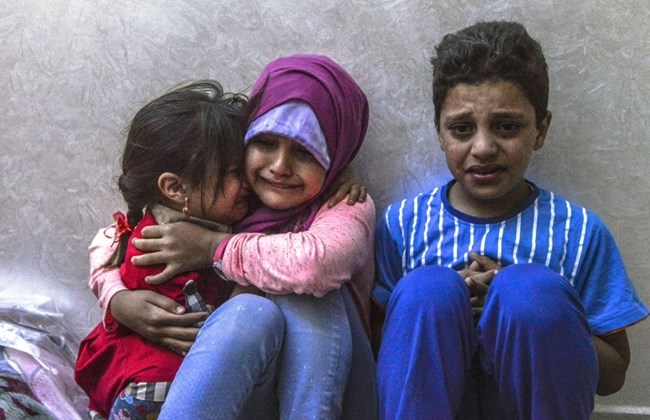
Beirut: As of May 15, 2016, according to Save the Children and an assortment of UN agencies and NGO’s, nearly 7 million people are displaced within Syria, half of them are children and more than two million of the youngsters are at risk of becoming ill, malnourished, abused, or exploited. In rural areas of Damascus one in 20 children is severely malnourished with 14 per cent classed as acutely malnourished. The charity’s chief executive Justin Forsyth recently told the UK Independent recently that “There is no room for delay or argument: Syria’s children must not be allowed to go hungry!”
Through no fault of their own, many civilians caught up in the conflict have been left unable to produce or buy enough food, and the food production industry has collapsed. Most of us living in this region have heard accounts of Syrian children forced to live off nothing more than lentils or bread. Food shortages are leading to skyrocketing price increases with the cost of the most basic supplies having increased by 100 per cent or more. Millions of children have been forced to quit school.
One inexcusable action that is today targeting Syria’s children, even if inadvertently, are the US economic sanctions against the country’s leadership by the US Treasury Department and its enforcement arm, the Office of Financial Assets Control (OFAC).
OFAC has long and zealously targeted its two nemeses, Syria & Iran with ever harsher economic sanctions that have damaged both economies, caused rampant inflation of consumer goods prices, while all but choking off economic development. The victims of the draconian regulations are not either country’s leadership but rather those most in need, especially the children in war torn Syria.
OFAC regulations to stop banks from providing services to charities and others that do business in targeted countries like Syria are in fact having an unanticipated serious impact on relief efforts. This according to more than a dozen interviews with aid directors, senior bankers, lawmakers and industry experts interviewed by Bloomberg.
More than half of the 170 local and regional banks surveyed by the World Bank last year reported losing their relationships with global partner banks over fear that OFAC will come after them as it has done in hundreds of cases.
Banks are also closing accounts for hundreds of money-transfer firms that work with charities and that provide lifelines to migrants and their families in the $582 billion remittance business. Mark Carney, governor of the Bank of England and chairman of the Financial Stability Board, has warned about the “financial abandonment” of entire countries.
According to Bloomberg, what started as a reaction to Sept. 11 has morphed into a dilemma with implications for governments, banks and hundreds of millions of people struggling to survive in nations with little financial infrastructure. U S and western law enforcement agencies have made tracking the global flow of money a key tool in their fight against al-Qaeda, Islamic State, and Hezbollah as well as Syria and Iran.
A couple of examples.
In southern Turkey, Islamic Relief has delivered 150 million dollars of aid to 6.5 million Syrian refugees, most of them children. Even though it had previously partnered with the United Nations and Western countries in providing aid to more than 30 countries over the past 32 years, it is experiencing repeated delays in getting food to Syria children after banks refused to transfer funds to pay for any supplies that might be sent to Syria.
Last year, former UK Ambassador to Lebanon, Ms. Frances Guy was close starting a major program to feed hundreds of displaced children and others in war-torn Syria. Guy, the Middle East head of Christian Aid, had secured funds and found partners. But there was one obstacle she couldn’t overcome: The charity’s bank, Standard Chartered Plc, refused to transfer $50,000 to put the project in motion. According to Ms. Guy “The unintended consequence here is that aid is being denied to people in desperate need of assistance. If this continues, it is possible to see a situation where Syria children and those most in need of humanitarian aid are least able to access it.”
Dozens of other charities wanting to help vulnerable Syrians are also being blocked. After U.S. authorities levied billions of dollars in fines against Standard Chartered, HSBC Holdings Plc and BNP Paribas SA for violating sanctions on Syria, banks have been unwilling to send money and have even shut accounts. Charity Finance Group, a London-based trade association with 1,350 members, says 200 to 300 charitable organizations have had their accounts canceled or faced long delays and rejections of money transfers.
In early 2016, the British government pledged 2.3 billion pounds ($3.3 billion) to ease the suffering of Syrian refugees and improve the lives of those still in the country. According to Save the Children, which is sponsored by 41 churches in Britain and Ireland, much of that money won’t help those in need if charities, major conduits for delivering government aid, can’t transfer cash.
Some U.S. banks have refused to transfer cash for Oxfam the global anti-poverty organization founded 74 years ago to relieve famine in Greece. Such obstacles are taking a toll in places where aid is needed most. This winter, Christian Aid made arrangements to deliver blankets to displaced people in Iraq, but by the time the money came through it was almost spring. Scores of charities are seeing donations from supporters held up by banks and online payments-processing companies.
The U.S. has prosecuted several charities over the past decade. In 2009, five leaders of the Holy Land Foundation for Relief and Development, once the largest Muslim charity in the U.S., were imprisoned for funneling dollars to the Palestinian group Hamas.
The Obama administration and other G-7 leaders are increasingly employing sanctions to punish nations such as Syria, Russian and Iran. That’s led to an explosion of new standards and regulations determining what banks can and can’t do when serving legitimate charities.
Unsure which of countless OFAC rules might apply to a simple banking transaction, increasingly banks are closing charity accounts to avoid any possibility of an OFAC fine. For banks asked to help transfer fund to set up a hot meals field kitchen for Syrian children, for example, the benefit to the banks are not worth the risk of crossing OFAC.
OFAC urges bank to play it safe and avoid risks. The de-risking advised by OFAC continues to intensify among banks globally after the U.S. Justice Department filed a criminal charge in 2012 against Standard Chartered for moving millions of dollars through the financial system on behalf of sanctioned Iranian entities. According to Bloomberg, the bank has paid almost $1 billion to settle actions brought by the federal government and New York State. Also in 2012 HSBC bank was fined 1.9 billion after being charged with violating sanctions laws.
An idea to somehow lessen some of the harsher OFAC regulations seen as targeting charities was offered recently by some industry lawyers that represent major lending institutions. The plan would be to create a sort of safe harbor where banks could avoid punishment if any money inadvertently ended up in the wrong hands, as long as prescribed due diligence measures were followed. OFAC quickly rejected this idea. Jennifer Fowler, assistant secretary for terrorist financing, affirms that the US government is not going to roll back any restrictions, insisting that “We have these rules in place to protect our financial system.”
One solution could perhaps be for the UN and its specialized agencies to get involved and take advantage of an OFAC regulation exemption. But this idea is complicated by OFAC’s refusal to permit humanitarian funds transfers to Syria except those made, pursuant to section 5420513, and done by United Nations organizations or its contractors. Even then, the general license prohibits any blocked entity from touching the funds, setting up additional compliance fears for the banks involved and their unwillingness to risk yet another mega-fine from OFAC.
The Obama administration acknowledges that closing the accounts of clean charitable organizations is a problem. The US Treasury Department has been informally passing the word to U.S. and foreign banks that they won’t be indicted for innocent mistakes.
But few if any financial institutions are likely to be much convinced given OFAC’s record.
Consequently, much needed food aid for Syria’s most vulnerable will likely continue to be blocked.