23 May 2016

Loathing Global Politics Is Dehumanizing The Mankind

Mahboob A. Khawaja

To Comprehend the Current Global Affairs
In 2008, Presidential candidate Obama inspired hope (“yes, we can”) for political change but it turned out to be a fallacy of perception and hope. The world is more dangerous place in 2016 than when a colored President Obama making history moved into the White House. In scholarly terms, politics is a game of pretension and obsession to egomaniac ideals to enhance one’s own image and interest for power. You can’t blame Obama squarely for all the wrong idealistic perceptions he generated to win the two presidential elections. Modern democracy is fast becoming a willful house of deception and exploitation for the rich and privileged ones. Was the 2011 Protest Movement not a revulsion against the same ideals? President Obama is leaving the presidency and the political world in much worst conditions than when he assumed the office. War is the only goal and policy aim that he pursued, not much different that of beleaguered George W. Bush did to dehumanize the American culture and victimize the humanity with new brand of terrorism. History speaks loud and clear. History will judge leaders and nations by their actions, not by their claims. None of these characters had any vision for universal harmony and sustainable political change or to foster peace and co-existence across many divided national lines of greed and hegemonic controls. American politicians do what political financiers and lobbyists dictate them to do - to loath the mankind with the fear of insecurity and continuous war agenda.
The Arab Middle East is virtually destroyed; its masses bombed, terrorized and displaced as unwanted refugees across many European national frontiers. The real problem of Palestine is replaced by the current wars to capsize the whole of the Arab world. Who is responsible for all the intriguing wars and backdoor conspiracies to kill one another? Have all the Arab people lost their sense of thinking and rationality? How would the future generations view them in a critical analysis? Were they so inept and stupid not to think of their own future and sustainability? The aggressors have carved up subjective titles and labels of sectarian killings, daily bloodbath and terrorism. As if it was not part of their planned scheme of things to dismantle the Arab freedom and human dignity. Was this perpetuated cruelty and darkness not the explicit outcome of the American and British war and occupation of Iraq and Afghanistan? Who will rebuild the century’s old cultures, human habitats and reputable ancient values that have been systematically destroyed by the war mongers?
In “How the United States and Britain Lost the Bogus War in Iraq and Afghanistan” (Global Research), this author clarified the pertinent facts of the bogus war: Michel Meacher, British Environment Minister under PM Blair (“This War on Terrorism is Bogus”) - provides reliable insight into the real reasons for the 'War on Terrorism'. He claims that the "war on terror" is flatly superficial: “the 9/11 attacks gave the US an ideal pretext to use force to secure its global domination ... the so-called 'war on terrorism' is being used largely as bogus cover for achieving wider US strategic geopolitical objectives ... in fact, 9/11 offered an extremely convenient pretext to put the PNAC plan into action. The evidence again is quite clear that plans for military action against Afghanistan and Iraq were in hand well before 9/11.”
David Swanson (“ISIS, Weapons Makers, Thugs Benefit from This Crime.” Dissident Voice), points out how the US weapon manufacturers have increased the cost of weapon sales by 19% and are ultimately the beneficiary of the war against ISIL. The coalition of war led by the US against ISIL is nothing but a paradox of self-contradictory coercive arrangement. The U.S. France, Germany, UK, Saudi Arabia, and Arab Gulf countries aim is to overthrow President Bashar al-Assad, which happens to be the goal of ISIL and other groups fighting in Syria. President Putin is shielding the besieged Bashar Al-Assad from final collapse and making gains in Syria and Arabian strategic thinking. Many Arab leaders are impressed by Putin’s decisive action to protect his client state. They could open new markets for Russian weapons and influence in the Arab world. President Obama remained in-between without any prompt action to oust Bashar Al-Assad. The current sectarian wars do not appeal to any holiest mission. The US and Russia are bombing to support their war economy and find a convenient pretext to kill the Arab people. American foreign policy aims at and acts like double-edge Razor King to install authoritarian regimes in the frontline Arab states and manipulate them for illegitimate purposes and exploitation of the natural resources. When these former neo-colonial tribal agents turned kings and princess become a liability, the US implies Plan “B” to get them killed by their own people like Ghadafi in Libya, Abdulla Saleh ousted in Yemen and Saddam Hussein hanged in Iraq. The Arab coalition leaders have no sense of time and history how the US will destroy the Arab culture and civilization by using false pretext of the war.
Truth is One, Not Many But Political Leaders will Deny it
We are witnessing an historic event and epic of empire-building. Leaders claiming to be democratically elected, think and behave like absolute dictators. President Obama is engaged in time-killing exercises at the end of his presidency. He was not an intellectual and proactive person leading to peaceful future-making. Mankind needs morally and intellectually responsible leadership to pursue a sustainable future. All absolute rulers and leaders tried to run down the mankind as if it was just a number - a digit - and conscious-less entity of technological imagination. But all of them have caused immense losses and liabilities to their own nations and empires. American political history was enriched with intellectual foresights and democratic values to safeguard the rest of the mankind. But its contemporary leaders and major institutions seem to defy the logic of peaceful co-existing with the global community.
The continuous wars have incapacitated the Arab states and rulers as some are complacent in providing logistical support to the US-British aggressions in Iraq and Afghanistan. The Western masses are against the wars but the US-Russian strategic plans increasingly pursuing more seen-unseen wars against the Arabs-Muslims, not just to occupy their natural resources but to go beyond Iraq, Afghanistan, Syria and Libya and occupy the lands and people. This is a call for a decadent Islamic culture to be destroyed within as the political developments are shaping up beginning with Palestine, Iraq, Syria onward to other Arabian Peninsula - collapse of the Muslim people to be taken over by the 21st century Crusaders. One wonders, if the oil enriched Arab elite occupying dusty palaces could come out to have the freedom to think on their own of a Navigational Change to avert the self-geared human catastrophes?
Chris Hedges (writes a regular column for Truthdig.com and was a foreign correspondent for The New York Times, and author of many books including his most recent book: Empire of Illusion: The End of Literacy and the Triumph of Spectacle) contributes a realist observation (“The Ghoulish Face of Empire.” Truthdig.com), to make the US policy makers understand the untold and challenging facts of global politics:
The black-clad fighters of the Islamic State of Iraq and the Levant, sweeping a collapsing army and terrified Iraqis before them as they advance toward Baghdad, reflect back to us the ghoulish face of American empire. They are the specters of the hundreds of thousands of people we murdered in our deluded quest to remake the Middle East…… The language of violence engenders violence. The language of hate engenders hate. “I and the public know what all schoolchildren learn,” W.H. Auden wrote. “Those to whom evil is done do evil in return.” It is as old as the Bible.
There is no fight left in us. The war is over. We destroyed Iraq as a unified country. It will never be put back together. ….We are not, as we thought when we entered Iraq…. We are something else. Fools and murderers. Blinded by hubris. Faded relics of the Cold War. And now, in the final act of the play, we are crawling away. Our empire is dying……. The disintegration of Iraq is irreversible. At best, the Kurds, the Shiites and the Sunnis will carve out antagonistic enclaves. At worst, there will be a protracted civil war. This is what we have bequeathed to Iraq. The spread of our military through the region has inflamed jihadists across the Arab world. The resulting conflicts will continue until we end our occupation of the Middle East. The callous slaughter we deliver is no different from the callous slaughter we receive. Our jihadists—George W. Bush, Dick Cheney, Paul Wolfowitz, Donald Rumsfeld, Richard Perle, Thomas Friedman and Tommy Franks—who assured us that swift and overwhelming force in Iraq would transform the Middle East into an American outpost of progress, are no less demented than the jihadists approaching Baghdad. These two groups of killers mirror each other. This is what we have spawned. And this is what we deserve.
The Earth and Space are wired with secrecy, new and unthinkable weapons of mass destruction, and global warming is a clicking time bomb for the future. The most hated and feared leaders do not have the intellectual and political capacity to solve nay problems which they have engineered for their own interest and greed of power. The humanity looks to proactive scholars, visionary and intelligent people of new ideas and leaders of change to rebuild a systematic and institutionalized sustainable future for the humanity and to articulate a culture of freedom and human dignity to co-exist without the fear of wars and in complete harmony with the Nature of things - more so, to imagine man (human being), humanity and the Universe to co-exist without animosity of the few vengeful mindsets. Man being the most intelligent creation on planet Earth and being the nucleus of Humanity must think of his originality of Creation and coherent role-play within the Laws of God governing Man’s life and the Universe. The Man, the Humanity and the Universe must be seen as interrelated to envisage global peace and harmony on One Plant. Life, the Universe and the laws of governance of the planet are not the outcomes of politicians and staged actors. Is there anew culture of rethinking and emotions to bring the mankind back to its originality of rational unity and peaceful co-existence to save the humanity and civilizations? Lessons of history are ignored - most feared and most hated leaders, who drove the mankind to the insanity of the Two World Wars and current war agenda in the Middle East, likewise are actively engaged to undermine the future prospects of harmony between people of diversity and varied cultures. With failed international institutions, incompetent and corrupt global leadership affiliated to the Washington-based Military-Industrial complex continues to enforce militarization of the globe- an insane perversion against the logic of peace and co-existence amongst the mankind. The humanity looks to men of intellect, scholars of integrity for solutions, certainly not to the warmongers destroying life and habitats throughout the globe. Rationality asserts that the future belongs to the global citizenry not to the few sadistic warlords, and that an informed and politically mature and active global citizenry must have the opportunity to exercise its rights, choice and freedom to develop the futuristic global institutions and governance by integrating the moral and spiritual values of man, humanity and the living Universe as the rational forces of global conscience for a sustainable future. Being one Humanity on One Planet and One World, People of the world to which the Universe belongs, have never allowed any abstract institutions or governments or egomaniac leaders to act on their behalf? The message and its spirit are clear that the mankind as ONE rational force must act to safeguard the future.

China: How is Nuclear Security Understood?

Chao Xie


China is situated in a nuclear neighborhood, with Russia, India, and Pakistan in possession of nuclear weapons, the DPRK a potential owner, and several others with nuclear materials. Just as some of these states are confronted with eminent threats of political instability, terrorism and homegrown insurgencies, China is not immune from terrorist threats, and it has to tackle both domestic terrorism and the penetration of outside terror into its own territory. Thanks to the greater importance attached to nuclear security and safety, China has maintained a good record for more than 60 years, which is a remarkable achievement considering the volume of nuclear materials involved in its nuclear power capacity generation, and the threat level it has faced and is now facing.
According to the latest statistics, the Chinese mainland has installed 30 nuclear power generating units with a total capacity of 28.31 GW, and another 24 units of a total installed capacity of 26.72 GW have been planned or under construction. There are also plans to build offshore floating nuclear power stations. China is on the way to assure the world that more than enough measures have been taken to ensure security and safety. In order to make these achievements better known to the world, it published its first ever nuclear white paper in January 2016 - an unprecedented gesture - to show that its nuclear emergency responses have adopted “the most advanced technology and most stringent standards.”
However, its efforts in the nuclear security arena are not fairly recognised by the world: for instance it only ranked 19th, near the bottom in the latest theft ranking, in the Nuclear Threat Initiative’s (NTI) Nuclear Security Index. There is recent reportage to securitise China’s plans on nuclear power unit construction. The negative assessment embodied in such reports may partially be the result of a deep-rooted bias in some Western countries against a rising China, while in fact the latter has successfully developed effective systems to secure its nuclear material and facilities. As a matter of fact, greater concerns about the security of atomic energy establishments in the West only gained prominence after the 9/11 terrorist attacks, and China’s emphasis on nuclear security predated even its Western counterparts. To some observers, the importance China has attached to nuclear security for decades is out of the ordinary.
Nevertheless, besides the hardware part of physical protection, there is an increasing awareness that it is up to individuals to ensure security by complying with rules and establishing best practices. This means a security culture should be able to permeate to all levels for people to understand the threats and the need to remain alert. Even though nuclear security culture is a relatively new topic in China, this does not mean it is lacking one. On the contrary, a deeper look into Chinese culture and way of thinking indicates that its perception about security and threat can better fulfill these needs.
In China, Anquan (安全) as a Chinese translation can be applied to both security and safety, while in English the two expressions – security and safety - have clear and specific meanings. When applied to the nuclear arena, as defined by the International Atomic Energy Agency (IAEA), nuclear safety is related to undue accidents and nuclear security - “the prevention and detection of and response to, theft, sabotage, unauthorised access, illegal transfer or other malicious acts involving nuclear material, other radioactive substances or their associated facilities.” In order to distinguish these two, nuclear experts in China are now translating security as Anbao (安保) in Chinese. The domestic debates on understanding security and safety, especially the enthusiastic discussions between nuclear technicians and strategists, help consolidate a typical culture emphasising both external and internal threats of nuclear establishments.
Chinese people have their way to understand the threat too. Compared with other states, especially the US, nuances in security paradigms can be found in China’s security culture and thus its out-of-ordinary emphasis on curbing nuclear threat can be understood. For US’ decision-makers and strategists, the threat is measured by the capability and intention of an outside power. In China, the threat is in parallel defined as a scenario in which its national security is threatened. With such a paradigm, the threat is not limited to that from a foreign power but also from within, and it embodies both military and non-military threats. This is why international analysts find that in China’s defence white papers, most security challenges come from various scenarios, rather than one specific enemy.
Compared to US’ rhetoric that nuclear terrorism is “the single most important threat” to its national security, nuclear security in general is prioritised to the level of national security in China, because a scenario of a possible nuclear theft or accident can threaten national security. This philosophy tends to raise domestic consciousness on nuclear security and safety and a security culture such as this can also help reduce “insider threats,” which are increasingly critical to safeguard a state’s nuclear security. This is as understood in a Chinese saying, Jia Zei Nan Fang (家贼难防), which literally means “a thief from within is hard to guard against.” The underlying logic is that an insider has the access, knows the vulnerable points and should he get the chance, is more likely to succeed in penetrating the system. Such emphasis on a greater sense of security goes in line with the increasing international awareness on nuclear security reflected in the four Summits.
Even as China has instituted effective security measures and is equipped with an active sense to safeguard nuclear security, it must remain alert and engage in more international conversations to review the rapidly changing threat scenarios, and share and learn best practices from each other. New ways are needed to tackle new threats and vulnerabilities; for instance, cyber security requirements at nuclear facilities should be reviewed and renewed on a regular basis.
A recent project undertaken by China can meet such ends. The establishment of the Nuclear Security Center of Excellence in Beijing was first discussed and agreed between China and the US at the Nuclear Security Summit (NSS) in Washington, DC, in 2010. The center opened in March 2016, on the occasion of the fourth Summit. According to sources, it is the largest of its kind in the Asia Pacific region, boasting a capacity to train up to 2,000 nuclear security staff each year and hence making itself a center for international exchanges and cooperation on nuclear security. Furthermore, China’s position on safeguarding nuclear materials could be better understood by the world through hosting international peer reviews, and publishing nuclear security-related annual reports.

Oil workers mobilise against French labour law

Kumaran Ira

Hundreds of gas stations in France were hit by fuel shortages over the weekend as truckers and oil workers blocked fuel depots and shut down refineries to protest the Socialist Party's (PS) unpopular and regressive labour law.
Oil workers at Total voted on Friday to shut down three refineries including Donges near Nantes, Feyzin near Lyon, and Gonfreville-Orcher in Normandy. Workers began to shut down oil production at Gonfreville-Orcher and Feyzin. Workers also blocked deliveries from Total's Grandpuits refinery to the Paris region, as well as oil depots in northern and western France, causing petrol shortages that could spread throughout the country if the strike continues.
French oil industry group UFIP (Union Française des Industries Petrolières) reported that 317 of Total's 2,200 petrol stations in France had run out of all or some fuels on Saturday. The north and west of France are the hardest hit: 54 percent of petrol stations in Brittany, 46 percent in Normandy, 43 percent in Pays de la Loire and 34 percent in Nord-Pas-de-Calais and Picardy face shortages.
Several departments in the north and the west have begun partially rationing fuel supplies, banning fuel sales in transportable containers. La Voix du Nordreported that stations supplying Lille were poised to run out of petrol over the weekend.
The PS government reacted to the strike with blustering threats and desperate attempts to crush the strike before it spreads to broader layers of workers. Visiting Israel yesterday, Prime Minister Manuel Valls insisted the labour law would be maintained and claimed there were no oil shortages in France, while bluntly warning that the PS would take all necessary measures to end the oil strikes, including deploying police to smash strikes.
“We are fully in control of the situation,” Valls blustered. “I think some refineries or fuel depots that were blockaded have been cleared or will be in the coming hours or days. Everyone can see the French government's determination to prevent shortages. Anyway, we have reserves to deal with shortages.”
In fact, despite Valls' boasting, the PS is in a desperate crisis. The widespread opposition to the labour law has escalated after President François Hollande’s government rammed the law through the National Assembly without a vote. The law—which allows unions and bosses to sign contracts violating the Labour Code, lengthens the work week, cuts pay, facilitates mass sackings and eliminates job security for new hires—is widely seen as an illegitimate attack on workers' social rights won through decades of struggle.
Faced with overwhelming popular opposition, the PS is relying on the treachery of the union bureaucracy, the Left Front and the New Anti-capitalist Party (NPA). These long-time allies of the PS, who called for a PS vote in 2012, are desperate to block a political struggle of the working class against the PS government. Under far more explosive conditions, they are reprising their role in the 2010 oil strike against pension cuts: isolating strikers, allowing the police to smash blockades and try to restart production and prevent a fuel shortage from forcing the government to retreat.
Yesterday morning, the PS government ordered CRS riot police to smash blockades at two oil depots, the Rubis terminal and at Saint-Pol-sur-Mer in Dunkirk, blocked by members of the Stalinist General Confederation of Labour (CGT) union. Police also intervened to disperse blockades of oil depots in Brittany, including at Vern-sur-Seiche near Rennes, and in Lorient.
When CRS intervened to disperse blockades in Dunkirk, the CGT did not seek to mobilise broader sections of workers to defend the strikers, but lifted the blockades without challenge. Christelle Veignie, secretary of the local union, stated: “Everything happened peacefully, the CRS asked us to leave nicely. We didn't resist.”
While the main weapon the oil workers have is their ability to shut down oil production and cause fuel shortages when they go on strike, CGT-Oil federation leader Emmanuel Lepine stressed, “Our goal is not to create fuel shortages.”
The struggle against the PS' agenda of austerity and war must be organised independently of the unions and their political allies, through a ruthless political break with them. As long as workers' struggles remains under their control, these organisations will seek to divide, sabotage and sell out the successive struggles of the working class as they erupt.
Now, the trade unions have signaled their readiness to isolate and wind down strike action. On Friday, the FO (Force Ouvrière) union called truck drivers to suspend road blockades after the PS claimed it would maintain their overtime pay despite the provisions of new labor law.
Both the FO and CGT hailed the government decision. In a common communiqué, they wrote, “The government is making concessions on overtime. This is very good news for a profession that is suffering.”
In fact, the workers will win nothing except through a conscious struggle to mobilise the working class in a political struggle against austerity across Europe on a socialist and internationalist platform.
Austerity cannot be fought by a struggle conducted under the national straitjacket imposed by the unions and pseudo-left parties like the Left Front and the NPA. Despite their toothless criticisms of the PS, these forces do not oppose austerity. Their ally in Greece, Syriza, is in power, imposing austerity measures even more draconian than its right-wing conservative and social democratic predecessors, while attacking protesting workers and tear gassing immigrants.
While these forces seek to divide the workers along national lines, the draconian austerity policies being imposed in one country after another are planned and imposed jointly by governments across Europe. The French labour law, modelled on the Hartz IV law in Germany, aims to boost French competitiveness by imposing the type of deep attacks on the workers imposed in Germany a decade ago. When workers and youth began protesting the French labour law in March, social democratic politicians from across Europe met in Paris to support Hollande.
These included German Social Democratic Party (SPD) leader Sigmar Gabriel, Italian Prime Minister and Democratic Party (PD) Chairman Matteo Renzi and EU Commission Vice President Federica Mogherini.
To the extent that these forces and their pseudo-left allies are allowed to pass themselves off as “left,” this only strengthens the hand of far-right populist forces like the National Front (FN) of Marine Le Pen, running on a nationalist, anti-immigrant and anti-EU platform.
The PS government itself tacitly supported a protest against “anti-cop hatred” organised by the Alliance police union with FN support last week, which was attended by Eric Cocquerel of the Left Front.

US Supreme Court avoids ruling on corporate religious objections to birth control

Tom Carter

The US Supreme Court last week refused to issue a decision on the merits of a controversial series of cases captioned Zubik v. Burwell. In these consolidated cases, various institutions are insisting it violates their “religious liberty” if their employees receive insurance coverage for birth control, even if the institutions do not have to pay for it.
This absurd and provocative position is part of a legal campaign unleashed by the Supreme Court’s 2014 decision attacking the separation of church and state, entitled Burwell v. Hobby Lobby. In that case, the court held that the provision of birth control and contraception under the Affordable Care Act (Obamacare) violated the religious liberty of corporations.
That Hobby Lobby decision opened the floodgates for numerous lawsuits, executive orders and legislative bills around the country invoking “religious liberty” to attack the right to abortion and birth control and discriminate against gay and transgender individuals. One such measure is North Carolina’s House Bill 2, which codifies discrimination against transgender individuals, among other reactionary provisions. There is no logical endpoint to this “religious liberty” campaign except the total abrogation of the separation of church and state and establishment of a theocracy in America.
This antidemocratic offensive, spearheaded politically by the Republican Party, has been abetted by the Obama administration and the Democrats, who at every turn have sought to accommodate themselves to religious fundamentalists, including by adding loopholes and exemptions for religiously affiliated organizations to the Obamacare law. President Obama bent over backwards to conciliate the religious right and the Catholic Church, going so far as to give a speech in 2012 riddled with the upside-down, pseudo-legal jargon later used by the Supreme Court in the Hobby Lobby decision. Granting the accommodations in question, Obama declared himself committed to the “principle of religious liberty,” adding, “As a citizen and as a Christian, I cherish this right.”
The case decided May 16 gets its name from David A. Zubik, the Roman Catholic bishop of Pittsburgh, on whose behalf the first such case was filed. Other cases consolidated with Zubik’s were filed by Priests for Life, Southern Nazarene University, Geneva College, the Roman Catholic Archbishop of Washington, East Texas Baptist University and Little Sisters of the Poor Home for the Aged.
The Obamacare law generally provides for birth control and other reproductive health services to be covered by insurance. However, pursuant to accommodations granted by the Obama administration, religious groups may object and opt out of paying for these services. In the case of an objection, the coverage is still generally to be provided, at no cost to the employer. The plaintiffs in the Zubik case are arguing that even with the accommodation, their religious liberty is violated if their employees or students are provided access to reproductive health care services.
If elementary democratic norms were applied in any sane or rational way by the Supreme Court, the Zubik case would be summarily tossed out and the attorneys who brought the case would be fined for making frivolous arguments. Neither the US Constitution nor any enforceable statute gives corporations the power to impose their religious prejudices on students and employees. Businesses and churches have no legal right to dictate the health care decisions of private individuals, and the Obama administration had no business granting arbitrary “accommodations” and “exceptions” to such institutions in the first place.
The Zubik case highlights the unprincipled prostration of the entire political establishment before the protracted assault on the separation of church and state. With the influence of religion declining in the population at large, especially among younger people, the most rabidly reactionary section of the ruling class and its political representatives are seeking to whip up religious fundamentalism to disorient and confuse the population, mobilize violent and backward forces, and block the development of organized social opposition to capitalism.
In its brief nine-page opinion, the Supreme Court expressly refused to decide the Zubik case on the merits. Instead, the case was returned to the lower courts with instructions for the parties to try to compromise. The Obama administration and the objecting religious groups “should be afforded an opportunity to arrive at an approach going forward that accommodates petitioners’ religious exercise while at the same time ensuring that women covered by petitioners’ health plans receive full and equal health coverage, including contraceptive coverage,” Justice Ruth Bader Ginsburg wrote in aper curiam opinion on behalf of the entire court.
She added that the lower courts were expected to “allow the parties sufficient time to resolve any outstanding issues between them.” Supreme Court analysts and commentators were fairly unanimous in calling this decision a “punt,” almost certainly the result of a 4-4 deadlock among the justices. Unable to break a tie, they returned the case to the lower courts without deciding it.
The Supreme Court, usually composed of nine justices, is currently functioning with eight following the death of the arch-reactionary Associate Justice Antonin Scalia in February. It can safely be assumed that the court’s right-wing bloc of Chief Justice John Roberts and associate justices Clarence Thomas and Samuel Alito, together with the so-called “swing justice” Anthony Kennedy, would have favored the religious groups in the Zubik case. They would likely be opposed by the “liberal” wing composed of associate justices Ruth Bader Ginsburg, Elena Kagan, Sonia Sotomayor and Stephen Breyer.
In March, President Obama nominated the conservative former prosecutor Merrick Garland to fill Scalia’s seat. Republican legislators had overwhelmingly supported Garland’s appointment to lower courts, but they are now stalling Garland’s confirmation in hopes that a Republican president will take office following the November elections and nominate someone more right-wing.
Front-running Republican presidential candidate Donald Trump released a list of potential Supreme Court nominees on Wednesday. Presented as an appeal to the Republican Party’s divided “moderate” wing, the list of nominees is a who’s-who of figures considered by the Republican establishment to have strong “conservative credentials.” The Washington Post ’s Chris Cillizza responded approvingly, applauding it on his list of “5 very smart things Donald Trump has done since becoming the presumptive GOP nominee” and calling it “a very smart strategic play.”
The Post continued, “Trump made no secret of his goal with the list: to put 11 names on it that would be totally unimpeachable in the eyes of conservative activists.” Zubik was among a number of cases the Supreme Court returned to the lower courts last week, apparently reflecting a 4-4 tie vote. Nevertheless, the court continues to carry out its essential functions, which include presiding over America’s brutal system of mass incarceration. In a unanimous decision on Thursday in the case of Betterman v. Montana, the Supreme Court decided that a 14-month delay before a man’s sentencing did not violate his constitutional right to a “speedy trial” under the Sixth Amendment, part of the Bill of Rights. Justice Ginsburg, considered the ideological leader of the four-justice “liberal” bloc, wrote the opinion for the unanimous court.

Currency conflicts surface at G-7 meeting

Nick Beams

Rising geo-economic tensions, resulting from the continuing stagnation of the world economy, came to the surface at a meeting of G-7 finance ministers and central bankers at Sendai, Japan, at the weekend held in advance of the group’s summit meeting this week.
The immediate point of contention was sharp opposition from the US over statements from Japan that it stands ready to intervene in currency markets to push down the value of the yen, a move aimed at boosting the Japanese position in the struggle for export markets. On top on the currency conflict, there were deep divisions over the role of increased government spending in trying to revive the global economy.
The currency dispute came into the open with statements by an unnamed US Treasury official as the meeting opened criticising remarks by Japanese government and financial officials that the recent upward movement in the value of the yen was “disorderly” and that intervention through the selling of yen may be necessary.
“If the perception and/or reality is that it’s for gaining unfair advantage, that is very disruptive to the global economic system,” the US official said. “It’s hard to imagine that if one country were perceived to be doing it that it wouldn’t lead to other countries doing the same.”
The Japanese warnings of intervention have come in response to the surprise increase in the value of the yen—at one point it has been up by as much as 13 percent—following the decision of the Bank of Japan (BoJ) at the end of January to initiate a policy of negative interest rates. While the BoJ move did not have the stated objective of lowering the yen’s value, it was expected this would take place.
However, the move of the currency in the other direction has had a significant impact on major Japanese corporations, many of which are reporting lowered profit expectations as a result of tougher conditions in international markets because of the yen’s rise.
This has prompted the calls for intervention, including from the Japanese finance minister Taro Aso. Echoing his views, a top Japanese financial official, Masatsugu Asakawa said in a recent interview: “What we need to be conscious of is that excessive volatility and disorderly movements will have an adverse impact on economic stability.”
However, the claim of “disorderly” movements was directly discounted by the US treasury official, making it clear the present situation did not fall into that category by referring to the conditions which followed the 2011 earthquake in Japan when it was agreed that there should be intervention.
“I think you have to distinguish the kind of crisis that was presented in those circumstances from the kind of fluctuations in a market that just happen,” the official said.
US Treasury secretary Jack Lew raised the issue from the beginning of the talks. A statement from the US Treasury said he had underscored the commitments made at the February meeting of the G-20 in Shanghai to “refrain from competitive devaluation and communicate closely” saying they have “helped to contribute to confidence in the global economy in recent months.”
Lew emphasised these points at a news conference saying that it was important that the G-7 have an agreement not to engage in competitive devaluations and to communicate “so that we don’t surprise each other.” “It’s a pretty high bar to have disorderly (currency) conditions,” he said.
While Aso said there had not been a “heated” exchange with Lew and that it was natural that countries had differences over how they view currency movements, he persisted in his original assertion about the increase in the value of the yen.
“I told (Lew) that recent currency moves were one-sided and speculative,” Aso said at a news conference, adding that the gains in the yen over the past weeks had been disorderly.
But Japan received no support from other participants. The French finance minister Michel Sapin said monetary policies were “well adapted” and there were “no big discrepancies in currencies, so there is no need to intervene.”
Behind the currency conflict is the fear that, as the ongoing stagnation of the global economy—characterised by lowered growth rates, deflation, and falling investment—increasingly comes to resemble the decade of the 1930s, the beggar-thy-neighbour policies of that era will return. Each of the major powers will increasingly resort to economic nationalist measures to protect its own position.
As with other major economic summits of the recent period, the G-7 finance ministers meeting failed to produce any coordinated response to global stagnation. The US and Japan want to see a boost in fiscal spending. But this is completely opposed by Germany and to some extent by Britain.
Germany has opposed both the quantitative easing monetary policies of the European Central Banks and any suggestion that it should use its stronger fiscal position to initiate stimulus measures. Its opposition is rooted in the fear that any relaxation of its demands for austerity measures will lead to a weakening of the German financial system and work to the advantage of stronger US banks and finance houses.
Consequently there was no agreement on coordinated measures. There was a completely vague, general agreement on the need to employ a mix of monetary, fiscal and structural measures, with the rider that these measures should take into account “country-specific circumstances.” In other words, what has been described as “go your own way” approach.
Emphasising his opposition to both fiscal and monetary stimulus, German finance minister Wolfgang Schäuble said “structural reforms”—the code phrase for deepening attacks on labour protections and social conditions—were the most important and there was greater recognition in the G-7 that “structural reforms are crucial.”
While the differences over currency values between the US and Japan did not lead to an open breach, the tensions will continue. This is because what were once regarded as “normal” conditions for the functioning of the capitalist economy are breaking down.
The chief factor in the global stagnation that is fuelling currency conflict is the lack of investment in the real economy. In Europe, investment levels are running some 25 percent below where they were before the global financial crisis of 2008.
In the US, major companies instead of re-investing profits in new plant and equipment are now hoarding cash. A Financial Times article at the weekend, citing a report by Moody’s, noted that five major US hi-tech companies—Apple, Microsoft, Alphabet (Google), Cisco and Oracle—were sitting on $504 billion in cash at the end of 2015, nearly one-third of the total of $1.7 trillion being held by US non-financial corporations.
Moody’s reported that capital spending in the US had contracted for the first time since the official end of the US recession in 2009, down by some 3 percent. One of the chief factors was the reduction in investment by mining and energy companies as a result of the sharp fall in commodity prices, itself another expression of falling global growth.

The capitalist crisis and the defense of democratic rights

Andre Damon & Alex Lantier

On Sunday, Austria’s presidential runoff between Norbert Hofer of the far-right Freedom Party and Alexander Van der Bellen of the Green Party ended in a deadlock. Mail-in ballots will now determine whether Hofer will become the first head of state of a major European country since 1945 whose party traces its lineage to the Nazis.
Thirty years ago, the exposure of Austrian President Kurt Waldheim’s previous membership in the Nazi Party ignited a political scandal. Today, Hofer’s rise is part of a growing and increasingly dominant international tendency that has significant support in ruling circles. In country after country, right-wing and authoritarian forces are being mobilized to divert the anger and frustration felt by masses of people toward the traditional parties of the ruling class.
This tendency can be seen in the rise of the French National Front, the Alternative for Germany, the UK Independence Party, neo-fascistic forces in Ukraine and the election of Rodrigo Duterte in the Philippines. Most significantly, with the imminent nomination of Donald Trump as the Republican presidential candidate, one of the two principal parties in the United States will be led by an individual with a distinctly fascistic program and orientation.
Underlying the breakdown of democratic institutions is the protracted global economic crisis, the extreme growth of militarism and war, and, above all, the intensification of the class struggle.
In the Perspective published on May 21, the World Socialist Web Site called attention to signs of a resurgence of class struggle and a process of political radicalization on a world scale, including the strike by 39,000 Verizon workers in the US, mass protests against reactionary labor “reform” laws in France, a general strike in Greece, and strikes in China and India. The revival of class struggle, we explained, “is finding political expression in a turn by workers against all the parties of the official ‘left’ that are backed by the trade unions.”
The ruling elites feel themselves under siege from all sides. They are well aware that their policies of war and austerity are deeply unpopular and are provoking mass resistance. They are attempting to preempt this political radicalization through the mobilization of far-right forces, while creating the conditions for ever more violent and brutal repression of social opposition.
To the extent that neo-fascistic forces are able to win broader support, the political responsibility rests with the right-wing and anti-working class character of the nominal “left.” This can be seen most clearly in France and Greece. Workers and youth elected a Socialist Party government in France that has imposed emergency powers in the name of fighting terrorism and forced through a law attacking workers’ wages and working conditions. In Greece, Syriza (Coalition of the Radical Left), is using riot police to implement, over mass working class opposition, the very austerity measures it promised to oppose.
In Brazil, the Workers Party (PT) government, which for 13 years loyally imposed the dictates of the global banks, has paved the way for the direct intervention of the military 52 years after an authoritarian dictatorship seized power and launched a reign of terror against workers and youth. In nearby Venezuela, the political heirs of Hugo Chavez are responding to rising inflation and plunging oil revenues by imposing a state of emergency that bans workers from striking for higher wages.
As for Trump, the ability of this billionaire businessman to win support by promising to “make America great again” on the basis of chauvinism and extreme nationalism is entirely bound up with deep popular hostility to the two-party system. In a campaign between Trump and his likely Democratic Party opponent, Hillary Clinton, it will be Trump who positions himself as the “anti-establishment” candidate against a corrupt and despised representative of Wall Street and the military-intelligence establishment.
Under these conditions, the representatives of the middle class pseudo-left are advancing the argument that what is needed is a general alliance of “democratic forces” on a capitalist basis. Typical are the comments of Yanis Varoufakis, the former finance minister of the Syriza government in Greece, who played a central role in the betrayal of the struggle of Greek workers against austerity.
In an open letter published on the International Viewpoint web site, Varoufakis declares, “We are at a moment in history very much like” the 1930s, with “deflation, xenophobia, hyper-nationalism, competitive devaluations, jingoism, etc.” What, he asks, “was the duty of progressives” in the 1930s? “It was… to reach across party affiliations and borders to create a pan-European movement of democrats (radicals, liberals, even progressive conservatives) in opposition to the forces of evil. I very much fear that this is our duty today too.”
In fact, the 1930s are an object lesson in the bankruptcy of the politics Varoufakis is espousing. In that decade, the Stalinist-dominated Communist parties responded to Depression, war and the growth of fascism by promoting the program of “popular frontism”—an alliance with supposedly “democratic” elements of the bourgeoisie against fascism. This proved to be a disaster for the working class. By 1940, most of Europe was under fascist rule.
In similar fashion to the Stalinist popular front of the 1930s, Varoufakis’ policy of shackling workers to the very parties that are carrying out austerity and war is aimed at precluding the development of a political movement against the growth of far-right forces that can actually win mass support. He wants a campaign for “democracy” without changing any of the conditions that have given rise to the danger of fascism. In the United States, the political forces around the Democratic Party are preparing a political movement against Trump without proposing any change to a social policy that has produced an unprecedented transfer of wealth from the working population to the financial aristocracy.
Explaining the crisis of bourgeois democracy in the period between the First and Second World Wars, the great Marxist theoretician and revolutionist Leon Trotsky wrote:
By analogy with electrical engineering, democracy might be defined as a system of safety switches and circuit breakers for protection against currents overloaded by the national or social struggle. No period of human history has been—even remotely—so overcharged with antagonisms such as ours… Under the impact of class and international contradictions that are too highly charged, the safety switches of democracy either burn out or explode. That is what the short circuit of dictatorship represents.
Trotsky based his analysis on an understanding that the breakdown of democratic forms was the product of a social and economic system in deep crisis. The task today, as it was then, is to mobilize the working class internationally on the basis of a political program directed against the source of the electrical overload: capitalism.
We call on our readers all over the world to draw the necessary conclusions. Nothing will be achieved by attempting to shore up the crumbling institutions of bourgeois rule. Two alternatives are starkly posed: either the ruling class and its economic system will drag humanity into the abyss of war, Depression and dictatorship, or the international working class will take power and reorganize the world economy on a socialist basis.

21 May 2016

UN Assessment: Global Destruction Of Mother Earth On Fast Track

Andrea Germanos

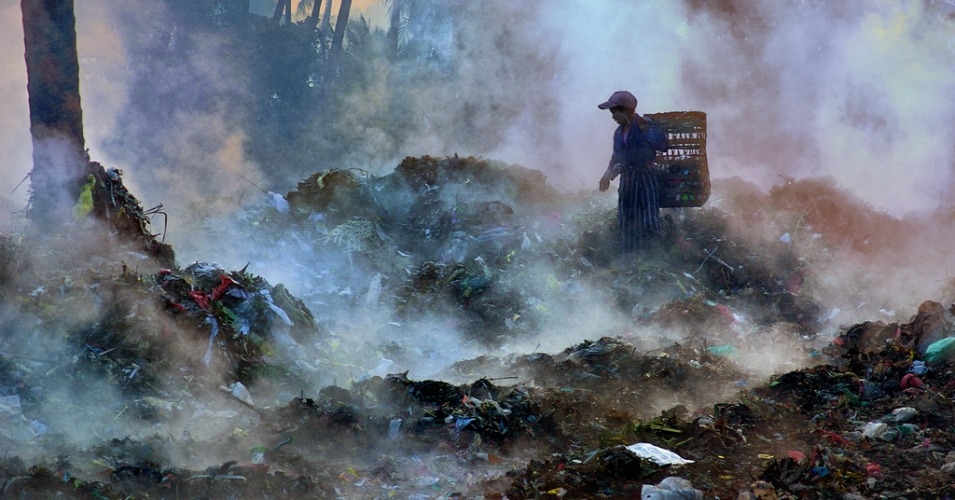
A little girl searches for recyclable materials in a garbage dump with smelling gas evaporating around her in Mandalay city, Mandalay province, Myanmar. (Photo: Nyaung U/United Nations Development Programme)
With no region of the Earth untouched by the ravages of environmental destruction, the state of the world's natural resources is in a rapid downward spiral, a comprehensive assessment by the United Nations has found.
Published Thursday, Global Environmental Outlook from the UN Environment Programme (UNEP) involved the expertise of more than 1,200 scientists and over 160 governments, and exposes through reports on each of the world's six regions that the rate of environmental deterioration is occurring faster than previously thought—and can only be halted with swift action.
"It is essential that we understand the pace of environmental change that is upon us," stated UNEP Executive Director Achim Steiner.
One threat many of the world's inhabitants are facing is that of water scarcity. For North America (pdf), for example, it "is of increasing concern," though it's just one of many "worsening pressures."
The report points to the recent five-year drought around Texas—a problem exacerbated by climate change. It also notes how the impacts of climate change were vividly felt when Hurricane Sandy struck in 2012.
"The 30 centimeters of sea level rise off New York City since 1900 likely expanded Hurricane Sandy's flood area by approximately 65 square kilometers, flooding the homes of more than 80 000 additional people in New York and New Jersey alone," UNEP states, adding: "Climate change is generating impacts across the region, and aggressive hydrocarbon extraction methods bring the possibility of increased emissions, water use and induced seismicity. The coastal and marine environment is under increasing threat from nutrient loads, ocean acidification, ocean warming, sea level rise, and new forms of marine debris."
And even with successful efforts to rein in carbon emissions, the outlook for the region isn't bright, the report notes:
A wide range of potentially catastrophic impacts are built in to the near and medium term climate, so that climate change impacts are highly likely to increase regardless of how fast the region reduces greenhouse gas emissions, and how fast it supports global emissions reductions. The consequences for human lives and livelihoods will depend on measures to adapt to climate change and increase resilience that, while showing signs of promise, are not yet sufficient to meet the threats. The region has been surprised by the emergence of major failures in traditional environmental issues, such as drinking water safety, suggesting that past successes are in jeopardy.
Or take the Latin American and Caribbean region (pdf), where greenhouse gas emissions are growing, a problem fueled in part by agriculture. UNEP notes:
>> Agriculture has had a strong impact on the emission of nitrous oxide and carbon dioxide. Nitrous oxide emissions - from soils, leaching and runoff, direct emissions, and animal manure - increased by about 29 per cent between 2000 and 2010. The abundance of beef and dairy cattle in the region has also increased methane emissions, which grew by 19 per cent between 2000 and 2010.
>> Andean glaciers, which provide vital water resources for millions of people, are shrinking and an increase in the intensity and frequency of extreme weather events are affecting economies.
In Asia and the Pacific, meanwhile,
Increasing unsustainable consumption patterns have led to worsening air pollution, water scarcity and waste generation, threatening human and environmental health. Increased demand for fossil fuels and natural resources - extensive agriculture, palm oil and rubber plantations, aquaculture and the illegal trade in wildlife - are causing environmental degradation and biodiversity loss.
Spreading desertification is a key threat for West Asia, while Africa's land degradation, due, in part, to deforestation, are among the environmental challenges for those regions.
And, of course, there's the Arctic region—"a barometer for change in the rest of the world" —with dropping levels of summer sea ice extent and glacier ice loss.
Among the recommendations UNEP calls for are scaling back fossil fuel dependency and increasing sustainable infrastructure investments.
While the UN body said there was still time to address many of the threats, urgent action, it stressed, was key.
"If current trends continue and the world fails to enact solutions that improve current patterns of production and consumption, if we fail to use natural resources sustainably, then the state of the world's environment will continue to decline," Steiner said, emphasizing the urgency "to work with nature instead of against it to tackle the array of environmental threats that face us."

German Social Democratic Party in free-fall

Ulrich Rippert

Germany’s Social Democratic Party (SPD) finds itself in free fall. In the latest poll by Forsa on Wednesday, its support fell to 19 percent, a decline of 2 percent from the previous month and an historic low for the SPD.
Forsa’s voter trends report for Stern/RTL states, “Only 14 percent say the SPD best represents their personal interests.” Forsa head Manfred Güllner commented on the results, “The working class still makes up the majority of society but no longer feels represented by the current SPD.”
The collapse of the SPD in the polls is the direct product of the right-wing, anti-social and militarist policies the party has pursued for years. The SPD is known as the “Hartz IV party,” which initiated an unprecedented social decline ten years ago with the Agenda 2010. The Hartz laws of the SPD/Green Party government (1998-2005), under Chancellor Gerhard Schröder and foreign minister Joschka Fischer, had catastrophic consequences.
Laid-off workers now lose all rights to social benefits after a year at the latest and are degraded to pleading for assistance. Those who wind up on Hartz IV welfare barely stand a chance of ever making it out of poverty. According to a study by the Paritätische Wohlfahrtverband, three quarters of those affected remain on Hartz IV permanently. Even the threat of falling into Hartz IV forces many laid-off workers to take a new job, often on the basis of low wages, a temporary contract or part-time hours.
Through the Agenda 2010, a second labour market was created, characterised by temporary work, short-term contracts and all kinds of low-paid jobs without any social security or rights. The legalisation of such precarious jobs has led to a sharp rise in poverty. The Paritätische Wohlfahrtverband’s latest poverty report classifies 15.4 percent of the population, or 12.5 million people, as poor. Among these are around 3.4 million pensioners and over 2.5 million children.
At the initiative of Labour Minister Andrea Nahles (SPD), the Bundestag two weeks ago adopted new legislation to regulate temporary jobs and short-term contracts. It writes extreme conditions of exploitation into law. At the same time, in collaboration with the trade unions, all opposition is being suppressed.
The SPD’s social counter-revolution has become the model for social democratic politics across Europe, The SPD led the way in enforcing one austerity programme after another on the Greek population and blackmailed and plundered the country in the interests of the international banks. Due to the collapse of the social democratic Pasok as a result of these policies, SPD leader Sigmar Gabriel and president of the European Parliament Martin Schulz (SPD) now cooperate closely with Syriza to press forward with social attacks.
The SPD has been attempting for years to export its Agenda 2010 to France. Two years ago, the architect who gave his name to the reforms, Peter Hartz, visited French President François Hollande and his government in the Elysee Palace to advise them on their labour market reforms. The result is the El-Khomri law, which the Socialist Party government has now imposed by emergency decree against mass protests.
In mid-March, at the beginning of the key phase in France’s Agenda policy, leading European social democratic politicians met in Paris to strengthen the hand of President Hollande. Along with Gabriel and Schulz, Italian Prime Minister and Democratic Party (PD) chairman Matteo Renzi, the then Austrian Chancellor and SPÖ chairman Werner Feymann, Portuguese Prime Minister and chairman of the Socialist Party Antonio Costa and the vice president of the EU Commission, Federica Mogherini, all participated.
The SPD has also played a key role in the preparations for war. Frank-Walter Steinmeier (SPD), Germany’s foreign minister, has led the shift in foreign policy and the return of German militarism. In close collaboration with defence minister Ursula Von der Leyen (CDU), he has organised military rearmament. Hundreds of millions of euros which have been squeezed out of the working class by austerity measures are flowing directly into arms programmes for the military.
These reactionary policies are coming up against growing popular opposition. The SPD virtually collapsed in March’s state elections. In Baden-Württemberg and Saxony-Anhalt, the SPD barely surpassed 10 percent of the vote and finished behind the far right Alternative for Germany (AfD). Members are also rushing in large numbers to leave the SPD. Since 1990, it has lost more than half its membership.
The SPD’s financial structure has in the meantime become largely independent of declining membership dues. The bureaucratic organisation works according to corporate targets and controls a wide-ranging network of commercial operations. In addition, the party receives large sums from the state party financing system. Last year, state subsidies amounted to more than €50 million. The SPD is a party of the state, which enforces the interests of German imperialism and leading corporate associations with utter disregard for the opposition of the population.
Concern is growing in the ruling elite about the party’s declining influence. The latest edition of the Frankfurter Allgemeine Zeitung ’s weekly magazine published a lead article on the subject entitled, “Decline of a people’s party.” It began,“The SPD has hit rock bottom.”
The article continued: “The SPD is Germany’s oldest party. It resisted the Nazis, provided three great Chancellors and influenced the German state like no other party apart from the CDU. But if federal elections took place on Sunday, it would receive, according to the latest polls, only 20 percent of the vote. In the east, the AfD would be 5 percentage points ahead of the SPD. A horror scenario for the great old party.”
The advanced decomposition of the social democrats is an international phenomenon. In Austria, Greece, Britain and above all in France, and also in many other countries, a similar development is taking place. It is connected to a growing radicalisation of the working class.
In Greece, mass strikes have taken place against the brutal austerity policies of the Syriza government. In France, workers and students have taken to the streets for weeks to protest against the Hollande government’s social cuts and labour market reforms. In Germany, strikes and workplace protests are sharply on the rise. Last year, the official number of strike days surpassed the one million mark for the first time in many years.
In the United States, China and India, strike waves are also breaking out. In the US, over 40,000 employees of the telecommunications giant Verizon have been on strike for weeks. This growing global radicalisation of workers and youth is finding expression in the mounting opposition to the SPD.
The working class confronts the task of finally liberating itself from these reactionary, nationalist bureaucracies. However, this requires more than a rejection of the party by refusing to vote for it and abandoning membership. The danger that far right parties like the AfD and FN could exploit the political vacuum is great.
The working class must adopt a new political course; it requires a new political perspective. Not a single problem confronted by the workers throughout the world can be dealt with within the framework of the nation state or the capitalist profit system. The working class needs an internationalist, socialist programme and a revolutionary party.
Herein lies the significance of the Partei für Soziale Gleichheit’s (PSG) participation in the Berlin state elections in September. Unlike the Left Party, which pursues the goal of retaining the SPD in power and supporting it, we call upon everyone wishing to combat war, repression, nationalism and social inequality to energetically support the PSG’s campaign. We are pursuing the aim of abolishing the capitalist system, the source of inequality, poverty and war, and developing a mass movement on the basis of a socialist and internationalist programme.

Sports Authority to close all stores, lay off 16,000

George Gallanis

The major retail company Sports Authority announced Thursday the closing and liquidation of all of its more than 460 stores. All employees, who according to Forbes currently total 16,000, are expected to be laid off. The shuttering of Sports Authority comes about after store closings and job cuts by other retail giants such as Kmart and Sears and is a further indication of a deepening social crisis facing the working class.
The elimination of 16,000 jobs will impact 41 US states and Puerto Rico. It is estimated that it will take three months until all stores are closed, leaving thousands of workers scrambling to find new jobs in an already depressed job market.
Sports Authority workers will be joining workers to being laid off from Kmart and Sears. Sixty-eight stores are slated to be closed at Kmart and 10 at Sears. Most of the stores will close in late July.
Sports Authority was in fact once owned by Kmart, which bought it in 1990. Its history is littered with mergers and acquisitions, fueled by financial speculation. Founded in Lakes Mall in Lauderdale Lakes, Florida, The Sports Authority, Inc. was put together by venture capital groups led by William Blair Venture Partners, including First Chicago Venture Partners, Bain Capital, Phillips-Smith Venture Partners, Marquette Venture Partners, and Bessemer Securities.
Its first store opened in November 1987 in Fort Lauderdale, Florida. A few years later, Kmart would acquire the company. Within five years, its stores sprawled across 26 states. It would eventually separate from Kmart and become an independent entity.
By 2003, The Sports Authority had expanded to 205 stores in 33 states and had become the largest full line sports retailer in the United States. In the same year, it would complete the “merger of equals” with Gart Sports Company, which also operated Oshman’s and Sportsmart, leading to the rebranding Gart Sports stores with the Sports Authority insignia.
SA’s yearly profit hit $3.5 billion in 2006. The same year, affiliates of the private equity investment firm Leonard Green & Partners agreed to leverage a buyout worth $1.4 billion. Since then, Sports Authority has been plagued with stagnant profits and heavy competition from rival sports realtor Dick’s Sporting Goods.
This past March, The Sports Authority filed for Chapter 11 bankruptcy protection and announced a plan to close at least 140 of its 463 stores and lay off 3,400 of its employees. On April 26, SA announced that they would sell off their assets and remaining store locations. Then, on May 18, the company announced that they had failed to restructure their debt making liquidation unavoidable, leading to the closing of all stores.
Going-out-of-business sales are expected to begin next Wednesday at all stores and will continue until Aug. 3. Stores previously slated to close have already begun the process of emptying their inventory. Dick’s Sporting Goods is seeking to acquire roughly twenty of Sports Authority store leases. “There’s a small group of stores we would love to get,” stated Dick’s CEO Edward Stack.
From one merger to another, from bankruptcy to financial riches, it is the working class that pays for it all. As 16,000 workers will soon be left jobless, the small staff of 45 at Leonard Green & Partners, which is leading the liquidation and selling of SA, will no doubt rake in a heavy profit for itself.
Like many private equity firms, Leonard Green & Partners has overseen acquisitions, mergers, and the selling off of numerous companies, including those of Petco, Whole Foods Market and Lucky Brand Jeans. It is the product of an economic system that places the interest of profit above that of the vast majority of people.
Commenting on the closing of Sports Authority stores, a worker said, “It’s all about a small number of hedge fund shareholders and f*ck the employees and community economic development incentives they suck dollars from.”

While cause of Egypt Air crash remains unknown, terror scare mounts

Thomas Gaist

Investigators discovered wreckage Friday believed to be remains of Egypt Air Flight 804, the Cairo-bound jetliner that crashed into the eastern Mediterranean Thursday after a series of abrupt swerving maneuvers.
It certainly is possible that the destruction of this aircraft was the result of some form of sabotage. But no solid evidence has yet been found, among the wreckage or elsewhere, to justify claims advanced by Western leaders Thursday that Flight 804 was targeted for a terror bombing. In contrast to the provocative statements of various political figures, officials charges with investigating the disaster have been careful to avoid jumping to conclusions.
US officials initially claimed that satellite photos show “strong indications” that the plane was brought down by an explosion, yet failed to bring forward any hard evidence.
A US avionics expert cited in US media late Friday suggested that a mechanical breakdown in the cockpit might have produced an electrical fire.
Even as uncertainty remains over the crash, the US and European ruling elites are seizing on the incident to demand further escalations of their military operations in the Mediterranean and across Africa and the Middle East, and to intensify their drive to remove all remnants of democratic restraint on the powers of the state.
The NATO powers, which are engaged in massive buildup on Russia’s border, responded to the crash by deploying a multinational naval flotilla to the crash area.
Los Angeles International Airport implemented heightened security procedures Friday, including random searches in entrance areas.
US media responded to 804’s disappearance with warnings that a “New Stage in the War on Terror” has begun, and that “Islamic State and Al Qaeda are on the March.”
The possibility that a bomb was smuggled onboard a flight leaving from Paris’ Charles De Gaulle (CDG) airport would prove the failure of “all the preventative security measures taken to safeguard global civil aviation since 9/11,” Time magazine warned in its report, “If a Bomb Brought Down Egypt Air 804 the War on Terror is About to Change.”
“If airline employees are being doubted, wouldn’t that include a mechanic, who could know where to tuck something out of sight?” Time warned, informing readers that “ISIS operates more like a mass movement” and that “anyone can join who is angry.”
Far from idle speculation, these conceptions are being advanced to rally support in ruling circles for even greater attacks on democratic rights, including intensified surveillance against the working class and broad mass of the population, under the slogan “anyone may be a terrorist.”
The decade and a half since September 11, 2001 has witnessed, in all of the advanced capitalist countries, a systematic buildup of the state’s capacity to spy on and capture individuals without any legal process. Open dictatorship now looms in all of the leading capitalist “democracies.”
Justified to the public in the name of fighting Islamic terrorism networks, these preparations are intended for use against the international working class. The November 13, 2015 attacks in Paris, planned under the noses of European intelligence, became the basis for the imposition of martial law decrees throughout France that remain in force today and are being bolstered with sweeping anti-labor measures.
The same terror groups who supposedly constitute “the enemy” were armed and financed by the US and the European powers on behalf of their predatory and neocolonial interests. Beginning in 2011, these forces were mobilized by NATO as tools of its wars against Libya and Syria.
In discussions with members of the Washington-backed dictatorship of General Abdel Fattah el-Sisi in the Egyptian capital on Friday, US and British diplomatic chiefs offered “all kinds of support” to Egypt’s military government.
The crimes of Egypt’s military regime, which has carried out massacres and mass executions in an effort to terrorize the revolutionary movement of the Egyptian working class that erupted in 2011, exemplify the real meaning of the “war on terrorism,” which aims at the suppression by military and police violence of the workers and oppressed masses throughout the entire world.