24 May 2016

Dormitory fire kills 17 children in Thailand

Tom Peters

At least 17 young girls died in a horrific fire that broke out at 10:30 on Sunday night at a school dormitory in the Wiang Pa Pao district of Chiang Rai, Thailand. According to local police, two girls were unaccounted for and five were injured.
The school, Pithakkiart Witthaya, is run by the Siam Ruam Jai Foundation, a charity that provides classes for children aged between 5 and 12 years from the northern region’s impoverished hill tribes who live near the border with Myanmar and Laos.
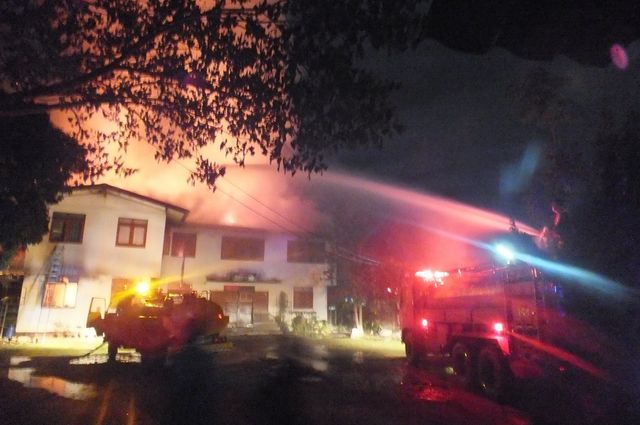
Photo credit - Pitakkiat Wittaya School Facebook page
Approximately 14 girls managed to escape unharmed. The province’s deputy governor, Arkom Sukapan, told Agence France Presse: “Some were not yet asleep so they escaped. But others were asleep and could not escape, resulting in the large number of casualties.”
According to the Nation, “Police Major-General Sant Sukhavach ... said yesterday evidence suggested the fire broke out because of a melting fluorescent tube,” which had ignited a pile of clothes. The cause of the fire has not been confirmed, however.
Like many buildings throughout Thailand, it appears that the dormitory had no fire alarm, sprinkler system or fire escape. Reports indicate that the fire spread rapidly and students had very little warning; a teacher ran through the hall shouting “fire.” Within minutes, the blaze had become extremely dangerous.
Many children were trapped on the second floor. At least one survivor, Makhata Taweejirakul, was forced to jump for her life. Twelve-year-old Kwanjira Anantapetch told the Nation: “Our teacher started tying bed sheets together and using it as a rope for children to scale down from the second floor.” Others used a nylon rope.
Two fire trucks, along with 10 members of the Siam Ruam Jai Foundation, took two hours to bring the fire under control. One described it as “the worst fire I’ve ever seen.”
Thai media reports indicate that families of the dead children can receive 200,000 baht under the school’s insurance provisions. This is just over $US5,600.
The tragedy is the product of a lack of basic safety precautions, combined with the extreme poverty and hardship suffered by large sections of the population who are forced to rely on charity to educate their children.
The Chiang Rai hill tribes are among the most exploited populations in Thailand. According to AFP, “Many are descendants of refugees from Myanmar or China and exist within subsistence farming communities often beyond the reach of state resources.
“Hill tribe children suffer at school, as well as in their health and development. Poverty means adults are easy prey for drug gangs who pay them to smuggle narcotics—including heroin and amphetamines—across the zone, known as the ‘Golden Triangle.’” The tribes also face discrimination from the state and repression by Thai security forces.
The country’s military regime, installed in a coup in May 2014 with the tacit support of the United States, has sought to whip up nationalism and xenophobia to divert from the country’s social crisis. It is waging a brutal campaign to repatriate more than 100,000 Myanmar refugees who live in nine camps near the border.
On Monday morning a Myanmar migrant was shot dead by Thai police following an escape by 21 men from an immigration detention centre in Phang Nga province. The victim was a member of the persecuted Rohingya Muslim minority.
The dormitory fire is only the latest in a litany of disasters linked to Thailand’s extremely poor building standards and the intense exploitation of workers. According to the latest government statistics there were 100,392 workplace accidents or injuries in 2014, including 625 deaths and 1,485 cases of “loss of organ.” These figures, which are based on reported incidents, no doubt underestimate the scale of the problem.
In 1993 the world’s largest ever factory fire, at the Kader Toy Factory outside Bangkok, killed 188 workers and injured over 500. There were no fire extinguishers, no alarms and no sprinkler systems. The building was essentially a death trap.
The collapse of the Royal Plaza Hotel in Nakhon Ratchasima three months later, due to the improper addition of three new floors, resulted in 137 deaths and 227 injuries. In July 1997, the Royal Jomtien Resort Hotel fire in Pattaya, blamed on poor fire-preparedness, killed 91 people and injured 53.
On 1 January 2009, 66 people died in a fire at the Santika night club in Bangkok. Again, there was a lack of adequate prevention and safety measures, including sufficient emergency exits.
According to the Bangkok Post, former general and self-appointed Prime Minister Prayuth Chan-Ocha made a brief statement on Monday “expressing deep regret” on hearing of the deaths in the Pithakkiart Witthaya dormitory fire.
As with the previous disasters, however, any official investigation into the Chiang Rai school dormitory fire will be strictly limited to identifying the immediate cause and possibly finding an individual scapegoat. There will be no effort made to address the broader lack of regulation and enforcement of building standards, or to alleviate poverty and the lack of basic services for people in the hill tribes.

US house approves new austerity program for Puerto Rico

Rafael Azul

On Friday May 20, the US House of Representatives approved legislation to restructure Puerto Rico’s $72 billion debt. The law was the result of an agreement between the administration of US president Barack Obama and the Republican Party-controlled Congress, centered on the joint commitment that there will be no federal rescue package for the US Caribbean island-territory.
The bipartisan measure is clearly skewed toward the banks and Wall Street. It attacks virtually every right of Puerto Rican youth, working and lower-middle classes, while protecting the profits of banks and hedge funds.
Policing Puerto Rico’s finances and debt restructuring will be a seven-member so-called financial oversight board, which will have powers to override the government of Puerto Rico. The oversight board will orchestrate Puerto Rico’s fiscal policies—taxes, pensions, health care, education, etc.—to ensure repayment. Its mandate is open-ended; it would hand control of finances back to the government only when Puerto Rico can reenter the bond market on Wall Street and globally, i.e., only when Wall Street decides that it will be so.
One can anticipate that the only role left for the elected authorities will be to send in police and security forces against the Puerto Rican masses, whenever so ordered by the oversight board.
While the new law supposedly provides for “restructuring” of debt, i.e., a likely reduction of the amount of money owed by the government and its agencies combined with payments over an extended period of time, its clauses make clear that those calling the shots will be those financial entities themselves. They will decide the concessions, if any, while the fiscal oversight board controlled by Wall Street will guarantee their profits through a combination of cuts in social programs, the privatization of public utilities, increased taxes, and reductions in wages and working conditions for Puerto Rican workers and youth.
The decision not to bail out Puerto Rico will have dire consequences. Currently, Puerto Rico dedicates roughly 30 percent of its fiscal budget to debt service and repayment, about three times what US states pay. In addition, a decade or more of economic collapse has been pushing Puerto Rican emigration into Miami and other US cities.
According to the Madrid daily, El País, Puerto Rico has lost 10 percent of its population during the last decade, despite near recession conditions in the US. While Governor Alejandro Garcia Padilla insists that Puerto Rico is not looking for a bailout (“we simply need the legal tools that will help us confront this crisis and insure that Puerto Rico has a viable future”), he has mentioned that an infusion of $20 billion is required in the short term, a pittance compared to the hundreds of billions handed out to Wall Street and the banks since 2008.
Discussions had been taking place for months between the White House and congressional leaders, the agreement was hammered out last week. It includes changes in the oversight board (from five to seven members, with at least one from Puerto Rico itself).
On wages, the new bill provides for the suspension of minimum wage and overtime rules.
The oversight board with expanded powers will be able to dictate Wall Street’s terms to Puerto Rico. It will be able to sell government assets, carry out the sacking of thousands of workers and veto legislative and executive branch decisions.
President Obama will appoint all members of the oversight board. All but one will be appointed from a list drawn up by congressional leaders. Restructuring decisions will require a super-majority of five.
Though the bill that was approved on Friday expands the oversight board’s power over Puerto Rico’s government, it constrains the board’s authority to compel hedge funds and banks to agree to virtually anything, severely limiting its ability to use the US courts against the debt holders.
“All in all the bill has been improved drastically by being more voluntary and protecting creditor priorities,” said Susheel Kirpalani, a partner at Quinn Emanuel Urquhart & Sullivan, representing a group led by 10 asset management firms. Among the provisions supported by Kirpalani and others is language that fiscally binds the territorial government, under the federal board’s oversight, to “respect the relative lawful priorities” of existing creditors, and requires any court-approved restructuring plan to be “feasible and in the best interests of creditors.”
According to the New York Times, “The bill bars Puerto Rico’s governor or legislature from exercising ‘any control, supervision, oversight or review over the Oversight Board or its activities.’” This means essentialy the imposition of direct colonial rule, which was left behind in 1952 with the creation of the Estado Libre Asociado (Free Associated State, or Commonwealth) and self-rule.
House Speaker Paul Ryan, who had led the negotiations for the Republicans, declared on the eve of the vote, “We got this bill exactly where we wanted it … We wanted to make sure that the restructuring worked, and that the restructuring is done in a way that it prevents any taxpayer bailout, or some precedence that could affect the bond markets. And we’re very confident that we’ve achieved that.”
There were those who accepted the new law with some trepidation, aware of rising class tensions in the island. Pedro R. Pierluisi, Puerto Rico’s nonvoting member of Congress, warned of the political instability that exists in Puerto Rico and the danger of a social explosion: “I hope every Member of Congress will bear in mind that the collapse of the bill could mean the collapse of Puerto Rico’s government,” declared Pierluisi.
The debt crisis and austerity measures of the administration of Alejandro García Padilla are magnifying a decade-long humanitarian crisis in Puerto Rico.
Hundreds of cases of the Zika virus have recently been documented. Though the virus is mosquito-borne, mosquito control is being hampered by budget cuts. Water quality and delivery that depends on an aging and collapsing infrastructure also allows mosquitoes to breed. Worsening the crisis is the flight of health professionals from Puerto Rico, and the closure of clinics and hospitals. In San Juan, people often wait 12 or more hours at crowded emergency rooms.
Compounding the health crisis is a food crisis. Half a million Puerto Ricans are in poverty, of which only 110,000 receive food assistance. For many children their main meal is the lunch that schools provide. Thousands depend on food banks and soup kitchens. A recent TV report on hunger in Puerto Rico asked a 10-year-old in the town of Lares about his dreams: “When I dream, I dream of food,” answered the child. Statistically, 47 percent of Puerto Rican children live in poverty, the highest in the United States.

Growing signs of a resurgence of class conflict in the US

Jerry White

In recent weeks, an increasing number of workers in the United States have been engaged in strikes, lockouts, contract rejections and other struggles. Social inequality is at historic highs, and workers are suffering the longest period of wage stagnation since the Great Depression, producing a radicalization that is in its initial stages.
According to President Obama, life has never been so good in America, and an Internet search for the word “strike” brings up far more coverage in the news media of murderous “air strikes” by the US military than of workers’ struggles. Despite the best efforts of the trade unions to suppress the class struggle, however, workers in the telecom, manufacturing, airline and supermarket industries, as well as public sector workers, are entering significant battles.
Developments in the US are part of an international tendency. Recent months have seen mass protests and now an oil refinery strike in France; a three-day general strike by Greek workers against austerity; a week-long strike by Nigerian workers against rising fuel and electricity prices; a strike by Mexican teachers to defend public education; a one-day strike by train conductors in the United Kingdom; and the first strike by Kuwaiti oil workers in two decades.
In the US, the strike by 1,700 telecom workers at AT&T West in San Diego, California has undermined the efforts of the Communications Workers of America (CWA) and other unions to isolate the six-week strike by 40,000 workers at Verizon. The CWA was forced to call the strike—which involves only 10 percent of the 16,000 AT&T West workers who have had no contract since April 9—because of growing rank-and-file opposition to giant telecom company. AT&T made $13.2 billion profit in 2015 and spent billions on acquisitions and dividend payments to its richest investors and top executives.
The CWA and the International Brotherhood of Electrical Workers (IBEW) are currently involved in secret negotiations under the auspices of Obama’s labor secretary and a federal mediator to shut down the strike at Verizon as soon as possible on management’s terms. Despite being put on starvation strike pay rations by the CWA and IBEW, Verizon workers remain determined to beat back the attack on their living standards.
In the working class as a whole, there is widespread support for a unified struggle. “We stand with our brothers and sisters on the East Coast,” an AT&T worker in San Diego told the World Socialist Web Site. “What happens to them can happen to us—corporate America is taking away our rights and we have to take them back.”
A worker at the GM Hamtramck Assembly in Detroit told the WSWS on Monday, “I truly feel all workers should support the Verizon and AT&T workers. There is nothing on the news. They don’t want anyone to know. They look at it like a cancer that should be stopped from spreading.”
An estimated 8,788 collective bargaining agreements, covering 2.2 million workers, are due to expire or be modified in 2016. The chief obstacles to a fight against the companies are the AFL-CIO and Change to Win unions, which are allied with the Obama administration and the Democrats. The unions function as an arm of corporate management and the state. They support the policy of lowering wages and cutting health care and pension costs to make US corporations more “globally competitive.”
The unions have long abandoned the principle of “no contract, no work,” keeping workers on the job for months or even years without a contract. On Friday night, the National Association of Letter Carriers (NALC) announced that it would continue negotiations with the US Post Office past the contract expiration date for 204,000 city letter carriers. Another 370,000 USPS workers were forced to accept arbitration by the American Postal Workers Union (APWU) and other unions.
The United Auto Workers barely survived a rebellion by autoworkers and required a campaign of lies, threats and vote fraud to get sellout contracts past the resistance of the rank-and-file last fall. This year has already seen sick out protests by Detroit teachers organized in defiance of the union, opposition to a union-backed concessions deal by Chicago teachers and a wave of student walkouts in Detroit, Chicago and Boston.
Earlier this month, hundreds of Honeywell workers rejected a “last, best and final” offer containing massive health care concessions by a nine-to-one margin at factories in South Bend, Indiana and Green Island, New York. The UAW forced workers to continue to labor past the May 3 contract extension, allowing the world’s largest aircraft parts manufacturer to lock out workers and bring in a notorious strikebreaking firm, Strom Engineering.
Four hundred workers have been on strike for two weeks at Triumph Composite Systems in Spokane, Washington, another parts supplier for Boeing, after overwhelmingly rejecting a company ultimatum. The International Association of Machinists, which rammed through an eight-year contract extension on 25,000 Boeing workers in 2014 by less than a 400-vote margin, is now isolating the Spokane workers.
Five thousand retail workers at Macy’s four New York stores, including in mid-town Manhattan, voted last Thursday to strike when their contract expires on June 15. The workers are fighting attacks on their health care, pay and the right to opt out of working on holidays. Thousands of workers at Kroger’s, the largest traditional grocery store in the US, have also voted to strike 41 stores in Virginia, Tennessee and West Virginia unless the company offers better pay and health benefits for retirees. The United Food and Commercial Workers (UFCW) has forced them to continue working after the contract expired May 8.
Two thousands pilots for five cargo companies contracted by DHL Express have voted to strike the German-based package delivery company because their wages are below those of workers at competing firms, UPS and FedEx. Meanwhile, thousands of UPS pilots and aircraft mechanics could strike after nearly three years of federal mediation.
Hundreds of thousands of other workers at United Airlines, Costco, Safeway and Albertson’s supermarkets face contract expirations. Across the border in Canada, some 23,500 hourly workers at Ford, General Motors and FCA Canada have a mid-September contract expiration.
In the US elections, the radicalization of workers and young people is expressed in the widespread support for Bernie Sanders, who has centered his campaign on social inequality and opposition to the “billionaire class.” Sanders role, however, has been to try to channel growing anti-capitalist sentiment back behind the Democratic Party, which, under the Obama administration, has overseen a historic transfer of wealth from the working class to the corporate and financial elite.
The Socialist Equality Party is running in the US presidential election to fight to unify every section of workers in an industrial and political counter-offensive. We call for the formation of rank-and-file committees, independent of the pro-capitalist and nationalist trade unions, in order to fight for common actions to defend the Verizon and AT&T workers and organize a joint offensive against the attack on jobs, benefits and working conditions.
Above all workers need a new revolutionary leadership, the Socialist Equality Party, to transform these struggles into a conscious political fight against the capitalist system, which is the root cause of social inequality, war and the drive towards dictatorship.

US military returns to Vietnam

Bill Van Auken

President Barack Obama’s announcement in Hanoi on Monday that Washington is lifting its four-decade-old arms embargo on Vietnam is described by the media, and Obama himself, as a decisive step in the “normalization” of relations between the US and Vietnam.
That process has been ongoing since the restoration of diplomatic relations in 1995. On the military front, the US agreed to sell Vietnam non-lethal military hardware in 2007, and last year it agreed to provide the Vietnamese coastguard with five unarmed patrol boats.
While there are no immediate prospects for massive arms deals between Washington and Hanoi, the US gesture is aimed at drawing Vietnam more closely into the orbit of US imperialism and the Obama administration’s “pivot to Asia.” It seeks in Vietnam, as in Japan, the Philippines, Singapore, Australia and elsewhere in Asia, the creation of a string of military alliances and bases to contain and ultimately wage war against China. The Pentagon wants the right to utilize the same bases it built up during the Vietnam War and to pre-position military hardware in preparation for such a conflict.
What has stood in the way of “normalization” until now is the bloody history of US imperialism’s encounter with Vietnam. Between 1964 and 1975, the US military unleashed violence of near-genocidal proportions against the Vietnamese people.
The war, which cost the lives of at least 3 million Vietnamese, saw the deployment of a US military force that at its height numbered more than 536,000 troops, 58,000 of whom died in Vietnam. By the time the war was over, US warplanes had dropped more than three times as much explosives on Vietnam and neighboring Laos and Cambodia as were dropped all across Europe and Asia during the Second World War. In addition, some 20 million gallons of toxic chemicals were dumped on the Vietnamese countryside, turning at least 10 percent of it into wasteland and leaving behind a health crisis that still inflicts cruel deformities upon Vietnamese newborns.
The politicians, both Democratic and Republican, and the senior military commanders who planned and prosecuted this devastating war of aggression were responsible for the worst war crimes committed since Hitler’s Third Reich, though, of course, none of them have faced the equivalent of a Nuremberg Tribunal.
Despite US imperialism’s massive military power, it suffered a humiliating defeat, caused in the first instance by the immense heroism and sacrifice of the Vietnamese people. This was combined with the overwhelming hostility to the war and the growth of militancy within the American working class that made it impossible to continue the imperialist intervention.
The image of the last American personnel scrambling onto helicopters on the US Embassy rooftop in Saigon in April 1975 remains an indelible expression of the historic crisis and decline of US imperialism.
That 41 years later Vietnam is being drawn into the preparations for an even more bloody and catastrophic US war against China is an expression of the tragic fate of the Vietnamese Revolution.
Vietnam’s evolution in the aftermath of the US war provides an historical vindication—in the negative—of Leon Trotsky’s Theory of Permanent Revolution. The liberation of this oppressed country from imperialist domination could, in the end, be accomplished only through a revolution of the working class, leading the oppressed masses behind it. Moreover, none of the immense economic problems confronting a war-shattered Vietnam could be resolved on the basis of nationalist policies such as those advanced by the Stalinist leadership of the Vietnamese Communist Party (VCP). In the epoch of the domination of the world capitalist economy over all national economies, socialist transformation, while beginning on the national soil, could be completed only on the international arena.
The isolation of the Vietnamese Revolution was a function not only of the VCP’s Stalinist perspective of “socialism in one country,” but even more decisively of the betrayals of a series of revolutionary upheavals internationally at the hands of Stalinist, social democratic and trade union leaderships during the same period. From the May-June events in France in 1968 through to the collapse of Franco’s fascist regime in Spain in 1975, these leaderships all worked to prevent the revolutionary mobilization of the working class and to re-stabilize capitalist rule.
In the end, the Vietnamese Stalinist bureaucracy took the same road as its Chinese counterpart, adopting its Doi Moi (renovation) policy in 1986 and declaring the creation of a “socialist-oriented market economy” as its goal.
Vietnam has been transformed into a cheap labor platform for transnational capital, with its working class subjected to grinding exploitation and wage levels that are half those prevailing in China. Corruption pervades the ruling party, which represents the interests of foreign capital and the emerging financial elite within Vietnam itself, while using police state measures to ensure labor discipline.
The Obama administration is attempting to draw Vietnam more tightly into its economic orbit through its participation in the proposed Trans-Pacific Partnership (TPP), whose principal aim is to counter China’s economic influence in the region. The agreement’s intended effects are to remove the remaining fetters on US capitalist investment and trade, while tearing down what remains of Vietnam’s state-owned enterprises.
China remains Vietnam’s number one trading partner, even as the US is its top export market. The ruling bureaucracy, while tilting toward Washington, still attempts to maintain a delicate balancing between the two.
The increasingly aggressive provocations being organized by the US military in the South China Sea and Washington’s drive to stoke tensions between China and neighboring states over control of islands, reefs and territorial waters will inevitably upset this balancing act, dragging Vietnam once again into the horrors of war.
Only the working class can prevent such a catastrophe. With its promotion of the penetration of Vietnam by foreign direct investment and the correspondingly rapid growth of capitalist production, Vietnam’s ruling bureaucracy and the wealthy layers it represents are creating their own grave diggers, in the form of a young and concentrated working class that will inevitably be drawn onto the road of class struggle.

Of Ranks and Scores in Nuclear Security: 18 Years of South Asian Nuclearisation

Rabia Akhtar


In the foreword of the Nuclear Threat Initiative (NTI) Index 2016, Sam Nunn, NTI Co-Chairman and CEO, asked an important question in the context of the last Nuclear Security Summit (NSS) held in Washington, DC: “Without the high-level attention and impetus provided by the summits and with so many competing priorities in a deeply unsettled world, can governments remain focused on the need to tighten nuclear materials security?”
It is true that the global threat environment has worsened over the last decade but measuring the performance of mature and stable nuclear weapons states (NWS) against new and developing NWS seems like an unfair comparison. India and Pakistan are in their eighteenth year of nuclearisation and in this time period, these two countries have not only institutionalised robust command and control structures but have also developed an efficient nuclear security culture, established export control regimes in their respective countries, and have worked with the IAEA and other nuclear non-proliferation and disarmament initiatives to strengthen the very regime that has kept them out as pariahs.
Between the de jure nuclear weapons states, there is rich nuclear experience equivalent to a cumulative 310 years, broken down individually to: 71 years of US nuclearisation; 67 of Soviet/Russian; 64 of British; 56 of French and; 52 of Chinese. Moreover, the US has provided nuclear weapons to non-nuclear NATO countries as part of nuclear sharing, a practice that violates the principles of the Nuclear Non-proliferation Treaty (NPT) by transferring direct or indirect control over nuclear weapons to non-nuclear countries.
Running nuclear weapons enterprises as old as the five de jure NWS have been, it should come as no surprise that almost all of them have an overall score of 60 and above out of 100 in the Theft and Sabotage NTI Index 2016, with the exception of China, which has an overall score of 60 in Theft and 59 in Sabotage. Given their cumulative and individual years of experience, one would think they would score almost 100 out of 100 but that is sadly not the case. Their individual ranking out of 24 for Theft and out of 45 for Sabotage is also not that spectacular given the years of experience they have had in institutionalising their nuclear safety and security regimes. In the Theft Index, the US ranks at number 10, Russia 18, UK 11, France 8 and China 19, and 6, 22, 3, 10 and 34, respectively in the Sabotage Index. It seems that only France fares better in individual ranking above others and would make an interesting case study.
In comparison if one must, after merely eighteen years of nuclearisation for both countries (42 years for India if 1974 nuclear test is taken into account) India ranks 21 and Pakistan ranks 22 out of 24, with an overall score of 46 and 42 out of 100 respectively in Theft. They rank 36 and 38 out of 45 with an overall score of 55 and 54 out of 100 respectively in Sabotage. These are not just numbers. These numbers tell a remarkable story. These numbers demonstrate that even with “competing priorities in a deeply troubled world,” to be specific, in the most deeply troubled region, both countries have shown incredible commitment towards securing their nuclear facilities, materials and personnel.
What is the way forward for these two countries in the absence of a multilateral forum like the Nuclear Security Summit? The prospects of establishing bilateral nuclear security mechanisms between the two are not too bright given the historic mistrust towards each other. Moreover, India will not sit down and share its best practices with Pakistan on nuclear safety and security if China is not part of any such arrangement.
These three NWS share a common border and are uniquely situated against each other, where theft or sabotage of nuclear facilities and materials in one country can create an emergency situation in other’s backyard. The threat of nuclear terrorism is real and should be acknowledged as such. The entry into force of the Amendment to the Convention on Physical Protection of Nuclear Material (CPPNM) on 8 May 2016 is a testament to the fact that states need to improve physical protection of nuclear material and facilities ‘in peaceful domestic use, storage and transport’. India, China and Pakistan are state parties to CPPNM and this is one platform on which these three countries can cooperate to reduce each other’s vulnerabilities to nuclear terrorism.
Since India and Pakistan cannot initiate a bilateral mechanism between them, China would have to take the lead to bring both countries together to develop a regional trilateral network for biannual meetings initially to develop trust and discuss regional threat scenarios related to nuclear terrorism that could affect each country equally. China’s ranking and overall score according to the NTI Index 2016 makes it the lowest ranking de jure NWS, but it fares better than India and Pakistan in the Theft Index and marginally so in the Sabotage Index. It is therefore in China’s interest to initiate such a trilateral conversation where each country gets to learn from the other to make South Asia a safer place for all.

23 May 2016

2016 Austrian Government-OeAD Ernst Mach Follow Up Grants for International Scholars

Application Deadline: 1st of September, 2016
Offered annually? Not known
Eligible Countries: Afghanistan; Algeria; American Samoa; Angola; Antigua and Barbuda; Argentina; Armenia; Azerbaijan; Bangladesh; Belize; Benin; Bhutan; Bolivia; Botswana; Brazil;Burkina FasoBurundi; Cabo Verde; Cambodia; CameroonCentral African RepublicChad; Chile; China; Colombia; Comoros; CongoCongo – Democratic Republic of the; Cook Islands; Costa Rica;Cote D’Ivoire; Cuba; Djibouti; Dominica; Dominican Republic; Ecuador; Egypt; El Salvador;Equatorial GuineaEritreaEthiopia; Fiji; GabonGambia; Georgia; Ghana; Grenada; Guatemala;GuineaGuinea-Bissau; Guyana; Haiti; Honduras; India; Indonesia; Iran – Islamic Republic of; Iraq; Jamaica; Jordan; Kazakhstan; Kenya; Kiribati; Korea – Democratic People’s Republic of; Kyrgyzstan; Lao People’s Democratic Republic; Lebanon; LesothoLiberiaLibyaMadagascarMalawi; Malaysia; Maldives; Mali; Marshall Islands; MauritaniaMauritius; Mexico; Micronesia – Federated States of; Mongolia; Montserrat; MoroccoMozambique; Myanmar; Namibia; Nauru; Nepal; Nicaragua; NigerNigeria; Niue; Pakistan; Palau; Panama; Papua New Guinea; Paraguay; Peru; Philippines; Rwanda; Saint Helena; Saint Lucia; Saint Vincent and the Grenadines; Sao Tome and Principe; SenegalSeychellesSierra Leone; Solomon Islands; SomaliaSouth AfricaSouth Sudan; Sri Lanka; Sudan; Suriname; Swaziland; Syrian Arab Republic; Tajikistan; Tanzania – United Rebublic of; Thailand; Timor-Leste; Togo; Tokelau; Tonga; Tunisia; Turkmenistan; Tuvalu;Uganda; Uruguay; Uzbekistan; Vanuatu; Venezuela; Viet Nam; Wallis and Futuna; West Bank and Gaza Strip; Yemen; ZambiaZimbabwe.
To be taken at (country): Austria
Brief description: Applications are open to Post Doctorate Scholars who are pursuing research or teaching at a higher education institution / university and who were in receipt of a grant in Austria which was administered by the OeAD-GmbH (formerly ÖAD). At the time of taking up the grant at least 5 years must have passed since the last scholarship-supported study or research stay in Austria.
Eligible Field of Study: Natural Sciences, Technical Sciences, Human Medicine, Health Sciences, Agricultural Sciences, Social Sciences, Humanities, Arts.
About the Award: The award has been financed by funds of the Austrian Federal Ministry of Science, Research and Economy (BMWFW) and the EU for international PhD or Post Doctoral scholars who desire to undertake research in science. The award aims to to promote scientific secondary growth, promote scientific cooperation and build a sustainable network of academics with relation to Austria.
Type: PhD, Post Doctorate Research grants
Eligibility: 

  • Maximum age: 50 years For the application Deadline, September 1, 2016, Candidate must have been born on or after September 1, 1966.
  • Applicants must not have studied/pursued research/pursued academic work in Austria in the last six months before taking up the grant.
  • Grants in this programme can only be applied for every 5 years.
  • The following documents have to be uploaded together with the online application at www.scholarships.at: • Consent of the academic partner in Austria • Scan of your passport (page with the name and photo) • Proof of employment by the home institution • Curriculum Vitae • Scan of university graduation certificate of PhD or doctoral studies.
Selection Criteria: 
  • The selection process for all grants for Austria is competitive, i.e. there is no legal claim to a grant even if all application requirements are fulfilled.
  • Applicants should take into consideration §1 of the Data Protection Act, Federal Law Gazette of the Republic of Austria No. 165/1999, as amended, that the Personal Details contained in the application will be passed on to the authority dealing with their application, the contractual partners, the Federal Ministry for Europe, Integration and Foreign Affairs and in the exchange as well as to other authorities awarding grants in Austria and will expressly agree with that.
  • Incomplete applications and applications not complying with the application criteria will not be accepted for the further selection process.
  • The selection follows a multistage processs:
    • Examination of the formal requirements
    • Assessment and evaluation of the application by experts
    • Final decision by the BMWFW.
  • During the selection process the following criteria are examined and assessed:
    • Purpose of your stay
    • Why did you choose the specific target institution in Austria?
    • Added value of the stay for the partner countries concerned (establishment and/or continuation of institutional cooperation)
    • Prior teaching and research activities
Number of Awardees: Not specified
Value of Grant: 
  • Monthly grant rate: 1,040 EUR
  • Accident and health insurance If necessary, the OeAD-GmbH will take out an accident and health insurance on behalf of the grant recipient.
  • Accommodation The OeAD-GmbH will endeavour to provide accommodation (student hall of residence or flat) for recipients of grants who wish to get accommodation arranged by the OeAD. Monthly costs: 220 to 470 EUR (depending on how much comfort the recipients of grants want). An administration fee of 18 EUR per month is payable to the OeAD-GmbH for arranging accommodation. The costs for insurance and accommodation have to be paid out of the grant by the recipient of the grant.
  • Scholarship holders will receive a travel costs subsidy of 1.000 EUR maximum upon presentation of original documents. Travels costs to Austrian representatives outside the home country are refundable upon presentation of original documents
Duration of Grant: One to three months
How to Apply: Application at www.scholarships.at. Only online at www.scholarships.at. A hardcopy application is NOT possible
Award Provider: OeAD-GmbH/ICM on behalf of and financed by the Federal Ministry of Science, Research and Economics – BMWFW
Important Notes: The recipients of grants will get the grant contract (Letter of Award and Letter of Acceptance) from the OeAD-GmbH/ICM. The contract covers the following aspects: Start and end dates of the grant; monthly grant rate; grant payment modalities (including a possible travel cost subsidy); compulsory presence at the place of study; performance record; data protection; repayment requirements.
Read More about Scholarship Conditions here: www.oead.at/scholarship-conditions

Netaji Subhas/ICAR International Fellowships for Agriculture Scholars – India

Application Deadline: 30th of June, 2016
Offered annually? Yes
Eligible Countries: Global
To be taken at (country): Select Agriculture Universities listed here
Brief description: The Indian Council of Agricultural Research (ICAR) is offering thirty Netaji Subhas-ICAR international fellowships for the academic year 2016-2017. These fellowships are available for pursuing a doctoral degree in agriculture and allied sciences at the recognised agricultural universities/ institutions in India and abroad.
Eligible Field of Study: Crop Sciences, Horticulture, Biotechnology and nanotechnology, Animal Sciences, Natural Resource Management, Agricultural Engineering and Fisheries. Subtopics of these fields listed here
About the Award: The Indian Council of Agricultural Research (ICAR) invites applications from the Indian as well as overseas national having Master’s degree in Agriculture and allied sciences for the “Netaji Subhas – ICAR International Fellowships (NS ICAR IFs)” for the year 2016-17. Overseas candidates will be eligible for study in Agricultural Universities (AUs) in the ICAR-AUs system.
Type: Doctoral Degree in Agriculture and Allied Sciences
Eligibility: 
  • Master’s degree in agriculture/allied sciences with an Overall Grade Point Average (OGPA) 6.60 out of 10.0 or 65% marks or equivalent will be the eligibility requirement for the NS-ICAR IFs.
  • The fresh candidates should not be more than 35 years of age on the last date prescribed for receipt of applications. The upper age limit for In-service candidates will be 40 years on the last date for receipt of applications.
  • Age on the closing date for receipt of applications will be considered for eligibility. 
  • Also, date of completion of qualifying degree will be the date of completion of both course and thesis work as declared by the university. Netaji Subhas- ICAR IF would be available for both, fresh and in-service candidates. However, the fresh candidates should have completed their qualifying degree not more than two years before the specified date in the year of admission. The in-service candidates from India should be employed in the ICAR-AU system.
  • The Council will identify and announce the priority areas of research and the list of institutions for admission, one year in advance, for availing the Netaji Subhas- ICAR IFs.

Number of Awardees: Thirty(30) fellowships
Value of Scholarship: The fellow will be entitled to the following:
  • To-and-fro, economy class air ticket for international travel, by the shortest route, from the airport, nearest to the residence/ work place of the candidate to the airport, nearest to the destination University in respect of both Indian and Overseas candidates (Air tickets to be provided by the Council).
  • The fellows will be entitled for economy-class-travel cost reimbursement from port of arrival in India to the destination University in India and back.
  • Indian Rupee 40,000 per month
  • The fellowship amount for the first six months, as first installment, will be released by the Council to the fellow through government notified/ approved bank to be deposited in the bank account of the fellow on receiving his/ her acceptance for the fellowship and admission letter received from the host University.
  • Thereafter, the amount of fellowship will be released to the fellow, every six months, after receiving the academic progress report from the fellow duly certified by the concerned advisor/ supervisor/ head of institution.
  • The fellow will meet all other costs including medical insurance etc. from the above fellowship or from his/ her own resources.
  • During the tenure of fellowship, an in-service fellow may continue to receive his/her salary, types of leave and benefits etc. from the parent organization as per rules.
Duration of Scholarship: Three (3) years
How to Apply: Candidates should fill the Application form. Filled in application along with supporting documents should be submitted (one hard copy by post and one soft copy by e-mail) to:
The Assistant Director General (EQR), Education Division, ICAR,
Krishi Anusandhan Bhavan II, Pusa,
New Delhi-110012
Email:  adgeqricar@gmail.com
Award Provider: The Indian Council of Agricultural Research (ICAR)
Important Notes: The other frontier areas in agriculture and allied sciences may also be appropriately considered.

Apply for the 2016 IBS Young Scientist Fellowship (YSF) – South Korea

Application Deadline: 31st of July, 2016
Offered annually? No
Eligible Countries: Global
To be taken at (country): South Korea
Brief description: The IBS Young Scientist Fellowship (YSF) is awarding fellowship grants to scientists from all over the world for challenging and high-risk basic research within the special nature of designated Research Centres. The goal of the fellowship is to advance the frontiers of knowledge and to train the leading scientists of tomorrow.
Eligible Field of Study: Basic sciences
About the Award: With the vision of “Making Discoveries for Humanity and Society,” the Institute for Basic Science (IBS) was founded in 2011 by the Korean government to promote basic sciences in Korea. Twenty-six IBS Research Centers have been launched and each Center is operated by internationally renowned scientists.
This year, the IBS introduces a new program called “Young Scientist Fellowship (YSF)” to play an active role in fostering next-generation basic science leaders. The YSF offers opportunities for young, promising scientists to do their own basic research work in one of the IBS Research Centers while sharing ideas and utilizing our state-of-art infrastructures.
Offered Since: 2016
Type: Postgraduate Science Fellowship
Eligibility: Within 5 years of obtaining a PhD or under the age of 40 with a PhD
Selection Process: 

  • Letter of intent
    1. Review and discussion by Evaluation Panel members
    2. Invitation to submit full proposals: August 31, 2016
  • Full proposal
    1. Submission deadline: September 30, 2016
    2. Review by Evaluation Panel members
    3. Invitation for an on-site interview: October 31, 2016
    4. Interview and presentation: November 30, 2016
    5. Selection and announcement of final YSF fellows: December 31, 2016
Number of Awardees: Not specified
Value of Scholarship: 
  • The YSF provides Korea Won 150-300 million per year
  • YSF fellows should be physically relocated to one of the IBS Centers
Duration of Scholarship: YSF fellows will be appointed for 3 years with possible extension of 2 years
How to Apply: Applicants should fill out the letter of intent form in English and submit via email toysf@ibs.re.kr as a single PDF file. The title of email should be “Applicant Name_YSF”.
Award Provider: Institute for Basic Science
Important Notes: YSF fellows are eligible to apply for the IBS Career Development Award (CDA), a research fund that can be used in the newly appointed affiliation after completing YSF.

Apply to Participate in the 2016 Thomson Reuters Foundation Grants for Journalists

Application Deadline: 12th of July, 2016
Offered annually? Not stated
Eligible Countries: Journalists from developing countries, USA, Canada or Germany.
To be taken at (country): The story lab event to take place near London
Brief description: The Thomson Reuters Foundation, in partnership with the Stanley Foundation and Gerda Henkel Stiftung, is launching a new programme which will support journalists to uncover emerging threats in specific communities, countries or regions worldwide, and bring these stories to a wide audience.
Programme Details: The programme features:
  • A three-day residential story lab (19 October – 22 October 2016) taking place near London that will bring together journalists, security researchers, and experts to share insight on emerging security situations and explore or refine story ideas (costs of participation are covered by the programme)
  • The opportunity to apply for small grants to cover the cost of reporting stories
  • Access to experienced journalists who have covered security stories all over the world, who can provide advice and editorial guidance
  • Support with pitching stories to international publication platforms if needed
About the Award: The news media plays a vital role in documenting conflict, instability and other security threats around the world. But media can also play a role in helping to prevent instability, by providing high quality reporting that highlights potential crises before they spiral out of control. The Thomson Reuters Foundation seeks to provide a unique opportunity for journalists to report emerging threats via collaboration. Participating journalists may choose to work in pairs or small teams and work on the same story together. They may also form partnerships with researchers who take part in the seminar – many of whom have experience gathering information ‘on the ground’ – to discover new leads, incorporate another story angle, or to deepen the content they produce.
Type: Journalism Grants
Eligibility: 
  • Journalists working for media outlets in the developing world, or the USA, Canada or Germany
  • At least three years’ experience in journalism
  • Experience covering security situations would be an advantage
  • Journalists working in any medium, or multiple media
  • Must be fluent in English
Topics to Cover: 
Genocide and atrocity crimes – How do regional and global responses to escalating atrocity violence impact conditions for civilians on the ground?
  • In 2014, the world’s attention turned to Boko Haram when it kidnapped 276 Nigerian schoolgirls. The Bring Back Our Girls advocacy campaign galvanized international outrage and put a spotlight on Boko Haram’s violent tactics. Two years later, most of the girls remain missing. Boko Haram has grown more violent, massacring villagers and killing thousands of innocent civilians. What other areas are at risk of similar atrocities, and what, if anything, can be done differently to better protect individuals and their communities?
Global peacekeeping – Given the number and range of emerging security threats globally, will humanitarian systems be able to cope?
  • The UN Sustainable Development Goals incorporated a goal around conflict prevention. What does this look like in practice on the ground in regions where instability is increasing?
  • Violent groups are using media and communications technologies to recruit, train, and incite acts of terrorism. Are there areas of the world that are becoming more vulnerable to this threat?

Nuclear materials  With so much attention focused on the nuclear weapons capabilities of Iran and North Korea, is the global community overlooking the risk of poorly safeguarded nuclear material or facilities in other places around the world?
  • Radioactive material was stolen in Mexico in February 2016 and in Iraq in November 2015, highlighting the vulnerability of materials that could be used to make a dirty bomb. In fact, since 1993, there have been more than 2,700 confirmed incidents of illicit trafficking, unauthorised possession, or loss of nuclear and radioactive material reported by states to the International Atomic Energy Agency. Where should the global community be turning its focus to prevent terrorists from obtaining these materials?
  • As the nuclear power industry expands in countries around the world, are there new or increasing security threats, such as the risk of cyberattacks, theft, or accidents that deserve more attention?
Migration – how is the movement of people, whether voluntary or forced, contributing to worsening security?
  • Refugees: In 2015, the number of people forcibly displaced surpassed 60 million for the first time. In a global context, 1 in 122 people have fled their homes due to protracted violence from the conflicts in Syria, Iraq, South Sudan, Burundi, and elsewhere. The rate of voluntary returns — a measure of whether refugees feel it is safe enough to go home — are at their lowest level in three decades. Where in the world is forced migration leading to new security threats?
  • Statelessness: In 2015, the Dominican Republic stripped citizenship from thousands of residents of Haitian descent and began deporting them from the country. The Rohingya in Myanmar are also stateless, deprived of citizenship rights by their government. In fact, an estimated 10 million people worldwide are stateless. Where is statelessness contributing to a worsening security situation?
Climate Change – Where could climate change introduce security threats, or multiply problems in areas already prone to conflict?
  • The COP21 Paris Agreement set a goal, agreed on by almost 200 countries, to strive to limit global warming to 1.5⁰C above pre-industrial levels. However, even if the COP21 commitments are fulfilled, the current trajectory of temperature rise is 3⁰C, which would cause devastating environmental and human impacts. How does this growing threat translate to communities on the frontlines of impact? Are the risks understood on the ground, and where could this lead to increasing conflict and deteriorating security?
Number of Awardees: To be decided after the Story Lab event
Value of Award: To be decided after the Story Lab event
How to Apply: 
  • Click here to access the application form
  • The application requires journalists to submit a brief story idea. All story ideas must relate to an emerging security situation in a specific community, country or region in the world.
  • If accepted, journalists will not necessarily be expected to pursue this story idea. During the seminar, journalists may learn of a different story, or modify their original story.
  • Applicants must also supply a letter from their editor consenting to their participation and to publishing/broadcasting any stories produced.
  • The opportunity to apply for funding will be shortly after the seminar.
Award Provider: The Thomson Reuters Foundation
Important Notes: The topics above are simply suggestions to give candidates a sense of themes that could be explored. We welcome story ideas that concern other security threats in any region of the world.