25 May 2016

Sri Lankan flood and landslide deaths continue to climb

Pani Wijesiriwardena

Tens of thousands remain homeless in Sri Lanka, while the number of people killed from Cyclone Roanu continues to rise. According to the Disaster Management Centre’s latest report, 101 people are confirmed dead in flooding and landslides. Rescue operations continue at Aranayake, where three villages were buried in a catastrophic landslide last week. Only 23 bodies have been found, out of the 134 people believed to be buried under tonnes of mud in these villages.
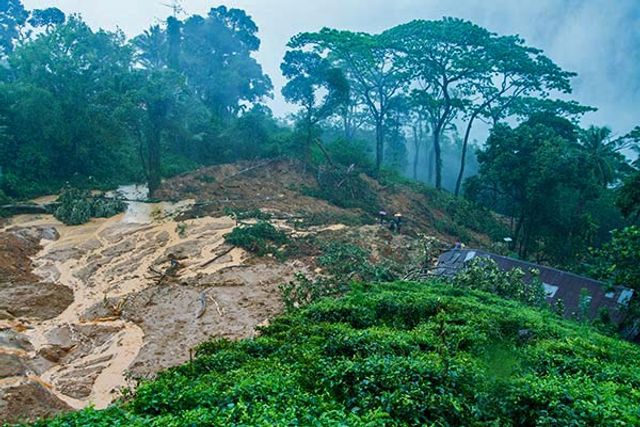
Landslide at Kalupahana Estate
In Colombo, over 200,000 of the city’s 650,000 residents have been displaced by major flooding. Thousands are accommodated in so-called welfare centres at temples and schools, in roadside tents or under the bridges of elevated roads.
Sri Lankan authorities report that over 125,000 homes and more than 300,000 small and medium businesses have been destroyed or damaged by landslides and floods. The finance ministry estimates that the total damage will be between $US1.5 billion and $US2 billion.
Torrential rains associated with Cyclone Roanu also hit Bangladesh last Saturday where an estimated 2 million people have been forced to leave their homes and at least 23 people have been killed.
Apart from perfunctory warnings for the public to be “vigilant,” the Sri Lankan government took no serious measures to counteract the danger of floods and landslides caused by Cyclone Roanu. This was despite consistent scientific predictions of extreme storm events precipitated by the current El Nino period. No evacuation crews or rapid response teams were deployed to potential disaster areas and no emergency shelters established in advance.
Sri Lanka’s disaster preparedness and management is virtually non-existent, despite the passage of the Disaster Management Act in 2005 and the establishment of the Disaster Management Centre (DMC). This toothless institution was introduced in response to deep public anger over the inadequacy of the government’s response to the Indian Ocean tsunami in late 2004 and the so-called recovery process.
In the more than decade of its existence, the DMC has not even established a proper dedicated rapid-response team with search and rescue capacity. This is in a country where deadly landslides occur every year. Military personnel deployed for search operations have been using their bare hands and long sticks.
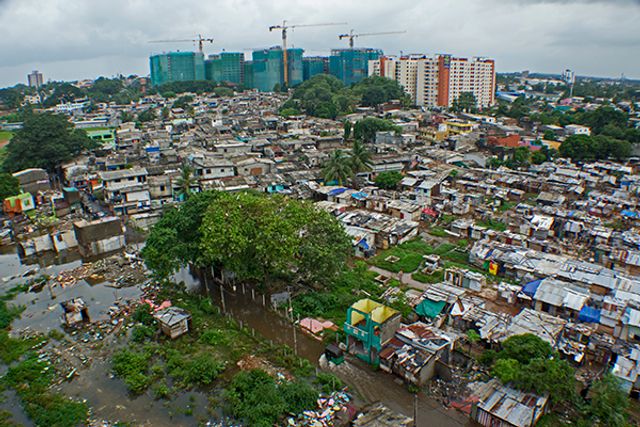
Kajeemawatta shanty town in Colombo city
On Monday, President Maithripala Sirisena declared that landslide-affected areas should be defined as High Security Zones and action taken to stop the construction of houses in “unsuitable places for living” and to prevent “unauthorised reclamation.”
Media reports said the government would deploy military and police units to prevent such “encroachments.” This unexplained move will be used to prevent poor families from settling in urban areas and to speed up the government eviction of shanty dwellers in order to release land for its Megalopolis project.
Yesterday, the government’s National Building Research Organisation announced that around 2,800 families will not be allowed to resettle in their original communities. This includes hundreds of homeless families in Aranayake. The government has not said whether the displaced families will be given alternative dwellings.
Aranayake residents told the WSWS that displaced villagers were being accommodated in dozens of “welfare centres” without adequate food and other assistance, and voiced their concerns about the future.
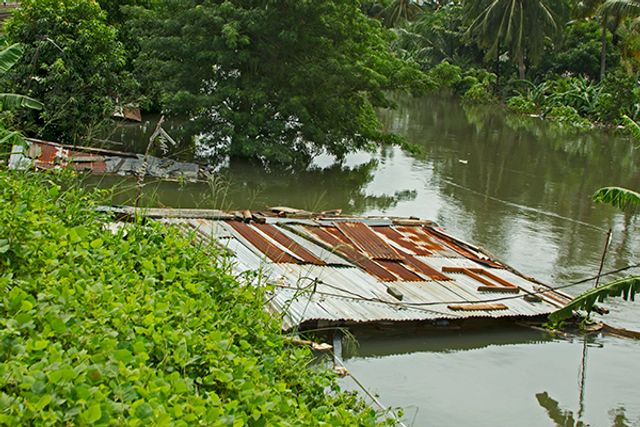
The roofs of small wooden houses at Orugodawath
Tens of thousands of working class and poor families were abandoned by Sri Lankan authorities following the 2004 tsunami. In Colombo, the previous government of President Mahinda Rajapakse spent billions of rupees for the beautification of the city, but slum dwellers and the poor were forced into unsafe, makeshift camps and left to experience yet another disaster.
The Sirisena-Wickremesinghe government has boasted of large donations from various foreign governments. The US has again shown its hypocrisy. Washington’s envoy to Sri Lanka, Atul Keshap, announced that the US has allocated $50,000 (7.2 million rupees) for flood relief in Sri Lanka. This is from a country which spends billions of dollars for wars to establish its global hegemony.
The Cyclone Roanu disaster has again revealed that the ruling elite and its successive governments, whether led by the United National Party or the Sri Lanka Freedom Party, are unwilling and incapable of providing the most rudimentary safety to residents.
In the past few days, the media has featured President Sirisena, Prime Minister Ranil Wickremesinghe and other ministers visiting flood and landslide victims in shelters and camp, feigning concern and making various pledges. Their promises will come to nothing.
Following the 2004 tsunami, the WSWS commented: “Confronting the greatest disaster to have hit the country in centuries, the entire political establishment is appealing for ‘unity’. Various appeals for aid have been made. Statements of sympathy have been issued. But their primary aim is to cover up the gross negligence of governments—both present and past—and to deflect growing anger over the level of assistance and relief being provided.”
This analysis has again been confirmed in the latest catastrophe.

Australian Treasury issues a blunt demand for austerity offensive

Mike Head

One of the central political frauds being perpetrated for the July 2 double-dissolution election was laid bare last Friday. The heads of Australia’s Treasury and Finance departments issued, in effect, a blunt edict to whichever parties take office after the election: slash social spending and launch a deep assault on workers’ conditions.
Less than three weeks after the Turnbull government’s May 3 budget, the country’s financial chiefs declared, in the official Pre-Election Economic and Fiscal Outlook (PEFO), that the budget’s predictions of economic growth and tax revenues were unrealistic and likely to be quickly overtaken by the deepening economic slump globally and in Australia.
The PEFO echoed the demands being issued by the corporate elite internationally for the dismantling of welfare and workers’ conditions. It warned that unless government spending was reduced and “structural reform” pursued with “renewed vigour” to drive up productivity, the international financial markets would strip the Australian government of its AAA credit rating. The statement said this would have disastrous consequences throughout the economy, because of its heavy reliance on overseas borrowing.
This ultimatum points to the reality that all the parties of the political establishment—Liberal-National, Labor and Greens—are trying to keep hidden from public view until after the election. Australian capitalism is facing a worsening crisis, generated by the collapse of the two-decade mining boom and the closure of entire sections of basic industry.
The slowdown in China and stagnation in Japan, Europe and North America are continuing to drive down prices for the resource commodities—such as iron ore, coal and liquefied natural gas—on which the Australian financial elite’s profits, and government revenues, substantially rely. And there are signs that a debt-fuelled property bubble has started to burst, with house prices and rents dropping in mining-related areas and growing predictions that the fall will spread nationally.
Far from the campaign slogans of “jobs and growth” or “putting people first,” Australia is being drawn into what financial commentators have described as a deflationary “vortex” of record low interest rates, declining prices, falling real wages, fewer working hours, reduced consumer spending and a lack of business investment.
All the various spending promises being made by the major parties will be dumped as soon as the voting is out of the way, in order to impose the real agenda: making young people and the working class pay for the growing impact in Australia of the global capitalist breakdown that erupted in the 2008 financial crash.
The PEFO described the assumptions underpinning the May 3 budget as “benign”—a polite term for over-optimistic. It declared: “Should Australia experience a significant negative economic shock, the fiscal position would be expected to deteriorate rapidly and not be consistent with the projections.”
Despite Australia’s “relatively rich endowment,” the country was dependent on “the willingness of foreign savers to finance current account deficits and support higher levels of investment.” Federal government debt levels were “projected to reach recent historical highs, both on a gross and net basis.”
The PEFO declaration triggered a fresh warning from Moody’s, one of the major international ratings agencies, that meeting the budget’s forecasts would be “challenging.”
The May 3 budget forecast that economic growth, as measured by nominal gross domestic product (GDP), would suddenly rise from 1.4 percent last financial year to 5 percent for the foreseeable future. There were equally fanciful revenue calculations, such as that company tax, which fell 2.2 percent this year, will surge 19 percent across the next two years.
With obvious frustration, the PEFO statement alluded to the political impasse that triggered the rare double-dissolution election for all members of both houses of parliament. “Reducing spending growth has proved difficult in practice,” it said, adding that “unlegislated policy decisions” alone would blow out the budget’s deficit predictions by $18 billion by 2019–20.
Prime Minister Malcolm Turnbull called the election in a bid to meet the mounting demands of the financial elite to break through the blockage in the Senate of key cuts to health, education and other social spending that were originally contained in the 2014 federal budget. These measures were stalled by Labor, the Greens and a number of independents, who all feared an electoral backlash if they voted for any of the cuts because of intense public hostility to the austerity program.
Most of these stalled measures—$18 billion worth—remain in the “benign” budget forecasts. The government is still counting on them to help eliminate the budget deficit, currently projected to be $39.9 billion in 2016–17 (up from $35 billion in last year’s budget), by 2020–21.
This logjam is part of a deeper political crisis. Since the 2008 crash, a succession of prime ministers, both Labor and Coalition—Kevin Rudd, Julia Gillard, Tony Abbott and now Malcolm Turnbull—have sought to slash social spending, but none have survived a full three-year term in office.
The PEFO warning was generally buried by the mass media—anxious to keep the truth out of sight during the election. But the financial elite’s main mouthpieces reinforced the message.
The Australian Financial Review’s May 21 editorial declared: “PEFO is intended to be a reality check on overheated campaign spending promises, and in these days of chronic budget deficits, a benchmark against which would-be governments must set their path back to surplus. This year’s document should be a jolt for both parties.”
A Labor government, with or without a coalition with the Greens, would be fully committed to imposing this agenda. Labor’s shadow treasurer Chris Bowen used the PEFO to reiterate his pledge to the financial markets to hand down a mini-budget within three months of taking office that would include “realistic assumptions and forecasts” for the budget.
These pronouncements foreshadow a vicious offensive against working class people, in order to meet the profit demands of a tiny super-rich elite. Already, millions of households in Australia struggle to make ends meet, more than a million workers are unemployed or under-employed and hospitals, schools, social services and other essential facilities are chronically under-funded and substandard.
As we explain in our election statement, the Socialist Equality Party calls for a vast redistribution of wealth to secure the social rights of all, including the right to a stable and decent-paying job, free, high-quality public education and health care, affordable housing, and a living income on retirement. These essential social rights cannot be achieved without ending the domination of a financial and corporate oligarchy over economic life, in Australia and on a global scale.

Obama appeals for closer US-Vietnamese ties

Peter Symonds

In a thoroughly cynical speech yesterday in Hanoi, US President Barack Obama made a public pitch for closer economic and military ties between Vietnam and the United States directed against the unstated enemy—China.
The previous day, Obama announced that the US was lifting its four-decade arms embargo on Vietnam—a longstanding demand of the Vietnamese regime to ensure that its armed forces can access hi-tech American military equipment. While no immediate deals were struck and other announcements were limited, Obama undoubtedly extracted commitments that will align Hanoi more closely with Washington against Beijing.
Obama’s “Address to the People of Vietnam” made clear in unmistakeable terms that the US is seeking a strategic partnership against China. As part of its “pivot to Asia,” the Obama administration has deliberately inflamed age-old territorial disputes in the South China Sea involving China and its neighbours, including Vietnam. Tensions between Beijing and Hanoi erupted in 2014 over the placement of a Chinese oil rig in disputed waters and led to violent anti-Chinese protests in Vietnam.
During his speech, Obama received applause from the handpicked audience when he declared: “Vietnam is an independent, sovereign nation, and no other nation can impose its will on you or decide your destiny.” Everyone in the National Convention Centre in Hanoi understood that he was referring to China, and raised not the slightest murmur of protest at the utter hypocrisy involved.
US imperialism waged a bloody, protracted war in Vietnam and throughout Indochina in an effort to subordinate the region to American interests that cost the lives of at least three million Vietnamese and many American soldiers. The physical scars remain from the devastating air war that involved not only massive quantities of conventional explosives but millions of gallons of toxic chemicals.
Moreover, the US continues to conduct military actions and wage wars that flout national sovereignty in complete disregard for international law. Just days before arriving in Vietnam, Obama boasted of ordering the drone strikes that murdered Taliban leader Akhtar Mohammad Mansour and ignored Pakistan’s protest that the unauthorised US attack breached the UN Charter.
In yesterday’s Hanoi speech, Obama repeated what are now standard declarations in relation to the South China Sea, stating that “the international order upon which our mutual security depends is rooted in certain rules and norms.” The insistence that China abide by the existing “international rules-based order”—that is, a world in which the US sets the rules—is nothing less than the demand that Beijing subordinate its interests to Washington.
Obama reiterated Washington’s determination to uphold “freedom of navigation and overflight” in the South China Sea and ensure the “peaceful resolution of disputes, through legal means, in accordance with international law.” The US is currently backing a Philippine legal case in The Hague based on the UN Convention on the Law of the Sea (UNCLOS) to challenge Chinese maritime claims. Vietnam has supported the Philippine challenge.
US contempt for international law is summed up not only by its failure to ratify UNCLOS, but its repeated military provocations in the South China Sea against China. Even before the Philippine case has been decided, US warships have on three occasions deliberately intruded within the 12-nautical-mile territorial limit surrounding Chinese-claimed and controlled islets.
Obama made no direct mention to China in his speech, but he made a deliberate historical reference which would have been lost on no one in Vietnam, or China for that matter. Posturing on the need for gender equality, he declared: “From the Trung Sisters to today, strong confident women have always helped to move Vietnam forward.” The Trung Sisters were Vietnamese military leaders who led a rebellion against Chinese domination in 40 AD and are promoted in Vietnam today as national heroines.
Obama also made an appeal for closer economic collaboration between the US and Vietnam and touted the importance of the Trans Pacific Partnership (TPP), signed last year. The Obama administration regards the TPP, which involves 12 Pacific countries but not China, as the means for advancing American economic interests in Asia and marginalising China.
Washington is well aware that Vietnam remains heavily reliant on trade with China. Obama pledged to work with Vietnam to “unleash the full potential of your economy” through the TPP, which would “let you sell more of your products to the world” and “attract new investment.”
The US president said the TPP would have “important strategic benefits” as “Vietnam will be less dependent on one trading partner and enjoy broader ties with more partners, including the United States.” In other words, the US is offering a comprehensive compact to the Vietnamese regime, with economic benefits that would allow it to lessen its reliance on China.
During his speech, Obama made ritual expressions of concern for human rights but stressed that “the United States does not seek to impose our form of government in Vietnam.” He held a special meeting with various hand-picked human rights activists, yet did not object when Vietnamese police prevented at least three from attending the meeting. These gestures were aimed at neutralising criticism in Washington that he should have extracted concessions on democratic rights before lifting the arms embargo.
Obama is no more interested in democratic rights in Vietnam than anywhere else in the world, including inside the United States. Rather, “human rights” is a convenient political tool to apply pressure to governments and justify interventions and wars. If Hanoi did a diplomatic about-face and shifted its orientation toward Beijing, it would soon find itself subject to a barrage of propaganda condemning its human rights abuses.
Obama’s trip confirms that the opposite is the case: the Vietnamese regime has made a significant tilt toward Washington that will strengthen the hand of the US as it ratchets up its preparations throughout the region for war with China. Obama stressed that in talks with Vietnamese leaders “we have agreed to elevate our security cooperation and build trust between our men and women in uniform.” While the overt signs of cooperation were limited to enhancing the Vietnamese coast guard, the US will be demanding much more in the coming weeks and months.

International finance capital and the strikes in France

Nick Beams

The mobilisation of the forces of the French state by the Socialist Party government of Francois Hollande against striking oil refinery and other workers is the spearhead of a long-demanded offensive against the French and European working class by the representatives of international finance capital.
Since the global financial crisis in 2008, and particularly since the crisis of the euro in 2012 and the second phase of a double-dip recession, the International Monetary Fund, the European Central Bank and other financial institutions have been demanding the implementation of what are euphemistically described as “structural reforms.” The real agenda is to boost profitability of French and European capitalism as a whole.
“Structural reform” is aimed at savagely attacking the conditions of the working class by opening the way for employers to hire and fire at will, scrapping legal protections against sackings, cutting unemployment benefits and reducing government social services spending.
As police were being brought in to attack striking oil refinery workers in Marseilles, the IMF set out its latest prescriptions for economic policy measures in France. They centred on techniques to increase labour market “flexibility” and reduce pensions and other social services.
It said the implementation of the El Khomri labour law, the focus of the strikes, would be a “step forward, increasing the scope for company-level agreements and reducing judicial uncertainty around dismissals.” But more had to be done, it insisted.
In other words, regulations that govern national pay and working conditions must be continually rolled back to the conditions that prevailed in the 1930s and beyond and legal impediments to the ability of companies to hire and fire removed. This is the agenda that the Hollande government is now seeking to impose with the force of the state.
Setting out the factors which had made France’s labour market “less adaptable” to developments in the global economy, the IMF cited “centralized labour agreements for over 700 branches; long and uncertain judicial procedures around dismissals; relatively easy access to unemployment and welfare benefits” as well as a “relatively high minimum wage.”
The other major demand is for a reduction in government spending which the IMF insisted was “at the heart of France’s fiscal difficulties.” It called for limiting the “wage drift at all levels of government that would help reduce the wage bill,” a reduction in pensions by lifting the retirement age, the extension of means-testing for social benefits and the rationalisation of hospital services to reduce costs.
This offensive comes at a critical turning point in the deepening breakdown of the global economy and the international financial system. Since 2012, and the commitment by ECB president Mario Draghi to do “whatever it takes” to prevent a collapse of the euro, the central bank has pursued a policy of “quantitative easing”—the pumping of trillions of euro into the financial system.
These measures have done nothing to revive the real economy. Their only effect has been to promote speculation in financial markets, leading to ever-widening social inequality. Investment in the real economy, the driving force of economic growth, remains around 25 percent below where it was prior to 2008 and large sections of the euro-zone economy have not returned to the levels of output they reached eight years ago.
The initiation of negative interest rates by the ECB earlier this year has likewise failed to bring any economic revival. In fact, their introduction and similar moves by the Bank of Japan have only added to the instability of global financial markets amid growing tensions among the major capitalist powers as they struggle for markets and profits in a stagnant world economy.
While accommodating the demands of the banks and finance houses with endless supplies of cheap cash, Draghi has been acutely aware that these measures in and of themselves are not sufficient to maintain the position of European capitalism in the intensifying global economic struggle against its rivals. In the view of the ruling financial elites, the entire post-war system of social services and regulations introduced to stave off the threat of social revolution after the experiences of fascism in the 1930s has made Europe noncompetitive and must now be destroyed. This is the essential content of the demand for “structural reforms.”
In a speech on this issue in May 2015, Draghi noted that in every press conference since becoming ECB president, he had ended his introductory remarks “with a call to accelerate structural reform in Europe.” This would raise productivity and increase “price and wage flexibility,” that is, boost profitability.
The increased urgency, from the standpoint of the ruling elite, of this task is underscored in the Annual Report of the ECB issued in April. After claiming that the present policies were working, the report then essentially refuted that assessment by noting that 2016 would be a “challenging year” for the central bank. “We face uncertainty about the outlook for the global economy. We face continued dis-inflationary forces. And we face questions about the direction of Europe and its resilience to new shocks.”
That is, almost eight years since the onset of the global economic breakdown, rather than there being an “economic recovery” on the horizon, the situation confronting global capital is worsening.
Just as in the 1930s, this deepening economic crisis is driving the ruling classes in France and throughout the world to war and militarism, coupled with a renewed onslaught against the working class and attacks on democratic rights at home. What is unfolding in France is, therefore, the most acute expression of global trends and tendencies.
Its significance can only be fully appreciated by placing it within the context of the history of the past quarter-century.
The collapse of the Soviet Union in 1991 was greeted with a wave of triumphalism on the part of the bourgeoisie and its political representatives as they hailed the “death of socialism” and the “triumph” of the market—a reaction which was mirrored in the response of all the petty-bourgeois pseudo left tendencies as they integrated themselves ever more deeply into the structures of the capitalist state and its political establishment.
Only the International Committee of the Fourth International (ICFI) explained that the liquidation of the Soviet Union was not the death of socialism but rather the collapse of Stalinism and its nationalist program of “socialism in one country” under the impact of globalised production, and that, far from establishing a new capitalist equilibrium, the world had entered a new period of wars and revolution.
The collapse of the Soviet Union, however, gave rise to considerable disorientation in the working class. But the essential tendencies identified by the ICFI are now coming to the surface and have produced a resurgence of the class struggle. The urgent immediate task is the mobilisation of the working class across Europe in support of the French workers in the struggle against the Hollande government and the financial elites that stand behind it. This movement must be armed with an international socialist perspective directed to the fight for political power and the building of the ICFI as the revolutionary party to lead it.

Modi in Iran: A Successful Visit

KP Fabian


Indian Prime Minister Narendra Modi’s two-day visit to Iran from 22-23 May 2016 is easily one of the best visits in terms of impact, made by this globe-trotting head of government who went to 26 countries in 2015. This visit has to be viewed in context. Iran is a superpower in energy with 10 and 18 per cent of global oil and gas reserves respectively. Treated as a pariah state by Washington since the 1979 US embassy hostage crisis and later put under more sanctions by others too for the absurd charge of enriching uranium, Iran demonstrated singular skill in playing diplomatic chess by concluding the nuclear agreement in July 2015, leading to the lifting of most of the sanctions by January 2016. China’s President Xi Jinping was the first to reach Tehran after the lifting of sanctions.

Any criticism of Modi for not rushing earlier to Iran is misplaced. He correctly chose the sequencing, Saudi Arabia, UAE, Iran, and soon, Qatar. If Modi had gone to Iran first and then to Saudi Arabia, he would have risked a cold reception in Riyadh, of which US President Barack Obama got a taste with the Saudi media not highlighting his visit.

Modi’s meeting with Iran’s Supreme Leader Ayatollah Ali Khamenei is significant as such a meeting is rarely accorded to a visiting chief of government or state. The Ayatollah had come to India in the early 1980s when he was deputy minister of defence. Twelve agreements on matters ranging from Iran’s Chabahar Port to foreign office-level consultations were signed. The most important themes covered by the agreements are connectivity, trade, and investment. Pakistan permits Afghanistan to send goods to India via the Wagah border but it does not permit Afghanistan to import from India via the same route. Chabahar Port will give India access to Afghanistan and Central Asia. The word ‘Chabahar’ means four springs in Persian, meaning that it is always spring there. There is a road from Chabahar in Iran to Zaranj in Afghanistan, and from there to Delaram (built by India in 2009) which is on the Garden Highway linking the four major Afghan provinces of Herat, Balkh, Ghazni, Kabul, Farah and Kandahar. India will be constructing a railway line in Iran connecting Chabahar to Zahedan.

The immediate takeaway is that apart from India’s gain in improved access to Afghanistan, Iran, and Central Asia, both Afghanistan and Iran stand to gain considerably. A glance at the map will show that Oman and UAE too will gain.

After connectivity comes energy. Some of India’s refineries are designed to take in the crude from Iran, which was a major supplier till the US began ‘dissuading’ importers of crude from Iran. Apart from buying crude and gas, India wants to invest in production. Iran’s Farzad B is a gas field under discussion and the agreement could not be finalised this time. There was a credit of USD 6.5 billion payable to Iran for crude already imported; but the US’ control over the international banking system, amounting to unipolarity, made it difficult for India to pay the sum. However, a part payment of USD 750 million was made before Modi landed in Tehran.

India will invest in the Chabahar Free Trade Zone. It is advantageous for India to produce aluminium and fertiliser given the low priced gas available there.

An agreement to deepen cultural cooperation too was signed. Modi presented a Persian version of Panchatantra and the Jataka tales and quoted Ghalib, “Once we make up our mind, the distance between Kaashi and Kaashan is only half a step.” Kashi, India is an Indian pilgrimage site and Kaashan, Iran, is famous for carpets. What was missing was an announcement about establishing an Indian cultural centre in Tehran. An Iranian cultural centre has been functional in New Delhi for years.

How will Pakistan respond to this coming together of Iran, India, and Afghanistan? Incidentally, the Dawn carried a photo of Iranian President Hassan Rouhani, Indian Prime Minister Narendra Modi, and Afghan President Ashraf Ghani sitting together. One did not find it in some of the mainstream Indian dailies. Pakistan might ask China to move faster with the USD 46 billion worth 2442 kilometre-long China Pakistan Economic Corridor to Gwadar, Balochistan. Still, Pakistan will have to recognise that its policy of not normalising relations with India and arranging for terrorist attacks against Indian targets in Afghanistan from time to time might not pay the expected dividends.

It will be useful to recall that former Iranian President Mohammad Khatami came to Delhi in 2003 as the chief guest for the Republic Day celebrations and signed the Delhi Declaration. Iran was already in the “axis of evil” in the eyes of the then US President George Bush. The Delhi Declaration issued during the visit spoke of a strategic partnership and added that the two sides “will explore opportunities for cooperation in defence in agreed areas.” The Wilson Centre, a US-based think tank, got rather worked up and said, “According to some press accounts, New Delhi will have the right to use Iranian military bases for combat operations against Pakistan should another Indo-Pakistani war break out.” The point to note is that Iran is prepared to get closer to India.

Modi’s worst foreign visit was the hurried and unprepared one to Lahore in December 2015. In contrast, the one to Tehran was well prepared, diligently designed and smartly executed.

The challenge before India can be summed up in two words: timely delivery. There is scope for improvement.

24 May 2016

The Financial Invasion of Greece

Sharmini Peries & Michael Hudson

SHARMINI PERIES: Greece’s economic crisis has perhaps been eclipsed by Europe’s refugee crisis, terrorist attacks, and by the forthcoming Brexit referendum. But it has not gone away.  Greece’s Syriza coalition faced violence on the streets and a 3 day general strike last week that had brought much of the country to a halt. In spite of the protests the government of Alexis Tsipras pushed through legislation to amend the country’s tax and pension system with the backing of 153 MPs, a measure required by the lenders in order to continue the debt negotiations. Addressing the 300 seat house, Prime Minister Alex Tsipras said we are determined to make Greece stand on its 2 feet at any cost.
To discuss these developments, I’m joined by Michael Hudson, a distinguished Research Professor of Economics at the University of Missouri-Kansas City.
Michael the International Monetary Fund is pushing for comprehensive measures to tackle Greece’s debt burden. They want the lenders to get creative in terms of debt cancellation and the measure that they’\’re proposing seems to be fairly progressive compared to what the lenders are talking about. Tell us more about the IMF’s proposal and how the lenders are reacting to it.
HUDSON: The IMF says it will not reduce Greece’s debt by a single penny. It will keep the debt in place. The problem is the way that the European central banks keep their balance sheets, if it breaks down Greece’s debt owed to the IMF, then the countries Germany, France and other countries whose banks are bailed out will have to take a loss and they refuse to lose a single penny. So the IMF has not made a creative proposal. It has repeated what it said a year ago without changing a single word. It says okay, we’re going to keep every penny of debt in place but we’re going to give you a fudging number. We’’e only going to charge you 1.5% interest and you won’t have to pay the debt for 25 years. So you don’t get a debt markdown, but you won’t have to pay interests for 25 years and we’ll charge you only a little bit of interest.
There’s only one kicker. You’re going to have to cancel your pensions, write them down, impose austerity, privatize your government, and you’re going to have to shrink your economy so that it will shrink by about 1, 2, 3% a year so that the 1.5% interest that we’re charging as little as it is, is going to absorb all the income growth you have. Every penny of growth of have from the next 25 years ,you’ll have to end up paying the German banks.
Now we know you can’t do it. We know that when you cancel the pensions you’re going to shrink. We know your labor’s on strike. We know they’re going to emigrate.
But there’s a way out. You can sell your ports, your land, your public utilities, your railroads, your airports, anything you have you can sell to the Germans and at the end of this time you won’t have a single thing and all we ask is that all you Greeks get out of our country, now that we own you. That’s what the IMF is saying. It’s not creative; it’s absolutely brutal. That’s why the Greeks are out on strike.
PERIES: Now why are the lenders then acting the way they are?
HUDSON: Because they’re using finance as the new means of war. There is a war going on in Europe but it’s not a military war anymore. They’re now using finance instead of war and
2KillingTheHost_Cover_rulethey’re using finance to say, we can grab your country. We can put you out of work. We can control you and we don’t have to kill you, we can just make you immigrate by taking away your pensions and taking all your money. There’s a land grab just as if it were an invasion to grab Greece’s ports, to grab Greece’s railroads, and to grab everything else. This is war.
PERIES: Now the international press has been reporting on Monday’s meeting with the finance ministers as if it was a success and Prime Minister Alexis Tsipras and the finance minister came out of it with smiles, why?
HUDSON: Because they sold out. Because you’re supposed to smile before a camera, that’s the polite thing to do. You’re supposed to smile as if you’ve somehow defended your constituency. Mr. Obama always smiles whenever he does another giveaway to Wall Street. But the smile does not reflect anything that’s good for the great people and the great people obviously know this as you can see by their political reaction.
PERIES: And these attack reforms and pension reforms that now they have to swallow, the people of Greece. What does it really mean for the people?
HUDSON: It means, the opposite of what reforms used to mean. For the last 100 years the whole reform movement meant you give more authority to government. You give more emphasis on economic growth. Reform used to mean making the economy fair. But today we’re in a Orwellian doublethink world where we reform means wiping out the reforms that Greece did after WW II. Wiping out the pension reforms, wiping out the tax reforms, and wiping out the tax reforms apparently. It’s a rollback to what you could call neofeudalism. It’s the opposite of the reform movement. So the newspapers use the word reform but it’s exactly the opposite.
PERIES: Alright then the left wing and the Syriza party. What are they saying in light of what we just heard?
HUDSON: Well they’re appalled and as you know Yanis Varoufakis, whom you’ve had on your show resigned rather than become the undertaker imposing austerity on Greece. They’re simply appalled and think nothing could be worse and that they realized there is a war going on and they’d hoped that they’d be supported by other left wing movements and France and Spain and Portugal. But there’s a bitter class war of debtors against creditors or creditors against debtors going on in Europe and all they can do right now is expose the hypocrisy of the IMF. If you’re talking about Greece, let’s juxtapose the IMF supporting a really insolvent economy of kleptocrats in the Ukraine.
The IMF is preparing to bail out Ukraine, to say you don’t have to pay your debts that you owe to Russia or any governments that the U.S. doesn’t like. You have to sell off your land to George Soros and the people whom the U.S. government does like. Look at the duel standard that the IMF is imposing on Greece compared to what it’s doing for the Ukrainian government. You see that the IMF has become a tool of the New Cold War and the Syriza people and the Greeks can do is point out how unfair this is and to try to let the world know that what is happening is a movement way to the right wing of the political spectrum and that finance is war.
PERIES: Finally, Michael, what choice does the Greek government have? What can they do?
HUDSON: Mr. Tsipras says they have no choice. He says the choice is only to surrender and in fact the argument now is not between Greece and the IMF. Not between Greece and Germany or Europe. The arguments that keep going on are solely between the IMF and Germany as to whether the IMF is going to break its traditional rules and make a loan in violation of all of its principles. Under its articles of agreement, the IMF is not allowed to make a loan to a government that cannot afford to repay the loan. All of the staff of the IMF have unanimously found that Greece cannot pay the loan because the terms of IMF loans, the conditionalities, shrink the economy and make it impossible to pay.
So the IMF says that we’re going to break the rules of that and we’re going to lend, essentially because the U.S. tells us to do that and Greece is going to have to pay so we can demonstrate that if Spain tries to stand up and pay its pensions to people, if France pays its labor, if Italy pays its labor, we’re going to smash their economies, we’re going to smash their labor unions, and we’re going to smash their labor just as we do to Greece. Greece is a demonstration very much like when the Nazis bombed Spain, in the Picasso drew the great drawing for. This is the IMF’s version of the Nazi bombing of Spain to say, this is what’s going to happen to labor throughout Europe if you don’t surrender.

Americans, A Conquered People: The New Serfs

Paul Craig Roberts

As readers know, I have seen some optimism in voters support for Trump and Sanders as neither are members of the corrupt Republican and Democratic political establishments. Members of both political establishments enrich themselves by betraying the American people and serving only the interest of the One Percent. The American people are being driven into the ground purely for the sake of more mega-billions for a handful of super-rich people.
Neither political party is capable of doing anything whatsoever about it, and neither will.
The optimism that I see is that the public’s support of outsiders is an indication that the insouciant public is waking up. But Americans will have to do more than wake up, as they cannot rescue themselves via the voting booth. In my opinion, the American people will remain serfs until they wake up to Revolution.
Today Americans exist as a conquered people. They have lost the Bill of Rights, the amendments to the Constitution that protect their liberty. Anyone, other than the One Percent and their political and legal servants, can be picked up without charges and detained indefinitely as during the Dark Ages, when government was unaccountable and no one had any rights. Only those with power were safe. In America today anyone not politically protected can be declared “associated with terrorism” and taken out by a Hellfire missile from a drone on the basis of a list of human targets drawn up by the president’s advisers. Due process, guaranteed by the US Constitution, no longer exists in the United States of America. Neither does the constitutional prohibition against the government spying on citizens without just cause and a court warrant. The First Amendment itself, whose importance was emphasized by our Founding Fathers by making it the First Amendment, is no longer protected by the corrupt Supreme Court. The Nine who comprise the Supreme Court, like the rest of the bought-and-paid-for-government, serve only the One Percent. Truth-tellers have become “an enemy of the state.” Whistleblowers are imprisoned despite their legal protection in US law.
The United States government has unaccountable power. Its power is not accountable to US statutory law, to international law, to the Congress, to the judiciary, to the American people, or to moral conscience. In the 21st century the war criminal US government has murdered, maimed, and dislocated millions of people based on lies and propaganda. Washington has destroyed seven countries in whole or part in order to enrich the American elite and comply with the neoconservative drive for US world hegemony.
Americans live in a propaganda-fabricated world in which a brutal police state is cloaked in nice words like “freedom and democracy.” “Freedom and democracy” is what Washington’s war machine brings with sanctions, bombs, no-fly zones, troops, and drones to countries that dare to cling to their independence from Washington’s hegemony.
Only two countries armed with strong military capability and nuclear weapons—Russia and China—stand between Washington and Washington’s goal of hegemony over the entire world.
If Russia or China falter, the evil ensconced in Washington will rule the world. America will be the Anti-Christ. The predictions of the Christian Evangelicals preaching “end times” will take on new meaning.
Russia is vulnerable to becoming a vassal state of Washington. Despite a legion of betrayals by Washington, the Russian government has just proposed a joint US/Russia cooperation against terrorists.
One wonders if the Russian government will ever learn from experience. Has Washington cooperated with the agreement concerning Ukraine? Of course not. Has Washington cooperated in the investigation of MH-17? Of course not. Has Washington ceased its propaganda about a Russian invasion of Crimera and Ukraine? Of course not. Has Washington kept any agreement previous US governments made with Russia? Of course not.
So why does the Russian government think Washington would keep any agreement about a joint effort against terrorism?
The Russian government and the Russian people are so unaware of the danger that they face from Washington that they let foreigners control 20 percent of their media! Is Russia unaware that Washington has Russia slated for vassalage or destruction?
China is even more absurd. According to the Chinese government itself, China has 7,000
foreign-financed NGOs operating in China! Foreign financed NGOs are what Washington used to destabilize Ukraine and overthrow the elected government.
What does the Chinese government think these NGOs are doing other than destabilizing China?
Both Russia and China are infected with Western worship that creates a vulnerability that Washington can exploit. Delusions can result in inadequate response to threat.
All of Europe, both western, eastern and southern, the British Pacific such as Australia and New Zealand, Japan and other parts of Asia are vassal states of Washington’s Empire. None of these allegedly “sovereign” countries have an independent voice or an independent foreign or economic policy. All of Latin America is subject to Washington’s control. No reformist government in Latin America has ever survived Washington’s disapproval of putting the interests of the domestic populations ahead of American corporate and financial profits. Already this year
Washington has overthrown the female presidents of Argentina and Brazil. Washington is currently in the process of overthrowing the government in Venezuela, with Ecuador and Bolivia waiting in the wings. In 2009 Killary Clinton and Obama overthrew the government of Honduras, an old Washington habit.
As Washington pays the UN’s bills, the UN is compliant. No hand is ever raised against Washington. So why does anyone on the face of the earth think that an American election can change anything or mean anything?
We know that Killary is a liar, a crook, an agent for the One Percent, and a warmonger. Let’s now look at Trump.
Are there grounds for optimism about Trump? In the West “news reporting” is propaganda, so it is difficult to know. Moreover, we do know that, at least initially, the response of the Republican Establishment to Trump is to demonize him, so we do not know the veracity of the news reports about Trump.
Without belaboring the issue, two news reports struck me. One is the Washington Post report that the Zionist multi-billionaire US casino owner Sheldon Adelson has endorsed Donald Trump for President. https://www.washingtonpost.com/opinions/sheldon-adelson-i-endorse-donald-trump-for-president/2016/05/12/ea89d7f0-17a0-11e6-aa55-670cabef46e0_story.html
Other reports say that Adelson has mentioned as much as $100 million as his political campaign contribution to Trump.
Anyone who gives a political campaign $100 million dollars expect something in exchange, and the recipient is obligated to provide whatever is desired. So are we witnessing the purchase of Donald Trump? The initial Republican response to Trump, encouraged by the crazed neoconservatives, was to abandon the Republican candidate and to vote for Killary.
Is Adelson’s endorsement a signal that Trump can be bought and brought into the establishment?
Additional evidence that Trump has sold out his naive supporters is his latest statement that Wall Street should be deregulated:https://ourfuture.org/20160519/populist-trump-wants-to-deregulate-wall-street
It is extraordinary that Trump’s advisers have not told him that Wall Street was deregulated back in the 20th century during the Clinton regime. The repeal of Glass-Steagall deregulated Wall Street. One source of the 2008 financial crisis is the deregulated derivative market. When Brooksley Born attempted to fulfill the responsibility of the Commodity Futures Trading Commission and regulate over-the-counter derivatives, she was blocked by the Federal Reserve, the US Treasury, the SEC, and the US Congress.
Nothing has been done to correct the massive mistake of financial deregulation. The Dodd-Frank legislation did not correct the massive financial concentration that produced banks too big to fail, and the legislation did not stop Wall Street’s reckless casino gambling with the US economy. Yet Trump says he will dismantle even the weak Dodd-Frank restrictions.
The American print and TV media are so corrupt that these reports could be false stories, the purpose of which is to demoralize Trump’s supporters. On the other hand, should we be surprised if a billionaire aligns with the One Percent?
Elections are an unlikely means of restoring government that is accountable to the people rather than to the One Percent. Even if Trump is legitimate, he does not have the experience in foreign and economic affairs to know who to appoint to his government in order to implement change. Moreover, even if he knew, unless Trump candidates also replace the Senate, Trump could not get his choices confirmed by a Senate accountable only to the One Percent.
Americans are a conquered people. We see this in the appeal from RootsAction to the rest of the world to come to the aid of the American people. Unable to stop the lawlessness of their own “democratic” government, Americans plea for help from abroad:http://act.rootsaction.org/p/dia/action3/common/public/?action_KEY=12247
The plea from RootsAction indicates that committed activists now acknowledge that change in America cannot be produced by elections or be achieved internally through peaceful means.

Call It A 'Coup': Leaked Transcripts Detail How Elite Orchestrated Overthrow In Brazil

Lauren McCauley

Confirming suspicions that the ouster of Brazilian president Dilma Rousseff is, in fact, a coup designed to eradicate a wide corruption probe, Brazil's largest newspaper on Monday published damning evidence of a "national pact" between a top government official and oil executive.
It is unclear how Folha de São Paulo obtained the transcripts of the 75-minute phone conversation between the newly-installed Planning Minister Romero Jucá, a senator at the time, and former oil executive Sergio Machado. But the discussion reportedly took place in March, just weeks before Brazil's lower House voted to impeach the democratically-elected Rousseff.
Both Jucá and Machado were targets of an ongoing internal investigation known as Operation Car Wash, which sought to expose money laundering and corruption at the state-controlled oil company Petrobras, which allegedly accepted bribes in exchange for contracts.
The transcripts, according to Intercept reporting, reveals "explicit plotting" between the two, who "agree that removing Dilma is the only means for ending the corruption investigation," as well as reported collusion with some of Brazil's "most powerful national institutions," including officials in the military and Supreme Court.
Summarizing the report, Intercept journalists Glenn Greenwald, Andrew Fishman, and David Miranda write:
The crux of this plot is what Jucá calls “a national pact” – involving all of Brazil’s most powerful institutions – to leave Michel Temer in place as President (notwithstanding his multiple corruption scandals) and to kill the corruption investigation once Dilma is removed. In the words of Folha, Jucá made clear that impeachment will “end the pressure from the media and other sectors to continue the Car Wash investigation.”
Miranda, among others, had suspected that such a motive was behind the ouster. But on Monday he and his colleagues declared the transcripts were "proof that this had nothing to do with preserving Brazilian democracy and everything to do with destroying it."
And while the political crisis in Brazil has been widely reported in mainstream press as an "impeachment," Greenwald, Fishman, and Miranda argue that the new reporting gives ample credence for news outlets to refer to it as a "coup." Pointing to some of the most damning aspects of the transcripts, they write:
The transcripts contain two extraordinary revelations that should lead all media outlets to seriously consider whether they should call what took place in Brazil a “coup”: a term Dilma and her supporters have used for months. When discussing the plot to remove Dilma as a means of ending the Car Wash investigation, Jucá said the Brazilian military is supporting the plot: “I am talking to the generals, the military commanders. They are fine with this, they said they will guarantee it.” He also said the military is “monitoring the Landless Workers Movement (Movimento dos Trabalhadores Rurais Sem Terra (MST)),” the social movement of rural workers who support PT’s efforts of land reform and inequality reduction and have led the protests against impeachment.
The second blockbuster revelation – perhaps even more significant – is Jucá’s statement that he spoke with and secured the involvement of numerous justices on Brazil’s Supreme Court, the institution that impeachment defenders have repeatedly pointed to as vesting the process with legitimacy and to deny that Dilma’s removal is a coup.
Jucá on Monday confirmed the authenticity of the transcripts but said his comments were taken out of context.
Meanwhile, demonstrators camped outside the home of Interim President Temer after a protest on Sunday organized by Frente Povo Sem Medo, a coalition of Brazil's leftist movements.

Spate of deaths in New Zealand’s forestry industry

Chris Ross & Tom Peters

New Zealand Coroner Wallace Bain released findings earlier this month from an inquest into the death of 23-year-old Robert Epapara, one of 10 forestry workers killed on the job in 2013. The inquest was one of eight carried out into recent deaths in forestry, New Zealand’s third largest export industry.
The findings came after five more fatalities at logging operations in the first quarter of 2016, making it still one of the deadliest occupations in the country. With the most technologically advanced equipment, such deaths are largely preventable. The majority of companies continue to operate with cheap harvesting gear, and many have lax procedures and poor safety training.
In 2014, Epapara’s employer Complete Logging Limited was fined $60,000 and ordered to pay reparation of $75,000 for “failing take all practicable steps” to ensure his safety. Epapara was hit by a log felled by another worker. In violation of an industry code of practice, he did not have a radio to communicate his location with the rest of the crew.
Bain criticised the company but, according to the Rotorua Daily Post, said forestry’s safety record had “dramatically improved” following an industry-led review in 2014, and several inquests and prosecutions over deaths. Bain said: “The industry is now a far safer place to work and families will not have to go through the heartbreaking process of losing a loved one when that death was preventable.”
The coroner was forced to concede, however, that this year’s deaths were a “concern ... especially after all the publicity and education in the sector.” In fact, the five recent deaths are a significant spike that gives the lie to official claims of a “dramatic improvement.”
This year’s toll is already higher than 2015 (three deaths) and 2014 (one death). In the past decade there have been 54 deaths—27 since 2010—and some 2,000 serious harm incidents. Forestry workers are 70 times more likely to be killed on the job than the average NZ worker. The industry’s death rate is 34 times higher than Britain’s and seven times that of Australia.
The deaths this year include Blair David Palmer, a 53-year-old foreman with over 20 years’ experience. He was crushed by a falling tree on March 31 while working for contractor DG Glenn Logging at Pan Pac’s Pohukura forest block near Napier. A week earlier, Damian Lee Tai, a worker in his thirties, was hit by a log and died in Pakotai near Whangarei.
On March 10, 31-year-old Matangaroa Taramai was killed, apparently by a tree that fell on him on a block managed by Forest Enterprises east of Masterton. A few days earlier, three-year-old Felyx Rhys Hatherley was killed by a rolling log while visiting his father’s workplace with his mother, at Point Lumber Washdyke’s operation in Timaru. Gaddum Construction worker Miki Butler-August died on February 17 when he was run over on a block in the Bay of Plenty.
In addition to five worksite deaths, there have been at least eight logging truck accidents this year. A collision between a car and a truck in Waikato last month killed one woman and seriously injured two others. Five serious incidents involving logging trucks in the Northland region between April and mid-May prompted a 150-strong public meeting in Whangarei recently to confront Transport Agency officials over the ongoing danger to public safety.
The spate of deaths comes after a public relations campaign designed to create the impression that the industry and the government regulator WorkSafe NZ had learned from the 2013 toll and, with the collaboration of the trade unions, made significant safety improvements.
In 2014 the industry launched an “Independent Forestry Safety Review.” Its task, as the WSWS noted, was to whitewash the responsibility of the forest owners, contractor companies, governments and unions by not assigning “blame” and making vague calls for safer practices.
Far from being independent, the review was led by the business owners themselves. It included Forest Industry Contractors and the Farm Forestry Association, alongside WorkSafe and the Council of Trade Unions (CTU).
The review resulted in the formation of the Forest Industry Safety Council (FISC), which includes business leaders, WorkSafe representatives and FIRST Union leader Robert Reid. In February, the council trumpeted the reduction in deaths and injuries in 2014-2015 as a “dramatic improvement.”
After insisting that the FISC would lead to safety improvements, the CTU described the latest deaths as “totally unacceptable.” CTU president Richard Wagstaff asked whether companies were “putting additional pressure on those working to get the logs cut in order to maximise profit.”
Reid similarly told the media: “We need to make sure that if the market for wood goes up, the price of wood goes up, it’s not workers who are going to suffer and lose their lives.” Neither union leader explained why their collaboration with big business and the government had failed to prevent the deaths. The unions’ role in the FISC is precisely to keep the industry profitable and prevent any industrial campaign among workers to demand decent working conditions.
FISC distributes “health and safety information” to forest workers, their supervisors and managers, and aims to make “everyone as accountable for their safety as their roles allow.” There is no legal requirement for businesses to adopt the safest technologies. Shifts up to 12 hours are common, leading to fatigue among workers. Regulation consists chiefly of occasional inspections and advice. In a number of cases, WorkSafe has refused to prosecute companies over workplace deaths.
The decline in forestry deaths in 2014–2015 appears to have been due, not to improved safety, but a downturn in activity. The 2013 toll coincided with the biggest forestry harvest ever seen. By August 2014, an industry group estimated that 50 small contractors had left the industry amid falling export prices, largely due to China’s economic slowdown. In 2015, the volume of logs harvested dropped 3 percent, the first decline in seven years.
While the precise causes of the latest deaths are not yet clear, they correlate with an upswing in the industry. By November 2015, demand had rebounded and log prices were at a seven-month high of $92 a tonne, driven by a decline in the New Zealand currency and falling international oil prices. By April 2016, the wharf gate price rose a further 30 percent to $119 a tonne.
The opposition Labour Party’s workplace relations spokesman Iain Lees-Galloway declared on April 27 that the toll of at least 46 workplace deaths in the past year was “a damning indictment” of the National Party government. In reality, both Labour and National governments are to blame for the deregulated environment that inevitably results in fatal incidents.
In 1987, the Lange Labour government, as part of a global market “liberalisation” offensive, transformed the NZ Forest Service, which owned most plantation forests and directly employed workers, into a state-owned enterprise, in preparation for privatisation. The 1990s’ National government then sold off more than 500,000 hectares of forests.
Today there are 15,000 forest owners and approximately 400 logging companies, which compete for harvesting contracts. There is intense cost-cutting at the expense of workers’ pay and conditions. Workers’ wages as a share of industry profits have dropped from 70 percent in the 1980s to 19.6 percent today. Many workers earn little more than the minimum wage, while putting their lives at risk to generate expanding profits for the forestry companies.