3 Jun 2016

Economic nationalism and the growing danger of war

Nick Beams

By every measure, the world economic and political situation is increasingly coming to resemble the 1930s—a decade marked by social devastation, economic conflicts and rising geo-political tensions that led to the explosion of war in 1939.
The global economy is moving further into “secular stagnation,” a term first coined in reference to the Great Depression to characterise a situation where global demand persistently falls below output, leading to glutted markets and “over production.”
Nearly eight years after the eruption of the global financial crisis, the euro zone economy remains mired in deflation and has only this year returned to the levels of output reached in 2007. The US has experienced the slowest “recovery” in the post-war period, while productivity is set to fall for the first time in more than three decades.
Japan, the world’s third largest economy, remains mired in low growth and deflation, while China, the second largest, is experiencing a marked slowdown, together with vast job losses and mounting concerns over its level of debt accumulation.
One of the most striking parallels with the conditions of the 1930s is the growth of economic nationalism and the rising trade war tensions as each of the major powers seeks to shove the effects of the global stagnation onto its rivals. The beggar-thy-neighbour policies of that earlier period produced devastating consequences as international trade contracted by more than 50 percent between 1929 and 1932, after which the world divided into currency and trade blocs leading up to World War II.
The intensifying struggle for markets is bringing the return of the kinds of measures that characterised the Great Depression, as seen in the decision by the US International Trade Commission (ITC), acting at the behest of US Steel, to launch an investigation into 40 Chinese companies, with a view to imposing increased tariffs.
As Professor Simon Evenett, the head of Global Trade Alert, an organisation that monitors protectionist measures, has warned, the ITC case should set off “alarm bells” and is a move towards a “nuclear option.” His words have more than a metaphorical or rhetorical significance: rather, they point to the inseparable connection between economic nationalism and outright military conflict.
Not only are old forms of protectionism being revived, new ones are being developed. Having virtually scuttled the Doha Round of multilateral trade talks under the World Trade Organisation last year, the US is pursuing its own nationalist agenda through the formation of exclusivist trade blocs under the Trans Pacific Partnership (TPP) and the Transatlantic Trade and Investment Partnership (TTIV).
The TPP, which despite its name, excludes China, the world’s second largest economy. Washington’s objectives have been spelled out by President Barack Obama who declared it is aimed at ensuring that America, not China, writes the global rules of trade for the twenty-first century.
Beyond the present administration, the rising tide of US economic nationalism is expressed in the strident “America first” campaign of the presumptive Republican candidate Donald Trump and his pledge to “make America great again.”
Trump’s campaign, however, is only a particularly violent and crude manifestation of deep-rooted tendencies within the entire political establishment, including the trade union bureaucracy. Notably, the statement issued by US Steel welcoming the ITC decision to investigate Chinese companies, pointed to the support for its case from “our union brothers and sisters.”
It would be a great mistake to think that these tendencies are confined to the United States. The turn to economic nationalism is ever-more visible in the political establishment of every major capitalist power.
In Britain, both sides of the official campaign over Brexit—the referendum of June 23 which is to decide whether the UK leaves or remains in the European Union—are advancing their positions on the basis of what is best for the country’s national interests.
On the European continent, the German political establishment demands the imposition of ever-increasing austerity measures over the whole of Europe, and vehemently opposes any stimulus measures. It fears that such actions would weaken the position of German banks and financial interests in the face of increasing competition from their international rivals, particularly the US finance houses. At the same time it insists Germany cannot confine itself to Europe, but must play an increasing role on the global arena, not least by military means.
Likewise, the Japanese government of Shinzo Abe is seeking to push down the value of the yen in order to boost its exports in a contracting world market. At the same time it has all but scrapped the so-called pacifist post-war constitution as Japan seeks to play an increased military role in world affairs.
The inseparable connection between the rise of economic nationalism and military conflict was the subject of far-reaching analysis by the revolutionary and Marxist theorist Leon Trotsky of the objective conflicts, rooted in the very structure of the capitalist mode of production, that led to the outbreak of World War I.
Pointing to the downturn in the European economy in 1913, he noted that the productive forces had run up against the limits fixed for them by capitalist property and capitalist forms of appropriation.
“The market was split up, competition was brought to its intensest pitch, and henceforward capitalist countries could seek to eliminate one another from the market only by mechanical means,” Trotsky wrote. “It was not the war that put a stop to the development of productive forces in Europe, but rather the war itself arose from the impossibility of the productive forces to develop further in Europe under conditions of capitalist management.”
Today it is not only a question of the inability of the productive forces to further develop in Europe, but globally under the regime of private ownership and private profit in the framework of the world economy riven by national-state and great power divisions.
The very phenomenon of “overproduction” is the expression of these contradictions. There is not overproduction of steel, industrial and agricultural products—all of which confront glutted markets—in relation to human need. All that can be produced by the world’s working class, whether in China, Japan, the US, Europe and elsewhere, could be more than productively employed in a rationally-planned socialist global economy.
Such an economy, however, can only be realised through the overthrow of the capitalist profit and nation-state system, by means of the seizure of power by the working class. This is the foundation of the program of the International Committee of the Fourth International.
This strategy is, of course, dismissed by all the pseudo-lefts and short-sighted opportunists as “not practical,” “unrealisable” and so on. But what alternative do they have to offer? Nothing but the descent into war, with potential nuclear consequences, threatening the very future of civilisation itself.
The material force for the realisation of world socialism is emerging with the rising tide of the struggles of the international working class. The crucial task is the building of the world party of socialist revolution, the International Committee of the Fourth International, to provide the necessary guidance in these struggles by imbuing the working class with the conscious understanding of the great historical task it has before it.

Economic conflicts threaten global trade war

Nick Beams

The ongoing stagnation in the global economy, marked by falling investment and the emergence of overproduction in key basic industries, is fuelling the rise of trade war protectionist measures by the major powers, above all the United States.
Last week, the US International Trade Commission (ITC) launched an investigation into Chinese steel mills which have been accused by the United States Steel Corp of stealing secrets and conspiring to fix prices.
Chinese industrial overcapacity, especially in steel, will be on the agenda of the “strategic and economic” dialogue to be held between the US and China in Beijing next week. The US treasury undersecretary for international affairs, Nathan Sheets, recently called for China to allow its industries to “better reflect capacity and global demand conditions.” In other words, China should cut back production.
Overproduction in the Chinese steel industry has been blamed for an increase in cheap exports and the loss of jobs and plant closures in both Europe and the US.
Recent tariffs on imports of steel have boosted American prices, but authorities are looking for further measures. Industrial overcapacity was important “for the global economy and we hope to make some progress on it” in Beijing, Sheets told a meeting at the Brookings Institution in Washington.
The issue is fraught, however, with contradictions because many industrial companies in the US are dependent on cheap steel imports for their business models. Stuart Barnett, the head of the Chicago-based Barsteel Corp which supplies a range of manufacturers said the government had done a “pretty good job” of keeping out the cheapest steel imports. “But now the greatest fear we have is that China keeps cheap steel for itself and makes products that undercut other industries,” he said.
In other words, suppression of the increasingly ferocious struggle for markets and profits in one area of the industrial economy will see it resurface in another.
Pressure from the US for China to cut back production and exports were met with a sharp response from the Chinese government.
Speaking at a briefing in Beijing on Thursday, Zhu Guangyao, China’s vice-finance minister, said: “Trade disputes between China and the US should be addressed in accordance with World Trade Organisation (WTO) principles. We are opposed to abusive trade remedy measures.”
There was an even stronger reaction from China’s Hebei Iron and Steel Group, the country’s largest steel producer. In a statement posted on its website on Thursday, it denounced the investigation by the US ITC.
“The protectionist behaviour taken by the US on purely groundless accusations by US Steel has seriously broken WTO rules, distorted the normal world steel trade and damaged the essential interests of Chinese steel mills and US steel users,” it said.
US Steel filed the complaint a month ago, claiming it was the victim of a Chinese computer hacking incident in 2011. The ITC has now taken up the case, identifying 40 Chinese steelmakers and distributors as being the subject of investigation.
Baosteel, China’s second-largest steelmaker, the world’s fourth-largest and a target for the ITC probe, said the US was in breach of WTO rules and urged the Chinese government to take all necessary measures to ensure the country’s steel industry received fair treatment.
The ITC case has raised concerns it could be the start of far broader measures, possibly including a wholesale ban on Chinese steel imports, according to Simon Evenett, a professor of international trade at University of St Gallen in Switzerland, who is engaged in monitoring protectionist measures.
“The big thing is really the potential scale of this case versus the pinpricks that we have seen unleashed over the past nine months,” he told the Financial Times. “This should be setting off alarms bells. It is really a nuclear option.”
The conflicts go beyond steel and extend to the entire functioning of the WTO, the international body in charge of regulating the global trading system. They are being fuelled by an aggressive push by the United States on two fronts.
Last week, the US told other WTO members it was vetoing the reappointment of Seung Wha Chang, a respected South Korean expert on international trade law, to a second term on the organisation’s appellate body which adjudicates on international trade disputes. Reappointment for a second term has been standard procedure in the past.
Washington cited several decisions that have gone against the US as a pattern of what it called “overreaching” and arriving at “abstract” decisions.
“The appellate body is not an academic body that may pursue issue simply because they are of interest to them or may be to certain members in the abstract,” the US declared. “It is not the role of the appellate body to engage in abstract discussions.”
Other members of the WTO, including Brazil, Japan and the EU say the US veto risks undermining the independence of the appellate body and the entire system. The EU said the US actions are unprecedented and pose “a very serious risk to the independence and impartiality of current and future appellate body members.”
The US move prompted a highly critical editorial in Wednesday’s edition of the Financial Times. The newspaper noted that in the wake of the collapse of the Doha round of multilateral trade negotiations last year—largely as a result of the US decision to walk away from further discussions—the last thing the WTO needed was another blow to its authority. With the end of the WTO’s role in negotiating global trade deals, its only real remaining function was to adjudicate between governments over existing trade rules and order “miscreants to bring policies into compliance.”
“The fact that the US is now trying to subvert it by removing a judge who happens to disagree with the American viewpoint is seriously disturbing,” it said.
The episode, it continued, also vindicated, at least in this instance, “those critics of the US who say Washington favours global cooperation only insofar as it controls the international institutions that run it. This is a serious charge to which the US remains exposed.”
The issue of the appellate body is linked to another brewing conflict within the WTO. Following its ascension to WTO membership in 2001, China is this year seeking to be accorded “market economy status,” which would make it more difficult to prosecute Chinese companies for alleged dumping, i.e. selling goods at artificially low prices.
The US is reported to have been lobbying hard for the upgraded status not to be granted, against opposition from at least some European powers, as well as Britain. The British government has portrayed itself as China’s “best friend” in the West, as financial interests in the City of London seek to profit from expanded Chinese investment and financial activity. Britain has said that if China is accorded full market status, dumping charges could still be dealt with under WTO rules. But this does not appear to have had any impact on the push by the US to prevent its status being raised.
Under conditions of global overcapacity, persistently suppressed demand, and warnings of a productivity slowdown in major developed economies, global conflicts over trade are deepening, and, together with the endless promotion of economic nationalism, threaten a global trade war similar to that which emerged in the 1930s. In that period, the growth of protectionism served as the antechamber to world war.
Today, the growth of economic nationalism under conditions of another persistent world slump is likewise fuelling conflicts that threaten to erupt into another global conflagration.

The US elections and the criminalization of American politics

Patrick Martin

With the US primary campaigns drawing to a close, the two parties of the US ruling elite, Democrats and Republicans, are preparing to nominate candidates who may be subject to criminal indictment between now and the general election.
The Republicans have as their presumptive nominee Donald Trump, a man who made his billions through various scams and insider dealings. US newspapers have been filled this week with details of the fraudulent methods he employed to enhance his fortune. Court documents in the lawsuit joined by numerous former students at Trump University allege that the supposed training in real estate provided by the school was a fiction.
It was a fraud on two levels. At an enormous price, up to $35,000 for the “Gold Elite” program, students were told little more than “buy low” and “sell high.” As many as 5,000 students paid a total of $40 million for the worthless instructions, most of which could be obtained, according to press accounts, through a simple Internet search.
As for the claim that Trump would be personally involved in sharing his supposed real estate expertise, with instructors who “are handpicked by me,” the documents show that Trump played no role in the “education” program except allowing his name and face to be used to promote the venture, and then cashing the checks—his cut of loot was at least $5 million.
New York state attorney general Eric Schneiderman, appearing on two television interview programs Thursday morning, said, “We have laws against running an illegal, unlicensed university. This never was a university. The fraud started with the name of the organization.” He added, “It was really a fraud from beginning to end.”
While Trump U. accounts for only a small fraction of the real estate mogul’s personal wealth, the methods used were representative of his “business model” as a whole, and for that matter, of his presidential campaign, which has been focused largely on appealing to increasingly desperate sections of workers and the lower middle class, offering Trump’s billionaire persona as the solution to deepening economic afflictions.
There is something extraordinary in the fact that one of the principal parties of the ruling class is preparing to choose an individual like Trump as its presidential candidate. Despite the initial hypocritical criticisms of his vulgar and racist pronouncements, nearly all Republican Party leaders have now reconciled themselves with Trump, culminating in Thursday’s statement by House Speaker Paul Ryan that he will support his candidacy.
This can only explained in relation to broader social tendencies that have produced an immense degradation of American politics. Trump personifies the descent of corporate America into every more brazen methods of speculation, swindling and outright theft, which culminated in the economic crash of 2008. Over the past 40 years, the operations of the American ruling class have taken on an ever more parasitic character, with a mass of financial operations covering over a long-term industrial decline.
On the Democratic Party side, Hillary Clinton is currently under investigation for conducting all her government communications while Secretary of State on a private email server, an arrangement clearly intended to keep her correspondence under her control, regardless of the provisions of the Freedom of Information Act. Later this summer she is expected to be interviewed by the FBI, which could lead to criminal charges over the mishandling of classified materials or perjury.
Clinton represents a more polished version of the same social processes that have created Trump. Bill and Hillary Clinton have accumulated a personal fortune topping $150 million by serving as speechmakers to corporate audiences, backed by their “fundraising” work at the Clinton Foundation, which connects corporate donors and charitable organizations in return for lucrative fees.
The foundation has become the center of a web of international influence-peddling that keeps the Clintons in front of their real constituency, the world’s billionaires, making them fabulously wealthy in the process.
Clinton is also more directly associated with the crimes of the state and the military-intelligence apparatus. The criminalization of the American financial aristocracy has found its reflection in foreign policy—in the casting aside of all legality and the adoption of torture, assassination and “preemptive war” as principal means for asserting the interests of the ruling class abroad.
It is significant that as the viability of her candidacy is being called into question as a result of the continued successes of her rival, Bernie Sanders, Clinton decided to focus a major speech in San Diego California on a critique of Trump’s foreign policy views. Clinton made her pitch to the military, based on the argument that she, and not Trump (or Sanders, or some other candidate) would be the most effective “commander-in-chief” of US imperialism.
Clinton focused her speech on the decision by President Obama and his top military and foreign policy advisers, including Clinton herself, to authorize the Navy Seal Team 6 raid that killed Osama bin Laden. She made no reference to the foreign policy debacle with which she is most closely identified, the US-NATO bombing of Libya, although it “accomplished” the same end. Libyan leader Muammar Gaddafi was murdered in his home town of Sirte by US-backed rebels, an event that Clinton celebrated at the time with the infamous wisecrack, “We came, we saw, he died,” touching off gales of laughter among her claque of traveling aides.
Trump and Clinton are both products of the same process: the criminalization of the American ruling elite, as the methods of the mafia have come to predominate in both the operations of Wall Street and the practice of imperialist “statecraft.”

2 Jun 2016

DAAD Masters Scholarships for Public Policy and Good Governance

DAADMasters Degree
Deadline: 31 July 2016 (annual)
Study in:  Germany
Next course starts Sept/Oct 2017


Brief description:
The DAAD Masters Scholarships for Public Policy and Good Governance Programme offers very good graduates from developing countries the chance to obtain a Master’s degree in disciplines that are of special relevance for the social, political and economic development of their home country at German institutions of higher education.
Participating Programmes in Host Institutions:
The scholarships are awarded for selected Master courses at German institutions of higher education listed below:
•  Hertie School of Governance, Berlin: Master of Public Policy (MPP)
•  University of Duisburg-Essen: MA Development and Governance
•  Willy Brandt School of Public Policy at the University of Erfurt: Master of Public Policy (MPP)
•  Leuphana University of Lüneburg: Public Economics, Law and Politics (PELP)
•  Hochschule Osnabrück: Management in Non-Profit Organisations
•  University of Osnabrück: Master of  Democratic Governance and Civil Society
•  University of Passau: Master of Governance and Public Policy
•  University of Potsdam: Master of Public Management (MPM)
The courses have an international orientation and are taught in German and/or English.
Number of Scholarships:
Not specified
Target group:
The scholarship scheme is open to candidates from Africa, Latin America, North/Central America, South Asia, Southeast Asia as well as from countries in the Middle East. See list of eligible countries.
Scholarship value/inclusions:
DAAD scholarship holders are exempt from tuition fees. DAAD pays a monthly scholarship rate of currently €750. The scholarship also includes contributions to health insurance in Germany.
In addition, DAAD grants an appropriate travel allowance and a study and research subsidy as well as rent subsidies and/or allowances for spouses and/or children where applicable.
Eligibility:
The scholarship targets very well qualified graduates with a first university degree (Bachelor or equivalent) who in the future want to actively contribute to the social and economic development of their home countries. The scholarships are offered both for young graduates without professional experience and for mid-career professionals.
The main DAAD criteria for selection are: the study results, knowledge of English (and German), political and social engagement, a convincing description of the subject-related and personal motivation for the study project in Germany and the expected benefit after the return to the home country.
The university degree should have been obtained during the six years before the application for the scholarship. Applicants cannot be considered if they have been in Germany for more than 15 months at the time of application.
All Master courses have further additional requirements that must be fulfilled by the applicants at any case.
Application instructions:
Please submit your applications for the selected Master courses and for the DAAD scholarship to the respective universities only (not to DAAD). Please fill in the DAAD application form by indicating your desired priority of study courses. The application period at all 8 universities is from 1 June – 31 July 2016.
It is important to read the 2017 Announcement and visit the official website (found below) to access the application form and for detailed information on how to apply for this scholarship.
Website:
Related Scholarships: List of Germany Scholarships

2016 HEC Paris-Forté Foundation for International Women Scholars


Application Deadline: Rolling. September 2016 Full-time intake: 18th August 2016
Offered annually? Yes
Eligible Countries: International
To be taken at (country): France
Brief description: HEC and Forté Foundation are offering scholarship opportunities to exceptional women candidates who understand the added value of an MBA from the University.
Eligible Field of Study: Courses offered for  MBA
About the Award: As part of the school’s partnership with the Forté Foundation, the HEC Paris MBA Program will offer exceptional women significant scholarships per graduating class. By opening educational pathways, the HEC Forté scholarships will help improve leadership opportunities for women in business.
Recipients of the Forté Scholarship are high-quality candidates who meet the school’s standard selection criteria and have demonstrated exemplary leadership skills in:
  • Academics
  • Team building
  • Community work
  • Creative activity
Offered Since: Not stated
Type: MBA

Eligibility: Only admitted candidates can apply for this scholarship. Candidates should have demonstrated a commitment to women via personal mentorship or community involvement. Candidates should please note that unfortunately, they cannot apply for this scholarship if admitted after June 15th for the September intake, and after November 26th for the January intake.
Selection Criteria: Essay – “Please explain in 1,500 words why you should be the Forté Scholar at the HEC MBA Program”.
Amount of Award: Variable, up to €15,000
Number of Awardees: A minimum of 3 scholarships for the September intake, a minimum of 1 for the January intake
Duration of Scholarship: Duration of programme
How to Apply: Once admitted into the HEC Paris MBA Program, candidates will have the opportunity to apply for HEC MBA Scholarships. Candidates will receive guidance in applying for a scholarship from the Admissions Officer
Award Provider: HEC MBA School

Register for the 2018 Football World Cup Volunteer Programme

Programme Dates: Registration starts June 2016. Selection starts Third (3rd) quarter of 2016. Training starts first(1st) quarter of 2017. Those who will volunteer at the 2018 FIFA World Cup™ will begin 10th of May 2018.
Eligible Countries: Global
To be taken at (country): Online
Brief description: The call is on for eligible youths to join the 2018 World Cup Volunteer Programme taking place in Russia! Dedicated volunteer centres will be responsible for recruiting and selecting applicants living in Russia. International candidates will apply and go through the selection process from their respective home countries with online support.
Minimum Required Experience: Zero (0) year(s)
Minimum Qualifications: High School
Eligible Field of Study: Not Specified
About the Award: Russia is now gearing up to host its first-ever football World Cup, which is impossible to organize without the help of volunteers. To take part in the World Cup as a volunteer means to be part of a global highlight, to get a chance to represent Russia and tell the world about it. Whether our World Cup is a success, to a great extent, depends on the volunteers.
What kind of person should be a World Cup 2018 volunteer? He or she is a cheerful, dynamic person, living a healthy lifestyle, proficient in foreign languages, and with a wide range of professional skills. He or she is a person who is willing to work hard and communicate with others. Not so long ago the volunteer culture was not developed in Russia. But in the past few years, thanks to a series of major international events, Russia has grown aware of what volunteers do and why their work is important.
Type: World Cup Volunteer Programme
Eligibility: Registration will be open to everyone, regardless of the gender, ethnic background and physical ability. There is only one requirement: volunteers wishing to volunteer at the 2018 FIFA World Cup™ must be at least 18 years old by the 10th of May 2018. Volunteers should also:
  • Agree to the terms and conditions of participation;
  • Undertake and successfully complete a security check;
  • Be available to work up to eight hours each day

Selection Process: Volunteer candidates go through a three steps selection process: testing to determine analytical skills and personal traits; English test; interview. Those who successfully pass will be enrolled in the training programme.
Number of Awardees: Fifteen thousand (15 000) 2018 World Cup volunteers
Value of Programme: 
  • Unique Volunteer Uniform
  • Free Meals during Shifts
  • Souvenirs
  • Free Use of Public Transport
  • Priceless Experience
  • New Friends
  • A chance to take Special Training
  • Participant Certificate
Key Functional Areas: There will be twenty (20) key  functional areas. Volunteers will be required to specify their preference in the application form. However, don’t worry if you cannot make a choice at this time, preference can be made during selection process:
  • Spectator Services
  • Marketing
  • Catering
  • Arrivals and Departures
  • Protocol
  • Transport
  • Sustainability
  • Ceremonies
  • Media Operations
  • Venue Management
  • Language Services
  • Hospitality
  • Team Services
  • Broadcasting Operations
  • Volunteer Management
  • Accommodation
  • Ticketing
  • Medical Services and Doping Control
  • Information Technologies
  • Accreditation
Duration of Programme: June 14-July 15 2018. The 2018 World Cup will take place at 12 stadiums in 11 Russian cities: Moscow, St Petersburg, Kazan, Nizhny Novgorod, Saransk, Sochi, Kaliningrad, Yekaterinburg, Rostov-on-Don, Volgograd, and Samara.
How to Apply: Interested participants should:
  • Fill out the form at fifa.com. To do that, participants need
    • Internet access
    • Passport
    • Digital Photo
  • Go for an online testing and interview
  • Find out if they have been picked
  • Participate in the training
  • Receive their accreditation and volunteer uniforms
  • Become part of the Football Highlight of 2018!
Programme Coodinator: FIFA

Fossil Fuel Energy Gave Us Power And The Illusion Of Security, So Far

Lionel Anet

The reason wealth gives the wealthy so many things is, that our planet and its ecosystems still have much to yield, but only by jeopardizing itself. What scientists have shown is only from their individual narrow specialised field with little or no holistic assessment, so the future appears manageable with only fine-tuning of the existing system. On the other hand, a holistically based assessment would show it’s impossible to deal with that multitude of threats, which’s combined in capitalism. Here are some of the obvious ones. Over-population, depleting sea food resources, acidification of oceans, warming of Siberian seas releasing methane hydrates, the loss of sea ice in the artic that reflects of sunlight to absorbing it as heat, rising sea levels of metres. Furthermore, on land there’s falling levels of ground water, desertification of farm land, a depleting soil due to synthetic fertilisers, the unprecedented speed in the heating of biosphere of the atmosphere, which’s creating a multitude of difficult leading to impossible condition for life, like severe storms and flooding, extended droughts. We are trying to deal with those threats in a piece meal fashion with the system that’s proliferating and reproducing those menaces. The structure and the way civilised systems must or are likely to functions will negate attempts to remove those threats to a continuing life. Furthermore, the effect those difficulties, will produce condition of chaos, civil and national wars, creating unimaginable numbers of refugees looking for sustenance and safety.
Civilisation was founded by warriors and maintained by the masses for the few dominant people to maximise their wealth and increase our oppressors’ domain and power over people and their land. This is civilisation and with the use of fossil fuels and fiat money the masses only see the power that money gives, so today, it’s a struggle for money, not for fairness. Although financial institution rules the planet’s people with money through the market, but it’s largely uncoordinated, unplanned, yielding unexpected outcomes, but worst still, it’s assessed inwardly on its ideological supreme premise thereby, they the financial market, are able to ignore scientifically evaluated needs and dangers to our wellbeing and survival.
Oil has soar civilisation to an incredible wealthy state and managed to feed the ever increasing population to a standard for many of the world people that would be unimaginable a century ago. Yet it’s hardly acknowledged the role oil plays in bolstering our lifestyle. The impossible has become the norm for road transport, shipping, air transport, agriculture, mining including coal, and most important for capitalism, all aspect of warfare. Without oil, capitalism is kaput, but with it people are finished. Our ultimate choice is to abandon both, although late, if we had used our foresight we would have phased out oil and capitalism by the end of last century and be living simple worthwhile life.
Oil has produced so much wealth, which has blinded our ability to foresee the effect of using so much of it. Without oil we would use picks and shovels to get that tiny bit of coal, and haul it with pit ponies to be taken by coal burning steam trains and ships, which was the world of my youth. But the second half of last century was the age of oil, it gave us the power to do real harm to the planet and we did, to the extent it’s jeopardizing our lives and will end it for today’s children unless we come to our senses. The cost of oil is vital, it was too high for the economy at $140 a barrel in 2014 and now it’s too low at $50 dollars a barrel for the oil industry, as it now requires over $140 a barrel to be viable.
So the first question I ask myself is why do we need so much energy and stuff, what do we do with it all? Well, the build-up of military hardware and its use is substantial, it kills, maim physically and emotionally directly and indirectly untold numbers of people. The advertising medium enticing us to buy more to feel good so as to buy more, the neocons eternal growth dependency, and civilisation ideology of living for a belief, or things. We even have children to bolster the economy to produce more stuff. Nurturing, particularly public education is centred on fulfilling the needs of the economy, what will benefit the economy will determent the education given. That’s capitalism and is our life now; it’s living for an economy. Pre-capitalism it was God King and country, which was the reason to live and die today it’s for the dollar.
All living things have an economic system that’s successful otherwise they die as individuals and as circumstances changes species adapt or die out. We are nature’s most social creature, because we have the body structure, the compulsive need of others, and the mental ability to be supremely social. Therefore, our nature must be compassionate, cooperative, and an affinity for one another, furthermore because our body and brain is so adaptable and able we have been able to withstand all the harrowing conflicts that tented to explode into violence time after time.

El Niño and the acceleration of global warming

Matthew MacEgan

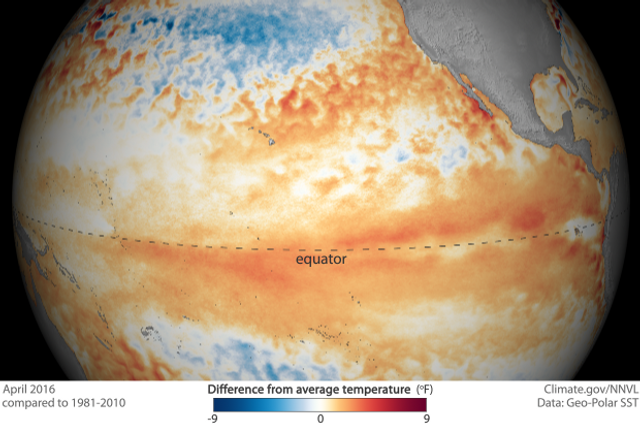
New temperature records have been set in the early months of 2016, according to data compiled by NASA. A driver behind what one researcher referred to as “extraordinary” temperatures has been the presence of an abnormally long El Niño. At the same time, research over the last several years has shown how El Niño and its cool-water counterpart, La Niña, have been affected and made more extreme by human-induced climate change.
El Niño and La Niña are phases of what scientists call the “El Niño Southern Oscillation,” a cycle of alternating warm and cold temperatures in the central and eastern parts of the Pacific Ocean that research suggests has been happening for at least 100,000 years. The changes in ocean temperatures produce significant shifts in air pressure over whole regions of the globe, inducing powerful weather patterns that have proven devastating for human habitation in many parts of the world.
The abnormally warm ocean waters caused by El Nino induce much more extreme weather patterns than normal, including droughts, cyclones and floods.
The most recent El Niño, which just recently came to a close after lasting two years, has been referred to as the strongest in two decades. It has been held responsible for record flooding in Argentina, Paraguay, Bolivia, Uruguay, and Brazil, as well as flooding and landslides in Ethiopia, which killed more than 100 people. It has been thought to have directly caused droughts in South Africa, Thailand, and Venezuela, affecting millions of people and, in the latter case, resulted in electricity rationing. It has also been blamed for the intensity of Tropical Cyclone Winston, which destroyed parts of Fiji in February, as well as having enhanced the Pacific cyclone season generally.
The continuing wildfires in Alberta and Saskatchewan, Canada are also in part attributed to the hot and dry conditions brought about by the current El Niño cycle. Moreover, while specific fires cannot be directly linked to global warming, higher temperatures in general mean less snowpack during winter, allowing for more frequent and intense wildfires.
Though El Niño is a natural phenomenon, in recent years many researchers have shown that its intensity has been exacerbated by global warming. An article published in Nature in January of 2014, for example, presents evidence that the increased frequency of “extreme” El Niño occurrences, such as the one which just closed, is largely due to surface water warming more quickly in the equatorial Pacific Ocean. The authors state, “We should expect more occurrences of devastating weather events, which will have pronounced implications for twenty-first century climate.”
Two years later, new data are supporting their predictions. The National Oceanic and Atmospheric Administration (NOAA) recently reported that April marks the seventh consecutive month of average global temperatures being at least 1 degree Celsius above the 20th-century average. In addition, NASA’s land-ocean temperature index shows that the last seven months saw about a 30 percent increase in sea surface temperature over the same months one year earlier.
Other metrics show the same warming. Measurements taken in January indicate that on a single day the northern hemisphere reached 2 degrees C above the pre-industrial average, a result that has only a one hundredth of one percent chance of happening without human-induced climate change. Data from the North Pole in December show temperatures above freezing, more than 30 degrees Celsius above average. Mark Serreze, who is the director of the US National Snow and Ice Data Center, stated, “I’ve been studying Arctic climate for 35 years and have never seen anything like this before.”
The consequences to the environment and human life are not limited to more severe storms. A recent update from NOAA shows that both El Niño and global warming are resulting in the longest global coral die-off on record, which will likely extend well into 2017. The event is referred to as “global coral bleaching,” the result of disease and heat stress caused by high ocean temperatures. NOAA reports indicate that some areas have already seen bleaching two years in a row, which means that the coral have no time to recover from their ailments. The potential cost to human well-being is high: 500 million people depend upon reefs for food and to protect coastlines from storms and erosion. Coral reefs contribute approximately $30 billion to the world economy each year.
While some attribute the recent heat events to El Niño alone, others state that this only accounts for a small amount of the anomalous warmth. Michael Mann, the director of Penn State Earth System Science Center, stated, “We would have set an all-time global temperature record even without any help from El Niño.”
This was echoed by Jeff Knight, from the Met Office Hadley Centre, stated that while additional heat from a big El Niño does contribute to the conditions, this contribution is relatively small. He stated earlier this year that “the bottom line is that the contributions of the current El Niño and wind patterns to the very warm conditions globally over the last couple of months are relatively small compared to the anthropogenically [human] driven increase in global temperature since pre-industrial times.” Put another way, global warming is the more fundamental problem that must be overcome.

New Zealand government, opposition housing policies grossly inadequate

Tom Peters

Over the past fortnight there have been reports nearly every day on New Zealand’s housing affordability crisis, fuelled by out-of-control property speculation.
Government figures show rents for three-bedroom houses in Auckland have increased 25 percent in five years. According to Trade Me Property, the median weekly rent in the country’s largest city is now at a record $520. This is roughly equivalent to the income of a full-time worker on the minimum wage after tax.
As temperatures plummet throughout the country, thousands of people, including families with young children, are living in appalling conditions in overcrowded or insecure accommodation, along with garages and cars.
There is widespread anger in the working class over the National Party government's utter failure to address the crisis and its plan to privatise thousands of state houses. According to a Newshub/Reid Research poll published on May 24, 76 percent of people believe not enough is being done to control the housing market. Despite this, Prime Minister John Key has repeatedly denied the existence of a crisis.
The government’s budget, announced on May 26, confirmed it would fund “community” organisations (which can include investors, charities and Maori tribal-owned businesses) to provide just 750 additional “social housing” rental properties, mostly in Auckland. Nationwide there are 4,500 people on Housing New Zealand's waiting list, who have been deemed eligible for public housing because they cannot afford market rents. This represents only a fraction of the need: the estimated housing shortage in Auckland alone is 30,000-40,000 properties.
The government also announced a policy of cash grants, of up to $5,000, for homeless people to move out of Auckland to vacant state houses in regional towns, many of which have even higher unemployment and poverty.
Writing in the New Zealand Herald on May 21, Social Housing Minister Paula Bennett feigned sympathy for the growing numbers of homeless people in Auckland and elsewhere, but asserted that “we have finite resources” and it was “challenging and expensive to house more and more people on the taxpayer dollar.” This comes from a government that has delivered billions of dollars worth of tax cuts for the rich and plans to spend $11 billion over 10 years on new military hardware to assist the country’s integration into US war preparations against China.
The opposition Labour and Green parties have criticised the government over the housing shortage. Their own proposals, however, would do nothing to address the crisis. Like National, Labour and the Greens are pro-business parties committed to maintaining the ability of wealthy investors, landlords, and the banks, to profit from the housing bubble.
Policies such as forcing landlords to charge affordable rents, and constructing tens of thousands of quality public houses, have been rejected out-of-hand by the entire political establishment.
In his recent Herald column, Labour leader Andrew Little repeated Labour’s xenophobic scapegoating of “foreign speculators.” Labour and the Greens, along with the anti-immigrant New Zealand First Party and the Maori nationalist Mana Party, have called for foreigners to be banned from buying houses, even though they make up only about 3 percent of all purchases.
The calls for a ban are an attempt to divert anger over the social crisis in a reactionary direction. The repeated attempts to pin the blame on Chinese buyers in particular are aimed at aligning the country with the US military encirclement and reckless provocations against China.
Labour has also called for the expansion of Auckland’s city limits, supposedly to increase the housing supply and improve affordability. In fact, this proposal is designed to boost the profits of property developers by removing restrictions on where they can build. It received support from the National government and the far-right ACT Party.
The Labour Party's other main policy is its “Kiwibuild” scheme, which housing spokesman Phil Twyford has described as “a massive state-backed building program of affordable housing.” In reality, the plan involves the construction of 10,000 homes per year, in partnership with private companies, which would be sold for profit at unaffordable market rates.
On May 19, the Greens announced a “Homes Not Cars” policy that would temporarily abolish the annual dividend of approximately $200 million paid by Housing New Zealand (HNZ) to the government, freeing up money for the state-owned corporation to build more houses. Co-leader Metiria Turei said: “The Government has the power and the money to ensure every New Zealander lives in a warm, safe, dry home—it just lacks the will.”
The policy, however, would only fund an estimated 450 new state houses—that is, about one tenth of the HNZ waiting list.
The most recent detailed study on homelessness, published in 2013 by Otago University, estimated that 34,000 people suffered from “severe housing deprivation.” This included families living in vehicles, sheds, garages, boarding houses or in severely overcrowded conditions. Assuming an average of three people in each state house, the Greens' policy would accommodate less than 4 percent of those in need.
The 2013 study was based on data from 2006. Since then the crisis has become much worse due to the 2011 Christchurch earthquake, which destroyed thousands of homes, and sky-rocketing house price inflation in Auckland and elsewhere.
The miserable so-called “solutions” put forward by Labour and the Greens demonstrate that these parties have no real differences with the government's austerity agenda, designed to make the working class bear the burden of the economic crisis.
Notwithstanding their demagogic criticism of funding cuts, the opposition parties have pledged to keep a tight lid on public spending if they win next year’s election. Earlier this year the Greens proposed a new unit within Treasury that would calculate the cost of each party's election promises, in order to promote fiscal restraint. The idea was warmly endorsed by the corporate media and the pro-National Party Kiwiblog site.
Neither party has promised to reverse National's tax cuts for corporations and the rich, or its increase to the regressive Goods and Services Tax in 2010. Far from opposing the allocation of billions of dollars to the military, Labour has attacked the government for not spending enough, calling for a stronger navy.

India: Congress Party and Stalinists suffer debacle in state elections

Arun Kumar

The Congress Party, the Indian bourgeoisie’s traditional party of government, and the Stalinist Communist Party of India (Marxist) and its Left Front suffered major reversals in the state assembly elections held this spring in four states with a combined population of 225 million.
The Congress Party was ousted from power in Kerala in the south and Assam in the northeast, leaving it the governing party in just six of India’s 29 states. The Stalinists were routed in West Bengal, the state that for decades constituted their principal electoral bastion, and failed to retain a single of their 22 seats in the Tamil Nadu assembly.
The Congress, which led India’s national government from 2004 to 2014, has been discredited among workers and rural toilers because of its pro-investor economic “reforms,” which have produced mounting economic insecurity and social inequality, and its pursuit of a global military-strategic partnership with US imperialism.
The Communist Party of India (Marxist) or CPM and its Left Front allies—including the older, but smaller Communist Party of India (CPI)—propped up the Congress-led United Progressive Alliance (UPA) government from May 2004 through June 2008, helping it to implement socially incendiary neo-liberal reforms.
The “Left” governments that held office in West Bengal and Kerala until their defeat in the last round of state elections, held in 2011, pursued what the CPM itself described as “pro-investor” policies. In West Bengal this included banning strikes in IT and IT-enabled industries and using police and goon violence to suppress peasant opposition to the expropriation of land for big business projects.
In the latest West Bengal state election, the CPM forged an unprecedented electoral alliance with the big business Congress Party and touted the prospect of a Left-Congress state government. CPM leaders, including former West Bengal Chief Minister Buddhadeb Bhattacharjee, appeared on platforms and held joint election rallies with Congress President Sonia Gandhi and Rahul Gandhi, her son and heir apparent.
In Tamil Nadu, the CPM and CPI contested the elections as part the of People’s Welfare Front—an alliance of right-wing, regionalist and casteist parties, including the Marumalarchi Dravida Munnetra Kazhagam (MDMK), Viduthalai Chiruthaigal Katchi (VCK) and Desiya Mutmoku Dravida Kazhagam (DMDK).
The Stalinists’ right-wing politics enabled various reactionary big business parties to rally support through a combination of populist promises and communalist, regionalist and casteist appeals.
This included the Hindu supremacist Bharatiya Janata Party (BJP), which in alliance with two regionalist parties—the Assam Gana Parishad (AGP) and the Bodo People’s Front—won 89 of the 126 seats in the Assam state assembly.
Under Narendra Modi, the BJP has formed India’s national government for the past two years. Following on from the Congress, the BJP has intensified the push for “pro-investor” reforms and dramatically enhanced military-strategic ties with the US and its principal Indo-Pacific allies, Japan and Australia.
In early April, the Modi government announced the impending signing of an agreement that will allow the US military to use Indian bases and ports for repair and resupply. While the Stalinists’ claim to oppose this agreement and India’s integration into Washington’s plans to wage war on China, they raised neither in their election campaigning.
In West Bengal and Tamil Nadu, the two biggest of the four states that went to the polls this spring, the respective ruling regional parties—the West Bengal-based Trinamul Congress (TMC) and the Tamil Nadu-based All India Anna Dravida Munnetra Kazhagam (AIADMK)—won reelection.
A right-wing split-off from the Congress and one-time BJP ally, the TMC was a largely discredited force until it was able, with Maoist support, to exploit popular anger with the Left Front over its pro-big business land expropriation program in 2007-08. In the 2011 West Bengal elections, the TMC was the senior partner in an electoral alliance with the Congress that swept the polls, ending 34 consecutive years of CPM-led government.
In this year’s election, running alone, the TMC increased its seat tally by 27, winning 211 of the 295 West Bengal assembly seats. One reason for this was the rallying of a sizeable chunk of BJP supporters behind the TMC.
But the most striking feature of the election was the continuing decline of the Left Front, which saw its strength in the state assembly nearly cut in half, from 60 to 32, and its popular vote fall to 25.9 percent from 29.9 percent in 2011.
The CPM campaign was explicitly right-wing, featuring its alliance with the Congress Party, on the one hand, and claims that a Left-led government would be better able to attract investment to West Bengal on the other.
The electorate rewarded the CPM with its lowest-ever seat total. Indeed, the Congress, which increased its seat tally by two to 44, is now the second-largest party in the West Bengal assembly and is expected to claim the status of Official Opposition, although it won just 12.3 percent of the popular vote.
The West Bengal CPM leadership has publicly lamented that the Congress could not “transfer” its votes to the Left, in accordance with the public alliance between the CPM and Congress. “Our workers,” CPM Politburo Member M.D Salim told NDTV, “worked wholeheartedly for the alliance and the Congress benefited. However the Congress votes could not be transferred to us.”
Nonetheless, the West Bengal CPM leadership has indicated it wants the alliance with the Congress to continue at least through the 2019 national elections. Some are even arguing for a national CPM-Congress electoral bloc.
In Tamil Nadu the ruling AIADMK won 134 seats, 36 more than its principal rival, the DMK. During the campaign the AIADMK and DMK cynically traded promises of small subsidies and handouts for voters, while reassuring the ruling elite that they would continue to pursue pro-big business policies that condemn that vast majority to crushing poverty.
The Stalinists, who have previously alternated between supporting one or the other of these parties on the grounds they could be pressured to pursue “pro-people” policies, could not and would not mount any challenge to their posturing. The Stalinist supported People’s Welfare Front failed to win a single seat, its projected chief ministerial candidate, DMDK leader Vijayakanth, losing his deposit.
In the neighbouring small Union Territory, the former French colonial enclave of Puducherry (Pondicherry), the Congress won its sole election victory. Running in an alliance with the DMK, the Congress won government, routing a Congress-breakaway party, the NR Congress.
In Kerala, India’s 13th largest state, the CPM-led Left Democratic Front ousted the Congress-led United Democratic Front (UDF) after one term in office.
The result was not unexpected given the unpopularity of the Congress nationally, the right-wing polices pursued by Kerala’s Congress-led government and the wave of corruption scandals in which it was engulfed.
Attempting to cover up the debacle it had suffered in West Bengal and Tamil Nadu, respectively India’s fourth and sixth most populous states, the CPM Politburo issued a statement that hailed the outcome of the Kerala state election as an “historic” victory for India’s workers and toilers.
It is nothing of the sort. While the electoral outcome was different, the CPM campaign in Kerala was politically of a one with that in West Bengal, with the Stalinists pledging to pursue pro-investor policies and allying with various Congress split-offs.
Speaking to BusinessLine during his pre-poll “Nava (New) Kerala March,” state CPM leader and now Kerala Chief Minister Pinarayi Vijayan promised that a Left Democratic Front would spare no effort at improving conditions for business. Decrying his party’s traditional “negativity towards” business, he vowed, “This needs to change. A new paradigm should be evolved wherein an investor is welcomed with open arms.”