4 Jun 2016

A Very Brazilian Coup

Conn Hallinan

On one level, the impeachment of Brazilian President Dilma Rousseff seems like vintage commedia dell’arte.
For instance, the lower house speaker who brought the charges, Eduardo Cunha, had to step down because he has $16 million stashed in secret Swiss and U.S. bank accounts. The man who replaced Cunha, Waldir Maranhao, is implicated in the corruption scandal around the huge state-owned oil company, Petrobras.
The former vice-president and now interim president, Michel Temer, has been convicted of election fraud, and has also been caught up in the Petrobras investigation. So is Senate president Renan Calheiros, who’s also dodging tax evasion charges.
In fact, over half the legislature is currently under investigation for corruption of some kind.
But there’s nothing comedic about what the fall of Rousseff and her left-leaning Workers Party will mean for the 35 million Brazilians who’ve been lifted out of poverty over the past decade, or for the 40 million newly minted members of the middle class — that’s one-fifth of Brazil’s 200 million people.
While it was the current downturn in the world’s seventh largest economy that helped light the impeachment fuse, the crisis is rooted in the nature of Brazil’s elites, its deeply flawed political institutions, and the not-so-dead hand of its 1964-1985 military dictatorship.
A Lurch to the Right
Given that the charges against Rousseff don’t involve personal corruption, or even constitute a crime — if juggling books before an election were illegal, virtually every politician on the planet would end up in the docket — it’s hard to see the impeachment as anything other than a political coup. Even the center-right Economist, long a critic of Rousseff, writes that “in the absence of proof of criminality, impeachment is unwarranted” — and “looks like a pretext for ousting an unpopular president.”
That suspicion is reinforced by the actions of the new president.
Temer represents the center-right Brazilian Democratic Movement Party (PMDB), which until recently was in alliance with Rousseff’s Workers Party. As soon as Rousseff was impeached by the Senate and suspended from office for 180 days, Temer made a sharp turn to the right on the economy, appointing a cabinet of ministers straight out of Brazils’ dark years of dictatorship: all white, all male, and with the key portfolios in the hands of Brazil’s historic elites. This comes in a country where just short of 51 percent of Brazilians describe themselves as black or mixed.
 At least six of those ministers, moreover, have been implicated in the Petrobras scandal.
Temer announced a program to “reform” labor laws and pensions, using code words for anti-union legislation and pension cuts. His new finance minister, Henrique Meirelles, a former central bank head who once led BankBoston in the United States, announced that while programs for the poor “which don’t cost the budget that much” would be maintained — like the highly popular and successful Bolsa Familia, which raised tens of millions out of poverty through small cash grants — other Workers Party initiatives would go under the knife.
The new government is already pushing legislation that would roll back laws protecting the environment and indigenous people, and has appointed ministers with terrible track records in both areas.
For instance, one of the largest soybean farmers in Brazil, Blairo Maggi, was appointed agriculture minister. Maggi has overseen the destruction of vast areas of the Amazon to make way for soybean crops. Temer’s initial appointment for science minister was an evangelical Protestant minister who doesn’t believe in evolution. Temer also folded the culture ministry into the ministry of education, sparking sit-ins and demonstrations by artists, filmmakers, and musicians.
Corruption and Incoherence
Brazil has long been a country with sharp divisions between wealth and poverty, and its elites have a history of using violence and intimidation to get their way. Brazil’s northeast is dominated by oligarchs who backed the 1964 military coup and manipulated the post-dictatorship constitution.
Political power is heavily weighted toward rural areas dominated by powerful agricultural interests. The three poorest regions of the country where these interests dominate, accounting for only two-fifths of the population, control three-quarters of the seats in the Senate.
As historian Perry Anderson puts it, Brazil’s political system was designed “to neutralize the possibility that democracy might lead to the formation of any popular will that could threaten the enormities of Brazilian inequality.”
Brazil’s legislature is splintered into 35 different parties, many of them without any particular political philosophy. The legislature is elected on the basis of proportional representation, but with an added twist: There’s an “open list” system in which voters can choose any candidate, many of them standing on the same ticket.
The key to winning elections in Brazil, then, is name recognition, and the key to that is lots and lots of money. Most of that money comes from Brazil’s elites, like the oligarchs in the country’s northeast.
Because of the plethora of parties, forming a government is tricky. What normally happens is that one of the larger parties ropes in several smaller parties by giving them ministries. Not only does this encourage corruption — each party knows it needs to raise lots of money for elections — but also results in political incoherence.
When the Workers Party was elected in 2002, it was unwilling to dilute its programs by bringing ideological opponents into a cabinet — yet the party still needed partners. The solution was cash payouts to legislators, a scheme titled mensalao (“monthly payoffs”) that was uncovered in 2005. Once the payoffs were revealed, the party had little choice but to fall back on the old system of handing out ministries in exchange for votes. That’s how Temer and the PMBD entered the scene.
With the reputation of the popular former president Lula da Silva and his Workers Party dented by the payoff scheme, the right saw an opportunity to rid themselves of the left. But Silva’s resilient popularity and the success of his anti-poverty programs made the party pretty much unassailable at the ballot box. Silva won another landslide election in 2006, and his successor Rousseff was elected twice in 2010 and 2014.
A Very Brazilian Coup
In short, the elites could not win elections. But they could still pull off a very Brazilian coup.
First, they hammered at the fact that some Workers Party leaders had been involved in corruption and others implicated in the Petrobras bribery scheme. Rousseff herself headed up Petrobras before being elected president. While she’s never been personally linked to any of the corruption, it did happen on her watch.
Petrobras is the fourth largest company in the world. It’s building tankers, offshore platforms, and refineries. That expansion has opened huge opportunities for graft, and the level of bribery involved could exceed $3 billion. Nine construction companies are implicated in the scandal, as well as more than 50 politicians, legislators, and state governors, from the PMDB as well as the Workers Party.
Rousseff’s biggest mistake was to run on an anti-austerity platform in 2014 and then reverse course after she was elected, putting the brakes on spending. The economy was already troubled and austerity made it worse. The 2005 bribery scheme lost the Workers Party some of the middle class, and the 2014 austerity alienated some of the party’s working class supporters.
But it was most likely Rousseff’s decision to green light the Petrobras corruption investigation that spurred her enemies to strike before the probe could pull down scores of political leaders and wealthy construction owners. Temer’s own anti-corruption minister was recently caught on tape plotting to use the impeachment to derail the investigation, an event that led to his resignation.
Certainly the campaign aimed at Rousseff was well orchestrated. Brazil’s media — dominated by a few elite families — led the charge. According to Reporters Without Borders, the role of the media was “partisan,” its anti-Rousseff agenda “barely veiled.” Judge Sergio Moro, a key figure in the Petrobras investigation, illegally leaked wiretap intercepts that put Silva and Rousseff in a bad light.
Given the makeup of the Brazilian Senate, it’s likely that Rousseff will be convicted and removed as president. It also appears that Temer, who enjoys almost no popular support, will try to roll back many of the programs that successfully narrowed the gap between rich and poor.
On the Ropes
The stakes are high, and not just for democracy.
Brazil’s economy is in trouble, shrinking 3.7 percent last year. Commodity prices are down worldwide, in large part because of the downturn of China’s economy. Brazil’s debt is rising, though it’s still half that of Italy. And unemployment is low, at least compared to the indebted countries of Europe.
A return to the austerity policies that destroyed economies all across the southern cone during the 1980s and ‘90s — and which are decimating parts of Europe today — would be a disaster. The worst thing one can do in a recession is curb spending, which stalls out economies and puts countries into a debt spiral.
For now, the Workers Party is on the ropes, but hardly down and out. It has 500,000 members, and the new government will find it very difficult to take things away from people now that they’ve gotten used to having them. Some 35 million people are unlikely to return to their previous poverty without a fight.
One of Temer’s first acts was to put up 100,000 billboards all over the country with the slogan: “Don’t speak of crisis; work!” That sounds a lot like “shut up.” Yet Brazilians aren’t noted for being quiet, particularly if the government instituting painful cuts is unelected.
The pressure for new elections is sure to grow, although the current government will do anything it can to avoid them. Sooner or later there will be a reckoning.

Dismantling Civil Society in Bahrain

Rannie Amiri

Like a vise which first grips its object and then slowly, deliberately and inexorably crushes it, the al-Khalifa regime has done similarly to civil society in Bahrain. It did not stop when peaceful, pro-democracy, reform protests erupted in 2011 and were violently put down by government forces aided by an invasion of Saudi troops in March of that year. Indeed, the vise continues to close and relentlessly so.
Nationalities have been revoked, mosques razed, citizens deported, human rights activists imprisoned on flimsy charges of insulting the monarchy at the least or plotting its overthrow at worst, and the most perfunctory of dialogues with the opposition abandoned. By smothering the figures and institutions who dare challenge the authority of the ruling dynasty in the most benign of fashions – a tweet, waving the country’s flag, tearing up a photo or merely questioning the tenure of the world’s longest serving prime minister – the Bahraini regime and its Gulf allies would like to believe monarchal rule has been preserved. Such desperate measures however, only speak to its precarity.
The stalwart activist Zainab al-Khawaja was given a sentence of three years and one month in Dec. 2014 for (again) tearing up a picture of King Hamad. She refused to be separated from her infant son whom she took with her to prison. Al-Khawaja has just been released on “humanitarian” grounds after serving 15 months in jail.
Her father though, Abdulhadi al-Khawaja, remains imprisoned serving a life sentence on trumped-up charges of attempting to topple the government. While authorities may have set Zainab al-Khawaja free, they simultaneously doubled the sentence of Sheikh Ali Salman, head of al-Wefaq, an opposition political party. Initially given a term of four years incarceration for alleged incitement against the regime, it was increased to nine years on appeal. The unflinching President of the Bahrain Center for Human Rights (BCHR) and founding Director of the Gulf Centre for Human Rights Nabeel Rajab, remains banned from leaving the country despite the need to secure medical treatment for his wife.
Busy highlighting the nation’s cordial relations with the United Kingdom and United States, the latter of which headquarters its Navy’s Fifth Fleet in the capital Manama, the Western media has largely ignored the plight of Bahrain’s ordinary citizens. The arrest and torture of disabled youth has now been documented by the BCHR. Indeed, for more than a decade, the Center has meticulously chronicled the dismantling of Bahrain’s civil society in all its forms by the al-Khalifa regime.
Most recently, with the passage of a law preventing any religious figure from joining political societies or engaging in political activities, the BCHR issued a statement condemning, “… the Bahraini parliament and Shura Council’s passage of amendments to the Political Societies Law, which places a ban on participation in political decision-making based on discriminatory religious grounds. In defense of this draft amendment, lawmakers supporting this motion argued it would prevent religious acts from being politicized. This decision restricts people’s ability to freely engage in religious practices, as those members willing to join political activities pertinent to the legislative process in Bahrain would now need to refrain from any activities carrying religious connotations.”
In the face of widespread and open abuses in civil society, lack of proportional parliamentary representation, curfews, detentions, and imprisonment and torture of those who dissent, these practices have nonetheless failed to adversely impact the ties enjoyed between Bahrain and the United States. But when a regime becomes alienated from those whom it rules and for example, gives lengthy jail sentences for tweets it finds offensive, it speaks to a tenuous reign.
The pillars of civil advocacy in Bahrain – Nabeel Rajab, Abdulhadi al-Khawaja, Maryam and Zainab al-Khawaja, Abduljalil al-Singace (sentenced to life in prison for participating in pro-democracy protests), Naji Fateel, Hussain Jawad and countless others both named and unnamed – have consistently engaged in purely secular, non-sectarian activism. Unlike the practice of the regime, the designations Sunni and Shia need not be applied when discussing the ongoing struggle for legal, political and socioeconomic rights in Bahrain. The people have waited too long for the West to recognize their demands are not based on sect, but on equity.
Despite an oppressive regime and the long shadow cast by the U.S. Fifth Fleet, resilient Bahrainis remain unintimidated.

Sex Inequality and the £330,000 Lottery

Julian Vigo

Several weeks back a group of seventeen female French ministers banded together to fight sexual harassment they had experienced throughout their careers. Their joint statement published in Journal du Dimanche states: “It’s not for women to adapt to these environments. It’s the behaviour of certain men that needs to change.” Certainly, any woman reading their statement can relate to the sentiment—a mixture of anger and relief from years of having to remain silent for fear of losing one’s job and still that palpable fear that one can lose one’s job for merely speaking out. A 2013 study done in the UK shows that six in ten women have experienced sexual harassment in the workplace. Sexual harassment in the UK is part of a larger problem that speaks to sexual inequalities in public life, in both private and public sector employment, and in the media. And in the US some professions report far higher rates of sexual harassment for women with data from the Equal Employment Opportunity Commission (EEOC) showing 6,822 claims from 2015 and a poll demonstrating that only 30% of women come forward to complain about sexual harassment for fear of retaliation, economic instability should they fired, office gossip, and the difficulty of finding a new job.
As sexual harassment is being addressed in the public and private sectors, sexism is rife within other sectors to include the equal representation within most professions, recognition of merit, and equal pay. Most shocking are the statistics for the imbalance in media. In March 2016 The Guardian reported the incredibly skewed data on those in media stating: “The issue of equality and diversity in journalism came under the spotlight last month when 94 men and 20 women were shortlisted for this week’s British Press Awards.” And worse, on the matter of economic security—which is where equality is truly felt—“City’s [University of London] research indicates that women are paid significantly less than their male counterparts. Nearly 50% of female journalists earn £2,400 or less a month compared with just a third of men.” The study goes on to show the almost 50% of the women who have worked in journalism between six and ten years are not promoted whereas men with the exact same experience had been promoted into management positions. (And the statistics on race are even worse.) And just last month Stephen Follows published a study which shows the devastating sex inequality within the British film industry: over a ten-year period (2005-2014 inclusive) only 13.6% of active film directors were female. And this percentage has not vastly improved over the years, moving from 2005 at 11.3% to 2014 at 11.9%. Data on film crew was just as troubling: “Of the main key head of department roles, only two had greater than 50% female representation with the rest ranging between 6% and 31%. Similarly, only casting, make-up, and costume departments have a majority of female crew, meaning of the seventeen crew credits we studied, fourteen had fewer women than men.”
All this comes as no surprise to women who have been dealing with pay and promotion inequality for their entire lives with the added bonus of sexual harassment. But what are the costs of pay and promotion inequality in addition to sexual harassment? We already know that girls who routinely experience sexual harassment are significantly more likely to attempt suicide, but little is said about these repercussions on women who suffer “widespread and often serious health, emotional, and economic consequences.” And the economic impacts for discrimination and harassment are little explored in the media which are often the major factor playing into the future mental and physical health of women.
According to data published by the Equal Opportunities Commission (now part of the Commission for Equality and Human Rights), “the average woman working full-time could lose out on £330,000, in comparison with men’s earnings, over the course of her working life.” Similarly, they investigated similar inequalities within the financial sector specifically where the pay gap was explained in terms of: stereotyping in the recruitment processes, the sector’s extremely young age profile proves a challenge to those with children, the sector’s long hours’ culture also affects those with children, the intractability of senior leaders to take action on sex inequality and the lack of enforcement of good practices. Also according to the Equality and Human Rights Commission, female graduates earn up to £8,000 less than males who studied the same subject.
If the Fawcett Society’s 2008 report on women’s pay inequality wasn’t shocking enough then their 2013 study is enough to bring one to tears: “New figures from the Office of National Statistics published in December 2013  show the pay gap widening for the first time in five years.” And the reasons the Fawcett Society gives for this widening gap are the same reasons for sex-based oppression of women throughout recent history: women’s work is undervalued, more women work part-time, the “motherhood penalty,” and more generally that sex-based discrimination has not gone away. Because of their decreased earning power, women use their money quite differently: they invest in their children, the home, and they save over investing. RateSetter carried out research which showed that men are significantly more likely to own investment products (66% of men compared to 48% of women). Data suggests that women do not tend to move towards long or short-term investment products simply because, according to this report, they have 50% less of disposable income at the end of each month. And when one examines those countries with a closer economic parity between the sexes, one thing is painfully evident: that salary equality is maintained in countries where there is a balance of political representation of females and males.
Recently there was a petition, 50:50 Parliament, to request a 50% representation of women in Parliament because shockingly, in 2016 in the UK as well as other western countries, females are not fairly represented. With less than a 30% female presence in the House of Commons, one can only wonder if the more equitable presence of women in Parliament might not begin to effect real social change. And in the US, the representation of women in the 114th Congresses is lamentable with only 20 female senators out of a total of 100 (a 20% presence) and 84 female congress members in the House of Representatives out of 535 (a 19.4% presence).
I have recently written my MP, Mark Field, to request that he take action to ensure a 50% presence of women in Parliament. The larger question remains: how to effect this change?

Poverty, Militarism and the Public Schools

Robert Koehler

What’s the difference between education and obedience? If you see very little, you probably have no problem with the militarization of the American school system — or rather, the militarization of the impoverished schools . . . the ones that can’t afford new textbooks or functional plumbing, much less art supplies or band equipment. My town, Chicago, is a case study in this national trend.
The Pentagon has been eyeing these schools — broken and gang-ridden — for a decade now, and seeing its future there. It comes in like a cammy-clad Santa, bringing money and discipline. In return it gets young minds to shape, to (I fear) possess: to turn into the next generation of soldiers, available for the coming wars.
The United States no longer has a draft because the nation no longer believes in war, except abstractly, as background noise. But it has an economic draft: It claims recruits largely from the neighborhoods of hopelessness. Joining the U.S. military is the only opportunity available to millions of young Americans to escape poverty. We have no government programs to build the infrastructure of peace and environmental sustainability — we can’t afford that, so it has to happen on its own (or not at all) — but our military marches on, funded at more than half a trillion dollars a year, into ever more pointless wars of aggression.
Glory, glory hallelujah. I’d never been to a Memorial Day parade in my life, but I went to this year’s parade in downtown Chicago because members of the Chicago chapter of Veterans for Peace were going to be there, protesting the militarization of the city’s schools.
I arrived as the parade was still assembling itself along Wacker Drive. What I saw, along with the Humvees and the floats (Gold Star Families of the Fallen, Paralyzed Veterans of America: Making a difference for 70 years) were thousands of young people — mostly kids of color, of course — bedecked in various uniforms, standing in formation as martial music erupted sporadically, driven by the drumbeat of certainty. Some of the boys and girls seemed as young as 10 or 11. One boy walked past me twirling a rifle like it was a baton. Was it real? Was it loaded?
The concept of America is a totally military phenomenon, I thought as I walked along the parade route. This is what holds it together, not culturally, but as a legally organized entity. The flags, the rifles, the Humvees, the names of the dead . . . the uniformed children. For a moment I wondered if I could continue calling myself an American.
Then I met up with the Vets for Peace people at State and Lake — a small group of men and women handing out stickers that read: “No military in Chicago Public Schools. Education, not militarization.”
“The idea is, just by being here, we’re having people stop for a moment and think about the militarization of Chicago schools,” Kevin Merwin told me. “There’s opposition to the wholesale militarization of youth in Chicago. It’s the most militarized school system in the country, if not the world.”
Indeed, according to various sources, there are between 9,000 and 10,000 young people in the Pentagon’s JROTC program, with “military academies” — often in spite of furious community opposition — taking over portions of 45 of the city’s 104 high schools.
“Kids in seventh grade are being rolled up into this Memorial Day parade,” Merwin said. “We’re inculcating kids into the military system at a young age — the kind of thing we criticized the Soviet Union for back in the day. And it’s mostly kids of color.”
Ann Jones, addressing this hypocrisy, pointed out in an excellent essay that Congress actually passed an act in 2008 — the Child Soldiers Prevention Act — that was “designed to protect kids worldwide from being forced to fight the wars of Big Men. From then on, any country that coerced children into becoming soldiers was supposed to lose all U.S. military aid.”
However, not surprisingly, the economic interests of the military-industrial complex eventually gutted the intention of this rare bit of compassionate legislation. Five of the 10 countries on the child-solider list, Chad, South Sudan, Yemen, the Democratic Republic of the Congo and Somalia, have been granted “waivers” so they can continue to purchase American weapons.
“Too bad for the young — and the future — of those countries,” Jones wrote. “But look at it this way: Why should Washington help the children of Sudan or Yemen escape war when it spares no expense right here at home to press our own impressionable, idealistic, ambitious American kids into military ‘service’?
“It should be no secret that the United States has the biggest, most efficiently organized, most effective system for recruiting child soldiers in the world.”
Those who want to perpetuate the military mindset — that is to say, the servants of the most powerful economic interests in the country — have to grab the minds of the young, because only in one’s youth does militarism resonate with uncontaminated glory. This is why the Army maintains a gamer website. And it’s why every branch of military service sets up shop in our most desperate schools and parades the Junior ROTC boys and girls before the public on Memorial Day, our national holiday in celebration of arrested development.

Freedom From Fear

Sheikh Javaid Ayub

Oxford English dictionary defines fear as a strong, uncontrollable, unpleasant emotion caused by actual or perceived danger, or threat. As a countable noun it means a phobia, a sense of fear induced by something or someone. Islamophobia is an undue fear of Islam, so is Westernophobia a growing sense of insecurity and fear of the West. Fear makes minorities feel vulnerable about their minority hood. Fear of communal violence and rightist ideology may make Indian Muslims vote for secular parties, especially for the Congress. Despite constituting 14 percent of the total population of India, Indian Muslims, it is stated, are deliberately being kept out of the Indian parliament. In the 2014Lok Sabha elections Muslim representation hit an all time low of just 22 MPs, with UP despite its substantial Muslim population, not returning a single Muslim candidate to the Lok Sabha. The parties are finding it difficult to field Muslim candidates for fear of consolidating the majority vote.
Politics – both international and domestic is shaped by fear. The anarchical world order can create fear among the nation state so do the US hegemony. Fear of losing statehood put the nation states on the path of armamentation. From conventional arms to nuclear bombs, fear has largely been a motive in this mad race of arms. The idea of the military utility has been a key driver for the pursuit of nuclear weapons.
The fear of Fascism galvanized into the Second World War and the fear of Communism produced the Cold War. Cold War was a war of build up Vs build up. The two superpowers were so massively engaged in a nuclear race that they were in possession of more than 70000 weapons by the US and the Soviet Union during 1970s and 1980s. However, today’s nuclear world is very different from the bipolar world of the Cold War dominated by nuclear rivalry between the two superpowers. The centre of gravity is relentlessly shifting from Europe to Asia Pacific. Fear is thus mother of all wars and all weaponry. China’s presence as a nuclear power in the neighborhood provides a powerful reason for India to detonate its own, irrespective of being among the world’s poorest countries. According to the annual report of Agriculture Organization of the United Nations, India is home to 194.6 million undernourished people, the highest in the world. Despite being in such a killer poverty trap it manages its nukes. India’s bomb gave reason for Pakistan to have her own. Making of bomb kills so do its use.
Living with nuclear bombs has made us believe that possessing such beasty bombs will secure us through nuclear deterrence. Believing in the logic of deterrence is to live in a fool’s paradise. Deterrence is the buzz word of the people who like to think of themselves as hawks – claiming to have known human nature in its totality; perhaps not, because no one can claim a mastery over understanding the human nature. Ask Hobbes and he will claim human nature to be selfish, egoistic, quarrelsome, timid etc. Ask Locke and Rousseau they will opine that humans have a natural tendency of degeneration which is sufficient for men to wage wars and go for a rampant killing.
The theory of nuclear deterrence, we are told, prevented the Cold War from turning into a ‘Hot War’. True, the Cold War remained cold till it ended but there are lots of hidden truths that need to be unearthed. Neither states nor the statesmen have saved the world at the most dangerous moment of the Cuban Missile Crisis of 1962. It was Vasili Arkhipov, a Soviet Submarine Officer who blocked an order to fire nuclear-armed torpedoes, at the tensest moment of the crisis, when the submarines were under attack by US destroyers. A devastating response would have been a near certainty, leading to a Total War.
In a nuclear world it is not dying that we must fear, but living. It is folly to believe that nuclear bombs are deadly only if they are used. But the fact is that their very presence is cancerous for our existence. Setting of a tradition of using nuclear bomb, the US has put the whole world on a nuclear volcano which can burriest any time anywhere. The day it burriest, will surely be a dooms day for the mankind. Ours is a risk society and nuclear risks cannot be overlooked.
Barak Obama became the first serving US president to visit Hiroshima on May 27 of this year. The visit is mostly looked as reflecting obama’s conviction about a nuclear free world. Although he did not make an apology for dropping of the atomic bombs in 1945, but he returned to the nuclear disarmament agenda, stating that new and destructive technologies need a moral revolution. He called for moral courage to escape the ‘logic of fear’ in order to pursue a goal of a world without nuclear weapons. But he forgot to mention that the US has announced an ambitious plan to spend $1 trillion for modernization of its nuclear arsenal over the next three decades. Neither did he say that the US still maintains the right of ‘first use of nuclear weapons’ though limited to extreme circumstances.
Fear, if well articulated, can become a handy tool for keeping hegemony intact and can provide a kind of free license to intervene, attack and control nation states. Consolidation of power need creating and countering perceived threats to the society. Threats are created and solved in such a fashion that people relinquish their sovereign powers and surrender before propagandist state apparatus that virtually present herself as the guardian and protector of individual. People are made do think in the terms state wants them to think, there is no thinking beyond that, and no truth beyond the truth that is articulated by the state. Truth is what the hegemon calls truth! The fear of Al-Qaida can become enough reason for invading Afghanistan. In the same fashion the fear of Iraq possessing weapons of mass destruction become a valid reason for bombarding Iraq and eliminating Saddam Hussain.
The fear is seen everywhere. It is politicized, manipulated, mutilated, manufactured and removed – only to be replaced by a more intense one. The presence of seven lakh troops, backed by draconian laws is a glaring example of India’s fear of losing Kashmir. The presence of such a huge number of armed personnel has domesticated fear in every house hold with every Kashmiri. The fear hounds them as do ghosts in the dark dreadful nights. They are feeling dwarfed with their manhood lost. Their voices chocked and their individuality crushed. What they really need is freedom from fear.

Let the fears are done with and the much needed peace and tranquility be restored for human happiness and human progress.

It Is Expensive To Be Poor

Vidyadhar Date

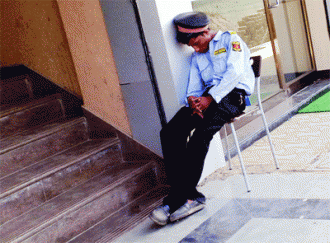
Mumbai: A man murdered a woman in Mumbai recently because he was afraid she was going to deprive him of his job as a temporary watchman. This shows the crisis of employment in Mumbai. And this is a city which among all places in India is supposed to provide the maximum employment opportunity.
And the watchman security industry is one of the few industries which has seen a big job growth in the last few years. If jobs are not easily available even here then it is a serious situation. So far one of the few jobs available for the poor is of security guards in housing societies . There is a big demand for the jobs even though these are very poorly paid. I talk with these people sometimes while taking a walk to Joggers Park and find that many of them work in two shifts, each of 12 hours, day and night. This is because the pay for one shift is not enough even for subsistence. Many of them sleep at night and it is easy to blame them if one does not take into account the working conditions. Doing two jobs is the only way they can tackle their problem of homelessness.
Mumbai’s municipal commissioner recently talked of two items on top of his agenda - providing houses for the poor and to create jobs. But then Mumbai is mainly creating poorly paying jobs and there is not the faintest chance of these poor people ever being able to afford even the most miserable dwelling. And the government has not the slightest credibility in the scheme of providing houses to slum dwellers as this is aimed mainly at enriching the builders. Those not having access even to a slum have little future.
Chief minister Antulay brought about a legislation in the early eighties to provide security of employment to security guards and to regulate the industry of security agencies often run by retired cops or armymen. It worked for some time and then was scuttled by subsequent administrations.
The food needs of the watchmen have led to a new industry. Last night I saw two men on a motor cycle stopping in front of every building handing out plastic parcels to watchmen. This was their dinner of dal, chawal and sabji for Rs. 35. That comes to nearly Rs. 2000 per month for two subsistence meals a day. That may be one dinner expense in a restaurant for a better off person. But when a man makes Rs. 6000 doing a total of two jobs per day for a month, this is very unaffordable. There are other expenses and he has to send money home in U.P. or Bihar..
I also saw a couple of young men with their own motor cycles in front of a chemist shop handing out a home delivery of medicines. Such job creation is all right for survival but does not reflect a healthy economy. Clearly, the claims that India is the fastest growing economy in the world can hardly impress those who experience reality.
The laziness of the rich is creating a demand for home delivery. People want home delivery even from a shop in front of their house. This is leading to the creation of agencies which offer home delivery for a range of products from groceries to electric appliances. But this job creation has little value.
Besides, so many jobs are not only poorly paid but also hazardous. Three workers were suffocated to death while cleaning a drain pipe in the posh Palava city township coming up on the outskirts of Mumbai near Dombivali. Most such workers are denied basic protective measures in the hazardous job. Just as the railway network in the U.S. and Canada is said to be laid on the graves of workers killed during construction, our rich would be living on the graves of the poor who are killed while laboring for building the luxurious apartments for the rich.
It is expensive to be poor as the famous American novelist James Baldwin and researcher Barbara Ehrenreich have pointed out. I know of a domestic help who pays Rs. 3000 per month for a shelter in a slum while an extremely rich man enjoying the protection of the old Rent Act may be living in a sprawling house in a posh area in Mumbai paying much less than that.
For everything the poor have to pay more than the rich in proportion to their income. Since, the poor do not have a proper dwelling address, they do not get basic services. The rich who clog the streets with their cars do not realizing that the congestion is driving up the expense of an ordinary man who takes an auto rickshaw or a taxi in an emergency.
The system does not care for the poor as the rich with their supreme ignorance and prejudice universally believe that the poor are to blame for their lot, not the system.
Ordinary people it seems do not deserve basic amenities at public spaces even when they are paying for the services and even when they are engaged in boosting the economy. On the other hand the rich get preferential treatment.
So, one notices that it is safer to get a heart attack at the Mumbai airport than anywhere else. A front page report in the Times of India said so earlier this month. One can be assured of treatment within three minutes with the use of electronic equipment installed at over 100 points.
Fine. But how come it is difficult or almost impossible to get even first aid at our suburban or mainline railway stations or bus depots ? Many more people travel by trains than planes but it took a case in the high court to force the suburban railway system to agree to provide first aid boxes at railway stations in the last couple of years. And travelling by overcrowded trains is far more stressful and hazardous than planes. So the need here is much more. Besides chances of mishaps occurring at railway stations are much higher. Only two days ago, a slab on a drain collapsed at Vasai railway station and several people were injured and they fell into the slush.
No one expects the posh ambience of airports at railway stations or bus depots. But how can the authorities discriminate between two sets of service users when it comes to basic amenities ? One has never noticed uncomfortable seats at airports. Toilet and drinking water facilities are all over and easily accessible. Can one imagine an airport where passengers wait in heat and rain without a roof over their head ?

Medical tourism is cited as a reason for good medical facilities at the airport. But then so many ordinary people also travel by train and buses to get medical treatment. They may not be big consumers for five star hospitals. But they are travelers for a medical treatment though they are not tourists. The main reason for the discrimination is the extreme callousness of the political class and the upper class which think they can get away without providing even basic amenities to common people.
Some top industrialists in Mumbai recently went out of their way to seek better surfacing of Marine Drive and wrote a letter to the municipal commissioner making a bitter complaint. If only they thought about the neglect of other areas, life would be better.

There is a wider issue regarding railway stations and bus depots. These are prime public spaces used by lakhs of people. If only these are maintained well, if the authorities set a good example, it will help create a more social mindset, people will learn to use public spaces better, join in keeping them clean.

It's Time To Ditch Industrial Agriculture

Andrea Germanos

If you can count as successes increased greenhouse gases, ecosystem degradation, rises in hunger and obesity, and unbalanced power in food systems, then industrial agriculture has done one heck of a job.
That's according to a panel of experts, whose new report, From Uniformity to Diversity: A paradigm shift from industrial agriculture to diversified agroecological systems (pdf), calls for breaking the chains that lock monocultures and industrial-scale feedlots to the dominant farming systems in order to unleash truly sustainable approaches—ones that use holistic strategies, eschew chemical inputs, foster biodiversity, and ensure farmer livelihoods.
As the authors write, "The evidence in favor of a major transformation of our food systems is now overwhelming."
The new publication from the International Panel of Experts on Sustainable Food Systems (IPES-Food), released Thursday, compares the two opposing methods of agricultural systems; looks at why, given the negative outcomes of outcomes of industrial agriculture, it remains in place; and suggests paths for how to move towards widespread adoption of agroecological systems.
"Many of the problems in food systems are linked specifically to the uniformity at the heart of industrial agriculture, and its reliance on chemical fertilizers and pesticides," stated Olivier De Schutter, former UN Special Rapporteur on the right to food and leader of the panel. "Simply tweaking industrial agriculture will not provide long-term solutions to the multiple problems it generates."
For example, the report notes that food systems are responsible for about one-third of all GHGs, "Aquifer exploitation and water table depletion are now occurring at alarming rates, particularly in industrial cropping zones such as the U.S. Midwest," and pesticide exposure has been linked to numerous health problems.
Among the factors keeping the dominant system in place, the report notes, is the flawed "feed the world" approach that frames industrial agriculture as the solution while ignoring power relations and poverty, as well as policies that keep fossil fuels cheap and short term political thinking that demands immediate results.
As De Schutter added: "It is not a lack of evidence holding back the agroecological alternative. It is the mismatch between its huge potential to improve outcomes across food systems, and its much smaller potential to generate profits for agribusiness firms."
Among the key messages, as noted by IPES-Food
>> Today's food and farming systems have succeeded in supplying large volumes of foods to global markets, but are generating negative outcomes on multiple fronts: widespread degradation of land, water and ecosystems; high GHG emissions; biodiversity losses; persistent hunger and micro-nutrient deficiencies alongside the rapid rise of obesity and diet-related diseases; and livelihood stresses for farmers around the world.
>> Many of these problems are linked specifically to ‘industrial agriculture’: the input-intensive crop monocultures and industrial-scale feedlots that now dominate farming landscapes. The uniformity at the heart of these systems, and their reliance on chemical fertilizers, pesticides and preventive use of antibiotics, leads systematically to negative outcomes and vulnerabilities.
>> Industrial agriculture and the ‘industrial food systems’ that have developed around it are locked in place by a series of vicious cycles. For example, the way food systems are currently structured allows value to accrue to a limited number of actors, reinforcing their economic and political power, and thus their ability to influence the governance of food systems.
"We must change the way we set political priorities," De Schutter said. "The steps towards diversified agroecological farming are steps to democratize decision-making and to rebalance power in food systems."
The new publication, presented at the invite-only Trondheim Conference on Biodiversity in Norway, follows a call in November 2015 by United Nations expert Hilal Elver to ditch industrial agriculture.
"There is a need for a major shift from industrial agriculture to transformative systems such as agroecology that support the local food movement, protect small holder farmers, respect human rights, food democracy and cultural traditions, and at the same time maintain environmental sustainability and facilitate a healthy diet," she said at the time.

School closed in remote Australian indigenous community

John Davis

Queensland’s state Labor government last month withdrew teachers and shut down the only school in the remote Aboriginal township of Aurukun, blaming violence by local youth, while boosting the number of police in the town from five to 21. It was the second time within weeks that the school was closed, depriving all the local students of the basic right to attend an education.
This repressive approach to the social crisis in Aurukun was backed by the federal Liberal-National government, as well as Noel Pearson, a high-profile Aboriginal figure whose organisation took over the school to operate as the “Aurukun Academy” in 2010.
Aurukun is in far north Queensland, on the west coast of Cape York, 811 kilometres from the nearest major town, Cairns. Home to about 1,400 people, it is one of the most economically oppressed and impoverished localities in Australia.
Like many other indigenous communities in Queensland, Aurukun was originally a paternalistic church mission. Aboriginal people were relocated from a large surrounding area, many against their will, to the mission settlement. Later it was placed under authoritarian state government control, then handed to a local Aboriginal council in 1978.
Since then, the chief beneficiaries have been a thin layer of indigenous businessmen, bureaucrats and lawyers. The economic and social conditions remained blighted and deprived of basic government funding. Aurukun’s power supply is intermittent, blackouts are common and the local sawmill and butcher have long closed.
Joblessness has plagued Aurukun for decades. According to federal Department of Labour statistics, the unemployment rate in December 2015 was 57.6 percent, jumping up from 37.4 percent three months earlier.
Unemployment is nearly back to the level of 69.6 percent in 2010. That was the year in which the then state and federal Labor governments handed school control over to Pearson’s right-wing, pro-business Cape York Institute for Policy and Leadership, which also runs the area’s government-funded employment services.
Since 2010, the community has been turned into a social laboratory for the “welfare reform” agenda pursued by successive federal Liberal-National and Labor governments. Families are threatened with being cut off payments if their children fail to attend the “academy.”
The school was halted at Year 7 two years ago. Pearson declared that offering classes to Year 10 was “extended child-minding” and had no value to students who did not wish to participate. The closest high school is a three-hour drive north to Weipa, a bauxite mining town. The other options are distant education courses operating out of Cairns, or far-away boarding schools.
Media reports have played up the allegations of violence against the academy principal and teachers. On May 8, the staff was evacuated after the principal’s car was reportedly stolen and he was confronted by a group of teenagers.
Some teachers returned after a week but were withdrawn again after further incidents on May 23 involving reported car thefts, stones being thrown on the roofs of the academy and teachers’ accommodation and other threats of violence.
In media interviews, Pearson backed the closure and complained that he previously asked the state government to send more police to the town. He contemptuously described Aurukun as “the Afghanistan of teaching,” where “the buildings are dilapidated … and unfit for the teachers that live in them.”
Yet, Pearson claimed that Aurukun school “inspired a movement here and dozens of schools over the country to adopt the program that we have running in that school.” He said “the school has never been as good as it has been in these past five years.”
In reality, a report by Cape York Academy, released in 2014, showed that Aurukun’s student attendance rate had sunk to 58 percent, down from previous years. Aurukun and other Cape York Aboriginal Academy Schools at Hope Vale and Coen became testing grounds for a Direct Instruction (DI) program.
First developed in the United States during the 1960s for teaching disadvantaged students, DI is a strict instructional-type education that follows a step-by-step, lesson-by-lesson approach, placing intense pressure on students through constant assessment. It features repetitive teaching, a narrow curriculum and passive learning. What the teachers say and do is prescribed and scripted.
Participation in this program has been enforced by “welfare reform” measures, for which Pearson has been a vocal advocate. The Australianexplained that Aurukun became a blueprint for “quarantining” welfare benefits. A Family Responsibility Commission would take control of a person’s welfare payments if they were “convicted in a magistrate’s court, breached a public housing tenancy agreement, were the subject of a child notification order or didn’t send their child to school.”
Pearson’s program also directs youth who leave school into low-wage exploitation. The Australian reported that Pearson’s “scheme has put eight Aurukun young people to work fruit-picking and in a South Australian abattoir.” Pearson said the program should be widened to cover the “shadow group” of youth who were at the centre of the recent “security scare.”
“We just need to scale it up by 10,” Pearson told the newspaper. “Instead of eight, we need 80. And after six months of fruit-picking or on a harvest trail or in an abattoir … you will then have the basis for entry-level labourers to go on to work in a mine or in a fulltime job.”
Pearson is an archetypal representative of a privileged Aboriginal elite, cultivated by the political and corporate establishment over the past few decades. In the name of “economic empowerment,” his schemes serve to prepare a layer of indigenous people to become business operators, often exploiting Aboriginal youth and workers as cheap labour.
The situation in Aurukun is an acute expression of the broader crisis facing many other remote communities, as well as other working-class areas. Youth in these areas face a lack of decent, well-paid employment, woefully inadequate health, education, housing and recreational services, and incessant police harassment. Among the results are alcoholism, drug abuse, domestic violence and other endemic social problems.
None of the underlying causes of the social and economic difficulties in Aurukun have been addressed in the corporate media. The truth is that the capitalist system, based on private profit, has nothing to offer most people in these communities except a lifetime of destitution and poverty.

Scotland’s RISE electoral coalition descends into crisis

Steve James

Last year saw the launch of the self-proclaimed “Scottish Syriza,” the RISE (Respect, Independence, Socialism and Environmentalism) coalition. RISE leaders intended to emulate the “success” of their Greek role-model, which had formed a government pledged to oppose austerity.
No sooner had RISE launched, however, than its components were forced to distance themselves from their Greek role model which, just one month earlier, had betrayed a massive anti-austerity mandate and signed up to all the brutal measures demanded by the European Union and International Monetary Fund.
Nevertheless, RISE aspired to return eight Members of the Scottish Parliament (MSP) at the next Scottish general election, calculating that they would need about 16,000 votes per region, 128,000 in total. Colin Fox, co-leader of the Scottish Socialist Party (SSP), RISE’s main component together with the Radical Independence Campaign (RIC), said the Labour Party’s “existential crisis” meant that the task of providing effective opposition to the ruling Scottish National Party (SNP) would fall to RISE.
Things turned out differently. The group did not win a single regional list seat and polled 10,911, 0.5 percent of the vote, or less than 10 percent of their target. RISE was even outpolled by former SSP leader Tommy Sheridan’s crisis-ridden Solidarity Scotland, which won 14,333 list votes across Scotland. Taken together with the Trade Union and Socialist Coalition (TUSC), the fragmented and feuding pseudo-left groups polled 28,864 regional and constituency votes. By contrast, in 2003, a year whose results RISE were hoping to emulate, the SSP alone polled 245,735 regional and constituency votes and elected six MSPs.
Dominant in Scotland for decades, in 2003 the Scottish Labour Party held the vast majority of Westminster seats, formed a minority government in Holyrood and dominated local government. Over the intervening 14 years, in line with the collapse of Labour in Britain and social democratic parties worldwide, Scottish Labour has suffered a rout due to its pro-business and warmongering policies. The main beneficiary has been the Scottish National Party (SNP), however. Today, Labour polls less than half the vote of the SNP and has just one Westminster seat, 24 in the Scottish Parliament at Holyrood, less than the Tories, and is likely to lose its remaining local authorities. Although the SNP-led “Yes” campaign decisively lost the 2014 referendum, SNP membership is now many times that of Labour.
The SNP won all but three of 59 Westminster seats and won the recent Scottish election, albeit with a reduced vote thanks to a low turnout in working class areas due to its imposition of cuts. In power since 2007, the party is forming a minority government, its third government in succession, in order to advance an anti-working class legislative program.
Commenting on RISE’s electoral humiliation in the nationalist blog Bella Caledonia, reprinted in the Pabloite International Viewpoint, RISE organiser Jonathan Shafi, of the RIC and formerly of the International Socialist Group and the Socialist Workers Party, complained, “By the time [RISE] had launched, the energy of the referendum had been incubated in the SNP.”
“[W]e convinced ourselves of their being political space for the far left in an election where the SNP, Labour and the Greens were all competing for the radical vote,” he continued. “In 1999 and 2003 when the SSP broke through, the space for the radical left was much more accessible.”
Shafi offered no explanation of the pseudo-left’s decline and the SNP’s rise. But the pseudo-left's central achievement has been precisely to ensure that the main beneficiaries from the collapse of the Labour Party in Scotland is the SNP—a tax-cutting, neo-liberal, pro-NATO, pro-European Union (EU) party. The SSP, latterly alongside the RIC and Solidarity Scotland, have worked year after year to portray Scottish nationalism as a progressive answer to pro-business, Conservative and Labour, austerity governments in Westminster, which the SNP successfully exploited by judiciously employing a little leftist rhetoric.
RISE is led by an aspiring middle class layer of academics and commentators seeking to build their careers through the creation of a new Scottish capitalist state. To this end they have offered their services as allies of the SNP in presenting its right wing nationalist project, directed towards breaking up the working class and fragmenting the social provision on which it depends, in vaguely socialist-sounding terms.
During the 2014 referendum, the SNP worked with the RIC and SSP, using them and Solidarity to mobilise for a “Yes” vote in working class areas. Solidarity now calls routinely for an SNP vote, with Sheridan hoping to secure a position for himself in the party.
All three groups hoped for a quid-pro-quo after the referendum, However, the SNP membership ballooned, expanding from less than 25,000 to over 100,000 in a matter of weeks. Presented with tens of thousands of new members, the SNP concluded it had little need of its varied suitors.
An additional consideration is the political unreliability of all three groups—in particular with regard to the SNP’s key aim of supporting EU membership in the June 23 Brexit referendum in line with its desire for EU membership for Scotland after any independence referendum. SNP leader and Scottish First Minister Nicola Sturgeon proposed herself as one of the leading lights in the “Remain” camp.
RISE, however, were unable to come to a unified position, with the SSP determinedly pro-EU while others such as academic Neil Davidson and former SNP leading light Jim Sillars calling for a “Leave.” Solidarity also supports the “Leave” camp.
RISE’s central election pitch was for a second Scottish independence referendum. Entitled “Another Scotland is possible,” their manifesto called for a new independence poll “within the Lifespan of the Next Holyrood Parliament, with or without Westminster’s Permission.” This is not currently much use to the SNP either, which wants another independence vote only under more favourable economic and political conditions.
As a consequence, RISE and Solidarity Scotland were both unable to convince the SNP to encourage its supporters to give them their second preference vote.
Their disastrous performance raises the possibility of RISE breaking apart. While its founding meeting was attended by over 700 people, a conference in late May drew a mere 40. There are said to be sharp divisions within the SSP over continuing participation. In the SSP’s Scottish Socialist Voice, party leader Colin Fox complained ruefully “Our ‘2nd vote for a 2nd referendum’ message simply did not resonate with Yes voters in the way we had hoped.”
The common conclusion of the RISE leadership is that their main mistake was to be overly critical of the SNP. Writing in the National, Carolyn Leckie, formerly an SSP MSP, declared, “I voted RISE,” but warned that “it really does need to tone down some of the over-the-top rhetoric that some of its activists directed towards the SNP.”
RISE official Jamie Maxwell was happy to concur, telling Bella Caledonia, “Bluntly accusing the SNP of being rightwing wasn’t smart. The Greens struck a more constructive tone and were rewarded for it.”
For his part, Shafi called for a RISE to focus on building a new “extra-parliamentary movement” to build a “broad movement for independence again.”
Taken together, these positions amount to a call to end all but the most loyal criticism of the SNP and to work alongside it once again as nationalist apologists for austerity, dictatorship and war.

3 Jun 2016

British pensioners over 75 increasingly likely to live in poverty

Trevor Johnson

A report by Independent Age, a charity for the elderly, reveals that 1.6 million older people live in poverty in the UK, with an increasing proportion of them over 75 years of age.
Around 950,000 or one fifth of pensioners over 75 live in poverty, compared to 14 percent of younger pensioners and 14 percent of working age adults. There are 11.8 million pensioners living in private households in the UK, of whom 4.8 million are aged 75 and over.
The average income of pensioners aged over 75 is £59 a week less than younger pensioners, and £112 a week less than working age adults. Just under a quarter (24 percent) of single pensioners are living in poverty.
Pensioners renting with private landlords are even more likely to be living in poverty—around a third, after housing costs are taken into account. This is the case for both younger and older pensioners.
While the amount of wealth going to pensioners has increased overall, it has primarily benefitted the wealthy, leaving large numbers of pensioners out. A disproportionate number of those left out are over 75.
A quarter of the over-75s have no savings at all. The maximum state pension is a derisory £119.30 a week, or around £6,200 a year. Those fortunate enough to have an occupational pension, invested in the stock market, have an average pension pot of around £60,000, giving an annuity worth only around £3,200.
Many over 75 (around a third) refuse to apply for means-tested benefits such as pension credit, even though they would qualify if they did. This is mainly because they see the process of means-testing as degrading.
Much has been made of the Conservative government’s “triple lock” on yearly increases in the state pension (ensuring it increases by the higher rate of inflation, average earnings or a minimum 2.5 percent). However, the lock does not apply to benefits relied on by an increasing number of pensioners: Pension Credit, Attendance Allowance or the winter fuel payment.
Almost one fifth (19 percent), or 350,000 single female older pensioners, live below the poverty threshold, and that goes up to a quarter (26 percent) before taking housing costs into account. More than one quarter (26 percent) of women over 75 receive Pension Credit and one quarter (25 percent) receive disability benefits. Among older pensioners, women tend to have lower incomes than men, and single pensioners have lower incomes than couples.
Those over 75 are most likely to have lived in poverty within the last four years, and are most likely to remain in poverty for the longest.
The report highlights the case of Jack, an 86-year old widower, who told the researchers he does not spend as much money now as he used to, nor does he buy any new clothes or go to the pub. He told them, “I know I have to [spend less] … the thought of being without a penny would be terrible. I wouldn’t ask anyone for help... I’ve got enough in the bank to bury me [and] pay for all the bills, so my daughter doesn’t have to do it”.
One in 10 pensioners is materially deprived, based on the criteria of the Department for Work and Pensions (DWP).
Despite being on a lower income on average, those aged 75 and over are no more likely to report material deprivation than younger pensioners, according to government statistics. However, this is likely to be the result of the way the questions on material deprivation are asked.
If someone reports not having access to one of the items on the deprivation checklist (for instance, having working heating, electrics and plumbing) they are asked why, with answers to be selected from a range between “cannot afford” and “do not want”. Those over 75 appear the most likely to explain their lack of basic items as the result of not wanting them, even if they have no money to pay for them.
Pensioners over 75 are more likely than younger pensioners to go without holidays. They are also less likely to go out socially once a month or more, and less likely to have access to a car or taxi when they need one.
One of the reasons that older pensioners have lower incomes is the lower levels of pension savings they were able to make during their working lives. Another factor is that incomes tend to decline as people age.
Age UK (a charity for the elderly) gives another reason why pensioners can be hit by government rules—namely, that pensions are reduced by time out of employment, caused by such issues as caring responsibilities, disability or unemployment.
The report shows up the fraud of the “generational divide”—claims that the younger generation is suffering because the older generation are getting more than their “fair share”.
This myth ignores the actual conditions facing many elderly people and the fact that wealth is as unevenly distributed among the elderly as it is among the population at large. The “generational divide” is another attempt to create divisions in the working class and distract attention from the reality of the class divide—which has become an ever-widening chasm.
The authors of the report do not intend to draw attention to class issues—the words “working class” and “inequality” are noticeable only by their absence. It makes a long list of recommendations for changes, none of which will be carried out as government policy heads in the opposite direction.
After claiming to have “ring fenced” pensions for the last few years, sections of the ruling class have recently become more vocal in calling for a direct assault on the elderly as part of their programme of imposing austerity on the working class.
The discussions around the selling of British Home Stores and Tata Steel’s UK operations—in which the rights of those who paid into occupational pensions have been used as a bargaining chip, with a fall in payments of up to 10 percent being envisaged—show that pension arrangements are slated to be ripped to shreds as the economic crisis begins to bite deeper.

US economy adds fewest jobs in five years

Evan Blake

In another indication of a deepening slump in the US economy, the Labor Department reported yesterday that the US economy added only 38,000 jobs in May, the lowest monthly job growth since September 2010.
The report was released merely two days after US President Barack Obama declared in a speech in Elkhart, Indiana that the belief, widespread in the US population, that the economy is doing poorly is a “myth.”
“By almost every economic measure, America is better off,” Obama declared.
The latest figures sharply contradict such claims. Summarizing the findings of the report, Laura Rosner, an economist at BNP Paribas, told the Associated Press, “The shockingly low payrolls gain in May provides further evidence that the economy is showing clear signs of slowing.”
In addition to the dismal rate of payrolls growth, the Labor Department said a massive 459,000 people left the workforce last month. In other words, 12 times more people gave up looking for work than got a job last month. Simultaneously, the Labor Department reported the number of people working part-time, but who would prefer to have full-time work, increased by 468,000 in May.
The labor force participation rate decreased by 0.2 percentage points, after an earlier 0.2 percent decline in April, to a nearly four-decade low of 62.6 percent.
The Bureau of Labor Statistics also revised downward the figures for March and April, which overestimated job growth by a combined 59,000 jobs. Together, the number of jobs created each month between March and May was 116,000, a marked decline from last year’s monthly average of nearly 230,000.
According to the Labor Department, the construction sector lost 15,000 jobs last month, mining and logging industries lost 11,000 jobs and the manufacturing sector lost 10,000 jobs. As with previous months, the jobs added were centered in the low-wage service sector.
The past several quarters have shown slow economic growth in the US. Real gross domestic product (GDP) increased at an annual rate of just 0.8 percent in the first quarter of 2016, down from 1.4 percent in the fourth quarter of last year.
The Institute for Supply Management also released a report Friday that rated the US non-manufacturing index as falling to 52.9 from 55.7 in April.
Many major US department store chains, including Macy’s, Kohl’s, JCPenney and Nordstrom, reported sharp declines in sales and profits during the first quarter of 2016.
The Federal Reserve’s Open Market Committee, which sets monetary policy, meets again on June 14-15. Many had anticipated that the Fed would raise the benchmark federal funds rate, but May’s unexpectedly poor jobs report makes it more likely that the Fed will hold off on raising interest rates until at least its next meeting in late July.
The employment figures were released just days before the crucial California Democratic Primary. In recent weeks, Bernie Sanders has narrowed the gap with frontrunner Hillary Clinton, trailing by only one point among eligible voters in a Thursday Los Angeles Times poll.
Throughout the primary campaign, Clinton has upheld Obama’s legacy as President and maintained that she will continue his economic policies.
Even aside from the most recent jobs report, Obama’s claim that “almost every economic measure” has improved under his administration is a patent absurdity.
In reality, the US working class has experienced an unrelenting assault on its living standards over the past eight years. The so-called economic “recovery” under Obama has entailed the creation of part-time and poverty-wage jobs, the slashing of employee benefits, and a continuation of mass unemployment.
A report published earlier this year by Princeton University and the RAND Corporation found that all job growth in the US over the last decade was accounted for by the growth of “alternative work arrangements,” or people working as independent contractors, temps, through contract agencies or on-call. Such jobs usually entail minimal job security, health benefits and vacation days.
Between 2005 and 2015, the percentage of the workforce in such contingent arrangements rose from 10.1 percent to 15.8 percent, placing nearly one in six full-time workers in a contingent status. Of these contingent workers, a staggering 32 percent are forced to hold multiple jobs to make ends meet, due to the lack of job security and benefits.
The growth of poverty-wage employment, particularly for young people, has resulted in sweeping demographic changes. A Pew report released last week found that for the first time in 130 years, Americans aged 18-24 are more likely to be living at home than with a spouse or partner.
As a result of eight years of near-zero interest rates, bank bailouts, and “quantitative easing” money printing operations, the wealth of the US financial oligarchy has soared, and social inequality has widened dramatically. Under Obama, 95 percent of all income gains have gone to the richest 1 percent of society, while median household income has declined by thousands of dollars.
In one of the starkest indications of social distress, the death rate in the US increased last year for the first time since 2005, fueled by increases in the rate of death from Alzheimer’s, heart disease, drug overdoses and suicides.
These figures make clear that, far from being a “myth,” working people have seen an enormous reversal in their living standards during the Obama presidency. For all the declarations by Obama and the Democrats that things are better than ever, the vast and pervasive economic distress felt by millions of people is fueling the growth of political opposition, expressed in the ongoing popular support for the candidacy of Bernie Sanders, who claims to be a socialist, as well as the growth of social struggles by the working class, such as last month’s strike by nearly 39,000 communication workers at Verizon.