6 Jun 2016

On World Environment Day, Profiting From Death, Devastation And Destruction Is The Norm

Colin Todhunter

The scaly anteater is considered to be the most trafficked mammal on earth. Over a million of these have been taken from the wild in the past decade alone. The illegal trade in live apes, including chimpanzees, gorillas and orangutans, is also rife, and many other species across the planet are being trafficked. It is estimated that rhino poaching in South Africa increased by as much as 8,000% between 2007 and 2014. For every live animal illegally taken from the wild, there are many more killed during capture and transport.
The Convention on International Trade in Endangered Species of Wild Fauna and Flora (CITES) is an international agreement between governments that aims to ensure international trade in wild animals and plants does not threaten their survival. Secretary-General of CITES, John Scanlon, states that the current wildlife crisis is not a natural phenomenon, but the direct result of people’s actions. He argues, “People are the cause of this serious threat to wildlife and people must be the solution, which also requires us to tackle human greed, ignorance and indifference.”
The nature of the crisis Scanlon speaks of is clear. The vast illegal trade in wildlife products is pushing whole species towards extinction, including elephants, rhinos, big cats, gorillas and sea turtles, as well as helmeted hornbills, pangolins and wild orchids.
Driven by a growing demand for illegally sourced wildlife products, the illicit trade has escalated into a global crisis. Thousands of species are internationally traded and used by people in their daily lives. The United Nations Environment Programme runs the annual World Environment Day (WED), which is celebrated each year on 5 June. The event aims to raise global awareness and sets out action to protect nature.
Angola is currently trying to rebuild its elephant population, which has been decimated by a decades-long civil war, and is hosting the 2016 WED celebrations. However, poaching in Angola is threatening the efforts to increase the number of elephants, and the government is committed to revising its penal code to bring in tougher punishments for poachers.
The illegal wildlife trade, particularly the trade in ivory and rhino horn, is a major problem across Africa. The number of elephants killed on the continent in recent years is over 20,000 a year, out of a population of around 4,20,000 to 6,50,000. According to data from the Proceedings of the National Academy of Sciences, as many as 1,00,000 elephants were killed between 2010 and 2012.
The population of forest elephants in Central and West Africa declined by an estimated 60% between 2002 and 2011. Official reports show that 1,215 rhinos were poached in South Africa alone in 2014 — this translates to 1 rhino killed every 8 hours. The rapid rise in rhino poaching, from less than 20 in 2007, has been driven by the involvement of organised syndicates in the poaching and trafficking of wildlife products.
UN Secretary-General Ban Ki-moon has called on UN agencies and various partners to provide a co-ordinated response to wildlife crime and spread the message that there should be zero tolerance for poaching. As part of a wider approach, a strategy is being developed to create greater public awareness of the issue at hand, which will hopefully lead to reduced demand for wildlife products.
As commendable as these aims are, however, on their own they will not be enough to save certain species. For instance, from 2000 to 2009, Indonesia supplied more than half of the global palm oil market at an annual expense of some 340,000 hectares of Indonesian countryside. Planned expansion could wipe out the remaining natural habitat of several endangered species.
This is a ludicrous situation considering that Brazil and Indonesia spent over 100 times more in subsidies to industries that cause deforestation than they received in international conservation aid from the UN to prevent it. The two countries gave over $40bn in subsidies to the palm oil, timber, soy, beef and biofuels sectors between 2009 and 2012, some 126 times more than the $346m they received to preserve their rain forests.
If we want to see how not to manage the world’s wildlife and natural habitats, we need look no further than India, which is now the world’s leading importer of palm oil, accounting for around 15% of the global supply. India imports over two-­thirds of its palm oil from Indonesia.
Until the mid-1990s, India was virtually self-sufficient in edible oils. Then import tariffs were reduced, leading to an influx of cheap (subsidised) edible oil imports that domestic farmers could not compete with. This was a deliberate policy that effectively devastated the home-grown edible oils sector (see this) and served the interests of palm oil growers and US grain and agriculture commodity company Cargill, which helped write international trade rules to secure access to the Indian market on its terms.
According to Vandana Shiva, the WTO and the TRIPS Agreement, written by Monsanto, and the Agreement on Agriculture, written by Cargill, was the beginning of a new corporate imperialism. It came as little surprise then that in 2013 India's Agriculture Minister Sharad Pawar accused US companies of derailing the nation's oil seeds production programme.
Indonesia leads the world in global palm oil production, but palm oil plantations have too often replaced tropical forests, leading to the killing of endangered species and the uprooting of local communities as well as contributing to the release of climate-changing gases (see this analysis). Indonesia emits more greenhouse gases than any country besides China and the US and that’s largely due to the production of palm oil.
The issue of palm oil is one example from the many that could be provided to highlight how corporate imperialism drives wildlife and habitat destruction across the globe. Whether it is in Indonesia, Latin America or elsewhere, transnational agribusiness - and the system of industrialised agriculture it promotes - fuels much of the destruction that we see.
Powerful corporations continue to regard themselves as the owners of people, the planet and the environment and as having the right - enshrined in laws and agreements they wrote - to exploit, kill and devastate for commercial gain.
Without addressing the impacts and nature of corporate greed and a wholly corrupt neoliberal capitalism that privileges corporations and profit ahead of people and conservation, regardless of any success in the area of the trafficking of wild animals or plants, much of the world’s wildlife and biodiversity will remain under serious threat. They will increasingly find themselves hemmed into smaller and fewer reserves surrounded by commodity plantations, industries, urban sprawl and barren, degraded landscapes.

The Sheer Terror Of Looming Biosphere Collapse

Glen Barry

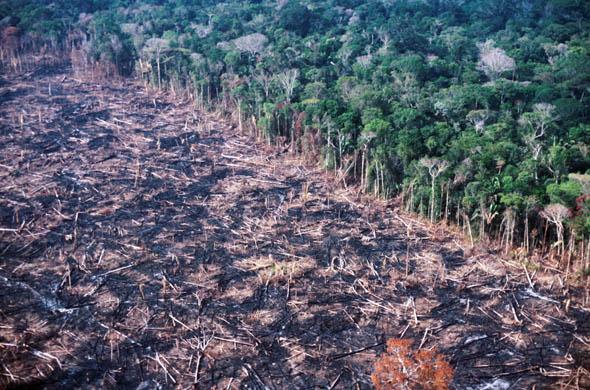
The global ecological system is collapsing and dying as humanity overruns natural ecosystems and the climate. We are entering an age of unrelenting violence and suffering, prior to biosphere collapse and the end of being, unless dramatic social change based upon a global ecology ethic arises quickly.
Humans evolved within a lush and vibrant Eden teaming with life, which until just a few generations ago provided for natural abundance and the prospect of perpetual human existence. We are one of many species utterly dependent upon natural ecosystems for all needs including air, water, food, and shelter.
The rise of ecological colonialism and the industrial revolution changed all that, as million year old naturally evolved ecosystems became fodder to be liquidated and consumed for accumulation of paper wealth. The disambiguation of buying our needs with money has led us to deny our ecological nature.
For two centuries humanity has waged an unrelenting war upon nature. Ecological habitats and their wildlife residents have been slaughtered incessantly. Entire species have been wiped out, as their members have been burnt, shot, tortured, and left to starve. Whole ecosystems have been dismantled to create throw away consumer crap that quickly is thrown away.
Concurrently Western science has learned what indigenous peoples have long known, that we are but one species in a web of life. That all is one, intertwined in a miraculous system whereby life creates the conditions for life. And that as goes nature befalls us. Those in touch with nature realize ecology is the meaning of life. And that without ecology there can be no economy.
It has become increasingly obvious to experts and astute lay persons that the ecological fabric of being is fraying. We now know that ecological boundaries exist, and that the human endeavor has overshot them. Old-growth forests remain as tawdry remnants, soil has become lifeless and sterile, oceans are dying, and water and food are scarce for humanity and kindred species.
Ever expanding human numbers have lost sight of our place within ecology, and have little knowledge of the natural world. Instead well-being is defined by mobile apps and expensive play-things that soon grow old and are discarded. For many life is a vacuous search for status and stuff. And for the rest – the large percentage of people living in abject poverty – life is a squalid struggle to meet basic needs amidst Disneyfied conspicuous over-consumption by celebrities and bankers.
Long a war-prone species, humans have concurrent with ecocide nonetheless undergone remarkable social evolution whereby slavery’s prohibition, women’s rights, freedom of thought, and representative democracy has largely been achieved. Nonetheless attempts last century to eliminate war have failed miserably. Over-populated inequity in an age of resource scarcity – stoked by grotesquely wasteful over-consumption by the few – fuels a rise of authoritarian fascism and conflict between the haves, have-lesses, and have-nots.
Few diagnose the state of perma-war waged by lone terrorists and drones as the result of environmental decline. Yet the coming anarchy can be seen all around us, by those who wish to see.
Streams of refugees flee collapsing ecosystems and abrupt climate change. Traditional food stocks from the oceans and forests are virtually exhausted. The act of saving seeds has become a radical act of resistance as all that is natural is commodified, homogenized, and toxified.
All around are well-meaning peoples pursuing pieces of the solution. Organic permaculture, ending fossil fuels, protecting and restoring natural ecosystems, consuming less, and more are occurring. But it is too little too late by orders of magnitude as the sheer inertia of ecocide found in mass conspicuous over-population and consumption prepares its final assault upon the natural world.
Already societies and economies are collapsing, from Syria to Haiti, and including the downturn in economic aspirations for the petty-bourgeoisie. The Earth’s capacity to provide for human well-being is collapsing. Every last natural ecosystem is to be mopped up for chopsticks and the last drop of oil. Not only will your children not have more than you have, they may die in an unimaginably horrendous ecological apocalypse.
Every month without the rise of ecologism, we fall deeper into nothingness, as the signs of sick ecosystems and dysfunctional climate are written off by the ecologically challenged. Soon as the pillages of war and ecocide come to your neighborhood you can expect to know hunger, disease, and the bad kind of anarchy.
Expect to face firsthand the terror of biosphere collapse – where your mothers and daughters are raped, along with your sons sold into the military and other forms of slavery, before they and you die like famished stray dogs on a dead Earth.
The global ecological system is collapsing and dying.
We are a clever species, with opposable thumbs and relatively large brains. Perhaps the Internet community and the sense of the human family it engenders can help us realize there is no god but Earth, that we are one people, and that we are one species of animals amongst many. And that we can choose to return to nature’s fold.
All that is green and natural must be protected in earnest and urgency with all our might or the biological foundation of being ends. Start with growing your food and restoring the land, reject personal cars and large families, and work outward to reconnect your community to its peaceful and healthy bioregion.
Otherwise the hairless ape show all intentions of pulling down the biosphere as we frantically seek more not understanding there is no more to be had. The sky is falling. The end of being looms.

Human Rights Abuses: A Recurring Alarm On Modi's Travels Abroad!

George Abraham

As Prime Minister Modi is about to embark on his fourth visit to the U.S. in the last two years, U.S. lawmakers have sharply criticized India’s human rights record. In a speech in New Delhi, U.S. Senator Benjamin L. Cardin (D-Md), the ranking minority-party member of the Senate Foreign Relations Committee, called on India to “do better” to address issues of violence against women, government corruption, extra-judicial killings, human trafficking and outdated anti-conversion laws that are still in use. “ A country must respond to these challenges,” he said.
Modi faced similar criticisms and faced protest demonstrations from one group of another every time he has touched down on the American soil. However, these strident criticisms from prominent lawmakers on the eve of Modi’s address to a joint session of Congress reveals a deep-seated reservation by many in Washington of a leader who once was denied entry into the country based on his human rights record.
At a Congressional hearing held a week ago in Washington, Bob Corker (Chairman of the Foreign Relations Committee R-Tenn) and Timothy M. Kaine (D-VA) questioned State Department officials on India’s human rights issues, including its crackdown on nongovernmental organizations receiving foreign funding such as Greenpeace and Ford Foundation, rising intolerance and India’s recent decision to deny visas to the members of the U.S. Commission on International Religious Freedom who were planning to travel to India.
Undoubtedly, the Indian American Community as a whole would like to see the bi-lateral relations between the U.S. and India strengthened and the progress achieved in the last decade or so to be consolidated between these two democracies. However, a strategic alliance is a partnership that would require trust and confidence in each other for a long term value creating relationship. There is no doubt that both of these nations need each other in the new world order, and the question is whether these two countries are at a point where they are ready to move forward with such a commitment.
Therefore, it is pertinent to analyze the upcoming visit of the Prime Minister from that vantage point. If the objective of the collaborative relationship is to achieve success for both nations, how can one advance that notion while justifying the denial of visas to a U.S. government body that monitors the core tenets of both of these democracies: freedom and justice? The appropriate action ought to be in assisting each other to achieve these goals and together building a stronger relationship.
For those who are advocating more reliable protection of religious freedom got a boost recently when Congress upgraded the ‘Frank Wolf International Religious Freedom Act’ giving Administration and the State Department new political tools in monitoring and creating watch lists. The legislation has also upgraded the office to Ambassador-at-large, who will be directly reporting to the Secretary of State. It includes a provision as well directing the President to focus sanctions on individuals who carry out or order religious restrictions. The impact of these rules will eventually be felt across the board while nations draft agreements ranging from Trade to environment and Defense purchases.
President Obama’s speech in New Delhi, to a great discomfiture of Modi, was a parting shot directed at his government to modify its behavior as regards respecting the pluralistic legacy of the modern India. He listed the relevant articles in the Indian Constitution to make his case. Despite the public posture, one could detect a chasm between these two leaders who seem to think and view things from different perspectives.
I have been told that at a recent dinner party in Washington, a former official was standing in line to greet President Obama. While shaking hands, the official congratulated the President for the bold statement he has made in New Delhi. First, he smiled and let go his hands and ready to greet the next guest, but on second thought, leaned forward, tapped his shoulder and said ‘I meant every word of it.' That says a volume of the thinking in Washington, especially with this White House.
However, U.S. is dealing with a different India today that has gained stature as a growing economic power and a global player that has to be respected and may even be courted. For the U.S, the changing dynamics in Asia necessitates new alliances and reliable partnerships. A rising China has created new challenges for the U.S. in that part of the world and past agreements like the Indo-US civil nuclear deal points to a strategy of exploring ways to sustain their global engagement capability. Also, a 4 million strong Indian immigrant community in U.S. has become vocal supporters of close collaboration between these two countries, often lobbying with their Senators and Congressmen.
Despite all these natural advantages, India seemed to have put in a lot of effort in convincing the U.S. authorities for this ‘state visit’ and the upcoming appearance before the joint session of Congress. There are unconfirmed reports of a quid-pro-quo as regards major defense purchases preceded by a veiled warning of India taking its defense purchases elsewhere if the same level of respect is not accorded to Modi as it was with Dr. Manmohan Singh, his predecessor. It is widely known that the sound of money garners a lot of mileage in Washington just as in any other capital around the world. Apparently, Modi is getting his requital by gaining an opportunity to bloviate before those who once denied him a simple entry visa to the country.
However, if India has to gain genuine respect and to be able to operate from a position of strength and moral clarity, it has to start dealing with some of the issues the lawmakers have raised. Last two years have witnessed a growing intolerance in the country with attacks on places of worship of minorities, the murder of secular advocates and harassment of liberal thinkers. People are afraid that even their dietary habits like eating beef could cost them their lives. The HRD ministry has been converted to become a vehicle to promote the ‘Hindutva’ ideology across campuses by shutting down Dalit student organizations and applying sedition charges on students for mere sloganeering.
BJP and its followers seemed to believe that they have a monopoly in defining what constitutes nationalism, and it has become a cause of confusion and conflict in many university campuses. History teaches us that ultra-nationalism is a sentiment of superiority and aggression towards others or other countries. It is intrinsically connected to war and imperialism. Therefore, India as a pluralistic nation will be treading on dangerous waters with the ongoing nationalist campaign, and the Prime Minister has a great responsibility to set the right tone for the country.
Indian Diaspora in U.S. is much more a diverse community representing different regions, languages, cultures and faiths than what it is given credit for? According to latest statistics, 51% of the Diaspora consists of Hindus and the rest includes Muslims, Sikhs, Christians, Buddhists and other faiths. Indian Diaspora is primarily taking the shape of Hindu Diaspora due to the cultural identity, and most of the Indians including those who belong to other religions accept it as a practical matter. However, Hindu Swayamsevak Sangh (RSS branches outside of India) is becoming increasingly assertive in demanding unflinching patriotism and preservation of Hindu culture and continuing with their efforts to present a monolithic view of the Indian Diaspora to the American public. It is alleged that many of the Diaspora organizations are raising money under the cover of 'charity' and ‘development’ to support RSS and its affiliates to wage violence against religious minorities in India.
There is little doubt that the RSS cadre is playing a prominent role in many of the Modi’s visits around the globe, particularly wherever there is a significant Indian community. It is only laudable that the Diaspora is enthusiastic and heartwarming towards any visit of a Prime Minister from their motherland. However, when that community is used as political pawns by turning them into a weapon against those who want to express their grievances; it not only defeats the purpose and good will but rather pits one group against the other and imports the same level of polarization and divisions to the country of their adoption. The recent attempt by Sangh organizations to reserve all 25 grounds on the Capitol Hill on the day of Modi’s visit to address the joint session of Congress is a case in point. That ‘clever’ and calculated maneuver made it almost impossible for any other groups to gather near the venue and air their dissenting point of view that is protected under the U.S. Constitution. It is quite obvious to any independent observer that the objective of such action is to stifle criticism and banish any dissent which is contrary to the spirit of democracy, and it is quite appalling to see it happening right here in U.S.
It is time for the Prime Minister to be more assertive in addressing these concerns at home and abroad and speak out forcefully when human rights violations occur in India. Unless he can align the actions of the radical elements of his party in line with his lofty pronouncements abroad, the human rights issue will continue to cast a shadow on his trips abroad, especially to U.S. Alfred Whitney Griswold who once said the following: "Books won’t stay banned. They won’t burn. Ideas won’t go to jail. In the long run of history, the censor, and the inquisitor have always lost. The only weapon against bad ideas is better ideas". Let freedom reign!

Obama Slams Door In Putin’s Face

Eric Zuesse

Actions speak louder than mere words, and U.S. President Barack Obama has now acted, not only spoken. His action is to refuse to discuss with Russian President Vladimir Putin, Russia's biggest worry about recent changes in America’s nuclear strategy — particularly a stunning change that is terrifying Putin.
On Sunday June 5th, Reuters headlined “Russia Says U.S. Refuses Talks on Missile Defence System”, and reported that, "The United States has refused Russian offers to discuss Washington's missile defence programme, Russian Deputy Defence Minister Anatoly Antonov was quoted as saying on Sunday, calling the initiative 'very dangerous’."
Russia’s concern is that, if the "Ballistic Missile Defense” or “Anti Ballistic Missile” system, that the United States is now just starting to install on and near Russia’s borders, works, then the United States will be able to launch a surprise nuclear attack against Russia, and this system, which has been in development for decades and is technically called the "Aegis Ashore Missile Defense System”, will annihilate the missiles that Russia launches in retaliation, which will then leave the Russian population with no retaliation at all, except for the nuclear contamination of the entire northern hemisphere, and global nuclear winter, the blowback from America’s onslaught against Russia, which blowback some strategists in the West say would be manageable problems for the U.S. and might be worth the cost of eliminating Russia.
That theory, of a winnable nuclear war (which in the U.S. seems to be replacing the prior theory, called “M.A.D.” for Mutually Assured Destruction) was first prominently put forth in 2006 in the prestigious U.S. journal Foreign Affairs, headlining “The Rise of Nuclear Primacy”, and this article advocated for a much bolder U.S. strategic policy against Russia, based upon what it argued was America’s technological superiority against Russia’s weaponry and a possibly limited time-window in which to take advantage of it before Russia catches up and the opportunity to do so is gone.
Paul Craig Roberts was the first reporter in the West to write in a supportive way about Russia’s concerns that Barack Obama might be a follower of that theory. One of Roberts’s early articles on this was issued on 17 June 2014 and headlined “Washington Is Beating The War Drums”, where he observed that “US war doctrine has been changed. US nuclear weapons are no longer restricted to a retaliatory force, but have been elevated to the role of preemptive nuclear attack."
Russia’s President Vladimir Putin has tried many times to raise this issue with President Obama, the most recent such instance being via a public statement of his concern, made on May 27th. Apparently, the public statement by Antonov on June 5th is following up on that latest Putin effort, by Antonov’s announcement there that Obama now explicitly refuses to discuss Putin’s concerns about the matter.
The fact that these efforts on the part of the Russian government are via public media instead of via private conversations (such as had been the means used during the Cuban Missile Crisis in 1962, when the shoe was on the other foot and the U.S. President was concerned about the Soviet President’s installation of nuclear missiles 90 miles from the U.S. border) suggests that Mr. Obama, unlike U.S. President John Fitzgerald Kennedy in 1962, refuses to communicate with Russia, now that the U.S. is potentially in the position of the aggressor.
Russia is making its preparations, just in case it will (because of the Aegis Ashore system) need to be the first to attack. However, some knowledgeable people on the subject say that Russia will never strike first. Perhaps U.S. President Obama is proceeding on the basis of a similar assumption, and this is the reason why he is refusing to discuss the matter with his Russian counterpart. However, if Mr. Obama wishes to avoid a nuclear confrontation, then refusing even to discuss the opponent’s concerns would not be the way to go about doing that. Obama is therefore sending signals to the contrary — that he is preparing a nuclear attack against Russia — simply by his refusal to discuss the matter. In this case, his action of refusal is, itself, an answer to Putin’s question, like slamming the door in Putin’s face would be. It’s a behavioral answer, instead of a merely verbal one.

Brazil: Police Have Killed Over 2,500 People In Rio Since Rio 2016 Was Announced

Amnesty International

Brazil is on a fast-track course to repeat the deadly mistakes it has been making around policing for decades, made even more evident during the 2014 World Cup, which left a long trail of suffering, Amnesty International said today in a briefing two months ahead of the Olympic Games’ opening ceremony.
Violence Has No Place in these Games! Risk of Human Rights Violations at the Rio 2016 Olympic Games reveals how Brazilian authorities and sports governing bodies in Rio de Janeiro have put in place the same ill-conceived security policies which led to a sharp increase in homicides and human rights violations by security forces since the 2014 World Cup. This jeopardizes the promised Olympic legacy of a safe city for all.
“When Rio was awarded the 2016 Olympic Games in 2009, authorities promised to improve security for all. Instead, we have seen 2,500 people killed by police since then in the city and very little justice,” said Atila Roque, Director at Amnesty International Brazil.
“Brazil seems to have learned very little from the great mistakes it made over the years when it comes to public security. The policy of ‘shoot first, ask questions later’ has placed Rio de Janeiro as the one of the deadliest cities on earth.”
“The country’s historic ill-conceived public security policies, coupled with the increasing human rights violations we have documented during major sports events and the lack of effective investigations are a recipe for disaster.”
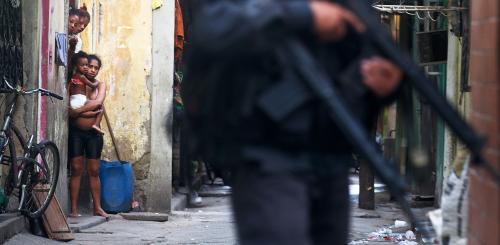
Dozens of people were injured and hundreds arbitrarily detained during police repression of protests across the country ahead of and during the 2014 World Cup. That same year, as police and military were tasked with “securing” the cities where events were due to take place, at least 580 people were killed during policing operations in the state of Rio de Janeiro alone.
In 2014, homicides resulting from police operations rose a shocking 40 percent -- and an extra 11 percent the following year with 645 people killed by police in the state of Rio de Janeiro alone. One in every five homicides in the city were committed by police on duty.
So far in 2016, more than 100 people have been killed in the state of Rio de Janeiro. The vast majority of the victims were young black men living in favelas or other marginalized areas.
Authorities have recently announced the deployment of around 65,000 police officers and 20,000 military soldiers to guard the Olympic Games, in what will be the largest security operation in Brazil’s history. This will include the deployment of military personnel to head operations in favelas, which in the past has resulted in a catalogue of human rights violations that are yet to be properly investigated and sanctioned.
In April 2014, months before the start of the World Cup, thousands of military troops were deployed to the Complex of Maré, a group of 16 favelas located near Rio de Janeiro’s international airport, home to around 14,000 people.
Military troops, who were not properly trained nor equipped to carry out public safety tasks, were supposed to leave soon after the sports event concluded. However, they continued to police the favela until June 2015.
The case of 30-year-old Vitor Santiago Borges highlights the tragic consequences of military policing in the Maré Complex of favelas. In the early morning of February 13, 2015, Vitor was driving back home with some friends when the armed forces opened fire on the vehicle without any warning.
Vitor was severely wounded, fell into a coma and had to remain in hospital for more than three months. He is now paralyzed from the waist down and had a leg amputated. The authorities have failed to provide him or his family with adequate assistance or to conduct a full and impartial investigation into the shooting. No one has been held to account so far.
Amnesty International warns that the lessons from the 2014 World Cup have not been learned. In March 2016, the then President Dilma Rousseff signed a new Antiterrorism Law which includes overly vague language that leaves it open for being unfairly used against peaceful protesters and activists.
Furthermore, on May 10, 2016, the federal government signed a new “General Law of the Olympics.” The law imposes new restrictions to the rights to freedom of expression and peaceful assembly in many areas of the host city which are contrary to international law and standards and do not address the use of unnecessary and excessive force by security forces while policing assemblies.
“Brazilian authorities are not only failing to deliver the promised Olympic legacy of a safe country for all, but are also failing to ensure that law enforcement officials meet international law and standards on the use of force and firearms,” said Roque.
“Two months ahead of the Olympics 2016, there is still time to put in place measures to mitigate the risk of human rights violations and establish accountability mechanisms for those found responsible of violating human rights. As the global sports community gathers in Rio in two months, the question remains: will the authorities respect and protect human rights and deliver the promised legacy of a safe city and country for all?”

Deadlock at Shangri-La: Is There a Way Forward?

Sandip Kumar Mishra


The discussions at the 15th Asian Security Summit (3-5 June 2016), popularly known as Shangri-La Dialogue in Singapore were indicative of the existing deadlock among the countries about Asia’s future security architecture. Overall, the discussions were quite pessimistic. The two most important players in the regional politics – the US and China – openly alleged each other on the issues of escalations in the South China Sea as well as the deployment of the Terminal High Altitude Air Defense (THAAD) system on the Korean peninsula.

US Secretary of Defense Ashton Carter warned China that it was at the risk of ‘erecting a Great Wall of self-isolation’ if it continues its current policies in the region. Carter criticised the Chinese military buildup in the region and said he hoped that “this development doesn’t occur because it will result in actions being taken both by the United States, and actions being taken by others in the region that will have the effect of not only increasing tensions but isolating China.” Japan too made stern statements about Chinese activities in the South China Sea.

In response to the China’s claim that the US and Japan are ‘outsiders’ in the region, Japanese Defense Minister Gen Nakatani said no country could be ‘outsider’ when it comes to regional stability. Responding to the US’ stern words, the Chinese representative at the Dialogue, Deputy Chief of General Staff, People’s Liberation Army, Admiral Sun Jianguo, claimed sovereignty in the region and said China “had no fear of trouble.” He claimed “we were not isolated in the past, we are not isolated now, and we will not be isolated in the future.” He suggested countries, indirectly indicating towards the US, to come out of the ‘Cold War mentality’.

Similarly, on the issue of THAAD, the US defense secretary claimed that the issue of THAAD deployment would be raised during his discussion with the South Korean Defense Minister Han Min-koo. Another defence official of the US even claimed that the US and South Korea would make a ‘public announcement’ about the deployment of a THAAD unit. However, in his bilateral talks with the South Korean defense minister, the Chinese representative Sun Jianguo warned South Korea that “it would destabilize the Asia Pacific region.” Sun said that it would “infringe China’s strategic interests.” Although, South Korea responded by stating that “China is overestimating THAAD” and that his country has “the will to allow THAAD deployment,” in another statement, he denied the US defence secretary’s claim that Seoul would discuss the issue during his meeting with Carter in Singapore.

Actually, it seems that the US and China are not ready to compromise and accommodate each other’s security concerns and a game of ‘staring at each other’ is going on. In the sidelines of the Summit, defence ministers of the US, Japan and South Korea held a trilateral dialogue and stressed their collective efforts to pressurise North Korea via UN resolution 2270 – passed in March 2016 after the fourth round of North Korean nuclear and missile tests. The leaders representing Washington, Seoul and Tokyo were in agreement that a diplomatic engagement with Pyongyang is fruitless, and demanded more cooperation with Beijing towards the implementation of UN Resolution 2270.

It is interesting to note that China appears to be moving in an entirely different direction. Just a few days before the Shangri-La Dialogue, Chinese President Xi Jinping met North Korean Foreign Minister Ri Su-yong in Beijing. This is an important departure from Xi’s approach towards North Korea after he assumed office in 2013. Previously, he had avoided any direct high level contacts with Pyongyang but now there are speculations that he may have a summit meet with North Korean leader Kim Jong-un in the coming months.

Thus, the intensity of the contest in the regional politics was demonstrated at the Shangri-La Dialogue. Although around 500 defence and diplomatic officials and experts from 52 countries, including defence ministers from 23 countries participated in the dialogue, the contest between the US and China was clearly the main theme of the conference.

Unfortunately, a ‘third opinion’ remains almost ineffective in the process.

Washington and Beijing are scheduled to hold their annual high-level Strategic and Economic Dialogue (6-8 June 2016) in Beijing. Hundreds of US and Chinese officials will conduct further discussion on regional issues. The US Secretary of State John Kerry, the US Treasury Secretary Jack Lew, China’s State Councilor Yang Jiechi, and China’s Vice Premier Wang Yang will to participate in the dialogue. However, it appears that both the parties are not ready to budge from their respective positions.

Thus, the 2016 Shangri-La Dialogue showed that great power contests are going to overwhelm peace and security concerns of other countries. It is high time to ask if the great powers of the region remain adamant on the stubborn positions, would not it be correct to articulate a ‘third opinion’? In the cacophony of contests that seems improbable; but if countries like India take the lead in articulating such an ‘opinion’, it would be a positive move for regional security and would also enhance India’s stature and position in regional politics.

Australian economic growth data masks slump and inequality

Mike Head

Australia’s gross domestic product (GDP) grew by 1.1 percent in the first three months of this year, according to official figures released last week. But the result was highly contradictory, pointing to the widening divide between the wealthy corporate elite and the vast majority of working people.
Media headlines proclaimed the strongest result in three years and both the Liberal-National government and the Labor Party opposition sought to exploit the data to boost their pitches for votes in the campaign for the July 2 double dissolution election.
However, while output rose by 3.1 percent over the year to March, real net national disposable income per capita slid 2.6 percent. The income figure—regarded as a measure of living standards—has now fallen for eight consecutive quarters, indicating a protracted decline in the conditions of life for most people.
This “income recession” features falling real wages, reduced working hours and lower government tax revenues. Labour costs for employers dropped in the March quarter, for the second quarter in a row, indicating an accelerating push to lower workers’ incomes. This slump is producing deflation—average prices are declining, fuelling a tendency by companies and consumers to delay spending.
Almost the entire March quarter growth—all but 0.1 percent—was produced by greater export volumes, mostly from recently completed iron ore and liquefied natural gas (LNG) projects. Large mining and resource companies are currently ramping up their production, even as global prices continue to fall or stagnate because of the deepening world slump.
The proceeds are benefitting only the transnational corporations and finance houses that funded the projects, not the tens of thousands of workers retrenched from mines and mining construction sites over the past two years. Super-profits are being made by some of the largest companies in the mining industry, where nearly 15 percent of the workforce has been laid off since 2014.
Moreover, the surge in mining exports, which followed a fall in the previous three months, may prove to be temporary, due to sharp fluctuations in world demand. This further underscores the vulnerability of Australian capitalism to global shocks, especially the volatility and downturn in China, its largest export market.
By contrast to the export rush, consumer and business spending, measured by domestic final demand, grew a mere 0.1 percent in the March quarter, pointing to the recessionary conditions throughout many working class areas and mining towns.
A local breakdown of economic growth prepared for Fairfax Media by SGS Economics & Planning gave some picture of the stark contrast. It showed economic activity has been shrinking in 30 of Australia’s 150 parliamentary electorates since at least 2014-15.
Economic activity in 2014-15 grew at more than 5 percent per annum in the inner suburbs of Sydney and Melbourne. These are the hubs of finance capital, where a debt-laden property bubble is continuing. However, there was contraction in a fifth of all electorates, including in the working class areas of western and southwestern Sydney and outer Melbourne.
The biggest reversals—more than 1 percent annual falls in economic activity—were taking place in working class southern and western Brisbane, the devastated coal mining towns of central Queensland, mining-related areas of Perth and rural South Australia, where major mine closures have added to the impact of manufacturing plant shutdowns in Adelaide.
Prime Minister Malcolm Turnbull hailed the March quarter GDP data, saying it reinforced his election slogan of “jobs and growth.” Turnbull claimed that “we are seeing strong growth in jobs,” due to his Coalition’s “clear economic plan and strong economic leadership.”
At the same time, Treasurer Scott Morrison said while the headline GDP numbers were welcome, the economy was fragile. He insisted the government’s promised $50 billion cut to company taxes over the next decade was essential in order to boost earnings.
While purporting to oppose this tax handout to big business, Labor’s shadow treasurer Chris Bowen also spoke of the “fragile” state of the economy, in a bid to win backing from the corporate elite for Labor’s pledges to restore growth.
Both major parties are relying on the unreal forecasts in last month’s federal budget of a sudden return to high growth by next year. They are trying to scramble back into office by pledging not to slash healthcare, education, childcare and other essential social spending.
Statistics released last week, however, showed that business investment contracted sharply again in the March quarter. The Australian Bureau of Statistics said private sector capital expenditure on buildings, equipment, plant and machinery shrank 5.2 percent, seasonally adjusted, leaving it down 15.4 percent year-on-year.
Mining investment dropped 12 percent in the March quarter, and manufacturing fell more than 10 percent. Outside these areas, there was just a 1.8 percent pick-up in capital expenditure, exposing the official mantra about Australia making a “transition” from mining to an unspecified “new economy.”
Total business investment has been falling in real terms since mid-2012, and is now down more than 25 percent over that four-year period. This precipitous decline means that plant closures and losses of jobs and working hours inevitably lie ahead.
Ironically, the March GDP figure was also boosted by a resulting drop in capital equipment imports. This only highlights the disconnect between the official growth data and the reality of recessionary trends.
International financial institutions and finance houses are increasingly sounding warnings about the Australian economy’s heavy dependence on debt and the property bubble.
The Organisation for Economic Cooperation and Development (OECD) last week said the property boom could crash. “Domestically, the unwinding of housing-market tensions to date may presage dramatic and destabilising developments, rather than herald a soft landing,” its report stated. Australia’s exposure to Chinese markets also remained “an important source of uncertainty and risk.”
A rise in federal and state government debt, which has tripled to about 34 percent of GDP over the past 10 years, has been outstripped by the doubling of private debt, to about 160 percent of GDP over the past 20 years.
“Australia’s household debt ratio has grown above peaks established in countries where housing bubbles formed and burst, as in Ireland, Spain and the United States,” LF Economics reported. “So highly leveraged is the housing market that even small declines in residential land prices will have adverse consequences.”
US investment bank, Morgan Stanley warned that total household, corporate and government debt had reached a 243 percent of GDP, a level that heightened the nation’s vulnerability to a deep downturn or recession. At the same time, nominal GDP growth had collapsed to 2.4 percent a year from its post-1996 average of 6 percent.
Moody’s Investor Services has signalled it may put Australia’s AAA rating on downgrade watch after the election unless deep cuts are made in the $40 billion annual budget deficit. Whatever promises the establishment parties—Labor, Coalition or Greens—make, they will be repudiated rapidly once the July 2 poll is out of the way.

Investigation reveals signs of nationwide US water crisis

Genevieve Leigh

The results of an investigation by British newspaper the Guardian reveal that, in the last decade, 33 major US cities have employed water testing “cheats” deliberately aimed at hiding dangerous levels of lead in their water supply.
The investigation identified three test manipulation methods known to hide actual lead levels: “pre-flushing” water pipes before testing, removing aerators from spouts, and deliberately running water slowly prior to collecting samples in order to prevent more lead from being dislodged from pipes. Each of these methods is in violation of recent US Environmental Protection Agency (EPA) guidelines.
The documents examined by the newspaper also revealed further unethical practices carried out by many state governments, in addition to these three testing methods. In some states, like New Hampshire, water departments were reportedly instructed to perform tests in a manner that allowed enough time to retest, and remove the previous results, if lead levels in the initial samples were found to be too high.
Another example comes from Howell, Michigan, where an official from the department of environmental quality (MDEQ) is recorded in an email instructing a water department director to remove a sample with an unacceptable amount of lead in a deliberate attempt to conceal unsafe levels.
Of the 43 cities investigated, only four were found to be in compliance with EPA guidelines. Over the last 10 years, 33 cities have employed one or more of the above methods. Six were found to have used all three methods, including Springfield, Massachusetts; Lewiston, Maine; Philadelphia: Buffalo, New York; Sebring, Ohio; and Chicago.
This investigation, while substantial in its own right, is made even more damning considering that it was able to uncover so many violations with such a limited scope. The research method employed was simply to contact 81 of the most populous cities east of the Mississippi and request documentation on how they test drinking water for lead. Not surprisingly, only 43 cities responded. It is safe to assume that cities with the more incriminating documented behavior were less inclined to hand over such information.
This ongoing water crisis is, without question, a problem facing more than just the few cities named above. Many of the large cities cited in this investigation sell their water supply to as many as 400 neighboring cities and towns. Studies sparked by previous crimes involving state-sponsored lead poisoning, like that of Washington, DC, in 2001; Durham and Greenville, North Carolina, in 2006; Columbia, South Carolina, in 2005; and Sebring, Ohio, in 2015.
Most recently, studies in Flint, Michigan, have revealed that even incredibly low levels of lead, well under the EPA mandated limit, can be damaging to human development.
In fact, the lead level at which the EPA requires action is not based on any health standard whatsoever. Instead, it is merely the product of a calculation that suggests that water in a minimum of nine out of ten homes susceptible to lead contamination will fall below that standard. In other words, even lead contamination at EPA levels at which action is required could result in significant public health problems.
Despite a congressional ban on lead water pipes in 1986, it is estimated that anywhere between 3.3 million and 10 million old pipes remain in use nationwide. Moreover, most researchers agree that a proper evaluation of health risks involving water quality extend well beyond lead.
There are innumerable contaminants that have yet to be properly researched, or are not tested or regulated. Efforts to reform water quality control have systematically been met by the opposition of various political representatives of the ruling class concerned about high cost of repair or regulations that would hurt profits in industries such as agriculture.
Coming on the heels of the water crisis in Flint Michigan in which 100,000 residents, over 9,000 of them children, have been poisoned by lead contaminated water from the polluted Flint River, the Guardian investigation has exposed the national scope of the crisis, as well as the scope of illegal activities on the part of various municipal governments.
Many local officials in the guilty cities have rushed to assure their constituents that the results of the investigation do not suggest a similar problem to that of Flint. Water department official Debra McCarty of Philadelphia, one of the cities guilty of all three methods, quickly went on record to report the “good news,” saying, “There are clear differences between Flint and Philadelphia.” However, the Guardian investigation suggests just the opposite.
While the case of Flint is an extreme manifestation of this problem, there are undeniable similarities between the events in Flint and other cities throughout the nation. Not only is at least one of the methods cited in this study the exact same manipulation tactic used in Flint to hide the lead contamination, but the outright denial by city officials of scientific evidence is also a characteristic common to the Flint crisis and every other water quality crisis in this country’s recent history.
The blatant attempt to downplay and contain this nationwide crisis to Flint alone, seen most recently by President Obama, shows the growing fear within the ruling class of a potentially explosive situation.
As events in Flint highlighted so sharply in the overwhelmingly bipartisan responsibility, the burden for these large-scale crimes, in part both malice and neglect, cannot be written off as individual mistakes or party-affiliated policy, but rather as a sign of a system in deep crisis.
The failure of the richest nation on the planet to provide even the most basic human necessity to its citizens, clean water, is a clear indication of the abject failure of the capitalist system and increasingly urgent necessity for a reorganization of society along socialist lines.

German government tightens anti-terror laws

Johannes Stern

On Wednesday last week, the German cabinet approved a further tightening up of anti-terrorism laws. Throughout Europe, the terrorist attacks in Brussels and Paris are being used as a pretext for constructing a police state, as happened in the US following the 9/11 attacks in 2001.
In his official statement on the draft legislation, Interior Minister Thomas de Maizière boasted about building a veritable surveillance state: “We have introduced mass data retention, we have strengthened the federal police and Federal Criminal Bureau, we have agreed to new regulations in Europe for the exchange of passenger data and information between police authorities.”
This is “all good,” de Maizière continued. Nevertheless, “following the attacks in Brussels, Paris and Istanbul,” the German government has “asked where there are still security gaps and what needs to be done in order to safeguard our people even more.” He added threateningly, “Knowledge is power. And we want to powerfully oppose terrorist organisations and this includes sharing our knowledge with each other.”
The draft legislation, which the interior minister wants to quickly push through parliament, contains three core points: the intelligence service and Federal Police will be granted more powers; the exchange of data with foreign intelligence services will be expanded; and communication using prepaid mobile phones will be subject to increased control and monitoring. The summary of the draft legislation also states, “Gaps in penal law covering support for the continued operation of banned organisations” will be closed.
If one studies the details of the 39-page draft, it becomes clear how far the measures go. Among other things, the laws covering the operation of the domestic Secret Service, the Foreign Intelligence Service (BND), the Federal Police, state access to Internet data, the law covering voluntary associations, the Federal Criminal Bureau (BKA), telecommunications and the penal code are all to be amended.
In addition, “The basic right of telecommunications secrecy (Article 10 of the constitution), in accordance with Article 5, will be restricted.” This means that “In case of emergency, data collection may be started on the day the application is made before the control measure is agreed.” In other words, in the future, it will be “legal” to start listening in without any form of court order.
The powers of the Federal Police are also to be extended. The modified Article 3 of the Police Act states: “With the insertion of the number 4 in section 28 paragraph 2, the Federal Police, as almost all police forces of the country and the Federal Criminal Bureau, are empowered to operate undercover agents within their jurisdiction to protect public safety and not only for law enforcement purposes.”
Like the BKA, the Federal Police will, in certain cases, be able to secretly record audio and video in private dwellings “without the knowledge of those affected.”
The amended Telecommunications Act stipulates that buyers of prepaid mobile phone must present their identity card, passport or “other valid official document containing a photograph of the holder.”
At the same time, the telecommunications service provider will be obliged under Section 111 (requests for information by the security authorities), “to immediately store the phone number and other subscriber line ID, the name and address of the subscriber, their date of birth, the address of the connection, the device number and the date of service commencement.”
To facilitate the networking of the secret services, the draft states, “For the cooperation with foreign public authorities that are entrusted with intelligence tasks (foreign intelligence agencies), for researching attempts or activities that relate to specific events or groups of people, the Federal Office for the Protection of the Constitution [as the domestic Secret Service is called], can set up shared data files.” Likewise, it can “utilise joint data files that are created by foreign intelligence services.”
Whereas the close collaboration of the German Foreign Intelligence Agency (BND) with America’s National Security Agency (NSA) was regarded as a scandal, this is now to be officially allowed by the domestic secret service.
Given these plans to massively increase state powers, it is hard to avoid the impression that the “disruption of a suspected terrorist cell” in the German city of Düsseldorf announced the following day arrived just on cue for the government and media.
On broadcaster ARD, BND chief Gerhard Schindler pushed for measures to finally deal with “the problems.” These lay “not in the exchange of information, but in the acquisition of information. We need a stronger penetration of terrorist networks with human resources and we need better monitoring of terrorist communications.”
In fact, the circumstances surrounding the arrest of three Syrian citizens by German security authorities last Thursday remain unclear. According to the official statement by the Attorney General’s Office, the four accused “planned to carry out an attack in Germany on behalf of the foreign terrorist group ‘Islamic State of Iraq and Syria (ISIS).’” But the same statement also says, “There is no evidence that the accused had already initiated the concrete implementation of their attack plan.”
While politicians and the media are stirring up a permanent hysteria about terrorism, it has become clear that the state of emergency proclaimed in France and Belgium does not serve the struggle against Islamist terrorist networks. Rather, the extensive increase in state powers is directed against the growing resistance of workers and youth. The French government is using its emergency powers to disperse occupations, ban peaceful demonstrations and threaten long prison terms for protesters who are opposing the reactionary El Khomri labour reforms.
The increase in state powers in Germany has the same aim. The first anti-terrorism legislation in Germany was introduced by the then-Social Democratic Party-Green Party government parallel to the introduction of the Hartz welfare and labour reforms. The tightening up of terror laws heralds even harsher attacks on the working class.
In its edition last Wednesday, the conservative daily Die Welt warned that the German economy was losing “its competitiveness” and Germany its “attractiveness.” The main reason identified by the newspaper was the weak “economic performance in relation to capital—a trend which is mainly due to the higher cost of labour.”

Who will follow the example of Muhammad Ali’s principled stand in our day?

David Walsh

The death of former heavyweight boxing champion Muhammad Ali, who, in his day, was a symbol of protest and resistance, has prompted the inevitable and instinctive effort by the establishment to appropriate his legacy for their own cynical uses.
It is hard to believe that more than half a century has passed since the first bout between Cassius Clay (Ali’s birth name) and Sonny Liston in February 1964 and more than 40 years have come and gone since Ali’s astonishing comeback.
Ali was a great athlete, but one could reasonably argue that he made his chief mark on history and popular consciousness by his courageous opposition to the Vietnam War. A product of rebellious times, Ali earned the admiration and respect of tens of millions around the globe for his act of protest.
After upsetting reigning heavyweight champion Liston in February 1964 at the age of 22, the boxer aligned himself with the black nationalist Nation of Islam and changed his name to Muhammad Ali. He defended his title numerous times, before announcing in 1966 that he would not serve in the US military and then refusing induction into the armed forces a year later.
Ali explained at the time: “My conscience won’t let me go shoot my brother, or some darker people, or some poor hungry people in the mud for big powerful America. And shoot them for what? They never called me nigger, they never lynched me, they didn’t put no dogs on me, they didn’t rob me of my nationality, rape and kill my mother and father... Shoot them for what?... How can I shoot them poor people, Just take me to jail!”
Ali’s boxing license was immediately suspended and his title stripped from him by the cowardly, “patriotic” boxing authorities. He was widely vilified by sports writers, generally among the stupidest and most superficial members of the journalistic fraternity. The venerable Red Smith claimed that the fighter had made himself “as sorry a spectacle as those unwashed punks who picket and demonstrate against the war.” Another sports writer-sage, Jim Murray of the Los Angeles Times, termed Ali a “black Benedict Arnold.”
Ali was convicted at a trial in June 1967 and sentenced to five years in prison. For four years, when he was at the height of his physical powers and his case was winding its way through the courts, Ali was unable to fight. The US Supreme Court finally tossed out his conviction in 1971. During his suspension he toured the country, speaking at hundreds of colleges and universities in opposition to the war in Vietnam and on other social issues. Ali would regain his boxing license and go on to take back his heavyweight title, lose it in the ring, and then win it back a record third time.
By all accounts, his noisy, self-promoting and occasionally cruel outbursts aside, Ali was a kind and decent man. In an often barbaric sport, he exhibited great gifts, remarkable grace and elegance, and enormous physical courage. Moreover, Ali had a devilishly sharp wit. He was not only impressive in the ring but could hold his own in the company of experienced interviewers and antagonists, and even best them.
Ali’s decision to join the Nation of Islam does not speak to his perspicacity, but it has to be viewed in context: official American political life, only emerging from the depths of McCarthyite anticommunism, had nothing to offer. The most oppressed layers of the population were hunting around for some viable form of opposition.
There is no reason, of course, to idealize the boxer or make his ideas out to be more coherent or progressive than they were. Ali was all over the place ideologically, and by 2005 he was sufficiently domesticated or worn down by age and health issues to accept a Presidential Medal of Freedom from the arch-war criminal, George W. Bush.
Nonetheless, in early 1966, when opposition to the Vietnam war was not yet a mass phenomenon in the US, Ali’s stance was principled and inspiring. It certainly contributed to and encouraged public disaffection. By the time he refused induction on April 28, 1967, protest demonstrations of hundreds of thousands of people had taken place in New York City and elsewhere, including one on April 15 of the same year (addressed by Martin Luther King, Jr.).
To root for Ali at the time was to root for opposition. He emerged as a public figure in an era when hostility to the status quo was a mass popular reality. In the US, Newark, Detroit, Los Angeles and other major cities went up in flames in the mid-1960s. The latter part of the decade witnessed the anti-Vietnam War movement and expressions of protest on every college campus. Big national strikes and battles between American workers and police on picket lines were on the order of the day. Internationally, hated dictatorships fell in Greece, Spain and Portugal. The global crisis reached its potentially revolutionary peak in the great French general strike, in which ten million people participated, in May-June 1968.
The dead, of course, cannot defend themselves against the exploitation of their lives and activities for utterly rotten purposes. Inevitably, President Barack Obama took the occasion of Ali’s death to present an unsuspecting public with another example of his almost supernaturally sinister hypocrisy and cant.
In a statement, Obama asserted that Ali “stood up when it was hard; spoke out when others wouldn’t. His fight outside the ring would cost him his title and his public standing. It would earn him enemies on the left and the right, make him reviled, and nearly send him to jail. But Ali stood his ground. And his victory helped us get used to the America we recognize today.”
As though Obama, the ideal president for spies, policemen and investment bankers, would know anything about “standing up” and “speaking out” when there might be a price to pay. Has this individual ever taken a single step, twitched so much as a muscle, without ensuring himself well ahead of time that it would find approval with the powers that be?
It is a remarkable commentary on the putrid state of the media and public intellectual life in America that Obama can make such an astounding statement without anyone calling him to order. The US president praises Ali for being prepared to go to jail—this from the relentless, vindictive persecutor of Chelsea Manning, Julian Assange and Edward Snowden! Dead and buried opponents of imperialist war are so much less threatening!
“Muhammad Ali shook up the world. And the world is better for it,” asserted Obama, the dispatcher of drone strikes that terrorize entire populations, the presider over “kill lists” that spell incineration for men, women and children in various parts of the globe.
One element of Obama’s statement did ring true: his obvious astonishment at Ali’s willingness to sacrifice career and income for principles. This speaks to a wider and genuinely disturbing problem: how is it possible that we are forced to look back to the 1960s for examples of political courage of this kind?
The United States has been at war with the rest of the world for a quarter-century. During that time, innumerable athletes, actors, musicians, artists, scientists and others have received honors at the hands of Bill Clinton, Bush and Obama, each president guilty of policies leading to the death of hundreds of thousands of human beings or more. Not a soul, as far as the public is aware, has turned down an award, spoken out at the White House or the Kennedy Center or generally repudiated honors from one of these blood-soaked administrations.
That list of honorees—some of whom have histories of social protest or at least independent thought—includes such figures as Sidney Poitier, Meryl Streep, Bob Dylan, Aretha Franklin, B.B. King, Stevie Wonder, James Taylor, Jack Nicholson, Paul Simon, Warren Beatty, Ossie Davis and Ruby Dee, Robert De Niro, Bruce Springsteen, Mel Brooks, Dustin Hoffman and Lily Tomlin.
Stagnant, opportunist times have encouraged submission and quiescence. In such periods of social indifference, as the Russian Marxist Plekhanov once noted, many souls fall into “a cold slumber” and “their moral level sinks very low.” The sooner we fully emerge from such times the better!