7 Jun 2016

Sri Lankan armoury explosion forces thousands to flee

W.A Sunil

A massive explosion in an armoury at the Salawa army camp on Sunday forced thousands of people to flee their homes, fearing for their lives. The military complex is located in a highly-populated area at Kosgama, just 33 kilometres east of Colombo. So far, one soldier’s death has been reported and about 50 people have been treated for injuries or respiratory problems.
Sri Lankan soldiers and police were yesterday trying to find and defuse unexploded bombs or rockets that fell on villages. Hundreds of homes were destroyed after the raging ammunition fire triggered a series of blasts that sent shrapnel flying into the air. AFP said its photographer saw commandos collecting four unexploded rockets from one house garden.
Residents did not know such a huge armoury had been set up near their villages. It was one of the biggest ammunition storages in the country, with a large stock of rocket-propelled grenade shells and heavy artillery weapons. According to some media reports, there were 600 containers of ammunition.
The blaze broke out at about 5:30 p.m. on Sunday and continued till 10:00 a.m. on Monday. The intensity of the explosions and fire was such that the fire brigade could only reach two kilometres from the location. Colombo Fire Brigade chief operating officer Rohitha Fernando said: “None of the trucks have entered the camp as it’s not safe to go inside. We have not handled this magnitude of armoury fire.”
It was the largest ammunition blast since an armoury explosion at Vavuniya in Northern Province during 2009. No explanation has yet been provided by the government or the military authorities.
Hearing huge noises, panic-stricken people around the army camp ran to seek safety. The police and the army then issued an announcement, asking those living within a five-kilometre radius to vacate the area. Many people were seen running, some unable to access a vehicle. The main highway running past the military complex was closed five kilometres on either side.
Many residents stayed at wayside shelters, while others took refuge at temples or schools. Some people returned to their homes yesterday to see destroyed or damaged houses. However, residents who live within a one-kilometre radius were barred from returning to their homes. The army said the area would be cleaned up by Thursday.
One resident, Trince Samantha Lal, told the World Socialist Web Site: “Suddenly we heard a huge explosion, like thunder. When we came out of the house we saw huge black smoke coming from the camp and the explosions were continuing. The police said to vacate the area, but people had not enough facilities. With my family, we went to my mother’s house about six kilometres away from the camp. Some who fled the area spent the night at temples and schools and some stayed with their friends and relatives.”
Another resident living near Hanwella township, some four-and-a-half kilometres from the camp, said: “There was a bright orange glow in the sky around the camp and regular explosions with short intervals. About 15 kilos of debris from the explosion fell in the garden of my neighbour. The people in the area were panicked and terrified. Many people, including my family, walked some three kilometres for safety because there was a huge traffic block and no transport facilities.”
According to the area administrative officer, M.M.S.K. Bandara, about 300 houses and two factories within one kilometre were destroyed. Many homes in villages near the army camp, including Salawa, Kaluaggala, Suduwella, Mavilgama, Katugoda north, Akaravita, Bandigamapola and Kosgama north and east, have been badly damaged.
According to Bandara, about 18,628 people have been displaced. They are staying in 11 camps. People fear they will not be able to return to their houses. Many are relatively poor rural people. Behind the Salawa army complex there is also a village built for disabled soldiers and soldiers’ widows. Residents have been warned not to drink water from wells until they are cleaned.
The armory was established, without the residents being informed, in early 2000 as part of the huge military buildup during the 26-year war against the separatist Liberation Tigers of Tamil Eelam. The military base took over a major complex of buildings from the liquidated state-owned Plywood Corporation.
Samantha Lal said during the war that the army brought arms to the camp. “When they brought them [the ammunition] they closed roads and number of army trucks would come. But people did not know what was going on, or the size of the armoury, or the danger they would face in an incident like this.”
Locating a major ammunition depot in a residential area underscores the utter disregard of successive governments for the lives of the ordinary people. All the establishment parties are directly responsible for the catastrophe.
In an attempt to deflect blame, former President Mahinda Rajapakse claimed that his administration had planned to relocate the ammunition dump from the built-up area before he was defeated in the January 2015 presidential election.
Fearing that the disaster will intensify his government’s political crisis, President Maithripala Sirisena called a national security council meeting yesterday and ordered a court of inquiry to investigate the cause of the explosion. Law and Order Minister Sagala Ratnayake said the government had also ordered an inquiry by the police criminal investigation department.
Prime Minister Ranil Wickremesinghe visited the area yesterday and held a meeting with administrative officers. According to media reports, Wickremesinghe pledged to build or repair all the damaged houses. The army made a similar promise.
However, people expressed doubts about whether they will have their houses repaired and be able to return. Just a month ago, hundreds of thousands of people in Colombo and suburbs, including in this area, fled their homes because of floods.


Maoists take cabinet positions in Philippine government

Joseph Santolan

Since Rodrigo Duterte’s election as president of the Philippines in early May, his administration, which will be inaugurated into office on June 30, has taken on an ever-more openly fascistic character. At the same time, the Maoist Communist Party of the Philippines (CPP) has become increasingly vocal in its support for his government and opened peace talks to end its 47-year armed struggle. Three of its leading representatives have been installed in cabinet-level posts in his administration as secretaries in the Department of Social Welfare and Development, and the Department of Agrarian Reform, and as undersecretary in the Department of Labor and Employment.
Over the past week, with Duterte’s explicit encouragement, police and vigilante groups have carried out at least ten summary executions of alleged criminals throughout the country. The victims had their hands tied behind their backs and were repeatedly shot in the back of the head. Cardboards signs were left on the corpses, stating they were drug pushers or petty thieves. At least one cardboard sign read “#DU30”—the social media hashtag of the newly-elected president.
Duterte told a press conference the majority of journalists murdered in the Philippines deserved to be assassinated because they were “rotten sons of bitches.” The Committee to Protect Journalists (CPJ) lists the Philippines as the third most dangerous country to be a journalist, after Iraq and Syria. The Philippines, however, is not a war zone. All the journalists killed in the country have been the victims of targeted assassinations.
Duterte announced he would no longer hold any press conferences, or allow himself to be interviewed or questioned by reporters. All press releases, he stated, would be coursed through the government-owned TV channel, PTV-4. The last Philippine president to manage the press in this manner was Ferdinand Marcos, after his declaration of martial law.
All these measures, from the creation of death squads to the moves toward suppressing the freedom of the press, are being prepared to crack down on emerging struggles of the working class. Duterte’s presidency has the support of leading sections of the Philippine ruling class and of international finance capital. The Washington-based think tank, the Center for Strategic and International Studies (CSIS), wrote on June 6 that Duterte “promised to continue and maintain the successful macroeconomic policies” of outgoing President Aquino. They hailed Duterte’s stated intention to allow increased foreign ownership of Philippine corporations.
Duterte is thus heading a government that is preparing to crack down on and murder the working class at the behest of international finance capital. The task of building a base of support for this fascistic program in the petty bourgeoisie and among various lumpen elements rests with the Communist Party of the Philippines (CPP).
The Maoist CPP has given its support to Duterte for decades, while he headed the notorious Davao Death Squads as mayor of the southern city. Elements from the CPP’s New People’s Army (NPA) have long been reported to have assisted in the assassinations carried out by these death squads. The NPA participated in the vigilante violence of the past week, carrying out a raid on a town in Davao Oriental in support, it told the press, of Duterte’s campaign against drugs.
On his election, Duterte offered four cabinet posts to the CPP, calling on Joma Sison, the founder and head of the party, to select his appointments. Sison hailed Duterte’s offer as “magnanimous.” Thus far, three CPP nominees have been appointed. These positions are not simply rewards for the CPP’s support. The CPP-appointed officials will be directly responsible for carrying out the suppression of the working class.
Selected to head the Department of Social Welfare and Development (DSWD) was Judy Taguiwalo. Taguiwalo was a national council member of one of CPP’s youth wings, the Samahang Demokratiko ng Kabataan (SDK), in the early 1970s. She was in the leadership of the Nationalist Corps, a student-based front organization responsible for carrying out charitable projects in poor communities in order to win their support for the CPP. After the declaration of martial law, she went underground with the party, re-emerging after Marcos’s downfall to take up a position as Professor of Women’s and Development Studies at the University of the Philippines (UP).
Taguiwalo announced she would continue the Aquino administration’s Conditional Cash Transfer program. This program, pushed by the World Bank, uses a limited cash subsidy for small sections of the poor who qualify, as a means of implementing austerity measures and slashing social infrastructure.
Appointed head of the Department of Agrarian Reform (DAR) is Rafael Mariano. The long-time head of the CPP’s peasant wing, the Kilusang Magbubukid sa Pilipinas (KMP), Mariano led peasants in 1987 in a march to request land reform from President Corazon Aquino’s Ministry of Agrarian Reform. The CPP leaders said they were looking to “meet Your Excellency in a dialogue.” Aquino’s military forces opened fire, killing 13, in what became known as the Mendiola Massacre. When Aquino died in 2009, Mariano attended public masses to honor Aquino and to pray for the well-being of her soul.
Joel Maglungsod, vice president for Mindanao of the CPP trade union umbrella Kilusang Mayo Uno (KMU), was made undersecretary of the Department of Labor and Employment (DOLE). When Duterte announced in February that he would kill workers who attempted to organize a union in Export Processing Zones (EPZ), Maglungsod issued a press release describing Duterte’s statement as “hyperbole.”
These three departments—Social Welfare, Agrarian Reform and Labor—serve as arms of the state for policing the poor, the peasantry and the working class. The CPP appointees to these positions will be directly responsible for carrying out the dictates of capitalism via an increasingly fascistic government against the working class.
The CPP’s various front organizations are working to whip up illusions in Duterte. Renato Reyes, national secretary of the CPP umbrella front organization, Bagong Alyansang Makabayan (BAYAN), wrote: “We support the progressive and nationalist goals and program of the new government.”
Carol Araullo, national chair of BAYAN, penned a more extensive justification of Duterte’s administration in her regular column in Business World, the leading business daily in the country. Araullo described Duterte’s government as “apparently inconsistent.” Duterte was “continuing the neoliberal economic policies of the Aquino government while offering socio-economic cabinet posts to the communists.” This seeming contradiction, however, was an example of Duterte’s “exceptional brinksmanship.” Duterte was “proving that an avowed Leftist and Socialist can win and wield the Presidency while reassuring the Right that he will keep his oath to preserve the system.”
Araullo’s perspective is a damning indictment of the CPP’s nationalist politics, which are entirely in the service of the bourgeoisie. She admits that Duterte is carrying forward Aquino’s policies of austerity and repression, which over the past six years have presided over mounting social inequality.
The fact that Duterte is installing “communists” into his cabinet, is only “apparently” contradictory. Duterte can install the CPP into his government and “reassure the Right” at the same time, precisely because the CPP’s politics are hostile to the working class.
From its inception, the CPP has been based on the Stalinist two-stage program, which stated that the tasks of revolution in the Philippines were national and democratic only, and not yet socialist. The working class, the CPP claimed, should not fight for its independent class interests but ally with its enemy, the bourgeoisie, in the name of national democracy. Time and again, this program has led to the betrayal and murder of the working class. The alliance with Duterte is the most criminal demonstration of the bankruptcy of the CPP’s politics.
As Duterte and Sison engage in peace talks and negotiate the role of the CPP in the new administration, the working class must take warning. These forces are preparing immense betrayals and class suppression.

NATO launches largest anti-Russian war game since Cold War

Alex Lantier

Military tensions surged yesterday in Europe as NATO launched Operation Anaconda, the largest NATO military exercise in Eastern Europe since the end of the Cold War a quarter century ago, when the Stalinist bureaucracy dissolved the Soviet Union in 1991.
Some 31,000 troops, 3,000 vehicles, 105 aircraft, and 12 warships are participating in war games based on a scenario that war erupts between NATO and Russia, a nuclear-armed power. European defense officials in Warsaw said the scenario was one where there is “a mishap, a miscalculation which the Russians construe, or choose to construe, as an offensive action.”
The largest contingents in the exercises are 14,000 troops from the United States, 12,000 from Poland, and about 800 from Britain, as well as other forces, including from non-NATO countries. They will be commanded by Polish Lieutenant General Marek Tomaszycki.
Operation Anaconda is a massive provocation, effectively amounting to a dress rehearsal for a NATO invasion of Russia. In the exercise, for the first time since the Nazi invasions of Poland and the Soviet Union during World War II, German tanks will cross all of Poland from west to east.
With staggering recklessness, NATO officials are launching exercises dangerously close to Russian soil, even as security analysts acknowledge that this creates a situation where miscalculations could lead to war between NATO and Russia. According to the British Guardian, “defence experts warn that any mishap could prompt an offensive reaction from Moscow.” The daily cited Marcin Zaborowski, an official of the Center for European Policy Analysis, as admitting that the international situation surrounding Operation Anaconda is “tense, and accidents can happen.”
Russian officials reacted aggressively against escalating NATO military activity along Russia’s borders. The exercises in Poland come as 5,000 NATO forces carry out exercises code-named Operation Iron Wolf in Lithuania, the largest NATO deployment to Lithuania in several years, and amid NATO military exercises in Latvia, another Baltic republic bordering Russia.
“We do not hide that we have a negative attitude toward the NATO line of moving its military infrastructure to our borders, drawing other countries into military unit activities,” Russian Foreign Minister Sergey Lavrov said in Moscow. “This will activate Russia’s sovereign right to provide its own safety with methods that are adequate to today’s risks.”
Russian Permanent Representative to NATO Aleksandr Grusho said yesterday that Moscow would closely analyze NATO military activity in the region during the exercises. Russian military sources indicated that they would move three divisions closer to Russia’s western borders in response to the exercises, likely motorized rifle units of about 10,000 men each.
Operation Anaconda goes hand in hand with US and NATO operations aiming to encircle Russia’s entire western border, from the Baltics and Eastern Europe to the Balkans. Last month, NATO officials set up a missile base in Deveselu, Romania, and began work on a similar base at Redzikowo in northern Poland.
Yesterday, the US guided missile destroyer USS Porter sailed through the Bosphorus into the Black Sea with a strengthened missile armament—a year after a similar US warship in the Black Sea, the USS Ross, nearly violated Russian territorial waters, prompting a standoff with Russian warplanes.
All of these aggressive actions come in the run-up to the July 8-9 NATO summit in Warsaw, which is expected to further escalate NATO deployments to the Baltic region and tighten ties between NATO and former Soviet republics including Ukraine and Georgia, in the Caucasus.
Twenty-five years after the dissolution of the Soviet Union, the disastrous geopolitical implications of this event are ever more evident. The elimination of what capitalist propagandists of an earlier era called the “communist menace” did not lead to a flowering of peace and prosperity under the aegis of a capitalist European Union (EU). Rather, the dissolution of the Soviet Union and of the Warsaw Pact threw Eastern Europe open to imperialist intrigue and war plotting by Washington and its major allies in Europe.
The assurances NATO gave Moscow decades ago that its strategic interests would not be threatened have proven worthless. The 1997 NATO-Russia Founding Act said: “in the current and foreseeable security environment, the [NATO] Alliance will carry out its collective defense and other missions by ensuring the necessary interoperability, integration, and capability for reinforcement rather than by additional permanent stationing of substantial combat forces.”
Instead, as NATO absorbed countries across Eastern Europe, what emerged was a steady spread of NATO wars and combat forces across the continent. From NATO’s bloody Balkan wars in the former Yugoslavia in the 1990s and the brief 2008 war that Georgia recklessly launched against Russia with US support, the intervention has now escalated to the point that Russia is surrounded and directly threatened with invasion.
The pretense that NATO’s latest escalation is a legitimate response to a change in the European security environment due to Russian aggression in Ukraine is a political fraud. The war in Ukraine was provoked by a violent putsch, led by the fascistic Right Sector militia and supported by the CIA and the European capitals, that toppled a pro-Russian government in Kiev in 2014. As the current military situation with Operation Anaconda makes clear, it was not part of a Russian master plan to conquer Europe, but of a relentless and aggressive NATO drive to strategically isolate Russia.
This does not change in any way the fact that the actions of the Russian capitalist oligarchy in the Kremlin are politically reactionary. Incapable of and hostile to mobilizing opposition to war in the international working class, they oscillate between seeking an accommodation with the imperialist powers and threatening them with Russia’s military power.
Particularly as Russia faces ever more bellicose and right-wing regimes in Poland, Ukraine, and further afield in Eastern Europe, backed by Washington and its NATO allies, such threats simply escalate the danger of nuclear war.
The right-wing regime in Poland is in particular using Operation Anaconda to inaugurate the 35,000-strong nationalist territorial militias it has set up after cashiering a quarter of the country’s generals since it came to power last October. There are numerous reports that the territorial militias, drawn from Polish gun clubs and paramilitary groups, are linked to racist Polish football hooligan groups.
The deployment comes amid rising tensions between the EU and the Polish government, which has sought to sideline the country’s constitutional court. On June 1, the EU Commission issued a ruling demanding “concrete steps to resolve the systemic risk to the rule of law in Poland.”
The territorial militias are apparently viewed with concern in the Polish army and in NATO circles internationally. The Guardian cited an unnamed “Western defense expert” as saying: “Poland is highly regarded internationally. In the past 15 years, they spent a lot of money and created one of the best armies in the region… It is not clear what the government thinks it needs to improve.”

6 Jun 2016

Employment Lies

Paul Craig Roberts

On Friday, the Bureau of Labor Statistics announced that the US economy only created 38,000 new jobs in May and revised down by 59,000 jobs the previously reported gains in March and April.
Yet the BLS reported that the unemployment rate fell from 5.0 to 4.7 percent, a figure generally regarded as full employment.
The May jobs increase only covers a small fraction of the monthly growth in the labor force and, therefore, cannot account for the drop in unemployment.
Moreover, the BLS reported that the labor force participation rate fell by 0.2 percentage points, bringing the decline to 0.4 percentage points over the past two months. Normally, a strong labor market, such as one represented by a 4.7% unemployment rate, causes an increase in the labor force participation rate.
The question becomes:  How real is the 4.7% rate of unemployment?
The answer is: Not at all.
The unemployment rate dropped because people unable to find jobs ceased looking and are no longer counted as being in the labor force.  If you are unemployed but not considered part of the labor force, you are not included when unemployment is measured. The BLS says that in May there were 1.7 million Americans who “wanted and were available for work,” but “were not counted as unemployed because they had not searched for work in the 4 weeks preceding the survey.”
In other words, the unemployment rate is a useless measure of unemployment, just as the consumer price index no longer measures inflation.  What were once useful statistical measures have been converted into good news propaganda.
Another inconsistency is the BLS report that, despite the low unemployment rate, in May almost another one-half million Americans were forced into part-time jobs as full-time employment was not available.
The average work week is no longer 40 hours.  The shrinkage of the average work week to 34.4 hours (May) is another reason for declining real median family income. Assuming 3 weeks of vacation, a 34.4 hour work week is 274.4 hours less per year. At $20 per hour, for example, a 34.4 hour work week produces $5,488 less annual income than a 40 hour week.
The loss of annual income is greater for many.  The average is a result of shorter and longer work weeks. The shorter work weeks that pull down the average are not full-time jobs and therefore do not receive health and pension benefits.
Just as Washington and the presstitute media lie about everything else, they lie about the economy.
The United States of America has beeen reduced to a House of Cards whose foundation is lies.
How long can it stand?

Defiance Of Law And Impunity In Bangladesh

Taj Hashmi

Karl Marx, among other critics of imperialism, had some kind words for British colonial rule in India, especially in regard to the prevalent rule of law in the colony. The civil and criminal laws, as evolved in Bangladesh – as in all the former British colonies, worldwide – are based on the British Common Law. However, barring a handful of former British colonies, there have been endemic violations of the law in Africa and Asia, including extra-judicial killings, and impunity from arrests and prosecutions of certain privileged individuals. Being one of the most corrupt and ungovernable countries in the world, of late Bangladesh provides hitherto unheard of impunity to “well-connected” people, mostly politicians, businessmen, civil and military officers, and their henchmen.
As arbitrary power leads to undue privileges, so members of the ruling elite, bureaucracy and law-enforcers frequently break the law by taking advantage of the ordinary people’s compliance to feudal, colonial and pre-modern traditions. The British – who introduced the Common Law and nurtured the rule of law in the Subcontinent – conceded certain (unwritten) privileges and extra-judicial power to high civil and military officers, and members of the landed gentry. However, the British did not allow extortions, torture, and public humiliation of people, at least not in the last two decades of the Raj.
In the backdrop of frequent violations of law – including the grant of impunity to the privileged few – in Bangladesh, one may be too naïve to impute this disorder to British colonial rule. And it’s absurd; the law-breakers are not ignorant of the law, colonial or postcolonial, which don’t allow vigilantism, extra-judicial killings, and any impunity from arrest and prosecution to the guilty, irrespective of one’s power, position, and status in the social hierarchy. It’s no exaggeration that British rule – at least during the last decade of the Raj, 1937-1947 – ensured much better law and order situation, democracy, freedom of the press, and human rights to the people in this country than what prevail here since Independence.
As the Common Law and its derivatives are quite adequate and comprehensive, so are the well-structured criminal and civil law in Bangladesh. There’s hardly any inadequacy in the law. The problem lies elsewhere, especially in the highhandedness of the executive and legislature, which stifle the judiciary, and influence the bureaucracy. There’s an ongoing tug of war between the legislature and the judiciary. While the former refuses to part with its power of impeaching judges, the latter apprehends the power could be arbitrary, and even worse, politically motivated.
Since the “right credentials and connections” matter most in Bangladesh, certain people enjoy undue benefits from corrupt regimes; they may kill and humiliate people, swindle billions from public and private sectors, with total immunity from arrests and prosecutions. For those who know the art of remaining “well-connected” forever, immunity goes hand in hand with impunity. Loyalty to one particular party or ideology is out of place in Bangladesh. Beneficiaries of ruling parties often change sides with the change of regimes, and join another ruling party, which might have totally different ideologies and programmes.
The predominance of the ruling party, or the Present Government Party (PGP) – I coined the acronym in the 1970s, which got a wide currency among my colleagues at Dhaka University – and the proliferation of the PGP Men and PGP Culture are at the roots of the prevalent culture of impunity. Then again, impunity isn’t a sign of strength, but of corruption, nepotism, weakness and incompetence of the government. Throughout history, incompetent autocracies failed to ensure the rule of law for the common people. And the rest is history – they didn’t last long. They either imploded due to civil wars and revolutions, or exploded due to foreign invasions.
Of late, we frequently hear from certain members of the ruling elite that development is more important than democracy. As if, the so-called development is unimpeded, and not subject to any retardation; and as if nothing can hold back Bangladesh’s growth and development despite corruption and violations of human rights! Hence the advocacy for the Mahathir Mohamad model of development! Nothing could be more condescending, complacent, and foolish than preferring development to democracy. Actually, today unimpeded democracy is the epitome of development.
Mahathir Mohamad, Lee Kuan Yew, Park Chung Hee and other authoritarian rulers didn’t ensure any immunity and impunity to members of the ruling elite, let alone police and bureaucracy. Malaysia, Singapore and South Korea – among other autocracies in the recent past – developed only by ensuring the rule of law or total accountability of the politicians, bureaucracy, police, military, judiciary, businessmen, and professionals. No government in Bangladesh has so far been able to ensure the rule of law, which is a sine qua non of growth, progress, and development. In sum, the rule of law is the mother of development.
Shockingly, influential people who were involved in mega scandals, corruption, or violation of human rights in the recent past, never had to face any law enforcer or the court of justice. The Padma Bridge Scandal, the Share Market Scam, the capture of seven million taka from a minister’s PS’s car in the middle of the night, the shooting of a 12-year-old boy by an MP, a ruling party MP’s alleged role as a drug lord, a former MP’s nephew’s drunk driving and killing a pedestrian in broad daylight, and last but not least, MP Salim Osman’s recent public violation of human rights of a school headmaster at Narayanganj may be mentioned in this regard.
Although the police, journalists, and sections of the population know who the criminals and their associates are, the “well-connected” criminals somehow remain unscathed. Thanks to the hush-hush culture, and the culture of fear of intimidation from above, people tend to feign indifference to the grossest violations of human rights, scandals in the share market, and fraudulent banking and financial transactions. What many people don’t realise, financial corruption leads to political corruption, and political corruption to impunity, and impunity to chaos, and disorder. In short, impunity is corruption, which breeds tribalism and fractured states. And corruption begins at the top. Mao Zedong has aptly said: “A fish rots from the head down”.
It would be sheer recklessness to assume that since Bangladeshis have tolerated all the excesses by members of the ruling elites during the last four decades, they would remain compliant and complacent for an indefinite period. Corruption, impunity, and unaccountability never saved any regime in the past. As the social media indicates, people want justice, not impunity for a select few. It’s time the superordinates read the writings on the wall. It’s a sacred obligation to the nation, not a favour to anybody. What Abraham Lincoln has said in this regard is very relevant to Bangladesh today: “You can’t fool all the people all the time”.

Demand Destruction And Peak Oil

Roger Baker

We are fully under the influence of petroleum demand destruction. The global oil market can't function without real oil production price discovery, which doesn't exist in the currently deflationary global economy, which forces indebted producers to sell far below cost.
Both supply and demand seem to cyclic in nature and we are not finished with the supply destruction phase, which can only be revived through a globally realistic oil trading price, which nobody knows. This is an unknown until demand destruction also runs its course. The global demand in the oil supply-demand balance that sets the global oil price cannot be known until we can understand where the global economy is headed. The global material economy seems to be contracting as the Baltic dry index, trucking, and railroad profitability seem to affirm, even ignoring oil prices and Chinese economy.
The reality is probably that a falling EROEI and the end to cheap oil after ~2005 made our finance capital investment growth less profitable. But this fundamental shift has been hidden through easy central bank credit and fiat currency generated on demand to pay interest on a growing mountain of unpayable debt, with a shift of debt from private hands to public, such as away from Wall Street toward Fed and US Treasury obligations. Now we see the world's major central banks each independently creating their own fiat currencies to preserve a trading advantage, led by the dollar as the world's standard reserve currency. (if it were up to me, things would work out a lot better if each dollar would be exchangeable on demand for a quart of conventional oil)
Under current conditions, nobody can predict a meaningful exchange rate for the major currencies trading on the key foreign exchange market; the trade exchange rates and pegs are established through national politics and are thus arbitrary, which leads to Triffin's paradox. National sovereign bank policies tend toward easy money, more debt, and business as usual. Global trade generates its own pressures that necessarily, for the sake of stability of global trade, have to be soundly based on how much energy, labor, and investment capital really went into the production of the goods being exchanged. Here the trends don't look so good.
It looks like a system that tends to resist change and internal pressure for reform until things break down into a sort of a global version of a "Minsky moment" where financial guarantees behind finance break down like a domino effect, think late 2008 before the emergency bailouts. Trying to predict how far an out-of-balance system can be pushed before it breaks down or stalls out is impossible.
When this happens, there is no reason to expect an orderly contraction toward the lower energy supply and demand balance needed to encourage new oil investment. It may look more like a chaotic price increase in a world full of angry oil junkies fighting over the existing production. Or maybe it already is that way more than we would like to admit.
Back to oil economics. Following is a nice analysis of when we might expect the next oil price spike, considering the current trends. Perhaps in early 2018 as this estimates? I have seen others guess maybe 2017 for a slow return to a tight global oil market. At any rate, this analysis gives appropriate credit to the many things that can go wrong in the meantime. This has a useful geopolitical account of the various global oil production regions, including Art Berman's rather discouraging Permian shale oil profitability map.
Jeffrey Brown makes the very important point that special attention should be focused on the higher boiling fractions of petroleum known as distillate. You can crack big hydrocarbon (distillate) molecules into little ones during refining, but you can't (affordably) go back the other way to make the little ones into big ones.
The problem here is that what we might call the raw mobile muscle power for our civilization and its trade rests critically on the availability of these bigger distillate molecules that mostly come from conventional oil. Trucks, planes, airplanes, ships and heavy equipment mining won't work using the smaller hydrocarbon molecules that predominate in gasoline. These lighter fractions tend to be favored in tight oil due to the geology and physics involved.
For this reason, whenever we do see oil production price discovery again due to the return of a tight global oil market, if operating under orderly market conditions, we should expect to see it expressed as a global fuel price shift. One where distillate price rises stubbornly, relative to the price of lighter fuel fractions like gasoline.

On World Environment Day, Profiting From Death, Devastation And Destruction Is The Norm

Colin Todhunter

The scaly anteater is considered to be the most trafficked mammal on earth. Over a million of these have been taken from the wild in the past decade alone. The illegal trade in live apes, including chimpanzees, gorillas and orangutans, is also rife, and many other species across the planet are being trafficked. It is estimated that rhino poaching in South Africa increased by as much as 8,000% between 2007 and 2014. For every live animal illegally taken from the wild, there are many more killed during capture and transport.
The Convention on International Trade in Endangered Species of Wild Fauna and Flora (CITES) is an international agreement between governments that aims to ensure international trade in wild animals and plants does not threaten their survival. Secretary-General of CITES, John Scanlon, states that the current wildlife crisis is not a natural phenomenon, but the direct result of people’s actions. He argues, “People are the cause of this serious threat to wildlife and people must be the solution, which also requires us to tackle human greed, ignorance and indifference.”
The nature of the crisis Scanlon speaks of is clear. The vast illegal trade in wildlife products is pushing whole species towards extinction, including elephants, rhinos, big cats, gorillas and sea turtles, as well as helmeted hornbills, pangolins and wild orchids.
Driven by a growing demand for illegally sourced wildlife products, the illicit trade has escalated into a global crisis. Thousands of species are internationally traded and used by people in their daily lives. The United Nations Environment Programme runs the annual World Environment Day (WED), which is celebrated each year on 5 June. The event aims to raise global awareness and sets out action to protect nature.
Angola is currently trying to rebuild its elephant population, which has been decimated by a decades-long civil war, and is hosting the 2016 WED celebrations. However, poaching in Angola is threatening the efforts to increase the number of elephants, and the government is committed to revising its penal code to bring in tougher punishments for poachers.
The illegal wildlife trade, particularly the trade in ivory and rhino horn, is a major problem across Africa. The number of elephants killed on the continent in recent years is over 20,000 a year, out of a population of around 4,20,000 to 6,50,000. According to data from the Proceedings of the National Academy of Sciences, as many as 1,00,000 elephants were killed between 2010 and 2012.
The population of forest elephants in Central and West Africa declined by an estimated 60% between 2002 and 2011. Official reports show that 1,215 rhinos were poached in South Africa alone in 2014 — this translates to 1 rhino killed every 8 hours. The rapid rise in rhino poaching, from less than 20 in 2007, has been driven by the involvement of organised syndicates in the poaching and trafficking of wildlife products.
UN Secretary-General Ban Ki-moon has called on UN agencies and various partners to provide a co-ordinated response to wildlife crime and spread the message that there should be zero tolerance for poaching. As part of a wider approach, a strategy is being developed to create greater public awareness of the issue at hand, which will hopefully lead to reduced demand for wildlife products.
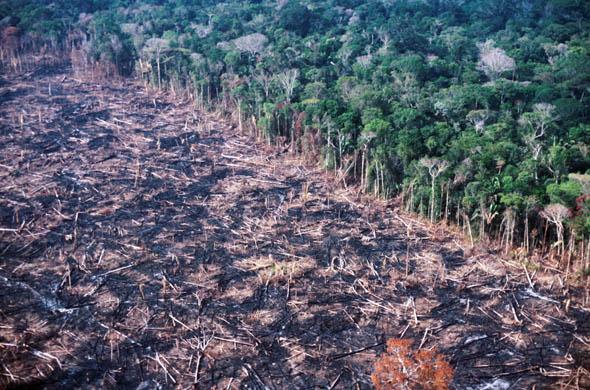
As commendable as these aims are, however, on their own they will not be enough to save certain species. For instance, from 2000 to 2009, Indonesia supplied more than half of the global palm oil market at an annual expense of some 340,000 hectares of Indonesian countryside. Planned expansion could wipe out the remaining natural habitat of several endangered species.
This is a ludicrous situation considering that Brazil and Indonesia spent over 100 times more in subsidies to industries that cause deforestation than they received in international conservation aid from the UN to prevent it. The two countries gave over $40bn in subsidies to the palm oil, timber, soy, beef and biofuels sectors between 2009 and 2012, some 126 times more than the $346m they received to preserve their rain forests.
If we want to see how not to manage the world’s wildlife and natural habitats, we need look no further than India, which is now the world’s leading importer of palm oil, accounting for around 15% of the global supply. India imports over two-­thirds of its palm oil from Indonesia.
Until the mid-1990s, India was virtually self-sufficient in edible oils. Then import tariffs were reduced, leading to an influx of cheap (subsidised) edible oil imports that domestic farmers could not compete with. This was a deliberate policy that effectively devastated the home-grown edible oils sector (see this) and served the interests of palm oil growers and US grain and agriculture commodity company Cargill, which helped write international trade rules to secure access to the Indian market on its terms.
According to Vandana Shiva, the WTO and the TRIPS Agreement, written by Monsanto, and the Agreement on Agriculture, written by Cargill, was the beginning of a new corporate imperialism. It came as little surprise then that in 2013 India's Agriculture Minister Sharad Pawar accused US companies of derailing the nation's oil seeds production programme.
Indonesia leads the world in global palm oil production, but palm oil plantations have too often replaced tropical forests, leading to the killing of endangered species and the uprooting of local communities as well as contributing to the release of climate-changing gases (see this analysis). Indonesia emits more greenhouse gases than any country besides China and the US and that’s largely due to the production of palm oil.
The issue of palm oil is one example from the many that could be provided to highlight how corporate imperialism drives wildlife and habitat destruction across the globe. Whether it is in Indonesia, Latin America or elsewhere, transnational agribusiness - and the system of industrialised agriculture it promotes - fuels much of the destruction that we see.
Powerful corporations continue to regard themselves as the owners of people, the planet and the environment and as having the right - enshrined in laws and agreements they wrote - to exploit, kill and devastate for commercial gain.
Without addressing the impacts and nature of corporate greed and a wholly corrupt neoliberal capitalism that privileges corporations and profit ahead of people and conservation, regardless of any success in the area of the trafficking of wild animals or plants, much of the world’s wildlife and biodiversity will remain under serious threat. They will increasingly find themselves hemmed into smaller and fewer reserves surrounded by commodity plantations, industries, urban sprawl and barren, degraded landscapes.

The Sheer Terror Of Looming Biosphere Collapse

Glen Barry

The global ecological system is collapsing and dying as humanity overruns natural ecosystems and the climate. We are entering an age of unrelenting violence and suffering, prior to biosphere collapse and the end of being, unless dramatic social change based upon a global ecology ethic arises quickly.
Humans evolved within a lush and vibrant Eden teaming with life, which until just a few generations ago provided for natural abundance and the prospect of perpetual human existence. We are one of many species utterly dependent upon natural ecosystems for all needs including air, water, food, and shelter.
The rise of ecological colonialism and the industrial revolution changed all that, as million year old naturally evolved ecosystems became fodder to be liquidated and consumed for accumulation of paper wealth. The disambiguation of buying our needs with money has led us to deny our ecological nature.
For two centuries humanity has waged an unrelenting war upon nature. Ecological habitats and their wildlife residents have been slaughtered incessantly. Entire species have been wiped out, as their members have been burnt, shot, tortured, and left to starve. Whole ecosystems have been dismantled to create throw away consumer crap that quickly is thrown away.
Concurrently Western science has learned what indigenous peoples have long known, that we are but one species in a web of life. That all is one, intertwined in a miraculous system whereby life creates the conditions for life. And that as goes nature befalls us. Those in touch with nature realize ecology is the meaning of life. And that without ecology there can be no economy.
It has become increasingly obvious to experts and astute lay persons that the ecological fabric of being is fraying. We now know that ecological boundaries exist, and that the human endeavor has overshot them. Old-growth forests remain as tawdry remnants, soil has become lifeless and sterile, oceans are dying, and water and food are scarce for humanity and kindred species.
Ever expanding human numbers have lost sight of our place within ecology, and have little knowledge of the natural world. Instead well-being is defined by mobile apps and expensive play-things that soon grow old and are discarded. For many life is a vacuous search for status and stuff. And for the rest – the large percentage of people living in abject poverty – life is a squalid struggle to meet basic needs amidst Disneyfied conspicuous over-consumption by celebrities and bankers.
Long a war-prone species, humans have concurrent with ecocide nonetheless undergone remarkable social evolution whereby slavery’s prohibition, women’s rights, freedom of thought, and representative democracy has largely been achieved. Nonetheless attempts last century to eliminate war have failed miserably. Over-populated inequity in an age of resource scarcity – stoked by grotesquely wasteful over-consumption by the few – fuels a rise of authoritarian fascism and conflict between the haves, have-lesses, and have-nots.
Few diagnose the state of perma-war waged by lone terrorists and drones as the result of environmental decline. Yet the coming anarchy can be seen all around us, by those who wish to see.
Streams of refugees flee collapsing ecosystems and abrupt climate change. Traditional food stocks from the oceans and forests are virtually exhausted. The act of saving seeds has become a radical act of resistance as all that is natural is commodified, homogenized, and toxified.
All around are well-meaning peoples pursuing pieces of the solution. Organic permaculture, ending fossil fuels, protecting and restoring natural ecosystems, consuming less, and more are occurring. But it is too little too late by orders of magnitude as the sheer inertia of ecocide found in mass conspicuous over-population and consumption prepares its final assault upon the natural world.
Already societies and economies are collapsing, from Syria to Haiti, and including the downturn in economic aspirations for the petty-bourgeoisie. The Earth’s capacity to provide for human well-being is collapsing. Every last natural ecosystem is to be mopped up for chopsticks and the last drop of oil. Not only will your children not have more than you have, they may die in an unimaginably horrendous ecological apocalypse.
Every month without the rise of ecologism, we fall deeper into nothingness, as the signs of sick ecosystems and dysfunctional climate are written off by the ecologically challenged. Soon as the pillages of war and ecocide come to your neighborhood you can expect to know hunger, disease, and the bad kind of anarchy.
Expect to face firsthand the terror of biosphere collapse – where your mothers and daughters are raped, along with your sons sold into the military and other forms of slavery, before they and you die like famished stray dogs on a dead Earth.
The global ecological system is collapsing and dying.
We are a clever species, with opposable thumbs and relatively large brains. Perhaps the Internet community and the sense of the human family it engenders can help us realize there is no god but Earth, that we are one people, and that we are one species of animals amongst many. And that we can choose to return to nature’s fold.
All that is green and natural must be protected in earnest and urgency with all our might or the biological foundation of being ends. Start with growing your food and restoring the land, reject personal cars and large families, and work outward to reconnect your community to its peaceful and healthy bioregion.
Otherwise the hairless ape show all intentions of pulling down the biosphere as we frantically seek more not understanding there is no more to be had. The sky is falling. The end of being looms.

Human Rights Abuses: A Recurring Alarm On Modi's Travels Abroad!

George Abraham

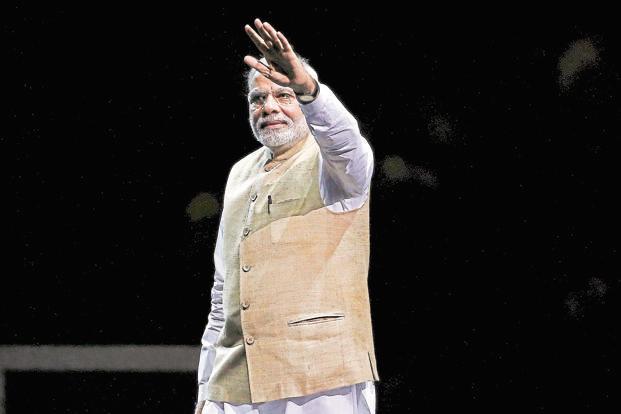
As Prime Minister Modi is about to embark on his fourth visit to the U.S. in the last two years, U.S. lawmakers have sharply criticized India’s human rights record. In a speech in New Delhi, U.S. Senator Benjamin L. Cardin (D-Md), the ranking minority-party member of the Senate Foreign Relations Committee, called on India to “do better” to address issues of violence against women, government corruption, extra-judicial killings, human trafficking and outdated anti-conversion laws that are still in use. “ A country must respond to these challenges,” he said.
Modi faced similar criticisms and faced protest demonstrations from one group of another every time he has touched down on the American soil. However, these strident criticisms from prominent lawmakers on the eve of Modi’s address to a joint session of Congress reveals a deep-seated reservation by many in Washington of a leader who once was denied entry into the country based on his human rights record.
At a Congressional hearing held a week ago in Washington, Bob Corker (Chairman of the Foreign Relations Committee R-Tenn) and Timothy M. Kaine (D-VA) questioned State Department officials on India’s human rights issues, including its crackdown on nongovernmental organizations receiving foreign funding such as Greenpeace and Ford Foundation, rising intolerance and India’s recent decision to deny visas to the members of the U.S. Commission on International Religious Freedom who were planning to travel to India.
Undoubtedly, the Indian American Community as a whole would like to see the bi-lateral relations between the U.S. and India strengthened and the progress achieved in the last decade or so to be consolidated between these two democracies. However, a strategic alliance is a partnership that would require trust and confidence in each other for a long term value creating relationship. There is no doubt that both of these nations need each other in the new world order, and the question is whether these two countries are at a point where they are ready to move forward with such a commitment.
Therefore, it is pertinent to analyze the upcoming visit of the Prime Minister from that vantage point. If the objective of the collaborative relationship is to achieve success for both nations, how can one advance that notion while justifying the denial of visas to a U.S. government body that monitors the core tenets of both of these democracies: freedom and justice? The appropriate action ought to be in assisting each other to achieve these goals and together building a stronger relationship.
For those who are advocating more reliable protection of religious freedom got a boost recently when Congress upgraded the ‘Frank Wolf International Religious Freedom Act’ giving Administration and the State Department new political tools in monitoring and creating watch lists. The legislation has also upgraded the office to Ambassador-at-large, who will be directly reporting to the Secretary of State. It includes a provision as well directing the President to focus sanctions on individuals who carry out or order religious restrictions. The impact of these rules will eventually be felt across the board while nations draft agreements ranging from Trade to environment and Defense purchases.
President Obama’s speech in New Delhi, to a great discomfiture of Modi, was a parting shot directed at his government to modify its behavior as regards respecting the pluralistic legacy of the modern India. He listed the relevant articles in the Indian Constitution to make his case. Despite the public posture, one could detect a chasm between these two leaders who seem to think and view things from different perspectives.
I have been told that at a recent dinner party in Washington, a former official was standing in line to greet President Obama. While shaking hands, the official congratulated the President for the bold statement he has made in New Delhi. First, he smiled and let go his hands and ready to greet the next guest, but on second thought, leaned forward, tapped his shoulder and said ‘I meant every word of it.' That says a volume of the thinking in Washington, especially with this White House.
However, U.S. is dealing with a different India today that has gained stature as a growing economic power and a global player that has to be respected and may even be courted. For the U.S, the changing dynamics in Asia necessitates new alliances and reliable partnerships. A rising China has created new challenges for the U.S. in that part of the world and past agreements like the Indo-US civil nuclear deal points to a strategy of exploring ways to sustain their global engagement capability. Also, a 4 million strong Indian immigrant community in U.S. has become vocal supporters of close collaboration between these two countries, often lobbying with their Senators and Congressmen.
Despite all these natural advantages, India seemed to have put in a lot of effort in convincing the U.S. authorities for this ‘state visit’ and the upcoming appearance before the joint session of Congress. There are unconfirmed reports of a quid-pro-quo as regards major defense purchases preceded by a veiled warning of India taking its defense purchases elsewhere if the same level of respect is not accorded to Modi as it was with Dr. Manmohan Singh, his predecessor. It is widely known that the sound of money garners a lot of mileage in Washington just as in any other capital around the world. Apparently, Modi is getting his requital by gaining an opportunity to bloviate before those who once denied him a simple entry visa to the country.
However, if India has to gain genuine respect and to be able to operate from a position of strength and moral clarity, it has to start dealing with some of the issues the lawmakers have raised. Last two years have witnessed a growing intolerance in the country with attacks on places of worship of minorities, the murder of secular advocates and harassment of liberal thinkers. People are afraid that even their dietary habits like eating beef could cost them their lives. The HRD ministry has been converted to become a vehicle to promote the ‘Hindutva’ ideology across campuses by shutting down Dalit student organizations and applying sedition charges on students for mere sloganeering.
BJP and its followers seemed to believe that they have a monopoly in defining what constitutes nationalism, and it has become a cause of confusion and conflict in many university campuses. History teaches us that ultra-nationalism is a sentiment of superiority and aggression towards others or other countries. It is intrinsically connected to war and imperialism. Therefore, India as a pluralistic nation will be treading on dangerous waters with the ongoing nationalist campaign, and the Prime Minister has a great responsibility to set the right tone for the country.
Indian Diaspora in U.S. is much more a diverse community representing different regions, languages, cultures and faiths than what it is given credit for? According to latest statistics, 51% of the Diaspora consists of Hindus and the rest includes Muslims, Sikhs, Christians, Buddhists and other faiths. Indian Diaspora is primarily taking the shape of Hindu Diaspora due to the cultural identity, and most of the Indians including those who belong to other religions accept it as a practical matter. However, Hindu Swayamsevak Sangh (RSS branches outside of India) is becoming increasingly assertive in demanding unflinching patriotism and preservation of Hindu culture and continuing with their efforts to present a monolithic view of the Indian Diaspora to the American public. It is alleged that many of the Diaspora organizations are raising money under the cover of 'charity' and ‘development’ to support RSS and its affiliates to wage violence against religious minorities in India.
There is little doubt that the RSS cadre is playing a prominent role in many of the Modi’s visits around the globe, particularly wherever there is a significant Indian community. It is only laudable that the Diaspora is enthusiastic and heartwarming towards any visit of a Prime Minister from their motherland. However, when that community is used as political pawns by turning them into a weapon against those who want to express their grievances; it not only defeats the purpose and good will but rather pits one group against the other and imports the same level of polarization and divisions to the country of their adoption. The recent attempt by Sangh organizations to reserve all 25 grounds on the Capitol Hill on the day of Modi’s visit to address the joint session of Congress is a case in point. That ‘clever’ and calculated maneuver made it almost impossible for any other groups to gather near the venue and air their dissenting point of view that is protected under the U.S. Constitution. It is quite obvious to any independent observer that the objective of such action is to stifle criticism and banish any dissent which is contrary to the spirit of democracy, and it is quite appalling to see it happening right here in U.S.
It is time for the Prime Minister to be more assertive in addressing these concerns at home and abroad and speak out forcefully when human rights violations occur in India. Unless he can align the actions of the radical elements of his party in line with his lofty pronouncements abroad, the human rights issue will continue to cast a shadow on his trips abroad, especially to U.S. Alfred Whitney Griswold who once said the following: "Books won’t stay banned. They won’t burn. Ideas won’t go to jail. In the long run of history, the censor, and the inquisitor have always lost. The only weapon against bad ideas is better ideas". Let freedom reign!

Obama Slams Door In Putin’s Face

Eric Zuesse

Actions speak louder than mere words, and U.S. President Barack Obama has now acted, not only spoken. His action is to refuse to discuss with Russian President Vladimir Putin, Russia's biggest worry about recent changes in America’s nuclear strategy — particularly a stunning change that is terrifying Putin.
On Sunday June 5th, Reuters headlined “Russia Says U.S. Refuses Talks on Missile Defence System”, and reported that, "The United States has refused Russian offers to discuss Washington's missile defence programme, Russian Deputy Defence Minister Anatoly Antonov was quoted as saying on Sunday, calling the initiative 'very dangerous’."
Russia’s concern is that, if the "Ballistic Missile Defense” or “Anti Ballistic Missile” system, that the United States is now just starting to install on and near Russia’s borders, works, then the United States will be able to launch a surprise nuclear attack against Russia, and this system, which has been in development for decades and is technically called the "Aegis Ashore Missile Defense System”, will annihilate the missiles that Russia launches in retaliation, which will then leave the Russian population with no retaliation at all, except for the nuclear contamination of the entire northern hemisphere, and global nuclear winter, the blowback from America’s onslaught against Russia, which blowback some strategists in the West say would be manageable problems for the U.S. and might be worth the cost of eliminating Russia.
That theory, of a winnable nuclear war (which in the U.S. seems to be replacing the prior theory, called “M.A.D.” for Mutually Assured Destruction) was first prominently put forth in 2006 in the prestigious U.S. journal Foreign Affairs, headlining “The Rise of Nuclear Primacy”, and this article advocated for a much bolder U.S. strategic policy against Russia, based upon what it argued was America’s technological superiority against Russia’s weaponry and a possibly limited time-window in which to take advantage of it before Russia catches up and the opportunity to do so is gone.
Paul Craig Roberts was the first reporter in the West to write in a supportive way about Russia’s concerns that Barack Obama might be a follower of that theory. One of Roberts’s early articles on this was issued on 17 June 2014 and headlined “Washington Is Beating The War Drums”, where he observed that “US war doctrine has been changed. US nuclear weapons are no longer restricted to a retaliatory force, but have been elevated to the role of preemptive nuclear attack."
Russia’s President Vladimir Putin has tried many times to raise this issue with President Obama, the most recent such instance being via a public statement of his concern, made on May 27th. Apparently, the public statement by Antonov on June 5th is following up on that latest Putin effort, by Antonov’s announcement there that Obama now explicitly refuses to discuss Putin’s concerns about the matter.
The fact that these efforts on the part of the Russian government are via public media instead of via private conversations (such as had been the means used during the Cuban Missile Crisis in 1962, when the shoe was on the other foot and the U.S. President was concerned about the Soviet President’s installation of nuclear missiles 90 miles from the U.S. border) suggests that Mr. Obama, unlike U.S. President John Fitzgerald Kennedy in 1962, refuses to communicate with Russia, now that the U.S. is potentially in the position of the aggressor.
Russia is making its preparations, just in case it will (because of the Aegis Ashore system) need to be the first to attack. However, some knowledgeable people on the subject say that Russia will never strike first. Perhaps U.S. President Obama is proceeding on the basis of a similar assumption, and this is the reason why he is refusing to discuss the matter with his Russian counterpart. However, if Mr. Obama wishes to avoid a nuclear confrontation, then refusing even to discuss the opponent’s concerns would not be the way to go about doing that. Obama is therefore sending signals to the contrary — that he is preparing a nuclear attack against Russia — simply by his refusal to discuss the matter. In this case, his action of refusal is, itself, an answer to Putin’s question, like slamming the door in Putin’s face would be. It’s a behavioral answer, instead of a merely verbal one.

Brazil: Police Have Killed Over 2,500 People In Rio Since Rio 2016 Was Announced

Amnesty International

Brazil is on a fast-track course to repeat the deadly mistakes it has been making around policing for decades, made even more evident during the 2014 World Cup, which left a long trail of suffering, Amnesty International said today in a briefing two months ahead of the Olympic Games’ opening ceremony.
Violence Has No Place in these Games! Risk of Human Rights Violations at the Rio 2016 Olympic Games reveals how Brazilian authorities and sports governing bodies in Rio de Janeiro have put in place the same ill-conceived security policies which led to a sharp increase in homicides and human rights violations by security forces since the 2014 World Cup. This jeopardizes the promised Olympic legacy of a safe city for all.
“When Rio was awarded the 2016 Olympic Games in 2009, authorities promised to improve security for all. Instead, we have seen 2,500 people killed by police since then in the city and very little justice,” said Atila Roque, Director at Amnesty International Brazil.
“Brazil seems to have learned very little from the great mistakes it made over the years when it comes to public security. The policy of ‘shoot first, ask questions later’ has placed Rio de Janeiro as the one of the deadliest cities on earth.”
“The country’s historic ill-conceived public security policies, coupled with the increasing human rights violations we have documented during major sports events and the lack of effective investigations are a recipe for disaster.”
Dozens of people were injured and hundreds arbitrarily detained during police repression of protests across the country ahead of and during the 2014 World Cup. That same year, as police and military were tasked with “securing” the cities where events were due to take place, at least 580 people were killed during policing operations in the state of Rio de Janeiro alone.
In 2014, homicides resulting from police operations rose a shocking 40 percent -- and an extra 11 percent the following year with 645 people killed by police in the state of Rio de Janeiro alone. One in every five homicides in the city were committed by police on duty.
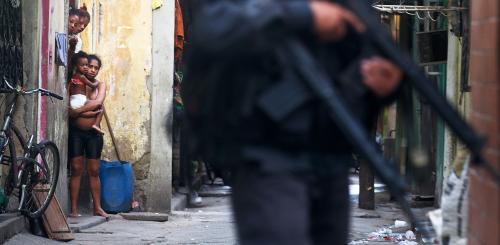
So far in 2016, more than 100 people have been killed in the state of Rio de Janeiro. The vast majority of the victims were young black men living in favelas or other marginalized areas.
Authorities have recently announced the deployment of around 65,000 police officers and 20,000 military soldiers to guard the Olympic Games, in what will be the largest security operation in Brazil’s history. This will include the deployment of military personnel to head operations in favelas, which in the past has resulted in a catalogue of human rights violations that are yet to be properly investigated and sanctioned.
In April 2014, months before the start of the World Cup, thousands of military troops were deployed to the Complex of Maré, a group of 16 favelas located near Rio de Janeiro’s international airport, home to around 14,000 people.
Military troops, who were not properly trained nor equipped to carry out public safety tasks, were supposed to leave soon after the sports event concluded. However, they continued to police the favela until June 2015.
The case of 30-year-old Vitor Santiago Borges highlights the tragic consequences of military policing in the Maré Complex of favelas. In the early morning of February 13, 2015, Vitor was driving back home with some friends when the armed forces opened fire on the vehicle without any warning.
Vitor was severely wounded, fell into a coma and had to remain in hospital for more than three months. He is now paralyzed from the waist down and had a leg amputated. The authorities have failed to provide him or his family with adequate assistance or to conduct a full and impartial investigation into the shooting. No one has been held to account so far.
Amnesty International warns that the lessons from the 2014 World Cup have not been learned. In March 2016, the then President Dilma Rousseff signed a new Antiterrorism Law which includes overly vague language that leaves it open for being unfairly used against peaceful protesters and activists.
Furthermore, on May 10, 2016, the federal government signed a new “General Law of the Olympics.” The law imposes new restrictions to the rights to freedom of expression and peaceful assembly in many areas of the host city which are contrary to international law and standards and do not address the use of unnecessary and excessive force by security forces while policing assemblies.
“Brazilian authorities are not only failing to deliver the promised Olympic legacy of a safe country for all, but are also failing to ensure that law enforcement officials meet international law and standards on the use of force and firearms,” said Roque.
“Two months ahead of the Olympics 2016, there is still time to put in place measures to mitigate the risk of human rights violations and establish accountability mechanisms for those found responsible of violating human rights. As the global sports community gathers in Rio in two months, the question remains: will the authorities respect and protect human rights and deliver the promised legacy of a safe city and country for all?”