10 Jun 2016

U.S. Elites: the Original Gangsters

Nick Alexandrov

Re-Thinking Organized Crime
Donald Trump is at home in the underworld. Tom Robbins writes that the de facto GOP nominee “has encountered a steady stream of mob-tainted offers that he apparently couldn’t refuse” in his decades in business. He “worked with mob-controlled companies and unions” while building his empire, the Washington Post reports.
So the man has presidential cred. U.S. elites, since the colonial era, have shown contempt for the law: if they weren’t ignoring their own codes, they were violating those of other nations or international statutes, or partnering with avowed outlaws. It’s not clear, in other words, what distinguishes politicians and businessmen from career criminals.
Think of how Europeans occupied North America. The process abounded with illicit activity, officially sanctioned in the end. “The original settlers in the Boston region who settled before the arrival of the Massachusetts Bay Colony were without legal rights in their settlement,” Henry Tatter observed. “Such were also the first settlers into the region later to become Connecticut.”
And colonists farther west: Andrew Cayton writes that Europeans crossing the Ohio River “had no legal right to occupy the land” they claimed. The 1787 Northwest Ordinance’s scheme to admit new states to the Union just “legalized the invasion” underway, D’Arcy McNickle argued.
This advance into Ohio was part of what Gary Nash called “lawless white expansion into Indian lands.” Repeated deceit enabled the takeover. Linda Robyn describes how, in the century after George Washington’s 1778 treaty with the Delaware Nation, “more than six hundred treaties and agreements were made with native tribes and nations of North America. Every one of these agreements was, at some point, broken.” The first president himself “had amassed vast tracts to which his titles were flatly invalid” by the 1770s, according to William Hogeland.
In the Southwest, “literally thousands of Norteamericanos”—“illegal immigrants,” Stewart Brewer dubs them—“began to settle in Mexican territories between Texas and California” in the 19th century. “By 1823 some three thousand Americans lived illegally on the Mexican frontier,” adds Graham Davis, stressing that “they occupied land to which they had no title,” even when Texas declared independence in 1836.
Next consider slavery, the institution that “produced the wealth that made independence possible” (Greg Grandin) and “made the United States powerful and rich” (Edward Baptist). The U.S. government banned slave imports in 1807. But Michael Woodiwiss points out“international organized criminal activity developed” to maintain the trade. W. E. B. Du Bois determined Washington, in effect, endorsed this piracy: “there was no especial set of machinery provided for the enforcement of this [1807] act,” which “came very near being a dead letter.” There was also regular Antebellum “kidnapping of free blacks for sale as slaves,” Carol Wilson reminds us. The peculiar institution had a criminal core, even by the warped standards of a slave society.
Now look at corporations. The modern firm, Ford Motor Co. VP William Gossett wrote in 1957, “touches every aspect of our lives,” and is today, Joel Bakan observes, “the world’s dominant institution.” Peter Andreas notes Washington’s “state-sponsored theft” spurred the industrialization businesses fought to dominate. The U.S. “systematically stole from [the British] as part of the nation’s early industrialization strategy,” and “aggressively engaged in the kind of intellectual property theft it now insists other countries prohibit and crack down on.”
When Edwin Sutherland studied seventy top U.S. firms in 1949, he found them guilty of “crimes against…consumers, competitors, stockholders and other investors, inventors, and employees,” contending that “the criminality of the corporations, like that of professional thieves, is persistent: a large proportion of the offenders are recidivists.”
Decades later, Russell Mokhiber assessed “the numbers of victims of corporate crime and violence in the United States”: “Almost 800 Americans die every day from cigarette-induced disease,” for example, while some “240,000 people—8,000 per year, one every hour,” would likely “die from asbestos-related cancer” over three decades. James Coleman put the tolls from “unsafe consumer products” at “20 million serious injuries and 30,000 deaths a year,” citing National Product Safety Commission statistics.
And Gregg Barak’s recent Theft of a Nation “explains how the federal government, despite its rhetoric to the contrary, came to dismiss the crimes of Wall Street,” freeing “bankers, mortgage lenders, and associated swindlers”—“networks of criminality”—“from any accountability for their criminally fraudulent behavior.”
Consider finally U.S. foreign policy. Just keeping to the last several decades, we can note, with Alfred McCoy, that “the Allied invasion of Italy” in World War II “returned the Sicilian Mafia to power.” The mob, after the conflict, formed “an awesome international narcotics syndicate,” exporting heroin to the U.S. “in substantial quantities” for over a decade—“without ever suffering a major arrest or seizure.” The operation was so efficient it “increased the number of active [U.S.] addicts from an estimated 20,000 at the close of the war to 60,000 in 1952 and to 150,000 by 1965.”
“One of the most well-known cases of CIA complicity” with drug-running, meanwhile, “occurred during the Vietnam War when the agency enlisted the support of General Vang Pao, the leader of an army of Hmong tribesmen in Laos whose primary cash crop was opium,” Ronald Berger informs us. Tom Feiling recalls that, under Reagan, “the CIA…approved and supported the Contras’ trafficking of cocaine into the United States.”
Other U.S. intelligence crimes ranged beyond drug-dealing: “All postwar presidents have used the CIA for illegal covert actions,” Melvin Goodman affirms. Richard Immerman, reviewing the CIA’s 1954 Guatemala coup, concluded Washington’s strategy was “unquestionably illegal.” “As for that liberal icon John Kennedy,”sneers Carl Boggs, “he…sponsored the illegal Operation Mongoose targeting Fidel Castro,” only one intended victim in the U.S. terror assault on Cuba.
Another onslaught—President Nixon’s 1969-70 “secret bombing” of Cambodia—was also “illegal,” explains national security expert Douglas Borer. Nicole Barrett concurs: it contravened, among other measures, “the U.S. Law of Land Warfare, published in 1956” and which “finds that firing on undefended localities or areas without military significance and causing purposeless destruction violate the law of war.”
Ronald Kramer and Raymond Michalowski argue George W. Bush’s assault on Iraq “was a clear violation of the United Nations Charter and other forms of public international law, making it a state crime of the highest order”—a war of aggression, the Nuremberg Charter’s “supreme international crime.”
And Obama, with his gleaming legal pedigree, backed the overthrow and forced exile of Honduran President Manuel Zelaya in June 2009. Four School of the Americas alumni helmed the coup. Another graduate involved—a top military lawyer—confessed they’d committed “a crime.” Honduran activists condemn the event for launching a surge in attacks on women. Hillary Clinton, as Secretary of State,championed the outlaw regime.
Michael Woodiwiss, in his piercing Organized Crime and American Powersays many today “understand organized crime in a very restricted sense, as being virtually synonymous with super-criminal organizations such as the Mafia,” when in fact “established economic and political power structures” mesh with, often thrive on, illicit activity. This situation suggests the “decent citizen,” as radical pacifist David Dellinger called her, must decide whether she or anyone else “owes one scrap of allegiance…to American law, American custom or American institutions.”

The South Asian Armageddon

Mohammad Ashraf


(Forget the Richter Scale 8 Earthquake; concentrate on avoiding a South Asian Armageddon!)

The most irresponsible and provocative statement of Dr. Qadeer Khan about nuking Delhi has drawn attention to the real possibility of the whole sub-continent along with South Asia going up in a flash! There have been a number of predictions about a possible nuclear holocaust in the sub-continent because of the race going on between the two neighbouring countries to acquire more and more nuclear and thermo-nuclear warheads. Pakistan is supposed to have 110 to 130 warheads while as India is stated to have 90 to 110! The most worrying aspect is the attempt by Pakistan to acquire tactical warheads capable of stalling the India’s cold start thrusts. They are also concentrating on getting submarines with nuclear missiles for acquiring a second strike capability.
About a couple of months back, Atul Singh wrote a detailed article in Fair Observer, titled, “Yes, Nuclear Terrorism is a Real Threat”! According to him, “Paul Ashley, a retired professional from the British Armed Forces, has mused that 2016 could be the year of nuclear terrorism. Many worry about a “dirty bomb” that might combine conventional explosives with radioactive material. Two of the bombers involved in the Brussels attacks appear to have monitored a senior researcher who worked at a Belgian nuclear center”. “A 2014 report by the Nuclear Threat Initiative (NTI) estimated that “nearly 2,000 metric tons of weapons-usable nuclear materials remain spread across hundreds of sites around the globe.” The NTI report points out that some of these sites are poorly secured and that terrorists might have acquired the ability to build a bomb”.
Nuclear Terrorism may be the immediate concern of the western powers but our main apprehension is a sub-continental Armageddon! This has been highlighted by Dilip Hiro in his article “The most dangerous place on Earth” in Caravan Daily. The first para of the article sums up the situation, “Undoubtedly, for nearly two decades, the most dangerous place on Earth has been the Indian-Pakistani border in Kashmir. It’s possible that a small spark from artillery and rocket exchanges across that border might — given the known military doctrines of the two nuclear-armed neighbors — lead inexorably to an all-out nuclear conflagration. In that case the result would be catastrophic. Besides causing the deaths of millions of Indians and Pakistanis, such a war might bring on “nuclear winter” on a planetary scale, leading to levels of suffering and death that would be beyond our comprehension”.
According to Dilip Kashmir is the root cause of enduring enmity between India and Pakistan. Three wars have been fought by the rivals on this, “toxic bone of contention”. He quotes President Bill Clinton who called the India Pakistan border in Kashmir as the most dangerous place on Earth! The most worrisome aspect is the Indian Cold Start doctrine involving massive tank thrusts and Pakistan’s response with the tactical nuclear weapons at the disposal of the field commanders. A limited encounter can rapidly escalate and result in a total nuclear exchange. It is a more worrisome scenario than Richter Scale 8 earthquake!
Within the sub-continent, it has been repeatedly asserted by all concerned that the core issue is Kashmir. India has been off and on deviating from its initial commitment of solving the problem in reference to the wishes of the people. In the beginning, Indian leaders including Pandit Nehru had declared that the final status of the State would be determined by reference to the people. Slowly, they reneged from this commitment and came to declare that Kashmir is an inseparable and integral part of India and the only dispute is the recovering of the part under Pakistani control. They not only made a total about turn in their stand but started measures for physical and cultural integration of the State into the mainland India.
Earlier, these measures were taken in a clandestine way but after the installation of the BJP government at the centre, these measures have not only been accelerated but are being taken in a brazen way. The recent events involving certain steps being taken by the Central Government with the active participation of the State Government have been alleged to be a part of a diabolical plan to change the demography of the only Muslim majority state in India. The Sainik Colonies, the Composite Townships for Pandits, the permanent settlement of Pakistani refugees and so on are being viewed with suspicion in spite of clarifications by the State Government. Incidentally, State Government’s explanations are negatived by BJP leaders time and again.
The result has been extreme alienation of the people in general and the youth, being harassed from all sides, in particular. The recent militant attacks show that the youth getting squeezed in from all sides are reacting violently. According to some top security and defence officials, the most worrying aspect is the open support of common people to these new militants, mostly locals and even some deserters from the Kashmir Police. The new Hindutva slanted measures have started uniting the various groups in the “Azadi” camp which had been earlier drifting apart. This attempted Hinduisation of Muslim Kashmir is a fuse not only locally but an invitation for outsiders to join in the “Jihad”! BJP’s failure to bring in Ache Din and the looming elections in some States need a new round of opium for the poor voters. As always, rising Indo-Pak tension posing a threat to “National Security” has been the best bet. However, the authors of this strategy need to think over the ultimate consequences of this dangerous game which, as predicted by many, may end in a South Asian Armageddon!

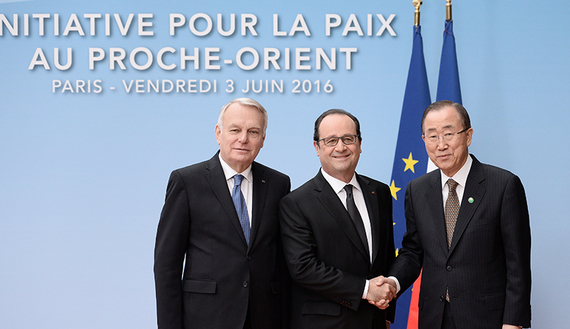
The Paris Peace Gambit

Ramzy Baroud

In their defense, the Israelis seem to have figured out the whole thing and opted out. But the hapless Palestinian leadership, along with their Arab League partners, joined by the French, EU and UN representatives, and even US Secretary of State, John Kerry, decided to play along.
However, the French peace initiative-turned-conference in Paris on June 3 is nothing but a charade, and they all know it, Palestinians included.
So, why the colossal waste of time?
If you have been following the Middle East ‘peace process’ business in the last quarter of a century, you are certainly aware that the ‘negotiations table’ is nothing but a metaphor for buying time and obtaining political capital. The Israelis want time to finalize their colonial projects in building up illegal settlements on occupied Palestinian land; and the Palestinian leadership uses the ‘talks’ to acquire political validations from the so-called ‘peace-brokers’, namely the United States.
The US, in turn, uses the futile ‘negotiations’ to further assert itself as the caretaker of the Middle East, overthrowing regimes while simultaneously brokering peace.
Meanwhile, every other relevant political entity is included or excluded based on its own worth to, or relationship with the United States. Thus, the honor of invitation is bestowed upon ‘friendly regimes’. Others, namely, ‘enemies of peace’ are rejected for their failure to accommodate or adhere to US foreign policies in the region.
While the ‘peace process’ has failed to deliver neither peace to the region nor justice to the Palestinians, the ‘peace process’ industry has been an unenviable success, at least until 2014 when Kerry and the US administration decided to tend to more urgent regional affairs, for example, the war on Syria.
By then, Israel’s rightwing Prime Minister, Benjamin Netanyahu, was too empowered by the anti-peace sentiment in his own society to even partake in the charade. There was little capital for him to be seen with aging Mahmoud Abbas, shaking hands and exchanging pleasantries. His rightwing constituency, which dominates Israeli society, could not have cared less. They were - and are - still busy confiscating Palestinian land, issuing more racist laws in the Knesset and fighting dissent among their own ranks.
Prior to that date, and since the very first peace conference in Madrid in 1991, the ‘peace process’ has splendidly paid dividends. The Israelis were finally accepted as a ‘peace partner’ and Israel slowly made its way from the margins of the Middle East to the center, without having to concede an inch.
Even Saeb Erekat, the Chief Palestinian Negotiator, has no qualms with this assertion. “In fact, the number of Israeli settlers transferred into Occupied Palestine has nearly quadrupled since the beginning of the ‘peace process,’” he recently wrote in the Israeli daily ‘Haaretz’; “yet Israel continues to enjoy impunity and is not held accountable.”
Considering his ‘chief’ position in the travesty, why did Erekat agree to help maintain the misapprehension of peace considering the price that was paid in lost land, time and lives?
Well, because the Palestinian leadership itself was at the forefront of raking in the benefits of the spurious peace. The ‘peace process’ meant money, and plenty of it; billions of dollars invested in the Palestinian Authority - feeding a dead-end political system that existed with no real authority, and almost always remained on the sidelines as Israel used extreme violence to sustain its colonial enterprise in the West Bank and Occupied Jerusalem.
The PA even stayed aside as Israel battled the Resistance in Gaza, killing thousands of civilians and besieging an already highly-populated and economically-devastated region. Alas, in the last ten years, it seems that Palestinian leadership and factions invested more energy to nurse their own internal strife than to confront the Israeli Occupation.
The French government has its own reasons for taking the lead on reviving the dormant peace talks and, no, those reasons have nothing to do with French desire to create a more equitable platform for talks, as Palestinian officials conveniently allege.
Writing in Israel's ‘Arutz Sheva’, Eran Lerman, explained the French endeavor in more practical terms. “Broad regional security considerations” are driving the French diplomatic initiatives, he contented.
In fact, the logic behind this is discernable. French President Francois Hollande's approval ratings are at an all-time low. As of March, he broke his own record of low approval, sinking to 17 percent. (In October of last year it stood at 18 percent). His country is embattled by violence, massive strikes, terrible foreign policy decisions that resulted in French military involvement in Libya, Mali and Syria.
Leading world leaders in another peace gambit that is helping distract from the US failure on that front is a clever political calculation from the French perspective. It might even help Hollande appear stately and in charge.
The Israelis rejected the initiative right away, without even bothering with a public diplomacy campaign to defend their position, as they often do. Dora Gold, director general of Israel’s Foreign Ministry repeated on the eve of the conference what Netanyahu and others have parroted for weeks. The conference will “completely fail”, she said, calling on Abbas to engage in direct talks with no prior conditions instead.
The nonchalant Israeli position can be partly explained in Tel Aviv’s trust in the French government, the very government that is taking the lead in the fight against the pro-Palestine Boycott, Divestment and Sanctions movement (BDS).
“On more than one occasion, French positions and actions on this subject have been more reassuring from an Israeli point of view than those of our American ally,” wrote Lerman. “For example, France served as the hardline anchor of the P5+1 [in the Iran nuclear talks]. It was France that raised questions about reliability and implementation (even as it was French business interests that were among the first to bang on Tehran's doors).”
The conceited Israeli response to the French conference was paralleled with euphoria among the embattled Palestinian leadership. That, too, is understandable. The PA subsists on this sort of international attention, and since the last major meeting between Abbas and the former, now jailed Israeli Prime Minister, Ehud Olmert, in 2008, Abbas is left on his own, disowned by the Americans and neglected by Arab governments.
“The French Initiative is the flicker of hope Palestine has been waiting for,” wrote Erekat. “We are confident that it will provide a clear framework with defined parameters for the resumption of negotiations.”
Even if - and when - the long-awaited ‘resumption of negotiations’ arrive, nothing good is likely to come out from it, except for political dividends for those who have participated in the 25-year gambit: buying time and acquiring more funds. There is nothing to celebrate about this.

Oceans Are Dying

Deirdre Fulton

(Photo: Daryl Wallace/flickr/cc)
Threatened by climate change, pollution, overfishing, and oil spills, the world's oceans are suffering, scientists warned on Wednesday—the day designated by the United Nations as one to honor the deep blue sea.
From widespread coral bleaching to floundering fish species to garbage stretching across the water's surface and hundreds of feet down, it's clear that human activity is taking its toll on the world's oceans, which cover more than 70 percent of the Earth's surface.
Indeed, dead coral reefs "are perhaps the starkest reminders—like the melting Arctic—that a thickening blanket of greenhouse gases is irrevocably changing the face of the Earth," Inside Climate News wrote on Wednesday.
And, as the National Oceanic and Atmospheric Administration's Coral Reef Watch warned in April, those "ghostly underwater graveyards" are only going to grow.
"There's even worse news ahead," Mark Eakin, coordinator of NOAA's Coral Reef Watch, told Inside Climate News. "There are a lot of places with similar mortality rates. We've got bleaching going on from the east coast of Africa to French Polynesia. Right now, it's basically covering half the Southern Hemisphere."
A separate study published Tuesday in the journal Nature found that overfishing and polluted run-off from farms and lawns made corals more vulnerable to above-average temperatures.
"Although the research showed that controlling pollution and overfishing can help corals survive in a warming world," John Upton reported on the study for Climate Centeral, "the scientists said curbing pollution from fuel burning, farming and deforestation, which is causing water temperatures to rise, would be the best way to protect them in the long run."
Deron Burkepile, a University of California-Santa Barbara ecologist involved with the research, told Upton: "We have to start controlling carbon emissions and start cooling our planet again for coral reefs to really have a chance in the future."
In fact, Inside Climate News warned that "[a]t the current rate of emissions, the average global temperature is expected to rise at least 2.5 degrees Celsius by 2100, a level that would be fatal to nearly all reefs."
Even a temperature rise of 1.5 degrees by 2050 would put 90 percent of coral reefs at risk, said Michiel Schaeffer, a scientist with the Berlin-based research institution Climate Analytics.
Meanwhile, the ocean conservation group Oceana used World Oceans Day to warn of how "rubbish dumping and waste pollution"—the impacts of which it has witnessed during its many expeditions at sea—"is hampering global conservation efforts to protect marine habitats and to restore depleted fish stocks."
The group says it has seen marine litter far below the water's surface, a "worrying problem [that] is often overlooked in reports on plastic pollution, which tend to focus on waste floating on the sea surface or in shallow waters."
"[W]e cannot continue to treat our seas as an out-of-sight, out-of-mind dumping ground," said Lasse Gustavsson, executive director of Oceana in Europe.
As ocean scientist and explorer Sylvia Earle wrote Wednesday at the Daily Beast: "If the ocean is in trouble, so are we. It is time to take care of the ocean as if our lives depend on it, because they do."

Saudi Arabia, UN Black Lists And Manipulating Human Rights

Binoy Kampmark

“It appears that political power and diplomatic clout have been allowed to trump the UN’s duty to expose those responsible for the killing and maiming of more than 1,000 of Yemen’s children.”- Sajjad Mohammad Sajid, Oxfam Director in Yemen, Jun 7, 2016
It is such cases that give the United Nations a bad name. And if heads and decay say something about the rest of the body, Ban Ki-Moon says all too much in his role as UN Secretary General. Always inconspicuous, barely visible in the global media, his presence scarcely warrants a footnote. This has been a point of much relief for various powers who have tended to see the UN as a parking space for ceremony and manipulation rather than concrete policy.
A most sinister feature of the latest UN reversal is the role played by the Kingdom of Saudi Arabia behind the move. Other powers have previously attempted to prejudice the various organs, and functions of the UN, exerting various pressures. In March, Morocco made its position clear when it expelled 84 UN staffers from a UN peacekeeping mission in the Western Sahara region after Ban deemed the disputed territory “occupied”.
The Kingdom is engaged in an enthusiastically bloody campaign in Yemen against the Shia Houthi insurgents, one that can scant be described as compliant with the laws of war. This was one of the subjects of a 40-page report, written primarily by the UN chief’s special representative for children and armed conflict Leila Zerrougui.
In an expansive document spanning several countries and regions, it was found that the Saudi-led coalition had been implicated in the deaths of some 60 per cent of the 1,953 child deaths and injuries in Yemen last year. A policy of systematic targeting of hospitals and schools was also noted. In Aden alone, six facilities were attacked 10 times.
On Monday, the UN announced that the Saudi-led coalition had been removed from the child’s rights blacklist. This sent a flurry through various diplomatic channels. The Secretary-General found himself red faced and crestfallen. According to Ban’s spokesman Stephane Dujarric, “Pending the conclusions of the joint review, the secretary-general removes the listing of the coalition in the report’s annex.”
Ban expressed a sense of helplessness. Before reporters at UN headquarters, he explained how, “This was one of the most painful and difficult decisions I have had to make.” Before him was the “very real prospect that millions of other children would suffer grievously if, as was suggested to me, countries would de-fund many UN programmes.”
Hoping to salvage tattered credibility, Ban still insisted that he stood by the contents of the report, warning that the coalition might make an ignominious reappearance depending on the findings of an investigation. In UN-speak, those findings can always be tinkered with. Given that Saudi Arabia will front that investigation along UN officials, the result is as good as decided.
The response by Saudi Ambassador Abdullah al-Mouallimi on Thursday gave a true sense of implausible deniability. “We did not use threats or intimidation and we did not talk about funding.” A slew of aggressive calls from coalition countries suggested otherwise. On Tuesday, Foreign Policy reported that the Kingdom had dangled the threat of severing ties with the UN and cut hundreds of millions of dollars in counterterrorism and humanitarian aid if it was not removed from the list.
The Monday warning involved senior Saudi diplomats threatening UN officials with their powers of conviction, stretching across other Arab governments and those in the Organization of Islamic Cooperation to similarly sever ties.
What, then, could Ban have done? From the start, the role of the secretary-general was unclear. A US Department of State meeting prior to the Preparatory Commission in London (Aug 17, 1945), recorded that the SG “should be a man of recognized prestige and competence in the field of diplomacy and foreign office experience. He should be between forty-five and fifty-five years of age and be fluent in both French and English.”
In 1985, that noted doyen of international law, Thomas Franck, emphasised that the SG was an official best disposed to fact-finding, peacekeeping initiatives and good offices. He surmised in a Hague Academy of International Law workshop that, till that point, the office had been occupied by those “completely successful in drawing a line between their role and the role played by political organs at the behest of member States.”
All in all, combative, engaged UN secretary-generals remain a distant murmur, one initially built by such figures as Dag Hammarskjöld and Trygve Lie. The last of any note to push the buttons of various powers, notably that of the US, was the late Boutros Boutros-Ghali, who brought a sustained arrogance to the office.
It was, to a degree, a fair call. The Cold War had thawed, thereby providing the body the prospect for a more active role. It was not to be, though Boutros-Ghali became one of the main celebrity hates for US politicians.
What we have gotten since is weak will and pliability, best reflected by Ban’s decision. To be fair, the organisation’s effectiveness has tended to suffer at stages because of an inability to collect back dues, or keeping the line of revenue flowing. The greatest violator of that tendency has been Washington itself. Again, the money card has been played, with all too predictable results. Human rights remain the playthings of the powerful.

After Tel Aviv attacks, Israel launches police-state crackdown

Thomas Gaist

The Israeli government deployed 600 additional combat troops to the West Bank Thursday, seizing on a shooting attack against the trendy Sarona market in Tel Aviv on the previous night to escalate its militarization drive and impose a package of police-state measures both inside Israel and in the Occupied Territories.
Hundreds of additional Israeli security forces will patrol Jerusalem beginning today. The government has revoked temporary internal passports for 83,000 Palestinians who sought to cross into Israeli sections of the city to visit relatives, including more than 200 relatives and associates of the suspected gunmen. On Thursday, Israeli courts imposed media bans on further coverage of the attack and its consequences.
In Yatta, the village of the alleged perpetrators of the Sarona attack, the Israeli Defense Force (IDF) has imposed a general blockade, preventing anyone from entering or leaving, and conducted house-to-house searches. The IDF is now preparing to demolish the family homes of the assailants.
“Life in the Yatta village won’t carry on as usual. A village that has terrorists leaving from its midst will pay the price,” Assistant Defense Minister Eli Ben-Dahan told media.
Responsibility for the bloodshed in Tel Aviv lies not with the villagers of Yatta, now facing harsh reprisals at the hands of the IDF, but with the Israeli state itself, which is responding to the immense crisis of Israeli society by escalating its decades-long oppression of the Palestinian people, and preparing for mass repression against the Israeli working class.
The shooting is the latest in a wave of violence provoked by the decision, handed down by then Defense Minister Moshe Ya’alon in December, not to prosecute or even detain the perpetrators of a firebombing attack against a sleeping Palestinian family in the village of Kafr Duma, despite clear evidence of involvement by the extreme nationalist Chabad-Lubavitch movement.
The attacks launched by Palestinians angered over the government’s response have been seized upon by the Netanyahu regime to implement a brutal crackdown and advance its longstanding agenda of collapsing the Palestinian authority and imposing direct military rule by the IDF over the West Bank.
Ominously, the Sarona attacks are being characterized in US and Israeli media as a “major test” for newly appointed Israeli Defense Minister Avigdor Lieberman, a fascistic demagogue with well known links to Israel’s ultra-nationalist milieu.
There can be little doubt that Lieberman, who assured media that he is “not going to settle for just talking,” aims to use the Sarona attacks to implement new and far-reaching repressions against the Palestinian and Israeli working class.
His rise to the highest civilian office within the US-funded Israeli military apparatus is a sharp expression of the ever more fascistic trajectory of Israeli politics, and was calculated by Prime Minister Benjamin Netanyahu to intimidate opposition throughout Israeli and Palestinian society.
In Israel, as in so many countries worldwide, extreme right figures are increasingly being welcomed onto the heights of power. The presidential candidacy of Donald Trump in the United States, the rise of the National Front in France and the ascension of Rodrigo Duterte to the Philippine presidency all give expressed to the same process.
The bourgeois establishment, faced with the growth of social inequality to levels not seen since the early 20th century, sees no other way of defending its privileges than the employment of the most vicious and degenerate social elements.
As the World Socialist Web Site noted in a July 2014 perspective, “The toxic crisis of Israeli society,” written on the occasion of the burning to death of a 16-year-old Palestinian boy, Muhammad Khdeir in East Jerusalem, by a gang of Israeli ultra-nationalists:
“There is a close connection between the violence being carried out by the Israeli government against the defenseless population in Gaza and the emergence of fascistic elements within Israel capable of such bestial crimes. These events are symptomatic of an immense social and political crisis within Israel itself. The unending and escalating repression of the Palestinian people requires the mobilization of the most reactionary forces.”
The pathological tendencies incubating within Israeli capitalism are so repugnant that they are openly commented upon by the more “liberal” figures within the Israeli establishment. Israeli Defense Force General Yair Golan remarked in May that present day Israel increasingly resembles Germany during the years immediately prior to the Holocaust. Former Prime Minister and IDF Chief of Staff Ehud Barak described Lieberman’s appointment as “a red light for all of us regarding what’s going on in the government,” and warned that Netanyahu’s government is “infected by the seeds of fascism.”
These warning are accurate, but those making them have no solution to offer to the cancerous growth of fascistic forces in Israel and throughout world society. The drive toward openly dictatorial forms of rule and the mobilization of the far-right is the necessary outcome of the domination of society by capitalist oligarchies, a reality that is painfully evident in Israel, where a handful of billionaires rule by means of machine-gun checkpoints and endless miles of razor wire, as in every other country worldwide. Only through a unified movement of the Israeli, Palestinian and international working class, fighting for socialism on a world scale, can the return of fascism and the descent of society into barbarism be averted.

Vicious media campaign in New Zealand over child abuse

Chris Ross

The death of Moko Rangitoheriri, aged 3, has been seized on by the media and political establishment to launch a campaign directed against the most impoverished and economically deprived sections of New Zealand’s population.
On August 10 last year, the child was taken by ambulance to Taupo Hospital with multiple internal and external injuries, consistent with a series of severe beatings. He died later that night.
Nicola Dally-Paki, Moko’s mother, had placed her son and 8-year-old daughter in the care of David Haerewa, 43, and his partner Tania Shailer, 26, who lived in Taupo with four of Shailer’s own children. Dally-Paki arranged with Shailer to take the children while she looked after her eldest son, who was in hospital after breaking his leg.
On May 2, Haerewa and Shailer pleaded guilty to manslaughter charges at Rotorua High Court. They will be sentenced on June 27. The Child, Youth and Family (CYF) agency has removed Dally-Paki’s remaining two children from her care.
Shailer had met social workers from CYF and the Maori Women’s Refuge days before Moko’s death, saying she was “not coping” with caring for six children. The agencies knew Haerewa had a previous conviction for domestic violence against Shailer, but no one was sent to check on the children.
Social Development Minister Anne Tolley deflected criticism of the agency, saying anyone who questioned CYF’s competence should “look at themselves in the mirror and ask what they could have done to save this wee boy.”
People throughout the country have been horrified by the crime and want to know how it could have occurred. Gruesome details of the abuse Moko suffered have been endlessly repeated in the media, but there has been little attempt to probe the social conditions that led to the tragedy.
Thirteen children died in New Zealand during 2015 in similar circumstances. Their average age was three. Over half the victims were Maori, one of the most exploited layers of the New Zealand working class. In the final analysis, the abuse and neglect inflicted on young children is a product of staggering levels of poverty, social breakdown and family dislocation.
In order to prevent an understanding of the deeper causes of the tragedy, politicians and the media have demonised not just the couple responsible for Moko’s death, but an entire “underclass” of impoverished welfare recipients.
Maori people, in particular, have been blamed for a “culture of violence” in families. The hysterical moralising and implicit racism in much of the media coverage has been aimed at deflecting attention from the responsibility of successive governments of all stripes for the worsening social crisis facing the entire working class.
Broadcaster Duncan Garner proclaimed in his Dominion Post column on May 7 that child abuse was “the product of the underclass ... [who] live in third and fourth generation benefit families.” He wrote: “They were beaten, and their parents were beaten and so it continues. They have not been shown love … they have no idea how to be parents. Monsters breed more monsters.”
Garner denounced the manslaughter charge as a “perverse plea bargain” that allowed the couple to get away with torture and murder. Comparing them to ISIS terrorists, he said they were “not humans, they are monsters and cowards and they need to be inside for decades.”
In another column on May 21, Garner declared: “Short of stopping these people breeding, we need to teach them what the generations before have failed to do.” He called on readers to join a “march for Moko” at the court when Haerewa and Shailer appear for sentencing.
Right-wing commentator and author Alan Duff wrote in the New Zealand Herald that “some Maori have no moral values because they’re not taught them.” Duff advocated pushing “a few more up into the educated or business-owning bracket,” i.e. to emulate entrepreneurs, rugby players and television producers and actors. He intoned: “You can bet those hideous child-killer monsters were never exposed to any positive, can-do attitude. No. They grew up on a diet of abuse.”
In fact, the cultivation of a small privileged layer of Maori through ethnic “empowerment” is exactly what the political establishment has done over the past two decades. Hundreds of millions of dollars have been handed over in land settlements to establish tribal-based Maori business entities.
Its purpose, however, has been to divide workers on ethnic lines and use the tiny, well-off Maori stratum to suppress the resistance by Maori workers. As a result, the majority of Maori, who have borne the brunt of successive industry closures, have seen their living standards decimated, with thousands condemned to entrenched poverty, desperation and cultural backwardness.
A series of marches against domestic violence and child abuse took place on May 22. Mother of two Karis Vesey, who initiated the campaign, told Maori television she was “stirred to do something” after reading Garner’s articles. At the centre of the protests were demands that “men” and Maori apologise and “take responsibility” for abuse.
At the Auckland rally, Labour Party justice spokeswoman Jacinda Arden echoed the media and the Sensible Sentencing Trust, a right-wing “law and order” lobby group. She railed against the fact that half of those found guilty for child deaths were convicted of manslaughter instead of murder. Maori Party MP Marama Fox, who is part of the conservative National Party-led coalition government, said “our whole nation has taken the lives of our children for too long.”
No one in the media has called for the political establishment to “take responsibility” for the root causes of child abuse. Decades of attacks on living standards have brutalised the most vulnerable sections of the population, creating a mental health crisis. There were a record 564 suicides reported in 2015, many connected to poverty and unemployment. Maori, who represent about 15 percent of the population, made up 23 percent of the suicides.
No one has asked if those at the centre of the Moko Rangitoheriri case were psychologically disturbed and in need of help. Funding for healthcare and counselling services has been drastically cut. The mentally ill were previously on sickness benefits but have been forced to look for work as part of government policies to push people off welfare.
Particular responsibility rests with the Labour Party and the trade unions, which, in the 1980s, began the 30-year assault on the social position of working people. From 1980 to 1990, mostly under the Lange Labour government, the share of gross domestic product going to income earners dropped from 60 percent to 50 percent. The social reversal has accelerated due to the austerity measures imposed since the 2008 economic crisis. According to Labour’s own figures, workers’ share of economic growth has now plummeted to 37 percent.
The unfolding crisis is affecting ever-growing numbers of people. Last December, the Children’s Commissioner reported that the number of children living in poverty increased from 24 to 29 percent, or 305,000 children, in the space of one year. The rate almost doubled from 15 percent in 1984. Meanwhile, welfare services have been slashed to the bone, and more than 30,000 people are homeless or living in overcrowded or makeshift accommodation, including many families with children.

Tensions mount in Poland in run-up to NATO summit

Dorota Niemitz

On May 15, six former Polish ministers of national defense who held office between 1997 and 2015 published an open letter calling for the resignation of Poland’s current defense minister, Antoni Macierewicz. The letter highlights mounting tensions within the Polish ruling elite in advance of the NATO summit, to be held July 8-9 in Warsaw.
While Poland has over many years played a key role in NATO’s military encirclement of Russia, there are fears that the hysterical Russophobia and Polish chauvinism of the present Law and Justice Party (PiS) government could become a destabilizing factor in the war preparations against Russia and lead to tensions within NATO itself, particularly with Germany and other European members of the alliance.
“All governments of the Republic of Poland have achieved great success in obtaining a strong position within the NATO structures” by presenting Poland as “a stable, predictable and trustworthy country,” the letter read. It was signed by Radosław Sikorski, Janusz Onyszkiewicz, Bronisław Komorowski, Bogdan Klich, Janusz Zemke and Tomasz Siemoniak. It went on to declare that “in a matter of a few months, the Law and Justice (PiS) government has undermined Poland’s position in Europe and NATO.”
The open letter strongly objected to a statement made by Macierewicz in parliament on May 11. “It is hard to believe that a politician holding such a responsible post could so carelessly discredit the potential of the Polish army,” the letter it stated.
Macierewicz said the Polish armed forces had neither the capacity to ensure the security of Polish territory or airspace nor the ability to protect key facilities in the country. He accused previous Polish governments of “an incorrect assessment of the intentions of the Russian Federation toward Poland and the other European countries.” As a result, he claimed, they left the eastern flank of the country “completely unprotected.”
Disagreements have also emerged over the defense ministry’s plans to turn far-right paramilitary militias into a national defense force called the Voluntary Home Army. This force, equipped with heavy weaponry, is to be incorporated into the professional army. The project, which is already far advanced, is seen by some military professionals as a possible source of friction.
Macierewicz is a notorious anti-Semite, right-wing nationalist and anti-communist. In 2006, in the government of Jarosław Kaczyński, he was responsible for dissolving the old military secret service and forming a new one. At the time, he accused “most former Polish foreign ministers” of being Soviet agents. He has systematically blocked the promotion of military officers who were trained before 1989 under the Stalinist regime. When he was appointed defense minister of the new PiS government, five generals (i.e., one in four) resigned.
His former superior, Radosław Sikorski, who was defense minister in 2006, recently called him a “nut” in a Twitter post and accused PiS leader Jarosław Kaczyński of reanimating a politically bankrupt “Frankenstein of Polish politics.”
Macierewicz’s claims that the previous Civic Platform (PO) government did nothing to prepare for war with Russia have little to do with reality. The White Book on the National Security of the Republic of Poland, published in 2013 by over 200 experts and analysts, states that the strategic potential and capacities of the Polish Armed Forces have been systematically increased since its accession into NATO in 1999.
In fact, Poland has been aggressively building its military potential for years, spending close to 2 percent of its gross domestic product on defense and pledging to increase that to 3 percent. The PO government was in the forefront of the drive for sanctions against Russia. It supported the 2014 coup in Ukraine and backed the permanent deployment of NATO troops in Poland.
Despite popular opposition, PO Prime Minister Donald Tusk signed a deal to install a missile defense complex in Poland in 2008. At present, Poland is the venue for Operation Anaconda, the largest NATO military exercise in Eastern Europe since the end of the Cold War a quarter century ago.
The main liberal publications, Gazeta Wyborcza and Newsweek, have intensified their anti-Russian warmongering since the coup in Ukraine. Adam Michnik, a leading figure in the anti-PiS opposition movement, stated in 2015 that “Putin can be stopped only by the use of force.”
After a Russian jet flew near a US warship in the Baltic Sea in April, the key foreign policy advisor to former president Bronisław Komorowski (PO), Roman Kuźniar, stated: “The Russian plane should have been fired upon. Too bad the Americans didn’t do it. Not shot down, but fired upon. Secretary Kerry… should have announced that they would definitely do it the next time… what the Turks had done, and rightfully so, a few months earlier.”
NATO’s expansion and the concentration of its armed forces near Russia’s borders, particularly the deployment of forces in close proximity to the base for the Russian Navy’s Baltic fleet in Kaliningrad, have created an extremely dangerous situation. Any Russian war plane flying to or from the Kaliningrad exclave can now be considered a “provocation” and used as a pretext to launch a military attack on Russia.
If Macierewicz is a Frankenstein monster, he is certainly one of NATO’s own making. The restoration of capitalism, the encouragement of nationalism, and years of military provocations against Russia have brought to the fore such right-wing figures. These are people who would not hesitate to instigate a war with the potential of wiping the population of Poland and large parts of Europe off the face of the earth.
The differences within the Polish elite are of a tactical nature. At a time when tensions between NATO and Russia, as well as within NATO itself, are already on the rise, it is in the interests of the European Union and US ruling elites to preserve, at least for a time being, a united front against Russia. The PiS regime is threatening this unity. Criticism by the EU of legislative changes disempowering the Polish Supreme Court have irritated the Polish governing camp and prompted rabid verbal attacks on the country’s main allies.
Ahead of the NATO summit in July, PiS leader Kaczyński, while desperately pressing for permanent bases of the alliance’s troops on the country’s territory, is insisting that the allies are making “a very grave mistake” by siding with the Polish opposition. He has insinuated that former US President Bill Clinton suffers from mental illness because he compared the PiS government to that of Putin and called Poland an undemocratic authoritarian state. Prime Minister Beata Szydło has attacked the European Commission for its criticism of Poland and for its refugee policy.
The Polish opposition fears that such statements will isolate Poland on the international arena. The May edition of Newsweek accused the PiS of having “an anachronistic vision of international relations,” particularly in Europe. “The Polish government on its own is not able to realize any of its strategic goals, yet it repels its foreign partners and institutions,” it wrote.
Another factor behind the conflicts within the Polish elite is the sharpening of class tensions within the country itself. Although Poland is generally presented as a “success story” by bourgeois economists, it has never recovered from the impact of capitalist restoration.
Between 1989 and 2003, some 3.2 million industrial jobs were destroyed in a country of less than 40 million people. Two-and-a-half million people have left Poland to work abroad, particularly in Britain and Germany. In 2015, the average nominal income was 904 euros a month, less than half the EU average of 2,299 euros. Despite economic growth, unemployment remains at 10 percent and youth unemployment at 25 percent.
Only a layer of the upper class and middle class has profited from integration into the EU. This is the main force behind the official opposition and the PO.
The PiS, with a mixture of right-wing nationalism and social demagogy, has been able to profit from the social discontent, particularly in the poorer countryside. But it knows that the country is highly dependent on the EU—a major source of financial subsidies and, with 80 percent of exports and 75 percent of imports, its main trading partner. And it is well aware that it will have to impose further social attacks.
The rewriting of history to glorify far-right authoritarian dictators, the trampling on democratic rights, the intimidation of the population through mass surveillance, and the construction of paramilitary militias are preparations for violent class war against the working class.

Mass voter disenfranchisement in US elections

Tom Carter

In recent weeks, numerous reports have emerged of arbitrary mass disqualifications, tampering with registration data, confusing and arcane voting procedures, and other efforts at voter suppression in the course of the primary elections and in advance of the US general election.
According to preliminary surveys, many voters were prevented from voting because they did not understand voting regulations, particularly early registration deadlines. Others were the subject of deliberate purges of voter rolls, the switching of their party affiliation without their knowledge or consent, their omission from the rolls at their polling places even though they were properly registered, or otherwise being turned away from polling places.
The brazen and provocative character of these voter suppression efforts is linked to the reactionary 2013 Supreme Court ruling gutting the enforcement provisions of the 1965 Voting Rights Act, a major reform of the period of civil rights struggles. The Voting Rights Act struck down arbitrary voting restrictions at the state and local level, a pillar of the Jim Crow system of segregation in the South.
Since the 2013 Supreme Court ruling, the Democrats have not introduced a single bill onto the floor of either house of the federal legislature that would mitigate the impact of the decision. Emboldened by this climate, state legislatures have unleashed a barrage of anti-democratic measures, such as “voter ID” laws, which discriminate against working class, poor, elderly and minority voters.
Voter ID laws are already in effect in 33 of 50 states. This year, new restrictions on voting will be operative in 17 states for the first time in a presidential election: Alabama, Arizona, Georgia, Indiana, Kansas, Mississippi, Nebraska, New Hampshire, North Carolina, North Dakota, Ohio, Rhode Island, South Carolina, Tennessee, Texas, Virginia and Wisconsin.
Voter disenfranchisement, gerrymandering and other forms of electoral corruption are increasingly accepted as a normal part of the American political system. Both capitalist parties have engaged in redistricting efforts that have twisted America’s election districts into absurd shapes that have no historical or geographical justification.
New anti-democratic provisions are often passed in election years by state legislatures in violation of federal law with the knowledge that by the time a judge can determine that the provisions are illegal, the elections will have already taken place and the desired result obtained.
The National Association of Latino Elected and Appointed Officials (NALEO) Education Fund estimates that new voter ID laws will effectively disenfranchise 875,000 Latino voters this year.
The state of Missouri passed a voter ID law in May that is expected to disenfranchise 220,000 mainly poor and working class voters, although it is not expected to go into effect before this year’s November election. Wisconsin’s new law is expected to disenfranchise 300,000 voters.
Ohio election officials have purged tens of thousands of citizens from poor areas from the voter rolls on the spurious grounds that they have not “voted enough” in the past. The American Civil Liberties Union has filed a lawsuit in an attempt to halt the purges. If voters who have been purged do not re-register by a certain deadline they may turn up at polling stations in November only to discover that they are not able to vote.
“These people are perfectly eligible to vote,” Ohio ACLU Legal Director Freda Levenson told reporters. “They've lived in the same house since they've been registered, they haven't moved, they haven't been convicted of a felony, and they didn't cancel their registration.”
The National Association for the Advancement of Colored People (NAACP) in Georgia has also filed a lawsuit in an attempt to prevent similar purges of the voter rolls. The lawsuit alleges that purges of voters who have not “voted enough” violate the National Voter Registration Act of 1993.
On Tuesday, just as the polls were opening in six states, including California, multiple TV and media networks announced that Hillary Clinton had secured the Democratic nomination in a transparent effort to discourage supporters of the self-described “socialist” Democratic candidate Bernie Sanders from voting. The report was purportedly based on a survey of anonymous superdelegates; neither Clinton nor Sanders have secured the 2,383 pledged delegates necessary to secure the nomination without superdelegates.
A lawsuit filed by Election Justice USA, a voter advocacy group, alleges that 125,000 Democratic voters were dropped from the rolls and prevented from voting in the New York primary elections. More than 200 voters have joined the lawsuit. The group has also alleged that voters who requested provisional or affidavit ballots were falsely told that “there was no such thing.”
The attorney general’s office in New York received more than 1,000 complaints from voters, a rise from 150 reports in the 2012 elections. At least one voter reported a forged signature on a voter registration sheet.
In California, the most populous state, reports are emerging of many voters receiving the wrong ballots, with registered Democrats receiving Republican ballots or non-party ballots. Voters who received non-party ballots may have cast them without realizing that doing so would preclude them from voting in the presidential primary for either party. A vote cast with the wrong ballot cannot be corrected.
The “non-party” ballot contains blank pages where the presidential candidates would otherwise be listed, with only an arrow and the words “GO TO NEXT PAGE.” A voter receiving the ballot could read the 23-page document, packed with dense legalese, from beginning to end without seeing the names “Clinton,” “Sanders” or “Trump.”
Under existing California regulations, a person who is designated as a “no party preference” (NPP) voter in California would have had to re-register as a Democrat or Republican by May 23 in order to vote for the presidential candidates of either party. There are approximately 2.2 million such voters in California. This means that a Bernie Sanders supporter who was listed on the rolls as an independent or “NPP” voter, and who did not know about the May 23 deadline, could have been handed a ballot on June 7 that did not have the name of his candidate on it.
Sanders campaigners were compelled to issue emergency instructions such as the following to their supporters: “California, DO NOT WRITE IN Bernie Sanders on your ballot. If you do not see Bernie Sanders’ name printed on your ballot, then you have the wrong ballot and you need to exchange it for the proper ballot. Do NOT send it back, go exchange it for A Dem party CROSSOVER ballot.”
The Los Angeles Times reported “chaos” at polling places on June 7 in an article headlined “Broken machines, incomplete voter rolls leave some wondering whether their ballots will count.” The article describes many polling places with broken or jammed machines, missing voter rolls, purged lists of party members, and poll workers who themselves did not understand the applicable rules and regulations.
Many voters were immediately handed a pink provisional ballot because the standard voting infrastructure had broken down. Others protested the provisional ballots because they are not counted immediately, take longer to read and fill out, and are frequently rejected as improperly marked--at a rate of about 10 to 15 percent.