16 Jun 2016

Tiptoeing Through The Renewable Energy Minefield

Richard Heinberg

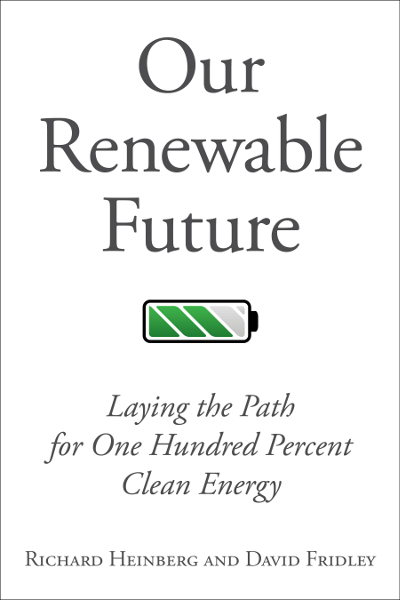
I spent the last year working with co-author David Fridley and Post Carbon Institute staff on a just-published book, Our Renewable Future. The process was a pleasure: everyone involved (including the twenty or so experts we interviewed or consulted) was delightful to work with, and I personally learned an enormous amount along the way. But we also encountered a prickly challenge in striking a tone that would inform but not alienate the book’s potential audience.
As just about everyone knows, there are gaping chasms separating the worldviews of fossil fuel promoters, nuclear power advocates, and renewable energy supporters. But crucially, even among those who disdain fossils and nukes, there is a seemingly unbridgeable gulf between those who say that solar and wind power have unstoppable momentum and will eventually bring with them lower energy prices and millions of jobs, and those who say these intermittent energy sources are inherently incapable of sustaining modern industrial societies and can make headway only with massive government subsidies.
We didn’t set out to support or undermine either of the latter two messages. Instead, we wanted to see for ourselves what renewable energy sources are capable of doing, and how the transition toward them is going. We did start with two assumptions of our own (based on prior research and analysis), about which we are perfectly frank: one way or another fossil fuels are on their way out, and nuclear power is not a realistic substitute. That leaves renewable solar and wind, for better or worse, as society’s primary future energy sources.
In our work on this project, we used only the best publicly available data and we explored as much of the relevant peer-reviewed literature as we could identify. But that required sorting and evaluation: Which data are important? And which studies are more credible and useful? Some researchers claim that solar PV electricity has an energy return on the energy invested in producing it (EROEI) of about 20:1, roughly on par with electricity from some fossil sources, while others peg that return figure at less than 3:1. This wide divergence in results of course has enormous implications for the ultimate economic viability of solar technology. Some studies say a full transition to renewable energy will be cheap and easy, while others say it will be extremely difficult or practically impossible. We tried to get at the assumptions that give rise to these competing claims, assertions, and findings, and that lead either to renewables euphoria or gloom. We wanted to judge for ourselves whether those assumptions are realistic.
That’s not the same as simply seeking a middle ground between optimism and pessimism. Renewable energy is a complicated subject, and a fact-based, robust assessment of it should be honest and informative; its aim should be to start new and deeper conversations, not merely to shout down either criticism or boosterism.
Unfortunately, the debate is already quite polarized and politicized. As a result, realism and nuance may not have much of a constituency.
This is especially the case because our ultimate conclusion was that, while renewable energy can indeed power industrial societies, there is probably no credible future scenario in which humanity will maintain current levels of energy use (on either a per capita or total basis). Therefore current levels of resource extraction, industrial production, and consumption are unlikely to be sustained—much less can they perpetually grow. Further, getting to an optimal all-renewable energy future will require hard work, investment, adaptation, and innovation on a nearly unprecedented scale. We will be changing more than our energy sources; we’ll be transforming both the ways we use energy and the amounts we use. Our ultimate success will depend on our ability to dramatically reduce energy demand in industrialized nations, shorten supply chains, electrify as much usage as possible, and adapt to economic stasis at a lower overall level of energy and materials throughput. Absent widespread informed popular support, the political roadblocks to such a project will be overwhelming.
That’s not what most people want to hear. And therefore, frankly, we need some help getting this analysis out to the sorts of people who might benefit from it. Post Carbon Institute’s communications and media outreach capabilities are limited. Meanwhile the need for the energy transition is urgent, and the longer it is delayed, the less desirable the outcome will be. It is no exaggeration to say that the transition from climate-damaging and depleting fossil fuels to renewable energy sources is the central cause of our times. And it will demand action from each and every one of us.
You can help by visiting the Our Renewable Future website, familiarizing yourself with the issue, sharing your thoughts and spreading the word with friends, family, colleagues, and allies.

Why Global Capital Fears ‘Brexit’

Helena Norberg-Hodge, Rupert Read & Thomas Wallgren


Trade treaties were a hot button issue during the recent US presidential primary campaigns. This represents an important victory for the people – for the grassroots – whose voice is finally being heard. While it’s hard to know what really lies behind Donald Trump’s opposition to the trade agreements, it’s very significant that Bernie Sanders put Hillary Clinton on the defensive about NAFTA and led her to take a stand against the TransPacific Partnership (TPP). In rejecting these trade deals, political leaders are going against the top-down pressure from global corporations and banks. We must of course be alert to the fact that politicians pander to voters while seeking election, but once in power they only seem to hear the voice of big money. Nevertheless, the fact that awareness about the trade treaties has become so widespread is itself a huge victory. Now that these corporate-friendly deals are seeing the light of day, it is unlikely that future trade agreements will be easy, automatic victories for global capital.
In the UK, meanwhile, another fierce debate is underway: voters in Britain will soon decide whether or not to remain in the European Union. Although this issue parallels – and is in fact linked to – the debate around trade treaties, most voices in favor of Brexit seem to offer little more than narrow nationalism, xenophobia and racism. Such associations make it feel impossible for most Greens and progressive thinkers on the left to vote ‘Leave’ in the upcoming UK referendum.
And that settles it in the minds of some: one ‘has’ to vote ‘Remain’. Anything else feels ‘unprogressive’, reactionary, even downright dangerous.

However, there are powerful arguments against the European Economic Union. In all five Nordic countries – Iceland, Norway, Sweden, Finland and Denmark – there has been a very powerful critique of the EU from an ecological, cultural, global solidarity and democratic perspective. A large proportion of the population in those countries realized that the impetus to link countries together was primarily based on a misguided notion of economic growth. However, these arguments didn’t reach the English-speaking world, and today on both sides of the debate in Britain this misguided notion continues to prevail.
In order to make sense of misleading pro and con arguments in the media, we need to go behind the scenes to examine the issues holistically. We need to look carefully at the process of economic ‘integration’ that has been going on for several generations now around the world.
At the regional, national and global level, societies and ecosystems have been transformed in order to accelerate economic growth. The emphasis has been on increasing international trade and benefits to international traders, at great cost to ecosystems, livelihoods, and democracy. It is important to understand the formation of the EU in this context, but by no means do the points we make here apply to the EU alone.
The EU is dedicated to corporate interests and economic globalization
The European Union is an extension of the Bretton Woods institutions – The World Bank, the International Monetary Fund (IMF), and the General Agreement on Tariffs and Trade (GATT).
It is widely assumed that the European Union was formed in order to prevent conflict and in order to avoid another depression. In the aftermath of the Second World War, political elites and business leaders promoted the notion that economic integration was a path to peace and harmony.
But the result was a form of economic development – based on debt, global trade and consumerism – that systematically undermined democracy and favored corporate interests while hollowing out local economies worldwide. In country after country, transnational corporations (TNCs) have been able to evade taxes by ‘offshoring’ their activities, and to bargain for lower tax rates and higher subsidies by threatening to move where even less in taxes will be demanded, and more in subsidies provided.
Today, interlinked multinational banks and corporations constitute a de facto European government, determining economic activity through the ‘European market’. Their vast lobbying power has an overwhelming influence on the EU Commission and the secretive Council. In other words, corporations run Europe.
Economic integration imposes human and ecological monoculture
Europe is home to a great variety of cultures, languages and customs. The economic union is based on an economic model that is eroding this diversity, which was born of human adaptation to different climates and ecological realities. A fabric consisting of mutually enriching and different cultural traditions is being replaced by the uniform culture of consumerist ‘individualism’.
Previously, the many borders, currencies, and differing regulations made trade difficult for big business, while the diversity of languages and traditions put limits on mass marketing. None of these were obstacles to businesses operating within their own countries – in fact, the borders and cultural diversity helped protect the markets of domestic producers from the predations of mobile capital, helping to ensure their survival.
But for big corporations and financial institutions, diversity is an impediment, whereas monoculture – in all aspects of life, from seeds, fast food and clothing, to architecture – is ‘efficient’. For them, a single Europe-wide market of 500 million people was an essential step to further growth: their growth.
Meeting that goal required a single currency, ‘harmonized’ regulations, the elimination of borders, and centralized management of the European economy.
The EU economy increases pollution and CO2 emissions
The global economic model promoted in the EU increases pollution and fossil fuel use in a multitude of ways.
First of all, economic policies are responsible for a concentration of jobs in ever-larger high-rise urban centers. When people move into urban areas, net resource and energy consumption tends to rise, massively increasing CO2 emissions and toxic pollution.
Secondly, the EU subsidies system not only wipes out family farms but paves the way for agribusinesses that destroy soils and ecosystems, or employ cruel factory farming methods.
Thirdly, investments in infrastructure and fossil fuel subsidies help to prop up the energy-intensive system of mass production for mass consumption. Moreover, most energy subsidies tend to support highly centralized power systems, rather than more decentralized renewable energy.
Even worse is ‘redundant trade’: in a typical year, Britain exports millions of liters of milk and thousand of tonnes of wheat and lamb, while importing nearly identical amounts. The cod caught off the coast of Scotland is shipped 5,000 miles to be turned into fillets in China, then shipped back again.
This kind of wasteful trade – which greatly overshadows the efforts of well-meaning individuals to reduce their personal carbon footprints – actually benefits no one but massive corporations. And it is not efficiency but a wide range of subsidies and ignored costs that make it all possible.
National governments stripped of political power
At the same time as governments subsidise big business, they must pay from their depleted treasuries to retrain displaced workers, to mend the unraveling social fabric, and to clean up the despoiled environments left behind by deregulated, mobile corporations.
Forced to go hat-in-hand to banks, countries can easily find themselves on a downward spiral, with interest payments consuming an increasing proportion of national output. It’s no wonder that so many governments today are struggling to stay afloat, while global corporations and banks are flush with cash.
This has left nation-states increasingly powerless to deliver what people need. They have lost the power to protect their citizens from the impacts of international capital and financial speculation. As a result, many people have lost confidence in governments and democracy itself. They feel disenfranchised and angered by the escalation of inequality-driven by international market forces and rootless, profit-hungry corporations, with the full complicity of the EU.
This is a dangerous situation, ripe for exploitation by extremist forces, including those of atavism and of outright fascism.
European government is not the answer
Many idealists see the EU as a political bloc that has raised environmental and human rights standards continentally and globally, and acted as a buffer to the United States. There is much truth in this. And to greatly strengthen pan-European collaboration with the aim of solving our global ecological and human rights problems is clearly highly desirable.
However, this type of collaboration does not need to – ought not to be allowed to – erode the rights of smaller nation states to run their own affairs under clearly negotiated agreements of environmental protection. We hold that the relatively high standards in the EU have been a consequence of the integrity of the democracies in many of the constituent countries, not a consequence of creating a single market that benefits big business.
We would also argue that to assess the overall contribution by the EU to global environment and human rights affairs we must not look exclusively at the relatively benign EU policies in these areas themselves but also at the consequences for ecological justice of EU policies in trade and military policy.
In fact, the main impetus behind the European Economic Union was the desire of big business to compete with the US. And to a great extent, what we have today is a nascent United States of Europe, competing with the US about market shares but also working closely together with the US in preserving the hegemony of the global North over the global South.
European democracy? If only …
Meanwhile, within the EU, the public has very little power and ability to affect decisions. There is no common public sphere where European citizens can get together to muster democratic control of the European economy and the administrative power concentrated in Brussels.
The European Parliament is weak, and, more importantly, elections to it work mostly on a national-level basis. There are no real European political parties and movements. Thus the situation is even worse than it is at the national level: for at least at the national level there is a public, a citizenry, a demos, a press, a political debate.
It might appear that the solution is to remove power from national governments and give it to a democratically-controlled European government. There is something completely understandable about this impulse. After all, there is a real need for international co-operation around the political and ecological crises gripping our planet.
But scaling up government means increasing the distance between civic society and their representatives. It would be a step backward to create a federal superstate of Europe. Such a government would be virtually incapable of responding to the diverse needs of half a billion people.
Democratic institutions need to operate at a level that is comprehensible and accessible to people: at a human scale. We must take seriously the possibility that global democracy – people’s urge to care for the globe and for all its citizens – can only be real if most functions are local and people’s dependence on global trade and institutions is limited.
When presented by continent- and global-level problems caused by businesses and untrammeled markets, let’s increase international collaboration with the goal of scaling down businesses and markets. This form of collaboration is fundamentally different from scaling up government. It points in the opposite direction!
The following point is then at the heart of the very challenging position we find ourselves in: there is a profound mismatch between politics at the national level, and economics at the international level. Many well-intentioned ‘progressive’ / green / ‘Left’ people and organizations across the continent believe the best response to this problem is to create a true (rather than a merely de facto) European government. Yet this is likely to merely amplify the control already exerted by corporations over the European economy.
The answer, instead, is to decentralize the European economy. This will enable us to shape economic activity to reduce waste and resource consumption while providing meaningful livelihoods and restoring the environment. Through decentralization and relocalization we also reassert democratic control over our own destinies.
The way forward: localization
There is an alternative to undermining our own people in order to enrich foreign corporations and banks. It’s called ‘localization’ and it involves moving away from ever more specialized production for export, towards prioritizing diversified production to meet people’s genuine needs; away from centralized, corporate control, towards more decentralized, local and national economies.
This means encouraging greater regional self-reliance, and using our taxes, subsidies and regulations to support enterprises embedded in society, rather than transnational monopolies.
A shift away from the global towards the local is the most strategic way to tackle our escalating social and ecological crises. Localization shortens the distance between producers and consumers by encouraging diversified production for domestic needs, instead of specialized production for export.
Localization does not mean eliminating international trade, or reducing all economic activity to a village level. It’s about shifting the power from transnational corporations to democratically accountable entities, including nation states. At the same time we need to build up regional and local self-reliance. It’s about reclaiming power over our lives while simultaneously shrinking our ecological footprint.
Localization – the benefits
In contrast with the make-believe of derivatives and debt-based money, localization is founded in real productivity for genuine human needs, with respect for the rich diversity of cultures and ecosystems worldwide.
By shortening the distance between production and consumption, localization minimizes transport, packaging, and processing – thereby cutting down on waste, pollution, and greenhouse gas emissions. This simultaneously increases resilience, which will be needed to cope with the inevitable crises coming our way.
Localized economies rely more on human labor and creativity and less on energy-intensive technological systems. This increases the number of jobs while reducing the use of natural resources.
By spreading economic and political power among millions of individuals and small businesses rather than a handful of corporate monopolies, localization provides the potential for revitalizing the democratic process. Political power is no longer some distant impersonal force, but is instead rooted in community.
As the scale and pace of economic activity are reduced, anonymity gives way to face-to-face relationships, and to a closer connection to Nature. This in turn leads to a more secure sense of personal and cultural identity.
Localization is a remarkable solution-multiplier, but it should not be mistaken for a complete panacea. It offers no guarantee for peace and ecological wellbeing. Going local needs to be pursued in full awareness of the need for environmental and human rights protection that goes beyond local, regional and national borders. It’s a prerequisite, a necessity in order to build the accountable structures we need that respect and renew diversity.
Localization, or decentralization, was central to the thinking of the people’s movements in the Nordic countries that have resisted full integration into the EU. In Norway, the economic and political elites twice tried to achieve EU-membership and were defeated, thanks to the campaigns for democracy and global responsibility for environment and justice.
In Denmark and Sweden, membership in the Eurozone has been rejected in several referenda after historic grassroots campaigns. In Iceland, the popular support for EU membership has always been weak. The first application for membership in the EU was submitted in 2009 but suspended in 2013 when the pro-membership government lost elections.
UK voters: think before you vote!
We are facing huge crises: the frightening specter of climate change; the threat of nuclear annihilation; the enormous problems of hypermobility and large-scale migration …
These are all consequences of a fixation on growth and technological ‘progress’. The leadership in both Brexit and Remain are committed to promising more ‘economic growth’ to the millions of people who are struggling to hold on to a job, struggling to keep a roof over their heads.
The ‘growth’ that is being discussed is actually supporting excessive global trade and global businesses and banks. The very same process is handing over more wealth and power to the 1%, to the detriment of the 99%. And this type of growth demands ever-more energy for global infrastructures, including bigger airports, ports and super-highways.
So we have a system that destroys livelihoods while driving up CO2 emissions and other forms of pollution. More and more people, including Nobel laureate economists, are questioning this path.
There are some who would believe that collaboration at the pan-European level could facilitate a path to genuine economic decentralization. Others are convinced that those steps to localize can best be taken by first leaving the EU. Still others don’t favor either of these paths. We are not trying to tell UK readers how (or even whether) to vote; we are asking you to help us shed light on and bring sanity to this volatile situation.
Whichever way you vote, please reject the glaringly stupid rhetoric in the media. Speak out, let your voice be heard for ecological and economic sanity, for a fundamental turnaround.
Wall Street’s candidate wins elections in Peru with support from pseudo-left

Armando Cruz

In what became the tightest election in Peru’s history, 77-year-old economist Pedro Pablo Kuczynski (widely known as “PPK”) defeated right-wing populist candidate Keiko Fujimori by just 41,438 votes.
The result was unexpected, as Fujimori, the daughter of Peru’s former authoritarian president Alberto Fujimori—now jailed for his part in death squad massacres, repression and corruption—was leading the polls for more than a year. A drug-related scandal and massive protests against the return of fujimorismo undermined Fujimori’s campaign in the last weeks.
However, the biggest boost for PKK in political terms came from the Broad Front of the Left (Frente Amplio de la Izquierda, FA), a coalition of the pseudo left, which decided to unconditionally support Kuczynski in order to defeat Fujimori.
While Kuczynski managed to get elected, his party Peruanos Por el Kambio—a personalist political vehicle and not a real party—won only 18 seats in Congress. In comparison, Fujimori’s party, Fuerza Popular, has overwhelming power over the legislative branch, with 73 of their candidates elected to the 130-member legislature.
Born in Lima in 1938 to a German-Polish father and French mother (French filmmaker Jean Luc Godard is his first cousin), Kuczynski had a privileged education both in Peru and abroad. He received a scholarship to attend Oxford University and then another to study at Princeton’s Woodrow Wilson School of Public and International Affairs, where he got a doctorate in economics at the age of 22. Back in Peru in 1966, he started his public career in the National Reserve Bank (NRB) under the auspices of Carlos Rodríguez Pastor, who belonged to one of the country’s richest families.
In 1968 the military, under the command of Gen. Juan Velasco Alvarado, launched a coup against the right-wing government of Fernando Belaúnde Terry and implemented nationalist measures, including expropriations of foreign businesses such as the International Petroleum Company, owned by Standard Oil.
Velasco’s government accused Kuczynski and his colleagues of stealing US$115 million from the NRB in order to give it to Standard Oil as compensation for the expropriation. Kuczynski escaped to Ecuador hidden in the trunk of a Volkswagen.
Exiled in the US, Kuczynski was rewarded with senior posts in the World Bank and IMF and obtained US citizenship. Starting from this period, his resume shows the avaricious rise of an ambitious businessman. He became chairman, partner and founder of various banks (including First Boston), private equity firms, companies and multinationals. According to opensecrets.org, he has made donations to both Republicans and Democrats.
He returned to Peru after the collapse of the military dictatorship (1968-1980) and became minister of energy under Belaúnde’s second government, imposing what became known as “Kuczynski’s law,” under which large foreign oil companies were handed tax breaks worth US$500 million.
In 2001, after the collapse of the dictatorial government of Alberto Fujimori (Keiko’s father) he entered the government of his successor, Alejandro Toledo, which—like all those that have come to power since the fall of Fujimori—continued and deepened the US-backed free market measures that Fujimori introduced in the 1990s.
Under Toledo, Kuczynski was instrumental in renegotiating a deal that would divert natural gas for export rather than needed domestic consumption. The company that benefited the most from the deal was Hunt Oil, for which he would later work. A WikiLeaks cable from August 2005 defined him as an “influential government ally.”
In 2006, Kuczynski showed his own personal racism, declaring before an annual gathering of major businessmen: “This thing of changing [economic] rules, changing contracts, to nationalize [property] its more or less an idea of [the people of] the Andes, a place where the altitude obstructs the oxygen from reaching to the brain, this is fatal and terrible.”
Kuczynski ran for president for the first time in 2011. He was the favorite of the business class. When the run-off became one between Keiko Fujimori and current president Ollanta Humala, he threw his support to Fujimori.
At the beginning of the latest elections, there was no reason to suspect that Kuczynski would advance from the third or fourth position to which he had been relegated in the polls. However, things began to change after the National Jury of Elections—the state organ that oversees the electoral process—barred both Julio Guzmán and César Acuña from the ballot. Both candidates, in different ways, fit the electorate’s desire for options outside of traditional politics and had, at different times, occupied second place in the polls. Kuczynski’s standing begin to increase by default, along with that of Veronika Mendoza, the FA’s candidate, who managed to achieve third place.
Kuczynski has won the election through a series of fortunate events, and political analysts have unanimously warned that his government will have a weak and isolated character unless he establishes alliances with fujimorismo, the foremost power in the legislative branch. As the Peruvian daily El Comercio put it: “The new president has been left with a minimum representation and without significant allies in a Congress dominated by his adversary as well as without a real party organization and with no real representation whatsoever in the country’s regions.”
It is probable that Kuczynski will carry out an earlier campaign pledge to pardon Alberto Fujimori (or grant him house arrest) as a gesture aimed at gaining the support of Fuerza Popular.
Neither Kuczynski’s past as a Wall Street banker nor any of the corrupt measures he backed under former administrations was a deterrent to the FA’s endorsement of him as the “lesser of two evils.”
On a video seen by 2 million people on Facebook, FA presidential candidate Verónika Mendoza looked into the camera and declared: “I don’t want for my children a country of corruption, drugs and violence [in reference to Fujimori and a drug-related scandal that damaged her campaign] or where to kill, lie and steal becomes the norm; because of that I am going to vote against Mrs. Fujimori. [...] The only thing left is to vote for PPK.” Mendoza added that casting null or blank ballots in protest against the two right-wing candidates would only strengthen Fujimori in the final vote count.
The FA’s decision to support Kuczynski is, in fact, an extension of the main objective of its own campaign: sustaining Peruvian capitalism by tying workers and youth to bourgeois politics and suppressing any independent movement of the working class.
Mendoza and her colleagues in FA will bear political responsibility for the inevitable attacks on the working class that are to come under Kuczynski, whose victory was hailed as “more good news from Latin America” in a Wall Street Journal editorial titled, “Peru Keeps Driving Right.”
Kuczynski’s spokesmen declared the incoming government’s interest in establishing alliances even with the “left” FA, which has 20 seats in Congress. Pedro Francke, one of the FA’s leaders, declared that they would evaluate participation with his government and that they would support any “good” policy it proposes.
The country’s main union federation, CGTP, and the teachers’ main union, SUTEP, also threw their support to Kuczynski after he signed a list of vacuous promises such as respecting certain labor benefits and increasing the meager salaries of teachers. This, from a man who personally reaped millions from the destruction of workers’ living standards on an international scale.
With Mendoza’s support, Kuczynski “was able to enter in Lima’s poorest neighborhoods and in the country’s south where he wouldn’t have any strength by himself. First data shows that he won in Lima and in the south, precisely thanks to Mendoza’s votes,” stated a report by the Spanish daily El País.
Right-wing novelist and former Peruvian presidential candidate (who lost to Fujimori’s father in 1990) Mario Vargas Llosa praised the FA’s decision in his weekly El País column. “The Peruvian left, acting in a responsible way, saved democracy and has assured the continuation of a policy that has given the country a remarkable economic progress,” he wrote.
Vargas Llosa’s column has long served as a vehicle for sanctifying right-wing governments that cooperate with the Western powers and financial institutions, while demonizing others that defy them even minimally. All of this all wrapped up in a self-righteous “intellectual” pose. In his latest columns he congratulates right-wing president Mauricio Macri of Argentina for his “brave” (i.e., unpopular) economic measures attacking the working class.
With the China-led “commodities boom” severely weakened and the disappearance of big foreign investments in Peru, ruling circles are pushing for the next government to impose even more deregulation for big business, to make it easier to fire workers and accelerate the privatizations of water and oil that have already begun, in order to make the country more “friendly” to the multinationals and foreign investors.
This will be the focus of Kuczynski’s agenda, which will inevitably trigger an upsurge in the class struggle in Peru.

12,000 Caltrans workers offered effective pay decrease in new contract

Gabriel Black

About 12,000 maintenance workers employed by the California Department of Transportation (Caltrans) were given ballots Monday to vote on a new contract agreement reached between the state government and the International Union of Operating Engineers (IUOE) on May 26.
The contract, which offers a 10 percent pay raise over four years, mens that—adjusted for inflation and benefit changes—a slight pay decrease. Workers are being asked over the course of the contract to spend an additional 4.1 percent of their salary on retirement contributions. Inflation, which averaged 1.5 percent a year since 2008, would eat up another 6 percent of workers’ pay gains.
The official inflation figures, however, do not fully take into account the impact of rental and housing costs, which will have a disproportionate impact on new workers moving to join the workforce. The average California home price increased by a whopping 50 percent between May 2012 and May 2016. Workers who do not already own homes, or have apartments that are not rent controlled—often younger and newer workers to the job—will see a significant pay cut when the sharp increase in the cost of living is considered.
While workers are being asked to accept, in effect, a pay decrease, the Democrats, with the support of the major unions, including the IUOE, have proposed a new state budget which will cut $10 million out of the Caltrans budget and work to double the number of contract workers in Caltrans in order to make it “more efficient.”
This attempt by the Democrats and their union backers to replace the Caltrans workforce with temp labor is being done behind workers’ backs and is not being openly discussed by the union, which has backed Democratic Governor Jerry Brown throughout his recent tenure in office.
The contract, meanwhile, does nothing to ensure the safety of workers, which has been a major complaint of workers.. Caltrans workers, who repair roads and bridges, are employed on some of the more dangerous jobs in California. Since 1921, 184 Caltrans workers have died on the job, according to the agency. That is almost two people per year. The last person to die was Oscar Vargas, 54, from the greater San Diego area. He lost control of his work truck on May 4, 2016 and crashed.
The job is also dangerous to long-term health. Workers are exposed, often daily, to serpentine aggregate, tar and asphalt. As a worker told the WSWS at a rally in Sacramento in April, “Take a look at our safety manual, there are hundreds of carcinogens that we inhale on a daily basis. There are a lot of hazardous materials that the administration doesn’t even acknowledge.”
The contract agreement comes almost two months after Caltrans workers staged a series of three rallies on April 8, without union support or endorsement, including one outside the site of contract talks in Sacramento (the union endorsed the rally retroactively on their web site after canceling the contract negotiations for that day). At the time of the rallies workers had been without a contract for nine months. At the rallies workers voiced their eagerness to struggle for better pay, safer working conditions, and better benefits. Many carried signs denouncing management’s proposal for an effective net pay decrease, which has now been accepted by the IUOE.
The Caltrans contract vote takes place in the midst of signs of mounting militancy by the working class in the United States and internationally. It follows the strike by 40,000 Verizon workers on the US East Coast and massive strikes and protests in France against changes to the labor code.
The World Socialist Web Site urges Caltrans workers to reject the contract. We call for the building of rank-and-file committees, independent from the unions, the Democratic party and management, to lead the fight against concessions and for a decent contract. As part of this fight Caltrans workers should reach out to autoworkers, oil workers, telecommunication workers, teachers, and health care workers—all whom are facing bitter struggles for safety, health care, retirement and wages.

European Union seeks agreements with African dictators to deter refugees

Martin Kreickenbaum

The European Union (EU) is abandoning all pretense of human rights restraints in its refugee policy. A strategy paper published last week by the EU Commission outlined migration partnerships that will compensate nine states in Africa and the Middle East, both transit countries and countries of origin, for their cooperation in deterring refugees.
The goal of the agreements—described as “compacts”—is “the combatting of causes of flight and a reduction of irregular migration to Europe,” EU Commissioner for Migration, Home Affairs and Citizenship Dimitris Avramopoulos declared in an interview with the German daily Die Welt. In fact, what is involved is a programme with which the refugees themselves are to be combatted. The EU’s reactionary partners are to seal off escape routes, detain refugees and send them back to their countries of origin.
The list of countries with which agreements are to be concluded alone makes clear that the EU has no qualms about with whom it cooperates. In the interview, Avramopoulos named Jordan, Lebanon, Tunisia, Niger, Mali, Ethiopia, Senegal, Nigeria and Libya. In addition, there is the “Better Migration Management” programme, with which the EU intends to provide technical assistance to the dictatorial regimes in Sudan, South Sudan, Ethiopia, Somalia and Eritrea to combat refugees. These are the most important transit states and countries of origin for refugees in Africa.
The agreement the EU plans to conclude with each of these states is aimed at “convincing” each government to “take back illegal migrants. In addition, we want to ensure that these countries deal firmly with people smugglers and effectively secure their borders,” Avramopoulos told Die Welt. Describing refugees as “illegal migrants” has long since become accepted practice in the EU, so as to deny the desperate people fleeing war, poverty and persecution any right to protection in Europe.
To secure cooperation in combatting refugees, the EU intends to top up the financial assistance available to those states designated part of “migration partnerships.” The prospects of improved trading relations and relaxed visa requirements have also been raised. The EU Commission intends to make almost €8 billion [$US 9.01 billion] available for the program by 2020.
With utter cynicism, the chairman of the social democratic fraction in the European Parliament, Italian politician Gianni Pitella, praised the EU Commission. Africa could not be permitted “to become a cage which refugees cannot leave” and the EU member states had to make a financial contribution. Yet the EU Commission’s plan is precisely to keep refugees stuck in Africa at any price. The High Representative of the European Union for Foreign Affairs and Security Policy, Federica Mogherini, spoke of a “Copernican shift” in the EU’s policy.
It is breathtaking how savagely the EU is trampling its oft-repeated “values” and principles under foot. With the migration partnerships, the EU is effectively making clear that it no longer has any intention of being bound by international law as contained in the Geneva Convention on Refugees.
“We want to try and bring order to the flows of refugees,” said Frans Timmermans, EU Commission vice president, repeating a formulation of German Chancellor Angela Merkel. She set the goal in April of “bringing order and managing the route from Libya to Italy as we have done in Turkey.”
The EU’s dirty deal with Turkey already systematically violated the rights of refugees. They are detained in Greece and even children are held under catastrophic conditions in internment camps. Turkey permits its forces to shoot at refugees on the Syrian border and ruthlessly deports them to their countries of origin.
Concluding such a deal with Libya, as the EU Commission proposes, would be a further crime. Since the US-led NATO intervention in 2011 to topple the regime of Muammar Gaddafi, the country has been dominated by a bloody civil war that has thrown it into economic and political chaos. There are three governments in the country, none of which controls substantial territory. A “unity government” recently imposed by the imperialist powers is to help, above all, to prepare a further military intervention by the US and its European allies.
Amnesty International recently published a report documenting arbitrary violence against refugees by the Libyan coast guard. Refugees intercepted at sea were beaten and shot, before being dragged to Libyan detention centres where they were abused and tortured. Despite this, the EU intends to deport refugees there.
Another “partner” of the EU is the Sudanese regime of Omar al-Bashir, who is sought by the International Criminal Court in the Hague for war crimes. Nonetheless, his regime is to receive vehicles, cameras, an aeroplane and additional technical equipment so as to strengthen the “border infrastructure” at the country’s 17 border crossings, as an EU Commission document states.
The German government has taken the lead in working out the deal with Sudan. Although Minister of Economic Cooperation and Development Gerd Müller (Christian Social Union) rejected a report by the Guardian that the German government was financing the strengthening of the Sudanese security forces, he neglected to mention that the state-sponsored Society for International Cooperation (GIZ) has already assumed this role.
In Eritrea, the EU plans to expand the judicial system. The military regime of Isaias Afewerki is a brutal dictatorship and has been charged by the United Nations with crimes against humanity. A UN report came to the conclusion that crimes against human rights had been systematically practiced in the country for 25 years. Oppositional figures are arbitrarily detained, tortured and killed.
Things are little better in South Sudan, Ethiopia or Somalia, which the EU also hopes to secure as border guards to carry out the dirty work in its ruthless policy of sealing off its borders.
The other side of the EU’s brutal external refugee policy is the further erosion of rights for refugees within Europe itself. The European Council for Justice and Internal Affairs issued a demand to the Greek government, which virtually coincided with the presentation of the African migration “partnerships,” to recognise Turkey as a secure third country and deport more Syrians there.
Austrian Minister for the Interior Wolfgang Sobotka also gave his backing to a proposal by Foreign Minister Sebastian Kurz (both members of the right-wing Austrian People’s Party) to intercept refugees in the Mediterranean and either deport them immediately or detain them on Mediterranean islands. He mentioned Australia as an example, which interns refugees on Pacific islands.
On Sunday, Bulgaria’s Foreign Minister Daniel Mitov told the Austrian newspaper Die Presse that the Geneva Convention on the status of refugees was obsolete. He claimed that “the document was written basically for people escaping communist regimes. It was not about masses of people.” This is a brazen lie. Mitov neglects to mention that the convention adopted in 1951 was primarily a response to the crimes of National Socialism. Hundreds of thousands of people, above all Jews, fled the Hitler regime between 1933 and 1945. With no country prepared to take them in, they were left in the murderous hands of the Nazis.
Today in Europe tens of thousands of refugees are once again kept in detention and denounced as “illegal migrants” or “economic refugees.” The human rights commissioner of the United Nations, Zeid Ra’ad Al-Hussein, recently sharply criticized the EU’s policy. The number of detentions are increasing “alarmingly”—with even unaccompanied minors being imprisoned, declared al-Hussein at the opening of a new session of the UN Human Rights Council in Geneva. The “hot spots” set up by the EU were, “essentially huge incarceration facilities.” Al-Hussein called on the EU to monitor the detention of migrants statistically: “I fear the numbers will be very shocking.”

European Court of Justice upholds UK ban on migrant benefits

Robert Stevens

The European Court of Justice (ECJ) ruled Tuesday that Britain’s laws denying many European Union migrants child benefit and child tax credits are legal.
The judgment states that the British government can withhold family welfare benefits to EU migrants who are not working if they do not have the “right to reside” in the UK. While the ECJ acknowledged this means that citizens of other EU nations would be subject to “unequal treatment” in the UK, it ruled that “this difference in treatment can be justified by a legitimate objective such as the need to protect the finances of the host Member State…”
To have the right to reside in the UK, foreigners must be in employment, looking for work or have been in Britain for at least five years.
The ECJ ruling relates to measures originally introduced in 2004 by the EU governing the rights of migrants from the EU and European Economic Area. Those deemed “economically inactive”, and their family members, were able to claim certain welfare benefits under the “habitual residence” test.
Had the ruling gone against the UK government, the Conservative government of Prime Minister David Cameron would have been thrown into an even deeper crisis. The judgment was made with just days remaining before the UK votes in the June 23 referendum, currently on knife-edge, on continued membership in the EU.
If the Tory government leading the Remain campaign wins, Cameron will legislate for child benefits for EU migrants to be restricted to the rate of their home country, and for an “emergency brake” on EU migrants claiming in-work benefits for up to seven years. These curbs on EU citizens’ democratic rights were agreed by Cameron with the other leaders of EU countries in February, giving the green light for the referendum to go ahead. These curbs were premised on the government winning the case before the ECJ, and demanded by Cameron in an attempt to satisfy the nearly half of the Tory parliamentary faction, and even wider base of the party, that oppose EU membership.
The EU and its leading powers, Germany and France, are opposed to the UK exiting. The ECJ ruling was a direct intervention in support of the Remain campaign. Cameron’s message to the euro-sceptic wing of his party is that cutting immigration levels and imposing austerity against the working class can be achieved within a “reformed” EU supportive of his agenda.
The decision was made all the more vital given that the Cameron government is preparing to oppose the free movement of workers within the EU in an attempt to cut the ground from under the Leave campaign. According to the Guardian, this could be done via the government “making a unilateral statement of intent or securing an understanding from European leaders that the issue can be examined under the UK presidency next year.”
On Tuesday, senior figures in the Labour Party, Cameron’s main backers in the Remain campaign, also came out in opposition to free movement. Former shadow chancellor Ed Balls called for controls on migration and was immediately backed by Deputy Leader Tom Watson and several others.
The legal case was brought against the UK government in 2014 by the European Commission (EC), the executive arm of the EU. It argued that the British process of checking whether claimants of child benefit and child tax credit were legally resident discriminated against foreign EU workers, as British citizens were not treated in the same way.
Last October, the ECJ’s Advocate General, Pedro Cruz Villalón, issued a preliminary opinion that the EC’s legal case against Britain should be dismissed. He argued that in order to protect a host EU Member State’s public finances, EU migrants to Britain could “suffer the inconvenience” of tougher checks even if this was “indirect discrimination.”
The ECJ echoed this stance, ruling that although it was endorsing “indirect discrimination,” it rejected the EC’s main argument “that the UK legislation imposes a condition supplementing that of habitual residence contained in the regulation.”
This verdict was reached despite the judgment noting in its first paragraph, “One of the common principles that the Member States must observe is the principle of equality. In the specific field of social security, the principle of equality takes the form of prohibiting any discrimination on grounds of nationality.”
The scapegoating of migrants and denial of access to the basics for subsistence is now the policy of governments across the continent. Last month, Andrea Nahles, the Social Democratic Party Minister of Labour and Social Affairs in Angela Merkel’s German coalition, submitted a plan under which migrants from other EU countries “will be excluded on principle from services such as social assistance and basic income for those searching for work.”
The Cameron government seized on the ruling as vindicating its position of remaining in the EU. A government spokesman welcomed the judgment, “which supports our view that we are entitled to ensure only EU migrants who have a right to be in the UK can claim our benefits.”
Vote Leave responded that it had been vindicated, with Leading Tory Iain Duncan Smith stating, “[I]t is clearly an illegitimate challenge to our sovereignty. Although David Cameron didn’t want to admit it, this case and others like it are proof positive that the unelected European Court of Justice is now supreme above our elected Parliament.”
With Cameron and the Tories widely hated, Labour is tasked with leading the Remain campaign. Its response proves that the election of Jeremy Corbyn, as a nominally left leader, has done nothing to change Labour from being a right-wing nationalist party.
On Tuesday, Alan Johnson, the Blairite chair of Labour In for Britain, insisted that only through the UK’s EU membership could immigration be cut back. Speaking to the BBC, he said that Labour had not said enough in the campaign about opposing immigration. He continued, “There’s three types of immigration: there’s immigration from outside the EU, there’s illegal immigration, and there’s free movement. Of those, free movement gives us the benefit of the single market. Our argument is remaining part of the single market helps us to control the other two forms of immigration.”
“If anyone believes that our UK border in Calais (France) is going to survive us leaving the EU then once again they’re in the realms of fantasy,” he added.
In recent weeks, the population of Turkey, the vast majority Muslims, have been designated by both the Remain and Leave campaigns as potentially an invading army of millions of people that only require Turkey’s accession to the EU in order to flood the UK and steal everyone’s jobs and access to health care, housing and education.
Citing comments 24 hours earlier by Hilary Benn, a Blairite warmonger who Corbyn appointed to his shadow cabinet, Johnson said, “If you are concerned about accession countries like Turkey, stay in the EU because Britain gets a veto [on who can join the EU] and can determine the terms of them coming in, including not allowing free movement from those countries.”
The Socialist Equality Party, the British section of the International Committee of the Fourth International, opposes both the Remain and Leave campaigns and is calling for an active boycott of the referendum.

Political crisis deepens in Australia’s “double dissolution” election

Mike Head

The past week has seen a sharp turn in the campaign for the July 2 “double dissolution” election in Australia, reflecting fears in the media and corporate establishment that Prime Minister Malcolm Turnbull’s decision to call the rare election for all members of both houses of parliament has backfired.
When Turnbull announced the election five weeks ago, it was a bid to break through a political impasse produced by the failure of successive governments, both Liberal-National and Labor, to fully impose an agenda of sweeping cuts to social spending and working conditions amid a deepening economic breakdown in Australia and internationally.
It was not just that key budget cuts had been stalled in the Senate since 2014, due to the election in 2013 of a range of “independent” and “fourth party” candidates who exploited the hostility toward the two major parties by professing to oppose key austerity measures. The underlying political crisis was reflected in the fact that not one prime minister had been able to see out a full term of office since 2007: the eve of the global financial crisis.
Now, however, there is the distinct possibility that the election could produce an even worse outcome for the financial elite. Not only could the government fail to secure control of the Senate but the result could be another “hung parliament” in the lower house, with no party able to obtain a majority, as occurred from 2010 to 2013, when the Greens propped up a minority Labor government.
Five weeks ago, Turnbull’s political gamble was dressed up in rhetoric of promising “exciting times” and “jobs and growth.” Equally cynically, Labor sought to appease the anger and alienation among masses of people over deteriorating living standards and widening social inequality by pledging to deliver “fairness” that would “put people first.”
Two factors have combined to shatter these lies. One is the rapid deterioration in the economic situation confronting Australian capitalism and the other is the growing public disaffection and hostility towards the entire political establishment. Over the past week, the posturing by the two traditional ruling parties has been replaced by de facto bipartisan unity on a program of severe cuts to healthcare, family payments, pensions, education and social infrastructure.
First, in response to incessant demands by big business and the corporate media, Labor leader Bill Shorten began unveiling a series of policy reversals, abandoning Labor’s earlier populist claims to oppose the government’s “billionaires” budget cuts to social spending. By one estimate, Labor has so far adopted $33 billion worth of cutbacks proposed over the next four years, plus the government’s devastating $50 billion cut to hospital funding over the coming decade—all of which Labor had professed to strongly oppose when the election campaign began.
Then, last Sunday, Turnbull declared a so-called “captain’s pick” to direct his Liberal Party to allocate its second-vote preferences to Labor. He insisted this was essential in the “national interest” to avoid a return to “unstable, chaotic minority Labor, Greens, independent government.” Turnbull overruled leading Liberals who urged allocating preferences to the Greens, which were seeking to gain several inner-city seats at Labor’s expense on the back of Liberal preferences.
Clearly, the “national interest,” dictated by the concerns in the corporate elite, required bolstering the position of the Labor Party, in the hope that it could form a majority government in the event of the Coalition losing office.
Some inkling of the anxiety in ruling circles was revealed yesterday when Fairfax Media reported focus group research showing that “voters are disgruntled with their lot, lack confidence in the future, have become increasingly disengaged with politics and lack belief in the political class.” The opinions of both Turnbull and Shorten were negative, but support for Turnbull had “fallen off a cliff” since he deposed Tony Abbott as prime minister last September.
Both major parties are seeking to impose the dictates of the financial markets, which are driven by the slump overtaking global and Australian capitalism. Since the mining boom began to collapse in 2014, tens of thousands of full-time jobs have been destroyed and investment has plummeted, making many more job losses inevitable in the months ahead. With many parts of the country already in recession, a housing bubble in Sydney, Melbourne and Brisbane shows signs of bursting.
The most common refrain in the corporate media has become that Australia will lose its AAA credit rating, with dire consequences, because of its exposure to China’s slowdown and depressed export prices, unless drastic action is taken to slash the almost $40 billion annual budget deficit.
The Australian Financial Review editorial on Tuesday welcomed the “potentially-sensible political convergence” but made it clear that the next government must impose even more savage measures, regardless of popular opposition. “Whoever wins the July 2 election will need to do much more to both further deflate public expectations of what governments can deliver,” it declared.
The air of economic and political volatility was underscored by feature article in the financial newspaper last weekend, under the headline: “Warning! Danger ahead.” It warned of “an uncertain world out there threatening smug political forecasts and also threatening to burst the current Australian election campaign bubble.”
The article listed shocks that could “ricochet here and erode Australia’s financial security.” They included a “fiscal debt-generated threat to Australia’s AAA credit rating,” “China’s precarious pump-priming balancing act,” instability generated by the Brexit referendum in Britain and the US presidential election, “the spectre of war in Eastern Europe” and “the global refugee crisis.”
The depth of the economic crisis makes clear that the next government, whether led by Liberal or Labor, will be compelled to make far deeper inroads into public spending than are being discussed in the election campaign.
Behind the backs of the population, the Coalition and Labor are also both committed to participating in more disastrous US-led wars, particularly against China. While both parties agree on making the working class pay for the economic breakdown, declaring there is “no money” for essential social programs, they are equally united in allocating almost half a billion dollars over the next decade to the military, including $195 billion for new submarines, ships and war planes.
This military expansion is integral to Washington’s “pivot to Asia” to confront China in order to assert unchallenged hegemony over the Asia-Pacific region. But these preparations are being kept from view, as much as possible, until after the election, for fear of arousing mass public opposition to war.
In response to the intensifying political crisis, the Greens, which currently constitute the “third party” of the political establishment, are seeking to channel the widespread discontent back into the parliamentary framework of capitalist politics by professing to oppose the most egregious cuts to social programs. In reality, they stand ready to again support a Labor-led government, as they did from 2010 to 2013, or to go further by joining a coalition government with Labor that would seek to implement the cuts pledged by Shorten.
While Greens leader Richard Di Natale voiced “strong disappointment” with the cuts embraced by Labor, he reiterated the Greens’ willingness to negotiate with either major party after the election to ensure that a stable government could be formed. Di Natale also accused the two main parties of striking a “nasty deal” on voting preferences to try to retain their political duopoly, but admitted that the Greens had sought similar vote-swapping agreements with the Liberals, as well as Labor.
Given the volatile political situation, further shocks and turns are quite possible before July 2—still more than two weeks away. But it is already clear that whichever parties form the next government, it will confront workers and young people with social devastation, deepening attacks on basic democratic rights and war.
The only party committed to opposing this offensive and speaking for the independent interests of the working people is the Socialist Equality Party. Its candidates are advancing a genuine socialist and internationalist program to unite the working class in Australia, across the Asia-Pacific region and globally, against the source of war, social inequality and dictatorship—the capitalist profit system itself.

Fed holds interest rates amid mounting global turmoil

Nick Beams

The decision by the US Federal Reserve to keep its base interest rate on hold is a measure of the worsening outlook for the global economy and financial markets. The overall situation is marked by growing concern over the US economy and a flight to “safe havens,” in the form of purchases of government bonds by international investors.
The two immediate factors in the Fed’s decision, announced at the conclusion of a two-day meeting on Wednesday, appear to have been the worsening jobs and economic outlook in the US and growing uncertainties surrounding the June 23 referendum in the UK on whether to quit the European Union, and the possible impact of a “yes” vote on equity and bond markets.
The statement issued by the US central bank’s Federal Open Market Committee noted that the pace of improvement in the labour market had slowed, with diminishing job gains, and that fixed business investment was “soft.” The Fed revised downward its estimate for economic growth in the coming year from the 2.2 percent forecast in March to 2 percent. Growth in 2017 was also revised downward from 2.1 percent to 2 percent.
As the Wall Street Journal noted, the decision suggested that Fed officials were coming to the conclusion that the economy could not bear higher interest rates even to achieve “mediocre growth.”
The issue of a possible exit of Britain from the EU (Brexit) was not mentioned in the statement, but Fed Chairwoman Janet Yellen commented on it in her press conference. Asked whether the upcoming British vote had been one of the factors in the decision, Yellen said: “It is certainly one of the uncertainties we discussed and factored into today’s decision.” A vote to leave the EU would have consequences for global markets, she added.
When viewed against the backdrop of the last six months, Wednesday’s decision indicates that the Fed is simply reacting to events as they occur, under conditions where its projections and forecasts are almost immediately blown off course amid slowing global growth and the rush by investors to the relative safety of government bonds. These are increasingly trading at zero or below-zero interest rates, and it is estimated that more than $10 trillion worth of bonds are returning negative interest rates.
When the Fed announced a 0.25 percentage point rise in its base rate last December, Yellen said the US economy was on a “path of sustainable improvement” and added that “we are confident in the US economy.”
In the two months that followed, global financial markets experienced considerable turmoil, part of which was attributed to the December Fed action.
The prospect of “sustainable improvement” was dealt a major blow with the release of data for the first quarter of 2016 that showed gross domestic product in the US rising at an annual rate of just 0.8 percent, repeating a pattern of first quarter declines over the last several years. Then the jobs data for May showed that employment had increased by only 38,000 in May, well below forecasts.
The unemployment rate fell, but that was only because the labour force shrank by 485,000 people, as thousands gave up looking for work. Other data shows that the percentage of men aged 25 to 54 who are not working is at an all-time high, and median household income is 1.3 percent below where it was in 2007.
In a speech last week, Yellen continued to maintain what she called “cautious optimism” on the US economy, but did not repeat previous remarks that she expected a further rate rise “in the coming months.”
The so-called “dot plot,” which indicates where members of the Fed believe interest rates will move, showed a lowering of projections in the short-term and stretching out to 2017 and 2018. This indicates that while the Fed would like to lift interest rates in order to have some means of stimulating the economy by lowering them in the event of a recession, it is unable to do so because the present low-rate regime is not bringing about a sufficient increase in growth.
Answering a question at her press conference, Yellen said: “We are quite uncertain about where rates are heading in the longer term.”
In her prepared remarks, she noted that non-energy business investment was “particularly weak” during the winter and appeared to have remained so in the spring. The growth in household spending “slowed noticeably” earlier in the year.
The immediate reaction in financial markets was that any rate rise was off the table for the rest of the summer, with the earliest date for an increase being September, or even December.
The Fed decision came in the wake of a day of turbulence on global financial markets Tuesday when yields on German and Japanese government bonds hit new lows, with the 10-year German Bund entering negative territory for the first time. The increase in bond prices, which have an inverse relationship to yields, was fuelled by opinion polls showing that the Leave option in next week’s Brexit referendum had attained a majority.
In addition to the falls in German and Japanese bonds, the yield on British 10-year bonds fell to a new low and the yield on the 30-year bond dropped to below 2 percent for the first time. The interest rate on US ten-year treasury bonds fell to 1.6 percent, just above its lowest level since 2012.
The British pound fell heavily on currency markets, with the cost of protecting swings in its value against the euro rising to a record high, exceeding levels reached in the global financial crisis of 2008.
While the immediate cause of the turmoil was the Brexit vote, longer term processes are clearly at work. Andrew Milligan, the head of global strategy at the UK insurer and investment group Standard Life, said it was “one of the most peculiar environments for investment I’ve known.”
He continued: “The Bund’s move below zero is symbolic of a trend we have been living with for more than a year, where the actions of central banks and the weight of money looking for positive returns is leading to unprecedented moves in markets.”
The sense of shock at what is taking place was also reflected in remarks by Ralf Preusser, head of European rates research at Bank of America Merrill Lynch.
“We are seeing the death of quality, positive-yielding assets,” he said. “Global growth is still weak and central banks are still buying bonds, but the real surprise, and the big driver behind this rally [the increase in bond prices, which sends yields lower], is the question of how sustainable the US recovery is.”
In other words, what was once considered the “normal” functioning of the global capitalist economy, where investments were made in the real economy in the search of increased profits leading to higher growth, and investment in government bonds returned a positive rate, securing a long-term source of income for insurance firms and pension funds, has completely broken down.
The various “quantitative easing” measures pursued by the world’s central banks have not only completely failed to increase real growth, they have created a mass of cash surging like a wrecking ball though financial markets as it seeks speculative profits.