19 Jun 2016

Competitive Football Violence At Euro 2016

Binoy Kampmark

“Russia and Poland are in top place in the hooligan chart. England has dropped down a long way.”
Andrei Malosolov, Jun 15, 2016
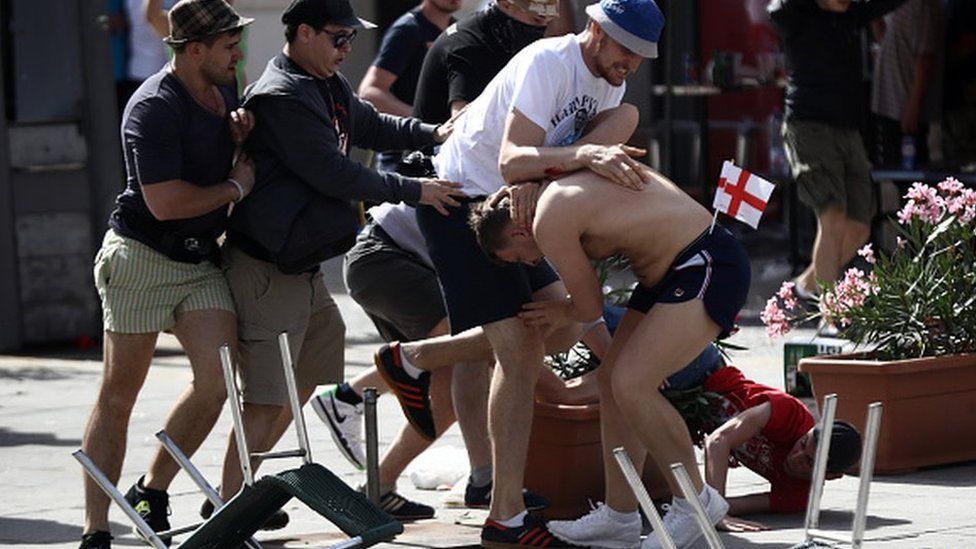
It had gone into something of a hibernating state, but it is clear that the European Football Championship in France is being made an example of by that scourge of sport, the football hooligan.
The modus operandi of such a figure is simple enough; organised, directed and coordinated, they strike at venues, agitate spectators and rile the authorities. They form a fifth column of violence and engagement, finding the activities on the pitch less relevant than what happens off it. Crowds provide the honey pots for their beelike activity. Codes of violent engagement are applied.
In the hooligan cosmos, a pecking order also exists. Just as teams compete for positions in league tables, hooligans also hope they will get the top spot. How they measure this, apart from noise and cracked skulls, is hard to say.
Within such communities, some groups are feared over others. Exploits are celebrated; triumphs are noted with hagiographic dedication. There are also deep seated rivalries, a competitive savagery that sees such figures as Alexander Shprygin, a superstar of the circuit, dominate.
As a supporter of Moscow’s CSKA football club, named Alexei, explained to the BBC, the violence in Marseille “showed who is the most important among hooligans.”
When such a figure initiates attacks, he does not do so by halves. The whole gamut is embraced, a rush of blood and viscera possibly involving death. Marseille prosecutor Brice Robin is even considering whether an attack on two England fans ahead of the 1-1 draw with Russia was attempted murder.
Shprygin was among 20 Russian fans being deported in the wake of the Marseille melees. Three other Russian fans received jail sentences for up to two years. This situation has an inevitable political sting. Sentiments in European sporting circles regarding Russia have not been glowing.
Performances on the athletics track are quizzed as being the outcomes of state-sponsored doping efforts. Some of Russia’s football supporters are deemed the spears by which to press home nationalist intimidation in foreign arenas. The BBC has gone so far as to claim that Shprygin’s All-Russia Supporters Union has the green light of support from the Kremlin, a case of the strongman Vladimir Putin supporting other “strong men”.
The response to the Russian hooligans from home, for that reason, has been mixed. The Russian Football Union has been expressing its regrets, keeping up the necessary appearances. Other officials have preferred to celebrate them as macho warriors, with their deeds those of “real men” (BBC News, Jun 15).
Such individuals see sporting violence as a normal, even necessary activity. “I don’t see anything wrong with the fans fighting,” claimed Igor Lebedev of the lower house of Russia’s federal assembly and Russia’s Football Union executive committee. “Quite the opposite, well done lads, keep it up!”
Lebedev has gone so far as to argue that the football fan never goes to a match not expecting violence. His ratio on that score is imaginatively high: nine out of ten. In a priestly tone of dispensation, he suggests that Russians “forgive and understand our fans.”
It did not take long for the Russian Foreign Ministry to issue a statement to the effect that further moves upon Russians fans might stoke “anti-Russian sentiments.” Deputy Foreign Minister Arkady Dvorkovich has tried to be reassuring, quoted in the Tass news agency as claiming that various blacklists of suspected hooligans are being drawn up ahead of the 2018 World Cup.
Russia should not be singled out as the ultra bogeyman in this affair. The hooligan league tables continue to have traditional contenders for top mantle. The city of Lille saw 36 arrests on Wednesday, with 16 taken to hospital following violent scrapping by England supporters. They, however, are being left behind.
Such a point has been made by some Russian supporters that they have had excellent teachers in the school of football violence. “In the 70s and 80s everyone would bow down before the English,” explained Alexei. “Now there are different hooligans. These are different times.” The pupils have surpassed the masters.
This different hooligan is a different breed, one seemingly trimmer, and importantly, more sober, than the English type a generation before. They are fitness fanatics who follow what Andrew Malosolov of the Russia’s Fans’ Union considers “a very healthy way of life”.
The ultimate penalty for such behaviour is the penalisation of sport itself. The behaviour of the fans as ambassadors for their team provides the yardstick upon which authorities can manage games.
The sinister events of Euro 2016 suggest that such control may entail disqualification and suspension. Russia has received a suspended disqualification and warning, while England has also been rebuked.
A football tournament without football teams is a sad one indeed, but we are bearing witness to a different world, one where football performance is secondary to an angry, tribal expression of testosterone and machismo.

Doping allegations cited to ban Russian track and field team from Rio Olympics

Barry Grey

The council of the International Association of Athletics Federations (IAAF) on Friday retained its earlier suspension of the Russian Federation's track and field body on the basis of charges that Russian government and sports authorities oversaw the doping of athletes with performance enhancing drugs at the 2012 London Olympics and other international competitions.
The decision means that the Russian track and field team is banned from the Summer Olympics to be held in August in Rio de Janeiro, Brazil. The action, barring an entire national team from competing in the games on grounds of cheating, is unprecedented.
At a press conference in Vienna following a meeting of the 27-member council, IAAF President Sebastian Coe, a British lord, said, “Although good progress has been made, the IAAF council was unanimous that RUSAF (Russian Athletic Federation) had not met the reinstatement conditions.”
The IAAF suspended the Russian track and field federation from international competition last November following the release of a report by the World Anti-Doping Agency (WADA) alleging that Russia had carried out systematic doping of its athletes at the 2012 Summer Olympics in London. Russian sports authorities at that time agreed to enforce enhanced anti-doping standards and submit to outside testing of its athletes by British officials.
The IAAF set up a task force to determine whether Russian sports authorities had reformed their system and set July 17 as the date for the council to review the report of the task force and decide whether to lift the suspension. On Friday, Rune Andersen, the chairman of the task force, told the press that “the deep-seated culture of tolerance, or worse, for doping that got Russian athletics suspended appears not to have changed.” He added that no track and field athlete would “compete in Rio under a Russian flag.”
Russian officials, who had lobbied intensively for the IAAF to lift the suspension, denounced the decision and said they would appeal it to the International Olympic Committee (IOC), the highest body overseeing the games, which meets Tuesday in Lausanne, Switzerland. Russian officials also indicated they might lodge an appeal with the Court of Arbitration for Sport in Switzerland.
Russian President Vladimir Putin, speaking Friday in St. Petersburg, denied that the Russian government had condoned or facilitated doping by Russian athletes.
The Russian sports ministry issued a statement declaring, “We have done everything possible since the ban was first imposed to regain the trust of the international community. We now appeal to the members of the International Olympic Committee to not only consider the impact that our athletes’ exclusion will have on their dreams and the people of Russia, but also that the Olympics themselves will be diminished by their absence.”
WADA largely based its November 2015 report on alleged Russian doping on a series of documentaries broadcast last year by the German public television channel ARD. Those documentaries relied heavily on allegations by Russian sprinter Yulia Stepanova and her husband, Vitaly Stepanov, a one-time Russian anti-doping official.
The statement released by the IAAF on Friday indicated that it would be prepared to allow Stepanova and other Russian athletes who provided evidence against Russian authorities or who had trained outside of Russia and been subject to drug testing by Western authorities to seek exemption from the ban, on the condition that they compete, if accepted, for a “neutral” team.
It is entirely possible that Russian government and sports officials were involved in the doping of athletes and the cover-up of their use of steroids and other banned substances. There is a long history of such practices in Russia dating back to the Soviet period. The Putin government, the political instrument of right-wing and semi-criminal capitalist oligarchs, largely bases its rule on the promotion of Russian nationalism and has a strong interest in using Russian sporting achievements toward that end.
That being said, there is no doubt that the virtually exclusive focus of international sporting authorities on Russian violations and the decision to ban the Russian track and field team—and threats that other Russian Olympic teams could also be banned—are driven by political interests. There is a large degree of coordination between major imperialist media outlets and Olympic and anti-doping agencies in the campaign to exclude Russia from the Rio games.
Just last week, on the eve of the IAAF council meeting, ARD broadcast a further documentary on alleged Russian doping charging that Russian Sports Minister Vitaly Mutko covered up a positive drug test by a football player from Russia's top league. ARD also claims to have videos of banned coaches training Russian athletes.
Mutko denied the accusations and denounced the airing of the documentary as an “information attack.” He charged, “The aim of this and other publications is clear to me. It is to influence the athletics committee on the eve of the meeting.”
The ARD film was followed by the release of a new WADA report on Wednesday alleging a pattern of interference and resistance by Russian Olympic athletes and officials to British efforts to oversee testing for doping.
On Thursday, the day before the IAAF council meeting, the New York Times, which has spearheaded the media campaign in the US for a ban on Russian athletes at the summer games, ran a story that began as the page-one lead and filled two entire inside pages criticizing WADA for being insufficiently aggressive in going after Russia. The story cited the ARD films, the whistle-blowing claims of the Stepanovs, and interviews given to the Times by Grigory Rodchenkov, a former head of Russia's anti-doping lab.
Rodchenkov was fired from his position by the Russian government after the publication of WADA's exposé of doping violations last November. He fled to the US and is collaborating with an American writer in Los Angeles who is preparing a book on Russian sports doping. Last May, the Times ran another extensive front-page article laying out Rodchenkov's claims to have supervised the systematic doping of Russian athletes and falsification of their drug tests during the 2014 Winter Olympic games at the Russian Black Sea report of Sochi.
The article was accompanied by a separate piece by one of its authors, “Sports of the Times” columnist Juliet Macur, calling for Russian to be banned from the Rio games and the 2018 Winter games as well. Macur was also a co-author of the article published on Thursday.
That Times article from last May prompted a WADA investigation of Russian practices at the Sochi games, the findings of which are slated to be released next month.
The political agenda here is clear. The campaign to bar Russia from the Olympics is part and parcel of the economic, diplomatic and military offensive being led by the United States and involving its NATO allies to isolate and encircle Russia and prepare for a military attack. The aim is to remove Russia as an obstacle to Washington's drive to establish hegemonic control over the Eurasian continent, reduce Russia to neo-colonial status and dismember it.
This campaign was massively escalated beginning in February 2014 with the US- and German-orchestrated right-wing coup that overthrew a pro-Russian government in Ukraine and installed an ultra-nationalist, anti-Russian regime in Kiev. The ensuing revolt by Russian-speaking regions in eastern Ukraine and the secession of Crimea, which subsequently voted to join the Russian Federation, became the occasion for a massive NATO militarization of Eastern and Central Europe, which continues to escalate and threaten a war between nuclear powers.
In the pursuit of this bellicose policy, the US is seeking to criminalize Russia and cast it as a rogue state.
More generally, the pretense that Russia is some kind of outlier and affront to the “Olympic spirit” is an absurd and cynical fraud. The Olympics have long been an exemplar of the money-grubbing corruption and national chauvinist politics of the professional sports racket. Doping is rampant and practiced by virtually every country.
Since 1986, when the International Olympic Committee changed the rules to allow professional athletes to compete in every phase of Olympics competition, any lingering connection to the principle of amateur sports has been repudiated. The Olympics have become a crass spectacle of corporate commercialism and flag-waving patriotism. In the process, the pressure on athletes to win at any cost—and the pecuniary reward for winning a gold medal—have immensely intensified.
Bribery scandals have become routine. One of the worst was the payoff by US officials and boosters to members of the International Olympic Committee for voting to locate the 2002 Winter Olympics in Salt Lake City. An ensuing investigation found the IOC members accepted bribes as well during the bidding for the 1998 Winter Olympics and 2000 Summer games.
The Americans are past masters in using the Olympics for political purposes, going back to the US-led boycott of the 1980 Moscow games over the Soviet invasion of Afghanistan—an invasion that was deliberately provoked by the Carter administration's funding and arming of Islamist opponents of the pro-Soviet government in Kabul.
As for doping, there is nothing that compares to the decade-long fraud carried out by Lance Armstrong, who rode for the team of the US Postal Service, a government-sponsored corporation. In October 2012, the US Anti-Doping Agency released a report declaring that the US Postal Service cycling team had run “the most sophisticated, professional and successful doping program the sport has ever seen.”

US insurers seek 10 percent Obamacare premium increase for 2017

Kate Randall

Premiums under the Affordable Care Act (ACA) are set to rise in 2017, according to a new analysis by the Kaiser Family Foundation (KFF).
The report, published Wednesday, shows that insurers in about one-third of all major metropolitan areas are seeking premium hikes of an average of 10 percent on the most popular plans under what is popularly known as Obamacare.
While Kaiser cautions that the analysis is preliminary, the foundation’s data shows that the trend of rising premiums under the ACA is continuing. Insurers cite rising drug and health care costs, as well as the growing pool of less healthy people shopping the Obamacare exchanges, for the rate increase requests.
What is clear, however, is that the private insurers, determined to increase their already bloated profits, are handing any cost increases along to the insured, and in some cases pulling out the ACA marketplaces altogether if they do not prove profitable.
KFF studied changes in premiums and insurer participation for the lowest and second-lowest cost “silver” plans in major metropolitan areas in 13 states plus the District of Columbia (DC) where complete data on rates is publicly available for all insurers. These two plans are the most commonly selected by Obamacare enrollees, while the government uses the second lowest-cost silver plan to calculate premium subsidies, also known as tax credits.
The analysis found that in the population centers studied, premiums for the two lowest-cost silver plans were increasing at a faster pace than in all previous years of the misnamed Affordable Care Act. The ACA was signed into law in March 2010 and the first plans were implemented in January 2014.
Kaiser also found that some states will have fewer insurers participating in 2017 than in 2016. In the 14 marketplaces studied, half (seven) will see insurer participation remain steady or increase. The other half of areas studied will see a drop in the number of insurers, in many cases due to the withdrawal of UnitedHealthcare from the ACA marketplace.
Across the 14 cities studied, premiums for the lowest-cost silver plans will increase by a weighted average of 11 percent in 2017. These changes vary geographically, from an increase of 26 percent in Portland, Oregon, to a decrease of 14 percent in Providence, Rhode Island. These figures show an overall upward trend in premiums prices combined with variations fueled by the volatility of the insurance market.
Premium changes also vary across these cities for the second-lowest silver plans, from a decrease of 13 percent in Providence, to an increase of 18 percent in Portland. These premiums’ changes do not take into account the tax credits enrollees receive based on their incomes and family size.
They also do not factor in the high deductibles charged for the two lowest-cost tiers of plans, silver and bronze, which in many cases exceed $5,000. The insured must pay these costs out of pocket, except for some “essential” services, before any coverage kicks in. These deductibles have the effect of forcing many enrollees to self-ration care for themselves or their dependents because they cannot afford to pay these huge costs.
Enrollees also face the dizzying prospect of shopping for new plans every year, as the most affordable plan one year may lose that distinction the next. This often means switching doctors and other providers on a yearly basis, breaking continuity and trust built between doctors and patients. The insured may also have to battle insurance companies over coverage for specific drugs and treatments.
In six of the 14 cities analyzed by Kaiser, the insurer offering the lowest-cost silver plan in 2016 is no longer offering one of the two lowest-cost silver plans in 2017. In nine of the 14 marketplaces, at least one of the two lowest-cost silver plans will no longer be in this category in 2017.
The report provides the example of Providence, where Blue Cross Blue Shield (BCBS) of Rhode Island offered the second lowest-cost silver plan in 2016 for a single 40-year-old, at $263 per month, before taking subsidies into account. In 2017, BCBS is raising this plan’s rate to $272 per month while another insurer, Neighborhood Health Plan, is now offering a few lower-cost silver options.
In a number of states, those shopping for coverage will see a decreasing number of insurers. UnitedHealth announced in November that it was considering leaving Obamacare by 2017, facing the prospect of not seeing the same $1.6 billion profits that it pocketed in the third quarter of 2015. The company announced it was dropping its ACA plans in Arkansas and Georgia and that more states were likely on the chopping block.
Insurance offerings vary from state to state and within states, where rural areas tend to have fewer insurers. Vermont, Rhode Island and DC each have only two Obamacare insurers statewide, while Connecticut and Nevada have only three each. Kaiser projects the likely risk of many rural areas having just one insurer in the future.
These rising premiums and declining insurance choices demonstrate the retrograde character of the Affordable Care Act. Under the legislation’s individual mandate, individuals and families without employer-sponsored coverage or from a government program such as Medicare are mandated to purchase coverage from a private insurance company or pay a penalty.
Under these plans they are saddled with increasing premiums and out-of-pocket costs, along with dwindling insurance options. The entire operation is aimed not at providing “affordable” or “near universal” coverage, but at rationing health care for the vast majority of Americans who are held hostage to the profits of the private insurance companies.

Report reveals millions living under modern day slavery

Usman Khan

A recent report by the Global Slavery Index estimates that some 45.8 million people today, across 167 countries, are living under some form of modern day slavery.
The figures reviewed in the report lay bare the conditions within which some of the most oppressed sections of the working class are living in. The plight of modern day slaves is the most extreme manifestation of the essential logic of capitalism; these are human beings that enjoy no rights beyond those of the commodity: to be bought, sold, and used.
Unlike historical definitions of slavery in which people were held as legal property—a practice that has been universally outlawed—modern slavery is generally defined as human trafficking, forced labor, bondage from indebtedness, forced or servile marriage or commercial sexual exploitation.
The countries with highest number of slaves, collectively making up 58 percent of the total number, are India, China, Pakistan, Bangladesh, and Uzbekistan. In India alone there are an estimated 18.35 million people living as slaves, 3.39 million in China, 1.53 million in Pakistan, 1.53 million in Bangledesh and 1.23 million in Uzbekistan.
The two countries with the highest percentage of their population living under conditions of modern slavery are North Korea with 4.373 percent and Uzbekistan with 3.973 percent.
The Asia Pacific has 66 percent of the total number of slaves documented by the report. The tremendous explosion of slavery in the region has been fueled by its transformation into the main cheap labor platform of global capitalism.
As the report notes, “the high prevalence of modern slavery in the region reflects the reality that many countries in Asia provide low-skilled labour for the production stage of global supply chains for various industries including food production, garments and technology.”
Beyond the Asia Pacific there are large numbers of slaves living in virtually every region of the world. The report notes 2.1 million slaves living in the Americas, 2.9 million in the Middle East and North Africa, 6.2 million in Sub-Saharan Africa, 2.8 million in Russia and Eurasia, and 1.2 million in Europe.
Poverty acts as a motivating factor in many of the countries listed in the report causing large numbers of people to migrate in search of work. Workers are often taken advantage of in the course of their search for work or upon arrival at their destination.
The report notes that “Young women and children migrate from rural areas to cities, or to wealthier nations, or in some instances mining sites, with the promise of employment, but upon arrival they are subjected to forced labour, debt bondage and sexual exploitation by their recruiter.”
In India, the country with the largest number of slaves by a wide margin, 300,000 children roam the streets as slave-beggars under the control of criminal cartels within the country. Millions more Indians are forced to work in a number of industries including domestic work, construction, agriculture, manufacturing, the sex trade, fishing and manual labor.
In western Europe most of the slaves are individuals originating from Eastern Europe, including Romania, Bulgaria, Lithuania and Slovakia. Non-EU trafficked victims are predominantly from Nigeria, China and Brazil.
The massive refugee crisis produced by US and European imperialisms’ criminal interventions throughout the Middle East, North Africa and Central Asia is expected to further fuel the slave trade in Europe.
A recent International Organization for Migration survey indicates that “people moving out of conflict zones and through Europe are both at high risk of exploitation, and are already being targeted”.
In Eastern Europe and Russia an important driving factor in the growth of slavery has been the collapse of the USSR, the reintroduction of capitalism into the former buffer states, and the violent imperialist breakup of Yugoslavia.
In all of the countries of this region the breakup of Soviet Union has led to a significant fall in the living standards and quality of life for the population. Accompanying the fall in living standards and quality of life has been an explosive growth of slavery and human trafficking in Eastern Europe, and throughout the post-Soviet sphere.
Between 1987 and 1998, during the decade following Mikhail Gorbachev’s announcement of perestroika, the number of Eastern Europeans living on less than $2 per day rose at a staggering pace, from 1 million in 1987 to 24 million by 1998.
Though the report does not specifically identify those countries as such, it is noteworthy that some of the wealthy countries on the list with high levels of slave trade are leading allies of the US. These countries include Qatar, Singapore, Kuwait, Brunei, Saudi Arabia, Bahrain, Oman, Japan and South Korea.
Within the Middle East the growth of slavery is directly tied to the ongoing imperialist wars. Yemen, the target of Saudi Arabian bombardment with the backing of the American military, has seen a fivefold increase in the recruitment of Yemeni children as child soldiers since last year. The report notes that this means that “a third of the combatants are children.”
In areas of Iraq and Syria which have been occupied by ISIS and other extremist forces, which developed out of the US led efforts to overthrow President Bashar al Assad, sexual slavery is now flourishing.
Saudi Arabia, along with a number of other Gulf States, has played a prominent role in the American military’s interventions in the Middle East. It has been the principle source of funding, arming, and training of Islamist militants in the wars to topple the Libyan and Syrian governments and is playing the leading role in the war in Yemen.
Japan and South Korea have, in recent years and with the encouragement of the American government, aggressively pursued claims against China to parts of the South China Sea and to small islands and rocky outcrops in contested waters. This is being done as a part of the Obama administration's “pivot to Asia.”
The Global Slavery Index is published by the Walk Free Foundation. The group’s founder, billionaire mining magnate Andrew Forrest, has stated that in order to combat the growth of modern slavery businesses need to be pressured to revise their practices to refuse to make use of slave labor. He has also said that consumers should boycott businesses which use slave labor.
Forrest stated that: “We need to make it unacceptable for people to buy something without asking the company where it was made and who made it and if they can’t answer that question clearly then the next question must be ‘how do you know it wasn’t made with slave labour?’”
This fundamentally pro-capitalist perspective of the report comes through the clearest in one of the passages on North Korea, which suggests that opening up North Korea to the capitalist market could improve income opportunities for ordinary Koreans. The absurdity of this perspective is demonstrated by virtually the entirety of the rest of the report which demonstrates that the continued thriving of slavery arises inevitably out of the operations of the global capitalist system.
The relentless pressures generated by the capitalist market, above all the drive of the major imperialist finance houses to extract ever greater profits from the world economy, form the objective basis for the growth of modern slavery.
Calling on workers of other countries to boycott the products of companies exploiting slave labor only serves to line up workers behind the interests of other, more “humane” capitalists. While the conditions of life for the 45.8 million people who are enslaved are particularly brutal, the majority of the rest of the working class works under hardly less brutal conditions. Freedom, under the prevailing conditions, would only mean entry into a different kind of slavery.

State Department “dissent” memo backs escalation of regime-change war in Syria

Bill Van Auken

The leaking of a so-called “dissent channel cable”—a classified memo signed by over 50 mid-level State Department officials calling for the Obama administration to re-direct its military intervention in Syria to a war against the government of President Bashar al-Assad—has ratcheted up tensions between Washington and Moscow.
The memo, issued under a State Department procedure allowing its functionaries to express disagreement with standing policy, called for “targeted military strikes” against the Assad government, employing a “judicious use of stand-off and air weapons, which would undergird and drive a more focused and hard-nosed US-led diplomatic process.”
US air strikes, according to this thesis, would force the Assad government to halt military activities against CIA-backed “rebels” and force it to submit to a negotiating process directed at replacing it with a puppet regime of Washington’s choosing.
The memo couches the call for a major escalation of US military aggression in the phony “human rights” rhetoric previously employed in relation to both Syria and the US-NATO war for regime-change in Libya in 2011.
“The moral rationale for taking steps to end the deaths and suffering in Syria, after five years of brutal war is evident and unquestionable,” the memo states. “The status quo in Syria will continue to present increasingly dire, if not disastrous, humanitarian, diplomatic and terrorism-related challenges.”
“We are not advocating for a slippery slope that ends in a military confrontation with Russia,” the document states, adding, however, that the signatories “recognize that the risk of further deterioration in US-Russian relations is significant” and that US military escalation “may yield a number of second-order effects.”
The duplicity and hypocrisy of this thesis is breathtaking. The “five years of brutal war” were imposed upon Syria by a massive regime-change operation carried out by Washington and its regional allies in utter disregard for the lives and well-being of the Syrian people.
US imperialism sought to achieve its aims by acting together with Saudi Arabia, Qatar and Turkey to fund and arm Islamist militias, the most influential of them linked to Al Qaeda, as proxy forces, with tens of thousands of so-called foreign fighters funneled in to serve as troops in a war to topple Assad.
The failure of this operation, due in part to the intervention of the Russian military on the side of the Syrian government and, in no small measure, to the revulsion felt by broad masses of Syrians toward the reactionary Islamist gunmen backed by Washington, is what underlies the demand for a US military escalation.
From the outset, the US intervention in Syria was directed at advancing far broader strategic aims, principally preparing for confrontations with both Iran and Russia by depriving them of their principal ally in the Arab world. Thus, despite the protest that they are not “advocating for a slippery slope”—whoever has?—the signatories to the document are clearly prepared to provoke a military confrontation with Moscow.
The publication of reports on the leaked memo came just one day after US Secretary of State John Kerry, on a visit to Norway, stepped up threats to Moscow over Syria. “Russia needs to understand that our patience is not infinite, in fact it is very limited with whether or not Assad is going to be held accountable,” he said.
Significantly, while the New York Times acknowledged that it had been handed the internal memo by a State Department official, department spokesman John Kirby Friday insisted that there was no interest in uncovering who was responsible for the leak or holding them accountable. For his part, Kerry described the memo as “an important statement.”
The memo rekindles a simmering dispute within the administration that has divided the CIA, the Pentagon, the State Department and the White House since August 2013, when President Barack Obama backed off from a threat to launch air strikes against the Assad government over fabricated charges that it was responsible for a chemical weapons attack. Instead, the White House accepted a Russian-brokered deal for Damascus to destroy its chemical weapons stockpiles, angering those who saw this as a missed opportunity to escalate the US war for regime-change.
Kerry, like his predecessor as secretary of state, the presumptive Democratic presidential candidate Hillary Clinton, disagreed with Obama’s decision and reportedly continued to press for stepped-up US military action in Syria directed against the government.
In a further indication of mounting US-Russian tensions over Syria, US Secretary of Defense Ashton Carter Friday accused the Russian military of carrying out air strikes in the south of the country that allegedly hit CIA-trained “rebels.” He denounced Moscow, charging that its forces were not directed at fighting ISIS but had “mostly supported Assad and fueled the civil war.”
Carter added that a hotline established to guard against unintended conflicts between US and Russian warplanes flying over Syria “wasn't professionally used” by the Russians. Apparently, US officials had tried to use the phone to get the Russians to stop bombing the CIA-backed “rebels.”
The Russian government responded to the charge by stating that it was difficult to distinguish between the US-backed “rebels” and fighters of the Al Nusra Front, Al Qaeda’s Syrian affiliate, because the two fought side by side.
This same essential point was candidly acknowledged by Anthony Cordesman, a long-time Pentagon adviser from the Center for International and Strategic Studies, in a report last week: “The United States still has yet to show that it can create any meaningful US-supported Arab rebel force,” he wrote. “So far, its support of such rebels has largely had the effect of helping to arm the Al Nusra Front (an al Qaeda affiliate)...”
While promoting its intervention in Iraq and Syria as a struggle against terrorism, the principal purpose of US threats against Russia is to prevent it from enabling Syrian government forces to deal a decisive defeat against the Syrian branch of Al Qaeda, which, together with ISIS, constitutes the main fighting forces in the war for regime-change.
The State Department memo and mounting US threats were denounced by Russian officials. Alexei Pushkov, the head of the foreign affairs committee in the lower house of the Russian parliament, described the memo as “kind of an ultimatum signaling the acknowledgement that the US is unable to achieve its goal by diplomatic and political means and so there is a need to switch to military methods.” He added, “This is a signal to us, a warning to Assad and the international community that there are people in the US who call to shift the fire from the Islamic State to the government of Assad.”
Meanwhile, in Washington, President Obama held talks in the Oval Office with Saudi Arabia’s deputy crown prince Mohammed bin Salman. Afterwards, Saudi Foreign Minister Adel al-Jubeir, traveling with the prince, told the media that “There should be a more robust intervention,” in Syria and reiterated Saudi support for what has been referred to in US ruling circles as “Plan B,” including the provision of surface-to-air missiles to the Islamist militias and the use of Western air power to create a no-fly zone.
While the Obama administration insisted that there are no plans to shift US military operations in Syria to directly target the Assad government, the rumblings in the State Department may well be a warning of what is to come after the presidential election, no matter whether the Democrats or Republicans emerge as the victors. Traditionally, US governments have put off major new military operations until after national elections in order to prevent war and militarism from becoming political issues placed before the American people.
However, both parties’ presumptive presidential candidates, Clinton and Trump, have called for an escalation of US military operations in Syria, including the establishment of a no-fly zone, a measure that would directly challenge Russia’s air power in Syria.
A US escalation of the Syrian bloodbath and the danger of a direct military confrontation between the world’s two major nuclear powers are likely to emerge as ever more direct threats after November.

17 Jun 2016

Ghana’s Dark Past

Charles R. Larson


No debate at all: Yaa Gyasi’s Homegoing is impressive, impassioned, and utterly original—all the more so because the Ghanaian born (but American raised writer) was twenty-six years old when she finished her novel. Certainly, it will be a choice for book clubs around the country and taught in progressive schools as a window on slavery and its aftermath, especially on Ghanaians who were complicit with the British in raiding neighboring areas of what was once called the Gold Coast and then selling their captives to European slavers. It’s not a pretty picture, and Gyasi has taken a bold stance, pointing her finger at her ancestors and their participation in her birth country’s slave trade. We are accustomed to regarding white people as the true monsters of the slave trade, not Africans. One thing is clear about Gyasi’s account: both Africans and Europeans paid a terrible price for what they undertook for greed.
The story begins in 1763 and concludes soon after the year 2000. Stretched in-between those two dates are nine or more generations of Ghanaians and the descendants—both in Africa and the United States—of two half-sisters, Effia and Esi, daughters of the patriarch, Cobbe Otcher. Effia was married to James Collins, the British governor of the Cape Coast Castle. She was barely fifteen years and an incredible beauty. Collins had another wife and children back in England. They are less important in Effia’s future than what she will quickly learn are the prisoners in the lower level of the castle, the “cargo” that will be shipped out to the New World as slaves. Ironically, mixed in that human cargo is her half-sister, Esi, who was raped by a white slaver and then tossed among the several hundred Africans on top of one another in the castle’s dungeon, awaiting shipment to the West. That’s the ugly opening of Gyasi’s powerful story, fleshed out with horrifying details of the slave business in the eighteenth century, the stench created by cargo regarded as sources of profit rather than as human beings. Gyasi is unsparing in her details, especially the treatment of female slaves. Enough to make you gag.
There are moments in the story of the descendants of these two half-sisters when life is not quite so bleak. Mostly, we read the account of what happens to one person from eachhomegoinggeneration on one side of the dual genealogy and then we skip to the other, rarely returning to any of these characters. And we slowly move beyond the actual years of slavery to its aftermath. Fortunately, there is a helpful genealogy at the beginning of the novel. In the African sections of the story, there is continued warfare between Ghana’s two major ethnic groups, the Fante and the Ashanti, and the on-going wars with the British. In the American sections, slavery will eventually end but be replaced by the equally debilitating Jim Crow years, with subsequent sections describing life in Harlem during the 1920s, then the Civil Rights era and its aftermath. Ghana will move from colonialism to independence, but always the stain of the slave trade is visible in the lives of Gyasi’s characters.
Two sections will suffice to illustrate the scope of Gyasi’s imaginative narration. The first involves Esi’s grandson, Kojo, who has worked in the Baltimore shipyards for sixteen years or more. He has forged papers saying that he is a freeman and believes that he and his mother who both fled the South all those years ago are safe. Kojo, also known as Jo, has been aided by abolitionists, who have helped him get a job. Furthermore, he’s married to a black woman who was born in the North, and they have a child. But then things suddenly change with talk of the Fugitive Slave Bill. Jo “couldn’t imagine who would be looking for him or Ma Aku after all of these years. Jo didn’t even know the name or the face of his old master,” who he has been told had died. Thus, Jo believes that if the bill is passed, no one will come looking for him. He doesn’t see any reason to leave Baltimore and flee to Canada. Then the unexpected takes place, after the passing of the bill. It’s Anna, his wife, along with their baby, who is kidnapped by the enforcers, whisked away and never seen again.
A second moving section of the story involves a character also known as James, the grandson of James Collins, and thus a man of visible mixed race. He lived some of his life in England, and when he returned to Ghana, he wanted to get as far away from his family on the coast as possible. So he moved inland and became a farmer, in spite of being unwelcomed because of the color of his skin. But he was never successful as a farmer and quickly dubbed “Unlucky.” Worse, when drought came, the villagers blamed it on him. But James refused to see himself as unlucky. As he said to his daughter, “My father was a slaver, a very wealthy man. When I decided to leave Fantaland, it was because I did not want to take part in the work my family had done. I wanted to work for myself. I see how these townspeople call me Unlucky, but every season I feel lucky to have this land, to do this honorable work, not the shameful work of my family.” He chose the price of dignity, and won the respect of his family.
In spite of harrowing scenes, of degradation (especially of Esi’s descendants in America), of humiliations and abuse, Gyasi wants her readers to understand that past actions have to be acknowledged if any sense of dignity can be attained. That is true of James/Unlucky already mentioned. But, it’s a woman—late in the story—who speaks of cleansing and healing, after the sins of the father (and of a nation) have been exorcised. She tells her son, Yaw, “There is evil in our lineage. There are people who have done wrong because they could not see the result of the wrong…evil begets evil. It grows. It transmutes, so that sometimes you cannot see that the evil in the world began as the evil in your own home.”
And then, she remarks about the horrible legacy of slavery: “When someone does wrong, whether it is you or me, whether it is mother or father, whether it is the Gold Coast man or the white man, it is like a fisherman casting a net into the water. He keeps only the one or the two fish that he needs to feed himself and puts the rest in the water thinking that their lives will go back to normal. No one forgets that they were once captive, even if they are now free. But, even still…you have to let yourself be free.”
The parallel stories on two continents are totally convincing, rife with humanity and memorable characters even though individual sections of the book sometimes give the impression that Homegoing is more collection of short stories than a novel. But that is not so because the narrative slowly moves toward fusion, bringing the two lineages together. That’s implied by Gyasi’s title, Homegoing, of course, and all I will reveal is my deep satisfaction from having read a story so personalized, so urgent and timely, especially for today’s readers and the many who do not seem to understand why African Americans are so conflicted.

The Wages of Corruption

Christopher Brauchli


“I do plainly and ingenuously confess that I am guilty of corruption. . . .”
Francis Bacon, On being charged by Parliament with corruption in office.
Brazil to the rescue!  I am not referring to the Olympics which will, if successful, serve as a distraction from other world events that are singularly depressing.  Brazil is riding to the rescue by reminding us that as corrupt as some leaders in our political system may be, Brazil beats us hands down.  For being made aware of the difference, we are indebted to the year 2016 and three separate but equal, at least in some respects, events.  The events described are not exclusive but merely representative. The first, and most recent, is brought to us by an old favorite, Wayne G. Hubbard of Alabama.
On June 9, 2016, Mr. Hubbard was the Speaker of the Alabama House of Representatives.  He attained that post when, in 2010, the Republicans took control of the Alabama House for the first time since Reconstruction.  Following that triumph,  Mr. Hubbard  wrote a book entitled “Storming the Statehouse” in which he explained the Republican victory.  That happened, he said, because: “Ethics was a subject that set Republicans apart from the Democrats.” The “setting apart” to which he was referring came about because prior to the election there had been a number of indictments and scandals involving Democrats.  There had not, apparently, been similar events involving Republicans. Mr. Hubbard would eventually correct that.  On June 10, 2016, Mr. Hubbard’s tenure as Speaker of the Alabama House of Representatives came to an end.  That was because on that day he was convicted of 12 felony ethics charges, a conviction that automatically caused his tenure as Speaker to come to an end.  Instead of serving as Speaker of the House, he faces the possibility that he will serve up to 20 years in prison on each of the 12 criminal counts of which he was convicted.  There is a bit of poetic justice in all this.  The law that led to Mr. Hubbard’s conviction was passed by the Republicans when they took control of the House in 2010.
Mr. Hubbard is not the only state legislator who will look back on May 2016 as a particularly bad month. In New York State, Dean Skelos and Sheldon Silver both former New York legislators, found that to be a particularly bad month. Dean Skelos was the Republican majority leader of the New York State Senate.  In December 2015 he was convicted of Federal corruption charges and on May 12, 2015, he was sentenced to five years in prison. He is no longer the Republican majority leader of the New York State Senate. Sheldon Silver was the Democratic Speaker of the New York State Assembly, and was convicted of, among other things, money laundering and extortion.  Like Mr. Hubbard, the conviction cost him his seat in the Assembly.  On May 3, 2016, Mr. Silver was sentenced to 12 years in prison. The good news to emerge from those examples is that there are good people available to replace the two former leaders who are not corrupt. For that, our friends in Brazil may well be envious.
On April 17, 2016, the Brazilian lower house of the Brazilian Congress overwhelmingly voted to impeach the president of the country, Dilma Rousseff.  The impeachment proceedings were led by the President of the House, Eduardo Cunha. As he cast his vote in favor of impeaching President Rousseff, Mr. Cunha said: “God have pity on this nation.”  God fell down on the job as far as Mr. Cunha was concerned. In early May, Mr. Cunha was ordered to step down from his post because he is charged with, among other things, having taken $40 million in bribes.
Following her impeachment, Ms. Roussseff stepped aside as president and was replaced by Michel Timer.  On June 15, 2016, Brazil’s Supreme Court released testimony from a plea bargain that implicated Mr. Timer in a graft scandal that involved, among others, Petrobras, Brazil’s state oil company.
The lower house of the parliament has 513 deputies of which 367 voted for impeachment.  According to a watchdog group in Brasilia,Congresso em Foco, more than 300 of the members of the lower house are under investigation for such things as corruption, fraud, or electoral crimes.
Mr. Cunha has been replaced as President of the lower house of Congress by Waldir Maranhão.  Mr. Maranhão is also involved in the graft scheme pertaining to Petrobras.  The president of the senate is Renan Calheiros.  Tax evasion and receiving bribes are among the matters for which he is being investigated.
Brazil’s troubles help the United States in that it shows how things could be worse in Alabama and New York.  There could be no one to replace the corrupt politicians who are heading off to jail. There is, of course, something positive that Brazil can look forward to.  It can look forward to hosting the Olympics in August assuming construction of the needed facilities is completed and there is not too much adverse publicity from the polluted water in which some of the events will take place. Its political problems will not spoil the games for those in attendance-only for those who are citizens of that country.

Militarism Abroad and Domestic: Challenging American Values

David Ragland

In these times, main stream media and news reports are not enough to guide thought or action in our society, particularly in matters of justice, war, and peace. Specifically, the massacre at Orlando nightclub, Muhammad Ali’s death and reflections on his life, Obama’s foreign policy, and this year’s election cycle require us to challenge both structural and direct violence at its roots.
To begin, President Obama’s made a historic visit to Hiroshima, one of two cities where the only atomic bombs were used against a civilian population. His critics were afraid he might apologize. True to the president’s pragmatic form, he did not. What he did instead was remind Japan of its wartime atrocities. He did so this without a word of American inspired and supported dictatorships, or structurally violent trade policies that have led to the war on drugs at home and abroad. While not completely this administration’s fault, there is little willingness to acknowledge and learn from this country’s past mistakes and change course. The importance of discussing this visit to Japan has historic and current implications.
The NYTimes described Obama’s Hiroshima speech as a call to a ‘moral revolution’. This headline should be questioned when American policy abroad orients our government to practices that are all but moral. Before Japan, Obama visited Vietnam, where he lifted a weapons sales embargo, which undermines the goodwill behind his speech advocating reduction in nuclear arsenals. Is the opening of markets, as being pushed on Cuba and the TPP trade agreement, more important than authentic development relationships with those in the international community? Many studies point out that by focusing on trade policies that create preferable conditions for the free market and not human development, conditions of inequality are exacerbated.
The words ‘moral revolution’ in the title of the NYTimes article should jog our collective memory. MLK’s 1967 speech against the war in Vietnam called for a shift in values away from the triple evils of militarism, materialism and racism. Obama, while praising the life and anti-war stance and activism of Mohammed Ali, does not get close – in rhetoric or action. The essence and action of American policy goes in the opposite direction, toward what some might argue is an approach rooted in the triple evils.
After World War II, the U.S. in its post war drafting-oversight of Japan’s constitution, required provisions changing its warrior culture, to those that instituted education for human dignity and peace to build more just and peaceful societies.
Would such a provision in the American constitution reduce the amount of violence (both physical and structural) we presently experience in our society? Germany has fewer cases of mass shootings and Japan has very little gun violence. Both societies have more effective health care systems, costing Japanese less, while NPR reports, German citizens are happier with their healthcare infrastructure.  Might these examples be connected education infused with values focused on rights dignity and peace? A UNICEF report suggest that education for values focused on rights, dignity and peace is necessary for a decent quality of life.
While Germany and Japan are insular and smaller societies, they have provisions in their laws that focus on education for human dignity and peace. To some extent, this provides a mandate to deal with racism, sexism and violence for their citizens at early ages. By comparison, in the U.S., relatively little money is spent on education and health care, whereas vast amounts are continuously spent on military and policing.
Obama in his Hiroshima speech said:
“For this, too, is what makes our species unique. We’re not bound by genetic code to repeat the mistakes of the past. We can learn. We can choose. We can tell our children a different story, one that describes a common humanity, one that makes war less likely and cruelty less easily accepted.”
But words are not enough; education on such matters is necessary for citizens to grapple with weighty issues. Instead, many in our society turn to violent ideologies that suggests gun violence among individuals and threats of war with increased military expenditures is an appropriate response answer to our national concerns.”
We are at a unique time in history, where movements for justice have reinvigorated conversations exposing racism, racist police killings and their connections between militarism abroad and at home and the politics of separation. Yet the value of education as a way to rebuild our society is stuck in neoliberal institutions and projects that incarcerate black and brown minds and bodies or prepare the elite and those who fare well on culturally biased tests and schools that propel our youth to work, not think. Education is not a business; the same logic of operation should not be applied. Learning about our social problems and possibilities can help us create a democracy with institutions and infrastructures that can put America to work.
When considering how we might improve American infrastructure providing long-term employment, as opposed to directing money in the military industry, conflict studies scholars describe the focus on military spending as one of the factors in escalating violent aggression.
While mainstream media tells us that this election cycle only give us choices of the lesser of two evils, we have to consider candidates who have real critiques and plans to end war, disrupt violence, and build learning systems and green infrastructures to remove us from these cycles of injustice. While Bernie seems poised to support Hillary against Trump, we can’t give into candidates who focus on war and divisiveness.
But we are not without hope. Candidates like Dr. Jill Stein, Cori Bush, Bruce Franks, and Maria Chappelle-Nadal present a set of principled politics that challenge the status quo.  Bush, Franks and Chappelle-Nadal were part of the Ferguson movement for Black lives that challenged police violence and the structurally violent system that allows racist policies to exist. These candidates show us the importance of merging social movements with the political system to challenge  for instance an American economic system largely based on profits from human misery of prisons, gentrification, weapon’s manufacturing, and overproduction of military grade equipment that increases the spiral and likelihood of war.
When I spoke to Missouri candidate for US senate Cori Bush, she offered the following: “We could be spending money used on tanks, and fighter jets to build public education, a green infrastructure, a healthcare system for the people that includes a focus on mental health. Instead our system rewards insurance and drug companies.  We need development that doesn’t involve weapons. This is an issue of morality and people. We can all profit together if we develop our society through public education for all – that focuses on learning the truth about our society so we can improve it.”
While voting is just one, but important approach, Ali taught us to challenge our society dependence on violence, Orlando should show us how those with the most vulnerable identities (gay people of color) are targeted.  We have to consider how education can teach us to move beyond status quo toward thoughtful ways to deal with our concerns and respect our human dignity.

Epicenter of Obliteration – Arctic Ice

Robert Hunziker

“Obliteration” is intentionally Machiavellian, and over-reaching, but the hard truth is that obliteration (extinction) could really, truly happen, assuming certain things happen, or not, depending….
In such case, in order to gain a full understanding of Arctic ice loss as it relates to obliteration, query the world’s foremost Arctic expert, Peter Wadhams, professor of Ocean Physics, University of Cambridge.
All of which brings to fore a fascinating fact: How many people have traveled under the ice of the North Pole?
Well, other than sailors on nuclear submarines, probably nobody, other than Professor Wadhams, who over the past 40 years, traversed Arctic ice, submarined beneath the frozen Arctic (numerous times), studies ice, dreams ice, researches ice, fondles ice, and writes about ice. In fact, he has a new book coming out in September, Farewell to Ice (Penguin Press).
Professor Wadhams does not sponsor any radical “obliteration” concepts, as indicated by the title of this article, but he does lay out, whether intentionally or not, in a compelling interview with Tom Hartmann, the groundwork for how it could happen, if human/anthropogenic activity stays the current course: An Ice Free Arctic???… A Reality Soon? Published June 9, 2016.
His interview prompts a sudden mental pause to “stop and think,” contemplating the ramifications of way too much complacency about the health and well being of the biosphere. As such, that extreme challenge of “stopping to think” brings to surface a mind-bending stark realization that, consummately, planet Earth is extraordinarily precious, almost beyond imagination, a vibrant blue sparkling jewel in the cosmos, truly an eye-moistening reflection.
Wistfully, the prismatic biosphere may very well be in peril but nobody can say for certain. Still, the signature of ecosystem collapse is far and wide, way too noticeable to ignore. And, it’s precisely that “signature” of human-influenced (anthropogenic) global warming that is not at issue with serious scientists throughout the world. There is no doubt about it. The physics, the hard-core science, is irrefutable, and anybody who denies the physics of global warming is a fool. After years and years of science confirming anthropogenic global warming, that’s official.
Tom Hartmann posed this question: What are the consequences of an ice-free Arctic for the first time in over 100,000 years? (As an aside: Heat melts ice, a tip-off to all of the Republicans and few Democrats who play in the climate-denier fruitcake factory.)
Wadhams: “A whole series of consequences, which are all unfortunately rather serious. Firstly, the retreat of the sea ice or the loss of the ice will mean that global warming will increase because you are changing a large area of white to dark, reducing the average albedo [reflection] of the planet… Secondly, there will be an acceleration of sea level rise because warm air that lies over the open water in the Arctic Ocean moves over to Greenland and gives you surface melt at the Greenland ice sheet [equals 23’ of sea level rise] to an extent that didn’t used to happen. We found in 2012, for instance, the entire surface of the Greenland ice sheet was starting to melt for a period in the summer, and this is completely new, and this means that sea level rise will be accelerated because that melt water runs off into the ocean… Possibly one of the most severe threats is the that the shallow waters off the Arctic coast, especially the Siberian coast, are very wide continental shelves, only about 50 to 100 meters of water. That water could warm up during the summer months because the area is ice-free now already, and this will give you positive temperatures on the seabed which will start to thaw out the seabed permafrost which has been sitting there frozen since the last Ice Age. This has never happened before because the sea ice never retreated very much in the summer and the water temperature could not rise above zero because of the ice cover… The permafrost is acting as a cap for a very large amount of methane (CH4), which is sitting in the sediments underneath in the form of methane hydrates. You release the pressure by removing that permafrost and methane comes out as huge bubble plumes. It’s already happening; it’s been detected by scientists all over the Russian Arctic and most recently by a Swedish expedition and by various U.S./Russian expeditions. Each time they go there’s more and more bubbles coming out, and the fear is that there’ll be a general release of methane trapped under those sediments, which could cause a very rapid rise in the rate of sea level. We calculated it could give you 0.6 C warming of the planet in five years. That’s a big boost because methane is such a powerful greenhouse gas.”
As for rapidity of climate change, Dr. Wadhams says that the situation is already getting very serious, and brand new feedback processes are coming into play. Accordingly, that’s what is most worrying, extra feedbacks from what global warming itself produces. It’s like AI with a “will of its own.”
For example, a study at Scripps Institute of Oceanography showed that just the retreat of sea ice alone is equivalent to adding a quarter to the amount of anthropogenic CO2 release into the atmosphere and including the snow line retreat, it adds one-half. So, for every two molecules of anthropogenic CO2 into the atmosphere, another extra molecule adds from self-fulfilling feedback. Therefore, the question becomes: Is this the forerunner to runaway global warming? It kinda seems like it is.
In fact, according to Dr. Wadhams, “What’s really worrying is that we are getting feedbacks that are almost dominating the warming process.”
That statement bespeaks a self-reinforcing out of control monster, a flourishing disaster; meaning, assume all the world’s utilities, trains, planes, automobiles, and ships stop, full stop, the global warming process continues on its own, insanely threatening, like a runaway train down a mountainside, in the vernacular, runaway global warming! At that point, it’s very likely lights out in due course. How to stop it?
Under such a scenario, climate change charges ahead on automatic pilot, cascading ice sheets into the oceans, sea levels swamp NYC, Boston, Miami, inland drought sizzles crops, ocean storm surges push tsunami-type floods far inland, Tibetan and Andean glacial water towers disappear, hordes of desperate people clash in bloody battles to control muddied water holes. Chaos impales civility.
According to Professor Wadhams, an ice-free Arctic (September low cycle) may occur within the next few years, possibly as early as the 2016-18 timeframe. Then, the ticking time bomb of massive methane release accelerates the ticking process, like a doomsday clock on the public square that spins ever faster as beads of sweat on the mayor’s forehead belie his adamant denial of human-caused global warming.
Still in all, Professor Wadhams is not a pessimist. He believes geo-engineering and carbon drawdown, removing CO2 from the atmosphere, for example, are ways out of the quagmire. He calls for the equivalence of a Manhattan Project, involving scientists and nation/states in unison to combat what today is still possible to combat.
Otherwise, in due course, irreversible tipping points cascade into an abyss so deep that there’s no way out. Life turns brutally ugly, vicious, and horribly messy.
Wadhams’ view of the planet: “A perfect storm of bad things is going on.”