22 Jun 2016

Canadian autoworkers face fight against threatened plant closings

Carl Bronski

In statements made to the Detroit Free Press earlier this week, Unifor President Jerry Dias made it clear the union plans to impose another round of concessionary contracts this summer on autoworkers at Canadian plants owned by General Motors, Ford and Fiat Chrysler Automobiles (FCA). The labour agreements covering 23,500 GM, Ford and FCA workers expire in mid-September.
At the union’s Auto Council held three weeks ago, 120 officials from Unifor’s national office and auto locals had already signalled that they would place “job security” as the leading priority in the upcoming talks. With no new products assigned and the future of facilities at Ford Windsor, General Motors Oshawa and Brampton Fiat-Chrysler currently unsecured, about one-third of the unionized auto assembly jobs in Canada are threatened. Thousands more workers at supplier plants are also in peril.
“Job security” is the union’s coded language for preparing the membership for more givebacks on wages, benefits and working conditions. Dias declared in his interview with the Free Press that he had “no intention of negotiating economic suicide”. The union will attempt “to bargain some increases in economics,” he claimed, but “it doesn’t matter what your wages are, or your benefits, if you don’t have a plant or a product”.
At a press conference Tuesday Unifor officials outlined their plans to persuade GM to prevent the closure of the Flex and Consolidated facilities at the giant Oshawa GM plant outside of Toronto, which would wipe out 2,600 jobs. Announcing the launching of a “GM Oshawa Matters” campaign, Greg Moffatt, Unifor/GM master bargaining committee chairperson, made it clear this would have nothing to do with mobilising autoworkers throughout Canada and North America to fight GM.

GM Oshawa plant
On the contrary, Moffatt spewed out the same nationalist poison that has divided and weakened autoworkers around the world, while imposing concession after concession in the name of attracting the transnational corporations to invest in Canada. After ranting against GM for shifting production from Canadian plants to the US, Mexico and China, Moffatt pathetically complained that GM was not being fair after all the concessions Unifor and its predecessor, the Canadian Auto Workers, had handed the company.
“To be quite frank, our product, our quality, our productivity, our cost per vehicle is as good as anybody in the world, our taxpayers in the province and in Canada bailed General Motors out, our retirees took huge hits,” Moffatt said. “We haven’t had a raise in nine years, I find it quite frankly insulting General Motors is doing this to the City of Oshawa, we don’t deserve it... let me tell you something right now, we’re not going to stand for it.”
The union officials announced that the union will circulate a petition and present it to the House of Commons to “hold GM accountable to the community when it was supported by the 2009 auto [bailout]”.
The threat to close the plants is an indictment of the entire strategy of the trade union bureaucracy. The unions have imposed a two-tier system in the plants reducing newly hired workers to vastly inferior wages and benefits over a 10-year “grow-in” period. In one contract alone—the 2009 deals renegotiated by the union after it had just signed concession agreements in 2008—givebacks slashed total labour costs by more than $19 per hour.
Of late, Dias has taken to bragging to the auto bosses about the “opportunities” presented to them through the retirement of thousands of veteran workers to be replaced by low-wage new hires.
The threat of plant closings and mass layoffs was also used by the Detroit automakers and the United Auto Workers (UAW) in the United States to weather a near rebellion by US workers and impose contracts that contained labour cost increases below the rate of inflation. Hostile to a struggle to unite US, Canadian and Mexican workers, Unifor is essentially engaged in a competitive struggle with the UAW to impose ever-deeper concessions in the name of “saving” jobs.
Analyses of Detroit Three profits in Canada show that they continue to make money hand over fist. All three companies reported record sales for 2015. Profits increased by 79 percent to almost $2.5 billion, with the pre-tax profit margin the highest recorded since 2000. Despite slower economic growth, profits for 2016 are still projected to come in at over $2 billion.
GM workers have noted that, unlike previous periods where new model projects are planned, no feasibility studies have been undertaken by the company raising the spectre of wholesale plant closures. The Oshawa complex, in operation since 1907 and once one of the largest assembly facilities in the world, faces the prospect that production on the Consolidated Line will cease in 2017 with the possibility of closure of all remaining work by 2019.
In a statement on Tuesday, GM’s Carlisle signalled that rationalization plans are on the table, not only for GM but also at Fiat-Chrysler and Ford. “The manufacturing headwinds that we have all been navigating in North America are well-understood—including assembly over-capacity, shifting market demand, trade patterns and economic competitiveness”.
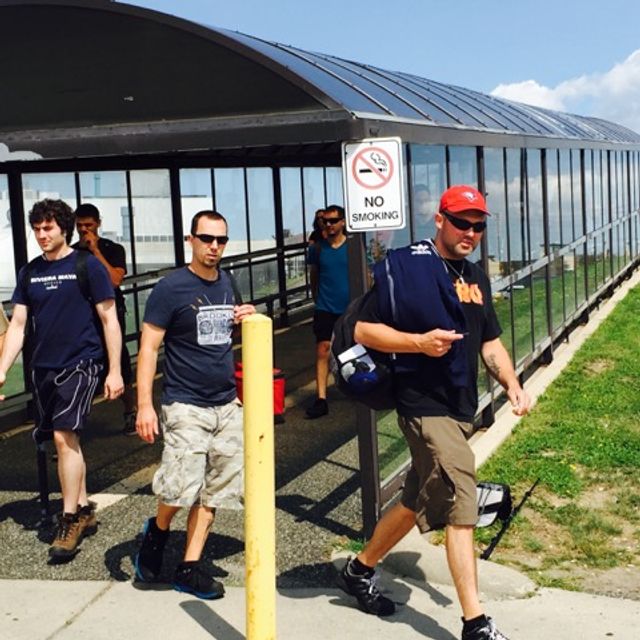
Workers at FCA's Brampton plant
When asked by reporters if workers will be willing to strike, Moffat said, “you got that figured out”. Of course, the strong willingness of Oshawa workers to strike is in inverse proportion to the record of the union bureaucracy when faced with previous plant closures. Unifor did not lift a finger when 1,000 jobs were transferred out of Oshawa last year and shifted to a Lansing, Michigan facility.
Unifor’s refusal to fight those Oshawa job cuts should come as no surprise to the thousands of members who have lost their jobs as a result of plant closures and downsizing. In a watershed dispute in 2012, the CAW blocked strike action against the closure of the Caterpillar plant in London, Ontario, and urged workers there to accept severance packages.
In 2010, the last GM plant closed in Windsor, Ontario. When the announcement of the closure was made in 2008, then-union head Buzz Hargrove blustered about strike action to an angry membership whilst quietly moving into discussions with the company for an “orderly shutdown”. Workers were quickly demobilized and the plant closed without incident.
When auto parts plants throughout southern Ontario were closed in the wake of the 2008-2009 economic crisis, CAW officials played an active role in disbanding several plant occupations launched by militant workers. Indeed, it was Jerry Dias that was dispatched to spearhead the suppression of those struggles.
GM workers in Oshawa will remember the antics of the CAW leadership in 2008 at the soon to be moth-balled truck plant. As workers marched through the city seething with outrage, CAW President Buzz Hargrove counselled against action on the shop floor, instead diverting the anger of the membership into a short-lived photo-op “blockade” of GM headquarters.
Union officials continue to lobby the Ontario and federal governments to provide grants to the auto companies. Earlier this month, the Ontario Liberal government of Kathleen Wynne handed over $85 million (CDN) to Fiat-Chrysler for its booming mini-van operation in Windsor (despite the company welching on paying back $1.5 billion in 2009 bailout relief).
In 2009, the Ontario and federal governments ponied up $13.9 billion in bailout funds to boost the stock values of the Detroit Three. Although shareholders over the ensuing years have reaped rich dividends, an Ontario Auditor-Generals report in 2014 noted that “it was impossible for us to gain a complete picture of the assistance provided, the difference the assistance made to the viability of the companies, and the amounts recovered and lost.”
Autoworkers can place no faith in Unifor to save jobs, let alone defend ever-diminishing wages, benefits and working conditions. A fight to defend jobs and living standards requires the formation of rank-and-file factory committees to unite autoworkers, not only across auto plants in Canada, but also in the US, Mexico and internationally in a common struggle against the corporations and the unions, which function as junior partners of the auto bosses. We encourage readers of the World Socialist Web Site and the Autoworker Newsletter in the plants to step up their efforts to build resistance and to share information and their comments with us for dissemination among autoworkers throughout North America.

UN agency reports 65 million people are refugees worldwide

Martin Kreickenbaum

The number of people around the globe displaced by war, armed conflict and persecution at the end of 2015 was higher than ever before. A report titled Global Trends, published on World Refugee Day by the UNHCR, counted 65.3 million displaced persons, the first time it has surpassed 60 million since the collection of figures began in 1951.
Compared to the previous year, the number of people forced to flee rose by 5.8 million. Compared to 2011, when the UN refugee agency reported a new record of 42.5 million, the number has risen by more than 50 percent.
Although the document fails to name those responsible for this global humanitarian crisis, it demonstrates very clearly the extent of the suffering and persecution caused by the continuous wars waged by the US and its Western European allies over the past two-and-a-half decades in the name of human rights and combatting terrorism.
According to the UNHCR, 12.4 million people were forced to flee their homes last year, of which 8.6 million sought refuge within their own countries and are now dependent on aid to survive as internally displaced people. Every minute, 24 people were driven from their homes, or 34,000 per day.
The number forced to flee from persecution, armed conflict, rampant violence or human rights violations surpassed the population of Britain or France. A fictional “nation of refugees” would come in 21st place in a list of the states with the largest populations. Today, one out of every 113 people is either an asylum seeker, internally displaced or a refugee.
In each of the categories into which the UN divides refugees, new tragic records were reached. Internally displaced people now number 40.8 million; there are 3.2 million waiting on the outcome of asylum applications and 21.3 million were forced to flee their country of origin as refugees. More than half of all refugees are children and young people. The number of unaccompanied children seeking asylum as refugees has trebled to 98,000.
A list of the main countries of origin for refugees sheds a stark light on the crimes of the imperialist powers, which have laid waste to wide areas of the Middle East, Afghanistan, Pakistan and Central Africa, thereby provoking the global refugee crisis.
By financing and providing military support to Islamist forces, the US encouraged the outbreak of a civil war in Syria in 2011 which created the conditions for the establishment of ISIS. Together with the US-led air strikes on ISIS militias, which in turn treat the local population with brutality, the war for regime change has forced more than 11.6 million people to flee in the past five years. Out of a total population of 20 million, every second Syrian is a refugee.
From Afghanistan, where the US led a military invasion in 2001 as part of a “war on terror” that destroyed large areas of the country, 2.7 million people fled across the country’s borders and 1.2 million have become internally displaced. The war in Iraq has to date forced 4.9 million from their homes, the majority of which are cared for internally by the UNHCR.
The UN report focused in particular on the rapidly worsening situation in Yemen. Within a year, almost 10 percent of the population has been forced to flee. Around 2.5 million are internally displaced, while 169,900 have fled abroad. The reason for this is the war waged by Saudi Arabia, the United States’ closest ally in the region. After Houthi rebels overthrew the Saudi and US-backed President Abed Rabbo Mansur Hadi in January 2015, Saudi Arabia intervened with air strikes and ground troops, resulting in the deaths of at least 6,000 civilians.
This intervention was not only given the full backing of the US government, it was carried out with participation and support of the Pentagon. US President Barack Obama had previously vastly expanded the drone war in Yemen, subjecting the impoverished population to criminal air strikes.
Another major source of global refugees is Central Africa, where, along with the US, it is above all the European powers who have acted militarily in the name of “humanitarian interventions” to secure important supplies of raw materials and markets.
The UNHRC counted 4 million refugees and internally displaced people from Sudan, 2.5 million from South Sudan, 2.4 million from Somalia, 2.9 million from the Democratic Republic of Congo, 1 million from the Central African Republic, 2.4 million from Nigeria, 475,000 from Eritrea, 450,000 from Libya and 280,000 from Mali.
The coup in Ukraine orchestrated by the US and Germany, which brought fascistic forces to power, forced almost 2 million people to leave their homes. Above all as a result of the separatist war in the east of the country, which was a direct product of the coup, 1.6 million people have been forced to flee internally.
But while the imperialist powers have caused the global refugee crisis, they are doing virtually nothing to accommodate and care for the refugees. According to the UNHCR report, 86 percent of the 21.3 million refugees have sought protection in low and middle income countries directly bordering conflict regions. In the least developed countries, 4.2 million refugees were accepted.
Top of the list for accommodating refugees is Turkey, where 2.5 million are struggling to survive. However, Turkey, as the border guard for Fortress Europe, has already closed its border to Syrian refugees. The Syrian Observatory for Human Rights reported that at least 60 Syrian refugees have been shot on the Turkish border since the beginning of the year.
There are 1.1 million refugees are living in Lebanon, which has a population of 4 million, 1.6 million in Pakistan, 1 million in Iran, 750,000 in Ethiopia and 700,000 in Jordan.
“More people are being displaced by war and persecution and that’s worrying in itself, but the factors that endanger refugees are multiplying too,” said UN High Commissioner for Refugees Filippo Grand. “At sea, a frightening number of refugees and migrants are dying each year; on land, people fleeing war are finding their way blocked by closed borders.”
Grandi was concerned above all with calls to abandon the Geneva Refugee Convention, which are mainly being raised within the EU. For this, he blamed racist agitation by governments and the media.
This contrasted, Grandi said, with the widespread willingness to help among the population, which is resisting the persistent xenophobia.
“In contrast to the toxic narrative repeatedly played out in the media, we have often witnessed an outpouring of generosity; by host communities, by individuals, and by families opening their homes,” Grandi said. “These ordinary people see refugees not as beggars, competitors for jobs, or terrorists, but as people like you or me whose lives have been disrupted by war. Their simple acts of solidarity are going on around the world, every day.”
Grandi ultimately appealed to the “international community of states” to increase financial support as well as the willingness to accept refugees. But it is precisely the aggressive foreign policy of the imperialist powers, and their strict closed border policy which is producing misery for refugees.

Landmark Supreme Court ruling backs illegal police searches

Tom Hall

On Monday, the Supreme Court voted 5-3 that evidence obtained by unlawful tactics by police may be admissible in court. The is the furthest the highest US judicial body has ever gone in undermining the basic protection against “unreasonable searches and seizures” granted by the Fourth Amendment to the Constitution, a core element of the Bill of Rights.
The ruling provides a blank check for police to arbitrarily stop and search a motorist or pedestrian without probable cause, so long as they discover afterwards that the person was one of millions of Americans with an outstanding warrant for something as minor as a traffic ticket. The ruling will result in a massive expansion of illegal stops and searches by police nationwide.
The case, Utah v Strieff, hinged upon the actions of Salt Lake City police officer Douglass Fackrell in a 2006 narcotics arrest. Acting on the basis of an anonymous tip, Fackrell staked out a house that was suspected of being used for drug sales, watching it over the course of a week. When this did not produce any evidence, Fackrell decided to question the next person he saw exiting the building, which happened to be Edward Strieff.
Fackrell detained Strieff, despite not having any reason to single him out, making the stop an illegal abuse of power. The policeman radioed in a search for outstanding warrants. When the search turned up a traffic violation, Fackrell arrested and searched Strieff, finding a small bag of methamphetamines.
Since the early years of the Warren Court (the period when Earl Warren was chief justice) more than half a century ago, such evidence has been considered inadmissible in court under the “exclusionary rule,” which prohibits the use of evidence obtained by police illegally. This, in turn, is based upon the Fourth Amendment, which reads: “The right of the people to be secure in their persons, houses, papers, and effects, against unreasonable searches and seizures, shall not be violated, and no Warrants shall issue, but upon probable cause, supported by Oath or affirmation, and particularly describing the place to be searched, and the persons or things to be seized.”
Fackrell’s actions were considered so blatantly illegal under this precedent that the Utah Supreme Court voted unanimously in Strieff’s favor, suppressing the drug evidence.
What is remarkable about the Supreme Court’s ruling is that it does not contest the illegality of the initial stop by Fackrell. Rather, in the opinion written by Clarence Thomas, the majority concludes that the evidence obtained by Fackrell was admissible because it was obtained after Fackrell radioed in for Strieff’s outstanding warrants. Thomas and his colleagues argue that Fackrell’s actions did not constitute “purposeful or flagrant” misconduct, so the evidence obtained by him in the subsequent search should be admissible in court.
“Officer Fackrell was at most negligent, but his errors in judgment hardly rise to a purposeful or flagrant violation of Strieff’s Fourth Amendment rights,” Thomas blithely asserts. “After the unlawful stop, his conduct was lawful, and there is no indication that his stop was part of any systemic or recurrent police misconduct.” The ruling effectively nullifies the long-established “fruit of the poisonous tree” doctrine, according to which evidence obtained as the result of illegal activity of the police is inadmissible in court.
It is significant that Justice Stephen Breyer, a Clinton appointee and a member of the court’s “liberal” bloc, cast the deciding vote in this case. It is a further demonstration of the shift to the right of the entire political establishment, within which there is no longer any significant constituency for core democratic rights. Scarcely four months after the death of Antonin Scalia, the long-time leader of the right-wing faction on the court, the dismantling of democratic rights by the Supreme Court continues unabated.
Justice Sonia Sotomayor, an Obama appointee, wrote an unusually sharp dissenting opinion that raises the essential democratic issues posed by the majority’s opinion, which she said provides police with “incentive to violate the Constitution.” She was joined only in part by the other two dissenting justices, Elena Kagan and Ruth Bader Ginsburg, who wrote their own opinions.
“Do not be soothed by the [majority] opinion’s technical language,” Sotomayor warned. “This case allows the police to stop you on the street, demand your identification, and check it for outstanding traffic warrants—even if you are doing nothing wrong. If the officer discovers a warrant for a fine you forgot to pay, courts will now excuse his illegal stop and will admit into evidence anything he happens to find by searching you after arresting you on the warrant.”
She pointed out, “The states and federal government maintain databases with over 7.8 million outstanding warrants, the vast majority of which appear to be for minor offenses,” which, after this ruling, can now be seized on to carry out searches without reasonable suspicion.
Sotomayor continued, “this case tells everyone, white and black, guilty and innocent, that an officer can verify your legal status at any time. It says that your body is subject to invasion while courts excuse the violation of your rights. It implies that you are not a citizen of a democracy but the subject of a carceral state, just waiting to be cataloged.”
Readers who consult one of the larger English dictionaries will find that “carceral” means “pertaining to prisons or a prison.” Sotomayor chose to use a deliberately obscure word to dilute the impact of what she was acknowledging: the Supreme Court ruling is appropriate to a police state, not a democracy.
Sotomayor is not an oppositional figure, but a time-tested defender of the political establishment. During her tenure as an appellate judge in New York, she handed down numerous rulings bolstering the arbitrary powers of the police. The fact that she feels compelled to denounce the decision of her colleagues in such stark terms should be taken as a warning of the willingness of broad layers of the political establishment to dispense with democratic forms of rule.

On eve of Brexit referendum, mounting warnings of global trade war

Andre Damon

On the eve of Thursday’s referendum on the United Kingdom’s membership in the European Union (EU), an event that threatens to substantially destabilize the world economy, the World Trade Organization (WTO) has warned that protectionism is on the rise as world trade stagnates.
The threat by Britain to leave the EU is only the most visible expression of growing tendencies toward economic nationalism and autarchy, expressed in the rise of right-wing nationalist politicians such as Donald Trump in the United States, Nigel Farage in Britain, Marine Le Pen in France, and similar figures in other countries.
On Tuesday, the WTO said in a report that between October 2015 and May 2016, members of the G20 group of leading industrialized nations implemented new protectionist measures at the fastest rate since the WTO began keeping records in 2009.
During this period, the WTO stated, the G20 economies applied “145 new trade-restrictive measures, equating to an average of almost 21 new measures per month.” This was “a significant increase compared to the previous reporting period at 17 per month.”
Source: World Trade Organization
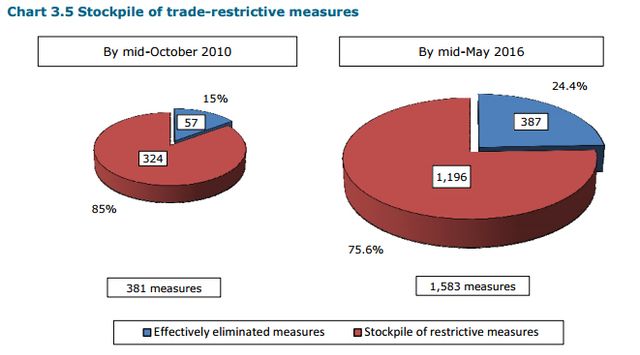
As a result, the total number of trade-restrictive measures in place in the G20 economies grew by 10 percent over the period under review. The total number of trade restrictions currently in place in these economies stands at 1,196, up from 324 in mid-October 2010. Only 20 percent of trade barriers created since 2008 have been eliminated after their implementation.
The report points to a stark discontinuity in the relationship of world trade growth to economic growth between the periods before and after the financial crisis. In the post-2008 period, the growth of trade has averaged just over half of its pre-2008 level. The WTO noted: “The slow pace of trade growth relative to GDP growth over the past four years stands in contrast to the period from 1990 to 2008, during which merchandise trade grew 2.1 times as fast as world GDP on average.”
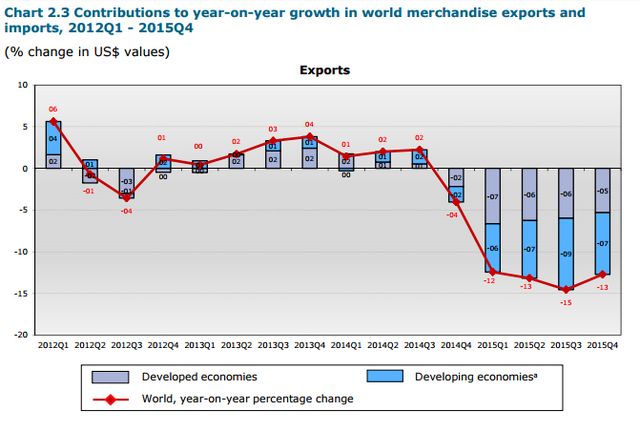
World trade plunged in 2015, led by a fall in commodity prices and export volatility. The report explained, “The dollar value of world trade fell sharply in 2015 and remained down around 13 percent year-on-year through the fourth quarter.”
Source: World Trade Organization
The tendencies toward economic nationalism are likely to intensify as a result of what a growing number of economists are beginning to warn could be an essentially indefinite period of economic slump.
Earlier this year, Maurice Obstfeld, chief economist at the International Monetary Fund, warned that the “increasingly disappointing” world economy was threatened by a “synchronised slowdown” amid the threat of another financial meltdown and mounting protectionism. “Across Europe the political consensus that once propelled the European project is fraying,” with a “rising tide of inward-looking nationalism,” he warned.
“One manifestation is the real possibility that the United Kingdom exits the European Union, damaging a wide range of trade and investment relationships,” Obstfeld said, adding, “In other advanced countries as in Europe, including in the United States, a backlash against cross-border economic integration threatens to halt or even reverse the postwar trend of ever more open trade.”
In comments before the US Senate on Tuesday, Federal Reserve Chairwoman Janet Yellen reiterated her concerns, which she first raised earlier this month, that the ongoing tendencies toward economic slump might continue indefinitely. “We cannot rule out the possibility expressed by some prominent economists that the slow productivity growth seen in recent years will continue in the future,” she said.
She also warned of the repercussions of a decision by Britain to leave the EU, saying such an outcome could trigger a sell-off in financial markets and even posed the possibility of a recession in the United States.
The vast majority of the new anti-trade measures have taken the form of “anti-dumping” cases, in which the countries implementing anti-trade measures accuse other countries of intentionally selling products below market rates. Some 40 percent of those cases have targeted metals, primarily steel.
Last month, the US Commerce Department announced it would impose duties of as much as 500 percent on Chinese steel, beginning as soon as this summer, after concluding that Chinese steel companies were “dumping” their products onto US markets.
Global overcapacity in the steel industry has led to massive global layoffs, including the effective halting of production in Britain with the closure of Tata Steel’s operations in that country. Earlier this year, China announced 500,000 layoffs in the steel industry and 1.3 million in the related coal industry.
This month, the US approved a case by US Steel, the country’s biggest steel producer, seeking a ban on steel imports from its Chinese competitors, this time using alleged attempts by Chinese companies to steal commercial secrets as a pretense.
The case points to the very real possibility that the next US president could ban all steel imports from China, a move that would have enormous economic and geopolitical consequences. Simon Evenett, a professor of international trade at the University of St. Gallen in Switzerland, told the Financial Times, “This should be setting off alarm bells… It is really a nuclear option.”
The collapse of world trade and the rise of protectionism are widely believed by economists to have been major contributors to the Great Depression of the 1930s. The Smoot–Hawley Tariff Act of 1930 is believed to have contributed to slashing US exports and imports by more than half.
In the wake of the 2008 financial crisis, G20 members pledged not to repeat what they saw as the mistakes of the 1930s and to avoid responding to slowing growth by enacting trade-war measures. But amid an ongoing and deepening economic slump and worldwide overcapacity, combined with mounting political opposition and social struggles by the working class—the tendencies that prevailed in the 1930s—all of the world’s capitalist economies are increasingly turning to the promotion of militarism, rabid nationalism and right-wing economic populism.
In the 1930s, the rise of economic protectionism, under conditions of an insoluble economic crisis, became the antechamber of World War II. Today, the same conditions increasingly prevail throughout the world. International institutions created in the post-war period to counter the tendencies toward national autarchy and inter-imperialist conflict, including the European Union, are falling apart at the seams. This trend, regardless the outcome of this week’s EU referendum, will only increase in the coming years, as the tendencies that have dominated the post-2008 period—economic slump, financial parasitism and the growth of economic nationalism—intensify.
Ultimately, as in the 1930s, these tendencies, rooted in the internal contradictions of the capitalist nation-state system, have no peaceful resolution. They are at the root of the continual military provocations by the United States against Russia and China, as well as the virulent growth of militarism in countries that played a leading role in World War II such as Germany and Japan.

There is a New Symphony at Play

Vijay Shankar


Change, more often than not, is driven by circumstances rather than scholastic deliberation. As President Obama once put it, perhaps as an unintended barb to the legions of geopolitical seers that stalk Massachusetts Avenue, Washington DC, “Change doesn’t come from Washington but comes to Washington.” So it was with Prime Minister Modi’s three-day state visit to the US (6-8 June 2016). Not only did the visit lay the foundation to several strategic goals mutual to both sides, but it was also punctuated by symbolism that provides a basis for the future. When Modi suggested stepping out of the “shadows of hesitations of the past” he could not have stated in more unequivocal terms that India’s strategic orientation was now one that not only respected the status quo, but also would contribute towards ensuring that attempts to upset it would not go unchallenged.
At the same time, laying a floral wreath at Arlington Cemetery to the Tomb of the Unknowns (a first for an Indian PM), on the face of it, was an unconditional tribute to that one unquestioning instrument of state power who historically has laid down his all for a national cause. Underlying the salute was recognition of the role played by the military in binding and stabilising an uncertain security milieu.
Alfred Thayer Mahan in The Influence of Sea Power upon History underscored three prescient perspectives relating to the Global Commons. First, competition for materials and markets is intrinsic to an ever trussed global system. Second, the nature of commerce on the one hand deters war, while on the other engenders friction. Third, the Commons require to be secured against hegemony, disruption and rapacious exploitation. These perspectives today ring a reality whose significance has not been lost on the PM.
Mr Modi’s understanding of contemporary dynamics in the Global Commons and the need to balance out China’s objectives of hegemonic control through strategic security partnerships is adroit. The Global Commons typically describes international and supranational resource domains. It includes the earth’s shared resources, such as the oceans, the atmosphere, outer space and the polar regions. Cyberspace also meets current discernment. It is hardly coincident that it is in these very domains that China has shown aggressive intent. The current distressed state of the Commons is marked by the impact that globalisation has had: strains of multi-polarity, anarchy of expectations and increasing tensions between demands for economic integration and stresses of fractured political divisions are all symptoms. Nations are persistently confronted by the need to reconcile internal pressures with intrusive external impulses at a time when the efficacy of military power to bring on positive political outcomes is in question. While most nations have sought resolution and correctives within the framework of the existing international order, China emerges as an irony that has angled for and conspired to re-write the rule book. The PM’s statement to Congress that it was only strong Indo-US ties that could anchor security in the Indian Pacific Region left little to speculate what direction relations were taking and the extent of mutuality that was perceived in the Logistic Support Agreement (LSA) being fleshed out. Not only is India preparing for strategic collaboration with the US, but it is buttressing its posture in the Indo-Pacific through multilateral cooperation with ASEAN. All this must be seen as its intent to institutionalise its presence in the waters of the Indo-Pacific.
Critics, both in the developed and indeed in the developing world, maintain that scripting an international security relationship with the US flies in the face of autonomy in global affairs. In response one only has to note the transformed conditions of the world order of the day which is far removed from that which existed between the post-World War II era to the end of the Cold War. Uncertainties of events and their multi-faceted impact reflect the new substance of increased global interdependence in every field of endeavour. Whether these fields are in the economic, political or security domains, corollary imperatives are interlinked at the national, regional and international levels.
Latest reports in the run-up to the plenary session of the Nuclear Suppliers Group (NSG) to be held at Seoul on 24 June 2016 suggest that the US and Russia along with most other member countries (total 48) have expressed support for India’s admission to the Group largely as a result of three considerations: India’s clean track record of non-proliferation; US and Russian along with majority support; and the lure of commercial gain. But China is resisting admission on the basis of a curious principle – that before any decision is taken about India’s membership, the NSG needs to agree on equitable and non-discriminatory criteria for membership of those countries that are nuclear weapon states (for “those countries” read Pakistan), but are not signatories of the Non-Proliferation Treaty (NPT). China argues that if any exception to the conditions for admission is to be made, then it should apply equally to both India and Pakistan. As a counter argument, accession to the NPT is not a criterion for membership — France was not a member of the NPT until 1992 though it was a founder member of the NSG in 1975. On the second rule condition — a good non-proliferation record; India has a better history than some of the NSG members. Particularly China, given membership in 2004, has debatably the most dubious proliferation record whether it is their dealings with Pakistan or North Korea. For that matter, equating the Indian and Pakistani applications for membership, as China has done, is disingenuous. India has never had a state-sponsored AQ Khan nuclear black-market network extending from Libya to North Korea nor sold nuclear technology to third parties. For China to have overlooked all this including the fact that, as Modi put it to the US Congress, all global terrorism is “incubated” in India’s neighbourhood (meaning Pakistan), must speak of China’s own credibility within the group.
What are the stakes involved? For India, the logical sequel to the Indo-US civil nuclear agreement of 2008 and the concomitant NSG waiver followed by entry into the Missile Technology Control Regime (MTCR) is membership of the NSG; gives legitimacy to nuclear aspirations and unimpeded access to technology. However, will China’s stonewalling work? Given the circumstances that China finds itself in, clearly not for long.
Even the prolific realist that Walt Whitman was would agree that “now that the orchestra have sufficiently tuned their instruments and the baton has given the signal to play;” Modi’s addendum that it “was best that a new symphony be played” is most appropriate.

21 Jun 2016

World Bank Scholarships for Women Entrepreneurs in Nigeria 2016

Application Deadline: 31st July, 2016
Offered annually? Yes
Eligible Countries: Nigeria
To be taken at (country): Nigeria
Brief description: The World Bank is awarding Scholarship to Female Entrepreneurs in Nigeria to learn at the Enterprise Development Centre.
Eligible Field of Study: None
About the Award: The Enterprise Development Centre, Pan- Atlantic University in collaboration with The World Bank if offering women entrepreneurs in Nigeria the opportunity to learn further about the business playing field through online and in-class training. Participants will also be given the join a solid female entrepreneurs network where they can be mentored.
Type: Entrepreneurship
Selection Criteria: Selection criteria will be as follows:
A. Company must be owned / managed by a woman
B. Should be a functional business (at least 6 months in operation)

C. The Enterprise must have high growth potential
D. High local content will be an advantage
Number of Awardees: Several
Value of Programme: 
  • Provide practical Business Education through a blended learning approach (online and in- class training)
  • Help strengthen Female Entrepreneurs network
  • Offer Mentoring
  • Create linkages between financial institutions and Female Entrepreneurs.
Duration of Scholarship: Not stated
How to Apply: Interested candidates can apply here
Award Provider: Pan Atlantic University, The World Bank Group
Important Notes: Interested candidates are encouraged to apply as soon as possible.

Brexit, the EU and the Future of Britain: the Main Enemy Resides Here, Not in Brussels

John Wight

There are times when the truth is not enough and only the unvarnished truth will do. We have arrived at such a time just days away from the EU referendum on June 23rd.
The unvarnished truth when it comes to the campaign for Britain’s exit from the European Union, Brexit, is that it has unleashed the ugly forces of right wing extremism, racism, xenophobia and British nationalism in a society that had allowed itself to grow complacent when it came to the aforementioned, doing so in the mistaken belief that common human decency was as British as Big Ben; in other words in the belief it could not happen here.
Recent horrific events reveal that it can and has happened here.
Over the past few months of the Brexit campaign we have borne witness to a scapegoating and demonization of migrants by mainstream politicians and right wing newspaper columnists reminiscent of the way Jews were scapegoated and demonized in Germany in the 1930s, and on the same grounds – i.e. they pose a threat to our way of life; they hold alien cultural beliefs and practices; their values are at odds with our values.
This scapegoating has been so intense, so vehement, it has raised the political temperature to the point where an elected MP who dared raise her voice in solidarity with migrants and for Britain’s continuing membership of the EU was murdered in the street in broad daylight in an act of right wing extremism and terrorism, reminiscent of the way democratically elected politicians were murdered in Germany in the 1930s, depicted as ‘traitors’ from the vantage point of the swamp in which fascism swims.
It is important to understand that the economic and social conditions that existed in depression-ravaged Germany back then have been replicated in Britain and across Europe today on the back of an economic recession compounded by the implementation of austerity, which has been tantamount to a mass experiment in human despair. This recession and resulting Tory austerity have combined to leave millions impoverished, marginalised, angry and fearful, thus perfect fodder for the kind of right wing populism and demagoguery that has underpinned a campaign that has been an insult to common human decency never mind the nation’s collective intelligence.
Without the horrific murder of Labour’s Jo Cox, UKIP leader Nigel Farage’s obscene anti-immigration poster should automatically have marked the point of no return for a Brexit campaign that has from the outset been predicated on exploiting the impact of austerity by politicians who have been among its biggest champions, inferring that the huge pressure brought to bear on the nation’s public services, on the social and private housing sector, and on the NHS is due to immigration rather than the extreme cuts to public spending and investment that have taken place.
As much as the EU needs to be reformed in the interests of its citizens rather than big business and the financial sector, it has been a last line of defense against a Tory establishment that would relish nothing more than to pull Britain out of the European Convention on Human Rights, a statutory requirement of EU membership, and get rid of the progressive legislation that we presently enjoy via the EU on workers’ rights and protections, maternity leave, paid holidays, consumer protection, and the environment. And this is without taking into the account the harm it would do to the economy in terms of investment, exports, jobs, and the value of sterling.
But these issues are trifling compared to the main one, which is the worrying emergence and normalisation of far right nostrums and the ‘othering’ of migrants, minorities, and asylum seekers. It is a toxic brew that has gained traction on the back the growing anger of the millions who have been battered materially, psychologically, and spiritually by a Tory government in whose control the economy has been wielded as a sword to punish the poor and the vulnerable instead of a held up as a shield to protect them from circumstances and factors beyond their control.
A vote to Remain on June 23rd is now a vote for hope rather than despair, for progress rather than regress. It is a vote against the politics of division and hate, against scapegoating and in defiance of a base tribalism that offers the country nothing apart from apartness.
We can no longer delude ourselves that racism is a marginal phenomenon in Britain. It is not. Indeed, it would be hard to recall a time when it has been more prevalent than now. This is not to accuse everyone who supports Brexit of racism, of course not. It is, however, a campaign in which racism has been afforded the opportunity to grow and incubate in a way it has not in living memory.
Warning of the danger of lapsing into complacency when it came to the possibility of fascism re-emerging after its defeat in the Second World War, German playwright Bertolt Brecht wrote: “The womb from which this monster emerged remains fertile.”
How those words resonate now, today, in Britain seven decades later.
My vote on June 23rd will not be cast as a vote for the EU; it will be cast as a vote against Brexit and the ugliness it represents and has unleashed.
The main enemy does not reside in Brussels. The main enemy resides right here at home.

Children Pay the Highest Price for the Refugee Crisis

Cesar Chelala

The world is witness to a rapid increase in the number of people forced to flee from wars, conflict and persecution in countries such as Syria, Iraq, and Afghanistan. It is estimated that approximately half of the 19.5 million registered refugees at a global level are children and youth. They are the most vulnerable victims of these conflicts.
The case of Syria is paradigmatic. Three years of conflict have turned Syria into one of the most dangerous places to be a child, according to UNICEF. Out of a population of 21.9 million, more than 9 million are under 18.  It is estimated that 5.5 million children are affected by the conflict, a number that is almost double from the year before. More than 4.29 million children inside Syria are poor, displaced or caught in the line of fire.
International aid organizations have been doing a remarkable job helping the population of countries affected by wars. However, only in Syria, one million children are living in areas that aid workers cannot reach regularly, thus depriving them of vital support. More than a third of Syrian families are no longer living in their own homes or communities, seriously affecting their health and quality of life.
As a result of the fall in immunization rates –from 99 percent before the war to less than 50 percent now -polio has reemerged in Syria, after a 14-year absence. At the same time, doctors report an increase in the number and severity of cases of measles, pneumonia and diarrhea. In response to the polio outbreak, UNICEF, the World Health Organization (WHO) and health ministries in the region have launched the largest immunization campaign in the region’s history, targeting more than 25 million children.
The capacity of the country’s health care system to provide assistance to the population has been seriously affected. Many doctors and health personnel have either been killed or have left the country. 60 percent of the public hospitals have been damaged or are out of service.
Many times, militants bomb health care facilities, wait for first responders and emergency crews to come in and then strike again, thus maximizing the impact of their attacks. On April 27, 2016, the Al Quds field hospital in Aleppo was hit by an airstrike. It killed 30 people, including 2 health workers, and injured 60 people, completely destroying the facility.
Dr. Abdo El Ezz, an Aleppo physician says, “The war in Syria has violated and destroyed anything called “agreements” or “an agreement” or “human rights” or anything humanitarian…Hospitals are looking for coffins because people are pouring in, some are completely burned and soon die. We need to bury them…Some people wish to die so they can finally rest and not live in constant terror and see constant destruction.”
An estimated 37,000 children have been born as refugees and over 83,000 Syrian pregnant women are living as refugees in Lebanon and Jordan, placing a heavy burden on those countries health and social systems. For example, Lebanon is planning for 600,000 schoolchildren this year –twice the number currently enrolled.
Syrian children refugees are at very high risk for mental illness and have poor access to education. In the Za’atari refugee camp in Jordan, for example, one third of all children displayed aggressive and self-harm behaviors. According to Europol, Europe’s policy agency, more than 10,000 thousand unaccompanied refugee and migrant children have disappeared, raising fears they are being exploited and used for sex.
The Post Traumatic Stress Disorder (PTSD) rate among Syrian refugee children is comparable to that observed among other children who experienced war. A study by the Migration Policy Institute shows that refugee children who are not formally educated are more likely to feel marginalized and hopeless, making them probable targets for radicalization.
What is experienced by Syrian children is also experienced by refugee children coming from other countries such as Afghanistan and Iraq. Few people have expressed as poignantly as James Fenton the tragic fate of these children. In his poem “Children in Exile” Fenton writes,
‘What I am is not important, whether I live or die –
It is the same for me, the same for you.
What we do is important. This is what I have learnt.
It is not what we are but what we do,’

Says a child in exile, one of a family
Once happy in its size. Now there are four
Students of calamity, graduates of famine,
Those whom geography condemns to war…’

The European Dead End

Jean Bricmont

European construction began as the dream of European elites and has become the nightmare of European peoples. For a number of European intellectuals and politicians, the dream was to transform Europe into a sort of Superstate, capable of rivaling the United States. For others, the idea was to get rid of the Nation-State once and for all, since it was considered chiefly to blame for the woes of the 20th century.
However, aside from the fact that this dream always enjoyed strong United States support, which casts doubts on its claim to constitute an alternative to American domination, it suffers from a fatal flaw: the nonexistence of a European people. That is, an overwhelming majority of European citizens feel part of their respective Nation-States, or of even smaller entities (Scotland, Catalonia, Flanders, etc.), much more than they feel “European”.
Advocates of European construction have two answers to that objection: either that the feeling of belonging is an historic construction (in the case of modern Nation-States) and is being changed into a “European” sense of belonging, or else that the sense of belonging does not really matter, inasmuch as political decisions must be taken on the basis of economic rationality (the liberal view) or class interests (the Marxist view), rather than on the basis of sentiments.
As for a sense of being European, it is perfectly possible that it may develop over the course of coming centuries, just as the various national sentiments did in the past. But one should not have illusions concerning the time scale. Such processes take centuries, and the Scottish example shows that even within a democratic State such as Great Britain, with equal rights for all and sharing the same language, centuries may not be enough to eradicate national feeling.
It is enough to watch sports events, such as the current European Cup, to see that national feelings are far from disappearing. They are not even disappearing among the “elites”: in Brussels, with rare exceptions, the representatives of the various Member States defend what they consider to be their national interest rather than the “European” interest.
As for the notion that national feeling does not matter, compare the national currencies that existed before the euro and the euro itself. Before the euro, changes in currency parities took place among Member States to make up for differences in economic strength between, say, Germany and France or Italy. But within each State, the unity of the national currency was maintained between rich and poor regions by a whole series of redistribution measures: identical pensions and social allocations, public investments and so on. These measures were politically possible because the citizens of these States “felt” that they were all French, or all Italians, or all Germans.
With the euro, there can be no adjustment in currency parity between weak and strong economies. Moreover, the eurozone lacks the redistribution mechanisms that existed between rich and poor regions of a single State. It is clear from following the Greek tragedy that the Germans do not feel sufficiently Greek – or even sufficiently European – to accept the transfers of wealth needed to “save Greece”. In short, national feelings have a huge economic importance, contrary to the views of the liberals and Marxists who both ignore or play down the importance of “irrational” feelings in social reality.
Or compare Europe with Latin America. In the latter continent, all the countries except Brazil have their origin in the same colonial empire, speak the same language, practice the same religion, even have more or less a common enemy (the United States) and have not massacred each other in recent major wars.
In Europe, it’s the other way around. The “memories” of the various peoples are very different, even contradictory, some having lived through communism, others through fascism, not to mention all the various wars among themselves. Their various legends and even languages preserve these diversities.
And yet, the integration of the Latin American continent is advancing in full respect of the sovereignty of each State. Nobody insists that Chile and Bolivia adopt the same currency, nor that all their four-year university programs be changed to five years, to “harmonize” studies, as with the Bologna process in Europe. If Bolivia or Ecuador decide to control their own natural resources, they don’t have do ask “Brussels” for authorization.
Such integration respecting national sovereignties could have been undertaken in Europe. That was the idea of a “Europe of peoples” proposed by Charles de Gaulle, ruled out by the existing European construction.
The left condemns the policy of the European Union because it is “neoliberal”, but the problem goes much deeper. The fatal flaw is that, in the absence of a European people, European construction can only be undemocratic and bureaucratic. A bureaucratic or autocratic power inevitably arouses hostility and ends up producing political effects contrary to those sought. If EU policies were “socialist”, they would arouse similar hostility.
From the point of view of the liberal right, depriving European peoples of their sovereignty and thus of democracy was natural because those peoples, left to themselves, would vote for too many redistributive measures.
On the left, European construction was promoted because those same peoples were supposedly chauvinist, nationalist, racist, and if left to themselves would surely end up at war with each other. This negative attitude toward their own population has been suicidal for the left, whose only base has to be the “people”.
The Europist left has made a mistake similar to that of the Communists in the past; they too thought that they were acting in the interests of the people, but the latter, being incapable of understanding, had to be led by an unelected elite.
This is particularly flagrant and tragic regarding immigration and refugees. The left Europists want to impose a policy of “opening” without ever asking their own people what they think, since some of them are sure to be against it. But they fail to understand that imposing an unpopular policy can only make it still more unpopular and that nobody likes being forced by others to be altruistic.
The Communists had their People’s Democracies, with democracy as only a façade.
The Europists have their Parliament which is another: it has no real power, and if it did, it would not be able to exercise such power because of the multiplicity of languages and national origins.
The Communists believed that national sentiments would disappear thanks to economic progress. The Europists bet on the same thing, but both have to acknowledge that “irrational” national sentiments have not disappeared, least of all when there is no sign of the promised progress.
For a long time the Communist used the accusation of antifascism to silence their opposition. The left Europists do exactly the same. The moment European peoples balk at the policies being imposed on them, they are ignored and accused of being populists and racists.
In both cases, that sort of intimidation works for a while but finally boomerangs. And when that happens, those who benefit from the popular revolt are those who never gave in to the intimidation, whether Communist or Europeist, that is, the nationalist or religious right.
No doubt, all that foreshadows “dark times” for our continent, as the Europists lament. But who is to blame? Not the Cassandras who try to warn of what is happening, but those who have “constructed Europe” on the shaky foundations of intellectual arrogance, contempt for the people and illusions concerning human nature.

The Great Seed Piracy

Vandana Shiva

A great seed and biodiversity piracy is underway and it must be stopped. The privateers of today include not just the corporations — which are becoming fewer and larger through mergers — but also individuals like Bill Gates, the “richest man in the world”.
When the Green Revolution was pushed in India and Mexico, farmers’ seeds were “rounded-up” and locked in international institutions, which used these seeds to breed green revolution varieties which responded to chemical inputs. The first two institutions were the International Rice Research Institute (IRRI) in the Philippines and the International Maize and Wheat Improvement Centre (CIMMYT) in Mexico. These institutes took diversity from farmers’ fields and replaced the diversity with chemical monocultures of rice, wheat and corn.
Dr. R.H. Richharia, India’s pre-eminent rice research scientist, headed the Central Rice Research Institute (CRRI) at Cuttack, Orissa. The Indian institute existed before IRRI, had the largest collection of rice diversity the biggest rice “bank” in the world. Dr Richharia refused to allow IRRI in the Philippines to pirate the collection. The World Bank removed Dr Richharia, the guardian of Indian rice knowledge, from CRRI so that it could transfer Indian peasant intellectual property to the international institute (which later became part of the Consultative Group of International Agriculture Research). Farmers’ seed heritage is held in the seed banks of CGIAR, a consortium of 15 international agricultural research centers, which is the single biggest recipient of grants from Mr Gates.
The Bill & Melinda Gates Foundation is the new World Bank when it comes to using finances to influence policies in agriculture. The Gates Foundation is a major funder of the CGIAR system — and through its funding, it is accelerating the transfer of research and seeds to corporations, facilitating intellectual property piracy and seed monopolies created through intellectual property laws and seed regulations. Control over the seeds of the world for “one agriculture” is Mr Gates’ target!
Since 2003, CGIAR centres have received more than $720 million from Mr Gates.
Besides taking control of the seeds of farmers in CGIAR seed banks, Mr Gates (along with the Rockefeller Foundation) is investing heavily in collecting seeds from across the world and storing them in a facility in Svalbard in the Arctic — the “doomsday vault”.
Mr Gates is also funding Diversity Seek (DivSeek), a global initiative to take patents on the seed collections through genomic mapping. Seven million crop accessions are in public seed banks. DivSeek could allow five corporations to own this diversity.
Today, biopiracy is carried out through the convergence of information technology and biotechnology. It is done by taking patents by “mapping” genomes and genome sequences. While living seed needs to evolve “in situ”, patents on genomes can be taken through access to seed “ex situ”. DivSeek is a global project launched in 2015 to map the genetic data of the peasant diversity of seeds held in gene banks. It robs the peasants of their seeds and knowledge, it robs the seed of its integrity and diversity, its evolutionary history, its link to the soil and reduces it to “code”. It is an extractive project to “mine” the data in the seed to “censor” out the commons.
The peasants (or farmers as they’re referred to now) who evolved the diversity have no place in DivSeek. their contributions, their knowledge is being “mined” — not recognised, honoured or conserved.
This “genetic colonialism” is an enclosure of the genetic commons. The participating institutions are the CGIAR nodes and “public universities” like Cornell and Iowa State, which are being increasingly privatised by the bio-technology industry and Mr Gates. Cornell is where Mr Gates funds the pseudo-science propaganda machine misnamed the Cornell Alliance for Science. Iowa State is where Mr Gates is funding the Unethical Human Feeding Trials of GMO bananas. The Bill & Melinda Gates Foundation is funding the partners of DivSeek, especially the African Agricultural Technology Foundation and an Africa-Brazil partnership in DivSeek.
Mr Gates is also investing in a one-year-old experimental genetic engineering tool for gene editing, CRISPR-Cas9, through a new front corporation EditasMedicine. While the technology itself is immature and inaccurate, it is a gold rush for new patents. The language of “gene editing” and “educated guesses” is creeping into scientific discourse. Piracy of common genomic data of millions of plants bred by peasants is termed “big data”. But big data is not knowledge, it is not even information. It is data, privateered.
Seeds are not just germ plasm. They are living. They are intelligent. They are beings and subjects of evolution, history, culture and relationships.
In the 1980s, Monsanto led the push for GMOs and patents on life. Today it is Bill Gates. One rich individual is able to use his wealth to bypass all international treaties and all multilateral governance structures to help global corporations grab the biodiversity and wealth of peasants by financing unscientific and undemocratic processes like DivSeek, and trying to unleash untested technologies like CRISPR.
Over the last two decades, humanity has taken actions and written laws to protect the biodiversity of the planet and the rights of farmers to seed, the rights of consumers to safety.
These laws include: The Convention on Biological Diversity (CBD); the Cartagena Biosafety Protocol to the CBD; the International Treaty on Plant Genetic Resources Treaty for Food and Agriculture (ITPGRFA).
India needs to strengthen international and national laws to protect biodiversity and farmers rights. Instead, the government is taking steps to facilitate BigMac™ seed biopiracy.
The New IPR policy has clauses which state:
2.20. Public research institutions should be allowed access to TKDL for further R&D, while the possibility of using traditional knowledge digital library for further R&D by private sector may also be explored, provided necessary safeguards are in place to prevent misappropriation.
4.20. National Biodiversity Authority.
4.20.1. The government will formalise a consultation and coordination mechanism between the national biodiversity authority, intellectual property office and other concerned ministries/departments like Ayush, with a view to harmonious implementation of guidelines for grant of IP rights and access to biological resources and associated traditional knowledge and benefit sharing;
4.20.2. The NBA will streamline approvals for expeditious grant of IP rights, monetary and non-monetary benefit-sharing and introduce efficient and user friendly mechanisms for a meaningful interface between the NBA and applicants.
In effect, the government is stating that our traditional knowledge and biodiversity heritage is available with ease of biopiracy through IPRs.
The government has also made changes in the Biodiversity Act, which was written with India’s decentralised democracy. The Biodiversity Act mandates that foreign entities seeking patents and IPRs on India’s biodiversity seek permission from the Chennai-based NBA.
Section 6(1) of the law requires a mandatory consultation with the local biodiversity management committees (BMC) since local communities are the custodians of biodiversity and traditional knowledge. Under global pressure from biopirates, there is an attempt to dispense with the BMC consultation. Which, in effect, implies destroying people’s rights to their own knowledge and heritage and the foundation of our living economies and democracies.

Thoughts About The Sham Cold War

Gaither Stewart

(Rome) A bit of bit of real European history not in the books yet: in the 1960s and extending into the 1980s there was widespread concern, preoccupation and discontent in Germany, in Europe, unease and a sensation of insecurity. The Communist East appeared to many people as an ominous threat, though it is now common knowledge that it was to a great extent a propaganda bugaboo created artificially by CIA. The Cold War raged to be sure, though  today something about it seems false and unreal, albeit a romantic period. It is as if it never took place.
In my mind it was a well-controlled, coordinated and monitored battle between systems in which neither side overstepped certain agreed upon limits. It was also a battle of attrition. A period of spymasters and secret agents for whom life was action on a treadmill, for right up to the end CIA never knew for certain what was really happening in Russia. The atmosphere was one of action for action’s sake. No wonder that in the wilderness of propaganda, conspiracy and anti-Communism neo-Nazi parties mushroomed here and there and their various fronts and battle groups popped up with the new spring. Who stood behind them, one might well wonder. The answer is clear. The American Minute Men and Tea-baggers of today are nothing new.
An American academic friend, Jack Aigler, Professor of European History at the Munich branch of University of Maryland, was obsessed with the imminent recrudescence of Nazi Germany. For him it was a socio-political certainty, its ideology inherent in the German people, he believed, only superficially cloaked by America’s hypocritical democratization of the defeated enemy as a consequence of the exigencies of the Cold War. “We wanted anti-Communist allies in Central Europe,” he pontificated to his students those evenings I sat in on his class, “Well, we’ve got them. We’ve got a tiger by the tail. Let’s arm them all and give them the green light. Then we’ll have a real bulwark against Bolshevism,” he said. This was linked to an old story I had heard many times from Germans: why hadn’t America united with Germany and whipped the Russians? Many like two-gun General Patton considered the alliance of America and Germany without Hitler the natural order of things. According to Jack, America and the ex-Nazis got their wish. Not that Jack was a leftist or even a liberal far ahead of his times but he saw aspects of the Cold War which I still did not understand. An iron bastion against the Commies! “Hah! You see all those gray Bundeswehr uniforms around town!,” he said in the 1960s. “And everywhere you hear Deutschland Deutschland über alles. Just wait till the Nazis kick out Adenauer and take over. Then we’ll see the tail wagging Europe. They’re too powerful a people; their instincts and their destiny are for expansion.” For him the Föhn winds he hid from symbolized the threat of renascent Nazism. When the Nazi-Föhn winds blew down from the Alps he sealed his apartment with hermetic shutters so that night reigned there constantly. He believed the beguiling, malefic Föhn had the same effect on people as Nazism. On such days when surgeons refused to operate and mechanics wouldn’t adjust a carburetor and judges refused to judge, Jack locked himself in, dressed in a long robe and red silk scarf high around his neck, wore heavy sunglasses over his steel-rimmed eye glasses, plunged rubber plugs in his ears that he boasted reached to his eardrums and passed the day drinking Pernod. The wind that departs quietly from the Sahara, whips across the Mediterranean and serpentines through the Alps ruining the snow for skiing and descends on the plains of Bavaria like the arm of capricious Fate was for Jack a physical enemy, inimical and inexorable, to be combated with all possible weapons. He needed the Föhn-Nazism, and spared nothing to defend all of us with the Pernod and the Fundor brandy he bought by the case at the PX at .75 cents a bottle. One wonders how Europe can permit the resurgence of Nazi parties, not only in Ukraine but in every corner of Europe, who assassinate at will, even parliamentarians as in England in these days.