23 Jun 2016

Israel’s Fear Of The ‘Desert’ Jews In Its Midst

Jonathan Cook

In a little-noticed move last week, Israeli defence minister Avigdor Lieberman barred an official close to Palestinian president Mahmoud Abbas from entering Israel. Mohammed Madani is accused of “subversive activity” and “political terror”.
His crimes, as defined by Lieberman, are worth pondering. They suggest that Israel’s conflict with the Palestinians is rooted less in security issues and more in European colonialism.
In his role as chair of the Palestinian committee for interaction with Israeli society, Madani had understandably used his visits to Israel to meet Israeli Jews – but he chose the wrong kind.
He tried to open a dialogue with what are known in Israel as Mizrahim, Israelis descended from the Jews who emigrated from Arab states following Israel’s creation in 1948. Today these Arab Jews comprise about half of Israel’s population. Abbas is known to be keen to forge ties with them.
Most of the country’s rulers identify as European Jews, or Ashkenazim. From the outset, this European elite distrusted the Arab Jews, seeing them as a “backward” population that might undermine Israel’s claim to be an outpost in the Middle East of the “civilised” west.
But more specifically the Ashkenazim feared that one day the Arab Jews might make a political alliance with the native population, the Palestinians. Then the Ashkenazim would be outnumbered. The Mizrahim, who came from countries as diverse as Morocco and Iraq, had a lot more in common with Palestinians than they did with the recently arrived Europeans.
Originally, Israel’s founders had intended not to include the Arab Jews in their nation-building project. They were forced to reconsider only because Hitler’s genocide in Europe deprived them of sufficient numbers of “civilised” Jews.
The archives reveal that Israel engineered much of the migration of Arab Jews, inducing them with false promises or conducting false-flag operations to foment suspicion of them in their home countries. They were seen as a useful cheap labour force, to replace the Palestinians who had been expelled.
David Ben Gurion, a Pole who became the first prime minister, described the Mizrahim in exclusively negative terms, as a “rabble” and “human dust”. They were a “generation of the desert”. Mizrahi immigrants were subjected to a programme of “de-Arabisation”, their presumed backwardness treated no differently from the diseases they supposedly carried. They were smothered in DDT on the flights to Israel.
Documents show the army vigorously debating whether their new Arab Jewish conscripts were mentally retarded, making them a lost cause, or simply primitive, a condition that might be uprooted over time.
Israel’s struggle, according to Ben Gurion, was to “fight against the spirit of the Levant that corrupts individuals and society … We do not want the Israelis to become Arabs”.
That task was made harder because, despite an aggressive expulsion campaign in 1948, Israel still included a significant population of Palestinians who had become citizens.
Israel kept them apart from the Mizrahim through segregation – separate communities and education systems. Mizrahi children were forbidden to speak Arabic in their Jewish schools, and made to feel ashamed of their parents’ benighted ways.
There were always those who resisted the negative stereotypes. In the 1970s some even set up a local chapter of the Black Panthers, named after the militant African-American group in the United States and echoing its demands for revolutionary change.
Today, that is ancient history. A small number of Mizrahim have joined the Democratic Rainbow, which focuses on social justice for Arab Jews. Others have sought solace in religious fundamentalism.
Yet more have internalised the self-hatred cultivated for them by the state. Many now vote for the far-right, including Benjamin Netanyahu’s Likud party, the official rival to the Labour party’s founding fathers.
The Likud’s zealously anti-Palestinian platform has proved appealing. Netanyahu’s warning on election eve that the “Arabs are coming out to vote in droves” rallied Mizrahi voters to Likud’s side and probably returned it to power.
Palestinian-hating Mizrahim can be seen each weekend in the stands at Jerusalem’s main football club, chanting “Death to the Arabs”.
One of their number, Elor Azaria, an Israeli soldier-medic, put the fans’ slogan into practice. In March he was caught on camera executing a Palestinian as he lay wounded on a street in Hebron. Netanyahu and Lieberman have offered him their backing.
More “moderate” Ashkenazis, including the army command, meanwhile, have distanced themselves from Azaria, fearing the damage his very public actions could do to Israel’s “western” credentials.
But their loathing of everything Arab is no less intense than the country’s founders.
Last week a group of former army generals and Ashkenazi politicians who support a two-state solution issued a video. It imagined the “nightmare scenario” of Palestinians putting down their weapons and heading to the polls to elect one of their own as Jerusalem’s mayor.
It was precisely this kind of “political terror” that led Lieberman to ban Madani from Israel last week. With the Arab Jews on the Palestinians’ side, the conflict with Israel might be ended at the ballot box. Now that truly would be subversive.

Robotic Politics Is Menace To Global Peace And Security

Mahboob A. Khawaja


drones
“The world is my country, all mankind are my brethren, and to do good is my religion” (Thomas Paine)
“Most Americans go along with unaccountable murder, torture, and detention without evidence, which proclaims their gullibility to the entire world. There has never in history been a population as unaware as Americans. The world is amazed that an insouciant people became, if only for a short time, a superpower. The world needs intelligence and leadership in order to avoid catastrophe, but America can provide neither intelligence nor leadership. America is a lost land where nuclear weapons are in the hands of those who are concerned only with their own power. Washington is the enemy of the entire world and encompasses the largest concentration of evil on the planet.  Where is the good to rise up against the evil?”  (Paul Craig Roberts, “Truth is Offensive”, paulcraigroberts.org).
Do American masses find themselves overshadowed by dark Age of unreason while presidential election campaigns are in full swing? Candidates lacking moral and intellectual visions and capacity using power over wisdom to imagine success. Money makes the difference in elections not the imagination of peaceful America. With Bernie Saunders being an exception, Hillary Clinton and Donald Trump have no rational assumptions to articulate a New America – they claim all along. Arnold Toynbee (A Study of History) noted that “soft countries breed soft men.”  Paradoxically, since the end of the Cold War, America and West European have not produced any leaders to claim that democratic nations breed leaders of peace and global harmony. The masses cherish thinking to foresee a sustainable future of global peace and understanding. Lessons of history cannot be ignored, no matter how intelligent and smart leaders pretend to be in an election campaign agenda. All contemporary leaders are prisoners of their own ideas and ideals. More so, directed by well paid advisors in words and actions to imagine political success. Record shows that George W. Bush, Obama and Tony Blair and David Cameroon, all had strategic advisors hired to sketch-out public-oriented critical issues, seek attention and sympathy from the masses, and create delusions out of the reality and lead successful election campaigns. Robots are programmed to perform desired functions. Are the 21st century politicians any different? Across North America and the globe, humanity is anxious if the current American presidential candidates will make any difference for the future.  Leadership envisages new visions; new ideals to explore new horizons for the good of the masses and promises to change the future for better.
Global Humanity in Search of Peace and Order
In its search for change and progressive future-making, the global mankind is oppressed and victimized by the systematic intransigence and arrogance of the few affluent class of people managing the global institutions, militarization and governance – the perverted insanity lacking basic understanding of the Human Nature and of the working of the splendid Universe in which we enjoy coherent co-existence.  The mankind continues to be run down by the cancerous ego and cruelty of the few Western warlords. Killing unjustifiably one innocent human being is like killing of the whole of the humanity. The global warlords represent cruel mindset incapable to see the human side of the living conscience. Madness of the perpetuated war on terrorism and its triggered insanity knows no bound across the global spectrum. Animals do not commit massacre of their kind and species, nor set-up rape camps for the war victims, the Western led wars against the humanity have and continue to do so at an unparallel  global scale without being challenged by any global organizations or leaders. Torture and massacres of innocent civilians are convenient fun games to be defined as “collateral damage” and a statistic. Perhaps, they view mankind just in digits and numbers, not as the living entities with social, moral, spiritual and intellectual values and progressive agendas for change and development. Every beginning has its end. It is just that most powerful nations have failed to learn from the living history – a slap to EH Carr’s precious thoughts of human history.
America is in the midst of crises of its own not capable to extend global peace and security even being the only leftover superpower so to speak. George W. Bush followed by President Obama to engulf America with the ripple effects of the bogus War on Terrorism. Richard Falk (The Declining World Order: America’s Imperial Geopolitics, 2013), is an internationally acclaimed scholar in global affairs and is Milbank Professor of International Law Emeritus at Princeton University where he was a member of the faculty for forty years. Professor Falk argues that “the United States has plunged “the world into a struggle between two extremist visions of how to achieve world peace and global justice.”
Warmongering as an institution spells out history’s malicious mistakes, often irretrievable. America needs a visionary transformational leadership capable to restore democracy, people-oriented system of governance, political accountability and to avert fascism on a global scale. Should such a leader not be equipped with superb insight, originality and verve, to make the masses think about a new and an emerging global civil society away from the existing reactionary onslaught of blame-games and failed institutions, and invigorated by human rights principles and religious tolerance. Does America want another Clinton or Trump to slip toward a geopolitical morass? One wonders if American presidential elections are just a prototype of robotic political model full of incurable resentment and repeated historical ironies to dominate and control the world. Could the next American president envision an apocalyptic ending to humanity’s stint on planet Earth?
Tia Ghose, Senior Writer of Life Science (“Doomsday: 9 Real Ways the Earth Could End” 5/30/2013), outlines critical issues that could terminate the world: “global warming, pandemic threats, Asteroid, nuclear war, robot ascension and snowbell” are the some of problems discussed. Strange as is that contemporary politicians do not discuss such vital issues of primary concern to the masses in North America and across the globe. Any apocalyptic disasters will affect all and everywhere on Earth.  The question must be faced: do we the humanity should destroy ourselves by our own inventions and deceptions?
“Big Thinking” Can Annihilate the Human Existence
Persistent culture of blame-game is in full gear. If nothing else works, Obama blames Putin for the Ukraine crises and continuing Syrian civilian bloodbath. Ironically, if peaceful solutions are sought, leaders must engage in dialogue and not to block the channels of official communication. You will find that G-8 meetings have has shrunk to G-7, with Russia not invited anymore. NATO is increasingly organizing military exercises in Eastern Europe touching Russian nerves. Undeniably, Russian involvements in Ukraine and occupation of Crimea can be tackled if leaders were to talk and meet one another. There are curious and conflicting mindsets across the divided Western Europe. America is the guide in all polices and practices and the EU follows it. Logic seeks truth and that is if President Putin is treated properly at international conferences, he could show tolerance and some balancing acts in Ukraine and East-West relations. To ignore Russia and insult President Putin is not the morally encouraging approach to move forward in all global crises. President Obama and EU leaders need to rethink about the future. Isolating Russia will increase probabilities of continuing conflicts, military threats and insecurity across the globe. America and Russia both have the largest stockpiles of nuclear weapons on earth. None appear to reduce the weapon manufacturing capabilities or to destroy the weapons on their own. The “big thinking” scenario could cause the apocalyptic ending of the world without notice. There are always unseen dangers of accidental warfare. The previous wars of the 20th century have not ended yet. Their ripple effects continue to haunt the humanity and make it fearful of the coming of a third world war. Robert Pape, Professor, University of Chicago’s, and author of Dying to Win: The Strategic Logic of Suicide Terrorism, 2005, points out the alarmingly failing record of the US Empire in war engagements: “America is in unprecedented decline. The self-inflicted wounds of the Iraq war, growing government debt, increasingly negative current-account balances and other internal economic weaknesses have cost the United States real power in today’s world of rapidly spreading knowledge and technology. If present trends continue, we will look back on the Bush years as the death knell of American hegemony.”
To Change Animosity and Hatred by Reason and Ingenuity
Future must be anew, not the repetition of the past. While the planned wars and military aggressions have failed to achieve any strategic goals except causing large scale deaths and environmental destruction of the human habitats, political thinkers and intellectuals and experts in conflict resolution should envision new strategies to avert the futuristic wars.
Time and encompassing opportunities warrant New Thinking, New Leaders and New Visions for change and the future-making. But change and creativity and new visions will not emerge out of the obsolete, redundant and failed authoritarianism of the few insane leaders. None have the understanding of neither peace nor respect for human life and co-existence in a splendid Universe. To challenge the deafening silence of the global leaders, the humanity must find ways and means to look beyond the obvious and troublesome horizons dominated by the few warlords and continued to be plagued with massacres, barbarity against human culture and civilizations, destruction of the habitats and natural environment as if there were no rational being and people of reason populating the God-given Universe. Men of power are simply repeating the history of malicious ironies. The informed and mature global community looks towards those Thinkers, educated and honest proactive leaders enriched with coherent unity of moral, spiritual, intellectual and physical visions and abilities to be instrumental to rescue it from the planned encroachment of the few Western warlords. The March 2011 Japan’s natural disasters – tsunami, earthquakes and nuclear meltdowns at Fukushima have further heightened the tormenting uneasiness, pain and anguish of the mankind across the globe.  Environmental experts, technological inventors and nuclear scientists seem to invent things but failed to manage the operational outcomes and accidents, essentially signaling major flaws between what is thinkable for the good of human change, progress and advancements and the divide between what could purge the human existence because of the ignorance of their own thinking and action, arrogance, warmongering and inconsistency and continued confrontations with the Nature of Things and challenges to the Laws of God.
Can we think to be human in all of our moral, political and intellectual endeavors?  Can we come-up with a remedial imagination to cure the incurable ignorance, sectarian resentment and nationalistic bloody rampage, the malice and perfidy out of the sadistic human plans and priorities?  Can we critically look at ourselves – why have we become so stagnated in moral, spiritual and intellectual values to be on a cliff to destroy the cause of freedom, equality and justice to all?  Can we see the mirror with a collective conscience – why have we been pushed to resort to animalistic characteristics and behaviors that those who appear to be well educated and morally and intellectually intact but act like agents of the draconian age as if there were no people of reason and accountability populating the Planet Earth?
“If the human nature is in part wicked and in part foolish, how can human beings be prevented from suffering from the result of their wickedness and folly?”  C.E.M. Joad (Guide to Modern Wickedness),the 20th century proactive thinker offers a rational context to the prevalent affairs of the 21stcentury political quagmire:
“Men simply do not see that war is foolish and useless and wicked. They think on occasion that it is necessary and wise and honourable, for war is not the work of bad men knowing themselves to be wrong, but of good men passionately convinced that they are right.”

Australian poultry processor Ingham to close Cardiff plant

Terry Cook

In a shock announcement on June 8, giant poultry processing company Ingham declared it will shutter its plant in Cardiff, New South Wales by the end of August at the cost of 199 full-time jobs and up to 160 casual positions. Cardiff, a suburb of the City of Lake Macquarie, is located 13 kilometres southwest of Newcastle, the state’s second largest city. The Ingham plant has been in operation for over 40 years.
Management simply called workers to a meeting an hour before the shift was due to end and informed them of the decision. Stunned workers said the announcement was a “complete surprise” and “completely unexpected.” Even though workers were clearly distraught, management attempted to send them back to complete the shift. Faced with opposition, it then withdrew the directive.
The announcement comes amid the ongoing destruction of jobs across Australia as companies restructure operations to bolster profits. In the surrounding Lake Macquarie-Newcastle-Hunter region, thousands of jobs have been axed in coal mining, shipbuilding and manufacturing over the past decade.
This onslaught has been backed by Liberal-National and Labor governments alike, state and federal, and enforced by the trade unions, in the name of making Australian-based operations “internationally competitive.” In the meat and poultry processing industries, there has been a relentless attack on jobs and conditions worldwide amid a ruthless restructuring by giant transnationals.
The Cardiff workers were kept in the dark about the preparations for the plant’s closure even though these clearly have been in train for some time. Ingham’s decision to dump its Cardiff workforce, whose labour over years has produced multi-million dollar profits, is a product of an “extensive review” that the company’s owners, giant US based equity firm TPG Capital, has been conducting of Ingham’s entire operations.
According to a company statement, the “review” is intended to “expand capacity, upgrade capability and improve productivity.” Improving productivity means nothing other than intensifying work processes so as to screw more out of the workforce in an industry already notorious for its exploitative conditions.
As part of its review, Ingham has expanded its larger processing plants and supply chain operations, mainly in South Australia and Queensland. In recent years, it has scaled back the amount of chicken processed at the Cardiff facility from a peak of 200,000 birds per week to about 160,000.
In a written statement, Ingham chief executive Mick McMahon cynically declared the Cardiff plant was not large enough and this “was compounded by recent reductions in volumes as capacity switched to larger, more efficient plants elsewhere in the network.” Adding insult to injury, McMahon said, “We thank our very loyal workforce that has contributed greatly to our business during this time (40 years).”
The company’s expansion in South Australia also allows it to cash in on pro-business benefits, including a subsidy of $3.7 million, put in place by that state’s government to attract investment. Among these handouts, Ingham secured $900,000 from an “Investment Attraction South Australia” fund, supposedly to create jobs.
While the company claims its South Australian expansion will generate 385 jobs, this has been offset by the 350 sackings at Cardiff. In May 2013, Ingham also closed down its Hoxton Park operation in Sydney, relocating production to South Australia at the cost of over 360 jobs.
Such schemes to create what McMahon hailed as “an investor-friendly environment,” also fully backed by the trade unions, are designed to play off workers against each other, state-by-state and country-by-country, to decimate jobs, conditions and basic rights.
In financial circles there are reports that the “review” is part of preparations by TPG Capital for a potential $1 billion-plus float of Inghams later this year. TPG Capital purchased Inghams Enterprises in 2013 for just $880 million and sold off a slice of the company’s property portfolio for $650 million, recouping much of its outlay.
The Australasian Meat Industry Employees Union (AMIEU), which covers the Ingham workers, has already made clear it will oppose any fight to defend jobs or stop the Cardiff plant closure. The AMIEU’s only concern raised is that company failed “to properly consult” with the union.
AMIEU Newcastle and Northern District secretary Grant Courtney told the media: “You would think the closure of this facility would require some consultation,” adding “we generally negotiate good agreements with them [the company].”
The “consultation” processes in union-negotiated enterprise work agreements are mechanisms to enshrine a place for unions in restructuring processes, so that they can best assist in suppressing workers’ opposition and ensure “orderly” plant closures.
For years, the AMIEU and other unions have enforced cost-cutting enterprise work agreements in the meat and food industries and assisted a wholesale destruction of jobs, notably at the two largest meat processors operating in Australia, Brazilian-based JBS and US-based Teys-Cargill.
In February this year, JBS and Teys-Cargill laid off more than 300 workers at abattoirs at Bordertown, Rockhampton and Wagga, while smaller meatworks cut shifts and working days.
In every instance, the unions have rejected and blocked any fight to oppose the cuts to jobs, pay and conditions, often citing the Fair Work legislation they helped the previous federal Labor government to impose, which outlaws any industrial action except during enterprise bargaining periods. The preoccupation of the unions is to retain their “consultation” partnerships with the employers.
Three years ago, for example, the AMIEU used backroom negotiations with Teys-Cargill to overcome workers’ opposition and impose the company’s demands for deep cuts to wages and conditions at its Beenleigh plant in Brisbane.
In order to defend jobs and conditions, at Cardiff and throughout the industry, workers have to take up the fight themselves, outside of, and against, the union apparatuses. The Cardiff workers need to organise a rank-and-file committee to prepare a real struggle, including a factory occupation, to stop the shutdown of the plant. They should issue a call to workers throughout the country, and meat and food industry workers globally, to support their fight and unite in a common struggle against the global corporations.
We urge Ingham workers to contact the Socialist Equality Party to take forward this struggle. The SEP is standing candidates in the current federal election as part of its fight to build a mass political party of the working class, based on socialism and the international unity of the working class.
As we explain in our election statement, the SEP fights for the establishment of a workers’ government—a government of the working class, by the working class and for the working class—that will implement far-reaching socialist policies, including expropriating the major banks and transnational giants and placing them under public ownership and the democratic control of the working class.

Canada Post preparing to lock out 50,000 workers

Roger Jordan

With less than two weeks to go before the July 2 expiry of the current collective agreement at Canada Post, the management of the government-owned Crown Corporation is brazenly preparing to lock out its more than fifty thousand letter carriers, postal clerks, mail-sorters, and truck drivers.
Conciliation between the Canadian Union of Postal Workers (CUPW) and Canada Post ended June 10, with the company insisting that massive contract concessions are required to maintain profitability under conditions of declining mail volume. Management has since taken the provocative step of announcing that all healthcare benefits for employees and their families will be halted as soon as the contract expires, while warning its large customers to make plans for service disruptions.
Management is demanding sweeping givebacks including: the elimination of the defined benefit pension scheme and its replacement by a defined contributions model; the weakening of job security guarantees so they apply only to workers with ten years’ continuous service rather than the current five; major attacks on healthcare benefits; a pay freeze for temporary workers throughout the lifetime of the new collective agreement; and the elimination of the paid meal period for employees.
Speaking with CBC, CUPW President Mike Palecek, a former leader of the pseudo-left Fightback group, admitted, “We are expecting Canada Post to lock us out.”
Despite acknowledging this threat, CUPW and Palecek are doing nothing to mobilize postal workers and the working class for an industrial and political struggle against concessions and in defence of public services. Rather they are boosting illusions in the big business Liberal government and the courts.
In recent weeks, postal workers have participated in strike ballots organized by CUPW. But the union has no intention of calling a strike unless its hand is forced by the company.
The never-ending rounds of attacks on postal workers over the past quarter-century have turned Canada Post into a profitable concern. Just in the first quarter, generally the company’s weakest, it took in over $40 million. Canada Post is exploiting technological change–including the decline in letters and the growth of online shopping–to justify its calls for increased labour “flexibility” and other attacks on basic rights.
In the last round of negotiations in 2011, Canada Post succeeded in pushing through major concessions. CUPW confined postal workers to toothless rotating strike action even as the Conservative government urged Canada Post to impose a lockout and then legislated postal workers back to their jobs. Rather than defying the reactionary legislation, which served as a model for the anti-strike laws the Harper government imposed on other sections of striking workers, CUPW initiated a court challenge which took almost five years to reach a conclusion. In the meantime, CUPW capitulated to management’s demands, citing the threat of a contract imposed by a government-appointed arbitrator to justify their criminal betrayal.
A court ruling earlier this year that the legislation used by the Harper government was unconstitutional did not overturn a single one of the concessions made by CUPW. Yet Palecek and CUPW are claiming that the judgment shows that the courts can be counted upon to uphold workers’ rights and that there is no threat of the government intervening to once again criminalize worker job-action.
CUPW’s determination to suppress a genuine challenge to Canada Post and the ruling class agenda of concessions, public service cuts, and privatization is exemplified by its fulsome praise for the Liberal government of Justin Trudeau and its ongoing review of Canada Post. In a recent bulletin to members, CUPW enthused, “Through the Review of Canada Post, the government is welcoming ideas of service expansion. We launched our campaign for postal banking in 2013. Now we have an opportunity to talk to the public and push hard to make postal banking a reality.”
This is nothing but a deliberate effort to deceive postal workers. The Liberal government has already made clear that its review will only consider proposals based on running Canada Post as a profitable concern. It is on this basis that CUPW premises its diversionary campaign for postal banking.
It is revealing that CUPW has chosen to focus considerable attention during the contract talks on Canada Post’s proposal to do away with Appendix T. This is a committee made up of representatives from management and CUPW supposedly tasked with overseeing projects to promote “innovation” and “service expansion.” Innovation is nothing but a codeword for the destruction of workers’ rights and jobs, while the expansion of services in some areas has been bound up with worsening conditions for postal workers.
A recent blog post by Palecek welcomed the day-and-a-half given to CUPW to present its ideas to the taskforce which will make recommendations to the Liberals’ Canada Post review.
The Liberals’ posed during last year’s federal election campaign as opponents of the Tory-backed plan to end home delivery and defenders of postal services. But predictably they are now singing a very different tune. Asked about maintaining home delivery, Public Services and Procurement Minister Judy Foote made no secret of the fact that this would be connected to service and job cuts, stating, “There’s a potential here for restoring home mail delivery. The question is, is it restored on a two-day a week, three-day a week, five-day a week—we need to hear from Canadians what they need.”
None of this should come as any surprise to postal workers, given that the Liberals, as the Canadian bourgeoisie’s preferred party of government, have been their vicious enemy for decades. In 1978, Prime Minister Pierre Trudeau, the current PM’s father, threatened to fire the entire workforce en masse when postal workers defied a strike breaking-law, ordered the union’s offices raided, and subsequently had CUPW President Jean-Claude Parrot imprisoned.
Under the Liberal governments of Jean Chretien and Paul Martin from the mid-1990s until 2006, privatization of the postal service was not halted, as CUPW often claims. Instead, the creeping privatization through the franchising process persisted. At the same time, the Liberals implemented unprecedented social spending cuts, slashing jobless benefits and public services.
CUPW, like the union bureaucracy as a whole, has been transformed over this period into an appendage of management, which is fully complicit in the attacks on its own members.
Palecek symbolizes this transformation. From leading the trade union work of Fightback, a self-proclaimed “Marxist” organization, he seamlessly transitioned over the course of less than two years into a leading trade union bureaucrat. Palecek was among the over 100 union officials who met behind closed doors with Prime Minister Justin Trudeau less than a week after he took office to pledge their readiness to collaborate in implementing the new government’s agenda. Predictably enough, Fightback has said nothing about their former leader’s evolution.
To prevent further concessions, postal workers must urgently draw the lessons of past confrontations with Canada Post and their political masters, take their struggle out of the hands of the CUPW apparatus, and oppose its attempts to limit any job action to a reactionary and futile effort to pressure the Liberal government to intervene on postal workers’ behalf with Canada Post management.
A struggle to defend the jobs and conditions of postal workers can only be successful if independent rank-and-file committees are formed on the basis of an explicit rejection of the principal that Canada Post, and public services more generally, must be run as profitable concerns. This requires mounting a challenge to the capitalist profit system, which is producing rapidly deteriorating living conditions for the entire working class. On the basis of a socialist program, postal workers should seek to make their struggle the spearhead of an offensive aimed at mobilizing the entire working in defence of health care, education, and all public services and developing the fight for a workers’ government capable of organizing society on the basis of human need rather than private profit.

Berlin plans mass deportations and more police

Carola Kleinert

On May 24, the Berlin Senate (state administration) approved its so-called master plan for integration and security. It is intends to implement the Integration Act, decided in May by the federal cabinet.
Like the federal law, the variant being implemented in Berlin is not about the humane integration of people who have fled war and poverty. Rather, it is about drip feeding and controlling refugees, threatening them with cuts in support or the withdrawal of their residency permit and dividing them up according to their country of origin.
Berlin was the first federal state “which regulates integration comprehensively and in detail”, the state minister for Work, Women and Integration, Dilek Kolat (Social Democratic Party, SPD) boasted when presenting the Berlin master plan, which has been drawn up with the help of business consultants McKinsey.
In fact, the integration measures apply only to a small portion of the refugees. Most of those that have fled to Germany will be deported as quickly as possible.
Along with a list of social promises, the 80-page master plan contains a section on special accommodation to support “repatriation logistics” and for a massive increase in the police apparatus. More than twice as many police officers are to be trained than had been previously foreseen—288 a year rather than 118. Advertising for new police officers has already appeared on Berlin's public transport system.
After months of oppressive and inhumane treatment of refugees in Berlin, the SPD-Christian Democratic Union (CDU) state administration is toughening its refugee policies before the upcoming state election. They consider “integration” solely as a bureaucratic administrative and police task, and, in so doing, are playing into the hands of right-wing forces such as the Alternative for Germany (AfD).
Specifically, the master plan assumes that after the closure of the Balkan route and the routes via the Mediterranean, the influx of refugees to Berlin will halve. With “entries and exits,” an average “stock” of 50,000 refugees was to be expected
Of the current 55,000 refugees housed in Berlin, it is predicted 21,000 will be granted a “right to remain,” according to the state government's experts. The remaining 34,000 would have no “perspective of remaining” and should be prepared for “repatriation.”
To this end, the master plan expressly calls for them to be housed in “special facilities.” This is nothing other than interning people in order to be able to deport them later without problems. Literally, “In order to increase the efficiency of repatriations, transparency regarding the location of the refugees’ accommodation is an important factor.”
These “repatriation logistics”, for which a budget line of 3 million euros is planned, also include the use of police violence, in case the “incentive” of “voluntary” return fails, as the master plan states.
In future, those without a “right to remain” are to be filtered out on initial registration. The former Tempelhof Airport is being transformed into a “reception centre,” with a “transit zone” for a maximum of three nights' stay. The language itself makes clear what is involved.
The people selected in this process are without any rights. They receive no money, are given meagre meals as “payment in kind” that are not part of their usual diet, and have absolutely no access to the so-called integration measures or the health provisions granted those with “good prospects of remaining.”
It is now clear that the establishment of a mass camp for refugees in hangars at the airport last November was not a transitional measure, as claimed at the time, but preparation for mass deportations.
Currently, over 20,000 people live in emergency accommodation, such as in sports halls, trade fair halls and airport hangers, and have been doing so for months. Only in May, the Senate cancelled contracts with hostels, where at least some families had better conditions, and sent them back to the sports halls.
But even those who do not face immediate deportation can expect anything but a rosy future. With flowery words about “participation in social life,” the master plan promises better housing, education and integration into the labour market. On closer inspection, this all proves to be misleading.
In addition to the accommodation of a few in municipal apartments, whose construction is promised, and for which Berlin families themselves have long waited, the bulk of the refugees who remain in the city, the master plan puts this at 15,000, are to be shunted into residential container villages.
The announced “integration into the labour market,” according to the master plan “a chance for Berlin as a business location and diverse metropolis,” turns out to be a blueprint for the use of some well-trained refugees as cheap labourers.
On initial registration, refugees are to be quizzed about their skills, the plan states. With “Welcome to labour offices” in the mass lodgings, they could be introduced to skilled work, and the low-threshold access to training and the labour market be accompanied by a “Berlin needs you!” consortium of employers and training providers. And so that everyone knows what is involved, the advisors in the job centres are told to use their experience in re-integrating the long-term unemployed.
The division into “good” and “bad” refugees is itself fluid. For example, if a Syrian refugee misses his mandatory German language and values course, he can be redefined as a “bad” refugee.
The Moabit Helps refugee initiative quite rightly calls the master plan a “means of dividing society.”
But it is more than that. The systematic expansion of the police apparatus—not only with more police officers but also with new weapons—is not just directed at refugees. Its purpose is to prepare for the growing resistance among workers and youth against the entire gamut of anti-social, anti-democratic and militarist policies.
It is no accident that the master plan points to the terrorist attacks in Paris last year, and claims “supposed war criminals and former members of armed groups” among refugees would endanger security. Just as the French government has used the state of emergency to act violently against striking workers, the Berlin Senate and the federal government will use the police state ultimately against the wider population.

IMF cuts estimates for US economic growth and points to worsening long-term trends

Nick Beams

The International Monetary Fund (IMF) has revised down its estimate of growth in the US economy for 2016 to 2.2 percent from the 2.4 percent it forecast in April and the 2.4 percent growth in 2015. The revision is in response to first quarter figures that showed the US economy grew at an annualised rate of just 0.8 percent in the first three months of the year, compared to 1.4 percent in the last three months of 2015.
The most significant aspect of the report, however, was not the immediate growth forecasts but the focus on long-term trends in the US economy, which point to lower productivity growth, persistently high levels of poverty, increasing social inequality and the rundown of public infrastructure.
It said that despite continued growth, the US faced a “confluence of forces that will weigh on the prospects for continued gains in economic well-being.” A rising share of the US labour force is moving into retirement, basic US infrastructure is “crumbling” and productivity gains were “scanty.”
These growing “headwinds,” it said, were overlaid by “pernicious secular trends in income,” with the labour share of national income 5 percent lower than it was 15 years ago, an increasing polarisation of wealth and income and rising levels of poverty.
These trends coincided with a fall in the potential growth rate of the US economy from above 3 percent in the early 2000s to below 2 percent today, a shift mirrored across a range of advanced and emerging market economies. If left unchecked, they would “continue to drag down both potential and actual growth, diminish gains in living standards, and worsen poverty.”
In her press conference on the report, IMF managing director Christine Lagarde noted that in the 10 years before the global financial crisis of 2008, productivity growth in the US was running at around 1.7 percent per annum, but in the period since then it had declined to 0.4 percent. The trend appears to be moving further down, with one major economic forecaster warning that it could fall to zero this year for the first time in three decades.
While the downward shift has been accelerated by the financial crash, it appears to have begun before then, with the IMF report noting that productivity growth had “slowed significantly” since the “boom” of the late 1990s, in what it said was a global trend.
The report also highlighted deepening social polarisation in the United States. While 0.25 percent of the population had moved from earning close to the median income of $45,000 to 1.5 times that level over the past 16 years, more than 3 percent of the population had moved into the group earning less than half the median income, Lagarde noted. This had resulted in growing economic insecurity with flat real incomes leading to stagnation or a decline in real living standards.
The share of the population that is impoverished was at a “very high level” with the latest data showing almost 15 percent of the US population, or one in seven, were living in poverty. This figure includes one in five children and one in three female headed households. According to other measures, taking into account the effect of government measures, the poverty level could be even higher than 15 percent, Lagarde said.
According to IMF calculations, this shift has reduced consumer demand by around 3.5 percent, the equivalent of one year’s consumption over a period of 15 years.
Its impact can be seen in the estimate that labour’s share of national income has declined by 5 percent. With the US GDP at around $16 trillion, this means that the amount of income going to workers in the form of wages is some $800 billion below where it would have been had the income share remained at its level of 15 years ago.
The IMF report was issued the day after Federal Reserve Board chairwoman Janet Yellen gave a somewhat downbeat assessment of the state of the US economy in remarks to a Senate committee as she delivered the Fed’s semi-annual report to Congress on monetary policy.
While expressing optimism about the prospects for improvement in the US labour market and the economy “over the next few years,” she said that “considerable uncertainty” remained over the immediate economic outlook.
“The latest readings on the labour market and the weak pace of investment illustrate one downside risk—that domestic demand might falter,” she said.
The most recent report from the US Labor Department showed the economy added only 38,000 jobs in May, the lowest monthly growth since September 2010.
Longer-term trends point even more clearly in the same direction. According to a report issued earlier this week by president Obama’s Council of Economic Advisers, the labour-force participation rate by men of prime working age, between 25 and 54, dropped in the US over the past quarter-century to the lowest level of any major economy apart from Italy.
The report said the decline, at least in part due to falling employer demand, was “particularly troubling” because workers in this age group were at their most productive level and the long-run decline had “outsized implications for individual wellbeing as well as for broader economic growth.”
Yellen also pointed to long-term trends in her remarks to the Senate. While issuing an obligatory statement about confidence in the future of the US economy, she said: “[W]e cannot rule out the possibility expressed by some prominent economists that the low productivity growth we have seen in recent years will continue into the future.”
Yellen did not name the “prominent economists” but the Wall Street Journal report of her remarks said they were an “acknowledgement, made most prominently by Harvard University professor Lawrence Summers, that the US may be in a state of ‘secular stagnation’ in which the economy grows slowly and interest rates stay low.”
All the tendencies cited in the IMF report and elsewhere—low investment, falling labour market participation rates, declining labour incomes, long-term lower productivity and increasing poverty, to name just some—underscore the fact that the 2008 financial crash was not a cyclical downturn but a breakdown in the functioning of the US economy and the global economy as a whole.

US wages and jobs decline, inequality rises

Patrick Martin

Two reports issued over the past week document the drastic worsening of the economic position of the American working class, and the consequent rapid rise in economic inequality.
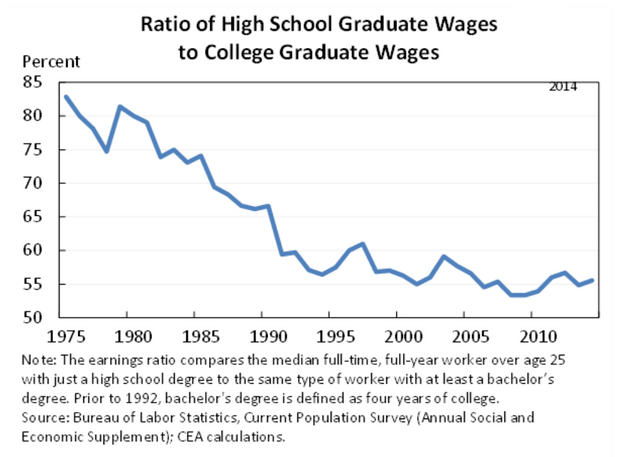
Men with a high school education now make barely 50 percent of the wages of men with a college degree or more, according to data presented Monday by the White House Council of Economic Advisers. This is down from near equality between the college-educated and the non-college-educated 40 years ago (see Chart 1).
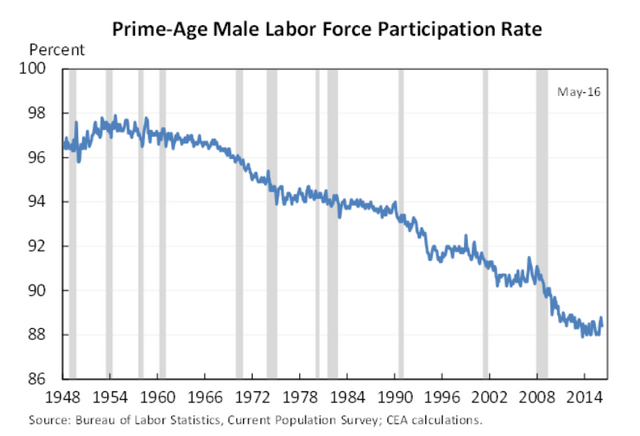
The CEA correlated the declining economic position of blue collar workers (using education as a surrogate for occupation) with the plunge in labor force participation rates among men of prime working age, those between 25 and 54 years of age (see Chart 2).
While 98 percent of men of prime working age were in the labor force in 1954, that figure has fallen to 88 percent today (81 percent actually working and 7 percent unemployed but available for work). The same divergence based on education was shown in these figures: 94 percent of male college graduates aged 25 to 54 were in the labor force, but only 83 percent of men with only a high school education.
The proportion of American men not in the labor force has risen six-fold over 60 years, from 2 percent to 12 percent. This compares to 7 percent in Spain and France and only 4 percent in Japan, countries which provide considerably better social benefits for the long-term jobless. In other words, men outside the labor force are both more numerous in the United States, and treated far worse by society.
The CEA report, like most such government and academic studies, is heavily laden with statistical jargon. But one passage makes clear that the brutal wage-cutting and job-slashing directed at workers in manufacturing and other semi-skilled occupations—carried out with the collaboration and support of the unions in those industries that are unionized—is a key factor in this social retrogression.
The report says: “In addition to reducing wages, abrupt demand shifts for less-skilled workers create inconsistencies between workers' expectations of the types of jobs they have traditionally had access to (and that were closely associated with their identity) and the realities of the jobs currently available to less-educated workers—for example, the decline in available jobs in manufacturing. This mismatch between what workers seek and what the job market offers may lead them to leave the labor force …”
In plain English, workers leave the labor force because they can no longer earn a living and support their families, which has a crushing moral and psychological impact in many cases.
The CEA report further finds that “the drop in the labor force participation rate for men over the past several decades may be explained by a decline in job opportunities for middle-skill workers and their reluctance to take jobs in other industries and skill classes.”
Again, in plain English, workers are dropping out of the labor force because they refuse to go from decent-paying factory jobs to low-paying work at WalMart, fast food or other so-called service industries.
Other details in the CEA report document regional differences, with the lowest rates of labor force participation in smaller industrial centers in the Midwest, the mining areas of Appalachia, and in rural, agricultural areas throughout the country—all areas where there has been little economic diversification and which are remote from high-tech centers or the booming financial markets.
The worst impact of the decline in labor force participation and the relative decline in blue-collar wages has been for black men. This is associated not so much with racial discrimination in employment, which is much less overt today than 60 years ago, as with the enormous increase in incarceration rates.
Men in prison are not included in the jobless figures and their appalling conditions are not recorded in reports like that issued by the CEA. But men who have been released from prison are far less likely to find decent-paying work and consequently leave the labor force altogether. These are disproportionately black and Latino.
The second report issued this past week was by the Economic Policy Institute, a liberal think tank supported by the AFL-CIO. This provided a state-by-state picture of the growth of economic inequality over the past century, supplementing reports issued last year on economic inequality at the national level.
The report found that income inequality declined in every state from 1928 until 1979. From 1979 through 2013, by contrast, economic inequality has risen in every state, and in many states it has now reached the level of 1928, the height of the stock market boom before the Great Depression.
Under the Obama administration, economic inequality has grown worse, and the growth is accelerating. In 15 states, the top 1 percent captured all of the income growth between 2009 and 2013. In 10 of these, the top 1 percent captured more than 100 percent of all income growth, with the result that incomes of the bottom 99 percent actually fell.
For the US as a whole, the top 1 percent captured 85.1 percent of all income growth for that five-year period. The average income of the top 1 percent grew 17.4 percent from 2009 to 2013, while the average income of the bottom 99 percent grew only 0.7 percent. The result is that by 2013, the average income of the top 1 percent was 25.3 times the average for the bottom 99 percent.
The EPI profiled the 10 states with the biggest increase in the share of the top 1 pecent from 1979 to 2007. These included: “four states with large financial services sectors (New York, Connecticut, New Jersey, and Illinois), three with large information technology sectors (Massachusetts, California, and Washington), one state with a large energy industry (Wyoming), one with a large gaming industry (Nevada), and Florida, a state in which many wealthy individuals retire.”
The EPI report refers to one particularly revealing episode in the operations of the wealthy parasites who dominate American society: the bipartisan deal in 2012, between Obama and the congressional Republicans, which extended the Bush tax cuts for all but the highest earners. This legislative change touched off a frenzy of “tax planning” (i.e., fraud) by the super-rich, which caused them to reduce their incomes significantly in 2013. This means that the disparities reported by the EPI study are significantly understated, since the wealthy deliberately avoided “earning” income in 2013 to avoid paying taxes.
Taken together, the CEA and EPI reports document a society that is deeply dysfunctional, unjust and unstable. For the workers who produce the wealth of society, wages and participation in the labor force are plunging. For the parasites in the financial aristocracy who owe their vast fortunes to the labor of others, incomes are rising faster than ever.
It is figures like these that underlie the upheavals that have already shaken the US political system in the course of the 2016 election campaign, which has many months to run its course and more shocks to endure. More fundamentally, these figures are infallible indicators that American society faces an eruption of mass struggle, as young people and working people rebel against the destruction of their jobs, living standards and social rights.

Obama's Syria Policy: The Dynamics of Engagement

Priyama Chakravarty


One of US President Barack Obama's core campaign promises during the 2008 Presidential election was a military withdrawal from Iraq and Afghanistan. Following through, his actions seem to have prioritised diplomacy over interventionist military responses, and policies of 'strategic patience' and the prudent use of power where necessary. Part of the policy package has been the shift from the model of fighting expensive large scale ground wars, to capacity-building in partner countries to prevent the growth of violent extremism and conflict.

Syria is a classic example of this strategy. It can be argued that the US’ policy is aimed at avoiding repeats of interventions in Libya, Afghanistan or Iraq – whose outcomes are virtually impossible to determine, in addition to getting bogged down in expensive nation-building exercises with no definable exit option. This is possibly why despite limited training and capacity building of a select few “moderate rebels,” the administration has been remarkably aversive to play an active role in the war theatre. This has been frequently done against overwhelming allied disapproval, including holding back on the proposed joint strike in Syria with the French forces in the wake of the Ghouta chemical attacks. At best, the US' air strikes have focused on achievable outcomes. Tactics of coercion and dissuasion have been employed to eliminate the Syrian government's arsenal of chemical weapons through diplomatic means, and specific targeted strikes have been carried out by fighters and drones against carefully selected ISIS targets by the CIA, and by having local players do the heavy lifting.

Those who have persistently argued for a US intervention firmly believe that Russia has filled the power vacuum left by Washington’s inaction. The Russian military intervention in Syria seems to have tilted the balance heavily in the favour of the Syrian government. However, President Obama believes that in Syria, “the price of action may be greater than the price of inaction.” He sees Russia sinking into much the same trap the US fell into in Iraq, given the debilitating costs it imposes.

Simultaneously, he has also been able to leverage non-intervention with amelioration: negotiating a cessation of hostilities agreement through the UNSC Resolution 2262 in February 2016. This resort was chosen over challenging Russia militarily in Syria, even though that would not have been realistically possible. All this has raised the benchmark for what constitutes a strategic US interest. Obama’s continued refusal to abide by the ‘Washington playbook’ seems to indicate that he has grasped that an empire can only endure by not fighting every battle.

Another overriding aspect of the non-intervention in Syria was Obama's dogged pursuit of a nuclear deal with Iran. Getting involved in combat in Syria would have almost certainly brought the US forces into direct conflict with Iran’s Islamic Revolutionary Guard Corps and Tehran’s proxy, the Hezbollah. A direct US intervention in Syria would have vastly complicated the already convoluted calculus of the nuclear deal. In effect, Obama's Syria policy was subordinated to his Iran policy. In doing this, he was willing to accept tactical “defeats” in exchange for a major and tangible “strategic victory.” If it realises its full potential, the nuclear deal, combined with the economic rehabilitation of Iran, holds the promise of altering the power dynamic in the ‘middle-eastern’ politics as we know it. While it will take time, the lifting of sanctions will lead to a stronger Iran, stabilising the Shia-Sunni conventional balance of power in the region, possibly reducing Iran’s dependence on sub-conventional actors for power projection.

The deal also creates path dependency – i.e. the benefits of maintaining a non-nuclear Iran will vastly outweigh the US’ institutional tendency to pick fights with the Iranians. In effect, this forces the regional US dependents such as Saudi Arabia to seek its own allies and methods to tackle Iran, rather than perpetually seeking the US’ assurances and bogging the US down in intractable and untenable conflicts. 

The Gulf Cooperation Council’s intervention in Yemen is the clearest example of the US trying to get its regional allies to bear the cost of their own follies. A stronger Iran will also keep the Sunni extremism restricted in West Asia, while refracting the forces of international Sunni jihadists back onto Saudi Arabia, as opposed to the practice of exporting them abroad.

Finally, the lack of a direct US intervention provides a powerful counter-narrative to the jihadi elements who have perpetually justified their attacks on Western targets on the basis of a prolonged US military intervention in the region. Even though most of these interventions have been at the behest of local allies, those allies remain content to feed the narrative of victimisation at the hands of the West. The clearest example of this was the US basing in Saudi Arabia upon the request of the Saudis themselves during and post the liberation of Kuwait. An intervention in Syria without the regime’s permission would have simply added fuel to the fire. Therefore, a vastly diminished US presence reduces the friction points.

Therefore, Obama’s policy of increasing the diplomatic engagement with minimum use of force is a prudent use of power. It is both visionary and realistically cautious and quite possibly the least worst of a whole range of bad options.

22 Jun 2016

Africa Business Fellowship for American Business Leaders 2016

Brief description: Applications are now accepted for the 2nd year of the Africa Business Fellowship, an innovative program designed to strengthen ties between up-and-coming American business leaders and top tier African companies.
Application Deadline:
  • November 1, 2016: Round 1 (preferred) application deadline
  • December 1, 2016: Round 2 (final) application deadline
Offered annually? Yes
Eligible Countries: United States of America
To be taken at (countries): NigeriaSouth Africa, Kenya and possibly other African countries.
Eligible Professional Fields:  Fellows from a variety of business backgrounds, such as consulting, finance, strategy, general management, marketing, and/or entrepreneurship, who preferably(not necessarily) possess an MBA degree.
About the Award: The ABF represents a radically different approach to intercultural exchange that places value on Africa’s contributions to shaping global business practices. The Africa Business Fellowship is a partnership between Econet, African Leadership Network (ALN), and Management Leadership for Tomorrow (MLT). The program will match young American business professionals with paid 6-month placements in African companies. Its purpose is to strengthen relationships between the African and American business communities and provide future American business leaders with the hands-on experience they need to truly understand business in Africa. We believe that by exposing high-achieving American professionals to African business at this stage in their careers, we are setting the stage for increased American-African investment and more meaningful collaboration.
Successful applicants will spend three or six months with premier African corporations and startups in countries including NigeriaSouth Africa, and Kenya. Fellows will have the unparalleled opportunity to familiarize themselves with business best practices and develop networks that will serve as a foundation for bridges between African and American business interests.
The fellowship aims to increase affinity for this collaboration between African and American businesses, and expose future American business decision makers to the continent early on in their careers.
Offered Since: 2015
Type: Business. Cross-Cultural Collaboration.
Eligibility: 
  • Educational and professional experience, including official transcript(s)
  • 3 brief essay questions that help us understand your passions, skills and interests, as well as how the Fellowship ties to your career objectives
  • 2 minute video response which allows our candidates to share more about themselves
  • Written professional reference(s) from employer or other professional who can speak to candidate’s leadership experience and potential
Selection Criteria: The ABF is looking for innovative and driven professionals who have a deep passion for learning about business in Africa. The ideal candidate will have an MBA and/or extensive business experience. Fellows from a variety of business backgrounds, such as consulting, finance, strategy, general management, marketing, and/or entrepreneurship are welcome. It is not necessary for fellows to have previous international experience, but we look for people who demonstrate a genuine interest in African business.
Number of Cohorts: 10 to 15 Fellows. The inaugural programme had 14.
Value of Programme: Fellows will be placed with leading corporates and startups across the continent.  In addition to gaining unique experience and building skills, relationships and networks Fellows will also have access to some of the most influential African businesses and leaders.
As part of the program also, fellows will receive a living stipend, housing, health insurance, assistance with visa applications, and additional support.
Duration of Programme: The Africa Business Fellowship is a Three or Six month opportunity, starting in June 2017.
How to Apply: Visit the Programme webpage to apply
Award Provider: Econet, African Leadership Network (ALN), and Management Leadership for Tomorrow (MLT).