16 Aug 2016

Astronomers reveal most detailed map of galaxy distribution

Joe Mount

An international collaboration of astronomers has announced the latest results from the Baryon Oscillation Spectroscopic Survey (BOSS) experiment, which ran from 2008 to 2014 as part of the Sloan Digital Sky Survey (SDSS). The research collated a three-dimensional map of distant galaxies, enabling scientists to make the most precise measurements yet of dark energy and the acceleration of the expansion of the Universe, and to study the early, formative years of the cosmos.
Astronomer Jeremy Tinker said, “We have spent five years collecting measurements of 1.2 million galaxies over one quarter of the sky to map out the structure of the Universe over a volume of 650 billion cubic light years.” The latest map extends about twice as far as the previous sky survey, providing unprecedented insight into the evolution of the Universe by examining the distribution of galaxy clusters.
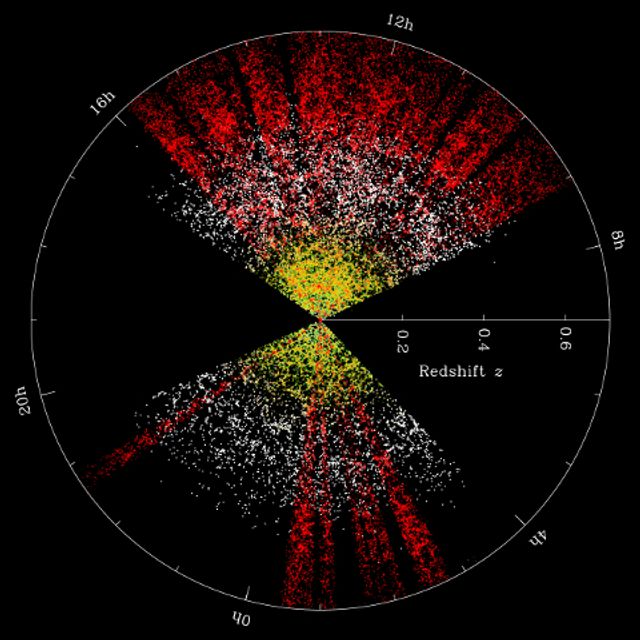
Galaxies measured by the latest survey are shown in red, with galaxies from previous surveys shown in white and yellow. Red shift is a way to measure distances (and velocities) on a cosmological scale. An object with a red shift of 0.6 is approximately 8 billion light years away. Credit: Michael Blanton
The Sloan Digital Sky Survey project began in 2000 and systematically builds comprehensive maps of the distribution of galaxies across vast stretches of the observable Universe, covering one quarter of the sky. It uses a 2.5-meter diameter telescope at Apache Point Observatory in New Mexico that takes both a survey of objects (such as galaxies) distant from Earth and more detailed measurements of those already known. It has observed over 500 million astronomical objects and discovered a ring of stars surrounding our galaxy, the Milky Way.
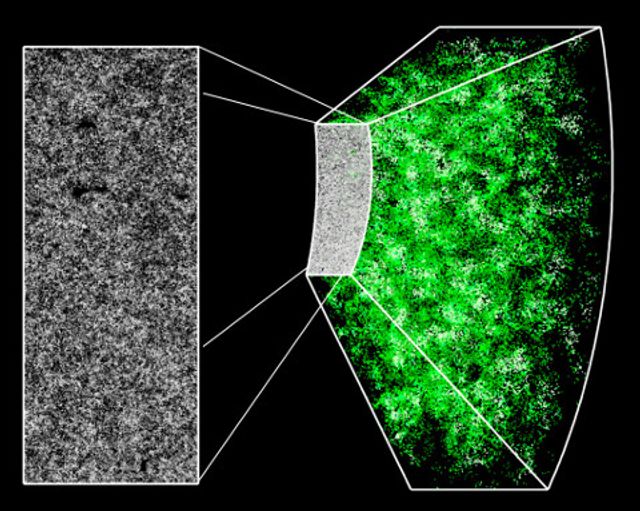
This image captures one tenth of the total sky survey. The image on the left is the view of space as seen from Earth. The wedge shows the same image as part of the map of galaxies in three dimensions. Each dot represents a galaxy containing several hundred billion stars. The brighter regions represent dense galactic clusters. Credit: Jeremy Tinker and the SDSS-III collaboration
One of the early results from the SDSS project was that galaxies are not spread uniformly throughout space, but form filaments that span cosmological distances and have a clumpy structure with dense clusters and sparse voids. This is seen both in galaxies nearby and in structures much farther out (and thus further back in time). Astronomers have probed through 7 billion years of cosmic history and have found filament structures across all of it.

A two-dimensional slice of space where each point represents a galaxy, colour-coded by brightness, clearly showing filaments and clusters. Earth is at the centre. Credit: M. Blanton and the Sloan Digital Sky Survey
It is thought that these filaments and voids are a result of the conditions of the Universe in its earliest years. For the first 400,000 years after the Big Bang, the Universe consisted of dense but expanding opaque gas, too hot to allow stable atoms to form. The gas was not perfectly uniform: very slight lumps of density produced areas of higher pressure. Each area of higher pressure sent a wave of pressure (essentially a sound wave) away from it throughout the early Universe, travelling at high speed until the Universe cooled and became transparent, freezing out the sound waves into an enduring imprint. The physics behind these sound waves are called baryon acoustic oscillations.
The scale of this clumping has been precisely measured by analysing the cosmic microwave background (CMB) radiation. The CMB provides a snapshot of the Universe at a time 378,000 years after the Big Bang when the hot gas of the early Universe cooled sufficiently to form atoms. Protons and electrons combined for the first time and thus electromagnetic radiation was able to travel freely through space. Some of this still reaches Earth today as radio waves: 1 percent of the noise a person hears when a radio is between stations is caused by this echo from the early Universe.
A few hundred million years later, the matter clumps provided the raw material for the formation of stars. As the Universe grew, this structure crystallised into vast filaments of galaxy clusters. In this way, the sound waves in the early Universe determined the large-scale distribution of matter in the Universe today, 13.8 billion years later. The spherical ripples in the distribution of galaxies are now 980 million light years across.
The BOSS experiment observed these ripples as the underlying space expanded over a period of 5 billion years, from 7 billion years ago to 2 billion years ago. It is through these structures that cosmologists study the pull of dark matter on galaxies and how dark energy is pushing them apart.
One can also begin to understand dark matter and dark energy through these observations. Initially, dark matter was thought to be dead stars, planets and/or black holes in massive quantities making halos around galaxies. Another idea, proposed more recently, is that dark matter is a new type of fundamental particle (or new class of particles) that are not part of normal particle physics. The baryon acoustic oscillations show that dark matter is most likely a whole new type of matter, of which the only known properties are that it does not emit light and is extremely massive.
Dark energy is even more of a mystery. Proposals for what it could be include a type of energy inherent to the vacuum of deep space, an effect of gravity over cosmological scales, some sort of quantum mechanical effect and a host of other potential phenomena. All that is really known is that dark energy is the name given by researchers for the energy that is causing the expansion of the Universe to accelerate.
This acceleration has been known since 1998, one of the first major discoveries of the Hubble Space Telescope. The discovery was made by studying a particular class of exploding stars, Supernovae Type Ia, which have a very distinct signature even across vast distances and thus can be used to measure accurately how far away distant galaxies are from Earth. Not only were these stars and galaxies found to be far away, but the measurement of the expansion velocities of these stars over cosmic distances, and thus cosmic time, provided a shock: instead of the expansion of the Universe slowing down over time, a result of the attraction of gravity, the expansion rate actually is speeding up!
The discovery revolutionised cosmology, as acknowledged by the 2011 Nobel Prize for Physics, and has since been confirmed by various independent measurements. The origin of the cosmic acceleration, now termed “dark energy,” is one of the biggest problems of modern cosmology.
To explain the cosmic acceleration, theorists retrieved Albert Einstein’s cosmological constant from the dustbin. Einstein arbitrarily inserted this effect into his theory of general relativity as a mechanism to counteract gravity and maintain the Universe at a stable, constant size. This corresponded to the widely held preconception that the Universe must be static and everlasting. He abandoned his “biggest blunder” after Edwin Hubble found in 1929 that the Universe was expanding.
Until the discovery of the cosmic acceleration it was assumed that the cosmological constant was zero and the Universe would either stabilise at a constant size or collapse in on itself in a “Big Crunch.” Now, the cosmological constant had to be given a non-zero value to account for the cosmic acceleration, which would cause the Universe to expand indefinitely.
Dark energy is the physical mechanism proposed to explain this acceleration. It is not an “anti-gravity” force that repels objects but an omnipresent phenomenon which increases the volume of space in regions of the Universe that are devoid of galactic clusters (the voids discussed earlier). Dark energy has never been directly observed in the laboratory, and its existence is inferred from cosmological observations. These observations suggest that dark energy comprises about 70 percent of the energy in the Universe.
The observations also support the “vacuum energy” theory of dark energy, one of the many competing models attempting to explain the cosmic acceleration. Essentially, the vacuum energy theory is that the amount of dark energy density is constant over time, as described by the cosmological constant. It is worth noting that this result is also supported by data from the survey reaffirming the validity of the general theory of relativity.
The BOSS experiment also confirmed that on cosmological scales the geometry of space-time is flat to within 0.1 percent. General relativity explains how massive objects induce space-time curvature that appears to us as the force of gravity. Across cosmological distances, the curvature of space-time tells us important things about the nature of the Universe. It may be flat like a sheet of paper, curved and “open” like a saddle or “closed” like a ball. A closed Universe must be finite in size, but a flat or open Universe may extend infinitely.
A number of further galactic surveys are planned for the coming decades. One of these is the Dark Energy Spectroscopic Instrument (DESI), which will use a larger telescope to probe fainter and more distant galaxies. Other works expanding and deepening the results of the third Sloan Digital Sky Survey are the fourth Sloan Digital Sky Survey (2014-2020), HETDEX, eBOSS and 4MOST. Physicist Stephen Hawking recently announced an effort by the COSMOS supercomputing centre to produce the most detailed map of the Universe to date. Simultaneously, the European Space Agency is planning the Euclid space mission, scheduled for launch in 2020, to build a similar map to investigate dark energy.

Thai junta exploits bombings to clamp down on opposition

Tom Peters

Last Thursday and Friday, apparently coordinated explosions in seven of Thailand’s southern provinces killed four people and wounded 35. More than a dozen sites were targeted, including the popular tourist destinations of Phuket, Surat Thani and Hua Hin. Among the injured were 20 Thais and 10 foreigners from Germany, Italy, the Netherlands and Austria.
Some of the bombs were reportedly concealed in flower beds and roadside plants. They were detonated by mobile phones amid crowds of people. Several unexploded devices were found over the weekend in Hua Hin, Phuket and Phang Nga.
Three small bombs exploded on Sunday in a street in the southern province of Yala. No one was injured.
Police authorities claimed that the bombings, plus a number of suspected arsons, were all orchestrated by a single person. Deputy police chief Pongsapat Pongcharoen told the media: “The events are connected, carefully planned and carried out across many areas and masterminded by one individual.”
Although no group has claimed responsibility for the attacks, Thailand’s military junta, the National Council for Peace and Order (NCPO), moved rapidly to exploit the tragedies to intensify its crackdown on political opposition.
NCPO spokesman Colonel Winthai Suvaree said suspects would be held without charge and interrogated for seven days, then released if determined to have no connection with the bombings. The Nation reported on Monday that police had “detained an undisclosed number of southern political leaders,” including some affiliated with the United Front for Democracy Against Dictatorship (UDD), also known as the Red Shirts, the protest wing of the Pheu Thai Party.
The military seized power from the Pheu Thai government of Prime Minister Yingluck Shinawatra in May 2014. The coup was backed by elites in Bangkok, including monarchists and sections of the state bureaucracy. These elements are determined to prevent a return to power by the wealthy Shinawatra family, whose political parties have won every election since 2001.
Yingluck’s brother Thaksin Shinawatra, a communications billionaire, was also ousted in a military coup in 2006. Thailand’s traditional elites turned against Thaksin following his attempts to open the economy to greater foreign investment, which cut across their own entrenched interests. Thaksin and Yingluck provoked further hostility in these quarters due to their limited social reforms, such as cheaper healthcare and subsidies for rice farmers, which won them a base of support among the rural and urban poor.
The NCPO has begun to eliminate these subsidies and is planning other austerity measures, including cuts to welfare entitlements for the elderly. It has also rewritten the constitution to effectively establish a permanent dictatorship, even if elections are held next year as promised.
Last week’s attacks occurred less than a week after the August 7 referendum, which endorsed the draft constitution by a narrow majority following a military crackdown on opposition. More than 100 people were arrested for campaigning against the constitution, while the NCPO mobilised soldiers to campaign for a “yes” vote. Several explosions were reported during the weekend of the referendum, one of which killed a teacher and injured two police officers.
Speaking to the media on Friday, Prayuth Chan-Ocha, the self-appointed prime minister and former army chief, blamed the string of fatal explosions on “bad people” who opposed the constitution. According to the Bangkok Post, NCPO spokesman Sansern Kaewkamnerd “suggested those behind the blasts could be people who have ‘lost benefits’—code for followers of Thaksin—because of last Sunday’s referendum.”
The regime immediately dismissed suggestions that the attacks were perpetrated by Muslim separatists based in the deep south. Deputy Prime Minister Prawit Wongsuwon declared on Friday: “This motive can be discarded. I confirm this is not the case.” He did not offer any argument for ruling out the insurgents as suspects.
For more than a decade several armed groups have carried out attacks on civilians and the military, and set fire to hundreds of schools. Since 2004, more than 6,500 people have been killed and 12,000 injured as a result of the conflict in the south.
Police also ruled out the possibility that foreign terrorists, such as Islamic State, were behind the attacks.
UDD leader Jatuporn Prompan denounced attempts to link his organisation to the bombings. He told the Bangkok Post that Wichai Padungsaksri, a Red Shirt leader from Ang Thong province, in the centre of Thailand, was arrested by 20 armed soldiers on Saturday morning. Soldiers also arrested Prapas Rojanapithak, a 67-year-old described by the Nation as a UDD leader. ThePost said Prapas denied being a UDD member, but he had “joined 90 other southern academics and activists in signing a statement condemning the May 22, 2014 coup.” Prapas and Wichai were detained without charge.
The Pheu Thai Party condemned claims that Thaksin is behind the bombings as “slander and defamation.” Thaksin, who lives in exile in Dubai, has reportedly threatened to sue anyone making “false accusations” against him.
Police have also arrested Sakarin Karuehas, a 32-year-old oil rig worker originally from Chiang Mai. He is accused of setting fire to a Tesco Lotus supermarket in the southern province of Nakhon Si Thammarat. No details have been released about Sakarin’s interrogation, his background or affiliations.
The NCPO’s actions recall its response to the August 2015 bombing of the Erawan Shrine in Bangkok, which killed 20 people and injured 125. Then, as now, the junta initially implied that the UDD was responsible and used the horrific attack to justify its dictatorship. Two men from China’s Uighur ethnic group were eventually charged over the bombing and are currently awaiting trial. Both have denied the charges and one claims he was tortured to force a confession.
Whoever carried out last week’s attacks, they have provided a pretext for the junta to further strengthen its grip on power. As it implements drastic austerity measures and attacks on democratic rights, the NCPO is preparing to confront mass opposition in the working class and among poor farmers.
There is widespread and deepening hostility toward the regime. Significantly, the junta has been forced to deny rumours that it was responsible for the explosions. According to the Nation, NCPO spokesman Colonel Piyapong Klinphan said on Saturday: “The military will never harm the people. I can vouch for that with my life.”
In fact, the history of the Thai military is soaked in blood, having carried out 11 coups since 1932. Most recently, in 2010, it was called on by the unelected Democrat Party government to brutally suppress Red Shirt protesters, predominantly drawn from the urban and rural poor, who called for fresh elections. More than 90 people were killed and thousands more injured in the crackdown in Bangkok.

UK: Dorset health services to be slashed to reduce deficit

Ajanta Silva


A major shakeup of National Health Service (NHS) facilities in Dorset, England is being planned in which two accident and emergency (A&E) units, a maternity unit, a children’s ward and several community hospitals will be closed or downsized.

As is always the case with such cuts, the bitter pill is being sugar-coated by PR experts and presented as a golden opportunity to “deliver care closer to home,” “increase the number of people supported in the community as an alternative to major hospitals,” and “increase the range of services in the community.” The reorganisation is portrayed as fulfilling the Conservative government’s pledge of providing “seven day services” in the NHS.

In a statement totally disconnected from the real world of austerity, budget cuts and privatisation, Dorset’s Clinical Commissioning Group (CCG), one of 211 organisations responsible for organising the NHS in England, proclaims the proposed changes in its “Clinical Services Review” will ensure that the public will “continue to have high quality, safe and affordable care both now and in the future.”

What the CCG does not discuss is that the changes are driven by the government’s policy of starving the NHS of funds in order to create favourable conditions for the privatisation of services. The 2010-2015 Conservative/Liberal-Democrat coalition granted the lowest ever funding increase for the NHS in its entire history, and imposed £20 billion in “efficiency savings” cuts.

The current Conservative government is demanding further cuts of £22 billion. As a result, one CCG after another is falling into deficit, with nine CCGs and five major hospital trusts recently forced by NHS bosses into “special measures,” under which they have to draw up an 
action plan to meet stringent budget targets.

Dorset CCG claims it is facing a £200 million deficit by 2021. Currently, it is seeking approval for its reactionary proposals, hatched behind closed doors over the past two years, from the Wessex Clinical Senate (a non-statutory advisory body providing independent clinical advice for the Wessex area, including Dorset, Hampshire and the Isle of Wight) and from NHS England. Then the proposals will be put out for the obligatory, but bogus, “public consultation” exercise before the reorganisation begins in earnest next year.

The plans include:

* The closure of three community hospitals—Alderney, Westhaven and St Leonards—and three others shut or downgraded to “community hubs” without beds to meet the CCG target of “7 strategically located sites with beds compared to 13 at present.”

* The slimming down of A&E departments at Poole General Hospital and Dorset County Hospital in Dorchester and the concentration of A&E at Royal Bournemouth Hospital.

* The possible closure of Paediatric and Neo-Natal care units at Poole General hospital as a result of the A&E downgrading.

* The shutdown of St Mary’s maternity unit in Poole.

* The closure of the remaining day hospital and rehabilitation units at Christchurch hospital, which means that all wards, with the exception of the MacMillan cancer unit, will disappear.

* A reduction in children’s services in Dorset County Hospital with the threatened closure of Kingfisher ward and the Special Care Baby Unit. Stroke care and emergency surgery at the same hospital will be reduced from 24 hours to 14 hours a day. 

* Further privatisation of services, indicated by language such as “short-term beds in care homes could be used as an alternative to community hospitals in areas where the need is small,” and the recent closure of Ward 9 at Bournemouth Hospital, which had 35 beds, at the same time that beds available for private patients are increased.

* Increased pressure on already struggling Mental Health Services, which has already included the 2013 closure of Kings Park Hospital in Bournemouth with the loss of more than 40 beds, plus the elimination of day clinics and day hospitals that support individuals across the county. Recently shut down was the Chalbury unit in Weymouth, which looked after dementia patients with highly specialised needs.

* Making health workers redundant or redeployed to other places against their will under the “fit for the future” proposals.

On top of this are the disastrous implications of the threatened imposition by the Conservative government of an inferior contract on junior doctors. This is opposed by the doctors as being unsafe for patients and detrimental to pay, terms and conditions.

The closure or downgrading of community hospitals, which are often rehabilitation units closely integrated into their local communities, undermines the vital role they play in avoiding admissions to and facilitating early discharges from acute hospitals. The changes belie the CCG’s talk about “care closer to homes.”

The slashing of services at the already overwhelmed A&E departments in Poole and Dorset will put enormous pressures on the remaining one at Bournemouth, and cutting maternity units and children units will have a crippling effect on patient safety and care.

The concentration of services in the Bournemouth and Poole conurbation in the east of Dorset, home to 450,000 of the county’s 750,000 inhabitants, will involve longer journey times and inevitably lead to excessive deaths. People reliant on public transport are already facing difficulties, with many rural areas in the west having no proper services at all. This situation means that at some hospitals, staff are already unable to work early shifts or at weekend because of the lack of transport.

The CCG attempts to justify this “streamlining” on the grounds that well-resourced but fewer units would improve care and the longer ambulance transport times would be offset by the presence of trained professionals. However, in May, the South West Ambulance Trust, which operates across Dorset, was issued a Warning Notice by the Care Quality Commission for the inadequacy of its 111 call service and told to make “significant improvements to protect the safety of patients.”

The inspection found that “there were often not enough staff to take calls, or to give clinical advice when needed.” It added, “Staff reported working long hours, many feeling high levels of stress and fatigue. There was a high staff turnover and high sickness rates. Too many calls were abandoned, and patients were waiting too long for their calls to be answered and to be assessed, or to receive a callback with appropriate advice.”

Many clinicians are rightly outraged by the CCG plans, and the thousands of people who marched against the closure of the Kingfisher ward and Special Care Baby Unit at Dorset County Hospital this summer are just one expression of the opposition that is brewing. 

Parliamentary petitions against the shutting of A&E departments have attracted nearly 50,000 signatures.

Dorset CCG is opposing criticisms of its proposals with the response that they are “the result of ongoing engagement with local clinicians” and the public during road shows.

The attack on health services in Dorset is not unique. CCGs across the country have started rationing vital services, including knee, cataract and hernia surgeries and IVF treatment, with the ultimate aim of expediting the privatisation process. The CCGs, with their control of £100 billion worth of NHS funding, are a goldmine waiting to be plundered.

According to a report published by the Unite trade union last year, more than a quarter of the 3,392 CCG board members have links to a private company involved in health care, including 513 company directors and 140 business owners.

Although Unite publishes such incriminating information about the destruction of the NHS, it, along with Unison, the largest public sector union, GBM and Royal College of Nursing are doing nothing to oppose the attacks on health services in Dorset. Given their record, there is no doubt that they will work to sabotage any struggles that erupt in opposition to the slashing of services in order to steer them into safe channels and not challenge the capitalist profit system that is responsible for these attacks.

Workers in the health service, in alliance with those relying on these critical services, must prevent this by mobilising independently of the unions and forming committees of action.

Latest Australian “terrorism” arrests set dangerous precedents

Mike Head

Two arrests in recent weeks have highlighted the capacity of Australia’s ever-expanding “anti-terrorism” laws to be used far beyond the main current targets—vulnerable boys and young men, supposedly linked to Islamist extremists in the Middle East.
Last week, Phillip Galea, 31, described by the media as a right-wing extremist, was arrested during a series of house raids across Melbourne in a joint operation by the Australian Federal Police (AFP) and Victoria state police. He reportedly suffered injuries after police fired a stun grenade and dragged him through a broken glass window.
Galea was charged with collecting or making documents likely to facilitate a terrorism act and planning or preparing for a terrorist act. The police provided no details of these vague charges and released no evidence, except to say they bugged Galea’s phone for eight months.
The highly-publicised character of the arrest, and the speed with which Prime Minister Malcolm Turnbull’s Liberal-National Coalition government claimed credit, point to definite political calculations.
Justice Minister Michael Keenan emphasised that it was the first time in Australia’s history that federal terrorism laws had been used to charge an alleged right-wing extremist. He immediately insinuated Galea’s guilt, saying he had “strong links to right-wing extremist organisations,” thus prejudicing any chance of a fair trial.
Keenan declared that the government was fulfilling its responsibility to “keep the Australian people safe” from “anybody who has violent extremist views who threatens” that safety. This language is wide enough to cover a range of political organisations, and points to a bid to legitimise the broader use of the terror laws.
Victorian police assistant commissioner Ross Guenther declared that the arrest interrupted “something that could have been quite serious in terms of harming the community.” He said police acted on information that individuals were either “advocating” harm or “producing documents” that might lead to harm.
In a brief hearing on August 9, a federal police prosecutor asked for Galea to be held in detention until late November to give the police time to transcribe the calls and prepare the case. However, Galea’s lawyer objected that he was given only a vague summary of the charges against his client and opposed the lengthy delay. The magistrate set a committal hearing date of October 31.
Whatever exactly Galea is accused of, and that remains entirely unclear, the charges mark a shift in the police response to his activities. He was previously fined for possessing a knife at an anti-immigration rally. Last November, he was jailed for a month after pleading guilty to possessing five Tasers and 360 grams of mercury.
Since 2010, Galea has been publicly associated with anti-immigration and anti-Islam groups, most recently Reclaim Australia, the United Patriots Front and the True Blue Crew. These outfits seek to exploit and channel in nationalist and xenophobic directions the growing social discontent over the widening job losses, inequality and poverty imposed by successive Labor and Coalition governments.
While the terrorism laws might be utilised, at this point, against some right-wing elements, the real aim of the measures is to build up police-state powers to suppress the underlying unrest, and set precedents that can be used against left-wing and socialist organisations.
The Fairfax Media last Saturday indicated that the Australian Security Intelligence Organisation (ASIO) was targeting “extremism” across the political spectrum. After reporting that Galea’s arrest was prompted by ASIO monitoring of right-wing groups, the article cited ASIO’s 2014-15 annual report, which asserted that “violent rhetoric continued from extreme right-wing and left-wing individuals in Australia.”
In the other recent case, Kurdish journalist Renas Lelikan, 38, was arrested and charged late last month with being a member of the Kurdistan Workers Party (PKK), which has been proscribed as a “terrorist organisation” by consecutive governments since 2005.
An Australian citizen, Lelikan returned to the country from Iraq last October, saying he was escaping from the dangers of Islamic State (ISIS), which a PKK-linked militia, the Peoples Protection Units (YPG), is fighting in northern Iraq with the support of the US and its allies. On his return, Lelikan was questioned by the AFP for 10 hours, then released. No reason has been given for his arrest eight months later.
Lelikan was denied bail on July 29, after appearing in a Sydney court via video-link, handcuffed and dressed in an orange jumpsuit—the prison garb allocated to those convicted of terrorist-related offences. A magistrate ruled there were no “exceptional circumstances”—the extraordinary requirement to be granted bail under the terrorism laws. This was despite his lawyer arguing that he was no security threat because the PKK was not an enemy of Australia, and that Lelikan was being held in solitary confinement and faced threats by jailed ISIS supporters.
Since the still-unexplained attacks of September 2001, Australian governments, both Coalition and Labor, like their counterparts in the US, Britain and other imperialist powers, have used the pretext of combating terrorism as a cover for predatory wars in the Middle East, accompanied by draconian domestic laws, overturning basic legal and democratic rights and permitting mass surveillance.
The Australian laws define terrorism in such sweeping terms that they can cover many forms of political activity. Any act or threat intended to advance a “political, religious or ideological cause,” and “coercing, or influencing by intimidation” a government or “section of the public,” that damages property or endangers “public health or safety” is classified as terrorism, punishable by life imprisonment.
As a result of extensions to the laws since 2001, no specific terrorist plot needs to be proved—not even a time or place. “Advocating,” preparing” and “conspiracy” provisions mean that people can be convicted for even discussing actions defined as terrorist.
Just before the latest arrests, the Turnbull government, backed by the Labor Party, unveiled further measures as its first political initiative since scraping back into office at the July 2 election. One will permit the indefinite incarceration of prisoners convicted of terrorism-related offences, after they have served their sentences. The other will allow 12-month control orders—which can include tracking devices or house arrest—to be imposed on children as young as 14.
Taken together, these developments indicate that the unstable government and political establishment, assisted by the media, is promoting terrorism scares to justify further bolstering the repressive powers of the police-intelligence-judicial apparatus in the face of rising social and class tensions. As the Socialist Equality Party warned during the election campaign, the “terrorism” powers are being prepared for wider use throughout the working class as economic conditions worsen and Australia’s involvement in US-led wars intensifies.

Leaked files reveal brutal regime in Australia’s Nauru refugee camp

Max Newman

The levels of trauma and abuse inflicted on asylum seekers imprisoned in the Australian-run “offshore detention centre” on Nauru were partly documented last week when more than 2,000 leaked incident reports were published by the Guardian.
Covering the period from May 2013 to October 2015, the Nauru files make public, for the first time, officially suppressed and buried cases of violence, mistreatment and suicide attempts among the over 600 refugees, including 104 children, indefinitely detained on Nauru. This inhuman regime, in violation of international law, was established by the previous Greens-backed Labor government and has been maintained by the current Liberal-National Coalition government.
In numerous incident reports, asylum seekers described brutality at the hands of guards, including violence directed toward their children. Guards were accused of assaulting or choking children, or coming in to “restrain” or “remove” children who were supposedly fighting or yelling.
The reports include complaints about a guard grabbing a boy and threatening to kill him and guards slapping children in the face. In another report, a mother stated that a female security guard would not let her take her daughter to the toilet. When her daughter attempted to go to the toilet on the ground in front of the guard, the guard shone her torch directly on the child, making the child unable to urinate.
Children, who made up 18 percent of the population imprisoned on Nauru, were overrepresented in the incident reports. More than half the 2,116 reports, or 1,086, involved children and included allegations of sexual assault.
One report detailed how a young boy was allegedly molested in a car by a security guard when being transported from one area to another. There are also reports of rape, as well as women complaining of threats of sexual assault by guards or Nauruan men, and fearing for their safety.
The Nauru files paint a picture of the camp in squalor, with dirty tents, no chairs for children in schoolrooms, and water not being provided or prioritised at the school despite stifling heat. Mice ran around on the floor, and children needed tetanus shots after being bitten.
The reports demonstrated the psychological impact of indefinite detention. In one incident, a young female asylum seeker took an entire month’s supply of contraceptive pills in attempt to commit suicide. In another, a woman attempted to overdose on her medication because a guard had trampled on her son’s photo and kicked her and her husband in their tent.
A further report recorded that a man attempted to hang himself with a rope before being physically stopped by guards. Three months later, a young woman tried to kill herself by hanging. In another incident, a women vomited after ingesting baby bottle steriliser tablets.
According to one shocking report, a girl walked into her classroom, grabbed some cleaning liquid from the shelf and proceeded to drink the entire bottle before she was physically stopped by her teacher. In September 2014, four unaccompanied minors sliced their forearms with knives while another two kicked and punched the walls of their tent.
Hundreds of such reports were classified under the label of “self-harm,” designed to minimise the severity of the incidents, blame the victim and hide the reality of acts of desperation born from severe oppression and mental harm.
The files constitute the most extensive leak of its kind from inside Australia’s offshore detention centres on Nauru and Papua New Guinea’s Manus Island. They indicate significant opposition among the camp staff to the abusive character of the detention and the Australian government’s efforts to suppress the evidence. Amendments to the Border Force Act introduced last year impose lengthy jail sentences for anyone who publicly divulges any details.
Some of the incident reports appear to originate from records kept by the Salvation Army and Save The Children, charity organisations that had Australian government contracts to provide welfare, education and recreational services to the detainees. Other reports came from Wilson Security, the security firm employed by the head contractor, Ferrovial(formerly Transfield and Broadspectrum).
Former staff members have previously defied the government’s secrecy. They include Dr. Isaacs, a paediatrician who published a medical journal article demonstrating that the conditions constituted torture. In the recently released film Chasing Asylum, former employees risked jail time by showing themselves on camera, exposing the barbaric conditions.
Alongside these courageous actions, official reports, issued by UN agencies, Australian human rights agencies and parliamentary committees, have confirmed the appalling conditions. The overwhelming evidence has generated widely-supported social media and other campaigns, pleading with the government to bring the detainees to Australia.
But none of these reports has shifted the Coalition government or the opposition Labor Party one inch from their determination to continue the “offshore” regime as a deliberate means of deterring refugees from seeking to reach Australia.
The government responded to the Nauru files by accusing asylum seekers of falsely reporting abuses in order to come to Australia. Immigration and Border Protection Minister Peter Dutton declared that “some people have even gone to the extent of self-harming and people have self-immolated in an effort to get to Australia.”
Prime Minister Malcolm Turnbull and Labor leader Bill Shorten both flatly dismissed calls for a royal commission into the incident reports. In any case, such an inquiry would only serve to whitewash the abuses and bury the evidence as much as possible.
Shorten reiterated Labor’s ongoing support for the camps, which were re-opened by the previous government—in which he was a key minister—reviving the “Pacific solution” imposed by the Howard Coalition government in 2001.
At the same time, conscious of the public disgust, Shorten fraudulently claimed to oppose indefinite detention. In fact, Labor deliberately consigned the detainees to Nauru and Manus Island for indeterminate periods, declaring that they must have “no advantage” over the millions of refugees who wait endlessly in Middle Eastern and African camps.
The Greens joined Labor in proposing yet another parliamentary inquiry into the latest revelations, but this will only seek to channel the widespread outrage back into the hands of the same parliamentary establishment. The Greens are just as culpable as Labor for the detainee abuses, having propped up the last minority Labor government as it reopened the camps. Moreover, for all their claims to oppose this regime, the Greens advocate an alternative form of “regional processing” in impoverished Asian countries, and are fully committed to the underlying framework of “protecting” national borders.

As growth prospects fall, US markets hit record high

Nick Beams

All three US stock market indexes closed at record highs yesterday, in the second time this has happened since the height of the tech and dot-com bubble in 1999.
The S&P 500 rose 0.3 percent to close at 2,190, the Dow Jones index ended up by 0.3 percent at 18,635 and the Nasdaq Composite was up by 0.6 percent to reach 5,263.
The immediate reasons for the rise appear to have been firming oil prices and the continuing fall in the yield from bonds that have made investment in equities more attractive.
Given the fact that the last time triple highs were reached was on the eve of the bursting of the tech bubble, there were some comparisons drawn with the events of seventeen years ago. But the preponderance of the commentary was to the effect was that there was no similarity between the two events. This was despite comments from a number of market analysts that the market is heading for a major downturn.
The Thailand-based Swiss investor Marc Faber had said that the market is due for a 50 percent correction, following warnings earlier this year from Albert Edwards, a strategist at the financial firm Société Générale, that equities could lose as much as 75 percent of their value. US investor Carl Icahn has warned that stocks are 80 percent overvalued.
These forecasts have been dismissed on the grounds that the price earnings ratios of the major share indexes are significantly below where they were in 1999 and consequently the market is not characterised by the “irrational exuberance” marking that earlier period.
Comments by David Tippin and Ron Meisels published in a Barron’s blog were typical of such assessments.
It was time to declare “long live the bull market,” they wrote. “This has so far been an extraordinary year for a long-in-the-tooth bull market, and there are further all-time highs ahead.” Vulnerability to a significant correction would increase in the September/October period but the bull market would continue into 2017.
Fuelled by the expectation that central banks around the world will continue to pump out more money into the financial system and that the US Fed is unlikely to increase interest rates in the immediate period, the market may continue to rise.
But the claim that there is no market irrationality is undermined by an examination of the underlying trends in the real economy, as opposed to the financial system.
The US economy is marked by slowing growth, expanding at an annual rate of only 1 percent in the first six months of the year, amid declining investment and lower productivity—both conditions that are expected to continue. The two phenomena are interconnected because the lack of profitable opportunities in the real economy has resulted in an explosion of financial parasitism.
In a recent blog post, former Fed chairman Ben Bernanke noted that members of the Federal Open Market Committee, which decides on the bank’s base interest rate, had significantly reduced their estimates on a number of key economic variables, pointing to lower long-term growth in the US economy.
He noted that over the past four years estimates of the annual potential growth of the US economy had declined by 0.5 percentage points. The evidence suggested that this was not due to inadequate monetary or fiscal policy support but reflected “constraints on the supply side of the US economy.”
The recent decline in productivity growth, and thus potential output, he wrote, had been “both large and mostly unexpected.” In 2009, at the end of the recession, “leading scholars were predicting productivity growth in the coming years of about 2 percent per annum. In fact growth has recently been closer to half a percent per year.”
These projections were based on the assumption that, even though the financial crisis and recession were particularly severe, there would be a strong rebound in the “recovery” phase. In fact, it has turned out to the weakest in the post-war period.
Bernanke noted that it had “not been lost on Fed policymakers that the world looks significantly different in some ways than they thought just a few years ago, and that the degree of uncertainty about how the economy and policy will evolve may now be unusually high.”
In other words, those in charge of the US economy have no real idea about the forces that have confounded their expectations, much less what to do about countering them.
The worsening growth outlook for the US economy is compounded by international trends, which all point in the same direction.
Data on the Japanese economy, the world’s third largest after the US and China, show that gross domestic product grew at an annualised rate of only 0.2 percent in the second quarter, well below forecasts of 0.7 percent growth, following a growth rate of 2 percent in the first quarter.
The Financial Times reported: “The weak data suggest a combination of monetary and fiscal stimulus under the prime minister’s Abenomics program since the end of 2012 has not been sufficient to boost domestic demand.”
Corporate profits have fallen sharply as a result of the rise in the value of the yen and little or no wage growth has meant consumption spending has remained flat.
According to Yoshiki Shinke, the chief economist at the Dai-ichi Life Research Institute: “There is little expectation for consumption, capital export and exports to grow going forward so it looks like the economy will remain at a standstill for the rest of the year.”
Similar results are also expected for Germany, the major economy in the European Union, when GDP data are released on Friday. CNBC reported that economists polled by Reuters said they expected growth to be only 0.2 percent for the second quarter compared to 0.7 percent in the first.
According to CNBC: “Experts said the export-driven economy is struggling to sustain momentum in an uncertain global environment that encompasses unsteady emerging economies and the uncertainty surrounding Brexit.”
Carl Weinberg, the chief economist at High Frequency Economics, told the business news channel: “No matter how you look at it, the economy is slowing. The economic trend is clear. It is not pretty.”
He pointed to retail sales, industrial production and export data as the chief factors leading to lower growth and noted that “all the risks are to the downside.”

British Special Forces operating inside Syria

Harvey Thompson

Photos published by the BBC last week were the first ever taken proving that British Special Forces are covertly involved in fighting in Syria. The photos showed a Special Air Service (SAS) unit patrolling near an army base belonging to so-called “rebel forces” close to the Syria-Iraq border.
The presence of ground-based British military personnel inside Syria constitutes a further significant breach of Syrian sovereignty, as no foreign forces, with the exception of those from Russia, have been authorized by the Syrian government to operate within its borders.
The BBC images indicate the full extent of the involvement of British and other forces, under the aegis of the United States, in a protracted civil war that has to date killed over 400,000 against the regime of President Bashar al-Assad. Washington’s ultimate targets are Assad’s allies, Iran and Russia.
The BBC’s report states, “The pictures, which date from June, follow an attack by the so-called Islamic State (IS) on the moderate rebel New Syrian Army base of Al Tanaf on the Syria-Iraq border. The British soldiers appear to be securing the base’s perimeter.” Al-Tanf had previously been under ISIS control.
The Ministry of Defence (MoD) issued its standard refusal to comment on the actions of UK Special Forces. But, as the Guardian reported, “An independent source confirmed they were UK special forces, which are operating against ISIS in Syria, Iraq and Libya.”
The photos show Special Forces seated on Thalab long-range patrol vehicles as they move around the perimeter of the rebel base. The Thalab (Fox) vehicles, a joint Anglo-Jordanian innovation, are militarised SUVs—with mounted weaponry—used for long distance reconnaissance and surveillance missions. The Thalab is often used for border patrols by Jordanian Special Forces.
The BBC tries to portray the Special Forces as a supposed reserved force. Quentin Somerville, BBC Middle East Correspondent, is careful to let reader know, “According to eyewitnesses, they [the Special Forces] were there in a defensive role.”
This is immediately contradicted by his following sentence, that “they are carrying an arsenal of equipment including sniper rifles, heavy machine guns and anti-tank missiles.”
In his audio report accompanying the photos, Somerville describes the Special Forces operatives pictured as a “small but lethal force” of 12 men, “who have come laden with weaponry to fight their way out of any trouble.”
Somerville’s piece includes an interview with an anonymous individual, who is described as a spokesman for what the BBC terms the “moderate rebel” New Syrian Army (NSA). The spokesman said, “We are receiving special forces training from our British and American partners. We’re also getting weapons and equipment from the Pentagon as well as complete air support.”
The spokesman refused to comment on the pictures of the British Special Forces.
The BBC gives few details on the NSA but notes, “The New Syrian Army, which draws most of its recruits from Deir Ezzor province, failed in a recent attempt to disrupt a key IS trading route across the Iraq-Syria border, but they have been able to fend off attacks at Al Tanaf.”
The report added that the NSA “were mocked in an IS propaganda video. ... And, embarrassingly for its Western partners, videos of training sessions with western special forces were also included in the IS broadcast.”
As the World Socialist Web Site made clear in its analysis on the recent battle for Aleppo, the 15-year-old “war on terror” requires a new Orwellian terminology. US-led forces are now in military alliance with various proxy groups that constituted for years the Al Qaeda network, previously cited as the main “terrorist” enemy of Washington.
The US and British governments have continually claimed—as Lieutenant General Sean MacFarland, the top US commander in Syria and Iraq, did recently—that their forces are only playing an “advise and assist” role at a distance and in specific locations. However, as the BBC photos reveal it is undeniable that US-led forces with British support are involved militarily on the frontline. MacFarland confirmed that US-led forces had killed “25,000 enemy figures” in the past 11 months.
US Special Operations Forces have established a base in the Syrian Desert between the ISIS stronghold of Raqqa and the Iraqi border in support of Syrian “rebel forces.” British Special Forces are believed to be operating in the border areas between Raqqa in Syria and the towns and villages linking it to its northern Iraqi bastion, Mosul.
The ramping up of UK military intervention is seen as vital to imminent US plans to recapture Mosul from ISIS. The UK has around 300 conventional forces operating in Iraq, mainly in and around Baghdad. These too are supposedly restricted to training and advisory roles—operating from behind secured bases. Britain has also promised to provide up to 1,200 troops to an Italian-led international force to support the Libyan regime of Fayez Sarraj.
Britain’s Royal Air Force (RAF) has conducted almost 950 airstrikes from RAF Akrotiri in Cyprus since the UK restarted military action in Iraq in September 2014, as part of the US’s Operation Inherent Resolve to recapture territory held by ISIS. Around 1,150 military personnel are stationed in the region and more have been promised by Conservative Defence Minister Michael Fallon.
Last month, speaking of Syria at a Royal United Services Institute (RUSI) conference on airpower, Fallon said, “The RAF has not operated at this sustained operational tempo in a single theatre of conflict for a quarter of a century.”
Just this month, the MoD’s web site records that RAF operations, including military strikes in Iraq and Syria, took place on August 2, 3, 4, 7, 8, 9 and 10.
All of this was only possible as the result of last December’s vote in Parliament authorising British airstrikes in Syria. Central to this was Labour leader Jeremy Corbyn allowing pro-war Labour MPs a “free vote.” As a result, 66 Labourite warmongers voted with the Conservative government, allowing the Tories to claim a political consensus for airstrikes that began immediately.
Even so, Parliament voted to support an air campaign against ISIS in Syria, not the use of ground troops and Special Forces.
The UK’s Special Forces are a law unto themselves, with the Guardian noting, “Convention is that they are never mentioned on the floor of the British parliament.” They are only subject to nominal oversight through Parliament’s intelligence committee.
December’s vote reversed an August 2013 vote in which former Tory Prime Minister David Cameron unsuccessfully sought Parliament’s backing for military action aimed at deposing Assad. At that time, under conditions of huge opposition to war among the population, and divisions in the political and military establishment as to its efficacy, Labour, along with 30 Conservative Party rebels, were obliged to oppose British military intervention against Assad. The vote meant that planned joint military action by the US and Britain in Syria was halted.
Corbyn continues to state his personal opposition to military action in Syria and Libya, but his newly appointed shadow secretary of state for defence, Clive Lewis, has pointedly refused to rule out support for military operations in Libya.

South Sudan government approves 4,000-strong UN force

Thomas Gaist

On Monday, the government of South Sudan approved plans for expanded foreign military intervention on its own soil, including 4,000 soldiers drawn from East and Central African militaries, to be organized under a United Nations mandate. The UN troops will be assembled under a newly formed “Force Intervention Brigade,” a multinational force proposed during an emergency meeting of the Inter-Governmental Authority on Development (IGAD) in Addis Ababa earlier in August, and approved by the UN Security Council last Friday.
The African troops, committed during the IGAD summit by delegations of Africa’s national bourgeois elites from Kenya, Rwanda, Uganda, Sudan, Djibouti and Somalia, will join the 12,000 nominal “peacekeepers” already present in country. They will operate with unusually broad authority to conduct offensive operations in and around the capital of Juba, and employ “all necessary means,” including “proactive” attacks against military units loyal to both the government and the opposition.
The deployment of the offensive-oriented Force Intervention Brigade comes amid mounting instability and chaos in Juba, including clashes between supporters of the ruling clique, led by President Salva Kiir Mayardit, and opposition elements organized around former Vice President Riek Machar, which have led to the deaths of hundreds of soldiers on both sides.
Mayardit and Machar lead opposed ethnically-based—the Dinka and Nuer people respectively—political factions, and their rivalry has been exploited by the imperialist powers to deepen their political control over the country. Since President Kiir Mayardit’s dismissal of Machar from his cabinet in 2013, the newly formed country has been plunged into a grinding civil war, killing over 10,000 South Sudanese in the past three years.
Gun battles have broken out in recent weeks between Mayardit’s and Machar’s fighters at key checkpoints, and in front of the central government compound in Juba. The skirmishes have been seized upon by Washington to escalate its direct military presence, with the US military’s Africa Command (AFRICOM) sending scores of Marines to the capital last month. In a sign of increasing imperialist pressure against Mayardit, Western media have played up reports of gruesome atrocities by government troops against residential areas of Juba, accusing forces loyal to the president of extrajudicial killings and rapes of foreign aid workers.
The South Sudan government is clearly ambivalent about the prospect of hosting additional foreign troops. There are signs that Juba has accepted the deployment only under the threat that refusal would be met with stepped-up support to the opposition. While President Mayardit said Monday that his government “welcomes assistance,” he went on to express concerns that Juba was being “presented with a fait accompli from outsiders” and that the “intervention should not turn into an imposition that becomes an intervention in which our sovereignty is compromised and our ability to govern effectively diminishes.”
Mayardit’s concerns are well justified. Though conducted under the formal banner of the United Nations, the deployment of the “Force Intervention Brigade” marks the latest stage in Washington’s protracted political and military intervention in Sudan. Since the dissolution of the Soviet Union, the American ruling class has worked relentlessly to leverage conflicts between factions of the national ruling elite to its advantage, especially through the cultivation of pro-US elements in the south, where most of the country’s oil wealth is located.
The separation of South Sudan was placed on the agenda by the 2005 Comprehensive Peace Agreement (CPA), a US-brokered peace deal between Khartoum and the Sudan People’s Liberation Movement (SPLM).
Backed by Washington, the SPLM secured provisions laying out a phased process leading to greater autonomy for the south, and paving the way for the establishment of Juba as a fully autonomous sovereign, in 2011.
Far from representing any advance of the African masses toward genuine independence from imperialism, however, the breakup of Sudan emerged out of the drive of the US and European powers to open the country’s oil resources, previously controlled largely by Chinese firms, to exploitation by Western capital, and the willing collaboration of the national bourgeoisie therein.
The scale of Chinese financial and commercial ties to Sudan insures that, however the present crisis develops, it will result in a major intensification of US-Chinese strategic competition in Africa. Beijing, which has invested tens of billions of dollars over decades, providing Khartoum with cheap cash and weaponry in return for petroleum, is clearly concerned over the implications of the latest US and UN troop deployments.
Chinese special representatives, including Foreign Minister Wang Yi, traveled repeatedly to Juba in recent weeks, discussing requests by the Juba government for loans, valued at some $2 billion. On Monday, Yi said that Beijing would pursue stepped-up diplomatic and political interventions in South Sudan and a number of other regional hotspots.
The fact that the Force Intervention Brigade troops will arrive under a UN flag, and will wear the international body’s signature blue helmets, should not mislead anyone as to the destructive and predatory purposes to which they will be put. Special multinational intervention forces, often deployed under UN mandate, became a staple of Africa’s political scene during the postcolonial era, providing a “neutral” and “international” gloss for the efforts of American and European imperialism, as they sought to maintain their hegemony over the continent, despite the transfer of power, at least formally, to independent African nation-states.
Throughout the past seven and a half decades, blue-helmeted forces have served as instruments of imperialist power projection throughout the continent, insuring “order” on behalf of Western corporations and enforcing political transitions between sections of the national bourgeoisie in accordance with the strategic needs of Washington and the former colonial powers.
The very first such UN mission boldly illustrates the true content of the UN’s numerous “peacekeeping” operations during the subsequent decades, which have included missions in Angola (1988-1991), Mozambique (1992-1994), Liberia (1993-1997), Sierra Leone (1998-1999), Central African Republic (1998-2000), Democratic Republic of Congo (1999-2010), and Chad (2007-2010).
The United Nations Operations in the Congo (ONUC), begun in 1960, was launched just months after Congo gained formal independence, and in the immediate aftermath of a CIA-backed coup against the country’s first democratically elected president, Patrice Lumumba. The UN Congo intervention continued for the next four years, serving to maintain “internal stability” amid the withdrawal of Belgian troops, and was ended in 1964, just months before a new, imperialist-backed military dictatorship was consolidated under the control of Colonel Joseph-Desire Mobutu.
Mobutu, who conspired with the CIA to bring about Lumumba’s murder while serving as the first Congolese president’s Army Chief of Staff, would subsequently rule the country as military dictator for three decades, until his own overthrow in May 1997, in an insurgency led by Laurent-Desire Kabila.
The deepening of the South Sudan civil war, spurred on by the predatory efforts of Washington and a handful of other global and regional powers to enhance their interests in the world’s newest nation-state, is a sharp expression of the explosive geopolitical tensions building up throughout the world system. In every corner of the globe, American imperialism is stoking regional conflicts, dismembering or preparing to dismember national governments, and generally fostering conditions that are leading humanity rapidly to the precipice of a third, and nuclear, world war.

Saudi coalition airstrike on hospital in Yemen kills at least 11

Peter Symonds

The Saudi-led coalition added to its war crimes in Yemen by carrying out an airstrike yesterday afternoon against a hospital run by Doctors Without Borders (MSF), killing at least 11 people and wounding at least 19 others. As MSF had provided the GPS coordinates of the medical facility to all sides in the conflict, the targeting was deliberate.
With US backing and assistance, Saudi Arabia and its Middle Eastern allies have waged an illegal air war inside Yemen since March 2015, following the seizure of Sana’a, the capital, by Houthi Shiite rebels. The Saudi regime accused its regional arch-rival Iran of backing the Houthis and is seeking to reinstate the government-in-exile of President Abd-Rabbu Mansour Hadi.
Yesterday’s airstrike on the Abs hospital in the northern Hajjah province is part of a deliberate campaign to terrorise the Houthi population in the north of Yemen. The Saudi-led war has killed more than 6,500 civilians and destroyed much of the country’s social infrastructure, including some 250 medical centres, 800 schools and hundreds of electricity plants and fuel store houses.
Hospital director Ibrahim Aram told the New York Times by phone that three Yemini MSF staff members—a guard, a logistician and an electrician—were killed in the attack. Another guard, an X-ray technician and a nurse had limbs amputated as a result of their injuries. Three foreign doctors suffered relatively minor injuries.
Ayman Ahmed Mathkoor, health director for Hajjah province, reported that the airstrike destroyed the hospital’s emergency department. He put the death toll at 15 killed and 20 wounded. Health ministry official Ibrahim Jafari, who visited the site yesterday, told the New York Times that the emergency area had been full of patients at the time and that many of the victims were badly burned. He said there were no military forces near the hospital.
Teresa Sancristoval, MSF emergency program manager for Yemen, said it was the fourth attack on an MSF-supported medical facility in Yemen during the past year. Other airstrikes hit Shiara Hospital in Razeh in northern Saada province on January 10, killing six people; Taiz Hospital in the city of Taiz on December 2; and Haydan Hospital in Saada province on October 26.
“Once again, today we witness the tragic consequences of the bombing of a hospital. Once again, a fully functional hospital full of patients and MSF national and international staff members was bombed in a war that has shown no respect for medical facilities or patients,” Sancristoval said in a news release.
Other aid agencies condemned the attack. “This was a horrific attack, killing sick and injured people and the medical staff desperately trying to help them. The world cannot turn a blind eye as the most vulnerable suffer in his conflict,” Sajjad Mohammad Sajid, Oxfam country director in Yemen, said.
The Saudi-led coalition told Associated Press its Joint Incidents Assessment Team was “aware of reports of an airstrike on a hospital in Yemen’s northern Hajjah province” and had opened an investigation. The outcome will undoubtedly be another whitewash. A Saudi report, issued this month, claimed that the MSF hospital hit in October had been used by Houthi rebels for military purposes.
On Saturday, an airstrike on a school in Saada killed at least 10 children and wounded another 28, according to local officials and aid workers. MSF staff treated the victims, who were aged between 6 and 15. The Saudi military said the attack hit a militia training camp, but provided no evidence to support its allegation.
US State Department spokeswoman Elizabeth Trudeau issued a low-key expression of concern over yesterday’s airstrike. “Strikes on humanitarian facilities, including hospitals, are particularly concerning,” she said. “We call on all parties to cease hostilities immediately. Continued military actions only prolong the suffering of the Yemeni people.”
These remarks are utterly hypocritical. The US has backed the Saudi war to the hilt, deploying US military advisers and intelligence officers to coordinate with their Saudi counterparts and assisting airstrikes by providing targeting data and aerial refuelling. In May, the Pentagon announced the deployment of small Special Forces teams inside Yemen to support Saudi operations. The US has waged its own protracted and illegal drone war inside Yemen, nominally against Al Qaeda in the Arabian Peninsula.
Last week, the US State Department approved the sale of 150 Abrams battle tanks to Saudi Arabia—part of a package of American weaponry worth $1.15 billion. The package includes a range of additional military hardware, including Galting guns, as well as extensive training for the Saudi military. US arms sales to Saudi Arabia, one of its key Middle Eastern allies, are worth an estimated $20 billion annually.
The State Department’s muted comments about yesterday’s attack on a hospital are in marked contrast to the propaganda campaign by the US and international media over alleged atrocities by Russian and Syrian war planes against US-backed Islamist militias inside Syria.
The US military is responsible for the criminal attack on an MSF hospital at Kunduz in northern Afghanistan last October that killed 42 civilians. An AC-130 gunship unleashed its devastating firepower on the medical facility for more than an hour. Some victims were burned alive in their beds while others were mown down as they tried to flee. The Pentagon’s final report, released in April, was a brazen cover-up which denied that a war crime was committed. None of the personnel involved faced criminal charges or a court martial.
Yesterday’s airstrike on a Yemeni hospital is further evidence of an intensification of the Saudi-led war inside Yemen following the breakdown of UN-sponsored talks between the Houthi government and the government-in-exile led by President Hadi. Backed by Washington and armed to the teeth with US weapons, the Saudi regime is determined to subordinate the country to its interests.