2 Sept 2016

Ongoing job cutting in New Zealand

Chris Ross

New Zealand’s National Party-led government is overseeing a deepening wave of job cuts that is hitting every part of the country. As elsewhere around the world, the working class is being made to pay for the economic crisis through the axing of jobs, wages and working conditions.
New Zealand is highly exposed to the global slump, particularly the slowdowns in China and Australia, the country’s two largest trading partners. There has been a collapse in export prices for basic commodities such as dairy, coal and steel. The country’s annual economic growth rate has so far fallen to 2.8 percent in 2016, from 3.7 percent in 2014.
Prime Minister John Key claimed in a Radio NZ interview on August 17 that the “economy is growing pretty strongly.” In fact, as the Otago Daily Times noted, the economy “stood still” in the three months to March. The Ministry of Business, Innovation and Employment (MBIE) forecast that unemployment will rise from 5.2 percent to 6 percent next year.
The official jobless figure was recently cut by Statistics NZ from 5.7 to 5.2 percent by excluding people who are only job-seeking online. The real unemployment rate, including those who work just a handful of hours per week, is undoubtedly much higher.
The job cutting is being undertaken with the full collaboration of the opposition Labour Party and the trade unions, which agree with the underlying program of protecting corporate profits and making locally-based firms “internationally competitive.” Their chief role is to stifle any opposition by workers.
Phil Goff, a longtime Labour Party leader who is a candidate for mayor of Auckland, has foreshadowed job cuts if he is successful. Goff is pledging to slash council costs and reduce “inefficiencies” to save $50 million a year. Private sector executives will be hired and council departments “where staffing and expenditure are very high” required to find “higher levels of savings.”
The council-owned Ports of Auckland is cutting 50 jobs through a three-year project to automate its container terminal via the installation of driverless straddle carriers. Maritime Union general secretary Joe Fleetwood said the union was “involved in discussions from the start” and accepted the cuts on the basis that automation was “happening one way or another.”
In the South Island the Christchurch city council, led by Mayor Lianne Dalziel, another former Labour MP, is presiding over job cuts as part of an agenda, worked out in collaboration with the government, of austerity and asset sales to pay for reconstruction work after the 2010–2011 earthquakes.
The Earthquake Commission (EQC) is threatening 500 job cuts, which will see total jobs decline from 900 to 383 by January, with 242 to be lost in Christchurch, 172 in Wellington and 71 in Hamilton. CEO Ian Simpson claimed he was “supporting” staff, many of whom are on fixed-term employment agreements, through “CV writing skills and career planning tools.”
Carpet manufacturer Cavalier Bremworth will close its Christchurch plant in October and downsize operations in Whanganui, blaming falling demand for woollen carpets. First Union said the moves would see around 104 redundancies. CEO Paul Alston said the company was “consulting with the unions” about relocating some workers to its Napier plant. The Christchurch workers have been threatened with being denied redundancy payouts if they take job offers from nearby NZ Yarn before their plant shuts.
In a pattern of attacks on the public service, the Ministry for Primary Industries is seeking to cut 49 jobs, 15 percent of its workforce. The Public Service Association has not opposed the cuts. The union simply said it had “grave concerns about the process being followed” while supporting management moves to “streamline processes.”
Golden State Foods closed its vegetable-processing factory in Nelson last month, eliminating 30 jobs. Silver Fern Farms is cutting 28 jobs and closing its plant in Belfast, Christchurch following the closure of its Islington plant with the loss of 54 jobs. In December, the company made more than 100 Dunedin seasonal meat workers redundant.
Steel fabricator Integrated Maintenance Group cut the jobs of five production welders last month. E Tu union organiser Joe Gallagher, in alliance with the industry employers, sought to divert opposition by stirring up divisive anti-Chinese sentiment, blaming the job cuts on imported Chinese steel. Last October, the predecessor of E Tu, the Engineering, Printing and Manufacturing Union, collaborated with employers to cut 200 mining and steel jobs.
Education institutions hit by government funding shortfalls are targeting jobs and conditions. Auckland polytechnic Unitec will shut its Albany campus this year. Some 300 staff face the loss of their jobs over three years, with 50 already gone. Otago University has announced the axing of 20 positions across five humanities departments. The university’s College of Education will see more cuts next year. Victoria University is moving to extend working hours, introduce public holiday work and remove Sunday penalty rates for support staff.
About 250 Otago University staff and students attended a protest on August 24, promoted by the Tertiary Education Union (TEU) under the slogan “Love Humanities.” To head off this opposition, a union spokesman pleaded with the university to “slow down and reconsider its options.” Similarly, last year the TEU told Unitec council it was committed to working with managers to undertake cuts “in such ways that staff are brought along with the changes; and at a pace that will allow change to bed in.”
NZ Post cut 500 jobs last month, bringing the total number of jobs destroyed since 2013 to 1,900. The state-owned company said the cuts were due to an annual $20–$30 million fall in revenue from 60 million fewer letter deliveries per year. The unions, which have been complicit in the attack on jobs since the beginning, expect a further 25 percent reduction in the workforce.
Westpac Bank plans to shut 19 branches in October, hitting provincial areas with 70 job cuts. Over 300 people blocked the main street of the South Island town of Ranfurly last Friday to protest the local branch closing. Three rural towns will be left with no full-service banking. Five closures are in Waikato, a region hit hard by the dairy downturn.

Australian government shaken by defeats in parliament

Mike Head

Just two days after the Australian parliament resumed for the first time since the July 2 election, the narrowly-returned Turnbull government’s tenuous hold on office suffered another blow last night when it lost a series of votes in the House of Representatives.
The Liberal-National Coalition government became the first majority government to suffer a defeat in the lower house for five decades. In 1962, Robert Menzies’s Coalition government—which like Malcolm Turnbull’s held just a one-seat majority—lost a number of votes, and was forced to call an early election the following year.
Between 2010 and 2013, the minority Greens-backed Labor government lost numerous votes, but avoided defeats on motions of confidence until it was thrown out of office by an electoral landslide in 2013.
While last night’s defeats, on three procedural motions, were not fatal, in themselves, to the current government’s survival, they have underscored its instability. They highlight the fragility of Prime Minister Malcolm Turnbull’s position and signal the possibility of more serious defeats in coming months.
Three senior ministers, two of whom are known supporters of Tony Abbott - the former prime minister ousted by Turnbull last September - were among several government MPs absent from the chamber. This gave Labor and other opposition members a majority for almost three hours, before enough Coalition MPs returned to adjourn the house, which will not sit again until September 12.
In the meantime, there were chaotic scenes as government ministers and others scurried back from Canberra airport, or flew back to the capital, to give Turnbull the numbers he needed to scuttle a Labor motion to establish a royal commission into the banking and financial services industry. At one point, when the vote was tied at 71-all, the house speaker used his casting vote to extend the debate until enough government members had returned to shut down the proceedings.
This morning, the leader of government business in the lower house, Defence Industry Minister Christopher Pyne, tried to dismiss the events as a mere “stuff up.” Turnbull, however, revealed his alarm, declaring in a radio interview that he had “read the riot act” to the absent ministers. In an indication of the rifts gripping the government, he said: “They’ve been caught out, they’ve been embarrassed, they’ve been humiliated, they’ve been excoriated, and it won’t happen again.”
Having barely survived the July 2 election, Turnbull began the week by declaring that “this will be a term of delivery.” He vowed to eliminate the budget deficit, boost military spending and strengthen the “national security” apparatus.
The government is under intense pressure from the financial markets and the corporate elite to slash welfare, healthcare, education and other social spending, and from the Obama administration to commit itself to militarily challenging Chinese territorial claims in the South China Sea.
The opening three days of the new parliament, however, became a debacle, throwing increased doubt over the government’s capacity to impose this agenda.
The turmoil began on Wednesday, the first full day of the parliamentary session, when Labor’s call for a banking royal commission was defeated in the lower house by the narrowest possible margin—75 to 73. Even to secure that win, Turnbull had to politically back-pedal.
Several government MPs, particularly from the rural-based National Party, threatened to cross the floor to back Labor’s bill. This forced Turnbull to make a series of concessions to their demands for inquiries into predatory bank practices, which have driven a number of investment funds, businesses and farmers into liquidation. Among these concessions, the prime minister promised an inquiry by the financial ombudsman and a tribunal to hear the victims' grievances.
Labor’s bill was later passed by the Senate, one of three defeats for the government on Wednesday and Thursday in the upper house, where it holds only 30 of the 76 seats. Labor gained the backing of some of the 11 “crossbench” senators—mostly right-wing populists—who won seats on July 2 by professing to oppose the three main establishment parties, the Coalition, Labor and the Greens.
Labor Party leader Bill Shorten then brought the royal commission bill back into the House of Representatives late yesterday afternoon, triggering last night’s parliamentary chaos.
The loss of control over parliament, even temporarily, has been portrayed by the Labor opposition as vindicating Abbott’s criticism earlier in the week that the government was “in office but not actually running the country.” Abbott, who is regarded as more committed than Turnbull to meeting Washington’s demands, is clearly positioning himself for a possible return to the prime ministership.
Shorten’s manoeuvre was itself politically desperate, on a number of levels. In the first place, a banking inquiry will do nothing to curtail, let alone end, the rapacious activities of the banks and finance houses, whose profits have soared since the 2008 global financial crisis at the direct expense of working people. Rather, it would whitewash the abuses, as part of Labor’s wider bid, assisted by the Greens, to divert rising popular hostility toward worsening social inequality back into the parliamentary framework.
By pushing the banking bill, Shorten is also frantically trying to shore up his own leadership. Extracts released this week from a new book on Turnbull’s ouster of Abbott confirmed that moves were underfoot twice this year to remove Shorten as Labor leader, in favour of former deputy prime minister Anthony Albanese, who almost beat Shorten for the Labor leadership in a ballot after its 2013 election loss.
Plans were hatched among Labor’s factional bosses, first in January this year and then just after the July 2 election, to instal Albanese, a member of Labor’s nominally “left” faction, as a means of boosting Labor’s electoral support, which remains at near record low levels.
These developments underscore the crisis of the two-party parliamentary system that has been maintained for most of the period since Australia’s federation in 1901. Each of the establishment parties is already discredited in the eyes of millions of people, after decades of implementing the dictates of the financial elite, at the expense of the jobs, working conditions and basic services of the working class.
A recent analysis of the July 2 election results by former Labor senator John Black, pointed to “existential threats” to both the Liberal and Labor parties, with their traditional constituencies turning against them and their votes—at 28.7 percent and 34.7 percent respectively—barely above historic lows. Only 16 Labor MPs out of 69 won their seats on first preference votes. As for the Greens, they are increasingly dependent on “high-income professionals” and other well-off inner suburban ex-Liberal voters.
These parties are now seeking to impose an even more savage program of budget cuts and militarism, driven by a deepening global slump, the implosion of Australian capitalism’s mining boom and the mounting geo-strategic tensions generated by Washington’s military and economic “pivot to Asia” to confront China.

France pushes for regime change after contested elections in Gabon

Stephane Hugues & Alex Lantier

The Gabonese capital of Libreville is on lockdown, and violent clashes are erupting after the results of Saturday's contested presidential election were announced on Wednesday. Well before any investigation of the election returns has begun, however, Paris is demanding that incumbent President Ali Bongo hand over power in the oil-rich former French colony to the French-backed candidate, Jean Ping.
Political tensions were running high in the days before the announcement of the election results, with tanks in the streets and large areas of Libreville already deserted. Inhabitants stocked food and returned home early from work in anticipation of street fighting.
After official results came out on Wednesday—Bongo received 49.8 percent and Ping 48.2 percent, handing Bongo the election under the terms of Gabon's first-past-the-post presidential election system—opposition supporters organized protests and clashed with riot police. They also partially burned down the Gabonese National Assembly Wednesday night.
Yesterday, France's ruling Socialist Party (PS) issued a public statement bluntly demanding that Bongo cede power to Ping.
“It has been a half-century that the Bongo family has ruled Gabon,” it declared. “Handing over power would be a sign of good faith and would provide a good example to follow.”
The Bongo family, which has ruled Gabon in close collaboration with French imperialism since Ali's father took power in 1965 based on a French military intervention in Gabon that toppled Jean-Hilaire Aubame, declined to respond to the PS statement. However, after the burning of the National Assembly, they sent special forces to storm Ping's campaign headquarters and launched mass arrests. Interior Minister Pacôme Moubelet-Boubeya said that over 1,000 people had been detained nationwide.
The situation in Gabon remains extremely volatile, with contradictory reports emerging on events in the country's major cities.
Several people were killed yesterday when security forces stormed Ping's campaign headquarters, and Ping said that 26 top politicians are still detained there. They include René Obiang, the former assistant general secretary of Bongo's Gabonese Democratic Party (PDG), who left the PDG last year; former Vice President Didjob Divungui Di Ding; and leaders of the opposition National Union (UN) party, Zacharie Myboto and Paul-Marie Gondjout.
Ping, who sought refuge in the French embassy in Libreville before the election results came out, is working to rally support for the opposition in the European press and ruling circles.
Le Monde published an extensive, sympathetic interview with Ping last night, in which he compared the situation in Gabon to that in Syria—where the NATO powers have armed opposition forces in a war to topple the sitting president, Bashar al-Assad. Asked if he was safe, Ping replied: “No one is safe in Gabon anymore. We have a tyrant that is shooting his population, just like Assad. Who can be safe in such conditions? No one!”
Ping called for Bongo to organize an internationally-monitored vote recount. When asked by Le Monde about his relations to the French authorities, he replied: “I am doing everything I can to have excellent relations with the French, both on the left and on the right.”
These remarks were echoed by Ping's lawyer in Paris, Eric Moutet, who told French business daily Les Echos: “Mr Jean Ping vigorously reaffirms, in agreement with the European Union and the United States, that a recount, poll station by poll station, is the only way to guarantee the integrity of the election result.”
Paris' claims that it is intervening to defend democracy and ensure a peaceful handover of power in the interests of the Gabonese people are a reactionary fraud. It is launching an imperialist regime change operation. Amid escalating divisions and conflicts within the Bongo clique itself, the PS government is intervening to back a dissident faction of the Bongo regime in an attempt to fashion a more stable basis for its continued domination of this key African state.
The clearest indication of this is Ping's own career. The son of an influential Franco-Chinese businessman and a Gabonese mother, he is Ali Bongo's former brother-in-law, having married and divorced Ali's sister Pascaline Bongo, who played the role of financial advisor to her father Omar until his death in 2009.
According to La Diplomatie, Ping has large real estate holdings both in France and Ivory Coast, whose president Laurent Gbagbo was toppled by a French military intervention in 2011, as part of a wave of French neo-colonial wars in Africa after the outbreak of the NATO war in Libya. He runs the consulting firm Ping & Ping with his son.
Ping is intimately familiar with the corrupt financial circuits through which Gabon's oil wealth was siphoned off over decades by the French government and oil industry. He was a beneficiary of this system, which also allotted a small portion of the profits to buying off a tiny clique around Bongo himself. Omar Bongo amassed an estate is worth an estimated €450 million (US$503 million), triggering bitter battles among his children after his death over how to divide his power and wealth.
The masses' living standards in Gabon, whose economy produces over $10,000 per inhabitant, are not significantly different from those of nearby impoverished sub-Saharan African countries where the majority of the population lives on the equivalent of a few dollars a day.
French imperialism is intervening not to defend democracy, but to preserve this neo-colonial social order in Gabon. Paris felt that its interests were threatened not only by escalating social discontent with the Bongo regime, but above all by Ali Bongo's developing ties with China, whose economic and political influence is surging across Africa.
After coming to power, Ali Bongo allegedly took tens of millions of dollars in bribes from Chinese construction company Sinohydro, which has won key contracts in Gabon despite the traditional influence of French construction companies in France's former African colonial empire.
Ping's intervention in the Gabonese elections was well-prepared with top French officials, whom he met in Paris last October to discuss the elections. He spoke with PS First Secretary Jean-Christophe Cambadélis, Senator Jean-Pierre Cantegrit, President François Hollande's Africa advisor Hélène Le Gal, diplomat Jean-Christophe Belliard, and Ibrahima Diawadoh, Prime Minister Manuel Valls' Africa advisor.
Ping apparently worked closely with the PS and the regime installed in Ivory Coast by the French army five years ago to prepare a French-backed destabilization campaign. Jeune Afrique has published partial transcripts of an intercepted phone call Monday between Ping and Ivorian official Mamadi Diané. In the call, the two men discussed how to launch a destabilization operation against Ali Bongo after the elections.
Diané: “Brother, how is it going?”
Ping: “Yes, I received the paper, we will send it.”
Diané: “No, no, there's something else, more important. You must succeed in getting two or three people onto the electoral commission, who say there was too much funny business and resign.”
Ping: “Yes.”
Diané: “You understand, it will create total chaos. If you can do it tonight, it would be fantastic.”
Ping: “OK, thanks.”
The Ivorian government told Diané to step down after the transcript was made public.

China completes majority purchase of Greece Piraeus port

John Vassilopoulos

The China Ocean Shipping (Group) Company (Cosco) took over 51 percent of the Greek state-owned Piraeus Port Authority (PPA) on August 10, making it the controlling shareholder. Under the deal, Cosco has management and operation rights to run the PPA until 2052.
The deal was signed at the beginning of April and was rubber stamped by Greece’s Syriza-controlled parliament at the end of June. The sale is part of the wider privatisation programme that has been imposed on Greece by the European Union and the International Monetary Fund in order to raise funds towards the repayment of the country’s vast mountain of debt.
Following its takeover of the PPA, Cosco is reportedly also interested in purchasing the management rights of the port of Thessaloniki in northern Greece. The country’s second largest port after Piraeus, Thessaloniki is also slated for privatisation.
Cosco paid €280.5 million to secure the 51 percent stake in the Piraeus port. As part of the deal, in five years’ time it will be able to acquire a further 16 percent stake for €88 billion—once it has completed investments worth €300 million. These include expanding the infrastructure of the cruise port, upgrading the shipyard repair zone and the construction of a multi-story garage in the RO-RO (or “roll-on, roll-off”) vessel port.
Hellenic Republic Asset Development Fund (HRADF) head Stergios Pitsiorlas described the Piraeus deal as “a very important moment.” Speaking to the Chinese news agency Xinhua, he said, “The cooperation at Piraeus port is not just an economic collaboration but has strategic characteristics. Greece, via the Piraeus port, can indeed become China’s gateway into Europe to the benefit of China and Greece.”
To mark the occasion, Cosco CEO Wan Min, accompanied by Pitsiorlas, visited the Athens Stock Exchange on August 11 to symbolically ring the bell for that day’s opening session.
Speaking of the deal Wan Min stated, “The Piraeus project represents a key milestone in the Belt and Road initiative, and the port’s growth and prosperity will boost economic development both in China and Greece, ushering in a new era of trade cooperation and cultural exchange between east and west.”
The “Belt and Road initiative” refers to Beijing’s so-called “One Belt, One Road” strategy, which aims to expand the global reach of Chinese capitalism through massive infrastructure development to link the Eurasian landmass, as well as Africa, both by land and sea.
The scheme was unveiled in late 2013 as a counterweight to Washington’s “pivot to Asia”, which is aimed at undermining China through a build-up of military presence in the region and through the Trans-Pacific Partnership economic bloc from which China is excluded.
Cosco has had a presence in Greece since it acquired the management rights of two of the three container terminals at the Port of Piraeus in 2009. Alongside the Guangzhou South China Oceangate Terminal, Cosco’s container terminals in Piraeus was the group’s best performing operation in terms of revenue and cargo volume in the first half of this year, increasing its revenue by 13.2 percent compared to the same period last year.
This is in stark contrast with the group’s overall revenue, which dropped by 0.6 percent over the same period, due to pressures from the stagnant state of the global economy.
With the acquisition of the PPA container terminal, Cosco’s management intends to turn Piraeus into one of the largest container transit ports in Europe.
The profitability of Cosco’s facilities in Piraeus is directly reliant on the extreme sweatshop practices prevailing there. According to several reports, the working day is often in excess of 15 hours, while breaks are considered a luxury by management. Moreover, overtime is unpaid, which means that monthly wages are never more than €700 a month.
In February, Cosco workers carried out stoppages to protest working conditions in the two terminals owned by the company. According to a statement released by the Piraeus Terminals Container Handlers’ Union (ENEDEP), “there are constant problems with the machinery, none of which have been resolved despite them being reported, which have led to health problems amongst drivers and operators. Workers have not been supplied with protective clothing against the elements nor with specially designed [safety] cages.”
It was this regime that prompted Cosco’s Piraeus operation chief to declare in 2014, “No other country in Europe offers such potential.”
The drafting of the bill voted on by parliament in June was overseen by Shipping Minister and Syriza MP Thodoris Dritsas. An erstwhile opponent of the privatisation of the port, Dritsas had declared shortly after the pseudo-left party was first voted into power in January 2015 and he was appointed Deputy Shipping Minister that “the public character of the port will be preserved and the PPA’s privatisation stops here.”
The signing of the deal is testament—if any more was needed—to the extent that Syriza has capitulated to the demands of the financial aristocracy after it signed a third bailout package last summer.
There was huge opposition to the deal by dock workers in Thessaloniki and Piraeus, both of whom went on a month-long strike until June 25.
The strike caused disruption to the tourist industry and in particular to cruise liners docking in Piraeus. Speaking about the strike in the first week of June, Theodoros Kontes, president the Association of Cruise Ship Owners and Maritime Agencies, estimated that possible losses in June for his sector could total up to €12 million. He added that while “the loss is currently small, it would multiply from here onwards, not just for this season of maritime tourism, but for its future years as well.”
The decision of the Federation of Greek Port Employees (OMYLE) to call off the strike, at the very point when it could have a real financial impact, and a few days before parliament approved the deal, underscores the complicity of the trade union bureaucracy in facilitating the sell-off of state property, by diverting working class militancy into harmless channels.
OMYLE justified its capitulation on the grounds that port workers in Piraeus and Thessaloniki would have the right to be transferred to the public sector after privatisation. This measure would do nothing to safeguard the interests of port workers, given that their pay would not be guaranteed in the event of a transfer. A transfer is also dependent on there being an equivalent job opening in the public sector, which is becoming increasingly unlikely given the aggressive drive to privatise Greece’s ports.
OMYLE was instrumental in demobilising opposition to the sale of the two container terminals to Cosco in 2009. After a series of strikes in the first half of October that year by Pireaus’ dock workers in protest against the takeover, OMYLE called off any future strike action after a meeting with Louka Katseli, finance minister in George Papandreou’s social democratic PASOK government. There followed a two-week “consultation period”, during which the union refrained from strike action, that concluded with Cosco’s takeover in November.
The privatisation of Piraeus port, and the sweatshop working practices that are accompanying it, show the disastrous conditions that are being created for the working class in Greece and across Europe by the European Union and its enforcer, the Syriza government.
Last week it was revealed that Cosco is the frontrunner in a bid for a tender to develop and operate a third terminal at the Spanish port of Algeciras on the Straits of Gibraltar, a key trans-shipment hub in the Mediterranean and a gateway into Europe.
Cosco’s expansion into Europe within the framework of China’s One Belt, One Road strategy has explosive geopolitical implications. Far from providing the possibility of a peaceful outlet for Chinese capitalism by enabling it to by-pass US military aggression and trade obstacles, China’s inroads into Europe will stoke tensions even further.
A July article on US think-tank Lexington Institute’s web site argued, “China’s surge of financial investments in Greece and Europe could result in unintended security concerns in the future. If European countries become too economically dependent on China, they may side with Beijing when it comes to NATO security concerns involving China or its allies including North Korea and Russia.”
Though China was framed as the aggressive party, using its relations in Europe to potentially undermine NATO, the article made clear US hostility to the developments in Greece.
“What happens in Europe matters to America because the U.S. depends on the European Union for much of its commercial activity, and most of the members belong to the North Atlantic Treaty Organization (NATO) which provides collective security”, it states, concluding, “The West must tread cautiously when accepting Chinese economic deals.”
The US has taken a direct interest in keeping Greece within the western sphere of influence since the end of World War II. The lengths Washington went to preserve this status quo is underscored by its backing of the military coup in 1967, which ruled Greece for seven years. The coup’s goal was to suppress the working class and pre-empt any attempt to shift Greece’s foreign policy toward neutrality between NATO and the Soviet Union.

Chicago police shoot someone every five days

George Marlowe

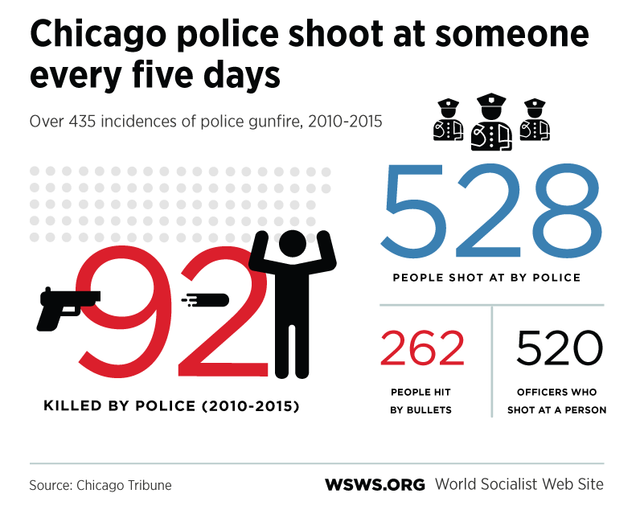
A newly released report revealed that the Chicago Police Department (CPD) shot and killed 92 people between 2010 and 2015 and wounded 173 people during that time. Over the course of the last six years, more than 2,623 bullets have been fired by officers in 435 shootings in areas of high poverty and in deep social distress. On average, every five days a Chicago police officer shoots someone.
The database of information on recent police shootings was obtained by theChicago Tribune as part of a Freedom of Information Act Request detailing every time a police officer fired a weapon at someone. The majority of these cases have never been brought to public attention or scrutiny. The city of Chicago currently outpaces other major cities—such as New York, Los Angeles, Houston and Philadelphia— in officer-involved shootings over the last five years.
According to the database, of the 435 shootings at least 235 incidents involved a person getting shot by a bullet. Four out of five of those shot were African-American males. The officers that fired a weapon were mostly veteran police officers with more than a decade of experience. Of the 520 officers that fired shots, at least 60 were involved in repeat shootings. The individuals shot range from those in their early teens to a 92-year old woman.
While the majority of those shot were African-American nearly fourteen percent of the shooting victims were Hispanic and a little less than six percent were white. The common feature in all these police shootings is that they occurred in areas of Chicago with high indices of poverty and unemployment.
Over the course of the last year Democratic mayor Rahm Emanuel and the CPD have faced growing public outrage against rampant police brutality.
Official investigations into police brutality and killings largely proceeded within the CPD and its oversight body, the Independent Police Review Authority (IPRA), with details of investigations covered up and hidden from the public. The standard operating procedure for a police report included a pro forma statement from a police union spokesperson or the department. The police review and oversight agency largely functioned as an appendage of the CPD and the mayor’s office.
A few videos have surfaced in response to mass outrage, most notably the murder of 17-year-old unarmed teenager Laquan McDonald by Officer Jason Van Dyke in 2014. The video of McDonald’s shooting was only released to the public in the fall of 2015 after an independent reporter sued the city of Chicago for obstruction of access to public records. Prior to the release of the video of the shooting, the city quickly made a financial payout of $5 million to the McDonald family in an attempt at damage control, fearing broader public unrest.
Emanuel and the Democratic Party establishment in Chicago played a central role in the cover-up of McDonald’s killing. In the wake of the release of the McDonald video, the Emanuel administration has been in damage-control mode to try to quell mass unrest and protests against police killings. Since then, Emanuel has made cosmetic changes to the CPD personnel with various proposals to suggest that his police force’s actions will be “transparent” in the future.
In fact, Emanuel and the police department have continued to block efforts of public oversight into officer-involved shootings since then. Despite a seven-month-long request by the Tribune to acquire information about police shootings, the data was only handed over when the newspaper threatened to sue the department for repeatedly obstructing access to public records.
In the wake of the McDonald video’s release, the mayor’s self-appointed Police Accountability Task Force presented superficial proposals for “reform,” one of which included the recommendation that the police superintendent acknowledge the force’s “history of racial disparity and discrimination.” Such claims are made to prevent any real examination of the roots of police violence.
While racism no doubt plays a role in these police shootings, the socioeconomic features of these shootings highlight the fundamental class character of police brutality. Even as the majority of the shootings occurred in neighborhoods that are predominantly African-American, they are also areas that reflect the concentrated impact of the social and economic crisis of capitalism. Decades of deindustrialization have resulted in extreme poverty in many working class neighborhoods on the city’s South and West side.
The neighborhood of Auburn Gresham took the lead with over 30 police shootings where someone was injured or killed. The per capita income in this neighborhood is just $16,032. Unemployment is more than 24 percent and nearly 25 percent of households live below the official poverty live. Other highly impoverished areas also had high numbers of police shootings that resulted in death or injuries, including the districts of Englewood, Calumet, Grand Crossing and Harrison.
Significantly, more than half of the officers involved in the shootings were minority police officers, either African-American or Hispanic. Hispanic officers, according to the report, make up only 19 percent of the CPD, but they account for more than 26 percent of police-involved shootings.
The CPD officer that shot their gun the most was Tracey Williams, a female African-American tactical officer who opened fire five different times in five years, killing one person, wounding another and missing three more people.
These facts highlight the essential class character of the police, regardless of the individual officer’s race or gender, as armed guards of the state to repress the population, overwhelmingly the poor and working class layers of society.
According to the data released by the Tribune, only a handful of cases of officer-involved shootings were claimed to be unjustified. In most cases, the agency declared the use of force by police officers to be justified and in almost all of these cases the police were declared to be the only witnesses involved. The police, in other words, self-report on their activity with no real oversight. Without video evidence or other eyewitness testimony, the police frequently can engage in cover ups and frame ups, as well falsely reporting the facts of the case.
The CPD and the Fraternal Order of Police—just as every police department across the nation— has claimed without fail that the officers “feared for their life” in each case in order to justify their killings.
However, a joint study conducted by the Chicago Reader and City Bureaufound that the majority of CPD statements on police shootings have turned out to be fabricated and based on lies. Statements given by the police union since 2012 were shown to be false by legal testimony, video, media investigations, and contradictory statements given by the police themselves.
In the wake of all these revelations, the Emanuel administration has continued to work to cover up the key role played by his administration, the Democratic Party and the highest levels of the state apparatus in the United States that perpetuates the reign of police violence.
Recently, Chicago police Superintendent Eddie Johnson formally sought to fire the officers involved in the cover-up of the police murder of McDonald. Such a measure is little more than an effort to quash anger and deflect the blame from Emanuel’s administration’s role in covering up police murders.
Emanuel also recently submitted a proposed ordinance for a vote by the City Council which would rebrand the widely discredited oversight agency IPRA and replace it with another called the Civilian Office of Police Accountability (COPA). The replacement of IPRA by COPA does not, however, herald a new era of policing in Chicago. Police killings and shootings have continued unabated since Emanuel began proposing his “transparency” and “accountability” measures earlier this year.
Moreover, the new agency remains entirely subject to Emanuel’s control and cannot function in any genuine sense as an independent agency to review police misconduct and violence. COPA’s funding remains entirely dependent on Emanuel and the Democratic Party establishment which has overseen decades of police violence and brutality. Moreover, COPA will not have the power to hire independent counsel and will have to go through City Hall’s Law Department, which is a major conflict of interest. The Law Department and its lawyers already represent the mayor and the police officers, who are often the ones involved in cases of police misconduct.
IPRA itself was formed in the wake of anger against the previous police “oversight” agency, the CPD’s Office of Professional Standards, which failed to carry out any action against Jon Burge and other police officers implicated in torture. In its eight years, IPRA carried out superficial investigations, collaborated closely with the mayor’s office of communications, and ruled that the vast majority of police misconduct cases were justified. COPA’s new interim chief will be the current head of IPRA—Sharon Fairley— which merely highlights the fraud of so-called “civilian oversight” and police “reform” measures.

Refugee numbers decline as deaths rise in the Mediterranean

Martin Kreickenbaum

More than 9,500 refugees were rescued earlier this week from the seas off the west coast of Libya within just 48 hours. The number of refugees who have arrived in Italy via the central Mediterranean route from Libya rose as a result to more than 112,000. The dramatic rescue operations retrieved at least two dead bodies from the water.
Last Monday alone, 40 rescue operations saved 6,500 refugees from severely overcrowded boats. Alongside boats from the Italian navy and coastguard, ships from non-governmental organisations participated in the operations.
Around 3,000 refugees were then pulled from the water in 30 rescue missions. Due to good weather and calm sea conditions, an increased number of refugees were attempting the dangerous crossing to Europe.
However, this week’s rescue operations cannot conceal the disastrous consequences of the European Union policy of sealing off its borders to refugees. Investigations by the UN refugee agency (UNHCR) and the International Organisation for Migration (IOM) reveal a sharp increase in the number of refugees who have drowned during the journey to Europe, even though the number arriving on Europe’s coastlines has declined significantly.
IOM registered 280,000 refugees who had crossed to Europe by the end of August. Between January and December 2015, the figure was over a million.
While in the first three months of the year almost 160,000 crossed the Aegean Sea to Greece, this route is virtually sealed off now because of the closure of the Balkan route and the dirty deal between the European Union (EU) and Turkey.
By contrast, the number of refugees arriving in Italy is almost the same compared to last year, when 116,000 refugees arrived in the first eight months.
More than 3,167 refugees have lost their lives in the first eight months of the year during their journey to Europe.
The central Mediterranean route between Libya and Italy claimed the most fatalities, with 2,728 deaths. In the Aegean, 386 refugees drowned during their crossing, and 53 on the western Mediterranean route from Morocco to Spain. The number of deaths is thus close to equaling the figure for last year as a whole, when 3,673 lost their lives.
This makes the Mediterranean by far the deadliest route for refugees in the world. One out of every 29 refugees setting out from Libya or Egypt to Europe drowns during the crossing—an average of 13 refugees each day.
The main responsibility for these deaths lies not with unscrupulous smugglers, who force refugees to board unseaworthy boats, but rather with the European governments who are determined to prevent the influx of any refugees. They are not only showing complete disregard for the numerous victims of their inhumane refugee policy, but also consider them as useful collateral damage in their policy of deterrence.
When the Italian navy mission Mare Nostrum, which had rescued 100,000 refugees from the Mediterranean between Italy and Libya, was halted in November 2014 and replaced by the Frontex mission “Triton,” the EU border protection agency had already come to the conclusion “that the withdrawal of naval units from the sea areas off the coast of Libya…will likely result in a greater number of fatalities.” But as a result, according to Frontex at the time, “far fewer refugees will risk the crossing during bad weather and the prices for the crossings increase.”
European navy units now operate the “Eunavformed – Sophia” mission in these waters. As they are not performing a rescue mission, but a combat operation against people smugglers, their ships are not part of the Italian coast guard’s SOS system. The military ships are not even visible to the coast guard’s radar. The Italian coast guard’s operations centre always has to contact the office of commander Enrico Credendino to ask if a naval ship is active in the area around a ship in difficulty.
The militarisation of the Mediterranean, with the EU effectively waging war on refugees, is to be expanded further in the future by incorporating the coast guards of North African countries more directly into the EU’s policy of sealing off its borders. Marine units involved in the “Sophia” mission will begin this month to train the Libyan coast guard and navy. The EU has already concluded an agreement on this with Libya’s “unity government.”
What is presented as a struggle against unscrupulous smugglers and the illegal arms trade is in reality aimed above all at the refugees themselves. This is demonstrated by two instances in which the Libyan coast guard fired on two ships operated by non-governmental organisations.
In April, a Libyan speedboat attacked a ship operated by Sea Watch, an NGO that monitors refugee traffic, outside of Libyan territorial waters. Armed personnel stormed the ship under the pretext that it was suspected of illegal fishing, and intimidated the crew by firing shots.
On August 17, the Bourbon Argos, operated by Doctors without Borders, which was sailing in international waters north of Libya as part of a rescue mission, was targeted by the Libyan coast guard. Shots fired from a Libyan speedboat damaged the bridge of the Bourbon Argos, which was subsequently boarded and searched for hours.
Despite this, the EU extended the EUBAN mission, which is aimed at rebuilding the Libyan military and police. EUBAN has the task of “planning a possible future EU mission which would offer advice in the areas of criminal justice, migration, border protection and combatting terrorism, and press ahead with capacity building,” as an agreement approved by the EU foreign ministers stated.
NATO also intends to participate in the operation. On July 9, NATO Secretary General Jens Stoltenberg announced the transformation of the “Active Endeavour” naval mission first established in 2001 into “Sea Guardian,” which operates off the Libyan coast.
One goal is the construction of a presidential guard, which is to enable the EU and US-backed Prime Minister of the unity government, Fayez al-Sarraj, to leave his naval base in Tripoli and bring more territory under his control. In this way it will be possible, among other things, to immediately deport refugees who have arrived in Europe back to the North African country, which the German government in particular is pushing for.
The human rights organisation ProAsyl has justifiably denounced such inhumane actions. “Giving the Libyan coast guard the capability of intercepting refugee boats and bringing people seeking protection back to Libya is complicity in serious violations of human rights,” ProAsyl wrote. Abuse and torture are daily occurrences in the internment camps in Libya where refugees are being imprisoned.
While the US and its allies are currently escalating the wars in Syria and Libya, thus driving millions more to flee their homes, the European Union is sealing off their escape routes. With boundless cynicism, the western powers are forcing refugees, fleeing the consequences of their own aggressive foreign policy, to attempt ever more dangerous routes, or supporting puppet regimes to intern them in transit states.

IMF issues warning on global growth to G20 summit

Nick Beams

The International Monetary Fund has issued a call for “forceful action” by G20 countries to boost the world economy ahead of the annual leaders’ summit meeting being held in China over the weekend.
It came in an assessment which said recent data, including “muted activity,” slower trade growth and very low investment, pointed to “an even more modest pace of global growth this year.” In a clear indication that the IMF will likely revise down its forecast for global growth when it meets in October, the note to the G20 said despite record-low interest rates, “investment continues to disappoint,” reflecting demand conditions and “weak financial sector balance sheets.”
Weak investment dampened underlying potential growth, which was already low due to “dismal productivity trends.” The IMF said income growth had not only been meagre but had “bypassed low-income earners in many countries.”
In a blog comment on the assessment, IMF managing director Christine Lagarde warned that continued low growth could lead to increased protectionist measures. “The political pendulum threatens to swing against economic openness, and without forceful policy actions, the world could suffer from disappointing growth for a long time,” she said.
In a broad survey of the global economy, the IMF said recent data had pointed to “softer growth” in the advanced G20 economies. In the US, second quarter growth came in at a 1.1 percent annual rate, less than half the consensus forecast, and noted “disappointing business investment.”
Weak growth was also reflected in low inflation across most advanced and emerging economies with “excess industrial capacity” in large exporters putting downward pressure on the prices of tradeable goods.
On the financial front, the assessment said that while the immediate turbulence from the UK decision to quit the European Union (Brexit) had passed, banks remained under pressure “with particular tensions surrounding Italian banks.”
Recent stress tests conducted by the European Bank Authority had underscored “challenges to banks’ financial health” posed by the “large stock” of non-performing loans. These were estimated to be around 8 percent of gross domestic product of the euro area in mid-2015. Weak growth and low interest rates also posed a risk.
It said the longer term outlook for the world economy as a whole was “disappointing.”
In the wake of the global financial crisis of 2008, the claim was advanced that emerging economies would provide a new base for expansion. That prospect has well and truly gone. Growth in these areas has declined over the past five years and is expected to revert back to levels that prevailed previously. In the advanced G20 economies, growth was expected to be only 1.5 percent in the medium term, as compared to the historical average of 2.5 percent. Investment in the advanced economies in 2016 is expected to be two percentage points lower than in the period 1990–2007.
“Moreover,” it continued, “in a negative feedback loop the resulting weakness in the global outlook can further lower incentives to invest” which, combined with slow trade, will “weigh on underlying growth.”
It is in the area of trade that some of the underlying trends in the global economy are expressed most sharply. The marked slowdown in trade since the financial crisis was a result of low investment and weak growth, compounded by a recent increase in protectionism.
Global trade “has fallen significantly,” with the volume of goods and services trade increasing by only 3 percent per year since 2012, less than half the rate than in the years before the crisis. The IMF noted that from the mid-1980s into the 2000s, trade grew at double the pace of global GDP. Now it was barely keeping pace. “Such prolonged weak growth has few precedents,” it said.
The summit will, like previous meetings, issue commitments not to engage in protectionist measures, with claims that the lessons of the 1930s, when beggar-thy-neighbour policies wreaked havoc on the global economy and led to war, have been learned. But facts speak louder than these declamations and protectionism is on the rise.
The World Trade Organisation has reported that G20 countries have imposed a record 145 new trade-restriction measures in the seven-month period from November 2015 to May 2016. This is the highest level since the WTO began monitoring such measures in 2009.
The tensions extend to other areas as well. Following previous statements to G20 meetings, the IMF again called for government fiscal measures, including more public investment projects, to boost the economy in conditions where interest rates are already at historically low levels.
It singled out Germany as having the capacity to finance “identified needs in public investment.” This has long been the position of the United States which, while cutting back its own government spending, has called on the European Union and particularly Germany to relax austerity measures. The US wants to see government measures to boost the European economy in order to benefit the export markets of American corporations. Germany, on the other hand, has opposed the US calls, seeing them as aimed at weakening its financial position as against the US.
The tensions were highlighted by US treasury secretary Jack Lew, who declared on the eve of the summit that a “consensus” had emerged on the US position that countries had to use all policy tools, including fiscal measures. That assertion may not be disagreed with publicly but opposition will remain just below the surface. Earlier this year, at the G20 finance ministers meeting, following a call by the IMF for co-ordinated action, German finance minister Wolfgang Schäuble pointedly remarked that the “debt-financed growth model has reached its limits.”
The failure of the G20 to provide any real lift to the world economy was highlighted by an assessment of progress on commitments made at the Brisbane, Australia, summit in 2014. There world leaders pledged to lift their collective GDP by an additional 2 percentage points by 2018. According to the IMF, only 55 percent of the commitments have been implemented and concluded that “with 2018 drawing closer, the Brisbane goals seem out of reach.”
The IMF also took account of political developments, in particular the deepening hostility to the policies of governments around the world as reflected in developments such as the Brexit vote to quit the EU.
It said the G20 should “make the positive case for globalisation” and that G20 leaders should “champion this agenda by presenting a clear and persuasive narrative showing the right policies will not only raise growth, but also ensure that it is shared by all, including those who shoulder the burden of adjustment to a changing world economy.”
This is the economic equivalent of squaring the circle, and once again facts speak louder than declarations. The reality of the last eight years has been the accumulation of ever-greater wealth for the financial elites, fuelled by the cheap money provided by central banks, widening social inequality and a decline in living standards for billions of people.
While the global integration of mankind’s productive forces is in and of itself a progressive development, it is carried out within the framework of the profit system, which demands an unrelenting offensive against the social position of the working class. A continuation and deepening of this agenda will be the only “forceful action” to emerge from the G20 summit.

1 Sept 2016

War clouds overhang Obama’s Asian trip

Peter Symonds

What is likely to be US President Obama’s final trip to Asia, which began today, takes place amid acute geo-political tensions, especially between the United States and China, for which his “pivot to Asia” aimed at maintaining American hegemony bears direct responsibility. Both forums—the G20 in Hangzhou, China and the Association of South East Asian Nations (ASEAN) summits in Vientiane, Laos—will be overshadowed by the worsening global economic breakdown and the growing danger of war.
The White House has already flagged that Obama intends to use the international gatherings to make “a forceful case” for ratification of the Trans-Pacific Partnership (TTP) which is the economic spearhead of US efforts to subordinate China to American interests. The TPP agreed last year between 12 Asia Pacific nations is a comprehensive trade and investment pact to ensure, as Obama has stated, that the US, not China, writes the economic rules of the twenty-first century.
Speaking prior to Obama’s trip, deputy national security advisor Ben Rhodes declared: “The TPP is a litmus test for US leadership.” If it is not ratified by Congress, the US “would be ceding the [Asia Pacific] region to countries like China, who do not set the same types of high standards for trade agreements.”
Both US presidential candidates—Democrat Hillary Clinton and Republican Donald Trump—have publicly expressed their opposition to the TPP on the basis of economic nationalist claims that it would destroy American jobs. With strong opposition in Congress, Obama is desperate to find political levers to push ratification through prior to the end of his term.
The TPP, however, is far more than an economic deal. The Obama administration has regarded it as a vital component of the “pivot”—a diplomatic offensive and military build-up throughout Asia against China. US Defence Secretary Ashton Carter last year openly drew the connection between the TPP and the Pentagon’s war plans, declaring that the deal was “as important to me as another aircraft carrier.”
Failure to ratify the agreement would be a blow to American efforts to reassert its dominance in Asia and undermine US economic and military ties throughout the region. Speaking in Washington last month, Singapore’s Prime Minister Lee Hsien Loong urged the US to “stay engaged and maintain its indispensable role in the Asia Pacific.” He warned that ratification was a “test for your credibility and seriousness of purpose.”
For Obama to use the G20 to push the TPP will only exacerbate tensions with the host country, China, which is effectively excluded from the agreement and thus any discussions surrounding it. During the summit, Obama will meet with Chinese President Xi Jinping in a bid to extract concessions on a range of issues. US Treasury Secretary Jack Lew flagged American demands for cutbacks to excess capacity, particularly in steel, as one of the items on Obama’s agenda in talks with Xi.
Amid a deepening global slump and rising trade war tensions, the TPP is not the only agreement that is in doubt. The US-European equivalent—the Transatlantic Trade and Investment Partnership (TTIP)—is under a cloud after Germany’s economy minister Sigmar Gabriel declared that negotiations had effectively failed. A bitter dispute has now erupted after Lew accused the EU on Wednesday of “reaching into the US tax base” after it ordered the American mega-corporation Apple to pay $13 billion in back taxes.
Also in the background to the Xi-Obama talks are the maritime disputes in the South China Sea between China and its South East Asian neighbours. Over the past five years, the US had deliberately exacerbated these disputes including by backing and assisting the Philippines to mount a legal challenge China in the Permanent Court of Arbitration (PCA) in The Hague. The PAC’s politically-driven ruling in July negating all of China’s claims has set the stage for the US to further exploit the issue to isolate Beijing and justify the American military build-up around the South China Sea and the region.
The Hague ruling will likely be a focus of discussion at the ASEAN summits in Laos where Obama next week will become the first US president to visit the country. As is the case throughout the region, Washington has engaged in strenuous diplomatic efforts to press Laos, which has had longstanding ties with China, to tilt its foreign policy more towards the US. A change of government in Vientiane in April has seen an apparent shift away from Beijing—as indicated by the stalling of a major $7 billion rail project—and towards Vietnam, which has moved closer to the US over the past two years in particular.
Since taking office as Philippine president in July, the fascistic Rodrigo Duterte has attempted to steer a less confrontational course with China than his predecessor Benigno Aquino, raising concerns in Washington as a result. While he has indicated his support for the military basing agreement with the US reached under Aquino, Duterte has suggested that a negotiated solution to territorial disputes with China could be possible.
Obama is due to meet with Duterte in Vientiane. In his comments this week, White House deputy national security advisor Rhodes indicated that Obama intends to raise the issue of “human rights” during the talks. Duterte is notorious for unleashing a wave of extrajudicial killings of alleged drug dealers by police and vigilantes that has resulted in more than 1,800 deaths. The Obama administration, which has promised funds for this anti-drug campaign, intends to use the issue as a threat. If Duterte does not fall into line on the South China Sea, he will confront an increasingly strident, and utterly hypocritical, “human rights” campaign against him.
While Duterte said last week that he does not intend to raise the South China Sea at the ASEAN summits, Philippine Foreign Secretary Perfecto Yasay signalled a harder line against Beijing on Tuesday. “When we start formal negotiations or bilateral engagements with China, we will have to do it within the context of the arbitral decision [in The Hague]. There are no buts or ifs insofar as our policy on this matter is concerned,” he said. The comments put Manila on a collision course with Beijing which has refused to recognise the court or its ruling.
A comment this week in China’s state-owned Global Times, which usually adopts a hawkish stance, suggested that the meeting of the Chinese and American presidents in Hangzhou was “a crucial opportunity to bring bilateral relations back on a steady footing.” What is far more likely is that the Obama’s trip to Asia will only heighten tensions between the two countries including in dangerous flashpoints for conflict such as the South China Sea.

Irish government crisis over Apple’s €13 billion tax dodge

Robert Stevens

The European Union’s decision to fine US tech giant Apple up to €13 billion (US$14.5 billion) for failing to pay taxes at its European corporate headquarters in Ireland, has prompted a major crisis in Irish ruling circles that could lead to the collapse of the government.
The total amount due to the Irish government is around £19 billion, when interest is taken into account.
Shortly after Tuesday’s announcement directing the Irish government to collect legally due taxes from Apple, the right-wing Fine Gael party, which is in a coalition with the Independent Alliance, announced it would appeal the decision. In doing so, it fell into line with Apple, which immediately announced it was appealing. However, Independent Alliance ministers, fearful of mounting public anger, are delaying backing an appeal and are seeking the recall of parliament to discuss the issue.
In a statement summing up the role of governments as servants of big business, Fine Gael Finance Minister Michael Noonan said an appeal would be made “to defend the integrity of our tax system; to provide tax certainty to business; and to challenge the encroachment of EU state aid rules into the sovereign member state competence of taxation.” He added that to collect the taxes owed by Apple would be “destroying the future for short-term advantage.”
Noonan’s comments were a refined version of the apoplectic response from Irish business leaders. Ryanair CEO, Michael O’Leary, declared the ruling “bizarre,” adding, “Frankly the Irish government should turn around—they shouldn’t even appeal the decision—they should just write a letter to Europe and tell them politely to f**k off.”
Following a three-year investigation, the European Commission (EC)—the EU’s executive arm—concluded that Apple had effectively paid a maximum of just 1 percent tax on its European profits in 2003, which had diminished to about 0.005 percent by 2014. Over that entire period, Apple paid just €50 million in tax.
Due to lucrative tax deals granted to it by successive Irish governments, Apple was able to avoid tax on almost all the profit generated from its multi-billion euro sales of iPhones and other products across the EU’s single market.
The EC investigated the activity of two of Apple Inc.’s subsidiaries—Apple Operations Europe (AOE) and Apple Sales International (ASI), both of which were incorporated in Ireland and therefore permitted to record profits in the country. Both subsidiaries had a “Head Office” and an Irish branch, which were known as “Double Irish” schemes. In 2011, ASI made a profit of €16 billion, yet only €50 million of this was allocated to the Irish branch—equivalent to a tax rate of just 0.05 per cent.
“To put that in perspective,” European Commissioner for Violation of EU Treaties, Margrethe Vestager, declared, “it means that for every million euros in profit, it paid just €500 in tax.”
According to Vestager, the vast remaining amount of profit was allocated to what was in reality a fictitious Head Office with “no employees, no premises and no real activities” where it remained untaxed. If the profit had been taxed under Ireland’s corporate rate, the figure of € 13 billion plus interest would have been payable.
Apple first set up operations in Ireland in 1980 after the then government offered the company a deal allowing it to operate virtually tax-free in exchange for locating its European headquarters in the country. Some £7 million was invested and 700 jobs created.
Even though Ireland’s membership of the European Economic Community, (the EU’s predecessor) meant it had to levy taxes on companies operating on its territory, Apple continued to be offered preferential treatment.
The EC’s ruling points out that the selective treatment given to Apple by Ireland through two tax rulings in 1991 and 2007 were illegal under EU guidelines.
The first of these “sweetheart deals” in 1991 resulted in Apple only being taxed on a certain bracket of its earnings. In 2007, the year that Apple first launched the iPhone, the previous deal was renewed giving the corporation access to further tax loopholes.
The courting of Apple was part and parcel of the whole system of subsidies and tax breaks handed out by Irish governments to attract transnational entities and global investment that made Ireland into the so-called “Celtic Tiger.” The country functioned as an offshore financial centre and tax haven. At the same time, Ireland’s membership of the EEC in 1973 was utilized by firms globally to access to the Single European Market and a base from which to avoid and evade taxation.
As of 2016, Ireland hosted over half of the world’s top 50 banks and half of the top 20 insurance companies. In 2013 it hosted nearly 14,000 funds (6,000 of these were Irish-domiciled) administering an estimated €3.7 trillion—up from $840 billion a decade earlier. Today, corporate tax rates are 12.5 percent, compared to 50 percent in 1988 and the top rate of income tax is just 40 percent, compared to 65 percent.
The “Double Irish” strategy and other deals have enabled Apple to dodge US taxes on an estimated $181 billion in profits, contributing to the company amassing a cash hoard of over $230 billion. The €13 billion owed in Ireland equates to just 27 percent of the profit Apple made just in 2015.
The world’s major conglomerates and super-rich are up to their necks in similar financial swindles. Another “Double Irish” scheme saw an Irish subsidiary of Facebook shift profits of €1.75 billion in 2012 to another subsidiary in the Cayman Islands and post a pre-tax loss of €626,000 instead. Google dodged $2 billion a year in taxes using a “Double Irish” scheme via the Netherlands and Bermuda.
The cost to the Irish working class and society is staggering. It is estimated that that the €13 billion tax withheld from the public purse by the Apple deal equates to €2,500 for every man, woman and child. It would cover the cost of Ireland’s annual healthcare budget, used by 4.5 million people, two-thirds of the social welfare budget or 20 new hospitals.
This pillaging of vast public resources must be understood in the context of the even larger bailout of the banks and super-rich that took place in Ireland following the 2008 global financial crash.
The EU, International Monetary Fund and European Central Bank arranged an €85 billion bailout in 2010 for the Irish financial elite to avoid the collapse of the major banks. The borrowing undertaken as part of the bailout has already cost the Irish state almost €9 billion to service.
The Irish population was made to pay for this, plunging millions into poverty. With the collaboration of the trade unions, savage cuts to jobs, wages and conditions have been imposed. Eight austerity budgets were passed between 2008 and 2014 involving €18.5 billion in public-spending cuts. Nearly 40,000 public sector jobs were lost and health spending cut by 27 percent. On top of this €17 billion of Ireland’s national pension reserve was seized to pay off the bailout.