3 Sept 2016

A Children’s Story in Syria

Franklin Lamb

Children’s Orthopedics Ward, Al-Mouwasat Hospital, Damascus
It was about 11 in the morning on Tuesday August 2, 2016 when two sisters, ten year-old Ghina and her eight year-old younger sister Nagham were walking a short distance from their home in the town of Madaya to its “field hospital” in order to acquire serum for their anemic mother Sahar whose body was very deficient in calcium because of 18 months existence with very little food. Sahar explained to this observer a couple of days ago that she and her four babies, lived at times with nothing more than a watery soup made of grass, or sometimes black peppers, but most often made from the pink and white flowers of thistle plants she gather from a nearby field.
For more than a year, after having fled from their own Sunni village of Zabadani due to fighting, the family has been living in surrounded Madaya, a mountain town of 40,000, now with four times its pre-war population, about 30 minutes northwest of Damascus. Military forces encircled Madaya in July of 2015 as part of a broader offensive to recapture the nearby Qalmoun Mountain villages and the town of Zabadani, held by rebels since 2012. Residents of Madaya have been trapped ever since.
Having made their medicine purchase, the girls started their short 60 yard walk home. A claimed eye-witness says that a sniper near al-Asali checkpoint took aim and fired at the youngsters. One explode-on-impact bullet entered Ghina’s upper-left thigh, shattering her leg bone and thigh.
For an instant, not realizing what had happened, Ghina’s younger sister 8 year old Nagham, noticing that Ghina had dropped the small plastic medicine bag to be given to their mother at home, instinctively picked it up and began to scold her big sister for dropping it. The little heroine, by now instantly covered in her sister’s blood, tried to pull badly bleeding and screaming Ghina off the road to a secure location- the roadside ditch. The sniper took aim a second time. This time, shrapnel from the bullet struck Nagham’s right arm and hand. The two young girls lay on the side of the road until minutes later passersby were able to pull them out of the line of fire and transport them to the towns nearby “field hospital”.
Over the past year, snipers have killed seven people in Madaya, according to a report published on 7/13/2016 by Physicians for Human Rights, a US-based organization that has provided medical assistance to thousands in Syria since the civil war erupted in March of 2011. The PHR findings were confirmed in a separate Report from the Madaya Medical Commission published on 7/23/2016. The following week, snipers shot and wounded three more people, a Madaya resident reported last week by telephone to a relative of the girl’s family.
The sniping of civilians continues until today in Madaya as some try to escape the siege imposed on their town. So also do deaths mount from the approximately 6,000 additional landmines recently placed around the southern and eastern sides of the town, by militia in order to further imprison residents inside.
Such indiscriminate use of landmines in a populated civilian area violates international humanitarian law and, as with sniping civilians, constitutes a punishable war crime once the conflict ends and hopefully the global community insists on full accountability under the law for all who have targeted the people of Syria.
Several dozen people have also died from starvation in Madaya, despite surrendering in exchange for relief from the siege. With almost nothing and no one allowed in or out, the town continues slowly dying from the inside.
At Malaya’s “field hospital” whose medical staff consists of two heroic dental students and an animal veterinarian, Ghina was diagnosed with a displaced fracture, a badly shattered leg bone and a severed nerve in her upper left thigh.
Before long, Ghina’s leg and thigh became badly infected and a tentative decision was taken to amputate it. As one of the MDs reported at the time via “What’sUP” to medical colleagues abroad, Madaya’s health workers today are only able to perform emergency surgery, mainly amputations. As Dr. Darwish, a dentistry student and one of three health professional still in Madaya insisted, they did not have the equipment or the training to repair the damage to Ghina’s leg and thigh or most other serious injuries brought to the “Field Hospital.” However, amputation of Ghina’s leg was something they could perform. Time was running out for Ghina shown below shortly after she was evacuated from Madaya to Al-Mouwasat Hospital, Damascus
Madaya’s severely wounded, like Ghina, have only one way to get out of the besieged town and thru the 65 checkpoints, countless landmines and snipers, and to receive the lifesaving treatment they need. It is through a painstakingly negotiated reciprocal agreement between rebel and regime forces, brokered by Iran and the United Nations last year. In theory it provides for the evacuation of some wounded people from Sunni Madaya in exchange for a parallel evacuation from two Idlib Shia towns of Foah, and Kafraya, besieged by rebel forces.
Unfortunately, there are a number of additional bureaucratic hurdles which result in very few in need of urgent medical aid being allowed to leave Madaya through one of the 65 checkpoints which also surround adjacent Zabadani. A major one being that snipers regularly shoot residents if they approach Madaya’s periphery from any direction.
Fortunately in Ghina’s case, as with the case of the conjoined twins from the Damascus suburb of East Ghouta, Nawas and Moaz (the subjects of Part II of this article) a social media campaign led by Amnesty International pressurized the powers that be to allow the Syrian Red Crescent Society (SACRS) to enter Madaya at night, so as not to attract the attention of many other families with severely injured members who surely would demand evacuation for their loved ones in critical condition, and rescue the girls and move them for urgent emergency medical intervention.
Screen Shot 2016-09-02 at 10.02.08 AM
(Photo: fplamb 8/27/2016)
The metal rods must remain deep inside Ghina’s leg and thigh for three months and she must stay in a hospital bed for two months. The sniper bullets were designed to explode on impact and they did much nerve and muscle damage.
Until the past few days, there has also been great concern about the risk that Ghina’s muscles in the left leg will be permanently shortened, causing walking abnormalities. That erstwhile grim likelihood is now largely discounted.
Today Ghina and Nagham are recovering at Al-Mouwasat Hospital in Damascus and eating plenty of nutritious food including three pieces of fresh fruit daily for which Syria is blessed and famous, on specific instructions from their new American “uncle”, their mother Sahar and their new “big sisters”, Rima and Raraf, both from Damascus. And the girls can have each have two pieces a day (maximum!) from their growing supply of admittedly less nutritious treats arranged by their new friends. This morning this observer was advised by the girls Dr. that Nagham’s hand and arm stitches can be removed in five days. And then the little one will for sure head to the fine swimming pool at my hotel.
Screen Shot 2016-09-02 at 10.03.15 AM
(Photo by Rima Karwan, the new “big sister” of these beauties. 8/282016)
On Sunday (the first of the week end) September 18, 2016, the public schools across Syria will open for the next academic year. Arrangements have been made by MSRCL, which also helps specific cases in Syria itself, for 7 year old Nagham, who her mother explained has been an average student last year in Madaya-when classes could even be held- to begin classes. She was lectured today by her American uncle that is was important to start off the school year well, to sit in the first two rows of her classroom (to be separated from the “antics and distractions of the boys in the back of the class!”) and to make eye contact with her teacher and not to be shy about asking questions if there is something she does not understand.
With respect to Ghina, her proud mother Sahar explained today that she is an excellent student but cannot attend school this year for at least two or three months. Arrangements were made today for Ghina to receive home schooling by tutors Alaa and Nadine until she can join the new school year.
MSRCL is still working to get permission to bring Sahar’s two other babies, Manal age 3 and Mohamad-Kamal out of Madaya. The little ones were unfortunately not allowed to leave as part of Ghina’s evacuation. Again, for bureaucratic reasons.
Ghina and Nagham were very lucky to survive the sniper’s bullets last month and are today out of harm’s way. But this is not the case for the 40,000 entrapped residents of Madaya who remain imprisoned by the war in Syria, as do nearly one million other besieged civilians across Syria today.
To provide a meal to a Syrian refugee child in Lebanon: Please visit:

Turkey’s Coup: Winners & Losers

Conn Hallinan

As the dust begins to settle from the failed Turkish coup, there appear to be some winners and losers, although predicting things in the Middle East these days is a tricky business. What is clear is that several alignments have shifted, shifts that may have an impact on the two regional running sores: the civil wars in Syria and Yemen.
The most obvious winner to emerge from the abortive military putsch is Turkish President Recep Tayyip Erdogan and his campaign to transform Turkey from a parliamentary democracy to a powerful, centralized executive with himself in charge. The most obvious losers are Erdogan’s internal opposition and the Kurds in Turkey, Syria, Iraq and Iran.
Post-coup Turkish unity has conspicuously excluded the Kurdish-based People’s Democratic Party (HDP), even though the party condemned the July 15 coup. A recent solidarity rally in Istanbul called by Erdogan’s Justice and Development Party (AKP) included the opposition Republican People’s Party (CHP), but the HDP—the third-largest political organization in the country—was not invited.
The deliberate snub is part of Erdogan’s campaign to disenfranchise the HDP and force new elections that could give him the votes he needs to call a referendum on the presidency. This past June, Endogen pushed through a bill lifting immunity for 152 parliament members, making them liable for prosecution on charges of supporting terrorism. Out of the HDP’s 59 deputies, 55 are now subject to the new law. If the HDP deputies are convicted of terrorism charges, they will be forced to resign and by elections will be held to replace them.
While Erdogan’s push for a powerful executive is not overwhelmingly popular with most Turks—polls show that only 38.4 percent support it –the President’s popularity jumped from 47 percent before the coup to 68 percent today. With the power of state behind him, and the nationalism generated by the ongoing war against the Kurds in Turkey’s southeast, Erdogan can probably pick up the 14 seats he needs to get the referendum.
The recent Turkish invasion of Syria is another front in Erdogan’s war on the Kurds. While the surge of Turkish armor and troops across the border was billed as an attack on the Islamic State’s (IS) occupation of the town of Jarablus near the Turkish border, it was in fact aimed at the Kurdish Democratic Union Party (PYD) and its armed wing, the People’s Protection Units (YPG).
According to Al Monitor, the IS had been withdrawing from the town for weeks in the face of a YPG offensive, and the Turks invaded to preempt the Kurds from taking the town. The question now will be how far south the Turks go, and whether they will get in a full-scale battle with America’s Kurdish allies? The Turkish military has already supported the Free Syrian Army in several clashes with the Kurds. Since the invasion included a substantial amount of heavy engineering equipment, the Turks may be planning to stay awhile.
While the YPG serves as the U.S.’s ground force in the fight against the IS, the Americans strongly backed the Turkish invasion and sharply warned the Kurds to withdraw from the west bank of the Euphrates or lose Washington’s support.
The Kurds in Syria are now directly threatened by Turkey, were attacked in Hasaka Province by the Syrian government, and have been sharply reprimanded by their major ally, the U.S. The Turkish Kurds are under siege from the Turkish army, and their parliamentary deputies are facing terrorism charges at the hands of the Erdogan government. The Turkish air force is also pounding the Kurds in Iraq. All in all, it was a bad couple of weeks to be Kurdish.
There are others winners and losers as well.
Erdogan has been strengthened, but most observers think Turkey has been weakened regionally and internationally. It looks as if an agreement with the European Union (EU) for money and visa free travel if Ankara blocks the waves of immigrants headed toward Europe is falling apart. The German parliament is up in arms over Erdogan’s heavy-handed repression of his internal opposition and his support for extremist groups in Syria.
Turkey’s decision to shoot down a Russian bomber last Nov. 24 has badly backfired. Russian sanctions dented the Turkish economy and Moscow poured sophisticated anti-aircraft weapons into Syria, effectively preventing any possibility of the Turks or the U.S. establishing a “no fly zone.”
Erdogan was also forced to write a letter of apology for the downing and trot off to St. Petersburg for a face-to-face meeting with Russian President Vladimir Putin. All were smiles and hand shakes at the Aug. 9 get-together, but the Russians have used the tension generated by the incident to advance their plans for constructing gas pipelines that would bypass Ukraine. Indeed, the EU and Turkey are now in a bidding war over whether the pipeline will go south—Turkish Stream— through Turkey and the Black Sea, or north—Nord Stream—through the Baltic Sea and into Germany.
Erdogan apparently has concluded that Russia and Iran have effectively blocked a military solution to the Syrian civil war, and Ankara has backed off its demand that Syrian President Bashar al-Assad has to go before there can be any resolution of the conflict. Turkey now says Assad can be part of a transition government, pretty much the same position as the Russians take. Iran—at least for now—is more invested in keeping Assad in power.
Iran has also come out of this affair in a stronger position. Its strategic alliance with Russia has blocked the overthrow of Assad, Teheran’s major ally in the region, and its potential markets have the Turks wanting to play nice.
Any Moscow-Ankara-Tehran alliance will be a fractious one, however.
Turkey is still a member of NATO—it has the second largest army in the alliance—and its military is largely reliant on the U.S. for its equipment. NATO needs Turkey, although the Turks have mixed feelings about the alliance. A poll taken a year ago found only 30 percent of Turks trusted NATO. The post coup polls may be worse, because it was the pro-NATO sections of the military that were most closely tied to the putsch.
Iran’s Shiite government is wary of Erdogan’s ties to the Sunni Muslim Brotherhood and Ankara’s close relations with Iran’s major regional nemesis, Saudi Arabia. The Russians also have a tense relationship with Iran, although Moscow played a key role in the nuclear agreement between the U.S. and Teheran, and Iran calls its ties with Russia “strategic.”
The Saudis look like losers in all this. They—along with Turkey, France, Britain, and most the Gulf monarchies—thought Assad would be a push over. He wasn’t, and five years later some 400,000 Syrians are dead, three million have been turned into refugees, and the war has spread into Turkey, Lebanon, Jordan, Iraq and Saudi Arabia.
The Yemen war has predictably turned into a quagmire, and even Saudi Arabia’s allies are beginning to edge away from the human catastrophe that the conflict has inflicted on Yemen’s civilian population. The United Arab Emirates, which provided ground forces for the Saudis, is withdrawing troops, and even the U.S. has cut back on the advisors assigned to aid the kingdom’s unrestricted air war on the rebel Houthis. U.S. Defense Department spokesman Adam Stump said aid to Riyadh was not a “blank check,” and several U.S. Congress members and peace groups are trying to halt a $1.15 billion arms sale to Saudi Arabia.
In military terms, the Yemen war—like the Syrian war—is unwinnable, and Washington is beginning to realize that. In fact, were it not for the U.S. and British aid to the Saudis, including weapons resupply, in-air refueling of war planes, and intelligence gathering, the war would grind to a halt.
The Saudis are in trouble on the home front as well. Their push to overthrow Assad and the Houthis has turned into expensive stalemates at a time when oil prices are at an all-time low. The Kingdom has been forced to borrow money and curb programs aimed at dealing with widespread unemployment among young Saudis. And the Islamic State has targeted the kingdom with more than 25 attacks over the past year.
Ending the Yemen war would not be that difficult, starting with an end to aid for the Saudi air war. Then the UN could organize a conference of all Yemeni parties—excluding the IS and al-Qaeda—to schedule elections and create a national unity government.
Syria will be considerably more challenging. The Independent’s long-time Middle East correspondent Patrick Cockburn calls the conflict a three-dimensional chess game with nine players and no rules. But a solution is possible.
The outside powers—the U.S., Turkey, Russia, Iran, and the Gulf monarchies—will have to stop fueling their allies with weapons and money and step back from direct involvement in the war. They will also have to accept the fact that no one can dictate to the Syrians who will rule them. That is an internal affair that will be up to the parties engaged in the civil war ( minus the IS and the al-Qaeda linked Nusra Front.)
The Kurdish question will be central to this. The Syrian Kurds must have a place at the table regardless of Turkish opposition. The Iranians are also hostile to the Kurds because of problems with their own Kurdish population. If there is to be eventual peace in the region, Ankara will also have to end its war against the Kurds in southeast Turkey. Turkish army attacks have killed more than 700 civilians, generated 100,000 refugees, and smashed up several cities. The Kurds have been asking for negotiations and Ankara should take them up on that.
Erdogan has made peace with the Kurds before—even though part of the reason was a cynical ploy to snare conservative Kurdish voters for the AKP. It was also Erdogan who rekindled the war as a strategy to weaken the Kurdish-based HDP and regain the majority that the AKP lost in the June 2015 elections. The ploy largely worked, and a snap election four months later saw the HDP lose seats and the AKP win back its majority. The Turkish president, however, did not get the two-thirds he needs to schedule a referendum.
Erdogan is a stubborn man, and a popular one in the aftermath of the failed coup. But Turkey is vulnerable regionally and internationally, two arenas where the U.S., the EU, and the Russians can apply pressure. The hardheaded Turkish president has already backed off in his confrontation with the Russians and climbed down from his demand that Assad had to go before any serious negotiations could start.
If the chess masters agree to some rules they could bring these two tragic wars to a close.

UK doctors struggle escalates with announcement of 20 days of strikes

Robert Stevens

On Thursday, the British Medical Association announced an additional 15 days of strike action by junior doctors to follow five days announced Wednesday.
A first strike is set for September 12-16, with additional five-day strikes on October 5, 6, 7, 10 and 11, November 14-18 and December 5-9. The BMA said the strikes will involve a "full withdrawal of labour" by doctors—meaning they will be held without the provision of any emergency cover.
This scale of industrial action is without precedent in modern times. It speaks to the anger and determination among 50,000 doctors to oppose the Conservative government’s imposition of a new contract that undermines their conditions and threatens the well-being and safety of patients.
The new contract, which the government intends to impose next month, includes the reduction of unsocial payments for weekend working, with Saturday and Sunday between 9 a.m. and 9 p.m. reclassified as normal working days and nightshift rates reduced, along with the elimination of automatic pay progression.
While the government claims it wants to make NHS services fully available, seven days a week, this is only a pretext for the destruction of living standards and working conditions for doctors and other NHS staff, who will be required to work nights and weekends without overtime pay.
In July, junior doctors defied the government and BMA by throwing out the agreement the two had reached on a revised contract. This followed five rounds of nationwide strikes that started in January and culminated, in April, in the first ever all-out strike in the nearly 70-year history of the NHS.
A ballot on the agreement recorded a 58 percent majority against acceptance, with over two thirds of those eligible to vote taking part—approximately 37,000 doctors. This led to the resignation of Dr. Johann Malawana, chair of the BMA's junior doctors committee (JDC), who had recommended the inferior deal.
It is reported that the BMA council voted by 16 to 12 or an even narrower 16 to 14 in support of further industrial action. Dr. Mark Porter, chair of the BMA council, said the BMA only authorised the first set of strikes after “long and difficult debates.”
Even as it announced the new strike dates, the BMA stressed its willingness to call them off if the government returned to negotiations. Malawana’s interim replacement, Dr. Ellen McCourt, stated, “We have a simple ask of the government: stop the imposition. If it agrees to do this, junior doctors will call off industrial action.”
The strike announcement met with a vitriolic response from the government and media. Prime Minister Theresa May denounced the strikes and backed health secretary Jeremy Hunt, who has advocated the NHS’s privatisation.
The Tory-supporting Daily Telegraph editorialised, “The BMA’s frightening militancy is reckless”, adding, “We urge the junior doctors to test their consciences—acknowledge the danger to patient safety—and cross the picket line.”
A leader column in the Daily Mail, “How dare the doctors barter lives for cash,” continued the onslaught: “For make no mistake. If these stoppages go ahead, causing the cancellation of some 125,000 operations and 1 million outpatient appointments, it will be only a matter of time before the body-count begins.”
It added, “Why don’t they come straight out with it and say: ‘Give us more money—or else we’ll let people suffer and die?’”
The strikes are also opposed by the Academy of Medical Royal Colleges, which brings together doctors’ professional bodies. This group stated Thursday, “Five days of strike action, particularly at such short notice, will cause real problems for patients, the service and the profession.”
To blame doctors for endangering patient safety is a vicious slander. The government’s provocative efforts to impose an inferior contract on junior doctors are integral to its plans to further privatise the NHS.
Last week it was revealed that under new Sustainability and Transformation Plans, the Tories plan to close down a raft of hospitals and health units, and “re-provide” health units deemed “not clinically and financially sustainable” to the private sector. This is part of a drive to cut £22 billion in “efficiency savings” from the NHS budget in the current parliament, and is on top of the £15 billion in cuts made between 2010 and 2015.
Earlier this year the Guardian gave a flavour of the discussions underway in ruling circles. It noted, “Some ministers are privately describing the bust-up with doctors in training as ‘a miners’ moment—a dispute we cannot lose’.”
An article on the leading ConservativeHome blog called for the junior doctors to be “given their 1984.” This is in a reference to Tory Prime Minister Margaret Thatcher’s struggle with the National Union of Mineworkers in 1984-85, in which the entire force of the state was hurled against striking miners, and whose defeat led to the loss of more than 100,000 jobs. The defeat of the miners was pivotal to the unrelenting assault on the jobs and conditions of the working class over the subsequent three decades.
In taking a stand in defence of publicly funded, free, well-resourced health care, the junior doctors have the support of the majority of the population, despite the massive barrage of right-wing propaganda denouncing their struggle. An online poll conducted Friday by ITV of a large dataset of over 42,000 people recorded 85 percent of people in favour of their action. Another poll taken Friday by the Rupert Murdoch-owned Sky News found that 57 percent supported the strikes.
In the face of the onslaught against the junior doctors, Labour Party leader Jeremy Corbyn has yet to speak in their defence, no doubt in deference to the right-wing putsch attempt against him by a majority of the Parliamentary Labour Party. There was just one solitary tweet from the Labour leader praising a Guardian article written by Labour’s Shadow Health Secretary Diane Abbott.
The tweet said only “Government must engage collaboratively and constructively with junior doctors.” Abbott’s article likewise did not make any call for support of the strikes. Blaming the Conservative government for having potentially caused the “very first five-day strike in the NHS,” Abbott lamented, “All of this is avoidable. The BMA junior doctors committee is willing to enter talks about the contract. The government could approach the aim of creating a seven-day NHS in a collaborative way.”
Such statements can only blind junior doctors and the working class overall as to the real intention of the ruling elite and the need to launch a political struggle against the government and its apologists in the Labour Party based on a socialist perspective.
The junior doctors’ dispute confirms the analysis of the Socialist Equality Party and its NHS Fightback initiative that the defence of health care as a social right means breaking the domination of the financial and corporate elite over economic and political life.
The strike must be taken out of the hands of the BMA bureaucracy, with doctors forming committees independent of the unions and turning to staff throughout the NHS and the entire working class and young people for support. The Socialist Equality Party and the NHS Fightback campaign pledge their support in building this necessary solidarity in defence of the junior doctors and the defence of free and universal health care.

Rana Plaza disaster case postponed in Bangladesh

Sarath Kumara

More than three years after Bangladesh’s worst-ever industrial disaster, which killed hundreds of apparel workers, a Dhaka court has postponed by two months the trial of 18 people facing charges over the catastrophe. The delay further underscores the indifference of all sections of the Bangladeshi ruling elite towards the plight of garment workers who continue to toil under unsafe and slave labour conditions.
More than 1,135 workers were killed in Dhaka on April 24, 2013, when the Rana Plaza building, which housed five apparel factories, collapsed. Despite cracks being discovered in the building the previous day, building owner Sohel Rana ordered reluctant workers to return to their jobs. Three extra storeys had been added to the structure, making it more vulnerable.
The judge last month adjourned until October 26 the trial of Rana and 17 others for allegedly violating building construction codes, after the defendants filed a petition to the high court challenging the charges. Some 130 witnesses were due to testify in the case, which was to focus on design flaws, unapproved extensions and use of substandard building materials.
Government prosecutors also failed to present the plaintiff, Helal Uddin, an official of RAJUK, the capital development agency, which filed the case. This points to a move by the Awami League government to delay the hearing.
The legal cases are in order to quell widespread anger among workers in Bangladesh and internationally. The government, however, is also anxious to assure foreign and local investors that they will be protected against being held legally responsible for unsafe working conditions.
In another case, scheduled for September, 41 defendants, including Rana Plaza factory owners, the local mayor and 14 government officials, will face murder charges.
From the beginning, the government tried to cover up the tragedy. It took three years to file charges. Rana was an Awami League regional leader and there are close connections between the entire political establishment and the apparel industry. Around 30 past and present members of parliament from both main parties, the Awami League and the Bangladesh Nationalist Party (BNP), are apparel factory owners.
The Rana Plaza disaster highlighted the deadly conditions facing approximately 4.5 million workers in nearly 7,000 garment factories in Bangladesh. Other workers face similar situations. A gas leak in a fertiliser factory last month left at least 25 workers ill, with one suffering respiratory problems.
The government, its local officials and the ruling establishment as a whole are fully complicit in policing these conditions in order to attract foreign investment. Global retail giants that reap super-profits from workers in countries like Bangladesh are equally responsible, but they too are being legally protected.
In May, a US judge in Delaware dismissed a law suit filed by a garment factory worker injured in the Rana Plaza disaster, and the husband of another worker who was killed, accusing three garment retailers, Wal-Mart, JC Penney and Children’s Place, of being responsible for the unsafe conditions in the Bangladeshi garment factories making clothing for them. The judge ruled that the companies had “no duty of care” to the workers, not being their employers.
As a public relations exercise, 30 major European retailers, including H & M, Marks & Spencer, Carrefour, Inditex, Tesco and Premark, signed an “Accord on Fire and Building Safety in Bangladesh” with two global trade union federations in May 2013. This accord was actually about shielding the retailers and their contractors from any legal liability for similar disasters, and ensuring the continuation of the low-wage regime.
Promises by the retailers and the government to remedy the situation have not been carried out. According to a report last May by the Wage Alliance, a research group, “78,842 garment workers in Bangladesh continue to produce garments for H&M in buildings without fire exits.”
There is concern in Western capitals about growing militancy among Bangladeshi garment workers. Five ambassadors, from the European Union, US, UK, Canada and the Netherlands recently urged the government to allow more trade unions, and safety and participatory committees in the garment sector. The unions are regarded in these circles as a valuable means of containing workers’ struggles and ensuring the continuous extraction of profits.
Highlighting the importance of the Bangladeshi garment sector for global retailers, Hasnain Malik, regional head of frontier markets equity strategy at Exotix Partners, an investment bank, recently pointed to the country’s low tariffs, experienced supply chain and low costs, with factory wages well below those in other South and South East Asian countries.
In fact, the country’s garment sector wages are the lowest in the world. The average wage in India’s apparel sector is $US112 per month, and in China $280, compared to just $68 in Bangladesh. As a result, the country’s garment companies generated its highest-ever export earnings in 2015, accounting for 80 percent of Bangladesh’s exports. Some $5.4 billion worth of exports went to the US, an increase from $3.9 billion in 2010.
China remains the world’s leading apparel exporter, with $186.61 billion worth of exports in 2014, but it is shifting away from the industry due to its higher production costs. Bangladesh is competing with its rivals in the region to gain the bulk of the market and seeks to maintain its competitive cutting edge through poor wages, oppressive working conditions and cheaply-erected factories.

German armed forces prepare for domestic operations

Peter Schwarz

German Interior Minister Thomas de Maizière announced somewhat casually on Wednesday that the police and Bundeswehr (armed forces) will conduct joint domestic operations in February 2017 for the first time. This represents a political turning point and is a clear breach of the German constitution.
Domestic military operations were formerly a strict taboo in post-war Germany. That was one of the lessons that had been drawn from the role of the army in the Weimar Republic in the 1920s and 30s. As a state within the state, the Reichswehr (German military from 1919 to 1935) contributed decisively to establishing an authoritarian regime and to the rise of Hitler.
The decision to undertake the joint exercises is a bipartisan one. The critical meeting was attended by Maizière and Defence Minister Ursula von der Leyen (both Christian Democratic Union, CDU) and the Social Democratic Party (SPD) state interior minister of North Rhine-Westphalia, Ralf Jäger, and his CDU counterparts from Saarland and Mecklenburg-Western Pomerania.
The exercises will initially take place in four states: Bavaria, governed by the CDU’s sister party, the Christian Social Union (CSU); in the SPD-Green Party-governed North Rhine-Westphalia and Bremen; as well as in Baden-Württemberg, run by a coalition of the Greens and CDU under Prime Minister Winfried Kretschmann (Green Party). Other states have also expressed an interest.
All parties are keen to avoid any public debate on the domestic use of the Bundeswehr because they fear massive opposition. For this reason, they are trying to downplay the political importance and historical implications of this step.
They have cited Article 35 of the constitution, which governs so-called “official and disaster relief” between the federal and state governments. According to this, “in cases of a natural disaster or an especially grave accident” the states can call on the Bundeswehr for support. It was on this basis that German soldiers were used to secure dikes during the devastating Elbe river floods in 2013.
The Green Kretschmann and the Social Democrat Jäger, in whose parties there are some reservations, have cited the same article to support the joint exercises.
Jäger asserted that discussions and joint exercises between the police and Bundeswehr were important because the various official channels have to work in an emergency. However, the exercise scenarios had to take into account the fact “that domestic security is the responsibility of the police, in the first place.”
However, the planned exercises are not about disaster relief, but constitute an anti-terrorism operation. It is conceivable, Maizière said, “that we could face complicated, days-long and difficult terrorist cases.” The exercises involved “a wise provision for an unlikely but possible situation.”
What is meant by such anti-terrorism operations was seen three years ago in Boston in the US and, more recently, in France.
In Boston, the security forces used the hunt for a 19-year-old who had carried out an attack on the city’s annual marathon as an excuse to put the entire city on a state of emergency for 24 hours. The authorities imposed a curfew, while thousands of heavily armed National Guardsmen and police combed the city and ransacked homes without a court order. The measures were wildly disproportionate to the actual threat. They served to accustom the population to a police state, in which constant monitoring, surveillance and intimidation are commonplace.
“Behind these and other assaults on civil liberties is fear of the buildup of class tensions on the domestic front, fueled by declining living standards and burgeoning social inequality,” the WSWS commented. “Under conditions where the system has nothing to offer the vast majority of the American population but poverty and war, the ruling elite is amassing the repressive forces of the police-military apparatus to confront the social explosions that must inevitably arise.”
In France, heavily armed elite soldiers have been a regular sight on the streets ever since the government imposed a state of emergency following the Paris attacks in November 2015. Here, too, it is a matter of accustoming the population to the constant presence of soldiers, to curfews and arbitrary house searches, and their use to tackle social resistance. The state of emergency has already been used to suppress demonstrations against the hated new labour law.
In Germany, the government’s domestic deployment of the Bundeswehr is directed against its own people. The return of German militarism is inevitably connected to a return to the police state.
By adopting the “White Paper 2016 on German Security Policy and the Future of the Bundeswehr” in July, the governing partiesCDU/CSU and SPDagreed to link increased defence spending on foreign deployments of the Bundeswehr with the use of the armed forces domestically.
In the section “Deployment and Role of the Bundeswehr in Germany,” the White Paper states that “in order to assist the police in effectively managing emergency situations, the armed forces may, in certain conditions, perform sovereign tasks and exercise powers of intervention and enforcement.” In serious cases of terrorist attack the Bundeswehr could be called upon to “use specific military means” domestically, explained Defence Minister von der Leyen at the time. She added, “That is: it has jurisdiction.”
The “use of intervention and enforcement powers” and the enjoyment of “jurisdiction” are something completely different from technical and logistical disaster relief. The Bundeswehr is thus being fashioned into an instrument of domestic repression, and builds upon Germany’s fateful and tragic historical traditions.
Already in 1849, the Prussian military prevented Germany’s bourgeois-democratic development by suppressing the last gasp of the democratic revolution in southern Germany. In the Kaiser’s empire, it then formed a “state within a state,” as the historian Gordon Craig called it, and exerted a lasting influence on the aggressive domestic and foreign policy of the empire.
In the revolution of 1918-19, the Social Democratic defence minister Gustav Noske rested on the military to quell the workers’ and sailors’ uprisings, and to assassinate the revolutionary socialists Rosa Luxembourg and Karl Liebknecht. Throughout the Weimar Republic, the Reichswehr remained a stronghold of reaction. As president, its idol Field Marshal Paul von Hindenburg appointed Adolf Hitler as chancellor in 1933. In World War II, the Wehrmacht [unified armed forces under the Hitler regime] were then deeply involved in the crimes of the Nazis.
This and the devastating effects of World War II are the reasons for the deep-seated rejection of the military by broad layers of the German people. In the early 1950s, the rearmament that took place in the Federal Republic (West Germany) sparked massive protests, partially involving the trade unions. When the Bundeswehr was officially formed in 1955, this was accompanied by the assurance that it was intended solely for defensive purposes and would never be used domestically.
“Never again should soldiers fire on citizens. Never again should the military be used as an instrument of rule domestically. Where the armed forces under Hitler acted as a kind of Fourth Estate of force, independent of parliament, the Bundeswehr is deeply responsible to the Bundestag (parliament),” is how one contributor for the news show tagesschau recently summarized the principles which were then enshrined in the constitution.
But while the German ruling class sometimes organise a sideshow about the constitution, when it is a matter of protecting their own interestsincluding naming the Federal Security Service the “protection of the constitution” and describing political opponents as “enemies of the constitution,” as well as sociologist Jürgen Habermas’ referring to “constitutional patriotism”they treat the constitution as a scrap of paper when it stands in the way of their interests.
In May 1968, at the height of the French general strike and the international student revolts, the grand coalition of the CDU/CSU and SPD adopted the Emergency Laws. These allow the use of the Bundeswehr domestically “to avert an imminent existential danger or to the free democratic order” (Article 87a of the constitution), i.e., the defence of bourgeois rule. However, this paragraph has never been used.
Following German reunification in 1990, in its “out-of-area” judgment of July 12, 1994, the Supreme Court gave the green light to military operations outside NATO territory. Even inveterate militarists previously assumed that the constitution had precluded this. Since then, the Bundeswehr has been involved in numerous wars, from Yugoslavia to Afghanistan.
Other judgments followed which removed the obstacles to militarism without the text of the constitution being amended. For example, in 2012, in another historical judgment following the out-of-area ruling, the Supreme Court allowed domestic operations of the Bundeswehr in “exceptional catastrophic situations”an infinitely flexible definition.
The constitutional court justices have thus “not interpreted the constitution, they have amended it,” the Süddeutsche Zeitung commented at the time. “This is a legal coup.”
Since then, the establishment political parties have endeavoured to exploit this new room for manoeuvre. The joint exercises planned by the police and military represent a milestone in German politics.

US lost 14,000 manufacturing jobs in August

Shelley Connor

The US economy added only 151,000 jobs in August, according to the Labor Department’s latest jobs report, released Friday. The figure was less than the 180,000 new jobs projected by economists, and marked a slowdown from previous months. The official unemployment rate, meanwhile, stubbornly hung at 4.9 percent, above the predicted rate of 4.7 percent.
Most significantly, the US economy lost 14,000 jobs in the key manufacturing sector, which typically pays higher wages. The goods-producing sector as a whole, which includes manufacturing, lost 24,000 jobs, including 4,000 in mining and 6,000 in construction.
The entirety of the jobs created in August was in the service sector, which is dominated by low-wage, contingent, and part-time employment. The healthcare sector, which, in addition to some highly paid skilled workers, overwhelmingly employs lower-paid workers such as home health aides, added 36,000 jobs.
Eight years after the 2008 financial crisis, wage growth remains suppressed. Hourly wages for private sector workers rose by three cents in August. Average hourly wages have risen by 2.4 percent over the past year, or only 1.6 percent after accounting for inflation.
The labor participation rate fell from 62.8 percent in June to 62.7 percent for August—among the lowest rates the United States has seen since the late 70s. These figures point to the fact that many Americans remain “outside the circle of work,” according to reports by the Center for Economic and Policy Research (CEPR). In particular, the labor force participation rate amongst men between the ages of 25 and 60 has plummeted from 98 percent in 1958 to a mere 88 percent today. The CEPR notes, “the evidence is consistent with reduced labor market opportunities for lower-skilled workers, a factor that is also consistent with the decline in relative wages of lower-skilled workers.”
The August jobs report comes just as Wal-Mart, the United States’ largest private employer, announced plans to cut 7000 of its best-paying jobs.
The company announced that accounting and invoicing will be done by accountants in its home office in Benton, Arkansas. Cash counting operations, which are currently handled by store employees nightly, will be automated. Should these cost-cutting measures yield the results desired by the company and its shareholders, it will expand the project to more of its stores.
Other major employers announced similar plans this week. ConocoPhillips announced Friday that it will lay off about 6 percent of its global workforce in response to a continued slump in oil prices. The same day, Bombardier sacked aerospace employees in Montreal, Canada. The company plans to eliminate 7,000 jobs over two years.
Anheuser-Busch, which recently acquired rival SABMiller, indicated in takeover documents published Friday that about 5,500 jobs—3 percent of its combined workforce—would be eliminated as part of the takeover plan.
Other statistics point to the impoverishment of US workers. The National Employment Law Project reported that while US businesses added 1.85 million low-wage jobs between 2008 and 2014, they eliminated 1.83 million medium-wage and high-wage jobs during the same time.
These realities bear fruit in the social conditions facing the American working class. In June, reports from the Center for Disease Control and Prevention indicated that the death rate amongst workers had increased for the first time in decades. Among the reasons cited were an uptick in cardiac disease, Alzheimer’s complications, drug overdose, and suicide, all of which highlight increasingly austere living standards for workers. This is further illustrated by the fact that there is a fifteen-year difference between the life expectancy of poor white women and their wealthy counterparts.
The stagnation of wages, the continued loss of manufacturing jobs, and the increase in mortality rates for workers all give the lie to President Barack Obama’s claims that “things have never been better” for Americans.
Perversely, the stock markets closed up for the day on the negative economic jobs report, expecting that it would lead the Federal Reserve to delay raising interest rates. The Dow Jones Industrial Average gained 84 points; the Standard and Poor’s 500 gained eight points, and the NASDAQ added 20 points.

Tens of millions strike against Indian government’s right-wing economic policies

Deepal Jayasekera

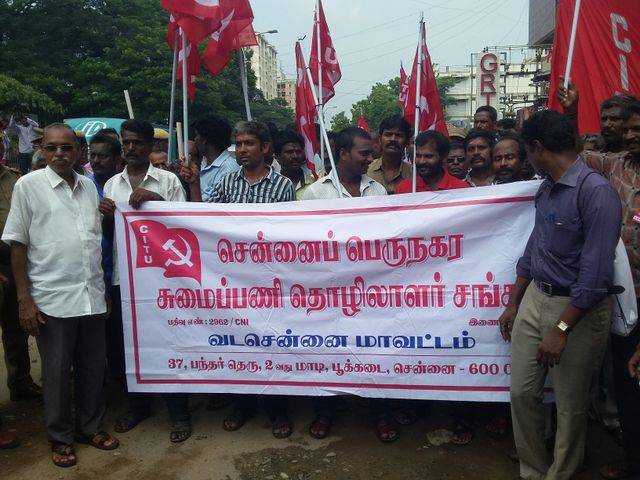
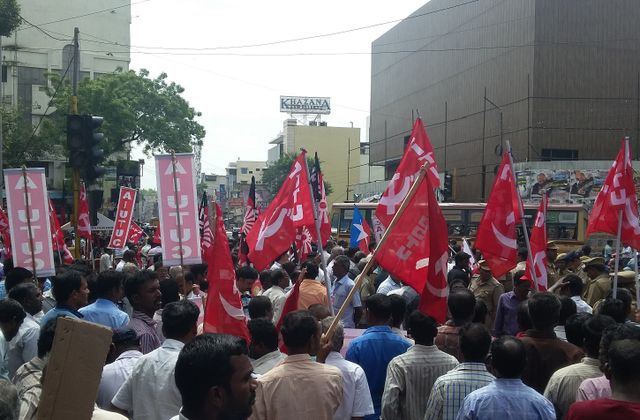
Tens of millions of workers throughout India participated in a strike yesterday against austerity measures and pro-corporate economic reforms implemented by the Bharatiya Janata Party (BJP) government of Prime Minister Narendra Modi.
The strike is an expression of mounting opposition in the working class in India and internationally. It follows significant strikes and demonstrations in the US, Europe, China and other countries against assaults by governments and corporations on jobs and working and living conditions.
However, the aim of the unions that called the strike, particularly those affiliated with India’s main Stalinist parliamentary parties—the Communist Party of India (Marxist) (CPM) and the Communist Party of India (CPI)—is to defuse growing opposition and harness it to the establishment parties. This means above all the opposition to the Indian National Congress, the traditional ruling party of the Indian bourgeoisie.
Protest rally near Purasawakkam telephone exchange
Support for the strike on Friday varied by sector and state. Those participating included workers in government banks, insurance, telecom and postal services, along with central government-owned companies in the coal, gas and oil sectors. Workers are demanding higher wages, job and social security, and an end to privatization and pro-investor changes to labor laws.
The southern Indian states of Kerala and Karnataka, the eastern state of Odisha and the northern states of Haryana and Punjab were mostly shut down. Workers joined protest demonstrations and rallies in various cities in those states. Demonstrations were also held in Chennai and Visakhapatnam in southern India, in the capital New Delhi and in the eastern state of West Bengal. In Kerala, the newly elected CPM-led Left Democratic Front (LDF) government supported the strike in an effort to cover up its own pro-corporate economic policies.
In West Bengal, workers employed by central government institutions joined the strike despite threats by the right-wing Trinamool Congress (TMC) state government. With workers facing significant penalties if they participated, public transport and state government offices were functioning. However, significantly fewer people were seen on roads. Nearly 200 were arrested by state police in an effort to suppress the strike and protests. In the state capital Kolkata and other cities, TMC-organized thugs held counterrallies against the strike and came close to physical violence against strikers.
Under conditions of growing working-class opposition, the Stalinists are deepening their political collaboration with Congress, including through their first-ever electoral alliance forged during the April-May state assembly elections in West Bengal. They have also lined up with Congress in the name of “fighting for democracy” against violent attacks by the TMC state government in West Bengal.
In fact, Congress is responsible for initiating the policies that Modi is now expanding and for creating the conditions for the Hindu chauvinist BJP’s rise to national power. In 1991, Congress initiated the Indian bourgeoisie’s economic reforms aimed at transforming the country into a cheap labor platform for global capital. It has also played a central role in forging a political alliance with American imperialism.
In May 2014, Modi, the chief minister of Gujarat at the time of the anti-Muslim pogrom in 2002, was brought to power by the Indian ruling elite to ruthlessly push ahead with pro-investor economic reforms.
Modi’s government has cut subsidies and social spending and sped up disinvestment, the partial privatization of public-sector companies and the further opening up of sectors like insurance and finance to foreign capital. In the latest move, it increased the regressive Goods and Service Tax (GST) to further place the tax burden on working people and rural toilers.
Hand-in-hand with these austerity measures, Modi, through developing India’s military-strategic ties with the US, has brought the country closer in line with Washington’s war drive against China. On Monday, India signed a Logistic Exchange Memorandum of Agreement (LEMOA) with the US, allowing US warships and combat planes to access Indian bases.
Striking load lifting workers in Chennai
Despite boasting by Modi and his Finance Minister Arun Jaitley that economic growth is at more than 7 percent, workers throughout the country face rising food prices, growing unemployment and poverty. According to a recent report, during a recent 12-month period, little more than a hundred thousand out of some 10 million youth entering the labor force could find employment in eight key, labor-intensive sectors. Seventy percent of the total population is forced to live on less than $2 a day.
At the same time, the right-wing economic policies pursued by both Congress and the BJP have led to soaring wealth for a small fraction of the population. India is home to more multimillionaires than any Asian country outside of Japan and China, along with 84 billionaires (placing it fourth in the world after the United States, China and Germany).
Under such socially polarized conditions, the Modi government has reacted by whipping up Hindu communalism to divide the working class and create the framework for a massive assault on democratic rights. Any opposition to the policies of the Indian bourgeoisie is labeled “antinational.”
The Stalinists, meanwhile, have responded to growing social opposition by redoubling their efforts to politically subordinate the working class to the parties of the bourgeois establishment, mainly the Congress Party and also to various caste-based and regional parties like the Janata Dal (United), the Biju Janata Dal and the Dravida Munnetra Kazhagam, in the name of defending “secularism” and “democracy.” All those regional parties have enthusiastically supported neoliberal economic reforms and India’s closer lineup with the US war drive. They have also been part of BJP-led governments.

The ouster of Brazil’s Workers Party government

Bill Van Auken

With a 61 to 20 vote in the Brazilian Senate Wednesday, the protracted drive to impeach Workers Party (PT) President Dilma Rousseff has culminated in her removal from power and the installation of an unelected president, Michel Temer of the Brazilian Democratic Movement Party (PMDB), along with the country’s most right-wing government since the end of the US-backed military dictatorship three decades ago.
In his first public statement after being sworn in, Temer, formerly Rousseff’s vice president and close political ally, declared that he would no longer tolerate being called a golpista (putschist) and insisted that the government would have to be “very firm” with its critics.
This directive was swiftly put into practice in the repression unleashed by military police and shock troops against the scattered protests held in repudiation of the impeachment. In Sao Paulo police violently attacked demonstrators, using tear gas and stun grenades that left several people wounded, including a 19-year-old university student blinded by an explosion that pierced her eye.
The country’s leading daily newspaper Folha de S.P. responded to these events by demanding an even harsher crackdown and warning darkly in an editorial: “Democracies incapable of repressing the fanatics of violence are candidates for repeating the [experience of] Germany’s Weimar Republic of the 1930s, engulfed by street violence until giving way to the worst dictatorship there ever was.”
This is the language of a capitalist ruling class that is determined to utilize the change in government to impose a sweeping program of austerity measures aimed at placing the full burden of Brazil’s deepest economic crisis in a century onto the backs of the working class. It is demanding a vast transfer of wealth from the income of the broad masses of the population and from spending on vital social services to bolster the profits of both Brazilian and international capital.
As the Folha editorial indicates, to achieve these aims Brazil’s financial oligarchy is prepared to go well beyond the crimes committed by the military juntas that ruled the country following the CIA-backed coup of 1964.
Temer has already spelled out the first steps in his reactionary agenda, which include drastic cuts to social security pension benefits; a 20-year freeze on spending for healthcare, education and other vital social services; the gutting of labor laws; and the wholesale privatization of state enterprises and infrastructure. Proposals are in the works to, for the first time, allow foreign corporations to buy Brazilian land and for foreign oil conglomerates to begin the direct exploitation of the vast “pre-salt” underwater oil fields off the country’s southeast coast.
Rousseff, the PT and their supporters have denounced the installation of Temer as a “coup.” In terms of the change of government’s implications for the working class, there is no question that the use of such dramatic terms is justified. But if it were to be called a coup, it would be necessary to add that the PT was a direct and indispensable co-conspirator.
Rousseff’s popularity collapsed to single digits before her ouster. The objective basis for her vast unpopularity was the crisis of Brazilian capitalism, which is now deeper than that of the 1930s, with nearly 12 million unemployed, falling real wages and poverty and social inequality once again on the rise.
Within the working class, the anger against Rousseff mounted steadily in the wake of her presidential campaign in 2014. She campaigned vowing to take measures to assure jobs and improve conditions for working people, only to embark, once reelected, on the kind of “fiscal adjustment” program that she claimed to oppose, and which is now being accelerated under Temer.
Among more privileged sections of the middle class, the anger against Rousseff was whipped up into a right-wing frenzy based on conceptions that the Workers Party was responsible for halting Brazil’s rise to “first world” status and for diverting wealth into minimal social assistance programs for the poor that these egotistical layers believe is rightfully theirs.
Among all layers of the population, disgust for the entire political setup has been fueled by the continuing revelations of the Operation Car Wash (Lava Jato) investigation into the multi-billion-dollar bribes for contracts scandal at Petrobras, the state-run energy giant. While virtually every political party has been implicated, the scandal unfolded under the presidencies of Rousseff, who had chaired the firm, and her predecessor, former metalworkers union leader Luiz Inacio Lula da Silva, who is himself charged with obstruction of justice in relation to the kickbacks scandal.
Rousseff and the PT were neither able nor willing to appeal to the working class against the impeachment drive. The Workers Party, its name notwithstanding, is not based upon the working class. It is a bourgeois party with its principal base among upper middle class elements, including academics, union bureaucrats and political and state functionaries.
It sought to remain in power by appeals to its erstwhile political allies, the collection of corrupt and right-wing bourgeois politicians who organized the impeachment. It argued that by virtue of its connections to the PT-affiliated CUT union federation and the state-sponsored “social movements” it would be in a better position to contain the class struggle as draconian austerity measures were imposed. In the end both the Brazilian ruling establishment and Wall Street decided that a more dramatic change in regime was required.
If the PT has paved the way to the present situation, it must also be said that the collection of pseudo-left organizations that played a pivotal role in founding and promoting the PT themselves bear political responsibility for the sharp dangers now confronting the Brazilian working class.
The leading role in this political project was played by organizations that had broken with the Trotskyist movement, the International Committee of the Fourth International. In the 1960s, these groups based themselves on the theory that Castroism and petty-bourgeois guerrillaism had presented a new road to socialism that rendered unnecessary the struggle to build revolutionary Marxist parties in the working class. Throughout Latin America, this theory contributed to disastrous defeats for the working class, culminating in decades of military dictatorship.
In the waning days of the Brazilian military regime, under conditions of massive strikes and militant struggles by students, these same elements joined with sections of the union leadership, the Catholic church and left academics to found the Workers Party. Once again, they had found a substitute for the building of a revolutionary party and the fight for socialist consciousness in the working class. The PT was to provide a unique Brazilian parliamentary road to socialism. The dead end of that road has now been reached.
None of these organizations have even sought to draw the lessons of this strategic political experience, much less offer a revolutionary alternative today. Instead, they are all being driven to the right and into crisis by the shipwreck of the PT.
The Morenoite PSTU (Unified Socialist Workers Party) has lost half of its members in a split over the group’s reactionary political line of “throw them all out,” which effectively supported the impeachment drive and adapted to the right-wing middle class protests. Those who split are seeking a “unity of the left” based on the subordination of the working class to the PT and its allies.
The Pabloite revisionists are split between those who remained within the PT and those who followed a parliamentary faction in forming the PSOL (Socialism and Liberty Party) based on the bankrupt perspective of returning to PT’s “original” principles. Also joining this party are the Brazilian followers of the Argentine Morenoites of the PTS (Socialist Workers Party). Oblivious to the implications of the coup, these elements are dedicating themselves to campaigning for municipal elections next month in which PSOL’s leading candidate is Luiza Erundina, a former mayor of Sao Paulo who has passed through a series of right-wing bourgeois parties before agreeing to join the PSOL slate.
With the thorough discrediting of the Workers Party, all of these groups are dedicated to erecting a new political trap for the working class along the lines of such “left” bourgeois parties as Syriza in Greece or Podemos in Spain.
Their efforts notwithstanding, an explosive development of the class struggle is on the agenda. The confrontation that is emerging pits finance capital against the working class not only in Brazil, but throughout Latin America. As the region’s largest economy, with extensive investments and trade links with every neighboring country, the policies pursued in Brazil will rapidly spill over its borders and accelerate the ongoing shift to the right and assault on the working class across the continent.
Just as the assault on Brazilian workers is part of a continent-wide and, indeed, global attack, so too a successful struggle against this attack requires the independent political mobilization of the working class throughout Latin America and internationally.
The Brazilian working class can defend itself only by fighting for the building of a unified mass movement of the Latin American working class together with the workers of North America in a common struggle against finance capital and the transnational corporations that exploit them all.
The fight for such a program requires a definitive political break with the Workers Party and all of its pseudo-left satellites that have propped up bourgeois rule in Brazil and throughout Latin America. The urgent question remains that of developing revolutionary leadership and political perspective. This requires the assimilation of the long history of struggle for Trotskyism embodied in the International Committee of the Fourth International.