6 Sept 2016

Subsidizing Nuclear Power: From Cradle to Grave

Peter Bradford

Since the 1950s, US nuclear power has commanded immense taxpayer and customer subsidy based on promises of economic and environmental benefits. Many of these promises are unfulfilled, but new ones take their place. More subsidies follow.
Today the nuclear industry claims that keeping all operating reactors running for many years, no matter how uneconomic they become, is essential in order to reach US climate change targets.
Economics have always challenged US reactors. After more than 100 construction cancellations and cost overruns costing up to US$5 billion apiece, Forbes Magazine in 1985 called nuclear power the greatest managerial disaster in business history…only the blind, or the biased, can now think that most of the money [$265 billion by 1990] has been well spent.”
US Atomic Energy Commission (AEC) Chair Lewis Strauss’ 1954 promise that electric power would be “too cheap to meter” is today used to mock nuclear economics, not commend them.
As late as 1972 the AEC forecast that the United States would have 1,000 power reactors by the year 2000. Today we have 100 operating power reactors, down from a peak of 112 in 1990. Since 2012 US power plant owners have retired five units and announced plans to close nine more. Four new reactors are likely to come on line.
Without strenuous government intervention, almost all of the rest will close by mid-century. Because these recent closures have been abrupt and unplanned, the replacement power has come in substantial part from natural gas, causing a dismaying uptick in greenhouse gas emissions.
The nuclear industry, led by the forlornly named lobbying group Nuclear Matters, still obtains large subsidies for new reactor designs that cannot possibly compete at today’s prices. But its main function now is to save operating reactors from closure brought on by their own rising costs, by the absence of a US policy on greenhouse gas emissions and by competition from less expensive natural gas, carbon-free renewables and more efficient energy use.
Only billions more dollars in subsidies and the retarding of rapid deployment of cheaper technologies can save these reactors. Only fresh claims of unique social benefit can justify such steps.
When I served on the US Nuclear Regulatory Commission (NRC) from 1977 through 1982, the NRC issued more licenses than in any comparable period since. Arguments that the US couldn’t avoid dependence on Middle Eastern oil and keep the lights on without a vast increase in nuclear power were standard fare then and throughout my 20 years chairing the New York and Maine utility regulatory commissions.
In fact, we attained these goals without the additional reactors, a lesson to remember in the face of claims that all of today’s nuclear plants are needed to ward off climate change.
Nuclear power has no place in competitive electricity markets
During nuclear power’s growth years in the 1960s and 1970s, almost all electric utility rate regulation was based on recovering the money necessary to build and run power plants and the accompanying infrastructure. But in the 1990s many states broke up the electric utility monopoly model.
Now a majority of US power generation is sold in competitive markets. Companies profit by producing the cheapest electricity or providing services that avoid the need for electricity.
To justify their current subsidy demands, nuclear advocates assert three propositions:
* First, they contend that power markets undervalue nuclear plants because they do not compensate reactors for avoiding carbon emissions, or for other attributes such as diversifying the fuel supply or running more than 90 percent of the time.
* Second, they assert that other low-carbon sources cannot fill the gap because the wind doesn’t always blow and the sun doesn’t always shine. So power grids will use fossil-fired generators for more hours if nuclear plants close.
* Finally, nuclear power supporters argue that these intermittent sources receive substantial subsidies while nuclear energy does not, thereby enabling renewables to underbid nuclear even if their costs are higher.
Nuclear power producers want government-mandated long-term contracts or other mechanisms that require customers to buy power from their troubled units at prices far higher than they would pay otherwise.
Providing such open-ended support will negate several major energy trends that currently benefit customers and the environment:
* Power markets have been working reliably and effectively. A large variety of cheaper, more efficient technologies for producing and saving energy, as well as managing the grid more cheaply and cleanly, have been developed.
* Energy storage, which can enhance the round-the-clock capability of some renewables is progressing faster than had been expected, and is now being bid into several power markets – notably the market serving Pennsylvania, New Jersey and Maryland.
* Long-term subsidies for uneconomic nuclear plants also will crowd out penetration of these markets by energy efficiency and renewables. This is the path New York state has taken by committing at least $7.6 billion in above-market payments to three of its six plants to assure that they operate through 2029.

Nuclear power vs. other carbon-free fuels
While power markets do indeed undervalue low-carbon fuels, all of the other premises underlying the nuclear industry approach are flawed. In California and in Nebraska, utilities plan to replace nuclear plants that are closing early for economic reasons almost entirely with electricity from carbon-free sources. Such transitions are achievable in most systems as long as the shutdowns are planned in advance to be carbon-free.
In California these replacement resources, which include renewables, storage, transmission enhancements and energy efficiency measures, will for the most part be procured through competitive processes.
Indeed, any state where a utility threatens to close a plant can run an auction to ascertain whether there are sufficient low-carbon resources available to replace the unit within a particular time frame. Only then will regulators know whether, how much and for how long they should support the nuclear units.
If New York had taken this approach, each of the struggling nuclear units could have bid to provide power in such an auction. They might well have succeeded for the immediate future, but some or all would probably not have won after that.
Closing the noncompetitive plants would be a clear benefit to the New York economy. This is why a large coalition of big customers, alternative energy providers and environmental groups opposed the long-term subsidy plan.
The industry’s final argument – that renewables are subsidized and nuclear is not – ignores overwhelming history. All carbon-free energy sources together have not received remotely as much government support as has flowed to nuclear power.
From cradle to grave, the nuclear cycle is run at taxpayers’ expense
Nuclear energy’s essential components – reactors and enriched uranium fuel – were developed at taxpayer expense. Private utilities were paid to build nuclear reactors in the 1950s and early ‘60’s, and received subsidized fuel. According to a study by the Union of Concerned Scientists, total subsidies paid and offered to nuclear plants between 1960 and 2024 generally exceed the value of the power that they produced.
The US government has also pledged to dispose of nuclear power’s most hazardous wastes – a promise that has never been made to any other industry. By 2020 taxpayers will have paid some $21 billion to store those wastes at power plant sites.
Furthermore, under the 1957 Price-Anderson Act, each plant owner’s accident liability is limited to some $300 million per year, even though the Fukushima disaster showed that nuclear accident costs can exceed $100 billion. If private companies that own US nuclear power plants had been responsible for accident liability, they would not have built reactors. The same is almost certainly true of responsibility for spent fuel disposal.
Finally, as part of the transition to competition in the 1990s, state governments were persuaded to make customers pay off some $70 billion in excessive nuclear costs. Today the same nuclear power providers are asking to be rescued from the same market forces for a second time.
Christopher Crane, the president and CEO of Exelon, which owns the nation’s largest nuclear fleet, preaches temperance from a bar stool when he disparages renewable energy subsidies by asserting“I’ve talked for years about the unintended consequences of policies that incentivize technologies versus outcomes.”
However, he’s right about unintended and unfortunate consequences. We should not rely further on the unfulfilled prophesies that nuclear lobbyists have deployed so expensively for so long.
It’s time to take Crane at his word by using our power markets, adjusted to price greenhouse gas emissions, to prioritize our low carbon outcome over his technology.

Opposition plots regime change in Maldives

Wasantha Rupasinghe

The BBC reported last month that moves are underway by opposition leaders in the Maldives, including Mohammed Nasheed, former president and leader of Maldives Democratic Party (MDP), to oust President Abdulla Yameen.
The apparent plot is being prepared amid an intensified campaign in the Western media to highlight the Yameen government’s anti-democratic methods. The US and its allies are hostile to Yameen, not because of his record of human rights abuses, but due to his ties to China.
Citing unnamed “credible sources,” the BBC reported on August 25 that Yameen’s opponents were “looking to move against him within weeks.” Few details were provided. A government spokesman denounced the ouster move but added that it was “a formal attempt to ‘legally’ overthrow the government” via a ballot.
The BBC simultaneously ran another article written by two correspondents who visited as ordinary tourists, secretly covering protests against Yameen and interviewing opposition members and media personnel critical of his rule.
The BBC report coincided with the news that Nasheed, who lives in the UK under political asylum, visited Sri Lanka on August 23. The Mihaaru website reported that Nasheed flew to Sri Lanka for “an important sit-down over the present crisis in the Maldives.”
Nasheed was accompanied by former vice president and the head of the United Opposition of Maldives (UOM), Mohamen Jameel Ahmed. The UOM was formed in June in London on the basis of a common agenda of ousting Yameen.
Sharp political infighting, involving competing capitalist cliques in the Indian Ocean archipelago, has continued for months. The Maldives, strategically located astride major sea lanes, has become a focal point for rivalry between the US and China as Washington has implemented its “pivot to Asia” and military build-up throughout the region.
While trying to maintain close diplomatic relations with the US and India, the Yameen government is heavily dependent on Chinese investment and concessionary loans. Washington and New Delhi are actively seeking to undermine Beijing and boost their own influence in the Maldives. Yameen is increasingly isolated after the resignation of key ministers.
As part of its crackdown on the opposition, the Yameen government instigated charges against Nasheed under draconian anti-terrorism laws for ordering, as president, the detention of Criminal Court Justice Abdulla Mohamed in 2012. Nasheed was jailed for 13 years in March last year. Under pressure from the US, UK and EU, he was allowed to travel to Britain, ostensibly for medical treatment. Nasheed is outspoken about his support for the US and India, and opposition to China.
The New Indian Express last week reported MDP international spokesman, Hamid Abdul Ghafoor, as saying that “India, the US and the EU are backing opposition moves to oust Yameen’s dictatorial government by legal means.” Ghafoor was in Colombo but claimed he did not know of Nasheed’s presence.
During his weekly press briefing, Sri Lankan Health Minister Rajitha Senaratne did not confirm the presence of Nasheed and other opposition leaders in Colombo but did not deny it either. He referred to Nasheed’s political activities in Sri Lanka during the previous government of President Mahinda Rajapakse and added that “he must be doing the same thing even now.”
Rajapakse, who was regarded as too close to China, was ousted in January last year in a US-backed regime-change operation in the Sri Lankan presidential election. Since Maithripala Sirisena was installed as president, the Sri Lanka government has played an increasingly active role on Washington’s behalf. It mediated Nasheed’s release and his travel last year to the UK.
Yameen clearly feels under siege. The country’s courts last week issued arrest warrants for Nasheed, Jameel and MDP senior official Akram Kamldeen, who are also in exile in the UK. Police raided Nasheed’s house in the capital of Male.
The government recently rammed a strict defamation law through the parliament that allows for jail terms and steep fines for journalists. The defence ministry has barred soldiers from meeting politicians and foreign diplomats, political party leaders and political activists without prior permission from senior officials.
The crisis surrounding Yameen has deepened in recent months, with rifts in the ruling Maldives Progressive Party (MPP). Gayoom, Yameen’s half-brother and MPP president, recently opposed land laws that allow foreign freehold ownership, following criticism in the Indian media that the legislation will pave the way for China to set up military bases.
Gayoom’s daughter, Dunya Maumoon, resigned as foreign minister in July. Several MPs are also supporting Gayoom.
The international media is ramping up the pressure on Yameen. The New York Times published a lengthy interview with Nasheed, who accused Yameen of corruption. Yameen, who was head of the State Trading Organisation, sold nearly $US300 million worth of oil to Myanmar’s military dictatorship in the early 2000s, despite sanctions by the US and the EU. “Nearly half of the money disappeared,” Nasheed said, implying Yameen siphoned off the money.
Al Jaz e era has announced that its investigative unit is getting ready to release a documentary named “Stealing Paradise” which it claims to reveal “how a president [Yameen] hijacked a nation and millions of dollars were stolen.”
The Australian has published reports about the “danger” that Maldivians are joining ISIS to fight the Syrian regime. Its report headlined, “Could a terror threat sink paradise?” noted: “The country famed for white sands and laid-back locals is teetering on the edge of a coup with unrest and the threat of Islamic State terrorism set to see paradise turn ugly.”
Some of the Indian media have written articles urging Prime Minister Narendra Modi to back the opposition in the Maldives to move against Yameen. After referring to lost opportunities to reassert Indian influence on the island nation, a Times of India columnist declared: “India must assert its credentials by helping democrats to come to power.”
The opposition parties in the Maldives do not represent a democratic alternative to the Yameen regime and pose great dangers for workers and youth. Like every other country in the region, the Maldives is being drawn into the machinations of US imperialism and its allies as it intensifies its military build-up in Asia and war drive against China.

Portugal’s response to forest fires undermined by austerity

Alejandro Lopez

Last month, wildfires ravaged Portugal, killing six people and injuring hundreds more. TV reports showed houses burning down, the evacuation of villages and roads, and railway lines closed.
On the tourist island of Madeira, more than 200 buildings in the regional capital and resort town of Funchal were destroyed or damaged. Four people died and 1,000 people were evacuated. On the mainland, much of northern Portugal was affected, and two people died in fires in the central Santarem region.
Over 4,200 Portuguese firefighters backed up by 30 aircraft, including those sent by Italy, Spain, Morocco and Russia, were mobilized to control nearly 200 forest fires set off in a heat wave, fanned by strong winds in difficult terrain. Portugal is also in the grip of one of its worst droughts in recent history.
According to the European Union’s (EU) Forest Fire Information System, over 116,000 hectares (286,600 acres) in Portugal were destroyed this year, over half the total of 217,000 hectares destroyed (536,200 acres) in the EU as a whole.
Between 2000 and 2013, Portugal, which comprises less than 10 percent of the landmass in Europe’s Mediterranean region, recorded a third of the fires. The number of fires has increased from around 3,000 in 1980 to around 20,000 a year today. They are always followed by an official enquiry and report, which blames the lack of firefighting resources, abandoned or mismanaged farmland due to the drift of the rural population to the towns, the planting of unsuitable tree species, and so on. This is followed by government pledges to act on the report’s recommendations.
As usual, the Socialist Party (PS) government is ignoring its failure to act on recommendations, and is instead blaming arsonists and climate change for the fires, which it presents as an unavoidable natural disaster.
Prime Minister Antonio Costa declared, “This abnormal situation surpasses the normal response capacity of our forces,” referring to high temperatures of up to 42 degrees Celsius. Interior Minister Miguel Constança Urbano de Sousa told reporters, “we are under extraordinary meteorological conditions that cannot be forecast, and are impossible to control by human beings.”
Police have so far arrested 34 people on suspicion of starting fires. Most have been released on bail. Meanwhile, a petition to demand maximum sentences for arsonists be raised to 25 years in prison has been signed by more than 25,000 people.
The whipping up of a law and order frenzy as a response to the fires is nothing new. In 2003, when Portugal was hit by its deadliest recorded blazes, in which 10 percent of the forests were destroyed and 19 people died, the press and Prime Minister Durao Barroso, later to become EU Commission President, launched a campaign attacking arsonists and calling for harsher penalties.
Central responsibility lies, however, with the Portuguese and EU authorities that have failed to implement plans drawn up to deal with the forest fires.
Since the 2007-8 global economic crises, successive Portuguese governments have imposed billions of euros in social cuts. Last November, the PS came to power promising to rollback years of austerity, but then announced it would implement a 2.2 percent structural deficit target this year.
In 2014, Portugal spent just €70 million on its firefighting budget and €20 million on fire prevention. This pales in comparison to the country’s €2.1 billion military spending.
Plans set by the National Forest Protection Plan, established in 2005, specified that 500 forestry teams would be working on fire prevention today. Now, however, there are only 283.
Cuts to fire and rescue services and prevention mean fewer firefighters and older equipment, leading to longer response times, weakened resilience and greater risk to the public and firefighters.
The chairman of the National Association of Firefighters (ANBP), Fernando Curto, blamed the government, telling Portuguese daily Diário de Notíciasthat the main problem is “the failure to focus on prevention.” He also denounced the miserable wages and conditions facing Portuguese firefighters, “working 24 consecutive hours while earning €1.87 an hour.”
Jaime Marta Soares, from the League of Portuguese Firefighters, told Euronews the main problem is that “There’s no structural fire-prevention in the forests, which are mostly uninhabited. But the cities and the areas around the industrial parks are not even protected. If we add high temperatures influenced by the Mediterranean, very low humidity rates and atypical winds, and the forest that is itself the fuel, when left untreated, this leads to fires, and it makes our country resemble a continuous torch.”
Another factor has been the eucalyptus agro-business industry. Its plantations, covering 7 percent of Portugal’s landmass, are a valuable source of pulp for paper and oils and resin for world markets. Not only do they consume large quantities of water, contributing to the drought, but their oil and fallen leaves produce a tinderbox for wildfires. In order to cut costs, eucalyptus businesses have also cut spending on fire prevention.
Rui Barreira, forestry technician and member of the World Wide Fund told reporters, the problem with the plantations is “forest care mismanagement.

German states try to offload refugees on each other

Elisabeth Zimmermann

A year after the unveiling of the so-called welcoming culture, refugees are not only being rejected and deported en masse in Germany; German states are also offloading refugees on each other.
German Chancellor Angela Merkel, who is frequently falsely portrayed as the initiator of the “welcoming culture,” has placed herself at the head of the offensive against refugees. At a meeting of the Christian Democratic Union/Christian Social Union parliamentary group executive in Berlin last Thursday, she declared that the priority now was to deport asylum seekers whose applications are rejected. “In the coming months, the most important thing is repatriation, repatriation and again repatriation,” Merkel declared.
In North Rhine-Westphalia (NRW), cities including Essen, Bochum, Dortmund and Gelsenkirchen have demanded that thousands of recognised refugees who have been living there for months return to Bavaria or states in eastern Germany, where their asylum applications were initially filed.
Municipal officials, most of whom are social democrats, are implementing the reactionary integration law passed in August, with dire consequences for refugees, their friends and families.
Previously, residence requirements only applied to refugees whose asylum applications had not yet been fully processed. In a violation of fundamental democratic rights, the state could order them to live in a certain area. As soon as their asylum application was approved, however, they could freely choose their place of residence.
According to the new law, authorities can retroactively impose a residence condition on refugees for three years. Generally, this will be in the city or region where the refugee lived while applying for asylum. Anyone who does not “voluntarily” accept the forced move will no longer receive welfare support from NRW job centres.
Gelsenkirchen, in the Ruhr region, has written to all the nearly 2,000 recognised refugees who have moved to the city since the beginning of the year, calling upon them to leave NRW. Since several states where they are being sent refused to accept them, authorities sent many back to NRW. Most of those affected came from Saxony, Saxony-Anhalt and Bavaria.
The Gelsenkirchen job centre permitted a temporary reprieve for those affected until October, to avoid homelessness. After that, however, all those newly residing in the city must return to their original place of residence in Germany.
States and municipalities are also trying to agree on regulations by the end of the year on the deportation of refugees.
In Essen, 1,662 asylum seekers accepted in other states have registered, according to the city’s statistics. They moved into their own homes and registered their children with kindergartens and schools. Many have begun taking language courses, to be able to reestablish an independent and self-sufficient life after months of flight and accommodation in inhumane refugee camps.
The city of Essen intends to send anyone who arrived after 6 August back to their original place of residence. The city administration estimates that this will affect around 2,500 people, including those who have not registered yet. They were briefly informed that they must return to their original place of residence.
The city of Bochum intends to send back some of the 1,000 asylum claimants who have moved to the city since the beginning of the year.
The city of Dortmund plans first to send back all refugees who arrived after 6 August, because they do not yet have data on those refugees who arrived prior to this date.
State and municipal politicians defend these ruthless measures, claiming that only in this way can costs be fairly distributed. The human costs of such inhumane policies are irrelevant to them.
Many refugees came to NRW because they had friends or relatives there and hoped to secure better opportunities for work than in rural areas or eastern Germany. In addition, they must fear for their lives in some regions: in 2015 alone, there were over 1,000 attacks on refugee centres in Germany, according to Federal Criminal Agency statistics.
In Bochum, many refugees and migrants impacted have begun protests against forced resettlements. In Essen, some are trying to legally challenge their removal.
The refugee organisation ProAsyl condemned the practice of moving refugees between states as “absolutely crazy,” and a “disaster for integration.”
The Refugee Council of NRW declared, “These people waited for a long time for recognition and were delighted to be able to move close to friends or relatives. If they are now sent away, the period of recovery they have long fought for will be taken from them.”
The World Socialist Web Site described the new integration law of 20 April as an attack on basic democratic rights. Imposing stringent residency conditions for recognised asylum seekers, based on an initiative of Baden-Württemberg state premier Winfried Kretschmann (Greens), was “simply a violation of the law,” it stated. It is a breach of the UN Convention on Refugees and the European asylum law, which guarantees recognised asylum claimants the right to freedom of movement.
“The forced resettlement of refugees into structurally weak regions, which will tear apart families and social networks that provide assistance in job searches, vocational training and continuing education and visits to the authorities, will drive recognized asylum seekers into isolation and exclusion and increase their dependence on social services,” the article continued.
The removal of recognised refugees from NRW underscores the reactionary and brutal character of German asylum policy. It is bound up with attacks being waged on the democratic and social rights of the working class as a whole and the growth of militarism. It exposes the right-wing policies of the SPD/Green state government in NRW. Interior minister Ralf Jäger (SPD) boasts that his state has deported the most rejected asylum seekers.
NRW immigration authorities had deported 2,652 refugees by the end of June, 32 percent more than last year. The numbers of those “voluntarily” leaving the state also rose significantly. According to the interior ministry, 13,633 people have left NRW since the beginning of the year.
Jäger has also complained of “extreme problems” with repatriating refugees to North Africa. He was supported by state premier Hannelore Kraft (SPD), who criticised the federal government from the right on this issue. She recently told Der Spiegel, “It cannot go on like this,” and demanded more support from Berlin to deport refugees more quickly and in greater numbers.
The NRW government is also crowding refugees into mass accommodation centres. Although about 14,000 places are available in normal accommodation facilities, approximately 9,000 people are forced to live in halls or tents. According to Jäger, this period in forced emergency accommodation is intended to ensure that refugees without a realistic chance of asylum never reach a municipality. This is based on an agreement with the federal agency for migrants and refugees (BAMF).

Russia’s Overtures in East Asia

Sandip Kumar Mishra


The Eastern Economic Forum (EEF) was held in Vladivostok, Russia, on 2 September 2016, a day before the G-20 Summit Meet in Hangzhou, China It was attended by the Russian President Vladimir Putin, Japanese Prime Minister Shinzo Abe, the South Korean President Park Geun-hye and the Australian Prime Minister Malcolm Turnbull. On the sidelines of the EEF, a bilateral meeting between the leaders of Russia and South Korea was also held. During this meeting, the Russian leader surprised his South Korean counterpart by giving her a special gift. It was a work of calligraphy, written in Chinese, by Park's father, the late former President Park Chung-hee in 1979 (the year he was assassinated), which read, “with strong teamwork, let's move forward together.” It was indeed a special gesture from Putin. Ahead of the bilateral talks, South Korea was concerned that its consent for the US-led THAAD battery on the peninsula meant that Russia-South Korea relations would be strained beyond repair. It was a pleasant surprise for the South Korean leader that even though Russia had gone along with China in its criticism of the THAAD installation on the Peninsula, it wanted to continue economic and other cooperation with South Korea.

Putin stressed after the meeting that he “had in-depth discussions about the current situation on the Korean Peninsula and reached an agreement that the two nations do not accept the self-proclaimed nuclear status of Pyongyang.” Furthermore, both the leaders also agreed to begin negotiations on a free trade agreement (FTA) between South Korea and the Russia-led Eurasian Economic Union (EAEU), which consists of Russia, Armenia, Belarus, Kazakhstan, and Kyrgyzstan. The feasibility study on this has already been concluded and the process of negotiations may begin in October 2016. In addition to this Russia and South Korea signed 24 MoUs, thereby expanding the range of their bilateral cooperation.
 
Japanese leader Shinzo Abe was also bold in proposing an annual summit meet with Russia’s top leader and appealed him ‘to act as a visionary’. This proposal by Japan was encouraging for Russia as most of the G-7 nations have shunned Putin since imposing sanctions over the Ukraine crisis in 2014. It is also interesting to note that the two leaders had a summit meeting in May 2016 and Putin has planned to have another summit meet with Japan on 15 December 2016 in Yamaguchi, Japan. The upcoming visit is going to be special as Yamaguchi prefecture is Shinzo Abe's home. There are definite positive vibes between Japan and Russia in recent times and it may lead to the resolution of their long-running dispute over a group of islands, which Russia calls the Kuriles and Japan, the Northern Territories. After a resolution of the island dispute, it would be easier for both countries to sign a peace treaty. The Russian leader, however, did not commit on the Japanese proposal of an annual summit meet. 

The EEF was attended by the current as well as former Prime Ministers of Australia and this means that Russia is willing to get involved and engaged with Australia at least through economic exchanges. It is obvious that Putin has been working on an economic and political strategy to foster economic ties with South Korea, Japan and Australia and appears to be ready to provide an alternative to China's economic dominance, while increasing trade in sanction-hit Russia.

In various scholarly speculations, it has been presented that Russia is ready to go along with China and be part of the China-Russia-North Korea-Pakistan nexus. However, the pictures and pronouncements of the EEF, just one day before the G-20 Summit, weaken this proposition. Russia appears to be distancing itself from a confrontational and assertive China. It seems that Russia may have an uncompromising stand in its western neighbourhood though it is ready to work with US allies in the eastern theatre. It is important to note that Putin’s deliberations with President Barack Obama over the Syrian issue on the sidelines of the G-20 meeting did not produce any substantial results. 

Although it is still premature to say that the new phase in the Russian overtures in East Asia is a permanent shift in its foreign policy, the continuation is definitely going to worry China, which would get more isolated in the regional politics. During his meeting with President Xi Jinping at the G-20, Putin tried to reassure China with all the right gestures but a gap between Russian and Chinese policies in the East Asian region is quite visible. Although China wants to have Russia on its side, Putin seeks an independent approach for Russia. For example, in an awkward move, China announced just few days before the G-20 summit that the Russian President would be the “number one guest”. However, it was not able to dissuade Russia to not discuss geopolitical issues at the Summit against the Chinese wish and to discuss only economy and environment. In this context, it should be keenly watched how both the countries calibrate their foreign policies as most of the countries of East Asia would try to take advantage of this gap. 

Fears of rising social opposition hung over G20 summit

Nick Beams

The headlines in the media in the lead-up to the G20 leader’s summit meeting in Hangzhou China, which concluded on Monday, were that it would have to find a way to boost global growth and deal with the rise of protectionism. The communiqué which emerged at its conclusion revealed that neither of those objectives came even close to being met.
Like statements from previous meetings, it contained a series of warnings about “downside risks” emanating from potential volatility in financial markets, continuing sluggish trade and investment and low productivity and employment growth and then offered a commitment to “usher in a new era of global growth.”
With the evident failure of monetary policies based on the pumping of trillions of dollars into the global financial system to stimulate expansion of the real economy, the communiqué noted that “fiscal strategies”—increased government spending—are “equally important to supporting our common growth strategies.”
But it was an empty phrase because it went on to state that such “policy options” would be “tailored to country circumstances.” In other words, there is no binding global commitment to boost the economy and each national government, while calling on others to take action, will continue with its own austerity agenda.
It is significant that under conditions where it is recognised that the central economic problem is lack of investment and demand, the only measure which contained real teeth was aimed at cutting back production in the global steel industry—a measure directed against China.
While not directly naming China, the G20 decided to establish a Global Forum on excess steel capacity to report back in 2017. The measure was pushed through with the threat from the European Union that if China did not agree it could face an adverse decision on its push to be accorded “market economy status” under the World Trade Organisation, which comes up later this year.
Such were the tensions surrounding the issue that, according to one official cited by the Wall Street Journal: “If you are looking for blood, steel overcapacity was the issue.”
While the G20 communiqué repeated many of the standard phrases of past meetings, including the need for “structural reforms,” the code for deepening attacks on the employment and social conditions of the working class, there was a new political dimension to this year’s meeting.
Overshadowing the summit were concerns there is a deepening hostility among broad sections of the world’s population to the policies of the past eight years that have resulted in ever-worsening living standards and the growth of social inequality to historically unprecedented levels.
This was the first meeting of world leaders since the referendum vote in the UK to quit the European Union, a distorted reflection of growing opposition to the drive to austerity and cuts in living standards. The growing hatred of the political establishment has been reflected in the US, both in the rise of the far-right Republican Trump presidential candidacy, the widespread support for the self-styled “democratic socialist” Bernie Sanders in the race for the Democratic Party nomination and the broad hatred for the party’s nominee Hillary Clinton.
The communiqué pointed to the growing concerns in ruling circles over this social opposition with a series of empty phrases about meeting the needs of “present and future generations,” ensuring public support for expanded growth in a globalised economy and the need for an “integrated narrative for strong, sustainable, balanced and inclusive growth.”
Fears of what it could bring were voiced in closed-door sessions. According to a report in the Financial Times, “US president Barack Obama, British prime minister Theresa May and her Australian and Canadian counterparts emphasised the need to placate public discontent.” The Australian prime minister Malcolm Turnbull, reportedly told the meeting there was a need to “civilise capitalism.”
At the conclusion of the summit, International Monetary Fund managing director Christine Lagarde also addressed these issues warning that economic growth had been “too low for too long for too few.”
“There was also a determination around the room to better identify the benefits of trade in order to respond to the populist backlash against globalisation,” she said.
The so-called backlash against globalisation is the expression of a deeper phenomenon—growing hostility to the operation of the capitalist profit system itself. The leaders of the countries named in the Financial Times report have reasons for concern, along with their counterparts in other countries, as statistics on the rise of social inequality make clear.
In the UK, real wages between 2007 and 2015 fell by 10.4 percent, a figure only matched in Greece, where workers were savaged by the austerity drive of the IMF and the EU.
In the US economic inequality leap ahead in 2015 with the average incomes of the top 1 percent rising twice as fast as the rest of the population. The top 10 percent of the population collected more than half of total US household income.
Last year the Organisation for Economic Co-operation and Development, which covers 35 of the wealthiest countries, reported that income inequality had reached an all-time high, a situation which is certain to have worsened since then.
The Australian prime minister Turnbull attended the summit after being returned to office on July 2 by a bare one-seat majority in an election marked by deepening hostility to the entire political establishment and in which the government’s slogan of “jobs and growth” stood in marked contrast to an economic and social reality characterised by four years of stagnant real wages and the replacement of full-time jobs with part-time and casual employment.
Turnbull’s call to “civilise capitalism,” along with all the other references to “inclusive growth,” is a completely empty phrase because the depredations afflicting billions of people do not arise from a series of misguided policies but are rooted in the irresolvable contradiction of the capitalist economy, based on the drive for profit.
The underlying fear of the ruling class, which saw partial expression at the G20 summit, is that the present inchoate opposition to the capitalist order will take the form, not of a “backlash against globalisation” but the development of a socialist movement based on the understanding that civilisation can only be advanced by the overthrow of the socially-destructive and historically-outmoded profit system.

Australian supermarket chain sheds hardware stores and jobs

John Roberts

Woolworths, one of the two dominant supermarket chains in Australia, announced last month it will shut down or sell off its two hardware businesses, directly threatening the jobs of 7,700 workers.
The firm, which has 961 supermarkets and 111,000 employees, also revealed an annual net loss of $1.23 billion for 2015–16, a sharp reversal from the previous year’s $2.15 billion profit. It was Woolworths’ first loss since listing as a public company in 1993.
Although the loss was mainly attributed to write-offs on the company’s failed six-year-old Masters home improvement business, the results point to the underlying impact, across the retail industry, of the global economic stagnation and accompanying deflationary pressures.
Total Australian retail turnover, in current prices, has remained virtually flat for the past three months, according to the latest Australian Bureau of Statistics (ABS) figures. Turnover was unchanged in July 2016, seasonally adjusted, following two months of rises of just 0.1 percent.
Fierce competition in pricing, particularly in food, is exacerbating the crisis, cutting into tight profit margins. These processes are not confined to the retail trade. Even according to under-stated ABS estimates, the number of full-time jobs fell by about 64,500 in the past year, and many of these have been eliminated by major firms.
Woolworths chief executive Brad Banducci said its 82 Masters sites will be sold to a property consortium and its Home Timber and Hardware (HTH) stores are being sold for $165 million to a competitor Metcash, which owns Mitre 10 hardware stores. Masters is scheduled to stop trading in December once its stock is sold off.
Banducci claimed that the 6,300 Masters workers will “have an opportunity” to work elsewhere within the Woolworths group. That promise, made for PR purposes and to quell opposition among workers, is doubly doubtful because of the reversals confronting the remaining Woolworths operations. As for the HTH workers, their fate lies in the hands of the stores’ new owner.
The Shop, Distributive and Allied Employees Association (SDA), which covers retail workers, is working hand-in-glove with the management to derail and suppress any opposition among workers. SDA national secretary Gerard Dwyer said the union was working with Woolworths, Masters, HTH and Bunnings, the rival hardware chain owned by Wesfarmers, supposedly to find jobs for the displaced workers.
The SDA is notorious for its collaboration with employers, including via deals to scrap wage penalty rates for evening and weekend shifts. Its only concern is to help ensure the orderly closure of the businesses so that the union maintains its mutually-beneficial arrangements with the big retailers to enrol their employees as SDA members.
The Masters’ sale is currently being challenged in the Federal Court by the US hardware firm Lowe’s, which has a third share in Masters as a joint venture, with Woolworths holding the other two thirds. The American partner is contesting the tax write off of Masters’ value as zero.
Woolworths hopes to make $1.5 billion by shedding the hardware businesses and selling off property. Banducci said the proceeds will be invested in store renewals, including checkout technology, which will almost certainly mean more job losses. On news of the sell-off, the company’s shares prices initially rose 5 percent on the anticipation of profits being generated at the expense of workers.
There is speculation in the financial press that Woolworths’ discount department store, Big W, which lost $14.9 million after a profit of $111.7 million the year before, and its petrol station business, may share the fate of Masters, threatening more jobs. Big W employs 22,000 people.
Last year, Woolworths’ food and petrol earnings dropped 40.8 percent to $1.76 billion. This was partly because Woolworths was forced to invest $500 million in reducing prices in a price war with its main competitor, the Coles supermarket chain owned by Wesfarmers.
Industry analysts have expressed concerns that competitive price cuts will reduce the profit margins of both main chains. Coles has 776 supermarkets and 100,000 employees.
Both these majors are under threat from the German discounter Aldi, which opened in Australia in 2001. It currently has 400 supermarkets in New South Wales, the Australian Capital Territory, Queensland and Victoria, and is planning 130 new stores in Western Australia and South Australia.
Aldi already has 10 percent of the market. Analysts predict it could soon reach 16 percent, undercutting not only the two largest chains but the smaller IGA chain owned by Metcash and other operators that employ tens of thousands of workers. Lidl, another German discount supermarket chain, is rumoured to be considering entering the Australian market.
The competition is intensifying in the face of deflationary trends produced by the global slump and falling demand. In the year to June 30, consumer prices in Australia rose by only 1.00 percent, the lowest inflation rate since second quarter 1999. Prices of food and non-alcoholic beverages decreased by 0.1 percent.
Falling or stagnant wages are forcing working class households to cut their spending, including by resorting to multi-store shopping to buy weekly specials to reduce grocery bills. On average, real wages have grown by only 0.3 percent since 2013.
Unemployment and under-employment is also growing, with more workers pushed into insecure part-time and casual jobs, having an impact on retail spending. Roy Morgan Research estimates that 19.5 percent of the workforce is either jobless or looking for more work.
Moody’s credit agency has put a red flag against Australian food retailing, warning that Aldi’s continued expansion will affect the credit rating of its rivals. Moody’s vice president Ian Chitterer told the Australian the outlook is negative for Woolworths, Wesfarmers, Metcash and small independent supermarkets.
This year, a series of retail chains have either collapsed or retrenched in Australia, notably electronics firm Dick Smith, furnishing and fashion retailer Laura Ashley and budget department operator Target, destroying thousands of jobs. High-profile clothing outlets, such as Willow, Meredith & Moore and Seduce, have shut their doors. Lesser-publicised failures include the Round the World Experts travel division, video-on-demand company Quickflix, marketing company Brand New Media and pet supplies distributer Animal Supplies Group.
Nearly eight years on from the global financial crisis, the worsening fallout, combined with the anarchy of the capitalist profit system, is threatening jobs in industry after industry in Australia, as elsewhere around the world. The closure of Masters and HDH is another indicator of the socially destructive forces at work.

German military desperate for new recruits

Ludwig Weller

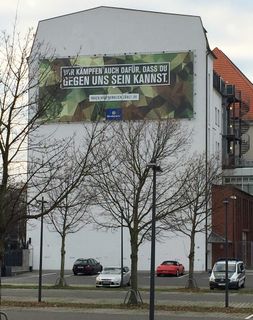
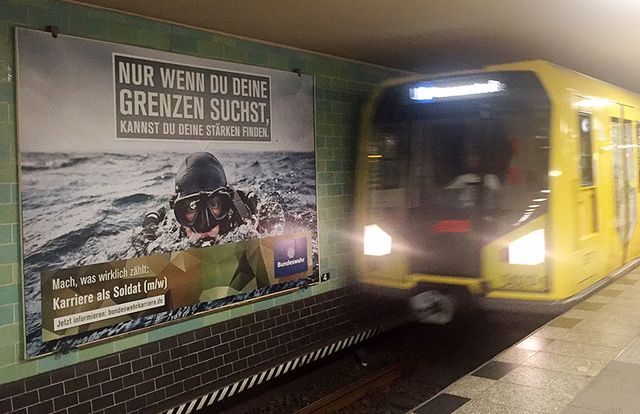
Just weeks before the Berlin state election, the German armed forces [Bundeswehr] has stepped up its odious campaign for new recruits. Large format posters have been plastered all over the city’s subway stations, bus stops and pedestrian zones. The aim of the campaign is to solve the recruitment problem of the Bundeswehr and win over young people for Germany’s current war drive.
Propaganda poster in the Berlin metro
The campaign, which is being carried out in other German cities as well, seeks to appeal to young people with the motto: “Do something that really counts”. Through such provocative language the Bundeswehr declares itself to be “the most attractive employer in Germany” (Defense Minister Ursula von der Leyen), which will enable young people to fulfil themselves in the fight for noble goals and values.
Some of the slogans (daubed in army camouflage colours), used on a total of 5.5 million postcards, 30,000 posters, videos and ads on Facebook, Google and Instagram, include: “For us it is about getting ahead. Not just about staying still”, “You will only reveal your powers if you go to your limits”, “We are also fighting for your right to oppose us”, and quite bluntly: “Trouble spots will not be resolved by hanging around and drinking tea.”
Propaganda poster on a wall in Berlin
The real reasons for German soldiers intervening to “resolve trouble spots” was laid out clearly in the “White Paper 2016 on German Security Policy and the Future of the Bundeswehr”, published in July. Under the heading “Germany’s strategic priorities”, the document states that the German economy is “just as dependent upon both securing raw material supply and international transport routes as on functioning information and communication systems”. However, the Bundeswehr could only “carry out its tasks and commitments … when it has a body of soldiers oriented to its actual demands.”
The document makes clear that the aim of the German army has nothing to do with enabling young people to “fulfil themselves” or fighting for democratic rights. As was the case in the First and Second World Wars, and more recent conflicts supported by the German ruling elite in Yugoslavia, Afghanistan and the Middle East, thousands of young people are to be used as cannon fodder on behalf of the geostrategic and economic interests of German imperialism.
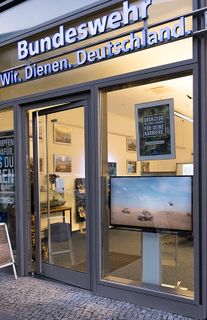
Ironically, the city of Berlin, where it is impossible to take a step without being reminded of the terrible crimes of German militarism in World War II, is once again to be the central recruiting centre. In the middle of the city, at Friedrichstrasse Station, the Bundeswehr opened a so-called showroom in 2014. Directly opposite is a memorial recalling the Nazi transport of Jewish children to death camps.
Recruitment office of the Bundeswehr at Berlin Friedrichstraße
The current Bundeswehr missions are extremely unpopular precisely due to Germany’s history, and the army therefore has had enormous recruitment problems since the suspension of conscription in 2011. In July, Defence Minister von der Leyen stated she was “dissatisfied” with the high drop-out rate “of around a quarter [of all recruits] in voluntary military service.”
In its desperation the government has even turned to the recruitment of juveniles. In 2013, over 1,000 17-year-olds were trained to fire weapons. Following pressure from child rights activists, a UN committee criticised the “various advertising campaigns of the Bundeswehr, which are specifically aimed at children, as well as … the presence of German troops in the schools”, and called for a ban of such practices.
Following the call two and a half years ago by President Joachim Gauck, and Germany’s government officialdom as a whole, for a revival of militarism, “career counsellors” and “youth officers” of the Bundeswehr have stepped up their attempts to recruit in schools and job centres. The total cost of the advertising campaign is estimated to be €30 million ($US 33.5 million) with 140 “counselling centres” operating nationwide.
In addition, events have been organised for the unemployed at job centres and for students in vocational information centres (BIZ) and schools. Celebrations such as “Army Day” are intended to once again position the military “in the middle of society” (White Paper 2016). Air Force officers who have just returned from their missions in Afghanistan or Syria now instruct 12-year-old children in the use of military equipment.
Currently, the reintroduction of conscription is being tested out, and information channels are being secured for recruitment or the general mobilisation of necessary personnel. In an “emergency” the Federal Employment Agency can compel men and women to work in “key social and defence areas”. These measures were incorporated in the “Concept for Civil Defence” (KZV), officially presented by Interior Minister Thomas de Maizière last Wednesday in Berlin.
In this situation the election campaign of the Socialist Equality Party (PSG) assumes increasing importance. While the army and government prepare the population for war, the PSG fights for the building of an international movement against war and capitalism. One of its election posters reads “No more war: billions for schools and jobs instead of armaments and war”. Another reads: “The German elites once again want more war––We say no.”

Polish and Ukrainian governments use World War II war crimes to promote nationalism

Jason Melanovski

Relations between NATO member Poland and the US-backed Poroshenko regime in Kiev have soured in recent months, as the two right-wing governments attempt to whip up nationalist support for their own corrupt governments by commemorating war crimes perpetrated during World War II against ethnic Poles and Ukrainians by right-wing paramilitary groups.
In late July, the Polish Sejm adopted a resolution to make July 11 a “National Day of Remembrance for Victims of Genocide.” The day is intended to mark atrocities committed by right-wing Ukrainian forces, such as the Organization of Ukrainian Nationalists (OUN) and the Ukrainian Insurgent Army (UPA), throughout the Volhynia and Eastern Galicia regions during the Second World War. On this day in 1943, the UPA carried out its bloodiest operations, attacking hundreds of predominately Polish villages and massacring tens of thousands of men, women and children.
Right-wing nationalists in Ukraine and abroad have for decades attempted to obscure the facts regarding the massacre of Poles in Ukraine, often blaming either the Nazis or Soviets for the killings, or inflating the number of killings of Ukrainians by Poles. It is generally accepted that UPA-OUN forces murdered approximately 100,000 Poles. Modern day Ukrainian nationalists insist that the true number is only 8,000.
The glorification of the UPA and OUN as courageous “freedom fighters” is being pushed by right-wing forces in Ukraine. The Polish bill is seen as a threat to these efforts. It has been met with widespread condemnation from all levels of the Ukrainian government and bourgeoisie, across the political spectrum.
Yuriy Shukhevych, son of OUN-UPA leader and war criminal Roman Shukhevych, told the Polish newspaper Gazeta Wyborcza that the Polish bill was “a regular stab in the back.” Ukraine’s president responded to the Polish resolution on his Facebook account stating, “"I regret the Polish Sejm’s decision. I know many would like to use it for political speculation,” wrote Petro Poroshenko.
The Polish resolution itself was a response to the ongoing glorification of right-wing World War II figures by the Kiev regime, such as Stepan Bandera. In July, Moscow Avenue, a major street in Kiev, was renamed Bandera Avenue in honor of the war criminal.
Earlier in May, the Ukrainian Parliament held a moment of silence for Symon Petliura, a nationalist politician who led Ukraine’s military forces during the short-lived existence of the Ukrainian People’s Republic from 1917-1921. Under Petliura’s leadership, an estimated 50,000 Jews were killed in anti-Semitic pogroms.
On August 4, Ukrainian Minister of Parliament Oleh Musiy introduced a draft resolution to declare March 24 a “Memorial Day of the Victims of Polish State Genocide against Ukrainians from 1919-1951.” Polish Foreign Ministry spokesman Rafał Sobczak responded to the resolution’s introduction by stating that the title “astonishes us.”
Kiev city leaders have also announced plans to honor UPA General Roman Shukhevych with a street of his own. In a 1944 military order Shukeyvych stated, “In view of the success of the Soviet forces it is necessary to speed up the liquidation of the Poles, they must be totally wiped out, their villages burned ... only the Polish population must be destroyed.”
The street’s renaming drew opposition from the conservative-nationalist Law and Justice (PiS) party-led Polish government. The PiS response to nationalism in Ukraine is not based on any principled opposition to nationalism, but rather is part of its own attempts to promote Polish nationalism, anti-communism and right-wing forces within Poland.Similar to recent developments in Ukraine, in April the Polish Sejm passed a de-communization bill that seeks to wipe the country clean of any symbols of communism in the public sphere. The bill will change the name of approximately 1,300 streets throughout the country that have anything to do with “communism.”
During the same month, the City Council in the Polish city of Szcecin voted to remove a World War II memorial that honored the Soviet Red Army for liberating the city from Nazi forces. The measure was pushed by PiS members on the city council who insisted that the Red Army had in fact not liberated the city from the Nazis, but rather “enslaved” the town’s citizens.
Across the border to the east, the Kiev regime has rapidly accelerated the “de-communization” that first began in 1991 after the liquidation of the Soviet Union. In May, Ukrainian Minister of Culture Yevhen Nyshchuk announced that the government would move forward with tearing down the The Friendship of Nations Arch, which was constructed in Kiev in 1982 to celebrate the 60th anniversary of Ukraine joining the Soviet Union, as well as the 1,500th anniversary of the founding of Kiev, a city to which modern-day Ukraine, Russia, and Belarus all trace their origins.
The arch also includes a statue of Russian and Ukrainian workers holding up a Soviet Order of Friendship of Peoples. In its place, the government plans to build a memorial to the Ukrainian soldiers who have been senselessly killed in the ongoing NATO-backed conflict in eastern Ukraine against pro-Russian separatist forces.
The destruction of Soviet monuments in Ukraine often takes on post-modern cultural sensibilities, such as when a Lenin statue in Odessa was replaced with a statue of Darth Vader from the film Star Wars. The statue is located in the same city where in 2014 right-wing thugs killed dozens of protesters opposed to the recent US-backed coup in the country’s capital.
The promotion of ethnic nationalism, anti-Semitism and far-right ideology is creating an increasingly volatile political state across eastern Europe. The tit-for-tat resolutions implemented by the two US-backed governments exposes the contradictions emerging for American imperialism as its seeks to turn two nations controlled by opposing bourgeois nationalist classes into militarized satellite states directed against Moscow.

German Luftwaffe begin NATO patrols over the Baltic

Johannes Stern

On September 1, the Bundeswehr (German Armed Forces) assumed air surveillance operations for NATO over the Baltic states of Estonia, Latvia and Lithuania.
According to an official Luftwaffe (Air Force) report, four to six Euro Fighters from the 74th Tactical Air Force Squadron based at Neuburg have been deployed to conduct “enhanced Baltic Air Policing”. The German aircraft replaced British Royal Air Force Euro Fighter Typhoons based at the Estonian Air Force Base in Ämari. In Siauilia in Lithuania, four French Air Force Mirage fighter jets have replaced a Portuguese contingent.
At the same time, the so-called Deployable Control and Reporting Centre (DRC), a Luftwaffe mobile guidance headquarters, has been used in Lithuania for the first time under combat conditions. The Bundeswehr is monitoring a section of Baltic airspace using its own and several Baltic radars. The exercise is part of the wide-ranging NATO offensive Persistent Presence 2016. During a visit to the German troops stationed there, and accompanied by Luftwaffe Air Marshall Karl Müllner, the Latvian Lt. Gen. Raimonds Graube praised the deployment as “very welcome” and “highly appreciated.”
The return of German troops to Eastern Europe is part of the preparations for war against Russia adopted in early July at the NATO summit in Warsaw. These include the deployment of four additional battalions, each with at least 1,000 troops, to the Baltic States and Poland (Germany will take over command of the battalion in Lithuania), the establishment of a NATO missile defence system in Eastern Europe and a further shifting of the most powerful military alliance in the world in the direction of the Russian border.
All these measures increase the risk of direct conflict with nuclear-armed power Russia.
On 24 August in Tallinn, at a joint press conference with the Estonian Prime Minister Taavi Rõivas, Chancellor Angela Merkel pledged to assist the Baltic states in the event of a conflict with Moscow. She declared, “We are pleased that with Air Policing, in accordance with Article 5 of the NATO Treaty, we can provide mutual support. We have jointly shared the decisions in Warsaw. Germany will be the framework nation in Lithuania. … I think that means we are showing that in the NATO alliance we stand up for each other.”
Merkel’s words should be carefully considered. Article 5 of the NATO Treaty stipulates that the “Parties agree that an armed attack against one or more of them … shall be considered an attack against them all”, and that if such an armed attack occurs, each of them “will assist the Party or Parties so attacked … including the use of armed force.”
If one of the Baltic states ruled by far-right, anti-Russian parties, provokes a conflict with Russia, Germany is pledged to wage war against Russia.
The day after Merkel was in Latvia, when American Vice President Joseph Biden issued a similar guarantee, the WSWS posed the question: “What would a war between the United States and Russia look like? What is the likelihood that such a conflict would entail the use of nuclear arms, given the fact that the US maintains its right to the ‘first strike’ use of nuclear weapons, and Russia has stated it will respond to incursions into its territory by all means at its disposal, including the use of its nuclear arsenal? How many millions of people in Russia, the US, Europe and beyond will die in such a conflict?”
Neither Biden, Merkel nor the German media and think tanks that regularly call for tougher action against Russia, have yet to provide an answer. However, the ruling elites know exactly what the potentially catastrophic consequences of its reckless policy would look like. For example, the “Civil Defence Guidelines”, presented by Interior Minister Thomas de Maizière two weeks ago in Berlin, call for the population to prepare for attacks involving biological or chemical weapons, and even nuclear war.
The guidelines were developed in parallel with the “White Paper 2016 on German Security Policy and the Future of the Bundeswehr,” which provides for a massive upgrade of the Bundeswehr, the expansion of military operations abroad and a European foreign and defence policy dominated by Germany. Where many had thought the return of German militarism was merely an extension of military operations in Africa and the Middle East, it is now clear that Berlin is preparing for wars that can also transform Germany and Europe into a battlefield.
Above all, since the British vote for withdrawal from the European Union, the German government has been aggressively pushing the militarization of the continent in order to establish itself as a hegemon and pursue Germany’s imperialist interests throughout the world militarily. During her speech in Estonia, Merkel said it was “agreed that the issues of internal and external security, the fight against terrorist threats [are] a common task of the European Union” and that we would “continue to work together” in these areas.
Asked about “joint military alliances” between the Eastern European countries and Germany, Merkel answered that “institutionalized cooperation between Germany and France and between Denmark, Poland and Germany” already existed. She saw no fundamental obstacles to closer collaboration with other Eastern European states. “Given how it was running with Poland”, she could “not imagine any major ideological barriers that would prevent doing such a thing jointly with Estonia.”
The Estonian prime minister agreed. At the joint press conference, he thanked Merkel “personally for ensuring that she was playing a key role in leading Europe through the crisis”, and had held the continent together “even in the most difficult moments”. At a time when “Europe was suffering from crises and confronted important decisions” you need “a Europe that looks more like Germany.”
The previous weekend, at a meeting of the Visegrad countries in Warsaw, attended by Merkel, the government leaders of Hungary and the Czech Republic also spoke in favour of a common European army. “We must prioritize security and begin the construction of a common European army,” said Hungarian Prime Minister Viktor Orban. The Czech Prime Minister Bohuslav Sobotka also demanded the “starting of a discussion” on the creation of a European army.
It is clear that Berlin’s objective of a European army dominated by Germany will exacerbate the national and political divisions in Europe.
In July, a strategy paper of the European Council on Foreign Relations warned that Germany was confronting an attitude of “dissociation and rejection”. According to the author, it was “too early” to speak of a “countervailing power.” “If Britain, however, leaves the European Union in conflict over the terms of exit, and if, with Marine Le Pen, a national-populist enters the Élysée Palace, this could rapidly change.” The “Opposition to Germany’s dominant role in the European Union could then choose from more powerful allies.”
Tensions over the course of foreign policy are also increasing within Germany’s ruling elites. One wing, led mainly by sections of the Social Democratic Party (SPD), the Left Party and the Committee on Eastern European Economic Relations, a joint organisation of the leading associations representing German business, has been calling for some time for closer economic, political and possibly military cooperation with Moscow.
The European working class must oppose all sections of the ruling class and the threat of the continent returning to nationalism, militarism and war with its own independent programme: the building of an international movement against war and capitalism, and the unification of Europe on a socialist basis.

Mass layoff at Harley-Davidson in York, Pennsylvania

Douglas Lyons

Harley-Davidson has recently announced approximately 200 workers will be laid off in the fourth quarter this year. The majority of the job cuts will take place at its York, Pennsylvania assembly plant.
Harley-Davidson spokesman Bernadette Lauer issued a statement to the media August 31 stating that, in an attempt “to right-size” the corporation, “approximately 200 regular and casual union employees will be impacted across our U.S. plants.” Harley, the fifth largest motorcycle manufacturer in the world, has stated that profits fell 6.4 percent from $299.8 million last year to $280.4 million for the fiscal year ending June 30. Revenue, however, was $1.86 billion, increasing from $1.82 billion last year.
The President of the International Association of Machinists and Aerospace Workers (IAM), Local 175 in York, Brian Zarilla, told the York Daily Record that workers had been notified at a town hall meeting last week that about 115 union positions will be eliminated. Harley reportedly offered the plant’s Tier 1 production workers—those hired before February, 2010— a highly insulting $15,000 buyout if they agree to leave their jobs, according to Zarilla. Layoffs will begin October 10 and finish by the end of November, with few workers likely to agree to the buyouts.
The IAM made no announcement of actions against the layoffs.
In 2009, the York plant employed 2,000 hourly workers. That year a new contract between Harley and the IAM destroyed almost 1,000 good-paying jobs, increased employee health insurance costs, reduced paid time off, and waived raises. It also contained a no-strike pledge for the duration of the contract.
The corporation and the union threatened to move production to Kentucky if workers refused to accept the Harley-IAM contract. The contract did not save jobs. Currently, about 950 IAM workers are employed.
The most recent contract by the IAM, ratified at the beginning of this year and set to expire in 2022, forced still more concessions on workers. Yearly raises barely keep pace with the rate of inflation, with a 2.5 percent increase slated for 2017 and 2022, and 2 percent in the other contract years. It includes Harley’s “flexible manufacturing model” by which the company is allowed to reallocate assets and employment opportunities in “the right place at the right time.” Put differently, Harley-Davidson workers do not have any job security whatsoever.
Zarilla praised the contract that paved the way for the current layoffs: “This is a good contract, a fair contract, for union members who have worked their butts off and haven’t received pay raises the past six years.”
In 2010, workers at Harley-Davidson’s plants in Menomonee Falls, close to Milwaukee, and Tomahawk, Wisconsin, ratified a concessions contract similar to the one in 2009 at the York plant. The United Steel Workers of America (USW) and the IAM demanded huge concessions from rank-and-file workers: a seven-year wage freeze, increased cost for health care, and a new tier of seasonal or casual workers, along with major layoffs. The unions, in concert with Harley-Davidson, intimidated workers, saying they would relocate the manufacturing plant to other states if the contract was not approved.
The pattern for these massive concessionary contracts was launched by the Obama administration during its restructuring of General Motors and Chrysler, where newly hired workers now earn about half of their counterparts.
York, in south central Pennsylvania, has a population of 44,000, 38 percent of whom live below the poverty line. Median household income is roughly $29,000 and per capita income is about $15,000. York had been dominated by small to midsized manufacturing plants, but many of them have left the city. Those that remain pay derisory wages and benefits.