7 Sept 2016

Warming of Earth proceeding at unprecedented pace

Bryan Dyne

Temperature records from ice cores and sediments analyzed by NASA show that the current rate of global warming is increasing and is more rapid than at any point in the past millennium. This trend makes it “very unlikely” that the average global temperature will stay within 2 degrees Celsius above the 19th century average.
One of the main reasons global warming is accelerating is that the whole system suffers from positive feedback—for example, as warming occurs, Arctic ice melts, causing more sunlight and heat to be absorbed by the Arctic ocean, since water is less reflective than ice, meaning more warming, ad infinitum.
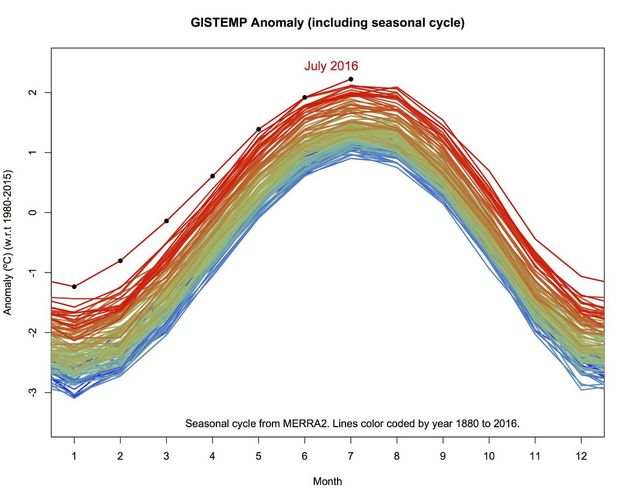
Source: Goddard Insititue for Space Studies
Another potential positive feedback mechanism is the melting of permafrost (ground frozen throughout the year) in places like Siberia, where it is estimated that a global temperature rise of 1.5 degrees Celsius could release 1 trillion tons of carbon dioxide and methane into the atmosphere over a span of years, something which takes industrial activity decades to do.
Gavin Schmidt, director of NASA’s Goddard Institute for Space Studies and one of its leading climate scientists, commented, “In the last 30 years we’ve really moved into exceptional territory. It’s unprecedented in 1,000 years. There’s no period that has the trend seen in the 20th century in terms of the inclination” (of temperatures).
One can also compare the last few decades of global warming to the most recent years. When the first indications of global warming were detected in 1977, it was predicted that average global temperatures would rise 2 degrees Celsius per century. In the past five years, the rate of global warming has been about five times that amount.
These rates are also much higher than what has occurred in Earth’s past when the planet has moved out of ice ages. During those periods, average temperatures typically rose 4-7 degrees Celsius over a span of 5,000 years. The past century’s rise in global temperatures has been 10 times faster than the most recent exit from an ice age. Current data suggests that the coming century’s rate of warming will be at least 20 times this rate.
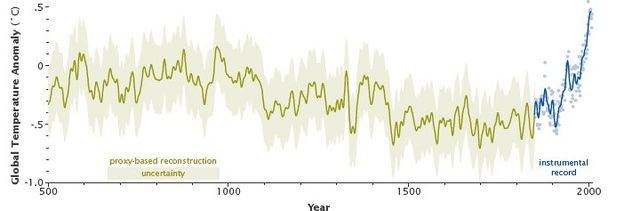
A comparison of measured temperature data over the past 136 years and temperature estimates for the past 1500. CREDIT: NASA Earth Observatory
Such estimates are in line with the latest month-by-month temperature data from both NASA and the National Oceanic and Atmospheric Administration. The thousands of worldwide meteorological stations, ship- and buoy-based instruments and Antarctic research stations all show that July 2016 was the hottest month ever in the 136 years of modern temperature recordings. It is also the tenth consecutive month of monthly high-temperature records (i.e., the hottest January ever, followed by the hottest February, etc.), the first of which was October 2015. If this trend continues, which it likely will, 2016 will be the hottest year yet recorded.
Some of these measurements are the effect of an abnormally long “El Niño,” a periodic warming of the Pacific Ocean that has taken place for at least 100,000 years. However, climate models of the most recent El Niño, which ended in May, show that even without the increase of temperatures caused, 2015 and 2016 would still be among the hottest years ever recorded.
Other metrics are available to provide insight into what Earth will look like if global temperatures continue current trends. Research done by the National Science Foundation from 2012 looked at the late Pliocene epoch, 2.7 million to 3.2 million years ago, the last time the carbon dioxide levels and global temperatures were as high as they will soon be. It was an attempt to understand the sensitivity of Earth’s glaciers to even small changes in global temperatures.
The research found that over the course of that period, sea levels were raised by 12 to 21 meters as a result of melted land ice from areas such as Antarctica. That is, Earth’s natural state with carbon dioxide at modern levels is one with sea levels possibly 21 meters higher than they are now and we are living through the process of the ecosystem approaching that state.
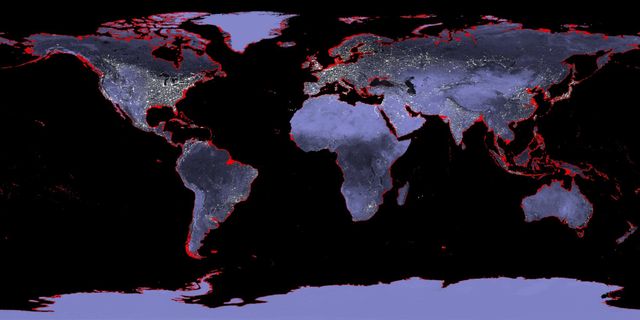
A world map highlighting areas (in red) that will be underwater if sea levels rise only 6 meters. CREDIT: NASA
A primary difference, however, is the rate of change of temperatures between the two periods. The Pilocene epoch was one that lasted half a million years. The current era of increasing global temperatures and carbon dioxide levels has lasted half a century, raising the probability of a much quicker, more major shift in the world’s ecosystem.
Most of these potential shifts are potentially catastrophic: oceanic acidification leading to the mass death of coral and plankton, the basis of the Earth’s food chain; the total collapse of the tropical rainforests; an ice sheet the size of Greenland or Antarctica falling into the ocean, causing a near instantaneous rise in worldwide sea levels of at least five meters and flooding one third of the world’s population.
Coral reefs are already suffering the longest global die-off on record, which has so far lasted 28 months and is not expected to end until at least 2017. It is estimated that at least 16 percent of the world’s reefs will die as a result.
Short-term effects of climate change have already been felt. Droughts in 1982 and 1997 were more intense than they would have been without climate change. Dry, hot weather in 1998, 2005 and 2007 almost set fire to the Amazon rainforests on a massive scale. This year, global warming has contributed to record flooding in South America, flooding and fatal landslides in Ethiopia, wildfires in Canada, droughts in Africa, Thailand and Venezuela, and a general increase in the intensity and destructiveness of this year’s Pacific tropical cyclones and Atlantic hurricanes. These are only a handful of the challenges to human well-being and even survival that have occurred in the past several years, attributable to global warming.


Colombian peace deal paves way for fiscal austerity

Neil Hardt

Colombian President Juan Manuel Santos announced Friday that the government and the FARC guerrilla group would formally sign a peace treaty on September 26. The deal was agreed upon in principle at the end of August and will be the subject of a national plebiscite scheduled for October 2. If approved, the treaty will formally bring to a close a 52-year civil war that has left over 200,000 dead and millions displaced.
Polls show the treaty will likely be approved by voters, who are justifiably eager for an end to the conflict. However, if ever approved and implemented, the peace deal will solve none of the problems plaguing Colombian society. Under the deal, the FARC will transform itself into a new bourgeois political party, while it and the government agree to forgive one another for the crimes they have committed against impoverished Colombian workers and peasants. It has been heralded by international banks and corporations as necessary to pave the way for further attacks on the Colombian masses.
The armed resistance of the FARC began in the aftermath of the Colombian Civil War of 1948-54. In the decades that followed, broad sections of the Colombian countryside were transformed into war zones as pro-government death squads terrorized the impoverished peasants with impunity. The Colombian government, with the support of US imperialism, has continued to cover up its role in carrying out mass murder, despite the fact that up to 80 percent of those killed in the conflict are victims of the government and its paramilitaries.
By the 1980s, the FARC had developed into a criminal syndicate whose right-wing political character found expression in its involvement in the drug trade and in its killing and extorting of innocent workers and peasants.
According to the terms of the deal, both the government and the FARC will be granted near-blanket amnesty for decades of extortion, kidnapping, murder, and torture. The FARC will be guaranteed a minimum of ten seats in the legislature if it turns in its weapons at a series of UN-monitored drop-off sites. Child soldiers will also be allowed to return from rural areas held by the FARC, and the government has promised a subsidy program aimed at reducing cocaine production.
President Santos has declared that the peace agreement represents the opening of a “new era” for Colombia. The head of the FARC negotiating team described the talks that led to the deal as “the most beautiful of all the battles” fought by the guerrilla movement.
In reality, the purpose of the deal is to pave the way for renewed attacks on the Colombian working class by international finance capital. According to an August 26 press release by the Fitch Ratings agency, “the agreement highlights the importance of rebuilding Colombia’s revenue base in order to accommodate required investment without jeopardizing fiscal consolidation.”
Fitch explained that transnational corporations are hopeful because “investment and growth could increase over the medium term, as areas that were formerly in conflict zones attract investment in mining and agriculture.” But most importantly, international finance capital views the agreement as necessary to cut government spending and impose a new tax reform plan aimed at reducing the deficit.
In July, Fitch reduced Colombia’s rating outlook to negative, “reflecting a large current account deficit, rising external indebtedness and a high government debt burden relative to rating peers.” The rating cut followed a similar move by Standard & Poor’s in February, which cited the drop in the price of oil as a major contributor to the government deficit.
Colombia’s creditors view the finalization of the peace treaty as necessary to minimize social opposition to the fiscal reform program. The Fitch statement made it clear: “Gathering support for the peace process and tax reform, while complementary, present political challenges for the government, especially given the tight legislative schedule.”
The most cynical role in this process has been played by the FARC. Founded in the aftermath of the Civil War of 1948-54 by a popular front of Stalinists and left-liberals, the FARC was idolized for decades by Maoists, Pabloites, Guevarists, and Chavistas as a “revolutionary” and “socialist” armed force.
“Today we bring to the Colombian people the transformative power that we have constructed in more than a half-century of rebellion,” FARC chief negotiator Ivan Marquez told the press on August 24, after news of the deal was announced.
In reality, the FARC’s right-wing character is exemplified in its signing a deal with the government that paves the way for renewed austerity in exchange for a government-guaranteed legislative presence.

Thousands of teachers strike as Costa Rican unions suppress struggle

Andrea Lobo

Last Thursday in San José, Costa Rica, about 5,000 workers and youth marched to the Legislative Assembly as part of a strike convoked by the Association of Teachers of Secondary Schools (APSE) union against wage stagnation, regressive taxes and legislative bills threatening to cut their pensions and other benefits that Congress began discussing that same day.
APSE has been the most active union protesting these historic attacks against workers, having brought relatively large contingents out on strikes in recent years, as well as in April and June of this year. The union was excluded from a collective agreement with the Ministry of Education (MEP) as reprisal for the strike in June.
The diminishing participation of workers in these demonstrations reflects their growing conviction that neither the union leaderships nor the political parties working with them are defending their interests, but are instead working behind their backs towards a deal with the government.
This policy has been developed through decades of betrayals against workers, which have led to a sharp fall in membership for APSE and other unions. While in 1984 the unionization rate reached a peak of 15 percent, today it has fallen to about 9 percent.
Carlos, a retired electrician who worked 40 years for the Costa Rican Electricity Institute (ICE), joined the demonstration to oppose the attacks of the government. He complained that “unions just take money from workers”. The union that he was part of, the National Association of Workers in Energy, Telecommunications and Related Sectors (ANTTEA) of the Patria Justa union coalition, allowed his pension to be reduced to less than half of his salary, while it “has taken money [bribes] from more than one.”
Speaking about the cost of his sons’ and daughters’ education, Carlos commented, “sometimes we don’t eat meat to buy books.”
Yamileth and Santiago
Yamileth, a school custodian for 21 years and a member of APSE, marched with her grandson Santiago. “We can only defend our work benefits out here on the street, not with negotiations. We are sending an ultimatum [to the government] today,” she said.
She was angry “that they want to increase our retirement age and now they are pushing through dual education, which will turn 14-year-old students into free labor for companies.” She also expressed how outrageous it was that public employees will only receive a 10 colones increase for every 100,000 colones (about $US180) in their salaries, or 0.01 percent.
The current historic assault is directed against not only public sector workers, but also the social conditions of all workers and youth. The increase in the regressive sales tax from 10 to 13 percent and the austerity measures in health and education during the Rafael Ángel Calderón PUSC (Social Christian Unity Party) administration (1990-1994) and the unity government of José María Figueres and Calderón (1994-1998)—comparable to the 15 percent added-value tax and social cuts being prepared today—led to massive growth in unemployment, poverty and the informal sector, as well as rising school desertion and the reappearance of formerly eradicated illnesses like dengue.
The Citizens’ Action Party (PAC) administration of incumbent President Luis Guillermo Solís and the Costa Rican ruling class as a whole are preparing for an intensification of the class struggle as the breakdown of social conditions intensifies. Already, the employment rate has fallen sharply for the past two years, reaching an abysmal 51.8 percent in the second trimester of 2016, according to the National Institute of Statistics and Census (INEC), making it the lowest in Latin America by a significant margin, according to Economic Commission for Latin America data.
Fewer people are seeking jobs, thus keeping the unemployment rate steady at around 9.5 percent, still one of the highest in the region, while real wages have fallen 3 percent and the poverty rate and informality have climbed steadily since 2010.
According to the central government budget for 2017, 44 percent of the budgetary increase from 2016 will be for debt payments. Accumulated debt is expected to climb to 49 percent of GDP next year. This vast accumulation of public debt with currently low interest rates represents a deliberately reckless situation that could make social services collapse. An estimated 67 percent of the 2017 education budget will be financed through debt.
The Inter-American Development Bank, the World Bank and the Central American Bank for Economic Integration are holding up on further financing until the value-added tax gets implemented, placing further stress on state expenditures.
If the new tax doesn’t get approved, President Solís insisted on Thursday, “we are going to make the Police Force compete for the resources of public education, public health, housing, and everything else.”
Another measure by the ruling elite is to tighten up the “tripartite agreement” between employers, the State and the unions, as stressed by the new minister of labor, Carlos Quesada, appointed in May.
In June 2015, the Patria Justa union coalition signed an agreement with the leaderships of pseudo-left Frente Amplio party and the ruling PAC, called “Patriotic Agenda for the Common Good,” which explicitly supports the current reactionary agenda of the government: “To carry out the political and civic control needed to guarantee the efficiency and effectiveness in the execution of public institution budgets, without any surplus,” the statement declares.
Ottón Solís, the founder of the ruling PAC, and Oscar Arias, the former PLN (National Liberation Party) president, have been working together to form a “national unity government” for the 2018 elections, which, according to Solís in an interview on Saturday with the far-right newspaper La Nación, enjoys the support “of a majority of the PLN directory. Weeks ago, Frente Ampio [and] the PUSC responded positively.” This project would count on either the explicit support or implicit obedience of the union bureaucracies.
Frente Amplio also agreed to negotiate with Arias for this partnership, something which would have been unheard of last year, when the party still opposed the right-wing agenda that they now support in Congress.
The WSWS also spoke to Félix, a music high school teacher, who insisted that voting for Frente Amplio and its presidential candidate, José María Villalta, “is not going to solve anything, just like [the current president] Luis Guillermo, they are just taking advantage of us.” When asked whether the unions were doing what was necessary to defend their interests, he replied that they are not and commented on how the situation is getting direr for workers. He added, “But watch out for some Comandante Zero [the Sandinista militia leader], a Castro or another guerrilla. They won’t help either.”
While one of the other two large teacher unions, the Education Workers Union (SEC), participated in the strike last week, the National Association of Teachers (ANDE), which participates in the Costa Rican Social and Union Block (BUSSCO), did not support this week’s strike nor the one in June.
The divisions between the unions, Félix explained, are due to the fact that all other unions focus on negotiating with the government officials, but at least APSE is “still more interested in supporting workers.”
However, APSE is financially and historically tied to the government and to the less active ANDE. Financially, the Ministry of Education (MEP) is the one responsible for extracting the 1 percent fee from teachers’ salaries that go to the education unions, and the pension and life insurance funds are administered by ANDE. Historically, APSE split from ANDE in 1955 as an “apolitical” union and was given access to MEP buildings and vehicles in its initial stages. Ultimately, the APSE leaders’ main interest is to continue having the support of the government so as to secure administrative posts, including a seat in the Superior Education Council, the commission on salaries, and others.
Both members of APSE, Yamileth and Félix, responded that there had not been any real efforts by APSE to make the struggle international, fighting for democratic rights and better living conditions internationally and appealing for the support of teachers and other workers abroad. The leaderships of both APSE and ANDE only make empty statements of support for broad groups like the teachers in Oaxaca, Mexico, or, in the case of ANDE, support for “left-turn” governments in Latin America.
The union leadership, including the reformist currents within the unions led by smaller nominally left parties, are aware of the implication of the intensification of the class struggle.
Martha Rodriguez, secretary general of the National Union of Workers of the Social Security Department (UNDECA) a leading member of BUSSCO, recently explained, “We are talking about a reduction in income for public workers that will affect unemployment, generate a reduction in the ability to acquire goods and services.” She concluded, “Services will deteriorate and that is how privatization would get justified.”
In spite of this grave warning, the UNDECA, ANDE and other leaderships in BUSSCO have insisted on helplessly appealing to the deaf ears of the parties in Congress. On July 21, they interrupted a session of the Legislative Assembly to yell from the visitors’ gallery and show placards with personal insults aimed at the politicians. These are the sort of actions that Gilberto Cascante, the president of ANDE, has been trying to pass off as the realization of the “indefinite strike” that workers are demanding, which he said “had already begun” back in June.
The only way for teachers and other workers in Costa Rica to protect themselves is to seek political independence from bourgeois parties and union bureaucracies, whose class composition has been predominantly petty bourgeois and which have historically defended bourgeois rule and capitalist exploitation. These forces’ “left” statements are aimed at politically disarming the most militant workers in order to suppress the class struggle and facilitate the assault against the living standards and democratic rights of all workers and youth in the service of the Costa Rican ruling elite and US imperialism.

UK: Review of Investigatory Powers Bill gives all-clear to mass surveillance

Trevor Johnson

A report commissioned by the UK Conservative government to review the “bulk” powers proposed in the Investigatory Powers Bill aims to bolster its argument in favour of mass spying and indiscriminate collection of personal data. It is nothing more than a cover for the real aim of the ruling elite—to increase the power of the state to monitor the population for any signs of potential threats to their interests.
The “Report of the Bulk Powers Review” by David Anderson QC, who is designated the “Independent Reviewer of Terrorism Legislation,” was published August 19.
Together with his previous 2015 report, “A Question of Trust: Report of the Investigatory Powers Review,” the Bulk Powers Review was commissioned to ease the passage of the Bill (known as the “Snoopers’ Charter) into law. To facilitate this, Anderson is portrayed as an expert who is independent of both the government and state apparatus.
With virtually no media coverage, MPs in the House of Commons voted in June by 444 to 69 in favour of the Bill. It will now be discussed in the House of Lords and is likely to come into effect in January 2017.
Anderson is a Queens Counsel (senior barrister appointed on the recommendation of the Lord Chancellor) and appointed “Independent Reviewer” in 2011 by then home secretary and now prime minister Theresa May.
Anderson came to public prominence earlier this year when he played a key role in a BBC Panorama documentary, Edward Snowden: Spies and the Law, which served as propaganda in favour of the spying carried out by the Government Communications Headquarters’ (GCHQ) on millions of people. Anderson spoke in favour of bulk data collection because there was “no way of predicting in advance in which packet of data, in which cable contains the incriminating information.”
In the documentary, Andersen also set the tone for his review, arguing that Internet service providers ought to retain Internet records for a year, so that they could be trawled through by the secret services. He declared that this was not itself a bulk power and would therefore not be investigated.
The team he picked to carry out the review speaks volumes about his role. To help him investigate the activities of the secret services were none other than former members of the secret services, including Robert Nowill, GCHQ’s former director of technology and engineering, and Gordon Meldrum, the National Crime Agency’s former director of intelligence.
The report is based on evidence given to these trusted establishment figures by GCHQ and the other spying agencies, MI5 and MI6. Case studies were clearly selected in order to strengthen the case for the bulk powers. For instance, one concerns a terrorist group in Syria responsible for hostage-taking and attempted attacks on UK nationals, which GCHQ claims could only be countered by “bulk equipment interference” (EI)—the hacking straight into the devices and systems of large numbers of innocent people, bypassing encryption measures, on the off chance unknown individuals or data are discovered. The device and data it contains can be remotely monitored, changed, infected or destroyed.
Unsurprisingly, their conclusion is that there is a “proven operational case” for three of the four bulk powers examined, and a distinct “though not yet proven” operational case for the fourth bulk power.
Anderson’s report claims bulk powers “play an important part in identifying, understanding and averting threats in Great Britain, Northern Ireland and further afield” including cyber-attacks, espionage and terrorism, child sexual abuse and organised crime.
His argument is that while mass surveillance represents a lessening of privacy, it is necessary for the sake of increased security. This flies in the face of the countless revelations that state spying is aimed at the general population that Anderson claims it should be protecting.
Anderson nowhere addresses why GCHQ and the domestic spying agency MI5 should be trusted to gather and handle private information on millions of people, when there is so much evidence of their existing powers being misused. Nor does he refer to the issue of police infiltration of political, environmental and campaign groups, including the family of murder victim Stephen Lawrence.
The strengthening of the military and intelligence arms of the ruling class is intensifying. Last September an anonymous serving general threatened a mutiny, within days of Jeremy Corbyn’s election as Labour leader, should a Labour government come to power with Corbyn at the helm, citing his unreliability to rule due to his declared opposition to the use of nuclear weapons.
The claim in Anderson’s previous report, and in the Panorama documentary, that the new powers in the Investigatory Powers Bill cannot be misused because they require a warrant providing judicial “independent oversight,” is worthy only of contempt. Such oversight was claimed to have existed in the years when GCHQ and other intelligence agencies carried out mass surveillance outside of the law as revealed by Snowden.
Even Anderson in his previous report “A Question of Trust” was forced to admit that “RIPA [Regulation of Investigatory Powers Act, 2000], obscure since its inception, has been patched up so many times as to make it incomprehensible to all but a tiny band of initiates. A multitude of alternative powers, some of them without statutory safeguards, confuse the picture further.”
What is described here—“a tiny band of initiates” using laws only they understood to run state spying activities without statutory safeguards—is utterly damning. The “patching up” of the law was done after the fact in order to justify what GCHQ were either already doing or actively developing.
That the security services are a law unto themselves was shown in June by Edward Snowden, who revealed that, beginning in 2009, GCHQ had already embarked on “bulk powers” spying under its MILKWHITE programme. One leaked document described MILKWHITE as a “support system” for Home Office plans to modernise its domestic interception (spying) capabilities.
As part of MILKWHITE, the agency provided access to vast amounts of metadata—logs of telephone conversations, emails and other communications—to MI5, the Metropolitan Police, Her Majesty’s Revenue and Customs, the Serious Organized Crime Agency (now the National Crime Agency) and the Police Service of Northern Ireland, as well as the eight former Scottish police forces. GCHQ was seeking an additional £20.8 million to update its “advanced analytics” section in 2011/12 due to “increasing customer demand” for the service.
This whole intrusive, illegal system of mass surveillance was planned and operated in secret without any trace of a “public debate” on “bulk powers.” Anderson’s review gives a backdated seal of approval to these activities, justifies their continued deployment and paves the way for the next step.

Deteriorating Australian economy adds to pressure on Turnbull

Mike Head

Economic data released over the past week highlights how far the economic situation in Australia has continued to worsen since Malcolm Turnbull was installed as prime minister last September 14—a year ago next week. The impact of the 2008 global financial breakdown is deepening after Australian capitalism was initially cushioned by huge Chinese stimulus packages that resulted in high demand for Australian mineral exports.
When Turnbull ousted his predecessor Tony Abbott he justified the Liberal Party room coup by declaring that Abbott failed to provide the necessary “economic leadership” for the country. But the statistics show sharply falling business investment, stagnant retail sales, declining real wages and destruction of full-time jobs over the past year.
This deterioration, driven by China’s slowdown, global slump and further falls in export commodity prices, is intensifying the demands of the financial elite for the ruling Liberal-National Coalition, which barely survived the July 2 election, to move swiftly to impose far deeper cuts to social spending, corporate taxes and working conditions.
Corporate discontent with Turnbull’s performance is feeding into the pressure being applied by Washington for the government to militarily challenge China’s territorial claims in the South China Sea, and the media campaign calling into question Turnbull’s commitment to a confrontation with China, which is Australia’s largest export market.
Gross domestic product figures released today by the Australian Bureau of Statistics (ABS) show the quarterly pace of growth halved to 0.5 percent in the June quarter from 1.0 percent in the first three months of 2016. While the headline annual figure was 2.9 percent for 2015-16, that is deceptive. The growth consisted mostly of larger export volumes as the major mining companies pumped up production to try to offset lower prices, while much of the domestic economy was close to recession.
According to ABS data released last week, business investment declined by 15.2 percent last year. This is an ominous statistic because it foreshadows further major job losses in the period ahead. Mining investment fell 34.5 percent in the past year, and manufacturing investment declined 7 percent. While total non-mining investment grew by 2.8 percent, it was nowhere near enough to offset the overall drop.
Investment in mining has fallen by 56 percent since its peak of September 2012. By contrast, non-mining investment since then has risen by just 5.9 percent. In total, investment has dropped continuously since December 2012, with the size of the quarterly falls growing since mid-2015, just before Turnbull ousted Abbott.
These results point to the fraud of Turnbull’s claims, initially backed by the corporate media, of making a “transition” to a new “exciting” economy based on “innovation” and higher-value services exports to China and other Asian markets.
The ABS forecasts for 2016–17 are even worse. Total private capital expenditure just exceeded $50 billion in 2015-16, but is expected to fall below $45 billion in 2016–17. This is the lowest such estimate since 2009–10, and that is in nominal terms, not accounting for inflation.
Although prices for Australia’s main mining exports rose marginally in recent months, they are predicted to fall again, resuming a devastating slide over the past five years.
* Coal prices have halved from their peak of $US132.5 per metric tonne in January 2011 to $67.3 in August 2016.
* Iron ore prices have been cut by two-thirds, from a peak of $187.2 per dry metric tonne unit in March 2011 to $61 in August 2016.
* Prices for liquefied natural gas (LNG), once touted as the new saviour of Australian capitalism, are also now just a third of the July 2012 peak of $18.1 per million British Thermal Units, sitting at $6.3 in August 2016.
These falls have cut government royalty and tax revenues, both federal and state, helping to push the annual federal budget deficit to around $40 billion, which is higher than it was in the immediate aftermath of the 2008 crash.
ABS figures released last week reported that total Australian retail turnover, in current prices, remained virtually flat for the past three months. Turnover was unchanged in July, seasonally adjusted, following virtual zero growth since January. For six consecutive months, growth has not exceeded 0.1 percent per month. This is well below the 20-year average of 5 percent annual growth in retail sales.
The depressed trend is the result of ongoing job losses and lower wages, which are forcing working class households to cut back on spending, with the worst results in household goods and department stores.
Even according to under-stated ABS unemployment estimates, the number of full-time jobs actually fell by more than 60,000 during the past year, while growing numbers of workers were pushed into lower-paid and less secure part-time or casual employment.
On average, real wages have increased by only 0.3 percent since 2013, and that figure is distorted by the widening gulf between the highest-paid executives, on millions of dollars per year, and the vast majority of workers, whose incomes are falling.
Except for a property bubble since 2012 in the three eastern capitals of Sydney, Melbourne and Brisbane, the economy would already be in recession. While business investment dried up, speculative funds poured into real estate, sending housing prices and rents soaring, adding enormously to the burdens on working class people.
However, analysts are warning that this bubble could burst. Prices have been falling for some time in the cities most exposed to the collapse of the mining boom, such as Perth and Darwin. Now there are clear signs of a glut in apartment construction in the eastern centres, which will soon throw thousands of building workers onto the dole queues.
AMP Capital chief economist Shane Oliver yesterday said apartment prices will fall by 15 to 20 percent in Sydney and Melbourne over the next two years. This could trigger defaults, especially among “off-the-plan” buyers who paid deposits on the expectation of ever-rising prices.
Earlier, global banking giant Citi made a similar prediction, saying housing starts reached a record 230,000 over the past 12 months, but the number was expected to fall to 172,000 in 2018. According to Citi’s equity analysts, risks are already rising for banks and developers.
The recessionary trends have continued despite the Reserve Bank of Australia (RBA) cutting official interest rates twice since last August, down to a record low of 1.5 percent. In its latest statement on monetary policy, issued yesterday, the RBA described the decline in business investment as “very large.”
Last month, as the parliament was about to reopen following the July 2 election, RBA governor Glenn Stevens delivered a warning to the Turnbull government and the political establishment as a whole: you must slash social spending, despite popular opposition, or the budget cuts will be imposed via a “moment of crisis.”

Syrian war threatens to escalate as Obama-Putin talks fail

Jordan Shilton

A 90-minute meeting between US President Barack Obama and his Russian counterpart Vladimir Putin on the sidelines of the G20 summit in Hangzhou, China Monday produced no results on an agreement between the two countries over the civil war in Syria.
Reports on the meeting spoke of the tense atmosphere between the two leaders. For his part, Obama absurdly sought to strike a pose of deep concern for the humanitarian situation in Syria and pinned the blame on Moscow and its allies in the Assad government in Damascus for the ongoing violence.
The failure of the previous ceasefire had enabled Assad to bomb “rebel” opposition groups “with impunity,” Obama intoned, creating a “very dangerous dynamic.”
Yesterday, Western media outlets fueled this narrative by widely reporting as fact unconfirmed allegations that the Assad government had launched a chlorine gas attack in Aleppo. The claims were based on a video posted online by the Syrian Civil Defence, a rescue team which operates in areas controlled by government opponents. They alleged that four barrel bombs containing poison gas were dropped, injuring 80.
In the past, the US has repeatedly seized on such allegations to prepare the ground for direct military intervention. On each occasion, the claims have turned out to be fraudulent, including most famously in 2013 when Obama pulled back from an all-out war with the Assad regime.
The allegations came in the wake of significant government advances at the expense of opposition forces around Aleppo. Indicating the potential for a rapid escalation of the conflict, Turkish President Recep Tayyip Erdogan, whose government is currently leading an invasion in the north of Syria to clear Kurdish militants and Islamic State forces from the Turkish-Syrian border, responded to the fighting by suggesting that Turkish troops could clear a humanitarian corridor to Aleppo. He reiterated his call for a “safe zone” between the towns of Jarabulus and Azaz, a move which would create a justification for the deployment of NATO troops, including from the European imperialist powers, to Syria.
According to a Reuters report, Turkish officials are appealing for international support to establish control over an area stretching 40 kilometres into Syria so as to break up two Kurdish-controlled areas to the east and west. An anonymous Turkish official commented that only the initial stages of this plan had been accomplished, before adding ominously, “What will be done now will depend on coordination with coalition powers and the support they will provide.”
The attempt by Obama and the corporate media to cloak US machinations in Syria in human rights propaganda should fool no one. Washington has waged virtually unending war over the past quarter century throughout the Middle East, laying waste to entire societies and claiming the lives of millions in the process. The calls for humanitarian aid and safe zones are transparent pretexts to legitimise a vast intensification of the imperialist intervention in Syria.
Even during the course of the past two weeks, since Secretary of State John Kerry met with Russian Foreign Minister Sergei Lavrov in Geneva to discuss Syria, it has been the US and its Turkish allies which have brought about the most significant escalation in violence with an all-out invasion of the north of the country. The Turkish troops and their Sunni Islamist allies made no secret of the fact that they intended to target Kurdish forces and drive them east of the Euphrates River. The US has been backing these same Kurdish forces with arms, funding and training for them to serve as proxies in Washington’s campaign against Islamic State.
The Turkish army reported its first fatalities yesterday, when two soldiers were killed in a rocket attack by ISIS forces. On Sunday, Turkish troops reportedly forced ISIS fighters out of their last stronghold on the Turkish border.
Despite Washington’s backing for Ankara’s open-ended intervention with air power and military “advisers” on the ground, Obama persisted after his meeting with Putin in casting Russia as the aggressor.
“We have had some productive conversations about what a real cessation of violence would look like to allow us to both focus our energies on common enemies,” Obama told a press conference afterwards. “But given the gaps of trust that exist, that’s a tough negotiation. We haven’t yet closed the gap.”
An unnamed White House official later told the Washington Post that Obama had been unwilling to strike a deal with Putin that would not secure the “long-term goals” of the US in Syria.
References to Washington’s “long-term goals” in Syria is code for the implementation of a long-planned regime change operation in Damascus that would replace Assad’s government with a pro-Western puppet regime. This has been the aim of US imperialism ever since it began fomenting the Syrian civil war five years ago by funding and arming Islamist extremist forces, including groups with ties to Al Qaida. Its intervention in Syria is part of a broader regional agenda of securing US dominance over the most important oil-producing region in the world and establishing an unchallengeable position on the Eurasian land mass by weakening its geo-strategic rivals, above all Russia and China.
This reality was summed up in a comment published by Anthony Cordesman, a veteran strategist of US imperialism, on the Center for Strategic and International Studies think tank’s web site yesterday. Cordesman blasted the Obama administration’s strategy of seeking a deal with Russia, writing, “Russia has steadily used its military intervention to promote its own interest in Syria and the Middle East, attack the Arab rebels, and support the Assad regime. Russia has also built new ties to Iran, shipped Iran advanced S300 surface-to-air missiles, and managed to reach out Saudi Arabia in spite of this—seriously discussing agreed limits on their petroleum production and exports.”
Cordesman went on to declare that ISIS was not the main problem in Syria or Iraq. After describing the ethnic partition of the country and the conflicts this has produced as if the US was a passive bystander, he noted in a revealing passage that the Obama administration “has never addressed the fact that the real fight for Syria is taking place where ISIS isn’t.”
Cordesman’s comment reflects growing concern among ruling circles about the lack of a US strategy in the region. Substantial sections of the political establishment, including leading Republicans, have rallied behind presidential candidate Hillary Clinton because she has pledged to intensify US military aggression abroad following November’s election.
However, Obama’s overtures to Russia for an agreement in Syria are in no sense a sign of decreasing tensions and a retreat by the US. The immediate impulse for a new ceasefire is the advances that have been made by government troops around the city of Aleppo. While US-backed rebels made substantial gains in early August, Assad’s forces have pushed back the Islamists with the help of Russian air support. A supply route to the north of Aleppo has been cut off by government soldiers and Assad’s troops also broke through a rebel-controlled corridor to the south of the city.
The US-backed, Turkish-led intervention into northern Syria, which brings troops from NATO countries in to close proximity with Russian forces, has heightened the potential for a clash between NATO allies and Moscow that could quickly spiral out of control into a broader war. Even if a deal is reached, it will not end the pursuit by Russia and the United States of opposed strategies in Syria that pose an ever increasing risk of direct military conflict between two nuclear-armed powers.
This is made all the more probable given the deep contradictions in Washington’s Syria policy. It has leant its full backing to the Turkish incursion, which is explicitly seeking to establish a zone free of Kurdish control in northern Syria to prevent the emergence of a unified area of Kurdish control, while at the same time it continues to support the Kurdish People’s Protection Units (YPG)–the forces now coming under Turkish bombardment.
Obama also had a bilateral meeting with Erdogan at the G20. Obama sought to paper over divisions by reassuring Erdogan that Washington would support Ankara’s efforts to bring those behind the 15 July abortive coup against Erdogan to justice, even though it is widely acknowledged that the US at the very least tacitly supported it.
Erdogan pointedly told the press afterwards, with reference to Syrian Kurdish organisations considered by Ankara to be terrorist, “All forms of terrorism are bad. All forms of terrorism are evil.”

White House to maintain nuclear “first strike” policy

Andre Damon

On Tuesday, the New York Times published as its front-page lead article a piece, written by longtime military/intelligence insider David Sanger, reporting internal White House discussions that the Obama administration is planning on maintaining the United States’ “first strike” nuclear weapons policy.
In recent months, the Washington Post and Times had published reports that President Obama had considered formally adopting a policy of not using nuclear weapons unless the US was attacked by such weapons first.
On July 10, The Washington Post reported, “The Obama administration is determined to use its final six months in office to take a series of executive actions to advance the nuclear agenda the president has advocated since his college days,” including the possible adoption of a “no first use” policy.
But Tuesday’s report in the Times declared that Obama “appears likely to abandon the proposal after top national security advisers argued” that it would “embolden Russia and China.”
The move takes place amidst a series of US provocations against both countries, including the deployment of thousands of troops on Russia’s border in Eastern Europe and ongoing “freedom of navigation” operations in the South China Sea. In their statements to the Times, White House and military officials were sending a clear signal that it will abide no scaling back of the US threat to kill millions of people to facilitate its geopolitical aims.
The White House decided ultimately to agree to the demands of Commander of Strategic Command Admiral Haney, Secretary of Defense Ashton Carter, Secretary of State John Kerry and others who declared, according to the Times, that “new moves by Russia and China, from the Baltic to the South China Sea, made it the wrong time to issue the declaration.”
Both before and during his presidency, Obama had postured as a proponent of nuclear non-proliferation. In his April 2009 speech in Prague, Obama declared that “as the only nuclear power to have used a nuclear weapon,” the US is committed “to seek the peace and security of a world without nuclear weapons,” and that “to put an end to Cold War thinking, we will reduce the role of nuclear weapons.”
Earlier this year, Obama visited Hiroshima, Japan, becoming the first sitting US president to do so since President Truman made the decision to incinerate the city with an atomic weapon at the end of the Second World War. Despite ruling out any apology for this war crime, Obama hypocritically called on countries that possess nuclear weapons to “have the courage to escape the logic of fear and pursue a world without them.”
Yet Obama’s real “nuclear legacy” is something else entirely. Over his eight years in office, the White House has initiated one of the most sweeping expansions of its nuclear capabilities in US history.
The Pentagon has embarked upon a $1 trillion nuclear modernization program, seeking to make US nuclear weapons smaller, faster, more maneuverable and easier to use on the battlefield. The effect of this program is, as General James E. Cartwright, a retired vice chairman of the Joint Chiefs of Staff, told the Times earlier this year, “to make the weapon more thinkable.”
At a cost of some $97 billion, the Navy is on track to replace its Ohio-class submarines, each of which is by itself equivalent to the world’s fifth-ranking nuclear power, with a new generation of ballistic missile submarines.
The Air Force, meanwhile, has contracted Northrop Grumman to build up to 100 next-generation B-21 nuclear-capable bombers, at a cost of nearly $60 billion. It is also in the midst of developing, at the cost of $20 billion, the so-called Long-Range Stand-Off Missile, which is capable of maneuvering at high speeds to deliver a nuclear payload behind enemy air defenses.
Experts have warned that the development of such a “dual use” nuclear-capable cruise missile makes the potential for a catastrophic miscalculation substantially greater, as countries attacked by these weapons, in addition to having little time to respond, have no way of knowing whether their payload is “conventional” or nuclear.
On Tuesday, Bloomberg reported that the Air Force also plans to spend another $85 billion to develop a set of new intercontinental ballistic missiles. The Pentagon is moving ahead with plans to buy some 642 of the new ICBMs “at an average cost of $66.4 million each to support a deployed force of 400 weapons.”
The dizzying pace of the US nuclear modernization program comes in the context of a deepening global geopolitical crisis, at the center of which is the ever expanding war drive of American imperialism.
Beginning with economic crises of the late 1960s and early 1970s, the American ruling class sought to offset the economic decline of US capitalism through the naked use of military force. With the dissolution of the Soviet Union, this process went into overdrive, kicking off a quarter century of intensifying war around the globe. Now, US-led regional wars and proxy conflicts, particularly in Syria, are metastasizing into ever-more direct conflicts with larger competitors, including Russia and China.
With the crisis-ridden US election dominated by allegations from the Clinton campaign of Russian cyberattacks and political subversion, together with ongoing and deepening tensions with China, the United States is sending a clear signal that it is thinking about the “unthinkable.”
Eighty years ago, Russian revolutionary Leon Trotsky warned, “In the period of crisis the hegemony of the United States will operate more completely, more openly, and more ruthlessly than in the period of boom.” Anyone who believes that the US would never again use nuclear weapons is underestimating not only the extent of the internal and external crisis confronting American imperialism, but the level of violence and criminality of which the American ruling class is capable.

6 Sept 2016

Gates Cambridge Scholarships (Masters & PhD) in UK for International Students 2017/2018

Brief description: Gates Cambridge Trust offers full fee postgraduate (Masters and PhD) Scholarships for outstanding International students to study any course at the University of Cambridge, UK 2017
Application Timeline:
Applications Open : 5th September, 2016
Applications Close: 7th December, 2016
Accepted Subject Areas: Masters and PhD Courses offered by the university
About Scholarship: Gates Cambridge Scholarships are highly competitive full-cost scholarships. They are awarded to outstanding applicants from countries outside the UK to pursue a full-time postgraduate degree in any subject available at the University of Cambridge. The programme aims to build a global network of future leaders committed to improving the lives of others.
Scholarship Offered Since: Not SpecifiedGates Cambridge scholarship
Scholarship Type: Full-cost Masters and PhD scholarship
Selection Criteria
  • outstanding intellectual ability
  • leadership potential
  • a commitment to improving the lives of others
  • a good fit between the applicant’s qualifications and aspirations and the postgraduate programme at Cambridge for which they are applying
Eligibility
  • a citizen of any country outside the United Kingdom.
  • applying to pursue one of the following full-time residential courses of study: PhD (three year research-only degree); MSc or MLitt (two year research-only degree); or a one year postgraduate course (e.g. MPhil, LLM, MASt, Diploma, MBA etc.)
  • already a student at Cambridge and want to apply for a new postgraduate course. For example, if you are studying for an MPhil you can apply for a Gates Cambridge Scholarship to do a PhD. However, if you have already started a course, you cannot apply for a Gates Cambridge Scholarship to fund the rest of it.
  • already a Gates Cambridge Scholar and want to apply for a second Scholarship. You must apply by the second, international deadline and go through the same process of departmental ranking, shortlisting and interviewing as all other candidates.
Number of Scholarship: Several
Value of Scholarship
Scholarship will cover the full cost of study
  • the University Composition Fee and College fees at the appropriate rate
  • a maintenance allowance for a single student
  • one economy single airfare at both the beginning and end of the course
Duration of Scholarship: For the duration of the programme
Eligible Countries: For international students
To be taken at (country): Cambridge University UK
How to Apply
Sponsors
Gates Cambridge Trust
Important Notes:
Gates Cambridge Scholarships are extremely competitive: over 4,000 applicants apply for 90 Scholarships each year.
Given the intense competition, the Trust has a four stage selection process:
  • Departmental ranking – the very best applicants to each department are ranked on academic merit only
  • Shortlisting – Gates Cambridge committees review the applications of ranked candidates using all four Gates Cambridge criteria and put forward a list for interview
  • Interview – all shortlisted candidates have a short interview to assess how they meet all four Gates Cambridge criteria
  • Selection – chairs of interview panels meet to decide the final list of Scholars
  • A good fit between the applicant’s qualifications and aspirations and the postgraduate programme at Cambridge for which they are applying

UK: Clarendon Fund Scholarships for International Students 2017/2018

Application Deadline: Applications for entry in 2017-18 can be submitted from 1 September 2016. The closing date is 6th or 20th January 2017 depending on the course of study.
Offered annually? Yes
Scholarship Name: Clarendon Fund Scholarship
Brief description: The Clarendon Fund scholarships open to all graduate (Masters, MBA and Doctoral degree) applicants regardless of Nationality for entry in 2017/2018 at University of Oxford UK
Accepted Subject Areas: All subjects can be funded by a Clarendon Scholarship. There is no quota by subject or preference for any particular course type. This encompasses all full-time and part-time Master’s courses (MSt, MSc, BCL/MJur, MBA, MFE, MPhil, BPhil, MSc by Research, MTh) and all DPhil programmes. A list of the all the graduate courses offered by the University of Oxford can be found on the Graduate Course Guide (from link below).
About Scholarship: The Clarendon Fund offers around 140 full scholarships every year to academically excellent graduate students from all around the world. Clarendon Scholarships are awarded on the basis of academic excellence and potential across all degree-bearing subjects at graduate level at the University of Oxford. The scholarships cover tuition and college fees as well as a generous grant for living expenses, and all graduate applicants who apply for study at the University by the January deadline, in their respective year of entry, will be automatically considered for this prestigious scholarship funding.
Scholarship Offered Since: 2001
Selection Criteria: Selection criteria vary slightly depending on the subject area and whether applicants apply for a taught or research degree, but include:
  • An excellent academic record is essential:
  • A high first class honours degree or its equivalent (a GPA score of at least 3.7 if the mark is out of 4, noting that most successful candidates achieve a score higher than 3.7) or an outstanding academic record at Master’s level is necessary (noting that an outstanding Master’s degree can compensate for a moderate first degree performance).
  • Other indicators of high academic achievement may include individual marks on student transcripts; evidence of previous university prizes or awards;
  • information on your overall position within your cohort; and publications (if applicable).
  • Aptitude for the proposed course of study: This may be assessed by reviewing academic references, the research proposal, demonstrated evidence of aptitude for research, and the likelihood the scholar will contribute significantly to their field of study.
  • Student motivation: This is assessed through evidence of the applicant’s commitment to their proposed course, evaluated by the personal statement and referees’ reports.
Who is qualified to apply?
  • Candidates applying to start a new graduate course at Oxford are eligible. This includes students who are currently studying for a Master’s degree at Oxford but who will be re-applying for a DPhil (you would be eligible for funding for the DPhil).
  • Scholarships are tenable in all subject areas and open to candidates who will be starting a new course.
How Many Scholarships are available? Not Specified (Several)
What are the benefits?
  • All Clarendon Scholarships cover tuition and college fees in full and a generous grant for living expenses.
  • The grant for living expenses for scholars on a full-time in 2010-11 is GBP£13,590, which is normally sufficient to cover the living expenses of a single student living in Oxford.
Duration: Clarendon Scholarships are offered for the full period that you are liable to pay tuition fees to the University, which is usually the same as the length of your course
Eligible African Countries
Clarendon scholars come from all continents in the world: from Africa, North America, Australia, South America, Asia, the Middle East to Europe
To be taken at (country): University of Oxford, UK
How to Apply: If you apply for a full- or part-time master’s or DPhil course at Oxford by the January deadline for your course, you will automatically be considered for a Clarendon Scholarship.
You do not need to submit any additional documents specifically for the Clarendon Scholarships and there is no separate scholarship application form.
Visit the Scholarship Webpage for details
Sponsors: The Clarendon Fund with donations from partners within and outside the University
Important Notes: Scholarships are subject to an annual renewal process based on satisfactory academic progress.