9 Dec 2016

Fossil Fuel Corruption: The Problem With Adani

Binoy Kampmark

“Every day that we stop Adani digging that coal is a day this planet is free from its pollution.”
Paul Sinclair, Times of India, Dec 5, 2016
The relationship between the mining sector and the Australian government has been traditionally that of complicity and acceptance. Touch this sector at your peril. Changes in prime ministers, rumbles in cabinet, and the overall show have suggested the influence had by the fossil fuel lobby in the market place.
Even by these standards, Adani Mining has done well for itself.  The placation and encouragement of this famed abuser of the environment has been stunning.  Australian politicians at the state and commonwealth level have marched to its tune for some years now, seeing it as a blessed provider in the development stakes. Whatever ends up on the desk in Canberra on this subject, rest assured that this mining monster will receive an endorsement.
The previous Newman government in Queensland waxed lyrical about the tentacle-like entity and its efforts to establish what would be the largest coal mine in the southern hemisphere, located in the state’s Galilee Basin. The first hurdle was the Queensland government and the need to secure the status of being a “suitable operator” under the Environmental Protection Act 1994 (Qld).  It was obtained without a single hiccup.
The cost of the Carmichael mine was intially projected to be $16.5 billion, featuring six open cut mines and five underground mines.  Over sixty years, the mine is expected to export in the order of 60 million tonnes of thermal coal per annum. A broader strategic vision with Indian energy is also envisaged, in so far as the mine system will supply coal to generate energy for up to a hundred million people.
Adani’s arguments have ranged across the environmental, logistical and bank book. There were doubts from the start that this ongoing concern would be a costly, and unsustainable venture for both banker and environmentalist.  The retort from the company personnel was that all was in order, with the company owning all the links in the chain “from pit to port”.
Then come the promises of employment glory and job creation, suggesting that the company was actually owed a break; consider the forecast of 10,000 direct and indirect jobs, with the creation of 2,500 to 3,000 full time jobs.  Ever at the ready, environmental groups have been onto that figure, arguing that a more humble 1,500 was a better approximation.
Turning a blind eye has since become a matter of state policy.  “The Queensland and Federal governments,” claimed Wangan and Jagalingou Traditional Owners Council spokesperson Adrian Burragubba, “knowingly overlooked that we stand in the way of this mine and when we say ‘no’ we mean no.  Through our legal actions we are intent on stopping this massive and destructive project from moving forward.” This is an entity proposing to dredge 1.1 million cubic metres of spoil in proximity of the Great Barrier Reef Marine Park.
A review of the Adani group’s environmental history by Environmental Justice Australia makes startling reading, though hardly surprising given the less than illustrious history of the entity. “This group has committed serious legal violations and caused extensive environmental harm in India.  It is therefore not a suitable operator, and its registration should be cancelled.”
Mindful that the hair splitters would be out in force to suggest that an Indian operation conducted by a branch of the company would not necessarily tarnish an operation in Australia, the authors also noted that Adani Mining Pty Ltd was “a wholly owned subsidiary in the Adani group, and is inextricably linked to the group’s integrated operations.”  Operations conducted by different members within the same group were not distinguished.
The head of the entire group remains Chairman Gautam Adani, who sees Australia as the true fossil fuel frontier rich with goods.  He has sought to be pampered by government, yet another example of how poor business will still be backed even by governments believing in the free market.  He has sought, and been promised $1 billion, to build the rail line from the Galilee Basin to the Queensland coast.
Adani, in a sense, has several politicians in his pocket, a point made a touch more obscene by his travels through the country with his private jet.  Australia is there for the plutocratic taking.  The Prime Minister, Malcolm Turnbull, has kept him company.  As has the Queensland Premier Annastacia Palaszczuk.  State Development Minister Anthony Lynham can only see the dollar signs.  “North Queensland is about to see a new horizon, because these big projects will be a huge economic stimulus for the north.”
Federal minister Matt Canavan verged on the imbecilic, suggesting that Adani’s arrival in Townsville was the “biggest news for North Queensland since the Beatles came to Australia”. Proportion and awareness have been pure casualties in this fossil fuel scrap.
The Adani group, in short, is a sullied one. Its pedigree as an environmental vandal is unquestioned. Its operating practices have retained an air of supposed and actual impropriety.  What it hopes here is that the Australian base of operations will have a sanitising sense to it, while feeding that long held sense in the country that plunderers are to be cherished.  The fossil fuel industry, in short, remains dirty in more ways than one.

Economic contraction intensifies pressure on Australian government

Mike Head 

Australian capitalism’s poorest economic performance since the 2008-09 global financial breakdown has underscored the economy’s fragility and heightened the corporate pressure on the unstable Liberal-National Coalition government.
Seasonally adjusted gross domestic product (GDP) fell by 0.5 percent in the September quarter, driven by a continuing collapse in business investment—down 9.7 percent over the past year. This was accompanied by a reversal in housing construction, cuts in government expenditure and decelerating consumer spending.
This is only the fourth time the economy has shrunk since the last official recession in Australia 25 years ago, before the start of the mining boom. The three previous quarterly falls could be explained by short-term drops in 2000 after the introduction of the goods and services tax, the 2008 crash and devastating floods in Queensland during 2011.
Far from a one-off blip, however, this downturn is part of a longer-term decline in Australia’s commodity export-dependent economy. Since June, the annual growth rate has dropped from 3.1 percent to 1.8 percent, despite the Reserve Bank keeping official interest rates at a record low 1.5 percent.
This is the result of ongoing global stagnation, a worldwide investment slump and what CommSec chief economist Craig James described as a “perfect storm” of political uncertainty. He cited June’s Brexit vote, the Coalition government’s near-defeat in July elections and the US presidential election. Since September, the uncertainty has only been exacerbated by Donald Trump’s victory and his threats of trade war, which would have devastating consequences for the Australian and world economy.
The September quarter contraction was considerably greater than market analysts predicted and much worse than the forecasts issued in last May’s budget of nominal growth of 4.25 percent this year and 5 percent in 2017-18.
This throws into deeper doubt the capacity of Prime Minister Malcolm Turnbull’s government to meet the demands of the financial elite and the global credit ratings agencies to eliminate the annual budget deficit, currently running at about $40 billion, by 2021.
Economists and media pundits rushed to assure the public there was no danger of a recession, which is usually measured by two consecutive quarters of contraction. But the September result has merely brought to the surface the underlying slump, which was hidden by anomalies in previous quarters.
There is no sign of an about-turn ahead. Corporate investment is still plummeting, signalling further serious job losses and cuts to working hours. Slumping private investment in new dwellings also contributed 0.3 percentage points to the GDP decline—an indicator of the end of a housing bubble that has partially offset the mining investment collapse since 2011.
September’s result would have been even worse, except for the agricultural sector, which grew by 7.5 percent because of unusually good harvests. Rising global coal and iron ore prices in recent months also increased real net disposable income by 0.8 percent in the quarter, but the prices could quickly fall again.
Analysts warned that the risk of recession increased significantly after further data showed the trade deficit blew out in October by 21 percent, from $1.27 billion to $1.54 billion, primarily because of sharp falls in coal exports.
Treasurer Scott Morrison provided some idea of the perplexity gripping the Turnbull government. “Driving investment is the challenge, getting capital out of its cave,” he declared at a media conference. He refused to rule out a recession, saying it would be “unhelpfully speculative” to discuss the prospect.
Morrison flatly repeated the government’s discredited mantra—maintained throughout the July election campaign—of delivering “jobs and growth” and a “transition” from the mining boom.
The treasurer insisted that the contraction was a “wake-up call” for the need for austerity measures and a proposed cut in the company tax rate from 30 to 25 percent over the next decade. He repeated the government’s claims that this would revive investment, which would “drive jobs.”
Exactly the opposite is true. The tax bonanza would boost corporate profits at the expense of severe cuts to essential social spending—including health, education and welfare—to cover the $50 billion cost of the tax cuts over 10 years.
Corporate economists said the biggest concern was household consumption, which has slowed sharply since March. Successive governments have relied upon debt-fuelled household expenditure to drive growth. In the eight years before the 2008 crash, consumption grew on average annually by 3.95 percent; since then it has been just 2.5 percent.
This tightening is no mystery. Working class people have already borne the brunt of the post-2008 slump via the destruction of thousands of full-time jobs, imposition of insecure casual or part-time work, reductions to pay levels and cuts in welfare and other social services. By 2014-15, nearly seven million people, or nearly 30 percent of the population, were living in areas experiencing recession.
September’s results indicate that the recession is spreading across the country. By far the biggest decline was in the mining state of Western Australia—3.8 percent in the September quarter and a record 9.5 percent over the past year. Business investment in the state has more than halved from its peak in 2012.
But other states and territories also recorded contractions in the three months to September. Victoria, an industrial state hit by heavy job losses, contracted by 0.4 percent, Tasmania, suffering industrial and mining decline, by 0.3 percent and the Australian Capital Territory, which depends heavily on government spending, by 1.3 percent.
“So much for jobs and growth,” the Australian Broadcasting Corporation’s business editor Ian Verrender commented. “While few economists are forecasting a December quarter disaster to make it two in a row, it’s pretty clear that 2017 looms as a difficult year for the Lucky Country.”
Some of the impact on the budget may be revealed on December 19, when the government belatedly produces its Mid-year Economic and Fiscal Outlook (MYEFO), which is expected to show another blowout in the deficit.
The corporate media is demanding that the government and the parliamentary establishment take far more ruthless measures to slash social spending, reduce business taxes and drive down workers’ wages and conditions.
Wracked by divisions between the Liberals and the rural-based Nationals, and between Turnbull’s supporters and his ousted predecessor Tony Abbott, the government only managed to get a few bills through parliament in the final weeks of the year with the help of the right-wing populists in the Senate or the Greens. Earlier, the Labor Party opposition joined hands with the government to pass spending cuts totalling $21 billion over the next four years.
This is nowhere near enough to satisfy the financial elite. Yesterday’s Australian editorial declared: “The parliament has contorted itself just to deliver $21 billion worth of savings since the election, a mere fraction of the task to return the budget to balance, let alone start to pay down debt. The obstructionist approach is debilitating not only for how it impedes budget repair but also for the way it saps business confidence.”
There are signs of a bipartisan front, directed against the working class, in response to the economic and political crisis.
Treasurer Morrison pleaded for the Labor opposition to emulate the Hawke and Keating Labor governments of the 1980s and 1990s by supporting the proposed company tax cuts. Those Labor governments cut the corporate tax rate from 49 to 36 percent as part of their pro-market restructuring of the economy, working in close partnership with the trade unions.
Heeding the call, Labor Treasury spokesman Chris Bowen made it clear that Labor was anxious to work with the government, saying only that its company tax plan would not have any measurable effect on the economy for two decades.

Germany to begin mass deportations to Afghanistan

Martin Kreickenbaum

Later this month the German government will begin the mass deportations of asylum seekers back to Afghanistan. Charter planes are to be used for the first time, with the German Interior Ministry announcing it would deport 50 Afghan refugees in the coming days.
Formerly asylum seekers from Afghanistan whose applications to stay in Germany had been denied were deported individually on regular flights—a procedure which led to a series of protests by pilots and passengers.
Until now the deportation of Afghan asylum seekers, the second largest refugee group in Germany after Syrians, has been limited due to the disastrous security situation in large parts of Afghanistan. On its web site, the German Foreign Office describes the situation in the country as follows: “There is a high risk of being kidnapped or the victim of criminal violence.” The recent attacks carried out in Kabul and Mazar-e-Sharif, where the German Consul General was targeted, confirm the prevailing insecurity.
In a striking disregard for this assessment, the German Interior Minister, Thomas de Maizière (CDU), is pressing for mass, forced deportations. The basis for the project of the Interior Ministry is the shabby deal struck by Germany and the European Union with the government in Kabul. They have signed an agreement which obliges Afghanistan to accept rejected asylum seekers in exchange for financial compensation. The EU wants to buy its way out of its obligation to provide shelter and support for refugees.
On the fringe of the EU’s interior ministry meeting in early November, de Maiziere denounced the growing number of Afghan refugees. “Our concern,” he said, “is the large number of refugees from Afghanistan at the moment. We want the signal to arrive in Afghanistan: ‘Stay there! We will send you back directly to Afghanistan from Europe!’”
Last week, German diplomats traveled to Kabul to clarify the final details. It is planned, among other things, to set up a separate terminal for the mass deportations at the airport in Kabul. The existing infrastructure of the Bundeswehr in northern Afghanistan is also to be used to repatriate refugees.
According to the current situation, approximately 12,500 refugees from Afghanistan now in Germany have been earmarked for deportation. About 80,000 out of a total of 213,000 Afghan refugees across the EU have also had their applications for refugee status denied. De Maizière made it clear that, in his view, nothing stood in the way of deporting tens of thousands back to the country, despite the fact that it has been ruined by decades of war incited by the Western imperialist powers—including Germany. Cynically he remarked, “We cannot send German soldiers and policemen into the country to provide more security, and then allow Afghan asylum seekers to stay in Germany.”
In other words, when the Bundeswehr is involved in NATO’s deployment in the country, the victims of their military operations have no right to seek security for themselves and their families.
Other leading Union politicians such as CDU General Secretary Peter Tauber echoed the Interior Minister and glossed over the precarious security situation in Afghanistan. The deputy CDU chairman Thomas Strobl, who is also a minister in the Green Party-CDU coalition in the state of Baden-Württemberg, issued a statement in which he advocated the relentless deportation of Afghan refugees. “The first planes with returnees to the Hindu Kush have to take off quickly. We must not be dependent on Kabul,” Strobl declared. In an interview with Die Welt Strobl continued, “If there is no other way, then the repatriation must be carried out by force.”
The situation in Afghanistan has worsened considerably over the past twelve months. According to the United Nations, more than 2,500 civilians died in the current civil war during the first nine months of this year. In the period from 2009 to 2015, more than 21,300 civilians have been killed and some 37,400 have been injured in the course of fighting by Afghan security forces and Western occupation forces with the the Islamic Taliban movement and other rebel groups.
Despite this, the German government considers the security situation to be “sufficiently controllable” in the majority of the 34 provincial capitals in Afghanistan. In response to the public television news program Fakt, a government spokesman explained that the situation was less dangerous for civilians than for representatives of Western organizations or troops. The Taliban leadership has repeatedly “stated credibly and clearly, it would avoid civilian casualties and spare civilian infrastructure.”
The guidelines for countries of origin (HKL), which assess the situation of refugees for the German Office for Migration and Refugees (BAMF), paint a much gloomier picture. “There is internal armed conflict in all parts of Afghanistan in the form of civil war and guerrilla fighting between Afghan security forces and the Taliban, as well as other opposition forces.”
Human rights violations are also widespread and are largely ignored. The food supply chain is insufficient and half of all children in Afghanistan have been “harmed by long-term malnutrition”.
“Since the second half of 2012, the number of civilian casualties has increased,” and an end to this increase is not in sight, the HKL concludes.
In order to reject the asylum applications of Afghan refugees and classify them as “required to leave the country”, a supplementary sentence has been inserted at the beginning of the HKL guidelines calling for consideration to be given to: “The basic rules on internal protection for young, single and working men”. According to a report in Die Zeit Kabul, Balkh, Herat, Bamiyan, Takhar, Samangan and Panjshir are all regarded as “consistently sufficiently safe” areas. According to BAMF male returnees could work in these areas without undue risk.
In doing so, the BAMF is using a fraudulent system to refuse asylum applications from Afghans. It calculates a “theoretical risk density”, a kind of probability calculation for possible death due to violent conflicts. On this basis 20,000 people killed in 2015 from a total population of 27 million for Afghanistan results in a mortality probability of 0.074 percent. BAMK concludes this is far from a “considerable probability” and thus poses no real danger.
This argument has been strongly criticized by former judge Paul Tiedemann. He wrote in the German magazine for immigration rights and foreign policy (Zeitschrift für Ausländerrecht and Ausländerpolitik) that the “risk density” in the bombardments of Coventry or Frankfurt in the Second World War was under one percent. Throughout the Second World War, with its tens of millions of victims, the official “risk density” for civilians was just 0.3 percent, according to Die Zeit.
The cynical calculations aimed at reducing the number of refugees from Afghanistan are also being used to put pressure on the BAMF staff to reject more asylum seekers. The recognition rate for Afghan refugees has already fallen sharply. In 2015, 78 percent received a positive decision from the BAMF; this year it is down to 52 percent.
One BAMF employee told Die Zeit: “You get to know how management presents the current decision-making practice. Whoever makes untypical recommendations or takes decisions must report to his team leader.” Another explained: “Actually, the basic law and the right to asylum specify who can stay and who can not. The fact that so many Afghans are being rejected now is entirely political.”

Tensions mount after EU freezes talks on Turkey’s membership

Halil Celik

After the European Parliament’s vote on November 24 to freeze talks on Turkey’s accession to the European Union (EU), tensions between the EU and the Turkish government are escalating to unprecedented dimensions.
This conflict is a continuation of the tensions between Ankara and its NATO allies that led the major imperialist powers to tacitly back the failed July 15 coup against Erdogan. The motion freezing the talks—adopted by 479 for, 37 against, and 107 abstentions—criticized the state of emergency President Recep Tayyip Erdogan imposed after the coup.
The Turkish government responded by lashing out with criticisms of the EU. On November 26, Erdogan said, “The [Turkish] government and parliament can extend the length of the state of emergency. What’s it to you? Does the European Parliament rule this country or the government [of Turkey]? Know your limits! Those days are over.”
Apparently referring to EU support for exiled Turkish preacher Fethullah Gülen, whose supporters Erdogan accuses of launching the coup, and for Kurdish nationalists, whom he claims are terrorists, the Turkish president denounced the European Parliament for “inviting terrorist groups.” He added that Turkey would continue to “go its own way no matter what they say.”
Turkish Prime Minister Binali Yildirim echoed Erdogan’s accusations of EU complicity in terrorism, saying: “First of all, the EU should decide on whether it will ally with Turkey or terrorist organizations that are freely wandering around Europe.”
Even before the EU Parliament vote, Erdogan had threatened that Turkey could respond to EU pressure by opening its western border and letting Syrian refugees go to Europe en masse. “You cried out and began to say ‘What will we do when Turkey opens the border gates?’, when 50,000 refugees turned up at the Kapikule [Turkey’s border with Bulgaria]. Look here, if you go further, those border gates will be opened. You should know that,” he said.
Erdogan also threatened the EU in 2015 that Turkey could open its borders with Greece and Bulgaria and send Syrian refugees to Europe, if a Turkey-EU deal was not reached. A few months later, in March 2016, the Turkish government reached an understanding with the EU. In this dirty deal, Ankara agreed to take back refugees from Greece in exchange for EU financial aid and a pledge of visa-free travel for Turks to Europe. The visa-free deal has not come about, however.
Erdogan had also threatened on November 20 that he might ally with the Shanghai Cooperation Organization (SCO)—a China-led security alliance including Russia and several Central Asian states originally called the “Shanghai Five”—and break with the EU and NATO. “Turkey should first of all feel relaxed about the EU and not be fixated” on joining it, Erdogan said. “Some may criticize me but I express my opinion. For example, I have said, ‘why shouldn’t Turkey be in the Shanghai Five?’”
The Turkish state of emergency is deeply reactionary. Erdogan has used it to arrest tens of thousands of people—not only coup supporters inside the state machine, but journalists and opposition politicians. However, the EU’s criticisms of the Erdogan regime’s policies are not motivated by democratic or humanitarian concerns, but the geopolitical interests of the major European imperialist powers.
One of the first responses to Ankara’s threats came from Germany’s Foreign Ministry, whose spokeswoman Sawsan Chebli declared in a November 25 news conference that the EU should not freeze Turkey’s negotiations. “It is important that we do not freeze the accession negotiations because that would only further damage the relationship between Turkey and Europe, and that would not be in the interest of Turkey or of Europe,” she said.
German Prime Minister Angela Merkel’s spokeswoman Ulrike Demmer has also voiced growing concern, saying: “We see the EU-Turkey agreement ... as a success for both sides. And the continuation of this agreement is in the interest of all parties.”
Jean-Claude Juncker, President of the European Commission, said that Europe should refrain from giving lessons to Turkey on the issue of migration, while urging Erdogan to carry out “necessary reforms.” Speaking to Euronews on November 26, Juncker described Turkey as “a crucial ally” and added that this was “not only because of the refugee crisis.”
The EU has tried to lay the main burden of the Syrian war on Turkey, while Ankara is pursuing its own reactionary and expansionist agenda by using Syrian refugees for political leverage.
The escalating dispute between Ankara and its Western allies, however, is not limited to Turkey’s EU membership, or to one or another tactical consideration in the Syrian war. It is a result of a fundamental international process: the breakdown of world capitalism and the imperialist drive to war, which has its own objective economic and social laws, independent of the will of this or that leader.
Deep relations between the Turkish bourgeoisie and its NATO imperialist allies were forged during the Cold War. Turkey has been a member of the Council of Europe since 1949 and of NATO, the US-led anti-Communist and anti-Soviet military alliance, since 1952. It was a founding member of the Organization for Economic Co-operation and Development in 1961, and the Organization for Security and Co-operation in Europe in 1973. Ankara first applied for membership to the European Economic Community, the predecessor of the EU, in April 1987.
Twenty-five years after the collapse of the USSR, however, amid an ever-deepening global capitalist crisis and after a quarter century of US-led wars from the Balkans to Africa and the Middle East, these relations are in deep crisis.
Ankara’s involvement in the US-led war in Syria and Iraq has not resolved but only escalated the difficulties it faces at home, with deepening mass unemployment, rising prices, growing indebtedness and poverty. Moreover, the regime-change operation led by the United States in Syria, where it is allied with Syrian Kurdish militias, has brought Ankara’s main concern, the century-long Kurdish question, to the fore.
On the brink of an economic collapse that it feared would trigger an explosion of anger that has been accumulating in the working class for years, Ankara also felt threatened by Western-backed Kurdish secessionism. It was in this context of deepening international and social tensions, and after Turkey nearly provoked a war with Russia by shooting down a Russian jet over Syria last year, that the attempted military coup took place on July 15.
The attempted coup against Erdogan, backed, or at least acquiesced to, by the main imperialist powers, notably Washington and Berlin, was a major blow to Turkish-Western relations. Parallel to the imperialist drive to re-divide the Middle East through ongoing wars in Iraq and Syria, it played a great role in Ankara’s recent decision to embark on a quest for new partners in the SCO, and the collapse of Turkey’s attempts to join the EU.

European Central Bank cuts asset purchases but insists “quantitative easing” continues

Nick Beams

The European Central Bank will reduce its purchases of financial assets from €80 billion a month to €60 billion from next April and continue the program to the end of 2017 and beyond if necessary, strenuously denying that the reduction is in any way a “tapering” of its program of “quantitative easing.”
Speaking at a press conference following a meeting of the ECB’s governing council yesterday, the central bank’s president Mario Draghi said “tapering” had not even been discussed. Responding to a question about whether there was “pressure” to discuss a possible exit from quantitative easing (QE), Draghi said the purpose of the decision was to “transmit a sense that the presence of the ECB on the markets will be there for a long time.”
While no names were named, the pressure to which the questioner referred is coming from Germany, which has opposed the QE program. Draghi claimed the measures he announced enjoyed a “very, very broad consensus” on the governing council. But even though the monthly asset purchases were reduced, German Bundesbank President Jens Weidmann cast a “no” vote.
Political considerations were apparent in the way the final decision was reached. The ECB had been weighing two options: to announce a six-month extension of the €80 billion per month asset-purchasing program or a nine-month extension at €60 billion. One of the reasons it decided on the latter course was to avoid announcing a decision on future policy in the midst of the German elections, which are expected to be held in September.
Draghi did not refer to these considerations and set out the decision in economic terms, saying that when the purchases had been upscaled to €80 billion a month last March the outlook for a sustained return to inflation was “very much darker” and deflation risks were “not immaterial.” But now the “risk of deflation has largely disappeared.”
“However,” he continued, “uncertainty prevails. Uncertainty prevails everywhere, and we’ll certainly see and assess the progress of the overall situation at the end of 2017.”
At the centre of those uncertainties is the long-term impact of the decision by Britain to quit the European Union (Brexit) and the impact of the Trump administration on the global economy.
Draghi said it was “very, very difficult” to immediately assess the effect of these big changes, including the “radically new administration” in the United States and the way it looks at the world. He cited the impact of Brexit and the outcome of the Italian referendum last weekend, which led to the resignation of Prime Minister Matteo Renzi following the overwhelming rejection of Renzi’s proposed constitutional changes.
Financial markets had proved to be more resilient in the face of these changes than had been expected, Draghi said, but “all these events—especially Brexit and the new administration in the United States—have effects that are, by their very nature, going to develop their full dimensions in the medium to long-term”.
Several questions were directed to the immediate situation confronting the Italian banking system and Italy’s reported request for the ECB for a delay on its program for a €5 billion rescue operation of the Monte dei Paschi di Siena bank, which has been called into question as a result of the referendum defeat.
Draghi said he could not comment on the issue of a delay, as that was the province of the ECB’s Supervisory Board.
The Monte dei Paschi (MPS) rescue operation is a complex debt for equity swap that centres on the injection of up to €2 billion from Qatar’s sovereign wealth fund. This has been thrown into doubt. In the words of a recent report in the Financial Times, with a decisive referendum “no” vote and the departure of Renzi, who had pledged reforms to the financial system, “Qatar or any other investor big beast is expected to lose interest in being MPS’s new anchor.”
If the rescue plan falls through, MPS could be wound up or restructured under ECB rules, hitting small bond holders and investors with losses.
On the issue of the vulnerabilities of the Italian banking system more broadly, Draghi said these had been there for a long time and he was “confident that the government knows what to do and they will be dealt with.”
But as another questioner noted, it was still unclear what would happen in Italy and what government would emerge.
Throughout his press conference, Draghi sought to reassure financial markets that the “underlying narrative” of the ECB decisions was to “maintain that extraordinary degree of monetary accommodation that we have in place.”
The official rationale for the policy, which provides ultra-cheap money to the banks and the financial system more broadly, is that it is aimed at lifting inflation to “below but close to 2 percent.” Asked whether the ECB’s projection of 1.7 percent inflation in 2019 met that definition, Draghi replied “not really” and the ECB would have to “persist.”
This is in line with the demands of the financial markets, as expressed in a Financial Times editorial yesterday. Noting that the ECB president was under pressure from critics of “ultra-loose monetary policy” both from within the governing council and from Berlin, the newspaper said inflation was still short of the target, the euro zone recovery remained weak and “investors are increasingly sensitive to the risk of political upheaval in the coming year.”
While it was true, as Draghi had claimed, that the risk of outright deflation had receded since last March, when the EBC had set purchases at €80 billion a month, this “does not make it the right time for the central bank to scale back its support for the euro zone economy.”
At his press conference, Draghi sought to convey the impression that the ECB was determined to maintain a “steady hand” and continue with monetary accommodation to achieve its objective. But the situation it confronts has become more complex.
Besides the longer-term impact of the policies of the Trump administration, there is the immediate effect of the policies of the Federal Reserve, which is almost certain to lift US interest rates when it meets next week. This creates the risk of financial turbulence because two key central banks could end up trying to move in opposite directions.

Greek workers stage 24-hour strike against Syriza government austerity

John Vassilopoulos

Greek workers struck Thursday in a one-day strike against plans by the Syriza-led coalition government to impose yet deeper attacks on living standards and increase taxes on the working class.
The strike was called by the Adedy public sector trade union and the General Confederation of Greek Workers (GSEE), which covers the private sector. The stoppage affected public transport, with no metro or suburban services in the capital, Athens. National rail services were cancelled as rail operator Trainose was forced to halt its service.
State-run schools and universities were closed. Public health workers also supported the strike, with hospitals kept open with emergency staff only. Bank workers took part.
On Wednesday, journalists had held a 24-hour strike, pulling all television and radio news broadcasts off the air. This meant that no newspapers were published Thursday and news websites were not updated until Thursday morning. The journalists were protesting social security cuts that will affect pension funds. Due to Greece’s economic crisis, and a general fall in newspaper sales globally, many journalists have been unpaid for months, despite continuing to work.
Seamen have also been striking throughout this week in protest against proposed tax hikes on their income, bringing passenger and cargo lines to a standstill.
Around 7,000 people protested in several demonstrations in Athens, with the main one beginning at Pedion tou Areos Square and ending at Syntagma Square, in front of the parliament building. Some of the banners on the march read, “We won’t compromise!” and “We want jobs.” One of the factory workers at the demonstration, Nikos Spanopoulos, told the media, “This leftist government was elected to make things better, but from what I see…they are going to take everything including our underwear.”
Speaking to Euronews, another participant said, “There is depression in almost every family,” adding, “There are huge difficulties not only economically but in the social sphere as well.” A pensioner said, “Our pensions have been cut by at least 40 percent. People have no money to pay more taxes. They have worked hard and paid a lot in social security contributions. It was all taken from them in advance.”
PAME, the trade union federation of the Stalinist Communist Party of Greece (KKE), held a separate demonstration in Athens.
Protests were held nationwide, including around 5,000 who demonstrated in Greece’s second city, Thessaloniki. No public transport ran in the city.
Since mass austerity began in Greece in 2009, the population has lost almost a third of their income. Unemployment remains above 23 percent (1.1 million people) with youth unemployment at more than 46 percent.
In calling the 24-hour general strike, the aim of the union federations was to allow Greek workers to let off steam while the barrage of austerity measures continues unabated. There is a sense, however, that this well-worn tactic, which has been employed countless times since the first bailout package was signed in 2010, has run its course. In an effort to maintain its stranglehold over the working class and to cover its own complicity in facilitating the imposition of austerity during the last six years, the bureaucracy adopted a more combative tone in the run-up to this strike. In its statement, Adedy declared the need for “a unified all-worker escalation of strikes, demonstrations and occupations in a common struggle with young people and the suffering sections of the middle class.”
The on-going implementation of austerity measures by the government has also sparked a crisis within Syriza, with nine out of ten voters now expressing dissatisfaction with the pseudo-left party. In an attempt to offset this hostility, the strike was supported by Syriza’s “Labour Policy Department,” which issued a statement railing against “neoliberal policies, which are dismantling labour rights” and calling “on workers, the unemployed and young people to dynamically participate in the strike” directed against their own party!
The strike took place just days after a meeting of European Union (EU) finance ministers, at which Greece had sought reductions in the 3.5 percent primary surplus target that it is expected to run after 2018, and some debt relief. German Finance Minister Wolfgang Schaüble responded by threatening Athens that if it wished to remain in the euro, it would have to deepen its austerity agenda. Debt forgiveness would “not help Greece,” he said. “Athens must finally carry out the necessary reforms. If Greece wants to stay in the euro, there is no way past that—completely independently of the debt level.”
For its part, the International Monetary Fund considers the 3.5 percent target as unrealistic and is in favour of some debt relief—but only in return for an extra €4.2 billion in austerity savings and further labour reforms, including abolishing collective bargaining and making it easier to sack workers.
The Greek parliament is expected to vote on the budget Saturday. Briefing parliament on the Eurogroup meeting yesterday, Finance Minister Euclid Tsakalotos stated, “there is no way that we will legislate the measures [demanded by the IMF].” He expressed his hope that a compromise could be reached on the primary surplus target, with one percent from the total target being set aside for stimulating the economy.
Given Syriza’s record of signing a third bailout agreement eight months after coming to power in January 2015 with a massive mandate to end austerity, even such mealy-mouthed appeals are worthless. Their aim is simply to give the government enough room for manoeuvre while they prepare the ground for implementing the attacks demanded by the country’s creditors.
According to sources cited by online publication TheToc.gr, “the IMF insists on imposing wage cuts and even sackings in the public sector in parallel with the abolishing of various public sector bodies.” According to the TheToc.grarticle, the IMF proposes that such measures be imposed automatically if payroll costs exceed a predefined percentage of GDP.
A few days ago a poll commissioned by pro-Syriza daily I Efimerida Ton Syntakton (Ef.Syn.) , which asked a loaded question, found that 6 in 10 Greeks are in favour of public sector workers who have had a negative performance assessment being sacked. The new performance assessment regime is due to start next year with an aim to provide an objective and scientific veneer to the predetermined agenda of gutting Greece’s public sector.
The propaganda-dictated Ef.Syn’s poll is aimed at softening up the public prior to mass sackings in the public sector, which is part of the wider agenda of driving down wages and conditions for the entire working class.

US life expectancy falls for first time since 1993

Jerry White

A new report from the federal Center for Disease Control and Prevention found that between 2014 and 2015 life expectancy fell in the US, the first time this has happened since 1993, at the height of the AIDS epidemic.
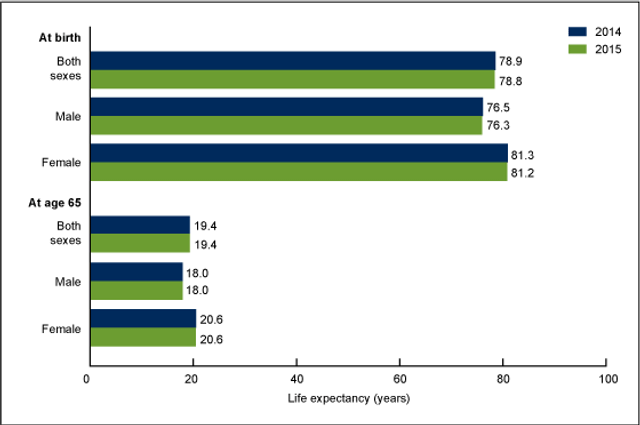
Life expectancy at birth decreased 0.1 years, from 78.9 years in 2014 to 78.8 years in 2015. This leaves the United States behind Cuba and Costa Rica and well behind Japan, Germany, France and other industrialized countries where life expectancy is still on the rise.
In 2015, just over 2.7 million deaths were registered in the US—86,212, or 1.2 percent, more than in 2014. White males and females and black males experienced higher death rates last year.
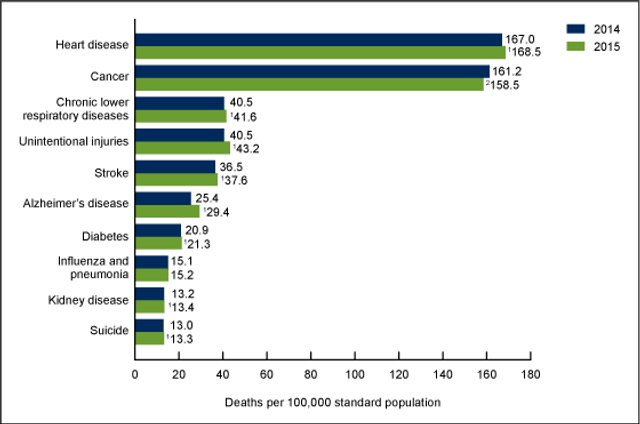
After declining for years, deaths increased from heart disease and stroke, as well as from chronic lower respiratory diseases, Alzheimer’s disease and diabetes. Mortality also rose from kidney disease, unintentional injuries and suicide.
The report also showed a rise in the infant mortality rate, from 582.1 infant deaths per 100,000 live births in 2014, to 589.5 in 2015. The US already ranks 26th out of the 35 nations in the Organization of Economic Cooperation and Development (OECD) in infant mortality. For infant deaths, the economically hard hit industrial states like Ohio and West Virginia rank just above the traditionally poorest states in the Deep South.
“These figures are very disturbing,” University of Pennsylvania sociology professor Irma T. Elo told the World Socialist Web Site. “Life expectancy declined for those under the age of 65, particularly from unintentional accidents, and that may be related to drug-induced mortality. Unintentional injuries and suicide had already increased from 2013 to 2014, and the trend continued last year.”
Age-adjusted death rates for the 10 leading causes of death in 2015, United States, 2014 and 2015 (Source National Center for Health Statistics)
“Life expectancy is declining in the US but not in other developed countries,” Professor Ilo added. “The US does a very poor job on this. If you look at the disparities in life expectancy according to income and in parts of the country where there has been a loss of jobs, this might give you the greatest clues as to why this disturbing downward trend is happening.”
A study by Harvard professors published in the Journal of the American Medical Association in April 2016 found a 15-year difference between the life expectancy of men in the richest 1 percent of the population and those in the poorest 1 percent. For women, the gap was 10 years. Life expectancy for the most impoverished American men is roughly the same as it is in Sudan and Pakistan.
The Harvard study also found that low life expectancy is not concentrated in the Deep South, but is prevalent across the so-called Rust Belt states in the US Midwest. These are the areas where Trump was able to able to exploit immense social anger over decades of deindustrialization, declining living standards and the Democrats’ hostility to the social concerns of working-class voters.
The decline in life expectancy is a verdict on eight years of the Obama administration. Obama’s signature domestic “reform,” the Affordable Care Act, has, in fact, made access to adequate heath care even less affordable for workers whose real wages have stagnated or fallen since Obama’s “economic recovery” began in 2009.
The past eight years are a continuation of a decades-long process of social counter-revolution. The American ruling class never reconciled itself to the gains won by workers during the “labor wars” waged by industrial workers between the 1930s and 1970s. The right to employer-paid health care and pension benefits, along with Medicare and Medicaid, led to a great improvement in life expectancy, which rose from 59.7 in 1930 to 69.7 in 1960 and to 77 by 2000.
The class war policies initiated under the Democratic Carter administration (1977-81) and accelerated under the Reagan years (1981-89) were aimed at clawing back everything the working class had achieved. In the face of this, the United Auto Workers, United Steelworkers and other unions abandoned any resistance, transforming themselves into appendages of corporate management. In the name of making American capitalism “more competitive,” the unions sabotaged every struggle by workers to defend their jobs and living standards.
By the mid-2000s, there was a steady drumbeat of complaints within corporate and political circles that workers were living too long, and that defined-benefit programs—i.e., employer-paid pensions and health care—were unaffordable.
Life expectancy at selected ages, by sex, United States, 2014 and 2015 (Source National Center for Health Statistics)
Summing up the attitude of the ruling class, Steve Miller, the CEO of automotive parts maker Delphi, declared in 2005, “Back in the days when you worked for one employer till age 65 and then died at age 70, and when health care was unsophisticated and inexpensive, the social contract inherent in defined-benefit programs perhaps made some economic sense.”
He continued, “People are living longer these days. And medical science is rapidly expanding the capability to spend vast amounts of money keeping you alive for decades. Of course, that is a good thing. But the question is, how can we afford it?” Similarly, Miller said, the government could no long sustain Medicare, Medicaid and Social Security.
The Obama administration was tasked with carrying out the unfinished businesses from the Reagan years, particularly in sharply reducing health care costs for corporate America by shifting the burden to workers and driving them into substandard plans that would shorten their lives.
The incoming Trump administration is assembling a government of billionaires, generals and ultra-reactionaries committed to dismantling whatever restraints on the exploitation of the working class remain. Trump’s pick for the US Department of Health and Human Services, Georgia Representative Tom Price, is a longstanding opponent of Medicare and Medicaid. These government health insurance programs for the elderly, the handicapped and the poor cover a combined total of 130 million people, or nearly half of the US population.
Price’s appointment is part of a scheme to use the total or partial repeal of Obamacare to begin the dismantling of both Medicare and Medicaid as government-run, universal entitlement programs, and their transformation into voucher programs, in which seniors and poor people would be given government subsidies that would cover only a fraction of the cost of private insurance.

A Trump junta?

Bill Van Auken

The selection Wednesday of Marine Gen. John Kelly, the former head of US Southern Command, to head the Department of Homeland Security brings to three the number of recently retired generals tapped by president-elect Donald Trump for his incoming cabinet.
Before nominating Kelly, Trump named the rabidly anti-Muslim Lieut. Gen. Mike Flynn, the retired former head of the Defense Intelligence Agency, as his national security adviser.
He has also announced his choice of the former head of US Central Command, retired Marine Gen. James Mattis, nicknamed “Mad Dog” for his repeated statements expressing a love for killing, to head the Defense Department. Securing the nomination of Mattis as defense secretary requires congressional approval of a waiver exempting him from a law barring commissioned military officers who have served in uniform over the previous seven years from taking the post. Mattis retired in 2013 and took a seat on the board of directors of major military contractor General Dynamics.
There are other so-called flag officers waiting in the wings. Retired Gen. David Petraeus, also a former US Central Command chief who briefly served as director of the Central Intelligence Agency, is reportedly under consideration for Secretary of State. He would have to secure permission from his probation officer to work in Washington or travel outside the US. Petraeus was sentenced to two years probation last year after pleading guilty to handing over top secret intelligence documents to his mistress.
Retired Adm. James Stavridis, the former supreme allied commander of NATO, who met with Trump in New York Thursday, is also reportedly being vetted for the post of Secretary of State. Previously, he was considered a possible running mate for Democratic presidential candidate Hillary Clinton. And Adm. Michael Rogers, currently head of the National Security Agency, is said to be a contender for Director of National Intelligence.
The number of senior military officers being assembled in the Trump cabinet makes the incoming administration resemble more and more a Latin American military junta. The placing of both the Defense Department, overseeing the massive US war machine, and the Department of Homeland Security, which coordinates a ballooning police-state apparatus, in the hands of two recently retired Marine Corps generals is particularly chilling, suggesting a government that aims to seamlessly coordinate war abroad and repression at home under the tight control of a military camarilla.
Trump, the billionaire conman who secured five deferments to avoid the draft during the Vietnam war, appears to revel in surrounding himself with military brass, shouting out idiotically “‘Mad Dog’ Mattis” at rallies, as if association with the architect of the slaughter of Fallujah will somehow strengthen his image. But there is an objective source of the rise of the military into the top positions of the government.
It is now more than 55 years since President Dwight D. Eisenhower, the former senior allied commander in World War II, made a farewell speech in which he cautioned against the “conjunction of an immense military establishment and a large arms industry” whose “influence—economic, political, even spiritual—is felt in every city, every statehouse, every office of the federal government.”
Eisenhower warned, “We must guard against the acquisition of unwarranted influence, whether sought or unsought, by the military-industrial complex. The potential for the disastrous rise of misplaced power exists, and will persist.”
It is highly unlikely that Eisenhower could have imagined in his wildest dreams either the scale of the “disastrous rise of misplaced power” expressed in the incoming Trump administration or the vast growth of the US military apparatus.
At $580 billion, the Pentagon’s budget consumes more than half of the discretionary spending of the federal government each year. Adding on the slush fund for unending overseas wars, money spent on atomic weapons and other military expenses, the real cost of Washington’s war machine is more like $1 trillion a year.
Along with the Pentagon budget, the power of the military brass has grown uninterruptedly, particularly over the past quarter century of unending wars. The creation of a professional “all-volunteer” armed forces has increasingly isolated the military from civilian society, creating a distinct social caste that has asserted its independent political interests in the affairs of state ever more aggressively. So-called “unified combatant commanders,” like Mattis, Kelly, Petraeus and Stavridis, exercise vast power over entire regions of the globe, far overshadowing any ambassador or other civilian representative of the US government.
While the rank-and-file of the US military appears to have heavily favored Trump in the election—partly out of the misguided hope that he would halt the unending wars in Afghanistan and the Middle East—Democrat Hillary Clinton was the favorite of the top US military brass, who considered her a veteran supporter of militarism and a more reliable backer of their strategic preparations for war against Russia.
Outside of Flynn, none of the ex-military commanders being nominated or considered for top posts had endorsed Trump. Some of them had clashed with the Obama administration, Mattis over Iran and Kelly over Guantanamo, for example.
As much as Trump is choosing ex-generals, the generals may themselves be choosing to join his administration, confident that they can ultimately dictate policy.
The Obama administration and congressional Democrats signaled Thursday that they will place no obstacles in the path of Mattis’ appointment as defense secretary. A measure has been added to a stopgap spending bill set for approval before Congress adjourns this weekend that will fast-track the waiving of the legal ban on recently serving officers taking the post. Debate on the waiver in the Senate is to be limited to 10 hours, even though this will be the first time such a waiver has been granted in over 60 years.
White House spokesman Josh Earnest said that Trump “should be given wide latitude in assembling his team,” and that Obama “believes this is an important principle.”
More important, apparently, than civilian control of the military. That this bedrock constitutional principle has been transformed into all but a dead letter, supported by no significant section of the political establishment, is among the starkest manifestations of the decay and collapse of bourgeois democratic institutions in the United States, which have found their consummate political expression in the advent of the Trump presidency.
What is being assembled in the ongoing sessions at New York City’s Trump Towers is a government of class war, comprised of billionaires and generals. It is turning to the military as it prepares to implement policies of social reaction at home and war abroad, and to confront the massive popular opposition that these policies will provoke from within the working class and the youth.

8 Dec 2016

University of Dundee Energy Industry Scholarship (LL.B) for Nigerian Students 2017/2018

Application Deadline: 1st October 2017
Offered annually? Yes
Eligible Countries: Nigeria
To be taken at (country): Scotland, United Kingdom
Eligible Field of Study: Law Candidate is to undertake Masters in Mineral Law and Policy.
About the Award: Energy has enhanced our lives: we have never been more connected and, today, more people have better opportunities, better health and better living conditions. This progress has been dependent on reliable, accessible energy.
Given the vital role of the energy sector, the Centre for Energy, Petroleum and Mineral Law and Policy (CEPMLP) in partnership with the energy industry is offering a fully funded postgraduate scholarship leading to the degree Mineral Law and Policy LLM.
Type: Law Masters
Eligibility: Candidates eligible for consideration should:
  • Available to Nigeria national / permanent resident full fee paying students on a full time, campus based Energy, Petroleum, Mineral Law & Policy postgraduate degree programme.
  • Scholarship will be deducted from the published tuition fee for the intended academic entry year
  • Prospective students must have formally applied to the University for an eligible course and received an unconditional or conditional offer.
  • Prospective students must have fully completed the scholarships application form, sent with the formal offer email.
  • Selection of students will be based on their academic performance to date, their formal application and the content of their scholarship application form.
Number of Awardees: Not specified
Value of Scholarship: 
  • Payment of academic tuition fees
  • 12 monthly stipends for living expenses for a single student
  • International travel costs to start the course and travel back to Somalia once the course is completed
Duration of Scholarship: Duration of university programme
How to Apply: All applications must be made through UKPASS 
Award Provider: Shell and ExxonMobil in cooperation with the Ministry of Petroleum and Mineral Resources of Somalia.

UTS Law Doctoral Scholarship+Fellowship 2017/2018 for International Students – Australia

Application Deadlines: 
  • Spring 2017: 31st March 2017
  • Autumn 2018: 30th September 2017
Offered annually? Yes
Eligible Countries: lnternational
To be taken at (country): Australia
Eligible Field of Study: Law
About the Award: UTS:Law has an expanding research degree program. The Faculty is committed to building an active and supportive research student community, which is also integrated into the Faculty research community.
Researchers in UTS:Law are working in fields which have the potential for real-world impact and change. The research is innovative and uses interdisciplinary, socio-legal, theoretical, and doctrinal approaches to address research questions. Regulation of biomedical technologies, refugee law, family and relationship law, new media and communications regulation, law and culture, and legal history are just some examples of the richness of the research being undertaken at UTS:Law.
Type: PhD Scholarship with the possibility of being granted a Teaching Fellowship upon candidate’s satisfactory performance.
Eligibility: Candidates must have completed a Masters Degree by research or a Bachelor Degree with first class honours, or be regarded by the University as having an equivalent level of attainment.
Selection Criteria: Scholarships will be awarded according to the following selection criteria:
  • academic merit of the applicant;
  • research and other relevant experience of the applicant;
  • publication record of the applicant;
  • quality of the research proposal; and,
  • relevance of the proposed research to the Faculty’s research strengths.
Number of Awardees: Not specified
Value of Scholarship: Benefits offered under the scholarships include:
  • a stipend of $40,000 per annum for 4 years
  • a research support fund of $1,500 per annum
  • paid holiday, sick, maternity, and parenting leave
Separate support may be available for international students to cover tuition fees.
Successful scholarship applicants may also be offered a Doctoral Teaching Fellowship which will provide an opportunity to gain valuable teaching experience in the Faculty of Law.
Doctoral Teaching Fellows will receive a salary of $25,000 per annum in addition to the QBLD scholarship, and be expected to teach 4 hours per week in both Autumn and Spring sessions.
Duration of Scholarship: Fellows will be appointed for a period of 12 months with an expectation that the Fellowship will be re-offered for two further 12 month periods, up to a maximum of 3 years.
How to Apply: Visit Scholarship Webpage to apply
Award Provider: University of Technology, Sydney