13 Dec 2016

Even War Has Limits

Aftab Alam


While the horror of barbaric incident of October 28, when militants aided by the Pakistani Army had mutilated the body of 30-year-old sepoy Mandeep Singh  is still fresh in our memory, yet in another gory instance on November 22 the body of another Indian soldier, Prabhu Singh of 57 Rashtriya Rifles,  was found in savagely mutilated state in Machhil sector along the Line of Control (LoC)  in Kupwara district of Jammu and Kashmir, triggering collective outrage and anger across the country.
The current cowardly act of mutilation of the body of our soldier is not a one-off case of Pakistan’s cold-blooded brutality. Earlier in January 2013 the bodies of Lance-Naiks Hemraj and Sudhakar Singh of the 13 Rajputana Rifles were found in a horribly mutilated state in the Mendhar sector of the valley. In a similar incident in July 2011 the Pakistani Border Action Team after striking a remote Indian army post in Gugaldhar ridge in Kupwara had taken back the heads of Havildar Jaipal Singh Adhikari and Lance Naik Devender Singh of 20 Kumaon Regiment. According to media reports the Indian Army had recovered a video clip from a Pakistani militant who was killed in an encounter while trying to cross the border, showing some jihadis and members of Pakistani Army dancing around the severed heads of Adhikari and Singh displayed on raised platform.
The brutality committed by Pakistani soldiers during the Kargil War of 1999 is well known when Captain Saurabh Kalia and his sepoys Arjunram Baswana, Mula Ram Bidiasar, Naresh Singh Sinsinwar, Bhanwar Lal Bagaria and Bhika Ram Mudh of 4 Jat Regiment were tortured to death. Their ears, nose lips, limbs and genitals had been chopped off and their skulls had been cracked open and they had been burnt with cigarette buds.
In August 2011 Pakistan had also complained that three of its soldiers were beheaded by Indian troops in a raid on a post in the Sharda sector in Kel. This has been confirmed in a recent media report claiming that the Indian Army in a retaliatory strike known as Operation Ginger had allegedly chopped off the heads of three dead Pakistani soldiers. A similar complaint was lodged by Pakistan in June 2008 alleging that Indian soldiers beheaded one of its troops and carried his head across the LoC in the Bhattal sector in Poonch. Earlier, in 2003  Pakistan charged Indian troops with killing and decapitating one of its soldiers and carrying his head off as a trophy, in a raid in Baroh sector. These acts on the part of the Indian Army, if confirmed, are also equally grave and patently illegal which can’t be justified even as a retribution for similar acts.
The mutilation of dead bodies during armed conflicts is not only inhuman and defies the minimum standards of human decency expected to be followed by a disciplined and professional soldier but also a grave violation of  international humanitarian law amounting to war crime. The old maxim that “all is fair in love and war” represents only half truth. It is no longer correct at least so far as the “war” is concerned. There is a whole body of law known as International Humanitarian Law (IHL) which stipulates that “Parties to a conflict and members of their armed forces do not have an unlimited choice of methods and means of warfare”. It is prohibited even to employ methods or means of warfare of a nature to cause superfluous injury or unnecessary suffering. Any soldier or civilian who falls into the power of an adverse party is entitled to respect for his life and dignity. Though the laws regulating the war accept that the death is an inherent part of war, they also recognise that the care and respect of the living holds greater priority.
IHL contains elaborate set of rules concerning the treatment of the dead during the armed conflicts the most prominent being safeguarding the personal dignity of the deceased. Parties to an armed conflict are under an obligation to search for the dead ‘without adverse distinction’ as it is necessary for returning the remains or providing a decent burial. Where possible, the burial or cremation is to be done in accordance with the religious rites of the deceased. According to customary IHL the mutilation of dead bodies is prohibited. There is not only prohibition on mistreatment of the dead but it is also prohibited to despoil or pillage the dead. The acts of abusing the dead amount to war crime under the Rome Statute of the International Criminal Court as such acts are covered by the war crime of “committing outrages upon personal dignity”.
The Military Manuals of many countries such as France, Germany, Israel, United Kingdom and United States etc. also prohibit the mutilation or other maltreatment of the dead. The U.S. General Military Government Court in Schmid Case held that the mutilation of the dead body of a prisoner of war and refusal of an honourable burial amounted to a war crime. In 1967 during the Vietnam War a U.S. Army sergeant, who had posed for a photograph holding the decapitated heads of two enemy corpses, was court-martialed and convicted of “conduct prejudicial to good order and discipline.”
Though both India and Pakistan are not parties to Additional Protocol I to the Geneva Conventions and the Statute of the International Criminal Court they are still bound by the customary principles of IHL concerning treatment of the dead. They should realise that the respect and compliance to the conventional and customary IHL pertaining to the dead is not only a legal duty but also in their mutual interest. Such restraints help boost their image as a responsible state committed to ethics of war in all circumstances. Furthermore, respect for such humanitarian restraints forms the basis of a professional disciplined army. History is witness to the fact that whenever soldiers had been given free hand to kill, destroy indiscriminately or committing act of savagery against the enemy, they are more prone to defy political leadership and to act ruthlessly against their own people. Additionally the violations of laws of armed conflicts also causes grave threat to international peace and security providing lame excuses to many for armed interventions.


Is The U.S Fighting Terrorism Or Manufacturing It?

Arshad M Khan


President Obama’s final foreign policy speech at MacDill air force base in Tampa, betrayed its purpose through the venue.  The Tampa, Florida, base is home to Special Operations Command and Central Command — Special Operations playing an ever increasing role in counter terrorism.
The gist of the speech seemed to assert that the US is and should stay true to its values when fighting terrorism.  An assertion when at the same time Congressman Ted Lieu, a California Democrat, has written a letter to Secretary John Kerry warning him the US could be charged with war crimes in aiding Saudi Arabia’s bombing campaign in Yemen.  The US helps through in-air refueling of planes.  The Congressman claims there are 70 documented incidents targeting civilians including women and children.  Yemen itself never had a refugee crisis through years of civil conflict, that is until the merciless Saudi air onslaught.
What did Libya do to incur US wrath?  It was fighting a civil war where the casualties were in the hundreds and the rebels themselves not without foreign instigators.  Look at Libya now.  From leading Africa on the Human Development Index scale to being bombed into a shambles without an effective government.  By the way, what was the strategic (or for that matter even tactical) value of bombing a precious and expensive water system bringing water from the south to Tripoli?  And how did it help the civilian population of Tripoli?  Now, of course, those who can, in Libya, are fleeing to Europe.  In fact, sub-Saharan Africans who would come to Libya seeking work now try also to get to Europe.
Ask the Libyans who they blame for their problems and the answer comes back without equivocation, the US.   It was the leading cause of the country’s destruction.  Ask the Yemenis … ditto.  It is the country supplying the planes, the bombs, the air-refueling.  Without it there would be no air campaign.  Ask the Syrians as a National Public Radio reporter did this week.  They certainly do not blame President Bashar Assad, who they feel is doing well at keeping the country together.  No, they blame the Saudis, the Gulf States and their arms supplier-in-chief, the US.
Ask the Somalis.  It was a U.S. sponsored invasion of Somalia by Ethiopia that destroyed the last chance of Somali stability, continuing the killing.  The Islamic Courts regime could not have chosen a worse name, which sent danger signals rippling through the US administration, bringing fears of a Taliban and al-Qaeda replay.  And it was a quiet, studious Somali student who went on a rampage at Ohio State University just over a week ago.  Mr. Trump has been there this week to express his condolences and to repeat his anti-Muslim immigration and “extreme vetting” creed.
Ask the Iraqis and the Afghans.  A vast swathe from North Africa through Yemen into Afghanistan and Pakistan are embroiled in conflict.  Estimates of deaths in Iraq vary from 200,000 ascribed to violence to a million from the ravages of war.  The war casualties in Afghanistan according to the Watson Institute at Brown University stand at around 111,000 with at least as many wounded, and continue to increase after a US presence for 15 years.  Deaths from the effects of war among the population are not easily determined but as in Iraq are likely to be even higher.
The question to ask is whether 19 persons, primarily from Saudi Arabia, responsible for the 9/11 attacks warrant this wholesale killing.  And for what?  If anything, the situation and the fear factor in the US are worse and one of the reasons for Donald Trump’s win.
Is this heavy-handed policy actually fighting terrorism successfully, or is it alienating populations enough to be a proximate cause?

New dinosaur discovery in Myanmar includes feathers

Matthew MacEgan


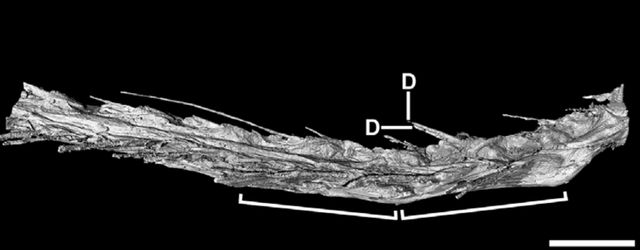
A new article published in Current Biology on December 5 provides details of a study that scientists made of a nearly 100-million-year-old dinosaur tail, which was discovered preserved in a chunk of amber. Due to the amber, more than bones survived the long encasement—also contained therein were muscle, ligaments, skin, and feathers—sparking a great amount of interest in the scientific community and the general public. This is the first time that non-avian feathered remains preserved in amber have been described, and it allows scientists to better understand the evolutionary pathway of feathers and modern birds.
Amber trapped the dinosaur's tail, preserving muscle, skin, flesh and feathers from nearly 100 million years ago.
The amber sample itself was recovered from a mine in the Hukawng Valley in Kachin, northern Myanmar. This region is well known for having an abundance of amber that contains a variety of plant and animal remains from the mid-Cretaceous period (approximately 99 million years ago). This particular sample is the size of a tennis ball and also contains an ant as well as plant debris that was alive at the same time the dinosaur tail was deposited into the amber. The tail fragment itself measures about 1.4 inches and is covered in chestnut-brown feathers with a pale-white underside.
X-ray analysis shows that the fragment is made up of eight vertebrae that likely served as the middle or end of a long thin tail that may have featured upwards of 25 individual vertebrae. The vertebrae suggest that the source of the tail is a juvenile coelurosaur, a type pf Jurassic dinosaur that is considered intermediate between dinosaurs and birds. Coelurosauria includes maniraptorans, the only dinosaur group alive today. Maniraptora are characterized by downy feathers with elongated quills, and they are also the only dinosaur group known to include flying members.
One of the interesting facets of the research is the analysis of barbs located on the stems of the feathers—something that can only be seen at the microscopic level. The authors of the paper explain that the spatial arrangement of the barbs allowed them to confirm hypotheses about the evolutionary development of feathers and how they reached their present morphology. This is important because the morphology of the barbs is what allows modern birds to fly.
A tail feather of the encased dinosaur.
They conclude that while the feather arrangement is similar to what we see in birds today, the dinosaur in question was likely incapable of flight based on the contours and the way the barbs fuse. This means, however, that the feathers may have evolved due to ornamentality, so it may be hypothesized moving forward that feathers evolved for other purposes such as signaling or temperature regulation before they were adapted for flight. Of course, with a sample size of one, it is difficult to say with certainty whether this was typical of coelurosauria or whether this individual specimen is an exception.
This is not the first time that feathers dating from this time period have been found in amber, and biologists have already reported evidence going back over 20 years that dinosaurs had feathers, based on fossil impressions. However, scientists had difficulty in interpreting feather morphology due to compression in sedimentary rocks. Another road block was the fact that none of the feathers discovered were attached to or even associated with actual skeletal remains.
Just as interesting as the results of the latest study are the circumstances that led to the recovery of the amber in question. This sample was one of many that was collected at an amber market in Myitkyina, the capital of Kachin, where amber is used in both jewelry and carvings. In fact, the piece of amber containing the tail had already been cut and shaped by the time the researchers found it at the bazaar.
An x-ray revealing the bone structure of the dinosaur's tail.
While the modification meant that the tail was less intact than it could have been, one positive aspect was that a cross-section was cut through the tail that allowed for chemical analysis. This means that the authors were able to detect small amounts of iron that came from the creature’s blood, which will allow scientists to identify more information about coelurosauria.
Research in this region has been hampered by an ongoing civil war between the Myanmar government and the Kachin Independence Army, which controls the Hukawng Valley. If this conflict ends, it could lead to researchers gaining greater access to the vast caches of amber that likely contain data that will unravel even more of the mysteries surrounding the mid-Cretaceous period. The lead author suggested that they may even find a complete dinosaur at some point in the future.

The Gambia president refuses to accept election result

Eddie Heywood

After initially conceding defeat to Adama Barrow after the December 1 presidential election, incumbent President Yahya Jammeh announced on Friday that he rejects the results of the poll, citing “serious abnormalities” which he claims occurred during the election.
“After a thorough investigation, I have decided to reject the outcome of the recent election. I lament serious and unacceptable abnormalities which have reportedly transpired during the electoral process,” Jammeh announced on state TV. He did not elaborate on what the “serious abnormalities” were, except to claim that the election held on December 1 was “influenced by foreigners.”
Jammeh called for new elections, saying, “I recommend fresh and transparent elections which will be officiated by a God-fearing and independent electoral commission.”
The veracity of Jammeh’s claims cannot be assessed, as the results of the “thorough investigation” have not been released. No evidence exists of the claim of foreign influence in the election.
The inquiry cited by Jammeh was initiated by the official Independent Election Commission (IEC) of The Gambia, which is beholden to Jammeh’s ruling government. Late Saturday, Jammeh said he would be preparing a legal challenge to the result of the December 1 vote before the Gambian Supreme Court.
The Supreme Court in a statement said that it would decline to hear the challenge due to a lack of seated judges.
Various international critics over the weekend sharply condemned Jammeh on the news of his decision to challenge the poll.
The United Nations Security Council denounced Jammeh’s about-face, and demanded that he hand over power to President-elect Barrow. In a unanimous statement of the 15-member panel, it called on Jammeh to respect the choice of the Gambian people.
The Obama administration via the US State Department condemned Jammeh’s reversal, declaring it “a reprehensible and unacceptable breach of faith with the people of The Gambia and an egregious attempt to undermine a credible election process and remain in power illegitimately.” It further stated, “We call upon President Jammeh, who accepted the election results on December 2, to carry out an orderly transition of power to President-elect Barrow in accordance with the Gambian Constitution.”
After Jammeh made his announcement rejecting the election result, troops were deployed in the streets of the capital city Banjul, and were reported to be setting up sandbags, as if in preparation for a siege.
This prompted the US embassy in Banjul to issue a statement, urging the Gambian army to show “respect for the rule of law and the outcome of the presidential election”, adding, “The Gambian people have made a clear choice for change and a new start.”
Washington’s condemnations are entirely hypocritical and make a mockery of its appeals for Jammeh to adhere to democratic norms, considering Washington’s recent history of launching a war with its NATO allies in Libya in 2011 utilizing Al-Qaeda-linked forces to remove and murder Muammar Gaddafi in Libya.
There is also Washington’s ongoing support of Islamist militias in Syria to foment regime change in order to place a more pliant government in Damascus. The result of these two imperialist excursions have left both countries virtual wastelands, with tens of thousands maimed and killed, and have resulted in the worst refugee crisis since World War II.
The leader of the incoming political coalition behind Barrow, Fatoumata Jallow-Tambajang, has vowed that they are preparing to prosecute individuals in Jammeh’s regime, including Jammeh himself, if the election is resolved in Barrow’s favor.
There is no doubt that this played a role in Jammeh’s sudden about-face. Jammeh and his security apparatus have committed acts of repression, disappearances, torture and murder of political opponents, the victims of which include members of the political party of the incoming Barrow administration. Many of these individuals still remain detained at the Mile 2 prison where at least two of the prisoners have died as a result of torture.
There are clear indications that Jammeh has fallen out of favor with Washington and its Western European partners.
In October, Jammeh made moves to withdraw The Gambia’s participation in the International Criminal Court (ICC), and in 2013 rescinded The Gambia’s participation in the British Commonwealth of Nations, the organization of former British colonies. The Commonwealth was set up after the formal independence of the colonies in order to maintain the framework of economic exploitation set in place during colonialism.
Jammeh’s decision to withdraw The Gambia’s participation in the ICC is based on his fear that he and his cronies may be brought forth before it like other autocrats that fell out of favor with Washington, such as Liberia’s Charles Taylor.
Washington has scathingly criticized Jammeh for his autocratic form of rule in recent years, hypocritically condemning his government’s brutal repression of dissent. In reality, Washington and Britain have grown weary of Jammeh and his unpredictability; such behavior is not good for the business of exploiting The Gambia’s economic resources.
The human rights abuses committed by the Jammeh regime are giving Western interests a public relations black eye. Since 2014, the European Union has withdrawn millions of dollars in aid to The Gambia. In the same year, Washington booted The Gambia from its African Growth and Opportunity Act, a program aimed at expanding trade on the continent.
Barrow, on the other hand, has demonstrated his willingness to enter a subservient relationship with Washington and its Western European allies, and has stated that he is open to greater economic relations with wealthy international interests, and has promised to restore The Gambia as a member of the Commonwealth.
In response to Jammeh’s about-face on the election result, Barrow said, [Jammeh] “is damaging The Gambia’s democratic credentials.” He went on further: “We are calling on Mr. Jammeh to respect the will of the people and will hold him responsible for anything that happens in this country and its people.”
A pall of fear has fell over the Gambian masses with Jammeh’s refusal to accept the poll result. Many are expecting a crackdown. In the capital city of Banjul, many shopkeepers closed early on Friday, anticipating unrest. Senegalese fighter jets have been reported flying across the Gambian skies, in what can be interpreted as a warning to Jammeh.
In the event that a new election is called, it will almost certainly result in a Jammeh victory, as the Independent Election Commission is in the back pocket of the ruling government. The IEC arbitrarily decides which parties can run for election, it oversees labyrinthine rules on voter registration and polling locations which result in voter disenfranchisement, and it is the sole monitor and custodian in the country over the counting of the vote. It is certain that Jammeh’s security forces will be out in force throughout the country to carry out acts of intimidation and repression of political opponents and voters.
Regardless of whether Jammeh or Barrow takes the reins of power, the exploitation and repression of the Gambian masses will continue unabated. While Barrow is more palatable to Washington and Europe, both men have pledged their undying loyalty to the demand by the tiny wealthy Gambian elite and wealthy international corporate and banking interests that The Gambia is to remain open for capitalist exploitation.

Australian government threatens to jail “overpaid” welfare recipients

Margaret Rees

Facing economic contraction and a widening budget deficit, the Turnbull government is targeting vulnerable welfare recipients, issuing sweeping and unsubstantiated claims that they have fraudulently claimed or been overpaid about $4 billion in recent years.
In a new drive to intimidate and demonise people relying on pensions, family tax benefits, unemployment benefits or other welfare payments, the government is threatening to jail them unless they can produce documents to disprove any alleged over-payment.
Under the banner of “welfare fraud,” the government is seeking another pretext for gutting the entire welfare system, including disability programs and aged pensions. Having barely survived the July 2 election, the Liberal-National Coalition government is trying to demonstrate to big business that it can deliver its requirements.
According to information leaked to the Australian, the government is issuing debt notices worth $4.5 million every day, supposedly “in a bid to rein in the ballooning welfare bill.” A new automated system that matches a welfare recipient’s details with information from the Australian Taxation Office is generating 20,000 “compliance interventions” a week, up from 20,000 a year before the latest crackdown began in July.
Already, debt notices worth almost $650 million have been issued in the past four months, creating anxiety for thousands of working class households. The stress is compounded by the difficulties involved in trying to contact Centrelink, the chronically understaffed agency that administers the welfare payments regime, to clarify or challenge any accusation of over-payment.
Human Services Minister Alan Tudge last week used an appearance on the television program “A Current Affair” to threaten to jail those deemed to owe money. “We’ll find you, we’ll track you down and you will have to repay those debts and you may end up in prison,” he declared.
Earlier this year, a mass mail campaign by police and Centrelink threatened welfare recipients with jail if they provided inaccurate information. The letters warned that the government’s welfare fraud taskforce was “currently working in your community” and that providing wrong information could result in a “criminal record or a prison sentence.”
This marks a further escalation by the government of an offensive to push people off welfare. In March, Prime Minister Malcolm Turnbull’s government introduced a raft of measures associated with welfare “debts,” including imposing an interest rate of 9 percent, removing a six-year limit on recovery and preventing recipients from leaving the country if they allegedly owed money to Centrelink.
At that time, Social Services Minister Christian Porter told parliament: “One percent of Australia’s population have received money they are not entitled to and owe a debt to the other 99 percent of Australians, a debt that in too many instances they are making no effort to repay.” That is, he was castigating the poorest one percent of society, not the wealthy layers that have benefited from the slashing of social services over the past four decades that helped to provide massive tax cuts.
Assisted by the corporate media, which incessantly witch hunts welfare recipients as “dole bludgers” and “welfare cheats,” successive Labor and Coalition governments have already substantially cut the proportion of the working age population receiving income support payments, from 25 percent in 1994 to 16.6 percent in 2015.
This has been achieved by eliminating sole parent payments once the youngest child turns 8, imposing harsh “work tests” on dole recipients and increasingly blocking access to disability pensions. By one measure alone, in 2012, the Greens-backed Gillard Labor government ended Parenting Payments for 100,000 single parents and forced them onto Newstart unemployment benefits: an average cut of about $120 per fortnight.
Turnbull’s government has touted varying figures that it claims it will recoup from welfare recipients. During this year’s election campaign, Treasurer Scott Morrison claimed that $2 billion would be recovered. Suddenly, that figure has been doubled.
The actual breakdown of the so-called debts is revealing. One-fifth of the supposed “overpayments,” comprising 39 percent of the total amount, involves people who have not lodged a tax return. Thus a nightmare of “debt” can be imposed on recipients simply for not filling out a tax return.
Other households have inconsistent income, which could result in “over-payment” if a member of the household secured some temporary work. This group comprises 13 percent of the “overpaid” and 10 percent of the alleged debts.
Official statistics show that that last year just 0.018 percent of those receiving payments were investigated for fraud. Only 996 cases were referred to prosecutors and just 29 cases resulted in indictable charges.
Hailing the new compliance campaign, the corporate media again railed against welfare recipients, diverting attention from tax cuts for the rich and the escalating military budget. An Australian editorial announced: “Cheats are on notice.” It declared that welfare spending had to be gutted to slash the budget deficit and stop the global credit ratings agencies ending Australia’s AAA rating on financial markets.
This effort was immediately endorsed by anti-immigrant One Nation leader, Senator Pauline Hanson, whose group’s four senators helped Turnbull’s fragile government pass a number of key bills in parliament last week. Hanson, who has a long record of demonising welfare recipients, as well as refugees, Muslims, Asians and Aborigines, said Australia’s entire welfare system was “wrong.”
In the name of cracking down on welfare fraud, Hanson proposed a police state-style national identity card, proclaiming: “The whole fact is you need to stop them getting welfare in the first place if they’re not entitled to it.” Hanson boasted that she had recently spoken to Turnbull about the idea.
True to its own pro-business record, the Labor Party opposition has criticised the government for not being ruthless enough in tackling so-called welfare fraud. Shadow human services minister Linda Burney said minister Tudge was trying to “sell the massive failure of his department as a victory.”

Human toll rises after Indonesian earthquake

John Braddock 

The death toll in the western Indonesian province of Aceh following a magnitude 6.5 earthquake that hit before dawn on December 7 stands at 101, with more than 800 injured. The number of people displaced or left homeless has risen in recent days to nearly 84,000.
Officials declared last Friday that search and rescue operations involving 1,500 personnel were nearing an end. Emergency response coordinators told Australia’s ABC News that while the death toll could still increase, their focus was shifting to clearing and securing the damaged sites.
The destruction in the districts of Pidie Jaya, Pidie and Bireun is extensive: more than 11,500 houses, 152 mosques and Mushola (Muslim prayer rooms), 157 shops, 25 schools, a shopping centre and a hospital are listed as destroyed or severely damaged. Many roads have been badly cracked and power poles toppled over.
The disaster is the worst in the Aceh region since the magnitude 9.1 quake which struck on 26 December 2004 triggering a devastating tsunami that killed more than 120,000 Aceheans. A total of 226,000 people died along Indian Ocean shorelines across Indonesia, Malaysia, Sri Lanka, India, Thailand and the Maldives.
Volunteers and rescue personnel have concentrated on the town of Meureudu, near the quake’s epicentre. Local officials have pleaded for more medicines, doctors and supplies to treat the injured. “We need surgeons and orthopedics, because many victims have fractures,” deputy district chief Said Mulyadi stated. Some areas have proved inaccessible to large machinery or too unstable, forcing rescuers to search by hand or with just basic tools.
More than a dozen bodies were pulled from rubble at a popular market place at Meureudu. A shop owner, Hajj Yusri Abdullah, told the Independent they included a group of eight—a newlywed couple and family members holding a celebration known as Antar Dara Baro. He did not hold out much hope of finding survivors.
Many of the severely injured were sent to other districts because Pidie Jaya’s hospital was damaged and unsafe. Beds lined an outdoor corrugated iron-covered corridor where the quake victims lay injured and shocked. More than 300 were treated at the hospital for cuts and bruises, broken bones and head injuries—about 50 died there. Minor injuries were being treated in a field hospital erected in the grounds of the district chief’s office.
A state of emergency has been declared in the province for two weeks, but the Indonesian government has not sought assistance from any foreign nation. The International Organisation of Migration’s Paul Dillon told the Sydney Morning Herald that the level of damage remains “opaque” and it was unclear how many people would be long-term or medium-term displaced.
Survivors told the ABC late last week they still feared a tsunami, although no warning was issued after the quake hit. Supplies of food and water were said to be low. The commander of a military medical facility, Major General Ben Rimba, said that with ongoing aftershocks, the biggest concern was illness and injuries.
The US Geological Survey said the earthquake was centred about 19 kilometres southeast of Sigli, a town near the northern tip of Sumatra, at a depth of 17 kilometres. Numerous aftershocks have rattled the area.
Devastating quakes occur regularly in the region. The world’s largest archipelago, Indonesia is prone to earthquakes due to its location on the “Ring of Fire,” an extensive arc of unstable fault lines in the Pacific Basin. Since 2004, thousands of people have died or been displaced in devastating earthquakes near the main island of Java in 2005, three times in 2006, and once again in 2009. An 8.5 magnitude quake hit Aceh in April 2012.
Last Friday, a 7.8 magnitude earthquake rocked Solomon Islands, triggering tsunami warnings across the southwest Pacific. While no deaths were reported, humanitarian agencies said over 3,000 people were affected and many buildings damaged. It was followed by a second 6.9 magnitude earthquake on Saturday.
Last month, two earthquakes off Japan’s northwest coast triggered tsunami fears and injured some 20 people. On November 14, a 7.8 magnitude quake hit New Zealand, isolating the seaside town of Kaikoura and causing considerable damage to the capital, Wellington.
Indonesian President Joko Widodo toured the stricken areas of Aceh on Friday, visiting a hospital and speaking to survivors at Atta Karuf mosque in Pidie Jaya. He reportedly told local children to “keep high spirits in your study, keep singing and stay happy.”
Widodo announced 15 million rupiah ($US1,125) in compensation for families of the deceased, with those injured receiving 5 million rupiah. The government will allocate just 40 million rupiah for heavily-damaged houses and 20 million rupiah for partially-damaged homes. The amounts pledged are a pittance and will only support the most superficial and short-term measures.
The victims face the same levels of poverty and underdevelopment that created the conditions for this and previous disasters. Most of the dwellings that were flattened were poorly constructed and not designed to withstand tremors. The earthquake was significantly smaller than the massive quake that triggered the 2004 tsunami, yet it still caused substantial levels of destruction and suffering.
The repeated occurrence of such social tragedies is an indictment of the irrational character of the profit system, which subordinates social need to the profit requirements and anarchy of the capitalist market. Little is being done to prevent disasters in the future, either by the Indonesian government or by the major powers such as the United States.
According to the UN Economic and Social Commission for Asia and the Pacific (ESCAP), the Asia-Pacific continues to be the world’s most disaster-prone. In 2015 there were 160 reported major disasters, accounting for 47 percent of the world’s total. Large-scale catastrophes caused more than 16,000 fatalities, more than a two-fold increase over 2014. In 2015, Asia and the Pacific incurred more than $45.1 billion in economic damage and even higher indirect losses.
The principal victims are the impoverished millions who constitute the urban working and rural poor, living in centres that ESCAP admits are “not adequately prepared” for such disasters. In 2014, memorials were held across Asia in remembrance of the thousands of victims of the 2004 catastrophe. Amid the commemorations, warnings were again raised by earthquake experts that the region’s early-warning systems required vastly more development and funding.

New prime minister installed in New Zealand

Tom Peters

New Zealand’s ruling National Party caucus yesterday elected Finance Minister Bill English as its new leader and therefore prime minister. English replaces John Key, who resigned suddenly on December 5 after eight years as prime minister.
In the corporate media, Key was widely predicted to lead the government to a fourth consecutive election victory in 2017. Media commentators and members of his government expressed shock and perplexity at his announcement. One week on, the political and media establishment has largely given credence to Key’s explanation that he is retiring so he can spend more time with his family.
Key’s resignation, however, occurred in the context of the US election result. Questions were raised in the media about whether Key would be able to work with President-elect Donald Trump. Key himself expressed disappointment with Trump’s pledge to pull out of the Trans-Pacific Partnership trade agreement. Trump’s protectionist agenda threatens to start a trade war with China and further destabilise the Asia-Pacific region.
While supportive of New Zealand’s military alliance with the US, Key was anxious to maintain good economic relations with China, which is New Zealand’s main source of export income.
During his final press conference as prime minister, Key yesterday pointed to the growing shift by sections of the ruling class toward national protectionism. He said he supported an “open, globally connected New Zealand, where we sell to the world, where we invite capital from overseas, where we’re not afraid of migration.”
Whatever the exact reasons for Key’s departure, it has undermined the government’s stability and set the stage for a further shift to the right by the political establishment as a whole in response to deepening social and political discontent.
English told the media that the new leadership team was chosen by the caucus in a “constructive and civil manner.” Both English, who was endorsed by Key, and Paula Bennett, the new deputy prime minister, were elected unopposed.
Nevertheless, the process revealed tensions within the National Party. Police Minister Judith Collins and Health Minister Jonathan Coleman initially said they would challenge English for the leadership, but withdrew their bids once it became clear that English had the majority of the caucus behind him.
Collins has pushed for more police officers and has links to far-right blogger Cameron Slater. Former National Party leader Don Brash, who is best known for his repeated attempts to whip up anti-Maori sentiment, threw his support behind Collins. Brash has criticised Key from the right, demanding an end to interest-free student loans and advocating other attacks on the working class.
Collins argued that she was better placed than English to “work with” the right-wing populist New Zealand First Party in a future coalition government. Whoever wins the next election, Labour or National, could need support from NZ First, whose leader Winston Peters has aligned himself with Trump and called for similar anti-immigrant, protectionist policies in New Zealand.
Already big business is calling for sharper austerity measures. New Zealand Herald business editor Liam Dann wrote that “some business friendly policies that Key had ruled out … may now be back on the table under English. These include further asset sales and the restructuring of NZ Superannuation.”
The media has heaped praise on English for his management of the economy, which has been growing at around 3.5 percent annually. The growth is largely based on speculative activity, particularly in the property market, which has driven up the cost of housing for working people and created an unstable bubble. Economists have warned that a significant correction in the market could destabilise the broader economy, as has happened in the US, Ireland, Spain and elsewhere.
With an eye to next year’s election, and aware of rising social unrest, English yesterday sought to project a moderate image. He said he would focus on “better incomes for our households, safer communities and smarter government support for our most vulnerable.”
As finance minister, however, English has been responsible for eight budgets that drastically underfunded health and education, cut welfare entitlements and increased the goods and services tax, while slashing taxes for corporations and the rich. He also oversaw the partial privatisation of power companies and devised the government’s plan to sell thousands of state-owned houses. Median incomes have declined following the 2008 global financial crisis and an estimated one in four children are living in poverty.
Further attacks on the working class are being prepared. Key repeatedly promised not to make any changes to the age of entitlement for the pension, currently 65. English yesterday would not rule out raising the age, telling the media: “I’m not making the same pledge as the previous prime minister did.”
Bennett, the incoming deputy prime minister, has previously served as social development minister and social housing minister. Over the past six years, she has overseen the government’s restructure of the welfare system, which included pushing tens of thousands of single parents off benefits.
Steven Joyce, the new finance minister, played a major role as tertiary education minister in cutting funding to universities and polytechs, reducing access to student allowances and imposing more onerous conditions on student loans. Under a policy implemented this year, graduates who have not made loan repayments can be arrested.
The opposition Labour Party and sections of the media are pushing for the government to call an early election.
Labour leader Andrew Little yesterday told the media the government had failed to address homelessness and was underfunding the health sector. There are an estimated 41,000 homeless people and tens of thousands of people, many of them elderly, have been denied hospital care and surgery.
In reality, the Labour Party agrees that the working class must continue to pay for the ongoing economic and social offensive. Little repeatedly praised Key’s response to the 2008 crisis, and Labour has accepted the increased consumption tax, asset sales, state sector job cuts and other austerity measures.
Little said he did not support increasing the age of entitlement for superannuation but added that he would “look at any proposal, any suggestion to help meet the affordability requirements, to help the sustainability of the scheme in the long run.” Labour has previously campaigned for an increase in the retirement age and for means-testing of pensions.
To divert the growing popular disaffection into reactionary channels, the Labour Party and its ally the Greens have joined NZ First in campaigning for cuts to immigration. All three parties have scapegoated foreigners, especially Chinese people, for the housing crisis and for placing pressure on hospitals and other public services.
The repeated denunciations of China by the opposition also dovetail with Trump’s protectionist demands and US preparations for war against China. Labour is demanding greater spending the military to accelerate New Zealand’s integration into the US military alliance.

Nearly 4 million children living in poverty in the UK

Barry Mason

The latest End Child Poverty coalition report shows that 3.7 million children (29 percent) in the UK are living in poverty. The coalition was established in 2001 and comprises over 100 local and national groups, including children’s charities, social justice groups, trade unions and faith organisations.
A graphic in the report shows 30 desks in a classroom, nine of which are in black to represent each child living in poverty. It explains that while child poverty exists throughout the country, in the areas with the highest levels, child poverty is running at 47 percent. It is at 10 percent in areas considered more affluent.
The data was compiled using the most recent tax credit data of two years ago but also used national trends in joblessness to give an up-to-date picture of child poverty.
The report gave a detailed picture of levels of poverty across the UK using parliamentary constituencies and local authority areas. The local authority area data was broken down into ward boundaries to give a detailed localised picture of levels of poverty.
The data based on parliamentary constituencies showed high levels of child poverty in the UK’s major cities. Birmingham Ladywood tops the list with a child poverty rate of 47.3 percent. The other top 20 areas include Manchester Gorton, Leeds Central, Glasgow Central, Liverpool Riverside and Sheffield Brightside and Hillsborough. Within Greater London, the Poplar and Limehouse constituency along with Bethnal Green and Bow have poverty rates greater than 43 percent.
Whole areas of the UK are blighted by child poverty, with nearly a quarter of children in Northern Ireland affected and 27 percent of children in the Yorkshire and Humberside region.
Scotland has nearly a quarter of a million children living in poverty, with a third of children in Glasgow and 30 percent of children in the former coalfield area of North Ayrshire blighted by poverty.
Commenting on the figures, John Dickie, director of the Scottish Child Poverty Action Group, said, “There’s no doubt that many of the key drivers of child poverty are UK-wide and if the prime minister is serious about supporting families then decisive action must be taken to end the freeze on children’s benefits and reverse sharp cuts to in-work support under Universal Credit.”
Some areas traditionally considered more affluent suffer elevated levels of child poverty. Kent has a 25 percent rate and in Slough the figure is nearly 27 percent. In the Cotswolds, the figure is one in six and nearly one in six in Aylesbury.
The measure used by the government defines relative poverty as households whose income is below 60 percent of the median income. The median income figure is one in which half of households earn more and half earn less.
In its Key Facts, End Child Poverty noted:
  • “Since 2010, child poverty figures have flat-lined. The number of children in absolute poverty has increased by 0.5 million since 2010. As a direct result of tax and benefit decisions made since 2010 the Institute of Fiscal Studies (an independent body) project that the number of children in relative poverty will have risen from 3.6m to 4.3m by 2020.”
  •  “Work does not provide a guaranteed route out of poverty in the UK. Two-thirds (64 percent) of children growing up in poverty live in a family where at least one member works.”
  • “Child poverty blights childhoods. Growing up in poverty means being cold, going hungry, not being able to join in activities with friends. For example, 60 percent of families in the bottom income quintile would like, but cannot afford to take their children on holiday for one week a year.”
  • “Childcare and housing are two of the costs that take the biggest toll on families’ budgets. When you account for childcare costs, extra 130,000 children are pushed into poverty.”
The Child Poverty Action Group (CPAG) states its mission is to “hold the government and all main political parties to account for their commitment to eradicate poverty by 2020.”
In a commentary on the report, Sam Royston, the chair of End Child Poverty, stated, “Many families who are just about managing today, won’t be managing tomorrow if Universal Credit leaves them with fewer pounds in their pocket, and if rising costs of living mean their money doesn’t stretch as far as it used to.”
Last month’s Autumn Statement given in Parliament by Chancellor Philip Hammond demonstrated that there would be no let-up in austerity from a government that, as revealed by the Institute for Fiscal Studies (IFS), has carried out an additional £12 billion in welfare cuts in the 18 months since the last general election. No cuts in place will be reversed, with Hammond saying the budget “re-states our commitment to living within our means.”
The statement included a reduction in the Universal Credit taper—meaning the rate at which the low pay supplement is withdrawn as earning rise was reduced. However, as Royston noted, the measures laid out in the Autumn Statement “are but a drop in the ocean compared to recent cuts to family income. The 3.9 million children living in poverty across the UK are still waiting for measures that make Britain ‘a country that works for everyone,’ as promised by Theresa May in her first speech as Prime Minister.” He added, “Instead, whilst experts are giving stark warnings of price rises on the horizon, the Government is continuing with a four year freeze on children’s benefits and tax credits until 2020. As a result, low income families are likely to find it ever harder to make ends meet in coming years.”
A Joseph Rowntree Foundation report published in June this year, based on a Department of Work and Pensions analysis of Households Below Average Income, showed 19 percent of children living in poverty before housing costs are taken into account—rising to 29 percent when they are factored in. It noted, “The gap between the two poverty measures has grown which reflects the rising housing costs over the past decade pushing more people into poverty.”
Another indicator of growing poverty is the ongoing increase in the use of food banks by families. Trussell Trust food banks, which operates 400 food banks across the UK, distributed—in Scotland alone—63,794 three-day supplies of emergency food to people in crisis between April and September 2016. This compared to 60,458 during the same period in 2015—an increase of 6 percent. Nearly a third 20,332 of these (32 percent) were for children.
Working people are being made to pay for the crisis of the capitalist system and poor families with children are at the sharp end of this. This is the result of a systematic offensive against the working class waged by successive Labour and Tory governments over the last decade.
More than £100 billion has been slashed from public spending as a result of the £1 trillion bailout of the banks initiated by the 2007-2010 Labour government of Gordon Brown and continued by the Tories. The ruling elite aims to destroy what remains of the post-1945 welfare state, while implementing its pro-business agenda to step up the exploitation of the working class to compete with their international rivals.

Julian Assange statement exposes bogus rape allegation

Steve James

WikiLeaks founder Julian Assange, incarcerated in the Ecuadorean embassy for four and a half years, has released a transcript of the statement he made to Swedish investigators last month.
Assange’s comments include more detail about the sexual encounter on which the bogus “rape” allegations against him were based. He presents a devastating review of the US-led campaign against him, which underscores the politically motivated and concocted character of the smears.
Assange issued the statement after he was finally interviewed by Swedish authorities, on behalf of prosecutor Marianne Ny, following years of prevarication and delay. In his 19-page statement, Assange exposes blatant breaches of Swedish law by Ny.
Swedish law demands the conduct of “preliminary investigation as expeditiously as possible and when there is no longer reason for pursuing the investigation, it shall be dropped.”
No person should be “exposed to suspicion, or put to unnecessary cost or inconvenience.” But Ny “deliberately suspended her work to progress and bring to a conclusion the preliminary investigation,” despite Assange’s repeated offers to be interviewed following his original voluntary questioning on August 30, 2010.
Assange outlined the egregious circumstances of the November interview. His Swedish defence lawyer was not permitted to be present, despite the interview being a Swedish criminal preliminary investigation. Assange’s Ecuadorian defence counsel has no access to the case file and did not understand Swedish. Assange has not been able to read key text messages in the possession of the Swedish authorities, which will confirm he is innocent of the allegations against him.
Nevertheless, the WikiLeaks founder felt “compelled to give my statement today so that there can be no more excuses for the Swedish prosecutor Marianne Ny to continue my indefinite unlawful detention, which is a threat to my health, and even to my life.” He continued, “I will not grant this prosecutor any excuse to avoid taking my statement as I fear she would use it as a means to indefinitely prolong my cruel, inhuman and degrading treatment.”
On the circumstances of his trip to Stockholm in 2010, Assange explained that earlier in that year Hillary Clinton, as United States Secretary of State, launched an investigation “unprecedented in scale and nature” against WikiLeaks. Led by the Federal Bureau of Investigation [FBI], the investigation grew to involve “a dozen other agencies, including the CIA [Central Intelligence Agency], the NSA [National Security Agency] and the Defence Intelligence Agency.” Described as a “whole of government” investigation, the case also involves a closed door Grand Jury and the torture and jailing of whistleblower and political prisoner Chelsea Manning for 35 years in an attempt to implicate Assange and WikiLeaks.
WikiLeaks published the Afghan War Diaries in July 2010. These exposed a brutal war of colonial subjugation involving rampages by army personnel, targeted assassinations, indiscriminate bombing and drone attacks on entire villages and the destruction of an impoverished country.
The diaries provoked a state-orchestrated international media witch-hunt against WikiLeaks and threats to arrest or kill Assange. The statement cites Marc Thiessen in the Washington Post, whose article “WikiLeaks Must be Stopped” called for diplomatic pressure to be brought on governments to arrest Assange. Failing this, the US “can arrest Assange on their territory without their knowledge or approval.” Another article described an office near the Pentagon with 120 analysts, from the FBI and other agencies, working around the clock “on the frontlines of the secret war against WikiLeaks.”
Assange travelled to Stockholm under enormous pressure and in considerable danger to ensure the safety of WikiLeaks publishing servers, some of which were in Sweden. Swedish state television complained that WikiLeaks’ presence in Sweden risked its strategic relationship with the US. During Assange’s stay his personal bank cards were blocked, and WikiLeaks’ Moneybookers account could not be accessed. Later in the year, this became a “concerted judicial economic blockade against WikiLeaks by US financial service companies, including VISA, Mastercard, PayPal, Bank of American, Western Union and American Express.”
Cut off from funds, Assange was forced to rely on people he hardly knew for “food, safety and telephone credit.” He gave a speech on the Afghan war which a woman, “SW,” attended and sat in the front row. SW, he writes, “appeared to be sympathetic to my plight and also appeared to be romantically interested in me.” The pair went to the National Museum, where “SW” said she worked and where “she kissed me and placed my hands on her breasts.”
They met again two days later. “SW” invited Assange to her home where she “made it very clear that she wanted to have sexual intercourse with me.” Assange notes that “he felt concerned about the intensity of ‘SW’s’ interest”. SW knew an “unusual amount of detail” about Assange.” They had consensual sex on “four or five occasions.”
He goes on, “In the morning she went out to pick up breakfast for us. After enjoying breakfast together, I left her home on good terms. At no stage when I was with her did she express that I had disrespected her in any way or acted contrary to her wishes other than to be not interested enough to pay her attention above my security situation or attempts to sleep. She accompanied me to the train station on her bicycle and we kissed each other goodbye.”
Over the following days, he and SW spoke on the phone and SW told him of her concerns over sexually transmitted diseases (STDs). She went to the Swedish police for STD advice and asked him to be tested for STDs. He agreed and stated, “You can imagine my disbelief when I woke the next morning to the news that I had been arrested in my absence for ‘rape’ and that police were ‘hunting’ all over Stockholm for me.”
Texts from SW to a friend and seen by Assange’s lawyers expose the allegation of rape as bogus. Assange states that the texts “were sent to her friends during the course of the evening I was at her home and during that week, which the Swedish police collected from her phone. Although the prosecutor has fought for years to prevent me, the public and the courts from seeing them, my lawyers were permitted to see them at the police station and were able to note down a number of them, including (as directly cited by Assange):
• · On 14 August 2010 SW sent the following text to a friend: I want him. I want him. Followed by several more of similar content (all referring to me) in the lead-up to the events in question (13:05);
• · On 17 August SW wrote that we had long foreplay, but nothing happened (01:14); then it got better (05:15);
• · On 17 August, after all sex had occurred, SW wrote to a friend that it “turned out all right” other than STD/pregnancy risk (10:29);
• · On 20 August SW, while at the police station, wrote that she “did not want to put any charges on Julian Assange” but that “the police were keen on getting their hands on him” (14:26); and that she was “chocked (sic shocked) when they arrested him” because she “only wanted him to take a test” (17:06);
• · On 21 August SW wrote that she “did not want to accuse” Julian Assange “for anything”, (07:27); and that it was the “police who made up the charges (sic)” (22:25);
The remainder of the statement records the extraordinary and ever more aggressive, undemocratic, illegal and intimidatory methods employed by the US, Swedish and British governments to silence Assange and WikiLeaks.
In November 2010, immediately following WikiLeaks’ release of hundreds of thousands of US diplomatic cables exposing further crimes and political conspiracies carried out by Washington and the Pentagon, the US established a State Department “War Room” against WikiLeaks. On November 30, an Interpol Red Notice was sent to 180 countries to arrest Assange for a Swedish “preliminary investigation” for which no charges or indictment exist. Days later a European Arrest Warrant was issued and Assange was arrested in London. He was held in a high security jail, then under house arrest for nearly two years before applying for diplomatic asylum in the Ecuadorean Embassy in London in June 2012, where he remains.
Last month, the British government lost its appeal as “inadmissible” against a legally binding verdict earlier this year by the United Nations Working Group on Arbitrary Detention (UNWGAD). According to the original verdict, “taking into account all the circumstances of the case, the adequate remedy would be to ensure the right of free movement of Mr. Assange and accord him an enforceable right to compensation, in accordance with article 9(5) of the International Covenant on Civil and Political Rights.”
Julian Assange’s full statement can be accessed here.

Paolo Gentiloni named as new Italian prime minister

Marianne Arens

Four days after the resignation of Italian prime minister Matteo Renzi, President Sergio Mattarella has appointed the former foreign minister Paolo Gentiloni to be his successor.
On Monday evening, Gentiloni presented his cabinet proposals to Presient Mattarella. The names will be announced today, and the new cabinet will then be presented for confirmation by both chambers of parliament over the next few days.
Gentiloni (62) is regarded as a close follower of Renzi, who suffered a serious defeat in the constitutional referendum on 4 December and subsequently resigned. He has therefore been derided by the opposition as Renzi’s “clone” and “avatar”.
The scion of an old Italian noble family, he was active in leftist circles as a teenager and had occupied a school. He then joined the environmental movement, and finally the Christian Democrat-dominated party, Margherita, where his political career began in local politics in Rome. In the Democratic Party (PD), into which Margherita dissolved itself in 2007, he is regarded as a theoretician of a “third way”, in the mould of Tony Blair.
In his first statement on Sunday afternoon, Gentiloni said that both in its composition as well as its programme, his government would follow in the footsteps of the Renzi government. “Not voluntarily,” he said, “but from a sense of responsibility, we will stick to the framework of the outgoing government and its majority.”
Like his predecessor, Gentiloni’s administration will be based on a coalition of the PD with the right-wing New Centre Right (NCD), a spin-off from Silvio Berlusconi’s Forza Italia. His personnel will largely be drawn from the same sources, according to media reports.
Pier Carlo Padoan, who was originally talked of as a successor to Renzi, remains as finance minister, to continue taking care of the unresolved banking crisis. Gentiloni’s successor as foreign minister will be the former Interior Minister Angelino Alfano, leader of the right-wing conservative NCD.
The Gentiloni government will continue the policies of the Renzi government—massive attacks on pensions, public schools and workers’ rights. Its two central tasks are the adoption of a new electoral law and the mitigation of the acute banking crisis.
President Mattarella, who is supported by the European Union and the international financial community, is determined to forestall any elections until a new electoral law is passed. Under the existing law, the two chambers of parliament, which enjoy equal rights, are elected using completely different methods, almost automatically leading to differing majorities and a correspondingly weak government.
In the House of Representatives, the largest party automatically gains the majority of seats, even if it is only supported by a minority of voters, while in the Senate, a complicated system of proportional representation applies, which also gives a chance to smaller parties. Renzi’s failed constitutional reform would have largely disempowered the Senate, and thereby imparted authoritarian power to the government. After the referendum failed, a similarly undemocratic electoral law is now to be drafted for the Senate.
According to press reports, ex-prime minister Renzi is preparing to head the PD slate again in the next elections. He told the newspaper Quotidiano Nazionale that he expects the elections to be in June 2017, one year prior to the usual deadline. He only regards Gentiloni as a transitional figure. He wished him good luck with the words, “He has the stuff, he will succeed.”
The euro-sceptic Five Star Movement and the right-wing populist Lega Nord are pushing for immediate elections and have called the delay in the election date a betrayal of the voters in the referendum. Opinion polls have the Five Star Movement as the second strongest party, just behind the PD.
The second major problem facing the Gentiloni government is the crisis of the Italian banking system, which is burdened with bad loans totalling €360 billion. With the rejection of the new constitution on December 4, this crisis has become even more acute.
The third-largest Italian bank, Monte dei Paschi di Siena (MPS), must receive a capital injection of €5 billion by year’s end. But following the failure of the referendum, potential investors from Qatar and the United States have withdrawn their capital commitments, fearing losses under an unstable government. The bank has lodged a request with the European Central Bank for an extension until January 20, but the ECB Banking Supervision rejected this on December 9. As a result, MPS shares slipped by 14 percent. All Italian bank stocks gradually fell and at the close were 4 percent in the red.
If the rescue plan for MPS fails, the bank would have to be either wound up or restructured following ECB rules. Tens of thousands of small investors would lose their savings, since they must be used in accordance with EU rules as part of the restructuring. In the case of four smaller regional banks, a similar approach led to mass protests months ago.
One reason for the appointment of Gentiloni, in addition to his loyalty to Renzi, is his good relations with leading international and EU politicians, which he developed as foreign minister. He gets along well with US Secretary of State John Kerry, Russian Foreign Minister Sergei Lavrov and particularly German foreign minister Frank-Walter Steinmeier.
On Thursday, he will participate in the EU summit in Brussels as the new Italian prime minister. President Mattarella has said the country quickly needs an effective government to participate in the important meetings that are scheduled both at home, in Europe and internationally.
The December 4 referendum failed mainly because many Italians voted against, in protest against the right-wing course of the Renzi government. Most “No” votes came from young voters and socially disadvantaged regions or city districts.
Because the PD and its pseudo-left supporters have pursued a policy of welfare cuts for decades, and there is no socialist alternative, it is right-wing parties that particularly benefit from the discontent. They will continue to gain support when the same government continues the same policies but with another man at the top.