13 Dec 2016

Commonwealth Shared Scholarship Scheme (CSSS) at Sheffield Hallam University 2017/2018 – UK

Application Deadline: 29th March 2017
Eligible Countries: Developing Commonwealth countries
To be taken at (country): UK
Fields of Study: 
  • MSc International Hospitality and Tourism Management
  • MSc Logistics and Supply Chain Management
  • MSc Advanced Mechanical Engineering
  • MSc Urban Planning
  • MSc Nutrition with Public Health Management
  • MSc Healthcare Education
  • MA Design (Product)
  • MSc Environmental Management
Type: Masters
Eligibility: Applicants must
  • be nationals of (or permanently domiciled in) a Commonwealth developing country (see list below), and not be currently living or studying in a developed country
  • hold a first degree at either first or upper second class level
  • have not previously worked for one year or more in a developed country
  • have not undertaken tertiary studies outside their home country
  • be able to confirm in writing that neither they nor their families would otherwise be able to pay for the proposed course of study
  • return to their home country within one month of the end of their course
Number of Awardees: In 2017/18 Sheffield Hallam University will be allocating three CSSS scholarships.
Value of Scholarship: The CSSS covers tuition fees, living and travel costs for the duration of a full-time taught masters course.
How to Apply: 
Please submit your application via the CSSS electronic application system.
Please include the following documents in your online application
  • a copy of your IELTS certificate (or equivalent)
  • copies of your qualifications
If you do not include these supporting documents, then your application could be delayed. You can add the documents as a PDF to your online application.
Award Provider: Commonwealth Scholarship Commission

The Deep Economic Roots of Italy’s Political Troubles

Mark Weisbrot

Much of the media, and the analysts on which it relies, have provided a misleading narrative on the current political problems in Italy, following Sunday’s “no” vote on a referendum on constitutional changes. It has been lumped together with Trump, Brexit, the upsurge of extreme right-wing, anti-European or racist political parties and “populism,” ― which in much of the media seems to be code for demagogic politicians persuading ignorant masses to vote for stupid things. “Stupid things” here is defined as whatever the establishment media doesn’t like.
Of course we do not have a detailed map of why various Italian voters rejected the proposed constitutional changes. The most obvious explanation is that Prime Minister Matteo Renzi, who has been in power since February 2014, had promised to resign if the people voted no. This mobilized all of his political opponents, including those within his own party.
Those who wanted to defend Renzi had a hard sell. He was not offering a future for the country, and especially for the young people who most overwhelmingly voted “no.”  Unemployment is at 11.6 percent, and youth unemployment is more than 36 percent. Of the unemployed, most are long-term unemployed, having been out of work for more than a year. And there are big regional disparities, with parts of the generally less-well-off South having been harder hit since the world recession.
The IMF projects that the Italian economy will not return to its 2007 level of GDP ― what the country produced nine years ago ― until the mid-2020s. In other words, nearly two “lost decades,” as the Fund itself noted. This is really bad, by any modern historical comparison.
In these circumstances, it is not surprising that voters across the political spectrum rejected sweeping constitutional changes that would have given much more power to the executive. The split in the electorate did not fit the standard media narrative, distilled from Brexit, Trump, etc., of the young, educated, and pro-European on one side (“yes”) versus xenophobic, populist, uneducated and anti-European on the other (“no”).  Young people in particular had a reason to vote overwhelmingly “no”: they face a dismal future under the current regime.
In one important sense there are similarities between the rise of Trump and the fall of Renzi. Both are the result of the long-term failure of neoliberal policies implemented by the major political actors. In both cases, the center-left lost a big part of its working and middle-class base because it was jointly responsible for this failure.
In the US, the neoliberal era was launched “big league” by Ronald Reagan, but Bill Clinton became a co-owner by bringing us NAFTA, the WTO, financial deregulation, and other neoliberal structural reforms that have done permanent damage.
In Italy there have also been neoliberal reforms since the 1980s, but the most devastating was adopting the euro in 1999. Now you might think that nothing could be worse than having to say the words “President Trump,” but adopting the euro put Italians in an even worse jam. They lost control over their most important macroeconomic policies (monetary, fiscal, and exchange rate), and gave it to some really wrong people in the European Commission, the European Central Bank (ECB), the Eurogroup of Finance Ministers, and the IMF.
There have been some positive changes in the eurozone since 2012, when the European Central Bank finally decided to act like a normal central bank and effectively guarantee the bonds of the largest member countries (unlike for Greece, where it insisted, together with the rest of the European authorities, on inflicting further brutal punishment). And the ECB’s quantitative easing, begun in March of 2015, was a major step forward. It has played a significant role in the recovery ― however weak ― of the eurozone, including Italy, which finally emerged from a three-year recession in 2015.
But the European authorities are still committed to a program that promises another lost decade of mass unemployment, possibly undermining the eurozone and European Union, as inevitably angry voters look for solutions or scapegoats. The elite consensus is that the keys to recovery are in “structural reforms” ― deregulation of various markets, especially labor; reduced real wages; and “internal devaluation.” The theory is that such reforms increase efficiency and competitiveness and will allow for economic recovery even as the government cuts pensions, health care, and other social spending in order to pay down debt and please the “confidence fairies.”
Unfortunately, Renzi is part of this consensus, voluntarily or otherwise.  His Jobs Act, which took effect nearly two years ago, is typical of these structural reforms. It has gutted employee protections and made it easier to fire and lay off workers, while promising to increase long-term employment relative to temporary contracts. But the opposite has happened so far.
To recreate an economy that would give young Italians a future without having to leave the country, the country would have to leave the euro. Or, alternatively, elect a government that had a credible threat of leaving and was tough enough ― presumably with allied governments in other eurozone countries ―to force the eurozone authorities to change course.  But the options currently on the table for whatever government emerges from the current crisis are looking pretty grim.

Entrenching Capitalist Agriculture in India Under the Guise of Development

Colin Todhunter

Washington’s long-term plan has been to restructure indigenous agriculture across the world and tie it to an international system of trade based on export-oriented mono-cropping, commodity production for the international market and indebtedness to international financial institutions (IMF/World Bank).
This result has been the creation of food surplus and food deficit areas, of which the latter have become dependent on agricultural imports and strings-attached aid. Food deficits in the Global South mirror food surpluses in the North. Whether through IMF-World Bank structural adjustment programmes, as occurred in Africa, trade agreements like NAFTA and its impact on Mexico or, more generally, deregulated global trade rules, the outcome has been similar: the devastation of traditional, indigenous agriculture for the benefit of transnational agribusiness and the undermining of both regional and global food security.
In the 1990s, the IMF and World Bank wanted India to shift hundreds of millions out of agriculture. India was advised to dismantle its state-owned seed supply system, reduce subsidies and run down public agriculture institutions and offer incentives for the growing of cash crops. As the largest recipient of loans from the World Bank in the history of that institution, India has been quite obliging and has been opening up its agriculture to foreign corporations.
Food and trade policy analyst Devinder Sharma describes the situation:
“India is on fast track to bring agriculture under corporate control… Amending the existing laws on land acquisition, water resources, seed, fertilizer, pesticides and food processing, the government is in overdrive to usher in contract farming and encourage organized retail. This is exactly as per the advice of the World Bank and the International Monetary Fund as well as the international financial institutes.”
Hundreds of thousands of farmers have taken their lives since 1997 with many more experiencing economic distress or leaving farming as a result of debt, a shift to (GM) cash crops and overall economic ‘liberalisation’. This is a result of the plan to make agriculture financially non-viable for India’s small farms and enable the World Bank model.
The aim is to replace current structures with a system of chemical-intensive, industrial-scale agriculture suited to the needs of Western agribusiness, food processing and retail concerns. This is to be facilitated by the World Bank’s ‘Enabling the Business of Agriculture’ strategy, which entails opening up markets to Western agribusiness and their fertilisers, pesticides, weedicides and patented seeds. What we are seeing is the further commercialisation of rural India designed to entrench the forces of capitalist agriculture under U.S. leadership and its transnational agribusiness corporations.
We need look no further than the impact of chemical-intensive farming in Punjab to see some of the impacts. The application of synthetic pesticides have turned the state into a ‘cancer epicentre‘. In Maharashtra, the growing of cash crops is heavily water intensive and is placing a massive stain on water resources. As a whole, according to the Indian Council of Agricultural Research, India is losing 5.3 million tonnes of soil every year because of the indiscreet and excessive use of fertilisers and pesticides. Soil is becoming degraded and lacking in minerals, which in turn contributes to malnutrition. Across the world, the corporate-led, chemical-laden Green Revolution has entailed massive social, health and environmental costs. In an open letter written in 2006 to policy makers in India, farmer and campaigner Bhaskar Save summarised some of the impacts of this model of agriculture in India.
As a mirror image of what has happened in other countries (as described by Michel Chossudovsky in ‘The Globalization of Poverty and the New World Order‘), the Indian economy is being opened-up through the concurrent displacement of a pre-existing (very) productive system for the benefit of foreign corporations. Despite the rhetoric, jobs are not being created in any substantial number but hundreds of thousands of livelihoods are being destroyed to enable these companies to gain a financially lucrative foothold (see this and this).
It begs the question: are we to see a system of food and agriculture based on the U.S. model taking hold in India? The fact that U.S. agriculture now employs a tiny fraction of the population serves as a stark reminder for what is in store for Indian farmers. Giant agribusiness companies (whose business model in the US is based on overproduction and huge taxpayer subsidies) rake in huge profits, while depressed farmer incomes, poverty and higher retail prices become the norm.
The long-term plan is for an overwhelmingly urbanised India with a fraction of the population left in farming working on contracts for large suppliers and Wal-Mart-type supermarkets that offer a largely monoculture diet of highly processed, denutrified, genetically altered food based on crops soaked with toxic chemicals and grown in increasingly degraded soils based on an unsustainable model of agriculture that is less climate/drought resistant, less diverse and which was never designed to achieve food security. The bottom line was always geopolitical interest and commercial gain.
This model of agriculture produces bad foodcreates food deficit regions, destroys healthimpoverishes small farms, leads to less diverse diets and less nutritious food, is less productive than small farms, creates water scarcitydestroys soil and fuels/benefits from World Bank/WTO policies that create dependency and debt.
The number of jobs created in India between 2005 and 2010 was 2.7 million (the years of high GDP growth). According to International Business Times, 15 million enter the workforce every year. And data released by the Labour Bureau shows that in 2015, the trend towards jobless ‘growth’ had finally arrived in India. A speech this week by the governor of the Bank of England sets out a scenario where 15 million jobs in the U.K. could eventually be lost due to automation.
So where are the jobs going to come from in India to cater for hundreds of millions of agricultural and rural-based workers who are to be displaced from the land or those whose livelihoods will be destroyed as transnational corporations move in and seek to capitalise small-scale village-level industries that currently employ tens of millions?
If we really want to feed the world, assist poor farmers in low income countries and contribute to effective and inclusive social and economic development at the same time, we should address the political, economic and structural issues laid out here which fuel poverty and hunger. Policy makers should also follow the recommendations of various reports that conclude agro-ecological approaches and/or low input farming strategies are more suitable for these countries.
Any genuinely inclusive programme of social and economic development must start in the countryside where most people reside. Instead of trying to empty rural India of most of its population and eradicate small farms, development should be centred on small farms that currently form the backbone of food production in the country, despite the adverse policy framework they are forced to cope with.
An alternative model to the current one would involve protecting indigenous agriculture from rigged global trade and corrupt markets and a shift to sustainable, localised agriculture which grows a diverse range of crops and offers a healthy diet to the public (alongside appropriate price and/or income support and infrastructure).
It is vital to invest in and prioritise small farms. They are after all, despite the commonly-held perception, more productive per unit land area than large-scale industrial farms. Moreover, again contrary to the popular belief, smallholder farms feed most of the world, not industrial-scale farming. Whatever measures are used, small farms tend to outperform large industrial farms, despite the latter’s access to various expensive technologies.
Let us turn to what food and agriculture researcher and analyst Peter Rosset said in 2000 to fully appreciate the vital importance of the contribution that small farms make to food security:
“In monocultures, you have rows of one crop with bare dirt between them… It’s going to be invaded and taken advantage of by… weeds. So, if that bare dirt is invaded, the farmer has to invest labor or spray herbicides or pull a tractor through to deal with those weeds. Large farmers generally have monocultures because they are easier to fully mechanize.”
He explains that smaller farms tend to have crop mixtures. Between the rows of one crop there will be another crop, or several other crops. The smaller farm with the more complex farming system therefore gets more total production per unit area, because they’re using more of the available niche space.
Rosset adds:
“It might look like the large farm is more productive because you’re getting more, say, soybeans per acre. But you’re not getting the other five, six, ten or twelve products that the smaller farmer is getting. And when you add all of those together, they come to a much greater total agricultural output per unit area than the larger farms are getting.”
Also, with small farms, there’s recycling of nutrients and biomass within the system, which helps makes it more efficient and productive.
The smaller the size of the farms, the easier it is to have more complex systems of crop production:
“As farms get very large, labour costs and logistics become prohibitive, so farmers switch to machinery, and machinery requires simpler systems. With machines, you can’t achieve the same level of complexity and therefore the level of productivity that you can with a smaller size.”
India’s wrong-headed development model is to eradicate small farms in a country dominated by small farms. Under World Bank instructions, it involves displacing the rural population and moving them to cities to do non-existent jobs. What should be happening is investing in and prioritising small farms (and associated local food production activities) that sustain livelihoods and which keep food and money in local economies. Corporate imperialism, often under the guise of ‘foreign direct investment’, sucks money from India and merely swells the profit margins of foreign capital, which captures and dominates markets for narrow self-interest, with often devastating effects. We have seen this happen with Monsanto, its monopolisation of cotton and is exorbitant ‘royalty fees’ placed on its GM seeds and the mass suicide of farmers resulting from the debt entailed.
In finishing, let us return to Peter Rosset who notes that the post-war economic ‘miracles’ of Japan, South Korea and Taiwan were each fuelled initially by internal markets centred in rural areas. He argues that this was real triumph for ‘bubble-up’ economics, in which re-distribution of productive assets to the poorest strata of society created the economic basis for rapid development.
It stands in stark contrast to the failure of ‘trickle down’ neoliberalism to achieve much of anything: in India’s case, debt, dispossession and suffering.
So, we might ask, why isn’t such a model of development being pursued? The glaringly obvious answer is that low input, sustainable models of food production and notions of local or regional self-reliance do not provide opportunities to global agribusiness to sell their products and cash in on the vision of a trillion-dollar corporate hijack of India.

Even War Has Limits

Aftab Alam


While the horror of barbaric incident of October 28, when militants aided by the Pakistani Army had mutilated the body of 30-year-old sepoy Mandeep Singh  is still fresh in our memory, yet in another gory instance on November 22 the body of another Indian soldier, Prabhu Singh of 57 Rashtriya Rifles,  was found in savagely mutilated state in Machhil sector along the Line of Control (LoC)  in Kupwara district of Jammu and Kashmir, triggering collective outrage and anger across the country.
The current cowardly act of mutilation of the body of our soldier is not a one-off case of Pakistan’s cold-blooded brutality. Earlier in January 2013 the bodies of Lance-Naiks Hemraj and Sudhakar Singh of the 13 Rajputana Rifles were found in a horribly mutilated state in the Mendhar sector of the valley. In a similar incident in July 2011 the Pakistani Border Action Team after striking a remote Indian army post in Gugaldhar ridge in Kupwara had taken back the heads of Havildar Jaipal Singh Adhikari and Lance Naik Devender Singh of 20 Kumaon Regiment. According to media reports the Indian Army had recovered a video clip from a Pakistani militant who was killed in an encounter while trying to cross the border, showing some jihadis and members of Pakistani Army dancing around the severed heads of Adhikari and Singh displayed on raised platform.
The brutality committed by Pakistani soldiers during the Kargil War of 1999 is well known when Captain Saurabh Kalia and his sepoys Arjunram Baswana, Mula Ram Bidiasar, Naresh Singh Sinsinwar, Bhanwar Lal Bagaria and Bhika Ram Mudh of 4 Jat Regiment were tortured to death. Their ears, nose lips, limbs and genitals had been chopped off and their skulls had been cracked open and they had been burnt with cigarette buds.
In August 2011 Pakistan had also complained that three of its soldiers were beheaded by Indian troops in a raid on a post in the Sharda sector in Kel. This has been confirmed in a recent media report claiming that the Indian Army in a retaliatory strike known as Operation Ginger had allegedly chopped off the heads of three dead Pakistani soldiers. A similar complaint was lodged by Pakistan in June 2008 alleging that Indian soldiers beheaded one of its troops and carried his head across the LoC in the Bhattal sector in Poonch. Earlier, in 2003  Pakistan charged Indian troops with killing and decapitating one of its soldiers and carrying his head off as a trophy, in a raid in Baroh sector. These acts on the part of the Indian Army, if confirmed, are also equally grave and patently illegal which can’t be justified even as a retribution for similar acts.
The mutilation of dead bodies during armed conflicts is not only inhuman and defies the minimum standards of human decency expected to be followed by a disciplined and professional soldier but also a grave violation of  international humanitarian law amounting to war crime. The old maxim that “all is fair in love and war” represents only half truth. It is no longer correct at least so far as the “war” is concerned. There is a whole body of law known as International Humanitarian Law (IHL) which stipulates that “Parties to a conflict and members of their armed forces do not have an unlimited choice of methods and means of warfare”. It is prohibited even to employ methods or means of warfare of a nature to cause superfluous injury or unnecessary suffering. Any soldier or civilian who falls into the power of an adverse party is entitled to respect for his life and dignity. Though the laws regulating the war accept that the death is an inherent part of war, they also recognise that the care and respect of the living holds greater priority.
IHL contains elaborate set of rules concerning the treatment of the dead during the armed conflicts the most prominent being safeguarding the personal dignity of the deceased. Parties to an armed conflict are under an obligation to search for the dead ‘without adverse distinction’ as it is necessary for returning the remains or providing a decent burial. Where possible, the burial or cremation is to be done in accordance with the religious rites of the deceased. According to customary IHL the mutilation of dead bodies is prohibited. There is not only prohibition on mistreatment of the dead but it is also prohibited to despoil or pillage the dead. The acts of abusing the dead amount to war crime under the Rome Statute of the International Criminal Court as such acts are covered by the war crime of “committing outrages upon personal dignity”.
The Military Manuals of many countries such as France, Germany, Israel, United Kingdom and United States etc. also prohibit the mutilation or other maltreatment of the dead. The U.S. General Military Government Court in Schmid Case held that the mutilation of the dead body of a prisoner of war and refusal of an honourable burial amounted to a war crime. In 1967 during the Vietnam War a U.S. Army sergeant, who had posed for a photograph holding the decapitated heads of two enemy corpses, was court-martialed and convicted of “conduct prejudicial to good order and discipline.”
Though both India and Pakistan are not parties to Additional Protocol I to the Geneva Conventions and the Statute of the International Criminal Court they are still bound by the customary principles of IHL concerning treatment of the dead. They should realise that the respect and compliance to the conventional and customary IHL pertaining to the dead is not only a legal duty but also in their mutual interest. Such restraints help boost their image as a responsible state committed to ethics of war in all circumstances. Furthermore, respect for such humanitarian restraints forms the basis of a professional disciplined army. History is witness to the fact that whenever soldiers had been given free hand to kill, destroy indiscriminately or committing act of savagery against the enemy, they are more prone to defy political leadership and to act ruthlessly against their own people. Additionally the violations of laws of armed conflicts also causes grave threat to international peace and security providing lame excuses to many for armed interventions.

Is The U.S Fighting Terrorism Or Manufacturing It?

Arshad M Khan


President Obama’s final foreign policy speech at MacDill air force base in Tampa, betrayed its purpose through the venue.  The Tampa, Florida, base is home to Special Operations Command and Central Command — Special Operations playing an ever increasing role in counter terrorism.
The gist of the speech seemed to assert that the US is and should stay true to its values when fighting terrorism.  An assertion when at the same time Congressman Ted Lieu, a California Democrat, has written a letter to Secretary John Kerry warning him the US could be charged with war crimes in aiding Saudi Arabia’s bombing campaign in Yemen.  The US helps through in-air refueling of planes.  The Congressman claims there are 70 documented incidents targeting civilians including women and children.  Yemen itself never had a refugee crisis through years of civil conflict, that is until the merciless Saudi air onslaught.
What did Libya do to incur US wrath?  It was fighting a civil war where the casualties were in the hundreds and the rebels themselves not without foreign instigators.  Look at Libya now.  From leading Africa on the Human Development Index scale to being bombed into a shambles without an effective government.  By the way, what was the strategic (or for that matter even tactical) value of bombing a precious and expensive water system bringing water from the south to Tripoli?  And how did it help the civilian population of Tripoli?  Now, of course, those who can, in Libya, are fleeing to Europe.  In fact, sub-Saharan Africans who would come to Libya seeking work now try also to get to Europe.
Ask the Libyans who they blame for their problems and the answer comes back without equivocation, the US.   It was the leading cause of the country’s destruction.  Ask the Yemenis … ditto.  It is the country supplying the planes, the bombs, the air-refueling.  Without it there would be no air campaign.  Ask the Syrians as a National Public Radio reporter did this week.  They certainly do not blame President Bashar Assad, who they feel is doing well at keeping the country together.  No, they blame the Saudis, the Gulf States and their arms supplier-in-chief, the US.
Ask the Somalis.  It was a U.S. sponsored invasion of Somalia by Ethiopia that destroyed the last chance of Somali stability, continuing the killing.  The Islamic Courts regime could not have chosen a worse name, which sent danger signals rippling through the US administration, bringing fears of a Taliban and al-Qaeda replay.  And it was a quiet, studious Somali student who went on a rampage at Ohio State University just over a week ago.  Mr. Trump has been there this week to express his condolences and to repeat his anti-Muslim immigration and “extreme vetting” creed.
Ask the Iraqis and the Afghans.  A vast swathe from North Africa through Yemen into Afghanistan and Pakistan are embroiled in conflict.  Estimates of deaths in Iraq vary from 200,000 ascribed to violence to a million from the ravages of war.  The war casualties in Afghanistan according to the Watson Institute at Brown University stand at around 111,000 with at least as many wounded, and continue to increase after a US presence for 15 years.  Deaths from the effects of war among the population are not easily determined but as in Iraq are likely to be even higher.
The question to ask is whether 19 persons, primarily from Saudi Arabia, responsible for the 9/11 attacks warrant this wholesale killing.  And for what?  If anything, the situation and the fear factor in the US are worse and one of the reasons for Donald Trump’s win.
Is this heavy-handed policy actually fighting terrorism successfully, or is it alienating populations enough to be a proximate cause?

New dinosaur discovery in Myanmar includes feathers

Matthew MacEgan


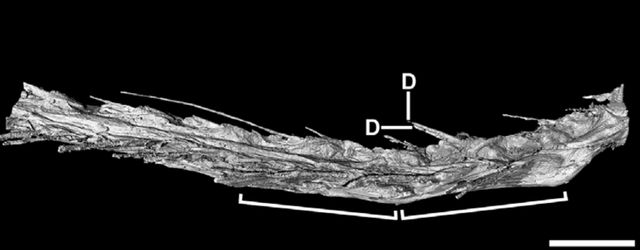
A new article published in Current Biology on December 5 provides details of a study that scientists made of a nearly 100-million-year-old dinosaur tail, which was discovered preserved in a chunk of amber. Due to the amber, more than bones survived the long encasement—also contained therein were muscle, ligaments, skin, and feathers—sparking a great amount of interest in the scientific community and the general public. This is the first time that non-avian feathered remains preserved in amber have been described, and it allows scientists to better understand the evolutionary pathway of feathers and modern birds.
Amber trapped the dinosaur's tail, preserving muscle, skin, flesh and feathers from nearly 100 million years ago.
The amber sample itself was recovered from a mine in the Hukawng Valley in Kachin, northern Myanmar. This region is well known for having an abundance of amber that contains a variety of plant and animal remains from the mid-Cretaceous period (approximately 99 million years ago). This particular sample is the size of a tennis ball and also contains an ant as well as plant debris that was alive at the same time the dinosaur tail was deposited into the amber. The tail fragment itself measures about 1.4 inches and is covered in chestnut-brown feathers with a pale-white underside.
X-ray analysis shows that the fragment is made up of eight vertebrae that likely served as the middle or end of a long thin tail that may have featured upwards of 25 individual vertebrae. The vertebrae suggest that the source of the tail is a juvenile coelurosaur, a type pf Jurassic dinosaur that is considered intermediate between dinosaurs and birds. Coelurosauria includes maniraptorans, the only dinosaur group alive today. Maniraptora are characterized by downy feathers with elongated quills, and they are also the only dinosaur group known to include flying members.
One of the interesting facets of the research is the analysis of barbs located on the stems of the feathers—something that can only be seen at the microscopic level. The authors of the paper explain that the spatial arrangement of the barbs allowed them to confirm hypotheses about the evolutionary development of feathers and how they reached their present morphology. This is important because the morphology of the barbs is what allows modern birds to fly.
A tail feather of the encased dinosaur.
They conclude that while the feather arrangement is similar to what we see in birds today, the dinosaur in question was likely incapable of flight based on the contours and the way the barbs fuse. This means, however, that the feathers may have evolved due to ornamentality, so it may be hypothesized moving forward that feathers evolved for other purposes such as signaling or temperature regulation before they were adapted for flight. Of course, with a sample size of one, it is difficult to say with certainty whether this was typical of coelurosauria or whether this individual specimen is an exception.
This is not the first time that feathers dating from this time period have been found in amber, and biologists have already reported evidence going back over 20 years that dinosaurs had feathers, based on fossil impressions. However, scientists had difficulty in interpreting feather morphology due to compression in sedimentary rocks. Another road block was the fact that none of the feathers discovered were attached to or even associated with actual skeletal remains.
Just as interesting as the results of the latest study are the circumstances that led to the recovery of the amber in question. This sample was one of many that was collected at an amber market in Myitkyina, the capital of Kachin, where amber is used in both jewelry and carvings. In fact, the piece of amber containing the tail had already been cut and shaped by the time the researchers found it at the bazaar.
An x-ray revealing the bone structure of the dinosaur's tail.
While the modification meant that the tail was less intact than it could have been, one positive aspect was that a cross-section was cut through the tail that allowed for chemical analysis. This means that the authors were able to detect small amounts of iron that came from the creature’s blood, which will allow scientists to identify more information about coelurosauria.
Research in this region has been hampered by an ongoing civil war between the Myanmar government and the Kachin Independence Army, which controls the Hukawng Valley. If this conflict ends, it could lead to researchers gaining greater access to the vast caches of amber that likely contain data that will unravel even more of the mysteries surrounding the mid-Cretaceous period. The lead author suggested that they may even find a complete dinosaur at some point in the future.

The Gambia president refuses to accept election result

Eddie Heywood

After initially conceding defeat to Adama Barrow after the December 1 presidential election, incumbent President Yahya Jammeh announced on Friday that he rejects the results of the poll, citing “serious abnormalities” which he claims occurred during the election.
“After a thorough investigation, I have decided to reject the outcome of the recent election. I lament serious and unacceptable abnormalities which have reportedly transpired during the electoral process,” Jammeh announced on state TV. He did not elaborate on what the “serious abnormalities” were, except to claim that the election held on December 1 was “influenced by foreigners.”
Jammeh called for new elections, saying, “I recommend fresh and transparent elections which will be officiated by a God-fearing and independent electoral commission.”
The veracity of Jammeh’s claims cannot be assessed, as the results of the “thorough investigation” have not been released. No evidence exists of the claim of foreign influence in the election.
The inquiry cited by Jammeh was initiated by the official Independent Election Commission (IEC) of The Gambia, which is beholden to Jammeh’s ruling government. Late Saturday, Jammeh said he would be preparing a legal challenge to the result of the December 1 vote before the Gambian Supreme Court.
The Supreme Court in a statement said that it would decline to hear the challenge due to a lack of seated judges.
Various international critics over the weekend sharply condemned Jammeh on the news of his decision to challenge the poll.
The United Nations Security Council denounced Jammeh’s about-face, and demanded that he hand over power to President-elect Barrow. In a unanimous statement of the 15-member panel, it called on Jammeh to respect the choice of the Gambian people.
The Obama administration via the US State Department condemned Jammeh’s reversal, declaring it “a reprehensible and unacceptable breach of faith with the people of The Gambia and an egregious attempt to undermine a credible election process and remain in power illegitimately.” It further stated, “We call upon President Jammeh, who accepted the election results on December 2, to carry out an orderly transition of power to President-elect Barrow in accordance with the Gambian Constitution.”
After Jammeh made his announcement rejecting the election result, troops were deployed in the streets of the capital city Banjul, and were reported to be setting up sandbags, as if in preparation for a siege.
This prompted the US embassy in Banjul to issue a statement, urging the Gambian army to show “respect for the rule of law and the outcome of the presidential election”, adding, “The Gambian people have made a clear choice for change and a new start.”
Washington’s condemnations are entirely hypocritical and make a mockery of its appeals for Jammeh to adhere to democratic norms, considering Washington’s recent history of launching a war with its NATO allies in Libya in 2011 utilizing Al-Qaeda-linked forces to remove and murder Muammar Gaddafi in Libya.
There is also Washington’s ongoing support of Islamist militias in Syria to foment regime change in order to place a more pliant government in Damascus. The result of these two imperialist excursions have left both countries virtual wastelands, with tens of thousands maimed and killed, and have resulted in the worst refugee crisis since World War II.
The leader of the incoming political coalition behind Barrow, Fatoumata Jallow-Tambajang, has vowed that they are preparing to prosecute individuals in Jammeh’s regime, including Jammeh himself, if the election is resolved in Barrow’s favor.
There is no doubt that this played a role in Jammeh’s sudden about-face. Jammeh and his security apparatus have committed acts of repression, disappearances, torture and murder of political opponents, the victims of which include members of the political party of the incoming Barrow administration. Many of these individuals still remain detained at the Mile 2 prison where at least two of the prisoners have died as a result of torture.
There are clear indications that Jammeh has fallen out of favor with Washington and its Western European partners.
In October, Jammeh made moves to withdraw The Gambia’s participation in the International Criminal Court (ICC), and in 2013 rescinded The Gambia’s participation in the British Commonwealth of Nations, the organization of former British colonies. The Commonwealth was set up after the formal independence of the colonies in order to maintain the framework of economic exploitation set in place during colonialism.
Jammeh’s decision to withdraw The Gambia’s participation in the ICC is based on his fear that he and his cronies may be brought forth before it like other autocrats that fell out of favor with Washington, such as Liberia’s Charles Taylor.
Washington has scathingly criticized Jammeh for his autocratic form of rule in recent years, hypocritically condemning his government’s brutal repression of dissent. In reality, Washington and Britain have grown weary of Jammeh and his unpredictability; such behavior is not good for the business of exploiting The Gambia’s economic resources.
The human rights abuses committed by the Jammeh regime are giving Western interests a public relations black eye. Since 2014, the European Union has withdrawn millions of dollars in aid to The Gambia. In the same year, Washington booted The Gambia from its African Growth and Opportunity Act, a program aimed at expanding trade on the continent.
Barrow, on the other hand, has demonstrated his willingness to enter a subservient relationship with Washington and its Western European allies, and has stated that he is open to greater economic relations with wealthy international interests, and has promised to restore The Gambia as a member of the Commonwealth.
In response to Jammeh’s about-face on the election result, Barrow said, [Jammeh] “is damaging The Gambia’s democratic credentials.” He went on further: “We are calling on Mr. Jammeh to respect the will of the people and will hold him responsible for anything that happens in this country and its people.”
A pall of fear has fell over the Gambian masses with Jammeh’s refusal to accept the poll result. Many are expecting a crackdown. In the capital city of Banjul, many shopkeepers closed early on Friday, anticipating unrest. Senegalese fighter jets have been reported flying across the Gambian skies, in what can be interpreted as a warning to Jammeh.
In the event that a new election is called, it will almost certainly result in a Jammeh victory, as the Independent Election Commission is in the back pocket of the ruling government. The IEC arbitrarily decides which parties can run for election, it oversees labyrinthine rules on voter registration and polling locations which result in voter disenfranchisement, and it is the sole monitor and custodian in the country over the counting of the vote. It is certain that Jammeh’s security forces will be out in force throughout the country to carry out acts of intimidation and repression of political opponents and voters.
Regardless of whether Jammeh or Barrow takes the reins of power, the exploitation and repression of the Gambian masses will continue unabated. While Barrow is more palatable to Washington and Europe, both men have pledged their undying loyalty to the demand by the tiny wealthy Gambian elite and wealthy international corporate and banking interests that The Gambia is to remain open for capitalist exploitation.


Australian government threatens to jail “overpaid” welfare recipients

Margaret Rees

Facing economic contraction and a widening budget deficit, the Turnbull government is targeting vulnerable welfare recipients, issuing sweeping and unsubstantiated claims that they have fraudulently claimed or been overpaid about $4 billion in recent years.
In a new drive to intimidate and demonise people relying on pensions, family tax benefits, unemployment benefits or other welfare payments, the government is threatening to jail them unless they can produce documents to disprove any alleged over-payment.
Under the banner of “welfare fraud,” the government is seeking another pretext for gutting the entire welfare system, including disability programs and aged pensions. Having barely survived the July 2 election, the Liberal-National Coalition government is trying to demonstrate to big business that it can deliver its requirements.
According to information leaked to the Australian, the government is issuing debt notices worth $4.5 million every day, supposedly “in a bid to rein in the ballooning welfare bill.” A new automated system that matches a welfare recipient’s details with information from the Australian Taxation Office is generating 20,000 “compliance interventions” a week, up from 20,000 a year before the latest crackdown began in July.
Already, debt notices worth almost $650 million have been issued in the past four months, creating anxiety for thousands of working class households. The stress is compounded by the difficulties involved in trying to contact Centrelink, the chronically understaffed agency that administers the welfare payments regime, to clarify or challenge any accusation of over-payment.
Human Services Minister Alan Tudge last week used an appearance on the television program “A Current Affair” to threaten to jail those deemed to owe money. “We’ll find you, we’ll track you down and you will have to repay those debts and you may end up in prison,” he declared.
Earlier this year, a mass mail campaign by police and Centrelink threatened welfare recipients with jail if they provided inaccurate information. The letters warned that the government’s welfare fraud taskforce was “currently working in your community” and that providing wrong information could result in a “criminal record or a prison sentence.”
This marks a further escalation by the government of an offensive to push people off welfare. In March, Prime Minister Malcolm Turnbull’s government introduced a raft of measures associated with welfare “debts,” including imposing an interest rate of 9 percent, removing a six-year limit on recovery and preventing recipients from leaving the country if they allegedly owed money to Centrelink.
At that time, Social Services Minister Christian Porter told parliament: “One percent of Australia’s population have received money they are not entitled to and owe a debt to the other 99 percent of Australians, a debt that in too many instances they are making no effort to repay.” That is, he was castigating the poorest one percent of society, not the wealthy layers that have benefited from the slashing of social services over the past four decades that helped to provide massive tax cuts.
Assisted by the corporate media, which incessantly witch hunts welfare recipients as “dole bludgers” and “welfare cheats,” successive Labor and Coalition governments have already substantially cut the proportion of the working age population receiving income support payments, from 25 percent in 1994 to 16.6 percent in 2015.
This has been achieved by eliminating sole parent payments once the youngest child turns 8, imposing harsh “work tests” on dole recipients and increasingly blocking access to disability pensions. By one measure alone, in 2012, the Greens-backed Gillard Labor government ended Parenting Payments for 100,000 single parents and forced them onto Newstart unemployment benefits: an average cut of about $120 per fortnight.
Turnbull’s government has touted varying figures that it claims it will recoup from welfare recipients. During this year’s election campaign, Treasurer Scott Morrison claimed that $2 billion would be recovered. Suddenly, that figure has been doubled.
The actual breakdown of the so-called debts is revealing. One-fifth of the supposed “overpayments,” comprising 39 percent of the total amount, involves people who have not lodged a tax return. Thus a nightmare of “debt” can be imposed on recipients simply for not filling out a tax return.
Other households have inconsistent income, which could result in “over-payment” if a member of the household secured some temporary work. This group comprises 13 percent of the “overpaid” and 10 percent of the alleged debts.
Official statistics show that that last year just 0.018 percent of those receiving payments were investigated for fraud. Only 996 cases were referred to prosecutors and just 29 cases resulted in indictable charges.
Hailing the new compliance campaign, the corporate media again railed against welfare recipients, diverting attention from tax cuts for the rich and the escalating military budget. An Australian editorial announced: “Cheats are on notice.” It declared that welfare spending had to be gutted to slash the budget deficit and stop the global credit ratings agencies ending Australia’s AAA rating on financial markets.
This effort was immediately endorsed by anti-immigrant One Nation leader, Senator Pauline Hanson, whose group’s four senators helped Turnbull’s fragile government pass a number of key bills in parliament last week. Hanson, who has a long record of demonising welfare recipients, as well as refugees, Muslims, Asians and Aborigines, said Australia’s entire welfare system was “wrong.”
In the name of cracking down on welfare fraud, Hanson proposed a police state-style national identity card, proclaiming: “The whole fact is you need to stop them getting welfare in the first place if they’re not entitled to it.” Hanson boasted that she had recently spoken to Turnbull about the idea.
True to its own pro-business record, the Labor Party opposition has criticised the government for not being ruthless enough in tackling so-called welfare fraud. Shadow human services minister Linda Burney said minister Tudge was trying to “sell the massive failure of his department as a victory.”