19 Dec 2016

US coal miners hit by sharp rise in deadliest black lung disease

Clement Daly 

Reports released last week show that the prevalence of the deadliest form of black lung among US coal miners is far worse than previously expected. An investigative report conducted by National Public Radio’s (NPR) Howard Berkes found the number of miners suffering from so-called complicated black lung is more than 10 times what federal regulators previously reported.
In its investigation, NPR obtained data from 11 black lung clinics in Virginia, West Virginia, Pennsylvania and Ohio showing 962 cases of the most severe form of the disease, also known as Progressive Massive Fibrosis (PMF), in the past five years. The number is nearly 10 times the 99 cases of PMF identified by the National Institute for Occupational Safety and Health (NIOSH), the federal agency tasked with tracking black lung, over the same period. It is also more than double the 441 cases of PMF tabulated by NIOSH over the past 40 years.
NPR cautioned that even these staggering numbers underestimate the magnitude of the disease since some of the clinics provided incomplete data and another eight clinics contacted in the heart of the Appalachian coal mining region did not share any data.
Black lung is the common name for coal workers’ pneumoconiosis, a debilitating and irreversible occupational lung disease contracted through the inhalation of coal dust. Miners afflicted with the painful disease gradually lose the ability to breathe and slowly suffocate to death over a period of years.
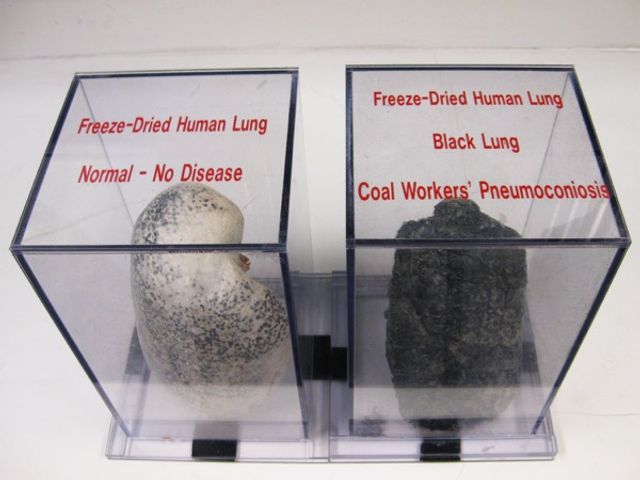
A display case at NIOSH shows a normal lung and a diseased black lung from inhaling coal dust and other harmful particles while coal mining. Credit: Howard Berkes/NPR
The dangers of black lung have been known for over a century. According to the Centers for Disease Control and Prevention (CDC), while black lung is incurable, it is “entirely man-made, and can be avoided through appropriate dust control.” Since government statistics began being collected in 1969, more than 78,196 miners have died from this preventable occupational disease.
The NPR story aired shortly after the release of a new report by NIOSH in the latest issue of the CDC’s Morbidity and Mortality Weekly Report, which identified 60 cases of PMF at a single clinic in eastern Kentucky over the course of 20 months.
The NISOH study was prompted by radiologist Brandon Crum who contacted the agency in June after he became alarmed over the number of miners in their 30s and 40s with less than 20 years underground being diagnosed with PMF at his clinic in Coal Run Village, Kentucky. The resulting study identified 60 cases of PMF at the clinic between January 2015 and August 2016, which had not been known to NIOSH. The afflicted patients had an average age of 60.3 years and an average career in the mines of 29.2 years.
NIOSH epidemiologist Dr. Scott Laney confirmed Crum’s fears over the cases. “The current numbers are unprecedented by any historical standard,” he told NPR. “We had not seen cases of this magnitude ever before in history in central Appalachia.” Dr. Laney, who co-authored the new NIOSH report, was also involved in a 2014 study by the agency, which concluded that black lung had reached its highest level in the US in four decades.
“This ongoing outbreak highlights an urgent need for effective dust control in coal mines to prevent coal workers’ pneumoconiosis, and for improved surveillance to promptly identify the early stages of the disease and stop its progression to PMF,” the latest NIOSH report warned. It concluded by noting, “The findings in this report serve as a reminder that more than 45 years after the Coal Act’s passage, one of its core objectives has not been achieved.”
Passage of the 1969 Coal Mine Health and Safety Act (Coal Act) and recognition of black lung as an occupational disease was granted only after a militant struggle waged by miners against both the coal operators and the United Mine Workers of America (UMWA) union bureaucracy. At that time, four out of every 10 coal miners were testing positive for black lung with about 1,800 dying each year from the disease.
The Coal Act set legal dust limits, implemented the federal black lung compensation program and established the Coal Workers’ Health Surveillance Program. Under the NIOSH-administered surveillance program, active coal miners are offered free chest X-rays upon entering the coal mines and at about five-year intervals thereafter.
While cases of black lung dropped precipitously following the implementation of the Coal Act, its loose provisions and lax enforcement prevented the complete eradication of the disease. The legal dust limit of 2.0 milligrams per cubic meter of air implemented in 1972 proved inadequate to fully protect miners and was long skirted by industry through widespread falsification of dust sampling used to determine compliance.
It has also been long known that the surveillance program is inadequate to the task of tracking the prevalence of black lung. The voluntary nature of the tests and its restriction to only active coal miners--excluding large numbers of retired and laid-off miners--coupled with industry intimidation ensures low participation and an incomplete picture of the scale of the disease. In its latest report, NIOSH admits that only 17 percent of Kentucky coal miners participated in surveillance program since 2011, leading the agency to conclude that “the actual extent of PMF in US coal miners remains unclear.”
In its story, NPR profiled Charles Wayne Stanley of Pound, Virginia, a 53-year-old who was diagnosed with PMF after he received his first screening after working 30 years in the mines. “If you’re working and you go and have that stuff done and the company finds out about it, they’ll find a way to get rid of you,” Stanley told NPR. “As long as you’re working and producing you’re an asset. But now when you get something wrong with you, you become a liability. And they’ll find a way to get rid of you.”
Health officials have been warning about a resurgence of black lung for more than two decades after the number of miners afflicted, as well as the aggressiveness and severity of the disease, began increasing in the 1990s. In 1995, NIOSH issued a recommendation that the dust standards, which had remained unchanged at 2.0 mg since 1972, be cut in half to 1.0 mg. The recommendation, however, remained a dead letter under both Republican and Democratic administrations.
By the time the Obama administration unveiled new dust standards in May 2014, more than 16,000 miners had died from black lung since NIOSH had issued its initial recommendation in 1995. Moreover, after meeting with coal industry representatives and UMWA officials, the Obama administration decided to tighten the dust standards by only 25 percent, down to 1.5 mg, instead of the 50-percent reduction argued for by NIOSH scientists.
As former US Mine Safety and Health Administration (MSHA) staffer Celeste Monforton explained in her blog The Pump Handle at the time, the agency had estimated that 20 out of every 1,000 coal miners would still develop PMF even if the standards had been reduced to 1.0 mg. Under the 1.5 mg limit, MSHA expected 50 cases of PMF for every 1,000 coal miners, thus leaving thousands at risk of contracting the disease.
The numerous studies and investigative reports over the past two decades have pointed to various objective roots for the resurgence of black lung: the eight-hour day being replaced by more typical shifts of 10 to 16 hours, increasing exposure times; increased mechanization and production rates leading to higher levels of dust; and thinning coal seams in the extensively mined Appalachian coal regions which release more silica rock dust when cut into. As NPR noted, “Every other industry cutting rock has strict limits on silica exposure, except mining.”
Under the impact of the global economic slowdown, increased competition from cheaper natural gas and the restructuring of the coal industry, 40,000 coal miners have lost their jobs and 600 mines have closed since 2011. With few prospects of being rehired, former miners are getting black lung screenings to secure some form of income. A successful black lung claim, however, provides just $600 to a maximum of $1,250 a month for a miner with three or more dependents.
Behind these conditions lies a massive social crime. The exploitation of the miners has produced vast fortunes for the coal and energy conglomerates, which are protected by the courts, federal, state and local agencies run by both big business parties, and the UMWA, which long ago abandoned the interests of miners and became a tool of the coal operators and the government.
The coal companies have used the bankruptcy courts to escape their obligations, threatening the health care and pensions of 120,000 retired coal miners and their families. The bankruptcy courts have also sanctioned the dumping of 1,000 black lung claims that were self-insured by the bankrupt companies into the federal Black Lung Disability Trust Fund, which is already nearly $6 billion in debt.

US deaths from synthetic opioids surge by 72 percent

Kate Randall 

The number of overdose deaths in the US from synthetic opioids surged 72 percent from 2014 to 2015, according to new data released Friday by the Centers for Disease Control and Prevention (CDC). The dramatic one-year rise follows a tripling of overdose deaths from opioids from 1999 to 2014, as tracked by the CDC.
The news follows CDC research released earlier this month showing that heroin overdose deaths in the US have reached epidemic proportions, with opioid overdose deaths rising 5,000 since 2014, surpassing 30,000 for the first time in recent history.
The reality of the opioid overdose crisis stands in stark contrast to President Obama’s rosy depiction of life in America as he prepares to leave office. At his last press conference of the year on Friday, he pointed to the low official unemployment rate, a modest increase in wages and, above all, a tripling of the stock market to claim that he leaves a legacy of economic “success.” He avoided any mention of the social crisis wracking the country, including declining life expectancy for large sections of the working class, rising suicides, and surging substance abuse and death from opioid overdoses.
Obama’s words provide cold comfort to the tens of thousands of families losing loved ones to the opioid epidemic, even as funding for treatment programs is cut. Despite the CDC’s stress in its report on the “urgent need for a multifaceted, collaborative public health” response to the opioid epidemic, there is no coordinated government effort to stem the tide of opioid abuse and overdose deaths.
According to the CDC’s latest report, a majority of US states reported significant increases in overdose deaths due to heroin and prescription painkiller abuse last year. In 2015 alone, drug overdoses killed 52,000 people, with nearly 66 percent of these deaths resulting from abuse of prescription or illegal opioids.
The CDC data shows that two synthetic opioids, fentanyl and tramadol, are largely responsible for the nationwide increase in drug overdose deaths. Fentanyl is a potent opioid pain medication estimated to be at least 50 to 100 times as strong as morphine. Overdoses from tramadol often involve other drugs, including alcohol.
Last year, 9,580 died from overdoses of synthetic opioids other than methadone, while painkillers such as Oxycontin and Vicotin had a 4 percent increase, resulting in 17,536 overdose deaths.
Over the last six years, deaths form heroin overdoses alone have quadrupled. For the first time ever, more people died from heroin overdoses last year, 12,989, than were killed by gun violence, 12,979.
Males saw a staggering 90.9 percent increase in synthetic opioid deaths from 2014 to 2015, with younger men the hardest hit. Men ages 15-24 saw a 91.7 percent increase; ages 25-34, a 94.1 percent increase; ages 35-44, an 80.6 percent increase.
Overdose deaths from synthetic opioids among women rose by 46.2 percent in 2015, with women ages 15-24 seeing the largest one-year rise in deaths--116.7 percent--of any age or gender group.
The CDC’s data shows blacks of all ages (non-Hispanic) with the largest one-year increase, 95 percent; followed by whites (non-Hispanic), 75 percent; and Hispanics, 50 percent.
Seven years into the so-called economic recovery, cities and towns across the country are gripped by an opioid and heroin epidemic that sees no signs of ebbing. Families seem helpless to deal with their members’ addictions, with their only apparent ally the drug naloxone (brand name Narcan), which reverses the effects of opioids within minutes. The drug is now widely available to the public in many states.
The Northeast region saw the biggest hike in synthetic opioid overdose deaths, rising by 107 percent in 2015 over 2014 figures. Three Northeast states registered overdose death increases in excess of 100 percent in one year: New York (135.7 percent), Connecticut (125.9 percent), and Massachusetts (108.7 percent). New Hampshire followed close behind (94.4 percent), as did Maine (90.4 percent).
In the face of the Massachusetts opioid crisis, Republican Governor Charlie Baker’s proposed budget for fiscal year 2017 slashes $1.929 million from the Bureau of Substance Abuse Services, affecting treatment programs across the state.
In Connecticut, another hard-hit New England state, there are 400 people on the waiting list for the substance abuse treatment and detox programs paid for by the state’s judicial branch on any given day, according to the CT Mirror. To cut $4 million from the judicial branch’s budget, the state has cut substance abuse treatment beds in Hartford, Middletown, New Britain, New London, Sharon and Waterbury.
The Midwest region saw the next biggest one-year increase, at 95 percent. Illinois saw a 120 percent increase, while Ohio had a 107.3 percent rise.
Among the 28 states meeting inclusion criteria for state-level analysis by the CDC, the largest absolute change in deaths from synthetic opioids other than methadone occurred in Massachusetts, New Hampshire, Ohio, Rhode Island and West Virginia. States seeing the largest absolute rate changes for heroin deaths were Connecticut, Massachusetts, Ohio and West Virginia.
Under conditions where budget cuts will only deepen under a Trump administration, little hope is offered to the tens of millions of people across the country facing a future of austerity and increased health problems, including addiction.
While one in seven Americans will become addicted to drugs or alcohol in their lifetime, according to a recent report from the US surgeon general, only 10 percent of those affected will ever receive help in treating their dependency.
Such is the true social legacy of Obama’s pro-corporate and militaristic policies, rooted in the defense of the capitalist profit system.

Trump and West Asia: Reading the Tea Leaves

Ranjit Gupta


Not only is Donald Trump the least-prepared president-elect in US history, but he compounds this handicap by showing little interest in preparing for perhaps the most important position in the world. He has been brazenly blasé about avoiding intelligence briefings, saying, “I don’t have to be told, you know, I’m, like, a smart person.”
Donald Trump, the first billionaire US president, has appointed to his cabinet or cabinet-level positions people having a combined net worth of about US$5.6 billion, the highest in US history. Success in deals and money-making seems to be a premium criterion for Trump’s evaluation of people, an unusual approach for successful governance. Having 4 former generals in his team is also unprecedented. Less than half of the appointees have government experience. Those who will have his ear on a daily basis are his cronies – his chief strategist, Steve Bannon, is an unabashed White-supremacist demagogue having headed right-wing news site Breitbart News, before chairing the president-elect’s campaign; Reince Priebus, Trump’s chief-of-staff, was chair of the Republican National Committee; Jared Kushner, Trump’s son-in-law, has emerged as a key power centre. None of them had worked in government. His daughter, Ivanka, has been sitting in Trump’s meetings with foreign dignitaries. His national security advisor, Gen Michael Flynn, is unabashedly racist and an Islamophobe; he was sacked as head of the Defence Intelligence Agency. He has a long record of being unable to work harmoniously with colleagues.
Trump’s foreign policy-related comments during the campaign were like throwaway remarks - seemingly consciously designed keeping in mind the next day's news headlines - conspicuously exhibiting a complete lack of serious thinking through on many critical issues. He has a dim view of long time US security alliances and of allies being freeloaders. Even after being elected he has continued to be off-handed. In a particularly conspicuous and potentially extremely dangerous break with the past, Trump took a congratulatory call from the president of Taiwan and later strongly defended his doing so against both domestic criticism and China’s continuing strong warnings. The Sino-US relationship is the most critical relationship in global geopolitics and must be treated with great sensitivity.

All this cannot but be a matter of considerable concern since the US is the world’s most powerful country and has been the linchpin of the global security architecture.

Trump has appointed Rex Tillerman, the CEO of ExxonMobil, as secretary of state, and South Carolina Governor Nicky Haley to be ambassador to the UN. Neither has any foreign policy experience. However, Tillerman has shepherded ExxonMobil’s work in over 50 countries remarkably successfully. Trump sees him as a pragmatist and a savvy dealmaker, viewing his strong personal ties with Putin and business relationship with Russia - including opposition to sanctions on Russia - favourably. This resonates well with his own personal warm feelings towards Putin as someone able to cut deals with strongmen, many of whom have traditionally been opposed to the US: “Rex is friendly with many of the leaders in the world that we don’t get along with…I like what this is all about.” All this said, Tillerman may prove to be an inspired choice.

Retired marine Gen James Mattis’ nomination as secretary of defence has been the most popular appointment. He is particularly well regarded in the US military and enjoys bipartisan political support.

It is to be hoped that both Tillerman and Mattis will bring a certain degree of sobriety and gravitas in the consideration of important foreign policy issues.

Currently, the most dangerous flashpoints in the world are in West Asia, which has been in flames for almost six years now, and there are few signs of the situation improving meaningfully any time soon. Issues in this region are likely to be amongst the earliest foreign policy decisions of the Trump administration. Each decision will have consequences that would adversely impinge upon Trump’s other regional priorities, and so it will not be easy to pursue many mutually contradictory components of his West Asian policy agenda.

Trump’s campaign remarks suggest that he attaches the highest priority to defeating the Islamic State (IS) through proactive cooperation with Russia, and that he wishes to establish a close personal working relationship with Putin. Particularly after Russia’s successful military intervention in Syria, such a partnership will inevitably ensure a fresh lease of life for Assad’s continuing in power until his patrons, Russia and Iran, decide otherwise. It will also further empower Iran in the region and enable Russia to consolidate its growing physical military presence and political influence in West Asia in the long-term.

On the other hand, Trump has repeatedly said that it would be his “number-one priority to dismantle the disastrous (nuclear) deal with Iran.” Vice-President Pence, NSA Flynn, CIA Director Pompeo, Chief of Staff Priebus and indeed even Defence Secretary Mattis are also hawks on Iran, but to his credit, Mattis has publicly suggested that the US must not unilaterally scrap the nuclear deal. Abrogating it will create complications with all other co-signatories, particularly Russia, apart from potentially causing Iran to take counter-actions with potentially highly destabilising consequences.

Trump has promised to shift the US embassy in Israel from Tel Aviv to Jerusalem. Announcing the appointment of a long time lobbyist for Israel, David Friedman, as the new US ambassador to Israel, Trump said, “the bond between Israel and the United States runs deep..I will ensure there is no daylight between us….He [Friedman] has been a long time friend and trusted advisor to me." Accepting the offer, Friedman inter alia said, “I intend to work tirelessly to strengthen the unbreakable bond between our two countries and…. I look forward to doing this from the US Embassy in Israel's eternal capital Jerusalem.” Long-term senior aide to Trump, Kellyanne Conway, later said, “this is a very big priority for the President-elect and I have heard him repeat it several times privately if not publicly” after being elected. Doing this will create a huge uproar all over the Muslim world, greatly complicating the new administration's relations with Muslim countries. This move will almost certainly provide a huge boost to greater radicalisation of increasingly larger numbers of Muslims and terrorism.

Trump has spoken highly of Erdogan and both Pence and Flynn have dropped hints that Gulen could be extradited to Turkey. This would greatly encourage Erdogan to become even more authoritarian. Given his visceral hatred of the Kurds and proclivity towards policy flip flops, this will serve to greatly enhance uncertainties in West Asia. At the same time, Trump has expressed great admiration and friendship for the Kurds of both Syria and Iraq. There is no clarity how this conundrum can be resolved.

If these campaign promises are carried out, it will almost certainly further inflame and destabilise the situation in West Asia. It would be in the interest of the region, the world, and indeed of the US itself to postpone decisions relating to the nuclear deal, shifting the embassy, and decision regarding Gulen for 6 months or so to enable a thorough evaluation of their inevitably serious consequences.   

Finally, it merits mention that the implementation of these promises will create huge dilemmas for India because it cannot sit silently on the fence as it has done advantageously in the past. India will perforce have to take stands, inevitably offending one or the other side, and each one of India's relationships in West Asia are very valuable for India. 

17 Dec 2016

Learn Social Media in Public Relations – Online Course by National University of Singapore

Enrolment: Take on demand
Timeline: 4 weeks @ 6-8 hours per week
Skill Level: Beginner
Course of Study: Public Relations for Digital Media | Course Platform: Coursera
Created by: National University of Singapore
Cost: Free
About the Course
Have you ever wondered why some videos go viral while others flop or how some companies have successfully leveraged Facebook and Twitter to reach out to their customers and clients? How are some companies able to effectively navigate the world of social media and build thriving online communities while others flounder, crash and burn? These questions along with many others concerning the use of, management and effects of social media in today’s world will be covered in this course.
Embark on a journey into the realm of social media in public relations and explore the dynamics and management of social media and how it has changed public relations. Get to examine the impact of digital influence, the relationship between traditional and social media as well as some of the pitfalls in the use of social media. You will also learn how to cultivate and manage relationships in social media, engage the online community, and plan and manage online content. We will also take a look at some ways to measure and evaluate social media campaigns.
Eligibility requirement
Anyone interested in digital media, social media and/or public relations can take this course.
Certificate offered? Optional
How to Enrol

Iowa State University Scholarship for International Students 2017 – USA

Application Deadline: 1st March 2017 
Offered annually? Yes
Eligible Students: International students
To be taken at (country): Iowa State University USA
Eligible Field of Study: Courses offered at the university
About Scholarship: Iowa State is committed to enrolling a diverse and talented student population. The International Merit Scholarship is awarded to students who have demonstrated strong academic achievement, and outstanding talent or achievements in one or more of the following areas: math and sciences, the arts, extracurricular activities, community service, leadership, innovation, or entrepreneurship.Iowa State University
Type: Undergraduate scholarship
Eligibility
Incoming international freshmen applicants and international transfer applicants with fewer than 66 transferrable semester credits
Selection Criteria
Demonstrated strong academic achievement, and outstanding talent or achievements in one or more of the following areas: math and sciences, the arts, extracurricular activities, community service, leadership, innovation, or entrepreneurship
Number of Scholarships: not specified
Value of Scholarship: There are two international Merit Scholarship levels:
Gold: $8,000/year (renewable)
Cardinal: $4,000/year (renewable)
Duration of Scholarship: Recipients will be funded for a maximum of 8 semesters, or completion of the degree, whichever comes first.
Application Requirements
  • A cumulative Grade Point Average (GPA) comparable to a minimum of 3.0 out of 4.0 (B)
  • The SAT is not required, but if submitted, it will be considered
  • A resume or CV listing your achievements
  • One letter of recommendation
  • A 500-word essay. You may write something that will help the committee get to know you better and tell us why you deserve the award, or you may answer one of the questions provided on the scholarship application form
  • Applicants must be international students and must have completed an international application for admission
How to Apply
You must submit your Undergraduate Application for Admission and all required transcripts, financial documents, and examination results before you may apply for the International Merit Scholarship, as your application file will be reviewed as part of the scholarship consideration.
Once you have submitted your application for admission, you may then complete the International Merit Scholarship Application Form.
Please be sure to use your name exactly as it is entered on your application for admission so that your scholarship application can be matched to your undergraduate application. You will use this form to upload your current resume or CV (in PDF format), type your essay, and send the letter of recommendation form to the person you have asked to provide it. (These items must all be submitted using this form. Any scholarship materials via email or post will not be accepted.)
Visit scholarship webpage for details
Provider: Iowa State University

York University Global Leader of Tomorrow Scholarships for International Students 2017/2018 – Canada

Application Deadline: 15th February, 2017
Offered annually? Yes
Eligible Countries: International
To be taken at (country): Canada
Field of Study: Candidate must apply to the following faculties: Arts, Media, Performance & Design; Environmental Studies; Education; Glendon; Health; Lassonde School of Engineering; Liberal Arts & Professional Studies; Science; or the Schulich School of Business.
Type: Undergraduate
Eligibility: To be considered for the Major International Scholarships, candidate must:
  1. Be
  2. Be
Selection Criteria: 
  • Highest academic average
  • Leadership and demonstrated skills
  • To renew – must have a high academic standing (7.80 on a 9-point York scale) in each academic year at York
  • By submitting this application, you will also be considered for the other available international scholarships requiring an application.
Number of Awardees: Not specified
Value of Scholarship: $80,000 ($20,000 x 4 years)
Duration of Scholarship: 4 years
How to Apply: Apply now.
Award Provider: York University

York University International Entrance Scholarships for Undergraduate Students 2017/2018 – Canada

Application Deadline: 15th February, 2017
Offered annually? Yes
Eligible Countries: International
To be taken at (country): Canada
Field of Study: Candidate must apply to the following faculties: Arts, Media, Performance & Design; Environmental Studies; Education; Glendon; Health; Lassonde School of Engineering; Liberal Arts & Professional Studies; Science; or the Schulich School of Business.
Type: Undergraduate
Eligibility: To be considered for the Major International Scholarships, candidate must:
  1. Be
  2. Be
Selection Criteria: 
  • Highest academic average
  • Demonstrated leadership skill
  • Letters of recommendation
  • To renew – must have a high academic standing (7.80 on a 9-point York scale) in each academic year at York
  • By submitting this application, you will also be considered for the other available international scholarships requiring an application.
Number of Awardees: Not specified
Value of Scholarship: $140,000 ($35,000 x 4 years)
Duration of Scholarship: 4 years
How to Apply: Apply now.
Award Provider: York University

American University of Beirut Graduate Scholarship in Health Science for MENA Countries 2017/2018

Application Deadlines:
  • 10th February, 2017 (Early)
  • 3rd April, 2017 (Regular)
Eligible Countries: Algeria, Bahrain, Comoros, Morocco, Lebanon, EgyptDjibouti, Iraq, Jordan, Kuwait, LibyaMauritania, Oman, Qatar, Saudi Arabia, Palestine, SomaliaSudan, Syria, Tunisia, UAE, Yemen.
To be taken at (country): Beirut, Lebanon
Eligible Fields of Study:  
  • Master of Public Health (MPH) with 3 areas of concentration:
    • Epidemiology and Biostatistics (EPBS)
    • Health Promotion and Community Health (HPCH)
    • Health Management and Policy (HMP)
  • Master of Science in Epidemiology (MS EPID)
  • Master of Science in Environmental Sciences – Major in  Environmental Health (MS EH)
About the Award: A limited number of partial or full scholarships are available to students from the Arab region interested in the MPH and MS programs at the Faculty of Health Sciences (FHS).
Scholarship opportunities are only available for the Fall admission term of every academic year. 
Type: Master’s taught
Selection Criteria: Prospective students will be evaluated based on the following criteria:
  • Commitment to service in public health in the region.
  • Relevance of work experience to public health or related fields.
  • Duration of work experience.
  • Local need for public health graduates in the country of the applicant.
Number of Awardees: Not specified
Value of Scholarship: Full scholarships cover tuition and related academic expenses, travel to and from the country of residence as well as basic living expenses. Partial scholarships provide financial support for a range of these expenses.
Duration of Scholarship: Duration of programme
How to Apply: The scholarship application form is part of the AUB online graduate application. Interested students who meet the selection criteria must first submit a complete AUB graduate application online, which includes the scholarship application.
Award Provider: American University of Beirut

Illinois Wesleyan University International Student Scholarships for Undergraduate Study 2017/2018

Application Deadline: 1st April, 2017
Offered annually? Yes
Eligible Countries: International
To be taken at (country): USA
Field of Study: All
About the Award: Merit-based scholarships are offered to qualified international applicants with outstanding academic achievement and test scores on the required entrance exams. These awards range from $10,000 to $25,000 per year and are renewable for up to four years. In some instances, additional help is provided through student loans and campus employment.
In addition, two full-tuition President’s International Student Scholarships are offered. These scholarships are awarded each year to two highly qualified international students in assessing their talents, interests and academic achievements. The President’s scholarship is renewable for up to four years of study at Illinois Wesleyan University.
Type: Undergraduate
Eligibility: 
  • Merit scholarships are offered to qualified international applicants with outstanding academic achievement and test scores on the required entrance exams.
  • President scholarships are offered on the basis of outstanding talents, interests and academic achievements.
Value of Scholarship: 
  • Merit scholarships: $10,000 to $25,000
  • President scholarships: Full tuition
Duration of Scholarship: Renewable for 4 years
How to Apply: For international applicants seeking additional financial assistance, the CSS PROFILE is required for need-based consideration. The PROFILE provides a detailed analysis of an applicant’s financial resources. Using this information, we can be “need sensitive” when considering ways to further assist our international students with Illinois Wesleyan University funded scholarships, loans and campus-employment opportunities.
Award Provider: Illinois Wesleyan University

University of Sheffield Merit Postgraduate Scholarships for Developing Countries 2017/2018

Application Deadline: 23rd June 2017  
Offered annually? Yes
Eligible Countries: 
  • East and South Africa: Kenya, Uganda, Botswana, Zimbabwe, Zambia, Malawi, South Africa, Tanzania, Mauritius
  • Middle East and North Africa: Jordan, Lebanon, Syria, Iraq, Iran, Oman, Saudi Arabia, United Arab Emirates, Qatar, Bahrain, Kuwait, Egypt, Sudan, Algeria, Tunisia, Morocco
  • South East Asia: Brunei, Indonesia, Malaysia, Myanmar (Burma), Singapore, Thailand, Vietnam
  • Hong Kong, Nigeria, Pakistan, Sri Lanka, Japan, S. Korea, Norway, Turkey
To be taken at (country): University of Sheffield, UK
Subject Areas: Masters courses offered at the university
About Scholarship: The University of Sheffield offers the Merit Postgraduate Scholarships to international students who show exceptional academic potential starting a postgraduate taught master’s programme at the University in September.
Each scholarship is worth 50% tuition fee discount of your postgraduate taught masters degree tuition fee per year, for one year of study. The scholarships will take the form of a tuition fee reduction.
Selection Criteria and Eligibility: The Masters Scholarships are awarded on the basis of academic merit.
To be eligible for the Merit Postgraduate Scholarships:
  • Applicants must have applied for and been offered a study place at the University of Sheffield to be eligible to apply for the scholarship.
  • Applicants must apply for a study place by Friday 16 June 2017 for entry in September 2017 to be eligible to apply for the scholarship.
  • The scholarship application is a separate online process to applying for a course. A link to the online scholarship application will be sent by email to all eligible students from January onwards.
  • The scholarship will be awarded on the the basis of academic merit and the supporting statement. The final decision will be made by an academic panel.
  • The scholarship can be awarded in conjunction with other University of Sheffield scholarships as long as the individual does not become fully funded, for tuition fee purposes, as a result of the sum of these awards.
  • The scholarships will take the form of a tuition fee reduction only.
  • You must be self-funding and classified as overseas for tuition fee purposes.
  • The scholarship will not be awarded where partial funding is applicable from an external body* and there is an agreement already in place between the external body and the University of Sheffield to offer a tuition fee discount to the student.
  • The scholarships are for full-time and part-time students only. Students studying online or via distance learning are not eligible for the scholarships.
  • Part-time students will receive the full value of a one year of scholarship split pro rata over the duration of an equivalent single full-time academic year.
  • These scholarships exclude postgraduate courses in Clinical Dentistry.
  • Overseas students registered on partnership programmes will only be eligible for a proportionate amount of scholarship reflecting the percentage of the programme studied at and percentage of the tuition fees paid to the University of Sheffield. E.g. studying a 50:50 course with the University of Sheffield and another institution where the fees paid to the University of Sheffield are £8000, a scholarship will be applied which represents 50% of the full scholarship amount.
Value of Scholarship: 50% tuition fee discount
Duration of Scholarship: The scholarship will take one year of postgraduate study
How to Apply: If you wish to be considered for this scholarship you need to apply. Eligible students will automatically be sent details of how to apply from January onwards.
Sponsors: University of Sheffield, UK
Important Notes: Applicants cannot apply for the scholarships before being offered a study place at Sheffield.

Online Course to learn Advanced Content and Social Tactics to Optimize SEO

Enrolment: Take on demand (Self paced)
Timeline: 4 weeks of study @ 1-3 hours/week
Skill Level: Advance
Course of Study: Search Engine Optimization | Course Platform: Coursera
Created by: University of California, Davis
Cost: Free without certification and assignments
About the Course
Discover the content marketing and social media ecosystems and how these interconnected channels drive search results to a website. Leverage content marketing and social media as part of your SEO strategy, and how to use influence marketing to establish a website’s authority.
Eligibility requirement
Anyone interested in advance content and social media techniques of improving search engine optimization for brands and enterprises.
Certificate offered? Yes
How to Enrol