1 Feb 2017

Italian court sentences ex-Latin American dictators for Operation Condor

Cesar Uco & Bill Van Auken

An Italian tribunal last month sentenced two former Latin American dictators and six other former officials and military officers to life in prison for their part in the deaths of 23 Italian citizens. These 23 victims were among the tens of thousands of opponents of Latin America’s fascist-military regimes who were murdered, tortured and illegally imprisoned under a US-backed campaign of repression known as Operation Condor in the 1970s and 1980s.
Those sentenced on January 17 included Peru’s former dictator (1975-1980) Gen. Francisco Morales Bermúdez, 95, and Gen. Luis Garcia Meza, 87, who imposed a bloody reign of terror over Bolivia from 1980 to 1981. Garcia Meza is already serving a 30-year prison term in Bolivia for the crimes of his dictatorship.
Receiving the same sentence were: Morales Bermúdez’s prime minister, Pedro Richter Prada and former commander-in-chief of the Peruvian Army Gen. German Ruiz Figueroa; Garcia Meza’s minister of interior, Luis Arce Gomez; former Uruguayan Foreign Minister Juan Carlos Blanco (1973-76); and two former Chilean military officers, Hernán Jerónimo Ramírez and Rafael Ahumada Valderrama.
During the 1970s and 1980s, dictatorships in Argentina, Uruguay, Bolivia, Brazil, Chile, Paraguay and Peru, with the aid of the US CIA, developed Operation Condor as a program of coordinated continental repression, pooling their police-military resources in order to hunt down exiles and send them back to their deaths, while allowing secret police death squads to freely cross borders.
Ten years ago, when the proceedings were initiated, an Italian judge issued orders for the preventive detention pending extradition of 140 officials of Latin America’s former dictatorships. By the time the trial ended last month, the number had been whittled down to 27 by bureaucratic hurdles thrown up by Latin American governments, as well as the deaths of many of the accused, including Argentina’s genocidal generals Jorge Videla and Roberto Viola, along with former Uruguayan dictator Gen. Gregorio Alvarez, all of whom who had been sentenced to prison in their own countries for the crimes of their dictatorships.
While the verdict has been hailed by some human rights groups as a victory and an official confirmation of the cross-border crimes carried out under Operation Condor, there was outrage among many of those present, particularly relatives of Uruguayans who were abducted, tortured and murdered by the dictatorships. Uruguay accounted for 33 of the 42 Italian citizenships whose disappearances and deaths were the subject of the trial at its outset. Yet, only one of the Uruguayans on trial, former foreign minister Juan Carlos Blanco, was found guilty and sentenced to life in prison. Of the 19 accused found not guilty by the court, 13 were Uruguayans, many of them notorious military assassins and torturers.
The most damning of the acquittals, in terms of the court’s credibility, was that of Jorge Tróccoli, a retired Uruguayan naval captain, who openly acknowledged torturing prisoners under the dictatorship and who served as a liaison between the Uruguayan dictatorship and infamous School of Naval Mechanics (ESMA), one of the main torture centers in Argentina. Tróccoli wrote books and gave interviews defending his crimes as acts of “war.”
Tróccoli’s verdict was the most significant because he was the only defendant who was actually within the grasp of the Italian justice system. Having secured Italian citizenship, he fled to Italy in 2007 after proceedings were initiated against him in Uruguay. Uruguayan attempts at extradition were stymied, and Tróccoli has been able to live well beyond the means of a retired Uruguayan naval officer in an expensive area on the Amalfi Coast in southern Italy ever since, apparently the beneficiary of protection from intelligence agencies.
While the rationale for the court’s decisions will only be provided in the coming months, it appears that it allowed Tróccoli to go free on the defense of “due obedience,” the claim that he was “only following orders” that was rejected when used by the Nazi defendants at Nuremberg. In his case, this defense was patently false, given his own public admission that no one ordered him to torture, and testimony by other officers that there were no sanctions against those who refused to participate in these crimes.
In a video interview in Rome, a young Uruguayan woman expressed her anger over the court’s decision: “They are genocidal. It is a shame what is happening. I’m completely outraged. I traveled thousands of miles to have an answer and have convictions. And, again, my parents are missing. I do not know their fate. I was born in a clandestine center. I’m 39 years old and I thought I would go free today.”
Raul Sendic, the vice-president of Uruguay who attended the final court hearing, was considerably more sanguine, declaring himself “disappointed” but “not in a position to pass judgment on this court.”. Sendic, whose father Raul, a founder of the Tupamaro urban guerrilla movement, spent a dozen years in prison under the Uruguayan dictatorship, is a member of the Frente Amplio (Broad Front), the electoral alliance into which the ex-guerrillas entered to pursue bourgeois politics.
Another notable aspect of the trial was the Italian prosecution’s position that, while Washington clearly was aware of Operation Condor—evidence against some of the defendants came from State Department files—it was not a participant in its crimes.
There is ample evidence however, that the CIA and the US government had a direct and guiding hand in the repression.The position of the Italian authorities was likely driven by political considerations, both the desire not to antagonize Washington and the knowledge that the US would never allow any ex-officials to stand trial under international law.
One of the main architects of Operation Condor, Manuel Contreras, the former head of Chile’s notorious secret police, the Directorate of National Intelligence, or DINA—who was also identified as a paid “asset” of the CIA—testified that two notorious assassinations carried out by his agents had been approved and jointly organized by the CIA.
The first was that of Gen. Carlos Prats, the ex-chief of the Chilean army, who had opposed the US-backed coup led by Gen. Augusto Pinochet. He and his wife were murdered in 1974 with a car bomb in Buenos Aires, where they had sought refuge. The second assassination was that of Orlando Letelier, the former foreign minister in the overthrown government of Salvador Allende and a key figure in the international opposition to Pinochet. He was also killed in a car bombing in 1976 together with his aide, Ronni Moffitt, in the streets of Washington, D.C.
Declassified documents also made it clear that then-Secretary of State Henry Kissinger was fully informed of Operation Condor by the foreign minister of Argentina’s military dictatorship, Admiral Cesar Guzzetti, in at an OAS meeting in 1976. Kissinger voiced his support for the crimes, urging his Argentine counterpart to “do them quickly” and assuring him “We want you to succeed.”
The most prominent among those found guilty who is not already imprisoned in his own country was Peru’s Morales Bermúdez. He was convicted in connection with the murders of three Argentines of Italian origin who had fled to Lima as refugees from the Videla dictatorship.
In a January 23 article, the Spanish daily El Pais described in detail the fate of the three:
“The Argentine Carlos Alberto Maguid was kidnapped in Lima, Peru, on April 12, 1977. At the time of his capture, he enjoyed political asylum in the country... at a central bus stop, four officers of the Peruvian Army put Maguid in a white Volkswagen and took him to the Ministry of War, where his military countrymen were waiting for him. It is unclear whether he was executed in Peru or taken to Argentina.
“Montoneras María Inés Raverta and Noemí Esther Gianetti de Molfino were kidnapped in the same city three years later... Both were taken to the military recreation area at Playa Hondable …and handed over to the Argentine military.
“The torture sessions included electric shocks in the vagina, drowning in the sea, beatings and a Tupac Amaru-style torture, using vehicles instead of horses. …Raverta was delivered by the Peruvian authorities to the border with Bolivia. She was never heard from again. Molfino was kept alive a little longer; her body was found weeks later in a hotel in Madrid.”
According to El Pais, the court established that Morales allowed Argentine military personnel into the country and offered them assistance in “torture in facilities of the Peruvian state and hiding the enforced disappearance.”
In a July 2015 interview with the Peruvian daily El Comercio, Morales Bermúdez denied that Operation Condor had a presence in Peru. In his defense, he insisted that the military regime he headed was “determined to lead the country to the democratic system by withdrawing from power.”
All of this is lies. Morales Bermúdez came to power in 1975, with the backing of the CIA, in a right-wing military coup that overthrew his predecessor, General Juan Velasco Alvarado. Velasco’s military regime had antagonized Washington by pursuing a left-nationalist course, establishing ties with the Soviet Union and Cuba, while carrying out nationalizations, even as it sought to repress the Peruvian working class.
Morales Bermúdez implemented the demands of the IMF and coordinated the policies of his regime closely with those of Washington and the other Latin American military dictatorships, including through collaboration with Operation Condor. His so-called “reforms” led to economic collapse and a growing resistance from the Peruvian working class that forced the military to relinquish power.
There is no extradition treaty between Italy and Peru, and previous governments refused to send Morales Bermúdez for trial. Given his advanced age and the right-wing character of the current government of President Pedro Pablo Kuczynski, it is even less likely that he will be sent to serve his sentence.

Drug distributors fined for failing to report suspicious orders of opioids

Brad Dixon

Drug distributors have recently been hit with millions of dollars in fines for failing to report “suspicious orders” of prescription painkillers to the Drug Enforcement Agency (DEA). These drug distributors, along with drug manufacturers and retail pharmacies, have contributed to the growing opioid epidemic in the United States.
The opioids that are manufactured by companies such as Purdue Pharma and Insys Therapeutics are distributed to retail pharmacies like CVS and Walgreens by drug distributors, also known as drug wholesalers, who act as middlemen.
The Controlled Substances Act (CSA) requires these drug distributors to identify and report “suspicious orders” of controlled substances to the DEA. Still, drug wholesalers have repeatedly failed to do so, while industry lobbying has curtailed enforcement of the law by the DEA. The recent penalties and fines reflect more the flagrant manner by which the drug distributors have allegedly violated the law, than any renewed effort by regulators to clamp down on the practice.
Earlier this month, McKesson, the nation’s largest drug distributor, paid a record $150 million civil penalty for alleged violations of the CSA. The settlement with the Justice Department requires the company to suspend its sales in Colorado, Ohio, Michigan and Florida for multiple years, although this will be done on a staggered basis that critics say will minimize the order’s impact.
The settlement follows a $13.5 million civil penalty McKesson agreed to in 2008 for failing to develop a system to detect and report suspicious orders of controlled substances. The 2008 settlement required the company to develop a compliance program, but a government investigation found that the company failed to adhere to it.
This past December, drug distributor Cardinal Health agreed to pay $44 million to resolve allegations that it failed to report suspicious orders placed in Maryland, Florida and New York. In Florida, for example, the company’s own investigator warned in 2010 against selling narcotics to the Gulf Coast Medical Pharmacy. The warnings were ignored. While wholesale distributors would normally expect to send 65,000 doses of oxycodone to a pharmacy of this size, Cardinal shipped more than 2 million doses to Gulf Coast in 2011 alone.
Cardinal announced a few weeks ago that it had also reached a $20 million settlement with the state of West Virginia to resolve a lawsuit alleging similar practices in that state between 2007 and 2012. Cardinal flooded West Virginia with 241 million oxycodone and hydrocodone pills during this period, more than any other drug distributor. West Virginia also settled lawsuits with other drug wholesalers, including a $2.5 million settlement with Miami-Luken and a $16 million settlement with AmerisourceBergen.
In nearly all cases, the companies denied any wrongdoing as part of the settlement.
McKesson, Cardinal and AmerisourceBergen are the three largest wholesale drug distributors, accounting for 85 percent of all drug shipments in the United States. The San Francisco-based McKesson, for example, which is currently number five on the Fortune 500 list, had $190.8 billion in revenues and $2.3 billion in profits in 2016, according to the company’s annual report.
The fines imposed on the drug wholesalers are minuscule in comparison to their revenues; they are simply another business expense necessary to keep the profits rolling in.
Previously, the DEA had focused its enforcement efforts on doctors, retail pharmacies, and drug manufacturers. In 2005, the DEA began to aggressively crack down on companies distributing prescription opioids by launching its “Distributor Initiative.”
According to an October 2016 investigation by the Washington Post, starting in 2013 there was political pushback against DEA enforcement, as the pharmaceutical industry ramped up its lobbying of congress. DEA leadership began delaying and blocking enforcement actions, while agency lawyers demanded higher standards of proof to initiate civil cases.
As a result, the number of civil cases filed by the DEA dropped from 131 in 2011 to only 40 by 2014.
In 2014, members of congress, led by Republican representatives Tom Marino of Philadelphia and Marsha Blackburn of Tennessee, proposed legislation that would weaken the DEA’s enforcement powers. Between 2014 and 2016, McKesson, Cardinal, AmerisourceBergen and the Healthcare Distribution Alliance, the drug distributor trade group, spent $13 million lobbying congress in favor of the legislation, known as the Patient Access and Effective Drug Enforcement Act.
The Act, which passed and was signed into law by Obama in 2016, requires the DEA to show that there is an “immediate” instead of “imminent” threat to the public before the agency can suspend the licenses of wholesalers, a much more onerous standard to demonstrate. Companies that fail to report suspicious orders can postpone or prevent the DEA from taking action against them by simply submitting a “corrective action plan.”
Enforcement by the DEA has been further hampered by the revolving door between pharmaceutical companies and the DEA officials charged with regulating the industry. An investigation by the Washington Post this past December found that at least 42 DEA officials had been hired by pharmaceutical companies or their law firms since 2005.
This includes officials from the DEA’s Diversion Control Division, which is charged with preventing prescription drugs from reaching the black market and has the power to suspend or revoke the licenses of doctors, pharmacies and pharmaceutical companies. A total of 31 former employees in the diversion division left to work for the pharmaceutical industry or law firms that represent it, including five DEA officials who went to work for McKesson.
“The DEA diversion officials who have gone to the industry since 2005,” reports the Post, “include two executive assistants who managed day-to-day operations; the deputy director of the division; the deputy chief of operations; two chiefs of policy; a deputy chief of policy; the chief of investigations; and two associate chief counsels in charge of legal affairs and enforcement actions against pharmaceutical companies.”
“The high rate of turnover makes you really wonder whether those officials were acting in the interests of the DEA rather than the companies they were regulating,” Craig Holman, an expert on revolving-door issues at Public Citizen, told the Post.
“Just by seeing your colleagues going that way, that tells you that you can shape your future employment prospects if you behave accordingly,” Holman said.
The irresponsible promotion and distribution of prescription painkillers by unscrupulous pharmaceutical companies, wholesale distributors, and retail pharmacies has exacerbated the opioid epidemic in the United States. According to the Centers for Disease Control and Prevention, the number of opioid overdose deaths in the United States has nearly quadrupled since 1999. Sixty-one percent of the 41,055 drug overdoses in 2014 were due to opioids, an increase of 14 percent compared to the previous year. 

Quebec City mosque assailant identified with ultra-right

Jacques Richard 

New information continues to come to light confirming the chauvinist, ultra-right wing views of Alexandre Bissonnette, the 27 year-old Laval University student who has been charged with five counts of murder and six of attempted murder over Sunday evening’s attack on a Quebec City mosque.
Bissonette contacted police only minutes after the assault on the Islamic Cultural Center of Quebec and surrendered to them shortly thereafter. Weapons, including an AK-47 automatic rifle and a high-powered hand-gun, were found in his car.
According to eye-witnesses, the masked gunman who opened fire on Muslims at evening prayer reloaded his weapon twice during the attack.
Sunday’s shooting left six Muslim-Canadians dead and caused nineteen other to be hospitalized. The dead included Canadians of Algerian, Moroccan, and Guinean origin. Most, if not all, were longtime Canadian residents. One was a professor at Laval University. Several others worked for the Quebec government.
Two of the wounded remain in a critical condition. Doctors have stated that they may suffer lifelong impairment.
According to authorities, at his arrest Bissonette expressed remorse, or at least concern about the fatalities, and spoke about taking his own life.
Police claim he has given no explanation for his actions. Nor apparently did he leave any on his computer or social media.
However, he was clearly acting on the basis of ultra-right wing political views.
Since Sunday night, numerous people who encountered Bissonnette in recent years, from the spokesman for a refugees support group, to fellow Laval University students, have said he was virulently anti-immigrant and an unabashed admirer of Marine Le Pen, the leader of France’s neo-fascist National Front, and of US President Donald Trump.
Both Le Pen and Trump have systematically stoked anti-immigrant chauvinism and Islamophobia.
Last Friday, just two days before the mosque massacre, Trump signed a patently anti-democratic and discriminatory executive order, excluding refugees, visitors and US permanent residents from seven Muslim countries from entering the US.
According to several associates of Bissonnette, Le Pen’s high-profile visit to Quebec last spring served to radicalize him.
Those who viewed Bissonnette’s Facebook page before it was taken down on police order, report that in addition to confirming his support for Le Pen, the National Front and Donald Trump, it showed him to be an admirer of the Israeli Defense Forces and a gun-enthusiast.
Olivier Banville, the former president of the Parti Québécois (PQ) club at Laval University, told the Montreal daily Le Devoir that Bissonnette was in discussion with him for a time in 2014 about joining the pro-Quebec independence party.
Significantly this was when the PQ was championing a so-called Quebec Charter of Values— chauvinist legislation that would have banned public sector workers, at the cost of their jobs, from wearing religious head-coverings and other “ostentatious” religious symbols. An exception was to be made for “discrete” crucifixes.
Media reports have portrayed Bissonnette as an introvert and a loner who had been subjected to bullying throughout much of his youth.
That he is likely psychologically troubled in no way detracts from the political character of his actions and, even more importantly, the culpability of the political establishment and capitalist elite.
In Canada, as in and the other imperialist “democracies,” the ruling elites have promoted a noxious political and social environment through their phony “war on terror” narrative. They have carried out wars of aggression in the Middle East, sweeping attacks on democratic rights, and policies aimed at redistributing wealth to the most privileged sections of society.
Canada’s current prime minister, the Liberal Justin Trudeau, denounced the Harper Conservative government’s open appeals to Islamophobia as “divisive.” However, Trudeau and the Liberals voted for Harper’s Bill C-52, which in the name of fighting “Islamic terror,” has armed the national security apparatus with what even the Globe and Mail, the traditional mouthpiece of Toronto’s Bay Street banks, describes as police-state powers.
Now Trudeau is bending over backwards to placate Trump, because the Canadian ruling elite views a close alliance with Washington as vital to aggressively pursuing its own imperialist interests on the world stage. Trudeau has scrupulously avoided criticizing Trump for his ban targeting Muslim travelers to the US, his plans to militarize the Mexican border and other flagrantly anti-democratic and chauvinist actions.
For the past ten years Quebec’s political establishment and corporate media have promoted the lie that immigrants, especially from Muslim countries, are a potential threat to "our democratic values."
The amalgam between Muslims and terrorists is never far away. Last August, for example, Jean-François Lisée, the new leader of the Parti Québécois, the alternate governing party of the Quebec ruling class since the 1970s, issued a demand on his Facebook page for the "banning of the burka BEFORE a jihadist uses it to hide his or her movements for an attack."
In the aftermath of Sunday’s atrocity some journalists have acknowledged, if only very partially, its connection to Quebec’s reactionary debate over “excessive accommodation” to minorities. Michèle Ouimet, a columnist with the Montreal daily La Presse, pointed to an "unhealthy climate fueled by trash radios that allow themselves to say anything and chroniclers who vomit on Muslims and Jews."
In an official statement, Philippe Couillard, the Liberal Premier of Quebec, obliquely referred to this climate by saying: "The words that are spoken and the words that are written are not insignificant."
The two parties most openly associated with the chauvinist discourse on Quebec “identity,” the PQ of Lisée and the Coalition Avenir Québec of Francois Legault, immediately rejected any link between their anti-immigrant appeals and the horrific act carried out by an ultra-rightist most likely influenced and encouraged by their positions. The two have promised to continue to demand a public debate on banning the chador and the burka in public—although Lisée thought it politic concede that his earlier warning that a burka could be used to conceal an AK-47 assault rifle was "not a good idea."
Couillard's statement, however, was entirely demagogic. His government has mounted an all-out assault on workers by slashing social programs and pensions, while cutting taxes on the rich and big business. At the same time, it has tabled legislation that directly targets the Muslim community by forbidding access to health care, education, and other essential public services (except in emergencies) to women who cover their faces for religious reasons.

German Social Democrats prepare for conflict with the US

Peter Schwarz 

The shuffling of posts in the leadership of the German Social Democratic Party (SPD) last week was a carefully prepared operation.
On January 24, the SPD made the surprise announcement that the former president of the European Parliament, Martin Schulz, would run as its candidate for chancellor in this autumn’s federal election. Schulz also becomes chairman of the SPD, replacing Economics Minister Sigmar Gabriel, who, in turn, takes over the post of foreign minister from Frank-Walter Steinmeier, who is due to assume the post of federal president.
Journalists close to government circles have gone to great lengths to present this change of posts as a personal, spontaneous decision made by Gabriel. Der Spiegel claimed that Gabriel decided only last Saturday to renounce the chancellor candidacy, taking by surprise all of the others involved, including Schulz. Such reports are aimed at obscuring what really took place.
When one examines the political positions of Gabriel and Schulz, a very different picture emerges. The ruling circles in Germany are repositioning themselves. They consider the nationalist policy of the new US president, Donald Trump, to be not only a danger, but also an opportunity for them to realize their own great power ambitions. They regard the SPD as the most suitable instrument to achieve this end.
That is why Schulz has been built up by the media as the “bearer of hope” for the SPD, bringing with him the chance for an election victory. In fact, Schulz personifies the despised politics of the SPD like no other. As a long-standing member of the conservative Seeheim circle in the SPD and the de facto leader of a grand coalition in the European Parliament, he belongs to the right wing of the party.
In a long interview with the Handelsblatt newspaper on January 24, Gabriel made clear the SPD’s agenda. Trump, he said, “means business,” but this was no cause for timidity. He continued, “If Trump starts a trade war with Asia and South America, this opens up opportunities for us… Europe should now work quickly on a new Asia strategy. The spaces that America leaves free must now be used.”
He added that if “US protectionism leads to new opportunities for Europe throughout Asia, we should take advantage."
In order to facilitate such a turn to Asia, Gabriel is striving for a core Europe under German leadership. He listed as top priorities “strengthening Europe, developing a common foreign and security policy… and, above all, building our own Asia, India and China strategy.”
Brexit could provide the decisive impulse. “The exit of Great Britain is being discussed much too defensively,” he said. “It is also an opportunity to increase the cooperation of a group in the EU” and “strengthen core Europe enormously.”
A few hours after the interview was published, Gabriel announced the change of posts in the SPD leadership. Three days later he was foreign minister.
Gabriel’s course was supported by the Swedish EU commissioner, Cecilia Malmström, who is responsible for trade policy. She announced that the EU had a long list of countries wishing to conclude trade agreements, including Japan, Mexico and members of Mercosur, the South American trade bloc. Many of these countries have been negotiating much more intensively with the EU since the election of Trump.
On Thursday, SpiegelOnline published a commentary by its Brussels correspondent titled “Trump can be Europe’s chance.” He presented Trump’s isolationism as providing new possibilities for European trade, but went further, writing that “an even more long-term opportunity for Europe” was the “imminent loss of moral leadership by the US.” [Emphasis in the original.]
This explains why Schulz is seen as a suitable candidate for the implementation of this policy. He has spoken out relatively clearly against Trump and now plans to exploit the widespread indignation over Trump’s racist and authoritarian policies to advance the interests of German imperialism, presenting Germany as the embodiment of “Western values.”
Chancellor Angela Merkel, who worked very closely with former European Parliament President Schulz, has also distanced herself from Trump, but her own party, the Christian Democratic Union (CDU), is deeply divided on the issue of refugee policy and nationalism. Its Bavarian sister party, the Christian Social Union (CSU), is cooperating with ultranationalist parties such as Hungary’s Fidesz and has expressed some sympathy for Trump.
In order to regain lost SPD voters, Schulz wants to promote “social justice” in the upcoming election campaign and turn to people who “work hard.” But apart from a few rhetorical thrusts against tax evaders and highly paid executives such as former VW boss Martin Winterkorn, he has nothing to offer. Such hollow denunciations do not cost him anything, and Winterkorn is no longer in office. At the same time, Schulz defends the anti-working class Hartz laws as “necessary reforms,” and is not even prepared to commit himself to an increase in the meagre minimum wage, on which it is impossible to live.
He has little chance of winning back the millions of former SPD voters who, as a consequence of SPD Chancellor Gerhard Schröder’s Agenda 2010, now spend their lives trapped in precarious, low-paid jobs. His appeal is to well-paid union and party officials and sections of the middle class, who are quite prepared to fall in behind Germany’s great power ambitions in exchange for a few moralistic phrases. Schulz would be prepared to govern in a coalition with the Greens and the Left Party.
Last Saturday, the printed version of Der Spiegel published a long article, which, underpinned by economic data, bluntly formulated the foreign policy objectives of German imperialism. The article projected a “radical break” in transatlantic relations between Germany and the US and “perhaps even the transformation from friend to foe.” It went on to advise “preparing countermeasures” and “seeking out allies, in Asia, for example.”
According to the article, the federal government is planning a “chain of trade agreements” that “give German companies access to the boom region in the Pacific.” The article specifically touts the prospect of “better relations with China,” adding that, “A new Berlin-Beijing axis could at least partially replace the old transatlantic order.”
This perspective is a mixture of megalomania and delusion. Contrary to the line taken by much of the German media, the US under Trump does not plan to withdraw into isolationism, but rather to replace economic methods of imperialist dominance with naked military force.
Barely noted by the German media is the fact that when visiting the Pentagon, Trump signed not only an executive order banning migrants, but also an executive order for a “great rebuilding of the Armed Forces.” Following the Obama administration’s decision to upgrade the US nuclear weapons program at a total cost of $1 trillion, Trump’s “rebuilding” will increase annual military spending from $600 to $700 billion.
Leading representatives of the Trump administration have threatened China with a blockade of the islands in the South China Sea—an action that would amount to a declaration of war. Trump’s government will not remain idle if Germany and Europe seek to move more aggressively into Asia at the expense of the US.
The foreign policy outlined by Gabriel and Schulz and the transformation of the US “from friend to foe” set the course for a military confrontation with the world’s biggest nuclear power, which Germany fought in two world wars in the last century.

Tens of thousands in UK protest Trump Muslim ban

Robert Stevens 

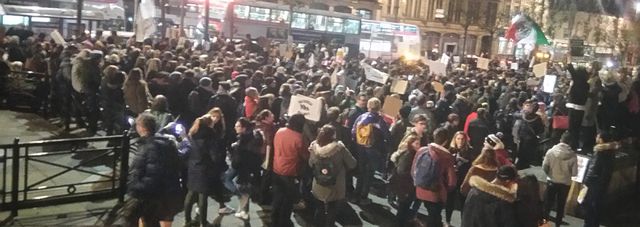
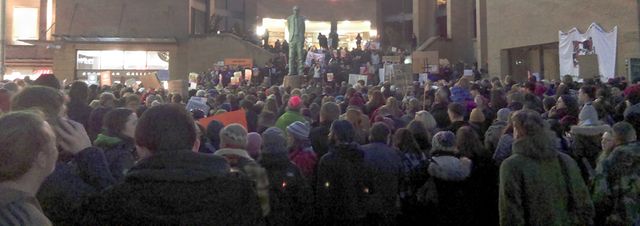
In an outpouring of opposition to US President Donald Trump and in defence of immigrants, refugees and asylum seekers, thousands of people attended protests Monday throughout the UK. Denunciations of Trump and British Prime Minister Theresa May for their Islamophobia were central to the protests. Protesters were overwhelming young. A number considered themselves socialists and supporters of Labour leader Jeremy Corbyn.
As well as opposition to Trump—and May’s moves to consolidate a close relationship with his administration—the protests reflected growing hostility to the whipping up of noxious anti-immigrant sentiment and xenophobia, which was accelerated during last year’s Brexit referendum campaign.
There was a stark contrast between the genuine and heartfelt response of the protesters and that of the organisers of the demonstration—whose opposition to Trump is that he is pursuing policies antithetical to the interests of British imperialism. Representatives of the pro-European Union faction of the ruling elite used the protests to oppose the UK allying itself with the US and to instead form a “progressive alliance” in support of an orientation to “civilised” Europe—above all the French and German governments—against Trump.
This was exemplified by the platform at the London demonstration. Owen Jones, a leading advocate of the Remain in the EU campaign and a pivotal figure in the Labour right-wing’s attempt to remove Corbyn following last year’s referendum vote to leave the EU, convened the rally. The main speakers included former Labour leader Ed Miliband and Liberal Democrat leader Tim Farron. The Liberals are set to vote against the triggering of Article 50—the means by which Britain’s EU exit begins—and are demanding a second referendum.
Despite his belated calls for May to cancel her invitation to Trump for a state visit to the UK this year, Corbyn absented himself from the London demo and instead sent close ally Diane Abbott.
Socialist Equality Party campaigners distributed the WSWS perspective, The Trump-Bannon government: Rule by decree, and explained that opposition to Trump must be combined with opposition to the Remain faction of the bourgeoisie in the UK and to the European powers. It must be centred on the mobilisation of the working class, in the US, Europe and internationally.
Despite having just one day’s notice, tens of thousands people converged on the prime minister’s Downing Street residence. By 7 p.m., the crowd stretched the length of Whitehall and drowned out the official speakers as they shouted anti-Trump and pro-immigration chants.
A section of the anti-Trump demonstration in Glasgow city centre
Many thousands took part in demonstrations in around 35 UK locations. Several thousand protested in Britain’s major towns and cities including Birmingham, Edinburgh, Glasgow, Aberdeen, Cardiff, Manchester, Leeds, Sheffield, Brighton, Newcastle and Liverpool.
Up to 3,000 demonstrated outside the Town Hall in Manchester’s Albert Square. Chants of “No hate, no fear, refugees are welcome here,” filled the air. Everywhere people held aloft homemade banners with slogans such as, “First they came for the Muslims, and we say, No not this time, Never Again,” and “Build bridges, Not walls.”
A section of the anti-Trump demonstration in Leeds city centre
In Leeds, demonstrators chanted, “Trump is a liar!” and “No hate! No fear! Donald Trump’s not welcome here!”
Official figures for the Sheffield demonstration were at 2,000, but the crowd was probably double that. Speaking at the rally was former Green Party leader and “progressive alliance” advocate Natalie Bennett, who plans to contest the Sheffield Central constituency at the next general election.
Bennett demanded that the British government emulate Germany and France, which she claimed were standing up against Trump. “Germany, well done,” she told the crowd, praising Chancellor Angela Merkel. “France is resisting too,” she claimed, as was the Canadian Prime Minister Justin Trudeau. They were setting an example to Theresa May, who lacks a “moral compass,” she asserted. Bennett also claimed that the United Nations was a source of opposition to Trump’s anti-democratic actions.
A Liberal Democrat councillor said that his party were united with the Greens and Labour in their opposition to Trump. “We have no disagreements on this issue,” he said. “We stand together.” Calling for opposition to Trump’s state visit, he said, “I am proud of Her Majesty the Queen and she will be put in a very bad position” if Trump is allowed to visit.
Maxine Bowler, Socialist Workers Party and Stand up to Racism representative, praised the large numbers involved in the January 21 Washington Women’s March, promoting racial and gender politics alongside empty eulogies to “democracy.”
“We are a little over a week into Trump’s presidency and our nightmare of what we thought it would be like has come true. This latest policy on entering the US is divisive and anti-Muslim,” she said, praising professional racial politician and Democrat, the Rev. Al Sharpton, for his assertion that “the election was over and resistance now begins.”
Referring to Trump, she said, “Many are appalled by this misogynist, racist bully.” “It’s just like in the 1930s. Trump is even proposing a register for Muslims. That is why we need to unite together. Hitler could have been defeated if everyone was united.”
The only speaker that drew a comparison between Trump’s policies and those being implemented in Britain was a representative of the Sheffield Asylum and Refugee group. His group had dealt with May as home secretary and as prime minister, “and her own policies are very much like Trump’s,” he explained.
In May 2012, Home Secretary May had spoken of creating a “hostile environment” for asylum seekers. It was she who was responsible for the launching of Home Office vans, with posters on the side telling immigrants to “Go Home.”
“In 2014, May deported thousands of students who had come here to study on the grounds that they were illegal,” he continued. “The Supreme Court recently said that that was illegal.”
He drew attention to policies of the British and European governments against migrants trying to enter the EU. Rescue ships had been withdrawn from the Mediterranean and Aegean Seas, he explained. This was a policy “to let them drown to deter other asylum seekers. As a result, 5,000 men, women and children died last year alone” in those waters.
Ahead of the demonstrations, Foreign Secretary Boris Johnson was asked in Parliament to clarify whether UK citizens and dual nationals would be impacted by the ban, in an emergency debate requested by Ed Miliband. It became an occasion for denouncing the May government for extending uncritical support to Trump and calling for his planned state visit in the summer to be cancelled.
Johnson promised that no British passport holders would be affected, but was jeered by opposition MPs when he claimed Trump was being “pointlessly demonised” over his refugee ban and that May’s visit to Washington had been “highly successful.”
A petition urging that Donald Trump “should be allowed to enter the UK in his capacity as head of the US Government, but he should not be invited to make an official State Visit because it would cause embarrassment to Her Majesty the Queen,” had secured in excess of 1.7 million signatures by Tuesday evening.
A briefing to Westminster journalists confirmed the state visit by Trump would go ahead, while a source told the BBC that cancelling the visit would be a “populist gesture” that would “undo everything.”

South Korea: Two Moons and the Future of a Nation

Rahul Raj


Since the impeachment of South Korean President Park Guen-hye after her alleged involvement in one of the nation’s biggest corruption scandals, the major political parties have swung into action to build electoral momentum and begin campaigning for the next presidential election scheduled to take place later in 2017. The corruption scandal has gravely damaged the ruling conservative Saenuri Party, which saw a large number of its lawmakers siding with opposition party leaders in support of Park's impeachment. On the other hand, the opposition party, which has supported public demonstrations to oust the president, is buoyant at the chance to end its ten-year exile and catapult itself to power by capitalising on the national disenchantment with the ruling party. However, things are not as rosy as they seem, for the opposition party. Despite the fact that the ruling party is in disarray and struggling to recuperate from political scandal, the opposition party is beset with its own frictions, which include trying to decide on a presidential candidate who can unite the various opposition groups.
 
Among those jostling for the Blue House, two main populist presidential candidates have emerged as front-runners – Moon Jae-in, the former leader of the main opposition Democratic Party, and Ban Ki-moon, the former South Korean foreign minister who has just ended a ten year stint as the UN Secretary-General. Both have relative strengths and weaknesses as well as loyal followers, which should make this election a highly competitive affair. In the balance hangs the future of a nation in the midst of its greatest political turmoil in decades. 
 
Moon Jae-in: A Quick Assessment
Since President Park’s impeachment by the South Korean Parliament, Moon Jae-in has shown strong popular appeal in election polling albeit he is not viewed as a particularly charismatic leader and there are doubts as to whether he can unite the public and political leaders behind his candidacy. Moon Jae-in has also been criticised for flip-flopping on major national security issues by his own party members as well as the conservative party. Last year, Moon joined the bandwagon in opposing the US-made Terminal High Altitude Area Defense (THAAD) system, joining other opposition parties in order to capitalise on public protests against deploying the system in South Korea. Now, Moon has changed his stance, stating that a decision on THAAD should wait until the next government is in place.
 
Furthermore, he has been embroiled in a controversy with Song Min-song, a former foreign minister who, in his memoir, alleges that Moon backed a proposal to seek Pyongyang’s opinion before casting a vote on the 2007 UN resolution on North Korean human rights violations (South Korea had abstained during the voting).
 
Moon has also been accused of leading the only group aligned with former progressive President Roh Moon-hyun while ignoring people loyal to the country's former progressive president Kim Dae-jung. This was one of the reasons for the division in the party last year that saw those aligned with Kim Dae-jung leave the party and form the new People’s Party, which is not eager to support a Moon Jae-in candidacy. The People’s Party also badly defeated the Democratic Party in the Assembly elections last year in South Korea’s Cheolla region, a bastion of progressive voters. 
 
Ban Ki-moon: A Quick Assessment
Ban Ki-moon is a popular figure in South Korean politics who has returned to South Korea after finishing his term at the UN, signaling his intention to join the fray for the Blue House. However, despite his celebrity status he has his own drawbacks.
 
Primary among them is the fact that Ban lacks experience in South Korean domestic politics and does not have the backing of a political party. The joy of his homecoming and possible electoral prospects have also been marred by an allegation by Sisa Journal, a local business magazine, that he received a bribe while serving as South Korea’s foreign minister in 2005. 
 
A Ban spokesman has rejected the charge calling them as baseless, and has vowed legal action, arguing that the magazine cited several anonymous sources in a 2016 story it published about the affair. Furthermore, he has been rumored to be supported by President Park, who tried to project him as a presidential candidate from the Saenuri Party. Hence, Ban has suffered a drop in popularity since the Park scandal broke and is now trailing behind Moon Jae-in in national polling. The breakaway conservative Bareun Party has indicated a willingness to support Ban, which would give him a political platform and also allow him to distance himself from the scandal-ridden Park presidency. However, Ban has been keeping his cards close to his chest amid speculation that he may form a broader alliance of like-minded parties who are opposed to both Moon Jae-in and Park Guen-hye, thereby broadening his appeal in the electoral mathematics. 
 
Looking Ahead
The campaigning is yet to pick up real momentum, but political leaders are already drawing battle lines and attacking each other; and this is expected to intensify in the coming weeks. At the moment it appears likely that the two 'Moons' will become the leading candidates to seek election as South Korea’s next president, in the midst of a crisis that has shaken the faith of the Korean people in their political leadership and in the institution of the presidency.

31 Jan 2017

Shell AccelerateHer Women-in-Entrepreneurship Initiative 2017

Eligible Countries: African countries
To be taken at (country): South Africa
About the Award: AccelerateHer is a fully-funded 3 month business accelerator for 25 exceptional women entrepreneurs, offering unrivalled training, mentorship and business development support alongside in-depth coaching from successful women mentors. Entrepreneurs in the programme are eligible for access to development opportunities through Shell’s Enterprise and Supplier Development programme and LiveWire, in addition one entrepreneur stands the chance of winning R50,000 towards to their business!
Type: Entrepreneurship
Eligibility: To be eligible, candidates must:
  • Be african females
  • be entrepreneurs or aspiring entrepreneurs
Number of Awardees: 25
Value of Program: Fully-funded
Duration of Program: 3 months. February to May 2017.
How to Apply: The application will be competitive. We know you have what it takes. We encourage you to apply!
We look forward to reviewing your application and getting back to you by mid February.
Award Provider: Shell, Seed Academy and WDB

Canon Collins Trust Scholarships for Masters Study for Africans 2017/2018 – UK

Application Deadline: 24th March 2017
Offered annually? Yes
Eligible African Countries: Angola, Botswana, Lesotho, Malawi, Mozambique, Namibia, South Africa, Swaziland, Zambia, Zimbabwe.
To be taken at: the following UK Universities;
  • School of Oriental and African Studies
  • University of Sussex
  • University of Edinburgh
Accepted Subject Areas: All Subjects
About the Award: Canon Collins Trust Scholarships Programme aim to help build the human resources necessary for economic, social and cultural development in the southern Africanregion and to develop an educated and skilled workforce that can benefit the wider community. Canon Collins Trust scholarship holders are thus expected to use the knowledge, training and skills acquired through their studies to contribute positively to the development of their home country.
Scholarships fall under several different schemes, with some administered in partnership with the British Foreign & Commonwealth Office and UK universities.
Over the past 30 years the Trust has supported over 3,000 inspirational individuals who are now making their contributions through governments, NGOs, business and universities.
By what Criteria is Selection Made? Applicants for all schemes within the 2017/18 UK Scholarship Programme will be assessed on the basis of the information that they supply on their application form in addition to the criteria outlined below:
  • Demonstrable leadership qualities
  • Demonstrated commitment
  • Quality and relevance of work experience, including work reference, and other skills
  • Financial Need and the potential to contribute to Southern Africa’s future prosperity
  • Academic record and academic reference
  • Relevance of proposed course
  • Intended career path
  • Likely future impact
  • Completion of form:
    • Demonstrate a high standard of English with no spelling and language errors
    • Answer all of the questions fully and with attention to detail
    • Provide all the necessary documentation and supporting documents.
Who is qualified to apply? To apply for a scholarship under this programme you must:
  • Be a national of, or have refugee status, in one of the following countries: Angola, Botswana, Lesotho, Malawi, Mozambique, Namibia, South Africa, Swaziland, Zambia, Zimbabwe.
  • Be normally resident in southern Africa
  • Be in possession of a good first degree (minimum second class, upper division or equivalent) or about to graduate in the year of application
  • Be applying for a full-time one-year taught masters course at one of the above named universities.
  • Have at least 2 years work experience in a relevant field
Number of Scholarship: Approximately 20-30 awards
What are the benefits? Full tuition fees, a monthly stipend, a return economy flight, a settling-in allowance and other support whilst in the UK.
How long will sponsorship last? All scholarships are for postgraduate masters taught study for one academic year.
How to Apply: Applicants can access the application forms and guidelines on the webpage. Applicants must apply to their chosen universities separately and awards are conditional on the applicant being offered a place at the relevant university.
Sponsors: Canon Collins Trust
Important Notes: These scholarships are for Masters Study in any subject field.  Applicants must apply to their chosen universities separately and awards are conditional on the applicant being offered a place at one of the above universities. At the time of applying for a scholarship applicants are expected to apply independently to the universities of their choice.

Freie Universität Berlin Post-Doctoral Fellowships for International Students 2017/2018

Application Deadline: 15th March, 2017
Eligible Countries: International
To be taken at (country): Germany
About the Award: DAHLEM RESEARCH SCHOOL (DRS) is the strategic center for junior researchers and the Center for Research Strategy (CRS) promotes cutting-edge research at Freie Universität Berlin. Through the DAHLEM POSTDOC FELLOWSHIP Program, DRS and CRS provide funding for highly qualified postdoctoral fellows with at least six months of international research experience to conduct their own research within one of the university’s outstanding collaborative research projects. In addition, international research stays are supported in order to allow researchers to build up a full year of international research experience by the time they complete their DAHLEM POSTDOC FELLOWSHIP.
Type: Fellowship
Eligibility: The call is open to experienced researchers of all disciplines and all nationalities who
  • hold a doctoral degree (the dissertation must already be submitted and proof of thismust be available by the application deadline)
  • completed their doctoral degree no longer than four years prior to the deadline (thedate on the doctoral certificate applies)
  • have at least six months international research experience, three months of whichmust be an uninterrupted stay.
Female postdoctoral researchers and returnees from phases of international mobility or after a career break e.g. due to family reasons are especially encouraged to apply.
Selection: Fellows are selected in a four-step procedure: 1. Administrative eligibility check 2. International peer review 3. Structured interviews 4. Approval by the university’s Executive Board Each phase must be passed successfully to proceed to the next.
Number of Awardees: 15
Value of Fellowship: Fellows are given the opportunity to expand their academic profile by experiencing early independence combined with professional guidance. During their stay they are integrated into research groups and assigned a professor as scientific advisor.
  • Employment contract at level TV-L FU E13 (which refers to the collective agreement for the public area of Berlin and translates into an annual net salary of approx. 25.600 to 33.400 Euro, depending on previous work experience and marital status)
  • Social security and health insurance included
  • An annual research allowance (3.600 Euro for office based/7.200 Euro for field-tripbased/ 10.800 Euro for lab based projects)
  • Travel allowance for research stays of up to six months at an international research institution
  • One-time reimbursement of travel costs when moving to Berlin
Duration of Fellowship: Each research fellowship will be awarded for 14 months  starting from November 1, 2017
How to Apply: To apply, please register with the DRS online application platform (on the DRS webpage), fill out the online application form and upload all required documents. Incomplete applications and applications submitted after the deadline will not be considered.
Award Provider: Freie Universität Berlin

Sheffield Hallam University PhD Scholarships for International Students 2017/2018

Application Deadline: 24th February 2017
Offered annually? Yes
Eligible Countries: UK/EU/International
To be taken at (country): UK
About the Award: Sheffield Hallam University is offering a range of PhD scholarships starting in autumn 2017:
University scholarships
  • Fully-funded scholarships – covering your tuition fees (at UK/EU levels) and maintenance at Research Council UK levels, for three years of full-time study commencing in October 2017.
  • Fully-funded collaborative scholarships – for projects which are part funded by external partners. It will cover your tuition fees (at UK/EU levels) and maintenance at Research Council UK levels for three years of full-time study, commencing in October 2017.
  • Part-time, fees only scholarships – covering your tuition fees (at UK/EU levels) for five years of part-time study commencing in October 2017.
Graduate Teaching Assistantship (GTA)
  • These programmes are designed to develop the next generation of academics. They include teacher training and up to six hours’ contact time with undergraduate students each week. These scholarships cover your tuition fees (at UK/EU levels) and maintenance at Research Council UK levels, for three years of full-time study commencing in October 2017.
Fields of Study: 
  • Art and Design
  • Biomolecular sciences
  • Centre for Health and Social Care Research (CHSCR)
  • Centre for Regional Economic and Social Research (CRESR)
  • Computing
  • Education
  • Engineering Graduate Teaching Assistantships
  • Humanities
  • Media and Communications
  • Sheffield Business School
  • Sport and Physical Activity
Type: PhD
Eligibility: 
  • All applicants should hold a strong undergraduate degree (2.1 or above) and/or a relevant masters qualification (or expectation of the same).
  • University scholarships in most disciplines are open to home/EU and international applicants. However, the shortfall between international and Home/EU fees will not be covered by the scholarship and another funding source will have to be identified by international applicants to cover this.
  • Part-time scholarships are open to home/EU applicants only.
  • GTA scholarships are open to home/EU applicants only.
  • While teaching experience is desirable for GTA applicants, successful candidates will have the opportunity to develop their higher education teaching skills through training, practice and mentoring.
  • Candidates who already hold a PhD offer from Sheffield Hallam University (to start in September 2017) are eligible to apply for a scholarship.
  • Currently enrolled PhD students are not eligible.
  • International students must provide evidence that they meet the minimum IELTS requirements appropriate for their field of study. These are detailed in the subject specific scholarship opportunities.
Number of Awardees: 30
Value of Scholarship: Fully funded as well as partially-funded scholarships are available
Award Provider: Sheffield Hallam University