6 Feb 2017

Environmental Disaster in Sumatra

Andre Vltchek

Outside Southeast Asia, almost no one knows about existence of Palembang, a city in Sumatra, which is the sixth largest island in the world. It is a gloomy but big city; it is actually immense, with almost 2 million inhabitants, most of them living in crammed and grubby conditions.
The city is cut in half, by the mighty tropical River Musi, a desperately polluted waterway, bordered by slums built on stilts, and by a few old colonial buildings.
Vessels of all types pass through Musi. They are taking away everything that can be sold, abroad or to the rest of Indonesia. There are enormous barges filled with coal, oil tankers, makeshift boats carrying palm oil fruit bunches, as well as countless ships carrying timber.
Plunder is done openly; there is no attempt to conceal it.
Ms Isna Wijayani, a Professor at Bina Darma University in Palembang, laments:
“There is no primary forest left in a wide area around Palembang. However, illegal logging doesn’t get reported in local media. It is because powerful forces, including police and the army (TNI) are involved or directly behind much of illegal logging and other profitable commercial activities in South Sumatra.”
Bina Darma University invited me to speak on the manipulation of the Indonesian media by the West. I was asked to address around one hundred selected students and lecturers from the region. What followed was an hour long discussion, during which I clearly understood how little is known, even among the local students and teachers, about the dire environmental situation in their part of the world.
“We have no idea about the extent of deforestation around here,” explained Ms Lina, a student.
Ms Ayu Lexy, a graduate student, was somewhat more knowledgeable on the subject:
“I think Donald Trump is crazy, claiming that there is no global warming. Effects of it are clearly felt here.”
***
This time, same as several years ago, I rented a makeshift speedboat, and instructed the captain to take me around the delta and to Upang, a village more than one hour of literally ‘flying’ over the murky waters, from Palembang.
For the first few kilometers, hellish-looking factories lined up along both shores. All of the plants appeared to be forming a grand coalition, serving a single goal: to destroy what was left of the once pristine tropical paradise.
There was the Pusri plant, producer of fertilizers, one of the largest in Southeast Asia, belching smoke and spreading an insupportable stench all around its vicinity. Right across the water, surrounded by slums, a wood-processing plant was emitting a very distinct odor. Local children were swimming nearby, clearly oblivious of health hazards.
Later, a former top executive of ‘Pusri’, Mr. Reza Esfan, confessed to me:
“We create pollution, of course, although we try to minimize it. I can’t deny that unsavory odor is emitted… Obviously, Pusri’s mistake was that they didn’t purchase the land surrounding their plants. Now, if we have a leak, then the community sues us…”
Naturally, not a word about the suffering of the communities…
At Kapitan Village, several women were washing their clothes in the filthy water of the river, and then brushing their teeth in it.
“Why shouldn’t we be washing ourselves and brushing our teeth in clean water? We can’t spend our money on such luxuries! Anyway, the river water is free, and it is clean.”
As a woman spoke to me, a grotesquely swollen carcass of a dog passed slowly by just a few meters away.
***
Deforestation was essential for construction of all local ‘industries’. But how ruthless is deforestation in Indonesia? How bad is its contribution to global climate change?
The simple answer is: it is not just bad; it is dreadful.
The Pan-Asian independent news network, the Coconuts TV reported in 2015:
“Deforestation is a major contributor to climate change, adding more carbon pollution to the atmosphere than all the world’s cars, trucks, ships, trains and airplanes combined each year. It’s also pushing many animal species to the brink of extinction, including the Sumatran rhinoceros, Sumatran tiger, Sumatran elephant, and the orangutan due to the destruction of their habitats.
Indonesia has become the global leader in deforestation, and the reason is the world’s thirst for palm oil. Palm oil is the most widely used vegetable oil on the planet. It can be found in over half of all packaged products at the supermarket, including everything from cooking oil to lipstick.”
As early as in 2007, Greenpeace Philippines snapped at Indonesia’s unwillingness to deal with the disaster:
“Indonesia destroys about 51 square kilometers of forests every day, equivalent to 300 football fields every hour — a figure, which should earn the country a place in the Guinness Book of World Records as the world’s fastest destroyer of forests… These figures demonstrate a lack of political will and power by the Indonesian government to stop runaway deforestation rates. A series of natural disasters in recent years, floods, forest fires, landslides, droughts, massive erosion are all linked to the unprecedented destruction of our forests. Forest fires from concessions and plantations have already made Indonesia the world’s third biggest contributor of greenhouse gases,” Mr Hapsoro (Greenpeace Southeast Asia Forest campaigner) said.”
Since 2007, not much has changed. The country has already lost well over 70 per cent of its intact ancient forests, and commercial logging, forest fires and new clearances for palm oil plantations threaten half of what is left. The greed seems to know no boundaries.
According to Science direct :
“Between 1970 and the mid-1990s, export-oriented log production and global demand were the primary pressures underlying deforestation. Cultivation of rice and other crops was also found to be associated with a growing population and transmigration policy. Moreover, deregulation of foreign investment in the 1980s appears to have led to expansion of an export-oriented industry, including commercial crop and log production. Between the mid-1990s and 2015, imbalance between global demand and production of Indonesian timber and oil palm led to illegal or non-sustainable timber harvest and expansion of permanent agricultural areas…”
The result: Sumatra and Kalimantan islands are now choking on their own smoke, although the agony spreads far into neighboring Malaysia and Singapore. Year after year, millions of people get affected, classes are cancelled, airplanes grounded, and regular activities averted. Hundreds of thousands of people are suffering from acute respiratory tract infections. Hundreds lose their lives.
Some even call the unbridled ‘export of pollution’ a ‘crime against humanity’. Emotions are running high, and many citizens of Malaysia and Singapore protest by boycotting Indonesian products.
On several occasions I witnessed thick smog covering the skyscrapers of major Malaysian cities, and of Singapore. In 2015, during the ‘big fires’ of Sumatra, life in Kuala Lumpur almost came to a standstill.
***
This time, landing in Palembang, the haze had been covering almost the entire runway. “Visibility 6 kilometers,” the captain of Indonesian flagship carrier, Garuda informed us, not long before the touchdown. In fact, the visibility appeared to be no more than 200 meters. But in Indonesia, many ‘uncomfortable facts’ are outrightly denied.
Throughout the following days my eyes became watery and my joints were aching. I kept coughing uncontrollably. When I was asked by the Italian ‘5 Star Movement’ to record my political message (I did it in a local slum), I could hardly speak.
The trouble didn’t just come from the forest fires: everything here seemed to be polluting the environment: the burning of garbage, notorious traffic jams, emissions from unregulated factories, even cigarette smoking in almost all public places.
***
Along Musi River, the original forests are gone, replaced by rice fields, palm oil and rubber plantations.
I spoke to dozens of farmers and fishermen: most of them have never heard about the global warming, others didn’t care. In Indonesia, the struggle for bare survival is what propels most of the people — this, as well as the cynical chase for profit, pursued by the ‘elites’. I described it in detail in my damning book “Indonesia: Archipelago of Fear”.
At some point, the captain of my boat became hostile. Angry, frustrated and nationalistic, he began sabotaging my work, constantly rocking his boat in order to prevent me from photographing disaster areas.
Still, I prevailed. I had to. Millions of people were suffering; dozens of species were disappearing, including tigers and rhinos, elephants and orangutans.
***
Mr. Ahmad, a 55 year old fisherman from Upang village, is aware of the tragedy:
“In the last 20 years, the level of Musi River has risen on average by 50 centimeters. Here we have a badminton court. In the past, during high tides, the water would go up only to our ankles, but now it comes up to our thighs.”
Mr. Ahmad doesn’t understand that it is the destruction of tropical forests that has a direct impact on the rising levels of his river.
Local university students, who are accompanying me, know what’s happening, but they don’t seem to care. As I interview farmers and fishermen, they’re chatting on their phones, clearly indifferent.
“The environmental destruction around Musi River, particularly of the rainforest, is very bad, and it continues. The great fire of 2015 showed how bad the management of the rainforests is in Indonesia, particularly in Sumatra,” Ms Khalisah Khalid working for WALHI (the Indonesian Forum for the Environment), told me over the phone.
However, for many different reasons, environmental disasters do not seem to be treated as emergencies: by the government, mainstream media, even by local people.
As my boat flew over the water, hitting waves created by monstrous coal barges, breaking my back in half, I realized that the mainstream media hardly ever comes here, despite the fact that what takes place around Musi has a devastating impact on our entire Planet. Abroad, the Sumatran environmental disaster is just one of those ‘abstract stories’.
For years, I worked in many parts of this enormous and once stunning island, from Aceh to Lampung. I also worked all over Oceania (Oceania is name of my book covering that vast part of the world), the most affected area of the Planet, where entire nations are now disappearing due to the climate change.
Global warming has undeniably devastating impact on the entire world, including the Palembang area itself. In the short term, palm oil and rubber plantations may bring some profits to the companies, even to local people, but tens, maybe hundreds of millions of lives could be disrupted, even broken as a result. The price is too steep, but in Indonesia, there is hardly any discussion on the subject. Too many powerful individuals are involved, and too much money is being made.
Now those who claim that there is no climate change have a powerful ally in the White House. And so the silence reigns. The water is rising. Increasingly, smog is covering, like an endless and deadly duvet, this entire part of the world.

The Question Of Jerusalem

Mustapha Marrouchi


The inauguration of Donald Trump as the 45th President has ushered in a new era of uncertainty, nowhere more so than in the Middle East.  The rules of the game have indeed taken a turn for the better for Bibi Netanyahou, who gave the final push to the construction of 566 new homes in East Jerusalem.  The new lodgings will be built in Pisgat Zeev, Ramot, and Ramat Shlomo, Meïr Turjeman, the Head of the Municipality in Jerusalem, declared while adding that he has plans to build 11000 homes to accommodate the demands of the newly-arrived Jews.  The deal seems to have the support of both the Prime Minister of Israel and the President Trump.  The former is elated by the election of Mr. Trump and delighted that President Obama, who dealt in fact, not speculation, is finally gone.  No wonder that some 430 000 Israeli settlers actually live in occupied West Bank and more than 200 000 in East Jerusalem, the part of the city Palestinians hope to turn into the capital of the state they aspire to found.
In point of fact, Bibi Natanyahou is having a celebration of a kind.  The new order of things is pleasing to him insofar as he cannot wait to annex the rest of the West Bank, East Jerusalem, and kill the peace deal with Palestine once and for all.  He hopes to do all this with the blessing of President Trump and his administration.  Even so, let us consider for a moment that the US government moved its embassy from Tel Aviv to Jerusalem and that the “Eternal City” has indeed become the new capital of Israel.  Let us also consider that Al-Aqsa Dome from which the Prophet Mohammed is said to have ascended to Heaven is no longer standing on its foundations and that a Jewish Temple is built on its ruins.  If that were to happen, and it could happen under a mentally unstable President Trump, I fear for the future of the region which might go ablaze once again.
The bill (Recognition Act) that was introduced by the three Republican senators on January 3rd —namely, Ted Cruz, Dean Heller, and Marco Rubio after they were sworn into the 115thCongress is aimed at encouraging the move of the US Embassy from Tel Aviv to Jerusalem.  The idea, encouraged by President Trump himself, is not new.  Far from the truth.  Both Bill Clinton and George W Bush tried to move the American embassy to Jerusalem but changed their mind once in office, deferring the implementation of the 1995 so-called Jerusalem Embassy Act, which stipulates that Jerusalem is Israel’s “undivided” capital.
The move by the newly elected Republican majority Congress to relocate the US Embassy runs contrary to world opinion in that not a single state acknowledges Israel’s sovereignty over Jerusalem.  It is for this very reason that not one country has an embassy there.  If this were to happen, the country in question would be violating international law and UN Security Council Resolution 478.  So, were the US Embassy to flit to Jerusalem under the watchful gaze of the Trump administration, it would not only contravene international law but also deny the Palestinian right to self-determination and return home.  In point of fact, ever since 1967, Israel has been busy turning Jerusalem into a Jewish city: landscape, food, fashion, architecture, education, history, music, dance, and so forth.  It has done so by adopting a policy ofJudaisationaimed at cleansing the city from its multicultural and multi-religious constituencies.  Such a method of “purifying” the city includes the revocation of Palestinian residency introduced under the pretext of a “breach of allegiance,” barring Palestinian families from reunifying, practicing urban discrimination as well as zoning policy, and above all, constructing the infamous wall that disfigures and slices through Jerusalem and the West Bank, which has become a Bantustan of sorts.  In addition, one must point to the collapse of the economy in East Jerusalem which had until recently a thriving tourism industry.  All that is gone as I write.
The relocation of the US Embassy would also encourage Israel to go on building illegal settlements which are stifling some 300,000 Palestinians in East Jerusalem who live below the poverty line.  Add to that the housing crisis since Palestinians have access only to 13% of the land in East Jerusalem while Jewish settlers hog every day on 35% of the land.  The alarming reality is that not only Trump but also Jared Kushner, a passive-aggressive special adviser of a kind to the president, and indeed his family donate colossal amounts of money to new settlements rising in Bet El, an area the size of Manhattan, situated north of Jerusalem.  It is likely that the aggressive policy of annexation will inflame the situation on the ground, especially in light of the appointment of the US new ambassador to Israel, the pro-Israel hardliner, David Friedman, who heads the American Friends of Bet El Institutions and who maintains that the “holy city of Jerusalem belongs to the Jewish people forever.”  For Trump Zionism Inc. the annexation is not an obstacle to peace in the region but rather a reason for being for the Jewish state.
The upshot is that we are all in for a bumpy ride with the advent of President Trump.  No one knows where we are heading: Israel, Palestine, Syria, Iraq, Iran, China, North Korea, Cuba, Yemen, Afghanistan, the list goes on.  A recipe for disaster, if you ask me.  Let us hope that we, the people, will fight back for a better and just world, a world where there will be room not only for the “happy few” millionaires appointed byMonsieurTrump to head his government, but for the rest of us who are languishing to set our energy free.  It is not too much to ask, is it!

Another Missile Crisis or More Chaos?

Arshad M Khan


Iran test-fired a missile and the U.S. government went ballistic. It put Iran ‘on notice’ — a phrase meaning little but with a distinct menace.
Rummaging around in the Obama administration files, the new arrivals soon discovered well-prepared plans for sanctions should Iran’s actions displease. Iran was no longer ‘on notice,’ it was sanctioned. The Iranians are furious, saying nobody was going to stop them from defending themselves.
Saudi Arabia, the perennial U.S. ally and unhappy with the Iran agreement, was well pleased promising to increase its investments. From Wikileaks we had learned how this defender of the true faith urged President Obama ‘to cut off the head of the snake’ meaning Iran. So a fourteen centuries old political struggle resulting in two Islamic factions continues, complicated no doubt by the lesser known fact that Saudi Arabia’s oil-rich province has a majority population who are Shia — the same form of Islam as in Iran.
The Iran agreement itself consisting of an initial Joint Plan of Action (JPA) and culminating in a Joint Comprehensive Plan of Action (JCPOA) is unique in including a UN Security Council imprimatur and in involving the six major world powers (U.S., Russia, China, UK, France and Germany) plus, of course, Iran. Should the U.S. abrogate the agreement unilaterally, it would consequently alienate not only Iran but also its allies, major trading partners, and friend-to-be Russia, if President Trump is to be believed. Nowhere in this copious document does the word ‘missile’ appear, for Iran would not have signed the agreement.
So it was that the Obama administration put forward a resolution in the UN security Council to secure missile restrictions not in the tentative agreement. And it dug in its heels. Thus the Security Council Resolution 2335 passed unanimously. The UN and its Security Council pass all kinds of resolutions sometimes implemented much more strenuously than was the intent (as in Libya) causing chaos, often ignored (as by India on Kashmir, or Israel, and others) and generally paid not too much heed … except when countries find it suits their purpose.
Is it all the Trump bluster? After all, his much self-vaunted business acumen consists of owning one building (Trump Tower) and a minority share in two others in New York and a few hotels. These constitute a majority of his net worth. The rest is a smattering of golf clubs and franchises.
Mr. Trump will soon discover the world stage, countries, their political leaders and their people a different cup of tea from real estate. In the first place, the stakes are higher … and can be deadly. And a war with Iran, a much larger, better armed country than Iraq, would be a disaster — its ramifications likely to be felt by Israel through a missile-armed Hezbollah. And its large army with easy access to Saudi Arabia’s oil fields, via a Shia run friendly Iraq government, could teach the Saudis and the Gulf States a lesson they would not soon forget — despite the U.S. base in Qatar.
If this president has been as easily seduced by military power as his predecessor, another war and even more refugees are the future. Add all the executive orders, lawsuits, immigration problems, demonstrations, and as Steve Schmidt a Republican strategist observed this week, their supporters ‘voted for change, not for chaos’.

Chile ravaged by fires

Alexandra del Piano

Chile is facing one of the worst forest fires in its history. The worst hit areas are O’Higgins, Maule, Biobio and La Araucana, all located in the extreme south of the country, where in addition to small Mapuche farming communities, there are large forestry companies.
The fire, fueled by strong winds, high temperatures and an eight-year drought, has had an enormous impact on the country’s fauna and flora, which experts consider irreversible.
Valparaiso, one of Chile’s main port cities, is known for frequent fires that consume its hillside forests. It has been declared on “Red Alert” after a fire on January 2 consumed 50 hectares and dozens of homes.
The whole city of Valparaiso has been blanketed in a layer of white smoke for over a week. The smoke is a daily reminder of the wildfires that continue to incinerate forests in seven of the country’s fifteen regions, four of which have been declared disaster areas.
Having already burned over half a million hectares, taken 11 lives and left over 3,000 people homeless, President Michelle Bachelet announced that the fires represent one of the worst emergency situations in Chile’s history.
But, why is Chile constantly subject to such fires? Why, with such a long history of battling fires of epic proportions, is the country not more prepared to face these emergency situations? The answer lies in why the Chilean forests are so prone to catching fire and why fires spread so quickly.
The configuration of the trees in Chile’s forests today is: 75 percent pine, 15 percent eucalyptus, and 10 percent native. Pine and eucalyptus trees are known for being incredibly dry. So, why then was the majority of Chile’s native, humid forest destroyed and replaced with this monoculture of dry pine and eucalyptus trees?
To understand this, one has to go back to the first year of Pinochet’s dictatorship. In 1974, Decree Law 701 (better known as the “forest development” law), which subsidizes plantations of monocultures of pine and eucalyptus trees with 75 percent of resources, was enacted. Once the state attached a high cost value to a plantation of trees, along with the “subsidy,” companies rushed in to destroy native forests, in order to replace them with plantations of pine and eucalyptus that could produce profits.
This law, which is still in effect today, allowed for the appropriation of huge areas of national territory by two main monopolies: CMPC, run by the Matte family, and Bosques Arauco run by the Angellinis. Seventy percent of Chile’s forestry business (2 million hectares) is controlled by these two families.
As part of this process, these companies stripped the Mapuche community of its native lands, leaving them with a mere half a million hectares. Since then, a multi-million-dollar fortune has been accumulated by the two families, yet the regions they exploit suffer from among the highest rates of poverty in the country. For example, over 100,000 residents live in homes without access to water.
While these two companies are worth at least $10 million, they have shown little interest in investing in fire prevention to protect their land.
Ken Pimlott, director of the California Department of Forestry and Fire Protection, who has done consulting for Chile’s National Forest Corporation (CONAF), noted that with the intensity of forest fires and its impact on residents losing their homes, Chile is about 30 or 40 years behind California, in terms of fire prevention. It begs the question, why doesn’t the state own any planes that can carry more than 10,000 liters of water? Why are there no specialized training programs for wilderness firefighters?
Over 9,000 people (including 4,500 volunteer firefighters and 4,600 members of the military, police, and public functionaries) have been working to extinguish the fires with the aid of 24 planes, 45 helicopters, and 124 fire trucks, not counting the “Supertanker” plane that can carry up to 75,000 liters of water, which is currently being rented out by Benjamin Walton’s (of the Wal-Mart Waltons) Chilean wife, Lucy Ana Aviles.
According to CONAF, there are still 110 active fires, including 49 currently under control and 60 still out of control.
Those most affected by the disaster are obviously the thousands of poor families who have lost their homes, belongings and land, not the major forest companies, whose land and assets are protected by insurance, ensuring their continued profit.
In the final analysis, the “natural disaster” of Chile’s fires is another fatal result of a capitalist state which only serves to maintain the wealth of a small group of individuals, at the expense and exploitation of millions of impoverished people.

Australian coalition government faces defections

Mike Head 

With the Australian parliament due to resume tomorrow for its first sitting of 2017, question marks hang over the survival of the Turnbull government, which has been clinging to office by a threadbare one-seat majority since last July’s election. The ruling Liberal-National Coalition is riven with divisions on foreign and domestic policy that have only been intensified by the advent of the Trump administration.
Media reports are speculating that the government, facing rapidly declining public support and possible splits by some of its most right-wing members, will not last the year. The commentaries generally focus on the plight of Prime Minister Malcolm Turnbull as an individual, but more fundamental issues are coming to the surface.
The Trump administration’s menacing threats of trade war and war with China have compounded the dilemma facing the Australia ruling elite: Washington will undoubtedly press Canberra to play a frontline role in any confrontation with Beijing, putting in jeopardy lucrative economic relations with China, Australia’s largest trading partner. Trump’s bullying phone call to Turnbull last week over a refugee deal is just a foretaste of what is to come.
Today’s Australian Financial Review editorial noted: “Over the past decade, Australian foreign policy has become understandably obsessed with not being forced to choose between Chinese economic prosperity and American national security. The Trump presidency has brought the tensions into harsher relief, meaning the chances of Australia having to make difficult strategic trade-offs has increased uncomfortably.”
Turnbull has attempted to put the best possible face on his dressing down by Trump. Last night, on the “60 Minutes” television program, Turnbull claimed that “this has been a very good week for Australia,” because in response to Trump’s phone call, “we have seen dozens and dozens of congressmen and senators talking about the importance of the Australian alliance.
Yet, all of these statements emphasised that Australia had been involved in every major US war since World War II and thus by the implication would be required to do so again. Senator John McCain, the 2008 Republican presidential candidate, stressed the “shared sacrifice in wartime,” in Afghanistan and Iraq, as well as Vietnam.
On “60 Minutes” Turnbull also tried to dismiss Murdoch media reports that, supposedly in return for a refugee deal, the White House would expect Australia to send more special forces troops to Iraq and/or send warships or planes into the territorial zones around Chinese-controlled islets in the South China Sea.
Questioned by veteran journalist Laurie Oakes, Turnbull did not rule out sending Australian troops “for some Middle Eastern adventure” or “ships in the South China Sea.” But he said any such requests would be no surprise, because “at the end of the day our two military establishments work very, very closely together, seamlessly, extremely closely together.”
Thus, Trump’s call appears to have achieved its immediate objective. Turnbull, who once expressed reservations about the US “pivot” to Asia to confront China, and whose government has not yet followed the US in provocatively challenging Chinese territorial claims in the South China Sea, has been forced to state his government’s readiness to accede to the demands of the White House.
Nevertheless, doubts remain in Washington about Turnbull and the public airing of the content of Trump’s phone call has undoubtedly undermined his standing. His predecessor Tony Abbott, whom Turnbull deposed in September 2015, was a far more forthright participant in US military aggression and clearly has not given up his ambitions to become prime minister again.
As well as creating enormous tensions in the Australian establishment, Trump’s election has given succour to right-wing populists seeking to emulate him in demonising refugees and immigrants, and inciting protectionist sentiment, as a means of diverting rising discontent into reactionary nationalist directions.
Among them are Pauline Hanson’s anti-immigrant One Nation Party and Senator Cory Bernardi, whose “Australian Conservatives” grouping is threatening to split from the ruling Liberal-National Coalition. Both are being given extensive publicity in the corporate media. Bernardi is reportedly set to announce his break from the Coalition in the coming days.
The Murdoch media’s Newspoll added to the pressure on Turnbull today, reporting that the Coalition’s support plunged from 39 percent to 35 percent over the summer holidays, down to its lowest since Turnbull ousted Abbott. None of the anti-government swing went to Labor or the Greens. Instead, support for other parties jumped to 19 percent—up from 13 percent at the July election—including 8 percent for Hanson’s One Nation.
Reporting the results on its front page this morning, the Australian noted with alarm that a record 29 percent of people would not give their first preference vote in a House of Representatives election to either the Coalition or Labor.
Turnbull has experienced what the Australian Broadcasting Corporation dubbed a “summer of discontent.” As well as the phone call from Trump, the US president also dumped the Trans-Pacific Partnership trade bloc, despite Canberra’s pleas to the contrary. Turnbull has also had to deal with the forced resignation of Health Minister Sussan Ley, and constant sniping by Abbott, who is seeking to destabilise Turnbull’s leadership. Turnbull also admitted he donated $1.75 million of his own private fortune to the Liberal Party’s election campaign last year—an indicator of flagging backing from corporate donors.
Behind the media conjecture about Turnbull’s future stands a deepening economic and social, as well as geo-political, crisis. There is mounting frustration in the corporate elite that Turnbull has not delivered what he promised them when he toppled Abbott. Turnbull, a multi-millionaire ex-banker, declared he would provide the economic leadership and “narrative” to ram through the austerity agenda that Abbott had failed to carry out.
The Coalition government already confronts intense popular opposition over the inroads it has made into health, education and other essential social services. But under conditions of a collapse of the mining boom and a slide towards recession, big business is demanding much more and is concluding that Turnbull may not be up for the task.
Turnbull’s government, like Abbott’s, is the latest in a line of unstable administrations—back to the last Rudd and Gillard Labor governments of 2007 to 2013—that have sought to impose the austerity agenda of big business on politically hostile population. Today’s Australian editorial puts Turnbull on notice:
“For perhaps the tenth time in the past five or six years, as our politicians return to Canberra for the resumption of a parliamentary sitting period, there is a heavy burden of necessity on the government to reset and start afresh. Malcolm Turnbull, barely six months into his first term as the elected Prime Minister, seems to have lost his way, or is struggling to find it.”
Meanwhile, the world situation has changed, accelerating this crisis. Trump’s domestic program, on behalf of the billionaires he represents, of slashing corporate taxes, business regulation and health, education and welfare spending, must be matched. This means the Australian ruling elite requires a far deeper assault on the jobs, working conditions and social rights of the working class.

EU summit approves sealing off the Mediterranean from refugees

Martin Kreickenbaum

At the European Union’s special summit in Malta last Friday, European heads of state adopted a 10-point plan aimed at blocking off the central Mediterranean route from Libya to Italy. The key components of the plan are the upgrading and training of the Libyan coastguard, which is to seize refugees in Libyan territorial waters and return them to the African coast, and the establishment of internment camps in North Africa.
The hypocrisy with which the EU is carrying out its defence against refugees is breathtaking. In the run-up to the summit, several European heads of state and governments criticized US President Donald Trump for his plans to build a wall along the border with Mexico and to impose an immigration ban from seven predominantly Muslim states in the Middle East and North Africa.
Leading European politicians attempted to outdo one another, praising the EU as “the last bastion of liberal democracy.” But the isolationist policies the EU employs against refugees are in essence no different than the inhumane measures of the US government.
According to the summit resolutions, a double wall against refugees is to be built in Libya. The EU wants to train Libyan border officials, coast guard and marines, and equip and finance them to cordon off the southern border of the country as well as the maritime border with Europe. This will strand tens of thousands of refugees in the desert regions of Central Africa or, if they cross the Mediterranean by boat, will force them back to devastated countries.
Because the ships of the European border protection agency Frontex and the NATO mission Sophia are not permitted to operate in Libyan territorial waters, the Libyan coast guard will take on the EU’s dirty work, even though it is notorious for its extreme brutality against refugees. In addition to training, the Libyan coastguard will receive several patrol boats and technical equipment from the EU.
For the care of refugees, “appropriate reception facilities” are to be established in Libya that will operate jointly with the UN Human Rights Commission and the International Organisation for Migration (IOM). These are in reality internment camps for refugees.
For months, German Interior Minister Thomas de Maizière has been calling for camps in North Africa to stop refugees on the way to Europe and to enable mass deportations from Europe to Africa. However, only a small fraction of African refugees ever reach Europe. More than 86 percent of all refugees remain in the immediate vicinity of the regions from which they originate, where they linger hopelessly under disastrous conditions in miserable mass camps.
Instead of improving refugee camps, the EU will increase its police presence in North Africa to block refugee escape routes. Libya’s land borders with transit states Niger, Algeria, Sudan and Egypt will be strictly monitored and guarded with the support of European border protection agency Frontex.
Finally, the collaboration of the police and secret service will be deepened. Above all, Europol and Frontex are to provide data with which smugglers and their boats already in coastal towns can be located. The trade with motorboats and inflatable boats is to be permanently destroyed.
Following the closure of the Balkan route and a deal with Turkey, Libya is back in the focus of European isolationist policy. More than 90 percent of all refugees begin their journey to Europe there. In the last year, 181,000 refugees reached Italy by this sea route, while more than 4,600 drowned on the central Mediterranean route alone.
Although a majority of refugees leave home to escape war, civil-warlike conflicts, persecution and tyranny, and their rate of protection in the EU is correspondingly high, the letter of invitation to this EU summit states most refugees are “irregular economic migrants who may be sent back to their countries of origin.”
Provisions of the Geneva Refugee Convention and the European Human Rights Convention are being stretched beyond recognition in the campaign by the EU to block refugees. This includes the plan to seize refugees already in Libyan territorial waters to bypass the “non-refoulment” rule and the proposal to soften the concept of secure third states, in which even individual places and refugee camps can be declared “secure locations,” which de Maizière did a few weeks ago.
The United Nations High Commission for Refugees and human rights organizations regularly list in their reports the inhumane conditions in Libyan refugee camps. The deportation of refugees there will mean torture and death for thousands of people.
Employees of the German diplomatic service in Niger have also come to this conclusion. In a report to the German government, they write that in Libyan detention facilities “the worst, systematic human rights violations” prevail. “Executions, torture and rape” are a daily reality for refugees. “Authentic cell phone photos and videos prove the concentration camp-like conditions in these so-called private prisons.”
The report goes on to state, “Eyewitnesses describe exactly five executions per week in one prison—with announcements always made on Fridays to make room for new arrivals, which is to say, to increase the human delivery rate and, with it, the profits of the operators.”
In these prisons, refugees get neither sufficient nourishment nor clean drinking water, and the medical care is completely inadequate. An asylum system does not exist in Libya, either in law or in practice.
None of this has deterred the EU, however, from developing the closest collaboration with the Libyan government of Prime Minister Fayez al-Sarraj. On the eve of the summit, al-Sarraj met with European Council President Donald Tusk and Italian Prime Minister Paolo Gentiloni to work out the details of the dirty deal against refugees.
Immediately prior to the EU summit, the Italian government secured a bilateral treaty with the government in Tripoli. Gentiloni and al-Sarraj reached an agreement on joint coastguard patrols along the Libyan coast to send refugees directly back to Libya. Moreover, the Italian government will participate in the construction and financing of refugee camps in Libya. In return, trade relations with the former Italian colony will be improved, above all in the energy sector.
Prime Minister Gentiloni is thus associating himself directly with a refugee deal that former Prime Minister Silvio Berlusconi made in 2008 with Muammar Gaddafi. Berlusconi commented at the time: “We will get more gas and petrol and fewer illegal immigrants.”
At the same time, the EU is working on a stronger military collaboration with the Libyan government. The German government has entrusted al-Sarraj with armoured vehicles valued at €15 million, while Italy will participate in the construction and upgrading of army and police organizations. The Italian army has stationed 100 paratroopers in Libya under the pretext of protecting a hospital.
NATO has also declared its willingness to fully support the Libyan government. “NATO is ready to help with the construction of more effective security and defence organs,” declared NATO General Secretary Jens Stoltenberg after a meeting with al-Sarraj. Stoltenberg also offered to assist the EU in the development of the Libyan marines and coastguard.
The EU’s campaign against refugees from North Africa is increasingly a means of subordinating Libya and other countries in the region to military control and returning them to the status of colonies.

Trump plans rollback of drug industry regulations

Brad Dixon 

Trump met last week with pharmaceutical industry lobbyists and executives at the White House where he announced his plans to drastically reduce the regulatory power of the Food and Drug Administration (FDA) while slashing taxes on the pharmaceutical industry.
Participants at Tuesday’s meeting included Stephen Ubl, head of the drug industry trade group PhRMA, and the CEOs of Novartis, Merck, Eli Lilly, and Johnson & Johnson.
Trump has demagogically postured as a critic of the pharmaceutical industry, including calling for rule changes to allow the federal government to use the bulk purchasing power of Medicare to negotiate drug prices with pharmaceutical companies.
“Pharma has a lot of lobbies, a lot of lobbyists and a lot power,” Trump said at his first press conference as president-elect on January 11. He said that it was necessary to “create new bidding procedures for the drug industry, because they’re getting away with murder.”
Trump has now abandoned any pretense of opposition.
“We’re going to be changing a lot of the rules,” Trump proclaimed prior to the meeting.
“I’ll oppose anything that makes it harder for smaller, younger companies to take the risk of bringing their product to a vibrantly competitive market. That includes price-fixing by the biggest dog in the market, Medicare, which is what’s happening,” Trump told reporters after the meeting, reversing his previous position on allowing Medicare to negotiate prices and falsely stating that the program currently does so.
“We’re going to be lowering taxes, we’re going to be getting rid of regulations that are unnecessary,” said Trump. He said that he wants to get rid of 75 or 80 percent of FDA regulations.
Biotech and Pharmaceutical stock shares rallied following the meeting, and Trump’s plan was met with approval by the industry lobbyists and CEOs gathered at the meeting.
“Tax, deregulation—those are things that could really help us expand operations,” commented Eli Lilly CEO Dave Ricks, according to Reuters.
“These changes are going to be great for the country,” Celgene Chairman Robert Hugin told the Washington Post.
The deregulation of the FDA and the streamlining of the drug approval process will result in less knowledge about the safety and efficacy of the drugs approved by the FDA.
“Streamlining drug approvals sounds good, but the agency has already weakened approval standards and patients are paying the price—hugely expensive drugs that don’t even work,” Diana Zuckerman, president of the National Center for Health Research, told the New York Times.
Dr. Michael Carome, the director of Public Citizen’s health research group, noted in a statement that Trump’s proposal would “destroy the ability of the agency to protect patients and consumers from unsafe or ineffective medications and medical devices, hazardous foods and dietary supplements, and dangerous tobacco products.”
“The end result would be countless preventable deaths, injuries and illnesses across the US,” he said.
These risks have already been heightened by the bipartisan legislation passed late last year, the 21st Century Cures Act. The Act significantly rolls back the regulatory authority of the FDA, lowers the standards that must be met before a drug is approved, and expands expedited approvals.
The FDA will be further hindered by Trump’s executive orders instituting a hiring freeze and the rule that two regulations must be removed for every new one.
“That will cripple the FDA’s ability to do anything other than regulate by non-binding guidance documents,” David Vladeck, a professor at Georgetown University Law Center, told the Washington Post.
“To hollow out the agency’s authority by forbidding it from dealing with emerging issues through new regulations, and perhaps even giving guidance will jeopardize consumers and threaten the reputation of the agency around the world,” Vladeck said.
Trump tied his criticism of high drug prices to his “America First” rhetoric of economic nationalism, attacking “global freeloading” through “foreign price controls.”
“Our trade policy will prioritize that foreign countries pay their fair share for U.S.-manufactured drug, so our drug companies have greater financial resources to accelerate development of new cures, and I think that’s so important,” Trump said.
Instead of allowing Medicare to negotiate drug prices, which Trump referred to as “price fixing,” he claimed that competition spurred by deregulation and tax cuts would bring down drug prices.
This approach will do nothing to address skyrocketing drug prices in the United States, which have doubled since 2011 and are up to ten times higher in the US than in other countries.
The pharmaceutical industry, which continues to consolidate through mergers and acquisitions, is notorious for dodging competition when it threatens the bottom line. For example, drug companies will often raise prices almost simultaneously with their competitors, a practice known as “shadow pricing.” When a drug is about to go off patent, companies will often pay potential generic competitors to hold off on introducing generic versions in “pay-for-delay” deals.
Moreover, there is little evidence that high drug prices are due to the costs associated with researching and developing drugs. According to an article published in August of last year in the Journal of the American Medical Association, large pharmaceutical companies invest only 10 to 20 percent of their revenue in R&D. The authors cite an analysis that looked at 26 products or product classes over the past 25 years and found that more than half originated in publicly funded research centers.
The authors of the article conclude that “there is little evidence of an association between research and development costs and drug prices; rather, prescription drugs are priced in the United States primarily on the basis of what the market will bear.”
In response to Trump’s meeting, Democrats continued to perpetuate illusions in the president’s demagogic attacks on the pharmaceutical industry, with Senator Bernie Sanders and Maryland representative Elijah Cummings issuing a joint statement saying they “hope” Trump “really” takes on the industry.
“I look forward to working with President Trump on this issue if he is serious about standing up to the pharmaceutical industry and reducing drug prices,” Sanders said after Trump’s meeting.
The Trump administration has not yet named its nominee for FDA commissioner, who would be charged with “streamlining” the agency. Four possible nominees have been mentioned, all of whom favor weakening FDA regulations.
Jim O’Neill, an associate of Trump transition adviser and Silicon Valley billionaire Peter Thiel, is a managing director at Thiel’s Mithril Capital Management. He has called for changing FDA regulations to allow pharmaceutical companies to begin marketing drugs before they have been shown to be effective.
“We should reform FDA so it is approving drugs after their sponsors have demonstrated safety, and let people start using them at their own risk, but not much risk, of safety,” O’Neill said in a 2014 speech.
Balaji Srinivasan, another Thiel associate, is the CEO and co-founder of 21 Inc., which develops software and hardware for bitcoin micropayments, and was a co-founder and chief technical officer at Counsyl, a company that developed a prenatal genetic test for chromosome-related birth defects.
“Drug development shows that modern regimen is not necessary for safe innovation,” Srinivasan said in a tweet in December.
Scott Gottlieb is a former FDA deputy commissioner and venture capitalist who has worked with numerous drug companies. He is currently a resident fellow at the conservative American Enterprise Institute.
Finally, the Trump transition team has spoken with Dr. Joseph Gulfo about possibly heading the FDA. Gulfo, a former CEO of drug and medical device companies, has criticized the FDA for delaying approvals by requiring clinical trials demonstrating that a drug is effective, and has called on the FDA to rely more on “biomarkers” rather than actual clinical outcomes. He says that any attempts to impose price controls on drugs would be “punishing” the pharmaceutical industry.
The positions of the potential nominees are at odds with a report released by the FDA last month showing that reducing drug approval standards would pose greater financial and health risks for patients.
The report highlighted 22 case studies of drugs, vaccines and medical devices tested since 1999 where promising data from smaller and shorter phase 2 clinical trials, which often rely on biomarkers instead of clinical outcomes, diverged from the larger phase 3 randomized controlled trials. The phase 3 studies failed to confirm phase 2 findings on effectiveness (14 cases), safety (1 case), or both (7 cases).
“As a result of the Phase III studies discussed in this paper, patients outside of clinical trials were not subjected to drugs that would not benefit them or to the risk of unnecessary serious toxicities, and did not suffer unnecessary financial expenditures. Where effective alternative therapies existed, they were not diverted from proven treatments; where an implanted medical device was at issue, patients were spared unnecessary surgical procedures,” the report concludes.

Tens of thousands rally in London in second round of anti-Trump protests

Robert Stevens

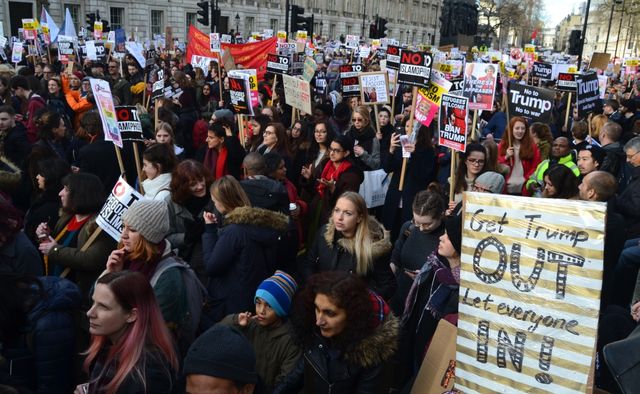
Tens of thousands demonstrated in London, and thousands more around the UK Saturday, to protest Donald Trump’s presidency and his travel ban on citizens from seven majority Muslim countries entering the United States.
The demonstration was organised by a number of organisations, including the Stop the War Coalition, People’s Assembly, Stand Up to Racism and the Muslim Council of Britain.
Protesters at the London demonstration
Protesters assembled at the US Embassy in the capital and marched a few miles to Downing Street—the residence of Prime Minister Theresa May—where a further rally was held.
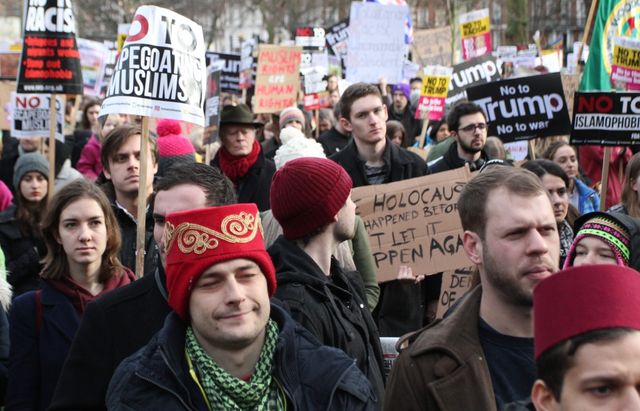
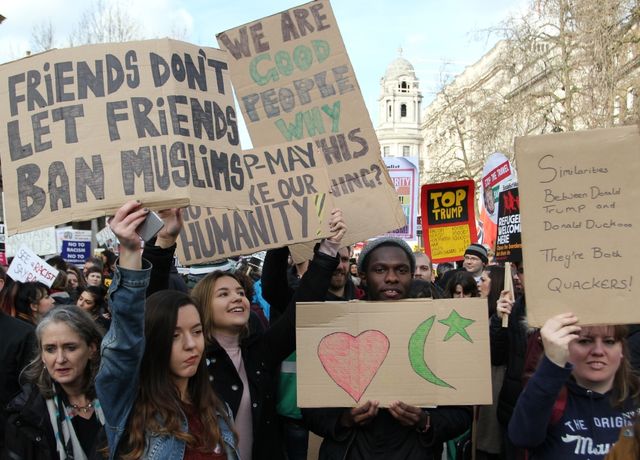
The overwhelming majority attending were young people. Many carried homemade banners denouncing the ban and other policies being rolled out by the Trump administration.
While the vast majority of protesters attended on the basis of seeking to oppose Trump, the organisers sought to divert this opposition into the dead end of appeals to May on the basis that she end the “special relationship” between the US and Britain.
Speeches from the platform at the beginning and end of the rally were centred on appeals to May to “disinvite” Trump from attending an official state visit to the UK later in the year, when he is scheduled to meet the queen at Buckingham Palace. Andrew Murray, the chair of Stop the War and a supporter of the Stalinist Morning Star, went so far as to state, “I must admit I stand here as a republican, but my first thought when I heard that was ‘Donald Trump, keep your wandering hands off the Queen.’”
Andrew Murray speaking to the rally at the US Embassy in London
He called on May, “Let go of his [Trump’s] hand. It’s time, at last, to call time on the special relationship.”
Concealing the onslaught against democratic rights carried out by successive Labour and Tory governments, including the period that May recently spent as home secretary in the Cameron government, Murray concluded, “It’s time we had a British government” that will “stand up for the dignity of our democracy and the values that we believe in.”
None of this is aimed at mobilising the working class in Britain and the US against either Trump or May, but on appeals to sections of the ruling class and upper layers of the middle class to force May to recognise that such a close relationship with Trump would be detrimental to the interests of British imperialism.
In the lead up to the demonstration, Stop the War issued a petition calling for an end to the special relationship tied to opposing Trump’s proposed state visit.
A January 27 statement read, “Our government should not be seen to be endorsing the sorts of ideas and policies he [Trump] is putting forward.”
A January 23 article by leading STWC figure and member of the Counterfire splinter from the Socialist Workers Party, Chris Nineham, stated, “Any civilised or sensible government would be breaking links with him.”
He concluded, “We must demand now that our government breaks ties with the Trump regime and ends the special relationship. Only then can we begin to move away from war and towards a sane foreign policy” (emphasis added).
A section of the London demonstration
What unites all the organisers of the London protest is their resolute opposition to any independent movement of the working class against the ruling elite.
John Rees, another leader of Counterfire, spoke in the name of the People Assembly outside Downing Street. Rees claimed that the only way forward in the fight against Trump and May was by supporting and joining the trade unions. Trump, he said, was attacking the unions.
This completely misrepresents the relationship between Trump and the trade unions, which have reached out to the fascistic demagogue based on asserting a common platform of economic nationalism in defence of US capitalism.
Last December, the New York Times published an op-ed piece by Richard Trumka, the president of the American Federation of Labor and Congress of Industrial Organizations (AFL-CIO), arguing that Trump would be far more successful if he saw the unions as “partners” rather than antagonists. January saw the AFL-CIO urge Trump to honour his pledge to renegotiate the North American Free Trade Agreement, with Trumka pledging, “We are ready to fix it.”
In February, Trump held a White House lunch with corporate executives and officials from the United Steelworkers (USW) and the International Association of Machinists (IAM) from motorcycle manufacturer Harley-Davidson. Trump said of the unions, “You folks have been terrific to me.”
The head of the USW, Leo Gerard, has applauded Trump’s executive order pulling the US out of the Trans-Pacific Partnership (TPP) trade pact, pledging to work with Trump on the “promised, pro-worker, pro-income-growth agenda that prioritizes revitalizing manufacturing.”
Protesters on the London demonstration
In the UK, the unions have an unbroken record of organising defeat after defeat for the last three decades. But this didn’t prevent Rees from declaring, “What we should chant today is union, union, union!”
The same pro-British capitalist message was repeated at protests all over the country. In Sheffield, for example, around 800 people rallied outside City Hall to be subjected to a platform dominated by the Labour Party, Green Party and pseudo-left groups including the SWP.
Former Greens leader Natalie Bennett condemned May’s support for Trump as being opposed to British national interests. “We are focusing on Trump,” said Bennett, “but we’re also focusing very much on Theresa May, walking hand-in-hand with Donald Trump, and I think she’s got a message from Britain that says, ‘that’s just not acceptable.’”
Sheffield Trade Union Council (TUC) Secretary Martin Mayer condemned May as a racist but was silent on the Labour Party’s anti-immigrant record, including its repeated calls—backed by the Trades Union Congress—for a “legitimate discussion” against the free movement of labour. Rally organisers presented speakers from a range of ethnic and community associations, including local Labour councillors Mohammed Maroof, and Abdul Khayum, whose political affiliations were deliberately concealed.
The SWP’s Maxine Bowler was introduced as a “leading trade union activist” and combined demagogic attacks on Trump (“You’re fired!”) with overt support for the imperialist powers in Europe and elsewhere. “Politicians around the world are having a go at Trump,” she declared. “We need to stop Theresa the appeaser.”
Prior to the London demonstration, an attempt was made to sabotage it by Guardian columnist Owen Jones and a number of his journalistic co-thinkers. Jones, a Labourite who, last year, played a pivotal role in the attempted coup against Labour leader Jeremy Corbyn, launched a slanderous witch-hunt against the SWP, claiming the group were behind one of the organisers of the event, Stand Up to Racism. He tweeted Friday, “I’m not taking part in tomorrow’s Trump demo because of the leading role of the SWP in it, a cult which covered up rape.”
The aim of the attack on the SWP, using its bureaucratic efforts to suppress accusations by two members against one of its leaders in 2013, is aimed at whipping up hysteria against all left-wing political thought and tendencies—asserting that the “Comrade Delta” affair is an indictment of Leninism, Trotskyism and proof that “gross abuses of power” are “inevitable on the far left.”
Jones’s aim is to stigmatise anyone who even remotely challenges his efforts to subordinate politics to the Labour Party—and above all the pro-capitalist, pro-European Union perspective of its Blairite wing that he regurgitates every week within the pages of the Guardian.
Jones is a leading figure in the Stop Trump Coalition, which is seeking to exploit mass hostility to the right-wing regime in the White House and to the Tories to argue that last June’s referendum decision to leave the EU must give way to a reorientation towards a new anti-US, pro-EU foreign policy.

White House appeals ruling against anti-Muslim travel ban

Tom Carter 

On Friday, Federal District Judge James Robart entered an order halting the enforcement of President Donald Trump’s anti-Muslim travel ban, which has prompted large protests across the US and worldwide. The Trump administration has responded by filing an immediate appeal, arguing that the judge’s order violates a “fundamental sovereign attribute” of the president.
Robart’s order was entered in a lawsuit brought by the states of Minnesota and Washington, which argued that the ban was motivated by unconstitutional “religious animus” and would hurt the states economically. Robart, a George W. Bush appointee, expressly struck down the ban nationwide.
Trump’s January 27 executive order prevents citizens of seven Muslim-majority countries—Iraq, Syria, Iran, Libya, Somalia, Sudan and Yemen—from entering the US for 90 days. The order also indefinitely halts all refugee admissions from Syria, halts all other refugee admissions for 120 days, and permits Christian refugee applications to be prioritized over applications by Muslims.
The order was widely viewed as a fulfillment of Trump’s campaign promise to ban Muslim immigration, as well as a boon for racist and far-right groups, which promote theories that there is a Muslim conspiracy to oppress Christians and enact Sharia law in the United States. Breitbart News, formerly headed by Trump’s chief strategist Stephen Bannon, ran an article in November headlined, “Muslim Migrants Secretly Hate Christians, Seek to Outbreed Them.” Bannon once proposed a documentary about how the US is in danger of being transformed into the “Islamic States of America.”
While the executive order itself does not include the word “Muslim” or “Islam,” it is freighted with anti-Muslim stereotypes and tropes. “The United States cannot, and should not, admit those who do not support the Constitution, or those who would place violent ideologies over American law,” the order states. “In addition, the United States should not admit those who engage in acts of bigotry or hatred (including ‘honor’ killings, other forms of violence against women, or the persecution of those who practice religions different from their own) or those who would oppress Americans of any race, gender, or sexual orientation.”
Trump responded to the judge’s order on Friday with a Twitter rant that all but accused the judge of being a traitor. “The opinion of this so-called judge, which essentially takes law-enforcement away from our country, is ridiculous and will be overturned!”
Trump continued: “The judge opens up our country to potential terrorists and others that do not have our best interests at heart,” Trump wrote. “Bad people are very happy! Just cannot believe a judge would put our country in such peril. If something happens blame him and court system. People pouring in. Bad!”
Trump’s accusation that the judge is complicit in future terrorist attacks is particularly ominous, suggesting that any opposition to his decrees will be considered treason.
On Saturday, the Ninth Circuit Court of Appeals summarily rejected an emergency appeal filed by the Trump administration for an immediate administrative stay of Robart’s order. Further briefing on the issue by the states of Washington and Minnesota was due in the Ninth Circuit by midnight on Sunday, with the Trump administration to respond by 3:00 p.m. Monday. The case, State of Washington et al. v. Trump et al., is expected to move rapidly through the federal judicial system and may even reach the Supreme Court.
In addition to the question of whether the Trump administration’s executive order was motivated by religious bigotry, the most significant legal issue raised by the case concerns the scope of presidential powers. In the brief for the Trump administration, Justice Department lawyers bluntly argued that the US president has authoritarian powers that cannot be “second-guessed” by anyone.
“Judicial second-guessing of the President’s determination,” the administration lawyers wrote, “would constitute an impermissible intrusion on the political branches’ plenary constitutional authority over foreign affairs, national security, and immigration.” They went on to argue that the “the power to expel or exclude aliens” is a “fundamental sovereign attribute” that is “largely immune from judicial control.”
In its latest brief, the Trump administration pointed to arbitrary executive powers previously asserted by the Obama administration, which the Supreme Court—in an opinion by Antonin Scalia—had affirmed in a 2015 case called Kerry v. Din. Citing the precedents set by the Bush and Obama administrations, Trump’s lawyers argued essentially that the president is a dictator whose authority cannot be challenged.
There are tensions within the ruling class over the issue of the “Muslim ban.” The states of Washington and Minnesota were supported in court by briefs filed by Amazon, Expedia and Microsoft, all of whom opposed the ban. There is a concern that such a flagrantly bigoted action by the president will be bad for business, not just in terms of its immediate consequences for individuals affected, but also in terms of undermining America’s ability to posture as the leader of the democratic “free world.”
No confidence can be placed in the Democratic Party or its big-business allies to wage a principled opposition to the Muslim ban. While ex-President Barack Obama now postures as a sympathetic friend of immigrants, the former “deporter-in-chief” was responsible for the brutal expulsion of a record 2.5 million people during his eight years in office. Indeed, the Trump administration is expressly relying on authoritarian precedents set by the Obama administration that were supported by the Democratic Party at the time. Whatever show of opposition they may make to the “Muslim ban,” congressional Democrats are meanwhile assisting the Trump administration in its campaign of economic provocations against Iran.
While Judge Robart’s order temporarily halts enforcement of the “Muslim ban,” the remainder of Trump’s anti-immigrant orders remain in effect. According to calculations published by the Los Angeles Times on Saturday, up to 8 million people living in the US could be targeted for deportation under the Trump orders.