24 Feb 2017

Australian governments’ decade-long cultural wrecking operation

Richard Phillips & Linda Tenenbaum

Over the past decade, Australian governments have drastically reduced the country’s already-limited public funding to the arts. In the last three years alone, the Liberal-National coalition government—first under Tony Abbott and now Malcolm Turnbull, who previously postured as a “friend of the arts”—has cut more than $300 million from federal arts spending.
Thousands of jobs have been eliminated in every sector and the career hopes dashed of hundreds of young people in the visual and performing arts, literature, film and music.

Force Majeure dance company, one of scores of arts organisations denied federal government funds last year. Photograph © Peter Plozza
While the cuts are part of the government’s social austerity measures on all social spending, its actions are not just driven by financial considerations. The national arts budget, after all, is miniscule compared to the billions spent on tax cuts for the rich, or new weaponry and the promotion of militarism. The assault on state-funding of the arts—in Australia and around the world—is motivated by deeper political considerations.
In its struggle against the decaying feudal order, the bourgeoisie in previous centuries sought to lift society’s intellectual and cultural climate in order to challenge the old aristocratic regimes. It championed artistic freedom, recognising its role in enhancing the critical capacities of the population.
Today, such sentiments are anathema to the ruling elites, who regard genuinely critical and creative voices with suspicion or outright hostility.
To maintain political power and justify unprecedented levels of social inequality, attacks on democratic rights and preparations for war, governments everywhere seek to keep the population ignorant, demoralised and in a state of political confusion. That means eviscerating anything that inspires thoughtful reflection, humane sensitivity and honest artistic work.
This is the essential purpose of the Australian government’s gutting of the Australia Council for the Arts, the country’s nominally independent arts funding body, and the network of federally funded museums, libraries, art galleries and other key cultural institutions.
Prior to 1967, federal arts funding in Australia was virtually non-existent. Apart from small amounts to a few well-known authors via the Commonwealth Literary Fund, which was set up in the late 1930s, and the establishment of the Australian Elizabethan Theatre Trust in 1954 to assist large performing arts companies, Canberra gave nothing to assist or encourage artistic activity.
The Australian government is turning the clock back to these dark days, forcing artists to rely on corporate sponsorship or rich benefactors.

Melbourne artists and performers rally against funding cuts
Last May, after a $100 million reduction in government funds, the Australia Council was forced to cut its grants to 62 small- and medium-sized arts organisations, many of them outside the major state capitals and in remote areas. Grants to individual artists were also drastically reduced—down from over 1,140 in 2014 to just 700 in 2016.
While it is not possible here to list the scores of organisations destroyed by these policies, the damage caused and the social implications have been far-reaching. Nothing short of a cultural wrecking operation is underway that impacts most heavily on young artists, the smaller arts companies and those providing vital arts programs in regional and marginalised communities.
The destruction of ArtStart and numerous other financial assistance schemes for young writers, visual artists, musicians and others, for example, prevents all but the sons and daughters of the wealthy from working full-time in their chosen artistic field. Without these grants, it is impossible for young artists to live while devoting adequate time and effort to their work—to experiment, take risks, make mistakes and gain the necessary experience to expand their creative vision and skills.
Australia Council cuts to regional arts communities and remote indigenous settlements have been equally devastating. Arts programs in many indigenous communities play a vital role in enhancing social well-being. In many cases they provide the only source of employment or creative outlet in these desperately poor areas.
As well, arts programs for the disabled and the mentally ill in cities and towns across Australia have been targeted. Starting this year, funding will cease to 13 organisations that deliver remedial treatment arts courses to over 16,000 people across Australia.
David Doyle, head of Disability in the Arts, Disadvantage in the Arts in Western Australia, told a 2015 Senate inquiry into federal funding that the cuts were catastrophic. Community arts programs for the disabled, he said, were being hit by a “perfect storm”—the Australia Council cuts, government “reforms” of national disability and health services and falling sponsorship caused by the collapse of the mining boom.
Helen Bock from Community Arts Network SA told the same inquiry that the government cutbacks would mean that “ordinary Australians will have less or no access to the arts … I have always talked about the arts as the ‘haves’ and the ‘have nots.’ Now what we are going to have is the ‘haves’ and the ‘have mores’…”
Bock correctly observed: “Ordinary Australians will miss out on that transition to appreciating the arts. Organisations will miss out on having their lives improved, having opportunities to build their self-esteem and confidence—a stepping stone and having the experience of creating things …”
Another part of Canberra’s wrecking operation is the annual “efficiency dividend”—an Orwellian cost-cutting measure first introduced by the Hawke Labor government in 1987 and imposed on federally funded cultural institutions and all public sector agencies.
Labor’s “efficiency dividend” policy, which has been retained by consecutive federal governments, forces management at the National Library, National Museum, National Gallery and other important cultural bodies, including most recently the Australia Council, to reduce annual operational costs by up to 2.5 percent. This has led to the destruction of hundreds of jobs and a serious decrease in services—shorter opening hours, fewer resources, fewer exhibitions and in some cases outright closures.
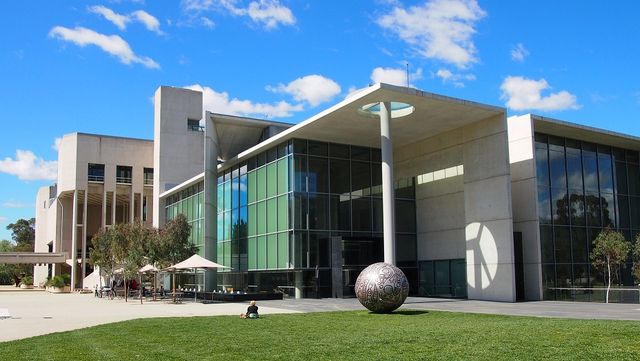
National Gallery of Australia
The Australia Council cuts run parallel with growing demands in government and right-wing media circles for grants to be stopped to individuals and arts organisations that dare to speak out against the government or challenge policy.
George Brandis, then arts minister in the Abbott government, made this abundantly clear in 2014 when he ordered that the Australia Council establish new grant guidelines. Any artist who rejected corporate sponsorship for political reasons should not be given Australia Council funds, he declared.
Brandis’ diktat was in response to a decision by nine visual artists who withdrew their work from the Sydney Biennale because the event was sponsored by Transfield, one of the companies running Australia’s repressive offshore asylum seeker facilities. The arts minister’s demands were echoed by various right-wing columnists and radio shock jock commentators.
Tim Blair at the Murdoch-owned Daily Telegraph supported Brandis and denounced the Australia Council as a “multi-million-dollar tax playpen.”
The Council, Blair said, had perpetrated a “spineless movement of grant-dependent tax sucklings” and “should be shut down, along with just about all arts funding. This would save close to $700 million per year—absolutely guaranteed—and would result in better art.”
What sort of society is being created by these demands? How distant is this from the direct censorship of anything that fails to conform to the political status quo? Or from the measures introduced in Nazi Germany and Mussolini’s fascist Italy to suppress oppositional art?
Those demanding that artists remain silent about Australia’s concentration camp-style refugee detention centres and other anti-democratic violations will soon be calling for direct censorship against anyone daring to speak out against militarism and war.
And what happens if the so-called “efficiency dividend” regime is applied across the board to individual artists? Should painters be forced to cut back on art supplies, or writers to produce novels, or poetry, at a faster rate? Should a choreographer or composer be required to use fewer dancers or musicians, or be obligated to organise more performances of their works?
The Turnbull government, with bipartisan support from Labor and the Greens, claims there is no money. This is a lie. A massive $495 billion military acquisitions program is being carried out over the next decade, to purchase submarines, warships, F-35A strike fighters and a fleet of new battle tanks and other infantry vehicles. Moreover, more than $500 million has been allocated, as part of the promotion of the centenary of World War I, to funding scores of government-commissioned works and events aimed at fostering militarism and fanning the noxious fumes of nationalism.
Scores of arts colleges, galleries and libraries, not to mention schools, hospitals and other vital social facilities, could be financed and staffed with such resources. And countless regional arts organisations and disability arts programs could also be funded.
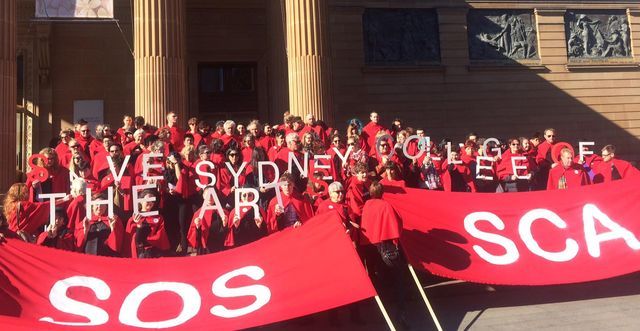
Save Sydney College of the Arts demonstration in 2016
Art seeks to cognise life and provide a deeper understanding of the world and society beyond what is immediately revealed in everyday life. That is why, if artists are unable to survive and do their work, then society as a whole suffers—intellectual life is denuded and critical thought compromised.
The development of serious art and the nurturing of those who carry out this work, however, is a complex social process, and, in the 21st century, the necessary conditions cannot be created or sustained by ordinary individuals—i.e., those without wealthy patrons.
State-funding of the arts is essential—and on a far higher level than currently provided by any country in the world—to create the conditions to train and develop those involved in genuinely creative work and as an essential component of the struggle for a genuinely humane society.
Artists, writers, filmmakers, musicians and other cultural workers have sought to fight the cuts over the past two years via fruitless appeals and protests to government and opposition MPs. But in order to confront the government onslaught, artists and other creative workers need to frankly confront what these measures reveal about the existing social order, what kind of struggle is required and on the basis of what political perspective.
The dangerous undermining of the arts by the Australian government is not a national issue. Nor is it simply the fault of the predilections of individual politicians. Its retrogressive policies, along with the official promotion of xenophobia, ignorance and militarism, are inseparable from the social war being conducted against the working class—the destruction of its jobs, living standards and basic rights—in every country.
In Britain and Europe state-funding of the arts is being eliminated, while the Trump administration plans to destroy what little remains of US government support for the arts. Its targets include the National Endowment for the Arts and the National Endowment for the Humanities, and it aims to sell off the Corporation for Public Broadcasting.
These far-reaching attacks are another measure of the fact that the capitalist socio-economic order, where everything is measured according to its ability to generate profits, has reached an historic impasse. While extraordinary advances have been made in science, technology, and human productivity, which provide the objective conditions for a new and humane social order, the continuation of a society based on private ownership of the means of production and embedded in the system of rival nation states, offers only a dystopian future of social destruction, dictatorship and war.
The democratic right to art and culture has become a revolutionary issue, intimately bound up with the struggle for a new and higher social order. Serious creative and intellectual endeavour has no future under this moribund system.
As Leon Trotsky, revolutionary Marxist and co-leader with Lenin of the 1917 Russian Revolution, explained in 1938, on the eve of World War II: “To find a solution to this impasse through art itself is impossible. It is a crisis which concerns all culture, beginning at its economic base and ending in the highest spheres of ideology.
“Art can neither escape the crisis nor partition itself off. Art cannot save itself. It will rot away inevitably—as Grecian art rotted beneath the ruins of a culture founded on slavery—unless present-day society is able to rebuild itself. This task is essentially revolutionary in character. For these reasons the function of art in our epoch is determined by its relation to the revolution.”
Those wanting to fight the cultural vandalism now underway need to be equipped with an understanding of the complex theoretical and political conceptions, based on the historical and scientific socialist perspective of Marxism, that found their highest expression in the October 1917 revolution and in Trotsky’s struggle against the Stalinist bureaucracy. These liberating ideas, which, in the first decades of the 20th century, attracted the most far-sighted artists, writers and intellectuals, provide the only progressive solution to the explosive political and social issues facing humanity today.


New President of the Gambia, Adama Barrow opens the country for plunder

Eddie Haywood

Newly elected president of Gambia, Adama Barrow, was inaugurated last month after a contentious election held in the small Western African nation. Gambia comprises a sliver of land following the Gambia River, and is bounded by Senegal.
The outgoing president Yayha Jammeh at first conceded defeat to Barrow, and agreed to cede power, but backtracked days later, declaring last December's poll fraudulent and cited unsubstantiated “abnormal irregularities” in the vote count. The Obama administration and governments throughout Europe sharply condemned Jammeh's refusal to concede to Barrow.
Barrow was sworn into office last month in neighboring Senegal under fears of a violent crackdown by the Jammeh government. Jammeh had declared a state of emergency, and the Gambian armed forces occupied the streets in the capital city Banjul.
With the approval of the United Nations Security Council, a military force led by the Senegalese military was organized comprising of forces from the West African nations of Nigeria, Mali and Ghana, and invaded the Gambia with the explicit mission of forcing Jammeh out of the country. Without a shot fired, Jammeh voluntarily boarded a plane in Banjul and left the country.
The universal condemnation of Jammeh heard in the capitals of Western Europe and Washington is a clear indication that Jammeh had fallen out of favor with international finance capital.
The autocrat's 22-year rule was beset by a souring of relations between his government and the imperialist powers; in 2013 Jammeh had withdrawn the Gambia from the British Commonwealth, the organization comprised of 52 former British colonial African nations. Last year Jammeh rescinded the Gambia from the jurisdiction of the International Criminal Court.
In 2014, in response to the sharp international displeasure with Jammeh, the European Union withdrew its economic aid to the nation.
Jammeh had conducted a campaign of expropriating industry during his rule and operating it for the benefit of himself and his clique which raised the ire of international capitalist interests. Jammeh's confiscated enterprises consisted of sectors throughout the Gambian economy, including agriculture, telecommunications, and the service and tourism sector.
The repressive regime was also viewed unfavorably by Western governments not on the basis of democratic rights, but that such brutality is considered “bad for business” in exploiting the Gambian economic resources.
Also viewed intolerably were Jammeh's imposition of overvalued exchange rates for the Gambian dalasi, seeking to prop up the Gambian currency at the expense of the world currency exchange market. These moves provoked a 33 percent drop of international investment in the Gambia in 2014.
With the end of Jammeh's rule, the Gambian economy has been bankrupted, collapsing under years of corruption, cronyism, mismanagement, and ostracism from international markets. It has been reported that Jammeh looted the state coffers of as much as $11 million before his departure from the country.
Barrow, in contrast, is welcomed favorably by Washington and its partners in Europe. Since his inauguration, Barrow has declared that the Gambia is “open for business”, and the new government has agreed to cooperate with the recommendations of the International Monetary Fund and the World Bank for “economic reform” in the country. Interpreted bluntly, this “reform” is nothing short of the complete opening up of the Gambian economy to plunder.
Washington and Europe, in the face of the global crisis of capitalism, are salivating at the massive profits to be made out of exploiting the African continent’s resources and labor in a new “scramble for Africa.”
For its part, Washington sees Africa as a geo-political prize to be lodged securely under its control. For several years, China has increased its economic investment in Africa, and Washington is threatened by Beijing's vast economic influence on the continent.
Barrow has been busy in the first days of his administration lining up investors seeking to carve up the Gambia’s economy. According to African Business magazine, Barrow has pledged to work with investors to create a climate in the country that is consistent with business and market expectations.
The main sectors of the Gambia's economy are agriculture, tourism, and remittances from the Gambian diaspora throughout Europe. Barrow has vowed to expand the Gambian economy further for exploitation.
The oil industry is keen to exploit the Gambia for what it calls “significant reserves” discovered offshore of the tiny nation. CAMAC energy, a conglomerate of oil producing corporations headquartered in Houston, Texas, obtained an exclusive contract last year for the development of oil extraction in the country.
Barrow has promised that the Gambia will return to its membership in the British Commonwealth, the organization set up to continue the capitalist exploitation of the former colonies of Africa after the nations won official independence from British colonialism.
UK Foreign Secretary Boris Johnson paid a visit to the Gambia on February 14 to meet with the new president. In an statement to the media, Johnson said, “President Barrow is determined to take Gambia back to the Commonwealth, and the Commonwealth is ready to welcome Gambia back,” Johnson vowed to do whatever possible to “speed up” the process.
Barrow has also guaranteed that the Gambia will return its cooperation in the International Criminal Court.
With the Barrow in place the European Union has committed €225 million in new funding to Gambia. In African Business magazine Neven Mimica, the European Commissioner for International Cooperation and Development, praised the Barrow government, stating that he wishes to work with the Barrow government in “promoting inclusive entrepreneurship schemes along various value chains with […] potential for exports.”
The Economic Organization of Western African States (ECOWAS), the economic trade bloc comprising the region of Western Africa, has hailed Barrow's election as a promising sign of new investment opportunities in The Gambia.
ECOWAS was set up in 1975 as a regional trade bloc to oversee and facilitate the ease of exploitation and trade of Western Africa's economic resources. Headquartered in Lagos, Nigeria, ECOWAS works in tandem with the United Nations and the African Union.
Underlining this foul climate of capitalist exploitation are the Gambian masses, who, according to the UN, are among the poorest populations in the world. Some 60% live in at or below the poverty line, and earn little more than a dollar a day.
The Barrow administration’s proclamation of “new era for Gambian democracy” and its promises of improvement in living standards is a lie, intensified capitalist exploitation will only deepen the immiseration of the Gambian masses.

Inequality deepens in New Zealand

John Braddock

A report on global inequality, published last month by Oxfam, highlighted that not only is the difference in wealth between people in different countries extreme, the growing gap between the rich and the poor within the same countries is also “alarming.”
Oxfam reported that eight billionaires, six of them from the US, own as much combined wealth as the bottom half of the world’s population, some 3.6 billion people.
In New Zealand, the report found that the two richest individuals have more wealth combined than the poorest 30 percent of the adult population. Graeme Hart and Richard Chandler have an estimated $US6.4 billion and $2.7 billion respectively. Hart owns a swathe of global packaging and consumer goods firms, while the Singapore-based Chandler runs a personal investment fund. The gap is wider than in Australia, where two individuals own more than the bottom 20 percent.
Oxfam’s figures belie the current media spin about an economic recovery. A New Zealand Herald editorial on February 6 celebrated the national holiday by proclaiming the country was “thriving” and brushing aside any “despondency” caused by the US Trump’s administration’s looming protectionist measures.
The richest 1 percent of New Zealanders own 20 percent of the wealth, while 90 percent of the population have less than half. The number of individuals with more than $NZ50 million surged from 212 in October 2015 to 252 in June 2016—an increase of almost 20 percent. Figures from Inland Revenue (IRD) show more than a third of this group declared income of less than $70,000 in 2015. The 252 individuals were linked to 7,500 financial and business entities, some in dispute with IRD over nearly $111 million in tax.
Fairfax Media reported on January 17 that the top 20 percent of households hold 70 percent of the wealth. The top 10 percent of households have 53 percent of total wealth, a higher concentration than the average in the 35 industrialised countries of the Organisation for Economic Co-operation and Development (OECD). There are just 140,000 households in this bracket, each with more than $1.5 million. The bottom 40 percent account for just 3 percent of total wealth. More than 86,000 households have negative worth, nearly 10,000 with debts over $100,000.
These figures do not account for housing costs. In Auckland, the largest city, the average house price is over $1 million and over half of all adults are renting. According to a new Salvation Army report, average rents in the city jumped from $392 to $490 a week in the five years to December. An average Auckland wage-earner works 16 hours just to pay rent, compared with 14.2 hours a week five years ago.
The Salvation Army points to homelessness “unseen in more than a generation,” persistent child poverty and a record imprisonment rate. Radio Newstalk ZB earlier this month found a dozen sites around Auckland where “villages” of people are regularly living in cars, tents, trees and huts. At most sites, in the city’s working class western suburbs, half the inhabitants are young people. Meanwhile the latest National Business Review Rich List showed the fortunes of the wealthy elite are increasingly derived from property speculation.
The National Party government last year dismissed as “sensationalist rubbish” reports that almost one third of children, more than 300,000, are living in poverty. However, the numbers living below the poverty line increased by 45,000 in a year and are now double the number in 1984. A Unicef spokesman told the Guardian child poverty was becoming “normalised” in the country of 4.5 million people.
A major factor in growing child poverty is the government’s deepening attack on welfare entitlements. Draconian work requirements have cut the numbers on sole-parent benefits from 3.1 percent of the working age group in 2008 to 2.3 percent last December—the lowest since 1983. An estimated 50,000 children have been adversely affected. Welfare numbers have dropped faster than official unemployment, indicating that many of those pushed off benefits have not found jobs.
Inequality widened markedly in the late 1980s and 1990s under both Labour and National Party governments. The Gini co-efficient, one measure of household income inequality, has risen from 0.27 in the mid-1980s to 0.35 today.
The increase is the result of two interconnected factors: the boom in financial parasitism and the relentless assault on the living standards of the working class.
Over the past 30 years the economy has gone from being one of the most tightly regulated in the OECD to one of the least regulated. There are no exchange controls or restrictions on bringing in or repatriating funds. In 2015, the World Bank ranked New Zealand as the second easiest country in which to do business and the easiest place to start a business.
The beneficiaries have been a social layer many of whom enriched themselves through the privatisation of public assets begun by the Lange Labour government of 1984–89. Between 1982 and 2011, gross domestic product grew by 35 percent. Almost half of that increase went to the tiny richest group.
Among them were Maori tribal-based businesses, now worth around $42 billion. These were created through multi-million dollar Treaty of Waitangi settlements with successive governments, purportedly in recompense for the crimes of British colonialism. While a small elite has been enriched, the vast majority of Maori remain among the most impoverished layers of the working class.
The wider economy is dominated by parasitic activities related to finance, banking and currency trading, which are equivalent in importance for the capitalist class to dairying, the country’s major export industry. The New Zealand dollar is listed among the world’s 10 most traded currencies. The stock market soared 121 percent from April 2009 to June 2015.
The working class, meanwhile, has suffered an historic social reversal, imposed by successive governments with the close collaboration of the trade unions. Income levels, which used to exceed those of many Western European countries before the 1970s, have dropped in relative terms and never recovered.
The official unemployment rate rose to 5.2 percent at the end of 2016. The unreported figures, including people who want to work or are seeking more work, are far higher. According to economist Rob Stock in the Sunday Star Times, the “underutilisation rate” has been “stubbornly high,” remaining at 13 percent since the 2008 financial crisis. Compared to the 132,000 jobless, there were 342,000 workers classed as underutilised.
Stock noted that for people in this situation the labour market “could feel more like a Portugal or a Greece.” Some 12 percent of youth aged 15–24 are not in employment, education or training, down from a recession peak of 14.1 percent in 2009 but still above the 2007 rate of 10.9 percent.

Australian industrial tribunal slashes workers’ wages

Oscar Grenfell 

The Fair Work Commission (FWC), the federal government’s industrial tribunal, yesterday cut wage rates for workers on Sundays and public holidays across the retail, hospitality, pharmacy and fast food industries.
The wage reductions, which target some of the lowest-paid workers, will be used by the corporate elite to step up the assault on the wages and conditions of the entire working class. Employer groups and media editorials are already demanding deeper and more sweeping cuts.
Around one million workers will be directly affected by the pay cuts. Another three million, who work on weekends, likewise face the future prospect of being stripped of the after-hours penalty rates on which they depend to live.
The ruling follows a protracted campaign by business groups, the financial press and successive Labor and Liberal-National governments against penalty rates, which were first introduced in 1947 for after-hours work.
It was the Labor government of Kevin Rudd and Julia Gillard that established the FWC in 2009, with the full support of the trade unions, and then included penalty rates in a four-year FWC review, aimed at stripping back conditions in industrial awards.
Under the FWC ruling, Sunday penalty rates will be reduced from 175 to 150 percent of the base rate of pay for permanent employees in the hospitality industry. Permanent fast food workers face a reduction from 150 to 125 percent, while casuals will suffer a cut from 175 to 150 percent.
For permanent retail and pharmacy workers, the rate will be slashed from 200 to 150 percent, while for casuals, it will be reduced from 200 to 175 percent. Across the sectors, public holiday rates will decrease from 250 percent to 225 percent. Most of the cuts take effect at the beginning of July.
According to trade union estimates, which are likely to be under-stated, the changes will strip workers of up to $6,000 in annual wages. Permanent retail workers, paid the award rate of $19.44 per hour will lose over $72 for every Sunday shift.
This comes on top of the lowest wage growth in recorded history, with average weekly earnings rising only 1.6 percent over the past year, just above the official inflation rate of 1.5 percent.
These figures hide a widespread decline in real wages, particularly hitting the poorest workers. Forty-one percent of households earning less than $40,000 a year reported a decline in income last year, according to this month’s Household Financial Comfort Report. Less than a third of households, overwhelmingly the wealthiest, reported income gains.
Under conditions of soaring major city housing and rental prices, fuelled by speculative investment, the penalty rates cut will increase the hardships facing broad sections of the working class. According to recent figures, over 42 percent of low-income renters are in housing stress—spending more than a third of their income on housing. Household debt is at record highs, with a debt-to-income ratio of over 189 percent.
The FWC ruling has already provoked widespread opposition, with thousands of hostile comments on social media and elsewhere pointing to the social consequences of the ruling. Labor, the Greens and the trade unions have adopted cynical postures of opposing the decision, making vague claims of challenging it by seeking to amend industrial legislation.
In reality, it was current Labor leader, Bill Shorten who amended the Fair Work Act in 2013, as workplace relations minister, to specifically include penalty rates among those aspects of award rates to be “reviewed,” i.e., cut. The FWC president who handed down yesterday’s ruling, Ian Ross, is a former union official whom Shorten appointed in 2012.
Throughout last year, including during the July 2 federal election, Shorten stressed that he would not challenge any FWC ruling cutting penalty rates, in a bid to assure the corporate elite of Labor’s pro-business credentials.
Moreover, in handing down its ruling, the FWC was fulfilling its mandate, based on draconian legislation enacted by the last Labor government, which outlaws most industrial action by workers and is aimed at facilitating continuous cuts to workers’ wages and conditions, usually via union-negotiated enterprise agreements.
In January the FWC endorsed pay cuts of up to 65 percent for power workers at AGL’s Loy Yang A plant in Victoria’s Latrobe Valley, establishing a new wage-cutting precedent. In other aggressive interventions into industrial disputes, the FWC has banned strike action on a number of occasions, including with the support of state Labor governments.
The statements of Greens leaders denouncing the ruling are no less hypocritical. In 2013, Senator Peter Whish-Wilson, the party’s treasury spokesman and a former Wall Street banker, denounced penalty rates as “outdated” and called for a “national discussion” on their abolition.
For their part, the union leaders who condemned the ruling as “the biggest wage cut since the depression” have already established a host of backroom agreements eliminating penalty rates and other rights for broad sections of the working class.
In 1998 the Australian Workers Union (AWU) established a secret deal with Cleanevent, a major cleaning corporation, to dismantle penalty rates, costing poorly-paid cleaners up to $400 million over more than a decade. Bill Shorten, as AWU national secretary, was intimately involved in the arrangement.
In 2015, the Shop Distributive and Allied Employees Association (SDA), the country’s largest union, struck a deal with Business South Australia to abolish Saturday and weeknight penalty rates for up to 40,000 shop assistants. The agreement, a precedent for the FWC ruling, slashed Sunday rates by 50 percent, and public holiday loadings by a third.
At the time, Shorten hailed the SDA deal as a “win-win,” and Mark Butler, a Labor shadow minister and former union official said: “This is what we envisaged when Paul Keating’s government put together the enterprise bargaining model.” In other words, the entire industrial relations framework set in place by Labor and the unions was aimed at imposing wage cuts.
Hailing the FWC decision, Martin Ferguson, who was president of the Australian Council of Trade Unions during the Keating Labor government, and later became a key government minister, urged workers to accept the ruling. Currently the chairman of Tourism Accommodation Australia, an employer organisation, he complained that his industry still did not get the full rate reductions it was hoping for.
Likewise, editorials in the financial press, while welcoming the ruling, demanded much more. The Australian said the ruling was “correct in principle” but “evolutionary” and “limited in scope.” The Australian Financial Review said the decision fell “well short” of those recommended by the government’s Productivity Commission in 2015, and declared that “a less regulated job market is a critical condition for sustaining Australia’s modern prosperity in a more competitive world.”
In other words, what is being demanded is essentially the destruction of all that remains of the conditions and basic rights won by workers over decades of struggle.

Behind the UK government attack on “health tourism”

Richard Tyler

Earlier this month, Britain’s right-wing tabloid press screamed about the damage “health tourism” was doing to the National Health Service (NHS).
The Express, owned by soft-porn millionaire Richard Desmond, fulminated against “Health Tourism Outrage.” The pro-Conservative Daily Mail proclaimed, “Health tourism ‘chaos’ draining the NHS,” quoting “Whitehall research” that “puts the cost to taxpayers of health tourism at anywhere between £200 million and £2 billion a year.”
Rupert Murdoch’s Sun plumbed new depths, condemning a supposed “£500k health tourist,” who in fact was an expectant mother, returning to Nigeria from the US when she experienced complications and had to be taken to hospital from Heathrow.
The Daily Mail wrote of the woman, “A hospital in Luton is chasing a £350,000 bill racked up by a Nigerian mother,” saying the “shocking figure exposes the scale of abuse of the crumbling NHS by health tourists.”
The mother was subjected to this inhumane treatment by the Mail hate sheet, despite it being forced to acknowledge: “The woman had been transferred from another hospital nearby due to complications during the pregnancy and the babies spent two months on the paediatric intensive care unit.” The local NHS Trust was cited as saying that it could not refuse treatment “if there was a danger to life.”
The Sun attacked NHS staff too, in an article headlined, “Shocking health tourism abuse exposed”—for allegedly bringing their relatives to Britain for free treatment.
The headlines were prompted by Health Secretary Jeremy Hunt announcing that the government planned to collect £500 million a year from so-called “health tourists,” following publication of the House of Commons Public Accounts Committee report “NHS treatment for overseas patients.”
Nowhere to be found in the lurid press coverage was the fact that the £500 million the Tories are seeking to obtain represents under 0.5 percent of the current NHS budget of £107 billion.
As the footnotes of the parliamentary report attest, the much reported “£2 billion a year” the NHS is said to be losing to “health tourists” turns out to be a completely made-up figure. It is not based on any scientific examination of actual costs that might be chargeable under the current rules.
The report asserts as a fact: “The research also estimated that the total cost to the NHS of treating people who were not ordinarily resident in this country was around £2 billion.” However, the footnote for this statement refers to another document by the National Audit Office, in which a further footnote about the figure points out, “There is significant uncertainty about the amounts that are potentially chargeable.”
In oral evidence to the committee, the senior civil servant at the Department of Health, Permanent Secretary Chris Wormald, said the £2 billion figure was a “very rough estimate” from which “we came to the figure of £500 million as the chargeable amount.”
When pressed on how the figure of £500 million had been arrived at, Wormald said it was “based on a series of assumptions about the number of people here” [i.e., in the UK].
To implement the government’s proposal means turning doctors and other medical staff into border guards, whose responsibilities would include checking the immigration status of those they are meant to treat.
For the Tory government, this initiative has absolutely nothing to do with the money that might be recoverable from overseas visitors for receiving health treatment in the UK. Blaming foreigners, immigrants and asylum seekers for the dire state of the National Health Service, which has been eviscerated by tens of billions of pounds in cuts since 2010, has long been a staple of government propaganda—faithfully repeated by their media echo chamber. This whipping up of nationalism is now being ramped up, as a central element of the government’s Brexit agenda.
The attack on “health tourists” is vital in diverting the public’s attention from the ruling elite’s plans to completely gut the NHS, turning over those elements that could turn a profit to the private sector. Moreover, scapegoating foreign “health tourists” is just a prelude to introducing charges throughout the NHS for everyone for such routine matters as GP visits.
In the last months, a number of developments point to the dire situation already confronting the NHS.
* Sustainability and Transformation Plans: These mark a significant step towards the dismantling of the NHS. Their aim is to exacerbate the crisis in health care to the point of collapse in order to justify wholesale privatisation.
* Spending Cuts: The Tories are imposing £22 billion in “efficiency savings” on the NHS by 2020. In 2018-19 NHS spending per person in England will go down in real terms. This prompted the chief executive of NHS England to say “let’s not pretend that’s not placing huge pressure on the service.”
* Staff shortages: In England, 96 percent or 214 out of 224 acute hospitals operated without an adequate level of nursing staff during day shifts last October, while 85 percent of them did not have the right staff levels on nightshifts. According to Janet Davies, chief executive of the Royal College of Nursing, “There are already at least 24,000 nursing vacancies in the UK and it’s getting worse every day.”
* Closure of Accident & Emergency Departments: 24 A&E units could face closure over the next four years—seven units have been already identified, and a further 17 face an uncertain future.
Those immediately at risk include departments in East London, West Bromwich and Birmingham. Others threatened include Dewsbury and District Hospital and Huddersfield Royal Infirmary in West Yorkshire, Poole Hospital in Dorset, Southport and Warrington hospitals on Merseyside, Darlington Memorial and University Hospital of North Tees, Southend University Hospital and Broomfield Hospital in Essex.
This would represent the closure or downgrading of 14 percent of England’s “type one” emergency units—those that are consultant-led and offer comprehensive 24-hour services. The effect would be to send emergency cases to a smaller number of units. Dr. Chris Moulton, vice president of the Royal College of Emergency Medicine, said, “Even hospitals that could cope with a large increase in emergency attendances do not have sufficient bed numbers or other facilities to care for the accompanying surge in admitted patients.”
The “urgent care centres” that would replace some of the A&E departments would only offer a limited service and would not have the wide range of medical expertise or equipment available in Accident & Emergency units.

With mass job cuts looming, German union pits Bombardier workers against one another

Dietmar Henning 

The Canadian aircraft and train manufacturer Bombardier is planning new job cuts, including the possible closure of factories in Germany. The country’s largest union, IG Metall, and the works councils are pitting factories against each other to facilitate the company’s downsizing plans.
The plant in Görlitz in east Germany, with over 2,300 employees, is particularly threatened. Bombardier Transportation plans to limit production at the plant to aluminum passenger car bodies, according to a recent Frankfurter Allgemeine Zeitung interview with Michael Fohrer, the chairman of the German division. In Hennigsdorf, hundreds of job cuts imperil the production of the company’s prototypes. The site in Bautzen, on the other hand, is to be developed into an “industrial control center” for the mass production of trains, at a cost of 20 million euros.
The job cuts are part of a second worldwide round of redundancies, involving the loss of another 7,500 jobs. In February and March last year, Bombardier announced it would cut 7,000 jobs worldwide.
For months production at the Görlitz plant has been systematically reduced. Previously double-decker trains and parts for the new ICE 4 train were produced there, including engineering, interior finishing, steel and aluminum parts. The concentration on the production of aluminum car bodies is a major blow, which is the writing on the wall for the complete closure of the factory. According to the works councils, demand has shifted from aluminum to steel and stainless steel trains.
Fohrer blamed international competition for the job cuts. The company has more than 61 factories in 26 countries but Asian and Eastern European companies were increasingly bidding for contracts, he said, and this was depressing price levels due to their lower labor costs and higher government subsidies. In addition, big customers, he said, had demanded that production and service of finished products take place in their own countries.
The company’s aviation division has suffered major losses in recent years, adding pressure to reduce costs in the transportation division. The division’s pre-tax profits were $465 million in 2015, while the aviation sector lost over $5 billion.
The solution, Fohrer said, lies in a “specialization of sites as development and production centers”, and the transition from “order-specific design and production” to the cost-saving “modular principle”. Under this scheme, several varieties of trains are built from the same train type or module, depending on whether they will be used as commuter, regional express trains, etc. In addition, Fohrer said automation and digitization had to be brought up to date. “We want to implement the industry change 4.0”, he said.
He could not give any long-term prognosis on factory closures, Fohrer said, adding that any such speculation would be “untrustworthy”.
Job cuts and possible closures are not restricted to east Germany. Locomotive engineering, which was discontinued in Görlitz last year, is also to be terminated at the company’s plants in Poland, Switzerland and Italy. It will be concentrated, at least temporarily, in Mannheim, Germany.
Fearing slowdowns or other forms of resistance, Fohrer said he wants to ensure that existing orders are completed before announcing the final restructuring plan in July. In the meantime, management is relying on IG Metall and the company works councils to force workers into a bidding war over who will sacrifice more to keep their jobs.
At the same time workers are not prepared to wait until the closure of the plant is announced. “All the signals point to storm”, declared René Straube, the chairman of the works council in Gorlitz. “To take away our production of the steel shell is a deadly blow”.
In mid-January, Sigmar Gabriel (Social Democratic Party-SPD), the former economics minister, the premiers of Brandenburg and Saxony and works council and union officials met with Bombardier management. All sides then sought to downplay the announcement and sow complacency among workers.
The main role of the union and works councils is to allow the company’s plan to be implemented without a “storm”. IG Metall leader for East Saxony, Jan Otto, instructing workers not to strike during a general meeting of IGM members in January and swept aside demands by workers for a fight.
The company joint works council delivered its own restructuring proposal, under the title “Timetable Zu(g)kunft” (Train- Future), to management. The basic premise is that the company is facing a “financial slump” and changes must be implemented. One works council member from Görlitz told the WSWS, “There is already a small internal competition taking place”.
In fact, the “Timetable Zu(g)kunft” is already leading to fierce competition with the works councils playing off plants against one another. They all praise their own factory as the most cost-effective, hardworking and competitive. To prevent falling into disrepute with management, the works councils vehemently oppose any serious measures to defend workers’ jobs.
The unions and work councils are not opposed to layoffs and plant closings in principle. They only ask that they be the ones to enforce factory closures and job cuts—through their own methods. One of these is slashing workforces via “social plans”, severance payments, early retirement or the sacking of temporary workers. “There will be no compulsory redundancies!” declared IGM functionary Otto, making it clear the union will help implement the jobs cuts but wants to sell them as “voluntary” instead.
The bankruptcy of this policy was strikingly revealed with the closure of the GM-Opel plant in Bochum in late 2014. GM and its labor “partners” presented the closure of the Bochum plant and, before that, in Antwerp, Belgium, as necessary to save remaining jobs. Now GM has floated plans to sell Opel-Vauxhall to Peugeot-Citroën (PSA), which would threaten the jobs of tens of thousands of workers in Great Britain, France, Germany and other countries.
IG Metall is now involved various stunts to present itself as the champion of the workers in Görlitz. To let off a little steam IG Metall has called for a demonstration in the town on 4 March. As far as the union bureaucracy is concerned the protest will be a kiss of death to the workers at the plant. A fight can be taken up but it cannot be left in the hands of the unions and works councils—it is up to rank-and-file workers themselves.

German army announces major expansion as tanks roll into Eastern Europe

Johannes Stern

In a comment in the Süddeutsche Zeitung one week ago the German Defense Minister Ursula von der Leyen (CDU) announced a massive increase in the country’s military budget and new international operations to be carried out by the Bundeswehr (German Army). She subsequently announced that the size of the Bundeswehr will increase to almost 200,000 soldiers in the next few years. At present, the total number of active soldiers is around 178,000.
An official press release from the Ministry of Defense stated Tuesday that “a demand has been established for a further 5,000 military posts, 1,000 civilian posts and 500 additional reservists over the next seven years.” The “target for the Bundeswehr up to 2024” would “be increased to a total of 198,000 soldiers with about 61,400 posts for civilian employees.”
In May last year Von de Leyen announced a so-called “Trend Change of Personnel” involving a gradual increase in staffing. At the beginning of December this was followed by the new “Personnel Strategy of the Bundeswehr.” Following the election of US President Donald Trump, the German government’s demands for rearmament and war have become increasingly aggressive.
The latest press release states: “The Bundeswehr must be able to respond appropriately to foreign and security policy influences at all times.” The aim of the “Trend Change of Personnel” is to “increase the capacity of the Bundeswehr, strengthen its robustness and build up important future capabilities.”
Overall “99 individual measures are planned to increase the efficiency of the Bundeswehr.” These included, among others, “specialists in the new organizational area, cyber and information space, crews for the Korvetten K 130, strengthening the support forces of armed force bases (logistics/ABC defense)” and “setting up a 6th tank battalion.”
There is no doubt that the Bundeswehr is preparing for war. Why else the massive investment in personnel and equipment? “The Bundeswehr is required like never before”, Ursula von der Leyen stated in a press release. “The fight against IS terrorism, the stabilization of Mali, continued support for Afghanistan, human smuggling in the Mediterranean and the Aegean, or our considerable presence for NATO in the Baltic States.”
Significantly, on the same day, the Defense Ministry announced the transfer of heavy equipment and other combat groups to the Russian border. “20 Martens and six Leopard battle tanks as well as three mountain tanks are on the way to Lithuania,” according to a report on the official web site of the Bundeswehr. In all, approximately 120 containers and 200 vehicles have been loaded since mid-January and transported to Lithuania by a total of nine trains. By the end of the week the rest of the 450 soldiers are due to leave on their way to lead a NATO battlegroup of a total of 1,000 men.
The transfer of NATO troops to Eastern Europe—further battle groups are being set up in Estonia (under the leadership of Great Britain), Latvia (Canada) and Poland (US)—is part of the campaign to escalate NATO’s conflict with Russia, decided in July 2016 at the NATO summit in Warsaw. This includes the establishment of a NATO missile defense system in Romania and Poland, the creation of a 5,000-strong Rapid Reaction Force and an increase in the NATO Response Force from 13,000 to at least 40,000 soldiers.
Media outlets such as German weekly Der Spiegel justify “the largest deployment of troops to the east since the end of the Cold War” and the posting of the first German battalion to Eastern Europe since the destruction wrought by the Wehrmacht (the German army under Nazism) in the Soviet Union in the Second World War as “a reaction to the take over of Ukrainian Crimea by Russia.”
This turns the facts upside down. The real aggressor is NATO, not Moscow. Prior to the integration of Crimea into Russia in March 2014, Washington and Berlin had organized a putsch against the pro-Russian Yanukovich government in close collaboration with extreme right-wing forces. Since then, NATO has been exacerbating the situation and using the predominantly defensive response of Moscow as a pretense to systematically upgrade its forces and step up military pressure against Russia.
A recent comment in the Tagesspiegel titled “Nuclear weapons against Russia: Germany needs nuclear weapons” made clear how far sections of the German elites are prepared to go. Maximilian Terhalle, a political scientist at the University of Hagen and former security policy advisor in the Defence Ministry, said: “A Germany… that wants to limit the power of Putin’s Russia in order to maintain an independent Europe, which maintains our domestic and foreign-policy room for action, must do so militarily and therefore also with nuclear weapons.”
Terhalle justifies his nuclear great power fantasies by pointing to Trump’s “pro-Russian course” and what he said were the defective arsenals of the “two security council members” France and Great Britain. These were “too small, too tactile, and partly obsolete” and could not “provide a comprehensive deterrent.” Moreover, in the event of an emergency, one can not simply rely on the fact that the stronger partner (for example the UK) guarantees nuclear (protection) for [Germany] and nuclear offence against Russia.” In “a worst-case scenario,” Germany “must be able to stand up for itself.” This is what “it owes to its people.”
One wonders about the sanity of people like Terhalle. As an alleged “security adviser,” he should be well aware that a “worst-case scenario”—that is, a nuclear war with Russia—has the potential not only to wipe out the German population, but eradicate the entire human race. Workers and youth must take such comments seriously. Seventy-five years after the end of the Second World War, the German ruling class is again preparing to commit terrible crimes in order to impose its geostrategic and economic interests throughout the world.

US anti-immigrant witch-hunt leads asylum seekers to make perilous trek to Canada

Roger Jordan

Since Donald Trump’s election as US president last November and particularly since the beginning of the year, increasing numbers of refugees are fleeing the US for Canada. To do so, many are making perilous journeys through snow-laden fields, in frigid temperatures.
The Trump administration and its anti-immigrant witch-hunt are responsible for the refugees’ plight. So too is Justin Trudeau’s Liberal government. If refugee claimants are being forced to cross into Canada using fields and seldom-traveled back roads, it is because the Trudeau government has instructed the Canada Border Services Agency to continue to enforce the reactionary Canada-US “Safe Third Country Agreement” and deny them entry if they try to enter Canada at a border crossing.
The number of asylum seekers crossing from the US states of New York, Vermont and Maine into Quebec in January was up more than ten-fold from two years ago. While only 42 made the crossing in January 2015, last month the figure was 452.
A network of smugglers has sprung up, charging up to $1,000 per head to take families from New York and other cities to the Canadian border.
Since January, hundreds, often in groups of a dozen or more, have trekked along frozen rivers and fields to reach Manitoba from Minnesota and North Dakota. Many have made the trip without winter clothing and in temperatures of -20 degrees Celsius (minus 4 degrees Fahrenheit). Some have lost fingers due to frostbite.
Most of the refugees entering Canada from the US fled war, poverty and persecution in their native Africa. But the asylum seekers also include people from Latin America and other impoverished parts of the world.
The Trump administration launched a brutal witch-hunt against refugees and immigrants, with Muslims a special target, almost from the day it took office. The President has vowed to deport up to 3 million immigrants and already authorized mass deportation raids and vastly expanded the grounds on which people can be deported. He is also preparing a new executive order to re-impose the ban on refugees, immigrants and visitors traveling to the US from seven Muslim-majority countries.
Yesterday, in a further indication of the draconian character of the assault his administration is mounting on undocumented immigrants, Trump referred to it as a “military operation.”
The Canadian government’s response to the spike in asylum seekers has been a combination of callous indifference and outright hostility. New arrivals are being forced to rely on private charity to obtain the basic necessities of life, with many organizations reporting that they are already running short of supplies.
Under conditions where the US is openly violating its obligations to refugees and refugee-claimants under international law and asylum seekers are putting their lives at risk to reach Canada, the Liberal government has said it will not raise Canada’s pitifully low refugee quota for 2017.
More significant still is the Liberals’ staunch defence of the 2002 “Safe Third Country Agreement” with the United States. Under this agreement, any asylum seeker who enters Canada from the US at a border checkpoint is denied entry and the right to make a claim for refugee status in Canada and immediately returned to the US.
It is this that is causing people fleeing the US for Canada to choose high-risk routes to enter the country. Those who cross the border at an unauthorized point and subsequently file asylum claims are not automatically returned to the US. Canadian authorities can, however, later argue against granting them asylum on the grounds that they should have applied for refugee status in the US.
More than 200 legal scholars and refugee advocacy groups have called on the government to scrap, or at the very least suspend, the “Safe Third Country Agreement,” citing Trump’s anti-immigrant measures. But the government, with Immigration Minister Ahmed Hussen, who came to Canada as a 16-year-old Somali refugee serving as its frontman, has callously refused to do so.
When asked in parliament earlier this month about his government’s response to the spike in asylum seekers, Trudeau made clear that the plight of the refugees is the last of his concerns.
“We need,” declared Trudeau, “to make sure that we are protecting the integrity of the Canadian border, the strength of our immigration and refugee system, and demonstrating that we are there for the security of communities and individuals.”
The Trudeau government’s refusal to assist those desperately seeking to escape Trump’s deportation dragnet underscores the hypocritical and fraudulent character of the Liberals’ posturing as “refugee-friendly.” In the 2015 election, Trudeau sought to appeal to popular anger against the Harper Conservative government by making calibrated attacks on its whipping up of Islamophobia and its depiction of Syrian refugees as a grave threat to Canadian security.
Trudeau has since been promoted by the likes of the New York Times and the British Guardian as something of a poster boy for international liberalism because his government accepted 25,000 Syrian refugees into Canada in its first months in office. Not only is this a drop in the bucket given the millions displaced by the war in Syria, but Ottawa refused to accept any single men and worked with the US Department of Homeland Security to screen those it did allow in. Moreover, the majority were privately sponsored by churches and other charities, meaning that the government provided no support for them.
Last but not least, the Liberals used their “pro-refugee” stance as political cover for increasing Canada’s role in the US-led Mideast War. Yet it is the wars Washington has mounted over the past quarter-century, with Canadian imperialism’s support and participation, in the Middle East, Afghanistan and the Balkans, that have laid waste to entire societies, producing the greatest refugee crisis since the Second World War.
There are two reasons the Liberals are so adamant about upholding the “Safe Third Country Agreement.” First, Trudeau’s cynical tweets about Canada being “open” notwithstanding, they do not want to encourage asylum seekers to seek refuge in Canada. All the more so under conditions where Trump’s brutal measures could cause many to look to Canada for refuge.
Second and even more importantly, Trudeau and his government are determined to forge a close working relationship with the Trump administration and, therefore, don’t want to cause it any embarrassment or be seen to criticize it.
Earlier this month, Trudeau visited Trump at the White House and reaffirmed the longstanding Canada-US military-strategic partnership. Their joint statement pledged Canada to collaborate even more closely in US-led imperialist interventions around the globe and to forge a protectionist trade bloc under Washington’s leadership aimed at offloading the capitalist crisis onto Washington and Ottawa’s economic and geopolitical rivals.
During his Washington trip, Trudeau studiously avoided making any direct comment about Trump’s ruthless crackdown on immigrants. When, at their joint press conference, the US president launched into a full-throated defence of his 120-day suspension of all refugee claims and his discriminatory ban on persons from seven Muslim countries entering the US, Trudeau remained silent.
Canada’s Conservatives and other right-wing forces are seeking to exploit the refugee issue to foment reaction. Predictably, the Conservatives have launched a xenophobic campaign, denouncing asylum seekers for entering Canada “illegally” and demanding that the government do more to “defend” Canada’s borders.
Such claims deliberately seek to scapegoat refugees for problems that have been created by Canada’s brutal refugee policies. If asylum seekers are being forced to enter the country “illegally,” it is precisely because of the draconian anti-immigrant measures imposed by the former Conservative government and upheld by the Liberals, including the Trudeau government’s refusal to cancel the “Safe Third Country Agreement.”

The discovery of a system with seven “Earth-like” exoplanets

Bryan Dyne

The detection of a nearby solar system of potentially Earth-like exoplanets orbiting the star Trappist-1 has evoked widespread public interest and enthusiasm. Millions of people have read reports, watched videos and posted on social media about the seven worlds that might have liquid water on their surfaces.
The Trappist-1 system is comprised of seven planets that orbit a nearby ultracool dwarf star (so-called for its comparatively low temperature). Six of the planets have been confirmed to have an Earth-like size, mass and density. None of them have any hydrogen in their atmospheres, further confirmation that these are all terrestrial, rocky worlds like Mercury, Venus, Earth and Mars. Moreover, due to the gravitational interactions between all seven planets and Trappist-1 itself, every world in the system may have liquid water.
Of particular interest is the fact that the planets are very close. They are Earth’s next-door neighbors, relative to the vastness of the universe. Trappist-1 is only 39 light years away—that is, it takes light, traveling at about 300,000 kilometers per second, 39 years to travel the distance. In comparison, the Milky Way galaxy of which our sun is a part has a diameter of 100,000 light years, and it is about 2.5 million light years to its larger companion, the Andromeda galaxy, one of trillions of galaxies in the Universe.
An artist's rendering of the seven worlds of the Trappist-1 system, shown to scale in both size and distance, as might be seen from Earth with a future telescope. Credit: NASA, JPL-Caltech, Spitzer Space Telescope, Robert Hurt (Spitzer, Caltech)
The planets are so close that, in the not-too-distant future, it should be possible to make far more detailed analyses and even direct observations of exoplanets.
The discovery of these worlds is the most remarkable of a wave of new scientific findings since the first “exoplanet”—a planet outside of our solar system—was discovered around a Sun-like star in the mid-1990s. At the time, while exoplanets had been predicted for nearly four centuries, none had been conclusively detected, let alone directly observed.
Advances in measuring techniques and the use of instruments placed in the orbit around Earth, free of the distortions of the atmosphere, made it possible to detect very slight dips in the brightness of stars. When those dips were observed with regularity, they could be attributed to the motion of planets across the line of sight between the star and the observers.
When the first detection occurred, it opened a whole new realm of astronomy. The gravitational effects of these unseen planets could also be studied, providing evidence of their mass, density and other physical characteristics. Today, not only have scientists detected more than 3,400 exoplanets, the knowledge built up over the past 20 years makes it possible to visualize what these worlds might look like, either from space or from the surface. And with the launching of the James Webb Space Telescope next year, it should be possible to make far more detailed analysis and even direct observation of exoplanets.
Like most significant astronomical advances, the planets’ discovery was an international endeavor. The detection of exoplanets around Trappist-1 began in May 2016, when a team of astronomers used the Chile-based Transiting Planets and Planetesimals Small Telescope (TRAPPIST), remotely operated from Belgium and Switzerland, to first observe the star. They discovered three Earth-sized planets orbiting it, with the outermost one likely within the star’s habitable zone.
This encouraged further observations, which were conducted by a series of ground-based telescopes located in Chile, Hawaii, Morocco, Spain and South Africa. The Spitzer Space Telescope was also commissioned to use its higher precision and greater ability to see in the infrared to study the system. When it was discovered that the system had not three, but seven planets, the Hubble Space Telescope was employed to do an initial survey of the planetary atmospheres for hydrogen. Astronomers across Africa, Europe, the Middle East, North America, South America and Southeast Asia coordinated their efforts to make sense of the data.
The discovery of a planetary system around Trappist-1 is not merely a piece of luck. It is the confirmation of a scientific hypothesis, first advanced in 1997, that, due to the physics of stellar formation, stars with about a tenth of the mass of the Sun are more likely to have terrestrial-sized planets. Trappist-1 is one of many candidates to be studied using this hypothesis, and the first for which the idea has been borne out.
This scientific breakthrough is the culmination of several centuries of advances in astronomy and physics: the understanding of how solar systems are formed; the analysis of visible light and other forms of electromagnetic radiation; and mathematical methods of analysis used to discover the subtle signals in the data from stellar observations.
Trappist-1 is a demonstration of the power of human cognition, science and reason. It is a powerful rebuke to the incessant contemporary glorification of irrationalism, whether through the cultivation of backwardness and religious prejudice or the promotion of postmodernism and its rejection of objective truth, and a mighty vindication of the materialist understanding of the world, that there are objective laws of nature and that humans can comprehend them.
Among millions of people inspired by such discoveries, there is an instinctive understanding that the methods employed to find the Trappist-1 planets and make other scientific and technical advances should be used to solve social and economic problems, to provide sufficient health care, education, shelter or food for all humanity. How can our society discover seven potentially Earth-like worlds more than 350 trillion kilometers away, yet proceed, through environmental recklessness and nuclear-armed militarism, to destroy the planet on which we live?
The exoplanet discovery was based on collaboration towards a common goal whose driving force was the pursuit of knowledge, not the amassing of insane amounts of personal wealth. This sort of thinking is totally alien to the world’s ruling elite, which flaunts its backwardness, vulgarity, ignorance and parasitism, personified in the figure of Donald Trump.
This discovery highlights another contradiction of modern society. The organization and planning required to produce these results is a testament to humanity’s ability to rationally and scientifically coordinate resources on an international scale. The scientists on the project also had to reject the constant mantra of national chauvinism, espoused by the ruling elites throughout the world. While science probes the seemingly infinite distances of galactic space, humanity remains trapped at home within the prison house of the nation-state system, with barbed-wire fences, wars, invasions, bombings and mass flights of refugees.
The squandering of trillions of dollars, yuan, yen and euros to enrich a parasitic capitalist elite and to wage war around the globe is one reason why scientific announcements of this order are so rare. Immense resources, material and human, are wasted, which should be devoted to the improvement of the human condition and the conquest of knowledge of the material world.
The creation of a society in which the development of knowledge can be freed from the constraints of capitalism requires the application of science and reason to the evolution of society and to politics. In opposition to postmodernism and its many variants, which insist that there is no objective truth, Marxism is rooted in an analysis of the laws of socioeconomic development.
Driven inexorably by its internal contradictions, capitalism is leading mankind toward the abyss of world war and dictatorship. These same contradictions, however, also produce the basis for the overthrow of capitalism: the international working class. The objective process must be made conscious, and the growing opposition of millions of workers and youth around the world must be transformed into a political movement that has as its aim the establishment of an internationally coordinated, rationally directed system of economic planning based on equality and the satisfaction of human need: socialism.