27 Feb 2017

Hostility to immigrants dominates major parties in Dutch election

Dietmar Henning & Martin Kreickenbaum

According to recent polls, the two governing parties taking part in the Dutch parliamentary elections on March 15 will be punished for their drastic austerity policies.
Poised to benefit the most from the losses of the free-market, liberal People’s Party for Freedom and Democracy (VVD), whose leader is Prime Minister Mark Rutte, and its coalition partner, the social-democratic Labour Party (PvdA), is Geert Wilders’ anti-immigrant and anti-Muslim Party for Freedom (PVV). Current polls place the latter in the lead, just ahead of the VVD.
The elections in the Netherlands are significant. This country of approximately 17 million people has often been the harbinger of trends affecting Europe as a whole. In May there will be presidential elections in France, and parliamentary elections will take place in Germany this September. Here, too, the far right hopes to profit from the politics of the established parties.
Wilders is basing his campaign on a concoction of social demagogy and xenophobia years in the making. In a televised interview he compared mosques to “Nazi temples” and the Koran with Hitler’s Mein Kampf. Wilders calls Moroccans “vermin” and “scum.”
In its election program, the PVV calls for a ban of the Koran, the banning of construction of new mosques, a halt to immigration from Islamic countries, the abolition of the right to asylum, the sealing of the borders, an exit from the European Union (EU) and the ending of all state funding for developmental aid, wind energy, art and public broadcasting.
At the same time, Wilders engages in certain social demagogy. He promises to reverse the raising of the retirement age, as well as cuts to elder care. In addition to this, he promises that obligatory deductibles for health insurance would be rescinded.
Above all, however, the PVV has been successful because no one has seriously opposed its radical right-wing course. In the last 10 years, various coalitions of all the established parties have set the stage for the ultra-right with an unprecedented orgy of social cuts and the scapegoating of refugees and migrants as responsible for declining social conditions.
According to official economic and social data, the Netherlands is doing well by international standards. In the last year, its economic performance rose by 2.1 percent while the unemployment rate decreased to 5.4 percent. But concealed behind these numbers are enormous social tensions.
During the 2008 global financial crisis, the Christian Democratic Appeal (CDA) and PvdA government pumped more than €85 billion [$US 90 billion] into the financial sector to rescue failing Dutch banks.
Prime Minister Rutte, whose VVD governed from 2010 to 2012 in an alliance with the CDA and since the September 2012 general election with the PvdA, set out to recover the cost of bailing out the banks through extreme social cuts.
The labour market was radically liberalized, the retirement age and sales tax increased, the health care system effectively privatized and basic social security slashed. Subsidies for students and the disabled were cut. The housing market collapsed and many families lost a large proportion of their assets through the decline in the value of their homes.
The supposed economic upturn has done nothing for the poor and working class. The number of people living in poverty has increased sharply since the crisis of 2008. Some 1.2 million people, or nearly 8 percent of the population, are still considered poor. In the big cities—Amsterdam, Rotterdam and The Hague—the unemployment rate is between 13.4 and 14.4 percent.
Particularly affected by the rise in poverty are children and immigrants. Approximately 22 percent of Dutch residents originating in Morocco live beneath the poverty line. Some 12 percent of all children suffer in poverty. Among children with immigrant backgrounds, that figure rises to 28 percent.
At the same time, the portion of workers with a “secure job” fell from nearly 57 percent in 2008 to 30 percent in 2014. The increase in low-wage work ensures that the official unemployment rate remains relatively low. But the underemployed, who work part-time or are often self-employed, and the so-called “discouraged workers” who have given up searching for a job, are not included in the numbers. According to calculations made by the Dutch central bank, if one were to include these figures, the unemployment rate would stand at 16 percent.
In the eradication of social benefits, the social democratic PvdA distinguished itself in particular. In 2008, then party chairman Wouter Bos organized the bank bailout. And as the minority government of the VVD and CDA came apart in 2012 over a further austerity program, because Wilders refused to support them in parliament, the PvdA threw itself into the breach.
Six PvdA ministers hold positions in the current government, including the party’s leader and top candidate, Lodewijk Asscher, who serves as minister of social affairs and employment and deputy prime minister. Minister of Finance Jeroen Dijsselbloem also comes from the PvdA. Since January 2013, he has been the president of the Eurogroup (the informal meetings of the finance ministers of the eurozone) and in this capacity he oversees the brutal austerity policies in Greece and other countries burdened by extreme debt.
Through its ties to the Dutch Federation of Trade Unions (FNV), the PvdA also made sure that the 2013 labour protests against the austerity measures of the government did not get out of control.
While social spending decreases, spending on the military and security apparatus is rising. The budget for the police force and judiciary has increased by €700 million in the last two years. By the year 2020, the defence budget will climb by €1 billion. Dutch troops are participating in the US-led war in Syria, supposedly training Iraqi and Kurdish forces to fight ISIS, and alongside German troops in their mission in Mali.
The building up of the Dutch state apparatus goes hand-in-hand with sharp attacks on democratic rights, above all those of refugees and immigrants. As early as 2010, the once-liberal asylum laws were severely tightened. The human rights organization Human Rights Watch has since called them the strictest in the EU.
Asylum seekers receive only minimal provisions, commonly referred to as “bed, bath and bread.” Rejected refugees are given 28 days to leave the country. Even if deportation is impossible for legal reasons, the refugees no longer have the right to support from the state and are condemned to homelessness.
The wearing of burqas and niqabs is banned in state buildings, on public transportation, in hospitals and schools, although there are only 100 Muslim women in the Netherlands who wear veils covering their faces. In its latest annual report, Amnesty International criticized the fact that in the future the Dutch police and secret service will be allowed to carry out far-reaching surveillance measures while alleged “terror threats” are robbed of their rights.
The Dutch government confronts the population with open hostility and arrogance. When the Association Agreement between the EU and Ukraine was rejected last year in a referendum, Rutte flouted the decision and ratified the agreement anyway.
To open the election campaign, Rutte imitated Wilders’ xenophobic tirades. On January 23, he published an open letter in the seven largest daily papers in the country, calling on immigrants to adapt to “Dutch norms and values.” The prime minister said, “We feel ill at ease when people abuse our freedom to disturb the country though they came here because of this freedom.” He threatened: “Conduct yourselves in a normal manner or go.”
PvdA leader Asscher has adopted the same course. He calls for stricter regulations on immigration, a defence of Dutch “identity” and “progressive patriotism.”
Rutte and Asscher are playing directly into the hands of Wilders’ anti-immigrant agitation. Prior to 2005, Wilders was a member of the VVD faction in parliament and was considered Rutte’s mentor. He broke with the VVD over the question of Turkey’s entry into the EU and launched the extreme right PVV.
Three weeks prior to the election, Wilders’ PVV is neck and neck with Rutte’s VVD in the polls. Both parties would each have 23 to 28 seats in the 150-seat parliament.
The PvdA is threatened with a plunge from 38 to less than 10 seats. Their share of the vote in the polls has dwindled from 25.3 percent to 8 percent.
The Socialist Party (SP), which was founded in 1971 as a Maoist organization (the Communist Party of the Netherlands/Marxist-Leninist), has proven itself unable to profit from the collapse of the PvdA. After winning 25 seats in 2010 and 15 seats in 2012, it is now predicted to get only 11 to 13 seats despite the social crisis.
The SP, “socialist” in name only, advances a strictly nationalist programme and attempts to cover it up with hollow promises of reform. Their lead candidate Emile Roemer is in agreement with the law-and-order campaign of the other parties and calls for an increase in police personnel and equipment.
In addition to Wilders’ PVV, the CDA, the GreenLeft and the left-liberal Democrats 66 are expected to gain support. Each is counting on receiving around 11 percent of the vote, or 15 to 16 seats. The final election result, however, is far from certain. I&O Research reports that 77 percent of voters are still undecided.
Because no party is likely to achieve a majority of seats, the SP now speculates that it could build a coalition with the social democrats and GreenLeft. The SP is open to any coalition, according to its leader Roemer, “except with Wilders and Rutte.”
Rutte has also excluded the possibility of a coalition with Wilders, but according to polls, more than three-quarters of voters expect him to break his promise.

Private prison companies to profit from mass immigrant detention

Genevieve Leigh 

To enforce its mass deportation program, the Trump administration’s immigration advisors have proposed that the Department of Homeland Security double the number of people held in immigration detention centers to 80,000 per day. Such a massive increase in detentions will require the erection of a vast prison apparatus to house migrants who have committed the “crime” of escaping the violence and poverty of their war-torn home countries.
According to a February 23 USA Today report, several of the private prison companies profiting from immigrant detention donated heavily to Trump’s inauguration festivities. The report shows that GEO Group and CoreCivic each gave $250,000 to fund Trump’s inauguration.
GEO Group CEO Pablo Paez told USA Today that the corporation “does not take a position on or advocate for or against any specific criminal justice, sentencing or immigration policy” when asked about his donation to Trump’s inauguration. However, one industry analyst could not help but note that “the ICE picture bodes well for the private prisons.”
They certainly have reason to celebrate: Stock shares of the two biggest private prison operators—CoreCivic (formerly know as Corrections Corp. of America) and GEO Group—have doubled since the election of Donald Trump. These two companies, both real estate investment trusts, account for 85 percent of the private prison market in the United States.
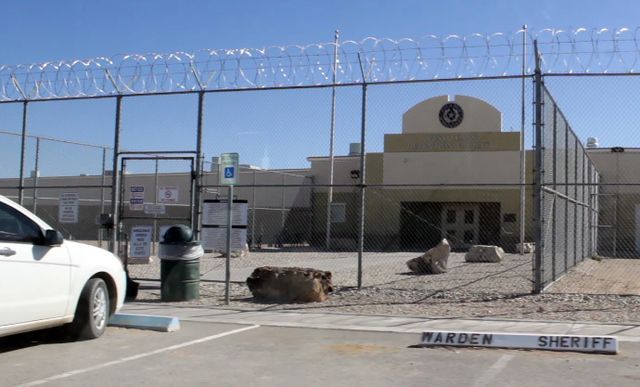
Two immigrants jailed at the West Texas Detention Facility for the "crime" of crossing the border
Shares have increased further since Attorney General Jefferson Sessions announced last week that the new administration would not reduce the Department of Justice’s use of private prisons. Sessions claimed phasing out private prison use would “impair” the ability of the government “to meet the future needs of the federal correctional system.”
As of November 2016, 65 percent of ICE detainees were being held in facilities run by for-profit prison companies. These companies make money by charging the government a per-detainee, per-night fee and depend on profits made from cost cutting for detainee services.
The language of the new memos outlines blanket policies targeting virtually all undocumented individuals and gives the for-profit prison industry reason to believe its services will be in high demand: “With extremely limited exceptions, DHS will not exempt classes or categories of removal aliens from potential enforcement.” The total number of people now targeted under these policies have been estimated at anywhere from 8 million to all 11.4 million undocumented immigrants living in the United States.
As outlined in documents handed down to top Homeland Security officials in late January, the various immigration institutions have been instructed to rescind programs that allow people to leave immigration custody and check in with federal agents or wear an ankle monitor while their cases run through the system. The new policy is to detain these individuals for future deportation at the discretion of the local ICE officials.
Plans for expanded detention are being devised by Trump’s top officials behind closed doors. To manage the immediate influx, the administration is sending migrants to two new facilities commissioned by the Obama administration before leaving office.
The first, Prairieland Detention Center in Alvarado, Texas, opened in November and can hold 700 immigrants, including a separate 36-bed unit for transgender individuals. The Obama administration arranged the opening of this facility through a no-bid contract with the Louisiana-based private prison corporation Emerald Correctional Management. The corporation manages six other detention facilities and has faced numerous allegations of mistreating detained immigrants.
The second, Folkston ICE Processing Center, is a 780-bed center that is set to open in the coming months in south Georgia. This facility, arranged through a no-bid contract with Florida-based GEO Group, will cost $116.7 million over the next five years. GEO has also been accused of neglect and mistreatment of detainees, including denying attorneys and families access at the Adelanto Detention Facility in California.
The opening of these facilities exposes the role of the many pseudo-left organizations whose growing nostalgia for the days of the Obama administration obscures the reality of the administration’s criminal role in paving the way for Trump. It is a testament to the profound depths to which the Democratic Party has plummeted that the Obama administration’s attention to identity within their barbarous prison system would be hailed as “progressive.”
The Obama administration carried out a widespread attack on immigrants over its eight years in office. In addition to deporting more immigrants than any other president in US history, the legacy of Obama includes laying the groundwork for a massive detention network within the United States.
There are currently over 200 immigration jails across the country at which the government detains hundreds of thousands of individuals each year. In 2013, the last year for which there is accurate data, 441,000 individuals were held by the government in these facilities.
The detention system operates under a congressionally mandated quota that requires ICE to maintain 34,000 detention beds at any given time. Under this policy, the profits of the for-profit prison corporations will be guaranteed. This policy, known as the “detention bed quota,” was introduced by Democratic Senator Robert Byrd under the Obama administration in 2009, a time when there was a Democratic Party majority in both the House and the Senate.
These facilities are infamous for their inhumane treatment of detainees, including inadequate access to medical care and legal services, lack of clean clothes, unregulated food service and reports of physical and sexual abuse, among many others. Since 2003, 167 people have died in immigration custody.
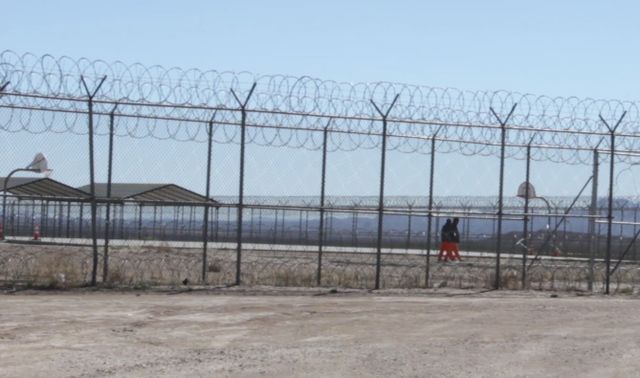
World Socialist Web Site reporters visited one such detention center outside of El Paso, Texas, called the West Texas Detention Facility. The center, which began taking immigration detainees in 2004, holds up to 1,053 immigrants. It is located in the desolate town of Sierra Blanca, which has a population of 553 and a poverty rate of nearly 30 percent. Located off the highway down a dirt road, the facility is surrounded by multiple chain link fences topped with razor wire and patrolled 24 hours a day by ICE vehicles.
West Texas Detention Facility in Sierra Blanca, TX
In order to reach a detainee by phone, one must call and leave a message with the facility with the detainee’s full name and identification number, known as their “alien number.” Money must also be added to the detainee's phone account as they are not permitted to make free phone calls. Only those individuals who are added to the visitation list by the inmate at the time of initial processing may visit at the designated visitation hours, which are limited, and separate for males and females.
A 2007 audit of the facility by the consulting firm Creative Corrections exposed deficient food services, a lack of detainee grievance procedures, mismanagement of storing and maintaining hazardous materials, lack of clean clothes and an inability of families to leave money or property for the inmates. Despite these documented charges, the audit gave the facility a rating of “acceptable.”
There is no shortage of detainment horror stories and cases similar to or much worse than the West Texas detention facility. There are some locations which have even gone as far as altering the rules to lower facility standards in order to stay open, as in the case of the South Texas Family Residential Center.
In 2016 a state court threatened that it would shut down the facility unless childcare was improved. In response, the jail attempted to lower its own standards for childcare by increasing the maximum number of room occupants and allowing unrelated adults to share bedrooms. In this way, the facility was able to continue housing children. The Texas Department of Family and Protective Services explicitly stated the standard was lowered to assist the Obama administration in executing its immigration policy.
The many barriers put in place to prevent oversight and the Spanish-speaking detainees’ lack of access to legal services means those allegations that end up being reported likely represent only a small fraction of the abuse migrants face in these jails.
The Obama administration was well aware of the conditions and crimes in the detention facilities which they insisted on filling. Even as many locations were forced to close over allegations of abuse or inadequate care, new contracts were simultaneously being drawn up and signed with the very same private prison companies running the shut-down facilities.
The massive system of for-profit incarceration, and the tools of repression which have been built up to sustain it, were forged long before Obama came to office. The 1980s and 1990s saw the introduction of for-profit prisons and draconian drug laws used to fill the new cells under the auspices of the “War on Drugs.” This growing apparatus was then expanded drastically under the “War on Terror” in the early 2000s. The Obama administration represents one link in the long chain of policies carried out by the American ruling class which have culminated in Trump’s executive orders.
These methods have today been turned against immigrants, one of the most vulnerable layers of the population. The fact that corporations could reap windfall profits on the mass incarceration of immigrants seeking to escape the violence and poverty of their home countries is a damning indictment of the capitalist system.

25 Feb 2017

OWSD Elsevier Foundation Awards for Early-Career Women Scientists in Developing Countries 2018

Application Deadline: 1st September 2017
Offered annually? Yes
Eligible Countries: Angola, Benin, Botswana, Burkina Faso, Burundi, Cameroon, Cape Verde, Central African Republic, Chad, Congo Dem. Rep., Congo Rep., Côte d’Ivoire, Equatorial Guinea, Eritrea, Ethiopia, Gabon, Gambia, Ghana, Guinea-Bissau, Guinea, Kenya, Lesotho, Liberia, Madagascar, Malawi, Mali, Mozambique, Niger, Nigeria, Rwanda, São Tome and Principe, Senegal, Sierra Leone, South Sudan, Tanzania, Togo, Uganda, Zambia, Zimbabwe.
To be taken at (country): Boston, USA
Eligible Field of Study: Physical Sciences: Chemistry, Maths and Physics
About the Award: Launched by The Elsevier Foundation, TWAS and OWSD, the Awards reward and encourage women working and living in developing countries in the early stages of their scientific careers. Awardees must have made a demonstrable impact on the research environment both at a regional and international level and have often overcome great challenges to achieve research excellence.
The award has an important impact on local research cultures. Previous winners say the awards have had a powerful effect, enhancing the visibility of their past work and creating new opportunities for the future. The awardees are powerful role models for young women who are contemplating whether to remain in an environment that is often hostile to their needs and experience.
Nominations are invited from senior academics, including OWSD members, TWAS Fellows, ICTP visiting scientists and staff, national science academies, national research councils and heads of departments/universities both in developing and developed countries.
Offered Since: 2012
Type:  Science Research
Eligibility: The nominee must be a female scientist; have received her PhD within the previous 10 years; and have lived and worked in one of the following developing countries during the three years immediately prior to the nomination:
Selection Criteria: The competition will be judged by a distinguished panel of international scientists, including members of TWAS, OWSD and ICTP, and chaired by OWSD. The assessment will be based on achievements in the field, with particular attention paid both to the nominees’ contribution to capacity-building in their region, as well as international impact. Winners will be informed of their selection in November 2015.
Number of Awardees: five Awards. One woman is awarded for each of five regions in the developing world: Latin America and the Caribbean; East and South-East Asia and the Pacific; the Arab region; Central and South Asia; and Sub-Saharan Africa (see the list of countries in Africa above)
Value of Award: Each winner receives a cash prize of USD 5,000 and an all-expenses-paid trip to attend the American Association for the Advancement of Science (AAAS) annual meeting in Boston in February 2017. Lasting 5 days, the event is packed with networking opportunities. The winners receive their award at a special networking ceremony, as well as invitations to mentoring and science communication workshops, a visit to a local laboratory, and a celebratory dinner organised by the Elsevier Foundation.
Duration of Award: Not stated
How to Apply:
Award Provider: The Elsevier Foundation
Important Notes: Candidates should please note that self-nominations are not accepted. Nominations must be made on the nomination form and signed by the nominator; they must include the candidate’s curriculum vitae and full list of publications; and be accompanied by three reference letters.

IDFA Bertha Fund for Filmmakers in Developing Countries 2017 – Amsterdam

Application Deadline: 15th May, 2017
Eligible Countries: developing countries
To be taken at (country): Amsterdam, Netherlands
About the Award: The IDFA Bertha Fund is the only fund in the world dedicated solely to stimulating and empowering the creative documentary sector in Africa, Asia, Latin America, the Middle East and parts of Eastern Europe.  The IDFA Bertha Fund aims to stimulate and empower the creative documentary sector in Africa, Asia, Latin America, the Middle East and parts of Eastern Europe by supporting the development, production and/or post-production of documentary projects by filmmakers from developing countries. The Fund not only provides financial support to realize this endeavour, but plays a crucial advisory role as well.
In short, the IDFA Bertha Fund supports documentaries that make a difference. Documentaries that are both a creative form of artistic expression, but also an expression of a world-view and a lifestyle.
Type: Contest
Eligibility: Documentary projects can be submitted for two categories: Project Development or Production & Post-Production. The application has to be submitted by a director or producer from a country on the DAC-list. The core rule of the fund is that the director of the project should have the nationality of a DAC- country and live and work in this country.
  • The director of the project should have the nationality of a country as defined on the DAC-list and primarily live and work in this country. In addition the production company attached to the project must be based in a country on the DAC list.
  • In the category Production & Post-production the following countries cannot apply: Argentina, Brazil, Chile and Mexico.
  • Filmmakers from Brazil can apply for development, but only when they’ve completed a film education.
  • Eastern Europe: only projects from Belarus, Kosovo, Moldova, Turkey and Ukraine can apply. Filmmakers from all other Eastern European countries have access to funding from the MEDIA programme.
  • Filmmakers from the Caucasus can all apply: GeorgiaArmenia and Azerbaijan (till the moment they’ll have access to funding from the MEDIA programme)
  • If a production company from a non-DAC list country is attached to the project, it is also necessary that the project has a producer and production company based in a country on the DAC-list. In this case, the application to the fund must be filed by this producer.
  • If a project is selected, the contribution must be spent in a country on the DAC-list.
  • A project can be submitted only once for each category.
  • A project can be submitted for Project Development and at a later deadline for Production or Post-Production, whether or not the Project Development submission was successful.
Submission requirements:
  • Application deadlines in 2017 are February 1 and May 15. Incomplete applications will not be taken into consideration. (See Submit your project in link below) Completed applications must be in our office on the day of the deadline.
  • Entry forms must be filled out in English. Only for applications coming from French-speaking African countries and Haiti, the Fund offers the possibility to submit the entry form in French.
  • Production applications will only be accepted when accompanied by a trailer, demo, edited sequence or other audio-visual material of the project with a minimum of 3 minutes.
  • Projects that have finished the shooting phase will be considered as Post-Production applications. In this case applications have to be accompanied by an edited sequence, rough cut or first edit with a minimum of 20 minutes.
  • Project Development applications can be accompanied by one previous work when relevant to the project or when representative for the style of the filmmaker. If available a trailer or selected research material from the project is recommendable if representative for the style.
  • DVD’s and Vimeo or YouTube links must be in our office on the day of the deadline. Make sure that dvd’s are clearly marked with the project title.
  • DVD’s and Vimeo or YouTube links must be in English or have English subtitles. Links should remain online for at least two months following the deadline. If possible, please allow for free viewing of the material (no password required) or make sure you send us the password.
Only projects that have been submitted according to the IDFA Bertha Fund regulations will be considered.
Selection Criteria: Project’s originality, cinematic quality and market potential.
Selection Process: In assessing projects the fund will consider (1) the strength and originality of the treatment, (2) the originality and urgency of the story, (3) the vision and ability of the director and (4) the financial feasibility of the project.
Please note that fund is very competitive and can only select around 5 % of applications received.
All applications that are complete will be considered for selection. After a first selection round the fund will make a pre-selection. The filmmakers of the pre-selected projects will receive a more extensive application form. Within two months after the deadline the Fund will inform applicants of the selection results.
Number of Awardees: Not specified
Value of Programme: 
  • Project development: The maximum contribution for project development is €5,000. A contribution for project development can be spent on research and on the development of a script and/or on the production of a trailer. It must be spent in a developing country.
  • Production & post-production: The maximum contribution for production & post-production is €17,500. A contribution for production & post-production can be spent on all forms of production & post-production, but it must be spent in a developing country.
 Each year, also the International Documentary Film Festival Amsterdam (IDFA) screens a large part of the year’s harvest of completed films supported by the IDFA Bertha Fund. These may be selected in Competition or in the sections Panorama, Masters or Best of Fests. And every year the Fund works with numerous international film festivals, including Cannes, Berlinale, Thessaloniki, Locarno, Toronto and Pusan, to screen the films that have received IDFA Bertha Fund support.
How to Apply: Submit your project
Award Provider: The International Documentary Film Festival Amsterdam (IDFA)

African Population and Health Research Center (APHRC) Research Fellowship for African Researchers 2017

Application Deadline: 15th April, 2017 (11:59pm, Nairobi time)
Offered annually? Yes
Eligible Countries: Kenya, Tanzania, or Uganda
About the Award: The African Population and Health Research Center (APHRC) is implementing a project that aims to improve and expand implementation and resourcing of national sanitation policies in Kenya, Tanzania and Uganda, with a specific focus on human fecal waste management in urban areas.
The six fellows will embed their research in the project’s research activities, and will be required to support engagement with key decision-makers. Through these fellowships, the Center hopes to build a networked cohort of well-trained scholars able to generate high quality research and interact with policymakers and practitioners on issues around sanitation management policy and practice, especially on fecal waste management
Type: Research, Fellowship
Eligibility: The fellowship will primarily support research (including data collection and/or analysis). Funds will not be used to support coursework. Applicants must:
  • Be citizens or permanent residents of the three East African countries where the project will be implemented
  • Be undertaking Master’s or doctoral training at a university in Kenya, Tanzania, or Uganda;
  • Have completed all pre-dissertation requirements;
  • Provide a detailed timeframe for completing their dissertation which must be endorsed by the head of department or the chair of the dissertation committee; and
  • Must complete their research within 12 months (Master’s students) and 24 months (Doctoral students) of the start of the fellowship.
Female applicants are especially encouraged to apply
Selection Criteria: 
  • The fellowship will support original qualitative or quantitative or mixed methods research that addresses a clear research question, employs appropriate and rigorous design, has an urban focus, and has unambiguous national or regional policy and/or programmatic implication(s)
  • Candidates must demonstrate interest in pursuing a research career and dissertations must be sufficiently linked to future research interests
  • At least one of the fellowships will support research to identify innovative approaches for social or technological innovations in the field of sanitation or hygiene: this could include the use of GIS, application of conversion technology such as bio-digestion, or adaptation of mHealth platforms to the sanitation sector
  • At least one of the fellowships will emphasize analysis of relevant policies with the aim of identifying critical policyimplementation gaps
  • The dissertation should ideally have received strong endorsement and support from the department
  • Those interested in gender issues, especially the role of women in sanitation and hygiene decision-making and management are particularly encouraged to apply
Evaluation Criteria: The applications will be evaluated on the following criteria:
  • Candidate’s scientific background and potential to develop a strong research career
  • Scientific merit of the proposed research project including originality of research question(s); integration of social or technological innovations; clarity and adequacy of the study design; demonstrated knowledge of relevant/current literature; detailed analysis plan; ethical considerations, etc.
  • Research environment including commitment of main supervisors and department to facilitate timely completion of the dissertation. Candidates are expected to have a supervisor or dissertation committee of persons who fully understand the depth and breadth of sanitation and hygiene issues,
  • Well-elaborated statement on the policy relevance of the research, and
  • Budget summary and justification, including clear plan to complete the dissertation within 24 months
Number of Awardees: 6
Value of Fellowship: Each fellowship award will be up to a maximum of USD 12,000 for Master’s students and USD 25,000 for Doctoral students. This amount comprises a completion award of USD 2,000 that is only payable after successful thesis defense. Applicants can budget for a laptop computer and analytical software (e.g. STATA, SPSS, NVivo, Atlas/ti); research/data collection costs; and participation in one regional or international conference or workshop. In addition, there are two competitive innovation grants each worth $20,000 that will be announced in the course of the fellowships so that grantees with innovative solutions for sanitation and hygiene can apply for the grants and if successful work with experts in the field to develop their solutions.
Successful candidates will attend two week-long training workshops on research methodology and scientific writing. Attending the workshops is mandatory. The research methodology workshop is tentatively scheduled for May 29 – June 02, 2017 while the writing workshop will be held in 2018. During the workshops, grantees will receive training and mentorship on various aspects of research (design and methods, ethics, data analyses, scientific writing, proposal development and communication of research results, etc.). The working language for these workshops is English. The cost of attending this workshop is directly covered by the program.
How to Apply: The application form and supporting documents (attached) must be submitted via email at 2017addrf@aphrc.org by April 15, 2017 (11:59pm, Nairobi time).
Award Provider: African Population and Health Research Center (APHRC)

Chinese Government – Chinese University Program (CUP) Scholarships for International Students 2017/2018 – Fully-Funded

Application Timeline: 15th April 2017 (Generally)
Offered annually? Yes
Type: Masters, Doctorate
Eligible Areas of Study: 
  • Public Administration
  • Public Health
  • International Communications
About the Scholarship: Chinese University Program is a full scholarship for designated Chinese universities and certain provincial education offices in specific provinces or autonomous regions to recruit outstanding international students for graduate studies in China. It only supports graduate students.
Eligibility: 
  • Applicants must be a citizen of a country other than the People’s Republic of China, and be in good health
  • The requirements for applicants’ degree and age are that applicants must:
  • be a bachelor’s degree holder under the age of 35 when applying for the master’s programs;
  • be a master’s degree holder under the age of 40 when applying for the doctoral programs.
Number of Awards: Not specified
Duration of Awards: This scholarship only supports master’s students for no more than 3 academic years or doctoral students for no more than 4 academic years. The scholarship covers both major study and Chinese language/preparatory study, as specified in the Admission Letter.
Value of Scholarship: The Chinese University Program provides a full scholarship which covers tuition waiver, accommodation, stipend, and comprehensive medical insurance. Please refer to Introduction to CGS—Coverage and Standard for details of each item.
How to Apply: 
  • Step 1 – Apply to the designated Chinese universities undertaking this program.
  • Step 2 – Complete the online application procedure at CGS Information System (Visit http://www.csc.edu.cn/laihua or http://www.campuschina.org and click “Application Online” to log in), submit online the completed Application Form for Chinese Government Scholarship, and print a hard copy. Please consult your target university for the Instructions of the CGS Information System and Agency Number.
  • Step 3 – Submit all your application documents to your target university before the deadline.
You need to apply between early January and early April. Please consult the Chinese universities for the specific deadline of each year.
Important Notes: Only applications of recommended candidates from designated Chinese universities will be considered by CSC.

Hundreds of Ahwazis demonstrate in Brussels against Iranian regime’s crimes

Rahim Hamid


Hundreds of Ahwazi Arabs led a demonstration in front of the European Union headquarters in Brussels on Tuesday in solidarity with the Arab people of Ahwaz currently experiencing the worst brutality to date in another crackdown by the Iranian regime.
The protesters, originally from the Arab Ahwaz region, which has been brutally occupied by successive Iranian regimes for almost a century to date,  were joined by hundreds of other Arab and non-Arab human rights activists  at the invitation of the Arab Struggle Movement for the Liberation of Ahwaz (ASMLA),  which organized the demonstration in protest at the Iranian regime’s brutality against the Ahwazi people. The region has witnessed renewed widespread protests in recent weeks as the long-brutalized and marginalized Ahwazi people expressing their anger at the Iranian regime’s systematic and brutal apartheid-style racism, and at the countless crimes perpetrated against the indigenous Arab people and their lands; these calculated policies have resulted in massive poverty amongst Ahwazis,  despite the region hosting over 90 percent of the oil and gas resources claimed by Iran, as well as large-scale desertification and toxic levels of pollution of the region’s air and water.
Protesters at Tuesday’s  peaceful demonstration in the Belgian capital carried placards and banners bearing a number of messages and chanted slogans including “Down with Iranian occupation”, “End the Iranian occupation”, “End crimes against Ahwazis”, and “Ahwazi Arabs are slaughtered in many ways – where is the world’s conscience?” The demonstrators also protested against the Iranian regime’s massively destructive environmental policies in the region,  including a large-scale program of damming and diversion of the rivers that once made Ahwaz a fertile agricultural area; with those waters now being redirected to other, ethnically Persian areas of Iran,  Ahwaz is now plagued by desertification and ever-worsening sandstorms which, accompanied by the existing heavy pollution from the oil and gas refineries in the region,  make for a toxic environmentally lethal cocktail.  Protesters’ chants and banners  also reflected their concern at this environmental devastation,  with the slogans including “Stop destroying Ahwaz’ environment”, “Stop the destruction of Ahwaz’ heritage and historic monuments”, “End water theft in Ahwaz”, and “Patience, patience o people of Ahwaz, that victory is coming”.
The protesters at the demonstration outside the EU headquarters confirmed that the protest was taking place to express solidarity with the people of Ahwaz who are paying a terrible price for renewing their uprising for freedom and justice, and for rejecting the Iranian regime’s brutal policies and racism, with many Ahwazi activists being arrested, imprisoned, tortured and often killed simply for calling for freedom and human rights.  The most recent protests in the town of Falahiyeh saw demonstrators attacked by police, with two of the protesters, all of whom were unarmed, shot dead and dozens imprisoned for protesting.
The protesters at Tuesday’s event in Brussels urged the European Union to meet its humanitarian responsibilities by opposing the inhuman and oppressive policies of the Iranian regime towards the Ahwazi people and to reject any connection with the regime’s savage racist policies,  urging the EU to instead take a principled stance in supporting the legitimate rights and aspirations of the Ahwazi people in their struggle to preserve their existence in the face of the Iranian regime’s state terror, despite being subjected to relentless injustice, oppression, persecution and murder.
The demonstrators pointed out that the Iranian regime not only denies the Ahwazi people their lands and Arab heritage, dispossessing and persecuting them for their Arab ethnicity, but even attempts to deny them any means of making a living,  seizing farms from families which have farmed the lands for generations,  forcibly evicting people from their homes for no reason before reducing the homes to rubble, expelling them from jobs,  polluting the air and water or diverting the rivers so as to make massive areas uninhabitable, all with no legal recourse for the Ahwazi peoples subjected to these inhuman policies.
While the Iranian regime likes to exploit the cause of Palestinian freedom, its own policies towards Ahwazi Arabs are every bit as racist, brutal and inhuman as those of Israel towards Palestinians, with Iran also building ethnically homogenous settlements solely for “ethnically pure” Iranians on lands ethnically cleansed of the indigenous people; as in Israel these settlements are provided with all amenities for the privileged non-Arab peoples resettled there, while even the most basic of rights are denied to the indigenous Arab peoples.   Even Israel does not forbid the Palestinian people from speaking their own Arabic language or wearing their Arab dress as Iran does to Ahwazis.
The protesters at Tuesday’s demonstration in Brussels said that the Iranian regime has been relentless in perpetrating acts of terror against unarmed citizens in Ahwaz  in an effort to undermine the people’s steadfastness and to cow the brutalized population into silence, with their protests and demands for justice now damaging the regime’s dishonest efforts to depict itself as civilized on the international stage, even while it expands the scope of its institutionalized crimes against the Ahwazi people on a daily basis.
The demonstrators at the EU headquarters lauded the steadfastness of the Ahwazi protesters and activists in Falahiyeh and in the regional capital, also named Ahwaz, as well as in Mashhor and across the Ahwaz region who continue to risk their lives and freedom in the struggle for their legitimate rights and for justice and liberty, adding that the international community should recognize the just and fair nature of the Ahwazi people’s cause and demand that the Iranian regime comply with international law in order to finally allow Ahwazis to have the voice and justice they have been denied for so long.
The demonstrators further demanded that the international community should recognize Ahwazis’ long-denied right to self-determination,  underlining the need for the UN to send an independent fact-finding delegation to Ahwaz to investigate the Iranian regime’s crimes extending back over a period of over 90 years to date, with these crimes including genocide, collective violation of human rights, ethnic cleansing,  mass displacement,  looting and destruction of property, persecution on the basis of race, ethnicity and religion, and efforts to enforce demographic change.
The protesters’ demands also included the right of displaced Ahwazis to return to their lands and reclaim their property, and the condemnation of the construction of ethnically homogenous settlements on stolen lands,  along with the need to release unjustly imprisoned detainees from regime prisons.
The list  of demands also includes the need to examine the Iranian regime’s ‘justice’ system and the grotesquely unfair sentences routinely handed down to Ahwazi activists, often or even usually after sham trialswithout legal representation and with detainees being tortured into signing false  confessions,  with the ASMLA emphasizing that these are universally recognizedas grave human rights abuses, and the people of Ahwaz who have suffered for almost a century should not have to endure such monstrous systematic injustice any longer.
Tuesday’s demonstration was one of several events held by Ahwazis  in recent days, in solidarity with the people of  Ahwaz  ,in light of their suffering under the Iranian regime’sbrutal oppression and persecution, with earlier demonstrations also taking place in Holland in front of the Iranian regime’s embassy in the Hague,  and in Austria in front of the UN headquarters building in Vienna.

‘Hindu’: Religion or Nationality?

Ram Puniyani


Debate around the words Hindu, Hinduism, Hindutva is not new. Recently the assertion by Mohan Bhagwat, the Sarsanghchalk (Supreme Dictator) of RSS that ‘everyone living in India is Hindu’ and that Muslims might be Muslim by religion but they are Hindus by nationality’, is yet another interpretation of Word Hindu. He said that this is Hindustan so all those living here are Hindu. Both these, Hindu is a nationality and we are Hindustan are erroneous formulations in today’s context and need to be examined from the point of view of Indian Constitution.   
Bhagwat at times says that Muslim’s way of worship-faith might have changed but their Nationality remains Hindu! Over nearly two decades ago when Murli Manohar Joshi, was the President of BJP, he had stated that we are all Hindus, Muslims are Ahmadiyya Hindus and Christians are Christi Hindus. These statements are part of the newer formulation of RSS which in a way are in tune with the ideology of RSS, which regards India as a Hindu nation. Their earlier ideologues had a different take on the issue.
Their current formulation is based on the confusion about the word Hindustan. Simply put the RSS ideologues state that this country is Hindustan, as all people living here are Hindus. This is a circular argument. The word Hindustan needs to be re-examined in today’s context as many words keep changing their usage historically. One knows that the word Hindu is not there in Holy Hindu scriptures. The word Hindu was coined by those coming from Western Asia. They identified this land in the name of the river Sindhu. They use the word H more often than the word S, so Sindhu became Hindu. The word Hindu thus begins as a geographical category. Built around this; the word Hindusthan comes up, the land on East of river Sindhu. 
The religious traditions prevalent in this part of the World were multiple and diverse. Unlike in Islam and Christianity Hinduism has no prophet. Origin of the diverse traditions here are of local origin. In due course the word Hindu came to be used for conglomeration of diverse religious traditions prevalent here, and these traditions were lumped together as Hinduism. Within Hinduism there are two major types of traditions, the dominant Brahmanical one and the Shamanic traditions, like Nath, Tantra, Bhakti, Shaiva and SIddhanta. During colonial period the identity of Hinduism was constructed more around Brahmanical norms.
This historical identification of our region as Hindustan was not around religion, but around geographical area, Hind-Hindu. The confusion is due to the fact that same word Hindu was initially used for the ‘area’ and then for religious traditions. Today the word Hindustan is not appropriate, as per the Indian Constitution and as per the global recognition now we are India not Hindustan. ‘India that is Bharat’ to be more precise! That’s what our Constitution says we are. So what is our Nationality, is it Indian or Hindu? RSS refused to be part of the process of ‘India as a nation in the making’, it was not a part of freedom movement. The rise of RSS politics came to oppose the concept of India. Concept of India was brought up by the modern sections of society, the industrialists, workers and modern educated classes. This concept had parallel and integrated aspirations of women and Dalits. Here it is important to see that India stands for Liberty, Equality and Fraternity. Hindu nation stands for pre-Modern values in the modern garb. India has the Constitution which recognizes diversity and pluralism. Hindu nation harps back to imaginary glories of the past where birth based hierarchies of caste and gender were the core aspect of social laws. That’s how RSS ideologues are uncomfortable with Indian Constitution and always invoke Holy books (i.e. Manusmriti for example) as the model code for current times.
What about the religious minorities, Muslims and Christians being Hindus? As per the founder of Hindutva ideology, Vinayak Damodar Savarkar, Hindu is one who regards this land from Sindhu to seas as his father land and holy land. In his definition of Hindus, Christians and Muslims are not called Hindus, as per him they have different nationality. The second major Hindutva ideologue Golwalkar also follows this line and in his book ‘Bunch of Thoughts’, regards Muslims and Christians as ‘threat to ‘Hindu nation’. It is lately that RSS after gaining political strength wants to assimilate the religious minorities and wants to impose Hindu norms on these minority communities, so the assertion that they may be so and so but their nationality is Hindu. As per the Indian Constitution our nationality is Indian. So the contrast between RSS ideology and ideology of Gandhi, Nehru, Ambedkar and myriad other; who stood for Indian nationalism. Indian Constitution with its libertarian message of justice and equality is in contrast to the injustice inherent in Manu Smriti, the holy Hindu scripture.
To say that Muslims have merely changed their mode of worship is a deliberate move to co-opt them into the fold of Hindu nationalism. Adopting Islam not merely change in ways of worship, it is a faith in a different religion. This can apply to Christianity also. So Muslims have Islam, Christians have Christianity, Hindus have Hinduism, but their nationality is Indian not Hindu. To expect that Muslims will also have Aarti and chant ‘Bharat Mata ki Jai’ is not as per Indian Constitution. Aarti is a Hindu ritual. If people of different religions wish to adopt the holy rituals of other religions it’s their choice. It may relate to Aarti or Namaz or a prayer in Church. But to expect that they should do it; is anti democratic and against the norms of Indian Constitution. Many Muslims do feel that they can bow only to Allah and no other deity, so many of them are opposed to chanting ‘Bharat mata ki jai’ (Hail mother India), so be it. It’s what is in tune with our Constitution.  

Ongoing investment plunge in Australia

Mike Head 

Australia’s precipitous four-year slump in corporate investment is set to continue, according to official statistics released this week. This has serious consequences for jobs, as well as economic growth and the Liberal-National government’s already large budget deficit.
Spending by companies on new buildings, equipment and machinery fell for a fourth straight quarter in the three months to December, sliding 2.1 percent from the previous three months—double the contraction forecast by business economists.
This extends a collapse that began when the country’s mining boom began to implode in 2012. New capital expenditure, seasonally adjusted, fell 15.5 percent during 2016. It has declined overall from about $42 billion a quarter in 2012 to $27 billion per quarter in 2016, a drop of 36 percent.
There was also another slide in investment intentions for 2017–18. Companies told the Australian Bureau of Statistics (ABS) they would spend just $80.6 billion, or about $20 billion a quarter, in the next financial year. That is 3.9 percent less than they forecast a year ago for the current financial year.
These indicators have ominous implications, because capital investment is the key driver of economic activity under the capitalist profit system. Workers and young people are already paying for the crash. Unemployment and under-employment now affects more than 2.4 million workers, or nearly 18 percent of the workforce, according Roy Morgan polling company surveys. Of these, 1.3 million are jobless and 1.1 million are under-employed, that is, they want more working hours.
Despite the government’s claims of delivering a “transition” to a new economy based on being “agile” and “innovative,” the slump extends beyond mining. Mining investment has plunged almost 60 percent since its peak in 2012, and is expected to fall by another 27 percent in 2016-17, but there has been no overall rise in non-mining investment.
Instead, the mining plunge has flowed onto other areas of the economy, especially in the former mining-dependent states of Western Australia, South Australia and Queensland. This trend is far from over. Plans for mining investment in 2017–18 are down by another 20 percent, and those for manufacturing investment by 1.2 percent. Plans for unspecified “other selected industries” are up 8.3 percent, but nowhere near enough to offset the overall slide.
The ABS figures are bleaker than those given by the government of Prime Minister Malcolm Turnbull in its December budget update, which forecast a decline of just 12 percent in mining investment, offset by an increase of 4.5 percent in non-mining investment.
The investment freeze-up highlights how reliant Australian capitalism has become on mining and mining-related financial activity since the turn of the century, primarily driven by China’s economic expansion.
Mining investment in Australia soared from 2 percent of gross domestic product (GDP) in the early 2000s to 9 percent in 2012, and has now plunged back to just above 3 percent. Over the same period, non-mining investment dropped as a share of GDP from about 12 percent to around 9 percent.
In a speech on Wednesday, Reserve Bank of Australia governor Philip Lowe conceded that non-mining investment has suffered “significant spill-over effects” from the mining slump. The results undercut his previous claim that “economic headwinds” from the unwinding of the mining boom would soon “blow themselves out.” The central bank chief told international investors in February that 90 percent of the slide had already happened.
Capital Economics chief economist Paul Dales said the new statistics left “question marks hanging over hopes that non-mining investment will soon rise significantly.” Dales said the figures were disappointing because iron ore and coal prices recovered somewhat during 2016. The results suggested that even if prices remain higher, businesses would “pocket the money rather than boost capex (capital expenditure).”
Dales further noted that the Reserve Bank has also counted on higher wages growth to boost the economy. But this week’s wages figures showed continued record low growth. Average weekly earnings rose just 1.6 percent in 2016, barely above the official consumer price index rise of 1.5 percent.
These results indicate that the recession gripping much of the country, outside the financial centres of Sydney and Melbourne, will persist. Despite record low official interest rates of 1.5 percent, the economy contracted by 0.5 percent in last year’s September quarter, and the result would have been worse except for a housing market bubble in these cities.
The latest fall in investment prompted global financial services firm UBS to cut its growth estimate for the December quarter from 1 percent to 0.7 percent, implying an annual growth rate of just 1.9 percent for 2016. This is far below the 3 percent forecasts on which the government has based its budget calculations.
Even that prediction will be shattered if the property market bubble and associated apartment construction boom unravels. In Wednesday’s speech, Reserve Bank governor Lowe warned of a “sobering combination” of record levels of household debt and slow wages growth.
“It is possible that continuing rises in indebtedness, partly as a result of low interest rates, increase the fragility of household balance sheets,” Lowe said. “If so, then at some point in the future, households, having decided that they had borrowed too much, might cut back consumption sharply, hurting the overall economy and employment.”
On Wednesday, in another symptom of the deepening destruction of manufacturing jobs, Coca-Cola Amatil, a partly-owned Australian subsidiary of the US giant, announced the closure of its bottling plants in South Australia. About 200 jobs will be eliminated, worsening the toll being produced by the closure of Australia’s auto assembly plants by Ford, General Motors and Toyoto.
The investment statistics compound the perplexity in the ruling class over the fact that annual foreign direct investment inflows halved, to less than $30 billion, between 2013 and 2015. Turnbull’s government recently tried to use the foreign investment plunge to ramp up its campaign to slash the company tax rate from 30 to 25 percent over the next decade, and match the sweeping cuts to US corporate taxes promised by President Donald Trump.
The financial elite is demanding that Turnbull’s government deliver deep cuts to business taxes and social spending, especially welfare, health and education, as well as to workers’ wages and conditions, in order to stem the haemorrhaging of investment. The implementation of these demands will only fuel the already intense popular discontent and escalate the crisis of the government, which only holds a one-seat parliamentary majority following last July’s federal election.

US retail chain J.C. Penney announces over 130 store closures

Niles Niemuth 

The US retail chain J.C. Penney announced Friday that it plans to close between 130 and 140 of its stores as well as two distribution centers. While the company did not say how many workers will lose their jobs, it did announce early retirement buyouts for 6,000 eligible employees to coincide with the closures.
The downsizing will eliminate approximately 14 percent of the 1,014 stores operated by the company in the US and Puerto Rico. The distribution centers slated for closure are located in Lakeland, Florida, between Tampa and Orlando, and Buena Park, California, southeast of Los Angeles.
The downsizing comes in the wake of a holiday sales season that failed to meet expectations. Sales in the fourth quarter of 2016 fell by 0.7 percent, more than double the rate of decline that had been anticipated.
J.C. Penney is only the latest in a string of clothing retailers and department store chains to announce major closures this year following poor holiday sales. Hundreds of store closures and thousands of job losses are expected this year.
Macy’s, which announced 68 store closures and 10,000 layoffs at the beginning of January, recently announced that it would increase the number of store closures to 100. Sears announced last month it is closing 150 Sears and Kmart outlets.
Teen clothing retailer Wet Seal, once a mainstay of shopping malls across the country, announced at the end of January that it would be closing all 173 of its remaining locations, two years after the company filed for bankruptcy, closed 338 stores and fired 3,695 employees. Women’s clothing retailer The Limited, another shopping mall mainstay, announced in January the closure of all 250 of its locations and the elimination of 4,000 jobs.
Clothing retailer American Apparel also announced in January that it would be going out of business, closing all 110 of its remaining stores. The company operated a clothing factory in Los Angeles that will also be shuttered, putting at least 3,400 workers out of a job.
Kohl’s, which has so far avoided announcing store closures this year, told investors on Thursday that it was planning to downsize the square footage of 500 of its stores and would seek to lease the vacant space to other retailers.
Retailers and department stores have come under increasing pressure from Internet retailers, including Amazon, which are able to provide clothing and other consumer goods at much cheaper prices. Workers who have seen their wages stagnate or decline over the last decade have increasingly avoided traditional stores and turned to the online outlets.
The closure of the large retailers will have a knock-on effect, since smaller businesses and kiosk operators at malls relied on the large department stores and clothing retailers to draw in customers. Shopping mall-based retail stores Aéropostale, Quicksilver, Pacific Sunwear, Sports Authority and Vestis Retail have all declared bankruptcy in the last two and a half years and closed hundreds of locations.
Abandoned and hollowed out strip malls and shopping malls have become a common sight, blighting the US landscape, particularly in once prosperous working class neighborhoods and suburbs.