1 Mar 2017

IOE-ISH Centenary Doctoral Scholarships for Developing Countries 2017/2018 – University College London

Application Deadline: Monday 10th April 2017 (23:59 London time).
Offered annually? Yes
Eligible Countries: Low or Lower-Middle Income Country
To be taken at (country): University of London, UK
Type: Doctoral
Eligibility: Candidates should:
  • Be citizens and residents of a low or lower-middle income country (as per World Bank website).
  • Have an offer to study a full time PhD degree in London at the UCL Institute of Education (October 2017 start).
  • Not have studied or lived in the UK before.
Number of Awardees: Not specified
Value of Scholarship:  ISH provides accommodation, while the IOE covers tuition fees.  The scholarship does not cover subsistence in London or travel.
Duration of Scholarship: 3 years
How to Apply: Students who have received an offer to study at the UCL Institute of Education, will receive an email with a copy of the application form.
If you have an offer and haven’t received the application form please contact IOEinternational@ucl.ac.uk (please include your full name and student ID in your email).
Award Provider: UCL Institute of Education, ISH
Important Notes: Please note the online PhD and the Educational Psychology (Professional Educational, Child and Adolescent Psychology) DEdPsy are not eligible for this scholarship.

Foreign Language Teaching Assistant Program (FLTA) 2017/2018 - USA

Application Deadline: 30th April 2017
Offered annually? Yes
Eligible Countries: Nigeria
To be taken at (country): United States of America (USA)
About the Award: The Foreign Language Teaching Assistant (FLTA) program is a nine month non-degree course funded by the Bureau of Educational and Cultural Affairs and administered by the Institute of International Education. The objective of the program is to strengthen foreign language instruction at U.S. colleges, universities, and some high schools, while providing future teachers from abroad the opportunity to refine their skills, increase their English language proficiency, and expand their knowledge of U.S. society and culture.  FLTA fellows must return to their home countries upon completion of their programs to teach English at the secondary or university level.
Type: Short training
Eligibility: All applications must meet the following criteria:
  • Applicants must be teachers of English or in training to become teachers of English.
  • Applicants must possess a university degree in English, Language Arts, or combined honors.
  • Applicants must be fluent in English, demonstrated by a TOEFL score of 79-80 (Internet based testing) or 6.0 (overall score International English Language Testing System-IELTS).
  • Applicants must be between 21 and 29 years old at the time of application.
  • Applicants must demonstrate maturity, dependability, integrity and professionalism.
  • Applicants must be physically present in their home country throughout the nomination and selection process.
Number of Awardees: Not specified
Value of Scholarship: Fully-funded
Duration of Scholarship: 9 months
How to Apply:  
  • Applications must be completed and submitted online.
  • Applicants should request that the academic office of their institution send a stamped copy of their transcripts in a sealed envelope to: The Public Affairs Section, U.S. Embassy, Plot 1075 Diplomatic Drive, Central Area, Abuja, Attention: Cultural Affairs Officer.
  • Other documents to be submitted include academic credentials, signed and stamped letters of reference, and the photo page of a valid Nigerian passport.
  • The application can be accessed at: http://apply.embark.com/student/fulbright/flta.
Award Provider: Government of the United States through the U.S. Embassy, Nigeria.
Important Notes: For further inquiries, please contact Cultural Affairs Assistant, U.S. Embassy, Plot 1075 Diplomatic Drive, Central Area, Abuja: email: CulturalAbuja@state.gov or U.S. Consulate General, #2 Walter Carrington Crescent, Victoria Island, Lagos;

Civil Society Facility South (CSFS) Dialogue Fellows Program 2017 for Young People from MENA Region

Application Deadline: 12th March 2017
Eligible Countries: Participants will come from Algeria, Egypt, Israel, Jordan, Lebanon, Libya, Morocco, Palestine , Tunisia and Syria
To be taken at (country): Activities to be held mostly in the European Neighbourhood South and Brussels.
About the Award: Young people have played a significant role in demanding basic rights for building their future towards sustainable processes. The Fellowship programme invests in the mobilisation of youth as drivers of change and democracy: it aims at involving Youth into policy making and dialogue in the Southern Mediterranean region. It will support existing youth networks and Youth fellows, to share experience, monitor progress and provide mutual support.
The program features online coaching and three workshops in the region between April and October. The specific focus is on peace, partnerships and preventing violent extremism.
Fields of Dialogue: For this 2017 programme, there will be a specific focus on: peace and partnerships (advocating for CS space; employment and social business), and preventing violent extremism.
Type: Events and Conferences, short courses
Eligibility:  Eligible CSOs from eligible countries can nominate ONE participant based on these requirements:
  • applicant /participant per organization (CSO);
  • Proposed applicant should be within the age limits of 24-36 years old;
  • Proposed applicant has at least 3 years-experience being involved in sectorial projects, specifically in actions of advocacy and policy dialogue;
  • Good Command/ Proficiency in English or/and French language proficiency in addition to Arabic will be required.
Selection: Applicants must be a staff of a Civil Society Organisation (or platform/network) from the Neighbourhood South Region and comply with the definition (in the link below)
Number of Awardees: 30
Value of Program: Costs related to participation will be covered (flights and visas, accommodation, meals)
Duration of Program:  3 workshops will take place in the region between April and October 2017.
How to Apply:  
  1. Application forms fully filled out- with recommendations from the applicant’s CSO supporting the candidacy;
  2. Motivation letter by the applicant in Arabic; translated in either English or French, and co-signed by the CSO;
  3. Curriculum vita of the applicant;
  4. Copy of passport or ID (with birth date).
Applications to be submitted to info@csfsouth.org by 12 March 2017 in Arabic, English or French (for the ones in Arabic, a summary of the cover letter and profile should be translated in French or English).Trainings’ fees will be fully covered by the EU.
Award Provider:  This programme will be managed by the Civil Society Facility South (CSFS), based in Tunis on behalf of the European Union (DG NEAR), in close collaboration with partner CSOs from the region and EU Delegations.
Important Notes: Selected applicants will receive a confirmation of selection by email. They will have to confirm their presence to all activities. Invitations for obtaining visas will be sent.
Workshops will be held mostly in Arabic with translation and interpretation in English and French: a good command of English or French is required

American Dystopia – A Future of Racists, Snitches and Outcasts

Yoav Litvin

Dystopia
Pinch me, I really need to wake up from this nightmare.
Donald “grab them by the pussy” Trump, a sexual predator who some claim has trouble reading the English language, is President of the United States.
Pinch me once more.
Hillary Clinton, a warmonger who relished the moment Gaddafi got sodomized and brutally murdered at her behest, has yet to retire in shame after her electoral debacle, ever threatening to return.
Pinch me again and again.
George “they misunderestimated me” Bush is sounding reasonable these days, while Jeff “KKK is OK” Sessions is the Attorney General of the United States.
Pinch me, please, one last time.
Chief White House strategist Steve Bannon is unabashedly preaching his conspiratorial, racist philosophy and passing it off as a rational vision rather than lunacy.
Changes within the Democratic party
In a colossal failure of the Democratic party, mainstream media and other components of “the establishment”, the most extreme elements of the Republican party have assumed control of the White House and both houses of Congress, paving the way for an unprecedented roll back of corporate regulations and civil liberties, a spike in racism and vigilante violence, intense war-mongering, ecocide and general chaos. This unraveling scenario has all the makings of a corporate-controlled police state.
In a testament to the extremity of present day America, comparisons of the new administration to Nazism and fascism, and Trump to Hitler, Mussolini, Stalin et al. have become commonplace and cliché.
Meanwhile, the Democratic “opposition” party just elected Tom Perez, a corporate yes-man, as Chair in yet another indication that they are hopelessly beyond repair, and a further blow to Bernie Sanders’ “revolution from within”.
These tectonic rightward shifts have dramatically changed and polarized the American political map and escalated a fight for its center.
Within this climate, an emerging faction of Democrats/liberals have been showcasing and promoting a thinly-veiled version of White supremacy in the name of “free speech”. Proponents of this approach justify and normalize racism by adopting an identity-driven divisive attitude with a supposed affinity for human rights, but only for those who abide by the notion of American exceptionalism and Islamophobia. It is no surprise that Perez’s Muslim opponent Keith Ellison met his final doom by showing empathy toward (brown-skinned) Palestinians.
Racism and White supremacy are no strangers to the Democratic Party, but a change is happening in the means of its expression. Whereas in pre-Trump America it was inherent yet outwardly denounced, nowadays more and more mainstream liberals are proudly coming out of their closet of bigotry and prejudices. The Democratic party is turning into a liberal wing of the White supremacist movement, a rebranded and “hip” political party that champions the agenda of corporations, warmongers, mainstream media and the deep state.
Within this constitution of forces and movements, Trump’s America will be reduced to racists, snitches and outcasts.
New sub categories of racists will evolve and proliferate with minute, subtle differences; White racists, gay racists, feminist racists, Muslim racists, Black racists, Latino racists, Jewish racists, Russian racists, Indian racists, what have you. They will all coalesce under an umbrella that champions racial divisions and global apartheid.
The obsessive scapegoating and targeting of radicals and progressives is embedded in the political DNA of mainstream Democrats and will only escalate in Trump’s America. Thoroughly debunked smear campaigns against Ralph Nader and Jill Stein are but two examples.
Today’s liberals, “also known as “libtards” in right-wing circles, ever under suspect by the racist dominant class that places loyalty above all else, will be confronted with a choice: either snitch on- and disavow progressives and radicals as a test of loyalty, or join the resistance.
Up against racists and snitches, progressives and radicals will be deemed extreme, naïve, dangerous and irrelevant. They will be ridiculed, marginalized, villainized and abused: i.e. will join immigrants, the poor, Black and Brown communities as American society’s outcasts. It is no coincidence that Jeff Sessions recently called for a renewed expansion of private prisons; he knows that soon there will be a high demand for housing immigrants, dissidents and other enemies of the state.
Welcome to America, a budding racist dystopia. Presently it is barreling away towards a destructive future of injustice, inequality and apartheid.
Resistance is our only hope of awakening from this nightmare and averting catastrophe.

The Fictitious Economy: Hiding How the Economy Really Works

Michael Hudson


SHARMINI PERIES: Michael Hudson is a distinguished research professor of economics at the University of Missouri, Kansas City. He’s the author of many books including, “The Bubble and Beyond” and “Finance Capitalism and Its Discontents”, “Killing the Host: How Financial Parasites and Debt Destroy the Global Economy,” and most recently, of course, “J is for Junk Economics“.
Michael, your book reminds me of Raymond Williams’ key words. That was an incredible contribution to cultural criticism, a criticism of society and cultural studies as a discipline. And I think your book is going to make a phenomenal contribution to the field of economics. It would be a reference for people to go back, especially students to go back, and look at your version of the definition of these terms and looking at economics from that critical prism. So, my first question to you is really about this book. Why did you write it?
MICHAEL HUDSON: I originally wrote it as an appendix to a book to have been called, “The Fictitious Economy.” That draft was written before the 2008 crisis. My point was that the way the economy is described in the press and in University courses has very little to do with how the economy really works. The press and journalistic reports use a terminology made of well crafted euphemisms to confuse understanding of how the economy works.
In addition to giving key words to explain what’s positive and how to understand the economy, I discuss the misleading vocabulary, the Orwellian double-think used by the media, bank lobbyists and corporate lobbyists to persuade people that austerity and running into debt is the key to wealth, not its antithesis. The aim is to make them act against their own interests, by drawing a fictitious picture of the economy as if it’s a parallel universe.
If you can make people use a vocabulary and concepts that make it appear that when the 1% gets richer, the whole economy is getting richer – or when GDP goes up, everybody is improving – then the people, the 95% who did not improve their position from 2008 to 2016 somehow can be made to suffer from the Stockholm syndrome. They’ll think, “Gee, it must be my fault. If the whole economy is growing, why am I so worse off? If only we can give more money to the top 5% or the 1%, it’ll all trickle down. We’ve got to cut taxes and help them so they can give me a job because as Trump and other people said, Well, I never met a poor person who gave me a job.”
I’ve met a lot of rich people, and instead of giving people jobs when they buy a company, they usually make money for themselves by firing people, downsizing and outsourcing labor. So you’re not going to get the rich necessarily giving you jobs. But if people can somehow think that there’s an association between wealth at the top and more employment, and that you have to cut the taxes on the wealthy because it’ll all trickle down, then they have an upside-down view of how the economy works.
I had written an appendix to the book and that took on a life of its own. If you have a vocabulary that describes how
jjunkeconthe world and the economy actually work, then one word will lead to another and soon you build up a more realistic picture of the economy. So, I not only discuss words and vocabulary, I discuss some of the key individuals and the key economists who’ve made contributions that don’t appear in the neoliberal academic curriculum.
There’s a reason the history of economic thought is not taught anymore in the universities. If people really read what Adam Smith wrote and what John Stuart Mill wrote, they’d see that Smith criticized the landlords. He said that you’ve got to tax away their rents, because it’s a free lunch. Mill defined rent as what landlords make in their sleep, without working. Adam Smith said that whenever businessmen get together, they’re going to conspire as to how to get money from the public at large – how to do a deal and mislead people that it’s all for society’s good.
This is not the kind of free enterprise that people who talk about Adam Smith explain when they depict him as if he were a tax cutter, an Austrian economist or a neoliberal. They don’t want to hear what he actually wrote. So, my book is really about reality economics. I found that to discuss reality economics, we have to take back control of the language or economic methodology, not use the logic that they use.
Mainstream economists talk as if any status quo is in equilibrium. The subliminal trick here is that if you think of the economy as always being in equilibrium, it implies that if you’re poor or you can’t pay your debt, or you have problems sending your kids to school, that’s just part of nature. As if there isn’t an alternative. That is what Margaret Thatcher said: “There is no alternative.” My book is all about how of course there’s an alternative. But to make an alternative, you need an alternative way of looking at the world. And to do that you, as George Orwell said, you need a different vocabulary.
SHARMINI PERIES: Speaking of vocabulary and euphemistic economic concepts, that’s what’s so unique about this book. It’s not just the words, like in Raymond Williams’, but it’s also about the theory and the concepts that we are tackling. You also talked about businessmen and how they use these terminologies in order to mislead us. So here we have a businessman in office, as President of the United States, who is proposing all kinds of economic reforms supposedly in our favor, in terms of workers. And you know, the big infrastructure projects he is proposing that are supposed to elevate and lift people out of poverty and give them jobs and so on. What is the mythology there?
MICHAEL HUDSON: Well, you just used the word “reform.” When I grew up, and for the past century, “reform” meant you unionize labor, you protect consumers, and you regulate the economy so that there’s less fraud against consumers. But the word “reform” today, as used by the International Monetary Fund in Greece when it insists on Greek reforms, means just the opposite: You’re supposed to lower wages by 10 or 20%. You cut back the pensions by about 50%. Ideally, you stop paying pensions in order to pay the IMF and other foreign creditors. You stop social spending. So, what you have is an inversion of the traditional vocabulary. Reform now means the opposite of what it meant early in the 20th century. It’s no longer Social Democratic. It’s right wing, anti-labor, pro-financial “reform” to cut back social spending and leave everything in a privatized way to the wealthy, and to the corporate sector.
So reform is the first word that I’d use to illustrate how the meaning has changed as it’s used in the mainstream press. Basically, what the right wing has done in this country is hijack the vocabulary that was developed by the labor movement and by socialist economists for a century. They’ve appropriated it and turned it to mean the opposite.
There are 400 words that I deal with. Many of these words show how the meaning has been turned upside down, to get people to have an upside down view of how the economy works.

89th Academy Awards: What does Hollywood offer today?

David Walsh

The 89th Academy Awards ceremony, held Sunday at the Dolby Theatre in Hollywood, was an even more complex and peculiar affair than usual. At such an event, in a quite striking and almost brutal fashion, genuine artistic talent and personal decency cross paths with banality, cynical commercial interest and triviality.
This year, the coming to power of Donald Trump little more than five weeks ago inevitably added an element of heightened tension and anxiety. A number of award presenters and recipients expressed opposition to Trump’s extreme right-wing administration, but the opposition of these circles—despite sincerity in many cases—tends to be distorted by their wealth and distance from the burning problems of the mass of the population.
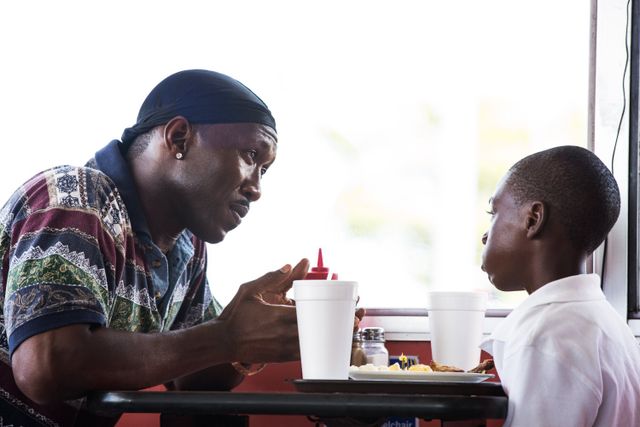
Moonlight
After an embarrassing mix-up, Moonlight was announced as the winner of the best picture award. The film, about a black youth growing up in Miami in the 1980s and 1990s, also gained honors for best supporting actor (Mahershala Ali) and best adapted screenplay (Barry Jenkins and Tarell Alvin McCraney).
Damien Chazelle’s La La Land, about love and music in contemporary Los Angeles, collected six awards, including best director (Chazelle), best actress (Emma Stone), best original score and best original song (Justin Hurwitz) and best cinematography (Linus Sandgren). The film had been nominated in 14 categories.
Casey Affleck won the best actor award for his performance in Manchester by the Sea, written and directed by Kenneth Lonergan, who won for best original screenplay. The film looks at a working-class man in the Boston area responsible for a terrible personal tragedy.
Viola Davis earned the best actress award for Fences, a film based on the August Wilson play, directed by Denzel Washington, which treats a Pittsburgh sanitation worker and his family in the 1950s.
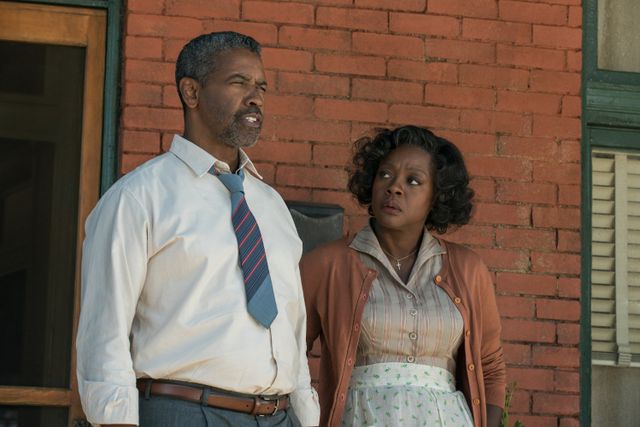
Fences
The best foreign language film award went to Iranian writer-director Asghar Farhadi’s The Salesman. Farhadi was not present, but issued a strong statement, which we will reproduce below, denouncing Trump’s proposed travel ban. Farhadi’s A Separation won the same prize in 2012.
The best feature documentary award went to Ezra Edelman (the son of children’s rights activist Marian Wright Edelman) and Caroline Waterlow for O.J.: Made in America, a nearly eight-hour miniseries tracing the life and fate of American professional football player O.J. Simpson, accused of murdering his ex-wife and her friend in 1994.
The British film, The White Helmets, directed by Orlando von Einsiedel and produced by Joanna Natasegara, won in the short documentary category. The White Helmets is a dubious organization supposedly carrying out humanitarian efforts in Syria. However, it was created in collaboration with the United States Agency for International Development (USAID), notorious for its overseas operations on behalf of American imperialist interests. The White Helmets pushes US intervention in Syria and regime change.
MoonlightManchester by the Sea and Fences are intelligently and sensitively made films, whose characters face real economic and moral difficulties. The writers and directors involved accord human beings a considerable degree of respect and sympathy, even if the latter make serious mistakes and act unwisely or thoughtlessly.
At the same time, each of the three films (and the other better ones honored Sunday night) suffers from the limited perspective and outlook that dominates contemporary cultural life. In each case, the viewer is largely restricted to what the given character or characters know and feel. There is no consistent effort to investigate and dramatize the bigger social impulses that lie behind the immediate motives.
Chazelle’s La La Land has a few intriguing moments, and some engaging performances, but it is essentially a poor and insubstantial effort, which largely plays on the more complacent and shallow instincts of viewers.
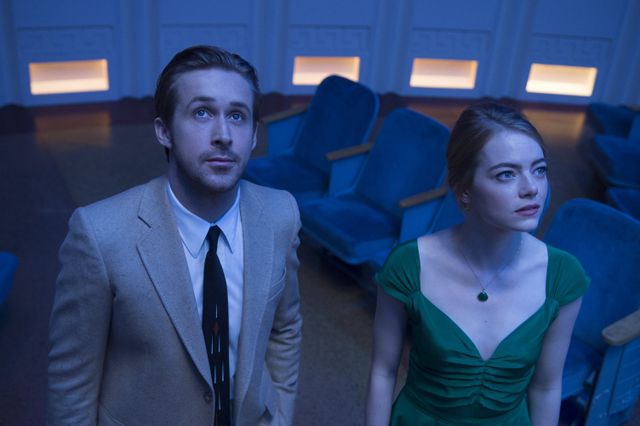
La La Land
The four performers honored Sunday night are all extremely gifted, although Emma Stone was not seriously challenged by her role in La La Land.
The February 26 ceremony was not simply a cultural event, however. The election of Trump has triggered an immense political and social crisis. It marks and ushers in a new, advanced stage in the disintegration of American democracy. That unquestionably overshadows every significant public occasion at present.
Trump and his supporters have launched numerous vicious attacks on the media and any signs of opposition, including from Hollywood liberals like actress Meryl Streep. Extreme right-wing elements urged a “boycott” of Sunday night’s program on ABC, denouncing the “socialist perverts” who would be gathering at the Dolby Theatre.
It is safe to say that the vast majority of those present at the Academy Awards opposed Trump’s brutal measures on immigration, the proposed wall along the Mexican border and his general policy of extreme chauvinism and nationalism.
The host of the awards ceremony, late-night talk show host Jimmy Kimmel, opened his monologue by noting, “This broadcast is being watched live by millions of Americans and around the world in more than 225 countries that now hate us.” He quipped later, “I want to say, maybe this is not a popular thing to say, but I want to say thank you to President Trump. I mean, remember last year when it seemed like the Oscars were racist? That’s gone, thanks to him.”
Kimmel pointed to the presence of French actress Isabelle Huppert, nominated for Paul Verhoeven’s Elle, and added: “You were amazing in that film, and I’m glad Homeland Security let you in tonight, I really am.” Underscoring in its own way the astonishingly foul and degraded character of the current political atmosphere, the awards host said, “Some of you will get to come up here on this stage tonight and give a speech that the president of the United States will tweet about in all caps during his 5 a.m. bowel movement tomorrow.”

Manchester By the Sea
As noted above, Iranian director Asghar Farhadi made the strongest statement on the present situation. At the time of the introduction of Trump’s ban on travel from seven Muslim-majority countries, as well as his temporary ban on the entry of refugees from any country, Farhadi announced he would not attend the Academy Awards, whether an exception was made for him or not.
On Sunday night, astronaut Anousheh Ansari and former NASA scientist Firouz Naderi accepted the award on Farhadi’s behalf in a speech that evoked strong applause. Ansari read Farhadi’s statement, which first thanked those involved in the production of The Salesman and then continued:
“I’m sorry I’m not with you tonight. My absence is out of respect for people of my country and those of other six nations who have been disrespected by the inhumane law that bans entry of immigrants to the US. Dividing the world into the us and the enemy categories creates fear, a deceitful justification for aggression and war. These wars prevent democracy and human rights in countries in which have themselves have been victims of aggression.
“Filmmakers can turn their cameras to capture shared human qualities and break stereotypes of various nationalities and religions. They create empathy between us and others. An empathy we need today more than ever.”
Backstage, Naderi explained why he and Ansari had been asked to accept the award: “She’s an astronaut. She has gone to the space station. I work for NASA … I think the reason is that if you go away from the Earth and look back at the Earth you don’t see any of the borders, any of the lines. You just see one whole beautiful Earth.”

The Salesman
Mexican actor Gael Garcia Bernal, on hand to present an award for best animated feature film, spoke out against the Trump administration’s plans to build a wall on the US-Mexico border: “As a Mexican, as a Latin-American, as a migrant worker, as a human being, I’m against any form of wall that separates us.” Bernal played a central role in Desierto (2015), directed by Jonás Cuarón, as an immigrant worker from Mexico being hunted on the border by a ruthless vigilante (Jeffrey Dean Morgan).
In highly emotional remarks, Viola Davis paid tribute to the people now in their graves who never experienced satisfaction in their lives. She explained that she wanted to tell the “stories of the people who dreamed big and never saw those dreams to fruition. People who fell in love and lost. I became an artist--and thank God I did--because we are the only profession that celebrates what it means to live a life. So, here’s to August Wilson [who wrote Fences, the play on which the film is based], who exhumed and exalted the ordinary people.”
There were several other moving and generous moments, including the introduction of 98-year-old Katherine Johnson, the African American physicist and mathematician and former NASA employee whose life-story was one of the inspirations for Hidden Figures.
In the ceremony’s final moments, when it became apparent that Moonlight and not La La Land, as had first been announced by presenter Faye Dunaway, was the winner of the best picture award, the response of the latter’s producers and actors was very gracious. The producers and actors of Moonlight were equally gracious in victory.
There were, naturally, many banal and empty-headed moments Sunday night. A good number of Kimmel’s antics misfired or simply wasted time. Nine-tenths of the introductions of the various categories were trite and dull. The set was ugly, and musical numbers at the Academy Awards rarely fail to convey tawdriness.
In its tone and substance, the special presentation “highlighting the benefits of film and diversity,” delivered by Cheryl Boone Isaacs, president of the Academy of Motion Picture Arts and Sciences (AMPAS) and a public relations executive, reflected the conservative and establishment character of the film industry hierarchy.
The surprise “gag” in which a busload of unsuspecting sightseers were let in to the Dolby Theatre and led through an “impromptu meet and greet with Hollywood’s A-list” was as distasteful as it was revealing. The “ordinary people” behaved with dignity and so, for the most part, did the actors, but the episode had the character of commoners being permitted a brief audience with royalty. The isolation and insulation of American “celebrities” is not of their doing or necessarily of their choosing, but one had the uncanny and unhappy feeling that this was truly as close to “average” men and women as the star performers ever get.
The consequences of that remoteness are immense and debilitating. In that sense, there was something sad and a little pathetic about the fleeting and surreal encounter, because a sustained encounter with everyday life ought to be the center of the actors’ artistic existence.
One was struck again Sunday night by the fact that, as things presently stand, the American film industry’s greatest strengths lie at two ends of the spectrum—on the one hand, in acting and, on the other, in the technology of image and sound making. The largest and most damaging weakness emerges in the processes of writing and directing, those activities most closely associated with carrying out a rational analysis of the social and historical process and transforming that into something dramatically meaningful.
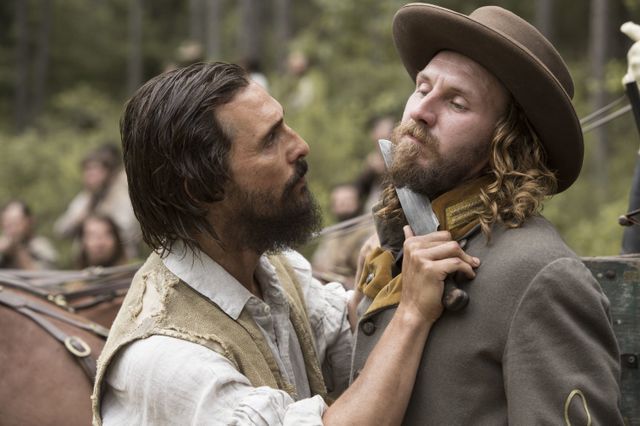
Free State of Jones
At its weakest, therefore, decency and good will in Hollywood merely trail off into trivia, the wringing of one’s hands ineffectually about the ills of the world or into the political lowest common denominator, which at this moment happens to be the upper middle class obsession with race. The opposition to things as they are remains at a low level, historically and socially uninformed to a large extent.
The African Americans honored February 26 were certainly deserving of their awards, but the contrasting attitude toward class, revealed inadvertently through the “sightseer-commoner” gag, and race, expressed in the endless hymns to diversity and the rather desperate efforts to ensure that there would be black nominees and award-winners, is instructive.
One could also not help but take note of the fact that several of the more creditable films produced by the American film industry this year, Free State of Jones (Gary Ross), Loving (Jeff Nichols) and Snowden (Oliver Stone), were all but snubbed. Ruth Negga, the Ethiopian-Irish actress, was nominated as best actress for Loving, but lost to Stone. All three films included white male characters who resisted oppression or injustice. That thought, and what it might imply about wide layers of the American population, was apparently too much for the academy voters.

Rifts tearing Australian government apart

Mike Head

Extraordinary conflicts have erupted within Australia’s Liberal-National Coalition government, underscoring a profound political crisis that is engulfing not just the government but the entire parliamentary establishment.
An open confrontation is raging between Prime Minister Malcolm Turnbull and his predecessor Tony Abbott, whom Turnbull ousted as Liberal Party leader in September 2015. Last Thursday, Abbott publicly criticised the government and warned it was “drifting to defeat.”
Abbott, who speaks for the conservative wing of the Liberal Party, made it plain that his concerns went far further, pointing to the widespread popular disaffection with both the traditional ruling parties, the Coalition and Labor. Abbott said nearly 40 percent of Australians did not vote for the Coalition or Labor in last July’s election and declared: “It’s easy to see why.”
Abbott issued a five-point manifesto of reactionary, nationalist policies that he declared the government must adopt to halt the reported surge of support for right-wing populists, such as Senator Pauline Hanson’s anti-immigrant One Nation.
The ex-prime minister’s list consisted of cutting the renewable energy target, supposedly to lower electricity bills, reducing immigration, “to make housing more affordable,” scrapping the Human Rights Commission, stopping all new government spending and amending the Constitution to reduce the power of the Senate to block unpopular legislation.
Abbott’s manifesto amounts to yet another attempt by him and his backers to meet the increasingly impatient demands of the financial elite for the gutting of social spending and the slashing corporate taxes, while channelling the rising discontent already produced by the austerity offensive into reactionary and xenophobic directions.
Turnbull accused Abbott of sabotaging the government, blaming him for the latest slump in the government’s opinion poll ratings. Turnbull said Abbott had delivered “an outburst on Thursday and it had its desired impact on the Newspoll.” Monday’s Newspoll, published by the Murdoch media, reported that the Coalition’s vote has collapsed to 34 percent, from 45.6 percent at the July election. Labor’s near-record low of 33.4 percent last July vote rose marginally to 37 percent.
For now, some of Abbott’s closest supporters, such as Finance Minister Mathias Cormann, have opposed his intervention, but they share his concerns. Yesterday, according to quickly leaked accounts of a Coalition party room meeting in Canberra, Turnbull aimed another rebuke at Abbott, warning his colleagues that “disunity is death.”
That message, however, was undercut within hours. Right-wing Liberal National Party (LNP) Queensland backbencher George Christensen quit as the National Party’s whip in the House of Representatives—the party official tasked with enforcing its policies in parliamentary votes. He declared that his resignation would enable him to speak more freely against the government.
In recent weeks, Christensen has repeatedly threatened to defect from the government. This would not immediately bring down the government, which holds only a one-seat majority in the lower house—provided that Christensen supports the Coalition in any vote of no-confidence. But it could encourage other backbenchers to follow suit, further destabilising the government.
Christensen is also advocating a demerger of the LNP in Queensland, in order to re-establish the Nationals as a stand-alone rural-based party, a move that could unravel the Coalition nationally. Today, the Australian Financial Review reported “near unanimous agreement” among LNP parliamentarians from Queensland, including cabinet ministers, that the merger had created a vacuum for a third party with a regional focus.
A poll this week indicated that One Nation is attracting about 30 percent support in Christensen’s northern Queensland electorate, putting it on a par with the LNP. Heavily-promoted by the corporate media, Hanson’s polling numbers have doubled nationally in the past three months to 10 percent. The heaviest concentrations of her support are in the most economically devastated areas, even though she advocates policies, including the slashing of welfare spending, which would hit hardest the voters she claims to represent.
Like Hanson, Christensen has a long record of demagogy directed against Muslims and espouses reactionary nationalist policies, such as cutting immigration, banning the burqa and reintroducing the death penalty. Amid soaring unemployment and social distress in his electorate, Christensen, echoing Hanson, has sought to marry this pitch with demands for protectionist measures, notably for the sugar industry, and an inquiry into the predatory practices of the major banks.
Highlighting the scramble by rival right-wing formations to exploit the political turmoil, Liberal Party defector Senator Cory Bernardi declared that Abbott would find a “warm welcoming embrace” in his recently-launched Australian Conservatives party.
“People are increasingly disillusioned with mainstream parties and are seeking alternatives,” Bernardi told Sky News. He recently returned from the US, where he studied and hailed the election of Donald Trump, and invoked the necessity to develop a similar movement in Australia. Bernardi warned of a leftward turn by young people and workers, as shown by the support for Democratic Party presidential contender Bernie Sanders, who postured as an opponent of the “billionaire class.”
The social crisis in Christensen’s seat of Dawson provides an insight into the disaffection wracking the political system. Extending along the Queensland coast between the regional cities of Mackay and Townsville, the electorate covers sugar cane farms, rural communities and working-class people who have been severely affected by global corporate restructuring and the mining slump.
Across the country, regional and working-class areas are being impoverished by the destruction of jobs, falling wage levels and soaring utility and housing costs. In Mackay and nearby Gladstone the number of jobless workers on poverty-line Newstart unemployment benefits has doubled since 2013 to 3,600. In Perth, the Western Australian capital, the suburbs of Rockingham, Kwinana and Wanneroo have experienced a combined jump of more than 7,000, up to 70 percent.
Even these figures camouflage the elimination of full-time jobs, forcing workers into lower-paid part-time work. According to recent data, the prevalence of part-time work has risen by 70 percent since 2000, more than double the rate of increase in the US, Britain, Canada and New Zealand.
Areas targeted by One Nation are among the worst affected. For example, in the Lockyer Valley, west of Brisbane, mean annual taxable income has fallen by 6.5 percent since the 2008 financial crash, from $41,432 to $38,713.
Statistics released this week indicate an acceleration of the social polarisation. Wages fell by 0.5 percent in the December quarter of 2016, while company profits surged by 20 percent, or $13 billion. Last week’s ruling by the Fair Work Commission (FWC) to cut the Sunday and public holiday penalty wage rates for low-paid retail, hospitality and fast food workers will intensify the wage-cutting, and the resulting discontent.
Like Bernardi, Paul Kelly, the Australian’s editor-at-large, today warned that the real political danger facing the ruling class was the rise of “left populism,” not “right populism.” Kelly said the “weakened” Turnbull government was about to be subjected to a campaign by Labor, the trade unions and the Greens decrying the penalty rates ruling as “proof of Turnbull’s alleged war against working men and women and families.”
In feigning opposition to the penalty rates cut, Labor Party leader Bill Shorten and all those promoting him are displaying breathtaking hypocrisy. Shorten, a key minister in the last Labor government, initiated the FWC review of penalty rates and pledged to abide by its decision.
Labor’s opportunist switch is another indicator of the seething unrest that the political elite is seeking to divert. Far from any of the rival factions having any genuine opposition to the ongoing economic and social restructuring being driven by the capitalist class globally, they have all helped impose that offensive for decades. And they are well aware that this assault will quicken as the full implications of Trump’s aggressive “America First” program of trade war, militarism and elimination of social programs reverberate around the world.

Leading opposition senator arrested in the Philippines

Joseph Santolan

On February 24, Philippine Senator Leila de Lima, the most vocal political opponent of President Rodrigo Duterte’s murderous war on drugs, was arrested on charges of drug trafficking. De Lima’s arrest is an expression of the advanced political crisis in the country which is rooted in the dispute within the country’s ruling class over Manila’s geopolitical orientation.
Since taking office in July 2016, Duterte has reoriented Manila’s foreign policy, in a volatile but nonetheless steady manner, away from Washington and toward improved economic and diplomatic ties with Beijing. Duterte undertook a series of moves calculated to improve relations with China, which had soured drastically under his predecessor, Aquino, who had functioned as the leading regional proxy of the Obama administration’s “pivot to Asia” against Beijing. Duterte has deliberately ignored the ruling handed down by the International Tribunal on the Law of the Sea (ITLOS) dismissing China’s territorial claims in the South China Sea, and moved to end the most aggressive joint military exercises with the US military in the disputed waters.
At the same time, under the guise of a “war on drugs,” Duterte has readied the apparatus of military dictatorship. Since he took office, over 7,000 people, the overwhelming majority of them from the poorest layers of society, have been killed in this campaign of police and vigilante murder. He declared a national state of emergency in September, which has not been lifted, granting the police and military to enforce checkpoints and carry out warrantless searches. He has threatened to declare to martial law.
Seeking to use the pretext of “human rights” to pressure Duterte back into the fold, the Obama administration raised mild public criticisms of this policy, while secretly continuing to supply tens of millions of dollars to the Duterte administration’s drug enforcement measures. Duterte responded in an unhinged fashion to these criticisms, and relations worsened further.
There is no genuine opposition to military dictatorship in any section of the Philippine bourgeoisie. When Duterte took office, the various opposition parties all joined with his party—which was a small minority in the legislature—to form a vast “super-majority” bloc. As he launched his murderous crusade, no one voiced opposition.
The opposition to the war on drugs, spearheaded in the legislature by Liberal Party Senator Leila de Lima, is a manifestation, above all, of the interests of Washington, which had sought to use the issue to pressure Duterte, and is now looking at the possibility of securing his ouster.
De Lima served as justice secretary under the Aquino administration, and in this capacity she prosecuted a number of corrupt campaigns against political rivals from the predecessor Gloria Macapagal-Arroyo administration (2001–2010). Arroyo had sought to increase Philippine economic ties with China, a move which entailed shifting Manila somewhat out of the ambit of Washington. No move on her part was as flagrant as those which have been undertaken by Duterte, but Washington was not prepared to tolerate this violation of its interests by its former colony.
Arroyo herself was imprisoned on corruption charges by Leila de Lima and Arroyo’s allies, including the Chief Justice of the Supreme Court Renato Corona, were likewise hounded. De Lima oversaw the charges filed against Corona, who was impeached. At least part of the evidence used against Corona was supplied to De Lima by the US Embassy in Manila.
Elected Senator in 2016, De Lima was chair of the Senate Justice Committee, in which capacity she conducted an investigation into claims that Duterte had been the head of long-standing death squads in Davao City, where he had been mayor prior to election as president. Duterte has on numerous occasions admitted, boasted even, that he was the head of these death squads. De Lima brought witnesses before the Senate to testify to the murders which Duterte had ordered.
Duterte first sought to remove De Lima by impugning her character, denouncing her as a “loose woman” for having had an affair with her driver, and threatening to publish video evidence of this. When this failed to stick, Duterte’s Justice Ministry issued a warrant for De Lima’s arrest, citing the testimony of prison inmates convicted of high-level drug charges that De Lima, during her stint as Justice Secretary, had facilitated the smuggling and trafficking of drugs within the Philippine prison system.
Another key opponent of Duterte in the legislature is Senator Antonio Trillanes. On February 20, Trillanes produced a new witness against Duterte, a former Davao police officer named Arthur Lascañas, who claimed to have served as a leader of the Davao Death Squads (DDS) under Duterte. Lascañas’ account corresponds closely to what had already been established by prior accounts, including at least in part to Duterte’s own boastings.
Lascañas revealed that the former members of the New People’s Army (NPA), the armed wing of the Maoist Communist Party of the Philippines (CPP), served as the muscle for carrying out hits on Duterte’s orders. He explained that the initial killings carried out by the Davao Death Squad in the late 1980s, had notes left on the corpses which were signed, not by the DDS, but by the NPA. The DDS was paid for every victim killed. Duterte used the DDS to target the poorest layers of Davao society as well as his own political opponents. Lascañas also claimed that a string of bombings of local mosques in the early 1990s in Davao had been carried out on the orders of Duterte.
Trillanes, who has been instrumental in bringing these and earlier charges against Duterte, is a sordid political figure. A Navy lieutenant, he led a coup attempt against the Arroyo administration in 2003, for which he was imprisoned. He was elected for Senate from prison in 2007, and staged another brief military standoff later that year, seizing the Manila Peninsula Hotel, where he denounced Arroyo for “treason” for having signed a deal for joint oil exploration in the South China Sea with China. This coup attempt—which was staged with assistance from both the Maoist CPP and the pseudo-left Akbayan—failed and Trillanes took up life as a Senator. During the Aquino administration, Trillanes served as a key ally, bringing corruption charges against Vice President Jejomar Binay, who was interested in pursuing expanded economic ties with China. Trillanes served as the Aquino administration’s back-channel negotiator with China during the tense military stand-off over the Scarborough shoal in 2012.
Trillanes and De Lima articulate the interests of sections of the Philippine ruling class who are intimately tied to Washington and are looking to reverse the reorientation of Manila’s foreign policy under Duterte. As pressure tactics have proven fruitless, they are making preparations to attempt his ouster, a fact that is openly being discussed.
The Liberal Party, however, which would be the logical standard-bearer of such a move, is in disarray. Duterte’s allies in the Senate, headed by Senator Manny Pacquiao, successfully moved to have the Liberal Party chairs of several Senate committees removed from their positions over the weekend. Former President Aquino convened a meeting of the Liberal Party on Monday, where he called on Liberal Party legislators to break with the super-majority allied with Duterte in the legislature, but was unable to secure support for the move. The majority of the Liberal Party legislators are fearful of the backlash in the legislature from Duterte’s allies.
The remaining bourgeois opponents to Duterte are constellated around Vice President Leni Robredo, a member of the Liberal Party, who, in the event Duterte was removed from office, would take his place. The pattern for such a political transition was established by the removal of President Joseph Estrada by what amounted to a military-backed constitutional coup in 2001 and the installation of Vice President Arroyo.
Duterte has sought to secure the support of the military, as he is readying the apparatus of martial law, doubling soldiers’ salaries and granting the military effectively carte blanche powers. The top brass, however, have been trained in, and are loyal to, Washington. Duterte’s peace talks with the communists, and, above all, his geopolitical reorientation, have provoked coup rumblings among the military leadership.
Congressman Gary Alejano, a former military officer, who followed Trillanes in his coup attempts in 2003 and 2007, told the press on Monday that such coup plotting was being discussed, and while there were as yet “ no ouster moves against the President ... there is always a breaking point.”