7 Mar 2017

Court hears final arguments in South Korean president’s trial

Ben McGrath 

The impeachment trial of South Korean President Park Geun-hye concluded last Monday. She is accused of being involved in a corruption scandal that includes her close aides and high-level executives at local conglomerates. The Constitutional Court is now deliberating on whether to uphold Park’s impeachment by the National Assembly on December 9 and remove her from office. A verdict is expected by mid-March.
Park refused to appear before the court or face questioning by the special prosecution counsel set up to investigate the corruption allegations. Her legal team agreed to sit down with investigators on February 9, only to pull back, claiming that the latter had violated good faith by leaking the schedule to the media and insisting that the session be recorded.
One of her defense attorneys conveyed a written statement from Park to the court on Monday, reiterating what she had previously said publicly. “I have never been involved in corruption and graft in my political journey,” Park stated. “Among the numerous things I have done until now, not one was for my personal interest, and I have never exercised or abused my authority as president for myself or those around me.”
The special prosecutors named Park a suspect in the separate corruption case last Tuesday, but she is immune from indictment while in office. They have accused her of colluding with her close friend Choi Soon-sil to accept bribes from major corporations.
If the Constitutional Court upholds the National Assembly’s decision, a new presidential election will be held within 60 days. Leading contenders include Moon Jae-in from the opposition Democratic Party of Korea (DPK).
The prosecution team also formally indicted 18 others, notably Lee Jae-yong, vice chairman of Samsung Electronics and heir to the largest chaebol (family-owned conglomerate) in South Korea. This brought the total number of indictments to 31, the largest since the introduction of the special prosecutor system in 1999.
Among the list of charges, which also include perjury and embezzlement, Lee is charged with handing over 43 billion won ($37 million) to firms controlled by Choi in exchange for the government approving a merger between Samsung affiliates Cheil and Samsung C&T Corporation in 2015. The move, through cross shareholdings, solidified Lee as next in line to take over the conglomerate from his ailing father Lee Kun-hee.
According to the Yonhap News Agency, the merger also led to profits of 854.9 billion won ($754.7 million), while depriving the state-run National Pension Service (NPS) of at least 138.8 billion won ($122.5 million). However, the NPS approved Samsung’s move. Four other senior Samsung executives will face trial as well.
The Seoul Central District Court approved an arrest warrant for Lee Jae-yong on February 17. A warrant was previously sought by the investigation team in January, but the request was denied. After the counsel presented new charges and evidence, the court approved Lee’s detention.
There is little new or shocking about these allegations, in and of themselves. South Korea’s chaebols have long been hotbeds of corruption, with government officials turning a blind eye or benefitting from kickbacks. Seoul, regardless of the party in power, is also no stranger to using extra-legal and outright oppression to enforce its agenda.
Park’s impeachment is a sign of the struggle taking place within the political establishment over how to balance between the US and China amid sharpening tensions between the two powers, exacerbated by the election of Donald Trump.
Park came to office in 2013, seemingly with the intent of developing a closer relationship with Beijing. While the Obama administration publicly supported Park, tensions with Seoul grew over the US deployment of a Terminal High Altitude Area Defense (THAAD) anti-ballistic missile battery in South Korea. After dragging out a decision, the Park administration finally agreed to the THAAD deployment in July 2016 but negotiations continued over where and when the battery would be installed.
China opposed the THAAD installation. Far from being a defensive measure against North Korea as the US claims, THAAD and its accompanying radar system are aimed at Beijing. In the event of an attack on China, the battery would be used to knock out any response by the Chinese military.
Significantly, at no point during the mounting political crisis that led to her impeachment in December did Washington express support for Park. Within Park’s right-wing Saenuri Party, since renamed the Liberty Korea Party, a prominent group of lawmakers backed Park’s impeachment. They split and set up the Bareun (Righteous) Party in January.
Acting president Hwang Gyo-an has promised to push forward with the THAAD deployment. Last week, the military and Lotte, another South Korean chaebol, signed a land swap agreement to provide a location for the weapon on a golf course in the southeastern city of Seongju. The battery could be installed as early as May, two months earlier than previous predictions.
The Bareun Party’s Kim Moo-sung (Kim Mu-seong) and Yu Seung-min, a presidential contender, have been highly critical of China. Kim, as chairman of the Saenuri Party in July 2015, stated in Washington: “The US seems to have suspicion that South Korea may be coming too close to China, but it should be kept in mind that none other than the US is the only, irreplaceable, unique ally.”
In September 2015, Yu criticized Defense Minister Han Min-gu over the Park administration’s public position on THAAD and its relations with Washington. He also questioned the president’s appearance at a military parade in Beijing that month, which had raised concerns in the Obama administration. “Seoul must make it clear the US-South Korea military alliance ... is a blood alliance free of problems, and clarify this fact for the citizens of both the United States and South Korea,” Yu stated.
Yu also said in January: “We should hardly have to be conscious about China’s stance. Rather, we should convince China by saying that once the North Korean nuclear issue is solved we will withdraw THAAD from the Korean peninsula.” The Bareun Party denounced a visit by seven opposition DPK lawmakers to China in January as “kowtowing” to Beijing.
The DPK, which has not opposed the THAAD installation in principle, is attempting to capitalise on public opposition to the deployment, which will ensure South Korea is a target in any conflict between the US and China. The DPK delegation, which was an attempt to ease tensions with Beijing, carried a message from its potential presidential candidates, including Moon Jae-in, who are now pushing to put off a final decision on THAAD for the next administration.

China lowers economic growth target

Nick Beams 

The Chinese government has reduced its growth target for this year to “around” 6.5 percent after the economy expanded by 6.7 percent last year—itself the lowest increase in more than a quarter of a century.
The target was announced in the annual “work report” delivered by Premier Li Keqiang to the opening session of the two-week session of the National People’s Congress yesterday. The main reason for the lowered target is concern that increased growth, fuelled by rising debt, could set off a crisis in the financial system, an issue that Li addressed in his remarks.
“At present, overall systematic risks are under control,” Li said. “But we must be fully alert to the build-up of risks, including risks related to non-performing assets, bond defaults, shadow banking and Internet finance.” He also pointed to government concerns about the “high leverage in non-financial Chinese firms.”
The reference to financial problems comes after a warning from the International Monetary Fund in a report on the Chinese economy last August about the high levels of corporate debt.
The IMF’s mission chief in China, James Daniel, said the country’s medium-term outlook was becoming clouded because of “high and rising corporate debt” and authorities had to “urgently address the problem.”
Chinese debt is now estimated by the Bank for International Settlements to be 254 percent of gross domestic product. While that is comparable to the levels of other major indebted countries, the main concern is the speed of the increase. According to one estimate, debt quadrupled between 2007 and 2014.
Another indication of the financial expansion is that the Chinese banking system has now surpassed that of the euro zone to become the largest in world by assets.
In a comment to the Financial Times on Li’s address, Eswar Prasad, a specialist on the Chinese economy at Cornell University, said the lower growth target was “symbolically important” because it signalled “the government’s concerns about rising financial risks and environmental degradation wrought by the earlier emphasis on high growth at all costs and the unbalanced growth model that sustained it.”
A Commerzbank economist echoed this assessment, telling the newspaper that “China’s policy stance has turned to risk control.”
Li said financial supervisors must fix “weak links” in the financial system and action had to be taken to rein in housing prices in major centres, saying “houses are built to be lived in,” not for speculation.
Last year, when faced with the problem of unsold real estate and falling construction, the government eased mortgage conditions, setting off renewed buying that led to a slight fall in unsold apartments.
However, according to the report in the New York Times, “what looked like a bubble before looks ever more so now.” Real estate prices in Beijing and Shanghai are now among the highest in the world in relation to local income, with developers still heavily in debt.
But a lower growth rate brings other problems for the Chinese government. In past years, the official position has been that a growth rate of at least 8 percent was necessary to maintain employment and “social stability.” The official target is now well below that level and could go even lower.
Li sought to address those concerns in his report, which called for the creation of 11 million jobs, up from the level of 10 million in 2016. He acknowledged the government’s difficulties in developing a “new normal” for the economy, with less dependence on debt. “Like the struggle from chrysalis to butterfly, this process of transformation and upgrading is filled with promise but also accompanied by great pain,” he said.
Last year’s NPC took place amid protests by hundreds of coal miners in south-eastern China, who marched through the city of Pingxiang as the government announced that some 1.3 million workers would lose their jobs.
The protests saw some officials pressing for government policies to support economic growth. But according to the Financial Times “that debate has been settled in favour of officials who feel the government should pay more attention to financial and economic risks even if its results in slower economic growth.”
While the issue may be “settled” within ruling circles, it has not gone away. Many regional areas are experiencing far lower levels of growth than the official figures for the economy as a whole, with local authorities covering up the real situation in their regions.
Evidence of this surfaced last month, when Chen Qiufa, the governor of Liaoning, a major industrial region in north-eastern China, revealed that false statistics boosted the province’s economic data from 2011 to 2014. According to the official Chinese news agency Xinhua, government officials inflated figures by more than 100 percent. Revenue for one county for 2013 was revised down from 2.4 billion yuan ($350 million) to 1.1 billion yuan ($160 million).
Last year, the province, which has a population of 43 million, larger than the state of California, reported that its economy actually contracted as a result of cuts in major industries.
The government also faces major problems on the financial front. Monetary policy is going to come under pressure because the US Federal Reserve is expected to further raise interest rates, probably as soon as this month, with more rises to follow.
This will tend to increase the outflow of capital from China, putting downward pressure on the yuan under conditions where US President Donald Trump and other members of his administration have denounced China as a “currency manipulator”—allegedly lowering the value of the yuan to gain an advantage in export markets.
In fact, Chinese authorities tried to prop the currency up, spending almost $1 trillion over the past year and imposing restrictions on sending money out of the country. If US interest rates do rise, the government will have to further tighten monetary policy and impose more restrictions, putting it at odds with better-off sections of the middle classes and wealthier layers of society—the main social base of the regime—which have been sending money out of the country.
The government is also under pressure because of the considerable anger in the major urban centres over the increased prevalence of choking smogs. In his report, Li said the government would renew its effort to combat pollution and that “we will make our skies blue again.”
But clearing the clouds from the cities is likely to prove as intractable a problem as clearing those which hang over the economy and the financial system.

US coal miners face loss of retiree health coverage, black lung benefits

Samuel Davidson

Thousands of retired coal miners and surviving widows have been sent letters by the United Mine Workers of America (UMWA) Health and Retirement Fund notifying them that their health benefits will be cut off April 30 when funding for 22,600 recipients runs out.
This is the third letter sent to retirees in five months. The first two were sent in October and November 2016. In December, congressional Democrats agreed to a four-month extension of the health plan, which is set to expire in eight weeks.
The UMWA Health and Retirement Fund administers retirement and health plans for both active and retired miners. Benefits are paid from the 1974 UMWA Pension Plan and the Multiemployer Health Benefit Plan, which are both slated to run out of funds.
A few congressmen from coal mining states have introduced bills to extend funding for the programs, but no votes are presently scheduled. The Trump administration, which has postured as the friends of miners, has said nothing, while pushing for the lifting of occupational health and safety and environmental laws, which it calls “job killing.”
Opposed to any struggle against the energy giants and the government, the UMWA is telling workers to place their fate in the hands of Democrats and Republicans on the federal and state level who have long been the pawns of Big Coal. Trump’s billionaire commerce secretary, Wilbur Ross, is the former boss of the Sago Mine where 12 West Virginia miners were killed in a 2006 explosion following numerous safety violations.
Changes or the repeal of the Affordable Care Act (ACA) could also make it more difficult for thousands of coal miners and widows to receive black lung benefits. Black lung, or coal workers’ pneumoconiosis, has been on the rise for the past two decades after years of decline.
Each year about 1,000 miners die from the slow and painful disease caused by coal and rock dust, which scars lung tissue, causing miners to slowly suffocate to death.
In the 1960s and 1970s, rank-and-file miners, retirees and widows in the Appalachia coal fields had to wage wildcat strikes and other struggles just to win recognition of the disease and get compensation. The miners had to fight not just the coal operators and the government but the UMWA bureaucracy, which was allied with the coal bosses.
For years, coal companies vigorously fought paying benefits based on legal requirements that miners prove they were both 100 percent disabled and suffered black lung from their work in the mine. Coal companies would often bring in their own doctors to testify that the miner was not totally disabled and that he contracted black lung from smoking.
One provision of the Affordable Care Act slightly amended this process. If a miner had worked 15 years in a mine and was 100 percent disabled it could be assumed that his black lung was caused by mining unless the company could prove otherwise.
The Obama bill left intact the 100 percent disability requirement, meaning miners who are deemed partially disabled are forced to choose between quitting and losing their income or continuing to breathe coal dust that is slowly killing them.
“One hundred percent disabled with black lung means you don’t have very long to live,” an underground coal miner from Pennsylvania told the World Socialist Web Site. “It’s often that guys work in the mines and then die pretty soon after they leave.
“When black lung sets in you can’t breathe and get any oxygen to the blood. Fifteen years seems like a long time before you can claim black lung benefits. With the new technologies, you are mining so much coal and producing so much dust a miner can get black lung a lot quicker than before. You see people who work six or seven years getting it now.
“If you are working six days a week, nine hours a day, whether you are running a shearing machine, a bolter or a cutter, there is so much dust. They want production so they just keep you running the machines. There is only so much water and so much air you can throw at it to keep down the dust.”
Studies have shown black lung is on the rise, hitting miners at a younger age and assuming a more aggressive form. 
One thousand miners die every year from the disease, and its incidence is now as high as it was in the 1970s when the first provisions to protect miners were enacted. Researchers attribute this to the increased amount of silica produced from grinding into rock, as companies seek to mine thinner and more difficult to reach seams of coal. Like coal dust, silica cuts into lung tissue, causing it to scab over, and preventing the absorption of oxygen.
“There are guys in my mine with black lung who are still working. They are nominally protected by the government but instead of being taken out of the mine, they are shifted to another job where they are not exposed to as much coal dust. Once a quarter an inspector takes a sample to show how much dust the worker is being exposed to. But they are still in the mine and breathing in dust.”
In 1995, the National Institute for Occupational Safety and Health (NIOSH), the federal agency tasked with monitoring black lung, issued recommendations that the legal dust limit be lowered from the 2.0 mg to 1.0 mg. The administrations of Democrat Bill Clinton, Republican George W. Bush and Democrat Barack Obama refused to implement the new standards. In 2014, the Obama administration issued new standards cutting dust levels to 1.5 mg, just a 25 percent cut rather than the 50 percent reduction sought by NIOSH scientists.
“The Feds lowered the dust limit last year. The guys in the mines say with current production levels you can’t meet the standards. You would have to scale back production, but that is not something the coal operators are going to do. If they already have contracts for so many tons they are going to run production to get those tons. They will sell as much coal as they think they can extract from the ground.
“It is framed to us that regulations are killing the coal industry. The operators would like to see zero regulations if they could. I am not saying all operators are bad, but typically speaking, if a miner comes between a coal operator and a dollar, they are always going to take the dollar.
“Another thing we talk about in the mine is the health impact from breathing fumes. A lot of the equipment is run by diesel engines now so they don’t have to run electrical cables through the mines. But nobody really knows what all those fumes are doing to you. It’s almost like they’re doing an experiment on us.
“Workers have to unite together. It will be hard, in many countries, workers would be risking their jobs and being able to support their families if they speak up. All over the world, miners are producing more coal and giving their lives and health away.”
Another provision of the ACA allows widows to continue receiving black lung benefits when their spouses died. Without that provision, spouses will have to reapply for the benefits, often waiting years to get approved.
The increased incidence of black lung and threat to miners’ health and pension benefits is the direct result of the long record of betrayal by the UMWA, which has systematically worked to isolate and betray the coal miners. Former union president Richard Trumka, now the president of the AFL-CIO, played a key role in overturning the militant traditions of the miners and selling out key struggles, including the 1984-85 AT Massey strike and the 1989-90 Pittston strike.
Trumka has recently pledged to “partner” with Trump on trade and immigration issues, underscoring once again the anti-working class character of these pro-company and nationalist organizations.

UK: Up to 250,000 protest attacks on National Health Service

Robert Stevens

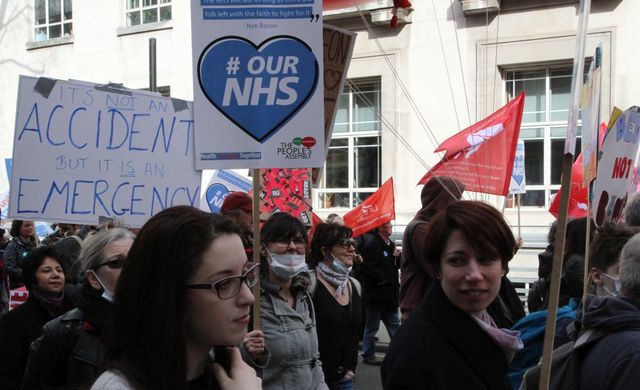
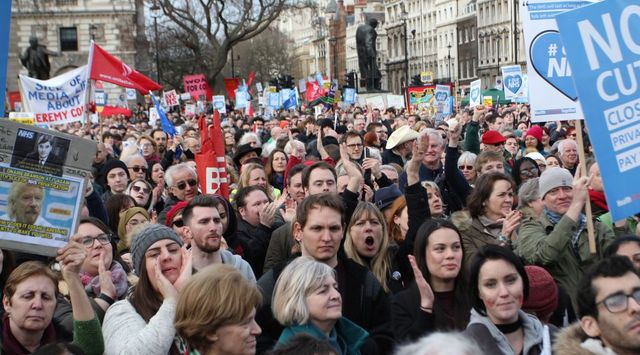
Up to 250,000 people demonstrated in London on Saturday in defence of the National Health Service (NHS).
The NHS is being systematically decimated, after nearly a decade of cuts in which more than £40 billion is being slashed from its budget. Such is the scale of the attacks being carried out against public health care, that in January the British Red Cross described the situation facing the NHS as a “humanitarian crisis.”
Protesters listening to the speeches in Trafalgar Square
The demonstration was called by the Health Campaigns Together coalition and the People’s Assembly, with the backing of national trade unions, including Unite, Unison, the GMB and British Medical Association. The People’s Assembly is backed by the Trades Union Congress (TUC), Green Party and an assortment of Stalinist and pseudo-left outfits.
The protest was far larger than the organisers anticipated. That the event was so much larger demonstrates that broad layers of working people, youth, students and pensioners are determined to defend the NHS from cuts and privatisation. The Daily Mail, which along with other right-wing newspapers routinely plays down the size of demonstrations, described Saturday’s event as “one of the biggest NHS rallies in history.”
Health workers and members of the public attended from every major town and city in the UK, including London, Birmingham, Liverpool, Manchester, Leeds, Sheffield, Preston, Nottingham, Southampton, Portsmouth, Norwich, Cambridge, Derby, Brighton, Bristol, Exeter, Stoke, Newcastle, Carlisle, York and the Isle of Wight.
Many of those marching carried official demonstration placards with the slogans, “Our NHS” and “No Cuts, closures, privatisation, pay restraint.” The placards also included a statement from Anuerin Bevan, the Labour MP who inaugurated the NHS in 1948, reading, “The NHS will last as long as there are folk left with the faith to fight for it.”
Large numbers attended with their own homemade banners with a range of slogans, including many that linked the onslaught on the NHS to other attacks on working people. One read, “My education is under attack, my health is under attack, my future is under attack.” Another read, “No More Austerity—No Cuts.” Other slogans, including “NHS not Trident,” opposed spending the resources of society on war and demanded it be spent on health, education and housing.
Some of the protesters marching in London
A number of demonstrators were supporters of the many local campaigns that have sprung up to oppose the closure of vital health services facilities. Others brought placards denouncing the government’s “Sustainability and Transformation Plans,” which are the means by which tens of billions in cuts are being imposed in 44 areas of England. “Stop STP—Save the NHS,” one proclaimed, and another, “Death by STP—5 year NHS Cuts Plan.”
The rally assembled in London’s Tavistock Square, before marching through the capital and passing Trafalgar Square, with bystanders crowding pavements to show their support. It continued down Whitehall and passed the prime minister’s Number 10 Downing Street residence on its way to the main rally in Parliament Square. Uniformed police officers stood behind barriers as the marchers passed the Department of Health building.
At the head of the march were Labour Shadow Chancellor John McDonnell, Unite General Secretary Len McCluskey and Public and Commercial Services union leader Mark Serwotka. They and the speakers on the main stage offered no strategy to fight the onslaught against the NHS.
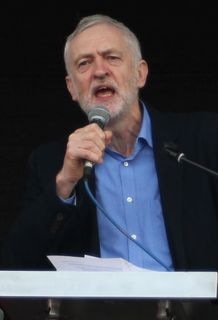
Keynote speaker and Labour Party leader Jeremy Corbyn’s speech consisted of a series of truisms about the NHS that not even Conservative Prime Minister Theresa May could openly disagree with. “Whatever you do in the health service, thank you, because every day you contribute to what is the most civilised institution in this country,” he said. Alluding to the biblical tale of the Good Samaritan, he added, “Defending the NHS is defending a basic human value and a basic human right. You don’t walk by on the other side when somebody is in difficulties or needing help.”
Jeremy Corbyn speaking at the NHS rally
Citing Bevan’s statement to loud applause and cheering, Corbyn told the rally, “We’ve got the faith, we’ve got the fight and we are up for it!” Yet he offered no basis on which health service workers could conduct any fight against the government’s attacks.
Corbyn said the crisis wracking the NHS “is the fault of a government who have made a political choice.” “The money’s there,” he said.
On this basis, he made no appeal to mobilise the working class against the Tories, but instead appealed to Chancellor Philip Hammond to use next week’s Spring Budget to guarantee funding for the NHS and for social care.
To render Corbyn’s bromides more palatable, Serwotka, McCluskey, Communications Workers Union leader Dave Ward and McDonnell made more demagogic speeches, as they fraudulently claimed that the unions were involved in a determined fight to defend the NHS.
Serwotka stated that NHS workers had suffered seven years of pay cuts with many leaving in search of better jobs as they were unable to pay bills and make ends meet. He then called on the government to offer a pay rise, declaring that it was “long overdue that the trade unions and the TUC [Trades Union Congress] do something about the resolution we agreed unanimously [at the TUC’s Congress] in September, which is to get all public sector workers to campaign against the pay cuts and to take action together.”
Serwotka concluded by urging everyone to support Corbyn.
McCluskey concluded by stating, “Our message to the private health companies … is a simple one, keep out of our NHS, you thieving Tory bastards.”
John McDonnell (left) and Len McCluskey (right) at the head of the march
Ward said, “When we say the NHS is in a crisis, it’s in intensive care and the Tories are getting away with murder.”
In full rhetorical flow, he concluded, “We are going to take back control of the NHS. What about taking back control of the railways? What about taking back control of the postal industry, the telecommunication industries? What about taking back control of workplaces … come on everybody, rise up.”
Many of the speakers referred to last year’s struggle carried by 50,000 junior doctors, who struck repeatedly in unprecedented action against the government insistence that they accept an inferior contract. McDonnell said in his speech, “We owe a debt of honour to the junior doctors who took action last year. They were fighting to save the NHS. ... If industrial action takes place over pay, whether it’s in Parliament or on the picket line, Jeremy and I will be with you. And if we have to take to the streets we will.” Labour had created the NHS and it would be a “Labour government under Jeremy Corbyn that restores the NHS.”
Such statements are lies. Corbyn and McDonnell, despite a token attendance at the picket lines of junior doctors “in a personal capacity,” did nothing to mobilise Labour members and supporters in defence of the doctors, and instead urged a negotiated settlement be reached by Tory Health Secretary Jeremy Hunt.
Neither did the trade union bureaucracy lift a finger in opposition to these attacks, ensuring that the junior doctors suffered a defeat and in so doing once again cleared the path for the attacks that have followed.

US ramps up bombing campaign in Yemen

Niles Niemuth

In a major escalation of operations in Yemen, the US military carried out more than 30 airstrikes and drone strikes on Thursday, Friday and Saturday, hitting multiple targets allegedly linked to Al Qaeda in the Arabian Peninsula (AQAP). As many as 20 people were reported killed in the attacks, which hit the southern governorates of Shabwa, Al Bayda and Abyan.
The multi-day bombardment was the heaviest so far in the undeclared US war in Yemen, which has killed or injured more than 1,700 people, including hundreds of women and children, since 2009. According to a tally maintained by the Bureau of Investigative Journalism, the US has carried out a least 390 attacks in the last eight years.
Pentagon spokesman Navy Captain Jeff Davis told reporters on Friday that more airstrikes would be forthcoming: “US forces will continue to target AQAP militants and facilities in order to disrupt the terrorist organization’s plots and ultimately to protect American lives.”
Last week’s offensive was the first major military operation by the US in the country since the raid on January 29 by US Special Forces that killed as many as 30 civilians, including 8-year-old Nawar al-Awlaki, the daughter of Anwar al-Awlaki, the US citizen and Islamist cleric assassinated by the Obama administration in 2011. The raid resulted in the death of Navy SEAL William (Ryan) Owens and left three other soldiers wounded.
President Donald Trump used the presence of Owens’ widow, Carryn Owens, at his address to a joint session of Congress last week to defend the murderous operation and promote American militarism, praising her husband as “a warrior and a hero.”
The string of attacks since January marks a definite intensification by the Trump administration of the US intervention initiated by the Obama administration. Trump’s predecessor pioneered the use of drone-fired missiles to assassinate those declared to be leaders or members of AQAP. Drones have been used to target and kill alleged terrorists in countries, besides Yemen, where the US is waging war without congressional authorization, including Pakistan, Somalia, Syria and much of North Africa.
Obama notoriously claimed the right to assassinate American citizens and anyone else he chose, beginning with the murder of Anwar Al-Awlaki in September 2011. His drone killing program and war in Yemen have now passed into the hands of Trump.
The intensification of US military operations in southern Yemen comes amidst an ongoing aerial onslaught and naval blockade by a coalition led by Saudi Arabia against Houthi rebels in the country’s more populated western region.
The air campaign and subsequent ground invasion aim to push back the Houthi rebels, who took over much of the country in early 2015, and reinstate the US-backed government of President Abd Rabbu Mansour Hadi. The Saudi Arabia and its Persian Gulf allies have been funneling weapons and money to Sunni militias, including those affiliated with AQAP, to serve as ground troops in the war against the Zaidi Shiite Houthis.
Since it began in March 2015, the Saudi-led campaign, made possible by continuous support from the US government in the form of intelligence, logistics, military equipment and aerial refueling, has killed more than 10,000 Yemeni civilians and wounded 40,000. Saudi bombs have hit hospitals, schools, marketplaces, factories and residential neighborhoods.
The war has plunged the poorest country in the Middle East into a humanitarian disaster, with the UN estimating that at least 19 million Yemenis, more than two-thirds of the country’s population, are in need of assistance and protection.
UN Relief Coordinator Stephen O’Brien reported on Friday that 500,000 children under the age of five are suffering from severe acute malnutrition and more than 7 million Yemenis did not know where they would get their next meal. Even though the country risks being pushed into famine without immediate action, O’Brien reported that the UN had received only 3 percent of the estimated $2.1 billion needed to provide humanitarian assistance to 12 million people over the next year.
While Yemen is one of the poorest countries in the world, it is of considerable geopolitical significance, forming the eastern side of the Bab El Mandeb Strait, a major shipping lane which connects the Red Sea to the Gulf of Aden and the Indian Ocean. A significant portion of the world’s oil supply traverses the strait, making it one of the most important strategic choke points on the planet.
The US Navy announced last month that the USS Cole would join three other warships already operating off the coast of Yemen in the Red Sea and the Bab El Mandeb, out of “concern for the freedom of navigation.”

J&K: A Strategy is What May Still Be Elusive

Syed Ata Hasnain


It has been almost 27 years since the externally sponsored conflict commenced in Jammu and Kashmir (J&K). Throughout this period, each year came and went with some reviews and a few lessons learnt. However, without fail, a strange phenomenon occurs every year. The Army charts out two strategies per year: a winter strategy and then a summer strategy. That is strange for an organisation that always believes in first outlining an aim and then the strategy; and strategy is usually supposed to be segmented into long term, mid-term and short-term.  Even stranger is that for 27 years there has been utter clarity in the aim of Pakistan and its Army; giving its due to the adversary is usually prudent. Their aim alludes to wresting the territory of J&K (by means foul and fair).

Mostly each set of Pakistani strategies to achieve the aim has followed a course of three or four years, interspersed with tactical ploys and triggers. It has also addressed most of the domains that go into making such a strategy. In other words when that is compared with India's approach, the latter's is largely seen to be tactical and perhaps at most operational, whereas the former's approach has been solidly strategic.

Analysing and writing about the approaching summer of 2017 would once again be akin to falling into the same trap that has consumed India’s establishment for many years. Since India does not have an articulated or even a semi-articulated aim, it becomes difficult to outline a strategy that is anywhere near long or mid-term. It is about time that at least the Indian Army evolved a draft political and military aim, even as an exercise in its various training institutions, where vast talent exists. Indian Army Chief Gen Bipin Rawat’s extensive experience in hybrid war should help him push this agenda and facilitate a discussion at the highest levels of government. J&K is not a pushover issue that can be handled during breaks from politics. It needs solid intellectual application of ideas and experience to make any difference on ground. The first long term strategy can then be evolved. The internal report of India's Ministry of Home Affairs could well be a start point too with no dogma attached to it.
 
The lack of clarity for those on the ground, in command assignments or managing the proxy conflict elsewhere, can be gauged from the fact that there is only grudging support within the Army’s ranks for Sadbhavana, the Army’s twenty year long hearts and minds campaign. This emerges from the inability to grasp what Sadbhavana is. Some perceive it in a civilian way that it is all about pandering to the needs of Kashmiri society, which in their perception, is already pampered. The absolutely uninformed and inexperienced call it the Army’s administration of J&K in the light of the failure of the government, not being even remotely aware of the miniscule annual budget of the exercise. Yet others imagine that it is India’s psychological warfare machinery at work. With such gross lack of clarity, one of the essentials of the counter-insurgency campaign rests on diffused perceptions. What then should be expected from the ticket punching events such as national integration tours of J&K’s youth and other citizens that are rarely followed to any conclusion? The cumulative effect on the psyche of the target population is hardly ever known to different levels of leadership. 
 
It is never the intent to pick holes in the strategy or narrative creation by the establishment; but just a few core issues may help better the record in taking these beyond the tipping point. For far too long has the joint capability taken the path of countering the terrorist menace only to be stumped by its incapability in taking it beyond to the social, political and psychological domains in which solutions of mainstreaming the society ultimately lie.
 
For a start, let there be a clearer strategy evolved with consensus. The latter bears the key otherwise it will return to the unsavory experience of what is being currently witnessed with former members of the cabinet finding fault with everything the establishment does today. The inevitable question to them that they never seem to answer is – what happened to the interlocutors' report and why was it not tabled in the parliament for a discussion? For inspiration, the establishment needs to only fall back to the strategy adopted in 1994 - which saw the coming together of the two mainstream parties to pass a joint resolution of both houses of parliament affirming that the territories of the former princely state of J&K all belong to India; that India will aspire to and enable the return of these. 22 February 1994 is a golden day in India’s strategic history. It is the day the resolution was passed in parliament. 
 
Secondly, the strategy must cater to all domains – the military and intelligence, diplomatic, political, development, social, economic, and most importantly, psychological. No single entity can dictate these and needs the coming together of many minds. There has to be a long and mid-term tasking of different organisations with review of achievements, failures, and need for course corrections. This has to be carried out by entities that are responsible for different domains and should lead to a national level review. 
 
When people speak of the need for change in the narrative, it need not be specific to execution. In the current context, when policy has been reasonably astray for some years, change of narrative should first look at sending home a very early message to Pakistan’s security establishment. It should convey that Pakistan is involved in an unwinnable game that will subsume it internally. A larger country, a virtual subcontinent such as India can still absorb such a situation in a border state albeit it is always dangerous to let it fester. However, a smaller state such as Pakistan, which has invested much energy in its mission to wrest J&K will have a much larger impact internally. 
 
Finally, at present, India’s policymakers need to examine how much of a change, if any, has occurred in Pakistan’s thinking after Hafiz Saeed's detention. Is there something for real? There must not be a rush to resume talks unless India is reasonably assured that these will not go the way all other talks have gone in the past.

US Tactical Nukes in the Korean Peninsula?

Sandip Kumar Mishra


On 4 March 2017, the New York Times reported that the US national security deputies discussed the option of redeploying tactical nuclear weapons on the Korean peninsula. The expressed purpose was to give North Korea a ‘dramatic warning’. It may not be easy to make a final decision on the issue as it would also need consent from South Korea; but bringing the option on the table itself is an important move by the Trump administration, with serious implications. 

The US' tactical nuclear weapons were withdrawn from the Korean peninsula in September 1991. Washington's policy has been consistent and clear that neither US tactical weapons are needed on the Korean peninsula nor is South Korea allowed to develop its own nuclear arsenal. The current deliberation, if taken forward, would be a fundamental departure from the US' nearly three decades-long posture.

There could be three reasons for the US to opt for this change. One, presence of the tactical nuclear weapons would give parity to South Korea in its negotiations with North Korea. Two, it would send a clear message to North Korea that the policy of the new administration would be very different from the ‘strategic patience’ of former US President Barack Obama's administration. Third, it would push Beijing to be tougher with North Korea as these tactical warheads are going to be stationed in the close vicinity of Chinese territory. The US' move is also posited in the Trump administration’s recent opinion that it is too late to talk to North Korea and China is not doing enough to end North Korean nuclear ambition, which it can do 'very quickly and easily'. 

The US' desperation vis-a-vis the North Korean nuclear programme is understandable but its strategy and course seems to be less informed about the recent developments in China-North Korea relations and China-South Korea relations. In fact, China has recently shown willingness to apply more pressure on North Korea. On 18 February 2017, China cut off one of Pyongyang's very few revenue lifelines by banning North Korea’s coal imports for the rest of the year. China has also been concerned about the Kim Jong-un regime in North Korea which has had 40 ballistic-missile and three nuclear tests during his five-year reign, including four missile tests on 6 March 2017. Furthermore, Jong-un has purged senior officials who allegedly had close links to China, including his uncle Jang Song-thaek. 

It is also suspected that Jong-un fears about a possible conspiracy of Beijing to replace him; and that the recent killing of Jong-un's estranged brother Kim Jong-nam in Malaysia is also a result of this fear psychosis towards China as he was living in Macao under Chinese protection. Although, North Korea denies its role in the killing, the use of the nerve agent VX would definitely alarm China about Pyongyang's chemical weapons capacity. For the same reasons, Chinese President Xi Jinping met his South Korean counterpart on multiple occasions after assuming office, but has so far denied meeting with the North Korean leader. On 28 February 2017, North Korean Deputy Foreign Minister Ri Kil-song began a five-day visit to China but reportedly the visit failed to re-establish communication between the two countries. 

However, it would be premature to conclude on whether China will be irreversibly tougher towards North Korea because it fears that a collapse of North Korea may lead to a wave of refugees and also the disappearance of a geopolitical buffer to US forces under a unified Korea. However, obdurate North Korea poses difficult choices for Beijing, and China has increasingly adopted a tougher approach towards North Korea.
Already, the deployment of Terminal High Altitude Air Defense (THAAD) missile defense system in South Korea has been an unacceptable proposition to China. Even though South Korea has explained to Beijing about its being meant for North Korea multiple times, China does not seem convinced. In the past few months, it has taken tougher actions on South Korea by curtailing Chinese tourists to South Korea and punishing Lotte Stores in China, which in South Korea is proving space for the THAAD installation. 

In the above context, the recent deliberations over redeployment of the US tactical nuclear weapons on the Korean peninsula seem to be an act of over-doing. It comes at a time, when Beijing appears to be ready to do more to stop North Korea’s nuclear ambition. China seems to be convinced that North Korea's dangerous provocations in the form of nuclear and missile tests along with its clear defiance to China’s national interests could not be tolerated indefinitely. However, it needs space and excuses to be tougher on North Korea. Over-doing by the US or South Korea would not provide China that space or excuses to do so. 

The US moves in the East Asia, including its approach towards North Korea under the Trump administration, appears to be based on the tactic of unilateral pro-action, and friends and foes are pushed to make their own re-actions. Several experts who have been dissatisfied with the Obama administration’s ‘inaction’ in Northeast Asia may read Trump’s moves positively. However, even from this perspective of pro-activeness, it would be more appropriate to give sufficient time to others for reactions. This week, US Secretary of State Rex Tillerson will visit China, South Korea and Japan, and hopefully, his deliberations would lead to a rethink over the US' deliberation on tactical nuclear weapons. Otherwise, it seems that the US has moved from being inactive to overactive vis-a-vis North Korea and neither of the strategies may be able to bring desired results.

4 Mar 2017

OXFAM – EDC SME Development Programme for Nigerian Entrepreneurs 2017

Application Deadline: 21st April, 2017
Eligible Countries: Nigeria
To be taken at (country): Nigeria
About the Award: Do you manage an SME and are you ready for GROWTH? Do you want to get tailor-made support to boost your business and tackle your challenges? Do you want to diversify your market, increase your competitiveness, improve the value chain of your sector, and create opportunities to manage your business in a more sustainable and responsible manner?
Apply for the Oxfam-EDC SME Development Program and get your business diagnosed by experts to identify improvement opportunities for desired business growth!
Type: Entrepreneurship
Eligibility: We are looking for companies that have a clear social and/or environmental impact strategy. This includes for example creating jobs for youth, using sustainable resource management solutions, developing renewable energy solutions, sustainable sourcing from local suppliers (e.g. farmers), or selling relevant products/services to low-income Nigerian households.
Any sector is welcome to join, especially agribusiness (the entire value chain), light manufacturing, producers of women’s consumer products, renewable energy and recycling.
The following criteria apply to be eligible to participate:
  • Age bracket of the entrepreneur/manager: 25 to 45 years
  • Annual turnover: N40million and above
  • Number of employees: between 10 and 250
  • The company should exist at least 2 years
Selection Criteria: The key selection criteria are your social or environmental impact vision and the potential of your business to create jobs
Number of Awardees: Not specified
To apply, click HERE
Award Provider: Oxfam

ESMT Germany Full MBA & E-MBA Scholarships for Students from Least Developed Countries 2017/2018

Application Deadlines: 
  • Full MBA: 1st October 2017
  • Executive MBA: 1st June 2017
To be Taken (Country): Berlin, Germany
Type: Executive MBA and Full-time MBA
Selection Criteria: Scholarships will be allocated on the basis of intellectual excellence, evidence of personal and professional achievement and financial need.
Eligibility
  • Candidates with permanent residence in any developing country
  • Candidates are expected to prove their strong intention to promote business development and pursue professional options in a least developed country within a reasonable timeframe after completion of the program.
  • The scholarships are restricted to self-funded candidates and will be accounted for against the applicant’s program fees.
  • Applicants must meet ESMT’s general admission requirements.
Number of scholarships available:
  • Full MBA: 4
  • Executive MBA: 3
Value of Scholarship: 
  • Full MBA:
    • Four full tuition scholarships including stipend to cover living expenses for Kofi Annan Fellows
    • Several partial tuition scholarships: up to € 15,000
  • Executive MBA: Three full tuition scholarships: € 57,500 each, and a small stipend to cover travel to and from Berlin for each module
Requirements:
Candidates are required to submit a scholarship essay along with their complete application to the ESMT Full-time MBA program. Candidates will be expected to actively promote the school in the respective regions throughout and after their studies, e.g. by participating in the ESMT mentoring program.

For full details about these scholarships and how to apply, visit 

DAAD Postdoctoral Researchers International Mobility Experience (P.R.I.M.E.) for Research in Germany 2017

Application Deadline: 15th May 2017.
Funding begins on 1st January 2018.
Eligible Countries: All
To be taken at (country): Germany
About the Award: With co-funding from the Federal Ministry of Education and Research (BMBF) and the European Union, the German Academic Exchange Service (DAAD) gives young postdocs the chance to spend a period of time researching abroad, in combination with a research phase in Germany. What is special about this programme is that is provides jobs, not scholarships. Applications are invited from postdoctoral researchers of all nationalities and subjects.
Offered Since: 2014
Type: Research
Eligibility: Requirements for applicants include the following:
  • PhD completed before the start of funding
  • free choice of country for the research phase abroad, providing that the candidate did not spend a total of more than twelve months there in the previous three years
  • agreement of host institutions in Germany and abroad
  • confirmation from the German host that it is willing to employ the postdoctoral researcher for the entire funding period if funding is approved
Number of Awardees: Not specified
Value of Program: 
  • basic salary and international allowance, plus travel allowance for the researcher, spouse/partner and children
  • invitation to attend an orientation seminar before programme begins
Duration of Research: 18 months
  • twelve months spent abroad
  • six months spent in Germany
How to Apply: The application form is available at the application portal. To get to the portal please click on Stipendiendatenbank für Deutsche, fill in Fachrichtung (subject of your research), Zielland (country of the period abroad) and Status “Promovierte” (position), and select the programme.
Please mind the instructions on registering on the portal, choose English as portal language, activate, if necessary, the compatibility view of your browser and choose English as browser language.
After registration in the portal, please click on the tab “personal funding“.
Award Provider:  Federal Ministry of Education and Research (BMBF) and the European Union, the German Academic Exchange Service (DAAD)

Newcastle University Vice-Chancellor’s International Scholarships 2017/2018

Application Deadlines:
  • 5th May 2017 and
  • 31st July 2017.
Eligible Countries: International
To be taken at (country): Newcastle University, UK
Fields of Study: 
  • Undergraduate –  All undergraduate degrees including integrated Masters
  • Masters – MA; MArch; MBA; MClinDent; MClinRes; MEd; MFA; MMedEd; LLM; LLM (by research); MLitt; MMus; MPH; MRes; MSc
About Scholarship Newcastle University offers partial scholarship awards to encourage well-qualified graduates assessed as international for fees purposes to undertake taught postgraduate and undergraduate study.   Each award is worth £3,000 for one year payable to the student’s tuition fee account.   Research postgraduates and fully funded taught postgraduates are not eligible to receive these awards.   Enquiries regarding these scholarships should be sent to: scholarship.applications[at]newcastle.ac.uk
Type: Postgraduate and Undergraduate taught degree
Eligibility Criteria: Applicants can only apply and be considered for a Vice-Chancellor’s International scholarship after they have been offered a place to study on their chosen degree course and have been assessed as international for fees purposes. They must also be:
  • registered at Newcastle University for the 2017/18 academic year.
  • registered for one of the following eligible courses above
  • wholly or partially self-financing
  • defined as ‘international’ for fee purposes
  • registered to study at Newcastle University city centre campus
  • students new to the University and not those transferring or repeating courses.
Number of Scholarships: 255
Value of Scholarship: £3,000 payable towards tuition fees
How to Apply: Academic offer holders on an eligible course who have been assessed as international for fees purposes will be invited to apply for the Vice-Chancellor’s International Scholarship.  Details of how to apply will be emailed within 10 working days of an academic offer being made.
Scholarship Provider: Newcastle University UK

United Nations University – WIDER PhD Internships for International Students 2017 – Finland

Application Deadline: 31st March 2017 and 30th September 2017 23:59 EEST
Eligible Countries: All
To be taken at (country): Finland
About the Award: PhD interns typically spend 3 consecutive months at UNU-WIDER and are expected to return to their home institution afterwards. During their time in Helsinki, PhD interns prepare one or more research papers and present a seminar on their research findings. PhD interns may also have the opportunity to publish their research in the WIDER Working Paper Series.
Type: Internships
Selection Criteria: Applicants must be enrolled in a PhD programme and have shown ability to conduct research on developing economies. Candidates working in other social sciences may apply but should keep in mind that UNU-WIDER is an economics-focused institute. Candidates should be fluent in oral and written English and possess good quantitative and/or qualitative analytical skills. Preference is given to applicants who are living or working in developing countries and who are at later stages of the PhD.
Number of Awardees: Not specified
Value of Internship: UNU-WIDER provides a travel grant to cover the costs of travel to and from the location of your PhD granting institution, medical insurance (for medical and hospital services resulting from sickness and accident during your stay at UNU-WIDER), and a monthly stipend of EUR 1,600 to cover living expenses in Helsinki during the period of their internship. The programme does not cover expenses related to dependents.
Duration of Internship: PhD interns typically spend 3 consecutive months at UNU-WIDER and are expected to return to their home institution afterwards
How to Apply: If you are interested in participating in this programme you should complete and submit the application form.
As part of your application, you will be asked to upload your curriculum vitae. Your PhD supervisor will need to provide UNU-WIDER with a letter of reference, which should be emailed (by your supervisor) to the following address: phdreference(at)wider.unu.edu. The reference letter will also be used to certify that you are enrolled in a PhD programme at your university.
Please note we do not receive applications by email or post.
Award Provider: UNU-WIDER